Get government out of birth!

hands off my birth

Over the past few days, in the wake of the UK decision to promote homebirth, I’ve looked at several reasons why the effort to promote homebirth over hospital birth is unethical.

First, in a system struggling with staff shortages, lack of supervision of midwives, poor outcomes, and exorbitant insurance expenditures, it is defies logic to promote type of birth that will only exacerbate staff shortages, further limit supervision of midwives, and increase the risk of poor outcomes and additional insurance expenditures.

Second, it is nothing short of cruel to force women to choose between personalized care and pain relief in labor.

Today, I’d like to address the third reason why promotion of homebirth is unethical: a national government has no business encouraging ANY form of birth over another. In doing so, it restricts women’s reproductive autonomy.

Imagine, if you will, that the UK government had decided to encourage “natural family planning” (NFP) over other forms of contraception, claiming that NFP is the most “natural” method and the way that women have controlled their fertility for most of human existence, and that it costs the government far less in contraceptive funds than the birth control pill or IUDs.

Women’s rights groups would, quite appropriately, decry such a plan. They would be angry because NFP is not as effective as other forms of birth control, it is far more onerous to use than other forms of birth control, and the government is overstepping its bounds by involving itself in the highly personal decision of fertility control.

They would not be mollified by government claims that the ideal effectiveness rate of NFP is high. They would likely point out that the real world effectiveness of NFP is rather low, and that is the rate that counts.

They would likely point out that women should not be “encouraged” to sacrifice convenience of a birth control method to save money for the government. The greatest portion of the burden of contraceptive failure falls on the individual woman and therefore, she is the one, and the ONLY one, who should choose among safe, effective methods of birth control.

They would almost certainly point out that choice of fertility control is a personal decision in which the government ought to have no role. Women are not truly free to control their own bodies when the government is “encouraging” a less effective, less convenient method of contraception over others.

Women’s groups would be correct on all three counts.

Let’s take another example:

How about if a government decided to promote induction of labor over conventional surgical pregnancy termination? For most first trimester and early second trimester terminations, minor surgery is used to evacuate the uterus, thereby ending the pregnancy. Surgical termination is a safe method, takes only a short time, and involves a relatively easy physical recovery.

But imagine instead that a government decided to “encourage” medical abortion, using various types of medication that induce uterine contractions to force out the products of conception, reasoning that it is the most “natural” method, one that women have used to end pregnancies for hundreds of thousands of years, and costs the government less than surgical terminations. The government might point out that pharmaceutical manufacturers have been recommending medical termination over surgical termination for years.

Women’s rights groups would, quite appropriately, decry such a plan. They would be angry because medical termination is far more painful, more onerous, and takes longer than a surgical termination. They would point out that government is overstepping its bounds by involving itself in the highly personal decision of which method of termination to use. That is both a medical decision and a personal decision and there is simply no justification for government involvement.

They would not be mollified by government claims that medical termination is cheaper and they would likely point out that women should not be “encouraged” to endure the hours of pain of a medical termination to save money for the government. The greatest portion of the burden of the procedure falls on the individual woman and therefore, she is the one, and the ONLY one, who should choose among safe, effective methods of pregnancy termination.

They would almost certainly point out that pregnancy termination is a personal decision in which the government ought to have no role. Women are not truly free to control their own bodies when the government is “encouraging” a more painful, less convenient method of pregnancy termination over others.

Women’s groups would be correct on all three counts.

The government in the UK does not privilege one form of birth control over another, and does not privilege one form pregnancy termination over another, but it has decided to encourage one form of birth over another.

The government has decided to promote homebirth reasoning that it is more “natural”: it’s the way women have given birth for millions of years; and it costs less than hospital birth. The government notes that midwives have been recommending homebirth for years.

Women’s rights group, indeed anyone concerned with medical ethics, should decry such a plan.

They should not be mollified by government claims that homebirth is relatively safe for some women under ideal conditions (i.e. The Birthplace Study). No one has bothered to look at the safety of homebirth in the UK under real world conditions, and that is the only standard of safety that counts.

They should highlight the fact that women should not be “encouraged” to sacrifice safe, effective pain relief for the agonizing pain of childbirth to save money for the government. The burden of childbirth (pain, risk of death, risk of the baby’s death) falls on the individual woman and therefore, she is the one, and the ONLY one, who should choose among safe places to give birth.

They should emphasize that place of birth is a personal decision in which the government ought to have no role. Women are not truly free to control their own bodies when the government is “encouraging” a more painful, arguably less safe place of birth over others.

The decision by the UK government to “encourage” homebirth is fundamentally unethical. It interferes with a woman’s right to control her reproductive decisions. It makes no sense from a healthcare perspective. It represents political pandering to midwives and a vain hope that reducing upfront costs for childbirth won’t be totally obliterated by massive downstream costs for care of children injured at birth and lawsuit payouts for infants who died.

It’s not healthcare; it’s politics. And, above all, it’s unethical.
The cruel choice at the heart of UK homebirth promotion: you can only get best care if you forgo pain relief

Pregnant woman detail backache

Imagine for a moment that the UK National Health Service, in an effort to save money and diminish overcrowding, offered the following service:

Patients who break a long bone, like an arm or leg bone, will be given a choice. They can receive the highest quality personalized care by orthopedic nurses in the comfort of their own home, complete with X-ray, re-alignment of bones that are out of place, and casting, but only if they forgo pain relief. Or, they could opt to wait many hours in the local emergency room for an overworked orthopedic surgeon, who also offers X-ray, re-alignment of bones, and casting, PLUS adequate pain relief.

The NHS is pleased to offer this service because it anticipates significant cost savings from limiting the use of hospital resources, paying nurses instead of doctors to provide care, and zero expenditure on either pain medications or anesthesiologist who might be needed to administer them.

That sounds to me like a choice that is both barbaric and unethical. NHS would be forcing orthopedic patients to choose between high quality care without pain relief and low quality care with pain relief.

Similarly, the latest effort to promote homebirth in the UK has the same barbaric and unethical choice at its heart. Women are forced to choose between high quality, personalized care in the comfort of their own home as long as they accept the agonizing pain of unmedicated childbirth or low quality, rushed care in exchange for access to adequate pain relief.

The orthopedic nurses who staff the new program assure us at NHS that there is really no need for pain relief in the wake of a broken arm or leg. People have been breaking long bones since the beginning of time and enduring it without pain relief. If people had needed pain relief in order to survive broken bones, the human species would no longer exist. The orthopedic nurses point to additional benefits: decreased sedation, the ability to get up and move immediately instead of waiting for anesthetics to wear off, faster healing (according to them) and fewer complications (according to them). Plus, we are designed to heal our broken long bones without any pain relief at all. It worked well for our ancestors; it can work just as well for us.

Sound familiar? It should since these are precisely the claims advanced by midwives in their efforts to promote homebirth.

But that begs the fundamental question:

Why should anyone have to choose between high quality care and pain relief?

There is really no reason why anyone should have to choose between the two, for orthopedic care or for childbirth care. So why is the choice being forced on women in the UK? The forced choice reflects the philosophical beliefs of UK midwives. They believe (without any scientific evidence) that unmedicated birth is better than birth with pain relief. They view an unmedicated birth as a success and a medicated birth as a failure. They prefer to care for women who decline pain relief and they use a variety of methods to force them to do without pain relief including delay, chivvying them into believing that they are accomplishing something by withstanding the pain, or simply refusing to provide effective pain relief altogether.

The promotion of homebirth in the UK reflects the unholy alliance of midwives who wish to increase their autonomy and bureaucrats who wish to save money. It uses an unethical, and, frankly, barbaric, bargain to promote homebirth. You can get seemingly better, more personalized care ONLY if you agree to endure childbirth in agony.

Both midwives and bureaucrats should be ashamed of themselves. This is deliberate infliction of a pernicious philosophy that treats women’s severe pain as irrelevant. Every woman deserves BOTH the highest quality childbirth care AND easy access to the most effective forms of pain relief.

Promotion of homebirth reflects political expediency and not the needs and desires of the majority of childbearing women. It’s politics, not healthcare.

When UK midwives put the lives of mothers and babies at risk, the solution is not more homebirths

iStock_000002497405Small copy

It’s enough to make a person cynical.

1. It has become startlingly, painfully clear that UK midwifery promotes vaginal birth above the well being of mothers and babies.

2. Not surprisingly, the amount of money paid for bad outcomes and the cost of insurance coverage have skyrocketed (A fifth of maternity funding spent on insurance).

3. Only 6 months ago, a UK government report delivered a scathing indictment of UK midwives, and their weak system of self-supervision that allows them to avoid accountability for multiple maternal and infant deaths.

It is unfathomable, therefore, that a government health group has just recommended more homebirths.

More women should give birth with only midwives present, including at home, because that is better for them and their babies than labour wards where doctors are in charge, the government’s health advisers say on Tuesday.

Midwives should advise mothers-to-be who already have at least one child and whose latest pregnancy appears straightforward to opt for a midwifery-led unit (MLU) or a home birth when deciding where to have their baby, the National Institute for Health and Care Excellence is urging.

The 40% of women giving birth who are first-time mothers should also be advised to choose either location, Nice is recommending in draft guidelines to the NHS in England and Wales.

Both groups of women should select either location “because the rate of interventions is lower and the outcome for the baby is no different compared with an obstetric unit”, Nice says.

Let’s me amend my previous statement:

It is unfathomable for a system that purports to care for mothers and babies to encourage UK midwives, who have caused unbelievable suffering by failing to adequately monitor and care for laboring women and their babies, who have failed spectacularly to supervise themselves and learn from their errors, to increase a practice that leaves midwives with even less supervision than before.

Of course it makes perfect sense if your objective has nothing to do with mothers and babies and, instead, is devoted to the twin aims of fulfilling the ambitions of midwives and saving money.

UK midwives have demonstrated over and over again that they value their personal autonomy over the lives of mothers and babies:

Promoting normal birth is killing babies and mothers
Midwife : UK deaths result of failing to meet the needs of … midwives?
New document on British maternity services is fundamentally unethical

They apparently believe that their autonomy resides in “normal birth,” woman’s wishes and women’s health be damned, and they have relentlessly promoted “normal birth” to catastrophic effect. Increasing the proportion of homebirths is the next logical step in increasing the autonomy of midwives, but it mind bogglingly cynical for a system that is supposed to promote the health of mothers and babies.

It is cynical on a variety of levels.

First, is a cynical misuse of the results of the Birthplace Study. I have long maintained that Birthplace Study appeared to be designed to reach the conclusion that homebirth is safe regardless of what the actual data showed. In order to achieve the desired result, the investigators created eligibility criteria that are substantially stricter than the actual eligibility criteria for homebirth in the UK. So the Birthplace Study NEVER showed that homebirth in the UK is safe. It showed that homebirth might be safe if the eligibility criteria were substantially tightened.

It is cynical because there is a growing body of evidence, particularly from The Netherlands, that midwives caring for low risk women (home or hospital) have a higher perinatal mortality rate that obstetricians caring for HIGH risk patients.

It is cynical because there is no evidence that increasing homebirths will address the known deficiencies in midwife death rates.

It is cynical because in a system already struggling with a shortage of midwives, it defies reason to promote a practice that has the impact of increasing the shortage by assigning two midwives to one patient at home, instead of centralizing the location of births so that two midwives can each care for multiple patients at a time.

But most of all, it is cynical because all the existing evidence points to a need for GREATER supervision of midwives, not greater autonomy.

NICE is promoting the interests of MIDWIVES above the very lives of newborns, its most vulnerable patients.

That’s not healthcare, that’s politics.

Rixa Freeze: Disagreeing with you online is not cyberbullying

iStock_000032271928Small copy

To a surprising degree, natural childbirth and homebirth advocates are desperate for validation. So desperate, in fact, that when they are not validated, they actually believe that they are being bullied.

Consider how Rixa Freeze explains cyber bullying to her daughter. But before we do, let’s look at the definition of cyber bullying.

According to bullying.gov:

Cyberbullying is bullying that takes place using electronic technology…

Examples of cyberbullying include mean text messages or emails, rumors sent by email or posted on social networking sites, and embarrassing pictures, videos, websites, or fake profiles. (my emphasis)

Here’s how Rixa explains it in a dialogue with her daughter:

Did you know that sometimes adults are cyberbullies?

Really?

Yes. Did you know that there is a doctor who says mean things about me online?

Really? And she’s an adult? And a doctor?

Yes.

That’s not good.

She says mean things about me because she doesn’t think anyone should have their babies at home. She says that mamas who have their babies at home do not love them and do not care about them.

But that’s silly. You love your children!

I know.

What did you say to the doctor?

I told her she was a bully and that how she was acting wasn’t right.

I’m glad that you spoke up. I think you should call the police to stop her.

No, it’s the law that people can say anything they like, even if it’s mean. I just choose not to pay attention to mean things that people say about me.

Rixa, of course, is talking about me.

Have I sent her any text messages or emails (mean or otherwise)? No.

Have I posted any rumors about her online? No.

Have I posted any embarrassing pictures or videos? Only if she think linking to a video that she posted is embarrassing.

So what did I do to Rixa that she believes is cyberbullying? I didn’t agree with her, I didn’t validate her beliefs and self-image, I failed to praise her.

Oh, the horror!

Why do natural childbirth and homebirth advocates have a dichotomous view of the world and everyone in it: if you aren’t validating them, then you must be bullying them?

Because natural childbirth and homebirth have nothing to do with childbirth, and nothing to do with babies. They all about the women who embrace them and how they would like to see themselves. They would like to see themselves as smarter, better and more loving than other mothers, and they believe that their choice of natural childbirth or homebirth is a shorthand way of broadcasting their superiority. Simply put, Rixa has made homebirth into something far more important than the way that her children were born. She has made homebirth into an integral part of her self-image. Apparently, if you believe that your choices make you superior, you also believe anyone who questions those choices is bullying you.

For Rixa, it is “bullying” to point out that she could have killed her 3rd baby who stopped breathing after an unattended homebirth. It is bullying to point out that in supporting Dr. Robert Biter, she was supporting someone who had committed negligence and malpractice. It is bullying to note that her unattended homebirths are such as large part of her identity that she manages to mention them in situations that aren’t appropriate. It is bullying to tell the truth instead of relate the sugar-coated, self-congratulatory fantasy that Rixa wishes to project.

Here’s what I’d say to Rixa’s daughter if I had the chance:

Part of being a grown up is thinking about what you do and whether it is right. There are lots of different people in the world, and lots of different ideas about what is right. Just because someone disagrees with you does not mean that they hate you, or are trying to bully you.

Most people keep their thoughts about what is right within their circle of family and friends. But some people, like your Mama, want other people to copy them. She set up a public blog to tell all the people in the world what she believes about birth, and why other people ought to believe the same things that she believes.

Your Mama thinks she knows a lot about childbirth and she is trying to teach people what she knows. Unfortunately, much of what she thinks she knows isn’t even true. Worse, much of what she tries to teach people is actually dangerous to babies; it can hurt them or even end up leading to their deaths.

I also have a blog to teach people about birth, and especially to correct the untrue things that others believe about birth. Why should anyone listen to me? Well, in addition to having given birth to four babies, just like your Mama did, I spent 8 years learning everything that I could possibly learn about women having babies, and taking care of thousands of women while they were giving birth.

It hurts my heart when I learn that babies have been injured or died because they believe the things your Mama told them. She’s not a bad person. She’s not trying to hurt babies. She’s a good person. She just doesn’t realize how much she DOESN’T know about childbirth, because she didn’t spend 8 years learning everything she could about taking care of women giving birth.

So sometimes I correct the things your Mama writes. I point out when she says things that aren’t true (she doesn’t know they aren’t true). One of the things your Mama says that isn’t true is that giving birth at home is just as safe as giving birth in the hospital. It isn’t. It’s just like saying that not wearing your seatbelt is as safe as wearing it. If your Mama said that, I would correct that, too.

As you probably know, it hurts when people disagree with us. Grown ups get hurt feelings just like children do. It would be much easier and feel much better if no one noticed when we did something wrong or said something that wasn’t true. But then we wouldn’t learn to be better people. When you get an answer wrong on a test in school, it feels bad. Sometimes you might even think that the teacher is being mean to you for marking an answer wrong; after all, you thought it was correct when you wrote it. But the teacher isn’t being mean, is she? She’s teaching. She knows more than you and she is helping you learn what she knows.

I’m sure that your Mama feels bad when I point out the things that she says that are wrong. It feels to her that I am being mean; it feels to her like I am bullying her. After all, she thinks that what she say is right, otherwise she wouldn’t be saying it. But I’m not being mean, and I’m certainly not bullying her. I’m teaching and I’m helping many people learn what they do not know.

Hopefully, when you are a grownup, you can handle feeling bad about being wrong. Hopefully, you will consider that the people who disagree with you might know more than you do and might be right. Hopefully you will learn from criticism. Children think that someone is being mean when they don’t agree with them. Grownups hopefully know better.

Love makes a mother, not birth choices

iStock_000038303210Small copy

A dear friend of mine buried her mother on Thursday. When she called to tell me about her mother’s death, after more than a decade of Alzheimer’s ravages, we reminisced about what a wonderful woman she had been.

My friend told me that she was proud that she had kept her promise to her mother to care for her at home until the very end, an extraordinarily difficult promise to keep. When I expressed my admiration, she shrugged it off, as merely giving back to her mother her due. “There was never a moment in my entire life,” she told me, “when I didn’t feel loved.”

Later today, Mother’s Day, I will pay a shiva call. Shiva is the Jewish obligation on family and friends to comfort the mourner and remember the deceased, and I anticipate hearing lots of stories about my friend’s mother and what she meant to her children and others.

I can predict with near absolute certainty a number of things that we won’t discuss. We won’t talk about whether my friend was born vaginally or by C-section. Why? Because it doesn’t matter; it had no impact on the love and attention she showered on her children.

We won’t discuss whether her mother was awake or anesthetized when my friend was born, whether she was in agony during labor or pain free courtesy of an anesthesiologist. Why? Because it makes no difference; my friend and her siblings never cared how their mother experienced childbirth, and I’d be willing to wager that her mother didn’t give it much thought, either. She loved her children simply because they were her children, not because they were birth “achievements.”

We won’t discuss whether my friend was breastfed or bottle-fed. Why? Because it is irrelevant. It tells us nothing about her love for her children, the way she protected them, nurtured them, launched them into the world and took pride in their successes.

We are unlikely to talk about whether her mother “wore” her in a sling, whether her parents had a open bed policy, whether her mother made her baby food from scratch or bought it from the grocery store. Simply put, all the appurtenances of modern “attachment parenting,” promoted as ever so necessary to ensure a strong mother infant bond, will never be mentioned. Why? Because her mother couldn’t have been more bonded to her children if she had been super-glued to them; how they were born, whether she had pain relief in labor, whether she breastfed them, wore them, invited them into her bed or made their baby food by hand had absolutely nothing to do with it.

Today is Mother’s Day, and many of us will be celebrating our own mothers. Not everyone had an idyllic childhood as my friend did. There may be anger and resentment along with love and admiration.

Consider your own relationship with your mother. Does the way you feel about her, the relationship you have with her, have anything to do with whether you were born vaginally, by C-section, or in the case of adopted mothers, whether you were even born of her body? It doesn’t, does it?

You may be emotionally close to your mother, distant from her or angry at her. Does that have anything to do with whether she was in pain or pain free when you were born? Or are your feelings about her the result of the way she treated you in the many years since then?

Is your mother your biggest cheerleader, your closest confidant, your greatest source of comfort when you are distressed? Do you think it would be any different if she had bottle-fed rather than breastfed you or vice versa? It sound foolish to even ask, doesn’t it?

So if the love you bear for your mother, the degree to which you are bonded to her, has nothing to do with how (or even if) she gave birth to you, whether she had pain relief in labor and how she fed you as an infant, why would you think that it has anything to do with how your own children bond to you? It doesn’t.

As for me, I love my four children more than life itself. I am always only as happy as my least happy child (fortunately, they are usually happy). Their successes mean more to me than mine ever did, and their disappointments hit me far harder than my own. They are in their 20’s now, and my love for them has only grown, having been enriched by my admiration for the people they have become; each remarkably different from the others. I love them more now than on the day each was born; I love them for who they are, as well as simply because they are mine.

Love makes a mother, not birth choices.

Don’t let anyone tell you otherwise.

Happy Mother’s Day to all my readers and to mothers everywhere!

What Consumer Reports does not want you to know about C-sections

Consumer Reports fail

People put a lot of trust in Consumer Reports, but reading their piece about C-section rates suggests that such trust may be misplaced.

While some C-sections may not be absolutely necessary for the health of the mother or baby, there is no scientific evidence that the C-section rate is either a safety metric, or an accurate quality metric. Indeed, ranking hospitals by C-section rate provides no  information of value. But Consumer Reports, which has fallen down the rabbit hole of natural childbirth, just like The New York Times, seems not to have noticed that the C-section rate reflects procedures, not outcomes. Most mothers are interested in the OUTCOME of childbirth, a healthy mother and a healthy baby. In a blindingly obvious misstep, Consumer Reports doesn’t even bother to mention, let alone investigate outcomes, which would be reflected in mortality and morbidity rates, NOT C-section rates.

What Consumer Reports does not want you to know about C-sections is that the C-section rate has nothing to do with either safety and little to do with quality.

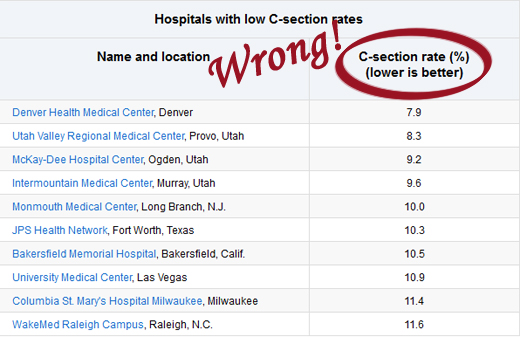
The primary problem with the Consumer Reports’ piece is reflected in their graphics:

low C-section rate

The fundamental assumption, on which the entire piece rests, is that a lower C-section rate is better. That is 100% FALSE. There is simply no scientific evidence to support the claim.

For better or for worse, there is no consistent relationship between C-section rates and outcomes. While that may mean that higher C-section rates are not better, it ALSO means that lower C-section rates aren’t better, either. Why? Because the ideal C-section rate is the one where all women and babies who NEED a C-section get one, and not too many women and babies who don’t need a C-section end up with one anyway. Notice that I did not say that there would be NO unnecessary C-sections. Given the current state of technology that can only imperfectly tell us in advance which C-sections are necessary, it is better to do many unnecessary C-sections in order not to miss any necessary ones.

How do we know that a lower C-section rate is not better? Consider international C-section rates. The countries with the lowest C-section rates in the world are those with the highest perinatal and maternal mortality. That’s because lack of access to C-sections leads to preventable perinatal and maternal deaths.

But how about countries where C-sections are easily available? As the chart below (adapted from Cesarean Section Rates and Maternal and Neonatal Mortality in Low-, Medium-, and High-Income Countries: An Ecological Study) demonstrates, there is no discernible relationship between C-section rates and safety:


C-section rates high income countries


Italy, the country with the highest C-section rates has one of the best safety profiles.

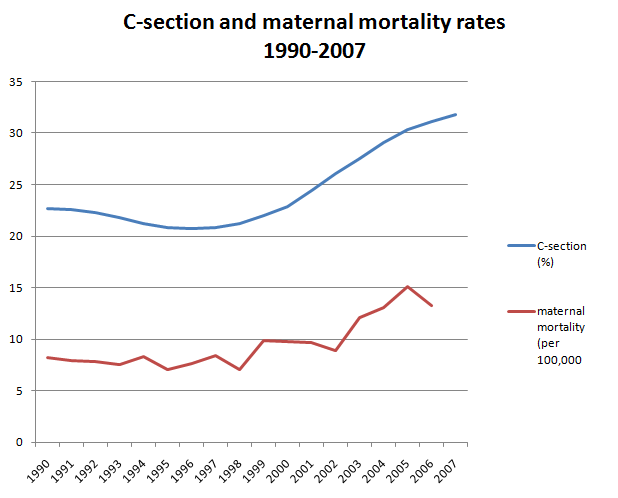
Consider the impact of C-section rates on safety over time in this country. What about an association between the rising C-section rate and rising maternal mortality? A graph comparing the maternal mortality rate and the C-section rate shows a correlation.

C-section maternal mortality 1990-2006

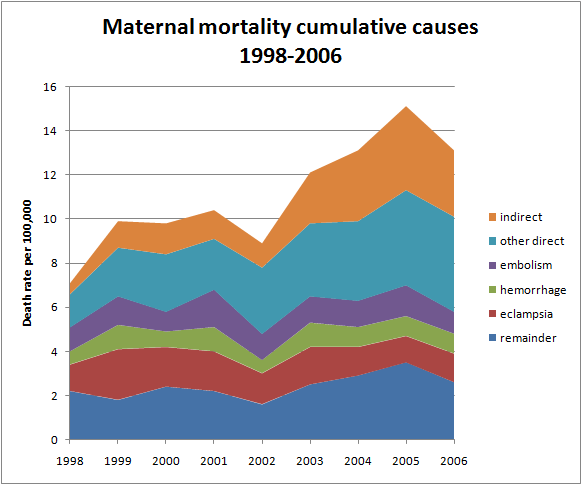
But correlation is not causation. If the rising C-section rate were leading to an increased maternal mortality rate, we would expect to see C-section complications, such as hemorrhage and embolism increasing disproportionately. But that’s not what we see. As the following graph makes clear, both hemorrhage and embolism death rates did not change their contributions to overall maternal mortality.

Maternal mortality cumulative causes 1998-2006

In addition to being based on a completely false empirical assumption, the CR piece also suffers from bias. Consider the title: What hospitals don’t want you to know about C-sections. The inescapable impression is that hospitals are hiding their C-section rates and that CR had to go to extreme lengths to obtain those rates. Yet C-section rates are widely available for free on public website. And as far as individual hospitals are concerned, Consumer Reports was easily able to obtain C-section rates for 1,500 hospitals in 22 states. That doesn’t sound like hospitals “don’t want you to know.”

Ultimately, though, the piece reflects the bias of the natural childbirth philosophy that privileges process over outcome. Consumer Reports is so sure that vaginal delivery is “better” than C-section that they never even bothered to check the outcomes at the various hospitals. But the philosophy of natural childbirth is NOT based on scientific evidence (it was dreamed up by Grantly Dick-Read, a eugenicist who was trying to convince women of the “better classes” to have more children than their “inferior” counterparts) and is both perverse and dysfunctional. It is a form of biological essentialism, judging women on the function of their reproductive organs as opposed to their intellect or character. It assumes that women are improved by agonizing pain and that they value the experience of a baby transiting the vagina more than whether the baby actually survives the transit. Natural childbirth is anti-feminist in the extreme, and is not safer, healthier, better or superior to childbirth with any and all interventions.

Consumer Reports is flat out wrong in pretending that C-section rates are a safety metric and they are wrong to encourage women to judge either hospitals or doctors based on C-section rates. They owe their readers an apology and an investigation of real safety metrics, so women can choose hospitals based on quality.

Consumer Reports tries to destroy trust in hospitals and obstetricians (not coincidentally the same objective of natural childbirth advocates and organizations) and replace it with trust in their Consumer Reports itself. Based on this irresponsible piece, they are not worthy of that trust.

The New York Times falls down the natural childbirth rabbit hole

canstockphoto6139465 copy

In a masterpiece of shoddy journalism, New York Times writer Tina Rosenberg published a ridiculous piece in yesterday’s edition: In Delivery Rooms, Reducing Births of Convenience. It is a sad illustration of what happens when a writer falls down the natural childbirth rabbit hole and utterly ignores scientific evidence and even common sense.

The piece begins with a bang:

San Francisco General is largely a hospital for the poor. It’s the city’s safety net hospital, known for providing free care for all who can’t afford it, and for its display — while you wait and wait — of the parade of humanity in all its glory.

It might be surprising, then, that according to data compiled by the state (pdf) it is probably the safest place in California to have a baby. Not the most luxurious, certainly — the labor and delivery ward in the famously dilapidated complex of buildings is strictly industrial. Since the hospital doesn’t accept money from formula companies — the usual providers of baby swag — mothers go home with blankets and baby caps made by volunteers from the Baby Love Ministry at Grace Episcopal Church in Napa, and diaper bags filled with breast pads the hospital purchased using money from a grant.

Really? San Francisco General Hospital has the lowest perinatal and maternal mortality rates in the state of California? No, silly, Ms. Rosenberg didn’t assess safety by how many babies and mothers lived and died. She measured it by the preferred metric of the natural childbirth community, by C-section rate.

While San Francisco General’s maternity ward does not provide luxury, it does something else very well: evidence-based medicine.

The evidence says doctors should do far fewer cesarean sections — the American College of Obstetricians and Gynecologists sets a target rate of 15.5 percent for first-birth low-risk C-sections.

Sometimes C-sections are necessary. Most are probably not. They are done (very rarely) for the convenience of the mother, or, far more commonly, for the convenience of the doctor

Who says that the C-section rate should be 15.5%? According to Ms. Rosenberg, that information comes from ICAN (International Cesarean Awareness Network) a group of lay people with no training in obstetrics or epidemiology, which quoted a press release from the American College of Obstetricians and Gynecologists that DID NOT recommend any optimal C-section rate, let alone one of 15.5%.

And how do we know that most C-sections are done for convenience? Because the Childbirth Connection, the premier lobbying group for the natural childbirth community insists, without even the tiniest shred of evidence, that they are.

In other words, Rosenberg’s piece is predicated on two claims made special interest groups, neither of which is true. What’s next, Ms. Rosenberg, a piece on evolution predicated on the claims of creationists?

Rosenberg should have known better than to rely on special interest groups for her factual claims, but even if she didn’t, basic logic should have alerted her to the fact that safety can ONLY be measured by outcomes, not by procedures. Would Rosenberg judge a cancer center by how much chemotherapy is “necessary” or “unnecessary” or would she judge it by how many cancer patients survived? I doubt it. Would she judge the treatment of heart disease by how many people got angioplasty vs. how many had surgery, or would she judge it by how many people survived and thrived after hospitalization. Almost certainly not.

The goal in obstetrics is NOT to maximize vaginal deliveries. The goal is to maximize babies’ lives and brain function and mothers lives. Apparently Ms. Rosenberg falls into the same trap the natural childbirth crowd does: assuming that a live, healthy baby and a healthy mother are guaranteed. Nothing could be further from the truth.

What are the perinatal and maternal mortality rates at San Francisco General Hospital? I don’t know and I can’t find out. The mortality rates for all California hospitals used to be available on line, but now are available only by request to individual hospitals.

How did Rosenberg come to write such a foolish piece and how did The New York Times come to publish it. Apparently they fell down the rabbit hole of natural childbirth where process matters more than outcome, where a healthy baby is assumed to be guaranteed, and where scientific “evidence” is fabricated to serve the whims of an interest group with absolutely no reference to actual scientific evidence.

Rosenberg  and The Times should be embarrassed by this. A reporter allowed herself to be manipulated by a special interest group and wrote an entire piece about childbirth safety without ever mentioning any safety parameters.

Rosenberg should correct her errors, source her medical facts from medical providers, not lobbyists, and find out the mortality rates at San Francisco General Hospital.

Does San Francisco General have the lowest perinatal and maternal mortality rates in the state? If not, it is not the safest hospital.

A “medwife” reflects on 3rd world birth and American homebirth

iStock_000016207634Small copy

A new guest post from the “Medwife“:

I’m a Medwife and I take call, about 72-96 hours a week to be exact. My phone rings at all hours of the day and through the night. The inevitable page comes through at family reunions and playoff games. Everything from the usual Friday afternoon 30 minutes after office closes “I think I have a UTI” to the Saturday morning 5:00am “I think I have a yeast infection”, spaced between “My pessary fell out” or “I can’t find my IUD strings” and the “Can I take Robitussin while breastfeeding” or “I think my water broke”. Top it off with a few late night calls from the ED and few more from Labor & Delivery and it’s a full time effort to be sure. Add in a few less common favorites “my nipple ring got stuck in the shower curtain” and you just never know what concern is waiting at the other end of the receiver.

But there’s that one call that makes time stop, a stomach churn and the thud of one’s own pulse resonate as whooshing sound through a medwife’s ears: “The baby’s not moving.” Silence. Now I’m not a fan of discussing Monistat-7 at 5:00am on Saturday morning, but “the baby’s not moving” is why it’s impossible to become complacent in the usual barrage of ringing during call hours. It’s the call that makes you hold your breath, the call that makes you wish warp-speed time travel existed and the call you never dismiss. When you’ve done this long enough, you know the last words you always hear before you diagnose a stillbirth are: “The baby’s not moving”. The dreaded call came in last night, despite 8 weeks of discussions on kick counts and a full 24 hours after the last perceived movement. In anticipation of her arrival to Labor and Delivery, commence the breath holding, conduct a review and mental checklist of risk factors (Primigravida, IVF and Gestational Diabetes) and recall last evaluation in office (48 hours ago, Glucose well controlled, Reactive NST, BPP 8/8, AFI 14).

Upon arrival to L&D, the mother was placed on the fetal monitor and a reactive NST was obtained. (Exhale). An ultrasound was ordered and returned a BPP 6/8 with AFI 10. It took a long discussion to convince her it was in her baby’s best interest for continuous monitoring over night with a repeat BPP in the morning. In the morning, the BPP had decreased to 2/8 and new onset of oligohydramios with an AFI of 4, which prompted the move towards a 36 week induction. Her labor progressed with an epidural in place and she proceeded to spontaneously deliver a growth restricted infant. The baby was handed to the Neonatologist for evaluation with Apgars 9-9. A placenta with a velamentous insertion and a hypocoiled cord was delivered. Mom and baby remained stable postpartum and Hepatitis B vaccine was given.

The decision-making was quite straight forward and outcome excellent, not something case studies are made of. However, sitting with this well-educated recently emigrated family awaiting their baby’s safe arrival was a good reminder of how fortunate we are to have the model of care we do in the US:

Health Care Providers: Although providers are available in her country, many women seek care with traditional healers and the extent of physician care is often limited to emergencies. The mother received care in an office and hospital setting with a CNM, Obstetrician, Perinatologist and Endocrinologist according to established standards of care. An Anesthesiologist placed an epidural and a Neonatologist was present to provide resuscitation care at birth.

Gestational Diabetes: When we discussed Gestational Diabetes, the father informed me it is rare for such a diagnosis in his country and that Diabetes is usually only diagnosed in older adults. When I asked him how many women in his family may have been screened in his country, he replied that they simply don’t test for it. No test, no diagnosis. He seemed a bit taken aback when I further discussed the actual rate of in his country is in fact 11 times as prevalent as US Caucasian rates.

Ultrasounds: The father commented on the number of ultrasounds performed during the course of pregnancy. In his country, it was rare to have even one. He questioned the utility or overuse of imaging. She had multiple early IVF ultrasounds for location, number and viability, as well as a third trimester growth ultrasound with weekly BPP/AFI after 34 weeks. Final ultrasound identified a baby with a significant perinatal morbidity risk.

Epidurals: The mother was unable to explain the concept of epidural pain management to her family in her country of origin. They couldn’t understand the concept of controlling pain in labor or the safety of doing so. She eventually gave up. Although she had planned epidural placement from the onset of pregnancy, yet was still quite delighted in how it removed an element of fear of the process of labor.

Hepatitis B Vaccine: The parents consented to Hepatitis B vaccine administration to the baby at birth. In fact, the father had a smile when we asked “You can do that right here? He can get vaccinated?” His response perplexed me until I realized the magnitude of Hepatitis B infection in his country and the relatively new program of pediatric immunization schedules with a history for very low compliance.

As I head home at the end of the day, I am reminded of how grateful I am to be a part of the US healthcare system, its technology and the safety it provides. How differently that phone call could have turned out if the system wasn’t there? How different it would have been if this family was in their country of origin with a perinatal mortality rate 8x’s higher than the US? How different this outcome could have been?

But then again, if we replace the country of origin with US Homebirth… would it really have been any different at all?

It’s so touching when the ignorant band together to defend each other’s ignorance

expression -  Ignorance is bliss - written on a school blackboar

I have often pointed out that no sooner do I write a post on the buffoonery of various homebirth and anti-vax activists then they rush to double down on their buffoonery.

For example, no sooner did I write a post that the surest sign of ignorance is when someone claims to be “educated” then the nitwits at The Thinking Mom’s Revolution rushed to demonstrate that my claims are true. Not surprisingly, the “Thinking Moms” are the one’s who have trouble with thinking.

Consider this gem of stupidity published only this morning, Featured Guest Blog: Oh, for Shame! But Shame on Who?. It is a truly touching example of how the ignorant ban together to defend each other’s ignorance.

The piece is about me and my attempts to hold Jennifer Margulis accountable for her nonsense, ranging from her claims that ultrasound might cause autism to her masterfully idiotic defense of the hideous homebirth death rates in Oregon (“Amy, Oregon has some of the safest best homebirth stats in the country IF YOU DON’T COUNT PORTLAND…”).

The author of the TMR piece is Jody McGillivray. What are McGilligray’s qualifications for assessing any disputes between Jennifer Margulies and myself?

She is a former K-12 foreign language educator and a volunteer autism legislative insurance reform advocate.

Well if that doesn’t qualify her to adjudicate a dispute about scientific evidence, I don’t know what does!!

Not surprisingly, her “defense” of Margulis is as damning as her lack of qualifications to defend Margulis.

The piece reads like it was written for The Onion. Here she lists Margulis’ qualifications for opining on medical issues.

Dr. Margulis is a magna cum laude Phi Beta Kappa graduate of Cornell University. She was accepted for graduate school at Harvard University and the University of California at Berkeley (she turned down Harvard to go to Berkeley). After earning a Master’s there, she spent three years doing development work in West Africa and worked in corporate philanthropy in the United States. As the small-project coordinator for Africare/Niger, Margulis built a hanger for handicapped artisans, directed an off-season gardening project with hundreds of rural women, spent two weeks in the bush interviewing very poor women about their health and the health of their families for a needs assessment, and worked on a child survival campaign. She was invited to speak live on prime-time TV in France to talk about the problem of child slavery. Her writing has appeared in so many magazines and newspapers that I couldn’t list them all, including the New York Times, the Washington Post, and on the cover of Smithsonian magazine.

Exactly! Margulis has NO qualifications of any kind to assess or comment on medical research.

It gets worse:

Oh, and did I mention Jennifer Margulis has a Ph.D.? From Emory University in Atlanta. And four children? And is part of an astonishingly intellectual family that includes at least one Nobel Prize winner (her uncle), a microbiologist who changed our understanding of evolution and whose name is in every Biology text book in the world (her mother), and the former head of the Math department at MIT, who solved several unsolvable problems?

She has a PhD in English! She has smart relatives!

So why does Amy Tuteur think Jennifer Margulis should be included in the “natural childbirth hall of shame?” Her biggest indictment of Dr. Margulis is that Dr. M has no credentials (see above). Her second reason for freaking out? The Business of Baby received two bad reviews.

Earth to Jody! Earth to Jody! My biggest indictment of Jennifer Margulis is that she is WRONG! I didn’t need a scathing review from The New York Times to tell me that Margulis’ book (currently ranked #297,043 on Amazon) is garbage, although I did enjoy Annie Murphy Paul’s takedown:

Inaccurate or inflammatory statements are repeatedly reproduced without adequate substantiation or comment from the other side… Margulis’s treatment of scientific evidence is similarly unbalanced… [U]ltrasound exams of pregnant women may be responsible for rising rates of autism among their children, according to “a commentator in an online article.” This anonymous individual has “used ultrasonic cleaners to clean surgical instruments (and jewelry),” which apparently qualifies him or her to offer an opinion on how the vibration of ultrasound waves may be causing the developmental disorder: “Perhaps this vibration could knock little weak spots in myelin sheeting of nerves or such, I don’t know.”

Jody keeps digging herself in deeper and deeper:

Dr. Margulis was recently in New York City. Why? Because the very same book that Dr. Amy Tuteur (retired)’s followers want you to shred for your hamster cage was nominated as one of five finalists for the prestigious Books For A Better Life Award.

Prestigious? It’s awarded by The New York City-Southern New York Chapter of the National Multiple Sclerosis Society. No doubt they do great work supporting people with MS in NYC and Southern New York, but they are hardly the Pulitzer Prize Committee.

Jody thinks this is her coup-de-grace:

Dr. Margulis really seems to have gotten Dr. Amy Tuteur’s (retired) goat. AT concludes her nasty blog with: “Jennifer Margulis has gone from journalist to joke, because of her endless stream of nonsense. Perhaps if she spent more time learning science, and less time worrying about me, she wouldn’t be one of the leading candidates for a spot in my Natural Childbirth Hall of Shame.”

I snorted my herbal ice tea out my nose when I read that. In fact, it is Dr. Tuteur (retired) who needs to spend more time in the actual field of science and less time personally attacking accomplished women who are working hard to make positive changes, to promote safe childbirth, and to champion safer childhood vaccines.

And who would know better than Jody, than a K-12 teacher of foreign languages?

McGillivray concludes:

Luckily, Thinking Moms are not so easily duped. We research, we study, we read extensively, and we educate ourselves beyond our degrees to become the best moms we can be. We live in the real world, not on the Internet. We make informed choices, beginning with choosing where to give birth, and we recognize that the decisions we make for our children determine how healthy they will be, and what type of people they will become. Nice try, Amy. But we will not be subjugated, intimidated, or made to feel disempowered by a schoolyard bully.

In other words, the “Thinking Moms” have no idea what they are talking about.

Oh, and Jody, no one is trying to subjugate, intimidate or disempower you. I’m simply trying to make you and Margulis look like the fools that you are. Thanks so much making my job even easier than it already was.

Dr. Amy