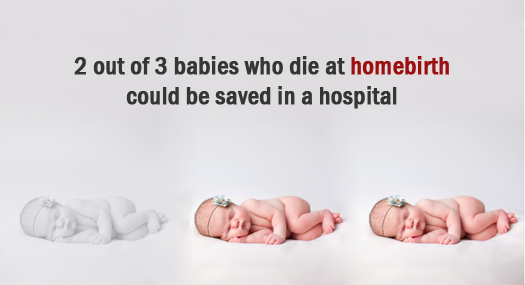
2 out of 3 babies who die at homebirth could have been saved in a hospital

As homebirth advocates have been forced to reconcile themselves to what everyone else has known all along — homebirth increases the risk of perinatal and neonatal death — they’ve been experimenting with rhetorical strategies to diminish the significance of these deaths.

On Wednesday I wrote about Henci Goer’s effort to make homebirth deaths more palatable by comparing homebirth to amniocentesis. Other homebirth advocates emphasize that the absolute risk of death is low (true) or that only women having first babies are at risk for homebirth death (false). The argument goes something like this: Yes, 3 times (200%) as many babies die at homebirth as in comparable risk birth the hospital, but 3 times a small number is still a small number.

Leaving aside for the moment that this is the same group who crowed over a 20% increase in homebirths from from 0.56% to 0.67% of US births, does dismissing the absolute number of death as low fully convey what is at stake in the decision to attempt homebirth? It seems to me that it does not.

Since the way we formulate risk changes the way we view risk, I am offering another formulation of the exact same data:

2 out of 3 babies who die at homebirth could have been saved in the hospital. 0 babies who die in the hospital could have been saved at homebirth.

And that is a best case scenario. That’s what happens in a system where the midwives are highly educated, homebirth care is integrated into the larger obstetrical system, and the list of exclusion criteria long and detailed. None of those criteria apply to homebirth in the US, so the proportion of preventable homebirth deaths in the US is undoubtedly much higher.

In other words, most of the babies who die at homebirth in the US could have been saved in the hospital, whereas none of the babies who died at the hospital could have been saved at home. This formulation makes a mockery of the claims that advocates make for homebirth.

  • Obviously, if 2 out of 3 babies who die at homebirth could have been saved in the hospital, homebirth is not as safe as comparable risk hospital birth.
  • Since 2 out of 3 babies who die at homebirth could have been saved in a hospital, homebirth is not “as safe as life gets.”
  • Since 2 out of 3 babies who die at homebirth could have been saved in the hospital, trusting birth is a bizarre and deadly strategy.
  • As 2 out of 3 babies who die at homebirth could have been saved in a hospital, living close to the hospital is not close enough.
  • Since 2 out of 3 babies who die at homebirth could have been saved in the hospital, hiring an attendant who is trained in “normal birth” is not going to save those babies.

Homebirth advocates like to claim that choosing homebirth birth means “taking responsibility” for the outcome. If that’s so, in 2 out of 3 cases of a homebirth death, the mother is responsible for the fact that her baby died.

Unless and until homebirth advocates understand this reality, they are not making an informed choice of homebirth.
Saraswathi Vedam’s deeply disingenuous guide to the homebirth literature

Homebirth stamps

I never cease to be amazed at the pervasive contempt in which professional homebirth advocates hold their own followers.

  • Contempt for the intelligence of their followers: they are confident that followers can be easily tricked with long lists of citations;
  • Contempt for their unfamiliarity with forms of scientific literature: they are confident that their followers will believe something is a scientific paper if they just make it look like a scientific paper; but most of all,
  • Contempt for the obligations they owe their followers: they have no compunction about tricking them into risking the lives of their babies by using mendacious means to convince them of homebirth safety.

Saraswathi Vedam’s Homebirth: An Annotated Guide to the Literature © is a case in point. Vedam has helpfully provided a list of 66 separate citations. But if you read each and every citation, as I have done, you will find that only 3 of the 66 “citations” support the claim that homebirth is as safe as hospital birth.

Vedam was one of the organizers of the recent Homebirth Consensus Summit, a public relations ploy to elevate the status of homebirth midwives, giving the impression that they were “invited to the table” by the expedient of creating the table and issuing all the invitations.

Vedam describes her Guide:

This annotated bibliography provides citations and critical appraisal of original studies on home birth.

It’s all very official and “scientific” looking, complete with elaborate subcategories and a table of contents. It’s true purpose is betrayed by a statement on the first page:

Please distribute widely.

In other words, it’s a document designed for advocacy of homebirth, not truth about homebirth safety. And homebirth advocacy organizations, including Citizens for Midwifery (CfM), the Center for the Childbearing Year, and the Coalition for Improving Maternity Services (CIMS) are duly offering copies of the Guide on their websites.

What does the Guide offer?

Let’s start with the title. Reading it, you might think that the guide provides an overview of scientific citations and original scientific research on home birth. You’d be wrong.

Sure, there are some scientific studies in there, but out of 66 total “citations,” fully 25, more than 1/3, are not scientific studies at all, 1 was never published and 1 was published in a non-peer reviewed publication.

Well, that’s not too bad, is it? Vedam has compiled and annotated a list of 39 studies that “support” homebirth and its safety.

Not exactly.

Of the 39 actual scientific citations:
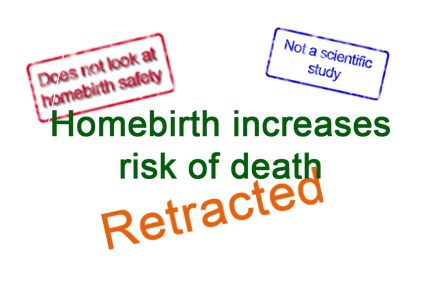
1 was publicly retracted
17 do not address the issue of homebirth safety.

Okay, so in an effort to support homebirth, Vedam has compiled and annotated 21 contemporary scientific studies that address the issue of homebirth safety. And they show that homebirth is safe, right?

Not exactly.

Of the 21 scientific studies:
2 are underpowered
4 compared homebirth to a hospital group containing high risk women

That leaves 15 studies of which:
12 showed that homebirth had an INCREASED risk of perinatal or neonatal death
3 showed homebirth may be as safe as hospital birth under very strict conditions

That’s right. Out of 66 separate citations in Vedam’s Guide, only 3 show that homebirth is as safe as hospital birth, 2 from Canada and 1 from the Netherlands. The results from the Dutch study are called into question by the fact that it compared homebirth with a midwife to hospital birth with a midwife. A more recent study showed that low risk birth (home or hospital) with a Dutch midwife has a HIGHER perinatal mortality rate than high risk delivery with a Dutch obstetrician.

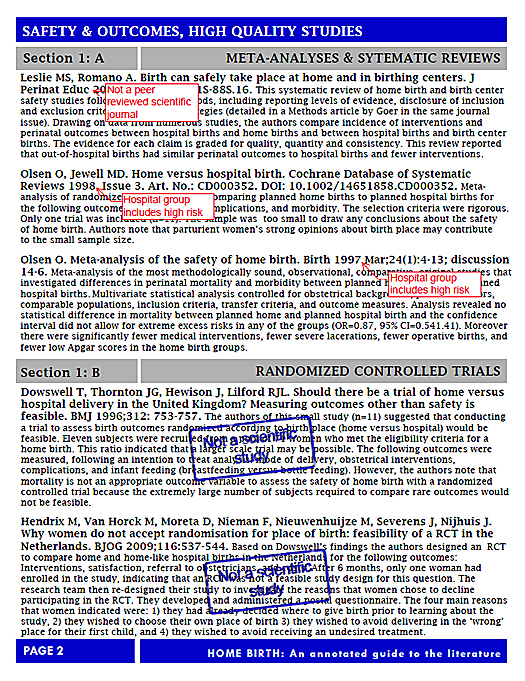
Of course, nothing brings the point home like an illustration, such as the view of a typical page of the Guide posted below.

Vedam guide page 1

You can view the complete document, with my annotations, here:

Dr. Amy’s Annotated Guide to the Annotated Guide

Vedam’s deeply disingenous Guide shows how professional homebirth advocates use the forms and language of science to mislead their readers and the contempt that they have both for their readers and for the truth.

Is homebirth like amniocentesis?

Henci Goer has finally moved the homebirth debate where it ought to be (Is Home Birth a Reasonable Option). It’s not about whether homebirth is as safe as hospital birth; even she acknowledges that hospital birth is safer. The issue is whether homebirth is safe enough.

That, as Goer recognizes is a value judgment. It is up to the individual woman to decided if it is worth it to her to expose her baby to an increased risk of death simply to have the birth “experience” that she desires. In an effort to make the deliberate decision to risk a baby’s life more palatable, Goer attempts to equate homebirth with amniocentesis, and with that, her argument goes off the rails.

… To put this into perspective, the excess risk of losing the pregnancy as a result of having an amniocentesis is 60 per 10,000. No one is advising women against amniocentesis on grounds of its danger, so we may conclude that an excess risk considerably more than 8 per 10,000 is deemed tolerable by the obstetric community.

At a superficial level, Goer is correct in her comparison. Both amniocentesis and homebirth involve exposing a baby to an increased risk of death in exchange for a benefit that accrues to the mother. In the case of amnio, the benefit is knowledge of genetic defects and the opportunity to abort a genetically abnormal fetus. In the case of homebirth, the benefit is the mother’s experience. But the similarities end at that superficial level.

What are the differences?

  1. The gestational age of the baby: Amniocentesis is done in the mid second trimester, before viability. Homebirth occurs long after viability has been reached.
  2. The decision to continue the pregnancy: Amnio is usually chosen to decide whether to continue a pregnancy. Homebirth is chosen for a pregnancy that the mother has already decided to continue.
  3. The relative risks: In both cases, the absolute risks are small. However, while amnio increases the rate of pregnancy loss by 6%, homebirth increases the risk of perinatal death by 200% or more.

Moreover, Goer’s claim about physician counseling is flat out false.

Goer insists that “no one is advising women against amniocentesis on grounds of its danger.” Actually every doctor is ethically and legally required to counsel women about the risks of amniocentesis. Such counseling typically includes the recommendation against amniocentesis if the woman is not going to act on the information (would not abort the pregnancy).

Amniocentesis, like all medical procedures, has risks and benefits. The primary benefit is the ability to terminate a pregnancy. If that option is not on the table, doctors routinely counsel women that the risks outweigh the benefits.

Goer’s follow up claim is also flat out false. She asserts that “an excess risk considerably more than 8 per 10,000 is deemed tolerable by the obstetric community.”

The excess risk is not determined to be “tolerable” by the obstetric community. It is determined to be of the same magnitude as the risk of having a baby with a serious chromosomal abnormality. Amnio is only offered when the risk of pregnancy loss from amniocentesis is exceeded by the risk of a genetic abnormality in the baby. That risk is determined by age and by screening tests such as alpha-fetoprotein.

Furthermore, the decision to have an amnio is determined by whether the risk is tolerable to the mother, not to the obstetric community. Even when the risk of a chromosomal abnormality far exceeds the risk of loss from amniocentesis, the mother won’t have an amnio unless she feels that the risk of loss is acceptable to her.

I understand what Goer is trying to do here. Having finally acknowledged that homebirth increases the risk of perinatal death, she is trying to put an acceptable face on deliberately choosing that risk. But no one has ever claimed that an amniocentesis is as safe or safer than foregoing an amnio. Moreover, the two choices differ in gestational age, decision about continuing a pregnancy and relative risk.

It is one thing to say that amnio is safe enough for women at increased risk of having a baby with a genetic abnormality, when done long before viability, in a pregnancy that will be terminated if the baby has a genetic defect. It is another thing entirely to risk the life of a baby at term, in a wanted pregnancy, for no other reason that the desire for a particular experience.

Melissa Cheyney: mandatory licensing for homebirth midwives … with a few exceptions

You can’t make this stuff up.

Melissa Cheyney has seen the light. Voluntary licensure of homebirth midwives has been recognized for the self-serving ploy that it is, so now Cheyney is in favor of mandatory licensing.

Yes, she is; she said so in this article:

Melissa Cheyney, a licensed midwife and chair of the Oregon Board of Direct Entry Midwifery, argues that mandatory licensure is not a matter of making the practice safer but a matter of holding midwives accountable and making sure every midwife has a minimal entry level of training.

Yes, she’s absolutely in favor of mandatory licensing, except …

… Cheyney is wary about establishing a law so soon without data proving licensed midwives produce better birth outcomes than those without a license. Though a project to obtain this data is under way, it will take at least three years to compile the information and determine the results.

Of course that data already exists and shows that both licensed and unlicensed Oregon homebirth midwives have appalling levels of perinatal death. (How many babies died at the hands of Oregon homebirth midwives?)

No matter, Cheyney is completely in favor of mandatory licensing for Oregon homebirth midwives. There just need to be a few teeny, tiny exceptions in light of the fact that a license costs money:

Cheyney is concerned for many midwives, including those with fewer client bases such as student midwives who are just starting out, midwives who work in rural towns, and midwives who work with under-served populations. If those midwives can’t afford a license under a new law, they would be forced to give up their practice.

Because what’s really important is the ability of homebirth midwives to make money.

It’s not like women in rural areas and in under-served populations deserve accountable, minimally trained midwives, right? And, really, is it fair to hold brand new homebirth midwives accountable? Let’s wait until they made some money before we ask them to prove that they’ve been minimally trained.

So let’s see. Melissa Cheyney is completely in favor of mandatory licensing for all homebirth midwives who aren’t new, who aren’t practicing in rural areas and who aren’t working with under-served populations.

Yes, indeed, every single one those midwives must be licensed. Well, actually not every single one.

Cheyney wants to maintain protection for traditional midwives regardless of licensing laws. She suggests allowing midwives to apply for exemption from mandatory licensure to preserve those traditions. “I think it’s a travesty around the world that Western-style obstetrics have come in and annihilated long traditions of traditional midwives,” Cheyney says.

She’s got a point. But why stop at homebirth midwives? Shouldn’t we also exempt traditional neurosurgeons from the requirement for a medical license. Isn’t it a travesty around the world that Western-style neurosurgery have come in and annihilated long traditions of trephining skulls and exorcisms?

Be that as it may, the important thing is that Melissa Cheyney has changed her mind and recognized the importance of licensure for Oregon homebirth midwives. Every single homebirth midwife should be licensed except for the new midwives, those who work in rural areas, those who work with the under-served and those who practice traditional midwifery.

I, for one, am giving thanks for this change of heart.

As someone who is working diligently to abolish the CPM credential, I must give thanks to Melissa Cheyney directly. It’s difficult to imagine a more incompetent and downright destructive defender of the grossly undereducated, grossly under-trained certified professional midwife than Cheyney.

How has she hurt the cause of CPMs? Let me count the ways:

promoting voluntary licensure;
creating laws that allow anyone to call herself a midwife, even if she has no training;
refusing to release the death rates of the 24,000 homebirths in the MANA database;
refusing to share the Oregon MANA statistics with the state of Oregon;
publicly acknowledging that she won’t share those statistics because they could be used to discipline midwives;
and now, promoting mandatory licensure with indefensible exceptions.

I could tell you that CPMs are nothing more than birth junkies who wish to call themselves midwives without doing the hard work of earning a midwifery degree. I could tell you that CPMs care only about themselves, eschewing the need for training, licensure and accountability. I could tell you that CPMs have appalling death rates and couldn’t care less. But no one brings the point home like the Melissa Cheyney.

Keep up the good work, Missy!

Why don’t homebirth advocates learn from a near miss?

She argued with me in another forum about the safety of homebirth:

I truly recommend the book, “Born in the USA: How a Broken Maternity System Must be Fixed to put Women and Babies First” by Dr. Marsden Wagner. He is a Doctor with extensive experience and would enlighten many a doctors on the subject and safety of Homebirth…

Lets start there Doctors. Lets actually enable a women to birth rather then telling her in many ways that she does not know her body, cant possibly push a 10 pound baby out of her vagina (for example), must birth on her back with a cathetar and epidural because she could never handle the pain. Lets educate women and truly give all sides of the birthing procedures…

She became an ICAN co-leader because of her belief that her first child was delivered by an “unnecessary” C-section:

My oldest son was a c/s bc the ob thought he was too big. I was young, ignorant and swayed quite easily. He was scheduled to be cut out of me one day after his due date. I never felt labor, and I barely remember his birth. He was 9lb 6oz 21 in and a 13.5in head.

She vowed that her second birth would be different. Despite the risk factors of a previous C-section and previous macrosomic baby, she chose to have a home VBAC with a certified professional midwife (CPM). The baby nearly died and she suffered a significant postpartum hemorrhage:

[The midwife] checked [his] heart tones, she couldn’t find them.

My heart stopped.

[The midwife] had me get on all fours with my chest on the bed to relieve the pressure from his head in the birth canal. [She] told [my husband] to call the ambulance. [Her] assistant called the hospital to prepare for a homebirth transport…

She had a partially prolapsed cord. Fortunately the ambulance arrived quickly and the hospital was only a few minutes away. The baby was born alive.

Delivering the placenta was interesting, and seemingly boring. Then I began to lose a lot of blood, it poured out of me. Pieces of [the baby’s] amniotic sac were still adhered to the wall of my uterus and required [the doctor] to manually scrape the walls to remove the excess.

She was extremely proud of her vaginal birth. Earlier this year she wrote:

…Having [him] has set me on the path to becoming a homebirth midwife. I believe in women and their innate ability to birth.

Someone asked me recently how I could want to be a homebirth midwife since I had such a difficult delivery and it is obviously not safe. My response was, “Yes it was incredibly difficult however, will you not birth your child at the hospital under induction because women and babies have died?” I needed the hospital and it was there. I will birth my next child at home as well, no second thoughts.

She planned a homebirth with the same CPM despite her history of a previous C-section, a macrosomic baby, an occult cord prolapse and a postpartum hemorrhage.

At 41 weeks, her daughter died in utero on Thanksgiving day. She was delivered later that evening in the hospital. The baby weighed 5 lbs. 15 oz, suggesting that she had been suffering from intrauterine growth retardation likely due to placental insufficiency.

This mother dodged a bullet at the first homebirth, but didn’t learn anything. She wasn’t as lucky the second time around and her daughter is dead.

More mendacity from MANA

Is there anyone left out there who thinks MANA isn’t hiding its death rates?

If so, it’s not for lack of bone-headed moves on MANA’s part. While vigorously denying they are hiding the number of deaths out of the 24,000 planned homebirths in their database, MANA has made it clear that that is precisely what they are doing.

The obvious thing to do, if they are hiding their death rates and have absolutely no intention of revealing them, would be to keep silent when someone points out that they are hiding the data. Any claim that they are not hiding how many of those 24,000 babies died that does not include disclosure of the number merely serves to call attention to the fact that they are indeed hiding this data and that the death rate is likely to be nothing short of an appalling indictment of homebirth with a certified professional midwife (CPM).

Their disingenuous, mendacious and down right inept responses to my piece on Time.com and the subsequent comments are inadvertently providing loads of entertainment. On Wednesday I wrote about the unsigned letter by MANA executives that was published on their website and on Time.com.

In particular, I pointed out that MANA executives changed their Handbook for Researchers just this month, removing specific requirements I highlighted in my Time piece, while implying in their letter that those requirements had never existed. When this was pointed out in the comments, a MANA executive claimed that it is just an amazing coincidence. Wendy Gordon, CPM, LDM/LM, MPH, (and placenta encapsulation specialist!) Midwives Alliance Division of Research explains:

I have to smile at the suggestion that the Midwives Alliance or any organization could move so swiftly as to make policy changes in response to something someone says in a blog somewhere. These were decisions that were carefully weighed and discussed over several months, culminating in Board member approval. If only decisions could always be made that quickly!

Wow, MANA executives began planning to remove the inappropriate requirements for data access months ago, and it is just an incredible coincidence that release of the new guidelines occurred in the very month that my piece appeared. If only they had coincidentally released the death rates, too!

And if that claim isn’t foolish enough, Ms. Gordon can’t seem to help making another, even more foolish claim:

There has never been a requirement that researchers must swear to use the data for the advancement of midwifery — even the Wayback Machine can confirm that.

Are you sure, Ms. Gordon? I don’t know if the document is in the Wayback Machine, but it is certainly on my hard drive. The MANA bulletin of Summer 2006, explaining how the data will be used, asserts (page 11) that midwives were told prior to submitting data to the study that the data could only be used for the “advancement of midwifery” and that the Director of Research would close the account of any researcher who did not conform and used the data “inappropriately.”

Oops!

When Gabe Paparella, writing as SomeoneIsWrongOnTheIntenet asked Ms. Gordon point blank for the mortality data, she suddenly remembered, that:

We are preparing this information for publication and look forward to sharing it widely.

Oh, they are preparing it for publication. Really? Then why did the executives of MANA fail to mention that salient point? Why didn’t former President of MANA Geradine Simkins mention that? Why didn’t Ms. Gordon herself mention it at any time before she was asked point blank to reveal how many of those 24,000 babies died. How curious that no one thought to mention this before.

But my favorite comment made by Ms. Gordon is this:

There are no significant differences from previously published data (see Johnson & Daviss, BMJ, 2005).

Now that’s funny! The Johnson and Daviss BMJ 2005 study ACTUALLY shows that homebirth with a CPM in 2000 had nearly triple the death rate of comparable risk hospital birth in 2000. Of course, Johnson and Daviss left that out of the original paper, but have since publicly acknowledged that they never compared homebirth in 2000 with low risk hospital birth in 2000.

Let’s leave all those disingenuous and mendacious comments aside for the moment. The issue under discussion is exquisitely simple:

Is MANA hiding how many babies died at the 24,000 planned homebirths in their database?

According to the MANA executives, they’re not hiding how many babies died, … they just refuse to say.

And that’s not the same as hiding, especially since they just remembered, just yesterday, that they are planning to publish how many babied died … some day … at some point in the future … and they look forward, yes they do, to sharing the number of dead babies with us then, but for now they just can’t reveal how many babies died because … because … well, they can’t think of a reason.

But they know there is a reason, even if they can’t think of it, because if there were no reason then they would be hiding the number of babies who died and they aren’t hiding the number of babies who died…

So how many of those 24,000 babies died at the hands of homebirth midwives?

They’re not hiding the answer; they just won’t tell us.

How homebirth advocates do research on the internet

A little more than a year ago I wrote a piece entitled Attachment parenting causes autism. The purpose was to demonstrate the faulty reasoning skills of vaccine rejectionists and explain how the same reasons offered to “prove” that vaccines cause autism could also prove that attachment parenting causes autism.

The piece has been extremely popular and a lot of people understood the point, but I’ve been surprised by a completely unforeseen response: some people actually came away from it believing that attachment parenting could cause autism!

I’ve seen a variety of discussions on a number of different parenting message boards; in fact there is one going on at the moment. It usually takes only 10 back and forth posts on a thread for someone to come along and put everyone out of their misery by pointing out that it is a satire on the faulty reasoning of vaccine rejectionists. After which, predictably, the usual arguments are trotted out about how they “know” that vaccines cause autism.

What’s most interesting to me is the insight these discussions offer into the way that homebirth advocates (and vaccine rejectionists) “educate” themselves about health issues.

1. They are unbelievably gullible.

When I wrote the original piece I thought long and hard about an example that was so incredibly outrageous that readers would immediately understand that the piece is a satire. Who could possibly take seriously the claim that attachment parenting causes autism? Evidently, the same people who think homebirth is safe or vaccines cause autism.

2. They don’t actual read an article; they simply accept the title.

I am hopeful that the main reason that some readers don’t understand the piece is satire is because they don’t actually read or even effectively skim the article which clearly states:

Those who have read this far have probably figured out that this is a satire.

3. They don’t understand what they read, and make no effort to understand it.

The alternative, of course, is that there are people who read the beginning of the article, don’t finish it and are left with the impression that attachment parenting does cause autism. What’s remarkable is that it never occurs to them that they may have misunderstood and that they should read the rest of the article to find out.

4. They completely and utterly miss the point.

When it is eventually pointed out to them that the piece is a satire on what passes for “reasoning” among homebirth advocates and vaccine rejectionists, it never occurs to them that they have been duped precisely because they don’t understand logic. They fail to draw the obvious conclusion that if they can be tricked into believing that attachment parenting causes autism, they can be tricked into believing that vaccines cause autism.

These factors go a long way toward explaining how people are so easily fooled by the websites and publications of professional homebirth advocates and vaccine rejectionists. Those who think they can “educate” themselves on the internet are gullible; don’t actually read the books and websites, merely skim the titles; if they read the books and websites, they don’t make an effort to understand what is written; and, of course, they have no idea about even the most basic elements of logical thought.

I never meant to trick people into believing that attachment parenting causes autism. The fact that I could do so inadvertently tells us a great deal about how homebirth midwives, childbirth educators, professional homebirth advocates and professional vaccine rejectionists can convince their gullible readers of just about anything, no matter how ridiculous.

Lies, damn lies and the Midwives Alliance of North America

Stung by my piece on Time.com What Ricki Lake Doesn’t Tell You About Homebirth, MANA has responded.

The response is the typical disingenuous attempt of MANA executives to justify withholding their death rates … with a twist.

The latest tactic? Changing their Handbook for Researchers just this month removing specific requirements and implying that they never existed at all.

The executives at MANA wrote:

“Our dataset is currently available to researchers, and we welcome applications. There is no stipulation that data must be used for the advancement of midwifery nor is there an agreement promising not to release death rates; this statement is completely false.”

Let’s analyze.

First, the executives of MANA would like to leave the impression that statistics can only be released in the context of research. That is completely untrue. Every state and the US government releases annual statistics on the number of births and the number of neonatal deaths (not to mention a myriad of other health issues). This information is publicly available to anyone for free through the CDC. MANA can and ethically should release its data to the public for free in the same form as the CDC data. There is nothing preventing them from doing this beside their unwillingness to reveal the numbers.

Second, MANA has removed key sections of the Handbook just this month to comport with their current claims.

As it happens, I originally submitted the piece to Time.com in late September. The following quotes are taken directly from the edition of the Handbook prior to this month’s changes. (Through the miracle of the “Way Back Machine,” you can access the edition of the Handbook as it appeared on July 2011 here.) Strike-throughs indicate the relevant text that was removed just this month.

1. A pledge to use the data to benefit the midwifery community:

“The MANA DOR [Director of Research] is responsible for representing the midwifery community in its relationship with investigators… Therefore the MANA DOR expects all investigators interested in collaboration with this community to consider how they can cooperate with these principles, and to describe how they intend to do so in their request for data access.

The Handbook does still mention that MANA endorses (a very indiosyncratice view of ) the principles of Community-Based Participatory Research. They apparently believe that it is designed to protect homebirth midwives, even though it is really designed to protect research subjects.

2. An elaborate vetting procedure, including, among other things:

“…
a. Investigator affiliations
b. The nature and purpose of the proposed research, including:
i. Basic description of the study design and methods of analysis
ii. Time frame
iii. Specifics of data requested (year, intended site of birth, provider)

3) Signed statement of familiarity with Community Based Participatory Research (descriptive material contained in this Handbook) – form available at
http://www.mana.org

4) Signed statement of familiarity with the Midwifery Model of Care, scope of
practice and out-of-hospital birth protocols or practice guidelines (descriptive
material contained in this Handbook) – form available at http://www.mana.org

5) Copy of Research Protocol, to include the following:
a. Description of Project and Research Questions
b. Project Background, Review of the relevant literature, and Significance
c. Methods and Procedures
d. Variables Requested for Analysis, including any time or geographic limits
e. Risks/Benefits Assessment
…”

3. A non disclosure agreement promising not to reveal any data (including death rates) to anyone:

access will be predicated on the signing of … a Confidentiality and Non-Disclosure Agreement

replaced with: “A standard confidentiality/ non-disclosure agreement will be provided.”

4. The substantial fee for access remains unchanged:

“Fee for individual researchers is $250 and for institutions $1000.”

So what are we to make of this?

MANA is still struggling mightily to avoid releasing their own death rates. Nonetheless, they have been deeply stung by my accusations, so much so that they went to the effort to remove various offending passages. But they went a bit too far by implying that those passages never existed instead of acknowledging that they removed them.

It’s one thing to call for a retraction of false claims. It’s another thing entirely to amend a document to make it look like the original claims are false.

MANA took a golden opportunity to do the right thing and turned it into another example of mendacity. Instead of announcing that the inappropriate requirements for access to the data were removed, MANA executives have tried to make it look like they never existed. In my judgment, this is grossly unethical conduct and raises questions about whether we can ever believe MANA claims and statements.

And the original issue still remains:

MANA needs to tell us: how many of those 24,000 babies delivered by MANA members died?

There is no plausible reason why this information should be withheld from American women.

Advocates hail news that driving without a seatbelt is safe

Advocates of seatbelt free driving are hailing the results of the largest study ever done of driving without a seatbelt.

Investigators compared 16,000 women who drove without a seatbelt to the grocery store to 16,000 women who were wearing a seatbelt on the drive to the grocery store and found that the number of deaths was very similar. In fact, for experienced drivers driving to the grocery store, fatalities were the same.

The authors investigated only those who were at low risk for a fatal crash by applying a long list of exclusion criteria. Drivers could only be included in the study if their drive to the grocery store took place

  • during daylight
  • in the absence of rain
  • on roads that had no potholes
  • only if there were no other cars on the road during the entire route.

Overall, the number of fatal outcomes was similar in both groups, but in depth analysis revealed that most of the fatal outcomes occurred in the subgroup of first time drivers. In contrast, for women who had driven before AND

  • never had an accident or speeding ticket
  • never drove drunk in the past, texted or even talked on a cellphone during driving
  • were driving cars with front and side airbags

the results were very similar.

Of note, the authors found a surprisingly high rate of drivers changing their minds. Between 36-45% of first time drivers actually ended up wearing a seatbelt even though they had planned not to do so. A far smaller number, 10-15% of experienced drivers also wore seatbelts even though they had not intended to do so.

The study was conducted by Seatbelt-Free America, a consortium of auto manufacturers who have long argued that the requirement to put seatbelts in all cars adds needless expense and results in only minimal benefit.

In a press conference, Ima Frawde CPG (certified professional gadfly), leader of the study explained the results:

This, the largest study of its kind, demonstrates that all women should be offered the choice of buying a car without seatbelts. Of course, women should receive adequate counseling from their auto salesman, about the slightly increased risk of fatal outcomes among first time drivers, but it they elect to buy a car without seatbelts, that it their decision.

Ms. Frawde continued:

The risk of a fatal accident was very low in both groups, suggesting that driving to the grocery store with or without a seatbelt is extremely safe. The additional protection afforded by wearing a seatbelt was relatively trivial, just a few deaths avoided per thousand drivers.

During the press conference, a reporter asked if this study of seatbelt use restricted to driving to the grocery store during daylight, in the absence of rain, on roads that had no potholes, and only if there were no other cars on the road during the entire route was generalizable to the population at large, given that many drives are far longer, it is often raining, many roads have potholes and there are usually other cars on the road.

Ms. Frawde expressed surprise:

Why wouldn’t it be?


This piece is a satire on the response of homebirth advocates to the recently published Birthplace Study.

Real message of Birthplace Study? Don’t trust birth!

iStock_000015695134XSmall

It is interesting to see how different media outlets and different stakeholders are trying to spin the results of the Birthplace Study. Is the glass half full or half empty? Did the study show that homebirth increases the risk of perinatal death and brain damage or did it show that homebirth is safe for rigorously screened women who have had uncomplicated births in the past?

I reviewed the findings of the study this morning (It’s official: homebirth increases the risk of death), but there’s more to the study than just the numbers. It is valuable to look at the bedrock principles that the researchers used, because there is not much doubt about those.

Specifically, the investigators rejected the bulk of midwifery theory. The underlying assumption of the study is that birth is inherently dangerous, that there are a myriad possible complications with serious consequences and that carefully culling out anyone with even minor risk factors is critical to good outcomes at homebirth.

The real message of the Birthplace Study is this: don’t trust birth.

Moreover, the various homebirth midwifery aphorisms that flow from trusting birth are treated as the nonsense they are:

Breech is a variation of normal? Nonsense.
VBACs are safe at home? Nonsense.
Twins are safe at home? Nonsense.
Elevated blood pressure not a cause for concern? Nonsense.
Gestational diabetes not a cause for concern? Nonsense.
Preterm deliveries before 37 weeks safe at home? Nonsense.
History of previous shoulder dystocia safe at home? Nonsense.
Low or high amniotic fluid safe at home? Nonsense.

The investigators have no use for other midwifery theories, either.

Trust your intuition? Nonsense.
Babies know how to be born? Nonsense.
You won’t grow a baby too big to birth? Nonsense.
And my personal favorite, including the nonrational is sensible midwifery? Complete and utter nonsense.

The Birthplace Study is predicated upon the fact that complications in birth are common and that various risk factors increase the risk of complications to the point where it is unsafe to give birth at home. Therefore, the only way to assure that there are a minimal number of preventable neonatal deaths is to exclude anyone that had a problem in the past as well as anyone with the merest hint that a problem might develop.

To the extent that the Birthplace Study identifies a subgroup in which homebirth may be as safe as hospital birth, that subgroup is “women who can be relied upon not to experience any complication of any kind.” In other words, homebirth is safe if nothing goes wrong. If there is any chance of anything going wrong, homebirth is not safe.

What does this mean for American homebirth midwifery (CPMs, certified professional midwives)? It basically blasts it out of the water.

Given what the Birthplace Study shows, we can conclude that the underlying philosophy of American homebirth midwifery is garbage, the principles that flow from that philosophy are nonsense, the rejection of risk factors is deadly, and the education and training of CPMs is completely inadequate.

Homebirth in the UK for women who have had a previous completely uncomplicated pregnancy, whose current pregnancy has no risk factors of any kind, and who are being cared for by highly educated and highly trained midwives may be safe, so long as those midwives adhere to the very strict criteria in the study. Homebirth in the UK for women who have never had a baby but whose current pregnancy has no risk factors of any kind and who are being cared for by highly educated and highly trained midwives increases the risk of perinatal death and brain damage. Everyone else isn’t even a candidate for homebirth.

In other words, this study is a huge blow to Ina May Gaskin and her followers. This study does NOT support the safety of homebirth with an American homebirth midwife (CPM). In fact, it indicates that homebirth with an American homebirth midwife (CPM) cannot possibly be safe.

Dr. Amy