Lessons from Canadian and Dutch homebirth studies: Don’t trust birth, trust obstetrics

midwife and patient

American homebirth advocates continue to celebrate the recent publication of homebirth studies from Canada and the Netherlands. Evidently, they have failed to grasp the central lesson of both studies: homebirth can only be safe when practiced by highly educated, highly trained midwives under rigorously controlled conditions. Since this is in direct opposition to the philosophy of American homebirth, it is not clear what advocates are celebrating.

Reading the Canadian and Dutch studies makes it clear that Canadian and Dutch midwives don’t “trust birth.” There is none of the prattle traditionally associated with American homebirth. No babbling about how birth “is not a disease”; that women’s bodies are “designed” for birth; that babies are “not library books,” due on a certain day.

In fact, the fundamental premise is exactly opposite: birth is inherently dangerous and great care must be taken to prevent, diagnose and manage complications. Practitioners must adhere to the tenets of modern obstetrics. Consistent with that premise, both countries mandate rigorous education and training of midwives. Midwifery is a university degree; midwives are trained for both hospital and home; and significant education and training is devoted to handling complications. No one pretends that homebirth midwives are “experts in normal birth,” as if such a thing were even possible. There is no such thing as a homebirth midwife. All midwives attend births in the hospital and at home.

In contrast, American homebirth midwives are grossly undereducated and undertrained. The CPM designation (certified professional midwife) is a post high school certificate program, not a college degree. Most courses are not eligible for transfer college credit because they are foolish: homeopathy, flower essences, gem energy, etc. There is no training in managing complications because there is no hospital training. Clinical training is nothing more than an apprenticeship to an older midwife.

Keeping with the premise that childbirth is inherently dangerous, both Canada and the Netherlands have strict criteria for homebirth eligibility. Virtually anything that raises the risk of potential complications results in disqualification for homebirth: no breech, no twins, no postdates, no pre-existing conditions or conditions arising during pregnancy. These are not considered variations of normal; they are recognized as abnormal and treated accordingly.

American homebirth midwives, in contrast, like to pretend that virtually anything that happens naturally is normal. Postdates pregnancy? That happens naturally, so the baby must “know” when to be born. Labor stalled at 7 cm for 5 hours? No problem, just keep waiting for labor to naturally pick up. American homebirth midwives routinely ignore due date, blood pressure, glucose tolerance, colonization with group B strep, virtually that occurs naturally during pregnancy.

The dismal mortality statistics of American homebirth midwives reflect their poor understanding of childbirth. Homebirth with American homebirth midwives has approximately triple the neonatal mortality rate of homebirth in Canada or the Netherlands. Homebirth with American homebirth midwives has almost triple the neonatal mortality rate for low risk hospital birth in the US.

Both the Canadian and Dutch studies have methodological problems that raise questions about their conclusions. The Canadian study has an unusual way of calculating perinatal mortality, and the Dutch study points out that homebirth is as safe as hospital birth in the Netherlands without addressing the fact that the homebirth population is much lower risk than the hospital population. Nonetheless, the neonatal death rates for homebirth in both studies is dramatically lower than for homebirth with an American homebirth midwife.

Homebirth with an American homebirth midwife can never be safe unless the midwives are held to a higher standard. Their level of education and training must be brought up to the same level as midwives in every other first world country. Homebirth must be subjected to the same eligibility requirements as in other first world countries. Unless standards are raised, babies will continue to die unnecessarily at births attended by American homebirth midwives.

New Canadian study is bad news for American homebirth midwives

istock_000000382755Xsmall

American homebirth advocates are celebrating a new Canadian study of homebirth. I suspect that they don’t realize that it’s not good news for them. Indeed, the study shows that homebirth with an American direct entry midwife has more than triple the death rate of homebirth with a Canadian midwife.

First, a little background on the study, Outcomes of planned home birth with registered midwife versus planned hospital birth with midwife or physician. The lead author is Patricia Janssen who published a similar study in 2002 and then was forced to publicly retract the conclusion that homebirth is safe because the homebirth group had two perinatal deaths and the hospital group had none.

Dr. Janssen presented a much more careful and rigorous study this time. The study population was drawn from all births in British Columbia from 2000-2004. Patients were divided into three groups, homebirth, hospital birth with a midwife and hospital birth with a doctor. Risk levels were matched by excluding anyone from either hospital group if they would not meet the eligibility criteria for homebirth. The key finding:

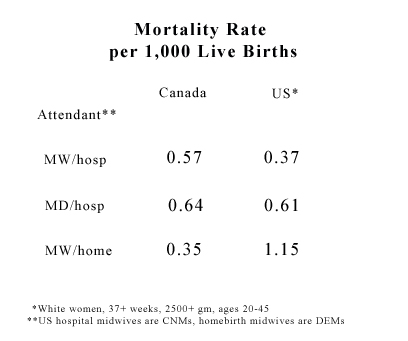
The rate of perinatal death per 1000 births was very low and comparable in all 3 groups: it was 0.35 (95% confidence interval [CI] 0.00–1.03) among the planned home births, 0.57 (95% CI 0.00–1.43) among the planned hospital births attended by a midwife and 0.64 (95% CI 0.00–1.56) among the planned hospital births attended by a physician. There were no deaths between 8 and 28 days of life.

These results are good news for Canadian homebirth advocates, demonstrating that homebirth in Canada is as safe as hospital birth. However, the results are very bad news for American homebirth advocates. They throw into sharp relief the dangers of homebirth in the US.

canadauscomp

The death rates for hospital births in Canada are comparable to the death rates for American hospital births in 2003-2004. However, the homebirth death rate for American midwives is more than triple the homebirth death rate for Canadian midwives.

There are two reasons for this.

1. American homebirth midwives have less education and training than Canadian midwives. Canadian midwives attend both hospital and homebirths, and therefore have extensive education and training in the recognition and treatment of complications. They receive comparable training to American certified nurse midwives.

2. There are strict eligibility requirements for homebirth in Canada. You can’t have a homebirth simply because you want one. You must be very low risk because anything else is considered too dangerous.

The new Janssen study has many strengths, but it has one glaring weakness. It fails to provide the nature and circumstances of the deaths in each group. Since there were only 7 deaths in the entire study, it is an inexplicable omission. That is especially relevant since the authors chose an unusual measure of mortality. Rather than using neonatal mortality (birth to 28 days) or perinatal mortality (from 28 weeks of pregnancy to 28 days of life), they used deaths from 20 weeks of pregnancy to 7 days of life.

It is widely recognized that stillbirths prior to 28 weeks have nothing to do with obstetric care. Therefore, the decision to include stillbirths from 20-28 weeks raises the possibility that the authors chose to include such stillbirths to make the numbers from the hospital group look poor by comparison to the homebirth group. Unless and until the authors are forthcoming about the circumstances of the deaths, we need to reserve judgment about what the study really shows. If the early stillbirths are removed, the study may actually show that homebirth in Canada is not as safe as hospital birth.

addendum: CMAJ has published my letter about the paper. It can be found

Katie Roiphe: Now I get it, Mom.

Katie and Anne Roiphe

The response to my piece about Katie Roiphe has mirrored the response across the blogosphere. Instead of answering Roiphe’s question, ‘why are feminists dishonest about the passion of early motherhood,’ most women have expressed hostility to Roiphe, her feelings and her reaction to those feelings. They view her essay as criticism, implied or overt, of themselves and their decisions to return to work.

Rather than interpreting Roiphe’s essay through the prism of their own insecurities, feminists would find it more profitable to interpret it by recognizing the influence of the writings of her own mother. According to NNDB:

Anne Roiphe is an American feminist author known for such novels as Up the Sandbox and Lovingkindness. Her work is noteworthy for its examination of the conflict between the desire for family and relationships and that for career and self-determination…

Roiphe’s principle contribution to feminist thought is her furthering of arguments introduced earlier by Betty Friedan regarding a woman’s right to enjoy motherhood… Roiphe points out that although daycare may seem to be the answer to balancing work and career, it robs women of many of the joys and satisfactions of spending time with their children.

Roiphe further argues that the solution is not to relegate women to weekend/evening parenting, just as men have been traditionally, but rather to create a system in which both men and women can share in a full family life. She further advocates rethinking our current career track pacing such that a person’s late 20s and early 30s might be more given over to family concerns (and joys), with the realization that life spans, and thus productive work years, for both genders have been greatly extended.

In light of her mother’s work, I see Katie Roiphe’s piece as a public acknowledgement of her mother’s philosophical endeavors. Basically, she is saying, “Now I get it, Mom.”

Personally, I think Katie (and Anne Roiphe) are correct in identifying this issue as one of the central failings in contemporary feminism, and the major reason why young women today often reject the label “feminist” even though they believe in the fundamental principles of feminism.

Many women don’t want to “balance” family and career. They want to fully enjoy motherhood and then, when that phase is over, fully enjoy their career. Instead of acknowledging this reality, and thinking creatively about a solution, contemporary feminists have embraced the notion that women must slavishly copy men in their devotion to established career trajectories.

The response of feminists to Roiphe’s essay mirrors the response of feminism to the power of mother love. They degrade it, deny it, diminish it and ridicule it. And the same reasoning underlies the similar responses; if you don’t acknowledge its value, you don’t have to address the conflict.

The genesis of the “mommy wars” is the inability of contemporary feminism to acknowledge the power of mother love. Instead of trying to remake the working world to respect and support mother love, feminists have ducked the responsibility by denying that mother love is so very powerful, or by claiming that “real” feminists find career more compelling than being with their children.

The solution to the problem is not that complicated. Women should be able to cycle out and back into their careers by helping each other. Just as there is always a cohort of women who wish to scale back or leave work temporarily when their children are small, there is always a cohort of women who wish to ramp up or return to work when their children are older.

But feminists tend to sabotage the very cooperation that is essential to the success of such a system. Instead of acknowledging the power of mother love and making accommodations for it, older, more established women professionals tend to denigrate it, insisting that a “real” lawyer, doctor, etc. would not deign to leave the work force for something as trivial as being with one’s children.

Unless and until feminists can acknowledge Katie Roiphe’s feelings as real and admirable, and stop treating then as implied criticism of themselves and their choices, we will be unable to make progress. Mother love is real, powerful and worthy of respect. Feminism should acknowledge what is important to women, instead of pretending that the only thing that is important is being just like men.

“But what does that mean about me and my children?”

For most of my years as a practicing obstetrician, I worked part-time and only at night. I got the idea from a male colleague who, as he neared retirement, arranged to work only during the day. I was working part-time already, but I missed my children when I was working and figured that working only at night would be ideal for our family. Our large HMO practice was desperate for night coverage, so it seemed like a perfect fit.

Despite the fact that my new schedule would benefit the practice as a whole, my boss was reluctant to approve my request. Her response was quite illuminating. “My children are the same age as yours,” she said,” if you decide to work only at night, what does that mean about my children and me?”

I was reminded of that episode when I read about the recent uproar over Katie Roiphe’s essay My Newborn is Like a Narcotic, in which she rhapsodizes about her love for her 6 week old son. On the face of it, the piece is rather uncontroversial. Roiphe is experiencing the same thing that many other new mothers experience, a love overwhelming in its all encompassing nature and power. Mother love IS like nothing else, and there is certainly nothing wrong in celebrating it.

Unfortunately, many feminists reacted with outrage, and their response seemed very much like that of my boss. “Katie Roiphe thinks that motherhood is more important than her work; what does that mean about my children and me?”

The passage that caused the most offense appears to be:

One of the minor dishonesties of the feminist movement has been to underestimate the passion of this time, to try for a rational, politically expedient assessment.

As can be expected in any discussion of motherhood and work, the response of feminists has been vicious. They range from the dismissive (“just wait until the baby is older”), to the pedantic (“Roiphe is battling a straw man”) to the nasty (“she doesn’t love her baby; she merely loves not working”).

The response of feminists is so formulaic as to be a stereotype, right down to the humorlessness often attributed to them. Describing the experience of a friend after the birth of her second child Roiphe writes:

My friend looked down at her newborn and her tiny eyelashes… Here, sitting in the garden, looking at the eyelashes, would you trade the baby for the possibility of writing The House of Mirth? You would not.

This is what is understood by most people as humor through hyperbole. Predictably, feminists are livid. Katie Roiphe thinks a baby is more important than Edith Wharton’s masterpiece!

Roiphe’s comment is figurative, not literal in the same way that the claim “if my mother hates my new dress, I will kill myself” is figurative, not literal. It is a way to emphasize strong emotion. Just as a woman wouldn’t really kill herself if her mother hated her new dress, Roiphe is not seriously suggesting that Wharton should have had a baby instead of writing a book. She is merely trying to convey how powerful her love for her new baby feels to her.

Feminists have a nasty habit of being too self-referential. They seem incapable of accepting Roiphe’s piece for what it is, a paean to the intense feelings of early motherhood and her surprise that feminism has devoted so little attention to this important phase in a woman’s life. Roiphe is not talking about other women. She is not chastising them because they did not feel as she does. She is not secretly criticizing their decisions to return to work, or to work the hours that they do. She’s talking about herself. Any criticism of them, implied or overt, is in their imaginations.

Don’t believe me? Try a little thought experiment. Imagine if a new father wrote the following:

One of the minor dishonesties of American male culture has been to underestimate the passion of new fatherhood.

Would feminists condemn that statement as criticizing fathers who do not feel overwhelmed with love for a newborn? Would they view the statement as implied criticism of men who work? No, they would do the opposite. They would celebrate that new father as a man who truly appreciates what was valuable in life.

Feminists need to get over themselves. Katie Roiphe was not talking about you and your children. She was talking about herself and her son. She was asking a perfectly valid question. Why are feminists afraid to celebrate the power of mother love? Instead of imagining personal slights, feminists should try to answer the question.

Dr. Andrew Weil, of Weil Supplements, Weil Baby, Andrew Weil for Origins, fears doctors’ recommendations are motivated by greed

malpractice

You’ve got to give the guy credit for chutzpah. The man who heads a multimillion dollar industry peddling countless products fears that the profit motive is corrupting medicine.

… many physicians in high-medical-cost cities … have a diversified “revenue stream,” the result of what one hospital administrator termed “entrepreneurial spirit.” This “spirit” often manifested in physicians owning their own medical testing equipment, which meant the more tests they ordered, the more money they made. A 2002 University of North Carolina study showed doctors who own imaging equipment sent patients for roughly two to eight times more imaging tests than those who don’t own.

That quote is from Andrew Weil, MD, writing in the Huffington Post, the same Andrew Weil who controls and profits from products licensed by Weil Lifestyle, LLC. Just contact Weil Lifestyle LLC, pay a hefty licensing fee plus royalties, and you can add Andrew Weil’s name to your products too.

Weil Lifestyle LLC licenses the right to use Dr. Weil’s name and likeness to companies philosophically aligned with his principles and committed to advancing integrative medicine. To qualify for licensing, the products themselves must also conform to the principles of integrative medicine. Current licensees are: Weil Nutritional Supplements (vitamins and supplements), Dr. Andrew Weil for Origins (skin-care products), Pet Promise (premium pet food), Dr. Andrew Weil for Tea (premium teas), Lucini Italia Organics(organic extra virgin olive oil and whole, peeled tomatoes), Weil by Nature’s Path (organic cereals and nutrition bars), Weil for Vital Choice, Weil Baby™ (baby feeding systems), Weil by Vita Foods, and Orthaheel™.

The guy who is hawking tea, pet food, extra virgin olive oil and orthotics has the unmitigated gall to complain that doctors might profit from their recommendations. What, exactly, is he doing when he slaps his name on a product in exchange for a fee? He’s profiting from his recommendation, obviously.

Does this man think that we are stupid? He counsels patients:

…[I]t’s up to you to ask your physician if the tests or treatments ordered for you are truly essential. You might get an honest answer about the test’s potential risks and benefits. Then, together, you can arrive at a decision that satisfies both of you.

Okay Dr. Weil, which of the products licensed and recommended by you are truly essential? It can’t be the premium tea; it isn’t the pet food; I doubt it’s the skin care products. Maybe it’s the newest product line Andrew Weil Gourmet Kitchen Products including bakeware, kitchen utensils, cutlery, gadgets and small appliances. If an Andrew Weil 10 cup Rice Cooker priced at $129.95 isn’t essential, I don’t know what is.

Dr. Weil proudly proclaims that he “donates all of his after-tax profits from royalties received by Weil Lifestyle, LLC from the sale of these products” to his foundation. How nice. He doesn’t tell us what he does with the profits from licensing fees, book advances, personal appearance fees, etc. I guess we can assume that he simply keeps those for himself.

Does greed play a role in healthcare? Unfortunately, in the case of unethical practitioners it does play a role. Should greed play a role? Of course not. So please tell us, Dr. Weil, why we should pay the least bit of attention to your faux outrage? None of the products that you hawk are essential and most do not even provide the health benefits that you claim for them. The only thing they do is line your own pocket.

You’re right, Dr. Weil. Patients shouldn’t trust doctors who recommend treatments that provide financial benefit for the doctor and little if any health benefit for the patient. In other words, Dr. Weil, by your own logic, patients shouldn’t trust you.

Doctors used to encourage VBAC; what changed?

Stethoscope and Gavel, Medical Law Concept

When I was practicing, obstetricians encouraged VBAC (vaginal birth after cesarean section). I had a high rate of patients attempting VBAC and a high success rate as well. So when I first heard that ACOG had changed their guidelines, I was stunned. Why had ACOG changed?

They changed the guidelines for one and only one reason: they listened to women. Despite being counseled about the risks of VBAC, women who experienced a uterine rupture routinely sued their obstetrician and routinely won. ACOG was simply recognizing the reality that women believed that they did not and could not understand the risks of VBAC.

One of the most egregious cases involved a woman who claimed that her doctor withheld material information about the risks of VBAC. Although the obstetrician had told the patient that not only could a uterine rupture happen, she had seen one happen, the patient asserted that she wasn’t adequately informed because the doctor did not mention that the baby in that case died:

… Flagg advised the plaintiff that, statistically, there were risks associated with the procedure, including uterine rupture and even a small chance of death of the child. Flagg reassured the plaintiff that all necessary steps would be taken to minimize or eliminate the risk to either the plaintiff or the plaintiff’s decedent and that the risk was “very, very small . . . .” … [T]he plaintiff asked … whether Flagg had had any negative outcomes. In response, Flagg stated that one of her previous patients suffered a uterine rupture as a result of a VBAC delivery. She did not mention, however, that the uterine rupture had caused the infant’s death and had placed the mother’s health at risk.

When patient lost her original lawsuit against the doctor, she was appealed using a new theory.

The plaintiff’s informed consent claim rested on the allegation that Flagg had given an incomplete and misleading response to the plaintiff’s inquiry about prior experience with VBAC deliveries. The plaintiff maintained that Flagg told the plaintiff that, in a prior VBAC delivery, she had one complication that resulted in a uterine rupture, but failed to tell the plaintiff that the uterine rupture resulted in an infant’s death. The plaintiff asserted that this evidence supported her claim that Flagg had not provided her with adequate information required for informed consent … The plaintiff also claimed that if Flagg had informed her that the prior VBAC delivery resulted in the death of the infant, she would not have elected the VBAC procedure.

The Appeals Court agreed with the mother and granted a new trial on the theory that the mother had not given informed consent.

It is cases like these that led to the dramatically more stringent ACOG recommendations. Obstetricians wanted to offer VBACs but women insisted, and courts agreed, that the women weren’t capable of understanding the risks. A journalist writing about his wife’s successful VBAC gives us insight into the position of obstetricians:

Given his support of VBACs, I was surprised to learn that Burgee himself doesn’t perform them. He did for two decades, but he stopped in 1990 when he reduced his practice to half-time while he got a law degree (so far unused). When he resumed his full-time practice, he didn’t take them up again. He stopped, he says, partly because his legal education made him see his legal risks more starkly. Managing the cases thus seemed more complicated than ever: The OB in him would be pulling for the VBAC, while the surgeon, lawyer, and potential trial defendant would worry that he should wheel the mother to the O.R. Now he explains to his patients why he doesn’t perform VBACs, outlines the odds as well as the arguments for and against, and offers the names of midwives and doctors who will perform the procedure…

Are doctors overreacting? It’s hard to make that claim when you learn how lawyers are advising women. The title of this law firm’s webpage is VBACs Too Often Result In Injury and Death:

While the promotion of VBACs may save insurance companies money, the risks simply cannot and should not be ignored. It is known that patients who fail a trial of labor are at increased risk for infection and death. Infants born by repeat caesarian delivery after a failed trial of labor also have increased rates of infection. Recent reports indicate that major maternal complications such as uterine rupture, hysterectomy, and operative injury were more prevalent in women who attempted a VBAC than those who underwent repeat caesarians.

If the uterine scar ruptures, it can be life-threatening for both the mother and the infant. For the mother, uterine rupture can require hysterectomy and can result in death.

For the infant, uterine rupture can result in both neurological damage and death. Uterine rupture can result in a sudden disruption in the blood flow to the fetus, resulting in deprivation of oxygen to the blood and tissues. This deprivation can lead to death of brain tissues and serious harm to other vital organs within only minutes. Accordingly, it is imperative that no VBAC be attempted at a facility where emergency staff are not capable of performing an emergency caesarian in minutes in order to prevent this potential harm or death to the infant and mother.

Contrary to the ravings of VBAC activists, obstetricians did not “take away” women’s option for a VBAC. That was done by women themselves. If enough women claim that they cannot possibly understand the risks of VBAC and enough lawyers encourage lawsuits based on that theory, obstetricians and hospitals have no choice but to respond to their demands.

Have a problem with the decreasing VBAC rate? Take it up with the women and lawyers who are responsible instead of pretending that doctors are depriving women of choice.

This post first appeared on Homebirth Debate in September 2008.

Is Dr. Andrew Weil trying to torpedo healthcare reform?

Many advocates of “alternative” health are left wing idealists. Therefore, it comes as a surprise that, on the issue of healthcare reform, they are missing in action, or worse. Many appear determined to torpedo healthcare reform and the reasons why shed a lot of light on their belief that cossetting the “worried well” is more important than providing healthcare for the poor.

I guess we shouldn’t be surprised. Although “alternative” health practitioners are forever insisting that their quackery provides effective treatment and even cure, they make no effort to offer compassionate, or free care. There is not a doctor alive who hasn’t provided substantial amounts of free care to patients who cannot pay. Indeed, there are entire hospitals who consider it their mission to serve the underserved. In contrast, it appears that alternative health practitioners exist to help only those who can pay, and consider the poor unworthy of their concern.

Alternative health practitioners approach healthcare reform as would any special interest group. The most important question is: “What’s in it for alternative health care practitioners?” They are irritated by the answer: Of the millions of dollars that would be expended providing healthcare to the underserved, not much would go to them. To their dismay, the President and Congress appear to believe that providing access to care for people who already have diseases like cancer and heart disease is more important than lining the pockets of charlatans.

They’re fighting back. Dr. Andrew Weil appears to be leading the charge. His multi-million dollar financial empire is not enough. He needs more money, and therefore, he presents absurd drivel wit an apparently straight face. Writing on the Huffington Post recently (The Wrong Diagnosis), Dr. Weil offered this bit on inanity:

Washington is working on reform initiatives that focus on one problem: the fact that the system is too expensive (and consequently too exclusive.) Reform proposals, such as the “public option” for government insurance or calls for drug makers to drop prices, are aimed mostly at boosting affordability and access. Make it cheap enough, the thinking goes, and the 46 million Americans who can’t afford coverage will finally get their fair share.

But what’s missing, tragically, is a diagnosis of the real, far more fundamental problem, which is that what’s even worse than its stratospheric cost is the fact that American health care doesn’t fulfill its prime directive — it does not help people become or stay healthy. It’s not a health care system at all; it’s a disease management system, and making the current system cheaper and more accessible will just spread the dysfunction more broadly.

It might be amusing prattle were it not so cruel and so selfish. Evidently we shouldn’t worry about providing care to the underserved who already have cancer, heart disease and other life threatening conditions (you know, those pesky people with pre-existing conditions). Making cancer treatment, heart surgery and other life saving treatments available will “just spread the dysfunction.” Sure it might save the lives of those who are currently suffering, but who cares about them? It won’t provide Dr. Weil and his colleagues with more money and that’s what counts.

Dr. Weil’s prescription?

Most cases of disease should be managed in other, more affordable ways. Functional, cost-effective health care must be based on a new kind of medicine that relies on the human organism’s innate capacity for self-regulation and healing. It would use inexpensive, low-tech interventions for the management of the commonest forms of disease. It would be a system that puts the health back into health care. And it would also happen to be far less expensive than what we have now.

In other words, give the money to Dr. Weil and his colleagues. Will their methods work? Do they offer relief for those who are already ill? Do they cost less?

To even ask those questions is to miss the point. Who cares what happens to poor people? They can’t pay for alternative “treatments,” they don’t buy books, and it is too late to prevent the diseases they have. In other words, Dr. Weil and his colleagues can’t make any money from their misery. Weil makes money from the worried well. Hence his emphasis on providing even more services for those who already have plenty.

In his zeal to mine healthcare reform for personal profit, Dr. Weil comes strikingly close to the insurance and pharmaceutical companies he claims to despise. They are considering how healthcare reform might be manipulated to line their own pockets. Dr. Weil fails to acknowledge to himself and others that his “prescription” for reform is just as transparently self-interested.He promotes only that which he and his colleagues can provide without regard to whether that is what is needed.

Anyone who opposes healthcare reform simply because it provides more money for others and not for him is selfish and cruel indeed.

Can you still be “Dr. Wonderful” after conviction for sexual exploitation of a patient?

It’s probably the most egregious violation of professional conduct that any obstetrician-gynecologist can commit. I’m talking about the sexual exploitation of a patient.

You might think that such a doctor would be a pariah among patients, especially after a conviction, and the decision by the California Board of Medicine to place him on probation for 7 years, but you’d be wrong about this doctor. He is currently soliciting donations from patients and supporters for his latest legal woes, precipitated by routinely ignoring hospital policy, and women are proudly giving money.

What group of women would deliberately ignore a conviction for sexual exploitation and rally around a doctor in spite of it? Homebirth advocates, of course. They have chosen to ignore the behavior of Dr. Stuart Fischbein because he provides back up for homebirth midwives.

Dr. Fischbein is widely hailed within homebirth circles. He works with Ricki Lake on her website, and is routinely praised for his public “Letter to ACOG” condemning their stance on a variety of issues. I can only imagine what happened at the headquarters of ACOG when they received the letter. They must have been shocked and then laughed out loud at the audacity of a doctor convicted of sexual exploitation daring to lecture them on their responsibilities to patients.

The offense was described by the Ventura County Star:

His patient, identified in Medical Board records as S.K., was 14 years younger than he and earning her doctorate degree in psychology. She came to Fischbein’s office in Century City with her fiancee. They wanted to have a baby.

… He performed surgery … to remove a mass in her uterus and called her “sweet pea” in the recovery room. He sat at her bedside for long intimate talks, testifying in a hearing he viewed her as not just a patient, but as a woman…

S.K. said Fischbein told her he would be a better father than her fiancee. He persuaded her to leave him.

They talked about the ethics of doctor-patient relationships. She said he told her he dated “bushels” of patients. Fischbein denied the comment or any other relationship with a patient.

She said he advised her not to have sex for four to six weeks after surgery. Fischbein said in court he didn’t remember the discussion.

Five days after she was released from the hospital and eight days after surgery, he called and asked to visit her at her home in Los Angeles. They had sex then and again two days later at Fischbein’s home.

He testified it was consensual. She said she viewed him as a doctor who had performed a surgery that was going to enable her to have a baby. He had become a hero who seemed almost “godlike.” And he was interested in her.

“I would have done anything he would have told me to do,” said the woman, who is suing Fischbein. “I look back with my hindsight and with my mind today and say, How could I have done this?'”

The contrast between this description and the accolades of his supporters are jarring, to say the least.

The post by Rixa Freeze on her website Stand and Deliver is typical of the response of the homebirth community to Dr. Fischbein’s latest legal difficulties.

…[A] wonderful obstetrician, Dr. Stuart Fischbein, is being threatened with disciplinary action by his hospital “for violating hospital policies.” The hospital has already suspended the privileges of the two CNMs he works with, and now he faces a possible loss of his livelihood…

Dr. Fischbein is a vocal supporter of midwifery and home birth. His collaborative midwife practice had a primary c-section rate last year of only 5% … and an overall rate of 12% … compared to his colleagues’ 29%…

So what can you do to help?

1. Contribute to Dr. Fischbein’s Legal Aid Fund. Make Paypal Payment to angelfischs@yahoo.com or mail a check payable to Alan J. Sedley, Attorney at Law…

Dr. Fischbein claims that he is being faced with the loss of hospital privileges for repeatedly violating hospital policy on VBACs and breech deliveries. That is certainly possible since subjecting the hospital, nurses and other doctors to the risk of legal liability that they have chosen not to undertake is certainly a reason for losing privileges. However, the peer review process is protected by strict confidentiality on the part of the hospital. There is no way to know whether this is the primary or only cause for the peer review.

I take a dim view of soliciting money from patients and supporters for a legal defense when those patients and supporters have no way of knowing what the actual charges are. It seems only reasonable that if Dr. Fischbein is soliciting money for his legal defense, he should waive the hospital’s mandated confidentiality, so that they can tell their side of the story.

Homebirth advocates have every right to forgive Dr. Fischbein for sexual exploitation. Yet I feel compelled to ask: Is homebirth so important that any doctor who supports it, even one who has acknowledged sexually exploiting a patient, is worthy of the designation “Dr. Wonderful?”

New data: homebirth with a direct entry midwife is the most dangerous form of planned birth in the US

In a recent post (Homebirth kills babies) I analyzed the data in the Linked Birth Infant Death database and demonstrated that homebirth with a direct entry midwife has almost triple the neonatal death rate of hospital birth for comparable risk women. Similar results were presented at the Pedatric Academic Societies May 2009 meeting.

According to the Medscape article:

Dr. Michael H. Malloy, at the University of Texas Medical Branch in Galveston, compared a range of adverse outcomes among infants by delivery attendant type and site of delivery occurring in the U.S. over a recent 5-year period…

The present analysis was limited to term (37-to-42 weeks), singleton, vaginal deliveries.

“I decided to restrict the analysis to this low-risk population because they would be the best candidates for home delivery,” Dr. Malloy said.

During the study period, there were 10,330,214 (88.5%) hospital physician-attended births available for analysis; 1,237,129 (10.6%) hospital-CNMW births … 13,529 (0.1%) home-CNMW births; 42,375 (0.4%) home-other nurse midwife …

The number of neonatal deaths for each of the categories was respectively 6,992; 614… 14; 75

The neonatal death rates in each group were 0.68/1000 hospital MD births; 0.5/1000 hospital CNM births, 1/1000 home CNM births and 1.7/1000 homebirth direct entry midwives. These are almost exactly the same as the death rates that I calculated from the same database for the 2 year period 2003-2004.

In both cases, homebirth with a direct entry midwife has triple the rate of neonatal death as low risk hospital birth. In both cases, homebirth with a direct entry midwife (such as a CPM) is the most dangerous form of planned birth in the US.

As Dr. Malloy explains:

“However, while there were only 14 neonatal deaths occurring in association with a home-CNMW assisted delivery, the risk of death was more than two-fold higher for CNMW-home deliveries and four-fold higher for deliveries by other midwives versus CNMW-hospital deliveries.

The prevalence Apgar scores of less than 4 was eight times higher for CNMW-home deliveries than for CNMW-hospital deliveries. What’s more, the risk of neonatal mortality and low Apgar scores was still increased for CNMW-home deliveries versus CNMW-hospital deliveries after adjusting for multiple potential confounders (including maternal age, race, education, parity, presence of one or more medical or labor complications, presence of an anomaly in infant, gestational age, and infant sex).

“The increased risk of low Apgar scores among infants delivered at home suggests that the causal pathway to the increased risk of neonatal mortality may be through the occurrence of asphyxiating conditions at birth that are not easily handled by the home environment,” Dr. Malloy noted.

Overall, the results demonstrate that the safest setting for a delivery is an in-hospital delivery attended by a CNMW, and women who decide to deliver in the home “need to recognize the greater risk associated with that choice,” he said.

Finally, as for why in-hospital CNMW deliveries had a lower risk of mortality in his study than in-hospital physician deliveries, Dr. Malloy said he assumes it’s because physicians are delivering a higher risk population, which he could not completely control for in his logistic regression analysis.

Dr. Malloy would be expected to be very sympathetic to homebirth. He has published several papers on C-sections and neonatal mortality in association with Drs. MacDorman and Declerq alleging (and then forced to back track) on claims that C-sections increase the risk of neonatal death.

Dr. Malloy’s data confirms what anyone can see for themselves. The existing US statistics on homebirth shows that homebirth with a direct entry midwife has triple the rate of neonatal mortality of low risk hospital birth. It is the most dangerous form of planned birth in the US.

If women want to have a homebirth, they can, but as Dr. Malloy states, they “need to recognize the greater risk associated with that choice.”

WWJI: Who would Jesus insure?

WWJD

Ahh, the irony. Christian Conservatives have a sordid history of trying to force religion into medicine.

According to them, Jesus does not allow abortions, so laws should prevent abortion, or, failing that, should place innumerable roadblocks in the way of women who want abortions.

According to them, Jesus wants all life to be preserved, so they mustered a public campaign to prevent Terri Schiavo’s husband from honoring her wishes and allowing her to die.

According to them, Jesus considers homosexuality to be an abomination, so discrimination against gay people should be enshrined in law.

Since they appear to believe that medical decisions (even other people’s medical decisions) should be made with regard to what Jesus would want, I’d like to know: who would Jesus insure? *

I’m no theologian, but I feel confident that Jesus would not approve of our current method of providing healthcare.

Would Jesus tie health insurance to employment? I doubt it. He made manifest his concern for the poor and downtrodden, so it is doubtful that he would want their miseries magnified by denying them access to healthcare.

Would Jesus allow pre-existing conditions to be exempted? Not likely. He ministered to the sick without regard for how long they had been sick before he arrived. It is impossible to imagine him declaring: “I’m here to relieve your suffering, but only new illnesses, not those that existed before I came to your valley.”

Would Jesus consider it a priority to preserve existing insurance companies? Would he reject a public option for health insurance because it threatened the profits of insurance giants? Once again, not likely. He would not put profits ahead of the life and health of innocent people.

Who would Jesus insure? The conclusion is inescapable. He would insure everyone. He would insist that it was the moral responsibility of those who have health insurance to make it available to those who don’t. And the way we do that is by providing a public option for health insurance, exactly the same option that the elderly now enjoy.

So I have a suggestion. For those who believe that we should make healthcare decisions based on what Jesus would do, how about making healthcare insurance decisions based on what Jesus would do? Obama may be anathema to many Conservative Christians, but it is impossible to deny that his plan for healthcare reform bears the closest resemblance to what Jesus would do.

WWJI: Who would Jesus insure? Everyone, of course.

* I know that is “whom would Jesus insure” is grammatically correct, but “who would Jesus insure” sounds better.

Dr. Amy