Tag Archives: subfeatured

Parenting advice: science or scientism?

I’ve been writing for years about the way that science has been misused to support ideological movements like natural childbirth, lactivism and attachment parenting.

I’ve been writing most recently about the way that science is being misused to support ideological movements like gentle parenting and neuroparenting.

Both are scientism, not science.

What’s the difference?

Science follows the evidence wherever it leads. Scientism invokes science to cloak an ideological agenda.

Simply put, though midwives, lactation professionals and attachment parenting theorists insist that their recommendations are based on science, they use science to cloak an ideological agenda.

That’s why their predictions have never come to pass. There is no evidence that unmedicated vaginal birth is safer, healthier or better than childbirth with interventions. There is no evidence that increased breastfeeding rates saves lives, reduce major illness or limit healthcare costs in industrialized countries. There is no evidence that attachment parenting improves mental health outcomes for children.

Simply put, though parenting “experts” who prescribe specific forms of discipline or methods of “brain building” in infants and small children insist their recommendations are based on science, they use science to cloak an ideological agenda.

That’s why their predictions also aren’t coming to pass. There is no evidence that children raised with gentle parenting are mentally healthier than those raised with other philosophies. There is no evidence that neuroparenting, meant to create teens and adults who are smarter, happier and better adjusted, has done anything of the kind.

How can we tell the difference between parenting science and parenting scientism?

1. Science is falsifiable; scientism is not.

Science could (and actually does) show that breastfeeding is NOT best for a substantial proportion of babies and mothers. Scientism starts with the conclusion that breast is best, accepts any evidence to support that claim — regardless of poor quality — and rejects any evidence to the contrary.

In the case of gentle parenting, there is NO evidence that it is best. It’s proponents start with their preferred conclusion (which reflects personal beliefs about parenting), search for evidence — regardless of poor quality — to support it and reject any evidence to the contrary.

2. Scientism feels free to reject the evidence of science when it contradicts personal beliefs.

So, for example, some lactivists feel free to utterly ignore the scientific evidence on the deadly practice of bed sharing. They are not guided by science; they merely invoke science when it suits them.

So, for example, some advocates of gentle parenting feel free to utterly ignore the scientific evidence on the harms of divorce. They offer lots of excuses but the bottom line is that they are willing to ignore science when it interferes with their personal choices.

3. Science — in the best cases — has no agenda. Scientism is concealing an agenda.

Although Dr. Bill Sears claims that attachment parenting is based on the science of bonding, that’s simply an effort to hide his fundamentalist religious agenda.

Although advocates of gentle parenting claim it is based on the science of psychology, that simply an effort to cloak the anti-authoritarian political impulses that drive it.

4. Scientism attempts to use science to make claims that are utterly beyond its appropriate scope.

Science can never tell us what is “best” for even a single child let alone all children.

Consider vaccination. Science can never — and would never — claim that vaccination is best for a specific child, let alone all children. Science merely tells us what proportion of vaccinated children will acquire immunity, what proportion will have side effects and even what proportion might be allergic and therefore harmed by a specific vaccine.

Scientism doesn’t deal in proportions; it simply makes declarations like “breast is best” or “screen time is harmful.”

What does science — as opposed to scientism — really tell us about parenting? Not much. There is no single recipe for raising happy, healthy children; there are many ways to do it in keeping with the myriad different personalities of children and the multiplicity of ideological beliefs of parents.
Therapeutic parenting and the rise of “Generation Anxious”

One hundred years ago the people who Americans now refer to as the “Greatest Generation” were children and young adults. That was the generation that lived through a massive financial depression and grew to fight an existential war against Nazi Germany.

In contrast, if we were to characterize the contemporary generation of children and young adults we might do well to refer to them as “Generation Anxious.” On nearly every parameter of mental health Generation Anxious is doing worse than previous generations, with anxiety being a particular problem.

What happened?

No one knows for sure, but I’m beginning to wonder if our current obsession with therapeutic parenting has something to do with it.

My generation of parents spent the childhoods of their offspring ever anxious about their mental health. “Experts” insisted that children’s psyches are both infinitely malleable and exquisitely fragile. Parents, therefore, were tasked with creating positive mental health by preventing negative experiences and the negative emotions that are presumed to lead to psychological damage. Any childhood unhappiness made parents wonder what they were doing “wrong.”

Has parental anxiety over child rearing been transmuted into child anxiety about simply existing?

Consider:

The Greatest Generation was raised in ways that our current philosophy of parenting, therapeutic parenting, finds anathema. They were fed formula, put on rigid schedules, seen and not heard. Discipline was often harsh to the point that we might now consider abuse.

Generation Anxious wasn’t raised so much as cultivated. We breastfed, let children set whatever schedules they preferred, curated their experiences, encouraged any and all emotions and preferences, and attempted to reason with them instead of disciplining them.

We were promised they would be happier and, instead, they are more miserable.

But wait! Aren’t we living through a time of unprecedented downward economic mobility?

Actually it’s not unprecedented. The Greatest Generation lived through an economic depression of massive unemployment and utter impoverishment far exceeding any economic discomfort we see today. Yet they were less anxious.

What about our vicious political environment with its bigotry, cruelty and threats to democracy?

That’s not unprecedented either. Despite appalling contemporary prejudice, it does not come close to the racism, anti-Semitism and misogyny experienced by the Greatest Generation. And there was no greater threat to both democracy and the lives of Americans than World War II. Yet they were less anxious.

But Generation Anxious has just endured a pandemic that disrupted so much of every day life. Yet even that is not unprecedented. The Greatest Generation was preceded by a massive worldwide epidemic of influenza. More people died in the epidemic than in the Great War that had come immediately before it. Yet the Greatest Generation was less anxious.

Obviously the massive increase in anxiety disorders among today’s children and young adults involves a multiplicity of factors. But one thing is pretty clear: the improvements in mental health we were promised by experts promoting therapeutic parenting have not occurred; things have actually gotten worse.

Is therapeutic parenting — which made an entire generation of parents anxious about their children’s mental health — responsible for the rise of Generation Anxious?

We don’t yet know the answer, but it is certainly worth asking the question.

Our unquestioning acceptance of therapeutic parenting

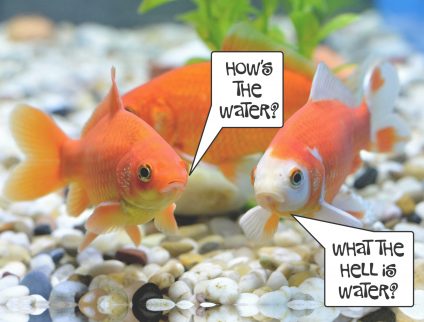
A joke:

First Fish: “How’s the water?”

Second Fish: ”What the hell is water?”

What applies to fish and water also applies to humans and culture. When you’re surrounded by it, you are often unaware that it is there. Hence most of us are oblivious to the culture of therapeutic parenting within which we have been immersed.

What’s therapeutic parenting? It’s a view of children (and their needs) as well as parents (and their responsibilities) that is informed by our therapeutic culture.

According to Aubry and Travis in their book Rethinking Therapeutic Culture:

[The] therapeutic orientation is so prevalent that we rarely question or examine it. It is now a matter of common sense that people are defined primarily not by their social roles, their class status, or their political commitments but by their interior feelings… This investment in the private emotive self means that immediate familial relationships become the key to understanding not only personal identity but also each person’s potential for success or failure.

Therefore:

[T]he cultivation of such a self is not merely a personal good, but a social obligation, the central purpose of human existence.

As a result, childhood has come to be viewed as the prism through which we should seek understanding of personality and parenting has come to be understood as the cultivation of the child’s interior feelings.

This view — while considered obvious by many of us — actually reflects a radical re-thinking of the both the parent child relationship and the meaning of negative emotions. Prior to the 20th Century, no one believed what we now unthinkingly accept as true.

Consider the idea that child suffering results in psychological damage. It rests on several beliefs that are historically quite new:

– the belief that suffering is not inevitable
– the belief that suffering causes damage, not improvement
– the belief that present unhappiness is caused by childhood psychological damage

Let me be very clear:

I’m NOT suggesting that these beliefs are untrue, although they might be.

My claim is that for most of human existence people’s experience led them to believe something entirely different:

– that human suffering (death, disease, pain, disappointment, frustration and grief) is both pervasive and inescapable
– that suffering can improve people — leading to psychological growth and intellectual empathy
– that there wasn’t simply merely nothing to be done to remove suffering from childhood but no reason to do so.

Our contemporary beliefs — embedded as they are in therapeutic culture — have led to a radical reimagining of parenting. For most of human existence parenting was about helping children to survive to adulthood while socializing them to function within existing societal arrangements. Today parenting — understood as therapeutic parenting — is about cultivating a child’s potential, preventing the negative experiences and emotions that are presumed to lead to psychological damage, and interrogating any childhood unhappiness or adult dysfunction for what parents did “wrong.”

It’s the equivalent of shedding the age old view that crops should be planted for survival and transmuting it to the view that each individual stalk of grain should be obsessively monitored to ensure that it becomes an ideal specimen of the particular genus and blaming the individual farmer if it does not.

The impact of this radical reimagining of parenting cannot be overstated. Virtually all contemporary parenting advice — from aggressive breastfeeding promotion to gender neutrality in toys — can be understood as an effort to prevent future psychological damage.

In the fish joke above, the fish who asks “how’s the water?” is not implying that water is bad or promoting the removal of fish from water.

Similarly, when I question contemporary parenting advice — whether it is the imperative to breastfeed or the horror with which occasional spanking is now greeted — I’m asking “how’s the water?” Just because fish don’t see water doesn’t mean it isn’t there, affecting everything about the lives of fish. And just because many parents are unaware of the therapeutic parenting culture that surrounds us, doesn’t mean that it shouldn’t be questioned.

Science denial, Dunning Kruger and the Tuteur Corollary

00A1BF6C-2246-46A4-B444-D109C816FFAB

I spend my days wrangling with science denialists on the Skeptical OB Facebook page. I don’t really argue with them since a doctor can no more argue science with a denialist than a mathematician can argue calculus with a four year old. Neither denialists nor four year olds know enough to come to grips with the actual subject.

Most four year olds would be quick to agree that they don’t understand calculus, but most denialists aren’t nearly so self aware. As victims of the Dunning Kruger effect, they actually think they know what they are talking about.

[perfectpullquote align=”right” bordertop=”false” cite=”” link=”” color=”” class=”” size=””]The Tuteur Corollary: If they don’t understand it, it must be a plot to harm them.[/perfectpullquote]

The Dunning Kruger effect explains why those who know the least about a particular topic — science, for example — actually believe they know the most. They simply don’t know what they don’t know. According to Dr. Dunning:

What’s curious is that, in many cases, incompetence does not leave people disoriented, perplexed, or cautious. Instead, the incompetent are often blessed with an inappropriate confidence, buoyed by something that feels to them like knowledge.

It seems to me that there is a corollary to Dunning Kruger — I’m going to call it the Tuteur Corollary — that applies to science denialists:

Those who lack relevant knowledge look at what they don’t understand and imagine it must be a plot to harm them.

I’ve noticed that when bad things happen to people, they can be roughly sorted into two groups: those who look at the untoward event they don’t understand and ask, “How did this happen?” and those who look at the exact same event and ask, “Who did this to me?” In other words, those with a modicum of knowledge want to understand — and assume they will be able to understand — what happened; in contrast, those who lack basic relevant knowledge (and often basic logic as well) assume that if they don’t understand something bad, it must be because someone, generally a corporation or government entity, is trying to harm them.

Anti-vaxxers are the perfect example.

Those who don’t understand basic immunology obviously don’t understand how vaccines work. Dunning Kruger leads them to conclude that vaccines don’t work; the Tuteur Corollary impels them to explain the world-wide consensus of immunologists, pediatricians and epidemiologists on the efficacy of vaccines as a world-wide plot to boost the fortunes of Big Pharma.

Those who don’t understand basic statistics obviously don’t understand that the recent apparent increase in the incidence of autism can be attributed to better diagnosis and expanded classification. Dunning Kruger leads them to insist that autism is an epidemic; the Tuteur Corollary leads them to conclude that corporations, with the blessing of government, are deliberately causing autism.

Those who don’t understand basic chemistry obviously don’t understand that a chemical that is dangerous in its elemental form, like mercury, is not dangerous when a component of a chemical compound, thimerosal. Never mind that there are many examples in every day life: elemental sodium is exposive; sodium chloride (table salt) is beloved as a seasoning for food. That’s Dunning Kruger. The Tuteur Corollary is responsible for the nonsensical belief that Big Pharma once added an expensive chemical to its vaccine preparations for no therapeutic reason and intended to poison children.

Those who don’t understand the scientific method obviously don’t understand that a single scientific citation (or even a dozen) that they’ve never read is not an argument against vaccination, especially when compared with the literally tens of thousands of papers that demonstrate the safety and efficacy of vaccines. Dunning Kruger leads them to assume that they are more educated about vaccines that those with PhDs in immunology. The Tuteur Corollary forces them to conclude that the entire scientific, medical and public health communities are deliberately ignoring all the fascinating data on whale.to and NaturalNews that seems so compelling to them.

Dunning Kruger explains why those who know the least are most likely to fall prey to anti-vax charlatans. The Tuteur Corollary explains why they abandon common sense to conclude that a random quack is more dedicated to curing their cancer than their own oncologists, that people peddling worthless miracle cures are less interested in profit than doctors, and that the vaccine conspiracy is so massive and so dastardly that doctors, pharma execs and public health officials are willing to inject their own children with vaccines in order to maintain the deception.

Dunning Kruger also explains why those who know the least are most likely to fall prey to COVID denialist politicians. The Tuteur Corollary explains why they abandon common sense to conclude that a politician like Donald Trump is more dedicated to preventing COVID than a scientist like Tony Fauci. It explains why denialists imagine simple public health measures like mask wearing to be a nefarious plot to deprive them of their “freedom.” It explains why denialists twist themselves into pretzels trying to argue that the hundreds of thousands of EXCESS American deaths in 2020 were all people who died of other causes.

The bottom line when it comes to science denial is that large groups of Americans now rest their self worth on the twin delusions that their own ignorance is “knowledge” and that whatever they don’t understand must be a plot to harm them.

Lactivism represents a profound lack of empathy

26235543 - woman consoling her friend

One of the most amazing traits of human beings is the ability to empathize with others.

We don’t have to lose a parent to imagine how devastating the loss of a parent could be and therefore we offer our support.

We don’t have to experience a divorce to imagine how devastating the end of a marriage might be and therefore we offer our support.

[pullquote align=”right” cite=”” link=”” color=”” class=”” size=””]Why don’t lactivists, who undoubtedly could feel empathy for another’s loss, have no empathy for women who can’t breastfeed?[/pullquote]

We don’t have to become paralyzed to imagine how shocking and life altering that would and therefore we offer our support.

We don’t have to have inadvertently starved our infant trying to breastfeed to imagine how horrible we might feel and therefore we offer … blistering condemnation accusing such women of being lazy, selfish and unable to bond with their own children.

Wait, what?

Why don’t lactivists, who undoubtedly could feel empathy for another’s loss of a parent, a marriage or the ability to walk have no empathy for women who can’t breastfeed?

I suspect that there are three reasons for this.

The first is that it’s easiest to imagine the suffering of others when we know the same thing might happen to us. There is no one who can pretend that they will never lose a parent, never have a spouse cheat on them, never become paralyzed in an accident. It really could happen to them and they express the same empathy that they would hope for and rely upon in such a situation. In contrast, many lactivists already know that they can successfully breastfeed; they don’t bother to imagine what it would be like to be unsuccessful precisely because (so they believe) it couldn’t happen to them.

The second reason is that lactivists have constructed infant feeding as a source of self-esteem. In truth, they have no more control over their breastmilk supply than they have over an impending miscarriage, yet they pretend that they do. In truth, deliberately choosing not to breastfeed is no more or less selfish than deliberately choosing to have a another child to give your existing child a sibling. Sure, many people consider their siblings to be among the joys of their life but we recognize that the detrimental impact of an additional child on the parents may outweigh the benefits to the child.

The third reason is that lactivists have constructed infant feeding as a zero sum game. Breastfeeding mothers imagine that they can only be considered “good” mothers if formula feeding mothers are labeled “bad.” They seem to be incapable of recognizing that infant feeding really has no bearing at all on whether a woman is a good mother. That’s why they abhor the rather basic and obvious concept that “fed is best.” If fed is best, they’re not best and that is simply unacceptable. It seems never to have occurred to them that there is more than one way to produce healthy, happy children.

The inability of lactivists to empathize with women who make (or are forced to make) different feeding choices is quite ugly.

Here’s a Facebook post from Kristy of Breastfeeding Mama Talk. She leads with the acknowledgement that this is going to make other women feel terrible but she doesn’t care:

I know I’m opening a can of worms with this , but I just cannot remain silent. I know this will rile up many and while that isn’t my intent, it needs to be stated. If I shy away from speaking out in fear of backlash and being bullied then I wouldn’t be true to all of you. Just like they are getting the floor to refute , we get the floor too. So here goes nothing…

Kristy is upset that the Fed Is Best Foundation has called out the World Health Organization for admitting that babies who are injured or die because of insufficient breastmilk are “not a priority.”

She continues:

They are pushing really hard to fear monger moms into supplementing, especially in the first few weeks when developing the breastfeeding relationship is the most crucial. Moms already have the doubt, fear, and concern , that they aren’t making enough milk. The answer is not to rush to supplementation (unless that is what the mom wants to do of course) but if her goal is to exclusively breastfeed she should seek assistance from a reputable IBCLC who can then assess what the issue is and may come to find there is no issue at all. Rather than just handing over those premade formula bottles. Often times , moms will assume they aren’t making enough when in actuality they are making just enough. There are ways to figure out if baby is getting enough without the need to supplement right off the bat.

In just a few short sentences I see constructing breastfeeding as a zero sum game: preventing infant injuries and deaths is transformed into pushing supplementation. There’s refusal to acknowledge both that breastfeeding has a significant failure rate and that not every woman can exclusively breastfeed. There’s gaslighting of women who are concerned that their babies are starving. But most of all, there’s an incredible lack of empathy.

What if the WHO had claimed that providing access for the disabled was “not a priority”? Would Kristy have claimed that those who are arguing for improved access are pushing paralysis? Would she have gaslighted them by implying that those who think they are paralyzed aren’t really paralyzed? Would she have declared that they just needed more “support” to walk, not ramps and elevators? Would she have insisted that those in wheelchairs figure out how to use the stairs and wait to see if ramps were really medically necessary?

I doubt it, and if she did behave that way to people who are paralyzed, most of us would be repulsed by her utter lack of empathy.

I’m going to guess that if a woman showed up in a wheelchair and told Kristy that she was paralyzed from the waist down, Kristy would believe her and certainly wouldn’t demand medical proof. But when a woman shows up with an infant who is failing to thrive and says she isn’t producing enough breastmilk to fully nourish her baby, Kristy feels no compunction about gaslighting her and demanding “proof.”

Why the difference? Because while Kristy and other lactivists can empathize with people who are paralyzed, they can’t or they won’t empathize with women who suffer from insufficient lactation. I suspect that Kristy would willingly acknowledge that it is simply a matter of luck that she is not paralyzed and others are. It’s easy to do that because she hasn’t contructed being able to walk as a source of her self esteem. She hasn’t created a Walking Mama Talk Facebook page to celebrate women who can walk and denigrate those who can’t. In contrast, she has constructed being able to breastfeed as a source of self-esteem and a zero sum game.

If Kristy were to acknowledge the truth, that breastfeeding is a matter of luck not will or skill, she wouldn’t be able to feel superior to others. For lactivists, that desperation to feel superior to other mothers is so powerful that they’d let babies die rather than admit that the ability to breastfeed is no different from the ability to walk.