All posts by Amy Tuteur, MD

Cochrane Review: women should get labor epidurals as soon as they want them

image

The folks at Cochrane Reviews have just crushed a number of the most cherished myths of natural childbirth advocates:

Pain during childbirth is arguably the most severe pain some women may experience in their lifetime. Epidural analgesia is an effective form of pain relief during labour…

We conclude that for first time mothers in labour who request epidurals for pain relief, it would appear that the time to initiate epidural analgesia is dependent upon women’s requests.

That’s three dead myths in only 3 sentences:

1. Contractions aren’t surges but the most severe pain experienced.

2. Epidurals are very effective in managing that pain.

3. A woman should get an epidural when she asks for one since the timing has no impact on outcome.

The Review, Early versus late initiation of epidural analgesia for labour, was published yesterday.

The authors explain the methodology and findings:

We included nine studies with a total of 15,752 women.The overall risk of bias of the studies was low, with the exception of performance bias (blinding of participants and personnel).

The nine studies showed no clinically meaningful difference in risk of caesarean section with early initiation versus late initiation of epidural analgesia for labour (risk ratio (RR) 1.02; 95% confidence interval (CI) 0.96 to 1.08, nine studies, 15,499 women, high quality evidence). There was no clinically meaningful difference in risk of instrumental birth with early initiation versus late initiation of epidural analgesia for labour (RR 0.93; 95% CI 0.86 to 1.01, eight studies, 15,379 women, high quality evidence). The duration of second stage of labour showed no clinically meaningful difference between early initiation and late initiation of epidural analgesia (mean difference (MD) -3.22 minutes; 95% CI -6.71 to 0.27, eight studies, 14,982 women, high quality evidence). There was significant heterogeneity in the duration of first stage of labour and the data were not pooled.

There was no clinically meaningful difference in Apgar scores less than seven at one minute (RR 0.96; 95% CI 0.84 to 1.10, seven studies, 14,924 women, high quality evidence). There was no clinically meaningful difference in Apgar scores less than seven at five minutes (RR 0.96; 95% CI 0.69 to 1.33, seven studies, 14,924 women, high quality evidence). There was no clinically meaningful difference in umbilical arterial pH between early initiation and late initiation (MD 0.01; 95% CI -0.01 to 0.03, four studies, 14,004 women, high quality evidence). There was no clinically meaningful difference in umbilical venous pH favouring early initiation (MD 0.01; 95% CI -0.00 to 0.02, four studies, 14,004 women, moderate quality evidence).

Catherine Pearson at HuffPo interviewed a number of clinicians on their thoughts about the review:

“This review — performed through the rigorous Cochrane methodology — provides a high level of medical evidence that early epidurals do not extend labor time, especially the pushing stage,” Dr. Sng Ban Leong, deputy head and senior consultant with the department of women’s anesthesia and KK Women and Children’s Hospital in Singapore, wrote in an email to The Huffington Post. Leong was an author on the review.

And:

“Epidurals these days are very different from the ’80s and ’90s,” Dr. J. Christopher Glantz, a professor of obstetrics and gynecology in the division of maternal-fetal medicine at the University of Rochester Medical Center, told The Huffington Post. Many hospitals now offer lower-dose walking epidurals, which can leave women with enough strength to move throughout labor and may help them push more effectively.

And:

“The takeaway message is that when women experience labor pain, and they choose to have early epidural pain relief, they [should] be reassured that this does not have any adverse effects to their labor outcomes,” Leong wrote.

When should a woman get an epidural in labor? According to the folks at Cochrane Reviews: whenever she wants it!

Toxicophobia, fear of toxins

iStock_000014509305Small copy

A new book about fear of vaccination reminds me of a piece I wrote nearly 5 years ago on toxicophobia.

The book is On Immunity: An Inoculation by Eula Biss. As a review in the New York Times Review of Books, characterizes the person most likely to be afraid of vaccines:

white, educated, relatively wealthy — a woman drawn to doing things “naturally,” who tells us she gave birth without pain medication, medical intervention or an IV.

That “naturally” is key. Our anxieties about industrialization, at how we’ve polluted the world and presumably each other, have given the word its particular luster: “Where the word filth once suggested, with its moralist air, the evils of the flesh, the word toxic now condemns the chemical evils of our industrial world.”

Biss reports from deep inside the panic. “My son’s birth brought with it an exaggerated sense of both my own power and my own powerlessness,” she writes. The world became suddenly forbidding: There is the lead paint in the wall to fear, the hexavalent chromium in the water. Even stagnant air, she was told, can kill her child. “It is both a luxury and a hazard to feel threatened by the invisible,” she says.

Biss is talking about toxicophobia, the fear of toxins, which underlies a variety of “natural” movements from natural childbirth to anti-vaccination to natural parenting. Aficionados of these movements suffer from a pervasive fear of being poisoned. And not poisoned accidentally, either. They fear being poisoned surreptitiously, deliberately, and as part of a giant conspiracy perpetrated by Big Pharma and Big Farma and Big Medicine.

It is axiomatic among quacktivists — anti-vax activists, organic food devotees, homebirth midwives, natural parenting advocates — that conventionally grown food and the water supply are filled with “toxins.” Sometimes these toxins are named; often they are not. In all cases, though, there is no evidence that anyone is actually being harmed by “toxins,” but, of course, proof is not a requirement in the fantasy world inhabited by devotees of quacktivism.

Vaccines supposedly contain “toxins” that cause autism. (N.B. Toxins always and only cause diseases and syndromes whose etiology is still unknown. No one ever claims that toxins cause strep throat, or sickle cell anemia, or gallstones.) Our food supply is purportedly contaminated by toxins too numerous to even bother mentioning by name. Our water supply is supposedly contaminated by the toxins in pesticides. And, of course, all medications produced by Big Pharma have myriad secret and toxic side effects.

Big Pharma deliberately adds toxins to its vaccines. AND vaccine manufacturers know all about this and do it to make more money. AND the government knows all about it, too, and insists that we take more and more vaccines every year. AND the government pays for it. AND the government has granted vaccine makers indemnity from prosecution. It is a wicked world.

Big Farma covers our fruits and vegetables with toxins, and, if that weren’t enough, adds toxins in the guise of preservatives to everything else. And these toxins cause cancer! What kind? Don’t ask, no one knows, and why would that matter anyway? Cancer is cancer. And if all that weren’t bad enough, Big Farma now wants to flood our food supply with … genetically modified food. Horror of horrors, genetically modified foods (they modified the GENES, for chrissakes) are sure to be filled with unnamed toxins of all sorts. And if that weren’t bad enough, Big Farma wants to irradiate our food to kill harmful bacteria (they’re going to expose our food to RADIATION, for chrissakes). Next thing you know we’ll all be gigantic and super-powerful. Oh, wait, maybe we’ll all be stunted and weak. It doesn’t matter; regardless of what they do you can be sure it will “weaken” our immune systems.

We are facing a big problem. Contrary to what the food and medicine toxicophobes believe, it is not the deliberate contamination of our food and pharmaceutical systems. The problem is a sociological problem. Large segments of the populations are suffering from the delusion that industry and the government are colluding to deliberately poison them.

To be clear, I’m not suggesting that medications don’t have side effects or that pesticides or preservatives are theoretically incapable of being harmful. Everything has potential side effects, but there’s a big difference between “potential” and “real.” Vaccines, for example, are known to cause brain damage and death in a tiny proportion of children who are vaccinated. That is real. But vaccines don’t cause autism. That’s fantasy.

What is the source of this toxicophobia? In part it stems for Americans’ apparent inability to understand risk. Americans are so obsessed with side effects that they forget about effects. They vastly overestimate the risk of side effects and vastly underestimate the life saving benefits of the treatments in question. That tendency to overestimate side effects is directly related to the sense of control that Americans do or do not feel. Just as Americans routinely underestimate the risks of driving, they routinely overestimate the risk of plane flight. They believe themselves to be in control while driving, yet they develop irrational fears about the risk of an unforeseen and unforeseeable plane crash.

So Americans obsess over the risk of side effects from medication and the theoretical risk of side effects from agricultural methods that have made the food supply larger and safer. They are consumed with anxiety by the belief that they are secretly being poisoned. This obsession is magnified by the belief that Big Pharma and Big Farma know about all these side effects and are hiding them. Do large corporations hide damaging information from the public? Yes, unfortunately, they do. But Big Pharma and Big Farma are no different from other large corporations. Yet no one has stopped driving because they fear the auto industry has designed cars that will blow up at the slightest provocation (even though that actually happened with the Ford Pinto) and no one has stopped crossing bridges for fear that shoddy construction will lead them to collapse (even though that has actually happened, too).

Simply put, there is no basis in reality for this pervasive toxicophobia, suggesting that it may be serving a psychological function. Americans are not being poisoned, but they imagine they are because, I suspect, it is a way to channel their anger at being so easily manipulated by large corporate entities like banks and other special interests, and their frustration at their perceived powerlessness. Toxicophobia projects this fear, anger and frustration onto medications, food, and, most importantly, vaccines. Unfortunately, rather than being protective, toxicophobia diverts attention from the real problems onto imaginary ones. And, paradoxically, toxicophobia doesn’t improve health, it kills people, generally babies, small children and the immuno-compromised.

Anti-vax activism is toxicophobia writ large. And as Biss points out, toxicophobia, like most quacktism is a luxury of the privileged.

Getting your information about C-sections from homebirth midwives is like getting your information about solar power from Big Oil

iStock_000007637100Small copy

More than 20 years ago, when my husband and I were seeking a new home for our expanding family, we were shown several beautiful plots of land. The houses were spacious, the plots of land were large and the entire area backed up onto conservation land. The builder who owned the land was offering three different house models, all very attractive.

We toured the development, but were not happy with the available models; none had a family room located off the kitchen and that was one of my few absolute requirements. My children were small and I wanted to be able to see them at all times, including when I was preparing meals. The fact that our 3 year old had recently cut the 5 year old’s hair with kindergarten scissors when I left them playing where I could not see them from the kitchen only strengthened my resolve on this point.

We tried to convince the builder to adapt an existing model to our requirement and were astounded when he told us that while we thought we wanted a family room off the kitchen, we didn’t really want one. Eventually the kids would get older and we would appreciate it when they weren’t in view. In other words, he couldn’t or wouldn’t built a house with the family room attached to the kitchen and it was therefore in his economic interest to convince us that we didn’t need one.

Not surprisingly, we sought out another builder with a different piece of land and ultimately got the house we wanted with a kitchen overlooking a sunken family room. For years I watched 4 children play by themselves, with each other and with friends in that room, and no one ever cut anyone else’s hair with kindergarten scissors ever again. And when the kids got older and we didn’t want them in view, we finished the basement.

I’m reminded of that episode whenever I see homebirth midwives discussing C-sections. Just like the builder who wouldn’t build the house we wanted tried to convince us that we really wanted what he was selling, homebirth midwives, who cannot perform C-sections, try to convince women that they don’t need C-sections, don’t want them, and will be sorry if they have them.

What never ceases to amaze me is that women seeking information on C-section from homebirth midwives fail to recognize the economic motivation behind midwives’ demonization of C-sections. It’s the intellectual equivalent of seeking information on solar power from Big Oil. Would you believe Big Oil if it tried to convince you that solar power was a bad idea? I doubt it. So why believe homebirth midwives when they tell you that C-sections are a bad idea?

Finally: a comprehensive analysis of US infant mortality

iStock_000009800679Small copy

I’ve been writing about this problem for many years: no, not the high US infant mortality rate, but the refusal to address the most important causes of high US infant mortality.

Five years ago, in November 2009, I wrote in Detailed report on infant mortality neglects the most important detail:

The new CDC report on infant mortality, Behind International Rankings of Infant Mortality: How the United States Compares with Europe [by MacDorman et al], is an object example of how to deceive with statistics. It purports to be a detailed investigation of infant mortality, but it inexplicably fails to investigate the most important detail…race. Unfortunately, African descent is a major risk factor for prematurity, and prematurity is a major cause of infant mortality. Therefore, it is hardly surprising that the US has a higher infant mortality rate than Sweden. The US has the highest proportion of women of African descent of any first world country. Sweden, of course, has virtually none.

And last year in The March of Dimes and dishonesty about prematurity, I wrote:

The March of Dimes has chosen to misrepresent prematurity as being caused by early elective delivery. While early elective delivery poses risks, it also has significant benefits (reducing the stillbirth rate) and, in any case, is only a tiny contributor to the problem of prematurity…

The MOD has been publishing a yearly “report card” on prematurity. The report card is rather farcical since while claiming to grade states on prematurity rates, it is basically grading them by the proportion of African-Americans in each state.

Finally, someone has analyzed the US infant mortality rate with the object of improving it, as opposed to using it for selfish ends. The new paper, Why is infant mortality higher in the US than in Europe?, is written by Professor Emily Oster and colleagues. Oster is the author of Expecting Better: Why the Conventional Pregnancy Wisdom Is Wrong—and What You Really Need to Know.

Oster et al. lay out the dimensions of the problem:

In 2013, the US infant mortality rate (IMR) ranked 51st internationally, comparable to Croatia, despite an almost three-fold difference in GDP per capita.1 One way to quantify the magnitude of this infant mortality disadvantage is to consider that the US IMR is about 3 deaths per 1000 greater than Scandinavia…

While the US IMR disadvantage is widely discussed and quantitatively important, the determinants of this disadvantage are not well understood, which hinders policy efforts aiming to reduce the US infant mortality rate. A key constraint on past research has been the lack of comparable micro-datasets across countries. Cross- country comparisons of aggregate infant mortality rates provide very limited insight, for two reasons. First, a well-recognized problem is that countries vary in their reporting of births near the threshold of viability. Such reporting differences may generate misleading comparisons of how infant mortality varies across countries. Second, even within a comparably reported sample, the observation that mortality rates differ one year post-birth provides little guidance on what specific factors are driving the US disadvantage.

In other words, as I’ve written countless times over the years, direct comparisons of national infant mortality rates are invalid because the US includes very premature babies born alive, while many other countries do not. Since the highest death rates are in very premature babies, failure to include them makes other countries’ infant mortality rates look far better than they really are.

How did Oster et al. address this problem?

… We combine US natality micro-data with similar data from Finland, which has one of the lowest infant mortality rates in the world, and Austria, which has similar infant mortality to much of continental Europe. We first provide a detailed accounting of the US IMR disadvantage, quantifying the importance of differential reporting, conditions at birth (that is, birth weight and gestational age), neonatal mortality (deaths in the first month), and postneonatal mortality (deaths in months 1 to 12)… Second, we provide new evidence on the demographic composition of the US IMR disadvantage.

What did they find?

… Differential reporting of births near the threshold of viability can explain up to 40% of the US infant mortality disadvantage. Worse conditions at birth account for 75% of the remaining gap relative to Finland, but only 30% relative to Austria. Most striking, the US has similar neonatal mortality but a substantial disadvantage in postneonatal mortality. This postneonatal mortality disadvantage is driven almost exclusively by excess inequality in the US: infants born to white, college-educated, married US mothers have similar mortality to advantaged women in Europe. Our results suggest that high mortality in less advantaged groups in the postneonatal period is an important contributor to the US infant mortality disadvantage.

First, nearly half the differential in infant mortality is due to failure of other countries to include extremely premature babies born alive.

Second, the disparity in infant mortality (death from birth to one year) has little if anything to do with obstetric care since US neonatal mortality (death from birth to 28 days) is similar to other industrialized countries.

Third the disparity in post neonatal mortality is attributable to race and socio-economic status.

In other words, while birth activists, including CDC statistician Marian MacDorman, who is also (surprise!) the Editor of the Lamaze journal Birth: Issues in Perinatal Care, and organizations like the March of Dimes have been wailing about American obstetric care in general, and early elective induction in particular, the relatively high US infant mortality has nothing to do with American obstetric care in general, and early elective induction in particular.

Which raises the question why the people supposedly concerned with reducing the infant mortality rate haven’t bothered to address the real causes of US infant mortality. It appears they don’t really care about infant mortality and prematurity beyond using it as a cudgel to chastise American obstetricians. The tragedies of women of color, and poor women are exploited to serve the ends of birth activists, not to improve the outcomes for those who suffer. The poor infant mortality rate is used as a slogan to increase market share and profits for midwifery among Western, white, well off women, the demographic most likely to choose midwifery services. The victims of high US infant mortality are left to fend for themselves.

What has Improving Birth done for the woman in the “forced episiotomy” video besides exploit her?

iStock_000015876280Small copy

Over the last few days I’ve been writing about the cynical exploitation by Human Rights in Childbirth of a woman who endured a forced episiotomy. Human Rights in Childbirth is protecting the identity of the doctor in the video, and is now deleting and banning anyone who dares to question why they have not filed a complaint against the doctor with the California Board of Medicine. Apparently the right to free speech is not one of the human rights in childbirth.

But HRiC was not the first group to exploit the mother in the video to promote homebirth midwifery while simultaneously doing nothing to obtain redress for her. That distinction goes to Improving Birth.

Who is Improving Birth and how do they aim to improve birth for women?

I know you will be shocked, shocked to learn that they are homebirth professionals who earn the bulk of their income by promoting birth outside hospitals. The founder is Dawn Thompson, a doula. As far as I can determine by perusing the sponsors, there is no one involved who could actually improve birth for the 99% of women who give birth in hospitals. The organization, just like Human Rights in Childbirth (also a sponsor) is yet another astro-turf organization hiding behind “grass roots” support of improved birth, but actually shilling for greater market share and profits for homebirth midwives and doulas. And just like HRiC, their favored technique for fundraising and publicity is fomenting distrust of doctors by implying that the wrong doing of one doctor represents the standards of all obstetricians.

What has Improving Birth done to seek redress for “Kelly,” the mother in the video? Not a damn thing because they don’t really care about Kelly beyond using her for fundraising. They haven’t assisted her in filing an official complaint with the hospital, they haven’t helped her file a complaint with the California Board of Medicine, they haven’t helped her obtain legal counsel, and, most importantly, they have not outed the doctor and hospital where the incident took place.

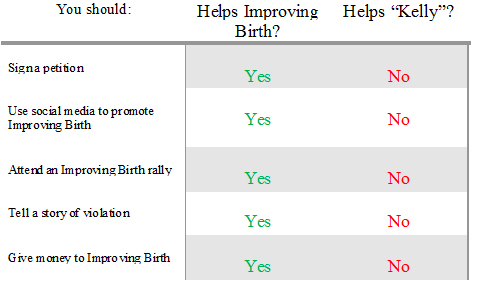
What does Improving Birth recommend that viewers of the video should do:

Helps Improving Birth

What a surprise! Every suggestion — sign a petition, use social media to promote Improving Birth, attending an Improving Birth rally, tell a story of violation under the aegis of Improving Birth, and give money to Improving birth — benefits Improving Birth. And NONE of the suggestions benefit Kelly in any way!

It’s actually not a surprise when you look past the inspiring language of Improving Birth to the real purpose of the organization. I imagine that they aren’t opposed to improving birth in hospitals, but they aren’t particularly concerned about it, either. The purpose of the organization is to increase market share and profits for homebirth midwives and doulas. Individual women are merely the dupes employed for the purpose.

It is both easy and free for Kelly, or Improving Birth, or Human Rights in Childbirth to file a complaint with the California Board of Medicine. According to Improving Birth:

As far as we know, this doctor is still attending women and babies at this hospital.

And as far as I know, neither Improving Birth or HRiC has lifted a finger to prevent it.

That’s rather surprising when you consider that:

… In [Kelly’s] case, there is no question about the facts she relayed. We can confirm her story, because it was captured on video (see “The Birth” below). Kelly’s mother filmed her grandson’s birth (with the full knowledge of the doctor in attendance)…

In other words, it isn’t a “he said, she said” situation. There is video evidence and the video was taken with the doctor’s permission, so there is no legal barrier to submitting it to the Board of Medicine.

According to Improving Birth:

Kelly told us that when she hand-delivered her complaint six months ago, she spoke with the hospital’s Director of Women’s Services for 45 minutes about what had happened.

She says she never received a response, even after inquiring several times about what was being done or what the next steps were…

But I bet a follow up letter on the stationery of Improving Birth or HRiC would elicit a prompt response, yet neither organization has sent one.

Why haven’t either Improving Birth or HRiC made ANY efforts to help Kelly seek redress?

There are a number of possible answers and all of them undermine the stated purposes of the organizations:

1. The video excerpt does not reflect the full story of what happened.

2. The doctor has already been disciplined and IB and HRiC don’t want women to know that the system works.

3. IB and HRiC couldn’t care less what happens to Kelly. They got what they wanted from her, yet another opportunity to increase market share and income of homebirth midwives and doulas by fomenting distrust of doctors. Now that they the propaganda they wanted, poor “Kelly” is on her own.

Perhaps IB and HRiC really mean that crap that they spew. After all, Hermine Hayes-Klein of HRiC came to this blog hoping to call my bluff by soliciting my services as an expert witness. I called her bluff; I’d be more than happy to serve as an expert witness. Moreover, I’d be happy to help Kelly file a complaint with the California Board of Medicine or find legal counsel in California.

If HRiC (or IB) were really interested in improving birth and promoting human rights in childbirth, they would have jumped on my offers of assistance. Instead, HRiC erased my comments from their website and Facebook page and banned me from commenting.

Why? Because HRiC (and IB) don’t give a damn about Kelly and her forced episiotomy and it was far too embarrassing to have that pointed out.

The human rights scandal at Human Rights in Childbirth

Media blind - censorship concept

Poor Hermine Hayes-Klein. She came to this blog to call my bluff and instead I called hers. She’s been dealing with the ugly fallout ever since.

And in doing so, Hayes-Klein has exposed not one, but two human rights scandals at Human Rights in Childbirth.

The rest of the professional natural childbirth and homebirth advocates would have told her to stay away. I don’t bluff, I can eviscerate ridiculous claims in short order, and I don’t give up.

Hayes-Klein parachuted in to comment on Friday’s post Why is Human Rights in Childbirth protecting the doctor in the so-called “Forced Episiotomy” video?. Hayes-Klein wrote:

Dear Dr. Amy, it is heartening to read your assessment of this video as “incompetent and negligent.” Perhaps you would be willing to serve as an expert witness if and when “Kelly” finds a California lawyer willing to bring a case for damages and redress. Amy, your voice has great value in the maternity care debate. Would you write some more about what you think the doctor could have done differently in that video? Do you think he violated her right of informed consent and refusal? Please comment.

And I promptly answered:

I’d be happy to serve as an expert witness. Moreover, I’d be happy to assist in finding a lawyer who would take the case; my husband is a trial lawyer. Just tell me: in what hospital and city/town did this take place? Who is the doctor in the video? Has any complaint of any kind been filed against him? Feel free to contact me privately …

Oops, that’s not what Hayes-Klein was expecting.

Hayes-Klein promptly disappeared but continued the discussion on the Facebook page of HRiC and on the website page showing the “forced episiotomy.”

HRiC 1

Hayes-Klein bizarrely claimed:

HRiC does not have the goal of stirring up a witch hunt against this doctor …

My response:

An organization that really cares about human rights in childbirth would be prosecuting this case with zeal. The fact that you are not prosecuting it in any way and that you refuse to protect the rest of the public by identifying the doctor and the hospital indicate that you aren’t really interested in human rights in childbirth, just in shilling business for the natural childbirth industry.

It seems bizarre that HRiC would portray an effort to stop this doctor from treating other women in the same way as a “witch hunt.” I would call it the only possible ethical response if what happened is what Hayes-Klein claims happened.

HRiC 2

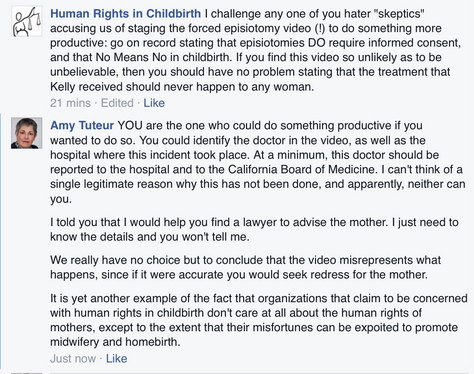
Later in the day, Hayes-Klein started to get a little panicky:

I challenge any one of you hater “skeptics” accusing us of staging the forced episiotomy video (!) to do something more productive; go on record stating that episiotomies Do require informed consent and that No Means No in childbirth.

My response:

YOU are the one who could do something productive if you wanted to do so. You could identify the doctor in the video, as well as the hospital where this incident took place. At a minimum, this doctor should be reported to the hospital and to the California Board of Medicine. I can’t think of a single legitimate reason why this has not been done, and apparently neither can you…

It is yet another example of the fact that organizations that claim to be concerned with human rights in childbirth don’t care at all about the human rights of mothers, except to the extent that their misfortunes can be exploited to promote midwifery and homebirth.

Of course, Human Rights in Childbirth is not a human rights organization. If it were it would it would have people on its advisory board who are trained in law, philosophy and human rights. Instead it is just a collection of homebirth midwives shilling for business. It is just like an other astro-turf organization. It claims to have a lofty purpose, but its true purpose is to increase market share and profits for homebirth midwives by fomenting distrust of obstetricians.

HRiC 3

I subsequently asked:

Tell me, Hermine, what do you and your organization actually DO to promote human rights in childbirth …? What lawsuits have you brought? What medical complaints have you filed? Who have you helped?

And that’s when Hermine Hayes-Klein went into full panic mode and started deleting comments and banning commentors. It suggests that she knows her decision to protect the identity of this doctor and her failure to file an official complaint against him are both indefensible. She is embarrassed, and rather than do the right thing and protect women from this doctor, she prefers to erase the evidence of her complicity in his continued freedom to treat other women the way he treated the woman in the video.

Deleting comments = consciousness of guilt.

So the first human rights scandal at Human Rights in Childbirth is the organization’s failure to protect the human rights of the woman in the video or, indeed, or any women at all.

The second scandal is that human rights in childbirth apparently does not include the right to free speech. In a classic authoritarian move, Hayes-Klein erased any evidence of her failures and silenced anyone who would dare question her.

Human Rights in Childbirth is a scam; Hermine Hayes-Klein is a hypocrite; and the true purpose of the organization has nothing to do with human rights and everything to do with increasing business for homebirth midwives by fomenting distrust of doctors.

Who would have guessed?

Why is Human Rights in Childbirth protecting the doctor in the so-called “Forced Episiotomy” video?

Portrait of doctor holding paper with question mark

On Wednesday I wrote about the latest meme to sweep the natural childbirth industry: obstetric violence.

Kim Lock, writing in Australia’s Daily Life, described a horrifying video:

…Earlier this year in California, during the birth of her baby, ‘Kelly’ has an episiotomy cut against her will. Human Rights in Childbirth shows Kelly, who had earlier disclosed to staff she had been raped twice in her life, flat on her back with her legs up in stirrups. Kelly clearly begs, “No, don’t cut me.” Despite her repeated protestations, and without any urgent medical reason, she is belittled by the doctor before he makes 12 cuts to her perineum.

I went to the website where the video is featured on its own page, Forced Episiotomy: Kelly’s Story.

Imagine my surprise to learn that Human Rights in Childbirth is protecting the doctor by refusing to reveal his identity!

The obvious question is WHY?

I had no reason to doubt the veracity of the video before I saw it. No one knows better than a physician that there are incompetent, negligent providers committing malpractice. There are multiple ways to rein them in: peer review, hospital discipline, the state Medical Board, and malpractice suits among others. I assumed it was going to show someone behaving negligently, if not committing outright malpractice. I assumed it was just another classic technique in the armamentarium of the natural childbirth industry (“Big Birth”): take an episode of malpractice and scare women by insisting that it is standard practice, widely embraced by obstetricians.

Now, having seen it, I’m not so sure it is real. The identity of all participants is deliberately blurred. You cannot tell if what you are hearing on the audio portion (and seeing in the captions) is actually being said by the people in the video. It is entirely possible that the audio portion was fabricated to make it look like it was a forced episiotomy when it was nothing of the kind.

That supposition is reinforced by the fact that Human Rights in Childbirth, after describing the violation in incredibly brutal detail is protecting the identity of the doctor who purportedly committed the brutal act. They expend nearly 3500 words discussing the video, and not one of those words reveals the identity of the doctor or the hospital where the incident took place.

Human Rights In Childbirth thinks this video has spectacular propaganda value. So why are they hiding the identity of the doctor and the hospital? If this really happened the way they say it happened, and if the audio is real and not added later, why are they afraid to show the doctor’s face or publicly identify him? If the doctor truly did what they accuse him of doing, why aren’t they publicly exposing him?

Why aren’t they shouting his name from the rooftops, challenging the hospital to discipline him and the Board of Medicine in his state to investigate him? Don’t they want to protect other women from this supposed violation?

Apparently they are afraid that they would be sued, yet why would they be sued if the situation is what they represent it to be? They wouldn’t.

The video shows a doctor who at the very least needs remedial training. He cut an episiotomy much too early and his “technique” was dreadful.

So why is Human Rights in Childbirth protecting HIM?

Big Birth takes a page from Big Pharma and creates a new disease that only they can treat

iStock_000000670080Small copy

Big Birth is the multi-million dollar business of the natural childbirth industry. It involves midwives, doulas, childbirth educators and lobbying organizations. It, like the anti-vax movement, climate deniers, and creationists has created an alternative world of internal legitimacy involving journals, conferences, and letters after names, not to mention blogs and message boards where true believers can never be challenged by actual scientists.

And because Big Birth is a business, it does what all businesses do; it aggressively markets its products in a constant battle for greater market share and more profits. In fact, in its marketing techniques it employs all the tactics of Big Pharma: grossly exaggerated claims of benefit, desperate efforts to hide bad outcomes, and aggressive efforts to besmirch the reputation of competitive products (in this case modern obstetrics).

An now it has taken a new step pioneered by Big Pharma. It has created a new disease that can only be treated by its products. Just like Big Pharma created the disease of “social anxiety” and proposed treating it with SSRIs like Paxil, Big birth has created the disease of “birth trauma” for which the only treatment is, you guessed it, the products and services of Big Birth.

How does Big Pharma create a new disease. Here’s how alternative health guru Dr. Larry Dossey explains it:

The trick [is] to inflate a common, everyday condition to the level of pathology, which, if not attended to, could blight one’s prospects for personal happiness and success.

Specifically:

• Taking a normal function and implying that there’s something wrong with it and that it should be treated

• Describing suffering that isn’t necessarily there

• Defining as large a proportion of the population as possible as suffering from the “disease” …

• Using statistics selectively to exaggerate the benefits of treatment

• Promoting the treatment as risk free

Those are the exact tactics that Big Birth is using to promote the disease of “birth trauma” to promote their own products and service.

Keep in mind that Big Pharma does not create the condition; the condition is real. Big Pharma merely pathologizes it and recommends a treatment that will add money to their coffers. Similarly Big Birth did not create the condition of fear, feelings of helplessness and disappointment that characterize the response of a small segment of women to childbirth. They have merely pathologized it, insisted that it must be treated, and promote a treatment that will add money to their coffers.

Birth trauma is a subset of the trauma occasioned by serious, life threatening illness, pain and feelings of helplessness. That form of trauma is experienced by many people who have felt helpless due to severe pain and frightened for their lives.

Most women are able to examine and integrate their feelings of agonized suffering and fear around childbirth and move on. A small segment are not, and they should be treated … by psychotherapists versed in the treatment of post traumatic stress syndrome.

But that won’t line the pockets of the midwives, doulas and childbirth educators of Big Birth, so they have responded just like Big Pharma would.

Read any natural childbirth book, website or message board and you will find copious references to “birth trauma.” It is now a full blown pathology; “lots” of women are suffering from it and if they are not, it’s only because they don’t realize they are suffering; obstetricians are advertized as the cause; unmedicated vaginal birth as provided by Big Birth is promoted as the cure; and the risks of forgoing obstetric interventions are ignored altogether.

It also explains why Big Birth denigrates anything other than unmedicated vaginal birth (since it can’t provide epidurals, or perform C-sections), and why it promotes unmedicated vaginal birth as “healing.” They’ve created the disease of “birth trauma”; they’ve insisted that anyone who doesn’t have an unmedicated vaginal birth has been traumatized by it, whether women feel traumatized or not; and they offer “healing” through purchase of their products and services.

Why should we care how Big Pharma and Big Birth market their products?

According to Dossey:

Why should we be concerned about disease mongering? There is a huge psychological burden in thinking of ourselves as diseased when we are not. Beyond the psychological cost, there are financial costs, both personal and social. Treating these “illnesses” with pharmaceuticals [or natural childbirth products and services] is not cheap…

How do we resist the tremendous marketing pressure brought to bear by both Big Pharma and Big Birth?

Dossey says:

The way forward may be in immunizing ourselves psychologically against the messages from Big Pharma [and Big Birth] that invade our lives on every hand. We have to learn to stop being suckers.

How? … [I]t may be that the best way to resist disease mongering is not to beat our heads against the fortress of Big Pharma, but to develop the psychological and spiritual maturity that makes us resistant to their efforts to instill fear and dread in our lives.

In the case of Big Birth, women need to immunize themselves psychologically against the messages from Big Birth that only unmedicated vaginal birth is a real birth, that they should feel traumatized by the interventions of modern obstetrics and that they have “failed” if they didn’t achieve and intervention-free, unmedicated vaginal birth.

It may be that the best way to avoid birth trauma is to develop the psychological and spiritual maturity that makes women resistant to the efforts of Big Birth to instill fear of modern obstetrics and dread of not achieving the natural childbirth idea.

We need to talk about obstetric violence: midwives are letting babies die

Letters A-Z and 1-10 dripping with blood on white background

Talk about bad timing!

Kim Lock has an opinion piece on obstetric violence in Australia’s Daily Life, on the same day that the Australian media is discussing yet another inquest into yet another series of homebirth deaths.

According to Lock:

A horrifying video recently appeared in my news feed. Earlier this year in California, during the birth of her baby, ‘Kelly’ has an episiotomy cut against her will. Human Rights in Childbirth shows Kelly, who had earlier disclosed to staff she had been raped twice in her life, flat on her back with her legs up in stirrups. Kelly clearly begs, “No, don’t cut me.” Despite her repeated protestations, and without any urgent medical reason, she is belittled by the doctor before he makes 12 cuts to her perineum.

Remove the crowning baby, gowns and masks, and put this same situation in another setting, what would we have? Sexual assault. Lawsuits. Worldwide outrage. And yet, because this occurred between hospital walls and beneath the gloved hands of a doctor, the woman remains powerless. As yet unable to find a lawyer who will take her case, Kelly has been told, “The problem is, you don’t have any damages. Your baby is fine and you are alive.”

“Remove the crowning baby, gowns and masks”?

In other words, only by taking this incident totally out of context can Lock make this into an episode of violence.

What’s a traumatic birth?

Australian organisation Birthtalk, describes traumatic birth, “A birth that you can’t let alone. It stays with you … It might not look ‘that bad’ to an outsider. It might not look ‘that bad’ to your partner … It could have been a caesarean or a natural birth. It might have taken 30 hours or 3 hours. A bad birth is defined by the way you feel, not just the events that occurred.”

In other words, there are no objective standards. That pretty convenient when you consider that Birthtalk produces the book How to Heal from a Bad Birth. A bad birth is whatever natural childbirth advocates want to pretend that it is.

Make no mistake, there is a problem with obstetric violence in contemporary childbirth care and it’s occurring at the hands of midwives. Midwives are letting babies die preventable deaths because “normal birth” is more important to them than whether babies live or die.

Consider the ongoing inquest into 3 preventable deaths at homebirth in Western Australia:

The traumatic hospital birth of a first child led a Perth woman to opt for a home birth with her second, the mother has told an inquest into her baby’s death.

The woman, who cannot be identified, gave birth to a boy at home in 2010 after a 40-hour labour assisted by two midwives.

The infant died in hospital from an infection and meconium aspiration two-and-a-half hours later.

The coroner is examining why the woman was not taken to hospital during the labour and what caused the baby’s infection.

In emotional testimony, the woman said she did not want to give birth in hospital because she had a traumatic experience with her first child and suffered from post-traumatic stress disorder.

She told the inquest she wanted to “maintain my own autonomy” and to have a support team around her.

When asked if there was anything that would have caused her to have a baby in a hospital environment, she replied: “If there was a clear pressing medical need, obviously I would have.”

But there WAS a clear pressing medical need, two in fact. The baby was infected with Group B strep and had aspirated meconium. Why didn’t this mother recognize these pressing medical needs? Because her midwives told her is was fine to ignore these warning signs.

A midwife has told the Perth coroner’s court the woman was not transferred to hospital during a home birth because it was not felt it was required.

One of the midwifes, Sally Westbury, gave evidence at the inquest today.

She rejected suggestions she should have transferred the woman to hospital much earlier.

Ms Westbury testified she talked to the mother and a back up midwife about going to hospital because of concern about the length of time since the woman’s membranes had ruptured.

However, Ms Westbury said because the mother was “afebrile” and “the baby was in good condition, it wasn’t felt that was required”.

She rejected suggestions that after the baby was born and the placenta had a bad smell, which indicated infection, she should have immediately transferred the woman to hospital, testifying that “observation” was the normal practice.

Ms Westbury also denied that her level of care was below what was expected, saying she “actually would do the same again”.

“Babies die in hospital in exactly the same circumstances,” she said.

This is pure ideological cant and it is killing babies who did not have to die.

The tragedy of this baby’s death follows the playbook of contemporary midwifery business generation to such an extent that it is practically a farce:

A “traumatic” first birth

A mother who wants to maintain her “autonomy

Multiple risk factors

Midwives determined to ignore those risk factors

A dead baby

Midwives who refuse to accept any responsibility

And the flourish of stupidity with which no story of midwife negligence is complete: the claim that babies die in the hospital, too.

The claims of obstetric violence toward mothers is part of an incredibly cynical plan to increase market share despite horrible outcomes. An unfortunate amount of contemporary midwifery practice is devoted to fomenting mistrust of obstetricians and hospitals. The plan has several critical aspects: the claim that obstetricians don’t follow the scientific evidence, the simultaneous (though totally opposite) claim that midwives don’t need to follow scientific evidence because they have “other ways of knowing,” and the demonization of obstetric treatment as “violence.”

Don’t get me wrong. I’m not claiming that hospital care is perfect. Although there is rarely any violence, there is a great deal of poor and disrespectful treatment. However, the chief victims aren’t Western, white, well off women; the chief victims are the elderly, people of color and those of lower socio-economic status.

Yesterday I wrote about the complete moral bankruptcy of UK midwives and the campaign of Birthrights to #FightFear of being held responsible for dead babies, so midwives can continue to promote “normal birth.” Not coincidentally, Hannah Dahlen, spokesperson for the Australian College of Midwives, was featured in both the Australian article about obstetric violence, and at the British conference organized to #FightFear. Yet on the day of the conference the British press was covering the appalling stillbirth rate that occurs at the hands of British midwives and could be halved by a simple ultrasound exam.

We need to talk about obstetric violence, but obstetric violence is very different from what midwifery marketers claim that it is. Obstetric violence is the chilling willingness of midwives to let babies die on the altar created to worship “normal birth.” Obstetric violence on the part of midwives comes from a desperate need to promote their own services regardless of whether or not those services are appropriate for an individual woman. Obstetric violence in midwifery is based on the notion that dead babies are a small and necessary price to pay for midwife autonomy and income.

The take home message is this: Birth is a business for midwives and the sole source of their income. They are willing to say and anything to maintain and increase market share;  prattling about “obstetric violence” while ignoring dead babies is just the most obvious manifestation of their obsession with themselves.

The real question about obstetric violence is how many babies will die because midwives, in an effort to promote themselves, sow fear of medical interventions and distrust of obstetricians? If the views of midwives are any indication, there will be no limit.

#FightFear: the hateful truth at the heart of UK midwifery

fight fear

What would you think of tobacco companies if they marketed cigarettes with a campaign entitled #FightFear? Why should people miss out on the pleasures of smoking just because they fear getting lung cancer, right?

Or how about beer companies promoting drunk driving with a campaign entitled #FightFear? Why should people miss out on the pleasures of partying just because they fear killing themselves and others while driving home drunk, right?

Disgusting? Yes. Hateful? Yes. Deadly? Absolutely!

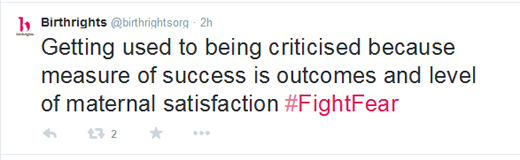
Not if you are a British midwife, apparently. The latest meme to hit the world of UK midwifery is #FightFear. Why should women forgo midwifery care just because they fear killing their baby? Why should midwives forgo promoting “normal birth” just because it leads to dead babies?

Think I’m exaggerating? Think again.

Check out the tweets emanating from a UK conference “Fighting the Fear: Providing positive maternity care in a litigation culture”:

fightfear1

fightfear2

fightfear3

The tweets are hardly surprising considering the nature of the conference. According to its sponsor Birthrights (motto: “Protecting human rights in childbirth”):

“Fighting the Fear: Providing positive maternity care in a litigation culture” offers a day of supportive discussion and reflection about fear of litigation, its impact on maternity care and strategies for overcoming it. We will hear from leading lawyers and midwives in constructive sessions designed to improve understanding, confidence and assertiveness in those who support women during pregnancy and birth…

Speakers include the typical apologists for crappy midwifery care:

… including Hannah Dahlen, Sheena Byrom, Mary Nolan, Alison Brown and Janet Sayers. Fiona Timmins will also join us in the afternoon to offer assertiveness training, with strategies specifically developed for midwives. We will be seeking, and expect to receive, RCM accreditation for the event.

How illuminating and tragic, then, is the juxtaposition of this conference of apologists for deadly midwifery care against the report detailing the hideous stillbirth rate in the UK.

LEADING experts are to tackle the country’s stillborn baby “scandal” which sees 17 infants die every day either near or shortly after birth.

The Royal College of Obstetricians and Gynaecologists is so alarmed at the death toll that next month it will launch a five year project to reduce the fatalities.

The government funded plan, “Each Baby Counts” will specifically aim to halve the number of preventable still births and cases of brain damage. Many of these have been linked to under staffed and overstretched maternity units together with poor quality care.

The first stage of the project will be to build a sophisticated data base of all still births and brain damage occurring during labour. This information will be analysed and the results used to develop national strategies to prevent future tragedies occurring.

The last comprehensive comparative study, a 2011 report carried out by the Lancet, put the UK well down the league table of 193 nations, including some of the world’s poorest countries, on a par with Belarus and Estonia.

It came 33rd of out the 35 high-income countries, with only New Zealand, Austria and France having higher stillbirth rates.

Many of these babies are dying because the midwives who care for them are so anxious to promote “normal birth” that they shun the interventions that would save their lives:

More than half of stillbirths in the UK could be prevented if the NHS implemented additional scans, a leading obstetrician has told Panorama.

Each year, more than 3,000 babies are stillborn in the UK, one of the worst rates in the developed world.

Prof Kypros Nicolaides says offering all women Doppler scans, which measure blood flow between the placenta and foetus, could save 1,500 babies a year…

Three-quarters of a million babies are born in the UK each year. One in 200 dies before birth, mostly to mothers with no known risk factors.

Many deaths are caused by a failure in the mother’s placenta – if the blood flow is abnormal, babies are starved of food and oxygen.

Often the problems occur towards the end of pregnancy, but, if identified, the baby can be monitored carefully and delivered by Caesarean before the placenta fails.

This can be spotted by a Doppler scan, but most hospitals use these only on the 15%-20% of women who are deemed high risk – as per national guidelines.

So let’s see if I get this straight: The UK has one of the worst stillbirth rates in the world and that stillbirth rate could be lowered dramatically by the use of regular ultrasounds even in low risk pregnancies. Meanwhile, UK midwives are worried not about the dead babies, but about the fact that efforts to save these babies will interfere with their mindless and deadly promotion of “normal birth.”

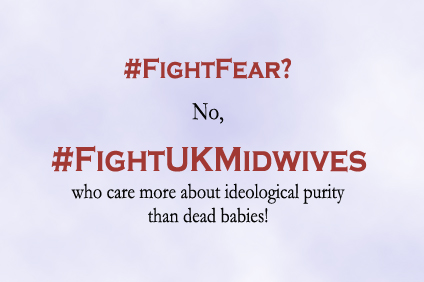
It seems to me that the problem isn’t fear. Fear is the ENTIRELY APPROPRIATE RESPONSE to preventable perinatal deaths. The problem is UK midwives who place ideological purity above the very lives of their tiny patients.

#FightFear should be replaced with #FightUKMidwives who are willing to let babies die in order to protect their professional ideology.