All posts by Amy Tuteur, MD

Anti-vaxxers, where did you get the idea I care about what you think?

BF1F55F4-A661-4039-925C-EA031C80FB53

Yesterday I expounded upon The extraordinary conceit of anti-vaxxers on my Facebook page:

When it comes to the benefits of vaccination, there is rare unanimity across scientific disciplines and across national borders. Nearly every immunologist in every country promotes vaccination as life saving and safe; nearly every pediatrician in every country recommends vaccination as the best, most effective form of preventive care in existence; nearly every epidemiologist in every government and health organization views vaccination as one of the greatest public health victories of all time.

[perfectpullquote align=”right” bordertop=”false” cite=”” link=”” color=”” class=”” size=””]No amount of attempted intimidation changes the fact that vaccines are safe and effective.[/perfectpullquote]

How conceited do you have to be to imagine that you, a lay antivaxxer, know better?

Very, very, very conceited.

It didn’t take long for the anti-vaxxers to appear at the behest of Stop Mandatory Vaccination.

Guys, Time to go and give your opinion to this OB nonsense.

87022A5C-DF6B-4801-AB5C-D6D1F0E8A58F

At the moment, there have been more than 2,300 comments on the post, most from anti-vaxxers.

Where did they get the idea I care what they think?

I don’t.

Anti-vaxxers, science is not a democracy. The belief with the most votes does not win. And no amount of attempted intimidation changes the fact that vaccines are safe, effective, and don’t cause non-specific “injuries.”

The Catholic Church tried intimidation on Galileo and it didn’t change the fact that the sun, not the earth, is at the center of the solar system.

A variety of the world’s religions tried intimidation on Charles Darwin and it didn’t change the fact that humans evolved and were not created de novo.

Semmelweis’ colleagues tried intimidation on him and it didn’t change the fact that doctors refusing to wash their hands spread disease.

Don’t get me wrong; I’m NOT saying that anti-vaxxers’ personal experience is irrelevant in medicine. In the aggregate, your experience is an important aspect of scientific evidence.

But anti-vaxxers personal BELIEFS are irrelevant! It doesn’t matter whether you think we evolved; we did. It doesn’t matter whether you think hand washing prevents disease; it does. And it doesn’t matter whether you think that vaccines aren’t safe and effective; they are.

I don’t doubt your sincerity. In the 16th Century ignorant, gullible people blamed demons for diseases they did not understand. They were extremely sincere in that belief. In the 21st Century you blame vaccines. You are equally sincere, but you are also equally wrong.

I’m not going to stop you from coming to my Facebook page to share your experiences and your “knowledge” (such as it is). If you want to preen before your equally ignorant anti-vax colleagues, have at it! But don’t be confused: I will never take you seriously when you don’t know a damn thing about science, medicine or statistics.

Get an education and then get back to me.

In the meantime your attempted intimidation won’t change the scientific evidence that vaccines are safe, effective and one of the greatest public health achievements of all time.

The frightening prognosis of breastfeeding dehydration

Wilted Flower on Black

A new paper in The Journal of Maternal-Fetal and Neonatal Medicine, Predictability of prognosis of infantile hypernatremic dehydration: a prospective cohort study sheds light on the outcome of newborn dehydration due to insufficient breastmilk. It highlights the severity of the problem, the risk factors and the prognostic signs.

I find it particularly interesting because it describes almost exactly the clinical course of babies like Landon Johnson, who died of breastfeeding dehydration, and the son of Dr. Christie del Castillo-Hegyi, who suffered permanent brain injury. Lactation professionals have insinuated or even denied that those babies suffered and died as a result of insufficient breastmilk. This paper makes it clear that it is the lactation professionals who are woefully (and often willfully) ignorant of what is going on around them.

[perfectpullquote align=”right” bordertop=”false” cite=”” link=”” color=”” class=”” size=””]17.5% of babies suffered permanent brain injury including 7% who died.[/perfectpullquote]

The authors start by acknowledging what lactation professionals refuse to admit — the risk of newborn hypernatremic dehydration is increasing:

The prevalence of hypernatremic dehydration has increased in recent years most likely due to insufficient intake of breast milk as the most important factor. Other influencing factors include: early discharge of mothers from hospital after delivery, inadequate training, awareness on breast milk insufficiency and improper breastfeeding technique, breast congestion, inverted, big or flat nipple, previous breast surgery …

As breastfeeding promotion efforts have become more aggressive, more babies are suffering the serious impact of insufficient breastmilk.

In contrast to the claims of lactation professionals, breastfeeding dehydration is NOT easy to diagnose:

Infantile hypernatremic dehydration (IHD) is a life-threatening medical emergency in which the intracellular water is sucked into the extracellular space due to sodium chloride hypertonicity usually induced by free water loss or administration of excessive sodium solutions. As a result, the intracellular volume is extremely decreased while the intravascular volume and skin turgor are maintained, resulting in difficulty in early diagnosis…

Why are babies so vulnerable to dehydration?

Following low milk intake in neonates, kidneys start sodium reabsorption and fluid retention; however, kidneys in neonates have a weaker ability of urine concentration compared to adults and hence water is not reabsorbed sufficiently. Besides, insensible fluid loss through the lungs as well as immaturity of neonatal skin can amplify dehydration and hypernatremia. Due to the gradual development of the disorder, the diagnosis is very difficult and dehydration is usually undetected. Accordingly, most infants are referred to the physician when neonatal complications such as decreased urination, lethargy, weakness or brain symptoms have already been presented.

Hypernatremic means high salt concentration and it is the high salt concentration that leads to brain injuries.

Long-term follow-up has shown that neurological disorders occur in approximately one-third of infants with hypernatremic dehydration. Also, developmental delay has been shown to occurs in cases with severe hypernatremia. Monitoring birth weight, breastfeeding position and frequency, and breast changes during breastfeeding as well as defecation and urination frequency are effective measures in early diagnosis of hypernatremic dehydration and controlling its complications.

In an effort to determine prognosis, the authors looked at the impact of dehydration on 183 babies. The results are frightening:

The 36-month follow-up of infants with hypernatremic dehydration showed that 32 (17.5%) out of 183 studied cases had abnormal outcomes, out of whom 14 cases have passed away during the follow-up and 18 cases were diagnosed with developmental delay.

Remarkably, these results were BETTER than results from previous studies:

The lower incidence of developmental delay in our study can be attributed to the larger sample size, the longer duration of follow-up, and/or the difference in measurement tool for the developmental status in our study.

There were notable difference between the babies who suffered serious long term effects and those who did not:

Hypernatremic dehydrated infants with unfavorable prognosis had been referred 4 days later than those with favorable prognosis…

According to the results of this study, hypernatremic dehydrated infants with developmental delay had serum sodium levels significantly higher (176 mEq/l) than those with the normal outcome (157 mEq/l). Also of 32 hypernatremic dehydrated infants with abnormal outcomes, 26 cases (81%) had a sodium level of 167–200 mEq/l.

In addition:

Convulsion was seen almost 5 times more (34%) in infants with unfavorable prognosis compared to those with normal prognosis (7%)… Consciousness impairments were observed in 32% of infants with unfavorable prognosis, but none were observed in those with normal prognosis. Cerebral edema was observed in about one-third of infants with unfavorable prognosis… Cerebral edema can be irreversible and hence fatal in some patients.

The authors conclude:

According to the results of this study, hypernatremic dehydration is a major problem with a common occurrence in the first 2 weeks of life that leads to unfavorable outcomes such as infant mortality (7%)… [C]ombination of variables such as sodium, urea, creatinine, lethargy, state of fontanels, convulsion, loss of consciousness, state of breast during postpartum, inverted nipple and brain CT scan had a high predictive power (98.6%) for determination of unfavorable prognosis in infants with hypernatremic dehydration.

Breastfeeding dehydration leads to grievous outcomes … and the ultimate tragedy is that nearly every single one of these tragic outcomes can be avoided simply and easily by supplementing with formula at the first sign of problems.

Breastfeeding ISN’T best for every baby. For some it is brain damaging and life ending.

An academic critique of contemporary breastfeeding promotion

18E69219-2DCC-4AB0-A9A0-916138076331

A new paper succinctly lays out the academic critique of contemporary breastfeeding promotion, and basically recapitulates most of the arguments I have been making for years.

The paper is Discourses and critiques of breastfeeding and their implications for midwives and health professionals by midwives Smyth and Hyde.

[perfectpullquote align=”right” bordertop=”false” cite=”” link=”” color=”” class=”” size=””]Current policies must change to reflect the truth — not the wishful thinking — about breastfeeding.[/perfectpullquote]

While the slogan ‘breast is best’ has historically been a truism in health promotion discourses internationally, in recent decades, criticisms have emerged that challenge the campaign for breastfeeding. In this article, we consider a number of strands in the debate, starting with discourses of breastmilk and breastfeeding used to promote breastfeeding and then move on to explore charges that the em- pirical support for breastfeeding is not as strong as breastfeeding advocates often suggest.

1. The benefits of breastfeeding have been overstated.

While official organisations collectively promote breastfeeding on the grounds of scientific evidence, the science behind the consensus of breastfeeding has been challenged. Wolf asserted that many research studies linking breastfeeding to improved health are weakly significant and often fail to control confounding variables that could affect the outcomes…

Indeed, the benefits predicted by breastfeeding researchers — that increased breastfeeding rates would lead to decreased infant mortality, severe morbidity and healthcare expenditures — have failed to materialize.

2. Bias in promoting breastfeeding

Parallel to the increase in research on the health outcomes of breastfeeding in biomedical literature, including less than strong evidence of its superiority, social science literature (predominantly) has criticised the pro-breastfeeding discourse as problematic and biased. A growing concern is that educational and promotional breastfeeding literature has become one-sided and more a tool for persuasion than education and replete with hyperbole (Wolf, 2011). Knaak raises the question ‘Are we educating or advertising?’ Foss noted how the media have been criticised for perpetuating the ‘myth’ of breastfeeding as a choice. Indeed, breastmilk has been so highly regarded in media discourse that it has been suggested that the result is an implied assumption that ‘breastfeeding is the only ethically acceptable option in infant feeding’.

3. Ignoring the harmful impact on many women

For the woman who experiences great difficulties in breastfeeding and for whom breastfeeding is a less than joyous experience, feelings of guilt and failure may provoke a crisis in her sense of self. Williamson [et al.] noted that women were often surprised by the difficulties faced when breastfeeding and experience anxiety, upset and damage to their self-worth when breastfeeding fails. Foss … [noted] that [“breast is best”] is ‘dripping with insinuation on a mother’s inferiority and attributions of blame for not breastfeeding’. In Símonardóttir and Gíslason’s study, women experienced difficulties and pain (often severe) when breastfeeding with negative consequences for their emotional well-being. The pressure to breastfeed was linked to postnatal depression by several women in the study and one described her experience of feeling constantly guilty and ‘like a terrible failure’ for ‘not being able to perform this simple task’.

4. Ignoring the impact on women’s economic and professional status

Law argues that breastfeeding serves to consolidate the maternal role in the home, exacerbates the gendered division of labour and negatively impacts on women’s participation in the workforce. This limits women’s choices and impedes their progress in paid employment, sustaining their economic dependency on men. Law (correctly) asserts that promotional material about breastfeeding fails to mention the negative outcomes of breastfeeding, including its impact on women’s economic position in society in the long run. While breastfeeding may be free at the point of delivery … the cost to women’s lifetime earnings because of their lost years in the workforce does not get toted up, and thus, they trail behind men in terms of power and privilege.

So the benefits of breastfeeding have been exaggerated, breastfeeding promotion is biased, and the harmful impact of breastfeeding on women’s mental health and economic status has been entirely ignored.

How are midwives supposed to counsel women when the Baby Friendly Hospital Initiative makes claims aren’t supported by the scientific evidence?

The fact that midwives and other health professionals may work in hospitals that are signatories to the Baby Friendly Hospital Initiative potentially places them in a difficult position, where their own critical assessment of the practice of breastfeeding may be silenced by the need to convey an official pro-breastfeeding position.

Current policies must change to reflect the truth — not the wishful thinking — about breastfeeding. It’s the mother’s baby, the mother’s body, and it ought to be the mother’s choice how to feed her infant, free from manipulation by healthcare professionals.

How do privileged mothers display their status if they can’t breastfeed?

58C45BA5-4701-407B-B078-122434149F76

Breastfeeding is a signifier of social status.

In every society the privileged attempt to distance themselves from those less fortunate. Privileged women adopt status displays that are costly, and therefore difficult for less privileged women to emulate.

For example, when poor people were thin because they didn’t have enough to eat, being overweight was a status display. When economics change, status displays change. Now when achieving and maintaining a thin, muscular body requires access to healthy food and gym memberships, being thin is a status display.

[perfectpullquote align=”right” bordertop=”false” cite=”” link=”” color=”” class=”” size=””]European formula and donor breastmilk allow privileged women who can’t breastfeed to still display their status.[/perfectpullquote]

Infant feeding is no different.

It is not a coincidence that in wealthy, industrialized countries breastfeeding is more common among those with higher socio-economic status because it requires the leisure time to do it. Women either need a partner to support them so they can stay home and breastfeed or a high paying, high status job that allows them time to pump and access to places where they can pump.

In contrast, in poor countries, where many women lack the financial resources to purchase formula, formula feeding is a status display and breastfeeding is a sign of poverty.

So what happens when privileged women cannot or do not wish to breastfeed?

There are two status displays being marketed directly to them: European formula and donor breastmilk.

Both, of course, are prohibitively expensive.

According to Yahoo Finance, domestic infant formula costs range from 9-32 cents per ounce. But that’s a fraction of the cost of domestic organic brands at $1.15 per ounce.

But those seeking status displays have turned to Europe for extraordinarily expensive formula that — in a status bonus — is difficult to access. European formulas, at $1.75 per ounce, are designer formulas.

A recent story on Parents explains:

To access European formula, American parents either need to know someone traveling overseas or order through a formula dealer.

Sure, you may be formula feeding, but by importing Holle or HiPP, you can distinguish yourself from those using Similac or, worse, the truly unfortunate mothers who must make do with store-brand formula.

Is European formula any better for babies? Not by any pediatric metric. It’s just more expensive and that is the point. It’s a status display because poor women have neither the money nor the time to access it.

But the best status display always costs the most. By that measure, sourcing and purchasing donor breastmilk truly sets you apart. It’s the bespoke equivalent.

Critically ill infants and premature babies get priority at most milk banks, but many will sell surplus milk to families whose babies aren’t hospitalized. However, it’s expensive and not always covered by insurance. For example, some milk from the Mid-Atlantic Mothers’ Milk Bank costs $4.50 per ounce, which adds up fast when babies eat as often as every two hours.

Yet there is no evidence that donor breastmilk provides ANY benefits for term babies.

The average baby drinks approximately 9000 ounces of milk in his or her first year.

Store-branded formula at 9 cents/ounce costs $820 for one year.
High end domestic formula at 32 cents/ounce costs $2,880 for one year.
Organic domestic formula at $1.15/ounce costs $10,350 for one year.
European formula t $1.75/ounce costs $15,750 for one year.
Donor breastmilk from a milk bank at $4.50/ounce costs $40,500 for one year.

There’s a price point for a broad range of status displays. Why pay $15,750 to import European infant formula for one year when you could pay $820 and get the exact same result? To display your status!

Infant feeding isn’t really about what’s best for babies; it’s about mothers and the curated image they present to their friends and on social media. Commiserating with other high status mothers over the laboriousness of importing European formula or accessing donor breastmilk is like fretting over the difficulty of finding good servants. It distinguishes you from those who are less well off and that is the point.

The classism and racism of the Academy of Breastfeeding Medicine’s embrace of bedsharing

newborn baby and mother sleeping together

The Academy of Breastfeeding Medicine is now on record as supporting the deadly practice of bedsharing.

The ABM just published a revision of its sleep protocol and it amounts to little more than special pleading for a practice that kills tens of thousands of infants a year (SIDS and suffocation).

It is a stunning violation of medical ethics, placing as it does a process (breastfeeding) over an outcome (safe babies).

[perfectpullquote align=”right” bordertop=”false” cite=”” link=”” color=”” class=”” size=””]The ABM’s principal “argument” is that while bedsharing is deadly, the babies of privileged white women are immune.[/perfectpullquote]

It is also a not so subtly classist/racist screed that focuses on distinguishing its core constituency — privileged, white women — from poor women, many of whom are women of color. Indeed, it’s principal “argument” is that while bedsharing is deadly, the babies of privileged white women are immune.

I suppose we shouldn’t be surprised that the ABM’s bedsharing protocol is unethical since its mission statement is unethical.

A Worldwide Organization Of Medical Doctors Dedicated To The Promotion, Protection, And Support Of Breastfeeding

Medical ethics requires supporting the health and wellbeing of PATIENTS, not processes. Perhaps lactation physicians initially believed their own marketing slogan, “breast is best.” But over the past 20 years, the scientific literature has made several things quite clear:

1. Breastfeeding is NOT best for every baby and every mother
2. Aggressive breastfeeding promotion has such significant risks that exclusive breastfeeding has become the LEADING cause of newborn re-hospitalization
3. Lactation professionals have encumbered breastfeeding with multiple onerous practices that are dangerous and ironically don’t increase breastfeeding rates

Now, the ABM is adding its tacit blessing to a practice that is deadly. Why? Because it purportedly “supports” breastfeeding:

Overall, the research conducted to date on bedsharing and breastfeeding indicates that nighttime proximity facilitates breastfeeding duration and exclusivity… Existing evidence does not support the conclusion that bedsharing among breastfeeding infants (i.e., breastsleeping) causes sudden infant death syndrome (SIDS) in the absence of known hazards. Larger studies with appropriate controls are needed to understand the relationship between bedsharing and infant deaths in the absence of known hazards at different ages.

If we break down the careful language, we are left with this:

Nighttime proximity is associated with breastfeeding; causation is unproven. It seems that the babies of privileged women are at lower risk. We don’t really know for certain.

No matter.

The ABM’s justification for its unethical stance is rationalized in two ways: anthropological and classist/racist.

The anthropological rationale is — not to put too fine a point on it — academic bullshit:

The concept of “breastsleeping” was proposed to describe a biologically based model of sustained contact between the mother and infant, starting immediately after birth, in which sleeping and breastfeeding are inextricably combined, assuming no hazardous risk factors. Described in cultures around the world, the breastsleeping mother and infant feed frequently during the night while lying in bed together, and by morning, the mother may not recall how many times she fed or for how long… The behavior and physiology of breastsleeping dyads may be different from that of bedsharing nonbreastfeeding dyads, signifying that the safety assessments for bedsharing with breastfeeding versus feeding human milk substitutes likely require different approaches.

When was breastsleeping first described? In ancient Egypt? In the Middle Ages? By anthropologists in the early 20th Century? No, no and no.

It seems that breastsleeping was first described in 1992 by — surprise! — a lactation professional. As far as I can determine, it does not appear in the anthropology literature to this day, although many of the lactation professionals who promote it are anthropologists by training.

The classist/racist special pleading is even more disturbing.

The ABM acknowledges that bedsharing dramatically increases the risk of infant death but rationalizes a special standard for the babies of privileged women, by and large white women. Indeed throughout the protocol there are strenuous attempts made to distinguish privileged white women from everyone else.

SIDS is most common among low-income and some marginalized communities in wealthy countries, with the world’s highest prevalence of SIDS occurring among U.S. American Indians/Alaskan Natives (combined) and non-Hispanic blacks …

And:

These are factors that increase the risk of SIDS and fatal sleeping accidents, either alone or when combined with bedsharing.
• Sharing a sofa with a sleeping adult (“sofa-sharing”)
• Infant sleeping next to an adult who is impaired by alcohola or drugs
• Infant sleeping next to an adult who smokes
• Sleeping in the prone position
• Never initiating breastfeeding
• Sharing a chair with a sleeping adult
• Sleeping on soft bedding
• Being born preterm or of low birth weight

Wealthy white women don’t sleep on sofas. Wealthy white women don’t smoke. Wealthy white women have a low rate of preterm birth. I could go on, but you can probably see the pattern.

The ABM concludes:

Accidental suffocation death is extremely rare among bedsharing breastfeeding infants in the absence of hazardous circumstances …

That’s just another way of saying “accidental suffocation death is rare among breastfeeding infants of privileged white mothers.”

And for the Academy of Breastfeeding Medicine, privileged women and their babies seem to be the only ones who count.

Breastfeeding as a signifier of social status

status - name from wooden letters. Office desk, informative and

The benefits of breastfeeding for term babies in industrialized countries are trivial. So why is there is panic around breastfeeding rates? Because breastfeeding functions as a class signifier. It’s not about what a baby needs; it’s about a mother and how she wishes to present herself to other women.

I’m not the only person who thinks so. A new paper, When is the breast best? Infant feeding as a domain of intrasexual competition, makes a similar case.

[perfectpullquote align=”right” bordertop=”false” cite=”” link=”” color=”” class=”” size=””]Dominant women adopt displays of status that are costly and thus difficult or impossible for lower-status women to emulate.[/perfectpullquote]

[B]reastfeeding or not breastfeeding can serve as a means of displaying status within the context of intrasexual competition. We argue that dominant (i.e., wealthy) women are likely to adopt … displays that are costly and thus difficult or impossible for lower-status women to emulate.

What do they mean by intrasexual competition?

…[W]omen (and/or their families) pay a dowry to their husband upon marriage in highly stratified societies… This is suggested to be a domain of female competition as it is a method to acquire a wealthy husband. Essentially, the higher the dowry … the more likely a woman will acquire a wealthy husband. An- other example of female competition that is observed in wealthy modern societies in dressing in the latest fashion trends and purchasing luxury items which depicts a woman’s wealth and can therefore threaten rival women.

It’s all about women competing with each other for reproductive success.

How does breastfeeding function as a form of intrasexual competition?

We argue that the changes in who breastfeeds under different environmental pressures can help shed important light on the possible evolutionary motives underlying of women’s competitive, reproductive, and breastfeeding choices.

In modern, wealthy countries:

…[W]ealthier and/or more educated mothers tend to have higher rates of breastfeeding than their less wealthy/educated peers… Lower-income mothers in these countries tend to acknowledge the superiority of breastfeeding over formula, but refer to a lack of social and/or financial support (i.e., an inability to stay home from work) as important reasons for why they do not invest as much in their infant via breastfeeding… [B]reastfeeding may be an evolutionarily honest (i.e., costly and hard to fake) signal of a woman’s ability to invest in her child relative to other women.

But in developing countries, the opposite is true:

…[W]omen in developing countries reported that the use of infant formula is viewed as more prestigious and breastfeeding is associated with poverty. In other words, providing formula may be a social signal of a mother’s prestige and wealth in developing countries because the aforementioned cost of infant formula and the scarcity of good water serve as honest signals of a woman’s capacity to invest in her offspring.

How about pre-modern cultures?

..[T]he invention of resource inequalities allowed some women to replace their own milk with that of other mothers… the outsourcing of breastfeeding was a relatively common strat- egy among wealthier historical women in Europe and Japan (Badinter, 2012). Thus, in contrast to some general suggestions that wealthy women will generally choose to invest heavily in their offspring, there is evidence that some wealthy women have historically done the opposite …

All these cases represent a departure from the behavior of hunter-gatherer cultures where all children were breastfed by their mothers.

What has led to the changes? Intrasexual competition.

What should be a simple decision to provide one’s child with the best nutrition available instead becomes both a decision about life history resource allocation (e.g., sacrificing time, energy, and future employment opportunities) and a statement to other women about one’s capacity to make those sacrifices to make one’s child more competitive…

In contrast, in less developed and/or in historical societies, women may be able to outcompete other women via fecundity if they possess sufficient resources. Not breastfeeding one’s infant for a prolonged period removes lactational amenorrhea, allowing for a reduced interbirth interval. If a wealthy mother can afford a reasonable substitute for breastmilk (e.g., formula or wet nurses), then she can increase her relative reproductive success by physically investing less in each infant and instead investing in having more offspring.

The authors conclude:

The extant literature of the historical and cross-cultural (specifically developed vs. developing countries) practices of breastfeeding provides important insights into women’s decisions of whether or not to breastfeed. From a feminist perspective, the variation in breastfeeding practices highlights the agency of women in controlling their own body for their own benefit (albeit through their offspring)…

Instead of insisting “breast is best,” we should be supporting women to make the choice that is best for them and their family.

Although it may be impossible to completely eliminate evolutionarily predisposed comparisons of who is a better mother/woman, or whether/when breast is the best, we would much rather see individual and societal energy focused on supporting informational and practical practices that help women freely choose the best options for themselves and their infants.

Her baby, her body, her breasts, HER choice!

Milk Matters UK, did Baby H ever have a tongue-tie?

2EF232F7-F1C1-47F4-8A6B-F9BF914A3F36

The principle is called Occam’s Razor.

It is sometimes paraphrased by a statement like “the simplest solution is most likely the right one” …

The Wikipedia article notes that possible explanations can become needlessly complex.

It might be coherent, for instance, to add the involvement of leprechauns to any explanation …

Those complex explanations are — revealingly — saving hypotheses.

These are special purpose hypotheses that are typically used to save a theory from being falsified by an observation.

For example, when you find your preschooler next to a vase that has fallen off a table, you will likely conclude that the preschooler knocked the vase over. The preschooler, however, may insist that bad men broke into the house, threw down the vase, and left; he was just trying to save the vase from the bad men. The principle of Occam’s Razor means that the simpler explanation (the preschooler knocked over the vase) is far more likely than the elaborate yarn he has spun.

[perfectpullquote align=”right” bordertop=”false” cite=”” link=”” color=”” class=”” size=””]The simplest explanation — insufficient breastmilk — explains everything every step of the way.[/perfectpullquote]

Similarly, the principle of Occam’s Razor suggests that the elaborate yarn Milk Matters UK has spun about starving Baby H is unlikely compared to the simple explanation that the baby starved because of insufficient breastmilk.

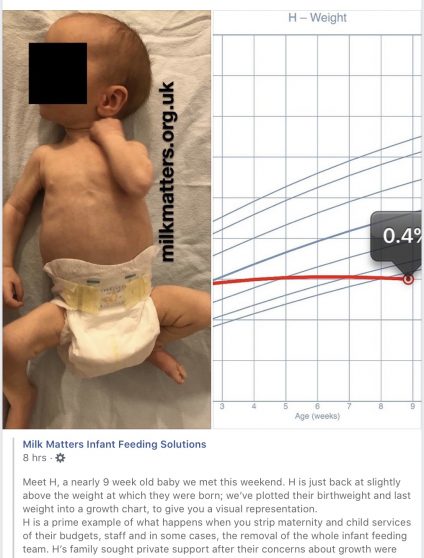
I wrote about Baby H last week. According to Milk Matters UK, the organization run by lactation consultant Charlotte Young (the Analytical Armadillo):

Meet H, a nearly 9 week old baby we met this weekend. H is just back at slightly above the weight at which they were born; we’ve plotted their birthweight and last weight into a growth chart, to give you a visual representation …

How did this horror happen?

[O]ne midwife noted some concerns and suggested a feeding group, where they were told to stop expressing and supplementing, relax and just “feed feed feed”. Seen weekly at jaundice clinic, reluctant to weigh but did after mum pressure, no concerns noted.

Baby H starved for 9 weeks because no one dared admit that he was getting insufficient breastmilk and therefore no dared give him the infant formula he desperately needed. Apparently the mother intermittently ignored the professionals and fed the baby formula from a bottle.

MMUK prefers a much more elaborate explanation, one that markets their lucrative service (at $280/hour) of tongue-tie surgery. They diagnosed Baby H with tongue-tie and treated it.

What does Occam’s Razor tell us?

The simplest explanation is that Baby H was suffering because his mother had insufficient breastmilk and no healthcare professional was willing to admit it. The more complex explanation, favored by MMUK, is that the baby had a tongue-tie that made it impossible for him to take in adequate nutrition by breast or bottle. That multiple medical professionals examined the baby and no one noticed this tongue-tie. That the mother failed to notice that the baby was not able to drink from a bottle.

According to MMUK, their treatment was “successful”!

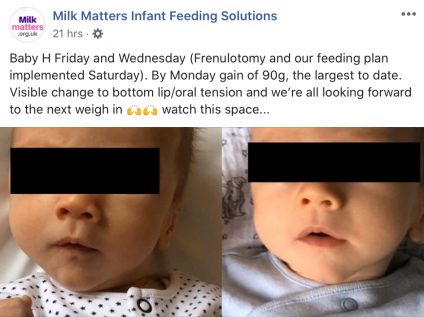
They posted these “before and after” photos:

F2D1204C-599F-4731-BB26-5F0F4D54E6EE

But these photos don’t show that the baby had a tongue-tie or that the “treatment” fixed anything.

Why are there no pictures of the tongue-tie itself?

The simplest reason is that there was never any tongue-tie and pictures of the baby’s mouth before and after would make that clear. MMUK has offered no explanation as to why they failed to show the “tongue-tie” that multiple other medical professionals ostensibly missed.

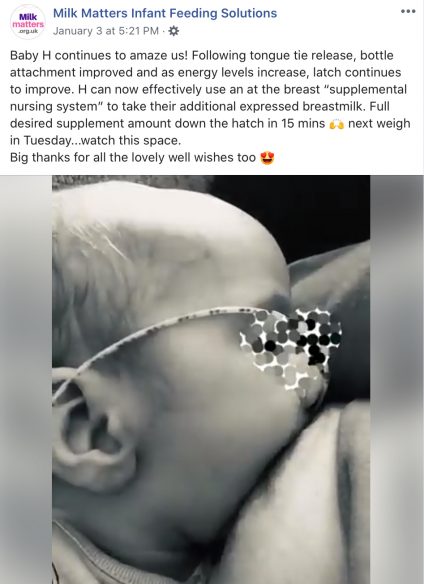
Instead MMUK posted a looping 2 second gif of the baby breastfeeding.

F96445AE-6517-447B-9F01-5B39A5A2920C

The baby is wearing an SNS (supplemental nursing system) designed to provide milk when the mother has insufficient breastmilk.

But why would a baby who supposedly had successful tongue-tie surgery need formula supplementation?

The simplest answer is that the problem all along was insufficient breastmilk.

That’s what I noted in a post on my Facebook page:

No evidence has ever been presented that this baby had a tongue-tie, needed expensive surgery, or benefited from it.

Indeed, it appears that the problem was — and still is — insufficient milk supply.

MMUK responded:

The milk is mum’s expressed milk, she can express oodles as this isn’t her first rodeo and actually has oversupply.

Really? If the mother has an oversupply of breastmilk, why is the baby being supplemented WHILE breastfeeding?

An MMUK partisan offered this bizarre explanation:

A baby who has been unable to feed because of severe restriction will not have the energy to nurse for as long as required in order to gain weight, hence why continued supplementation is recommended until back to full health.

If the baby does not have energy to nurse effectively (though the video shows the baby nursing vigorously), the answer is to supplement the baby through a bottle. It shouldn’t take long (hours not days) for the baby to be able to nurse effectively.

What does Occam’s Razor tell us about the cause of Baby H’s starvation?

The simplest explanation is insufficient breastmilk. It explains everything at every step of the way.

But that won’t sell MMUK’s services.

The preferred MMUK explanation is a tongue-tie that multiple medical professionals failed to diagnose and for which there is no documentation. The baby was “cured” but still has problems nursing despite the “cure.” The baby is being supplemented at the breast even though the mother has oversupply.

Which sounds more likely?

Illogical lactivist arguments

E70E8CEC-A6B2-4315-81F2-498368E7179F

Lactivists seem to have a lot of difficulty with basic reading comprehension. No matter how firmly I write — no matter how blunt I am, no matter how small and simple the words I use:

“I believe X.”

lactivists routinely respond with:

“So what you’re saying is Y.”

No, if I wanted to say Y, I would say it and I didn’t say it.

Part of the problem is that lactivists love the strawman fallacy:

You misrepresented someone’s argument to make it easier to attack.
By exaggerating, misrepresenting, or just completely fabricating someone’s argument, it’s much easier to present your own position as being reasonable, but this kind of dishonesty serves to undermine honest rational debate.

It’s very difficult to rebut most of the arguments I make about breastfeeding. That’s why lactation professionals don’t even bother to try. Lay lactivists strenuously attempt to misrepresent my arguments instead since it is easier to rebut the misrepresentations.

[perfectpullquote align=”right” bordertop=”false” cite=”” link=”” color=”” class=”” size=””]If p then q; if not q then not p.[/perfectpullquote]

But the bigger problem for most lay lactivists is that they don’t understand basic logic. They don’t understand how conditional statements, (if p then q), are constructed and what they mean.

The most common conditional statement I make, the one that undergirds most of what I write about breastfeeding is this:

IF breastfeeding had the benefits claimed for it (If p)

THEN we should see a drop in term infant mortality, severe morbidity and healthcare costs when breastfeeding rates rise. (then q).

According to the rules of basic logic, if the conditional statement (if p then q) is true the contrapositive (if not q then not p) is also true.

The contrapositive is this:

IF we don’t see a drop in term infant mortality, severe morbidity and healthcare costs when breastfeeding rates rise (Not q)

THEN breastfeeding doesn’t have the benefits claimed for it. (then not p).

It’s pretty simple: If p then q. If not q then not p.

It’s basic logic.

Instead of responding to the straightforward argument, lactivists prefer bizarrely illogical claims.

1. You hate p! (You hate breastfeeding!) I don’t, but even if I did, that doesn’t change the truth of the underlying statements.

2. Corporations profit from r! (Corporations profit from formula!) Maybe so, but r has nothing to do with if not q then not p. The fact that companies profit from formula does not change the fact that if the predicted benefits of breastfeeding don’t occur, then breastfeeding doesn’t have those benefits.

3. You’re being paid by the folks from r! (You are being paid by formula companies!) This is just a variation of 2. I’m not being paid by anyone, but even if I were, that would not change the fundamentals of basic logic: if p then q; if not q then not p.

4. You want everyone to use r! (You want everyone to formula feed). This is yet another variation of 2. It’s particularly illogical. Why should I care? I breastfed my four children. It also tells us nothing about p and q.

5. But 100% of women aren’t engaged in p! (But not all women breastfeed!). Makes no difference. If p then q does not require a specific proportion of people to be engaged in p.

6. But the World Health Organization says p always leads to q! (But the WHO says breastfeeding has lots of important benefits!) Basic logic is not dependent on authorities and can’t be changed by the pronouncements of authorities.

7. But I love p! (But I love breastfeeding!) Maybe so and perhaps p is a significant source of self-esteem because you believe if p then q. But that doesn’t change the rules of basic logic, either.

The bottom line is pretty simple: if p then q; if not q then not p. If we can’t find the benefits claimed for breastfeeding, it doesn’t have those benefits.

If you want to rebut my arguments, you need to find evidence that the predicted benefits of breastfeeding actually occur when breastfeeding rates rise in large populations.

If you wail that I hate breastfeeding or that the WHO claims breastfeeding has benefits, or that I must be on the take from formula companies you haven’t merely failed to rebut my argument, you’ve failed to understand basic logic.

Newborn tongue-tie: follow the money!

09C812D7-38E4-44EC-94CF-2D990011EDB0

Earlier this week I wrote about a baby suffering from breastfeeding starvation for 9 weeks.

The poor baby — living in a country where copious infant formula and the clean water to prepare it are easily available — nonetheless looks like a famine victim. His arms are stick thin and his ribs are showing.

C6817E07-AB74-495D-A560-B51117B0B652

The baby is a victim of the torture known as breastfeeding promotion. Lactation professionals have put their beliefs and goals ahead of the wellbeing of babies.

[perfectpullquote align=”right” bordertop=”false” cite=”” link=”” color=”” class=”” size=””]Why no pictures of the tongue-tie? Could it be that the baby didn’t have one?[/perfectpullquote]

As Milk Matters UK the organization run by lactation consultant Charlotte Young (the Analytical Armadillo) acknowledged, the baby’s mother had frantically consulted multiple NHS professionals (and possibly private professionals as well) for weeks. Despite this, the baby was DENIED the EMERGENCY TREATMENT — food — he needed to relieve his ongoing torture. It would have been incredibly easy to give this baby formula either by bottle or by NG tube if he couldn’t suck effectively.

Instead, professionals exploited this baby to promote their philosophical goals.

[O]ne midwife noted some concerns and suggested a feeding group, where they were told to stop expressing and supplementing, relax and just “feed feed feed”. Seen weekly at jaundice clinic, reluctant to weigh but did after mum pressure, no concerns noted.

The baby continues to be exploited, now by Milk Matters UK, attempting to market their expensive services. If you have any doubts about their priorities, their Facebook page helpfully leads with the services:

59D826B7-B654-4F0F-8F27-744935FC57E9

Their primary, and apparently most lucrative service (at $280/hour) is the diagnosis and treatment of tongue-tie … and this baby received the diagnosis and treatment.

In case you think this isn’t about marketing their lucrative services, just 6 hours ago, Milk Matters UK edited the post to highlight the diagnosis of tongue-tie and to claim — deceptively — that the baby was not exclusively breastfed. The professionals INSISTED that the baby should be exclusively breastfed; the mother intermittently ignored them (and by so doing may have saved the baby’s life).

Milk Matters UK posted pictures taken at the the follow up appointment (almost $100 for 30 minutes).

Did anyone notice what they haven’t posted? There are no pictures of the supposed tongue-tie and no pictures of the results of treatment.

Why not?

Could it be that the baby didn’t have a visible tie and didn’t need any treatment, let alone surgery?

If so, it would hardly be the first time. A recent study in JAMA Otolaryngology found nearly two-thirds of cases (62%) of tongue-tie surgeries recommended by lactation consultants are unnecessary.

The press release explains:

Despite a lack of medical literature linking the surgery to improved breastfeeding, the number of these procedures has been rapidly rising in recent years, the authors point out, noting that the Kids’ Inpatient Database in the United States estimated a 10-fold increase in tongue-tie surgeries from 1,279 in 1997 to 12,406 in 2012…

The researchers examined 115 newborns who were referred to the clinic for tongue tie surgery with a pediatric ENT. There, each mother-newborn pair met with a pediatric speech-language pathologist, who performed a comprehensive feeding evaluation including clinical history, oral exam and observation of breastfeeding. They then offered real-time feedback and strategies to address the hypothesized cause of their breastfeeding challenges.

Following the multidisciplinary feeding evaluation, 62.6 percent of the newborns did not undergo the surgeries.

And even among the babies who did ultimately need surgery, nearly all were misdiagnosed or underdiagnosed by the referring lactation consultants:

Although all of the referrals were for tongue tie surgery specifically, 10 (8.7 percent) underwent a lip tie surgery alone and 32 (27.8 percent) underwent both lip and tongue tie surgery.

This is a dramatic example of the fact that breastfeeding is an industry that seeks to increase their profits by lucrative “diagnosis” of breastfeeding problems. To a hammer, everything looks like a nail. To a lactation consultant, everyone looks like they can benefit from breastfeeding “support” and “treatment.”

New parents should know that the diagnosis of tongue-tie has exploded without any evidence that the underlying rate of tongue-tie has changed. Most studies have not yielded objective evidence that surgery improves breastfeeding and most babies recommended for surgery by lactation consultants do not need it.

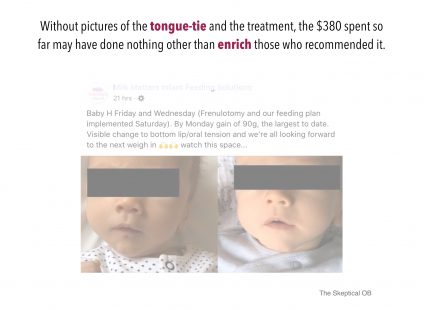
As for Milk Matters UK, without pictures of the supposed tongue-tie and pictures post treatment, there’s no reason to believe that the $380 spent so far did anything other than enrich those who recommended it.

Lactation professionals are harming babies … and they KNOW it

6BD6EDB2-6096-4BB6-A27B-E130CFAD61A9

I came across an extraordinary Facebook post yesterday.

It is extraordinary for four reasons:

1. A baby has been starved nearly to death in an effort to promote breastfeeding.

According to MilkMattersUk, the organization run by lactation consultant Charlotte Young (the Analytical Armadillo):

Meet H, a nearly 9 week old baby we met this weekend. H is just back at slightly above the weight at which they were born; we’ve plotted their birthweight and last weight into a growth chart, to give you a visual representation….

How did this horror happen?

[perfectpullquote align=”right” bordertop=”false” cite=”” link=”” color=”” class=”” size=””]Leah Drexler, Yashed LC, PRIVATELY acknowledges babies are starving, but PUBLICLY denies it.[/perfectpullquote]

“[O]ne midwife noted some concerns and suggested a feeding group, where they were told to stop expressing and supplementing, relax and just “feed feed feed”. Seen weekly at jaundice clinic, reluctant to weigh but did after mum pressure, no concerns noted.”

The baby was starving to death because healthcare providers apparently believed their own lies that insufficient breastmilk is rare and that all breastfeeding problems can be solved by breastfeeding harder.

Think — just for a moment — about the suffering this baby endured. He was forced to cannibalize his own body to survive 9 solid weeks of hunger.

2. Lactation professionals — who are responsible for this horror — posted the evidence because they want more MONEY.

H is a prime example of what happens when you strip maternity and child services of their budgets, staff and in some cases, the removal of the whole infant feeding team. H’s family sought private support after their concerns about growth were persistently dismissed, but never mind falling through the cracks, we’re falling off cliffs!

How could anyone be so willfully blind? This baby starved for 9 weeks because aggressive efforts to promote breastfeeding have already received TOO MUCH funding. There was no lack of support; there was TOO MUCH support for breastfeeding and not enough compassion for the suffering baby. But this — like every breastfeeding tragedy — is viewed by lactation professionals as an opportunity to promote themselves and their incomes.

3. Lactation professionals are aware that it happens ALL THE TIME and aren’t doing anything to stop it.

Look at these posts from the Facebook group LACTWORLD, a group run by Yashed LC (Leah Drexler), commenting on this starving baby.

5DF7B425-9B89-4968-80B2-C21959CFB047

1. These are the reasons Fed Is Best exist — as much as I hate it, first we have to prevent this from happening systematically
2. Yes we have colleagues guilty of perpetuating this and even whole health systems that desperately need to be remediated
3. These are the things that make me rate in my own outpatient/Peds clinical practice …

So lactation professionals KNOW that this is happening, see it in their own practices, are aware that even WHOLE HEALTH SYSTEMS are causing this. The follow up comments in the thread reveal other lactation professionals acknowledging infant starvation.

4. But the MOST remarkable thing about the hideous suffering that this baby endured is that Leah Drexler, who just privately acknowledged that this happens all the time went on record only 10 weeks ago PUBLICLY DENYING that infants are starving under the care of lactation professionals.

As I noted on Oct. 13, Drexler was asked by lactivists to comment on a Fed Is Best Facebook post.

Fed Is Best quoted a mother:

My baby cried for over two days in a row in the baby friendly hospital… It was just starvation. It breaks my heart to remember that.

Leah Drexler — the same LC who PRIVATELY acknowledges “we have colleagues guilty of perpetuating this” — PUBLICLY said:

STARVING KIDS DON’T HAVE ENERGY TO CRY STRAIGHT FOR DAYS IN A ROW.
They stop crying by the second day and start sleeping way. Too. Much. That’s when the high bilirubin sets in.

There’s many thing that could make a child cry continuously after birth, but lack of calories to expend is not one of them.

Kids that truly aren’t getting any food by day 2-3, you can barely get them to open their eyes …

Drexler and other lactation professionals PRIVATELY acknowledge that they are harming babies, but PUBLICLY gaslight the mother reporting the harm and the Foundation trying to stop it.

How can they live with themselves?