All posts by Amy Tuteur, MD

Defensive mothering

Last week I wrote about how contemporary societal beliefs about risk lead to defensive medicine.

There have always been risks, of course, but they have traditionally been viewed as outside the control of human beings. The risk society has arisen because of new beliefs that we can and (especially) that we should control every aspect of risk…

What does this have to do with defensive medicine? Consider that in our risk society we are supposed to reduce our risk to zero. How do we do that? We do that by acting to reduce risk regardless of how small the risk might be.

Defensive medicine is a direct result of our societal beliefs about risk, but doctors are not the only ones whose stance has become defensive in response. In our risk society we have come to believe that mothering itself is about managing risks. Ironically, those most obsessed with risk belong to the “natural” mothering crowd. In fact, it is hardly an exaggeration to say that “natural” mothering is really “defensive mothering” at the extreme. And natural childbirth is no exception.

Joan Wolf, in a fabulous new book entitled Is Breast Best?: Taking on the Breastfeeding Experts and the New High Stakes of Motherhood explains that in a society obsessed with risk:

… In a risk culture, when virtually everything from conception through childbirth can ostensibly be either controlled or optimized, nature becomes a beacon …

But nature, apparently, is just as obsessed with reducing risk as doctors are with reducing liability. While natural childbirth advocates claim to reject science as the primary lens through which we should view childbirth:

In natural mothering advice … the virtues of nature are filtered by science and expertise and much of what opponents of medical intervention champion is less a rejection that a selective embrace of scientific authority. Natural childbirth and parenting are mediated by classes and experts, and books are written by authors whose credentials are prominently displayed next to their their names.

The advice dispensing Sears’ family is paradigmatic examples. Father and son (William and Bob) are pediatricians and mother (Martha) is a nurse. While the Sears’ claim to disavow the belief that experts know more about parenting than parents:

The eponymous Sears Parenting Library … is itself an example of the expert culture that that infuses the discourse of total motherhood … The back cover of The Baby Book seeks to establish Sears as an authority in pediatric science. He and his wife are “the pediatrics experts to whom American parents are increasingly turning for advice and information …

So much for trusting your intuition.

Not only do Sears’ books position him as a scientific expert, he, too, is obsessed with risk. After identifying a seemingly interminable list of risks posed by various maternal behaviors:

…Sears and Sears suggest that even hypothetical risks should be avoided… The Sears state that “there is no pain-relieving drug that has ever been proven to be totally safe for mother and baby” in childbirth. But this is true, without exception, of every drug and consumer on the market; no medication has ever been shown to be completely safe for anyone…

Moreover:

Sears and Sears selectively employ science in ways that exacerbate public misunderstanding of risk. They ignore costs and trade-offs, and they hold decision making in pregnancy to an impossible standard. In embracing the notion that mothers are responsible for elimination all conceivable risks to their children, natural mothering furthers an ideology of total motherhood that is fundamentally similar to more mainstream approaches.

… Pregnancy in total motherhood literally embodies the essence of risk culture: the hyperawareneness of potential danger, the illusion of control, and the conviction that proper planning can eliminate risk…

Total motherhood is really defensive motherhood because:

[It] stipulates that mothers’ primary occupation is to predict and prevent all less-than-optimal social, emotional, cognitive and physical outcomes; that mothers are responsible for anticipating and eradication every imaginable risk to their children, regardless of the degree or severity of the risk or what the trade-offs might be; and any potential diminution in harm trumps all other considerations …

Sound familiar? It ought to, because that is the rationale for defensive medicine, the expectation that obstetricians must anticipate and eradicate every imaginable risk regardless of severity or what the trade-offs might be.

When we, as a society, become obsessed with risk, everyone is forced to behave defensively, not just doctors. That’s why solution to defensive medicine does not lie with doctors, it lies with all of us. Defensive medicine is not the only, or even the worst, manifestation of our obsession with risk. Defensive mothering is far more pervasive, entirely unrecognized, and is having a far greater impact on our children and ourselves than defensive medicine ever could.


Salon withdraws infamous vaccine article

Ordinarily I’d say, better late than never. In this case, though, all the damage has already been done.

I’m referring to the decision of Salon.com to withdraw its infamous 2005 piece written by Robert F. Kennedy, Jr. and alleging that thimerosol in vaccines had caused neurological damage in children and that a vast conspiracy had covered it up.

Why did they withdraw the article? Because it was flat out false, had been flat out false at the time it was written, represented the unsubstantiated musings of a celebrity who was in no way qualified to analyze vaccine safety, … and oh, by the way, one of their former writers has just published a book containing an entire chapter on the fact that Salon.com had broken just about every rule of professional journalism in publishing it.

Unfortunately, Salon.com continues to offer weasel words in its defense:

The piece was co-published with Rolling Stone magazine — they fact-checked it and published it in print; we posted it online. In the days after running “Deadly Immunity,” we amended the story with five corrections … that went far in undermining Kennedy’s exposé. At the time, we felt that correcting the piece — and keeping it on the site, in the spirit of transparency — was the best way to operate. But subsequent critics, including most recently, Seth Mnookin in his book “The Panic Virus,” further eroded any faith we had in the story’s value. We’ve grown to believe the best reader service is to delete the piece entirely.

They fact checked it? If by fact checking they mean making sure the spelling of all the big words was correct, perhaps they did. But if they mean checking to see whether there was any factual basis for the claims in the piece, no one did any fact checking. The entire piece was a series of false empirical claims that could easily be debunked by any vaccine expert.

Author Seth Mnookin is far more critical in the interview he did with Salon.com about his new book. He bluntly states that the media bares the bulk of the blame for creating hysteria by publishing falsehoods that, even at the time, did not withstand the most basic scrutiny.

Mnookin identifies a variety of journalistic standards that were violated with the publication of Kennedy’s article.

1. Creating false equivalence:

One is this false sense of equivalence. If there’s a disagreement, then you need to present both sides as being equally valid. You saw with the coverage of the Birther movement; it’s preposterous that that was an actual topic of debate. The fact that Lou Dobbs addressed that on his show on CNN is an embarrassment. It’s not a subject for debate just because there are some people who said it was.I do think that the media has more — we have more responsibility for this than really any other single entity… And I think it’s an absolute cop-out for reporters to say, “I’ve fulfilled my responsibility by presenting two sides.” Sometimes there aren’t two sides.

2. Letting reporters and editors who have no education, background or training on judging the validity of a scientific claim judge the validity of a scientific claim.

… You wouldn’t ask me to go write about hockey, because I don’t know anything about hockey. But if something came in over the wire about a cancer study … that assignment could end up on a general reporter’s desk. You wouldn’t ask me to cover business or the movie industry without knowing something basic about it. I don’t know how this happened, but I think there has to be some sort of movement away from, oh, like, we’re going be the first ones with this juicy story. And then in the days and weeks to come, we’ll figure out what the reality is …

3. Believing that it is acceptable to publish outlandish claims as long as you retract them later:

… It’s sort of like putting the genie back in the bottle… It’s the same thing with Obama and the Birther movement. Most outlets now certainly say that he was born in the United States. But once it’s introduced as a topic of discussion it’s really hard to un-introduce it.

There’s a final factor that Mnookin didn’t mention.

4. The willingness to publish anything uttered by a celebrity. Mnookin notes:

… If I said that, oh, I have a report that Derek Jeter’s going to quit baseball, no one would run that because it would be embarrassing. Because there’s no information to support it. If I said that I have good information that Boeing is about to buy IBM, you know, people wouldn’t run that. But for some reason when it comes to health and science, you don’t get that…

That “some reason” is the willingness to repeat any drivel uttered by a celebrity in order to grab readers. Had the vaccine piece been written by “Robert Keene, Jr.” instead of Robert Kennedy, Jr., it never would have seen the light of day. Why publish the uneducated musings and conspiracy theories of a private individual? But when a celebrity commits his or her uneducated musings and conspiracy theories to paper, media outlets fight for the privilege of publishing them.

This is not a trivial issue. Children have died and will continue to die of vaccine preventable illnesses because of the fear generated by media outlets like Salon.com who have been more concerned with page views than with the truth. As Mnookin points out, introducing outlandish conspiracy theories into mainstream media publications legitimizes them, and it is impossible to un-introduce those topics.

Salon.com offers a qualified mea culpa, but we would be better served if Salon.com promised to put journalistic protections in place. We would benefit from a commitment to avoid false equivalence. We would benefit from a commitment to have science issues covered by reporters who know something about science? We would benefit from a commitment to have science articles fact check with scientific experts, not lay people. And we would benefit from a commitment to stop recycling the bizarre conspiracy theories of celebrities.

How about it Salon?

Battle Hymn of the Koala Mother

In the wake of the controversy over Amy Chua’s new book “Battle Hymn of the Tiger Mother,” I decided it was the right time to offer my mothering philosophy to the world. Ms. Chua, a Harvard educated Yale Law Professor believes that the rest of us are frantically trying to figure out how Asian parents raise such high achieving children. She is ready to share the secret with us: She is a “Tiger Mother,” a mother who bares her teeth and growls all manner of threats, taunts and jeers at her children.

Here’s my secret: I am a “Koala Mother.” I’m warm and fuzzy and offer a safe place to escape from the pressures of the world.

According to her piece in the Wall Street Journal charmingly entitled Why Chinese Mothers Are Superior, Ms. Chua reveals:

Here are some things my daughters, Sophia and Louisa, were never allowed to do:

• attend a sleepover

• have a playdate

• be in a school play …

• watch TV or play computer games

• choose their own extracurricular activities

• get any grade less than an A …

In contrast, as a Koala Mother, I didn’t merely let my four children do all those things; I encouraged them. And it gets worse: the TV was on in our house from dawn to dusk and video games were the order of the day when homework was done.

For those who wish to be Tiger Mothers, Ms. Chua offers a few helpful examples:

The fact is that Chinese parents can do things that would seem unimaginable—even legally actionable—to Westerners. Chinese mothers can say to their daughters, “Hey fatty—lose some weight…”

Chinese parents can order their kids to get straight As. Western parents can only ask their kids to try their best. Chinese parents can say, “You’re lazy. All your classmates are getting ahead of you…”

In contrast, as a Koala Mother, I would never taunt my children (I would be ashamed of myself if I did) and I would do my utmost to protect them from taunting from others.

Ms. Chua proudly relates how “coercion works.” Describing 7 year old Lulu’s reaction to her mother’s demand that she practice piano 3 hours a day to master “The Little White Donkey,” Ms. Chua reports:

Back at the piano, Lulu made me pay. She punched, thrashed and kicked. She grabbed the music score and tore it to shreds. I taped the score back together and encased it in a plastic shield so that it could never be destroyed again. Then I hauled Lulu’s dollhouse to the car and told her I’d donate it to the Salvation Army piece by piece if she didn’t have “The Little White Donkey” perfect by the next day. When Lulu said, “I thought you were going to the Salvation Army, why are you still here?” I threatened her with no lunch, no dinner, no Christmas or Hanukkah presents, no birthday parties for two, three, four years. When she still kept playing it wrong, I told her she was purposely working herself into a frenzy because she was secretly afraid she couldn’t do it. I told her to stop being lazy, cowardly, self-indulgent and pathetic.

Here’s how I put my strategy into action:

Rather than demanding that my children achieve high grades, I pointed out that it was up to them to determine what they would make of their lives. Their father and I had made our choices: we had already finished high school, college and graduate school because it was very important to us. If it was important to them, too, they would work hard so that they could always choose what they wanted instead of being forced to accept the limitations of bad grades.

No doubt, Ms. Chua would consider me one of those Western parents who “are concerned about their children’s psyches. Chinese parents aren’t. They assume strength, not fragility, and as a result they behave very differently.”

I plead guilty! As a Koala Mother, I think that a child’s inner strength is built with support, not with taunts and jeers. I figure that the world will send each of them enough disappointments and difficulties; I want to build their inner strength so they can meet those disappointments and difficulties, not tear them down so they can start practicing their coping skills as toddlers.

What Ms. Chua does not seem to understand is my commitment to being a Koala Mother is not because I’m afraid of being a Tiger Mother. It’s because I think Tiger Mothers are self-absorbed narcissists. They have serious problems with boundary issues; apparently they think that their children are extensions of themselves, and exist to advertise the superiority of their Tiger Mothers.

I, and mothers like me, recognize that my children are independent human beings with needs and desires that might be different from mine. I had the opportunity to make my own choices and I am very happy with them. They deserve the opportunity to make their own choices and choose their own path to happiness.

Oh, one other difference between Ms. Chua and myself: we have entirely different goals. She’s aiming for children who have all the outward marks of professional success. I’m hoping for children who are happy with what they choose, regardless of whether my friends will be impressed.

It’s ironic then, that Ms. Chua’s children are not really more successful than mine. True, none of mine played at Carnegie Hall, but they’ve attended top flight universities, are going to graduate school or have a highly technical, high paying job. And the best part is their accomplishments are their own.

No, let me amend that, the best part as far as this Koala Mother is concerned when they are happy with their own choices.

What is defensive medicine?

The Defensive Medicine series on The Unnecessarean has tried to be inclusive, offering the perspective of two obstetricians, two lawyers, two sociologists and a lay person. There’s one thing that’s missing from the series, though: an explanation of how defensive medicine works.

According to Wikipedia:

Defensive medicine is the practice of diagnostic or therapeutic measures conducted primarily not to ensure the health of the patient, but as a safeguard against possible malpractice liability. Fear of litigation has been cited as the driving force behind defensive medicine…

Defensive medicine takes two main forms: assurance behavior and avoidance behavior. Assurance behavior involves the charging of additional, unnecessary services in order to a) reduce adverse outcomes, b) deter patients from filing medical malpractice claims, or c) provide documented evidence that the practitioner is practicing according to the standard of care, so that if, in the future, legal action is initiated, liability can be pre-empted. Avoidance behavior occurs when providers refuse to participate in high risk procedures or circumstances.

What about defensive medicine in obstetrics?

Consider the explosion in the rate of C-sections and inductions. They satisfy the requirements of assurance behavior.

Reducing adverse outcomes? Check.
Deterring medical malpractice claims? Check.
Pre-empting liability? Check.

Consider the precipitous decline in the rate of VBAC. That’s avoidance behavior: malpractice insurers have forced providers and hospitals to refuse to participate in VBACs.

There’s an important subtext that undergirds defensive medicine that often goes unrecognized and therefore unanalyzed. Defensive medicine is driven by the fact that we live in a “risk society,” a society that is organized around a new understanding of risk.

There have always been risks, of course, but they have traditionally been viewed as outside the control of human beings. The risk society has arisen because of new beliefs that we can and (especially) that we should control every aspect of risk.

In our risk society, we are obsessed with the risk of auto accidents and outfit our cars with ever more airbags and safety features. We are obsessed with risks to our children, and restrict their play outdoors and their independence, and we are obsessed with illness and death, literally passing laws to control personal habits like smoking.

How does the “risk society” impact obstetrics? We have become obsessed with the perfect child, and we construct ever more elaborate requirements to ensure that everything we do contributes to the perfect outcome.

There have always been risks in childbirth. Indeed, it has traditionally been the leading cause of death of babies, and one of the leading causes of death of young women in every time, place and culture. The “risk society” demands that we do everything possible to reduce those risks to zero.

Lay people often conceptualize risk as a dichotomy: an individual is either low risk (it won’t happen) or high risk (it will happen). But that’s not how risk works. Risk exists on a continuum; the risk varies from individual depending on a complex interaction of numerous factors. What’s the risk that a baby will die of group B strep meningitis? That depends on the presence of GBS in the mother’s genital tract, the exposure of the baby when delivered, and the presence or absence of antibiotics. We can determine the risk of GBS meningitis in large populations, but for the individual woman who carries GBS, we cannot predict the risk that her infant will be infected.

What does this have to do with defensive medicine? Consider that in our risk society we are supposed to reduce our risk to zero. How do we do that? We do that by acting to reduce risk regardless of how small the risk might be.

That represents an entirely new approach. Until the advent of the risk society, we determined which tests and procedures to use by establishing a risk threshold. For example, we know that the risk of stillbirth begins to rise in the last weeks of pregnancy (from about 36 weeks onward). The risk of stillbirth begins to increase precipitous at 42 weeks. So we arbitrarily established the risk threshold for postdates induction at 42 weeks.

Lay people, with their dichotomous view of risk, tend to imagine that there is no risk of stillbirth prior to 42 weeks, and there is a risk of stillbirth after 42 weeks. But the reality is that risk exists on a continuum. Defensive medicine can best be conceptualized at lowering the risk threshold. In the case of induction, the risk of stillbirth starts rising long before 42 weeks. Since the risk society mandates that we reduce risk to zero, doctors feel they have no choice, but to offer postdates induction to women by 41 weeks, or even 40 weeks. That’s really the only way to reduce the risk to zero.

This is a critical point. Lay people imagine that defensive medicine offers no benefits to patients and is undertaken solely to protect doctors, but that’s not a complete picture. Defensive medicine is simply lowering the risk threshold. It benefits patients in that the risk of a particular outcome (like postdates stillbirth) is reduced as far as it can be reduced.

So what’s wrong with defensive medicine? Defensive medicine rests on the premise that we must do things to reduce risk. It completely ignores the risks posed by doing things. But that’s not only a feature of defensive medicine, it is a feature of every aspect of a risk society.

Yes, we make cars safer by putting in more safety features, but we increase the price of cars. Yes, we reduce the risk of kidnapping if we don’t let our children play outdoors, but it’s not good for children to grow up cowering inside their houses. Yes, we reduce the risk of illness when we pass laws regulating private habits, but we also reduce freedom. And when we do more inductions for postdates we lower the risk of postdates stillbirth, but raise the risk of C-section.

In our risk society, though, we apparently don’t care. We consider ourselves required to reduce risk to zero, regardless of the other risks or costs that increase as a result.

Where does that leave us in regard to defensive medicine?

First, we can see that defensive medicine is not the use of tests and procedures on people who don’t need them. It’s lowering the risk threshold for using tests and procedures that we previously reserved for higher risk individuals.

Second, defensive medicine is not really a medical issue, but rather a societal issue. As a society, we need to give up the idea that we can and should reduce all risk to zero. We need to recognize that there are negative consequences to reducing risk, as well as positive ones. Most important, we need to figure out how much risk we are willing to tolerate. Zero risk is not achievable, and the price for attempting to achieve it can be very high.

What does this mean for birth activists?

It means that blaming doctors for defensive medicine not only isn’t working, but it can’t work. It means recognizing that low risk is not no risk and that, therefore, doctors need guidance on what patients believe is acceptable risk. And most of all, it means deciding, as individuals in a risk society, what trade offs we are willing to accept in order to reduce risk.

Cesareans and brain damage

One of the articles in the Unnecesarean’s series “Defending Ourselves Against Defensive Medicine” was written by a plaintiff’s attorney. The piece, The Necesarean: The Perspective of a Plaintiff’s Birth Trauma Attorney, was rather long and a bit unwieldy, but I took away several important points from it.

1. Hesitation in performing C-sections damages or kills babies:

For too many families, delays in performing Cesarean sections have transformed the most joyous occasion in the life of a family, the birth of a child, into a tragedy. Like other human beings, fetuses need a constant supply of oxygen, a supply that can be compromised during labor and delivery. Delays in restoring the oxygen supply by performing a Cesarean can cause brain damage or even kill the child. The daily struggles of the survivors, and that of their families to support them, are heroic…

2. Cesarean activists spread misinformation about C-sections. He tries to remedy that:

… Cesareans are not inherently bad. Some Cesareans have benefits and are medically necessary. Every human, including a fetus, needs a constant supply of oxygen. The fetus depends entirely on oxygen that passes through the placenta and umbilical cord. (Think of the fetus as a deep-sea diver, and the placenta as the oxygen tank.) Events which impair the function of the placenta (e.g. placental abruption) and umbilical cord (e.g. cord compression) threaten the oxygen supply necessary for fetal metabolism. Without oxygen, the baby’s brain cells can be injured or die within minutes. Restoring the oxygen lifeline to the baby may require a Cesarean.

3. Doctors spread misinformation about anoxic brain injuries to provide ammunition for their defense attorneys to use at trial:

Sadly, the debate has been clouded by medical literature written to defend birth trauma lawsuits… Some of the misinformation comes from respected sources of medical information… The misinformation usually appears in articles about whether events in labor and delivery cause, or a Cesarean might prevent, fetal oxygen deprivation and resulting cerebral palsy… If there was scientific evidence that events in labor and delivery, and particular fetal asphyxia, did not cause cerebral palsy, that evidence could be used to defend malpractice cases.

I don’t doubt that this is true. Anoxic brain injury cases rely in large part on portraying the hardship and medical expenses of the brain injured child. But they also rely on scientific evidence. Every trial has dueling medical experts wielding lots of scientific papers. The medical literature provides a great deal of evidence that lack of oxygen in labor leads to brain injuries. Some scientists believe that the brain injuries occur before labor even begins. If that could be shown to be true, it would provide a powerful defense for obstetricians being sued.

4. Cesarean activists seize upon the same (mis)information and use it to make the same case that defense attorneys make. They wield the information in different ways, though. The defense attorney insists that the brain damage had nothing to do with delaying a C-section; the brain damage occurred before labor. Cesarean activists insist that Cesareans don’t prevent brain damage, so it is pointless to do them.

5. Tilson explains the typical approach of the plaintiff’s attorney (the lawyer for the baby and parents):

Most birth asphyxia cases with which I have been involved share a common pattern. After fetal heart monitors display an abnormal fetal heart pattern, the nurses and staff undertake what is called “intrauterine resuscitation.” …

Many litigated birth asphyxia cases involve repeated attempts at intrauterine resuscitation. The Cesarean is not performed until the fourth, fifth, or sixth attempt at resuscitation relieves the signs of fetal distress …

The proposition that intrauterine resuscitation must fail before Cesareans are indicated and before surgical teams can be assembled creates an unconscionable risk of fetal asphyxia, injury and death.

6. Defense attorneys and Cesarean activists, each for their own reasons, argue the opposite: there’s no reason to do a C-section until attempts at resuscitation fail completely, the baby’s heart rate becomes extremely slow, and the baby does not recover.

7. Tilson strongly disagrees and delivers what is probably the coup de grace of his legal presentations:

… A successful intrauterine resuscitation strongly indicates that the fetus needs oxygen. A successful intrauterine resuscitation is not an “all clear” sign, but a warning sign. It is as clear of a warning sign as nature can give us that the fetus is not getting enough oxygen. If oxygen solves the problem, a lack of oxygen might have caused it.

Tilson’s message to Cesarean activists is important. As I understand it, he is saying, first: Beware scientific papers that claim to show that brain damage occurs before labor begins and cannot be prevented by C-section. Rather than representing “proof” that C-sections are unnecessary, they are cynical attempts to get doctors off in malpractice suits.

And second: The fact that episodes of abnormal heart rate (fetal distress) may end after oxygen is administered does not mean that those episodes can be ignored. They are warning signs that the baby is not getting enough oxygen and is depleting its own reserves. The baby is not “fine,” it is “hanging on” and needs to be rescued by C-section before things get worse.

Maybe defensive medicine works

Jill Arnold at the Unnecesarean is running a special series this week entitled Defending Ourselves Against Defensive Medicine. Defensive medicine is a problem in obstetrics. Obstetricians report that they are ordering tests, planning inductions, or performing C-sections that may not be necessary, not merely in hindsight, but which have no medical indication at the time they are done.

The first piece in the series is Myths of Malpractice in America by Louise Marie Roth, PhD who makes a rather bizarre claim:

Physicians and the public at large often attribute this to a “malpractice crisis,” whereby obstetricians perform c-sections routinely to avoid malpractice litigation… One of the things that I have learned is … the belief that a high risk of malpractice litigation has caused the rise in cesarean delivery rates is empirically false.

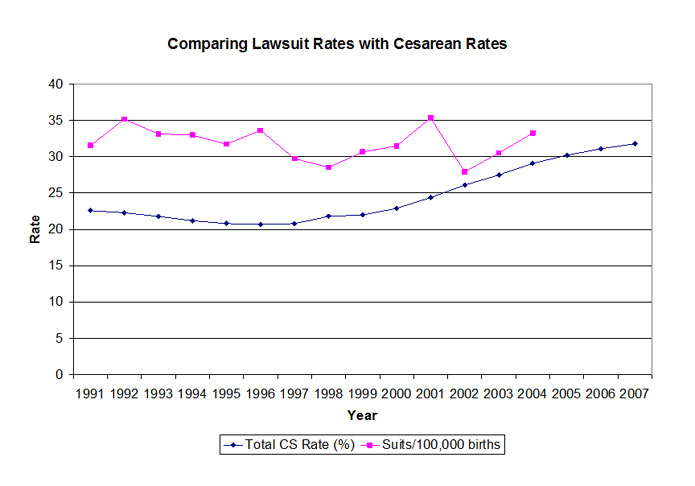
… The simple fact, however, is that cesarean rates in the United States have increased for 12 consecutive years, while malpractice litigation has remained the same or decreased. Data from the National Practitioners Data Bank reveals that obstetric malpractice suits fluctuated from 1991-2004 rather than increasing over time. This is not what one would expect if a malpractice crisis were causing the rise in cesarean rates.

In other words,there is no malpractice crisis. How does Prof. Roth support this claim? She uses one graph, and a series of personal interviews:

In addition to examining data on lawsuits, I am interviewing malpractice attorneys and birth attendants. I interviewed Jane,[1] a malpractice defense attorney (i.e. represents physicians) who has practiced for 15 years.

[1] All names are pseudonyms

That’s the goofiest thing I’ve heard in a while. For an article on medical malpractice she interviews a few friends who won’t even go on record with their real names? Since Roth has made no effort to ensure that the people she interviews are representative of lawyers, I can’t imagine why she expects such drivel to be taken seriously.

So here entire thesis rests on only one empirical observation, a graph that portrays the relationship between the number of obstetric malpractice claims. Here’s the graph:

Prof. Roth thinks this demonstrates that fear of being sued is not driving the rising C-section rate. Her conclusion is wrong because it is based on assumptions that are wrong. First, she assumes that obstetricians judge the likelihood of being sued by using the number of malpractice claims filed per year as a proxy for the risk of being sued. But obstetricians don’t need to use a proxy, they know their risk of being sued. The latest data indicates that 77% of obstetricians have been sued at least once in their career. So obstetricians know that almost all obstetricians ARE sued.

Second, she assumes that the deterrent effect is tied to the number of malpractice suits per year. That assumption is the equivalent of saying that bank robbers decide whether or not to rob a bank based on how many people went to jail last year for bank robbery. What keeps aspiring bank robbers from robbing the local bank is the belief that if they are caught, they will go to jail. It makes no difference to them how many individuals actually go to jail for bank robbery each year; the idea that they would reason that way is absurd.

The deterrent effect of malpractice suits on obstetricians is similar to the deterrent effect of jail sentences on potential bank robbers. The fact that the likelihood of being sued is high is what drives doctors’ actions, just like the fact that the likelihood of going to jail is high is what restrains people from robbing the local bank whenever they need cash.

I look at Prof. Roth’s graph and see the opposite of what she sees. The graph suggests that defensive medicine works.

First of all, the graph represents an anomalous time in obstetrics. Although Prof. Roth neglects to mention it, from 1991-2003, the rate of VBAC rose dramatically and then declined dramatically; that’s the reason for the relatively flat C-section rate in those years. Over all, the C-section rate has risen steadily and dramatically since 1970. And while the rate of obstetric malpractice filings may have been flat between 1991-2004, the rate rose steeply in the prior 2 decades.

In other words, since 1970 the C-section rate has risen steadily except for an anomalous period when VBACs became popular. Rates of obstetric malpractice filings rose steadily from 1970 and flattened out in the 1990’s. Looking at the data from the longer period suggests that the flattening of the malpractice filing rate may have been caused by the increased C-section rate.

In other words, defensive C-sections have done exactly what they are intended to do, prevent the filing of lawsuits. When I pointed this out to Prof. Roth (after being personally invited to comment by Jill), she replied:

With respect to Amy Tuteur’s comment, the reason that the malpractice lawsuit rate stabilized and started to decline is not because of the increase in cesareans. The reason that malpractice litigation is declining is because it has become increasingly difficult for injured patients to find legal representation.

Yes, that’s my point; it is increasingly difficult to find legal representation when your case is unwinnable.

Malpractice litigation is done by lawyers on a contingent fee basis. That means that the client pays nothing. The lawyer pays for everything and takes one third of any financial award. It is expensive to mount these cases, but there is the potential for multimillion dollar payouts that cover all expenses and leave millions left over.

Since lawyers use their own money to bring the malpractice cases, they will only take cases they believe they are likely to win; otherwise they will have wasted their entire investment in the case. In order to win a malpractice case, the lawyer must show that outcome of the medical situation would have been different if the doctor had done something different. In the case of obstetrical malpractice that typically means that the lawyer must show that if the doctor had done a C-section, or done one sooner, the baby would have been perfectly healthy.

So if an obstetrician performs a c-section at the first sign that something might be wrong, or even before anything goes wrong, any lawyer is deprived of the heart of the case. The case becomes unwinnable and no lawyer will take an unwinnable case. The entire purpose of a defensive C-section is to make sure that the case is unwinnable and therefore will never me brought.

If the rate of obstetric lawsuits has stabilized because lawyers are refusing to bring lawsuits, then the dramatic rise in the C-section rate is working exactly as intended.

New website: Hurt by Homebirth


Over the years I’ve received pleas from women who have lost their babies at homebirth. Each woman has suffered unimaginable tragedy and she wants to know that her baby’s death will not be ignored.

She cannot change the choices that she made, cannot bring her baby back, but perhaps the story of her baby’s death can open the eyes of other women to the dangers of homebirth. Each woman is different and the details of her story is different, but one refrain is common to them all: “if only I had known the truth about homebirth, I would not have chosen it.” The irony of homebirth is not lost on them; they thought they were making a loving choice and instead they were taking a terrible risk.

Unfortunately, women contemplating homebirth don’t know the risks and homebirth advocates aren’t about to tell them. In fact, adding insult to injury, when a bereaved mother attempts to share her baby’s story with other homebirth advocates, the baby is figuratively erased out of existence. Homebirth websites delete homebirth tragedies. They don’t want women to know the truth.

Enough is enough. Hurt by Homebirth has been created as a safe place where women can tell the stories of the babies who died or who were left injured by homebirth.

The babies who have died at homebirth will be hidden no more.

Amie Newman thinks it’s okay to hide the death toll of homebirth

I’ve participated in a number of on line discussions this week, and although the topics vary and identity of the homebirth advocates vary, one thing is always the same. When I mention that MANA is hiding the number of babies who died at the hands of CPMs, the silence is deafening.

Most homebirth advocates try desperately to pretend that I didn’t say it. They don’t deny that MANA (the Midwives Alliance of North America) is hiding the death rates at 18,000 homebirths attended by CPMs (certified professional midwives, formerly known as lay midwives). How could they? They don’t respond. What could they say? Instead they try to ignore this glaringly unethical behavior and hope that women will forget they ever heard about it.

Finally, though, someone decided to take a stand. Amie Newman, who blogs for RH Reality Check, explained why it is okay for MANA to hide the number of babies who died. After tangling with me through several back and forth comments, Newman wrote:

I 100% believe that women deserve the right to know how safe planned homebirth is with a Certified Professional Midwife. I also 100% believe that we have that information currently.

I replied:

You believe that we know the number of babies who died at the hands of CPMs in the 18,000 case MANA database?

Well, if you know the number, don’t keep us in suspense! Exactly how many babies died at those 18,000 CPM homebirths?

Or … will you simply acknowledge the obvious: we don’t have that information, MANA is hiding it, and you think it’s just fine for MANA to hide their own death rates from American women if those death rates are appallingly high.

At that point Newman simply stopped responding.

Honestly, I simply cannot fathom how a site that exists to support reproductive rights can produce a blogger and commenters that think women have no right to accurate information about the death toll of homebirth. Of course they join a long list of homebirth advocates who blithely ignore the issue that MANA is hiding homebirth deaths.

Ina May Gaskin thinks it’s just fine if MANA hides the number of homebirth deaths from American women.

Jill Arnold of the Unnecesarean claims to believe that “all maternity care data should be readily accessible to consumers and the general public,” but apparently thinks that does not apply to MANA.

Gina Crossley-Corcoran, the Feminist Breeder, offers the usual homebirth prattle without recognizing the irony:

I thought providers took an oath to help people? Putting their business ahead of reproductive choices isn’t keeping anybody safer, and the science proves that. Shame on them for ignoring the vast body of evidence from their own collegues.

Yes, shame on MANA for HIDING the vast body of evidence about homebirth deaths from their own colleagues, but especially from American women.

And Danielle Ellwood, the blogger who wrote the original piece on Babble performed the typical homebirth flounce:

Today, in true internet style… the poster [Dr. Amy] who started it all tried to call me out, and this is when I knew I needed to have my final word.

“And where’s Danielle who claims to care so much about mothers and babies? Why isn’t she demanding that MANA release their death rates?”

… Reply?

@Amy – There is no reasoning with someone like you. I care about women, I work on a local level, I work in my community, and I have actively been working for better maternal outcomes since entering the birth community 6 years ago, before even having my first child.

I am not going to feed into this debate anymore because it is clearly useless…

I am done.

In other words, she had painted herself into a corner and was too embarrassed to continue. Plus, she has all the right “birth cred” and everyone knows that means she really, really cares about women.

For these women and other homebirth advocates, I have a message:

You should be ashamed of yourselves.

Stop pretending! We all know that those statistics are being hidden because they show that an appalling number of babies died at homebirths with CPMs. Otherwise MANA would have published them and sent out a thousand press releases to boot.

It is time for American women to learn the truth about homebirth deaths, and homebirth advocates should be the first to call for transparency, not the first to offer the pathetic excuse that women already have all the information they need.

Don’t like the findings? Pretend they’re not true!


Sigh. Another day, another goofy Science and Sensibility post.

It may be a new year, and there may be a new editor, but the Lamaze blog appears to have merely traded one form of incompetent analysis for another. The previous editor Amy Romano, CNM, left to take a position with the lobbying organization Childbirth Connection. The new editor is Kimmelin Hull,

a Lamaze Certified Childbirth Educator, Physician Assistant, American Red Cross First Aid/CPR instructor, novelist and freelance writer for local and international parenting magazines.

In other words, she has no experience in caring for pregnant women, has no background in science or statistics, and essentially no qualifications for analyzing scientific literature. Not surprisingly, she’s off to a very unimpressive start.

Her first blunder didn’t even involve science. She wrote with a piece praising the Lamaze policy on conflicts of interest. Explaining why she declined to teach a class on breastfeeding at a local store, she wrote:

The slippery slope, however, became evident in this business owner’s expectation that the content of my presentation would directly entice class participants to buy certain products, based on my recommendations under the guise of authoritative knowledge.

But then I asked:

So why does Lamaze International license and recommend baby toys, women’s body lotions and women’s apparel? Clearly is trying to women to buy certain products based on their recommendations and under the guise of authoritative knowledge.

Cue the backpedaling. Hull tried to make an exception:

… if you truly believe in the healthy, helpful aspect of a product/service, providing information on it (or samples of it) to your clients becomes an act of “helping” vs. “promoting.” …

We’re supposed to believe that Lamaze collects licensing fees on baby toys, women’s body lotions and women’s apparel because they like “helping”?

Today Hull tries her hand at analyzing a scientific paper, The impact of maternal age on fetal death: does length of gestation matter? published in the December issue of the American Journal of Obstetrics and Gynecology. The authors found that women 40 and older had the highest risk of fetal death throughout pregnancy.

Hull accurately explains the methodology and findings of the paper, but then offers this startling assertion:

… other factors that have not garnered much attention in the literature but, in my estimation, certainly influence a woman’s general state of health and well-being (and thus potentially, the health of her pregnancy) are factors such as: diet, exercise routine and overall stress level. Designing a future study which could control for these additional variables would undoubtedly alter the data tremendously …

What??!! In her estimation? Based on what evidence? Apparently none.

Hull really, really wishes that advanced maternal age did not increase the stillbirth rate, so she is casting about for reasons she can ignore the evidence. Hmmm, let’s pretend that some easily modified factors (diet! exercise! stress!!) negate the impact of maternal age. Oooh, that sounds good! And as long as we’re pretending, let’s go all the way: these variable would undoubtedly alter the data tremendously! Really, Kimmelin?

Hull then proceeds to offer the “tremendously” altered data. Too bad she just made it up. But wait! She’s not finished making things up:

Despite the mention of induced labors being included in the cohort, there are no numbers on how many of the 2 million + pregnancies ended in induction—leaving a potentially HUGE confounding variable unchecked.

Yes, inductions may be a confounding variable because they REDUCE the risk of stillbirth. If inductions are a confounding variable, correcting for them would INCREASE the association between advanced maternal age and stillbirth, not decrease it, as she mistakenly believes.

The editor may have changed, but the quality of the scientific analysis at Science and Sensibility is still pathetic. Here’s some helpful advice: If you are going to dispute the results of a scientific paper, you need to offer scientific evidence to support your claims. Merely pretending the results aren’t true if they don’t fall in line with your personal beliefs does not represent scientific analysis, merely the wishful thinking that is so characteristic of contemporary NCB advocacy.