All posts by Amy Tuteur, MD

How Lamaze promotes misinformation

The folks at Lamaze are at it again. Amy Romano of the Lamaze blog Science and Sensibility has utterly misrepresented a new study. Indeed, the author of the study left a comment on her blog explaining exactly how she misrepresented it. But Amy Romano is not cowed by anything as unimportant as the truth. She’s not going to change her post. Presumably that’s because the original objective had nothing to do with science and everything to do with demonizing epidurals.

The paper in question appeared online at the British Journal of Obstetrics and Gynaecology website. Intrapartum risk factors for levator trauma by Shek and Dietz looks at the effects of childbirth on the levator ani, muscles that support the pelvic contents.

The authors were attempting to determine why vaginal delivery increases the risk of pelvic organ prolapse and related symptoms in older women. Some women sustain visible damage to the levator ani muscles (macrotrauma) resulting in a gap between the muscles that the pelvic organs can fall through. However, many women who have no evidence of mactrotrauma go on to develop pelvic organ prolapse. The mechanism seems to be damage to the substance of the muscle itself (microtrauma) that leads to weakening and stretching of the muscles. That can also lead to widening the gap between the muscles, a weakening that may only be noticeable when the intraabdominal pressure is increased, such as when the woman coughs or sneezes.

Sounds reasonable, right? But not to the folks at Lamaze. Amy Romano makes a series of empirical claims, all of which are demonstrably false.

We put “microtrauma” in quotes because no one has ever defined or determined the prevalence of this “condition”. The researchers invented it themselves!

Levator microtrauma is an example of a surrogate outcome (sometimes referred to as a surrogate endpoint)… [S]ome surrogate outcomes are extremely poor predictors of actual outcomes, and changing clinical practice based on studies that report only surrogate outcomes can be a major threat to patient safety if the therapy introduces other risks…

… [T]here is absolutely no data whatsoever linking the author’s definition of microtrauma to pelvic organ prolapse or other important pelvic floor problems such as incontinence or sexual dysfunction.

Wrong, wrong and wrong. If such claims sound familiar it’s probably because they employ the same language I have used to describe the blather than emanates from natural childbirth advocates: they make up “facts” to suit themselves. Did Romano want to turn the tables? If so, it was a spectacular failure as she simply demonstrated once again that NCB advocates make up “facts” to suit themselves.

What’s the truth? Muscle microtrauma can occur in any muscle, is widely mentioned in the scientific literature and has been mentioned in connection with the levator ani muscles in previous scientific papers. No one knows exactly how the levator ani muscles weaken in the aftermath of childbirth, but microtrauma is a very plausible explanation.

Levator ani microtrauma is not a surrogate outcome since the study was designed specifically to look at all possible ways that the levator may be damaged by vaginal delivery.

Why so much fuss over a study about muscle damage and prolapse? Why the tremendous effort to misrepresent the study by making up false claims? The answer is buried at the end of the study. When looking at a variety of factors that increase or decrease the risk of levator trauma, authors mentioned in passing that epidurals appear to be protective.

Oh, no! Epidurals are bad, bad, bad. Lamaze can’t let anyone get away with reporting any benefits from epidurals so the authors and their research must be discredited at all costs, truth be damned. And some made up medicine must be thrown in:

… Maybe doing away with coached pushing, fundal pressure, episiotomy, and supine positioning might be the better strategy. Maybe postpartum exercises can help reverse changes associated with pregnancy and vaginal birth so they don’t turn into symptomatic pelvic floor problems.

No evidence? No problem.

Dr. Dietz responded:

I’m the senior author of the study discussed by you. After 25 years of research in this field it still depresses me how excited people get when it comes to research that may affect the choices made by women in childbirth. There is way too much ideology and zealotry out there for a rational discussion. Amy Romano, you seem to intuitively know what’s right- saying: “Maybe doing away with coached pushing, fundal pressure, episiotomy, and supine positioning might be the better strategy.” How do you know? Where is the data?

And how do you know what ‘pelvic floor damage’ is? By all means do check my website if you really want to know:

http://web.mac.com/hpdietz1/iWeb/Site/Welcome.html

It seems you’re interested in those issues, and good on you for that. I’d be happy to answer any questions you may have, and I promise not to be prejudiced in any way. We all want the same: healthy mums and healthy babies. Just try and avoid the zealotry please.

Dr. Jeff Livingston wrote to encourage Romano to correct her mistakes:

… I am hoping you make a statement correcting your representation of the study so that we don’t spread false information since all of us are simply promoting science and patient safety through patient education. You have a large audience and I would not want them to get the wrong idea. I like this paper because it was simply thought provoking. I do a lot of pelvic reconstruction surgery. More papers like this looking at the basic science underlying pelvic floor damage will help us improve our understanding and surgical techniques in the future. That is how I will apply the paper in practice. It didn’t really speak to me about labor management.

So will the fact that the author and others eviscerated Ms. Romano’s “analysis” cause her to correct her misrepresentations and falsehoods? No way!

I’m not sure what you think I misrepresented…. But as of now I stand by everything I wrote.

I have written before that a key characteristic of science, as opposed to pseudoscience, is that all possible outcomes are allowed. That’s why “intelligent design” is not science; there is no evidence that would lead it’s advocates to announce that there is no “intelligent designer.” The conclusion is predetermined.

Romano’s analysis of this scientific paper veers perilously close to pseudoscience. It starts with an unalterable conclusion – under no circumstances can epidurals be beneficial. It then precedes to trash the study, making demonstrably false claims about microtrauma, for the SOLE purpose of insuring that no one credits the observation that epidurals may be protective. Finally, with absolutely no data, it asserts that the current recommendations of NCB advocates would surely be protective.

I think Romano owes the authors of the study an apology and a correction. She deliberately mischaracterized their work to fulfill a private agenda of demonizing epidurals.

Midwives need to stop focusing on “normal” birth

Midwife Suzanne Dara reflects on the effort of midwives to divide births into those that are “natural” or “normal” and those that are not. In her paper ‘Normal’, ‘natural’, ‘good’ or ‘good enough’ birth: examining the concepts, she suggests that such efforts are, at best, of little use, and, at worst are actually harmful.

Darra begins by exploring the current effort by midwifery organizations to promote “normal” birth. For example:

[I]n 2005 the International Confederation of Midwives updated their definition of the role of the midwife and they included ‘promotion of normal birth’ as a key part of the role…. The role of the midwife is also commonly defined according to the ‘normality’ or expected normality of pregnancy and birth. The idea of ‘normal’ birth is therefore clearly very much on the agenda for midwives and providers of maternity services, both in terms of providing safe, appropriate maternity care for women and in terms of defining professional roles.

But even those within the midwifery community have begun to question this relentless emphasis on “normal” birth. Darra cites Carolan and Hodnett, ‘With woman’ philosophy: examining the evidence, answering the questions. I have cited them as well when writing about the hegemony of normal birth.

… [T]he term ‘normal birth’ pervades midwifery literature and midwifery textbooks to such a degree that a struggle for hegemony is a legitimate concern. Many publications suggest a contest between medical intervention, paternalism and control on the one hand, and the midwife providing ‘woman-centred’ care and acting as the woman’s advocate on the other. Several discuss ‘protecting’ normal childbirth and reacquainting women with their natural propensity to birth… Throughout there is a suggestion of competing forces: midwives as guardians of vulnerable childbearing women vs. physicians wishing to take over and medicalise pregnancy…

… Overall, childbearing women, considered to be ‘at risk’ for pregnancy and maternal complication, are ever more likely to give birth surgically, and … approximately 15–25% of pregnant women are currently deemed to be at high risk for pregnancy complication in any given year. Additionally, there are many women having babies today who could not have reasonably contemplated pregnancy in the past. Examples include sufferers of diseases such as cystic fibrosis and cardiac disorders, who are now experiencing greater lifespans and better quality of life … The parameters of fertility technology are continually expanding and offer hope of pregnancy to many women who would have previously been considered infertile. For these women, a ‘normal’ birth may not be possible or particularly desirable.

In other words, while midwives may be enchanted with the idea of “normal” birth, it is neither appropriate for or desired by a substantial proportion of women.

Moreover, the term “normal” is not appropriate to describe childbirth. First, it’s use has negative connotations. Although natural childbirth advocates like to pretend that “normal” refers to biological norms, the truth is quite different. “Normal”:

…incorporates value laden connotations of socially expected/accepted forms of behaviour. Norms may refer to … a social standard by which human conduct can be measured and judgements of compliance can be made using this… The definition of normal is further complicated by ideas of normativity, what ‘ought’ to be, which is a more prescriptive idea.

… Political philosopher Hacking cites the word ‘normal’ as being ‘the most powerful ideological tool of the twentieth century’. In positivist terms the application of the word ‘normal’ had and still has some very powerful connotations. For example, in arguably its most powerful application, the diagnosis of mental ‘abnormality’ led to thousands of people being incarcerated in asylums during an extended period in medical/social history. Normality has therefore been the subject of much political, social and philosophical enquiry.

Second, the use of the term “normal” implies a degree of uniformity that simply does not exist:

Armstrong [discusses] the use of the ‘normal healthy subject’ as a measure against which all abnormalities, diseases and illness can be measured. However, he poses criticisms of this perspective, when he notes that of all the people attending a health centre in 1935 only 7% were found to be truly healthy by this form of assessment. Armstrong states that it seems more sensible to discard the idea of the ‘normal’ subject against which all others are measured and that instead one should examine a person or his/her body in context of other subjects, both ‘healthy’ and otherwise. This leaves one with the idea that people and their health are located on a continuum, thus making the definitive idea of the ‘normal’ as no longer useful; instead Armstrong proposes an idea of ‘normal variability’.

So “normal” birth as envisioned by its midwifery supporters exists so infrequently that it is foolish to make it normative, and “normal” birth does not reflect biological norms as much as it reflects socially sanctioned forms of behavior. Therefore, instead of “normalizing birth,” midwives and other providers should focus on humanizing birth. Darra laments that “such an in-depth consideration of ‘humanising’ birth is largely disregarded in the current organisation of care in childbirth, in which ‘normalisation’ is instead the current driving force.” Darra suggests that we start by listening to women.

… Very many studies have explored women’s experiences of childbirth and several refer to the care of the midwife and its impact on their experiences. Other studies refer to women wanting to be in control during childbirth and others refer to feelings of fear and pain. There are, however, very few studies in which women refer to their childbirth as being ‘normal’. One notable exception is Hunter’s (2007) study, in which she interviewed women about their experiences of birth. Women spoke about ‘normality’ in a highly individual way; what was seen as normal by some women was clearly not normal for others …

Darra concludes:

Midwives, other professionals and maternity service providers might, instead of concerning themselves with defining normal birth, … move away from defining and aiming for ‘normal’ birth, towards ‘being with’ women, metaphorically ‘holding’ them. Expert care providers would need to truly listen to what each woman wants at each birth, at all times taking only the measures to provide care for her to achieve that unique birth that she is happy with…

Induction is rising and birth weight is falling … but so is perinatal mortality

A new paper in the journal Obstetrics and Gynecology calls attention to the rising rate of induction and the falling birth weight which appears to be a consequence. Decreased term and postterm birthweight in the United States: impact of labor induction implies that this trend is worrisome:

From 1992 through 2003, mean BW fell by 37 g, mean GA by 3 days, and macrosomia rates by 25%. Rates of induction nearly doubled from 14% to 27%. Our ecological state-level analysis showed that the increased rate of induction was significantly associated with reduced mean BW (r = –0.54; 95% confidence interval [CI], –0.71 to –0.29), mean GA (r = –0.44; 95% CI, –0.65 to –0.17), and rate of macrosomia (r = –0.55; 95% CI, –0.74 to –0.32)…

Increasing use of induction is a likely cause of the observed recent declines in BW and GA. The impact of these trends on infant and long-term health warrants attention and investigation.

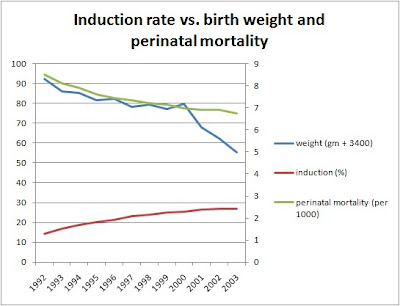
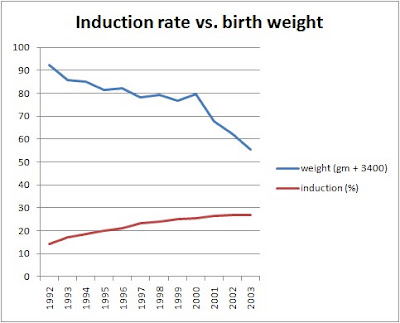
The following graph illustrates the trend of decreased birth weight.

The decrease in birth weight appears dramatic because of the scale of the y-axis, which displays weights from 3400 gm to 3500 gm. Indeed the fall in birth weight over the entire study was less than 50 gm from 3492.3 gm to 3455.3 gm.

As the authors note:

A reduction of 40 g in BW or 3 days in GA may not matter for an individual infant, but represents a substantial change for a population.

But that change is not necessarily bad. for example, as the authors point out, the rate of macrosomia has dropped by 25% in the same time span. Nonetheless, the authors are worried:

Recent systematic reviews and metaanalyses … concluded that labor induction may reduce perinatal mortality but without increasing the risk of cesarean delivery. As observed in this study, increasing and earlier use of labor induction appears to have shortened the duration of gestation and thus reduced both mean BW and rates of macrosomia. Although several studies have reported increased risks of some causes of neonatal morbidity and maternal complications with increasing GA at term, more and more infants are being delivered at early term gestation (37-38 weeks), up from 19% in 1992 to 29% in 2003. Earlier term birth is associated with increased risk of sudden infant death syndrome, and we have recently documented increases in several adverse birth outcomes among early term births, including increased risks of infant mortality and some types of neonatal morbidity. Thus the impact of these recent trends requires further investigation, including large randomized trials, to ensure that the rise in induction is doing more good than harm.

It’s rather surprising then that the authors did not investigate the trend in perinatal mortality during the same period. The main purpose of labor induction is to reduce stillbirth, which will be reflected in the perinatal death rate (death from 28 weeks of pregnancy to 7 days of life). All their data comes from CDC databases and perinatal mortality is available from the same source.

As the following graph shows, perinatal mortality did indeed drop by 21%.

Correlation, of course, is not causation, and it is possible that perinatal mortality has been steadily dropping for other reasons. And as the authors of the paper point out, there are risks associated with delivery at earlier gestation. Nonetheless, the existing evidence suggests that the increasing induction rate has not led to an increase in perinatal mortality. The primary reason for induction is to reduce perinatal mortality and that is exactly what seems to have happened.

Natural childbirth and “just so” stories

Henci Goer has finally responded to my critique of her smear of the Friedman curve. Did she address the fact that she completely misrepresented the history of the Friedman curve? No. Did she correct her mistakes about standard deviation? No. Did she acknowledged that she been utterly wrong in her statement of the purpose of the curve? No.

What did she do? She told a “just so” story. What’s a “just so” story? According to Wikipedia:

A just-so story, also called the ad hoc fallacy, is a term used in academic anthropology, biological sciences, social sciences, and philosophy. It describes an unverifiable and unfalsifiable narrative explanation for a cultural practice, a biological trait, or behavior of humans or other animals. The use of the term is an implicit criticism that reminds the hearer of the essentially fictional and unprovable nature of such an explanation. Such tales are common in folklore and mythology (where they are known as etiological myths — see etiology).

Here’s the tale that Goer told:

My daughter-in-law’s recent story was very much on my mind as I wrote my blog post. Her first baby, she was induced at 42 weeks for postdates. She hung up at 6 cm for many, many hours. Thanks to the watchful patience and excellent care by the staff at Kaiser Santa Clara–which included taking a break from the Pitocin for a shower and a rest (which allowed a restart at a lower dose), an epidural eventually, time to “labor down” before beginning pushing–and the knowledgeable assistance and support of her doula, my daughter-in-law gave birth spontaneously to an 8 lb 15 oz boy in the occiput posterior position…

The following explanation of the ad hoc fallacy shows that Goer’s story is a perfect example:

… [W]hen someone’s attempt to explain an event is effectively disputed or undermined … the speaker reaches for some way to salvage what he can. The result is an “explanation” which is not very coherent, does not really “explain” anything at all, and which has no testable consequences – even though to someone already inclined to believe it, it certainly looks valid.

Goer’s smear of the Friedman curve was blasted out of the water. She was shown to be wrong about the history of the curve, wrong about the purpose of the curve and wrong about the statistical analysis. In an effort to salvage what she could, she gave an “explanataion which is not very coherent, does not really “explain” anything at all, and which has no testable consequences.” And the best part? “To someone already inclined to believe it, it certainly looks valid.”

Telling her daughter-in-law’s story is like suggesting that people stop wearing seat belts because her daughter-in-law drove cross country without one and didn’t get hurt. It’s like recommending that women refuse breast biopsies because her friend ignored a lump for 3 years and it turned out to be benign. It’s no better than feeding your child a diet of Cheetos and Pepsi because your cousin did it and her child turned out fine.

Goer’s original discussion of the Friedman curve was wrong in virtually every particular: history, purpose and statistical analysis. She has nothing to say on those points, so she has attempted to salvage her post by telling a story and hopes that for those inclined to believe it, it will seem valid.

This is why celebrity NCB advocates refuse to appear in any forum where they can be questioned by doctors or scientists. Their “arguments” are eviscerated in short order and they are forced to fall back on “just so” stories. That might work for the readership of Science and Sensibility, but they’d be laughed from the podium at any meeting of medical or scientific professionals.

Using a technicality to avoid responsibility for a homebirth death

Australian midwife Lisa Barrett is trying desperately to avoid responsibility for a homebirth death over which she presided. As I explained in the post Is a baby who dies during homebirth a person?, the case is the typical homebirth tragedy, the kind that demonstrates that “trusting birth” is no substitute for emergency personnel and equipment.

Tate Spencer-Koch, had a vigorous heartbeat in the moments before the birth of her head, but after her head was born her shoulders were stuck. This is known as a shoulder dystocia and is an obstetric emergency of the highest order. The umbilical cord is trapped between the baby’s body and the walls of the vagina, cutting of the flow of oxygen to the baby. If the baby is not delivered within 5-10 minutes, permanent brain damage and even death can result.

In the hospital setting, shoulder dystocia is often anticipated if certain risk factors are present such as an unusually large baby, or an unusually slow labor. Shoulder dystocia is best managed by a team approach and even after the baby is delivered, an expert resuscitation including intubation is often required.

In the home setting, shoulder dystocia can quickly turn into a disaster. In the case of Tate Spencer-Koch, Barrett took an appalling 20 minutes or more to deliver the baby’s shoulders a truly extraordinary amount of time. When the baby was finally born, Barrett claimed, the baby was dead.

The ambulance crew begged to differ. Although Tate had no heartbeat, an EKG revealed electrical activity of her heart, the last stage before death. The ambulance crew believes that Tate was alive at the time they arrived and therefore was certainly alive at the time she was born. The distinction is critical, because the law gives the coroner power to investigate the death of “persons” and a stillborn baby is not a person under Australian law. The coroner initially accepted the testimony of Barrett and ruled that he did not have jurisdiction over the case.

Evidently Tate’s parents refused to accept this and requested and additional hearing in which the EMTs testified. After that hearing, the coroner reversed his decision and ruled that Tate had been alive and therefore her death should be investigated.

Barrett has appealed the new ruling and has taken the appeal to the Australian Supreme Court. As she writes on her blog:

Following the Coroners decision earlier this year to give himself Jurisdiction on a baby who had a PEA after birth with no sign of life, I would like to question his decision.  The transcript of his findings were in contradiction to his experts and in my opinion the law.  After seeking advice I have applied for a Judicial review.  We also applied for the inquest to be postponed until after the review.  The coroner held a small hearing last week where he declined to postpone so we went on to an emergency hearing at the supreme court.  We were granted an injunction to make the coroner postpone and the right to be heard.  A date will be set soon.  The process is massive, scary and it appears that I am up against the coroner, the Health department, the Ambulance service and the Attorney General.

This is a case of world interest, the rights of the coroner, the power of law over the common man and the definition of life.  I find it completely frustrating and frightening that when the case was at the coroners court there were press making our lives hell..

Barrett is desperate to avoid a review of Tate’s death because of the possibility that she will be accused of malpractice. She has every right to use all the legal tools at her disposal, but let’s be honest about what is going on here.

Midwife Lisa Barret is claiming that the death should not be a coroner’s case because she was so inept at resolving the shoulder dystocia (20 minutes until delivery of the shoulders) that the baby died before the entire body was born. And because she was incapable of saving the life of an otherwise healthy baby, as opposed to merely rendering it brain damaged, she should escape investigation.. It is outrageous for Barrett to proclaim that she is fighting for anyone else’s rights. A baby is dead and she wants to use a technicality to avoid investigation. This case is about nothing more than saving Lisa Barrett’s right to practice midwifery, no more and no less.

Anatomy of a natural childbirth smear

Recently I wrote about the natural childbirth website Science and Sensibility, detailing how it is neither scientific, nor makes much sense. That’s probably because every discussion has to be jammed into the same pre approved narrative arc: evil obstetricians, whose raison d’être is ruining birth “experiences” create a theory/practice/procedure which ignores scientific evidence, the evil obstetricians persist in using this theory/practice/procedure even though it doesn’t work, but now we’ve learned that they are utterly wrong and still they continue what they have been doing. Since the pre approved narrative arc has nothing to do with the truth, the post misstates or misinterprets the science in critical ways.

Henci Goer’s recent post, Iatrogenic Norms: How Fast Do First-Time Mothers Beginning Labor Spontaneously Actually Dilate, is a perfect example of natural childbirth as an unscientific smear. The first principle of the NCB is smear is to start with a gratuitous swipe combined with a little made-up “medicine.”

Iatrogenic norm: a defined range of normal values for a biological process that, rather than describing actual normal physiology, instead measures the consequences of a health care provider’s beliefs, actions, or therapies or the effects of exposure to a health care facility.

Oooh, sounds fancy and scientific. Too bad Henci Goer just made up that “definition,” which exists nowhere else.

The body of the post is an attempt to smear “the famous ‘Friedman curve’.” Recent research, looking at the ways in which epidurals influence labor, suggest new norms. Goer is outraged that anyone would presume to define any “arbitrary” norms to distinguish normal from abnormal labor.

Nevertheless, while revising norms to match reality would take a big step in the right direction, I would argue it doesn’t go nearly far enough because it still sticks us with the assumption that active first-stage dilation progresses smoothly. Anyone who has spent time with laboring women knows that this is often not the case. Neat graphical lines (or curves) come from averaging many highly variable individual labors, so the very expectation of how labors progress, at whatever pace, is itself an iatrogenic norm.

That sounds fancy and scientific, too. What a shame, then, that is nothing more than made up baloney centered around a made up “definition.” Then there is this witless gem:

Moreover, the published review points out that both the old and the proposed new threshold for “abnormal” are statistically derived (e.g. two standard deviations beyond the mean). No study links a cut point for “abnormally slow” with an increase in perinatal morbidity, but averting adverse outcomes should form the basis for intervening medically because of the risks of intervention. In fact, even if a study tried to establish an outcome-based threshold, it would be hard to determine whether the increase was due to labor duration per se or to the interventions used to treat slow labor…

Statistically derived? Two standard deviations beyond the mean? Well, duh. That’s not some nefarious plot; that’s the entire point of statistical analysis.

And finally there’s this:

… No study links a cut point for “abnormally slow” with an increase in perinatal morbidity, but averting adverse outcomes should form the basis for intervening medically because of the risks of intervention. In fact, even if a study tried to establish an outcome-based threshold, it would be hard to determine whether the increase was due to labor duration per se or to the interventions used to treat slow labor. So we have yet another iatrogenic norm, this one having to do with a definition of “abnormal” with no clinical significance.

No link with perinatal morbidity? No fooling! That’s because the curve has nothing to do with perinatal morbidity and no one ever claimed that it did.

There are so many mistakes and misinterpretations in this piece that it’s hard to know where to begin. I’ll confine my discussion to the three most egregious mistakes, one historical, one statistical, and the third a serious misrepresentation of the purpose of the curve itself.

I know a bit about the Friedman curve because I trained with Dr. Friedman himself. He was the chief of my department at Beth Israel in Boston for the four years of my residency. He was an extremely difficult man to work with, but he was brilliant and a strong advocate for women.

How and why did Dr. Friedman define the curve?

Dr. Friedman did his residency in the 1950s. He was not a man to suffer fools gladly and he considered a lot of his superiors to be fools. He felt that they made medical judgments based on their intuition and not on science, and he set out to accumulate the research data necessary to give the profession a firm scientific foundation.

During his residency, when he was on call every other night, he used his “spare” time to compile detailed observations about every laboring woman who came through the hospital. The goal was no less than to find out what normal labor looked like. Using observations from tens of thousand of women, he created a curve. Women who followed the curve were almost certain to have a vaginal delivery. Women who fell off the curve were more likely to need a C-section.

Dr. Friedman was the first to say that you should not section a woman in latent phase because a long latent phase was not a sign that the baby doesn’t fit. He insisted that you should not section a woman in the active phase of labor unless she failed to make a certain amount of progress in a certain amount of time. Dr. Friedman used to express the utmost disgust for doctors who would say, “she looks like a C-section to me”, instead of adhering to established criteria.

So Goer has thoroughly misrepresented the Friedman curve. It was created precisely to AVOID unnecessary C-sections, not to justify them. And it is hardly “arbitrary.” It reflects the observation of thousands of labors, both normal and abnormal and graphically represents those observations.

But perhaps Goer is confused into thinking that the curve is arbitrary since she completely misunderstands and misrepresents standard deviation.

NCB advocates like to claim that medical definitions of “normal” are utterly arbitrary and exist merely for the convenience of doctors. Nothing could be further from the truth. Often, “normal” is based on knowing the outcomes from previous experience. We can confidently say that having an Apgar score of 1 at 5 minutes of life is not normal, because babies who have Apgar scores of 1 at 5 minutes always have serious medical problems of one kind or another.

Sometimes “normal” is defined as a range. That is not an accident, and it does not mean that a range was chosen arbitrarily. A normal range in medicine is almost always based on a basic and widely accepted form of statistical analysis, the standard deviation.

There is an excellent simple explanation of standard deviation on SensibleTalk.com. It is written for journalists who have no background in statistics:

Let’s say you are writing a story about nutrition. You need to look at people’s typical daily calorie consumption. Like most data, the numbers for people’s typical consumption probably will turn out to be normally distributed. That is, for most people, their consumption will be close to the mean, while fewer people eat a lot more or a lot less than the mean.

When you think about it, that’s just common sense. Not that many people are getting by on a single serving of kelp and rice. Or on eight meals of steak and milkshakes. Most people lie somewhere in between.

When you graph the data with calories on the x-axis and numbers of people on the y-axis, you will get a bell shaped curve. The curve is a graphical representation of all the possible things that can happen. The important point, though, is that every possible thing that can happen is not necessarily normal. How do we tell the difference between normal and abnormal? We start by calculating the standard deviation. The formula for calculating the standard deviation is complicated, but the result is relatively simple to understand. The standard deviation is a reflection of distribution of all possible outcomes.

Mathematically, one standard deviation on each side of the mean (the average) encompasses 68% of individuals. Two standard deviations encompasses 95% of individuals. Therefore, only 5% of individuals will be outside of two standard deviations from the mean. This is always true, regardless of whether the bell curve is tall and narrow or short and extended. “Normal” is usual defined as within two standard deviations. That means that “normal” is a range, but the range is hardly arbitrary. It reflects the actual distribution of results among large populations of human beings.

So when we look at how long a first labor lasts, for example, we can graph the labors of large numbers of women and we will get a bell curve. Ninety-five percent of women will fall within two standard deviations of the mean. It is only those women who are outside of two standard deviations that are considered abnormal. That does not mean that a woman whose labor is lasting longer than two standard deviations from the mean cannot possibly have a vaginal delivery, but it does mean that a woman whose labor is lasting longer than two standard deviations from the mean is far less likely to have a vaginal delivery.

The bottom line is this: defining normal as a range is not arbitrary. It is a reflection of what we know about human variation. The range of normal accounts for most of human variation. Anything that lies outside the range of normal is very unlikely to be normal.

Finally, the swipe at the curve for not being related to perinatal morbidity and therefore being clinically irrelevant is just plain bizarre. The Friedman curve has NOTHING to do with morbidity and mortality. That wasn’t its purpose when it was developed and it is not its purpose today. It is, however, quite important clinically because it tells us the likelihood that woman will deliver vaginally.

Oh dear, it seems that the story of the Friedman curve does not fit the predetermine arc of the NCB smear. The Friedman curve was NOT created to ruin women’s birth experiences; it was created to reduce unnecessary C-sections. The Friedman curve is NOT arbitrary; it is simply a graphical representation of thousands of labors. Standard deviation is NOT arbitrary; it is at the foundation of statistical analysis. No matter. Who cares about the truth? Certainly not Henci Goer.

Noted childbirth educator behind My OB Said What

Recently I asked Why are the owners of “My OB said WHAT” hiding?

The website “My OB said WHAT?” is supposed to highlight “stupid” things said by obstetricians. It is a slick, professionally designed smear campaign, clearly requiring a fair amount of money to create and maintain. Yet the owners feel that they have something to hide — their own identities.

Apparently they are hiding their identities because they don’t want it known that a nationally prominent childbirth educator is behind “My OB Said What?” Teri Shilling, former president of Lamaze International.

In addition to her role as past president of Lamaze International, Ms. Shilling is Founder and CEO of Passion for Birth Childbirth Education, board member of Regional Association of Childbirth Educators of Puget Sound (REACHE), a DONA doula trainer for the Seattle Midwifery School/Bastyr U. She serves as the Media review chair for the Journal of Perinatal Education, and volunteers as the Lamaze International development member of the Education Council.

Readers of this blog will know her better as MaryM who has posted here repeatedly in the past week or so under that pseudonym and as “guest.” She posted such gems as:

The reason there is nothing personal on MOSW is probably because it is a forum – it’s for the women who want to submit what they have been through. Your theory about a stealth marketing campaign with an astro turf appearance is even more paranoid then your original attacks.

I privately offered Ms. Shilling the opportunity to comment on her involvement. She did not deny it; her only response was that the organization Passion for Birth is not involved. She mentioned nothing about the other organizations with which she is associated, but that could be because I did not ask her specifically about those other organizations.

Ms. Shilling is not the only person behind MOSW. As more information becomes available, I will share it.

Natural childbirth, a philosophy of privilege

Natural childbirth is the project of Western, white women from first world countries who are relatively well off. It does not have much resonance among women of other cultures, nor among women of color within first world countries. In other words, “natural” is about and absolutely depends upon social privilege.

It’s been that way from the very beginning. Grantly Dick-Read, widely considered to be the father of the natural childbirth movement, viewed natural childbirth as a way for white women of the “better” classes to avoid “race suicide.” Ornella Moscucci explains the thinking of Dick-Read and his eugenicist peers:

[T]hese health reformers were concerned about the differential birth rate—the tendency of poorer, less healthy sections of society to have larger families than their “betters”. Thus, as well as endorsing plans for the sterilisation and detention of “degenerates”, they also sought to encourage the middle classes to have more children… Female education and employment were seen as a particular evil, insofar as they led women to regard motherhood a burden and to neglect hearth and home…

… Dick-Read … claimed that primitives experienced easy, painless labours. This was because in primitive societies the survival value of childbirth was fully appreciated and labour was regarded as nothing more than “hard work” in the struggle for existence. In civilised societies on the other hand a number of cultural factors conspired to distort woman’s natural capacity for painless birth, producing in woman a fear of childbirth that hindered normal parturition…

In other words, “natural” childbirth was created as a philosophy for privileged women, and it remains so to this very day.

Political scientist Candace Johnson explores the role of “natural” childbirth as a philosophy of privilege in contemporary society (The Political “Nature” of Pregnancy and Childbirth, 2008). She starts by framing the question:

… [W]hy do some women (mostly privileged and in developed countries) demand less medical intervention in pregnancy and childbirth, while others (mostly vulnerable women in both developed and developing countries) demand more …? Why do the former, privileged women, tend to express their resistance to medical intervention in the language of “nature,” “tradition,” and “normalcy”? …

The answer?

The evidence seems to suggest that arguments about the negative impact of medical intervention in the lives of women, “medicalization,” seem to resonate only among privileged populations. As indicated by Laura Purdy, medical intervention in pregnancy and childbirth is evaluated very differently in different contexts, and the expression resistance among privileged women in developed countries often appeals to “nature”:

“When we learn that African-American women in the United States die more often in childbirth than white women, and that horrifying numbers of Third World women are dying as we speak, nobody concludes that preventive action would be morally intrusive. Yet we tend to be bewitched by the claim that menstruation or pregnancy are natural processes and thus inappropriately dealt with in the medical realm.”

In poor countries, communities or under-serviced areas, medical care is a necessity, upon which exercise of agency and autonomy is contingent. But the refusal of pharmaceuticals and clinical care among affluent or well accommodated (by a universal health system, for example) women is at once a form of political resistance and an assertion of identity.

It is precisely for this reason — that rejection of medicalization is an assertion of identity — that explains its restriction to privileged women. Only women of privilege, with enough to eat, easy access to medical care, and the leisure to contemplate their “identity” are attracted to “natural” childbirth.

In developing countries, appeals are continually made for more medical intervention in pregnancy and childbirth, not less… [I]n the United States, higher rates of maternal mortality among African American women serve as evidence for the need for better access to medical care … However, the preference expressed by many privileged women in affluent countries, such as Canada and the United States, for midwifery care and home births, is curiously at odds with public health data and ethical arguments.

As Johnson explains:

It is a rejection of privilege that simultaneously confirms it. Therefore, the problem of medicalization seems to apply disproportionately to privileged women. In fact, some of the most serious pronouncements of medical interference in pregnancy and childbirth as a “natural, normal, woman-centered event” come from women of considerable privilege and authority.

It is not surprising then that “natural” childbirth, a philosophy of privilege is rejected by women who lack social privilege, women of color and women from non first world countries. But there is a further reason for rejection, the romanticization of the experience of non-privileged women:

… Third World women’s experiences with traditional or natural birthing practices have been appropriated and romanticized by first world women, often to the detriment of the subaltern women. Sheryl Nestel claims that “conceptually, images of Third World women have served to define middle-class white women’s midwifery identities through both negative comparison and fantasized idealization”

To put it bluntly, privileged women construct a view of childbirth that explicitly ignores the vast suffering endured by real women forced to experience childbirth “naturally.”

… The fantasy of Third World women’s natural experiences of childbirth has become iconic among first world women, even if these experiences are more imagined than real. This creates multiple opportunities for exploitation, as the experiences of Third World women are used as a means for first world women to acquire knowledge, experience and perspective on ‘natural’ or ‘traditional’ birthing practices, while denying the importance of medical services that privileged women take for granted.

Natural childbirth is rejected by women of color and by women from countries outside the first world. Natural childbirth is a philosophy that presumes economic security, ready access to medical technology, and the leisure to construct an “identity.” It does not merely ignore the suffering that childbirth entails for many non-privileged women, it actively erases their suffering by pretending that it does not exist and never existed.

Breastfeeding and what it means to be a good mother

This month’s issue of the journal Health, Risk & Society includes an article on the moralizing discourse used to promote breastfeeding, Contextualising risk, constructing choice: Breastfeeding and good mothering in risk society. Stephanie Knaak, a sociologist, claims that breastfeeding promotion in first world countries is about much more than what an infant eats.

… this discourse is not a benign communique about the relative benefits of breastfeeding, but an ideologically infused, moral discourse about what it means to be a ‘good mother’ in an advanced capitalist society.

Knaak starts by noting that “risk management” has become a major feature of contemporary mothering.

As one of the primary concerns of modern post-industrial societies, we are becoming increasingly concerned with understanding, calculating, communicating, managing, and otherwise minimising or eliminating myriad risks associated with everyday life. So it is for the arena of parenting and motherhood. Indeed, it is argued that the role of motherhood in contemporary society is being redesigned in such a way that mothers are being increasingly positioned as veritable ‘risk managers’.

Within this ideology, mothers are seen as having a moral and social responsibility
to be risk conscious…

It makes sense that mothers would be encouraged to minimize risks to their children, but the attention given to various risks appears to have no relationship to their magnitude. As Knaak explains:

Risk, however, is socially and ideologically mediated… Indeed, ‘risk consciousness’ and associated decision-making is often related more to the emotive consequences and meanings attached to certain identified risks than to any rational calculation of probability …

The efforts to encourage breastfeeding represent a perfect example. Breastfeeding has real health benefits, but those benefits are small. Yet breastfeeding promotion has taken on moralizing tone typically associated with grave threats to children’s health:

…[T]oday’s dominant infant feeding discourse functions more as a vehicle of persuasion than as a vehicle of education, characterised by informational biases, moral overtones, and a restrictive construction of choice. Attention has also been given to the increasingly hegemonic and homogeneous character of pro-breastfeeding discourse, where alternative choices about infant feeding tend to be interpreted as acts of moral deviance rather than counter-discourses or acts of resistance…

Since the benefits of breastfeeding are small, it is really no one else’s concern what method of infant feeding an individual mother chooses. But women cannot keep themselves from criticizing other women’s choices and they rationalize this by a conception of public health that is growing ever more intrusive:

The increasing moralisation of public health is another part of what lends power to this feature of contemporary breastfeeding discourse. Namely, the tendency in public health discourse to increasingly frame personal health choices/practices as issues of social and moral responsibility makes breastfeeding much more than just a personal decision. Within this kind of discursive environment, breastfeeding becomes part of how good (i.e. socially responsible, moral) motherhood is defined.

Knaak draws from interviews with new mothers to describe how this moralizing works:

… [M]any of the mothers viewed commercial infant formula not only as nutritionally less superior, but in specifically negative terms. In as much as the larger discourse acknowledges both breastfeeding and formula feeding as ‘acceptable’ choices, there is an ever-increasing discursive gap between these two options; namely, that breastfeeding has become more and more idealised, and formula feeding ever more devalued.

Breastfeeding advocates have gone far beyond simple attempts to educated women about the benefits of breastfeeding. They have explicitly framed one feeding choice as “good” and another as “bad.” And they imply that only those women who make “good” choices can be good mothers.

… [T]his association of breastfeeding with ‘good mothering’ and formula feeding with ‘not so good mothering’ has been argued to be a key characteristic of today’s dominant infant feeding discourse. In large part, this can be attributed to the fact that pro-breastfeeding discourse is organised and mediated by: (a) a moralising public health ideology; and (b) the ‘ideology of intensive mothering’, today’s dominant parenting ideology.

Breastfeeding advocates disingenuously claim that they are merely trying to convey the facts about infant feeding methods. In reality they are attempting to promote one particular ideology of mothering and to shame women who refuse to conform.

The Coalition for Improving Maternity Services emphatically denies supporting smear campaign

Note: Several hours after writing this post I received a definitive response to my query sent to Denna Suko of CIMS.

Good afternoon, Dr. Amy. Thank you for contacting CIMS. We appreciate your inquiry.

CIMS does not provide funding, technical support, personnel, nor any other type of support to the “My OB Said What” website, and we do not know who is responsible for the site…

I appreciate Ms. Suko’s quick and emphatic response.

*****

Several days ago I asked Why are the owners of “My OB said WHAT” hiding?:

The website “My OB said WHAT?” is supposed to highlight “stupid” things said by obstetricians. It is a slick, professionally designed smear campaign, clearly requiring a fair amount of money to create and maintain. Yet the owners feel that they have something to hide — their own identities.

I speculated that:

The amount of money involved and the desperate effort to conceal themselves suggest that “My OB Said What?!?” is run by a professional natural childbirth advocacy organization that has seen its previous efforts to control women’s childbirth choices fail dismally.

There are several clues that raise the possibility that the Coalition to Improve Maternity Services (CIMS) may be behind the site. The most suggestive is that the site’s only outbound link is to The Birth Survey, a project funded by CIMS. It shares many of the same characteristics of MOSW: it is a non-scientific solicitation of birth stories masquerading as “survey.” Since ads for The Birth Survey are placed almost exclusively on websites promoting alternative beliefs about childbirth, it is designed to collect unfavorable stories about obstetricians and hospitals. CIMS intendeds to use the information to pressure obstetricians and hospitals without making any effort to determine if the stories they receive are representative or even true.

MOSW does essentially the same thing. It solicits brief stories about unpleasant or contentious interactions with obstetricians with the explicit aim of promoting ridicule of obstetricians (hence the name “My OB Said What!?!). Once again there is no effort to determine if the stories are representative or even true.

I have no special skills to conduct an investigation of the ownership of a site whose owners are trying to conceal their identity, but it seemed like the first step would be to query to site owners. So I left the following message on their site:

I’d like to ask the sponsors of the site a direct question:

Since the only outbound link on the entire site is to The Birth Survey, and since this site is run by self-described birth professionals, it seems very possible that this site is an anonymous smear campaign sponsored by the Coalition to Improve Maternity Care (CIMS), the same organization that sponsors The Birth Survey.

I can’t imagine why the owners of this site would be hiding their identity unless it were because it would be professionally embarrassing to engage in such behavior publicly.

The best place to start in figuring out who is responsible for this site is to ask the owners, so I’m asking:

Is CIMS funding this site? If not, who owns and runs this site?

It seems rather ironic that the same people who demand “transparency” in maternity care are hiding their identities when discussing maternity care.

As expected, the owners of the site refused to answer. I know they saw the post because the site is moderated. Moreover, they became concerned and stripped out any potentially identifying data from their code.

If they won’t answer, it seems like the next step is to ask CIMS directly. Denna Suko is the Executive Director of CIMS. I’ve sent her the following e-mail:

No doubt you are familiar with the web site “My OB Said What?!?” As the only outbound link on the entire site is to The Birth Survey, and since the site is run by self-described birth professionals, it seems very possible that the site is sponsored by the Coalition to Improve Maternity Care (CIMS), the same organization that sponsors The Birth Survey. I have queried the site owners by placing a public comment on their site, but they have refused to answer.

The next logical step is to ask CIMS. Does CIMS provide funding for the website “My OB Said What?!?” Does CIMS provide technical support, personnel or any other support to MOSW?

I have shared the contents of this e-mail with the readers of my blog, The Skeptical OB, and I will share your response with them.

Thank you for your consideration.

I will report back when and if I get a response.

Addendum: As promised, I am sharing the response from Dena Suko.

Good afternoon, Dr. Amy. Thank you for contacting CIMS. We appreciate your inquiry.

CIMS does not provide funding, technical support, personnel, nor any other type of support to the “My OB Said What” website, and we do not know who is responsible for the site…

I appreciate Ms. Suko’s quick and definitive response.