All posts by Amy Tuteur, MD

Belief that Duchess Meghan is sending messages is symptomatic of our dysfunctional mothering culture

2A0547BB-755A-4F77-AA0C-A4818C29AE44

There has been a spate of articles purporting to explain what Meghan, Duchess of Sussex is trying to “tell us” with her choices.

The subtle but important message Duchess Meghan is sending new moms about giving birth:

Meghan showed the world something that many of her royal predecessors have covered up: what a woman’s body looks like a mere 48 hours after birth. Her simple and understated white dress did not hide what her body had gone through. A simple belt tied high above her waist, in fact, seemed to be an intentional signal.

It was as if she was saying to the world, “Hey, I told you you’d have to wait a couple of days before you could see me, and this is what I look like. This is what happens to a woman’s body, even a woman like me who made a career out of rockin’ the pencil skirts on ‘Suits.’ ”

The belief that Meghan, Duchess of Sussex is trying to tell us something is symptomatic of our dysfunctional mothering culture that insists that the personal must be political. No longer can a mother make a choice simply because its the right thing for her baby and herself. We imagine her, and insist she must imagine herself, as sending messages about how to perform mothering.

[pullquote align=”right” cite=”” link=”” color=”” class=”” size=””]But what if the “message” Meghan is trying to send is that she is not going to be trapped by a culture that insists she must send messages? [/pullquote]

Mothering is no longer an intricate, intimate, largely private physical and emotional dance of baby and mother. It is assumed to be a highly stylized dancing performance created for the delectation of other women who seek to parse its “meaning.”

But what if the “message” Meghan is trying to send is that she is not going to be trapped by a culture that insists she must send messages with her choices?

What if she desired a homebirth because she feared being victimized by a hoax like that played on the hospital staff during her sister-in-law’s first pregnancy?

What if she postponed her first postpartum photo-call because she couldn’t stand unaided until then?

What if she chose that particular dress to wear because her first choice had been ruined by blood flow that couldn’t be contained by the multiple pads and net panties that were almost certainly underneath and her second choice promptly got stained by milk when she let down after hearing her baby cry?

What if she makes choices simply because they seem to her to be the best choices for baby and herself, and she has absolutely no interest is the choices that other mothers make?

What if the personal is just personal and NOT political?

We live in a mothering culture that is constantly trying to force mothers to behave in predetermined ways. We are every bit as rigid in our sanctimonious prescriptions for unmedicated vaginal birth, breastfeeding and baby-wearing as previous generations were in their prescriptions for twilight sleep, formula feeding and limited mother-infant contact designed to avoid “spoiling” babies. But whereas they were honest with themselves, we fool ourselves by insisting that we aren’t pressuring women, we are “normalizing” natural behaviors.

Feel free to correct me, but I’m not aware of a single health parameter or mental health parameter that has been improved by switching from an rigid insistence on one type of mothering to a rigid insistence on its “natural” opposite. It’s as if the various processes doesn’t matter — because they don’t.

Mothers should make choices for their children because — knowing their children and themselves best — they think those are the best choices. They should not make choices for their children that are designed primarily to impress other mothers.

They should not fool themselves into thinking that their own choices ought to be “normalized” for the edification of everyone else.

And women should not imagine that other mother’s choices are a commentary on their choices and need to be praised or resisted. Other women, including the Duchess of Sussex, are not trying to send them messages; they’re just trying to do what feels right.

The fact that we think otherwise is symptomatic of our dysfunctional mothering culture.

Surprise! CDC confirms US maternal mortality rate is high because pregnancy is inherently dangerous.

Beautiful Silhouette of a pregnant woman with highlight on belly

While the critics of modern obstetrics have been dithering about C-sections and intervention rates, American women have been dying in and around childbirth of potentially preventable causes that have nothing to do with either.

The latest CDC report on maternal mortality confirms that the US maternal mortality rate is high NOT because of C-sections and interventions, but because women haven’t received the lifesaving interventions they’ve needed.

[pullquote align=”right” cite=”” link=”” color=”” class=”” size=””]Modern obstetrics has taught us how to prevent many maternal deaths. We just need to do it.[/pullquote]

According to the Washington Post:

The CDC confirmed in a report released Tuesday that about 700 women die each year in the United States from cardiovascular conditions, infections, hemorrhages and other complications related to their pregnancies — up to a year after delivering their babies. In about 60 percent of the cases, the deaths could have been prevented, in part, with proper medical intervention, as well as better access to it, the researchers noted.

The report itself is short and worth reading in full. This paragraph includes the most important findings:

Pregnancy-related deaths occur not only during delivery but also during pregnancy and up to 1 year postpartum. The leading causes of pregnancy-related deaths varied by timing of death. Acute obstetric emergencies such as hemorrhage and amniotic fluid embolism most commonly occurred on the day of delivery, whereas deaths caused by hypertensive disorders of pregnancy and thrombotic pulmonary embolism most commonly occurred 0–6 days postpartum, and during pregnancy and 1–42 days postpartum, respectively. Cardiomyopathy was the most common cause of death in the late postpartum period (43–365 days postpartum). The higher proportion of pregnancy-related deaths in the late postpartum period among black women is likely attributable to higher proportion of pregnancy-related deaths due to cardiomyopathy among these women. Approximately three in five pregnancy-related deaths were determined by MMRCs to be preventable, and preventability did not differ significantly by race/ethnicity or timing of death. Recognizing the major causes of death by timing can help identify opportunities for intervention.

The word “Cesarean” doesn’t even appear in the body of the report and intervention rates are mentioned only to lament that women die for lack of them.

How did we get things so wrong?

We allowed ideology to replace science, specifically the ideology of natural childbirth. The principles of natural childbirth ideology — childbirth is inherently safe, interventions are dangerous and rarely needed, birth should be trusted and allowed to unfold naturally — are fundamentally at odds with reality: childbirth is inherently dangerous, interventions save lives and lots of women die when you allow childbirth to unfold naturally.

The biggest problem, in my view, is a low index of suspicion for complications of childbirth when we should have a high index of suspicion. You can’t diagnose a complication if you’ve been taught that complications are rare and doing nothing is the best response. When providers falsely believe that pregnancy is inherently safe when in reality it is inherently dangerous, nurses and even some doctors will insist that everything is fine even while a woman is dying before their eyes.

Here’s what I proposed back in 2017:

  • We must increase access to high tech medical and obstetrical care.
  • We must create a system of maternal critical care triage to parallel the highly effective system of neonatal critical care triage.
  • We must create algorithms and hold drills to prevent and treat common causes of maternal death.
  • We must devote significantly more research dollars to understanding cardiac complications of pregnancy.

This 2017 article by Tara Haelle in Consumer Reports recommended almost exactly the opposite. Titled What to Reject When You’re Expecting, it is paradigmatic of how an ideology that primarily benefits natural childbirth professionals led us to ignore and withhold the very treatments that could have saved lives.

Haelle wrote:

Infants in this country are more than twice as likely to die before their first birthday as those in Japan and Finland, and America lags behind nearly every other industrialized nation in preventing mothers from dying due to pregnancy or childbirth. The U.S. is one of only a handful of countries in the world, including Afghanistan and South Africa, whose maternal mortality rate is rising.

Why? There are no doubt many causes. But one likely contributor may be that medical expediency often takes priority over the best outcomes and evidence-based treatments.

She encouraged women to reject C-sections, repeat C-sections, inductions and delivery prior to term. Haelle was hardly alone in that view. But that was ideology NOT science. They were never implicated in infant and maternal mortality; they SAVE lives.

Here’s what the CDC now recommends:

No single intervention is sufficient; reducing pregnancy-related deaths requires reviewing and learning from each death, improving women’s health, and reducing social inequities across the life span, as well as ensuring quality care for pregnant and postpartum women. Throughout the preconception, pregnancy, and postpartum periods, providers and patients can work together to optimally manage chronic health conditions. Standardized approaches to addressing obstetric emergencies can be implemented in all hospitals that provide delivery services. The Alliance for Innovation on Maternal Health (AIM) has provided sets of bundled guidance to provide for such standardization.

Implementation of this guidance is often supported by perinatal quality collaboratives, state-based initiatives that aim to improve the quality of care for mothers and infants. Ensuring that pregnant women at high risk for complications receive care in facilities prepared to provide the required level of specialized care also can improve outcomes; professional organizations have developed criteria for recommended levels of maternal care. CDC has created the Levels of Care Assessment Tool for public health decision makers to evaluate risk-appropriate care. In the postpartum period, follow-up care is critical for all women, particularly those with chronic medical conditions and complications of pregnancy (e.g., hypertensive disorders of pregnancy). ACOG recommends that postpartum women have contact with obstetric providers within the first 3 weeks postpartum and recognizes postpartum care as an ongoing process tailored to each woman’s individual needs.

In other words, more high tech care, greater access to high tech care, mandated emergency protocols and more provider visits.

We must learn from our mistakes. While gallons of ink were being spilled on the obsessions of natural childbirth ideologues — the C-section rate, the induction rate, epidurals and electronic fetal monitoring — we were ignoring the deadly problems that are literally killing new mothers: cardiac disease in pregnancy, pre-existing chronic conditions, hemorrhage and blood clots.

Modern obstetrics has taught us how to prevent many maternal deaths. We just need to do it.

Natural mothering, intuition and the specter of the “bad other mother”

85E41F91-CA8B-4B2B-A5B4-5631963B555F

Women’s Studies Prof. Chris Bobel’s book, The Paradox of Natural Mothering, is seventeen years old but reads as if it were written yesterday.

In Bobel’s view, natural mothering isn’t just a paradox, it is a plethora of paradoxes. Promoted as radical simplicity, parenting just like our foremothers and offering feminist empowerment, it is in many respects the complete opposite. It is a form of consumerism, confirms traditional misogynistic gender roles, and reflects and reinforces privilege.

[pullquote align=”right” cite=”” link=”” color=”” class=”” size=””]The truth is that every caring mother follows her own intuition and does what feels right to her.[/pullquote]

Bobel seeks to understand not merely why advocates of natural mothering make the choices they do but how they perceive the choices they’ve made. Her assessment is spot-on:

…[N]atural mothers profess to operate in a realm virtually untouched by social influence. Their ideas, supposedly rooted in nature and fostered by their waxing self-confidence, are not the products of culture, but the products of nature. Natural mothering, then, is an organic experience. The experience of natural mothering is available to any woman who sheds her trust of others and taps into her trust in nature, a trust realized when she begins to trust herself…

But when Bobel asked natural mothers how they knew which mothering practices to choose, they repeatedly invoked intuition. They didn’t “know” what to do; they felt it.

It is clear that the reasons for natural mothering are often literally beyond reason. Rather than being rooted in an epistemology derived from the intellect, this type of “knowing” is intuitive, even instinctual and therefore defies explanation … Decisions are not ultimately based on thinking, but on feeling. Choosing a family bed, child-led weaning, or home birth is not based on reading a good book or even hearing a compelling argument, although those experiences often name dearly held beliefs that inform these decisions… For natural mothers, feeling both prefigures and constitutes her alternativity.

And that leads to yet another paradox, if decisions are made because they feel right to them, isn’t it equally likely that women who make choices of which they disapprove are doing so because it feels right to them?

Absolutely not! Women who make different choices are understood to be “bad other mothers.” The ideology of natural mothering [for it is an ideology, not a product of nature] has inoculated its advocates against the possibility of respecting the different choices of other mothers.

This mother … makes few conscious choices. Rather, she “goes with the flow” of the mainstream, seldom questioning the conventional wisdom that dictates so much of parenting practice. This mother is neither evil nor malicious, the natural mothers tell me; she is simply ignorant – duped by a powerful, child-hostile, expert-and institution-dependent culture.

You can identify her by the “terrible” choices she makes.

The “bad other mother” has her babies by planned cesarean section. She bottle-feeds because she does not want to be bothered by breastfeeding. She feeds her children hotdogs and potato chips for lunch because it is quick and easy. When her children complain of an car infection, she demands antibiotics but cannot understand why her children are chronically ill. She uses the television as an electronic babysitter. But perhaps the most common characterization zation of the “bad other mother” is the woman who insists that she must work, but really does so only “to support her addiction to materialism and careerism,” as one mother said.

The children of the “bad other mother” are imagined to be suffering.

Stories … were regularly invoked to prove the point that others choose wrongly. And their mistaken choices are evidenced by their harried, “miserable” lives. The natural mothers pride themselves on steering clear of the rushed life, the money-and status-driven life, ultimately, the unexamined life. The natural mothers tell me that they have risen above this fray and are never, ever going back.

The irony is that while they are busily criticizing women for copying ideas that are socially constructed, they fail to see that their own conception of good mothering is also socially constructed. Their choices are no more “free” than those of the bad other mothers they imagine as trapped by the conventions of contemporary society.

Whether the mothers are controlled by men or religion or some conception of nature, they are still controlled. Again and again, the natural mothers told me that they “just knew” that natural mothering was right; they could not mother in any other way and live with themselves… I argue that constructing structing a lifestyle on the basis of a body-derived feeling that can neither be explained nor denied is the action not of an agent, but of an individual who is dutifully following a script. In this case the script was written by biologically determinist and historically gendered ideas about women, mothers, and families.

To paraphrase Bobel, scratch the surface of a natural mothering advocate’s account of her brave refusal to follow the contemporary crowd and you will find a woman submissively following the dictates of her great-grandmother’s crowd.

Is that a bad thing?

No!

Because the truth is that there is NOT and there NEVER was a one-size-fits-all, best way to mother children. There is only each loving mother struggling to give each individual child what she feels that child needs.

The truth is that EVERY caring mother follows her own intuition and does what feels right to her.

The mother who chooses to have a homebirth is not more thoughtful than the mother who choose hospital birth; she’s just following an older social convention. The mother who chooses to breastfeed is not more caring than the mother who chooses to formula feed; she’s just making a different, equally healthy choice. The mother who “wears” her baby is not a better mother than the mother who uses a stroller; she’s just opting for a different form of convenience.

Unfortunately, natural mothering advocates have been taught to be contemptuous of women who make different parenting choices. They’ve been instructed that the only choices that are legitimate, authentic and worthy of respect are their own choices. And they’ve been encouraged to believe that they are better than other mothers.

The ugly desire to divide the world into us vs. them is not defiance of contemporary social convention, it is adherence to one of the oldest, ugliest forms of social conventions there it: the compulsion to privilege one’s own group by denigrating another.

What alternative health advocates get wrong about medical mistakes

BD424C84-6DE4-45F6-804B-1CA42CA6144A

My father died in the wake of a medical mistake.

He died in the hospital where I had trained and was on staff. It was nine months after his doctors neglected to inform him that a routine pre-operative chest X-ray had shown a small cancerous tumor in his lung. When he showed up seven months later coughing blood, the tumor was the size of his fist, filling the middle of his chest. He died 8 weeks to the day after the diagnosis despite aggressive treatment.

[pullquote align=”right” cite=”” link=”” color=”” class=”” size=””]Nearly all of those who died were going to die anyway. Had they refused conventional medical care, they probably would have died sooner.[/pullquote]

He was only 60 years old.

The medical mistake that preceded my father’s death was egregious, inexcusable and fatal. I am as outraged as anyone about the number of medical mistakes that occur. But — and this is the critical point — had he never had the fateful chest X-ray and had he never interacted with the conventional medical system he would have died anyway and possibly sooner.

That’s why, though I abhor medical mistakes more than most, I’m not remotely persuaded to abandon conventional medicine by the rallying cry of many alternative health advocates, “medical mistakes are the third leading cause of death in the US.” That’s because most medical mistakes are “failure to rescue.”

My father’s case is a perfect example. He died because of a cancer that was so aggressive that at the time he was diagnosed its origin could not be determined. It could have been lung cancer; it could have been cancer arising in a lymph node in the chest; it could have been a metastasis from a distant organ. It was no longer possible to tell.

He died of a cancer that was so aggressive that, in the space of 7 months, had grown from the size of his fingertip to the size of his fist. But — and this is the critical point — had he never had the fateful chest X-ray, he would have died anyway and in exactly the same way since he had no symptoms until he started coughing up blood. The chest X-ray offered an opportunity to rescue him from the disease he already had and because his doctors never communicated with him or each other, he was denied that opportunity.

That’s a tragedy but it also shows why it’s absurd to use medical mistakes as justification for shunning conventional medical care like vaccinations, hospital birth and just about any treatment you can name.

The claim that medical mistakes are the third leading cause of death US ignores the fact that nearly all of those who died were going to die anyway. Had they refused conventional medical care, they probably would have died sooner.

In 2016, Dr. Aaron Carroll provided an analysis why the claim that medical errors cause 98,000 deaths per year dramatically overstates the impact of medical errors.

They focused on the study from which the 98,000 was extrapolated. It involved an observational analysis of 7,743 “high-severity” patients in a New York hospital admissions database, which found that 13.6 percent had died, at least in part, because of an adverse event.

But this didn’t account for the baseline rate of death. Using New York State Health Department data, and applying the calculated death rate for in-hospital acute care admissions, they found that about 13.8 percent of patients in the “high-severity” group should have been expected to die over all.

This means that the death rate in the group with medical errors was probably similar to the death rate in a group without medical errors, casting doubt on those errors as being the cause of death. (my emphasis)

Subsequent studies claiming that the incidence of deadly medical errors is even higher, 250,000-400,000 deaths per year, suffer from the same problem.

As Dr. David Gorski noted earlier this year:

[T]he authors conflated unavoidable complications with medical errors, didn’t consider very well whether the deaths were potentially preventable, and extrapolated from small numbers. Many of these studies also used administrative databases, which are primarily designed for insurance billing and thus not very good for other purposes.

A more recent study, using more sensitive methodology, has found that the rate of death from medical errors is only a tiny fraction of the massive numbers originally claimed.

…First, it uses a database designed to estimate the prevalence of different causes of death, rather than for insurance billing. Second, it used rigorous methodology to identify deaths that were primarily due to AEMTs (adverse effects of medical treatment). One thing about this study that makes sense comes from its observation that AEMT is a contributing cause for 20 additional deaths for each death for which it is the underlying cause. For 5,180 deaths in the most recent year, that means 108,780 deaths had an AEMT as a contributing or primary cause that year, which is in line with the IOM estimates. It’s also in line with my assertions that one major issue with previous studies is that the unspoken underlying assumption behind them is that that if a patient had an AEMT during his hospital course it was the AEMT that killed him.

So “adverse medical events” ARE common, but most are NOT medical errors and are NOT the primary cause of death in any case.

What is the practical significance of these findings?

Let’s use an analogy. Imagine if firefighters were found to have made mistakes in fighting major fires. Perhaps they took too long to arrive, had a hose with a hole in it, or attacked the fire in the wrong way. People might even have died in the wake of the mistakes. But that doesn’t mean it was the mistakes that killed them; the fire killed them and the mistakes possibly impeded their rescue. It is also possible that they could never have been saved at all, even if the fire fighters had responded flawlessly.

Moreover, any mistakes made by the firefighters wouldn’t have made it a reasonable strategy to refuse to call the fire department. The death and destruction would have been worse, not better. Fire fighters who make mistakes fail to rescue people who might have been rescued, but not calling them ensures that everyone who is trapped will die.

Similarly, refusing conventional medical care prevents medical errors but it doesn’t protect patients from disease and it is the disease that kills them. Therefore, it makes no sense at all to shun conventional medical care because of fear of mistakes.

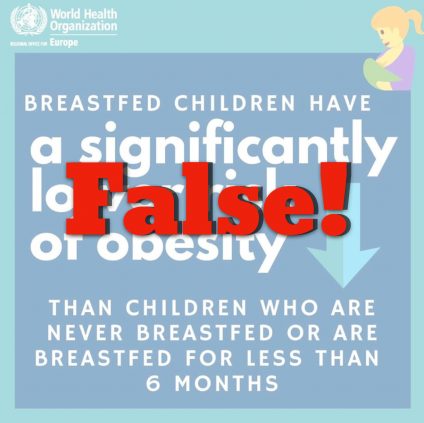
Why does the World Health Organization claim — falsely — that breastfeeding prevents obesity?

C97CD506-7F25-404E-81C6-37A20D25F645

If I had to guess, I would say that the folks at the World Health Organization are afraid.

They’re afraid that if women in industrialized countries knew the truth about how trivial the benefits of breastfeeding really are, they might not feel pressured to breastfeed. I don’t know why that would be a bad thing — since the benefits truly are trivial and have no measurable impact on infant health — but they seem to think it is.

[pullquote align=”right” cite=”” link=”” color=”” class=”” size=””]The WHO admits that their own data do NOT justify causal inference … then proceeds to draw a causal inference.[/pullquote]

Hence this latest effort to mislead women by claiming again — falsely — that breastfeeding prevents obesity.

They even made a meme! Too bad it isn’t true.

F459C2B2-C1AB-49B0-9EBA-E6F489931CF3

A 2018 comprehensive review of the breastfeeding literature had this to say about breastfeeding and obesity:

The relationship between breastfeeding and obesity later in life is debatable. A large, systematic 2014 review of 15 cohort and 10 cross-sectional studies found a significantly reduced risk of childhood obesity among children who were breastfed (adjusted OR=0.78; 95% CI, 0.74- 0.81). However, the review included studies that controlled for different confounders, and smaller effects were found in studies in which more confounders were taken into account.

The 2013 WHO meta-analysis found a small (approximately 10%) reduction in the prevalence of overweight or obese children, but cautioned that residual confounding and publication bias were likely. At 6.5 and 11.5 years of follow-up, PROBIT failed to demonstrate a protective effect for exclusively or “ever” breastfed infants. Sibling analysis similarly fails to demonstrate a statistically significant relationship.

A 2015 meta-analysis of 23 high-quality studies with a sample size >1500 children and controlled for important confounders showed a pooled reduction in the prevalence of overweight or obesity of 13% (95% CI, 6-19).57 The protection in this meta-analysis showed a dilution of the effect as the participants aged and an inverse relationship of the effect with sample size.

Breastfeeding is, therefore, unlikely to play a significant, if any, role in combating the obesity epidemic. (my emphasis)

But the WHO itself has published a new paper that found … the same thing that is already known about breastfeeding and obesity: the link is tenuous to non-existent.

The pooled analysis showed that, compared to children who were breastfed for at least 6 months, the odds of being obese were higher among children never breastfed or breastfed for a shorter period, both in case of general (adjusted odds ratio [adjOR] [95% CI] 1.22 [1.16–1.28] and 1.12 [1.07–1.16], respectively) and exclusive breastfeeding (adjOR [95% CI] 1.25 [1.17–1.36] and 1.05 [0.99–1.12], respectively).

There are three major problems with this paper:

1. The authors didn’t correct for the most important confounding variable, maternal BMI.
2. Even if the results don’t disappear when adjusted for confounding, they are so small as to be clinically meaningless.
3. Correlation does not prove causation.

The authors themselves acknowledge that they haven’t adjusted for all relevant confounders.

…[T]here was no information about the maternal BMI at the time of her child’s birth, which has been shown to be amongst the determinants of birth outcomes and childhood overweight, reflecting the contributions of shared genes and the environment.

So the results themselves could be illusory and might very well disappear if maternal BMI — a known determinant of childhood weight — were taken into account.

But even if the link between breastfeeding and obesity didn’t disappear, its effect is so small as to be meaningless.

Several years ago Gary Taubes wrote a piece for the New York Times Magazine explaining how lay people can judge the results of epidemiological studies, Do We Really Know What Makes Us Healthy?.

…[H]ow should we respond the next time we’re asked to believe that an association implies a cause and effect, that some medication or some facet of our diet or lifestyle is either killing us or making us healthier?

He answers:

If the association appears consistently in study after study, population after population, but is small — in the range of tens of percent — then doubt it. For the individual, such small associations, even if real, will have only minor effects or no effect on overall health or risk of disease…

In this study, as in multiple previous studies, the association is small, in the range of tens of percent. And that means it isn’t clinically relevant, having only minor effects or no effect on overall health or risk of disease.

The WHO claims about this study aren’t merely misleading, though, they are outright lies.

The authors themselves acknowledge that they have NOT proved that breastfeeding reduces the risk of obesity:

…[T]he data come from cross-sectional studies, which can detect an association between exposure and outcome but do not justify causal inference.

It’s hard to be clearer than that. They admit that their own data DO NOT justify causal inference … and then proceed to IGNORE what they just admitted.

The present work confirms the beneficial effect of breastfeeding with regard to the odds of becoming obese…

It doesn’t and it can’t because the data DO NOT justify causal inference!

Why would the WHO mislead the public about what their research on breastfeeding and obesity actually shows?

Here’s a clue in an interview with one of the researchers:

World Health Organisation (WHO) experts who led the Europe-wide research are calling for more help and encouragement to women to breastfeed, as well as curbs on the marketing of formula milk which, said senior author Dr João Breda, misled women into thinking breast was not necessarily better.

But breastfeeding ISN’T necessarily better, the actual benefits is industrialized countries are trivial, and there are very real risks to breastfeeding promotion — measured in tens of thousands of newborn hospital readmissions per year.

No amount of misleading claims from the WHO and its researchers changes the fact that breast is NOT best for every mother and every baby!

Bacteria and viruses are predators, our children are prey and vaccines are the fence that separates them

Angry roaring lion, Kruger National Park, South Africa

Imagine an idyllic village nestled in a jungle clearing.

The people are prospering because they have easy access to animals for meat, copious river fish, and abundant roots and nuts. There’s just one problem: the same land that feeds them so generously is filled with predators who attack them. Lions and tigers eat the villagers, elephants stampede and even small animals drag their children away, never to be seen again.

The villagers’ first thought is to create better weapons with which to kill marauders. They keep their spears that kill at close range, but add bows and arrows to kill predators long before they can get close enough to harm anyone. It’s not perfect, but it works well … in the daytime. Eventually the villagers have to sleep and nearly every night, someone, often a child, is eaten.

[pullquote align=”right” cite=”” link=”” color=”” class=”” size=””]Anti-vaxxers foolishly fear the fence more than the predators.[/pullquote]

Then they decide to built a wooden wall complete with wooden watch towers. Powerful or determined predators can scale the wall, but the watchers alert the villagers who use their weapons to kill them. This turns out to be an excellent solution. As each new home is built in the village, the owner is required to expand the fence.

It’s not a perfect system, of course. Every now and then a predator manages to scale or breach the fence, but the watchtowers allow for advance warning so the villagers invariably meet the predator with immediate and deadly force.

Several generations pass and one day a villager has the terrible misfortune to watch as his child suffers a serious injury and dies when one of the heavy timbers being used to construct a new watchtower falls over and crushes her. He grieves deeply.

“Why,” he asks, “are we repeatedly extending the fence as the village grows and building new watchtowers? No one has been killed by a predator in several generations. My daughter died because of a fence no one needs. Let’s stop extending the fence and building watchtowers. Don’t let another child die like my daughter did!”

All the villagers feel sorry for the grieving father, but most recognize that the reason that that no one has been killed by a predator for several generations is because of the fence and watchtowers, not in spite of them.

A few of the father’s friends, however, worry that what happened to his child might happen to one of their children. They decide that when they build their new houses, they will not extend the fence around it; they will simply leave it open. Others caution them about the risk, but they point out that they are well armed and can simply shoot any predators that make it through the gap.

Those who are afraid insists that the predators aren’t as dangerous as they used to be, and, in any case, they now have better weapons they can use to protect themselves.

Some even insist that the fence never worked at all and the fact that no one has been attacked in 20 years means that the predators have disappeared.

At first it seems that the father was right. Leaving a few segments of the fence open appears to make no difference. The fence perimeter is nearly a mile around and the scattered openings represent only a few feet. Every now and then the child of parents who refused to extend the fence is dragged away and eaten, but those grieving parents bear the horrible result of their personal decision. And, as they are quick to point out, none of their children are ever crushed by fence timbers.

Gradually the number of homeowners who leave their portion of the fence open slowly increases. Then something strange starts to happen. Villagers who live inside the fence are attacked by wild animals. An alligator drags off the child of a villager who had faithfully extended his fence and built a watchtower to go with it.

Why are people well protected by the fence being killed by predators?

The reason isn’t hard to fathom. A few small gaps in a large fence offered great protection even if it wasn’t perfect protection. A predator would only be able to gain access to the village if it found an opening by chance. As the number of gaps grew, the chance that a predator would stumble upon one and then enter the village also grew. The predators now had access to the entire population of the village and didn’t necessarily stop after killing someone near the gap. The fact that those living closest to the gap have powerful weapons wasn’t as helpful as they imagined it would be. They aren’t constantly standing guard so they can easily be caught unawares.

What does that have to do with vaccination?

Bacteria and viruses are the predators and our children are the prey. Vaccines are the fence and watchtowers. Vaccination is an early warning that allows the immune system to meet any threat with immediate and deadly force in the form of antibodies. Yes, you can fight an infection without having been vaccinated just as you can fight a predator as it is dragging off your child. But forewarned is forearmed in infectious disease just as it is in mortal combat.

Anti-vaxxers are like the grieving father and his friends. They are more frightened of falling fence timbers than of lions and tigers. They no longer see lions and tigers as a threat because they’ve been kept out of the village, but predators are deadly whether you have seen them recently or not.

Anti-vaxxers create holes in the immune fence that protects all of us. They risk the health of everyone, not just their own children.

When you understand that vaccines function as the fence you can see the absurdity of anti-vax claims:

Insisting that unvaccinated don’t threaten the vaccinated is like insisting that no one needs to fear a few gaps in the fence that keeps out the lions and tigers so long as the gaps are only near those who don’t like the fence. The reality is that once the predators get through the fence they can attack anyone and typically kill the most vulnerable no matter how desperately their parents try to protect them. Similarly, once bacteria and viruses get through the immune fence created by vaccination, they can attack anyone and typically kill the most vulnerable no matter how desperately their own parents try to protect them.

Leaving gaps in the fence is an invitation to predators. Leaving gaps in vaccine immunity is an invitation to predators, too. Pertussis and measles may not look as harmful as lions and tigers, but they are every bit as deadly.

Anti-vaxxers have created now so many gaps in the fence that vaccine preventable diseases have come roaring back.

All our children will pay the price.


Adapted from a piece that first appeared in September 2016.

Don’t squirt breastmilk on it! It’s not a cure for everything.

299A62A0-5A53-4A02-9C97-C0963FCC0BB7

Breastfeeding research keeps veering into pseudoscience.

It’s not merely that breastfeeding research like most pseudoscience research starts with the conclusion — breastfeeding is beneficial — and then works backwards to find data to support it. That has led to persistently massive exaggeration of the benefits and utterly ignoring the risks.

[pullquote align=”right” cite=”” link=”” color=”” class=”” size=””]No substance treats multiple conditions and diseases that have vastly different causes. That’s pseudoscience, not science.[/pullquote]

The chief indicator that much of breastfeeding “science” is largely pseudoscience is that breastmilk is touted as the cure for everything.

For example, a physician asked other physicians on Twitter:

Drs of Twitter! If your child had developed a mild superficial fungal infection over the weekend, would you buy some Canesten 1% (available from a pharmacist without prescription) or would you feel you needed to take your child to a walk-in centre for a formal diagnosis & script?

And Dr. Natalie Shenker, MD, PhD replied:

FDB99F7D-68AF-4B91-A339-56A93D6ADE63

Hey, hope the little one is ok. Have you tried putting breastmilk on? Contains fungicide components (probably for just this sort of thing)

Let’s leave aside for the moment the unwarranted assumption that every mother has breastmilk on hand. Why is Dr. Shenker recommending it?

She sent a variety of tweets in explanation:

8AA94469-D089-4B13-9C35-32A4084CF533

It’s has fungistatic effects!

There are presumably multiple factors that also combat pathogenic fungi!

It promotes the seeding of helpful fungi!

She offered citations to support her claims but as another individual noted:

The first paper is a study of isolates from human saliva being used on fungal samples (not infections on actual people). Do you have any data that supports the topical use of human milk on fungal infections in actual humans?

That’s a classic pseudoscience tactic: citing research that has nothing to do with the issue under discussion.

And Dr. Shenker responded with another pseudoscience dodge:

I did say data was scanty but as I’m sure you know, historically lab studies seldom get rolled into clinical trials in this field.

Well, yes. That’s because the results of in vitro studies rarely translate to effective treatment for humans.

Lots of things — like orange juice, for example — have fungistatic properties properties in vitro, but we don’t recommended treating fungal dermatitis by bathing in orange juice.

Sadly, however, breastmilk has become the miracle cure for everything.

As Dr. Steve Novella has written on Science Based Medicine:

One common feature of pseudoscience is that proponents of a specific belief tend to exaggerate its scope and implications over time…

How does that happen?

[T]here is a tendency for dubious treatments to undergo indication creep over time. A treatment that starts out being used for one specific indication has a growing list of conditions it can treat or cure, even conditions with very different real underlying causes.

This happens because the process that is being used to determine if the treatment works is flawed in the first place. Typically unscientific treatments are based upon anecdotal evidence, which is susceptible to placebo effects. Proponents are not being skeptical, nor are they conducting the kinds of studies that are capable of showing that the treatment does not work.

In fact the process they use is designed to show that the treatment does work. Therefore, no matter what they try it for, it will seem to work. They may naively come to believe that it works for everything. In some cases they may then backfill an explanation for why it works for everything …

Breastmilk might be helpful in treating certain kinds of dermatitis. In vitro studies do sometimes yield treatments that work in human beings. But no substance treats multiple conditions and diseases that have vastly different causes. That’s pseudoscience, not science.

Why insist that breastmilk is a miracle cure for everything? Marketing!

…If you have a product to sell, you want that product to have as wide a market as possible. In medicine this means as many indications for your treatment as possible. In fact, why limit your market at all? If your treatment works for every indication in every population, then you have maximized your potential customer base.

This does not necessarily mean that those selling panaceas are always knowingly lying … There is a powerful motivation to believe that your treatment has wide-ranging implications. If you discover a treatment that is effective for some cases of athletes foot, that is an achievement and might even be highly profitable. But if you discover the treatment for all infections, or all cancers, or all human disease, then you should become world famous and fabulously wealthy. This is a powerful motivation to believe.

Even legitimate scientists fall prey to the allure of believing their discovery is bigger than it actually was. They have the rest of the scientific community to give them a reality check.

Marketing has led lactation professionals to label colostrum or even breastmilk itself as “liquid gold.” Marketing has led lactation researchers to make outsize claims about the benefits of breastmilk for infants. And marketing has led these same researchers to imagine that there isn’t a medical problem that can’t be improved by squirting breastmilk on it.

Breastmilk is food. It has some benefits, but when people have access to clean water to prepare formula those benefits are trivial.

It’s not a cure-all and if breastfeeding researchers wish to be taken seriously, they must stop pretending that it is.

Why is there no alternative airline industry?

Scam or Scams Online on the Internet as Concept

If its customers are to be believed, the reason the alternative health industry exists is because of how poorly doctors treat patients.

Yet when it comes to poor treatment, the medical industry can’t hold a candle to the airlines. So why is there no alternative airline industry?

[pullquote align=”right” cite=”” link=”” color=”” class=”” size=””]Why is there a alternative health sucker born every minute, but no customers for an alternative airline industry?[/pullquote]

Why aren’t people paying random individuals they read about on the internet to fly them to their destinations in the same way they pay random individuals they read about on the internet to “treat” them with various nonsensical methods like homeopathy and cranio-sacral therapy?

Why are they so practical when it comes to airline travel, choosing only government certified purveyors, recognizing that they will have to compromise to get where they want, but so gullible when it comes to healthcare, sure that there must be an easier, less uncomfortable way to get treated for or cured of a serious illness?

If they (falsely) criticize the medical industry for merely treating their chronic diseases instead of curing them, why don’t they complain that the airline industry never teaches them how to fly but forces them to come back over and over again whenever they want to go somewhere?

And why do they trust that airlines take them where they want to go rather than imagine that the airlines are drugging them with hallucinogens to make them think they have flown somewhere else when they’ve never left the ground? After all, if you are foolish enough to believe that vaccines are an elaborate government conspiracy to give the population autism, you will believe anything.

Consider the many unflattering similarities between the Big Air and Big Medicine:

Both the airline industry and the medical industry are effectively monopolies.

If the average person wants to fly, he or she has no choice but to deal with the airline industry. If the average person wants to treat, cure or even prevent many serious illnesses, he or she has no choice but to deal with the medical industry.

Because they are monopolies, neither devotes serious effort to customer service.

The airlines cancel flights, bump passengers for no better reason than because it suits them. In addition, they have no compunction about delaying flights by hours just to have mechanics check to be sure everything is working right. Don’t like waiting? Too bad for you! Similarly, doctors make patients wait for hours in their offices and that’s nothing compared to the hours you will wait if you visit an emergency room. Don’t like waiting? Too bad for you!

They don’t listen.

Pilots have zero interest in how you think they should navigate to your destination. They don’t care what you believe you know after reading about flight on the internet; they won’t even talk to you about it. Doctors aren’t especially interested in what your Facebook mommy friends told you about your child’s symptoms. They might talk to you about it but even then, they will probably ignore your views on the subject and offer their own.

They don’t care about your comfort.

Leg room in airline seats; I rest my case! Hospital johnnies; another indisputable sign of lack of concern.

They have high barriers to entry.

If you are dissatisfied with your treatment by airlines, you can’t simply set up your own and you are not free to use airlines started up by individuals if they fail to meet the elaborate government standards for commercial flight. Similarly, you can’t simply call yourself a medical doctor if you haven’t graduated from medical school and you can’t obtain a license to practice unless you’ve completed additional years of training.

They make mistakes.

Mistakes by the airline industry are remarkably rare, but when they do happen they are often spectacular disasters that lead to the loss of many lives. Doctors and nurses make mistakes, too. They are far more common, though fortunately most do not lead permanent injury or death.

Given all the similarities, why is there a alternative health sucker born every minute, but no customers for an alternative airline industry?

I suspect the reason is simple: air travel is much more accessible to the senses than medical care.

You can hear the airplane engines.
You can feel the plane take off and land sometime later.
You can see that you are in a very different place when the plane arrives at its destination.

What do your senses tell you when you are being treated for or cured of a disease?

Not much, since most treatment occurs over days, weeks or even months so gradual change is not appreciated.

And your senses tell you nothing at all in the case of preventive care. You didn’t have measles before vaccination, for example, and you don’t have measles afterwards.

Indeed, when treatment or cure occurs over a relatively short period or can be easily perceived, there is no alternative health analogue. You don’t find many “natural” orthopedic surgeons for example, since people feel the acute pain of a fracture, feel the relief that pharmaceuticals offer, see the difference that splinting or casting makes, and feel the difference when the bone is healed.

The bottom line is that alternative health exists because you can trick people into believing you are treating them even when you are merely lightening their wallets, but you can’t trick people into believing that you have flown them to another place if you’ve never left the ground. The customer has to be a lot smarter to understand healthcare treatment than to understand airplane travel.

It has nothing to do with how you treat people and everything to do with their ability to understand something they cannot sense directly and immediately.

Pandering to anti-vaxxers, La Leche League reveals willingness to ignore scientific evidence

A child in a foil hat sits on a blue background

In the wake of the Charlottesville rally of white supremacists in 2017, resulting in the murder of a counter-protester, Donald Trump uttered these immortal words:

You also had some very fine people on both sides.

With that ugly claim, Trump signaled his sympathy with racists. Is Trump a racist? As Sen. Cory Booker recently pointed out, “The racists think he’s a racist.” That, of course, is the point. He is pandering to racists because he values their support above their immoral views and harmful acts.

But make no mistake, there are not very fine people on both sides of the white supremacy debate. There are only racists — whose racism hurts others — and everyone else.

[pullquote align=”right” cite=”” link=”” color=”” class=”” size=””]Is La Leche League anti-vax? Anti-vaxxers think it is.[/pullquote]

In the wake of an blog post asking if La Leche League is anti-vax, I found this statement on their website:

La Leche League does not have a stance on vaccinations …

Really? LLL doesn’t have a stance on the greatest public health advance of the past century, an advance that has saved more lives than breastfeeding ever could? Apparently, there are some very fine people on both sides of this issue. LLL is eager to pander to them because it values the support of anti-vaxxers above their unscientific, unethical views and harmful refusal of vaccines.

Make no mistake, there aren’t two sides to the vaccine debate. There are only conspiracy monetizing, pseudoscience peddling charlatans — whose fear mongering represents the greatest public health threat in this century to children in industrialized countries — and nearly all doctors, scientists and public health officials in the world.

Is LLL anti-vax? The anti-vaxxers think it is.

This list comes from the National Vaccine Information Center (NVIC), possibly the premier anti-vax organization.

3C4B6603-FACB-4E0F-81CA-7437CBD147ED

La Leche League can be found nestled among the major purveyors of pseudoscience like Mercola.com and Dr. Bob Sears. There is no indication that this endorsement was solicited, but it is an endorsement nonetheless.

Speaking of anti-vax charlatan Bob Sears, recently disciplined by the Board of Medicine of California for giving out vaccine exemptions, he is a regular speaker at LLL conferences, including the LLL International Conference in 2007. Indeed, he was scheduled to speak at this LLL conference that took place months after he had been placed on probation.

B5D244B3-7CF0-4819-9E9F-9224254F02B9

The topic? How to evade California’s recently strengthened vaccine mandate.

All of which raises the question: if La Leche League is willing to twist and ignore scientific evidence on vaccination — arguably the single most important protection of the health of children — can they be trusted to accurately represent the scientific evidence on breastfeeding?

The answer is an emphatic, “No!”

What does the truth matter when your goal is to promote breastfeeding even above the health and safety of babies?

It doesn’t matter enough to warn mothers about the dangers of breastfeeding itself. Breastfeeding is now the leading risk factor for newborn readmission to the hospital; literally tens of thousands of babies are being readmitted each year for iatrogenic problems caused by aggressive breastfeeding promotion. You might think that the readmission of tens of thousands of newborns each year merits a discussion on the LLL website, but you would be wrong.

What does the truth matter when your goal is to promote breastfeeding even above the health and safety of babies?

Fully one third of cases of Sudden Infant Death Syndrome (SIDS) are associated with bedsharing and the American Academy of Pediatrics is quite clear that bedsharing is unsafe for babies and should be avoided. LLL mentions the AAP recommendation only to disparage it.

The American Academy of Pediatrics (AAP) says, “Infants may be brought into the bed for feeding or comforting but should be returned to their own crib or bassinet when the parent is ready to return to sleep.” Easy to say… Eventually, many mothers find that bedsharing is a low-risk, long-term solution for sleep deprivation and an unhappy baby…

What does the truth matter when your goal is to promote breastfeeding even above the health and safety of babies?

La Leche League is no longer an organization devoted to science (if it ever was). It is a special interest group devoted to advancing the fortunes of itself and its members, regardless of whether children are harmed as a result.

There are not “fine people” on both sides of the anti-vax debate. There are only conspiracy monetizing, pseudoscience peddling charlatans and nearly all doctors, scientists and public health officials in the world. Going forward, medical professionals and medical organizations should either convince LLL to adhere to the scientific evidence or sever ties with them.

If La Leche League doesn’t stand on the side of doctors, scientists and public health officials, then doctors, scientists and public health officials should not stand by LLL’s side.

Why do natural childbirth & lactation professionals ignore the needs of survivors of sexual violence?

D3A3D1BB-E7C6-4895-887C-6437C7A09CA6

The statistics are staggering. Up to 1 in 3 American women experience sexual violence during their lifetime. Nearly 20% of adult women recall an episode of childhood sexual abuse or assault.

These women often have different needs around childbirth and breastfeeding and those needs are routinely ignored by natural childbirth and lactation professionals.

[pullquote align=”right” cite=”” link=”” color=”” class=”” size=””]Isn’t it a provider’s obligation to support WOMEN, not to promote their preferred method of birth or infant feeding?[/pullquote]

As the paper Responding to Prenatal Disclosure of Past Sexual Abuse explains:

…[T]he perinatal period can be especially challenging for abuse survivors. During pregnancy, bodily sensations resembling disturbing elements of past abuse may lead patients to experience four categories of posttraumatic stress symptoms:

recurrent and intrusive memories;
avoidance of thoughts, activities, and other reminders of the traumatic event;
heightened irritability and other manifestations of autonomic arousal;
and negative changes in mood and cognition.

… Soet and colleagues demonstrated that sexual trauma survivors were 12 times more likely to perceive their childbirth experiences as psychologically traumatic compared to women without this history…

Inter-relationships between sexual abuse, female sexual function and childbirth provides further detail:

Sexual abuse (SA) survivors have been found to potentially experience triggering flashbacks and/or ‘body memories’ of the SA trauma during childbirth. This recalling/re-experiencing of the sexual trauma may be due to a variety of factors such as the similarity in the anatomy involved and the exposure of sexual body parts. Clinical procedures and labour sensations have like-wise been shown to be experienced by SA survivors as triggers, reminding them of the abuse …

Nearly every paper on the topic emphasizes that a subjective sense of lack of control is particularly triggering.

Control/lack of control has also been reported as the main underlying factors influencing SA survivors’ subjective evaluation of the birthing experience in a study by Parratt. Moreover, feelings of powerlessness, betrayal and humiliation have been cited as potential adverse experiences of SA ‘birthing survivors’ – as detailed in a study by Parratt…

Abuse survivors report similar feelings around breastfeeding.

For example:

Some survivors worry that if they choose to breastfeed that breastfeeding advisors will need to touch them when teaching them how to breastfeed their baby…

Certainly no advisor should touch your breasts in any situation without seeking your permission first…

And others find night feedings particularly triggering:

Some survivors mention that they find night time feeds more difficult and are more likely to be triggered and have an unpleasant experience. Obviously, this is more likely if you were abused at night…

Survivors often struggle with feelings of failure that can be exacerbated by breastfeeding difficulties:

…[S]urvivors who breast feed may find themselves saying “My baby lost weight when breastfeeding. I’m useless”. You baby losing weight is not your failure… There are some medical reasons why occasionally a woman may not produce enough milk, or a baby may not take enough milk – and if this is the case then a health care professional will be able to suggest ways forward. It does not mean you have failed…..it is unfortunately one of those things that happens through no fault of your own.

The theme that is repeated over and over again among survivors is a loss of control is especially debilitating for them. Yet natural childbirth and lactation professionals consistently pressure women to give up control to “nature.” They are dismissive when women request epidurals and routinely demean the idea of C-section on maternal request. This despite the fact that women who make these choices are often protecting themselves from sensations they cannot bear and memories that haunt them.

Should women have to reveal a history of sexual violence just to receive the care they need? I always appreciated and felt honored by being taken into my patients’ confidence about past trauma and tried to do anything in my power to make their childbirth experience more bearable. But not every provider is supportive.

… When talking to one midwife about the fact that I would chose not to breastfeed if I had a baby, she replied “Well, you don’t deserve to be a mother then!” – without exploring any of the reasons with me that I may have come to this conclusion. Unfortunately, this attitude is not totally unheard of within the hospital environment, and rather than perhaps supporting survivors to be able to overcome their fears, this attitude can close a survivor down and prevent them from getting the support which may prove helpful to them.

Moreover, if up to one third of women experience sexual violence during their lifetime, shouldn’t ALL providers offer ALL women the option of taking control of their birth experiences by choosing epidural or C-section on maternal request? Shouldn’t ALL providers offer ALL women the opportunity to formula feed if they think that is the best way to protect their mental health.

Why do natural childbirth and breastfeeding professionals routinely ignore the needs of survivors of sexual violence?

Isn’t it a provider’s obligation to support WOMEN, not to promote their preferred method of birth or infant feeding?

2977569B-56DD-4AB6-80D7-C57EF04BE97A