All posts by Amy Tuteur, MD

What does breastfeeding have in common with vitamins? It’s not what you think.

Female medicine doctor hand give prescription to patient

The NYTimes article Older Americans Are ‘Hooked’ on Vitamins starts with an anecdote:

When she was a young physician, Dr. Martha Gulati noticed that many of her mentors were prescribing vitamin E and folic acid to patients. Preliminary studies in the early 1990s had linked both supplements to a lower risk of heart disease.

She urged her father to pop the pills as well …

But just a few years later, she found herself reversing course, after rigorous clinical trials found neither vitamin E nor folic acid supplements did anything to protect the heart. Even worse, studies linked high-dose vitamin E to a higher risk of heart failure, prostate cancer and death from any cause.

Why were cardiologists prescribing vitamins that ultimately turned out to be not merely ineffective, but potentially harmful?

[pullquote align=”right” cite=”” link=”” color=”” class=”” size=””]You can be sincere and be wrong at the same time.[/pullquote]

Often, preliminary studies fuel irrational exuberance about a promising dietary supplement, leading millions of people to buy in to the trend. Many never stop. They continue even though more rigorous studies — which can take many years to complete — almost never find that vitamins prevent disease, and in some cases cause harm.

You could say almost exactly the same thing about breastfeeding. Indeed, a prominent breastfeeding researcher has. Dr. Michael Kramer, known for the PROBIT studies of breastfeeding gave a fascinating interview to Canadian radio in early 2016.

Dr. Kramer is a lactivist, but the interview is remarkably nuanced. There’s no transcript, but I’ve linked to the audio file.

When asked why lactivist organizations continue to insist on benefits that have been shown not to exist, he explained that these organizations rely upon preliminary data and simply refuse to accept anything that contradicts it. He was quite blunt about the fact that lactivist organizations won’t accept scientific evidence that doesn’t comport with what they believe.

Kramer was speaking before publication of a spate of papers that show that the benefits aren’t merely exaggerated, the risks and dangers have been completely ignored.

Such papers include:

Taken together they show that insufficient breastmilk is common (up to 15% of first time mothers), formula supplementation makes successful breastfeeding more likely, pacifiers prevent SIDS and extended skin to skin contact lead to babies falling from their mothers’ hospital beds or suffocating while in them. The leading cause of jaundice induced brain damage (kernicterus) is breastfeeding and breastfeeding doubles the risk of neonatal hospital admission leading to literally tens of thousands of hospital admissions per year.

When it comes to vitamins:

There’s no conclusive evidence that dietary supplements prevent chronic disease in the average American, Dr. Manson said. And while a handful of vitamin and mineral studies have had positive results, those findings haven’t been strong enough to recommend supplements to the general American public, she said.

The National Institutes of Health has spent more than $2.4 billion since 1999 studying vitamins and minerals. Yet for “all the research we’ve done, we don’t have much to show for it,” said Dr. Barnett Kramer, director of cancer prevention at the National Cancer Institute.

But, but, but vitamins are natural! And it seems like every week some researcher publishes a paper and a press release claiming this or that vitamin prevents cancer or heart disease.

Similarly, breastfeeding is also natural and it seems like every week some researcher publishes a paper and a press release claiming breastfeeding prevents cancer or heart disease or obesity or asthma or allergy or … the list goes on and on.

Why is the lure of vitamin supplements so attractive?

A big part of the problem, Dr. Kramer said, could be that much nutrition research has been based on faulty assumptions, including the notion that people need more vitamins and minerals than a typical diet…

But:

..[M]ost Americans get plenty of the essentials, anyway…

Also, American food tends to be highly fortified — with vitamin D in milk, iodine in salt, B vitamins in flour, even calcium in some brands of orange juice.

Without even realizing it, someone who eats a typical lunch or breakfast “is essentially eating a multivitamin,” said Catherine Price a journalist …

A big part of the problem with breastfeeding research is the faulty assumption that babies need whatever breastfeeding has that formula lacks. But formula provides everything a baby needs for health and growth. There’s no magic to breastmilk, just like there’s no magic to vitamins.

There’s another thing that breastfeeding has in common with vitamins: confounding variables.

People who take vitamins tend to be healthier, wealthier and better educated than those who don’t, Dr. Kramer said. They are probably less likely to succumb to heart disease or cancer, whether they take supplements or not. That can skew research results, making vitamin pills seem more effective than they really are.

We know that women who breastfeed are also healthier, wealthier and better educated than those who don’t. That inevitably skews research results. The purported benefits of breastfeeding are really benefits of better education, more money and easy access to health insurance.

Dr. Gulati’s experience is instructive. When she recommended vitamin D and folic acid to her dad, she believed that they would be beneficial. She was entirely sincere in her recommendation. Unfortunately, she was wrong but she was willing to change her mind and her recommendations in response to more complete data.

Dr. Gulati, the physician in Phoenix, said her early experience with recommending supplements to her father taught her to be more cautious. She said she’s waiting for the results of large studies — such as the trial of fish oil and vitamin D — to guide her advice on vitamins and supplements.

“We should be responsible physicians,” she said, “and wait for the data.”

It’s time for breastfeeding researchers to be responsible physicians and scientists, too. They need to wait for the results of large studies — and wait further until they are reproduced — before recommending breastfeeding for every mother and every baby.

It’s not enough to sincerely believe in the benefits of breastfeeding. You can be sincere and be wrong at the same time. Breastfeeding researchers must change their minds and their recommendations in response to more complete data like that in the papers linked above. Otherwise, babies will continue to suffer and die because lactation professionals’ irrational exuberance about the benefits of breastfeeding.
Amy Brown condemns bottle propping but ignores the more deadly practice of co-sleeping

Mother giving milk from bottle to baby sleeping on hands

The hypocrisy of professional lactivists is truly mind blowing!

Take Amy Brown’s latest piece on The Conversation, Baby bottle propping isn’t just dangerous – it’s a sign of a broken society, a polemic against products that prop bottles:

How on earth have we got to the point where bottle propping is the solution? Why are we ignoring the needs of our new mothers? Why are new mothers literally the ones left holding the baby, day in, day out? Having a new baby is always going to be a huge change. But it doesn’t need to be like this.

[pullquote align=”right” cite=”” link=”” color=”” class=”” size=””]If Brown truly cared about babies, she’d oppose co-sleeping.[/pullquote]

You bet it doesn’t need to be like this! The contemporary philosophy of natural mothering (aka attachment parenting) has made it like this. It starts with the Baby Friendly Hospital Initiative — which Brown vigorously supports — that forces women to be left caring for a baby in the hours and days immediately after birth, despite pain and exhaustion, in an effort to promote breastfeeding.

Many cultures and religions specify a period of “confinement” after birth, weeks in which new mothers are relieved of their daily duties and allowed to concentrate on caring for a newborn. They don’t even have to take care of themselves; mothers, mothers-in-law and other women take care of them. In our culture, “broken” by lactivism, women have to start caring for the baby the moment the placenta detaches.

Of course, the real problem with bottle propping is that it is dangerous. As Brown notes:

Young babies may not have the head control or strength to move away from the flow of the milk that is being aided by gravity. Quite simply they can choke to death as they cannot escape from the milk, or inhale it as the bottle becomes displaced.

And that’s why bottle propping should never, ever be done! Brown is correct that maternal exhaustion is not an excuse.

But once again Brown’s hypocrisy rises to the fore. Bottle propping, as dangerous as it is, has only accounted for rare infant deaths. In contrast, co-sleeping — another practice vigorously supported by Brown — is killing many more each year because, according to the American Academy of Pediatrics, it nearly triples the risk of infant death from SIDS.

Yet Brown, apprised of this risk is on the record in her support:

Brown told Reuters Health by email that “feeding a baby this much can be really tiring, especially if new mothers are expected to go back to work or need to care for other children in the day.”

Sleeping in the same bed can be helpful, Brown said. “Anything that helps mothers to get more sleep, and helps to make sure that the baby feeds frequently is really important.”

Wait, what? Co-sleeping, which triples the risk of SIDS is okay because it help mothers get more sleep and ensures that the baby feeds as needed, but bottle propping, which kills only rarely, is completely unacceptable as a method of easing a mother’s exhaustion and ensuring that the baby feeds as needed? In our culture, “broken” by lactivism, exhaustion is the perfect excuse for engaging in a deadly practice if you’re breastfeeding, but anathema if you aren’t.

But there’s a larger issue at stake, the romantizing of a past that literally never existed. Brown writes:

We now have so many parents who are pretty much doing this on their own. Yes, they might have a partner, but they’re often at work all day. Yes, they might have visitors, but how many are there just to coo over the baby rather than do anything useful such as cook a meal, do the washing up, or anything else that might actually help a new mother feel more relaxed? …

No mother should be doing this alone. We should track down where the “village” – that extended network of family and friends which share responsibility for raising a child – went to and recreate it. There must be a recognition of how isolating and exhausting caring for a baby can be – and a system in place to catch mothers before they fall.

In nature women had no work to do and were free to spend all their time tending their infant? There was never a time like that.

Women have always been integral to the survival of small hunter-gatherer bands. They spent hours each day as the gatherers. They spent additional hours in laborious domestic tasks like grinding grain. In a very real sense, mothering in nature was an interstitial task, taking place in the gaps while performing other tasks that required attention and energy.

The dominant contemporary paradigm of natural mothering, in contrast, imagines mothering performed instead of other tasks. It is not something that you do while doing everything else; it’s something you do to the exclusion of everything else. That’s not natural; it has nothing to do with the way our foremothers raised children.

No doubt Brown is going to be flabbergasted to learn that while our society may prop bottles, indigenous societies propped the entire baby. That’s part of the function of cradleboards.

Cradleboards were used during periods when the infant’s mother had to travel or otherwise be mobile for work … The cradleboard could be carried on the mother’s back … The cradleboard can also be stood up against a large tree or rock if the infant is small, or hung from a pole (as inside an Iroquois longhouse), or even hung from a sturdy tree branch…

Mothers prop bottles today for the same reason indigenous mothers propped babies. They have older children. They have elderly relatives that need care. They have jobs, whether in the home or outside it. It’s not a sign of a broken society. It’s a sign of a real society, not the fictitious one that Brown longs for.

If Brown truly cared about babies, she’d oppose co-sleeping. If she truly cared about mothers, she’d opposed mandatory rooming in policies. Instead she merely opposes bottle propping. That’s hypocrisy.

What if formula harmed as many babies as breastfeeding does?

Risk

For years I’ve been pointing out that the promised benefits of breastfeeding have failed to materialize.

Although lactation professionals like Melissa Bartick, MD have continued to write papers modeling the purported savings of both lives and healthcare dollars, with the exception of extremely premature babies neither she nor anyone else can point to any lives or healthcare dollars that have actually been saved. Moreover, the countries with the lowest rates of breastfeeding like the UK have among the lowest rates of infant mortality in the world, while multiple countries with the highest breastfeeding rates in Africa have the highest rates of infant mortality in the world.

[perfectpullquote align=”right” cite=”” link=”” color=”” class=”” size=””]The promised benefits of increased breastfeeding have failed to materialize because the risks were never taken into account.[/perfectpullquote]

Why is there such a discrepancy between what breastfeeding professionals promise and what actually happens?

There’s a simple reason: exclusive breastfeeding also has risks.

Although those factors are never taken into account in Dr. Bartick’s modeling, they appear to negate the saving of lives and obliterate the saving of healthcare dollars that lactation professionals promise.

What if formula harmed as many babies as breastfeeding does? There would be a national outcry!

Consider the furor surrounding revelations that French formula manufacturer Lactalis sold products contaminated with salmonella over a period of a decade.

In the 2005 outbreak, 146 children fell ill. In last year’s outbreak, at least 38 cases in France and Spain were traced to Lactalis milk.

On Thursday, researchers from the Pasteur Institute in Paris said the salmonella bacteria had remained at the Craon factory until it was closed.

As a result, they said, a total of 25 babies had been affected between 2005 and 2016.

Parents were horrified, governments swung into action, and the formula company will ultimately pay hundreds of millions of Euros in fines and to damage claims … all because 209 babies became sick.

Now consider that literally TENS OF THOUSANDS of American newborns are readmitted to the hospital each year, costing HUNDREDS OF MILLIONS of healthcare dollars because breastfeeding doubles the risk of newborn hospital readmission.

Why? Because insufficient breastmilk is common (up to 15% of first time mothers in the days immediately after birth) and severe dehydration, jaundice, failure to thrive and death are the inevitable results of pressuring women to exclusively breastfeed regardless of whether the baby is getting enough.

It’s a scandal that dwarfs the Lactalis scandal yet no one seems in the least upset. Researchers merely ponder how they can reduce the harm while continuing to promote exclusive breastfeeding for its “benefits.”

Consider, too, that breastfeeding is now the leading cause of kernicterus (jaundice induced brain damage) responsible for 90% of the cases of this serious complication that often results in long term disability or even death.

It’s scandalous but researchers merely ponder how they can reduce the harm while continuing to promote exclusive breastfeeding for its “benefits.”

Consider that emphasis on skin to skin contact and 24 hour rooming in has led to a dramatic increase in sudden post neonatal infant collapse (SUPC). SUPC can result in severe brain damage and many affected infants die.

It’s scandalous but researchers merely ponder how they can reduce the harm while continuing to promote exclusive breastfeeding for its “benefits.”

Consider that the Joint Commission has just issue new guidelines to combat an epidemic of infant falls — and the resulting injuries and deaths — that also result from the promotion of extended skin to skin contact and 24 hour rooming in.

It’s scandalous but researchers merely ponder how they can reduce the harm while continuing to promote exclusive breastfeeding for its “benefits.”

So why hasn’t there been an outcry about the dangers of breastfeeding? The answer has more to due with psychology than scientific evidence.

Psychology leads people to imagine that the risks of technology are always greater than the risks of nature.

Professor David Ropeik discusses this in The Consequences of Fear. He notes:

… [M]any people fail to protect themselves adequately from the sun, in part because the sun is natural and because, for some of us, the benefit of a healthy glowing tan outweighs the risks of solar exposure. However, solar radiation is widely believed to be the leading cause of melanoma, which will kill an estimated 7,910 Americans this year.

Psychology is also responsible for out marked aversion to betrayal:

…[S]afety products rarely provide perfect protection and sometimes “betray” consumers by causing the very harm they are intended to prevent. Examples include vaccines that may cause disease and air bags that may explode with such force that they cause death…

The mere possibility of betrayal threatens the social order that enables us to trust the safety infrastructure of our society, causing intense visceral reactions and negative emotions toward the betrayer. Unfortunately, these strong negative emotions toward a potential betrayer may also lead people to take unwise risks…

So we react with outrage when we learn that a manufacturer sold contaminated formula and insist that breastfeeding, because it is natural, will never betray us.

There’s a final reason why we’ve acquiesced to the rising tide in injuries and deaths from exclusive breastfeeding promotion: lactation professionals have lied about them. They create endless lists of the “risks” of formula feeding and refuse to mention the risks of breastfeeding like insufficient breastmilk, SUPC and falls from bed.

Even worse, they demonize the people and organizations who try to alert mothers to the risks and prevent the injuries and deaths. The founders of the Fed Is Best Foundation have taken an incredible amount of abuse from lactation professionals who appear psychologically incapable of accepting the scientific evidence on breastfeeding harms.

I myself am often accused by lactivists of “hating” breastfeeding even though I happily and successfully breastfed four children; no doubt this piece will reinforce their views. But I don’t hate breastfeeding. I hate iatrogenic injuries and deaths that are the result of refusing to acknowledge that breastfeeding has risks as well as benefits.

Sure breastfeeding has benefits, but they can easily be dwarfed by unacknowledged risks. That’s why the predictions of lactation professionals like Melissa Bartick, MD haven’t come true and never will.

Lactivism and the hallmarks of pseudoscience

72775232 - paradigm shift, 3d rendering, traffic sign

On the first day of medical school, they tell students that half of what they are about to learn will be overturned or changed in the next five years; the problem is that we don’t know which half. But the hallmark of science is that new information challenges old certainties and doctors must change their thinking and practice in response.

Pseudoscience, however, does not change as the facts and understanding change. It starts with a claim —for example, the claim that breastfeeding is best for every baby — and it sticks with that claim regardless of new facts that come to light.

[pullquote align=”right” cite=”” link=”” color=”” class=”” size=””]Lactation professionals who resist changes to the Ten Steps are no different from obstetricians who continue doing routine episiotomies.[/pullquote]

The recent response of lactivists to the growing body of evidence that aggressive breastfeeding promotion is injuring and in some cases killing infants suggests that lactivism is a form of pseudoscience. While pediatricians, neonatologists and organizations like the Fed Is Best Foundation are begging the World Health Organization to revise the Ten Steps to Successful Breastfeeding to incorporate the new findings, lactivist organizations will not budge.

Contrast the response of the science of obstetrics to the pseudoscience of lactivism in the face of paradigm shifting scientific evidence.

I was taught to perform episiotomies very early in my training.

It was the rare delivery of a first time mother that was not accompanied by an episiotomy and the rationale was persuasive. The baby’s head often tore apart the lower vagina and tears might radiate out to the labia and clitoris and well as down to the rectum. It was thought that making a precise incision that was easier to repair would spare women from multiple, ragged lacerations. Most important, obstetricians believed that episiotomies made is less likely that the rectum would be damaged. Avoiding fecal incontinence was a high priority.

It made a lot of sense, but it was wrong. Paradigm shifting research done in the 1980’s and 1990’s demonstrated that a median episiotomy (straight up and down), by weakening the tissue of the lower vagina, made tears down to the rectum MORE likely, not less. Most obstetricians (including me) didn’t believe it at first, but the scientific evidence was clear and clinical practice changed on a dime. Within a few years the rate of routine episiotomies dropped precipitously and episiotomies are now almost solely reserved for forceps and vacuum delivery.

Lactation consultants are taught that breastfeeding is best for every baby, that formula supplementation and pacifiers harm the breastfeeding relationship, that insufficient breastmilk is rare, and that extended skin to skin contact and rooming in are safe and improve the likelihood of breastfeeding success. Paradigm shifting research done within the past decade has shown that insufficient breastmilk is common (up to 15% of first time mothers), formula supplementation makes successful breastfeeding more likely, pacifiers prevent SIDS and extended skin to skin contact lead to babies falling from their mothers’ hospital beds or suffocating while in them. The leading cause of jaundice induced brain damage (kernicterus) is breastfeeding and breastfeeding doubles the risk of neonatal hospital admission leading to literally tens of thousands of hospital admissions per year.

The evidence on the dangers of breastfeeding is actually far more compelling than the evidence on the dangers of episiotomies. In a feeble response, the WHO has made some minor, inadequate changes to the their recommendations. The response of lactation professionals has been to erect a wall of denial; they are vigorously protesting even the insufficient changes.

This letter from the International Baby Food Action Network, in partnership with the Baby-Friendly Hospital Initiative Network of Industrialized Nations (BFHI), International Lactation Consultant Association (ILCA), La Leche League International (LLLI), World Alliance for Breastfeeding Action (WABA) makes clear their insistence on clinging to old, discredited claims.

Global standards

The issues babies face in developing countries are very different than those in industrialized countries. Breastfeeding provides significant health benefits in developing countries as opposed to trivial benefits in industrialized countries. The WHO has proposed acknowledging these differences by allowing individual countries to develop national standards. Lactation professionals are opposed:

we still believe this approach will allow for wide variation of practices and inconsistent standards throughout the world, undermining global indicators. Global standards are the foundation of the BFHI and they are essential to monitoring the global effort to improve breastfeeding rates.

Yes, global standards might make things easier for the BFHI but they don’t make things better, healthier or safer for mothers or babies.

The BFHI

Given the paucity of evidence that the BFHI improves breastfeeding rates, the WHO has designated it as a “key” strategy, not the only strategy. Lactation professionals, sensing a threat to their employment prospects, vigorously disagree.

The Ten Steps

Many of the Ten Steps have been found to be harmful to babies and most have been found to be ineffective in promoting breastfeeding. No matter. Lactation professionals object to changes that incorporate the scientific evidence.

Consider the response to changing Step 9: Give no pacifiers or artificial nipples to breastfeeding infants. Pacifiers are lifesaving; indeed research shows that they are more likely to prevent SIDS than breastfeeding itself. Lactation professionals don’t care. They are affirmatively OPPOSED to making decisions based on the scientific evidence.

…[I]t was not the most appropriate method for examining the evidence related to the socio-cultural and ethical complexities of the BFHI. This method failed to portray the reality that those working and researching in this field have experienced over the past 30 years.

That’s the equivalent of obstetricians insisting that they are going to keep doing routine episiotomies because they believe in them despite the scientific evidence showing harm.

Lactation professionals have exerted tremendous pressure on the WHO to retain the outdated, dangerous Ten Steps. The WHO appears to be caving, but apparently not far enough.

WHO and UNICEF, based on an evaluation of the evidence and information submitted by the collaborative, appear to have made significant changes to the proposed initial draft, including the retention of the order, number and subject matter of each of the original Ten Steps. However, significant gaps in the alignment of our thinking with WHO and UNICEF remain.

They are encouraging their members to lobby the WHO to maintain the status quo even though the the status quo ignores the scientific evidence, is dangerous for babies leading to literally tens of thousands of newborn hospital readmissions in the US alone, and increases sudden infant deaths in hospitals.

Science necessitates change based on new information; pseudoscience resists change regardless of scientific evidence. By that metric, contemporary lactivism — cheered on by its lactation professional enablers — is pseudoscience.

Hey, Fatso, we have some breastfeeding advice for you

Beautiful woman doing different expressions in different sets of clothes: be careful

Information for Porky Patients from Smug-Bigoted Maternity Hospital

Welcome to Smug-Bigoted Maternity Hospital! We know how frightening and disruptive hospital admission can be and we want to tell you we are are sorry that a big honking whale like you has been admitted. We’re not just sorry for you; we’re sorry for ourselves. Do you have any idea how hard it is to turn a fat cow like you in bed?

Hey, we’re not insulting you. We care about your health and obesity is unhealthy. Push yourself away from the table for a moment and listen up. Hungry Hippos like you often have trouble breastfeeding and have to resort to artificial baby milk. It’s your choice to be the size of a house so don’t think we’re going to provide you with powdered or ready to feed poison, a suboptimal choice for nutrition chosen only by shit mothers. Losers like you can bring your own.

[pullquote align=”right” cite=”” link=”” color=”” class=”” size=””]Referring to formula as “artificial baby milk” is no more effective than addressing overweight women as “fatso” and just as harmful and unethical.[/pullquote]

Is this an ethical or effective way to address patients? Is insulting women about their weight likely to result in weight loss? Does insulting them make women more likely to follow healthcare advice? No, no, and no! We would rightfully be appalled at hospitals and healthcare providers treating obese and overweight patients this way.

So why is it acceptable for formula feeding mothers to be bombarded with insults under the guise of providing healthcare?

The BBC reports Hospital’s ‘artificial feeding’ letter to mothers criticised:

A hospital trust has been criticised for describing mothers who use formula milk as “artificially” feeding babies.

Worcestershire Acute Hospitals NHS Trust made the comment in a letter that said it would no longer provide formula milk in its maternity units to mothers who had decided not to breastfeed.

One woman who said she had been unable to breastfeed said the letter’s wording made her “sick to the stomach”.

The trust said it would “consider carefully” feedback it had received.

Where did they get the idea that such language was acceptable in the first place? They got the idea from lactation consultant Diane Weissinger.

Risky Business: Breastfeeding Promotion Policy and the Problem of Risk Language a 2017 paper published in the Journal of Women, Politics & Policy explains:

In 1996 the Journal of Human Lactation published a guest editorial called “Watch Your Language!” by Diane Wiessinger, an International Board Certified Lactation Consultant … In her editorial Wiessinger argued that, rather than providing a convincing case for breastfeeding, the language most commonly used to describe breastfeeding instead serves to reinforce formula feeding as the normative method of feeding infants. Words like “[b]est possible, ideal, optimal, perfect,” she insisted, “are admirable goals, not minimum standards”. Few people feel driven to provide the best, to “be far above normal,” she pointed out, but most people “certainly don’t want to be below normal”… [B]y using words like “best” and “benefits of breastfeeding” rather than “normal” and “risks of formula feeding,” breastfeeding supporters are depriving “mothers of crucial decision-making information”…

[Her] argument has become so well known among lactation consultants, [breastfeeding advocates] often introduce her “Watch Your Language!” piece as “seminal” or “classic.” It is perhaps even more telling that
her name has been made into a verb that is widely understood in the breastfeeding support community: to “Wiessingerize” means to refer to breastfeeding as the norm against which other infant feeding methods fall short…

The decision by the Worcestershire Trust to derogate formula as artificial baby milk is typical of the strategy.

The effort to promote breastfeeding by demeaning formula feeding has only accelerated in the past two decades.

Even just a cursory Internet search shows that breastfeeding promotion materials framed in terms of “the risks of formula feeding” are currently being used by some state breastfeeding coalitions, two hospitals, two private corporations, the Departments of Public Health in California and New York, the City of New York, as well as The Special Supplemental Nutrition Program for Women, Infants, and Children (WIC) programs in at least five states… The United States Department of Health and Human Services’ Office on Women’s Health publishes a 50- page guide to breastfeeding that points out that “among formula-fed babies, ear infections and diarrhea are more common”. It goes on to state that “Formula-fed babies also have higher risks” of a variety of conditions …

The authors note:

Making it hurt: The strategy of risk
The irony, of course, is that individuals and organizations so determined to convince women to breastfeed because of evidence-based claims about its health effects are themselves choosing a breastfeeding promotion approach that is not based on actual evidence.

Insulting formula feeding mothers is no more effective than insulting obese women. Indeed, there is a large and growing body of evidence that Weissingerizing breastfeeding promotion efforts is harming mothers and thereby harming babies as well.

They interviewed hundreds of women and found:

[Women] can recognize when they are being manipulated and that they distrust breastfeeding promotion materials worded in ways they identify as manipulative. Listening shows that many of them think it is cruel or unfair to make infant formula sound so dangerous, especially when it is the only option available to some mothers. Listening indicates that some of them believe that the science is correct and that others have doubts based either on their own experience or on their assessments of the science itself. Listening shows us that some of these women may not believe the risk is large enough, or that there are other risks that are larger or that matter more to them.

They conclude:

All of this suggests that breastfeeding promoters need to do more than simply “watch their language,” lest they themselves risk alienating their audience. Rather, they may want to consider stopping talking altogether, even for just a moment, so that they can hear what women are saying.

In other words, referring to formula as “artificial baby milk” is no more effective than addressing overweight women as “fatso” and just as harmful and unethical.

What do midwives and lactation consultants have in common with right wing trolls?

449F2B1E-717C-4773-8FA9-6C2C6530F7AB

Who could possibly be so heartless as to claim that the survivors of the Parkland high school shooting are actors faking their distress?

How vicious do you have to taunt the parents of the first graders massacred at Sandy Hook elementary school?

How could anyone with a modicum of compassion insist that the Pulse night club horror was faked?

[pullquote align=”right” cite=”” link=”” color=”” class=”” size=””]What’s the difference between tormenting a father whose son died at the hands of midwives and tormenting a Sandy Hook parent whose child died at the hand of a gun user? Nothing.[/pullquote]

Right wing trolls have done all three. Even more horrifying than their utter lack of decency is the fact that other right wing commentators/Facebook users/Tweeters haven’t rebuked them, but embraced these vile lies instead. Apparently it is easier and more comforting for gun rights activists to believe outrageous falsehoods than to acknowledge the tragedies that arise as a result of their beloved ideology.

Lest you think that such vicious behavior is somehow restricted only to gun rights activists, consider the response of midwives and lactation consultants to the tragedies that arise as a result of their beloved ideologies.

UK midwife Sheena Byrom, ironically author of the a book about “kindness, compassion and respect” in maternity care has relentlessly trolled loss father James Titcombe who has had the temerity to insist that the death of his son at the hands of midwives could have been prevented.

F890386B-B5F2-4591-9705-18846B5003CC

Highlights include:

oh James-don’t let’s get on that roll again …

and:

getting out of bed in the morning has risks

What’s the difference between tormenting a father whose son died at the hands of midwives and tormenting a Sandy Hook parent whose child died at the hand of a gun user? Nothing.

In the wake of newspaper reports detailing the massive increase in UK liability claims as a result of injured and dead babies, Australian midwife Hannah Dahlen declared that the dead babies were “fake news.”

EFBE9887-4CBC-41FB-B206-B338141362DB

For all those UK midwives feeling hammered this week by Fake News remember “thinking is difficult which is why most people judge” #ENOUGH!

What’s the difference between claiming that dead babies are fake news and claiming that the Pulse nightclub massacre didn’t happen? Nothing.

Lactivists are no better. When the story of Baby Landon Johnson broke, the story of a baby who died of dehydration from insufficient breastmilk, various lactation professionals and lactivists weighed in with their belief that the baby didn’t die of dehydration, some people even going so far as to fabricate the vile slander that Landon had been suffocated by his mother’s inattention when she was holding him.

What’s the difference between claiming that Landon’s mother lied about his death and claiming that the survivors of the Parkland school shooting are lying about their suffering and grief. Absolutely nothing!

Even more horrifying than their utter lack of decency is the fact that other midwives and lactation consultants commentators/Facebook users/Tweeters haven’t rebuked them, but embraced these vile lies instead. Apparently it is easier and more comforting for midwives and lactation consultants to believe outrageous falsehoods than to acknowledge the tragedies that arise as a result of their beloved ideologies.

The reason there’s no difference is because midwives and lactation consultants are afflicted by the same problem that bedevils right wing trolls: cognitive dissonance.

In A Theory of Cognitive Dissonance (1957), Leon Festinger proposed that human beings strive for internal psychological consistency in order to mentally function in the real world. A person who experiences internal inconsistency tends to become psychologically uncomfortable, and is motivated to reduce the cognitive dissonance. This is done by making changes to justify their stressful behavior, either by adding new parts to the cognition causing the psychological dissonance, or by actively avoiding social situations and/or contradictory information likely to increase the magnitude of the cognitive dissonance.

Gun rights activists insist that lax gun laws have no impact on public safety. When a gun massacre occurs precisely because of lax gun laws they have two choices to reduce cognitive dissonance. They can give up their treasured belief that widespread gun ownership is not dangerous, or — easier and more comfortable — they can pretend that gun massacres didn’t happen, blame the suffers as faking their suffering, or, worst of all, insist that the survivors are somehow responsible for their own suffering.

Many midwives and natural childbirth advocates insist that unmedicated vaginal birth (so called “normal” birth) is safest. When babies die because of the philosophy of normal birth, they have two choices to reduce cognitive dissonance. They can give up their treasured belief about normal birth or — easier and more comfortable — they can pretend that dead babies are “fake news”, insist that grieving parents are unfairly blaming the ideology, or, worst of all, insist that the survivors are somehow responsible for their own suffering.

Lactation consultants are certain that breastfeeding is best for every baby. When babies die because of aggressive breastfeeding promotion, they have two choices. They can give up their treasured belief about breastfeeding or — easier and more comfortable — they can pretend that dead babies are “fake news,” insist that grieving parents are unfairly blaming the ideology, or, worst of all, insist that the survivors are somehow responsible for their own suffering.

I have some sympathy for those suffering from cognitive dissonance. If you base your identity on a belief that turns out to be not merely false, but dangerous, it is very difficult to reconcile that treasured belief with the even more powerful need to feel you are a good person. It’s so much easier and more satisfying to insist that the tragic result of your belief didn’t happen and to troll the people whose suffering is making a mockery of your treasured belief.

I have no sympathy whatsoever for the wider community that fails to call those issuing vile accusations to account. I have no sympathy for gun owners who won’t disavow the ugly tactics of those who insist that deaths are fake news and grieving survivors are actors. Indeed, I find it inexplicable and indefensible. Similarly, I find it inexplicable and indefensible for the wider midwifery community’s failure to call the Sheena Byroms and Hannah Dahlens to account for their reprehensible claims that dead babies are fake news and grieving survivors have nefarious motives or even deserve their suffering. I find it inexplicable for the wider lactation community’s failure to call those questioning the sincerity and motivations of  the Fed Is Best founders and community members.

What do midwives and lactation consultants have in common with right wing trolls? Their willingness to do and say anything, no matter how vile, to ease their own cognitive dissonance.

5 lies my lactation consultant told me

E09458F2-0FC6-4CA9-8524-ECB67B94E261

Another day, another “study” of breastfeeding based on ignorance and ideology.

When I first saw the article from Manchester University, Research reveals why obese mothers less likely to breastfeed, I thought it would be about insulin resistance. After all, insulin resistance, a common complication of obesity, has been found to affect production of breastmilk.

[pullquote align=”right” cite=”” link=”” color=”” class=”” size=””]These 5 lies interlock to create the impenetrable wall of denial faced by new mothers who have breastfeeding complications. [/pullquote]

[P]revious research had shown that for mothers with markers of sub-optimal glucose metabolism, such as being overweight, being at an advanced maternal age, or having a large birth-weight baby, it takes longer for their milk to come in, suggesting a role for insulin in the mammary gland…

“This new study shows a dramatic switching on of the insulin receptor and its downstream signals during the breast’s transition to a biofactory that manufactures massive amounts of proteins, fats and carbohydrates for nourishing the newborn baby,” says Dr. Nommsen-Rivers.

“Considering that 20 percent of women between 20 and 44 are prediabetic, it’s conceivable that up to 20 percent of new mothers in the United States are at risk for low milk supply due to insulin dysregulation.”

But shockingly the paper didn’t mention insulin resistance at all. Instead it advanced the all purpose lactivist lie that the only limitation to breastfeeding is lack of maternal support.

Factors holding obese women back from breastfeeding included: lack of breastfeed planning, low belief in breastmilk’s nutritional adequacy and sufficiency, poor body image and lack of social knowledge.

That’s like looking at someone with glasses and blaming lack of support — instead of nearsightedness — for difficulty seeing. In an additional irony, the paper appears on the website Obesity Reviews beneath a paper exploring the role of insulin resistance and obesity in prostate cancer. Apparently no one insists that prostate cancer is due to a lack of support.

This is just the latest example of the sad fact that lactivism is based on a system of lies. Babies are suffering and dying as a result and their mothers are suffering, too.

Each individual lie is harmful of course, as any lie about healthcare will inevitably be, but the true danger comes from the system of lies and the clever way they interlock to prevent women and babies from receiving appropriate medical care.

What are these lies?

1. Breastfeeding is perfect? No, that’s a lie.

This is the foundational lie of breastfeeding advocacy — the belief that breastfeeding is perfect — and the lie from which all the other lies spring. Breastfeeding is a biological function just like any biological function; that means it will inevitably have a failure rate. And like most aspects of reproduction (human or animal), its failure rate is HIGH. Up to 20% of couples will suffer from infertility. Up to 20% of established pregnancies will end in miscarriage. It is hardly surprising then that up to 15% of first time mothers will be unable to produce enough breastmilk to fully nourish an infant especially in the first few days after birth.

2. All but the rare woman will make enough breastmilk? No, that’s a lie.

Insufficient breastmilk isn’t rare; it’s common and the consequences are widespread. Breastfeeding doubles the rate of newborn hospital readmission leading to literally tens of thousands of hospital readmissions per year for dehydration and jaundice. The leading cause of kernicterus (jaundice induced brain damage) is breastfeeding, accounting for 90% of cases.

The cost of hospital readmissions is massive, literally hundreds of millions of dollars each year. And that doesn’t even count the downstream costs of caring for children who suffer injuries and learning disabilities as a result of breastfeeding induced dehydration, hypoglycemia and hyperbilirubinemia.

3. The benefits of breastfeeding are massive? No, that’s a lie.

The benefits of breastfeeding in industrialized countries are trivial. Most of the myriad benefits claimed are based on studies that are weak, conficting and riddled with confounding variables. When breastfeeding studies are controlled for maternal income and education (both independently associated with improved health of offspring), nearly all of the purported benefits disappear. To the extent that breastfeeding has greater benefits in the developing world it’s because the unclean WATER used to make the formula is harmful NOT the formula itself.

4. Formula supplementation or pacifiers interfere with breastfeeding? No, that’s a lie.

The Baby Friendly Hospital Initiative, designed to promote breastfeeding, specifically discourages both formula supplementation and pacifiers as harmful to the breastfeeding relationship. But research shows that early judicious formula supplementation increases breastfeeding rates and pacifiers save lives by preventing SIDS (sudden infant death syndrome).

Moreover, many women successfully combo feed using both breastmilk and formula for months or years.

5. All breastfeeding problems can be solved with more support? No, that’s a lie and a particularly self-serving one.

A new paper about publicly funded lactivism, State power and breastfeeding promotion: A critique, makes the point eloquently.

The problem – whether it be postnatal depression, multiple births, or severely cracked nipples – can almost always be surmounted with appropriate counselling, management and determination. This is the case even when the problem is one of insufficient milk and the infant itself is not thriving as well as their peers. Hausman, for example, writes that ‘no one disputes that cases of true (or primary) insufficient milk syndrome exist – breastfeeding advocates simply tend to question the idea that there are large numbers of women who physically cannot make enough milk’…

Perseverance, counselling and management, and not choice, context and individual circumstances, seem to be an all too common response from many public and/or publicly funded health professionals and institutions to those struggling.

In other words, whatever the problem, more lactation consultants making more money by providing more government (or privately) funded support is  always the solution.

These 5 lies interlock to create the nearly impenetrable wall of denial that greets most new mothers when they experience entirely predictable difficulties and complications with breastfeeding. That’s how you end up with the travesty of a paper blaming obese women’s difficulty breastfeeding on “lack of support” when the cause is almost certainly biological at least in part if not entirely.

Latest data on US maternal mortality confirms it is a problem of race and healthcare disparities

36059381 - loving expecting couple expecting their first child.

The ongoing series on by ProPublica has shined light on the serious problem of US maternal mortality. Interestingly the series evolved over time, initially framing the problem with a story of a privileged white woman who was a victim of malpractice and ultimately recognizing that it is a problem of race and healthcare disparities.

Perhaps the most shocking fact about US maternal mortality is this:

…[A]lthough Washington, DC, has the highest maternal mortality ratio in the nation, non-Hispanic white patients in this district have the lowest mortality ratio in the United States. Excellent care is apparently available but is not reaching all the people.

New data presented in the forthcoming issue of Obstetrics and Gynecology confirms this assessment. The paper is Health Care Disparity and Pregnancy-Related Mortality in the United States, 2005–2014.

[pullquote align=”right” cite=”” link=”” color=”” class=”” size=””]Excellent obstetric care is available but it is not reaching the women who need it most.[/pullquote]

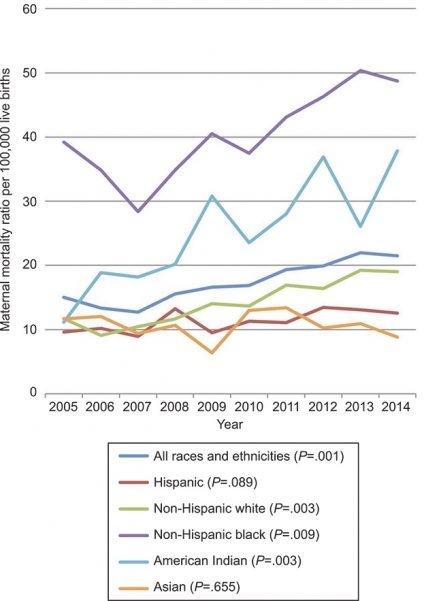
The trend is displayed in the following graph: Trends in maternal mortality ratio (maternal deaths/100,000 live births) by ethnic group and race: United States, 2005–2014. Numbers in parentheses represent P values for the Jonckheere-Terpstra test.Moaddab.

8210DFF5-AA7F-4BD3-90A9-2609F58F90C9

The authors note:

The U.S. maternal mortality ratio continues to climb and reached a rate of 21–22 per 100,000 in 2013 and 2014. Many explanations for this trend have been offered. Although the United States has a higher rural population than many European nations … our data failed to identify a statistical correlation between state-specific maternal mortality and either rural status or poverty. Immigration has also been cited as a factor in this mortality trend. However, we found lower mortality for Hispanic women who make up the majority of recent immigrants.

So the cause is NOT rural status, immigration or poverty.

What about the C-section rate, the all purpose bogeyman constantly used by natural childbirth advocates to scare women about obstetric care?

The high U.S. cesarean rate has also been invoked as an explanation for increased mortality, yet our data demonstrate only a weak correlation of mortality with cesarean delivery. Furthermore, previous work has demonstrated that this correlation does not reflect causation; the overwhelming majority of maternal deaths associated with cesarean delivery is a consequence of the indication for the cesarean delivery, not the operation itself.

What accounts for the difference in statewide maternal mortality rates?

Our data suggest that much of the variation in statewide maternal mortality ratios in the United States is accounted for by social rather than medical or geographic factors: unintended pregnancy, unmarried mother, and non-Hispanic black race. These data provide evidence for a strong contribution of racial disparity to maternal mortality ratio in the United States. Particularly striking is the close correlation between ethnic background and maternal mortality. A factor derived from factor analysis, which primarily represented ethnic background, accounted for 26% of the differences in statewide mortality. Excellent care is apparently available, but is not reaching all the people.

How should we compare maternal mortality across states (or countries, though the authors do not address international differences)?

…[C]omparative health care statistics that do not adjust for these important demographic factors are of little significance in judging the intrinsic quality of available health care in an individual state or region. The potential relative contributions of factors such as racial disparities in health care availability and access or utilization by underserved populations are not addressed by our data, but are important issues faced by states seeking to decrease maternal mortality. Ethnic genetic differences may also be involved. In addition, the potential role of unconscious (implicit) bias in this significant racial disparity must be considered.

Indeed, the US, which has the highest maternal mortality of any industrialized nation has by far the highest proportion of women of African descent.

The British press has been bemoaning the high US maternal mortality rate. For example, a recent BBC interview with Serena Williams was described thus:

Serena Williams says it is “heartbreaking” black women in the United States are more likely than white women to die from complications in pregnancy or childbirth.

It IS heart breaking that black women in the US are 3X more likely to die from complications in pregnancy or childbirth. What the BBC and Serena Williams don’t seem to realize is that the disparity is even greater in the UK; black women in the UK are 4X more likely to die from complications in pregnancy or childbirth.

According to the UK and Ireland Confidential Enquiries into Maternal Deaths and Morbidity 2013–15:

The rates of maternal mortality varied by age, socioeconomic status and ethnic background of the women, which are known to be independently associated with an increased risk of maternal death in the UK. The rate of maternal mortality was higher amongst older women, those living in the most deprived areas and amongst women from particular ethnic minority groups… Comparable to the previous reports, the risk of maternal death in 2013–15 was signi cantly higher among women from Black ethnic minority backgrounds compared with White women (RR 4.28; 95% CI 2.65 to 6.69).

The overall UK statistics look better than the US because women of African descent represent a far smaller proportion of the population in the UK (3%) than in the US (12.85%). The sad truth is that lower rates of maternal mortality in other industrialized countries reflect the fact that those countries are whiter. The countries with the lowest maternal mortality rates in the world (including Iceland, Sweden, Finland and Japan) are the whitest countries in the world.

The authors conclude:

…The increased mortality ratios seen in the United States in recent years reflect significant social as well as medical challenges and are closely related to lack of access to health care in the non-Hispanic black population. Our results provide evidence for the strong contribution of racial disparity to the maternal mortality ratio in the United States and suggest that addressing issues related to health care disparity and access for this population will play an important role in national attempts to reverse this mortality trend.

The only question that remains is whether we have the will to tackle the problem.

File Hannah Dahlen’s latest paper under D for Duh!

Three wooden blocks spelling "Duh!".

What if I told you that people who take insulin are more likely to develop blindness than those who don’t?

Duh!

Blindness is a known complication of diabetes and insulin is a treatment for diabetes. It’s the diabetes that causes blindness NOT the insulin.

The real issue is whether diabetics who take insulin are more or less likely to develop serious complications than those who don’t.

How about if I told you that people who have heart transplants have a shorter lifespan than those who don’t?

[perfectpullquote align=”right” cite=”” link=”” color=”” class=”” size=””]The critical issue, which the authors did not bother to address, is whether those who got the interventions did better than if they hadn’t gotten them.[/perfectpullquote]

Duh!

If you need a heart transplant you are very sick indeed and your other organs might have been damaged by your weak heart before you became got an available organ. It’s the underlying disease that created the need for the transplant that caused the shorter lifespan NOT the transplant itself.

The real issue is whether those who need heart transplants and ultimately get one live longer than those who don’t.

Along comes Hannah Dahlen to tell us that those babies who need childbirth interventions have more bad outcomes than those who don’t.

Duh!

But that’s not how Dahlen spins it.

On The Conversation, Dahlen writes.

Medical and surgical intervention during birth continues to rise in much of the world. Nearly one in three women who give birth in Australia have a caesarean section and around 50% have their labour induced and/or augmented (sped up with synthetic hormones).

Our new research, published today in the journal Birth, found babies born via medical or surgical intervention were at increased risk of health problems. These include short-term concerns such as jaundice and feeding problems, and longer-term illnesses such as diabetes, respiratory infections and eczema.

You remember the “journal” Birth, right? That’s the one owned by Lamaze International, the organization that makes its money by convincing women that childbirth interventions are bad. Although they routinely charge $38 dollars for 24 hour access to one article, they’ve conveniently made this one free so everyone can learn about the “dangers” of childbirth interventions.

But childbirth interventions are like insulin or heart transplants; the people who need them will often die without them. The real issue is whether those who need childbirth interventions do better or worse without them.

How did Dahlen and colleagues answer that question? They didn’t even bother.

In a paper of 11 pages in length, buried near the very end, is the single most important sentence in the paper:

…[W]e were unable to control for confounding by indication since the underlying reasons for the provided medical and operative birth interventions were unknown.

And that renders the results of this study 100% meaningless!

But that doesn’t stop Dahlen.

We found:

Babies who experienced an instrumental birth (forceps or vacuum) following induction or augmentation had the highest risk of jaundice and feeding problems needing treatment in the first 28 days

Babies born by caesarean section had higher rates of being cold and needing treatment in the hospital for this compared to babies born via vaginal birth

Children born by emergency caesarean section had the highest rates of metabolic disorders (such as diabetes and obesity) by five years of age

Rates of respiratory infections, such as pneumonia and bronchitis, metabolic disorders, and eczema were higher among children who experienced any form of birth intervention than those born vaginally.

Wow, they really had to slice and dice the data to make up something ominous.

And even Dahlen acknowledges that most of those results are entirely expected:

Forceps and vacuum birth, for instance, can cause bleeding and bruising in the baby’s scalp. These blood cells break down, releasing bilirubin that causes the skin to look yellow, which signals jaundice.

Babies born by caesarean section are more likely to be cold because the operating theatre is cold. Despite recommendations for the baby to be placed on the mother’s chest as soon as possible, this doesn’t always happen.

What she should have pointed out — but deliberately did not — is that babies born by C-section are often rescued from medical problems like fetal distress which necessitated treatment in the NICU.

What she should have pointed out — but deliberately did not — is that children born by emergency C-section are more likely to have mothers who are diabetic and obese (both of which are therefore more likely in offspring).

What she should have pointed out — but deliberately did not — is that large data sets are vulnerable to p-hacking.

Researchers look for statistically significant differences between two groups. Then they announce them as “findings” without acknowledging that any large dataset looking at multiple outcomes is bound to have random statistically significant differences that are coincidental and don’t represent real outcomes. Indeed, by definition using a p value of less than 0.001 means that almost 0.1% of the differences that appears to be statistically significant are actually due to chance and don’t represent a real finding at all.

How do you guard against p-hacking? The most important way is to recognize that it is always a possibility when analyzing large datasets; in other words, it is wrong to conclude that every statistically significant result in such an analysis is a real result.

Despite having found found NOTHING AT ALL, Dahlen proceeds to spin elaborate theories about her “findings.”

Reasons for the increased risk of longer-term problems are much less clear, but there are a couple of interesting hypotheses.

The first key theory is based on epigenentics: that life events affect how genes function and are passed on to the next generation.

Labor and birth exert a positive form of stress on the fetus, which impacts on the genes responsible for fighting off bugs, weight regulation and suppressing tumours. Too little stress (no labour and elective caesarean section) or too much stress (induced/augmented labour and instrumental birth) could impact the expression of these genes.

The second key theory is the extended hygiene hypothesis. This suggests that vaginal birth provides an important opportunity to pass gut bacteria from mother to baby to produce a healthy microbiome and protect us from illness.

If we have an unhealthy microbiome, we may be more vulnerable to infections, allergies, diabetes and obesity.

Dahlen doesn’t even asked the single most critical question.

Just as the key question for insulin and heart transplants is whether those who received it did better than they would have if they hadn’t received it, the key question for birth interventions is whether those who received them did better than they would have if they hadn’t received them.

Dahlen didn’t bother to look because that would have produced entirely different results than the demonization of interventions that drives contemporary midwifery theory.

File Dahlen’s latest paper under D for “Duh!” as well as D for “demonization.” It is not science; it’s ideology masquerading as science and it isn’t even very well disguised.

Hideous death rate prompts temporary closure of Baby + Co birth center

60762777 - scandalous colorful word on the wooden background

The latest scandal in American midwife attended birth out of hospital birth is occurring in Cary, NC. According to the The News & Observer:

Three-and-a-half years after its splashy debut in Cary, the Baby+Company natural birthing center has stopped delivering babies after the deaths of three newborns in the past six months.

The spa-like facility that enticed expectant moms with midwives and water-birth pools alerted its customers by email on Friday, March 16, that it would be sending all moms in labor to WakeMed Cary hospital, the birth center’s business partner, while it reviewed recent “incidents.” On Thursday, after inquiries from parents and The News & Observer, the center released the information about the newborn deaths.

The company said the Cary site has had a total of four deaths since it opened in October 2014. That compares to only one death at its other five centers in three states. According to Baby+Co, it has supported 1,200 pregnancies over its 3 1/2 years in business in Cary.

An additional baby is currently hospitalized in the NICU at Duke.

Four deaths in only 1,200 births is an extraordinarily high death rate of 3/1000. To put that in perspective, according to the CDC Wonder database, midwife attended hospital birth for low risk women has a death rate of 0.4/1000. The death rate at the Cary birth center is more than 600% higher than expected!

[pullquote align=”right” cite=”” link=”” color=”” class=”” size=””]The death rate at the Cary, NC birth center is more than 600% higher than expected.[/pullquote]

Is out of hospital birth safe?

I asked that question about homebirth in The New York Times back in 2016 and answered it.

[T]here are places in the world where home birth is relatively safe, like the Netherlands, where it is popular at 16 percent of births. And in Canada, where it appears safest of all, several studies have demonstrated that in carefully selected populations, there is no difference between the number of babies who die at home or in the hospital.

In contrast, home birth in the United States is dangerous. The best data on the practice comes from Oregon, which in 2012 started requiring that birth and death certificates include information on where the birth occurred and who attended it. The state’s figures show that that year, the death rate for babies in planned home births with a midwife was about seven times that of births at a hospital.

Many studies of American home birth show that planned home birth with a midwife has a perinatal death rate at least triple that of a comparable hospital birth …

Birth center birth is homebirth with a twist. The birth takes place outside a hospital but in a facility that has some safety standards and equipment.

Why is out of hospital birth in the US so deadly? There are a variety of reasons but one of the most important is the philosophy of “normal birth,” the self-serving idea promoted by midwives that the process of birth is somehow equally or more important than the outcome. It’s self-serving because “normal birth” is defined as what midwives can do autonomously, not by what is best for babies and mothers.

There’s a major problem with that definition: “normal birth” is inherently deadly. Since even apparently uncomplicated births in low risk women can naturally end in death for babies and mothers, birth outside the hospital is essentially a gamble. Women and the midwives who encourage them gamble that if complications occur (and some serious complications will inevitably occur), midwives can recognize them and transfer women to the hospital in time to prevent death.

But that can only happen if the midwives are proactive in making sure that women with risk factors are not allowed to give birth at the center, if complications are correctly identified and not dismissed at “variations of normal” and if complications are acted upon immediately before they become full blown disasters.

I’ve heard privately from a variety of people with knowledge of the Cary birth center situation who insist that this is just the tip of the iceberg. There have been serious safety concerns since shortly after the center opened, safety concerns that were not taken seriously.

The director of the center, Margaret Buxton, CNM was interviewd by a local TV station. You can listen here to her weasel words about a “cluster” of deaths and her false implication that this can happen in the hospital, too.

Buxton repeatedly reference to the “cluster” is both tasteless and misleading. A “cluster” did not die, four individual beloved babies are dead and at least on camera Buxton never offers her condolences. The deaths were almost certainly preventable. And while it is true that deaths can occur in a cluster, when those deaths are averaged over the number of patients delivered at the center, the death rate should be THE SAME as the death rate in the hospital, not 600% higher.

There should have been a maximum of 1 death among 1,200 patients. Once a second death occurred, it might have been reasonable to talk about a cluster and assume that the rate would average out over time. With a 3rd and 4th death, Buxton should not be talking about a cluster and in my view should be acknowledging a disaster.

Baby + Co is a birth center franchise. The News & Observer article claims that the other 5 birth centers have had lower death rates so the problem may be confined to the particular center and its staff. I wonder what kind of malpractice insurance Baby + Co carries. It looks like it may be needed.