All posts by Amy Tuteur, MD

Lactivist gaslighting in the wake of a suicide due to breastfeeding pressure

IMG_1782

Let’s try a thought experiment.

Imagine I told you a story about a 16 year old girl who committed suicide because she was bullied for being overweight. She felt herself to be surrounded by messages that women who aren’t thin are worthless. She was surrounded by peers who claimed she was ugly and worthless. Everyone in her life, including her parents and her doctor, told her that she could be thin if she only tried harder. She drowned herself because she could no longer bear the pain.

[pullquote align=”right” cite=”” link=”” color=”” class=”” size=””]I have yet to see a single lactivist acknowledge that pressure to breastfeed was a significant factor in Leung’s tragic death.[/pullquote]

Would your first response be to insist that she needed more support in dieting? Or would you conclude that she needed more support in recognizing that her weight was not a marker of her worth?

I’d conclude the second: that the societal pressure to be thin was toxic and that young women should be taught to love themselves regardless of weight.

The first response is a form of gaslighting. It’s denying the lived reality of the young woman who died. It’s denying the pernicious effect of the pressure to be thin. It’s refusing to take a hard look at a society that relentlessly undermines the self-worth of young women by judging them on their appearance first and foremost.

I’ve conjured this example in the wake of the lactivist response to the suicide of Florence Leung, a young mother whose lived reality was unbearable pressure to breastfeed when she could not do so exclusively. I have yet to see a single lactivist acknowledge that pressure to breastfeed was a significant factor in Leung’s tragic death.

All I’ve seen is gaslighting.

It wasn’t pressure to exclusively breastfeed in the face of her inability to do so that led to her suicide;

…if she had only received more lactation support she could have breastfed exclusively.

…if only she had received more mental health support she would have persisted and ultimately breastfed exclusively.

…there must be more to the story. Pressure to breastfeed was not the reason she took her own life.

Or even more egregious:

Facts are facts; if she wasn’t breastfeeding exclusively she wasn’t giving her baby the best.

I had difficulty breastfeeding; I persevered a was ultimately successful.

Or my personal favorite, the repulsive humble brag posted on the Leung’s memorial Facebook page:

IMG_1780

Breastfeeding 18 months and still going. I feel for the mothers who are unable to nurse their babies, no need to make them feel bad about it.

Lactivists seem to be unable to come to grips with scientific reality: the benefits of breastfeeding in first world countries are trivial.

In the face of lactivist insistence that breastfeeding is lifesaving, I’ve challenged them to point to the term babies whose lives have been saved. No one can do it.

In the fact of lactivist insistence that “breast is best,” I’ve pointed out that dehydration and starving from insufficient breastmilk is unhealthy for babies and guilt is unhealthy for mothers. No one has a response.

In the face of lactivist insistence that breastfeeding pressure led to Leung’s suicide, I’ve pointed out that they are gaslighting, denying the lived reality of a suffering women. No one appears to care.

It’s remarkable when you think about it. Lactivists, the same people who insist that failure to breastfeed is caused by lack of support, the same people who have rearranged the world to blare support for breastfeeding in the face of every mother and every healthcare provider, the same people who have banned formula gifts in hospitals because the mere sight of formula could undermine a woman’s will to breastfeed are suddenly denying that breastfeeding pressure could impact a mother’s mental health.

How ironic that the same people who are relentlessly “normalizing” breastfeeding so that some mothers feel supported could claim that is impossible that those efforts could make other mothers who can’t or don’t wish to breastfeed feel unsupported, worthless and suicidal.

It makes sense, though, when you realize that breastfeeding is not about what’s good for babies and mothers. It’s about what’s good for lactivists, their profits and their self-image.

We’ve come to realize the pernicious effect that idealizing thinness has on they psyches of young women. It’s long past time to recognize the pernicious effect of idealizing breastfeeding has on the psyches of mothers. How many more babies and mothers have to be harmed before lactivists acknowledge that breastfeeding “support” can be toxic and even deadly?

Killing kids with quackery

sleeping

Homebirth kills babies; pressure to exclusively breastfeed injures and kills babies and mothers; anti-vaccine advocacy kills children of all ages. All three are part of the larger societal trend of killing kids with quackery.

Of course no parent intends to maim or kill her child by embracing quackery; in general “natural” parents are busily preening before their peers and may even believe (based on the nonsense they’ve absorbed) that they are making healthy choices. However, as the piece Gluten-free baby: When parents ignore science in Macleans makes clear, children are being harmed by their parents “natural” choices.

[pullquote align=”right” cite=”” link=”” color=”” class=”” size=””]Quackery kills kids with fad diets, foolish joint manipulations and ridiculous “natural remedies.”[/pullquote]

Consider:

Nova had plans to her raise her son Zion on a vegan diet—and she had thousands of Instagram followers giving her plenty of love throughout her journey. But trouble struck when Zion’s teeth started to come in. One tooth, she recalls, had started to crumble apart by his first birthday. “It happened so fast,” Nova says. “His teeth are just really weak.”

But crumbling teeth are the least of it.

In Mississauga, Ont., in 2011, two-year-old Matinah Hosannah died of complications from asthma and severe malnutrition stemming from a vegan diet lacking in vitamin D and B12.

And:

A similar tragic outcome occurred in 2012 with 19-month old Ezekiel Stephan of Cardston County, Alta. His parents diagnosed their toddler’s meningitis as croup and treated it with natural remedies … After Ezekiel arrived at the Alberta Children’s Hospital in Calgary with abnormal breathing, he was quickly put on life support, but died within two days.

As a nutritionist at Sick Kids Hospital explains, she has seen children in her clinic:

… with everything from cognitive delays to rickets, a softening of the bones due to lack of vitamin D or calcium. One family, she remembers, had a diet that encompassed basically fruit, nuts, seeds and homemade almond milk—and the child came in with vitamin D deficiency, vitamin B12 deficiency, and, well, “the list was endless.”

What’s going on here?

…[T]here is the trend toward vilifying or fetishizing components of food, be it sugar, fat, gluten, salt or protein. Consider the gluten-free boom: Despite the fact that only an estimated one per cent of Americans lives with celiac disease, an autoimmune disorder that would require a gluten-free diet, a 2015 survey found about one of every five Americans actively choose to eat gluten-free foods. Meanwhile the spike in protein consumption is so far-reaching that General Mills created a “Cheerios Protein.”

There is undoubtedly no “Cheerios Protein” in the wild and that reflects the conceit that natural parenting has anything to do with parenting in nature. It doesn’t.

If anyone wants to see what living on natural medicine looks like, [pediatrician] Michael Rieder suggests, they should go to Afghanistan. “Afghanistan is about as natural as you’re going to get in …” For every 10 children born in Afghanistan today, odds are one of them won’t see their fifth birthday. “Most of them die before they turn one and most of them die from infection,” Rieder says. “That’s what happens when you don’t have vaccination or antibiotics.”

Anyone with least bit of scientific knowledge would realize that but many “natural” parents are pretty limited when it comes to science.

We’re slipping into this ‘all knowledge is relative’ dark age,” says Caulfield [a professor of law and public health]. “You don’t see this in other areas of science. We don’t have alternative physics or people who believe there’s a natural healing force that can be utilized to build bridges. But in health, we have this huge tolerance for this alternative, non-scientific perspective.”

But all knowledge is not relative. There’s actual knowledge and pseudo-knowledge, the fake news equivalent of knowledge. Much of what passes for “knowledge” in the world of food fetishism, child chiropractic and naturopathy is is fake, entirely made up to boost the economic fortunes of quacks.

Sadly, a certain kind of parent is particularly gullible when it comes to this kind of fake knowledge. Not only do they fail to understand science; they fail to understand that parenting is not an opportunity to burnish your self-image vis a vis other parents. Those who eagerly purchase quackery imagine themselves to be smarter than other parents when the reality is that they are as dumb as rocks, at least when it comes to child health.

The truth is that children have never been healthier. Rather than dying in droves from infection, starvation and nutritional deficiencies, they have begun to suffer from diseases of excess like obesity and type 2 diabetes. The solution, of course, it to cut back on excess. It is not to embrace unrestrained infectious disease by refusing to vaccinate, nutritional deficiencies caused by food fetishism; or quackery like chiropractic and naturopathy.

Quackery kills kids and the only people who appear to be unaware of that are those parents torturing their children with fad diets, foolish joint manipulations and ridiculous “natural remedies.” They proudly imagine themselves to be educated but they are merely wallowing in their own ignorance while their children suffer.

New mother commits suicide over breastfeeding pressure

Feeling sad

The suicide of a young mother is an unspeakable tragedy:

Thirty-two-year-old Florence Leung went missing without an explanation in late October, causing New Westminster police to launch a massive search. It was revealed she was suffering from postpartum depression and her family was concerned about her well-being.

On Nov. 16, Leung’s body was found in the waters near Bowen Island. No foul play was suspected.

Her husband knows that breastfeeding pressure contributed to her suicidality:

[pullquote align=”right” cite=”” link=”” color=”” class=”” size=””]How many dead babies and dead mothers will it take before we repudiate the tactics of breastfeeding advocates?[/pullquote]

Do not EVER feel bad or guilty about not being able to “exclusively breastfeed”, even though you may feel the pressure to do so based on posters in maternity wards, brochures in prenatal classes, and teachings at breastfeeding classes. Apparently the hospitals are designated “baby-friendly” only if they promote exclusive-breastfeeding. I still remember reading a handout upon Flo’s discharge from hospital with the line “Breast Milk Should Be the Exclusive Food For the Baby for the First Six Months” , I also remember posters on the maternity unit “Breast is Best”. While agreeing to the benefits of breast milk, there NEED to be an understanding that it is OK to supplement with formula …

IMG_1768
Postpartum depression, like all clinical depression, is a multifactorial problem. No one can say for certain what causes it. But we can say for certain that bullying makes it worse. And contemporary breastfeeding advocacy is BY DESIGN a form of bullying.

I finished my medical training before breastmilk became “the elixir of life” and before colostrum became “liquid gold.” What scientific evidence came to light in the last 35 years to elevate breastfeeding from one of two excellent forms of infant nutrition, the other being infant formula? No evidence. Indeed most of the scientific evidence around the purported benefits of breastfeeding is weak, conflicting and riddled with confounding variables. To the extent that there is definitive scientific evidence about the benefits of breastfeeding in first world countries, it appears to be limited to 8% fewer colds and 8% fewer episodes of diarrheal illness across the entire population of term infants in the first year. In other words, the vast majority of term infants will experience NO OBVIOUS BENEFIT from breastfeeding.

So if the scientific evidence hasn’t changed, what happened? Two things: the monetization of breastfeeding and the adoption of bullying as a deliberate marketing tactic.

Organized breastfeeding support originated with La Leche League, started by a group of seven traditionalist Catholic women whose goal was to keep mothers of young children out of the workforce. They reasoned that Mary, mother of Jesus, would not have worked because she was breastfeeding. Therefore all mothers should breastfeed so they wouldn’t be able to work either.

La Leche League was originally a volunteer organization that shared breastfeeding information and offered free support. It had to be a volunteer organization because the whole point was to prevent mothers of young children from working. But by the early 1980’s, mores had changed and the folks at LLL reasoned that they could charge for information that they had been giving away for free. They spun off the organization that created the lactation consultant credential and began campaigning vigorously for the employment of lactation consultants in hospitals, doctors’ offices and private practices.

Initially they met the existing demand for breastfeeding support. But like any industry, they wanted to grow and that meant expanding the market for their services beyond those women who wanted to breastfeed to those women who didn’t. They hit upon the perfect tactic: grossly exaggerating the benefits of breastfeeding, fabricating “risks” of infant formula, and, above all else, bullying new mothers.

Make no mistake, bullying is not an unfortunate side effect of contemporary breastfeeding advocacy. It is a deliberate tactic designed to increase market share. It is meant to create a sense of fear, obligation and guilt.

As I have written in the past, the foundational document of marketing breastfeeding through bullying is Diane Weissinger’s Watch Your Language.

All of us within the profession want breastfeeding to be our biological reference point. We want it to be the cultural norm; we want human milk to be made available to all human babies, regardless of other circumstances …(my emphasis)

In contrast, all of us within the medical profession want HEALTHY BABIES and HEALTHY MOTHERS to be the biological reference point. We are concerned with outcome; the breastfeeding industry is concerned with process, specifically the only process by which it can profit. And profit depends on bullying ever more women into breastfeeding.

The breastfeeding industry induces fear by lying about the benefits of breastfeeding and ignoring the risks (dehydration, starvation and death); it induces obligation with bullying catch phrases like “breast is best,” and “Baby Friendly Hospital Initiative,” and it induces guilt by insisting that “even one bottle of formula” is the mark of a mother who doesn’t truly love her baby.

The breastfeeding industry has perfected a particularly vicious forms of bullying, gaslighting. This is a specialized form of invalidation that involves denying reality. A mother says her baby is hungry? Tell her all babies scream like that. A mother worries that she is not producing enough breastmilk? Lie and say that all women produce enough milk. A mother needs medication incompatible with breastfeeding? Tell her she doesn’t really need it. A mother says that breastfeeding is harming her baby’s physical health and her mental health? Tell her that she is a failure at mothering before she’s really even started and imply that her baby deserves a better mother than her.

Is it any wonder then that some women will commit suicide as a result and a far greater number will experience significant postpartum depression?

We MUST put an end to the vicious bullying of new mothers by breastfeeding advocates.

  • Take down the “breast is best” posters and acknowledge that fed is best.
  • Stop lying about the benefits and risks of breastfeeding.
  • End the Baby Friendly Hospital Initiative immediately.
  • Stop pretending that “even one bottle” of formula harms breastfeeding or babies.

Breastfeeding advocates like to prattle about the theoretical “cost savings” from increasing breastfeeding rates. But what does it cost to hospitalize a mother for postpartum depression? What is the cost of the lost earnings of a mother who commits suicide? And what is the cost to a child of losing his or her mother? Incalculable.

How many dead babies and dead mothers will it take before we repudiate the bullying tactics of breastfeeding advocates?

Fed is Best!

Breastfeeding advocacy is not about convincing women to breastfeed? Tell me another one.

Baby girl.

Yesterday I came across a remarkable claim.

Pediatrician and breastfeeding advocate Dr. Daniel Flanders wrote this on Twitter.

IMG_1744

Breastfeeding advocacy is not about convincing moms to breastfeed; it is about enabling and supporting their success if they choose to.

Really? Really??!! On what planet is breastfeeding not about convincing moms to breastfeed?

Surely not this one.

Consider the philosophy statement of La Leche League:

  • Mothering through breastfeeding is the most natural and effective way of understanding and satisfying the needs of the baby.
  • Mother and baby need to be together early and often to establish a satisfying relationship and an adequate milk supply.
  • In the early years the baby has an intense need to be with his mother which is as basic as his need for food.
  • Human milk is the natural food for babies, uniquely meeting their changing needs.
  • For the healthy, full-term baby, breast milk is the only food necessary until the baby shows signs of needing solids, about the middle of the first year after birth.
  • Ideally the breastfeeding relationship will continue until the baby outgrows the need.
  • Alert and active participation by the mother in childbirth is a help in getting breastfeeding off to a good start.
  • Breastfeeding is enhanced and the nursing couple sustained by the loving support, help, and companionship of the baby’s father. A father’s unique relationship with his baby is an important element in the child’s development from early infancy.
  • Good nutrition means eating a well-balanced and varied diet of foods in as close to their natural state as possible.
  • From infancy on, children need loving guidance which reflects acceptance of their capabilities and sensitivity to their feelings.

Do you see anything there are about restricting breastfeeding promotion to women who have declared that they want to breastfeed? Me, neither.

Or how about the Ten Steps of the Baby Friendly Hospital Initiative:

  1. Have a written breastfeeding policy that is routinely communicated to all health care staff.
  2. Train all health care staff in the skills necessary to implement this policy.
  3. Inform all pregnant women about the benefits and management of breastfeeding.
  4. Help mothers initiate breastfeeding within one hour of birth.
  5. Show mothers how to breastfeed and how to maintain lactation, even if they are separated from their infants.
  6. Give infants no food or drink other than breast-milk, unless medically indicated.
  7. Practice rooming in – allow mothers and infants to remain together 24 hours a day.
  8. Encourage breastfeeding on demand.
  9. Give no pacifiers or artificial nipples to breastfeeding infants.
  10. Foster the establishment of breastfeeding support groups and refer mothers to them on discharge from the hospital or birth center.

Do you see anything there about limiting proselytizing to those women who have declared their intention to breastfeed? Me, neither.

How about this statement from Diane Weissinger’s paper on promoting breastfeeding:

IMG_1751

All of us within the profession want breastfeeding to be our biological reference point. We want it to be the cultural norm; we want human milk to be made available to all human babies, regardless of other circumstances.

It’s hard to be clearer than that.

When called on it, Dr. Flanders began backpedaling furiously. Did he say that “breastfeeding advocacy is not about convincing moms to breastfeed”? What he meant is that HIS personal version of breastfeeding advocacy is not about convincing women to breastfeed.

Would he disavow the statements from leading breastfeeding advocates and their organizations?

Silence.

The Fed Is Best Foundation was created specifically to counter the relentless pressure to breastfeed on women who can’t or don’t wish to do so. I asked Dr. Flanders if he agreed that #FedIsBest.

IMG_1758

He responded:

I do not like how the #fedisbest movement has evolved.

When asked to elaborate, he could not or he would not.

Instead, he used a classic obfuscation ploy which he repeated on Facebook where I posted his initial tweet.

IMG_1760

Amy, I have said this to you on twitter and will repeat it here (since you thought it appropriate to bring across platforms without mention to me): talking with u is like groundhog day. I know your views on this well. If you haven’t yet figured out mine then you never will. Although I consider it a waste of my time discussing these matters with you, there are a number of interesting folks on this thread with whom I enjoyed dialoguing and I am grateful for the productive discussion.

Yes, Dr. Flanders, I’ve figured out your position. It’s the same passive-aggressive position of many breastfeeding advocates: Pressure women to breastfeed and then, when called on it, deny that you are applying pressure.

Such passive-aggressive behavior has been tolerated for far too long. It’s time to name it, shame it, and force breastfeeding advocates to treat women who can’t or don’t wish to breastfeed with respect.

Of peanuts, breastmilk and faulty medical recommendations

Groundnuts on a white background


What do peanuts, the cause of deadly allergies, and breastmilk, the purported “elixir of life,” have in common?

Both have been the subject of medical recommendations that are wrong, based on weak science, implemented without adequate studies, involving failure to consider risks as well as benefits.

[pullquote align=”right” cite=”” link=”” color=”” class=”” size=””]Peanuts do not cause peanut allergies, and breast is not best.[/pullquote]

Peanuts do not cause peanut allergies, and breast is not best.

Medical researchers recently announced that they had made a big, life threatening mistake. The advice they provided regarding deadly peanut allergies, was 100% wrong. After years of insisting that keeping babies away from peanuts prevented peanut allergies, experts have reversed themselves and announced that giving babies peanut protein prevents deadly peanut allergies.

It’s hard to be more wrong than that.

As pediatrician Aaron Carroll notes in the NYTimes piece How to Prevent Whiplash from Ever-Changing Medical Advice:

…[T]he National Institute of Allergy and Infectious Diseases expert panel changed course and recommended that we start giving babies peanut powder or extract in food before they are six months old rather than make sure they go nowhere near it. The panel said this is good advice, especially if the babies are at higher risk for developing an allergy…

But it’s important to remember that the earlier recommendation wasn’t made in the Dark Ages. As recently as 2000, the American Academy of Pediatrics declared that children at risk for allergies be given no peanuts until they were 3 years old. It’s not unrealistic to think that this might have increased the number of children with peanut allergies, not decreased them.

This is hardly the first healthcare reversal. I’m old enough to remember when mothers were told to place their babies on their stomach to sleep … which turned out to increase the risk of death from SIDS (sudden infant death syndrome). I’m old enough to recall when doctors were told to give all post menopausal women hormone replacement therapy … which turned out to increase the risk of breast cancer. And I’ve lived through a plethora of dietary injunctions … which paradoxically increased the incidence of problems they were designed to prevent.

How could researchers and physicians have made such terrible mistakes?

Carroll carefully elucidates the reasons.

1. Concluding causation from research that merely demonstrates correlation.

A great deal of epidemiological research, particularly research about nutrition, suffers from this problem.

…[M]ost often, recommendations fail because they aren’t supported by high-quality research. They have only observational trials behind them, not the full weight of randomized controlled trials. Too many times, organizations have been burned when the associations we see don’t translate to causal changes in the more strict randomized controlled trials.

Correlation is not causation. That is Statistics 101, yet researchers, in their enthusiasm to address serious medical problems, often ignore that most critical caveat.

The recommendations to restrict peanut exposure were based on observational studies that erroneously concluded causation. Similarly, nearly all recommendations about the purported benefits of breastmilk are based on small observational studies — weak, conflicting and riddled with confounders — that erroneously conclude causation.

2. Extrapolation from high risk groups to everyone.

If something works for one group, we tend to believe that it should work for more. People at high risk for breast or prostate cancer may need to be screened for the diseases. Expanding that screening to people at low risk, however, yields more false positives than true revelations. Hormone replacement therapy most likely benefits some women, especially younger women and those who have had a hysterectomy. Others get the same side effects or harms with little benefit.

Premature babies benefit from breastmilk. Premature babies are at risk for nectrotizing enterocolitis and breastmilk seems to reduce the risk as compared to formula. But just because breastmilk is beneficial in high risk situations does not mean that we ought to extrapolate to all babies.

3. Failure to study, in many cases to even contemplate, the downsides of recommendations as carefully as the upsides.

This would apply to recent sleep recommendations, which may (and I stress may) benefit babies but also might hurt them and parents in other ways.

This especially applies to breastfeeding research, which suffers from a severe case of white hat bias.

‘White hat bias’ (WHB) [is] bias leading to distortion of information in the service of what may be perceived to be righteous ends… WHB bias may be conjectured to be fuelled by feelings of righteous zeal, indignation toward certain aspects of industry, or other factors…

Breastfeeding researchers are so sure that breastfeeding is beneficial and are so angry at historic malfeasance of the formula industry, they exaggerate findings that place breastfeeding in a positive light and ignore findings that the benefits of breastfeeding in industrialized countries are actually trivial (approximately 8% of breastfed infants have one fewer cold or diarrheal illness in the first year). They never consider the potentially deadly side effects of the relentless promotion of breastfeeding including starvation, dehydration and even death. Indeed, the Fed Is Best Foundation now exists to warn women about the very real risks and downsides of breastfeeding as well as the benefits.

Breastfeeding researchers “know” that breast must be best and therefore always begin and end any breastfeeding study with the claim that the benefits of breastfeeding are well proven when the truth is that they are not. The purported benefits are based almost exclusively on small observational studies, assumed rather than demonstrated causation, and unjustified extrapolation from high risk studies.

Researchers on peanut allergies were forced to reverse the recommendations that they had based on weak science. Breastfeeding researchers have based their claims on science that is even weaker still.

It is inevitable that “breast is best” will eventually be replaced by “fed is best.” The only question is how many infants and mothers will be hurt in the meantime.

Bashing breastfeeding?

Hammer Through Window.

If you’ve been on The Skeptical OB Facebook page this week you’ve probably noticed a seemingly never ending parade of lactivists dropping in to rail at me. What have I done this time? I’ve dared to insist that #fedisbest. In response I’ve been repeatedly accused of “bashing” breastfeeding.

[pullquote align=”right” cite=”” link=”” color=”” class=”” size=””]Is claiming that women deserve equal rights bashing men?[/pullquote]

Why?

Apparently because I’ve dare to tell the truth.

When lactivists insist that breastfeeding provides lifesaving benefits, I’ve ask them to show me that the lives of term babies are saved by breastfeeding using real world data, not theoretical models; they can’t.

I’ve posted graphs like this one, explaining that US breastfeeding dropped to an all-time low of 24% in the early 1970’s before rising again. Even a cursory glance makes it clear that breastfeeding rates have no correlation with infant mortality, let alone causation.

IMG_1730

And this one that demonstrates that countries with the highest mortality rates have the HIGHEST breastfeeding rates, not to claim that breastfeeding causes high infant mortality, but to show that it doesn’t prevent it.

IMG_1679

I linked to disturbing personal story from the Fed Is Best Facebook page about a baby who, at one month of age, looked emaciated despite his mother’s desperate attempts to breastfeed him.

IMG_1738

Just last night I posted this meme pointing out that infant nutrition is not a seesaw. High respect for breastfeeding does NOT require low respect for formula feeding.

IMG_1736

And still the accusations that I am bashing breastfeeding keep coming.

So I have some questions for lactivists:

Is claiming that women deserve equal rights bashing men?

Is asserting that all religions are worthy of respect bashing Christianity?

Is prohibiting discimination based on sexual orientation bashing heterosexuality?

No, no and no. Why then would honestly noting that fed is best be bashing breastfeeding?

Out of the many hundreds of lactivists comments, I find this one particularly illuminating.

IMG_1740

Natalie writes:

…Why do you insist on trying to devalue breastfeeding. If “fed is best” why did I go through hell to breastfeed my son? …

Why?

Because you wanted to do so and because you were physically capable of doing so.

Isn’t that reason enough?

Being honest with women about the real benefits (and risks) of breastfeeding is not bashing breastfeeding anymore than promoting equal rights for women is bashing men. Pointing out that formula feeding is an excellent form of nutrition is not bashing breastfeeding anymore than pointing that women are equally intelligent is bashing men.

In both cases, though, it deprives one group of the opportunity to declare superiority over another group and that’s what really bothers lactivists.

Why breastfeed? Not for bragging rights. Not to make a martyr of yourself. Not so you can shame other women who don’t.

You should breastfeeding because you want to and you can.

And like any other aspect of motherhood, you should not expect that your ego should be boosted in return.

Milk Meg and the marsupialization of mothers

Isolated kangaroo with cute Joey

Maybe it’s because she lives in Australia, but Meg Nagle, the Milk Meg, appears to believe that mothers are marsupials.

Human beings, like nearly all mammal species, are placentals. We have relatively long pregnancies during which we nourish our young through the placenta. The placenta is a complex organ that allows for indirect communication between the baby’s bloodstream and the mother’s bloodstream. The baby gets its oxygen and nutrients, not to mention antibodies, from the mother’s circulation and dumps its carbon dioxide and waste products back to her for processing and removal.

[pullquote align=”right” cite=”” link=”” color=”” class=”” size=””]If you want to mother like a marsupial, go for it! But don’t judge other mothers for refusing to imagine they are marsupials, too.[/pullquote]

The marsupials (like kangaroos) do not have a complex placenta and have a very different gestational process.

According to Wikipedia:

An infant marsupial is known as a joey. Marsupials have a very short gestation period (about four to five weeks), and the joey is born in an essentially fetal state. The blind, furless, miniature newborn, the size of a jelly bean, crawls across its mother’s fur to make its way into the pouch, where it latches onto a teat for food. It will not re-emerge for several months, during which time it develops fully…

A marsupial joey is unable to regulate its own body temperature and relies upon an external heat source. Until the joey is well-furred and old enough to leave the pouch, a pouch temperature of 30–32 °C (86–90 °F) must be constantly maintained.

In other words, a human baby relies for gestational growth on the placenta and uterus. A joey relies on the teat and the pouch. A human baby is born far more developed than a joey, and although it cannot care for itself, it can be successfully cared for by the father, siblings and members of the extended family. A joey can only be cared for by its mother.

But lactivists like The Milk Meg prefer to imagine human infants as marsupials with the teat, in this case the breast, serving as the center of infant existence.

A joey must, for itself survival, maintain continuous contact with the teat for months. A joey, because it cannot maintain its own body temperature, must stay within the embrace of its mothers pouch for a year or more. For both these reasons a joey must sleep with its mother.

The Milk Meg insists that human babies have the same needs as joeys. This is expressed by her belief that human babies can and should be in continuous contact with the breast for years.

In this meme, for example, Meg declares:

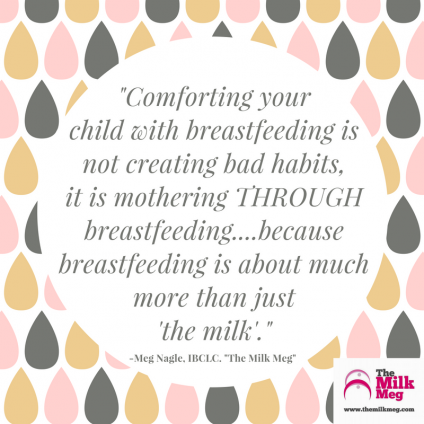
img_1715

Comforting your child with breastfeeding is not creating bad habits, it is mothering THROUGH breastfeeding … because breastfeeding is about much more than just milk.

Here Meg insists:

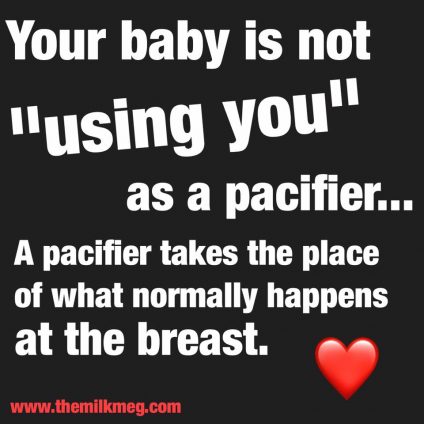
img_1717

Your baby is not “using you” as a pacifier. A pacifier takes the place of what normally happens at the breast.

She is telling mothers that their breasts not merely ought to be used as pacifier, but are pacifiers.

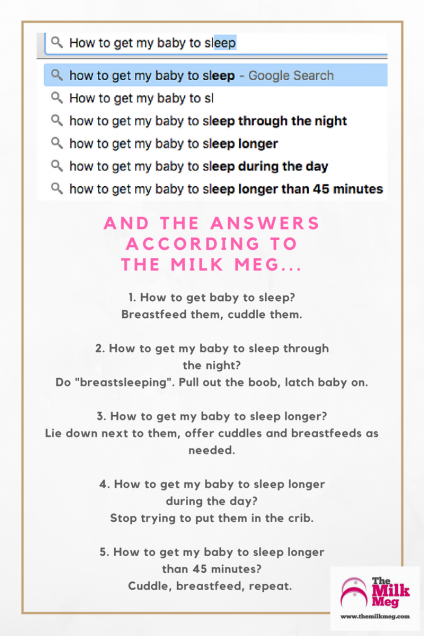
Consider this advice on how to get your baby to sleep more:

img_1642

Breastfeed them …
Do “breastsleeping.” Pull out the boob, latch baby on.
Offer cuddles and breastfeed as needed…
Cuddle, breastfeed, repeat.

In other words, let your baby attach to your breast and never let go … just like a marsupial.

Except humans are not marsupials.

Consider:

Joeys stay in the pouch for up to a year in some species, or until the next joey is born.

A mother kangaroo is usually has only one joey in her pouch at a time. Her older offspring are physically independent. But human children requires the care of their mothers for more than a decade. With the exception of the first child, a human mother is always caring for other children who need her just as much as the infant needs her. They too have physical and emotional needs that must be met in order to ensure optimal development.

Lactivism makes no provision for meeting the needs of older children (unless they want to breastfeed, too) and, of course, it makes no provision for meeting the physical and emotional needs of the mother beyond increasing and maintaining her ability to lactate.

What’s wrong with that?

Nothing so long as it is your choice to mother as a marsupial.

Where I disagree with Meg is in her insistence that human babies have the same needs as joeys do. I disagree with her conviction that good human mothering is the same as good marsupial mothering.

Human babies are placental mammals. They do NOT need to be attached to the breast. They do NOT need to use the breast as a pacifier. They do NOT need to be in constant physical contact with the mother. It is not merely untrue, but it is cruel to insist that human babies need to be treated like marsupials.

Why is it cruel?

Because human mothers aren’t marsupials, either. They have different needs, desires and demands on them than kangaroo mothers. It is cruel to tell women that their babies physical and emotional health depend on behaving like marsupials when it doesn’t; that belief requires sacrifices that, as placental mammals, we AREN’T designed (or evolved) to make.

If you want to mother like a marsupial, go for it!

But don’t judge other mothers for refusing to imagine they are marsupials, too.

WWJI: Who would Jesus insure?

img_1709

I first asked this question in 2009 during the months in which Congress debated the Affordable Care Act (ACA, also known as Obamacare).

I was struggling with the irony of religious conservatives, who have a sordid history of trying to force religion into medicine, rejecting the effort to provide health insurance for all Americans. I wondered what they thought Jesus would do when faced with a similar situation.

[pullquote align=”right” cite=”” link=”” color=”” class=”” size=””]It is impossible to imagine Jesus declaring: “I’m here to relieve all your suffering … except for your pre-existing leprosy.” [/pullquote]

Now as religious Conservative seeks to overturn the Affordable Care Act, I’m still struggling.

When faced with the prospect of depriving tens of millions of people of affordable healthcare access, what would Jesus do? WWJI? Who would Jesus Insure?*

According to religious conservatives, Jesus does not allow abortions, so laws should prevent abortion, or, failing that, should place innumerable roadblocks in the way of women who want abortions.

According to religious conservatives, Jesus wants all life to be preserved, so they mustered a public campaign to prevent Terri Schiavo’s husband from honoring her wishes and allowing her to die instead of continue on in a vegetative state.

According to religious conservatives, Jesus considers homosexuality to be an abomination, so discrimination against gay people should be enshrined in law.

Since they appear to believe that medical decisions (even other people’s medical decisions) should be made with regard to what Jesus would want, what do they think Jesus would want?

I’m no theologian, but I feel confident that Jesus would not approve of taking affordable healthcare away from tens of millions and going back to the health insurance system prior to the ACA.

Consider:

Would Jesus tie health insurance to employment? I doubt it. He made manifest his concern for the poor and downtrodden, so it is doubtful that he would want their miseries magnified by denying them access to healthcare.

Would Jesus allow pre-existing conditions to be exempted? Not likely. He ministered to the sick without regard for how long they had been sick before he arrived. It is impossible to imagine him declaring: “I’m here to relieve your suffering, except for your pre-existing leprosy.”

Would Jesus consider it a priority to preserve existing insurance companies? Would he reject a public option for health insurance because it threatened the profits of insurance giants? Once again, not likely. He would not put profits ahead of the life and health of innocent people.

Who would Jesus insure? The conclusion is inescapable. He would insure everyone. He would insist that it was the moral responsibility of those who have health insurance to make it available to those who don’t. And the way we do that is by providing a public option for health insurance, exactly the same option that the elderly now enjoy.

So I have a suggestion. For those who believe that we should make healthcare decisions based on what Jesus would do, how about making healthcare insurance decisions based on what Jesus would do? Obamacare may be anathema to religious conservatives, but it is impossible to deny that his plan for healthcare reform bears the closest resemblance to what Jesus would do.

WWJI: Who would Jesus insure? Everyone, of course.

There’s a word for religious conservatives who want to repeal the ACA: hypocrites.


* I know that is “whom would Jesus insure” is grammatically correct, but “who would Jesus insure” sounds better.

The “live” breastmilk hoax

hoax

The lactivist blogosphere is buzzing with news of micro photographs and videos that purported demonstrate that breastmilk is alive.

They were originally posted by Jansen Howard on her Facebook page.

img_1702

[pullquote align=”right” cite=”” link=”” color=”” class=”” size=””]Under the microscope breastmilk looks just like salad dressing.[/pullquote]

You guys… this is SO COOL!!!!!!!! this is the living liquid gold we call breast milk in motion!!!! My dad is a blood microscopist and this is a single drop off my breast milk under his microscope!!!! It’s miraculous and it’s ALIVE tailored to my babies needs at this moment!!!!

What’s blood microscopy also known as live blood analysis? It’s quackery. Even alternative health guru Dr. Andrew Weil acknowledges that:

… This procedure is used by practitioners who claim that a darkfield analysis of a blood sample reveals much about a person’s health. Usually, the magnified blood cells are projected onto a large screen, so that patients can watch as practitioners point out “abnormalities.” Most of the abnormalities are artifacts of the technique of darkfield microscopy, but LBA proponents claim they represent early indications of cancer and other serious diseases…

None of this is actually possible by LBA…

But that’s not what makes the breastmilk images a hoax. This is:

img_1704

The images look very similar to the breastmilk image above, but they’re not breastmilk; they’re salad dressing.

Why do they look so similar? Because in both cases we are looking at fat globules in an emulsion. Breastmilk, like salad dressing, is an emulsion.

According to Wikipedia:

An emulsion is a mixture of two or more liquids that are normally immiscible (unmixable or unblendable)… In an emulsion, one liquid (the dispersed phase) is dispersed in the other (the continuous phase). Examples of emulsions include vinaigrettes, homogenized milk, mayonnaise …

Breastmilk, like all milk, is an emulsion of fat and casein in water as depicted below.

img_1705

It is true that breastmilk is a living fluid in that it contains immune cells, but Howard’s microscopic images of breastmilk don’t show that. They merely show that breastmilk looks a lot like salad dressing under the microscope … and salad dressing is not alive.

Are lactivist campaigns abusive?

Woman sitting alone and depressed

Breastfeeding is great. Lactivism not so much.

Breastfeeding is about feeding a baby. Lactivism is about pressuring women to use their body in lactivist approved, ways. Breastfeeding support is undeniably good. Lactivist pressure can be frighteningly abusive.

[pullquote align=”right” cite=”” link=”” color=”” class=”” size=””]Sadly the abusive nature of lactivism is not a side effect; it’s a feature.[/pullquote]

Indeed, lactivist pressure shares a disturbing number of characteristics of psychological abuse.* Even more disturbing, the abusive nature of lactivism is not a side effect; it’s a feature. It seeks to control women’s behavior in the exact same ways as many male abusers seek to control women’s behavior.

This website Out of the Fog, about escaping abusive behavior, defines emotional abuse:

Any pattern of behavior directed at one individual by another which promotes in them a destructive sense of Fear, Obligation or Guilt (FOG).

Emotional abuse is designed to benefit the abuser at the expense of the abused.

One of the foundational documents of contemporary lactivism, Diane Weissinger’s Watch Your Language, is a veritable primer on emotional abuse. It explains in detail how to use fear, obligation and guilt to force women to breastfeed.

Weissinger acknowledges that lactivists want to control women:

All of us within the profession want breastfeeding to be our biological reference point. We want it to be the cultural norm; we want human milk to be made available to all human babies, regardless of other circumstances…(my emphasis)

That phrase, “regardless of other circumstances,” makes it clear that lactivists aim to force women to breastfeed and do not care about the physical and psychological toll of forced breastfeeding has on mothers. They apparently consider emotional abuse to be a reasonable approach to promoting breastfeeding.

The website offers a list of abusive tactics. It is disturbing to see how many of them are routinely employed by lactivists, including:

1. Thought policing: This is the foundational tactic and Weissinger waxes poetic on techniques of thought control:

When we … say that breastfeeding is the best possible way to feed babies because it provides their ideal food, perfectly balanced for optimal infant nutrition, the logical response is, “So what?” Our own experience tells us that optimal is not necessary. Normal is fine, and implied in this language is the absolute normalcy and thus safety and adequacy-of artificial feeding… Artificial feeding, which is neither the same nor superior, is therefore deficient, incomplete, and inferior. Those are difficult words, but they have an appropriate place in our vocabulary.

What better way to ensure fear, obligation and guilt than to insist that infant formula is “deficient, incomplete, and inferior”?

Lactivist thought policing goes far beyond the mere use of words. It’s a key principle of the Baby Friendly Hospital Initiative (BFHI), which mandates that staff must be trained to substitute their clinical judgment on what is best for a specific baby with a relentless effort to promote breastfeeding.

The acme of lactivist thought policing is a breastfeeding contract. The Fraser Health System in Canada tried to implement such a contract containing phrases like:

Although most babies grow on formula, studies show the routine use of formula comes with some risks to both mothers and babies…

Even one feed of formula can damage (baby’s gut) coating and make illness more likely…

Babies who do not receive breast milk are more likely to get significant illness and disease…

Beyond thought control, these phrases exemplify another trait of emotion abuse: lying.

2. Lying: Lactivists lie routinely in promoting breastfeeding. Yes, breastfeeding is beneficial, but in first world countries with access to clean water the benefits for term babies are trivial. Honesty is unlikely to promote the fear, obligation and guilt desire by lactivist so they lie instead. This deprives women of the opportunity to make informed decisions about breastfeeding since the information they are given is proganda, not scientific evidence.

3. Invalidation: In the world of lactivism, women’s thoughts, needs and values are dismissed out of hand. Maternal exhaustion? Who cares. Maternal need to return to work? Just pump. A history of maternal sexual abuse that leads a woman to avoid anyone touching her breasts? She should just get over it. Mothers’ feelings aren’t simply irrelevant; they are invalid.

4. Gaslighting: This is a specialized form of invalidation that involves denying reality. A mother says her baby is hungry? Tell her all babies scream like that. A mother worries that she is not producing enough breastmilk? Lie and say that all women produce enough milk. A mother needs medication incompatible with breastfeeding? Tell her she doesn’t really need it. In other words, lactivists refuse to accept the lived reality of breastfeeding for many women, substituting preferred beliefs instead.

5. Alienation attempts to extend thought control efforts by encouraging distrust of anyone who places the needs of mothers and babies above the effort to promote breastfeeding. Mother-in-law expresses fear that baby is losing weight? Tell her to mind her own business. Pediatrician recommends formula to prevent dehydration and life-threatening hypernatremia? Ignore him. Friends tell you to stop being so hard on yourself? Drop them. Those who place the needs of mothers and babies first are obviously not suitable allies in promoting the fear, obligation and guilt needed to force women to breastfeed.

6. Projection: This plays a more subtle role in lactivist emotional abuse. Whenever their abusive tactics are exposed lactivists respond by insisting that they are the victims and that critics are “anti-breastfeeding,” as if anyone opposes breastfeeding itself. Like many abusers, when lactivists are confronted with evidence of their abusive tactics they seek refuge in self-pity.

These are not the only emotional abusive tactics used to promote breastfeeding, but they are among the most prominent. Rather then treating women as autonomous individuals with their own needs and desires, emotional abusers treat women as less beings who exist to be manipulated to satisfy the abuser’s own needs. Rather than treating women as autonomous individuals with their own needs and desires, lactivists treat women as milk dispensers who exist to be manipulated into breastfeeding by deploying fear, obligation and guilt.

Like all emotional abusers, lactivists deploy thought control, lying, gaslighting and alienation to exert control. Why? Weissinger has told us: lactivists “want human milk to be made available to all human babies, regardless of other circumstances,” the actual needs of mothers and babies be damned.


* I am not suggesting in any way that the emotional abuse meted out by lactivists has anywhere near the destructive effects of the emotional abuse that can occur within personal relationships.