Category Archives: Uncategorized

A mother looks back at her daughter’s postdates death

iStock_000014757106XSmall

Hindsight is especially painful for loss mothers.

Heather at The Destiny Manifest:

Our daughter was stillborn at 42 weeks 3 days. She never opened her blue eyes. She never cried. She never nursed at my breast or grabbed her daddy’s finger with her chubby hand, but she was still born, and she deserves to be remembered forever.

Why was she born at 42 weeks and 3 days? Because her mother wanted to avoid another C-section after 2 previous C-sections (including one with an inverted T incision). She knew women who had given birth at 43 and 44 weeks and those babies were fine.

She started labor at 42 weeks and 1 day. Over the next 2 days she continued to have contractions intermittently.

I woke up on Sunday in real pain. It didn’t feel like the labor I’d been having, and it didn’t feel like the way countless books and birth stories and friends have described labor. It was pain and it was harsh. I couldn’t sit, couldn’t stand, couldn’t lay down, couldn’t make it to the bathroom without help and I felt like “if this is what labor really feels like, I give up”. I told David that something felt wrong, that it hurt too much and I needed to go to the hospital NOW.

At the hospital she was examined and found to be dilated 5cm.

David was sitting by my head, holding my hand, both of us as excited as children at Christmas. We were about to have a baby! The nurses were using a handheld doppler to find the heartbeat, and it seemed odd that it was taking so long. They said that “maybe it’s because she’s so far down in your pelvis” and brought in an ultrasound machine and tech. A couple minutes went by and the tech said (very cheerfully), “we’re going to have the doctor come take a look”…

The doctor came in and began the ultrasound. After a couple more minutes, David and I looked at each other and the realization that there was a problem began to dawn. I said, “can you not find her heartbeat?” and the doctor said “no, here is her rib cage and there is no heartbeat there”.

Heather was devastated:

Time seemed to slow to a crawl. I felt cold, lost in some surreal nightmare. David ran to the bathroom and collapsed to the floor, sobbing. The nurses and tech disappeared from our room. The doctor said “I’m so sorry”. David asked if he could possibly be wrong, that maybe he made a mistake. The doctor said that there are no guarantees in life and that there was a chance he was wrong. I asked “how quickly can you get her out?” and he answered “with a cesarean, we can get her out right now”. I said, “then do it, get her out now”.

All thoughts of my much coveted vaginal birth after cesarean were gone from my mind. If a cesarean can save my daughter, do it and do it immediately. Cut me from stem to stern if that’s what it takes for my baby to be okay. But of course, I realized later that the doctor must have known he wasn’t wrong, that our baby was already gone.

During the surgery:

The smell of infection filled the room when our doctor opened my uterus. David stood and watched as the doctor pulled our daughter from my body…

I began to sob in earnest and the anesthesiologist, with tears running down his own face, gave me “something for anxiety”. The nurse called David over and handed him our beautiful daughter, Clara Edith…

Heather is honest about her regrets:

I did not intentionally put my daughter’s life in danger by going two weeks overdue. I would never have chosen to attempt a natural labor and childbirth if I had known that my daughter was going to die…

I allowed my fear, and my absolute belief that I could have a natural childbirth like so many other mothers do, to color my decisions. I assessed risks, but unwittingly I was only looking at one side of the coin. I worried, questioned myself, asked questions and looked for reassurance on natural childbirth message boards. I was told about women who had gone many weeks postdates, women whose babies had no ill effects from passing meconium, women who had breech babies at home with only their husbands in attendance. I believed, completely and absolutely, that I was doing the right thing by avoiding induction and staying home until I was ready to give birth. I allowed popular birth culture to color my decisions.

And she demonstrates tremendous insight:

The natural childbirth community is full of wonderful people, who mean to empower women into trusting their bodies and allowing their babies to be born into the world peacefully. They don’t mean any harm by advocating these beliefs, but unfortunately, it is all too easy for a pregnant and hormonal mother to become hypnotized by the adrenaline high of other women’s experiences. Too often, the risks are skimmed over, with much focus given to staying positive and avoiding negativity…

The risks of meconium aspiration, postmaturity, uterine rupture, maternal mortality and stillbirth are real, and need to be discussed as openly as the benefits and risks of episiotomy, amniotomy and epidurals are. The feeling that pregnant mamas shouldn’t worry themselves that their babies could die, because it stresses them out unnecessarily, is misplaced. Mothers need to know that it can happen to them, because it does happen to mothers just like them every day, so that they can make informed decisions regarding their health care providers, their birthing facilities and their births.

Her conclusion is incredibly powerful:

If in doubt, get to a hospital and make sure that your baby is fine. Don’t hesitate. Above all else, be safe.

No soapbox or belief is worth the life of your baby. Believe me, I know.

(Please, share this post with anyone you know who is pregnant or trying to conceive. Help get the word out to mamas to be aware of the benefits and the risks of the choices that they make regarding their pregnancies and births. If we can help just one mama to make choices that prevent the death of a baby, than we have made all the difference in the world.)

You will never know who it is and how it happened, Heather, but by sharing your story you will prevents deaths and make all the difference in the world.

9 reasons why I have no regrets about being a stay-at-home mother

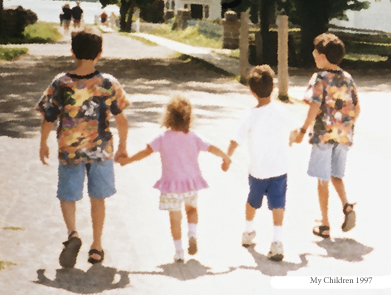
My four children holding hands

Lisa Endlich Heffernan, a British banker, airs her regrets about the years she spent at home with her children.

Because of her regrets, she’s trying to warn young women not to give up their careers for their children. If I’ve learned anything at all from 25+ years as a mother, it’s that there are a lot of different ways to successfully mother children. Therefore, in the interests of presenting the other side to young women, and following the structure that Enlich Heffernan used, I offer my 9 reasons why I have no regrets about giving up medical practice to stay home with my four children.*

I stood on the shoulders of the women who came before me. Although I entered medicine at a time when there were few women doctors and scientists, I was not one of the first. I never questioned my ability to handle college, medical school, internship and residency because other women had done it before me. And although I am grateful that they paved the way for me, I don’t for a moment think that they did it because of me or my generation. They became doctors and scientists because they deeply, fiercely wanted to practice medicine or engage in scientific research. They were willing to make sacrifices that I was not prepared to make (no marriage, no children). My generation wanted something more: they set out to have the careers of their dreams WITHOUT having to sacrifice the rest of their lives. In other words, they set out to be just like professional men.

I did not do this to inspire future generations. I did it because that’s what I wanted. And the fact that I and other women refused to compromise in the ways that the first women doctors and scientists were forced to compromise sets a new standard for professional women.

I used my driver’s license far less than my degrees, but I used it a lot. Yes, I spent years driving my children around. Lots of years doing lots of driving. But I discovered an amazing phenomenon: Children believe that when their mother is driving a car, she cannot hear. Therefore, I learned a great deal by listening to my children talk to their friends about the events of the day, the squabbles at school, and the worries of my children and their friends.

I used my degrees nearly every day and in every way during the years I stayed at home. In the first place, I never stopped being a doctor. I worked at night until my oldest was 8 years old and was home during the day. Even when I stopped practicing obstetrics, I always worked as a writer, both for pay and for my own enjoyment.

Second, I, with my husband, was my children’s first teacher. My education prepared me to give them knowledge and experiences that I had not had. My years as a professional gave me confidence to advocate vociferously for my two children with special needs and I think it made a tremendous difference for both of them. It’s not that I was more committed to their success than any other mother; it’s simply that I had a great deal of experience in how “the system” works and knew how to navigate it.

Third, it’s really convenient for a mother to be a doctor. I was able to diagnose ear infections with my otoscope, chest infections with my stethoscope and to tell the difference between mild and serious illness based on my clinical experience.

My kids think I did nothing. Erdich Heffernan complains that her kids think she did nothing. My kids think I did nothing, too, but not because I stayed home. They were also distinctly unimpressed with their father, even though he worked long hours at a prestigious job.

When my oldest was in the 3rd grade he came home with the results of his standardized tests and we discussed them while his 1st grade brother was present. The 3rd grader had done very well. The 1st grader asked me if I had taken those tests when I was in school and whether I did well.

“Yes, I did do well,” I replied, “but Daddy was an even better student than I was. In fact, when we graduated from college, Daddy was one of the top students in our class.”

My son was shocked.

“Really?” he inquired. “Our Daddy?”

Children, even children who have grown to adulthood, don’t see their parents as people. They see them as parents. It’s the nature of the job. If you think your fancy credentials and long hours of hard work are going to impress your children, you are doomed to be very disappointed.”

My world opened up. The author of the HuffPo piece claims that her world narrowed on leaving the work force. Mine opened up. I finally had time for something else besides practicing medicine. I was able to keep up with current events. I did graduate work in medical ethics. I read — voraciously, and still do.

I did a mountain of volunteer work. It was good for me, good for my children (setting an example for them) and good for my community.

I did not worry more. I am a Jewish mother; I could not worry more if I tried. If anything, I worried less, because I was there to supervise and observe. I spent time in my children’s classrooms, went on field trips and hosted playdates. I always knew what was going on.

My marriage remained exactly the same. Actually it got better, because I had more time for myself and more time for my husband. When I was working, he came after the kids and work and frankly, I was so exhausted I didn’t have much time for him. When I stopped working we had more time simply to be together and that was good for us.

My marriage never changed because I was no longer making as much money as I had earned before.

When my daughter was small, she asked me if I felt bad that Daddy made all the money and I had none.

I gently corrected her. “Daddy makes all the money, but it’s all MY money!”

“How does that work?”, she enquired.

I told her.

“If you marry the right guy, who believes that marriage is a partnership, not a business deal, it works just like that.”

I did not become outdated. If anything I am more up to date on the scientific literature than I ever was when I was practicing. Sure, I couldn’t go back to practicing obstetrics without a period of honing my surgical skills, but I could go back if I wanted (though I have no intention of doing so).

I never lowered my sights and I never lost confidence. Why should I? I have lived my life on my own terms, making the decisions that were best for me and my family without regard for what others thought I should do.

I have no regrets about being a stay-at-home mother. That doesn’t mean that it is the right choice for every woman and her family. As for advising younger women, I would say that the right choice is the one that works for you.

Don’t let anyone convince you otherwise.


*It goes without saying that having the option to stay home with children is the result of  privilege. That’s a topic for another discussion.

Just what we need, another old white male “mansplaining” childbirth to us women

pushing a touch screen

A new article about Dr. Michel Odent has me pondering an interesting phenomenon.

Have you ever noticed that it is old white men who feel they must “mansplain” birth to us womenfolk?

What is “mansplaining”?

According to Wikipedia:

To explain (something) condescendingly (to a female listener), especially to explain something the listener already knows, presuming that she has an inferior understanding of it because she is a woman.

The father of childbirth mansplaining was Grantly Dick-Read, who freely admitted that his claims were intended to get women back into the kitchen and pregnant, instead of agitating for political and economic rights.

He was followed by a string of childbirth mansplainers:

Fernand Lamaze
Frederick LeBoyer
Robert Bradley (“Husband Coached Childbirth”)
Marsden Wagner

And, of course, Dr. Odent.

What are Odent’s qualifications for mansplaining childbirth to us womenfolk?

The self-proclaimed “childbirth specialist” is not an obstetrician. He’s a surgeon. As far as I can tell, he has no qualifications of any kind for issuing childbirth instructions beyond his “fascination (and adoration) of women and the way they have delivered babies since the beginning of time.” In other words, no qualifications at all.

He’s publicizing his latest book, Childbirth and the Future of Homo Sapiens.

But in and among the complex scientific jargon and references, are some light-bulb moments; some absolute gems that you will keep turning over in your mind for days. His book is a tinderbox that will infuriate both the pro-C-section lobbyists (babies born this way are five times more likely to suffer allergies he points out) and the natural birthers (infant death globally between birth and 28 days appears twice as high after planned homebirth than hospital birth).

Odent’s conclusion:

… [M]illennia of evolution has caused women to lose the ability to birth as nature intended (ideally, in his mind, alone except for one “knitting midwife”) and therefore our global priority should be “to rediscover the primary needs of laboring women.”

The newspaper reporter cautions:

But before we dismiss him as a kaftan-wearing loon who likes women to suffer, we should listen.

Okay, let’s listen. Then we can dismiss him as a kaftan-wearing loon who like women to suffer.

On oxytocin:

“Most women give birth now on a synthetic Oxytocin drip. It is the most common medical intervention in childbirth,” he explains. But with no long term studies on its side effects, he says: “We are playing with the Oxytocin systems of human beings without knowing what we are doing.”

Thanks to masses of recent research into its effects, medical science now accepts that natural Oxytocin is the ‘love’ hormone needed to initiate and maintain labour. Nicknamed the ‘shy’ hormone, it requires a dark, quiet, familiar and non-threatening environment in order to flow (the antithesis of noisy, brightly lit maternity wards with unknown faces coming and going). Its enemy is adrenalin – hence the increasing popularity of birthing mothers using hypnotherapy to stay calm and offset the negative effects of ‘fear, fight and flight.’

Odent is a fan of this type of Oxytocin (hence his claim that women should birth privately with a midwife who is so busy knitting that she doesn’t transmit her own adrenalin through the ‘mirror neurone complex’). The hormone ‘peaks’ moments after birth and causes the overwhelming sense of ‘love’ that some women report on seeing their baby.

But he is frankly terrified by the long term effects of synthetic Oxytocin (which suppresses the natural version) on babies, mothers and – controversially – their bond. Odent points out that autistic children produce less Oxytocin. He is incensed that “thousands of articles all over the world” have discussed the link between MMR jab and autism although there is no “valuable epidemiological study detecting correlations” between the two.

No long term studies on its effects? Literally tens of millions, possibly hundreds of millions of women and babies have been exposed to synthetic oxytocin (which is an chemically identical to oxytocin produced in the body) over a period of 2 full generations, and we have yet to discern any harmful effects.

The rest of Odent’s claims are also unsubstantiated.

The enemy of oxytocin is adrenalin? Really? You know what dramatically increases adrenalin in labor? Pain! You know what dramatically decreases adrenalin in labor? Epidurals! According to Odent’s “reasoning,” every woman ought to have an epidural in labor.

Synthetic oxytocin suppresses the natural version? Really? Why would that be a problem? We only give synthetic oxytocin when there isn’t enough natural oxytocin to get the job done. And it works.

Oytocin causes the overwhelming sense of ‘love’ that some women report on seeing their baby? Where’s the evidence for that claim? There is no evidence. Odent simply made it up.

But wait! There’s more:

Odent is perhaps most famous for recently claiming that men should not attend births…

“It is only in the middle of the twentieth century that the birth environment became ‘masculinised’. The number of specialist doctors increased at lightening speed and almost all were men,” he writes.

Now that’s funny. Here’s a man complaining that childbirth has become masculinized while simultaneously pushing his masculine beliefs about childbirth. Ironic, no?

This book reads like a giant ‘I dare you’ to the medical world. He dares researchers to open the can of worms to ponder if ‘HOW’ we are born impacts on ‘WHO’ we become. And that in turn dares the obstetric world to treat women as sensitive yet capable mammalian beings rather than mere parts in a masculinised, medicalised production line of baby-makers pumped full of potentially harmful drugs.

His book asks if this is “utopian?”

No, it’s not utopian.

It’s classic fabricated, unsubstantiated mansplaining.

Are Hannah Dahlen and Australian midwives trying to trick people, or just ignorant?

iStock_000011708490XSmall

I am disappointed and very, very frustrated.

Scientific journals continue to publish more and more junk. Do the editors read what they publish? Do they think about whether it is true? Or do they simply print it, send out a press release and wait for attention?

The latest piece of junk published in a reputable scientific journal is Publicly funded homebirth in Australia: a review of maternal and neonatal outcomes over 6 years, just published in the Medical Journal of Australia.

I reviewed the findings when they were first presented at a medical conference in April (Australian midwives boast about terrible homebirth death rate):

During the 5 years of the study, there were 1807 women who intended, at the start of labor, to give birth at home. 83% had a homebirth, 52% in water (I have no idea why they mention this except to check women’s performances against the midwifery ideal.) The transfer rate was 17%. The C-section rate was 5.4% and the neonatal death rate was 2.2/1000. That’s more than 5X the rate of 0.4/1000 found in a 2009 report on birth in South Australia.In addition, 2 babies suffered hypoxic ischemic encephalopathy (brain damage due to lack of oxygen).

And that probably undercounts the deaths and complications because reporting was voluntary and only 9 of 13 program directors responded. Nonetheless, the authors conclude:

This study provides the first national evaluation of a significant proportion of women choosing publicly funded homebirth in Australia; however, the sample size does not have sufficient power to draw a conclusion about safety. More research is warranted into the safety of alternative places of birth within Australia.

Actually, the study is not underpowered to detect an extremely high death rate.

What is statistical power?

In plain English, statistical power is the likelihood that a study will detect an effect when there is an effect there to be detected. If statistical power is high, the probability of making a Type II error, or concluding there is no effect when, in fact, there is one, goes down.

Statistical power is affected chiefly by the size of the effect and the size of the sample used to detect it. Bigger effects are easier to detect than smaller effects, while large samples offer greater test sensitivity than small samples.

In most studies we find very small differences between the two groups under investigation. Therefore, we need a lot of individuals in each group in order to be sure that the difference we have found is real, and not the result of chance.

In contrast, if we find a very large difference, we don’t need a lot of individuals in each group in order to be sure that the result is real. A 400% increase in the death rate is an extremely large difference.

The authors never bothered to conduct a statistical analysis of any kind, which means that they literally have no idea whether any of their claims are valid. They simply announced that they could make no determination of safety, but nonetheless boasted about excellent outcomes. You can’t have it both ways. Either the study has too few individuals to draw ANY conclusions, in which case the entire paper is meaningless, or the study contains enough individuals to provide a meaningful result.

Caroline Homer, one of the authors of the study, and Hannah Dahlen, a spokesperson for the Australian College of Midwives, take to the lay press to boast about the results of the study (Study of low risk women reveals good news on the home birth front):

Hannah Dahlen, Professor of Midwifery at University of Western Sydney, said the findings we “very reassuring” and showed a very low perinatal mortality rate, comparable with birth centres.

That is an utter falsehood.

The study shows a VERY HIGH neonatal mortality rate, 400% higher than comparable risk hospital birth.

Which raises the question: Is Dahlen deliberately trying to trick readers, since a neonatal mortality rate of 2.2/1000 is 5X higher than comparable risk hospital birth? Or are she and the authors of the study so ignorant of childbirth safety statistics that they don’t realize that the homebirth death rate 400% higher than comparable risk hospital birth?

And what about the MJA?

Why did they publish such a misleading paper? Why didn’t they insist on a discussion of the very high death rate? Why did they allow the authors to declare that the study is underpowered to determine safety when they authors did no statistical calculations of any kind? If the study is underpowered, why did they bother to publish it?

The publication of this study is disappointing and very, very frustrating. The very best we can say about this paper is that it is utterly misleading.

As I said above, I don’t know if Hannah Dahlen and Australian midwives are trying to trick the Australian public into believing that homebirth is safe when it clearly is not, or whether they are so ignorant of basic science, statistics, and mortality data that they don’t realize that have shown that homebirth is dangerous.

It doesn’t really matter. Boasting about a hideous death rate is both bizarre and unacceptable.

No, new Dutch study does NOT show that homebirth is safe

Salad preparation

Dutch midwife Ank de Jonge is at it again, slicing and dicing data in yet another unsuccessful attempt to show that homebirth is safe.

She thought that she had succeeded in  Perinatal mortality and morbidity in a nationwide cohort of 529 688 low-risk planned home and hospital births (2009)  which appeared to show that homebirth with a midwife in the Netherlands is as safe as hospital birth with a midwife. Unfortunately for her, the subsequent study, Perinatal mortality and severe morbidity in low and high risk term pregnancies in the Netherlands: prospective cohort study, was a stunning indictment of Dutch midwives, demonstrating that Dutch midwives caring for low risk women (home and hospital) had a higher mortality rate than Dutch obstetricians.

Two months ago, de Jonge in a paper in the journal Midwifery Perinatal mortality rate in the Netherlands compared to other European countries: A secondary analysis of Euro-PERISTAT data that attempted to absolve Dutch midwives, but actually CONFIRMED their poor mortality statistics .

de Jonge continues to slice and dice the Dutch homebirth data is an effort to somehow prove that homebirth is safe, when the data suggests that it is not. Her latest effort is Severe adverse maternal outcomes among low risk women with planned home versus hospital births in the Netherlands: nationwide cohort study. She and her colleagues found:

Overall, 92 333 (62.9%) women had a planned home birth and 54 419 (37.1%) a planned hospital birth. The rate of severe acute maternal morbidity among planned primary care births was 2.0 per 1000 births. For nulliparous women the rate for planned home versus planned hospital birth was 2.3 versus 3.1 per 1000 births (adjusted odds ratio 0.77, 95% confidence interval 0.56 to 1.06), relative risk reduction 25.7% (95% confidence interval −0.1% to 53.5%), the rate of postpartum haemorrhage was 43.1 versus 43.3 (0.92, 0.85 to 1.00 and 0.5%, −6.8% to 7.9%), and the rate of manual removal of placenta was 29.0 versus 29.8 (0.91, 0.83 to 1.00 and 2.8%, −6.1% to 11.8%). For parous women the rate of severe acute maternal morbidity for planned home versus planned hospital birth was 1.0 versus 2.3 per 1000 births (0.43, 0.29 to 0.63 and 58.3%, 33.2% to 87.5%), the rate of postpartum haemorrhage was 19.6 versus 37.6 (0.50, 0.46 to 0.55 and 47.9%, 41.2% to 54.7%), and the rate of manual removal of placenta was 8.5 versus 19.6 (0.41, 0.36 to 0.47 and 56.9%, 47.9% to 66.3%).

Conclusions: Low risk women in primary care at the onset of labour with planned home birth had lower rates of severe acute maternal morbidity, postpartum haemorrhage, and manual removal of placenta than those with planned hospital birth. For parous women these differences were statistically significant. Absolute risks were small in both groups. There was no evidence that planned home birth among low risk women leads to an increased risk of severe adverse maternal outcomes in a maternity care system with well trained midwives and a good referral and transportation system.

There’s just one teensy, weensy problem. de Jonge left out the mortality rates. Severe maternal morbidity is an appropriate measure of safely ONLY when death rate is zero or nearly zero. If the death rate is not zero, that MUST be taken into account in assessing safety.

To understand the problem, it helps to look at a graphical representation. The image below compares the incidence of severe maternal morbidity in two groups.

Stickfigures dead covered

It’s easy to see that there were a greater number of serious complications in the second group than in the first. It is tempting to conclude that the place of birth for the first group is safer than the place of birth for the second group.

Look what happens, though, when we add the number of women who died in each group.

Stickfigures dead

Now it’s easy to see that the place of birth of the first group is far more dangerous than that of the second group. Notice that the rate of serious SURVIVABLE maternal complications is unchanged. But the dead women had complications, too, and they can’t be excluded simply because they died. If 6 women have serious complications in the first group and 3 die, compared to 5 women in the second group who suffer serious complications, and one dies, we CANNOT conclude that the group that had more survivors is the safer group.

de Jonge has shown us the equivalent of the first image, but it’s meaningless unless she shows us the equivalent of the second image. In other words, the MOST important piece of information, the information we MUST have in order to draw conclusions about safety is missing from the new paper and its absence is both inexplicable and impossible to justify. de Jonge does not explain what she did with the maternal deaths. It appears that she excluded them altogether.

If so, de Jonge compared the number of women who SURVIVED severe complications at homebirth to the number of women who SURVIVED severe complications at hospital birth. She didn’t compare the number of women who EXPERIENCED severe complications in each place. And she didn’t compare how many women DIED at each place. Without that information, de Jonge is not entitled to conclude anything.

This paper doesn’t show that homebirth is safe. In the absence of mortality data, this paper is meaningless.

Ina May Gaskin leads her own cult

iStock_000013510328XSmall

For years I’ve puzzled over the appeal of Ina May Gaskin.

She’s obviously a complete fraud. She babbles nonsense and makes up “statistics” that she refuses to publish in scientific journals. She has no education or training in midwifery. She has blood on her hands; homebirth kills babies, and indeed she let one of her own children die. She is a cult member who accepts her own husband as a “prophet.”

In writing yesterday’s post about the fact that she proudly transgresses personal boundaries, the final piece fell into place for me. Ina May Gaskin is the high priestess of her own cult, and her loyal followers, for their own reasons, pretend that she is leading them to the promised land.

What are the characteristics of a cult? According to the Group Psychological Abuse Scale, characteristics include:

  • The group advocates or implies that breaking the law is okay if it serves the interests of the group.
  • The group discourages members from displaying negative emotions.
  • Members feel they are part of a special elite.
  • The group teaches that persons who are critical of the group are [evil].
  • The group teaches special exercises … to push doubts or negative thoughts out of consciousness.
  • Medical attention is discouraged, even though there may be a medical problem.

What are the characteristics of cult leaders? According to Lalich and Langone, characteristics include:

  • The group displays excessively zealous and unquestioning commitment to its leader and … regards his belief system, ideology, and practices as the Truth …
  • Questioning, doubt, and dissent are discouraged …
  • The leader is not accountable to any authorities …
  • The leadership induces feelings of shame and/or guilt in order to influence and/or control members. Often, this is done through peer pressure …

It’s hardly surprising that Gaskin, the wife of a cult leader, has created her own cult in the area of action that he allows her. How do the characteristics of cults apply to homebirth in the US?

  • Homebirth advocates and homebirth midwives routinely break the law and encourage others to do so.
  • Homebirth advocates characterize dissent as “negativity.”
  • Homebirth advocates believe that they are more “educated” than others.
  • Homebirth advocates are vicious to those who question their beliefs. They reserve special contempt for women who have lost babies at homebirth.
  • Homebirth advocates attribute poor outcomes (from C-section to disability to death) to the “negative thoughts” of women who “didn’t trust” birth.
  • Medical attention is strongly discouraged, even though there may be a medical problem. Indeed medical problems are elided altogether by calling them “variations of normal.”

Does Gaskin exhibit the characteristics of a cult leader?

  • Homebirth advocates display zealous and unquestioning commitment to Gaskin, even though she has no education and training, let one of her own children die, and transgresses sexual boundaries.
  • No one questions Gaskin’s claims about homebirth even when they are obviously nonsensical. No one demands that Gaskin provide proof for her claims of purported excellent outcomes at The Farm.
  • Gaskin is not accountable to any authorities. Indeed she set herself up as THE authority, going so far as to join with others in creating a fake “credential” to fool non-cult members.
  • Homebirth advocates, including Gaskin, wield shame and guilt as cudgels to discipline members. Often, this is done through peer pressure.

Gaskin freely admits that she fondles women during labor:

It helps the mother to relax around her puss if you massage her there using a liberal amount of baby oil to lubricate the skin. Sometimes touching her very gently on or around her button (clitoris) will enable her to relax even more. I keep both hands there and busy all the time while crowning … doing whatever seems most necessary.

And:

Sometimes I see that a husband is afraid to touch his wife’s tits because of the midwife’s presence, so I touch them, get in there and squeeze them, talk about how nice they are, and make him welcome.

There is no possible medical or scientific justification for fondling women’s breasts and genitals without express permission. PERIOD. Unless Gaskin has her patients sign advanced consent for “tit squeezing” and clitoral stimulation, she has committed a sexual violation. What’s worse, she violates victims when they are most vulnerable, in pain and unable to advocate for themselves.

That’s the final piece that brought everything into focus.

It’s long past time to recognize this woman for what she is, a cult leaders whose empirical claims have no basis in fact, whose recommendations have caused countless preventable neonatal deaths, and who uses shame and guilt to discipline her followers.

Ina May Gaskin has condemned herself with her own words. Her followers have known about this reprehensible behavior for years and have excused or ignored it as is typical in a cult. This woman is not worthy of anyone’s admiration. She is worthy of condemnation in the strongest possible terms.

Abuse is abuse, even when it is committed by one woman on another, even when it is done under the guise of medical “care,” and even when the perpetrator is widely beloved by other members of the cult. There is no possible justification for this behavior.

Would you hire this midwife?

Gaskin quote

Would you hire this midwife?

Don’t let the head suddenly explode from the mother’s puss. Coach the mother about how much and how hard to push. Support the mother’s taint with your hand during rushes. It helps the mother to relax around her puss if you massage her there using a liberal amount of baby oil to lubricate the skin. Sometimes touching her very gently on or around her button (clitoris) will enable her to relax even more. I keep both hands there and busy all the time while crowning … doing whatever seems most necessary.

And:

Sometimes I see that a husband is afraid to touch his wife’s tits because of the midwife’s presence, so I touch them, get in there and squeeze them, talk about how nice they are, and make him welcome.

And:

I might want to have a cunt one day and a twat the next. On the third day I might decide that pussy is my favorite word.

Would you hire this midwife?

Her quotes make her sound immature, foul mouthed, and sexually inappropriate.

Plenty of women have hired her. Her name is …

Ina May Gaskin.

The quotes come from Spiritual Midwifery, 3rd and 4th Editions

Unnatural childbirth: 5 goofy things that natural parenting advocates do that never occur in nature

LOL

Natural childbirth has nothing to do with childbirth in nature. Not only does it fail to replicate birth in nature, it adds on practices that have never been seen in nature and then pretends they are “natural.”

Here are 5 of the goofiest unnatural things that Western, white, well off advocates do while cluelessly preening to each other that they are imitating primitive people.

1. Waterbirth

No primates, let alone humans, give birth in water. Zip, zero, nada. It’s pretty obvious why: childbirth in water is UNNATURAL and puts offspring at risk for drowning. To the extent that infants are “designed”, they are “designed” to be born into air and take their first breathe of air in relatively short order. Animals and pre-industrialized humans make great effort to ensure that their offspring survive. They don’t include stunts as part of birth, because they find no benefit in impressing their peers.

2. Eating the placenta

You have to be the most gullible rube on the planet to be or use the services of a “placenta encapsulation specialist.” Human beings in nature do not eat the placenta, and they certainly don’t freeze-dry it first.

Indeed, the anthropological literature dates the first sighting to an indigenous group of California homebirth advocates (I kid you not). In Consuming the inedible: neglected dimensions of food choice, MacClancy and colleagues report:

In association with the natural childbirh movement from the 1960’s placentophagia was taken up in some ‘Western’ societies, especially in California, on the basis that it was ‘natural’, as ‘all’ mammalian species eat the placenta. The problem with this is that not all mammals are regularly placentophagous and our closest primate relatives also are not placentophagous… [M]odern placentophagia is based on an inaccurate idea of making the human birthing process more ‘natural’.

3. Lotus birth

I can’t decide who are the bigger fools. Those who eat their placenta or those who leave it attached to the baby to rot off.

To my knowledge, there is not a single higher order animal that leaves the placenta attached to the baby for more than minutes. Lotus birth has nothing to do with childbirth in nature. It was made up by a wacky woman trying to outdo her wacky peers. Amazingly, gullible natural childbirth advocates have adopted it, too.

4. Unassisted childbirth

Unassisted childbirth rarely if ever occurs among human societies. There is a good reason for that. Assistance in childbirth raises the chances that both mother and baby will survive what is universally accepted to be an inherently dangerous situation. Unassisted childbirth is yet another fabrication from whole cloth that childbirth advocates try to pass off as “natural” when it is nothing more than a stunt practiced by the clueless in order to impress their clueless peers.

5. Tandem nursing

Although widely beloved by lactivists, to my knowledge there are no higher order animals that practice tandem nursing. Breastmilk is reserved for the youngest child and the older child is invariably weaned. It is not clear whether that’s because allowing an older child to continue to nurse robs the baby of valuable food and nutrients, but it simply doesn’t happen in nature.

If none of the above 5 are natural, how did they come to be included in natural childbirth?

Easy. Natural childbirth has nothing to do with childbirth in nature. From its “father,” Grantly Dick-Read, to its current exponents, natural childbirth was made up to serve the interests and aims of its fabricators. Once you start lying about the inherent dangerousness of childbirth and lying that women are “designed” to give birth perfectly, it is a short step to making up never before seen practices and advertising them as natural.

The current fetish for unmedicated childbirth while refusing life saving interventions, complete with birth photographer, live tweeting and a video on YouTube, is about as natural as hunting rabbits with a bazooka while wearing camo. It is not only unnatural, it doesn’t even mimic what really happens in nature.

Two crappy new breastfeeding studies make irresponsible claims of benefits

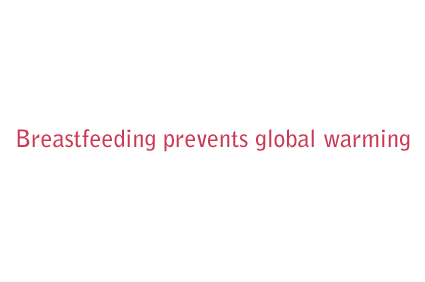
breastfeeding prevents global warming

Why aren’t breastfeeding advocates satisfied with the real, albeit small, benefits of breastfeeding? Why do they repeatedly publish pathetically poorly done studies that make irresponsible claims about the benefits of breastfeeding?

I don’t know the answers, but I’m becoming ever more disgusted with their insupportable attempts and the willingness of scientific journals to publish the crappy papers that result. Not one, but two, new papers on the benefits of breastfeeding are making headlines this week and both suffer from flaws that would doom a middle school science fair project.

The first paper is Breastfeeding and early white matter development: A cross-sectional study by Deoni, et al. published in the journal NeuroImage. The purported “findings” have been published by sanctimommies everywhere under titles such as Breastfed Babies Are Smarter But That Doesn’t Mean Formula-Fed Babies Are Dumb. There’s just one teensy, weensy problem. The authors didn’t show anything of the kind. Indeed, as far as I can determine, they didn’t show anything at all.

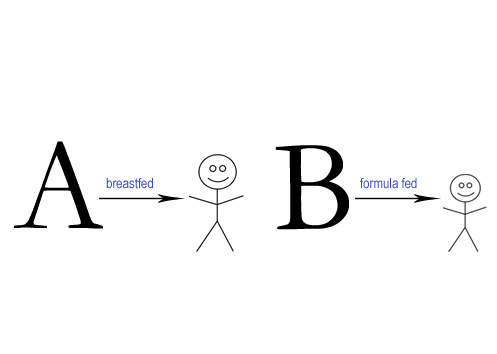
To understand why the their study is fatally flawed, imagine for a moment that I did a study comparing two groups of children to determine if breastfeeding increases children’s height. Imagine further that I found the children from Group A, which contains a high proportion of exclusively breastfed infants, turn out to be several inches taller at age 5 than the children from Group B, who never received breastmilk. I’ve included a sophisticated graphical representation below.

letters stick figures

Would I be entitled to conclude that breastfeeding made the children in group A taller than the formula fed children in group B?

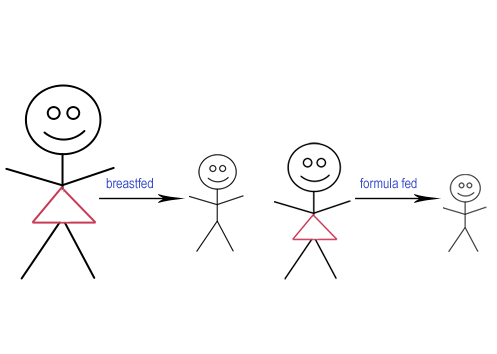
It might appear that way at first, but as students of statistics know, you must compare like with like. Are the mothers in group A the same as the mothers in group B? I’ve added more data to the sophisticated graphic representation.

mothers stick figures

Now we see that the mothers in group A are actually taller than the mothers in group B. We therefore CANNOT conclude that breastfeeding increased the height of the children. The more likely explanation is that the children in group A are taller than the children in group B because of genetic inheritance.

Deoni and al. committed that very mistake. They compared two group of children on a proxy measure of intelligence without ever comparing the intelligence of their mothers. The authors actually acknowledge:

While maternal IQ was not specifically measured, the combination of education and SES [socio-economic status] was believed to provide an adequate alternative.

But the education and socio-economic status of the mothers in group A was known to be higher than in group B. Hence any observed differences between breastfed and formula fed babies is most likely due to genetics and social advantages, NOT to breastfeeding.

That’s only the most egregious deficiency of the study. There are many more. The authors didn’t actually look at the intelligence of the children in the two groups; they looked at white matter development in the brain and implied that it is correlated with intelligence. There’s no proof that the two are correlated. Indeed there is no proof that white matter development is in any way related to intelligence let alone correlated with it.

So, in the end, the authors found nothing at all. The study is junk.

The second study, Cost Analysis of Maternal Disease Associated With Suboptimal Breastfeeding, is, amazingly, even more irresponsible than the first. Bartick et al. breathlessly conclude, with absolutely no basis in fact:

… [W]e estimate that current breastfeeding rates result in 4,981 excess cases of breast cancer, 53,847 cases of hypertension, and 13,946 cases of myocardial infarction compared with a cohort of 1.88 million U.S. women who optimally breastfed. Using a 3% discount rate, suboptimal breastfeeding incurs a total of $17.4 billion in cost to society resulting from premature death $733.7 million in direct costs, and $126.1 million indirect morbidity costs.

There is just one ginormous problem. There is NO EVIDENCE AT ALL that breastfeeding prevents maternal high blood pressure or maternal heart attacks. That means that out of nearly 73,000 purported lives saved, fully 93% are simply made up.

If there’s one thing we know about breastfeeding, it’s that women who breastfeed differ in important ways from women who don’t. Women who breastfeed tend to be wealthier, better educated, and thinner, among other things. There are studies that have investigated an association between breastfeeding and maternal cardiovascular health, and they’ve found that any observed differences disappear when the comparison groups are corrected for economic status, educational attainment and weight.

Bartick et al. acknowledge the tenuousness of their claim with this caveat:

If observed associations between breastfeeding duration and maternal health are causal …

There’s absolutely no reason to believe that breastfeeding affects maternal cardiac health and no mechanism has been proposed, let alone established. The idea that breastfeeding has a protective effect against the diseases of old age in affluent societies is absurd on its face. For most of human existence, women didn’t survive long enough to develop high blood pressure or have heart attacks.

This isn’t the first time that Bartick has published her own wishful thinking as if it were science. In The Burden of Suboptimal Breastfeeding in the United States: A Pediatric Cost Analysis published in 2010, Bartick used highly fanciful methods to  “estimate” that the US could save 900 infant lives and $13 billion if 90% of US women breastfed. The numbers are grossly misleading since not even a single US infant death (let alone 900 per year) has ever been attributed to not breastfeeding and since the purported savings are primarily the “lost wages” of the 900 dead infants.

Who is Dr. Bartick? She’s an internist and fervent campaigner to ban formula gift bags in hospitals, an idea that is punitive (particularly to women of color and those of lower socio-economic status) and has never been shown to have any impact on breastfeeding rates. Dr. Bartick appeared in the comments section of this blog and revealed herself to be a bit of a crank, bemoaning the way that babies are mistreated in the first hour after birth:

Instead, babies [are] routinely whisked off and traumatized during that hour with baths, shots, eye ointments.

Baths, shots and eye ointment are traumatic? I suppose if you believe that, without any evidence of any kind, it’s not hard to believe that breastfeeding prevents the diseases of old age in affluent societies.

Both papers are emblematic of current breastfeeding “research,” which substitutes wishful thinking for scientific evidence.

If you told me that breastfeeding reduces the chance of infants developing malaria, I would find that plausible, since malaria has posed a serious threat to babies for thousands of years and anything that protect against it would be highly beneficial. That’s why the fact that breastfeeding is somewhat protective against infant diarrhea is hardly surprising since diarrhea is a killer in primitive societies. But the claims that breastfeeding addresses the obsessions of contemporary privileged societies (such as the emphasis on infant “intelligence” and diseases of old age) are extraordinary claims. Why would breastfeeding prevent diseases that rarely occurred until the last century? How can we possibly believe that breastfeeding increases intelligence when we have lived through several generations of virtually exclusive bottle feeding with no apparent change in brain power, technical innovation or academic achievements?

Extraordinary claims require extraordinary evidence. Instead we are treated to poorly done studies making bizarre claims based on wishful thinking. What’s next? I’ve got it: breastfeeding prevents global warming!  That’s gonna really make a splash.

This week in homebirth idiocy

iStock_000000385785XSmall

Is there any limit to the narcissism and stupidity of these women?

1. Planning an unassisted childbirth (UC):

I believe that I can birth this baby unassisted, safely and happily. I have been trying to convince my DH, but he told me he will never be on board. Planning to birth while he sleeps or is at work. I’m sad that he can’t support me, but I know what this baby needs.

2. The baby is struggling to breathe and the mother is expressing colostrum into her mouth “just so she’d get a taste since we wouldn’t be able to breastfeed any time soon.” If the mother were struggling to breathe would she find it helpful for someone to squirt liquid into her mouth?

Her baby was transferred by helicopter to a NICU (without her) and this is what the mother is thinking:

On the way home from the birthing center, I kept saying, “I did it. I gave birth! Naturally!”

3. After an uncomplicated vaginal birth induced in the hospital at nearly 43 weeks:

… Although I had a mostly natural unmedicated vaginal birth with the most natural birth friendly doctor in the state, it still wasn’t the birth I had planned or wanted for my daughter. To this day, I feel guilty that Dinah didn’t get to choose her own birthday. I’m afraid I may have let her down by having her birth induced.

4. A homebirth midwife wails about the “horrors of midwifery licensing“:

… There are time limits on how long you can labor, or how long you can push, or on the size of your baby. If she ignores any of these rules and regulations, she is (again) subject to disciplinary action. But more importantly, if she ignores the rules (and many do)…then what happens to the “licensing equals safety” argument? How is she a “safe midwife” if there is blatant disregard for the rules that have been deemed to make birth “safe”?

You can’t make this stuff up!