Category Archives: Uncategorized

Anti-vax: a flat earth theory for the 21st Century

Flat Earth

The flat-earthers are back!

Well, not exactly, but their descendants have come up with the flat-earth equivalent for the 21st century: they don’t “believe in” vaccination.

Anti-vaxxers are all over social media promoting the “dangers” of vaccination. Anti-vaccine advocacy isn’t about vaccination, though. It’s all about parents and how they wish to view themselves.

[perfectpullquote align=”right” bordertop=”false” cite=”” link=”” color=”” class=”” size=””]Believing experts is portrayed as an intellectual deficiency and refusing to trust them is constructed as a positive cultural attribute.[/perfectpullquote]

It is important to understand that “vaxophobia” is not based on science. There is no scientific data that supports the fears of anti-vaxxers. Indeed vaccines are one of the greatest public health achievements of all time and virtually every accusation about vaccines by anti-vaxxers is factually false.

Vaccines have been around for more than 200 years, and anti-vaxxers have been around for almost as long. Over the years, they have made countless accusations about the “risks” of vaccines, and they have been wrong every single time. Despite the fact that they have been 100% wrong in their understanding of vaccines, statistics, risks and claims of specific dangers, they still have a large following. In part, that’s because the cultural claims of anti-vaxxers resonate with prevailing cultural assumptions. Anti-vax is a social construct.

‘Trusting blindly can be the biggest risk of all’: organised resistance to childhood vaccination in the UK (Hobson-West, Sociology of Health & Illness Vol. 29 No. 2 2007, pp. 198–215) explores these cultural attitudes. The first social construct is a re-imagining of the meaning of risk:

A primary way this is achieved … is to construct risk as unknowns… [This] serves as an example of how the realist image of risk as a representation of reality is undermined. In the realist account, uncertainty and unknowns may be recognised but are usually framed as temporary phases that are overcome by more research. For the [vaccine rejectionists], there is a more fundamental ignorance about the body and health and disease that will not necessarily be overcome by more research. Interestingly, this ignorance is constructed as a collective – ‘we’ as a society do not know the true impact of mass vaccination or the causes of health and disease.

The problem of anti-vaccine advocacy being based on false premises is elided by ignoring the actual scientific data and focusing instead on whether parents agree with health professionals or refuse to trust them. Agreement with experts is portrayed as an intellectual deficit and refusing to trust them is constructed as a positive cultural attribute:

Clear dichotomies are constructed between blind faith and active resistance and uncritical following and critical thinking. Non-vaccinators or those who question aspects of vaccination policy are not described in terms of class, gender, location or politics, but are ‘free thinkers’ who have escaped from the disempowerment that is seen to characterise vaccination…

This characterization of anti-vaxxers can be unpacked even further; not surprisingly, they imagine themselves as praiseworthy while other parents are denigrated.

… instead of good and bad parent categories being a function of compliance or non-compliance with vaccination advice … the good parent becomes one who spends the time to become informed and educated about vaccination…

And:

… [vaccine rejectionists] construct trust in others as passive and the easy option. Rather than trust in experts, the alternative scenario is of a parent who becomes the expert themselves, through a difficult process of personal education and empowerment…

The ultimate goal is to become “empowered”:

Finally, the moral imperative to become informed is part of a broader shift, evident in the new public health, for which some kind of empowerment, personal responsibility and participation are expressed in highly positive terms.

So anti-vaccine advocacy is about the parents and how they would like to see themselves, not about vaccines and not about children. In the socially constructed world of vaxophobes, risks can never be quantified and are always “unknown”. Parents are divided into those (inferior) people who are passive and blindly trust authority figures and (superior) anti-vaxxers who are “educated” and “empowered” by taking “personal responsibility”.

This view depends on a deliberate re-definition of all the relevant terms, however, and that re-definition is unjustified and self aggrandizing. The risks of vaccination are not unknown. Believing that vaccines work is not a matter of “trust”; it is reality. Questioning authority is not the same as being “educated”; indeed, it isn’t even related. Lacking even basic knowledge of immunology and rejecting medical facts is not a sign of education, independent thinking or taking personal responsibility. It is a lack of education at best, and self-serving, self-aggrandizing ignorance at worst.
OK Lactivist!

21EDF723-EC22-4199-A4B8-0A7FC4D2C756

They think they can ignore the problems they cause.

They refuse to listen to the younger generation they harm.

They imagine that because they hold the power, they don’t have to care.

They’re not boomers; they’re lactivists.

[perfectpullquote align=”right” bordertop=”false” cite=”” link=”” color=”” class=”” size=””]Think deleting and banning your critics is a winning strategy? OK Lactivist![/perfectpullquote]

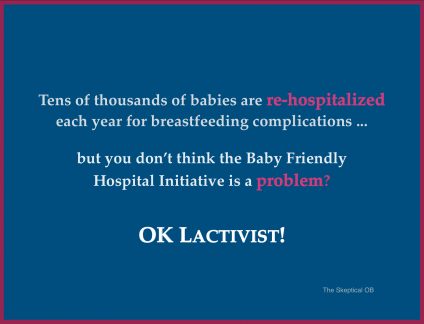
Tens of thousands of infants are re-hospitalized each year for breastfeeding complications. Shockingly, exclusive breastfeeding has become the leading risk factor for newborn hospital readmission.

A new movement, the Fed Is Best movement, encompassing hundreds of thousands of women has come to prominence for trying to protect babies from dehydration, hyperbilirubinemia, hypoglycemia and other complications of insufficient breastmilk.

How has the breastfeeding profession responded?

Amy Brown has written:

…[T]he phrase ‘fed is best’ is nonsensical. At NO point has anyone ever suggested that if a baby can’t be breastfed then they should starve… Fed is therefore not best, because best implies that there are other acceptable alternatives.

OK lactivist!

Marsha Walker wrote:

Social media has been alight with descriptions of exclusive breastfeeding being dangerous, resulting in significant and severe negative outcomes in infants whose mothers wished to breastfeed. This backlash has been led by a campaign that uses inflammatory anecdotes and misleading and inaccurate interpretation of research to bolster its assault on breastfeeding …

OK Lactivist!

Lucy Ruddle wrote:

So, that study being shared by certain places who like to scaremonger… the “1 in 71 breastfed newborns are readmitted” one… I got hold of it, mainly because I was interested in the limitations, which SOB and FIB have a habit of ignoring.

But Ruddle read the wrong paper, misunderstood what she read and it actually showed an even higher rate of readmission. When confronted with her multiple mistakes, Ruddle deleted the post without correcting her errors and without apologizing for them.

Okay Lactivist!

Serena Meyer wrote:

Have you heard about Fed is Best? It’s an organization that believes that the Baby Friendly Initiative is responsible for pushing breastfeeding in a way that essentially starves babies. There is a lot of carefully cloaked vitriol about breastfeeding and brain damage, starvation and death. It makes me feel pretty argumentative; not about the fact that babies can lose more than we would like, but at the goals of the organization as I perceive them.

When faced with hundreds of comments from women whose babies were starved by aggressive breastfeeding promotion, Meyer deleted them … all of them.

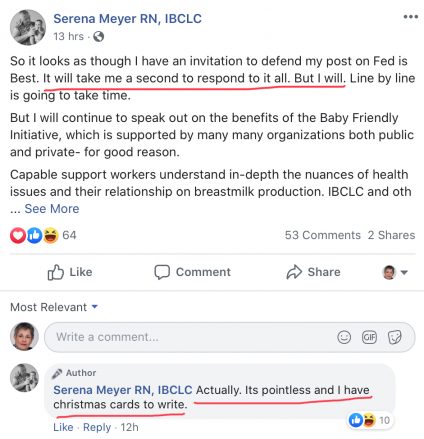
When invited by the Fed Is Best Foundation to respond to their careful recitation and debunking of Meyer’s lies, she responded:

So it looks as though I have an invitation to defend my post on Fed is Best. It will take me a second to respond to it all. But I will. Line by line is going to take time…

26C16ACA-C6BC-4E4F-93B7-CB602A151098

But within an hour she was back-pedaling:

Actually. Its pointless and I have christmas cards to write.

OK Lactivist!

You think you can ignore the problems you cause, but you’re wrong.

You refuse to recognize the younger generation you harm and therefore you are undermining the very programs you seek to support

You imagine that because you hold the power at the moment, you don’t have to care about the anguished mothers whose babies have been hospitalized, injured and, in some cases, rendered permanently impaired or even dead.

You’ve made it impossible to have a reasoned discussion because you delete comments, ban those who try to correct your falsehoods and refuse to engage with your critics.

Think that’s a winning strategy?

OK Lactivist!

Why does LC Serena Meyer think she speaks FOR women with breastfeeding complications without speaking TO them?

Two women whispering about a third woman

Yesterday I wrote about why you can’t trust lactation consultants to understand scientific literature.

I used a post in which an IBCLC insisted the fact that 1 in 71 exclusively breastfed babies are re-hospitalized for complications is not supported by the scientific evidence. I’ve repeatedly cited the claim and the paper that it comes from. The LC read the wrong paper; misunderstood what she read; and the paper she referenced actually has a HIGHER readmission rate.

[perfectpullquote align=”right” bordertop=”false” cite=”” link=”” color=”” class=”” size=””]Fed Is Best threatens lactation consultants’ income, employment prospects and autonomy. No wonder they’re opposed.[/perfectpullquote]

The LC has now “disappeared” her post without acknowledging she was wrong in nearly every respect. So not only can she not be trusted to read the scientific literature; she can’t be trusted to admit when she is wrong and apologize.

Today I offer an example of why lactation consultants cannot be trusted to be honest about the Fed Is Best Foundation.

Serena Mayer, RN IBCLC wrote:

Have you heard about Fed is Best? It’s an organization that believes that the Baby Friendly Initiative is responsible for pushing breastfeeding in a way that essentially starves babies. There is a lot of carefully cloaked vitriol about breastfeeding and brain damage, starvation and death. It makes me feel pretty argumentative; not about the fact that babies can lose more than we would like, but at the goals of the organization as I perceive them.

The name is a real teeth clencher for me and other International Board Certified Lactation Consultants. “Fed is Best”, is a highly charged three words that no one really wants to disagree with. The rhetoric flows untapped within their organization and it appears that they drop all the hot words on parents; words like “starvation” and “dead” are used a lot in their materials.

If you don’t understand what’s wrong with that, try this thought experiement. Imagine if we replaced Fed Is Best with MeToo:

Have you heard about #MeToo? It’s an movement that believes that some men harm women, there is a lot vitriol about touching, misogyny & discrimination. It makes me feel pretty argumentative.

The name is a real teeth clencher for me and other men’s rights activists. #MeToo is a highly charged two words that no one really wants to disagree with. The rhetoric flows untapped within their movement and it appears that they drop all the hot words on women; words like “harassment” and “assault” are used a lot in their materials…

Can you see the disrespect of women? The refusal to believe their stories? The implication that lactation consultants know better than the women whose babies suffered under lactation consultants’ ministrations?

Meyer continues with a reprehensible stream of lies and fabrications.

It’s a classic example of testimonial silencing. Lactation professionals routinely treat women with breastfeeding complications exactly the same way many men treat women who report sexual harassment: they aren’t believed; they are pathologized and they are viewed as trouble makers.

Tactics include: erasure from breastfeeding literature, gaslighting, pathologizing, claiming “lack of support,” disparaging women’s stories and banning from social media feeds.

I pointed this out in the comments but Meyer didn’t respond.

I posted a comment asking: What’s the difference between a doctor who tells a woman her experience is meaningless compared to his training and a lactation consultant who tells a woman her experience is meaningless compared to her training?

Meyer responded by claiming that she was trying to have a “serious” conversation about Fed Is Best.

Taking her at her word I asked her to provide quotations for claims that the Foundation offers “dangerous, anti-breastfeeding rhetoric.” She wouldn’t (or more likely couldn’t) provide any.

I asked: “how many of the Foundation’s 750,000 followers have you spoken to about their experiences? Zero?”

Meyer responded with: “Did you read my post?”

And: “Anyways, thanks for the traffic.”

In other words, she spoke to ZERO women who were helped to breastfeed by the Foundation and ZERO women who were supported in whatever choices they chose to make. Why confuse yourself with the facts, right Serena?

And this is why you can’t trust lactation professionals when they criticize Fed Is Best. They imagine they can speak FOR women who suffer breastfeeding complications without ever speaking TO them.

Mayer does offer this:

I can see the appeal of fed is best.

But I can’t support their political aims and the policies they wish to have in place in hospitals…

I’m not sure what she means by the “appeal” of fed is best. The fact that it’s true? The fact that it provides comfort to millions of women? The fact that it fights against the massive numbers of breastfeeding complications and re-hospitalizations that occur each year?

In contrast, I completely understand what Meyer means by being unable to support the aims and policies of the Foundation. Those aims and policies threaten lactation consultants’ income, employment prospects and autonomy. Those apparently matter more to lactation consultants like Serena Meyer than either babies’ health or mothers’ anguish.

Which leads us to a simple rule of thumb: don’t trust any lactation consultant who claims to speak FOR women who suffer breastfeeding complications without ever bothering to speak TO them.


Addendum: In the wake of this piece, Meyer has edited her original post and DELETED more than 200 comments that pointed out her lies and misrepresentations. This further confirms that you can’t trust lactation professionals to tell the truth.

Lucy Ruddle demonstrates why you can’t trust lactation consultants to understand research

Grade F Letter F

Lucy Ruddle IBCLC is exasperated because I have repeatedly used her as an example of the heartlessness many lactation consultants show to women who can’t or don’t wish to breastfeed.

I doubt she is going to be relieved that today I will use her as an example of the utter cluelessness of lactation consultants when it comes to the scientific literature. Not only do they fail to read it, but when they read it, they don’t understand it.

Yesterday Lucy gleefully wrote:

BD9B5E86-006F-422F-BD9C-70FEA824ACDA

[perfectpullquote align=”right” bordertop=”false” cite=”” link=”” color=”” class=”” size=””]She read the wrong paper; misunderstood what she read; and the paper confirmed my claim.[/perfectpullquote]

So, that study being shared by certain places who like to scaremonger… the “1 in 71 breastfed newborns are readmitted” one… I got hold of it, mainly because I was interested in the limitations, which SOB and FIB have a habit of ignoring.

The first thing which I found interesting was there was a significant difference in readmission rates if the baby was delivered by C section vs Vaginal delivery. Csec babies had a readmission for weight loss rate of 6%, vs 0.4% of vaginal birth babies.

Right away we learn several things.

1. Lucy — like many lactation consultants — is not in the habit or reading the scientific literature. She knows what she knows and imagines that she can’t learn any more. She only read this paper so she could play “gotcha.”

2. Lucy had no idea which paper I referenced, she couldn’t be bothered to check the many times I had provided the citation.

The paper has this quote:

1E0913CC-F651-4E21-A781-F033DE95A80C

…[E]xclusive breastfeeding at discharge from the hospital is likely the single greatest risk factor for hospital readmission in newborns.29,30 Term infants who are exclusively breastfed are more likely to be hospitalized compared to formula-fed or mixed-fed infants, due to hyperbilirubinemia, dehydration, hyper- natremia, and weight loss (number needed to harm (NNH)=71).

She just guessed and chose the WRONG paper.

3. Lucy — like many lactation consultants — cannot understand the science she reads. She confused weight loss rates with readmission rates.

She read literally ignored the results section of the abstract that said this:

A68014D0-01E4-44AF-B8E4-2CF94799CB5A

Exclusively breastfed newborns had higher readmission rates than those exclusively formula fed for both vaginal (4.3% compared to 2.1%) (p<0.001) and Cesarean deliveries (2.1% compared to 1.5%) (p=0.025).

It couldn’t possibly be clearer!

Instead Ruddle seized on these sentences deep in the paper:

577A71EA-AB88-406C-BB1C-26372B74E02B

For newborns delivered vaginally, WEIGHT LOSS >10% at discharge was rare (0.4%)… For newborns delivered by Cesarean, WEIGHT LOSS >10% at discharge occurred for 6% of newborns …

That’s an interesting finding, but those are NOT readmission rates.

4. Lucy didn’t stop to think. She assumed that she had caught me as well as the Fed Is Best Foundation in a glaring error. It apparently never occurred to her that since we have far more education and experience with scientific evidence, she ought to carefully check her own findings that disagreed so dramatically.

5. Lucy spun nonsensical theories based on her nonsensical conclusion:

So, why are C section babies more likely to be readmitted for weight loss? I’m wondering if its linked to delayed onset of copious milk production. Milk “coming in” can be delayed by 24hrs following a C section, and this may cause excessive weight loss with, or without signs of baby struggling or even being bothered by this…

But C-section babies are LESS likely to be readmitted, so her entire theory is a figment of her imagination. Why are they less likely to be readmitted? Because they stay in the hospital 24-48 hours longer while their mothers are recovering; dehydration and jaundice is more likely to be picked up and treated BEFORE discharge.

6. In the ultimate irony, the paper that Lucy read and misunderstood has a HIGHER readmission rate than 1 in 71. According to the data in the paper, the readmission rate for exclusively breastfed babies in as high as 1 in 54.

To summarize: Ruddle read the wrong paper; misunderstood what she read; never questioned why her “findings” differed so dramatically from others; spun a nonsensical theory to account for her misinterpretation; and the paper actually CONFIRMED my point by showing that even MORE than 1 in 71 exclusively babies are readmitted.

The bottom line? Don’t listen to lactation consultants if you want to know what the scientific literature shows.

Only one question remains: Will she apologize and issue a correction when she finds out how foolish she has been?

The ugly sin of midwives and lactation professionals: self-justification

Learn from your mistakes and used memo sticks.

There is no question that aggressive promotion of the ideology of normal birth has led to tens if not hundreds of infant brain injuries and deaths in various hospital trusts around the UK. There is no question that midwives were excruciatingly aware that they were at fault; that’s why they hid the evidence. Yet I can’t find a single UK midwifery leader willing to take responsibility for the tragic outcomes.

There is no question that aggressive promotion of breastfeeding has led to tens of thousands of newborn re-hospitalizations at a cost of hundreds of millions of dollars each year. Lactivist organizations don’t even deny it. There is no question that babies are suffering brain injuries and deaths as a result of the policies of the Baby Friendly Hospital Initiative. Lactation professionals are well aware of it. Yet I can’t find a single lactation leader willing to take responsibility for the tragic outcomes.

[perfectpullquote align=”right” bordertop=”false” cite=”” link=”” color=”” class=”” size=””]Mistakes were made but not by them.[/perfectpullquote]

The reason is simple: self-justification.

To hear UK midwives tell it, mistakes were made but not by them.

To hear lactation leaders tell it, mistakes were made but not by them.

The use of the passive voice is often a give away that self-justification is the response. In and of itself, self-justification is not harmful. But it becomes harmful when — as in the case of UK midwives and lactation professionals in industrialized countries — it replaces acceptance of responsibility, learning from mistakes, and ending the harm.

According to the book Mistakes Were Made (but not by me):

As fallible human beings, all of us share the impulse to justify ourselves and avoid taking responsibility for actions that turn out to be harmful, immoral, or stupid… most of us find it difficult if not impossible to say “I was wrong; I made a terrible mistake.” The higher the stakes—emotional, financial, moral—the greater the difficulty.

It goes further than that. Most people, when directly confronted by evidence that they are wrong, do not change their point of view or plan of action but justify it even more tenaciously…

When directly confronted by the evidence that UK midwives have harmed babies, they do not change their point of view or plan of action, but justify their allegiance to normal birth even more tenaciously.

When directly confronted by the evidence that the Baby Friendly Hospital Initiative is harming literally tens of thousands of babies each year, lactation leaders do not change their point of view or plan of action, but justify their allegiance to breastfeeding even more tenaciously.

The authors note that in many cases self-justification is more dangerous than an outright lie:

It allows people to convince themselves that what they did was the best thing they could have done. In fact, come to think of it, it was the right thing. “There was nothing else I could have done.” “Actually, it was a brilliant solution to the problem.” “I was doing the best for [those I serve].” …

Self-justification by professionals is particularly harmful:

…It blocks our ability to even see our errors, let alone correct them. It distorts reality, keeping us from getting all the information we need and assessing issues clearly… It permits the guilty to avoid taking responsibility for their deeds. And it keeps many professionals from changing outdated attitudes and procedures that can harm the public.

How can we tell when healthcare professionals are deluding themselves and trying to delude the public with self-justification? We can ask a simple question: are the principles they defend falsifiable?

Science always starts with a hypothesis and then tests it to see if it is true. The possibility always exists that the hypothesis is false. If, however, the hypothesis is viewed as non-falsifiable — there is no possibility that the conclusion is wrong since they do whatever is necessary to arrive at it — it’s not science.

That’s why religion is not and can never be scientific. If you insist that God exists and no amount of evidence can change your mind, you have made the existence of God non-falsifiable and therefore unscientific.

The bedrock principle of UK midwifery is that so called “normal” birth is best for the overwhelming majority of babies and mothers. No amount of harm to babies and mothers can change their minds. UK midwives view it as non-falsifiable. That’s not science; it’s personal belief.

The bedrock principle of lactation professionals is that breastfeeding is best for the overwhelming majority of babies and mothers. No amount of harm to babies and mothers can change their minds. Lactation professionals view it as non-falsifiable. That’s not science; it’s personal belief.

It is important to understand that midwifery does not require the belief that normal birth is best for the overwhelming majority of babies and mothers. Midwives could admit that normal birth is not best a lot of babies and mothers and still provide excellent care, be gainfully employed and act on their values. But that would mean collaboration with other health professionals and giving up control of many patients. They don’t want to do either.

Breastfeeding medicine does not require the belief that breastfeeding is best for the overwhelming majority of babies and mothers. Lactation professionals could admit that breastfeeding is not best for many and still provide excellent care, be gainfully employed and act on their values. But that would reduce their scope of influence and decrease their employment opportunities. They are loathe to do either.

UK midwives and lactation professionals in industrialized countries are hardly the first medical professionals to make deadly mistakes. But mistakes become deadlier When midwives and lactation consultants refuse to learn from them and change their practice.

Can you imagine if doctors who cut episiotomies that turned out to cause the very problems they were supposed to prevent insisted that there was nothing wrong with episiotomies and they were right to cut them? Women would continue to be harmed.

Can you imagine if doctors who prescribed postmenopausal hormone replacement therapy (HRT) to reduce the risk of heart disease and inadvertently raised the risk of breast cancer insisted that there was nothing wrong with routine HRT and continued to prescribe it? Women would continue to be harmed.

We would rightfully be horrified.

That’s why we should be horrified that UK midwives are still insisting — despite the death toll — that normal birth is still best. And we should be horrified that lactation professionals are still insisting — despite the hospitalizations and neonatal injuries and deaths — that breastfeeding is still best.

Apparently, mistakes may have been made, but not by them.

Maternal suffering has always been central to lactivism, but why do babies have to suffer too?

Newborn

I understand why maternal suffering is central to lactivism. It, like other aspects of natural mothering (natural childbirth, attachment parenting) is meant to control women. It was literally designed to subordinate women’s intelligence, talents, needs and desires to the purported “imperatives” of full time mothering.

Women’s needs and desires are therefore rendered invisible and treated as irrelevant. It’s not surprising then that maternal exhaustion is normalized, that maternal pain is ignored, and maternal needs beyond mothering are discounted. Although breastfeeding is typically portrayed with images of blissful mothers nursing milk-drunk babies, the reality is often quite different. No matter. There is literally no amount of maternal suffering — pain, exhaustion, mental anguish — that is not normalized in contemporary breastfeeding discourse.

[perfectpullquote align=”right” bordertop=”false” cite=”” link=”” color=”” class=”” size=””]Does supporting breastfeeding require ridiculing those who worry infants are suffering?[/perfectpullquote]

I understand that. What I don’t understand is why babies’ suffering is considered acceptable.

Lucy Ruddle, IBCLC has created the character Enid, an old busybody, to make fun of anyone who dares question aggressive breastfeeding promotion. Enid — Ruddle has acknowledged — is supposed to be me.

Enid incorporates anti-feminist, ageist tropes about older women: dry, desiccated women whose appearance is distasteful, whose experience is dismissed, who should no longer be seen or heard. I expected that. What I did not expect is how Enid is mobilized to normalize infant suffering.

This was the first Enid cartoon:

1765629E-2152-4F4F-85A1-F37E2178C882

This is Enid. Enid formula fed her babies, has no training in supporting breastfeeding, and wouldn’t know a letdown from her elbow. But Enid feels qualified to say you aren’t making enough milk for your baby.

Ruddle fails to explain why you need to understand letdown in order to recognize a starving baby; you don’t. Ruddle also fails to acknowledge that I breastfed four children over many years and am professionally trained both in the physiology of breastfeeding and the physiology of newborns. But what struck me most forcefully about this cartoon is that Enid’s concern that a baby might be suffering is mocked.

Babies ARE suffering as a result of aggressive breastfeeding promotion. In the US, tens of thousands are being re-hospitalized each year for complications of insufficient breastmilk. In the UK, the re-hospitalization rate for complications of breastfeeding is so high that it has significantly raised the overall preventable re-hospitalization rate for all babies.

It’s not a figment of my imagination. And therefore, it is not a figment of Enid’s imagination that a woman intent on exclusively breastfeeding her baby might be inadvertently starving that child. After all, as Academy of Breastfeeding Medicine Board Member Alison Stuebe, MD acknowledges:

… 15% of infants — about 1 in 7 breastfed babies — will have an indication for supplementation.

In other words, there’s a 15% chance that Enid is right, the baby is starving and he or she may end up re-hospitalized if no supplementation is forthcoming. Curiously, Ruddle doesn’t merely discount that possibility, she ignores the very real suffering of babies who are being inadvertently starved. Why? Is infant suffering funny? Is infant suffering unworthy of her concern?

Today’s Enid cartoon continues in the same vein:

A80AFA9D-F6A8-47BA-87AB-076AD1D22332

Enid took a casserole to her neighbor who recently had a baby … She also took a dummy [pacifier] because she heard the baby cry during Coronation St.

Imagine that. Dry, desiccated old Enid provided food for the parents because she wanted to be helpful and provided a pacifier for the exact same reason: she thought it might be helpful. Enid knows from experience that it is very hard to hear your own baby cry and new mothers are desperate to soothe their babies. Enid knows, probably from experience, that babies can be soothed with pacifiers, reducing the suffering of both babies and mothers. Enid probably doesn’t know — though I do — that pacifiers reduce the risk of Sudden Infant Death Syndrome (SIDS), the dreaded scourge of contemporary infancy.

There’s no evidence that pacifiers interfere with breastfeeding. Nipple confusion exists almost exclusively in the minds of lactation professionals and nowhere else. Babies have a natural need to suck and are soothed by sucking. Yet Lucy seems to think that babies should be deprived of pacifiers and suffer as a result. Why?

I have lots of other questions for Ruddle about the normalization of infant suffering but I’ll confine myself to this:

Does supporting breastfeeding really require ridiculing those who worry infants are suffering as a result?

Midwives and lactation professionals recapitulate physicians’ deadliest mistake

8734DDD7-A30F-4514-BAC5-1D899B6AC6D8

It’s described as the “largest maternity scandal in NHS history.” That’s saying something in a system that has suffered massive maternity scandals like Morecambe Bay.

According to The Independent:

[perfectpullquote align=”right” bordertop=”false” cite=”” link=”” color=”” class=”” size=””]Midwives and lactation professionals are copying physicians’ deadliest mistake: believing good intentions can’t cause harm.[/perfectpullquote]

Dozens of babies and three mothers died on the wards of a single hospital trust, in what is being described as the largest maternity scandal in the history of the NHS …

Clinical malpractice was allowed to continue unchecked over a period of 40 years …

The investigation singles out the deaths of at least 42 babies and three mothers at Shrewsbury and Telford Hospital Trust (SATH) between 1979 and 2017.

More than 50 children also suffered permanent brain damage after being deprived of oxygen during birth, the investigation discovered, as well as identifying 47 other cases of substandard care.

How could it happen?

Because midwives are recapitulating physicians’ deadliest mistake: believing good intentions can’t cause harm.

I’ve written about the ways in which midwives have replaced the paternalism of medicine with maternalism. They rightly excoriated doctors who thought they knew what women needed better than women themselves. Now they display a maternalism of stunning hubris, assuming that they know what women need from childbirth better than women themselves. Just like doctors who pressured, hectored and misled women into doing what the doctor ordered, midwives — through campaigns promoting “normal” birth pressure, hector and mislead women into doing what midwives want.

But that’s not the worst of it, as scandals like Shrewsbury and Morecambe Bay have made clear. The worst is the refusal to acknowledge the harm they cause and the concomitant resistance to changing the harmful behavior.

Just as in the case of Morecambe Bay, the horror at Shrewsbury and Telford can be traced to the midwives:

The subsequent review identified systemic failings by the former head of midwifery Cathy Smith, and midwives who altered notes retrospectively.

A forthcoming report identifies:

— A long-term lack of informed consent for mothers choosing to deliver their babies in midwifery-led units – where risks can be higher if problems occur – which “continues to the present day”

— A long-term lack of transparency, honesty and communication with families when things go wrong. This supported a culture that was “disrespectful” to families who had been “damaged” as a result

— Failure to recognise serious incidents. Many families who had undergone horrific experiences were told they were the only ones and lessons would be learnt. The report said: “It is clear this is not correct”

— A long-term failure to involve families in investigations that were often poor and described as “extremely brief” and “overly defensive of staff”

Not sharing learning, meaning “repeated mistakes that are often similar from case to case”. Failure to learn was present from the earliest case of a neonatal death in 1979 to cases occurring at the end of 2017 …

It is important to understand that this didn’t happen because the midwives wanted to harm babies and mothers. It happened — and it continued to happen — because the midwives believed their care couldn’t possibly harm babies and mothers because they had the best intentions.

Many of them believe to the core of their being that so called “normal” birth is better for babies and mothers. They confused cause and effect. Having seen that women in labor who don’t need interventions might have better outcomes than those who do, they concluded that the absence of interventions cause the good outcomes. It’s the maternity equivalent of responding to the fact that patients in the intensive care unit die at a higher rate than those on the regular floors by closing the ICU.

Midwives pledge their allegiance to “normal” birth for the purest of intentions. They thought (and many still do) that “normal” birth is better for babies and for mothers. And because they were so sure of their good will, they refused to accept the evidence of harm from their own eyes. They refused to properly investigate bad outcomes, refused to learn from them and tried to hide them. They were engaged in a passionate campaign to keep the ugly truth from themselves: their relentless promotion of “normal” birth is killing babies and mothers.

It is no different from the behavior of the colleagues of Ignaz Semmelweis, who refused to wash their hands because they passionately believed that their good intentions meant they couldn’t possibly be carrying disease. But good intentions did not prevent bacteria from being transmitted by doctors from patient to patient. Four decades and countless deaths passed before doctors were forced to acknowledge that they could cause harm despite good intentions.

And it’s no different from the contemporary behavior of lactation professionals who refuse to recognize the harm they are causing. As a result of aggressive campaigns to promote breastfeeding, exclusive breastfeeding has become the LEADING cause of newborn re-hospitalization. Literally tens of thousands of babies are re-hospitalized each year at a cost of hundreds of millions of dollars. Lactation organizations aren’t denying this; they know it’s true. But like the midwives of Shrewsbury and Telford, they are refusing to accept the evidence of harm, refusing to learn from the harm and trying to conceal the harm. They are engaged in a passionate campaign to hide the truth from themselves.

Doctors have learned the hard way that good intentions do not guarantee good or even safe care. Good intentions didn’t prevent the tragedy of DES (a hormone that was supposed to prevent miscarriage but instead gave female offspring a rare form of cancer). Good intentions did not prevent the fact that episiotomies cause the very same harm they were supposed to prevent.

Similarly, good intentions on the part of midwives do not prevent them from causing deadly harm. And good intentions on the part of lactation professionals does not prevent them from harming babies, sometimes grievously.

Belief that good intentions must necessarily lead to good outcomes is a form of professional arrogance. It’s wrong when doctors behave arrogantly and it is equally wrong when midwives and lactation consultants behave arrogantly. It’s time for midwives and lactation professionals to acknowledge that fundamental truth before they harm more babies and mothers.

Dr. Melissa Bartick uses make-believe math to avoid blame for deaths during skin-to-skin care

DAB1A6D9-33B8-4232-8511-18B605363152

Melissa Bartick, MD has a forthcoming paper in the journal Pediatrics entitled Trends in Breastfeeding Interventions, Skin-to-Skin Care, and Sudden Infant Death in the First 6 Days after Birth. She claims her data show that the Baby Friendly Hospital Initiative cannot possibly be blamed for sudden unexpected infant deaths (SUID) due to smothering during skin-to-skin care (SCC) because death rates dropped as the proportion of Baby Friendly Hospitals increased.

[perfectpullquote align=”right” bordertop=”false” cite=”” link=”” color=”” class=”” size=””]Dividing one unreliable number by another unreliable number cannot yield a reliable result.[/perfectpullquote]

In Massachusetts, births in Baby-Friendly facilities rose from 2.8% to 13.9% and skin-to-skin care rose from 50% to 97.8%. SUID prevalence decreased from 2010-2016 compared with 2004-2009: OR 0.32 (95% CI 0.13, 0.82).

There’s just one problem. The data show nothing of the kind because the data have been noted to be unreliable.

A chart from the paper makes it clear:

FA993474-6A7D-43F3-88EA-DCAD7FE81348

How did Dr. Bartick “calculate” that the Massachusetts SUID prevalence decreased over time? She divided one unreliable number (it is literally listed as unreliable) by another unreliable number and expects us to believe that the resulting number is magically reliable. Seriously?

This is just the most egregious misrepresentation in a paper full of them. For example, Dr. Bartick appears to be responding to the paper Trends in the Incidence of Sudden Unexpected Infant Death in the Newborn: 1995-2014 (her first reference).

That paper found:

Death records for 1995-2014 indicate that, although SUID rates in the postneonatal period have declined subsequent to the 1992 American Academy of Pediatrics sleep position policy change, newborn SUIDs have failed to decrease, and the percentage of SUIDs attributed to unsafe sleep conditions has increased significantly in both periods; 29.2% of the neonatal cases occurred within the first 6 days of life.

It’s central claim is that while SUID from 6 days of age to one year of age has decreased dramatically, SUID from birth to 6 days has not decreased and has come to represent an ever larger proportion of total SUID deaths.

So why does she restrict her paper to 2004 and after? Compare the graph she supplies of sudden deaths by year, to the one in the earlier paper and you can see why.

Her graph:

B3A57E3A-5D83-488A-B76E-07BB14F7D6B5

The graph from the earlier paper:

Print

The blue line shows the prevalence of sudden unexpected infant deaths in the neonatal period. The orange line shows SUID in the postneonatal period. It’s pretty hard to argue, as Bartick is trying to do, that as the Baby Friendly Hospital Initiative in general and skin-to-skin care in particular has become more widespread, early SUID deaths have decreased.

Dr. Bartick’s use of make-believe math is the sign of a far deeper problem than math illiteracy.

Why is she resisting the existing scientific evidence in this area as well as — not coincidentally — resisting the scientific evidence that bed-sharing is deadly? Sadly, she and her lactation colleagues appear to be more interested in protecting professionalized breastfeeding support and its attendant practices than in protecting babies.

It is a fundamental violation of medical ethics to protect a process instead of protecting patients. Nonetheless, contemporary lactation professionals view their mission as protecting, promoting and supporting breastfeeding. Their ethical obligation — in contrast — is to protect babies, promoting safe infant feeding, and support mothers.

By pledging their allegiance to the process of breastfeeding instead of babies and mothers, lactation professionals are making a terrible mistake. It’s all the more mystifying when you consider that skin-to-skin care has little to nothing to do with breastfeeding itself. SSC is a method to protect premature babies in low resource settings where there is no access to temperature controlled incubators. To my knowledge, there has never been any evidence that term babies need or particularly benefit from it. Yet lactation professionals are so rigid in their thinking that they feel compelled to mindlessly defend anything that touches upon breastfeeding.

They’re hardly the first medical professionals to make a mistake by refusing to recognize the harm they cause. Most famously, in the 1840’s Semmelweis proposed hand washing to reduce puerperal sepsis and his colleagues not merely ignored him, they got angry at him.

…[D]octors were offended by the implication that they were dirty and needed to wash more, or that doctors could be somehow at fault for their patients’ demise…

Lactation professionals, like Dr. Semmelweis’ colleagues are offended by the implication that THEY could be harming babies in their aggressive efforts to protect, promote and support breastfeeding.

Semmelweis’ colleagues managed to convince themselves for several more decades that puerperal sepsis had nothing to do with them, while women died because they didn’t wash their hands. It wasn’t until the 1880’s that everyone was forced to admit that hand washing protected patients because doctors could and did carry harmful bacteria.

Unfortunately, Dr. Bartick and her colleagues are responding to the burgeoning scientific literature detailing the harms of aggressive breastfeeding promotion just as Semmelweis’ colleagues responded to his discovery. They are desperately trying to protect their egos rather than their patients.

Why don’t lactation consultants believe women?

Two pieces of white paper with the word inconvenient turned into convenient

Women tell inconvenient truths.

That leaves us with two choices: we could believe them and deal with the resulting cognitive dissonance or we could ease our discomfort by insisting, without evidence, that they are wrong.

Guess which is easier.

[perfectpullquote align=”right” cite=”” link=”” color=”” class=”” size=””]Women tell inconvenient truths about breastfeeding.[/perfectpullquote]

For years women have been telling inconvenient truths about sexual aggression, harassment and assault. I doubt there is a woman alive who has not been the recipient of unwanted attention, unwanted touching or unwanted attacks. The problem is not rare; it is commonplace and equally commonplace is the response: that didn’t happen; it wasn’t him; you misunderstood; you’re overreacting; boys will be boys.

The tendency to ignore women’s incovenient truths is not limited to accusations of sexual assault. For example, within medicine it is well known that women’s pain is often undertreated. When women complain of severe pain, they are often dismissed in ways that men never are: it’s not that painful; you can tolerate it; you’re overreacting; it’s all in your head.

Sadly, this tendency to dismiss women’s pain and perceptions about their own bodies is not restricted to paternalistic male doctors. It is widespread among female lactation consultants.

Women tell inconvenient truths about the difficulties of breastfeeding, the pain they experience and the fact that many produce insufficient breastmilk to fully nourish an infant. Lactation consultants, who only make money when they convince women to breastfeed, respond dismissively: you must be doing it wrong; you’re overreacting; it’s all in your head; you’re a victim of formula manufacturers; you just need more support.

Consider this meme from Lucy Ruddle, IBCLC:

D03C54D2-4163-4E2F-A35D-14AF26432312

This is Enid. Enid formula fed her babies, has no training in supporting breastfeeding, and wouldn’t know a letdown from her elbow. But Enid feels qualified to say you aren’t making enough milk for your baby.

Lucy seems like a decent person and I imagine this was supposed to be humorous. But it has serious — and ugly — implications. It suggests that when women report insufficient breastmilk they can be ignored since they are unwitting dupes of formula feeders.

It’s uncomfortably similar to suggesting that women who report sexual assault can be ignored since they are unwitting dupes of feminist extremists.

What do lactation consultants lose when they believe women who report insufficient breastmilk? They lose income and ideological satisfaction; that’s why they have no trouble dismissing women’s perceptions as flawed, invalid or manufactured by “Enids.” So what if it’s both disrespectful and untrue; the end — maintaining lactation consultants’ belief in the perfection of breastfeeding — purportedly justify the means.

But, as in the case of sexual assault, there are no ends that justify disrespecting and refusing to believe women. It’s just misogyny in the service of self-dealing.


P.S. for Lucy: Think about how my piece makes you feel — angry, misunderstood, bullied — and realize that this is how women who struggle with insufficient breastmilk feel as a result of your meme.

Fake news from Baby Friendly USA

Fake news television broadcast screen illustration. Fake news and misinformation concept.

No doubt it is very difficult to learn that the organization that you lead, Baby Friendly USA — the organization that pays you — is completely ineffective at its central task. But that doesn’t make it acceptable to respond with fake news.

Fact vs. FIB: The Impact of Baby-Friendly on Breastfeeding Initiation Rates Is a masterful attempt to fool its lactivists and lactation professionals.

[perfectpullquote align=”right” bordertop=”false” cite=”” link=”” color=”” class=”” size=””]Breastfeeding rates were rising for decades before the advent of the BFHI.[/perfectpullquote]

The most recent example of data distortion is a novel but incomplete presentation of data in a study published last month in The Journal of Pediatrics, which Fed Is Best (FIB) has now leveraged into sensationalized social media posts and this erroneous and deceptive headline on its website: “US Study Shows Baby-Friendly Hospital Initiative (BFHI) Does Not Work.”

What did the study show?

Researchers could not find ANY ASSOCIATION (let alone causation) between the BFHI program and breastfeeding initiation rates and breastfeeding continuation rates.

To counter the copious data in the original study, BF USA presents this simple graph:

377C06F5-1D89-4BC8-89D3-53A9A5A3C1B1

It appears to imply two things:

1. It appears to imply that the BFHI came BEFORE the rise in breastfeeding rates.
2. It appears to imply a dose-response: more BFHI facilities lead to higher breastfeeding rates.

But, like most fake news, it misrepresents the data — in this case by looking only at a select time period.

What happens when we take a broader view?

This happens:

75326BCC-E1AF-4B3B-A7B5-C0EE0BE410B9

The graph is from Surgeon General’s Call to Action to Support Breastfeeding 2011; I added the red markings to illustrate the point:

The BFHI came AFTER the rise in breastfeeding rates.

Since that’s the case, simply graphing breastfeeding initiation rates against the number of BFHI hospitals CAN’T tell us whether the BFHI is successful; breastfeeding rates were rising already.

So the authors looked for a dose-response. Did more BFHI hospitals in a state lead to higher breastfeeding rates in that state?

This is what they found.

99D7BA3B-F0CD-4AB4-A176-8B97401DDC4A

You can see that increasing the proportion of BFHI facilities in a state has no impact on breastfeeding initiation rates. States with no BFHI facilities have the same breastfeeding initiation rates as those with nearly 100% BFHI facilities. The BF USA graph is fake news because it deliberately misrepresents the relationship between BFHI and breastfeeding initiation rates.

More remarkable still is that BF USA did not even try to dispute the central point of the study: that BFHI has no impact on continuation of breastfeeding.

Why is this so important?

Breastfeeding initiation rates were rising dramatically before the BFHI; women had received the message that breastfeeding has some benefits and they wanted to give their babies those benefits. However, the majority of women give up breastfeeding in a relatively short time. The study shows that BFHI has no impact on out of hospital breastfeeding rates. BF USA does not deny it.

The real problem, though, is that the BFHI is harming babies and mothers.

The authors of the study note:

…concerns about associated neonatal sentinel events including sudden unexpected postnatal collapse (SUPC), newborn falls, and newborn dehydration and jaundice, which are recognized by the American Academy of Pediatrics, the WHO, The Joint Commission, and the CDC.

Indeed, breastfeeding has become the LEADING risk factor for newborn re-hospitalization, leading to tens of thousands of re-hospitalizations a year at a cost of hundreds of millions of dollars.

BF USA has never denied this, and isn’t denying it now.

I suspect that lactivists and lactation professionals will gobble up BF USA’s misleading claims, but the rest of us don’t have to fall for fake news.