Category Archives: Uncategorized

Homebirth in The Daily Beast

Reporter Michelle Goldberg has written a terrific piece about homebirth in The Daily Beast, boldly and accurately entitled Home Birth: Increasingly Popular, But Dangerous. It is one of the first (? the only article) to explain how Johnson and Daviss manipulated their data in an effort to hide the fact that homebirth with a certified profession midwife (CPM) in 2000 had nearly triple the neonatal death rate of low risk hospital birth in the same year.

For [homebirth advocates], the gold standard is a 2005 study by Canadian epidemiologist Kenneth C. Johnson and his wife, Betty-Anne Daviss, a well-known home birth midwife…

But Tuteur points out that the figures Johnson and Daviss used for hospital deaths came from studies from the 1970s and 1980s. “They sliced and diced the data to fool people who are not sophisticated,” she says. When she compared Daviss and Johnson’s home birth figures with data on hospital births in 2000 from the National Center for Health Statistics, she found that for women with comparable risks, the perinatal death rate was almost three times higher in home births. That, she says, “is in line with every single other study that’s ever been done of other home birth statistics.”

Goldberg is also notes the appalling homebirth death rate in Colorado,

… one of the few states that mandates the collection of data from licensed home birth midwives. In 2009, midwives performed 637 deliveries, and transferred another 160 patients to the hospital either before or during labor. Altogether, the midwives’ patients suffered 9 perinatal deaths, almost double the perinatal mortality rate for the entire state, including high-risk and premature deliveries. Three of the nine babies died during labor, which is extremely rare in hospital births.

Golberg is referring to the publicly available statistics on the Colorado DORA website. The 2010 statistics (which have not yet been published, in violation of Colorado law) are far worse.

… [T]he perinatal death rate for planned homebirth with a licensed Colorado midwife rose from 11.3/1000 in 2009 to an astounding 16.4/1000 in 2010! Compare that to the overall perinatal mortality rate for the entire state of Colorado (all races, all gestational ages, all pregnancy complications, all pre-existing medical conditions) of 6.3/1000…

It’s easy to understand why Colorado homebirth midwives hid their 2010 statistics; they are an appalling indictment of the midwives and irrefutable evidence that they are unfit and unsafe practitioners.

The Colorado midwives are not alone:

This is the same tactic being employed on the national level by the Midwives Alliance of North America (MANA). MANA collected death rates for the years 2001-2008. While they were collecting the statistics, they publicly promised they would be used to demonstrate the safety of homebirth midwives, but once they saw the results, they decided to hide them instead.

No doubt Goldberg is going to receive a firestorm of criticism from homebirth advocates. I suspect that none of them will be able to rebut the data that she presented, and that is the greatest strength of the piece.

The Childbirth Connection is not “listening to mothers”

Oh, the irony!

The Childbirth Connection is a lobbying and advocacy organization for the natural childbirth industry. In an ongoing effort to promote the socially constructed values of a small subgroup of women, it publishes papers that purport to show that natural childbirth is supported by the weight of scientific evidence, and is desired by the majority of American women. There’s just one problem; it’s not supported by the weight of scientific evidence and it does not represent the desires and values of American women.

Its widely publicized Listening to Mothers Survey II is a perfect example. The report concludes that obstetric technology is overused, there are too many interventions, there are too many C-sections and women are not appropriately informed of the risks of interventions. Yet the conclusions are completely belied by the evidence in the report.

Mothers generally gave high ratings to the quality of the United States health care system and even higher ratings to the quality of maternity care in the U.S… [M]ost felt that the malpractice environment caused providers to take better care of their patients.

By law … women are entitled to full informed consent or informed refusal before expriencing any test or treatment. Most mothers stated that they had fully understood that they had a right to full and complete information … and to accept or refuse any offered care…

A small proportion of mothers reported experiencing pressure froma health professional to have labor induction (11%), epidural anesthesia (7%) and cesarean section (9%)… Despite the very broad array of interventions presented and experienced … just a small proportion (10%) had refused anything …

The Childbirth Connection wrote a report about listening to mothers, and then proceeded to ignore that mothers were pleased with American obstetric care.

Why did they ignore their own evidence? They ignored it because it did not match the predetermined conclusion that the socially constructed values of the natural childbirth industry represent the “ideal” way to give birth.It’s worth reading the report as an object lesson in the ways in which childbirth organizations misuse, misrepresent and ignore data to serve their own ends.

As usual, they start with the conclusions and work backward. As usual, they present no evidence to support their claims. Here are three specific examples of the way in which the Childbirth Connection attempts to pass off personal opinions as scientific evidence.

First, the title of the report is truly Orwellian, Evidence Based Maternity Care: What Is It and What Can It Achieve. The title is Orwellian because virtually none of the conclusions are supported by evidence in the paper or any evidence at all. The fundamental claim, that “natural” childbirth with minimal intervention is better, safer and healthier is not supported by scientific evidence. This is a classic example of using “scientese” to trick people. Obstetrics is evidence based medicine. Natural childbirth is values based opinion. Trying to hide that fact does not fool anyone who is familiar with the actual scientific evidence.

Second, the willingness to place personal opinion above scientific evidence is best exemplified by the section of the report on epidurals.

… Labor epidurals alter the physiology of labor and increase risk for numerous adverse effects. Undesirable maternal effects include immobility, voiding difficulty, sedation, fever, hypotension, itching, longer length of the pushing phase of labor, and serious perineal tears.

The authors provide no references to back up these claims. The central claim, that epidurals alter the physiology of labor is flat out false. The scientific evidence shows the opposite.

The authors have simply fabricated several of the so called “undesirable” maternal effects including immobility, and sedation. That begs the larger question: undesirable to whom? The answer is that the side effects (the real ones, not the made up ones) are undesirable to the members of Childbirth Connection. The authors provide no evidence that the patients consider these side effects to outweigh the benefits of effective relief.

Indeed, the authors acknowledge that the majority of women do not share their disdain for epidurals, but in the classic manner of “natural” childbirth advocates, they ascribed it to ignorance without offering any proof.

Many laboring women welcome the pain relief of epidural anesthesia, but they do not appear to be well-informed about the side effects.

Once again the authors present no evidence for their implication that women would forgo pain relief if they were “better” informed.

Third, the report, like virtually all natural childbirth and homebirth advocacy is filled with deliberate distortions. The authors compare neonatal mortality rates among countries, and fail to compare the more accurate measurement of perinatal mortality. The authors discuss the “charges” for obstetric procedures instead of the actual reimbursements. The authors claim that systematic reviews “give the most trustworthy knowledge about beneficial and harmful effects of specific health interventions,” but that is flat out false. Systematic reviews are completely dependent on the quality of the studies that the authors choose to include and whether those studies are representative of the existing scientific literature. Systematic reviews are a good starting point for evaluating obstetric procedures, but they are hardly the “most trustworthy” sources of scientific information.

This report from the Childbirth Connection is not consistent with the scientific evidence, and is not consistent with the desires and values of the majority of American women. It is more aptly titled Ignoring Mothers: Our Advocacy Efforts Aren’t Working.

Adapted from a piece that first appeared in October 2008.

Childbirth organizations and first world problems

As the website First World Problems explains, “It isn’t easy being a privileged citizen of a developed nation.”

Consider:

The sun is too bright for me to read my iPhone screen.

Or:

I tried to unlock the wrong Prius today. Twice.

And my personal favorite:

I can’t find the remote.

Evidently it isn’t easy being a childbirth organization in first world country with extraordinarily low rate of perinatal and neonatal death. Hence the creation of first world problems that are the raison-d’être of childbirth organization.

As Madeline Akrich and colleagues explain in Practising childbirth activism: a politics of evidence:

What do childbirth organisations in Western countries do? A review of existing literature reveals a degree of similarity in their causes which cluster around four key goals: (1) problematising medical/technical intervention in birth; (2) promoting “natural”/”normal” or “mother friendly” birth; (3) demanding birth practices and settings that are attentive to and respectful of the desires of birthing women and their families and (4) championing women’s right to make informed choices about type and place of birth.

All four “causes” epitomize first world problems. By that I mean that these “problems” make no sense anyplace except where it is taken for granted that childbirth is incredibly safe and that access to emergency childbirth care is easily accessible, and always available.

In other words, contemporary childbirth organizations like Lamaze, the Childbirth Connection, etc. work tirelessly to convince women that first world problems are real, devastating and demand immediate action. It’s a tough job, as evidenced by the first goal, which involves convincing women who are otherwise satisfied that there is a problem in the first place.

The authors describe that goal very well: problematizing birth interventions. It is absolutely critical for childbirth organizations to convince women that the interventions that save the lives of countless babies and mothers are “bad.” They employ a variety of strategies to accomplish this critical goal. These organizations thrive by creating dissatisfaction and can’t exist without it.

The strategies include claiming that childbirth interventions are:

  • unnecessary
  • unsafe
  • overused
  • harmful to the mother child-bond.

It doesn’t matter whether the claims are true or not; most of them are false. Facts and scientific evidence have nothing to do with “problematizing” birth interventions.

It is this overwhelming need to “problematize” that explains some of the otherwise inexplicable tactics of childbirth organizations. The constant references to perineal shaving and enemas more than 30 years after they were dropped from practice is explained by the fact that existing childbirth practice are necessary. The demonization of C-sections is critical to convincing women that childbirth interventions are both unsafe and overused. Finally, the utterly fabricated claims about childbirth pain, interventions and bonding are used to convince women to fear and avoid the very interventions that can save their babies’ lives.

All these strategies are deployed in an effort to create the ultimate first world problem: “My birth experience was ruined.” All childbirth organizations, and many midwifery organizations, depend to a greater or less extent on convincing women that they have this first world problem and childbirth organizations have the solution: promoting “normal” birth.

“[N]ormalisation [of birth] is…the current driving force”… [T]he desirability of “normal” birth and guidelines to promote its achievement are widely espoused and integrated into international and national guidelines for the governance of health (WHO, 1996; NICE, 2007), into the professional self-definition of many midwifery groups at international and national levels and into the objectives of a range of lay childbirth organisations.

Both women and birth are reduced to their purported “essences,” with the assumptions that technology destroys the essence of birth, and that the essence of all women is to desire a birth without technology. There is no room for individual beliefs and choices and indeed, these are denigrated as false consciousness resulting from societally induced “fear” of birth.

The third goal of childbirth organizations, ostensibly to demand processes that are more respectful of women, is a bit misleading. The real goal is to demand processes that are more respectful of natural childbirth professionals (like midwives, doulas, and those who run childbirth organizations). That’s the whole point of “problematizing” technology in the first place. Practically speaking, “technology” is anything that cannot be provided by midwives, doulas and childbirth organizations.

The fourth goal, championing women’s choices, is also misleading. Only specific choices (those that can be provided by midwives, doulas and childbirth organizations) are championed. For example, I’m not aware of a single childbirth organization that champions a woman’s choice for an elective C-section or even for the general concept of applying more technology to childbirth.

The bottom line is that childbirth organizations exist to promote themselves. To that end they work tirelessly to create first world problems around childbirth and to convince women that they are the answer to the very first world problems that they have created.

The goal is to convince women they are suffering from the ultimate first world problem:

I had childbirth interventions and all I got was a healthy baby.

Don’t listen to Dr. Amy: English to English translation

9A801170-18D6-4ECA-8D58-72882D1D11A1

I get a lot of feedback, both positive and negative, but there is one comment that I treasure above all others. That’s the blast e-mail sent out by Katie Prown of The Big Push for Midwives, bemoaning my influence, because of my “highly negative, but to the average person, highly plausible, comments.”

Curiously, there is no mention about which of my comments are false, or why they might be untrue. That’s because, as even Katie Prown and the folks at The Big Push for Midwives know, my claims are true, fully sourced with appropriate citations, and difficult to rebut. Therefore, homebirth advocates are reduced to whining “Don’t listen to Dr. Amy because …”

It’s time for an English to English translations of these fine whines.

Let’s start at the beginning. It always starts with “Don’t listen to Dr. Amy.”

English to English translation:

Don’t read what Dr. Amy has written. If you do, there is a very high risk you will be persuaded by scientific evidence and logic. Since we can’t rebut her, we prefer that you don’t even read what she says.

Alternatively:

Don’t think about what Dr. Amy has written. If you do, you will have no choice but to accept a great deal of what she says since she explains it very carefully so you can understand it.

Let’s look at some specifics:

“Don’t listen to Dr. Amy because she’s biased.”

English to English translation:

Dr. Amy is biased toward presenting complete information. She won’t exclude the mass of data that we feel compelled to conceal.

“Don’t listen to Dr. Amy because she cherry picks the data.”

English to English translation:

Dr. Amy understands math; we don’t. Dr. Amy does not merely quote the data, but she breaks it down so you can understand it too. That means that instead of merely accepting what we tell homebirth and natural childbirth advocates, you will be armed with the actual statistics that show that homebirth is not safe and that natural childbirth does not improve outcomes.

“Don’t listen to Dr. Amy because she’s crazy.”

Only a crazy person would take the time to present the data, show you where you can find it yourself, and explain how even you can understand and analyze it. That’s dangerous. Listen to us and you won’t have to use your own intelligence and reach your own conclusions. Just accept what we tell you.

“Don’t listen to Dr. Amy because she hates homebirth.”

English to English translation:

Don’t listen to Dr. Amy because she hates the fact that 2 out of 3 homebirth deaths are preventable. If you listen to her, you might start to hate that fact, too.

The bottom line is that when someone tells you “Don’t listen to Dr. Amy,” what they’re really telling you is don’t read, don’t learn, don’t think. If you do, you are bound to conclude that they are telling you is false, and they can’t have that, can they?

Ask yourself: Are you brave?

Are you brave enough to read what I say, review the papers that I cite, analyze the data for yourself, and reach your own conclusions?

I’m not afraid of that, but homebirth and natural childbirth advocates are. That should tell you all you need to know.

NICU nurse: life threatening emergencies happen without warning

The following is a guest post.

I am a nurse in a level 3 NICU at a large teaching hospital. I attend deliveries for preterm infants, infants with known defects, meconium, etc.

Several months ago, I went to a delivery that was paged as a “3.” In other words, it was a routine delivery, no signs of fetal distress, etc. We got there and were told it was light mec–we’re not always even called to light meconiums, but we were this time. Fetal heart rate on the monitor looked beautiful all during pushing.

Unexpectedly, the baby was born limp, dusky, and no drive to breathe.

The pediatric resident and neonatal nurse practitioner checked for meconium below cords, and there was none. We started tactile stim, with no response. We immediately intubated the baby, started PPV via the ET tube, and assessed there to be no heartrate. We then started compressions.

At 4.5 minutes of age, patient had a gasp and we were able to auscultate a heart rate of 160. While this went on, we had a code page sent out to the rest of our unit so that our respiratory therapist and neo doc could be there (only an RN, NNP, and resident attend a “3” page delivery).

The baby was brought to our unit on a ventilator, umbilical lines were placed, and just as we were getting ready to decide whether or not to body cool the patient for suspected HIE, he self-extubated and looked amazingly well by about 45 minutes of age. We dodged a bullet, and the baby most likely will be FINE! He will be in NICU for a day or two for observation and antibiotics, but should be able to go home with mom. This is even more remarkable when apgars at 1, 5, and 10 minutes of age were 0, 2, & 4.

Why am I telling you this?

There were absolutely NO indications–ever–that the baby was ever in distress. The meconium was light and there was no meconium below cord. There were no signs of distress in the baby ever noted during labor/delivery. NO ONE knows why the baby did what it did.

The attending OB and residents came up to the unit while we were stabilizing her and were visibly distressed and questioning what they could have done differently. We all assured them that we have NO indications that anything could have been done differently. I looked at the attending and said, “THIS is why babies shouldn’t be born at home!”

It took an entire staff of trained professionals to stabilize her–even the best CNM can’t intubate, bag, and do compressions at the same time. That baby, had she been born at home, would have died.

A totally normal, low-risk delivery, turned into an almost terrible catastrophe in the blink of an eye. Instead of a dead baby, I left a baby that was pink, breathing on his own, and looking amazing.

For people who claim that OBs and L&D nurses are heartless, they should’ve seen the look on the OB’s faces in the delivery room as they watched everything happen and then again when they came to the unit. These people truly care about their patients and want to do everything possible to ensure a healthy baby/healthy mom.

Is there any limit to what midwives will do to demonize C-sections?

I’ve written many times before that midwives have a problem. The scientific evidence does not support their cult like belief in the superiority of “normal” aka “physiologic” birth.

One of the ways that midwives have attempted to fight back against the unfortunate fact that much of what they believe is contradicted by science is to misappropriate science that they utterly fail to understand.

That’s what midwife Soo Downe did in her hilarious attempt to hijack quantum mechanics for her own purposes.

“The implication of the new subatomic physics was that certainty was replaced by probability, or the notion of tendencies rather than absolutes: ‘we can never predict an atomic event with certainty; we can only predict the likelihood of its happening’… This directly contradicts the mechanistic model we explored above, and it implies that a subject such as normal birth needs to be looked at as a whole rather than its parts…”

Wait one moment while I picked myself up off the floor from laughing so hard. Prof. Downe seems to have missed the most basic, most important fact about quantum mechanics, which is not surprising since she doesn’t have a clue as to what it means. Quantum mechanics is an explanation of events at the atomic level, not on at the level of objects in the world. So unless Downe would like to discuss the individual atoms that make up the molecules that make up the cells of the fetus, quantum mechanics has no applicability

Now Downe is back trying to misappropriate epigenetics. She and other midwives, who have neither training in nor understanding of epigenetics, are trying to hijack it to claim … C-sections alter newborn DNA.

For many nurses and midwives, it’s about time the medical community focused on the potential environmental markers a C-section could impart on a child’s genome. In January, 11 women from the US, the UK and Australia gathered in Hawaii for a panel investigating the epigenetics of birth.

What is epigenetics and is there any reason to believe that newborn DNA is changed by C-section?

Epigenetics studies various chemical modifications of DNA that are the result of environmental influences. The classic example occurred in Sweden:

In the 1800s, Overkalix’s residents depended heavily on farmers. Pembrey and his colleagues had access to records about the community’s feasts, famines and death certificates, and pieced together data for a landmark 2006 study: If a grandfather lived during a famine, his grandson was four times as likely to die of diabetes than if he lived during a time of plenty. Somehow, the grandfather’s genes were switched on or off, helping his body conserve calories — switches that were passed down to his grandson. If the grandson had access to too much food, he could get diabetes and die.

There are several things to note about epigenetic events. They occur in response to major environmental stresses; they occur in response to stresses that last multiple years; they occur across populations, not necessarily in any specific individual from that population.

So how does this apply to C-sections? It doesn’t, but that hasn’t stopped the same fools in the midwifery community who have attempted to misappropriate quantum mechanics to attempt to misappropriate epigenetics.

Having a C-section, a group of nurses and midwives are now suggesting, could possibly be one of those twists. They are both eagerly and carefully launching studies to examine possible connections between C-sections and medical conditions. The idea is controversial, unproven and has many skeptics, but birth experts say that studying C-sections’ effects on infants and their descendents is an important question that requires experimental testing.

Who are these midwives who have no training in genetics, epigenetics or basic scientific research?Their flyer reveals that they include usual suspects, Holly Powell Kennedy, Soo Down and Hannah Dahlen.

One of them inadvertently reveals the primary motivation:

Hannah Dahlen, an Australian midwife, says it could increase respect and demand for vaginal birth. “We’re at the beginning of a very exciting time,” Dahlen says. “I think in 10 years we will potentially look back at what we are doing now and think, ‘What on earth did we do?’”

Dahlen helped spearhead the Epigenetic Influence and Impact on Childbirth meeting…

They were all frustrated “that despite the research, political activism and efforts they and many others were putting in to increase the rate of normal birth, intervention during childbirth kept rising and arguments about safety and outcomes all had a short term focus,” she wrote in an email.

Damn those obstetricians with the “short term” focus on whether babies live or die! Midwives reject that short term focus in favor of a long term focus: their own economic wellbeing and professional status. There is simply no question that interventions they do not know how to perform, including C-sections, dramatically decrease the importance and value of midwives.

What do real scientists in the field of epigenetics have to say about the midwives’ desperate wish theory that C-sections alter newborn DNA? They dismiss the idea that the method of birth has any epigenetic impact.

Studying the epigenetics of birth is a hot topic, says Louis Muglia, the director of the Center for Prevention of Preterm Birth at Cincinnati Children’s Hospital Medical Center. It makes sense that the fetus would prime itself for life during gestation, he says…

In context, birth is a relatively short life event. “You wouldn’t want the body to be reprogramming itself every time an event came up,” Muglia says. “To me it’s a little counterintuitive that the labor process would have as big an impact on epigenetic programming as pregnancy.”

In other words, in addition to the fact that there is no data to support a claim that C-section alters newborn DNA, there is no reason to believe that it would.

That doesn’t stop midwives from making ludicrous claims. Why not? According to panelist midwife Aleeca Bell:

“As midwife researchers, we view labor and birth as a time when small physiological changes can have enormous impact on the mother and infant,” she wrote in an email. “Epigenetics may be a useful tool in discovering how.”

In other words, midwives are absolutely, positively, 100% certain that C-sections deserve to be demonized. There is no scientific evidence to support that belief, but they will just keep looking until they find it.

Oregon discovers that homebirth midwives are a liability

There’s nothing like a lawsuit to focus a state’s attention.

That may be the reason behind a sudden flurry of activity at the Oregon Health Licensing Authority (OHLA). I wrote about the $50 million lawsuit, seeking to hold both midwives and regulators responsible for the severe brain injury sustained by baby Abel Andrews at birth.

According to the Bend Bulletin

… Kristine and Greg Andrews — on behalf of their son — are suing the state of Oregon, Motherwise Community Birth Center, midwife Nicole Tucker, CPM and midwife Christyn King, CPM for the medical problems they say the baby faces as a result of oxygen starvation during birth.

Among other allegations:

The Andrewses allege the state was negligent for several reasons, most notably because of the blood pressure level it lists as a risk factor. The lawsuit also alleges the state didn’t require a mandatory disclosure form … and that it didn’t implement “evidence based standards for the protection of Oregon citizens.”

Suddenly, after years of lackadaisical oversight of homebirth midwives, OHLA is taking a closer look into their practices … and, importantly, reporting their findings to the general public. It is a rather ugly picture.

Based on Department of Justice advice, the Oregon Health Licensing Agency (OHLA) is providing the following information regarding complaints against licensed direct entry midwives (LDMs) (as of June 8, 2012):

Number of open investigations: 40
Number of midwives under investigation: 22
Percentage of the licensing base represented in those investigations: 28 percent
Complaints that have come from mandatory reporters: 9 from five complainants
Complaints that have come from clients: 13 from eight complainants
Complaints from family members of clients: 1
Complaints originating from hospitals or hospital-based health care professionals, whether they are mandatory reporters or not: 10
Complaints originating from inter-agency referral: 5
Complaints originated by OHLA: 2
Complaints against unlicensed midwives: 3

More than a quarter of Oregon homebirth midwives are facing outstanding complaints! Contrary to the claims of Board Chairwoman Melissa Cheyney, a large proportion of the complaints have been filed by patients. Moreover, almost all the complaints were filed against licensed midwives, midwives under the direct regulatory authority of OHLA and the Board of Direct Entry Midwifery.

The state seems to be expressing concern on other fronts as well. After unconscionably allowing repeated extensions to regulations mandating specific informed consent disclosures by homebirth midwives, the Attorney General’s office appears to have developed a deep interest in the content of homebirth midwifery consent forms. A Board hearing set to approve the guidelines set forth in a Board brochure was abruptly cancelled without explanation, apparently to give the Attorney General’s office time to determine exactly how much liability the state was going to incur.

It appears that after finally recognizing that the state can be held accountable for its poor to non-existent supervision of homebirth midwives, the Attorney General wants to make sure that its regulations can be defended in court.

Homebirth is no longer a win-win for Oregon state politicians. They’ve discovered there are consequences to turning a blind eye to the deadly incompetence of homebirth midwives in exchange for the political support of homebirth advocates. That can only be a good thing for Oregon mothers and babies.

Here’s hoping that the Oregon Attorney General’s Office subpoenas the MANA death rates that Board Chairwoman Melissa Cheyney refused to hand over. Those statistics are likely to provide a clearer picture of the gross incompetence and deadly practices of Oregon’s homebirth midwives.

Here’s hoping that the state of Oregon will remove Melissa Cheyney from her position of authority, where she has tirelessly promoted the interests of her colleagues at the expense of a horrifying number of preventable neonatal deaths.

Here’s hoping that the state of Oregon will reverse its inexcusable policy of allowing anyone who desires to call herself a midwife, without any education, any training, or any oversight.

Bravo to Kristine and Greg Andrews, who have taken their pain over the preventable disabilities of their beloved son Abel, and turned it into legal action that has already captured the attention of Oregon state officials and is sure to benefit countless babies and mothers in Oregon.

If homebirth midwives want to be treated like professionals, they need to be accountable like professionals

Homebirth midwives in the US, Australia, the UK and elsewhere are absolutely, positively, 100% certain that they deserve to be treated as autonomous professionals.

Let’s leave aside for the moment that any practitioner who depends explicitly on the diagnostic talents and surgical skills of an obstetrician, without which she can not provide safe care, is hardly autonomous. Instead, let’s take homebirth midwives at their word.

If we do that, we face a curious paradox. Midwives wanted to be treated as autonomous professionals, but they reject the very methods of accountability followed by all other medical professionals, and most non-medical professionals. Consider that obstetricians, who are presumably the paradigmatic autonomous practitioners whom midwives wish to emulate, must accept, whether they like it or not, a wide variety of strictures that serve to hold them accountable to their patients, to the hospitals where they bring their patients, and to the public at large. These include:

1. Adherence to all hospital practice guidelines.

2. Weekly meetings of all clinicians in a particular discipline, known as Grand Rounds or morbidity and mortality conferences (“M&Ms”) to review complicated cases in order to strengthen their clinical skills.

3. Frequent (even daily) meetings and phone conversations with any other clinicians who might care for their patients now or in the future, in order to apprise them of complications that may possibly develop.

4. Obstetricians must fulfill onerous licensing requirements and fulfill them to the letter. Self-study is not an acceptable substitute; apprenticeship is not an acceptable substitute; simply passing an exam is not an acceptable substitute.

5. Licensing does NOT entitle obstetricians to send their patients to the emergency room of any hospital they happen to choose. In order to provide care for their patients within the hospital setting, an obstetrician must apply for and be granted permission to that bring their patients to that hospital. Such permission is known as “privileges.” In order to receive privileges, obstetricians must agree to follow all hospital policies whether they like them or not.

6. If an obstetrician does not have privileges at a specific hospital, the obstetrician cannot simply send a patient to the emergency room and expect that other obstetricians will care for her. He or she must find a specific obstetrician who will accept the patient in transfer, but the person asked is not required to accept.

7. Obstetricians, like most professionals, must carry malpractice insurance. Malpractice insurance is extraordinarily expensive because childbirth is inherently dangerous.

Make no mistake, these restrictions on ostensibly autonomous obstetricians are both onerous and costly. Moreover, they limit what obstetricians can actually do. An obstetrician may want to do a VBAC, but if hospital policy does not allow it, the obstetrician can’t do it. An obstetrician may want to lower his cost of practice by forgoing malpractice insurance, but he cannot do so. An obstetrician may want to send a patient to the nearest hospital because it is convenient for her and her patient, but if the obstetrician does not have privileges at that hospital, she cannot do it. An obstetrician may want a specific doctor to accept his patient in transfer, but that doctor has no obligation to agree.

These restrictions do not benefit obstetricians themselves in any way, nor are they meant to benefit them. They exist to protect the people whom obstetricians care for or work with. Malpractice insurance protects patients who are injured and holds obstetricians accountable. Licensing standards protect patients by ensuring a high level of education and clinical skill. Hospital policies protect hospitals by ensuring a high and uniform level of care and hold doctors accountable when they do not meet that high level of care.

To date, homebirth midwives have rejected all attempts to hold them accountable to anyone. They reject high licensing standards; they reject being bound to hospital policies; they reject the need for weekly or even daily consultations with obstetricians, they dump patients in whatever emergencies rooms they choose, and they reject mandated malpractice insurance.

Homebirth midwives don’t behave like professionals. Unless and until they accept the same restrictions placed on physicians, the same high licensing standards, and mandated malpractice insurance, there is no reason why anyone should consider them professionals, let alone autonomous professionals.

Why homebirth midwives think it is okay to hide their statistics

Imagine that a group of creation “scientists” at a fundamentalist Bible college announced that they were in the process of performing an experiment that would definitely disprove the central tenets of evolutionary biology. Their experiment would settle the issue once and for all by showing that the idea of humans evolving from more primitive primates is completely inconsistent with scientific evidence.

Now imagine that they performed their experiment, analyzed the data and found, to their horror, that their own experiment showed that creation “science” was incompatible with the evidence and that the evidence supported the fundamental principles of evolutionary biology. How do you think they would handle that evidence?

My guess is that they would never publish it. Why? Because they start from a conclusion that they firmly believe, that God created the human beings in His own image, and will not accept any evidence that contradicts that belief. How would they justify hiding their own data? They would tell themselves and each other that their own data must be faulty. They must have done the wrong experiment, or the experiment was contaminated, or they had improperly analyzed the data. They would assure themselves and each other that future experiments would, without a doubt, ultimately invalidate evolutionary biology, even though their experiment did not.

I suspect that this is the same thinking process followed by homebirth midwives and professional homebirth advocates. They are lying about the safety of homebirth by hiding their own data that shows it is not safe, yet they do not consider themselves liars. Rather their belief in the presumed safety of homebirth is akin to religious faith. In their view any data that shows that homebirth increases the risk of perinatal death, even their OWN data, must be faulty. If they just hide the bad statistics now and keep collecting data, eventually, at some unspecified future time, the data will ultimately show that homebirth is safe.

How else to explain the grossly unethical behavior of Colorado homebirth midwives? Despite the fact that in every year since homebirth midwives were licensed in Colorado their death rates have been extraordinarily high and despite the fact that these high death rates have been rising precipitously, they feel perfectly justified in hiding these facts from the women of Colorado, even though they are violating state regulations. The way they see it, there must be something wrong with the data. The alternative is too frightening to contemplate. If they keep collecting statistics long enough, sooner or later those statistics cannot be relied upon to show that homebirth is safe.

How else to explain the grossly unethical behavior of Melissa Cheyney and the Midwives Alliance of North America? They collected statistics on the safety of 24,000 planned homebirths and they refuse to release their own death rates. It does not take a rocket scientist to figure out that the death rates are horrendous and that is why they are hiding them. I have been writing about this point for many years, in a variety of venues, including national publications like Time Magazine, and MANA has never denied it.

Yet the way that Cheyney and MANA see it, there must be something wrong with the data. Therefore, they feel perfectly justified in their own minds in hiding the truth from American women. They are convinced that if they continue collecting statistics long enough, sooner or later those statistics will have to show that homebirth is safe and they can publish them then.

Most of us understand that for creation “scientists,” the biblical account of creation is a matter of religious faith. It simply must be true or their entire world view will collapse. Similarly, for homebirth midwives and homebirth advocates, the safety of homebirth is a matter of faith. It simply must be true or their entire world view will collapse.

When it comes to creation “science,” no one is hurt by believing in the biblical tale of creation. However, when it comes to homebirth, the stakes are far higher. Babies are dying because homebirth midwives refuse to acknowledge their own evidence; babies are dying because homebirth midwives consider maintaining their own world view more important than whether those babies live or die; babies are dying because homebirth midwives are hiding the data from American women.

Enough is enough. There is no moral, ethical or legal reason that justifies homebirth midwives, such as those in Colorado or those who are in charge of MANA, hiding data from American women. Sure, acknowledging the truth will be very bitter for homebirth midwives, but it doesn’t come close to the bitter grief of homebirth loss mothers who, had they received accurate information on the dangers of homebirth, would be raising their babies instead of visiting them in cemeteries.

No wonder Colorado homebirth midwives hid their 2010 statistics

Each year, licensed Colorado homebirth midwives (certified professional midwives, CPMs) are mandated to report their safety statistics. As I detailed in a post about the 2009 statistics, in every year since homebirth midwives were first licensed in 2006, the midwives had a death rate that exceeded the state as a whole (including all races, all gestational ages, all pregnancy complications, all pre-existing medical conditions). Even worse, from 2006 to 2009, the death rate rose dramatically.

Imagine my surprise, therefore, when I looked for the 2010 statistics and learned that the homebirth midwives had failed to released them. Now I know why. They were ever more horrendous than the 2009 statistics.

How did I obtain the 2010 statistics? It’s not because the midwives publicly released them. No, they were required to hand them over after a Colorado citizen filed a CORA petition (Colorado Open Records Request). She shared those statistics with me, both the raw data and the summary data complied by the midwives themselves.

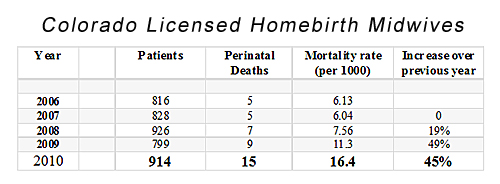
I’ve created a table of mortality rates from 2006-2010.

As you can see, the perinatal death rate for planned homebirth with a licensed Colorado midwife rose from 11.3/1000 in 2009 to an astounding 16.4/1000 in 2010! Compare that to the overall perinatal mortality rate for the entire state of Colorado (all races, all gestational ages, all pregnancy complications, all pre-existing medical conditions) of 6.3/1000.

Colorado homebirth midwives cared for fewer than 1000 patients and managed to lose 15 babies. It is difficult to convey just how appallingly large a number that is. Colorado licensed midwives have a perinatal mortality rate nearly triple that of the state as a whole. That actually dramatically understates the danger of homebirth in Colorado since the correct comparison (if it were available) would be to the mortality rate of low risk white women at term with normal sized babies.

It’s easy to understand why Colorado homebirth midwives hid their 2010 statistics; they are an appalling indictment of the midwives and irrefutable evidence that they are unfit and unsafe practitioners.

This is the same tactic being employed on the national level by the Midwives Alliance of North America (MANA). MANA collected death rates for the years 2001-2008. While they were collecting the statistics, they publicly promised they would be used to demonstrate the safety of homebirth midwives, but once they saw the results, they decided to hide them instead.

Now that Colorado homebirth midwives have been licensed for 5 years and had appalling and RISING death rates over that period, it is time to acknowledge the obvious. Licensed homebirth practitioners are grossly incompetent. They lack the education and training required of ALL other midwives in Europe, Canada and Australia and required of US nurse midwives (CNMs). It is time to end the experiment and declare it a resounding failure.

Homebirth in Colorado (and everywhere else in the US) is not about babies, and it is not about birth. It is about a bunch of high school graduates who couldn’t or wouldn’t get real midwifery training and made up a pretend credential they award to themselves to fool an unsuspecting public.

Colorado homebirth midwives are unethical in the worst possible way; they don’t care how many newborn lives are sacrificed, indeed that will go to great lengths to hide how many newborn lives are lost, in an effort to continue collecting fees for appallingly incompetent care. Of course, they are merely copying the behavior of their national leaders. The entire leadership of American homebirth, from the President of MANA on down should be ashamed of themselves.

How do American homebirth midwives handle their mistakes? They bury them — both literally and figuratively.