Category Archives: Uncategorized

You risked your baby’s brain function for this?

Are homebirth midwives morons?

I can’t think how else to explain how licensed Texas midwife Ms. Duffy handled this woman’s labor. The baby nearly died and it was only the father’s determination to transfer to the hospital that prevented the baby’s death. It’s not clear, however, how much of the baby’s brain function was sacrificed in the process.

Here is the mother’s story with the midwife stupidity helpfully highlighted. The patient was already more than 42 weeks pregnant.

Moronic homebirth practice #1: Failure to transfer the patient for postdates and pitocin induction.

[After 2 doses of castor oil] I woke up around 2am to heavy and obvious contractions…

Around 6am Matt called Ms. Duffy…

… At 10:15 am I was 5cm, 75% effaced, and the baby was at +1 station. My vitals were good…

Right after the check… my contractions began to space out … They began to give me black and blue cohosh drops to help get labor into a good pattern again. I would continue to get these drops every twenty minutes… The midwife was checking the baby’s heart rate every 30 minutes. It was great. Usually it was between 120-130…

Moronic homebirth practice #2: Inducing a postdates pregnancy with castor oil and failing to monitor the induction.

Moronic homebirth practice #3: Failing to recognize that the patient was in latent phase labor and attempting to speed up normal labor.

Moronic homebirth practice #4: Dosing a woman repeatedly with black and blue cohosh, which is toxic.

Moronic homebirth practice #5: Failing to monitor the baby’s heart rate at a minimum of 15 minute intervals as per the established protocol for intermittent ausculatation, after both inducing and augmenting the patient’s labor.

I was still continuing black and blue cohosh and nipple stimulation at 1:15 when I was checked next. At 1:15pm I was 6cm, 80% effaced. She said baby was lower, but still not quite a +2 station, so she kept it at +1…

… Ms. Duffy told us that she had only ever done this three times in twenty years, but she thought it might help speed things along if we broke my water… My water was broken just a few minutes later [at 4:45 pm]. It was clear.

Ms. Duffy checked me right after she broke my water, and I found out I had actually gone backwards. I was now 5cm dilated… I had suddenly gone from very manageable pain to pain so intense that I was screaming and crying through each contraction… I must have been pretty bad off because I remember looking over and seeing [my husband] crying many times.

… At one point I … began to feel “pushy”. Ms. Duffy told me … I could push any time I wanted if it felt good. I began to push during contractions. I noticed pretty quickly that something didn’t seem right… Ms. Duffy ended up checking me before I started pushing too hard. I was 9.5 cm and almost completely effaced. It was at this point that we learned I had a cervical lip left.

Moronic homebirth practice #6: Encouraging the patient to push without checking to see if there was a cervical lip, thereby causing swelling of the cervical lip.

Ms. Duffy … began to try to stretch and hold back the cervical lip while I pushed so that I could try and get rid of it… Ashley held back and stretched my cervical lip for about two hours… Finally Ashley [the midwife’s assistant] said that she thought the cervical lip was gone. I continued to push on my own under the assumption that the cervical lip was out of the way.

Moronic homebirth practice #7: Sticking your hand up a woman’s vagina and holding it there for TWO HOURS!! If that isn’t “birth rape,” I don’t know what is.

Around 7pm Ms. Duffy checked the baby’s heart rate… Ms. Duffy told me I needed to get out of the pool immediately and get in knee chest position. I later found out this was because the baby’s heart rate was suddenly going down into the 80s.

Moronic homebirth practice #8: Ignoring deep decelerations and pretending that they could be handled at home.

I got out of the pool and got on the floor in the knee chest position… Ms. Duffy told me I could not move from that position because it was what my baby needed. She had me on 8L of oxygen at this point…

Ashley began to continuously read out the baby’s heart beat. Ms. Duffy had her hand inside of me and was still stretching and pushing back my cervical lip while I pushed…

After being on the floor for about an hour, I begged to move to the couch. Baby’s heart rate was still having bad decels as low as the 70’s. I was still on oxygen… [M]y midwife refused to remove her hand from me. I kept begging her to get her hand out of me and let me rest, but she told me she had to do it to get the baby out…

Moronic homebirth practice #9: Ignoring deep decelerations after it is clear that delivery is not imminent.

At 10:45 … Ashley was still telling baby’s heart rate (literally non-stop as if she was reading a book. 130, 120, 80. 75, 83, 90, etc). Ms. Duffy had her hand in me stretching my cervical lip and messing with the baby’s head… My husband … looked at the midwives and told them, and told me he gave them a look that said he was done… At this point, baby’s heart rate was not coming back up above 100…

Ms. Duffy called the hospital and they asked if she wanted them to send an ambulance. She said we didn’t have time to wait on them. She told the hospital we had oxygen and would be driving ourselves. When I got to the back door, I noticed the oxygen was no longer working. Ms. Duffy looked it over and realized the tank was empty. We left the house with no oxygen. I was scared out of my mind…

Moronic homebirth practice #10: Failure to call for an ambulance when transferring for fetal distress.

Moronic homebirth practice #11: Failing to appropriately monitor resuscitation equipment and failing to notice that the oxygen tank is empty.

It was 11:15 when we got to the hospital… I heard someone say we had thick meconium… They checked me and I was basically 10 with a cervical lip. They grabbed my legs and told me to push…

The OB showed up. He told my husband they were going to do a c-section… They told me to rest and breathe between contractions… I couldn’t help but push. My midwife kept snapping at me saying “if you don’t stop pushing you’re just going to cause that cervical lip to swell and then they won’t let you try to have a natural birth. If you don’t stop pushing your baby can’t get any oxygen”…

At 12:45am … [t] wheeled me back to the operating room… At some point during the c-section I heard the doctor say “head is out. Nuchal cord x1”… Finally, someone said “you have a baby boy”. The neonatologist came over and told me that Jonah was born with a heartbeat of 60 and he was not breathing. He told us it took two minutes to get him breathing, another two minutes to get him crying, and then at six minutes old he still didn’t have any muscle tone and was very floppy. They let me kiss his cheek and then took him to the NICU…

About half an hour later my husband came back and told me that they had run a set of blood gases on his cord blood and that it was very acidic. The neonatologist informed us that meant he was deprived of oxygen … [and] he was showing signs that it may have affect his organs and his brain. So the decision was made to transfer him to the downtown Children’s hospital where they had a protocol to treat the problem. Jonah was life flighted to their hospital

Fortunately, there was no evidence of serious brain damage. No test, however, can diagnose subtle brain damage in a newborn.

We got a call later that morning that he had showed no signs of seizure activity (this is what they were watching for). They decided to hold him for observation, and ran a bunch of neurological tests, all which came back normal.

So the baby is alive and appears to be healthy but, not surprisingly:

I have severe post traumatic stress from this birth. My husband and I are already looking into counseling and some resources to help me. I never imagined I would go into labor with a healthy baby and then almost have him die on me…

Well of course she never imagined it. Her homebirth midwife never told her that childbirth is inherently dangerous or that post dates increases the danger or, especially, that Ms. Duffy had absolutely no idea what she was doing.

I’d like to think that someone is going to report the midwife for gross malpractice and violation of just about every standard of regulation of homebirth midwives. Even if no one reports her, I hope she reads this because she needs to know that she is a danger to mothers and babies. Her stupidity exceeds even that typically found among homebirth midwives and probably extends to the fact that she has no clue that she nearly killed this baby and may have left him with permanent brain damage.
Trust umbilical cords?

Natural childbirth and homebirth advocates get very excited about umbilical cords, specifically nuchal (neck) cords, the medical term for an umbilical cord that gets wrapped around the baby’s neck. They get excited because they believe that obstetricians dramatize the risk of nuchal cords (“the baby could die”) when they aren’t dangerous at all. As usual, natural childbirth and homebirth advocates are wrong on this point and the reason is that they fundamentally misunderstand when and why a nuchal cord dangerous.

How does an umbilical cord get wrapped around the baby’s neck in the first place. The reason is that for most of pregnancy, the baby has a lot of room to move and the cord is relatively long. Moving around, up and down, and somersaulting, the baby can easily get the cord wrapped around itself. Most of these loops will slip off at some point, generally without causing a problem. There is the possibility, however, that even if the loops eventually slip off the baby, a true knot will have been formed but many true knots never cause a problem.

Even more likely, a loop may get stuck around the neck because it is more slender than the shoulders below it and the head above it. Contrary to popular belief, the danger of a nuchal cord has nothing to do with the fact that it is wrapped around the baby’s neck. Since the fetus does not breathe, compressing its neck has no impact on whether there is adequate oxygen in the blood. In other words, the effect of neck compression is fundamentally different than if the neck of a child or adult is compressed.

In order to understand the danger of a true knot in the cord or a nuchal cord it helps to think of the cord as similar to the air line of a deep sea diver. It’s easy to understand that if a diver moved around such that he created a true knot in an air line, it could pose a serious problem. If the knot isn’t pulled tight, there is no problem. The oxygen can pass easily through the loop. However if the knot gets pulled tight because the diver pulls on the air line by diving down deep or it gets pulled tight by being snagged on something else, the supply of oxygen can get cut off and the diver could die.

Similarly, a loose true knot in the umbilical cord is not a problem for the fetus because the oxygen continues flowing through the loop. However, if the knot gets pulled tight, either by the cord being pulled as the baby descends into the pelvis or the cord getting pulled by being snagged on an arm or leg, the baby will be deprived of oxygen and die

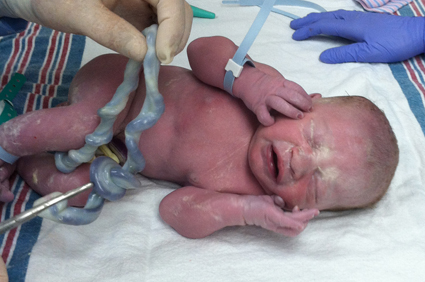
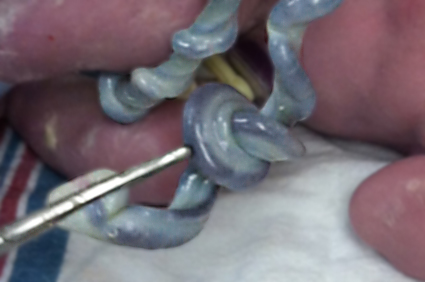
This picture of a true knot (a close up of the picture at the top) was sent to me by a reader. It was noted at her 3rd C-section. It is easy to understand that had the knot been pulled tighter, the baby might have died..

If an air line got wrapped loosely around a diver’s neck, the oxygen would keep flowing through it. However if the loop or loops were so tight as to cut off flow within the line, the diver will die. Of course a diver could actually be strangled by a loop or loops of cord, but a baby cannot. Therefore, the issue with a nuchal cord is NOT the fact that it is wrapped around the neck. The issue is whether the loop is pulled tight enough to cut off the flow of blood and therefore of oxygen.

The bottom line is that true knots of cord are not necessarily dangerous, but there is no way to no beforehand whether the knot will tighten during the course of labor and cut off oxygen to the bay. Similarly, a nuchal cord is not necessarily dangerous; in fact most nuchal cords are loose and therefore do not threaten the baby. Once again, though, there is no way to know beforehand how the loop or loops around the neck will be affected during labor. The higher the number of loops, the shorter the remaining cord, and the more likely that the cord will be fatally compressed during labor. However, even a single loop can be pulled tight during the descent of the baby and the baby will die for lack of oxygen.

Ultimately, when NCB and homebirth advocates “trust birth,” they are trusting that there are either no knots or loops in the cord, or that if they exist, they will not be pulled tight. But that makes no more sense than a deep sea diver trusting that he can assume that there are no knots in his air line and not worry if the air line gets wrapped around his neck. Obviously, in the case of the air line, trust has nothing to do with it, and, in direct contrast to what NCB and homebirth advocates proclaim, in the case of the umbilical cord, trust has nothing to do with the presence or absence of knots and loops.

The only way to know if a knot or nuchal cord is hindering the flow of the blood to the baby is to monitor the baby’s heart rate. Without monitoring, the supply of oxygen to the baby could completely stop during labor and no one would know until the baby was born dead.

The death toll of California homebirth

The state of California has released a comprehensive summary of outcomes of California licensed homebirth midwives of the year 2010. The reports makes for disturbing reading. Homebirths exceed low risk (and sometimes high risk) hospital birth on almost every negative outcome including deaths.

Before we look at the outcomes, let’s look at whether California licensed homebirth midwives comply with their own rules.

The first thing to note is that although all midwives are required to report outcome statistics, 16% never bothered to report their outcomes.

The second is that midwives are required to consult with and generally transfer care to obstetricians if a baby is known to be breech or in the case of twins. Nonetheless, California midwives delivered 13 breech babies and 5 sets of twins at home.

Let’s look at the basic statistics.

There were 2245 who planned homebirths at the onset of labor. 1840 delivered at home, for a transfer rate of 18%. There were 205 C-sections for a C-section rate of 9.1%.

How about outcomes? Simply put, the outcomes are dreadful as the chart below demonstrates.

The fetal mortality rate was 11/1000 compared to the California rate for white women (all gestational ages, all pre-existing medical conditions, all pregnancy complications) of 4.9/1000 for a rate more than double that expected.

The intrapartum mortality rate was 2.6/1000 compared to the expected rate of 0.3/1000, for a rate more than 8 times higher than expected.

The neonatal mortality rate was 0.9/1000 compared to the national rate for low risk white women of 0.4/1000, for a neonatal mortality rate more than double that expected.

A perinatal mortality rate of 12/1000 compared to the California rate for white women (all gestational ages, all pre-existing medical conditions, all pregnancy complications) of 5/1000 for a rate more than double that expected.

These numbers potentially under-count the real death rates for 2 reasons. First, among reported perinatal outcomes after transfer 11 were classified as unknown. Second, fully 16% of California homebirth midwives failed to report their outcomes.

How about birth complications? There were quite a few considering that the mothers were extremely low risk.

maternal

4 cases of massive PPH
1 case of seizure/shock
10 cases of retained placenta

neonatal

1 case of birth injury
2 cases of abnormal cry/seizures/loss of consciousness
6 cases of clinically apparent infection
9 cases of significant cardiac of respiratory issues
3 cases of 5 minute Apgar less than 6

Untimately, 14 mothers suffered serious complications resolved by 6 weeks and 1 mother suffered serious complications that persisted beyond 6 weeks. 21 infants suffered serious complications resolved by 6 weeks and 4 suffered serious complications that persisted beyond 6 weeks.

What conclusions can we draw from this data?

First and most important, despite the fact that the homebirth population presumably represents the lowest of low risk patients, the neonatal death rate is double that expected for low risk white women. The overall perinatal mortality rate is double that for all white women in California (including premature births, all pre-existing medical conditions, and all complications of pregnancy).

Second, homebirth in California has an extraordinarily high rate of intrapartum death, more than 8 times higher than the intrapartum death rate for women of all races, all gestational ages, all pre-existing medical conditions and all complications of pregnancy. While rigorous intermittent auscultation might be equivalent to electronic fetal monitoring under experimental conditions, that is clearly not true of intermittent auscultation as practiced by California homebirth midwives. In a population this size, we would expect that every woman who enters labor with a live baby will deliver a live baby. Instead, 6 babies died in the course of labor, because midwives didn’t recognize fetal distress and/or didn’t transfer in a timely fashion if they did recognize it.

Third, these results probably underestimate the dangers of homebirth in California because a substantial proportion of information is missing.

The bottom line is that homebirth in California increases the risk of perinatal and neonatal death by 100% or more. California homebirth midwives, like all homebirth midwives, “trust birth” and birth, far from being trustworthy, is inherently dangerous.

California birth outcomes can be found here.
For more information on the source of the homebirth statistics: Licensed Midwife Annual Report user guide.

addendum: Ideally, the California homebirth statistics should be compared to the mortality rates for California women in 2010 without any of the following risk factors (in order of importance): African descent, prematurity, pre-existing medical conditions and pregnancy complications that occur before onset of labor. Unfortunately, the mortality rate of that group is unavailable, so each comparison is made with the available group having the least number of risk factors.

In the case of neonatal mortality, the comparison group is hospital birth for low risk white women at term for 2007; for intrapartum mortality the only available group is all women; for fetal mortality the best available group is California white women of 2009; similarly for perinatal mortality the best available group is California white women of 2009.

Practically speaking, the substitution of these groups means that in all cases besides neonatal mortality, the correct comparison group would have much smaller mortality rates and that, therefore, the real increased risk of homebirth is much higher than that depicted here.

It is also important to note that homebirth appears to be associated with dramatically higher rates of intrapartum mortality, a vanishingly rare event among low risk women at term. Therefore, the figures that I routinely quote demonstrating that homebirth has a neonatal mortality rate at least 3 times higher than comparable risk hospital birth, dramatically underestimate the true risk.

The white homebirther’s burden

The white woman’s burden is never ending. Now, apparently, it is the white woman’s task to teach her unfortunate sisters of color how they ought to give birth.

Let’s presume for a moment that the self-proclaimed “midwives” (CPMs) of the Big Push for Midwives aren’t simply interested in cynically plundering the Medicaid coffers and take them at their word:

A report released by the CDC today found a 29 percent increase in home births from 2004 to 2009. The rate of home births among non-Hispanic white women underwent a dramatic increase, while the rate for women of color decreased or remained stagnant, a trend that reflects racial and ethnic disparities in other areas of maternity care throughout the U.S…

Barriers to out-of-hospital maternity care include … laws or policies in all but 11 … states that deny Medicaid coverage for home births managed by Certified Professional Midwives.

The fact that women of color don’t choose homebirth is portrayed as an “ethnic disparity” in need of remedy. Never mind that women of color might actually be pleased with their own choices for childbirth. Or perhaps — here’s a mind-blowingly outrageous idea — women of color ought to be the ones whose views are respected and emulated. No, it’s far more satisfying to pretend that women of color don’t know what they really want until they are “educated” by their white sisters.

The blogger at Balancing Jane is typical:

… [T]he women who are likely to choose home birth are more likely to be highly educated, married, and white. In other words, the women who choose home birth are the ones who benefit the most from privilege in our society. To me, this means that these are the women who have the greatest access to information and the greatest ability to go against societal standards for birth through informed self-advocacy. …

Of course, that presumes that the women who choose homebirth are actually educated and they’re not. They are distinguished primarily by their gullibility. Most of what they think they “know” is factually false and their personal experience is so limited that they have no idea what childbirth is like when you don’t have immediate access to high quality medical care.

Therefore, Jane fails to consider an equally plausible alternative explanation:

Women of color might have no interest in the fads that preoccupy privileged white women. Possibly they have more important things to worry about. For example, they may have medical problems and risk factors that privileged white women do not have to contend with.

As Janelle Harris writes on The Stir:

… I can’t hop on this bandwagon that homebirth brings black women closer to our African heritage. I’ll immerse myself in a native language, I’ll shell out a few grand to fly to the mother continent and trace my Guinean roots. Heck, I’ve already dedicated thousands of dollars and thousands more hours studying our history for a master’s degree in African-American studies.

But if and when I ever find myself pregnant again, I’ll have my baby in a hospital, thank you very much. If something goes haywire — Lord forbid — I want all the bells and whistles of modern science by my side to save me or my child.

Harris points out:

I agree that we come from a society that likes to overtreat and overmedicate us for every bitty thing. But most of Black women’s issues lie not in the hospitalization during labor, but the health risks we suffer leading up to childbirth…

The Amnesty International report on maternal mortality emphasizes this point:

The US government’s failure to ensure that women have guaranteed lifelong access to quality health care, including reproductive health services, has a significant impact on the likelihood of having a healthy pregnancy and delivery…

Insufficient access to quality health care services over a woman’s lifetime means that women are entering into pregnancy with health conditions that are untreated or unmanaged. This poses added risks for both the woman and her child. For example, women who become pregnant with uncontrolled diabetes are more likely to have a miscarriage or develop pre-eclampsia.

But it is not simply that women of color suffer from lack of access to the technology employed to treat women with pre-existing medical problems and complications of pregnancy, the factors most associated with high rates of maternal death. Many women of color don’t have the same interests or priorities of white women who choose homebirth. Indeed, lower income women of all ethnicity don’t have the same interests and priorities of the relatively well-off women who choose homebirth.

That’s not surprising. Homebirth is like following Martha Stewart. It’s delightful to bake your own bread when you know that you don’t HAVE to bake your own bread if you don’t feel like it. Similarly, it seems delightful to privileged white women to avoid the hospital when they know that they don’t HAVE to avoid the hospital if they change their mind. For other women, who don’t have routine access to high quality medical care, who have medical risk factors, whose home is not a domestic paradise, who have enough unmedicated pain in their own lives that setting themselves the “goal” of enduring more pain without medication is unfathomable, homebirth is an affectation they have no interest in emulating.

I don’t presume to speak for women of color. They can speak for themselves without my help. And frankly, I don’t think the white women of The Big Push for Midwives actually care about women of color beyond seeing them as the way to secure access to Medicaid reimbursements. Nonetheless, I think the assumptions behind their publicity campaign are demeaning and wrong. It seems impossible for them to imagine that women of color are the ones who are truly “educated” about the reality of childbirth, and that privileged white women ought to be emulating them.

A basic arithmetic lesson for homebirth advocates

In the wake of the tragic death of homebirth advocate Caroline Lovell, there have been several nonsensical claims put forth by homebirth advocates battling to avoid cognitive dissonance. Analysis of these nonsensical claims reveals the same error at the heart of each: an inability to do 4th grade math.

Here’s Illithyia Inspired Birth Servant (don’t miss the picture of mom holding her blue, limp baby in water in the wake of her own homebirth):

I hold a sliver of hope that perhaps people might take from this weeks media that twenty mothers died after birthing in hospital last year and that something might be done about this. Wouldn’t it be wonderful if some attention were given to this pressing matter, hospitals forced to practice evidence based midwifery and medicine in every maternity ward so that hospital birth might one day be as safe as homebirth.

In her defense, she copied this inane “argument” direct from Homebirth Australia:

… Sadly many women died in Australian hospitals in childbirth last year – should we ban hospital births, too?” Michelle Meares, Homebirth Australia spokesperson said.

So let’s see if I get this straight: 20 is a bigger number than one so hospital birth leads to more deaths than homebirth? Do these women have any idea how foolish they look? Apparently not.

Therefore, in the interests of basic numeracy, I offer the following simple arithmetic lesson.

Let’s start with an example.

Approximately 12 people die from poisonous snake bite in the US each year. Approximately 520 women die from pregnancy and childbirth related causes each year. By the “reasoning” of homebirth advocates, pregnancy is more than 40 TIMES more dangerous than poisonous snake bites. Wow, who knew that pregnancy was so dangerous?

What’s wrong with this “reasoning”?

Comparing absolute numbers is inappropriate. The only valid comparison is that of rates. Rate, in this case, is the absolute number of people who died from the cause divided by the number of people who could have been exposed to the cause. Approximately 8,000 people are bitten by venomous snakes each year for a death rate of 1.5/1000. Approximately 4 million women are pregnant each year, for a death rate of 0.13/1000 (equivalent to 13/100,000). In other words, snake bite is 12 times more dangerous than pregnancy.

So let’s get back to maternal death rates in Australia. Yes, there were 20 maternal deaths in the hospital last year. Since nearly 300,000 women gave birth in the hospital, that’s a death rate of 6.6/100,000. There was only 1 maternal death at homebirth, but there were only 750 homebirths. That’s a death rate of 133.3/100,000. That’s a maternal death rate at home birth more than 20 TIMES HIGHER than the maternal death rate in the hospital.

We can refine our calculations further. Most maternal deaths in the hospital are due to pre-existing medical conditions or serious complications of pregnancy. The maternal death rate for low risk women is probably in the range of 1/100,000 or lower. According to homebirth midwives, this is the first maternal death in 15 years for a homebirth death rate of 9/100,000. Obviously, that is 9 times higher than the hospital death rate for low risk women. Any way you look at it, homebirth is more dangerous for mothers than hospital birth.

The “argument” advanced by Homebirth Australia doesn’t show that hospital birth is more dangerous than homebirth, but it does make the case that people who can’t even do grade school arithmetic should not be entrusted with the lives of pregnant women and their babies.

The stunning mixture of ignorance and illogic that fuels homebirth midwifery

I’ve written extensively about the ignorance of American homebirth midwives (certified professional midwives or CPMs). It’s not surprising when you consider the pathetic nature of CPM training. Most CPMs have NO midwifery education of any kind. You can receive a “certification” after a program of unmonitored self-study.

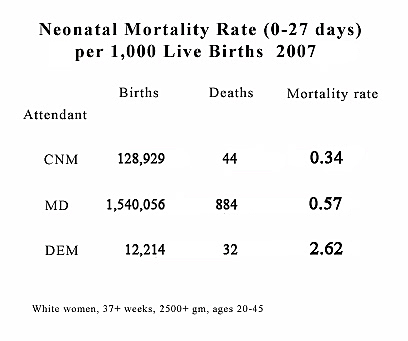
It’s hardly surprising therefore that death rates at the hands of homebirth midwives are appalling. The latest data from the CDC (available on the CDC) Wonder website shows that homebirth with a non-nurse midwife has a neonatal mortality rate more than 7 times HIGHER than low risk hospital birth.

Licensed homebirth midwives in Colorado have a perinatal mortality rate that is appallingly high and has risen in every year since 2006 when licensing was enacted. The midwives have actually refused to release their death rate for 2010.

In Oregon, there have been at least 19 newborn deaths reported to the state over the past decade for a death rate more than 4 times higher than low risk hospital birth.

The Midwives Alliance of North America (MANA), the organization that represents homebirth midwives, has a database of 24,000 planned homebirths. They refuse to release the death rate. Even MANA knows that homebirth kills babies. They just don’t want American women to find out.

But evidently that’s not enough. In addition to presiding over the preventable deaths of low risk mothers, they’d like to try their hands at increasing the rate of preventable deaths of high risk mothers.

Consider this idiotic press release published by the Big Push for Midwives, the professional lobbying group trying to obtain state recognition (and therefore insurance reimbursement) for CPMs:

A report released by the CDC today found a 29 percent increase in home births from 2004 to 2009. The rate of home births among non-Hispanic white women underwent a dramatic increase, while the rate for women of color decreased or remained stagnant, a trend that reflects racial and ethnic disparities in other areas of maternity care throughout the U.S.

“Unfortunately, the women who could most benefit from out-of-hospital midwifery care are those who are least likely to have access to Certified Professional Midwives with the specialized training needed to provide it,” said Susan Jenkins, Legal Counsel for The Big Push for Midwives Campaign. “The CDC report and other research shows that babies born to women cared for by Certified Professional Midwives are far less likely to be preterm or low birth weight, two of the primary contributing factors not only to infant mortality, but to racial and ethnic disparities in birth outcomes.”

Just two short paragraphs, but a mountain of ignorance and illogic.

Jenkins boasts that babies born to women cared for by CPMs “are far less likely” to be premature or growth retarded. As my children would say: “Duh!”

CPMs, the so called “experts in normal birth” don’t take care of high risk women and both prematurity and growth retardation are high risk. No doubt the women cared for by CPMs are “far less likely” to have congenital heart disease, kidney failure or cancer, so perhaps CPMs would like to take credit for preventing those conditions, too. After all, if you are not constrained by logic or common sense, the sky’s the limit.

The concept that high risk women are “most likely to benefit” from CPM care is really breathtaking in its stupidity. Even the most cursory examination of neonatal and maternal death rates shows that these deaths are due to a LACK of technological interventions, nor a surfeit.

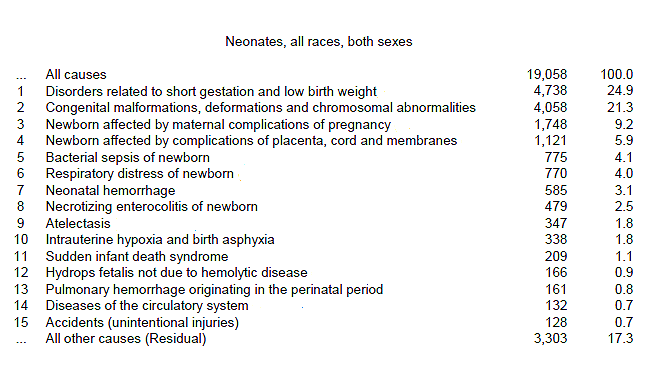
Let’s take a look at the leading causes of neonatal death. The following chart is adapted from Infant, neonatal, and postneonatal deaths, percent of total deaths, and mortality rates for the 15 leading causes of infant death by race and sex: United States, 2007:

Do CPMs know how to lower the incidence of congenital anomalies? No. Perhaps they know how to prevent pre-eclampsia, gestational diabetes or HELLP syndrome. No, they have no specialized knowledge in that area. Can they prevent abruption, vasa previa, or true knots in the umbilical cord? No, no and no. How about bacterial sepsis of the newborn? Hardly. The leading cause of infectious neonatal death is group B strep and many CPMs don’t treat it or employ bizarre “remedies” like garlic cloves in the vagina.

I can’t find a single thing on this list that CPMs, those self-proclaimed “experts in normal birth,” are educated or trained to prevent, manage or cure.

What about maternal mortality? Last week we looked at the leading causes of maternal ICU admissions.:

… The leading admission diagnosis for pregnant and postpartum women was maternal cardiac disease (36%). Maternal hemorrhage (both obstetric and nonobstetric) was the second leading reason for admission (29%). Hypertensive disease accounted for 9% of ICU admissions…

The majority of cardiac conditions prompting ICU admission resulted from cardiomyopathy. Acute complications associated with peripartum cardiomyopathy
comprised the majority of this group. Congenital heart disease is the underlying etiology for many of these valvular lesions and cardiomyopathies. Congenitally
acquired conditions were the second leading cause of maternal cardiac ICU admissions…

CPMs can’t prevent or treat peripartum cardiomyopathy, massive maternal hemorrhage or hypertensive disease. In fact, care by a CPM at home is more likely to increase death from these causes, not decrease it.

I can’t decide whether Jenkin’s inane boast is the result of ignorance or mendacity. Can she and the homebirth advocates of the Big Push for Midwives truly be so ignorant as to think they can take credit for preventing complications simply by caring for only uncomplicated patients? Or is this yet another bold faced lie told in attempt to increase CPM reimbursement, neonatal and maternal well-being be damned?

I guess the real reason doesn’t matter. In either case, CPMs have demonstrated once again that they lack the basic education (and reasoning ability) to be entrusted with the lives of pregnant women and their babies.

Birth and the survival of the fittest

Everyone knows that evolution is based on the principle of “survival of the fittest.” What does that mean for childbirth?

It means that by definition not everyone survives. Lots of people die. In the case of childbirth it means high levels of neonatal and maternal mortality.

So contrary to the inane babbling of NCB and homebirth advocates that women’s bodies are perfectly designed to give birth, no one’s body is perfectly designed for anything. There is a tremendous amount of genetic variation, there are many competing environmental pressures and the environment can change over time. Simply put, human existence is a competition and many drop out and die along the way. That applies to childbirth just as to any other aspect of human existence.

For example, there is tremendous genetic variation to the onset of labor and there are risks and benefits to each variation. Consider the onset of labor. The range of normal is extremely wide. In human pregnancy (average length 40 weeks) labor can start normally anywhere from 38-42 weeks, and onset is not restricted to the normal range. Premature birth is quite common and post mature birth is hardly rare.

Contrary to the nonsense spouted by NCB and homebirth advocates that babies “know” when to be born, there are advantages and disadvantages to birth at any possible gestational age. Babies born at earlier gestational ages are smaller and therefore more likely to fit through the mother’s pelvis. Yet babies born at earlier gestational ages will be less likely to have mature organ systems, and therefore more vulnerable to illness and death. On the other hand, babies born at later gestational ages are more robust, but they are also larger and might not fit through the mother’s pelvis or might outgrow the ability of the placenta to supply them with oxygen, and die before labor even begins.

And birth doesn’t depend only on the baby. It also depends on the mother. The maternal pelvic dimensions are determine by a wide array of genetic factors, each independent of the others. Moreover, a pelvic structure that is beneficial for birth may be suboptimal for maternal survival in the non-pregnant state. A wide maternal pelvis is ideal for childbirth, but limits maternal mobility and therefore the ability of the mother to outrun predators and to keep up with her tribe.

It isn’t simply the expulsion of the baby at birth that is affected by maternal genetic variation. If the mother’s blood type and the babies blood type differ (and both are determined independently), the mother’s immune system can attack the baby’s blood cells and kill the baby.

Pregnancy produces a variety of metabolic changes in the mother, some of which may be deleterious to the baby, the mother, or both. Gestational diabetes increases the risk of neonatal complications and the risk that the baby will be too big to fit through the maternal pelvis. Pre-eclampsia and eclampsia can kill the baby, the mother or both through a series of complex metabolic changes that affect everything from blood pressure, to blood clotting, to maternal seizure threshold. Just as subclinical sickle cell trait confers an evolutionary advantage in surviving malaria, but clinical sickle cell disease is a killer, subclinical variations of pregnancy complications probably also confer an evolutionary advantage, but clinical manifestations can and do kill.

Consider something as common as postpartum hemorrhage. The most common cause of postpartum hemorrhage is uterine atony, failure of the uterus to contract strongly after the placenta has been expelled. Prolonged labor is a risk factor atony, and the length of labor is determined not merely by maternal factors like the strength of contractions and the size of the maternal pelvis, but by fetal factors like the size of the baby and its position as it enters the pelvis. It is the interplay between these maternal and fetal factors that determine whether a fatal hemorrhage will occur after birth, not some mystical “perfection” of the process that can be relied upon to provide the desired outcome.

Survival of the fittest means exactly what it sounds like: only the fittest will survive and the rest will die. Being the “fittest” in a given environment depends on a complex interplay of multiple genetic factors, each of which is independent of the others. Just like a human being isn’t “perfectly designed” to outrun every predator, every human being (mother or baby) is not perfectly designed to survive pregnancy and childbirth.

Human beings have survived and thrived thus far because of technological interventions. We can’t outrun every predator, but we can create spears to kills predators from a distance and we can make fire to ward off predators that we cannot see in the dark. I haven’t noticed anyone claiming that authentic human existence requires returning to the savannah, giving up fire, and putting aside our spears.

We cannot control climate, or our vulnerability to severe climatic conditions, but we can create clothes to hold body heat, houses to shelter us, and central heating to warm us. I haven’t noticed anyone claiming that authentic human existence requires shedding our clothes, leaving our houses and huddling in caves.

We cannot depend on every baby to fit through a maternal pelvis, every pregnancy to last for the optimal length of time, and every mother to withstand the metabolic extremes that may be caused by pregnancy. Yet I have heard NCB and homebirth advocates prate that authentic childbirth requires vaginal delivery, “unhindered” labor regardless of timing, and an acceptance of every maternal metabolic change no matter how deranged.

The hallmark of human evolutionary success is the development and deployment of technology. In this environment, that’s what makes people fit. Rejecting that technology, and demonizing it as unnecessary and inauthentic is the ultimate in foolishness.

The fittest mother is not the one who rejects technological interventions; the fittest mother is the one who employs any and every technological intervention that can potentially enhance her child’s survival. Anything less is the intellectual equivalent of prancing around naked in a snowstorm while rejecting houses, central heating and even fire as unnecessary technological “interventions.” It’s extremely painful and a quick way to an unnecessary death.

No choice?

Re: Inquiry into Health Legislation Amendment (Midwives and Nurse Practitioners) Bill 2009 and two related Bills

I write to express my concern about the above bills. I understand that these bills will enable Medicare funding, access to the Pharmaceutical Benefits Scheme and professional indemnity premium support for midwives providing care for women to give birth in hospital. Medicare funding for midwifery care is long overdue. It is not acceptable however to exclude homebirth from this funding and indemnity arrangement…

On a personal note, I am quite shocked and ashamed that homebirth will no longer be a woman’s free choice in low-risk pregnancies… I feel the decision to outlaw homebirth’s is contrary to women’s rights … Please find a solution for women and babies who homebirth after this date as their lives will be in threat without proper midwifery assisstance. And as a homebirthing mother I will have no choice but to have an unassisted birth at home as this is the place I want to birth my children.

Yours sincerely,
Caroline Flammea, Nick Lovell and daughter Lulu Lovell.

*****
Caroline Emily (Flammea) Lovell

LOVELL (nee Flammea). – Caroline Emily 15.07.1975 – 24.01.2012 Passed away suddenly after giving birth to a beautiful baby girl. Beloved daughter of Jadzia (Jade), loving wife of Nick and exceptional mother of Lulu and Zahra. You taught us how to love Always in our hearts

*****

Does anyone know any new Mums in the Melbourne area?? Please share this post:

“Are there any mothers in the Melbourne area, who could be part of a milk tree? A woman named Caroline died this week while giving birth to her second daughter, Zahra, at home. And the family is seeking donated milk to help bubba along.

If you can help or know someone who can, please contact Eve …
.
And please send your love & thoughts to Carolines family 3yr old Lulu, 5day old Zahra & husband Nick.”

The curious silence on the rising rate of homebirth death

The CDC published an update on homebirth today. Entitled Home Births in the United States, 1990–2009 and written by MacDorman, Mathews, and Declercq, the data brief noted:

• After a decline from 1990 to 2004, the percentage of U.S. births that occurred at home increased by 29%, from 0.56% of births in 2004 to 0.72% in 2009.

• For non-Hispanic white women, home births increased by 36%, from 0.80% in 2004
to 1.09% in 2009. About 1 in every 90 births for non- Hispanic white women is now a home birth. Home births are less common among women of other racial or ethnic groups.

• Home births are more common among women aged 35 and over, and among women
with several previous children.

• Home births have a lower risk profile than hospital births, with fewer births to teenagers or unmarried women, and with fewer preterm, low birthweight, and multiple births.

• The percentage of home births in 2009 varied from a low of 0.2% of births in
Louisiana and the District of Columbia, to a high of 2.0% in Oregon and 2.6% in Montana.

But there’s one thing that the data brief didn’t mention at all: exactly how many of those babies died?

The authors managed to analyze homebirths by race. They managed to analyze homebirth in each and every state. They managed to analyzed the risk profile of homebirths. But somehow they couldn’t manage to check the neonatal death rate for homebirth located on one of the CDC’s own websites. They are curiously silent on the most important thing we need to know about homebirth: is it safe?

Had MacDorman et al. bothered to look, they would have seen that the most recent CDC data shows that homebirth with a non-nurse midwife has a neonatal mortality rate 7.7 times higher than comparable risk hospital birth!

This extraordinarily high death rate is all the more remarkable because it actually under-counts the homebirth death rate. That’s because homebirth transfers ended up in the hospital MD group and were not counted in the homebirth group. The real number of homebirth deaths is almost certainly significantly higher.

While MacDorman et al. were busily analyzing the state level data, they could have learned that in the state of Colorado, which has licensed homebirth midwives since 2006, the homebirth death rate has exceeded the death rate for the state as a whole (including premature babies and pregnancy complicati­ons) in every single year since and has risen in every single year since 2006, The death rates are so appalling that the homebirth midwives of Colorado refused to release the death rates for 2010. Or they could have learned that the state of Oregon has had at least 19 reported neonatal deaths in the past 10 years for a rate that is more than 4 times higher than the death rate for comparable risk hospital birth.

Every major news outlet has reported on this CDC data brief, and curiously, not one bothered to ask how many of the homebirth babies died. A few news outlets made vague pronouncements that homebirth might double or triple the neonatal death rate, but not a single one bothered to find out what actually happened in the group that MacDorman and colleagues studied.

I’ll admit that I’m pretty frustrated by the fact that MacDorman et al never bothered to look at the neonatal death rate, or looked at it and didn’t bother to report it. Who really cares that the homebirth rate rose an additional 9% since 2008? Yet somehow MacDorman thought it was critical to report on that. Everyone needs to know how many of those babies died, yet MacDorman couldn’t be bothered to report on that.

And I’m also pretty frustrated by the mainstream media. There are no questions, no probing, and no investigation into the number of babies who died. It’s as if they don’t exist. Journalists just collected opposing viewpoints and wrote “balanced” articles that inexplicably left out the most important issue. And while journalists interviewed midwives and obstetricians, not a single one thought to interview a pediatrician or a neonatologist to determine whether the people who actually care for babies think about the dangers of homebirth to babies.

I’m afraid that the only thing that will shake journalists out of their complacency is the death of a celebrity’s baby at homebirth. Sooner or later that is going to happen, and journalists will “discover” that babies have been dying preventable deaths at homebirth all along. Until then, they won’t ask the difficult questions; they’ll simply accept what they read in press releases and reprint them wholesale.