Category Archives: Uncategorized

The chaos of anti-vax is a ladder

8F371441-0C7D-4A7B-AAE7-7672941BBCF2

It could be the motto of Andrew Wakefield and other anti-vax medical professionals:

Chaos is a ladder.

It’s one of the most memorable of the many memorable Game of Thrones quotes, first uttered by Littlefinger, Lord Petyr Baelish, in a conversation with Varys (season 3, episode 6).

[pullquote align=”right” cite=”” link=”” color=”” class=”” size=””]Anti-vaxxers continue to be unwitting dupes, while anti-vax professionals climb ever higher on the ladder of deliberately created chaos.[/pullquote]

While Varys bemoans chaos as disrupting his plans (“a gaping pit, waiting to swallow us all”), Littlefinger reveals that chaos is essential to his plans.

Chaos isn’t a pit. Chaos is a ladder. Many who try to climb it fail and never get to try it again. The fall breaks them. And some are given a chance to climb. They refuse. They cling to the realm or the gods or love. Illusions. Only the ladder is real. The climb is all there is.

What does he mean?

For Littlefinger, creating chaos is a way to achieve his own goals. He uses chaos as an instrument for his own gain… Chaos can be used as an opportunity with anyone who: either creates chaos or uses it for their own gain, or, once in the chaos, can keep their cool and make something of it.

Anti-vax medical professionals and former professionals have created chaos among parents of young children in order to use it for their own ends:

  • They have incited a completely groundless fear of vaccines that has led to a dramatic decrease in vaccination rates and an equally dramatic rise in illness and death from vaccine preventable diseases.
  • They have single handedly brought back scourges that had not been seen for many decades.
  • They promote and monetize a variety of useless supplements and “immune boosters,” as well as books that promulgate their nonsense.
  • They have recently begun to specialize in victimizing isolated communities like Somali refugees in Minnesota and certain sects of ultra-Orthodox Jews in New York, playing on their fears of government.

They know vaccines work. As Dr. Bob Sears famously wrote in The Vaccine Book: Making the Right Decision for Your Child:

I also warn [parents] not to share their fears with their neighbors because if too many people avoid the MMR, we’ll likely see the diseases increase significantly.

In other words, Sears implicitly acknowledges that vaccines are highly effective and that their effectiveness is dependent on herd immunity.

But Andrew Wakefield is the true Littlefinger of the anti-vax movement.

Although it takes multiple seasons for it to be revealed, Littlefinger directly instigated the events that led to nearly everything that has happened on the series. GOT fans may remember that it is the death of Jon Arryn, purportedly at the behest of the Lannisters, that leads Robert Baratheon to appoint Ned Stark as his Hand. That very quickly results in the judicial murder of Ned Stark by Cersei Lannister convulsing the entire kingdom in war. We have been watching the horrors of that war ever since.

But the Lannisters, evil as they are, did not kill Jon Arryn. Littlefinger arranged for him to be poisoned, made sure he died, and sent a letter claiming that the Lannisters were responsible. Why did he do it? Because he was denied the opportunity to rise to power in the existing structure of the kingdom and saw his chance to rise by climbing the bodies of those killed in the chaos he unleashed. Things did not play out quite as he expected, but by keeping a cool head he managed to exploit every development. He almost got away with it.

Andrew Wakefield nearly single handedly unleashed the anti-vax movement by fabricating “research” that purportedly showed that the MMR (measles, mumps, rubella) vaccine caused autism. At no point did Wakefield believe that vaccines causes autism. If he had, he would not have needed to deliberately fake his research.

His motive was banal; he wanted to get rich. He was developing a vaccine to replace the MMR and sought to increase demand and market share for his new vaccine by discrediting the old one. He ended up creating chaos and then exploiting that chaos to enrich himself.

The similarity with Littlefinger doesn’t end there. Littlefinger was able to convince everyone that the Lannisters had murdered Jon Arryn because many people (correctly) distrusted the Lannisters. It had always been clear that they were out to improve their own fortunes so it was not a stretch to imagine that they had murdered a political rival. But those who believed were not sophisticated analysts of the Westerosi political scene; they were unsuspecting dupes of Littlefinger.

Wakefield was able to convince parents that vaccines cause autism because many people (correctly) distrust large industries like Big Pharma. There have been so many examples of deadly corporate malfeasance by Big Pharma that it was not a stretch to imagine that they were marketing a harmful vaccine. But those who believe vaccines are harmful are not sophisticated analysts of corporate misconduct; they are unsuspecting dupes of Andrew Wakefield and his ilk.

Littlefinger created chaos because he calculated that he could exploit to ensure his rise. He would have gotten away with it, too, if it weren’t for the fact that the all-knowing Three Eyed Raven Bran, has seen the past and exposed him.

Wakefield and other medical professionals like Bob Sears create chaos and bring back deadly diseases, because they calculate that they can profit from it. Sadly, we don’t have an all-knowing Three Eyed Raven whom anti-vaxxers will believe. So they continue to be unwitting dupes while anti-vax professionals climb ever higher on the ladder of deliberately created chaos.

Head of the UK National Childbirth Trust resigns, allegedly over being forced to stop bullying

The text Everyone Matters appearing on red cardboard

As anyone who has been a victim or bystander to bullying can attest, bullies enjoy bullying as a solitary pursuit, but absolutely adore bullying as a group activity. Having an audience apparently makes bullying more enjoyable, having minions makes it easier, and having those who admire you more because you are a bully makes it positively addictive.

Group bullying has sadly become one of the defining features of contemporary natural childbirth advocacy and lactivism. Both started to offer women choices but eventually hardened into groups that offer one choice each and bully those who make different choices.

[pullquote align=”right” cite=”” link=”” color=”” class=”” size=””]Having an audience apparently makes bullying more enjoyable, having minions makes it easier, and having those who admire you more because you are a bully makes it positively addictive. [/pullquote]

Now Seána Talbot, head of the UK Natural Childbirth Trust (NCT), has resigned over being forced to stop group bullying. Apparently, if the NCT can’t bully women who don’t mirror her own choices back to her, the job has lost its appeal.

In her resignation letter, Talbot wrote:

In the face of overwhelming opposition from most fellow trustees and NCT’s executive, I have tried my best to steer the charity back towards its core mission, and its longstanding values…

…[T]he executive team, with the support of most of the board, have already taken the charity away from our core mission of birth and breastfeeding, and towards more generic ‘parent support’ with an emphasis on postnatal mental health.

It’s almost as if Talbot thinks supporting all parents, regardless of their choices, is a bad thing.

How dare anyone consider women’s mental health more important than unmedicated vaginal birth and breastfeeding? How dare anyone imagine that the wellbeing of the bullied is more important than the enjoyment of the bullies?

As an article in The Guardian elaborated:

[Talbot] said the charity was shying away from publicly supporting breastfeeding in media debates and on social media, because its top priority was to be popular with new parents, including those who formula feed …

But no one has stopped supporting breastfeeding. They’ve merely stopped supporting breastfeeding to the exclusion of other choices. And, in particular, they’ve stopped supporting bullying parents into breastfeeding and shaming them for not breastfeeding.

Why? Because UK parents have made it clear that they won’t accept bullying anymore:

Since 2016, the charity has seen a 55% decrease in its membership from 110,000 to 50,000. It also suffered a 10% drop in its income over the same period, from £17.3m to £15.6m. A raft of competitors to the NCT have sprung up online and in cities like London, offering “non-preachy” practical courses which aim to help expectant parents feel confident and happy about their decisions, regardless of how they birth or feed their baby.

As Zoe Williams explains in The ‘breast is best’ lobby has left women feeling judged and unworthy:

…[F]or years the trust has been known for its fierce views on the “medicalisation” of childbirth. Women came away with the idea that epidurals were for wimps, caesarean sections meant you had failed, and the Syntocinon injection was only for the kind of weakling who couldn’t eject a placenta with the power of her mind.

It’s position on breastfeeding has been particularly harmful:

…[W]hen your position is that breastfeeding is the only real choice of the responsible mother, it’s difficult to claim a meaningful, simultaneous care for her mental health, and often this orthodoxy works actively against her confidence and mental wellbeing.

…Crucially, breastfeeding advocates react very badly to any notion of coexistence – that mothers who bottle-feed can enter the same conversations, forums, Instagram feeds, on the same terms. They will always be suboptimal mothers, though it won’t be their fault – rather, they didn’t get enough “support” to do the right thing.

Bullying has become a feature of lactivism, not a bug.

And Talbot and her supporters simply adore bullying and don’t want to give it up. From the article on Talbot’s resignation:

A breastfeeding counsellor and NCT practitioner, who did not want to be named, said she had been repeatedly concerned by posts by the NCT on Instagram regarding infant feeding. For example, social media influencer Naomi Courts, who lists baby bottle brand Tommee Tippee as a partner on her Instagram homepage, was given the opportunity to ‘take over’ the charity’s Instagram feed on Friday. Other posts have shown a mother with her head cropped off breastfeeding, immediately followed by a smiling mother formula feeding her baby.

A mother who enjoys formula feeding? The horror!

“Promoting bottle-feeding as equal to breastfeeding goes against our infant feeding policy, which says we should talk to parents about informed decision-making and not compare breast and bottle as equal – because it isn’t an equal choice.”

Except that formula feeding IS an equal choice and in some cases the better choice for individual babies and mothers. Why? Because exclusive breastfeeding has risks as well as benefits and most of the claimed benefits have been debunked.

As the current spokesperson for the National Childbirth Trust explained:

“If we’re making any change it’s about [wanting] to be here for all parents… Anybody who is either about to have a baby or has had a baby can come to NCT and get support and be welcomed. If that is a shift, then I think that is a really positive shift.”

Talbot and her supporters may not like it, but the truth is that there is no benefit of breastfeeding [or unmedicated vaginal birth] worth risking a mother’s mental health. That puts bullying off limits for natural childbirth and breastfeeding advocates.

Bullies won’t be happy and leaders of organizations that have enjoyed group bullying may resign, but the many, many women who have been bullied will be better off.

Anti-vax: how bacteria and viruses get humans to advance their interests

Virus and infectious disease concept.

Since time out of mind human beings and microorganisms have been engaged in an accelerating arms race. Diseases have found novel ways to infect us and we have found novel ways to fight back. First we evolved genes that help us resist disease; much later we learned to use natural antibiotics produced by other living things and then to synthesize entirely new ones; ultimately we engineered vaccines to prevent diseases before they even happened.

Microorganisms have fought back. They evolved antibiotic resistance and they evolved to pass the genes that confer antibiotic resistance among themselves so they don’t have to wait for evolution to protect them. They might ultimately evolve to evade vaccination, but in the meantime they’ve found a short cut. By presenting a mild face, they’ve tricked some people into helping them propagate.

[pullquote align=”right” cite=”” link=”” color=”” class=”” size=””]There’s a name for those who advance the interests of disease causing microorganisms; we call them anti-vaxxers.[/pullquote]

There’s a name for those who advance the interests of disease causing microorganisms — like measles, pertussis and influenza — over the interests of human beings; we call them anti-vaxxers.

Can microorganisms control human behavior? Why not? Plants and animals already do it.

In the book The Botany of Desire, Michael Pollan asked an intriguing question:

What existential difference is there between the human being’s role in [a] garden and the bumblebee’s?

Don’t both act to improve the wellbeing of plants?

He observes:

Gardeners like me tend to think such choices are our sovereign prerogative: in the space of this garden, I tell myself, I alone determine which species will thrive and which will disappear…

What if that grammar is all wrong? What if it’s really nothing more than a self-serving conceit? A bumblebee would probably also regard himself as a subject in the garden and the bloom he’s plundering for its drop of nectar as an object. But we know that this is just a failure of his imagination. The truth of the matter is that the flower has cleverly manipulated the bee into hauling its pollen from blossom to blossom…

And we’re being manipulated by plants, too.

The fact that one of us has evolved to become intermittently aware of its desires makes no difference whatsoever to the flower … All those plants care about is what every being cares about on the most basic genetic level: making more copies of itself. Through trial and error these plant species have found that the best way to do that is to induce animals — bees or people, it hardly matters — to spread their genes. How? By playing on the animals’ desires, conscious and otherwise…

The book tells the story of four plants — apples, tulips, marijuana, potatoes — and the traits they have evolved to trick human beings into propagating them by fulfilling human desires for sweetness, beauty and altered consciousness, etc.

Animals manipulate us in similar ways. The dog offers loyalty, the cow offers milk and the chicken offers meat and eggs. In return, we propagate them — in far greater numbers and to a much wider geographical extent — than they could ever have managed on their own.

Arguably, no plant or animal been more successful in manipulating us into promoting its own interests than the microorganism yeast. In exchange for the intoxication and leavening properties it offers, we propagate yeast in industrial quantities.

Yeasts can be considered man’s oldest industrial microorganism. It’s likely that man used yeast before the development of a written language. Hieroglyphics suggest that that ancient Egyptians were using yeast and the process of fermentation to produce alcoholic beverages and to leaven bread over 5,000 years ago…

It is believed that these early fermentation systems for alcohol production and bread making were formed by natural microbial contaminants of flour, other milled grains and from fruit or other juices containing sugar… Over the course of time, the use of these starter cultures helped to select for improved yeasts by saving a “good” batch of wine, beer or dough for inoculating the next batch…

Human beings commercially produce three million tons of baker’s yeast alone each year. That’s a pretty big accomplishment for a pretty small organism.

At no point is there any intentionality on the part of the yeast or any of these plants and animals. But by offering us something we want, these organisms have convinced us to do their bidding.

Anti-vaxxers are now doing the bidding of disease causing microorganisms such as those that cause measles, whooping cough and influenza. If dogs offer loyalty, apples offer sweetness and yeast offers intoxication, what do the vaccine preventable organisms offer human beings? In the case of anti-vaxxers, it is the the unmerited ego boost that anti-vax belief provides. Anti-vaxxers imagine themselves as smart enough to see the truth that others miss, cynical enough to recognize the corporate self-dealing that others ignore, and powerful enough to control their health in the face of government efforts to harm them.

How do vaccine preventable bacteria and viruses aid anti-vaxxers in their delusions? By presenting a mild appearance in a substantial proportion of cases.

Why don’t we ever see anyone holding Ebola parties, seeking to have their children acquire natural immunity? Ebola is obviously so debilitating and deadly that even the most delusional anti-vaxxer cannot imagine that prevention is worse than the disease. No one is rushing to bring back polio, either, for the same reason, although it is only a matter of time before it returns.

But diseases like measles, whooping cough and influenza often present a mild face, lulling anti-vaxxers into the complacent belief that they aren’t harmful at all. If the diseases aren’t harmful then the risks of vaccination (real or imagined) seem unjustified. Therefore, anti-vaxxers are doing everything in their power to allow the unrestrained propagation of these diseases. Measles, whooping cough and influenza don’t have many friends, but they have enough anti-vax friends to allow them to come roaring back.

It’s too late for smallpox. Even anti-vaxxers couldn’t convince people that the vaccine was worse than the disease because smallpox was rarely mild. As a result, the disease was wiped from the face of the earth. If measles, whooping cough and influenza were to become more virulent, anti-vaxxers would be relegated to the dustbin of history, quickly recognized as the foolish, ignorant conspiracy mongers that they are. Then we would be free to extirpate measles and whooping cough, too, (though probably not influenza because it mutates too quickly).

The bottom line is that anti-vaxxers are doing the bidding of deadly pathogens because those pathogens present a mild face often enough to fool them. Anti-vaxxers aren’t educated; they’re gullible … and bacteria and viruses are taking advantage of that fact.

Fisher-Price Rock ‘n Play recalled for 32 infant deaths; hospital skin to skin care kills more babies each year

BEE4446B-C6EC-42BE-BFDF-83854DFEA5D9

Unless you have been living under a rock, you have heard that the Fisher-Price Rock ‘n Play was recently recalled.

…A reclining baby sleeper that rocks, vibrates, and plays music, it developed a cult following among sleep-deprived parents and has been the subject of thousands of glowing reviews.

But recently, the product has come under scrutiny for safety concerns. It’s been linked to at least 32 infant deaths, and on April 12, Mattel, which owns Fisher-Price, announced it would recall all of its Rock ’n Plays. The company is advising that “consumers should immediately stop using the product.”

“Infant fatalities have occurred in Rock ’n Play Sleepers, after the infants rolled from their back to their stomach or side while unrestrained, or under other circumstances,” a joint warning from Fisher-Price and the Consumer Product Safety Commission reads.

Pediatricians warned about this problem for years, yet were largely ignored:

[pullquote align=”right” cite=”” link=”” color=”” class=”” size=””]How many babies have to die each year just so we can keep lactation professionals happy: 10, 50, a hundred?[/pullquote]

“As a pediatrician and parent consumer, I believe it is irresponsible to promote the Rock ’n Play Sleeper as a safe, overnight sleeping option for infants. By continuing to do so, you are putting babies at risk,” pediatrician Natasha Burgert wrote in an open letter to the company in 2015. “I am asking you to consider re-marketing the Rock ’n Play Sleeper as a comfortable, portable infant seat; to be used for observed play, and as a temporary place for brief rest.”

But finally, the US government acted:

“We cannot put any more children’s lives at risk by keeping these dangerous products on the shelves,” Dr. Rachel Moon of the AAP said in a statement. “The Rock ’n Play inclined sleeper should be removed from the market immediately. It does not meet the AAP’s recommendations for a safe sleep environment for any baby.”

Now consider this:

Routine skin to skin care as currently practiced by most hospitals causes more deaths each year than the Rock ‘n Play did in a decade.

How? Through Sudden Unexpected Postnatal Collapse.

As a paper from December 2017 explains:

This sudden collapse occurs in apparently healthy term newborns soon after birth, commonly during initial skin-to-skin contact or the initial breastfeeding session…

International data show an incidence of 0.026 to 0.05 per 1,000 live births. In Australia, the reported incidence is 0.05 per 1,000 live births >37 weeks’ gestation per year. A twofold difference in the reported incidence in Australia, compared with New South Wales (0.1/1,000 live births) suggests reluctance on the part of clinicians to report cases. Failure to investigate cases by autopsy leaves parents uninformed about the cause of death and without relevant information that may affect future pregnancies.

So from 25 to 50 or more infants per million infants die each year of this condition. In the US, with 4 million births per year, that means anywhere from 100 to 200 infant die each and every year in a misguided effort to promote breastfeeding.

How do hundreds of otherwise health babies die in the hospital, often on the day of birth?

The peak incidence of SUPC is within the first 2 hours after birth, typically, the time when the mother first places the newborn skin to skin and also breastfeeds for the first time. Although many risk factors have been identified, prone positioning, first-time mother, unsupervised first attempt at breastfeeding, and parental distraction, including smartphones, appear to be primary among them.

In a recent report involving 26 cases of SUPC, 15 of the infants were positioned prone during skin-to-skin contact, 18 were born to primiparous mothers, 13 occurred during unsupervised breastfeeding within the first 2 hours after birth, and 3 cases occurred during maternal use of a cellular smartphone. Some of these (situational) risk factors are easily modifiable.

Although SUPC events are relatively rare, the clinical outcomes for these infants are devastating, with many infants dying either at the time of the event or after a prolonged hospital course. Those who survive are at risk for hypoxic-ischemic encephalopathy, which is often severe, with seizures occurring as early as 6 hours after the period of asphyxia. Despite prompt hypothermia treatment, SUPC survivors may suffer severe neurodevelopmental disabilities.

Compounding these completely preventable tragedies is the fact that the evidence that skin to skin care provides any benefits for term infants is non-existent.

Skin to skin care was originally developed as a substitute for incubators in the care of premature infants in low resource settings. It has only been studied in preterm infants.

So why has it become “standard of care” for term babies? According to the American Academy of Pediatrics paper Safe Sleep and Skin-to-Skin Care in the Neonatal Period for Healthy Term Newborns, the evidence on the benefits of skin to skin care for term infants is this:

Although not specifically studied in full-term infants, it is likely that these infants also benefit in similar ways.

In other words, there is NO EVIDENCE it has any benefits for term babies, including the benefit claimed by lactation professionals of promoting breastfeeding success.

The AAP acknowledge that skin to skin care carries a risk of death. How can we prevent these deaths? They’re not sure.

Several authors have suggested mechanisms for standardizing the procedure of immediate postnatal SSC to prevent sentinel events; however, none of the checklists or procedures developed have been proven to reduce the risk. Frequent and repetitive assessments, including observation of newborn breathing, activity, color, tone, and position, may avert positions that obstruct breathing or events leading to sudden collapse. In addition, continuous monitoring by trained staff members and the use of checklists may improve safety.35 Some have suggested continuous pulse oximetry; however, there is no evidence that this practice would improve safety, and it may be impractical. Given the occurrence of events in the first few hours of life, it is prudent to consider staffing the delivery unit to permit continuous staff observation with frequent recording of neonatal vital signs.

But I know exactly how we can prevent these deaths:

Stop promoting skin to skin care!

Lactation professionals will howl, but honestly, how many babies have to die each year just so we can keep lactation professionals happy: 10, 50, a hundred?

I agree with the authors of this paper: Sudden Unexpected Postnatal Collapse: One Newborn Death is One Too Many.

Skin to skin care is more deadly than the Fisher-Price Rock ‘n Play. The government mandated that Fisher-Price recall its defective product. It should do no less to protect newborns from lactation professionals; hospitals should end the deadly practice of mandated skin to skin care.

The cruelest lactivist lie has been exploded: breastfeeding does NOT promote bonding

7DBFA365-D8E9-40DA-9AC0-FC4CAC2D1D0E

Most lies are cruel, depriving people of information they need. Lies about breastfeeding are particularly cruel because they are used to shame women and often harm babies. But the cruelest lactivist lie has just been debunked: breastfeeding does NOT promote bonding!

That’s not what the authors of Mother-infant bonding is not associated with feeding type: a community study sample expected to find.

The believed they would find the exact opposite:

[pullquote align=”right” cite=”” link=”” color=”” class=”” size=””]”Contrary to our hypothesis, and to commonly held beliefs, breastfeeding was not associated with the quality of mother-infant bonding.”[/pullquote]

The first hypothesis was that there will be a negative correlation between breastfeeding and bonding difficulties … Second, that this relationship would be age-dependent such that breastfeeding would have a greater impact on bonding during the first weeks of life … Finally … we further hypothesized that breastfeeding would be protective against the ill-effects of mood and sleep disturbances on mother-infant bonding.

Instead, they found that breastfeeding had NO positive effective on bonding and some negative effect:

Contrary to our hypothesis, and to commonly held beliefs, breastfeeding was not associated with the quality of mother-infant bonding. Moreover, and in contrast with previous reports, breastfeeding did not attenuate the association between depression symptoms or sleep-related daytime symptoms with bonding. In fact, a positive association between mood symptoms and bonding difficulties was observed among mothers who were actively breastfeeding, but not among those who never breastfed or stopped breastfeeding.

How could that be? The idea that breastfeeding facilitates bonding was fabricated by lactation professionals in the ABSENCE of evidence, as the authors acknowledge prior to detailing their investigation:

However, only a handful of studies have directly tested the existence of a positive association between breastfeeding and bonding in humans with inconsistent results… Thus, it remains unclear if breastfeeding considerably contributes to bonding among healthy mothers.

Sadly, this is a common tactic employed by the lactation industry. For example, at the inception of the Baby Friendly Hospital Initiative, there was literally no evidence for most of the recommended Ten Step and it was a full decade before anyone tried to find any (and often couldn’t).

The authors acknowledge this, too:

Arguably, the notion that a link exists between maternal bonding and breastfeeding originates in cultural norms. Although human mother’s milk has been the primary form of infant nutrition for thousands of years, in the absence of appropriate alternatives, wet nursing (AKA, adoptive breastfeeding), whether paid or via communal sharing of maternal responsibilities, was very common well into the eighteenth century … Only in the later decades of the twentieth century, with the surgence of breastfeeding advocacy, which recommends exclusive breastfeeding for the first 6 months of life and beyond (e.g., ‘Breast is Best’) has breastfeeding also been linked with maternal affiliative bond to her child.

This is part of a larger trend of trying to force women back into the home by problematizing infant attachment. As I noted recently, before the past century in highly industrialized societies, the bond between mother and child was understood as spontaneous and not contingent on any specific practices. Natural mothering advocates, in contrast, imagine mother-infant attachment to be a fraught process constantly shadowed by the looming risk that mother and child will fail to bond. Therefore, they have medicalized it, prescribing specific behaviors like breastfeeding.

This paper is so important not merely because it explodes the lie that breastfeeding facilitates bonding but because it analyzes the history and purpose of the claim:

In the past several decades public health policies have actively promoted breastfeeding adducing three apparent evidence-based benefits to the health and development of the infant the health of the mother the quality of the relationship between mother and infant… [D]irect evidence in support of a positive effect on maternal bonding is scant, at best. It has been argued that implicit in the assumption that breastfeeding has positive effects on maternal bonding is the notion that lactation activates endocrine cues that reinforce engagement with the infant.

Indeed, an elaborate hormonal theory was advanced without any evidence at all and some evidence of the opposite:

Oxytocin release, specifically, has received the most attention, being a key pro-social biological cue that enhances parental care in both human and non-human animals. However, recent evidence suggests that oxytocin is released by parents in response to many innate infant behaviors, such as clinging, facial expressions and vocal calls. Feldman, Gordon, Influs, Gutbir & Ebstein also showed stable oxytocin levels across a three-year period, concluding that: “long-term stability of peripheral oxytocin suggests the notion that oxytocin represents a ‘trait-like’ dimension”. Thus, breastfeeding-related oxytocin release may not have additive effects to oxytocin release associated with other infant-parent interactions.

The authors recognize the pernicious effect of this cruel claim:

Despite inconclusive empirical support, the bonding function of breastfeeding has permeated social meanings of motherhood and is often cited as a major motivation for wanting to breastfeed, as demonstrated in a recent meta-analysis of 17 ethnographic studies … The study found that the majority of women identified breastfeeding as “important for bonding”, that the belief that breastfeeding is consonant with being a “good mother” was highly prevalent, and that women who ceased to breastfeed experienced guilt and failure. Thus, in Westernized cultures breastfeeding has become a “moral” choice, and a test of motherhood, while the psychological, social and economic costs to women have largely been ignored.

The take home messages from this study are deeply important:

1. Breastfeeding does NOT facilitate bonding.

2. The claim was made DESPITE the fact that there was little to no evidence to support it.

3. The claim originated in CULTURAL norms about the role of women, not biological facts.

4. The false claim was highly effective in attaining the goal of its fabricators: shaming women who can’t or won’t breastfeed.

As the authors conclude:

…[M]others may be reassured that we don’t currently have evidence that their bond with their child will be negatively impacted if they do not breastfeed.

Anti-vax motto: Don’t be Happy, Worry!

9C7F4162-8552-4CDC-A8AE-DACED035E706

In your life expect some trouble
When you worry you make it double

The lyrics come from the 1988 Bobby McFerrin hit Don’t Worry, Be Happy, but the phrase originated with Indian mystic Meyer Baba as a meditation on the power of positive thinking.

According to Baba:

Say to yourself ‘I am meant to be happy, to make others happy’ and gradually you do become happy yourself and make others so too. Don’t suggest to your mind ‘I am tired, haggard, depressed.’ That will make you feel worse. Always say ‘All is well and beautiful. I will be happy.

Anti-vaccine advocacy, in contrast, is a meditation on the power of negative thinking. Don’t be Happy, Worry!

[pullquote align=”right” cite=”” link=”” color=”” class=”” size=””]Anti-vaccine advocacy is a meditation on the power of negative thinking.[/pullquote]

Don’t be happy that vaccine preventable diseases have been nearly eradicated; worry that there is a secret price to be paid.

Don’t be happy that vaccines allow children to develop immunity to a disease without having to survive it first; worry that vaccines are a plot to enrich drug companies at your expense.

Don’t be happy that it is the rare parent faced with burying a child who died of an infectious disease; worry that vaccines are a conspiracy to give your children autism … or auto-immune diseases … or cancer.

Don’t enjoy your good fortune to live in a time and place that can protect children; worry that you are being tricked into harming them.

Anti-vaxxers are united by fear and debilitating, chronic anxiety.

It’s not cynicism. It takes more than cynicism to conjure a giant conspiracy involving nearly all the doctors, scientists and public health officials in the world. It’s not skepticism. Skepticism demands proof; it doesn’t insist that every possible proof is inadequate.

It’s deep, disabling paranoia.

As Will Saletan noted in his explanation of conspiracy theories:

They tell themselves that they’re the ones who see the lies, and the rest of us are sheep.

But the truth is that they are in a state of chronic anxiety, convinced that they must constantly be on their guard against manipulation by “elites.”

He continues:

The strongest predictor of general belief in conspiracies … was “lack of trust.”

The common thread … is a perception of bad character. More broadly, it’s a tendency to focus on intention and agency, rather than randomness or causal complexity…

The rise in cases of autism is a complex, and as yet unexplained, phenomenon. But it is perversely more comforting for anti-vaxxers to believe that it is deliberately being caused by Big Pharma: It’s thimerosol! No, it’s aluminum! No, it’s some as yet unidentified toxin. Anything, in other words, besides acknowledging that it is random and there is nothing they can do to prevent it.

The more you see the world this way — full of malice and planning instead of circumstance and coincidence — the more likely you are to accept conspiracy theories of all kinds…

It’s hard to imagine anything more malicious than a giant conspiracy involving every major drug company, aided and abetted by all physicians and scientists IN THE WHOLE WORLD, plus the US government, pushing useless injections on innocent infants in order to deliberately poison them.

Anti-vaxxers can’t be happy because they are worried that drug companies are making money at their expense. It seems never to occur to them to do the math.

For example, the cost of two doses of MMR to prevent measles (and mumps and rubella) is $40.44/person. The cost of letting measles run rampant is $4785/person. Big Pharma and Big Medicine make money when people are sick, not when they are well.

No matter. Anti-vaxxers have a reflexive fear of elites, and for them, anyone who has an advanced science education is an elite. They feel small and powerless in the world of hospitals and corporations. To manage that fear, they have concluded that elites are plotting against them. They tell themselves that they’re the ones who understand, and the rest of us are sheeple.

They look at the massive success of vaccines in preventing deadly childhood illnesses and paradoxically conclude: Don’t be Happy, Worry!

Here’s the problem with lactivist claims about Fed Is Best: they miss the forest for the trees.

23AB9A58-4800-417C-89F6-1074A6D36FAA

Lactation consultant Wendy Wisner has written a piece for Scary Mommy criticizing the Fed Is Best movement. The piece is instructive, but not in the way she intended. Wisner demonstrates that lactation consultants continue to miss the forest for the trees.

The forest is a set of deeply disturbing statistics about the harms of aggressive breastfeeding promotion:

One in every 53 breastfed babies is readmitted to the hospital for complications of breastfeeding.

That’s tens of thousands of babies each year at a cost of hundreds of millions of dollars.

Exclusive breastfeeding on discharge is now the LEADING risk factor for newborn hospital readmission.

Wisner acknowledges the forest — that breastfeeding isn’t best for every mother and every baby:

[pullquote align=”right” cite=”” link=”” color=”” class=”” size=””]The forest is the tens of thousands of babies readmitted to the hospital for insufficient breastmilk; the trees are the theoretical and largely debunked benefits of breastfeeding.[/pullquote]

There were times – like when a baby was failure to thrive, or when a mother was deep in the throes of postpartum depression – where it was my job to actively encourage formula supplementation or full weaning. I didn’t hesitate to do that either.

Besides crisis situations like these, there are so many reasons why a mother might decide not to breastfeed: a history of sexual abuse, medical issues that prohibit breastfeeding (like a need for cancer treatments), military deployment, or simply no desire to pursue breastfeeding.

But then she obsesses over the trees — the purported benefits of breastfeeding:

I recently wrote an article for Scary Mommy about a newly discovered benefit of breastmilk: that it protects mothers against liver disease. It was based on a study published in a reputable medical journal and carried out by physicians and experts in the field. I also included quotes from physicians not directly affiliated with the study, backing up the claims in the study.

And yet, the comments section was filled with Fed Is Best supporters trying to take apart the research, saying that it must not to be true, that the results were overblown, and that there really isn’t a discernible difference between breastmilk and formula.

Tens of thousands of babies are being readmitted to the hospital. Some are sustaining permanent brain injuries. A few have even died as a result of dehydration or severe jaundice. And Wisner thinks what we really ought to concentrate on is small studies that propose benefits that aren’t yet proven and have not been demonstrated in large populations? Really?

Wisner insists:

The fact is, breastmilk is a healthier food for babies than formula. It has immune and disease fighting factors that formula is simply unable to replicate. It has benefits – some of which science has only scratched the surface of – that last a lifetime for both moms and babies.

No, the fact is that aggressive breastfeeding promotion is responsible for thousands of hospitalizations and countless brain injuries and no lactation professional can demonstrate that even a single term baby has been saved or made healthier by breastfeeding.

Wisner and her fellow lactation professionals have become so entranced by individual trees that not merely have they lost sight of the forest, they ignore the fact that the forest is on fire!

Wisner writes:

Especially these days, we need to rely on scientific evidence as we make health choices for our families – and not all the pseudoscience mumbo jumbo that seems to be at our fingertips all the time. What’s more, we need to be able to talk about these things clearly and thoughtfully, without worrying that we are automatically shaming someone just by stating facts.

I agree, so let’s look at what a comprehensive review of ALL the scientific evidence about breastfeeding shows.

A 2018 paper, Is the “breast is best” mantra an oversimplification?, summarizes the evidence that the benefits have been overstated and the risks ignored.

The authors could be talking about Wisner:

Recommendations about breastfeeding — absent critical analysis and removed from context — may overvalue its benefit…

The benefits of breastfeeding for infants have long been touted as numerous and supported by overwhelming evidence…

The truth is that most of the benefits originally claimed by breastfeeding researchers have been thoroughly and repeatedly debunked as caused by confounding variables like maternal socio-economic class. Breastfeeding is socially patterned; higher educated, higher income women are much more likely to breastfeed than their lower educated, lower income peer. A lot of the benefits that appeared to come from breastfeeding are actually benefits of being wealthier and having greater access to healthcare.

The authors review the data to answer the critical question: does breastfeeding save lives? A detailed review of the entire breastfeeding scientific literature shows that no clear association has been found between mortality and breastfeeding status in developed countries, except for the association with SIDS. And pacifiers reduce the risk of SIDS more than breastfeeding does.

Critically, breastfeeding has serious risks:

…[E]xclusive breastfeeding at discharge from the hospital is likely the single greatest risk factor for hospital readmission in newborns. Term infants who are exclusively breastfed are more likely to be hospitalized compared to formula-fed or mixed-fed infants, due to hyperbilirubinemia, dehydration, hypernatremia, and weight loss …

Many of these hospitalizations and events could be avoided with appropriate monitoring and medically indicated supplementation …

The bottom line?

The evidence for infant breastfeeding status and its association with health outcomes faces significant limitations; the great majority of those limitations tend to overestimate the benefits of breastfeeding. Nearly all evidence is based on observational studies, in which causality cannot be determined and self-selection bias, recall bias, and residual confounding limit the value or strength of the findings.

Wisner declares:

Women should be able to make informed choices when it comes to whether to breastfeed or not.

But women CAN’T make an informed decision when lactation consultants like Wisner are making claims about breastfeeding that simply aren’t true and refusing to provide detailed information about the risks.

Wisner concludes:

Mothers are smarter than that, and don’t like to be lied to. I believe that mothers are more powerful than they know, even when they are at their breaking points – and the way to fully empower mothers is to give them good, clear information, along with honest, non-judgmental, deeply loving emotional support.

Yes, mothers ARE smarter than lactation consultants think and they don’t like lactation consultants to LIE to them. That’s why nearly 700,000 have joined the Fed Is Best Foundation in promoting the message on Facebook and elsewhere.

If we want to give women good, clear information we must tell them the truth: Fed IS best! That’s the forest. Lactation consultants should stop obsessing about the trees of purported (and largely debunked) benefits and take a good look at what they’ve been missing.

Breastfeeding, medicalization and the pernicious rise of quasi-science

CDFDDEF8-3B07-4D7B-850F-DB5386777C44

How can we explain the unmerited veneration of breastfeeding in contemporary society?

The predicted benefits of raising breastfeeding rates have failed to appear; tens of thousands of infants are harmed each year; and breastfeeding promotion hasn’t saved money, only wasted it. Nonetheless breastfeeding is still promoted aggressively.

[pullquote align=”right” cite=”” link=”” color=”” class=”” size=””]Like the formula industry before it, the breastfeeding industry has invaded hospitals to promote itself, not the health or wellbeing of babies and mothers.[/pullquote]

Why?

The celebration and promotion of breastfeeding is a case study in the pernicious rise of quasi-science.

Everyone is familiar with pseudoscience. It is sham science, from the Greek pseudo for “fake.” Breastfeeding promotion isn’t pseudoscience, but it isn’t real science, either. I propose the term quasi (also Greek) for “nearly” to identify something that appears to be science — and may even invoke some scientifically valid claims — but ultimately isn’t real science because it violates the most critical principle of science: it is non-falsifiable.

How did breastfeeding promotion become quasi-science?

It’s all about the breastfeeding industry and market share. While they claim to abhor the tactics of the formula industry, no one could have copied those despised tactics more assiduously than the lactation profession. They recognized early on that it’s all about marketing!

Breastfeeding as natural is adequate for marketing breastfeeding goods and services to lay people, but the holy grail for the breastfeeding industry was to supplant the formula industry in hospitals. What better way to promote breastfeeding could there be than to give it both the imprimatur of medicine and exclusive access to new mothers recovering in hospitals?

But doctors weren’t likely to believe that just because something is natural it must be good. So lactation professionals chose a marketing technique they knew physicians were likely to understand: they medicalized infant feeding. The language and authority of science was once used to promote formula feeding as best; lactation professionals now use the language and authority of science to promote breastfeeding as best.

The Baby Friendly Hospital Initiative, created by the World Health Organization in conjunction with La Leche League, instituted elaborate medical practices around breastfeeding and justified its intrusiveness with claims of major medical benefits.

Breastfeeding saves lives!
Every woman can breastfeed!
Formula supplementation interferes with breastfeeding!
Pacifiers cause “nipple confusion”!
Long periods of skin-to-skin contact facilitate breastfeeding!
Mandating mother/baby rooming in makes it easier to breastfeed!

This was the first indication that breastfeeding was quasi-science, not real science. The lactation profession literally fabricated “science” to support its goals.

It is shocking to reflect that those claims were confidently made in the ABSENCE of any scientific evidence to support them. It was fully a decade before anyone attempted scientific investigation of the specific claims and by then nearly every scientific investigation was undertaken for the purpose of supporting the existing claims, not testing them.

That speaks to the non-falsifiability of medical claims about breastfeeding. Of course lactation professionals and the scientists they enlisted in their cause did not understand at the time that they were violating a basic principle of science. To the contrary, they were so sure that breastfeeding is always so much better than formula feeding that they embarked on scientific investigation merely to prove what they already believed to be true.

And at first, they found the scientific evidence they “knew” they would find. Small observational studies suggested that breastfeeding did indeed have significant benefits. Those findings were publicized far and wide and became the basis for aggressive breastfeeding marketing and promotion efforts.

But those small observational studies did not correct for socio-economic status, a critical flaw when studying something that is as socio-economically patterned as breastfeeding. Women of higher educational socio-economic status are much more likely to breastfeed. Therefore, the purported benefits of breastfeeding might actually be benefits of wealth and access to healthcare.

The past decade has witnessed a thorough debunking of nearly every claim made about the benefits of breastfeeding. When studies are corrected for maternal socio-economic status, the benefits of breastfeeding evaporate. Unfortunately, the lactation profession has made the deliberate choice to ignore that the scientific evidence they repeatedly quote was debunked long ago. That’s another reason why breastfeeding promotion is quasi-science: it doesn’t change as the scientific evidence changes. It relies on real science, but real science that has been superseded by better science.

The lactation profession has chosen not merely to ignore the fact that their favorite scientific claims have been bebunked, but, more ominously, they have chose to ignore the large and growing body of scientific evidence that breastfeeding promotion is harmful to babies, actually injures and in some cases kills them. That, too, speaks to the non-falsifiability of claims about breastfeeding promotion.

The bottom line is that breastfeeding promotion is quasi-science (nearly science but not real science) because:

It’s central claims were enunciated before they were tested.
It promotes real scientific evidence, but evidence that has been debunked.
It doesn’t change when the scientific evidence changes.
It ignores scientifically documented harms.

And most importantly:

It’s central claim is non-falsifiable; the breastfeeding industry will never admit that breastfeeding is NOT best for every mother and every baby.

Although it is not science, it is nearly science, and that has fooled us, but no longer.

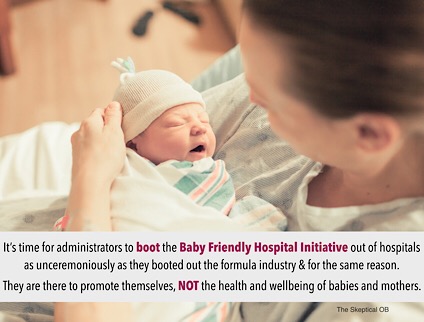
It’s time for doctors, nurses and hospital administrators to boot the Baby Friendly Hospital Initiative out of hospitals as unceremoniously as they booted out the formula industry and for the same reason. They are there to promote themselves, not the health and wellbeing of babies and mothers.

Midwives and lactation professionals, stop abusing women and calling it empowerment

CC13AD28-CEF7-4A85-8855-F9A6B07F33F3

Imagine a gynecologist who performed hysterectomies on every women done with childbearing — whether women wanted them or not.

Regardless of the women’s complaint (be it vaginitis, sexually transmitted disease, fibroids, heavy menstrual bleeding or pelvic pain), he always recommended hysterectomy. If the woman involved opted for something else, a D&C for example, he would perform a hysterectomy anyway when she was under anesthesia.

[pullquote align=”right” cite=”” link=”” color=”” class=”” size=””]Empowerment comes from giving a patient what SHE seeks, not what WE seek and certainly not what we think she OUGHT to seek.[/pullquote]

Now imagine that when called on it he claimed that he was entirely justified because he had empowered them.

They would not longer have fibroids, heavy periods or pelvic pain. As for the women who had vaginitis or sexually transmitted diseases, he had empowered them by making sure they would never get cervical or endometrial cancer.

I doubt any among us would fall for such self-justifying, self-aggrandizing nonsense.

We would recognize that empowerment, to the extent it can come from any medical provider, comes from giving the patient what SHE seeks, not what WE seek and certainly not what we think she OUGHT to seek. That’s not empowerment; that’s a violation of medical ethics.

So why do we let midwives and lactation professionals offer the same self-justifying, self-aggrandizing excuse for ignoring what patients want? Midwives claim that they are “empowering” women with campaigns to pressure women into unmedicated vaginal births, whether they want them or not. Lactation professionals insist they are “empowering” women by pressuring them to breastfeed, whether they want to or not.

Consider this self-serving, toxic nonsense offered by Rachel Reed, Midwife Thinking, approvingly quoting a student midwife:

As student midwives, we begin bright eyed and bushy tailed, with a passion for natural birth, for normal birth. We believe in the innate abilities of women, the knowing that she knows her body, her baby. That the woman is the expert and we trust in the seeming simplicity of this. Our university education aims to facilitate this passion, underpinned with feminist theory, enabling critical thinking, the use of evidence and the ability to learn how to apply clinical skill with heart and soul. Then, at some point, the on-the-ground practice begins. We set foot into the hospital. Here we fall into the deep chasm between theory and practice and experience the raw and visceral realities of the midwifery culture which exists at present. Where we thought we would be supporting women and the spectacular physiology of birth, we find the technocratic perspectives in full force. At every turn, in every space, be it antenatal, birth suite or postnatal, we view women being actively disempowered, intervened with and unsupported. Every damn day.

Not a single word about what women want, only what midwives believe women SHOULD want.

What if a woman DOESN’T want an unmedicated vaginal birth? She should be forced to have one anyway so she can be “empowered.”

But a woman is no more empowered by being denied an epidural or C-section than she is by being forced to have a hysterectomy she does not want.

Or this self-justifying nonsense from lactation professional Amy Brown:

Breastfeeding is not simply a logical choice based on some health benefit, but an urge, an instinct. And breastfeeding is useful to women, not just as a milk delivery system but as a convenience and means of mothering. Just as we quite enjoy having a sense of smell, women can enjoy breastfeeding. They can feel empowered, healed and calmed by it. And wanting that – expecting that – is fine.

But what about NOT wanting that, NOT enjoying it, NOT being able to breastfeed?

Formula milk can be life saving and some women may feel it works best for their family, but for others it can never replace the experience they hoped to have as a mother. They don’t want to simply give a bottle instead. Complications and stopping breastfeeding before a woman is ready can be a huge strain on maternal mental health. Women will grieve their loss – and should be allowed to.

She’s obviously disempowered and should be pressured to be empowered by breastfeeding so she won’t “grieve the loss.”

But a woman is no more empowered by being forced to breastfeed than by being forced to have a hysterectomy she does not want.

Who is being empowered in these situations? The professionals who insist that their skills offer empowerment.

Only gynecologists are empowered (and enriched) by forcing hysterectomies on women.

Only midwives are empowered (and improve their employment prospects) by withholding epidurals and demonizing C-sections.

Only lactation professionals are empowered (and enriched) by pressuring women to breastfeed.

A gynecologist who forces a woman into a hysterectomy is abusing her.

A midwife who forces a woman into an unmedicated vaginal birth is abusing her.

A lactation professional who forces a woman to breastfeed is abusing her.

No amount of empowerment blather changes these ugly realities.

Her baby, her body, HER choices and — regardless of who is or is not being empowered — nobody else’s business.

Another way to kill a baby through breastfeeding promotion

Wrongful Death report and gavel in a court.

Breastfeeding promotion has a death toll and it’s likely to be substantial.

As breastfeeding promotion has become ever more aggressive, babies have been dying from dehydration, hypoglycemia, severe jaundice, failure to thrive and starvation.

As lactation professionals have embraced mandated skin-to-skin care and mandated rooming in of babies and mothers, babies have been dying from smothering in their mothers beds in the hospital and at home, and skull fractures as a result of falling out of those beds.

[pullquote align=”right” cite=”” link=”” color=”” class=”” size=””]The problem of death from breastfeeding promotion has become so severe that the US government is taking action.[/pullquote]

Now we can add a new cause of potential death: massive hemorrhage from tongue tie clipping.

We might not have heard about this baby’s near death experience if his father hadn’t been an Australian celebrity:

Struggling to hold back tears, the children’s entertainer explained how the most traumatic days in his and wife Tori’s lives unfolded late last week after a tongue-tie snip went horribly wrong.

“My son Mack was in for a routine procedure and it didn’t go very well,” he said through tears in the emotional clip that aired on Dancing With The Stars last night, explaining to fans why he chose to withdraw from the competition.

“It led to blood loss, it snowballed from there. The blood loss got worse. He was rushed to hospital, it got critical and CPR was administered to the little fella.”

A Facebook post offers more information:

After a failed tongue tie snip on Thursday afternoon my son was rushed by ambulance to Gosford hospital where he lay in resus and had over 30 people working on him. CPR, blood transfusions, ventilator, emergency surgery, NETS transfer, ICU and a hell of a lot of drugs my Mack has proved the specialists wrong and is slowly mending. Gosford emergency department, you saved my son’s life – you were incredible. I love my family, I love my sons, I love my friends, and thank you so much for your thoughts – we are going to be ok. xxx @jimmyrees

The family posted a picture on Instagram:

9DD2C2DD-DFA1-447B-94E3-5F6F480C05B7

What went wrong?

I speculate that the clipping was being performed by a lactation professional or midwife, not a physician.

Given the massive blood loss, it sounds like someone clipped a blood vessel on the underside of the tongue — or worse, mistook the blood vessels FOR a tongue-tie.

As this illustration shows, the blood vessels that supply the tongue run close to where the tongue meets the floor of the mouth, in exactly the area where tongue-ties are severed.

A137BC63-4085-4B45-B598-DCA11FDD110C

Isn’t it possible that a physician lacerated a blood vessel? It’s far less likely since they are much more knowledgeable about the anatomy of the tongue and because a physician is likely to have the clamps necessary to close off the blood vessel until it could be repaired and the ability to repair it.

It’s also possibly, though less likely, that the massive blood loss was the result of an underlying clotting defect such as hemorrhagic disease of the newborn, the result of refusing Vitamin K prophylaxis at birth. It’s less likely because that would have led to a continuous ooze and it would have taken more time to result in the infant’s cardio-respiratory collapse.

As long as I am speculating, I am going to speculate about something else: I suspect that the baby didn’t have a tongue-tie at all or at least not one that required correction. The blood vessels were probably mistaken for a tongue-tie because someone was looking for an explanation for pain or difficulty breastfeeding, not because there was evidence of a tongue-tie. There has been a massive increase in tongue-tie surgery in the past decades and most of it has been unnecessary.

As a recent article in The Atlantic noted:

In recent years, surging numbers of infants have gotten minor surgeries for “tongue tie,” to help with breastfeeding or prevent potential health issues. But research suggests many of those procedures could be unnecessary.

So add yet another way to kill a baby through aggressive breastfeeding promotion.

How many babies are dying each year?

We don’t know because we don’t keep track. That must change.

The Fed Is Best Foundation formally submitted an addition to the pending Healthy People 2030 goals:

Reduce the proportion of infants who require treatment and/or extended or repeat hospital admission for insufficient feeding-related hyperbilirubinemia, hypernatremia, dehydration, excessive weight loss, hypoglycemia and failure-to-thrive.

The Committee promulgating the recommendations has already reduced the aggressive pressure to breastfeed by removing 7 of the 8 goals that appear in Healthy People 2020. Hospitals will no longer be required to reduce the proportion of infants who receive formula and no longer be encouraged to seek Baby Friendly Hospital Initiative certification.

How did we get to the point where the government must try to rein in breastfeeding promotion efforts to protect babies?

We got here because the lactation profession’s bizarre insistence that — unlike ALL other bodily processes — breastfeeding is supposedly perfect.

The egregious harm to babies — including the fact that exclusive breastfeeding on discharge has become the leading cause of neonatal hospital readmission — is not because lactation professionals have grossly exaggerated the benefits of breastfeeding although they have done so.

The egregious harm to babies, including deaths, is because lactation professionals have refused to acknowledge the limitations and risks of breastfeeding:

They’ve refused to acknowledge that the incidence of insufficient breastmilk is HIGH, not low … and babies have died.
They’ve refused to acknowledge that formula supplementation is OFTEN needed, not rarely needed … and babies have died.
They’ve lied about the size of the newborn stomach in order to pretend that babies need less fluid than they do … and babies have died.
They’ve lied about the need for skin-to-skin contact … and babies have died.
They’ve lied about the need for babies to room in with mothers … and babies have died.
They’ve lied the incidence of tongue-tie and the need for tongue-tie clipping … and babies may die.

The problem has become so severe that the US government is taking action. Individual mothers need to be aware of the deadly risks of breastfeeding promotion, too, so they can protect their babies from lactation professionals.