Women are perfectly designed to give birth — NOT!

image

Thanks goodness for natural childbirth and homebirth advocates. They’ve rediscovered what our ancient ancestors knew all along: women’s bodies are perfectly designed to give birth!

[pullquote align=”right” cite=”” link=”” color=”#8B2626″ class=”” size=””]Trust birth![/pullquote]

How did they figure it out? They looked at basic facts about childbirth.

Consider:

There is no infertility.

No baby ever dies in childbirth.

No mother ever dies in childbirth.

There are no premature babies.

There are no stillbirths.

There are no miscarriages.

No babies are breech.

No babies are transverse.

There are no twins, triplets or higher order multiples.

No babies are ever too big to fit through the birth canal.

No babies are ever deprived of oxygen during labor.

No babies fail to breathe when they are born.

No babies ever get an infection during labor.

The umbilical cord never prolapses.

The placenta never abrupts.

The placenta never grows over the opening of the cervix.

The placenta is never retained.

The uterus never gets infected.

There is no Rh incompatibility.

There are no birth defects.

No woman ever develops eclampsia.

There is no postpartum hemorrhage.

There are no vaginal tears.

There are no vaginal fistulas.

There is no incontinence after birth.

There is always enough breastmilk.

No breastfed baby ever gets sick.

No breastfed baby ever dies.

No nursing mother ever dies.

So there you have it. Add it all up and it is obvious that women’s bodies are perfectly designed to give birth. That’s why the key to perfection is simply to “trust birth.”

Natural childbirth and homebirth advocates know this; how can those foolish obstetricians think otherwise?

This piece first appeared in November 2013.

New piece for TIME.com on the ethics of counseling a woman whose unborn baby has Down Syndrome

cheerful little baby girl with Downs Syndrome

My latest piece for TIME.com is Not Discussing Down Syndrome Complications Is Unethical.

There’s definitely a wrong way to give an unexpected medical diagnosis.

In 2000 I was diagnosed with a benign brain tumor, a meningioma. I knew that the tumor would need to be removed, but I was shocked when the ophthalmologist declared: “I’m so glad that I’m not the neurosurgeon who’s going to operate. It’ll be tough; that sucker is sitting in the middle of your brain in a lake of blood.”

But while it’s easy to determine the wrong way for a doctor to give unexpected bad news, it’s surprisingly difficult to figure out the right way to give a specific diagnosis to a specific person. That’s what I thought when I read the account of the mother who was angry at her doctor for the way he handled her baby’s diagnosis of Down Syndrome.

Read more here.

You get what you expect? Rachel O’Brien IBCLC and the “psychology” of low milk supply

image

I have very few regrets about the years that I practiced medicine, but there is one thing that makes me embarrassed every time I think about it.

I was taught that “all breastfeeding women make enough milk.” It was a lie, but I didn’t know it at the time. My experience of breastfeeding my own children did nothing to disabuse me of this falsehood. I had a booming milk supply when I breastfed my own children, routinely pumping 10 oz. at each session.

[pullquote align=”right” cite=”” link=”” color=”” class=”” size=””]Are we setting people up for diabetes when we warn them to eat right and exercise?[/pullquote]

The consequence was that I counseled women to breastfeed without giving them accurate information to help them. Even worse — and this is the source of my guilt — though I never told anyone outright that I thought they were lying about low milk supply as an excuse to stop breastfeeding, I didn’t believe them. I’m ashamed to think that when I should have offered support, I offered judgment instead.

The only thing I can say in mitigation is that it happened 25 years ago when scientists and physicians knew a lot less about the physiology of breastfeeding than they know now.

Sadly, lactation consultants are still spewing the same lies that I was fed.

Consider Rachel O’Brien IBCLC and her vicious piece You get what you expect; the psychology of low milk supply.

Do you remember what you heard about breastfeeding before you ever tried it yourself? Did you hear other families talking about having a hard time making enough milk? Did you see articles in parenting magazines that told you how to AMP UP YOUR SUPPLY or warned you that 49% of mothers said low milk supply was their biggest “booby trap” or that you may have “less milk than the baby needs”? …

I am NOT saying that all women can breastfeed, and I am NOT saying that low milk supply is a myth. I’m not discounting the stories of anyone who experienced low milk supply. My point is that when we hear about low milk supply over and over, response expectancy theory says that our bodies can respond in the way that we expect them to- by making less milk than we need.

It’s a self-fulfilling prophecy, and we may be perpetuating this when we give well-meaning advice and warnings to others. Are we setting families up for failure?

Low milk supply: It’s your fault; you did something to deserve it.

O’Brien blames the victim.

What’s the truth?

Nancy Hurst notes in Recognizing and Treating Delayed or Failed Lactogenesis II:

Although actual rates of failed and delayed lactogenesis are unknown, estimates ranging from 5% to 15%, respectively, have been reported.

Other studies have found rates even higher. In other words, insufficient milk supply isn’t merely possible, it’s relatively common.

Alison Stuebe, MD and member of the Academy of Breastfeeding Medicine recently acknowledged:

… a substantial proportion of infants born in the US require supplementation. Delayed onset of lactogenesis is common, affecting 44% of first-time mothers in one study, and 1/3 of these infants lost >10% of their birth weight. This suggests that 15% of infants — about 1 in 7 breastfed babies — will have an indication for supplementation…

Breastfeeding physicians and researchers are well aware that insufficient milk supply is real, but apparently they’ve neglected to tell the truth to IBCLCs.

O’Brien boasts:

For today’s blog post I considered just cutting & pasting my 21,397 word Masters thesis on U.S. mothers and perceived insufficient milk supply.

What evidence does O’Brien provide for the connection between talking about low milk supply and the subsequent development of low milk supply? None, of course, because there is no such evidence. Instead she cites out of date papers about response expectancy theory, a fancy term for the placebo effect.

The placebo effect applies to treatments. When a patient believes a treatment will work he or she may improve when unknowingly receiving a placebo instead. I’m not aware of any research that shows that when a patient is told about a hormone deficiency, he or she will develop that deficiency, but O’Brien bases her conclusions on precisely this inappropriate extrapolation.

Perhaps O’Brien will consider writing future papers like “Diabetes and perceived insufficient insulin” or maybe “Recurrent miscarriage and perceived insufficient progesterone.”

Shouldn’t the same principles enunciated in her blog post apply to diabetes and recurrent miscarriage, too?

It’s a self-fulfilling prophecy, and we may be perpetuating this when we give well-meaning advice and warnings to others. Are we setting families up for failure?

Would we change how we talk about breastfeeding and nursing if we knew that our words may cause problems for the person who is listening to us?

What would happen if we made an effort to discuss the positive parts of our breastfeeding experience AT LEAST as much as we warn about the negative parts?

Are we setting people up for diabetes when we warn them to eat right and exercise? Do we create a self-fulfilling prophecy when we routinely test people for high blood sugar? What would happen if we made an effort to discuss the positive parts of eating pastry and candy as much as we warn about the negative parts?

What would happen is that people would think you were both ignorant and cruel, blaming a sufferer for a disease over which she may have had no control.

And that’s exactly what O’Brien and other IBCLCs do. They blame the victims — women with insufficient milk supply — for the hormonal and anatomical causes over which they have no control.

That’s because IBCLCs are not medical professionals. Instead of offering accurate scientific evidence about insufficient milk supply, they offer lies leavened with a heaping helping of judgment.

That’s not patient care; that’s cruelty.

The right to rape

image

We’ve made progress; some of us are now outraged when rapists, such as Stanford University student Brock Turner, get off with a proverbial slap on the wrist.

But we haven’t made enough progress, since rapists still get off with only a proverbial slap on the wrist.

Not all rapists, of course, only the privileged rapists. And that speaks to our deep-seated cultural belief that privileged men have a right to rape.

[pullquote align=”right” cite=”” link=”” color=”” class=”” size=””]Rape is a perk of privilege.[/pullquote]

To the victor go the spoils, right? And for the entirety of human history, women’s bodies have been the spoils. The only thing that has changed is our concept of victory. In the beginning, the victors were the men who were better warriors. They were men from indigenous tribes who raided other tribes for “brides.” They were men from primitive (and modern) wars who raped their way through conquered cities. They were men who decreed that raping their female slaves was the “master’s obligation.”

As Snopes notes:

The use of political power (or any exalted position in society) as a means of gaining entry into women’s beds has been with us for thousands of years. The name of this phenomenon has changed over the years (from ius primae noctus to droit de seigneur to “the master’s obligation” to sexual harassment), but the concept has remained the same.

Except that Snopes is wrong in one critical detail. The modern day incarnation of “droit de seigneur” is not sexual harassment, it is rape.

The right of powerful men to rape women of the was first codified as a “religious” right.

The custom of someone other than the husband being the first to engage in sexual intercourse with a bride after the wedding goes back several thousand years and is tied to the concept of God as the source of all life. If all life springs from the creator, then surely his earthly representatives … are guarantors of fertility …

It didn’t take long for the right to rape to be enshrined as a political right:

After the Sumerians developed the concept of a divinely-ordained king “descended from heaven” as the primary intermediary between man and his creator, kings supplanted priests as the vessels of fertility …

This codified “right” survived until relatively recently:

First night customs survived in parts of Europe into the Middle Ages (as the droit du seigneur), although by then it had been stripped of any pretense that it was a means of assuring fruitful harvests and fecund brides. Feudal noblemen were not of royal blood and had no claim to divinity; they were “lords” only by virtue of having been granted titles, and they simply used their positions of power over their vassals as a basis for asserting their “right” to substitute for any of them on the wedding night…

We don’t have official nobility anymore, but we do have the privileged and they apparently have no trouble getting away with rape. Wealthy men, athletes and celebrities are the new nobility and society seems to recognize them as such. In general, privileged white men are much more likely to get away with rape than other men. Had Brock Turner been a poor, black man who met a white women at a party and raped her, he would likely have received a lengthy jail sentence. But because he was a white man, and an athlete to boot, the judge in the case seemed to have spent more time considering the impact of punishment on the perpetrator than the effect of the rape on the victim.

Lest you think that this is purely an issue of race, consider that Bill Cosby has been allegedly drugging and raping women for decades without punishment.

To the victor go the spoils and wealthy men, athletes and celebrities are the victors in contemporary society. It isn’t merely that college athletes are valuable to the team that leads universities to protect them; it’s that they are stars and taking sex without consequences is believed (consciously or unconsciously) to be one the perks of being a star.

Obviously, it was Brock Turner who raped his victim and we don’t bear collective responsibility for the rape. But we do bear collective responsibility for a society that consciously or unconsciously believes that privileged men have a right to rape.

They don’t.

When bad things happen to good rapists

Anxiety

Yesterday I wrote a piece for Psychology Today entitled ‘When bad things happen to good mothers.’ In it I argued that the mother of the little boy who climbed into the gorilla enclosure at the Cincinnati Zoo, resulting in the death of the gorilla, does not deserve the vitriol directed at her on social media. The outrage she inspired tells us more about us and what we wish to believe about parenting, than about her. The truth, which is very difficult for some people to acknowledge, is that accidents happen even when mothers are as vigilant as they can possibly be.

Today’s social media clamor is also about parenting. People are justifiably outraged about the reprehensible letter written by the father of a rapist begging leniency for his son. The convicted rapist, Brock Turner, a Stanford University student-athlete was caught assaulting an unconscious woman outside his fraternity. Two men who happened to be bicycling nearby stopped the assault and held Turner until the police arrived.

[pullquote align=”right” cite=”” link=”” color=”” class=”” size=””]He’s a good rapist; he only raped one woman and it didn’t even take that long![/pullquote]

Turner was convicted and received a startlingly light sentence (6 months in jail despite being eligible for a 14 year prison sentence). Last week, his victim released an eloquent statement on impact of her assault. This week, a Stanford University Law Professor who is friend of her family released a copy of the letter written to the judge by the rapist’s father. To call it repugnant doesn’t even begin to capture its outrageousness.

image

Apparently being convicted of rape has been very hard on Brock:

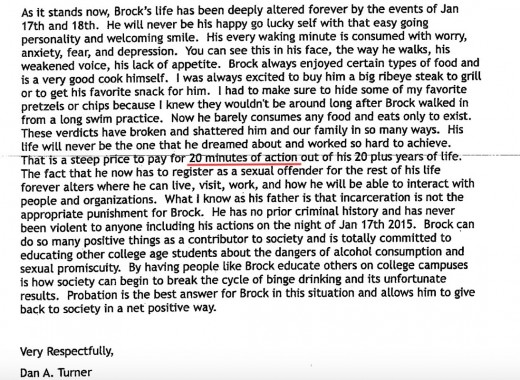
As it stands now, Brock’s life has been deeply altered forever by the events of Jan 17th and 18th. He will never be his happy go lucky self with that easy going personality and welcoming smile. His every waking minute is consumed with worry, anxiety, fear, and depression. You can see this in his face, the way he walks, his weakened voice, his lack of appetite.

His father doesn’t understand why Brock has to endure this. He’s a good rapist; he only raped one woman and it didn’t even take that long!

That is a steep price to pay for 20 minutes of action our of his 20 plus years of life.

Actually, it’s not a steep price to pay for raping someone. A six month jail sentence is a small price to pay for the heinous act of rape.

Clearly this reflects what activists call “rape culture,” the casual dismissal of sexual assault as “boys will be boys” and “she was drunk so she deserved it.”

But I fear that there is more going on here. Is it possible that Turner’s father would have written the same letter if he had been convicted of drunken driving, possibly insisting that a prison sentence was a steep price to pay for only 30 seconds of action, running a stop light and killing another driver? I wonder if Turner’s father is the ultimate incarnation of the snowplow parent.

The “snowplow parent” is defined as a person who constantly forces obstacles out of their kids’ paths. They have their eye on the future success of their child, and anyone or anything that stands in their way has to be removed.

… Helicopter parents hover and micro-manage out of fear…

Snowplow parents may also micro-manage … but they do so with an eye on the future. They want to remove any pain or difficulties from their children’s paths so that their kids can succeed…

They are like the mother of an acquaintance of one my sons. When her daughter, a senior in high school, was found to have stolen an exam from a teacher’s computer, and was given a zero as a result, the mother threatened to sue the school for ruining the child’s chances of getting into a good college, and the school backed down.

They are like the parents who call professors when their children get a bad grade in law school or try to attend job interviews or negotiate for better pay on their children’s behalf.

They lose sight of the fact that the goal of parenting isn’t to raise a child with fabulous credentials; the goal is to raise a child with fabulous morals.

I don’t doubt that Dan Turner’s anguish over his son’s conviction and sentencing is entirely genuine. We hurt when our children hurt. But the job of a parent is NOT to beg sufferance for children’s illegal actions.

Turner’s father apparently believes that a bad thing happened TO a good rapist, his son.

But there are no good rapists and jail sentences for rape are not bad things that happen TO rapists, but well deserved punishments FOR rapists. We send people to jail for a variety of reasons: punishment, rehabilitation and deterrence for others thinking about committing the same crime. In this case, Turner and society can benefit from all three.

Brock Turner is an adult who committed a heinous adult crime. Parenting often means supporting our children, even our adult children, through the consequences of their actions, but it SHOULDN’T mean helping them avoid the consequences of their actions, particularly if their actions involve breaking the law and harming others.

While we should not vilify parents for accidents like the boy who climbed into the gorilla exhibit, it is entirely appropriate to vilify parents who excuse their child’s deliberate illegal action and beg for leniency in an effort to soothe his feelings and ensure his success.

The three little pigs, natural childbirth edition

The Tthree little pigs kids story

Hi, folks! It’s Ima Frawde, CPM (counterfeit professional midwife) here with a retelling of that favorite children’s story, The Three Little Pigs.

I and my colleagues have performed a hermeneutical analysis of the story and uncovered role of the hegemonic patriarchy within. We’ve rewritten the story to more closely reflect our values.

[pullquote align=”right” cite=”” link=”” color=”” class=”” size=””]Wolves are natural so there was no reason for the pigs to fear.[/pullquote]

Without further ado:

Once upon a time there were three little pregnant pigs.

One pig planned a homebirth in her straw house while the second pig planned a birth at the birth center made of wooden sticks. Their midwives came to them for home visits that lasted an hour, they avoided all those unnecessary medical tests, and then they sang and danced all day. Regrettably, the third little pig, having failed to do her research and educate herself, planned to give birth in a brick hospital.

A big wolf saw the two little pigs while they danced and played. No worries: wolves are natural so there was no reason for the pigs to fear. Sadly, many pigs have been socially conditioned by the patriarchal, hegemonic farmers to fear wolves. But these pigs, having educated themselves reasoned that if wolves ate pigs, they wouldn’t be there, all their ancestors having been gobbled up by wolves. They were still here, ergo there was no reason to fear wolves.

But just in case, their midwives taught them wolf affirmations to better trust wolves.

Coincidentally, all three pigs went into labor on the same day. They weren’t due on the same day, but due dates don’t really mean anything (just another way for farmers to frighten pigs), so it didn’t matter that the first pig was 3 weeks past her due date and the second pig was five weeks before hers.

The big wolf went to the first house and huffed and puffed. The first pig became frightened.

“What will happen if the wolf blows down my straw house?” she wailed.

Her midwife reassured her. “There’s no reason to be frightened of wolves. Even if he blows your house down, the hospital is only 10 minutes away.”

The wolf huffed and puffed and blew the straw house down, just as the first little pig was about to give birth. Everyone piled into the midwife’s car, which wouldn’t start. Fortunately, the midwife had an oxygen mask with her, just like the hospital does; unfortunately, the tank to which it was attached was empty. The midwife had been meaning to get a new oxygen tank but couldn’t because of her car trouble.

By the time the midwife had hot wired her car and driven 30 minutes to the hospital (there was traffic so it took longer than anticipated), the piglet had been born vaginally. It was dead, but that didn’t change the first little pig’s feeling of empowerment.

Meanwhile, the big wolf went to the second pig’s birth center that was made from sticks. He huffed and he puffed.

“What will happen if the wolf blows down my birth center made of sticks?” the second pig wailed.

Her midwife reassured her. “There’s no reason to be frightened of wolves. Even if he blows your house down, the hospital is only 10 minutes away.”

The wolf huffed and puffed and blew the stick birth center down, just as the second little pig was about to give birth. Her midwife had no car, so they called for an ambulance. In the meantime the piglet’s umbilical cord had prolapsed. By the time the ambulance arrived the piglet had been born vaginally but had not drawn a breath in 10 minutes. The piglet was transported to the hospital and placed on total body cooling treatments. Sadly the piglet died, but at least the mother was nearby on another floor in the hospital recovering from her massive postpartum hemorrhage. She posted on Facebook to tell her friends that she had had a successful vaginal birth.

Finally, the wolf arrived at the brick hospital where the third pig was in labor.

“Should I be worried the wolf will blow the hospital down?” the pig asked.

“That can’t happen,” she was reassured. “We’ve undertaken many interventions to prepare for exactly this scenario. The brick is just a facade for the hospital’s steel reinforced superstructure, the windows have been wolf-proofed, and in the unlikely event that the wolf breaks in we are prepared to cut him into pieces with a scalpel (a W-section).

The wolf huffed and puffed for hours trying to blow down the brick hospital with the steel reinforced superstructure, but he could not. Ultimately he went away. In the meantime, the third little pig had given birth to a healthy piglet.

What did everyone learn from their experience?

The third pig was happy and grateful that she had given birth to a healthy piglet in the hospital. The other two pigs were already planning for their healing second births. This time, though, there would be no attendant and they would both give birth at home. They were happy to have had vaginal births, but sad that their piglets had died. Surely they hadn’t trusted wolves enough. This time they would really trust wolves so they were building their new houses out of tissue paper!

Breastfeeding and the obsession with representation

Funny baby girl with mom make selfie on mobile phone

Yesterday I wrote about the role of class and race in natural childbirth and breastfeeding advocacy. Natural childbirth and breastfeeding advocates, whether they realize it or not, define themselves in relation to poor women, often women of color.

One one hand, advocates claim to emulate poor indigenous women, whom they view as exotic, authentic and close to nature. On the other hand, they demonizing poor women (black and white) in their own countries whom they stigmatize as too ignorant to recognize the “truths” of natural childbirth and lactivism and too lazy to employ them when they learn of them.

I quoted from ‘The New Reproductive Regimes of Truth,’ a chapter in Alison Phipps book The Politics of the Body: Gender in a Neoliberal and Neoconservative Age.

Phipps offers food for thought on a variety of issues including breastfeeding and the lactivist obsession with representation.

Phipps writes:

[pullquote align=”right” cite=”” link=”” color=”” class=”” size=””]The central tenet of lactivism isn’t “breast is best”; it’s “breast-feeders are best.”[/pullquote]

The new reproductive politics is largely concerned with representations of birth and breastfeeding and attitudes towards them rather than how they are structurally framed. A key element of breastfeeding activism, or ‘lactivism’, is the general public’s reaction, with initiatives such as ‘nurse-ins’ … and campaigns to prevent social media sites such as Facebook from deleting pictures of mothers with their nurslings under obscenity rules.

The obsession with representation now extends to endless brelfies (breastfeeding selfies), as well as breastfeeding stunts wherein women breastfeed while wearing uniforms, etc. Lactivists refer approvingly to their obsession with representation by claiming they are “normalizing” breastfeeding.

But that’s not what’s really going on.

Such campaigns are an example of the politics of recognition, the identity-based activism in which issues around representation supplant those of structure and socio-economic redistribution.

If lactivists truly cared about what was best for babies and mothers, they’d spend far more time addressing economic barriers to breastfeeding, and no time at all posting pictures of themselves breastfeeding. But that’s hard, and in any case, it is far more enjoyable to coerce women, “for their own good,” into lactivist approved behaviors like rooming in (by closing well baby nurseries), then bemoan the purportedly ignorant and slothful poor who quit breastfeeding as soon as they are out the hospital door.

The project of “normalizing” breastfeeding,” encompassing brelfies, breastfeeding stunts and complaints about Facebook censoring, are forms of “virtue signaling.” What is virtue signaling?

[It] is the popular modern habit of indicating that one has virtue merely by expressing disgust or favor for certain political ideas [or] cultural happenings …

Virtue signaling is a form of personal micro-branding. As Phipps notes:

‘Natural’ birth and breastfeeding have become part of an identity package around organic or holistic parenting, while formula feeding and birth interventions (and in particular, caesarean sections) form aspects of a negative Other associated with other practices such as ‘cry-it-out’, vaccination and corporal punishment…

How does the lactivist obsession with representation intersect with the issue of class?

Lactivists represent poor indigenous women who have no choice to breastfeed as authentic and closer to nature, when the ugly reality is that there is no “authenticity” in a subsistence existence and the only thing they are closer to is death. They represent poor women who bottlefeed as ignorant and slothful, when the reality is that many work far harder for their children’s wellbeing (multiple low wage jobs) than privileged women who have husbands to support them, as well as a store of intellectual and social capital (e.g. college educations) paid for by their own privileged parents.

As Phipps explains, natural childbirth and lactivism:

… often play into broader class and ‘race’ antagonisms in which the white middle classes judge other social groups as ‘lacking’ and attempt, through education and occasionally through ridicule, to force them into the dominant mode.

The truth is that lactivism isn’t about what’s best for babies or mothers. It’s about what’s best for lactivists.

Lactivists themselves don’t have a clue to what lactivism really embodies. It isn’t about breastmilk, which in countries with clean water has only few benefits compared with formula. Lactivism reflects power relationships and philosophical beliefs about mothering, feminism and economic privilege.

The central tenet of lactivism isn’t “breast is best”; it’s “breast-feeders are best.”

The ancillary tenets are:

  • Ignore pain, inconvenience and  babies’ cries of hunger; if there’s no suffering, you aren’t really mothering.
  • Women can and should be judged by the function of their reproductive organs.
  • Institutions can and should violate women’s bodily autonomy to compel them to use their breasts to feed their babies.
  • The views and values of who don’t breastfeed can be ignored because these women have no moral agency; they are victims of formula marketing.

The lactivist obsession with representation is not an effort to normalize breastfeeding; it’s an effort to enforce a particular view of women while simultaneously ignoring the extraordinary privilege required to hold that view.

When I write in opposition to lactivism, many people — mothers, lactation consultants, some physicians — are incredulous. How can I be opposed to breastfeeding?

But I’m not opposed to breastfeeding; I breastfed my own four children. I’m opposed to the conceit that breastfeeders are better than other women, the beliefs that suffering is integral to mothering, that women have no right to control their own breasts, and that women who choose not to breastfeed are pawns of the formula industry, incapable of independent thought.

In short, I’m thoroughly opposed to the notion that breastfeeders are best.

I don’t want to normalize breastfeeding; I believe that we should normalize support for all mothers, regardless of how they feed their babies.


Birth, breastfeeding and class: indigenous poor women are exotic, but poor women in this country are ignorant and lazy

image

I just finished reading ‘The New Reproductive Regimes of Truth,’ a chapter in Alison Phipps outstanding book The Politics of the Body: Gender in a Neoliberal and Neoconservative Age.

Phipps explains her project:

In this chapter, I have introduced what I see as the new reproductive ‘regimes of truth’: the consensus around ‘normal birth’ and ‘breast is best’ which dominates policy, academia and the activist field… [A]gendas which began in feminist efforts to empower women have now been transformed into messages which can put pressure on mothers in a number of different ways while excluding other caregivers. In my analysis, I have attempted to apply the principle of intersectionality: seeing the new reproductive activism as largely a politics of white, middle-class women with abundant cultural, social and economic capitals, I have explored how such agendas might intersect with the politics of class and ‘race’ and access to economic, social and cultural resources.

[pullquote align=”right” cite=”” link=”” color=”” class=”” size=””]Where would natural childbirth and breastfeeding advocates be without poor women to exploit?[/pullquote]

There is a great deal of intellectual meat to chew on, but what struck me most forcefully was the central importance of class and race in natural childbirth and breastfeeding advocacy. Specifically, natural childbirth advocates and lactivists identify with an exoticized view the poor indigenous Other (generally black or brown), and simultaneously distinguish themselves from the poor industrialized Other (both black and white) whom they conceptualize as ignorant and lazy.

Complementing this focus on the ‘natural’, there is a tendency to search for authenticity and origins in the discussion of alternative birth practices. This … often involves the Orientalizing of ‘traditional’ cultures, whether prehistoric or from developing countries. American childbirth educator Judith Lothian describes her Lamaze class as modelling ‘traditional ways of passing information about birth from generation to generation’, and advice to mothers to pursue on-demand or extended breastfeeding often makes reference to the fact that these practices are common outside the West, but without highlighting pertinent differences in culture and lifestyle.

Natural childbirth and breastfeeding advocates are channeling Grantly Dick-Read’s notions of “primitive” women, but:

… Like the claims of many contemporary activists, however, Dick-Read’s points were made despite the fact that he had not spent extensive time in non-western countries. The lack of an evidence base to corroborate such assertions is particularly problematic when non-western birthing practices are appropriated in the service of authenticity rather than effectiveness.

Contrast that with the view of poor women in their own countries:

… [W]omen who choose childbirth interventions or formula feed (who are largely from working-class and minority ethnic groups) [are] presented as ignorant and lazy or at best in need of education (which feeds racist and classist stereotypes). A generous formulation is that women lack the confidence to give birth without technology and need to be educated to trust themselves … Less judiciously, British activist the Alpha Parent blogs that formula companies ‘exploit the lazy’ –women who ‘can’t be bothered’ –by claiming their products are convenient.

The surprising paradox is that natural childbirth and breastfeeding advocates claim to emulate poor indigenous women, whom they view as authentic and close to nature, while simultaneously demonizing poor women in their own countries whom they stigmatize as too ignorant to recognize the birth and breastfeeding “regimes of truth,” and too lazy to employ them when they learn of them.

The notion that women who have different preferences in childbirth and infant feeding are both ignorant and slothful justifies the beloved preoccupation of natural childbirth and breastfeeding advocates with the coercion of “informed choice.”

Within this framework of compulsory empowerment through ‘informed choice’, deviant behaviours are positioned as being a product of ignorance or weak-mindedness, rather than affirmative choices in favour of an alternative. This is clear in Lothian’s question: ‘why are women seemingly uninterested in choosing normal birth, in spite of our best efforts?’

Phipps concludes:

… [A]lthough birth and breastfeeding activists have a tendency to present themselves as counter-cultural, and identify themselves with global Others in their appropriation of ‘traditional’ practices, there is little attention paid to the stigmatizing effect this might have upon our own social Others, the working-class and minority ethnic women who may choose birth interventions or infant formula for a variety of structural reasons.

Natural childbirth and lactivism aren’t about babies, but rather are about privileged women and how they wish to see themselves, especially in contrast to the poor Other. It makes you wonder: where would natural childbirth and breastfeeding advocates be without poor women and their misfortunes to exploit?

The Baby Friendly Hospital Initiative is coercive and violates women’s medical autonomy

coercion

The American College of Obstetrician Gynecologists Committee on Ethics recently issued an important position paper entitled Refusal of Medically Recommended Treatment During Pregnancy. Their most important conclusion is this:

Forced compliance—the alternative to respecting a patient’s refusal of treatment—raises profoundly important issues about patient rights, respect for autonomy, violations of bodily integrity, power differentials, and gender equality.

I agree completely, but I have one question. When will ACOG condemn the Baby Friendly Hospital Initiative for its coercive approach to breastfeeding?

[pullquote align=”right” cite=”” link=”” color=”#FD842B” class=”” size=””]The Baby Friendly Hospital Initiative represents a deliberate and fundamental assault on women’s bodily autonomy.[/pullquote]

The BFHI — whose cornerstones include forced lectures on the benefits of breastfeeding, prohibitions on formula supplementation and pacifiers, and mandated 24/7 rooming in of babies  — is profoundly (and proudly) coercive, violating patient rights, respect for women’s autonomy, power differentials and gender equality.

The ACOG opinion brilliantly lays out the issues and principles at stake. These issues and principles apply equally to breastfeeding, another medically recommended treatment. Among them:

Pregnancy is not an exception to the principle that a decisionally capable patient has the right to refuse treatment, even treatment needed to maintain life. Therefore, a decisionally capable pregnant woman’s decision to refuse recommended medical or surgical interventions should be respected.

Breastfeeding is also not an exception to the principle that a decisionally capable patient has the right to refuse to medical recommendations. Therefore her decision should be respected.

The use of coercion is not only ethically impermissible but also medically inadvisable because of the realities of prognostic uncertainty and the limitations of medical knowledge… Obstetrician–gynecologists are discouraged in the strongest possible terms from the use of duress, manipulation, coercion, physical force, or threats, including threats to involve the courts or child protective services, to motivate women toward a specific clinical decision.

The use of coercion to promote breastfeeding is also ethically impermissible as well as medically inadvisable because of the realities of prognostic uncertainty as well as the limitations to the benefits of exclusive breastfeeding. Lactation consultants, nurses and physicians should be discouraged in the strongest possible terms from use of duress, manipulation or coercion to motivate a woman to breastfeed.

Forced lectures on the benefits of breastfeeding, forced visits by lactation consultants, and prohibition of formula supplementation and pacifiers represent both coercion and duress. The closing of well baby nurseries, justified by the desire to promote breastfeeding, represents duress, manipulation and blatant coercion.

Eliciting the patient’s reasoning, lived experience, and values is critically important when engaging with a pregnant woman who refuses an intervention that the obstetrician–gynecologist judges to be medically indicated for her well-being, her fetus’s well-being, or both…

Respect for a patient’s reasoning, lived experience and values is critical to engaging with a woman who cannot or does not want to breastfeed. When a woman tells you that she does not want to breastfeed, that decision should be respected, not viewed as an opportunity to change her mind.

It is not ethically defensible to evoke conscience as a justification to attempt to coerce a patient into accepting care that she does not desire.

There is no ethical justification for most of the principles of The Baby Friendly Hospital Initiative. Indeed, there is less justification for coercive treatment around breastfeeding, which has only small benefits for term babies, than there is for coercive treatment around medically recommended procedures designed to save a baby’s life or brain function, like C-sections.

The Baby Friendly Hospital Initiative represents a deliberate and fundamental assault on women’s bodily autonomy, and as such is deeply sexist. Men have the right to control their reproductive organs free from interference by governments, hospitals and providers. Women are entitled to the exact same right and the fact that the BFHI treats women and their breasts as if they constitute an exception to basic principles of patients’ rights is deeply disconcerting.

That’s why the rush to close well baby nurseries is profoundly unethical. Not only is it bad for babies because it increases the risk of in hospital deaths from falling out of bed or being smothered; not only is it bad for mothers because it keeps them from getting the sleep they desperately need to heal from labor and birth; but it is unethical because it is a deliberate effort to coerce women into 24 hour rooming in against what they might actually wish.

The truth is that there is nothing special about breastfeeding. It isn’t life saving for term babies and its benefits are trivial — a few less colds and episodes of diarrheal illness across the entire population of infants in the first year. If women have the absolute right to an informed refusal of a potentially life saving C-section — and they do — they most certainly have the right to opt out of every single provision of the BFHI.

The Baby Friendly Hospital is deliberately both manipulative and coercive. It depends on power differentials, violates women’s’ fundamental right to bodily autonomy, and is deeply sexist because it treats women’s bodies differently than men’s bodies.

ACOG is absolutely right that it is ethically indefensible to coerce women into accepting obstetric care that they do not desire. Will they affirm the fact that it is equally indefensible to coerce women into breastfeeding?

Lactation consultants care about breastfeeding; pediatricians care about babies.

image

To a hammer, everything looks like a nail.

To a lactation consultant (LC), every problem looks like it can be solved by breastfeeding harder.

And just as hammering a screw harder will make things worse, breastfeeding harder in the face of infant weight loss may make things much worse. In the first situation you could permanently strip the threads. The potential consequences in the case of a baby losing weight while breastfeeding are far worse: dehydration, seizures, permanent brain damage, and even death.

[pullquote align=”right” cite=”” link=”” color=”” class=”” size=””]Weight loss means that a baby is cannibalizing her own body to fuel her vital organs.[/pullquote]

That’s why in any conflict between a pediatrician and a lactation consultant over a baby who is losing weight, you should IGNORE the lactation consultant.

Consider this post that appeared recently on Reddit:

My baby girl just turned 12-weeks yesterday. She was born 16 days early, and only weighed 5lbs 12oz at birth. On May 6th, she weighed 7lbs 12oz. A little light, but no big deal. A few days ago, my wife felt something was wrong, so she made an appointment with a lactation consultant. We went and weighed her there. She was down to 7lbs 10oz.

She feeds all the time, and just isn’t making enough. Breastfeeding alone isn’t working anymore. I desperately want to supplement her with formula (I’d even be happy with just 4-6 ounces a day), but my wife isn’t having it. She completely refuses, screaming to the point of tears when I suggest it…

A pediatrician left an excellent response and I sincerely hope that the father followed it:

… [T]his is a pediatric emergency. Please take your daughter to an emergency room (at a Children’s Hospital if available) or her pediatrician’s office NOW, today! Do not wait until the holiday weekend is over. She needs assessment and treatment immediately! I cannot emphasize this enough. Please get her medical care immediately!

There is no question that this is an emergency. Beyond the first few days, an infant should NEVER lose weight. Weight loss means that the baby has been so deprived of nutrients that she is beginning to cannibalize her own body to continue fueling her vital organs.

Infancy is a period of extraordinarily rapid brain growth and the brain can only grow if nutrients are available in ample supply. When an infant is losing weight, she is potentially losing brain growth and the loss may be permanent. Even if you believe that breastmilk is superior to formula in promoting optimal brain function (I don’t), there is simply no question that adequate formula is far superior in all respects to inadequate breastfeeding.

Malnutrition is not the only problem. Breastmilk is the only source of fluid for exclusively breastfed infants. When they are not getting enough breastmilk, they quickly become dehydrated. Their electrolyte levels can rise very high and high sodium levels lead to seizures, brain damage and death. Indeed a baby can die of dehydration long before it would die from malnutrition.

Sadly, many LC have an unreasoning fear of formula. They have spent so much time and energy demonizing it that they are incapable of recognizing when it might be necessary.

They believe erroneously that inadequate breastmilk is always better than adequate formula. They believe erroneously that formula supplementation interferes with breastfeeding when the scientific evidence shows that judicious supplementation promotes breastfeeding. They believe erroneously that even one bottle of formula harms the infant gut (it doesn’t), failing to realize that when it an infant is losing weight, protecting the BRAIN is more important than protecting the gut. And they believe the biggest breastfeeding lie of them all, the fantasy that all women can produce enough breastmilk when we KNOW that 5-15% or more are biologically incapable of doing so under any circumstances.

Pediatricians, in contrast, have only one goal, keeping babies healthy, growing and able to reach their full physical and intellectual potential. Unlike LCs who have only hammers at their disposal, they have a full tool belt including tools of every type and size. A baby who is losing weight NEEDS supplementation, either formula or donor breastmilk. Pediatricians recognize that an adequate amount of milk is far more important than whether the baby is fed breastmilk exclusively.

There’s another factor that we must consider: letting a baby starve is CRUEL.

Hunger is painful. You might believe that tofu is healthier than steak and that water is healthier than soda, but suppose that you were given only one small piece of tofu and 3 ounces of water each day even though you need 1400 calories and 2 liters of fluid a day to survive. You’d quickly become painfully hungry and desperately thirsty with all the signs and symptoms of malnutrition and dehydration. If meat were available, would you ignore your hunger pangs day after day hoping that more tofu will magically become available in the near future? If soda were available would you ignore you desperate thirst hoping that more water will magically appear? Or would you eat the meat and drink the soda in order to survive?

I’d be willing to bet that you would find your hunger and thirst to be so painful that you would quickly decide that eating and drinking enough is infinitely more important than eating inadequate amounts of healthiest foods. If you wouldn’t allow yourself to starve, how could you possibly think it is okay to let your baby starve?

Lactation consultants mean well, but they’re not medical professionals and have only the vaguest knowledge of infant metabolic needs. They are hammers and everything looks like a nail to them. Pediatricians ARE medical professionals and they have a firm and detailed understanding of infant metabolic needs. More importantly, their primary goal is to meet those needs, not allegiance to any particular feeding method. They are handymen and handy women with every possible tool at their disposal.

Is your baby more than a few days old and losing weight? It’s a medical emergency.

Take your child to a medical professional and follow their medical recommendations. Listening to an LC and letting your baby suffer hunger pangs and desperate thirst in an effort to promote breastfeeding is missing the forest for the trees. It is shockingly cruel and startlingly dangerous.

Never forget: Fed Is Best!

Dr. Amy