Is this pitiful response the best homebirth midwives could offer?

image

I’ve been waiting eagerly to see how CPMs (certified professional midwives) would respond to my piece in The New York Times Sunday Review Why is American Home Birth So Dangerous?

I made several points in the piece:

  • Homebirth is relatively safe in Canada and other countries.
  • The US homebirth death rate is 3-7X higher than comparable risk hospital birth.
  • Most US homebirths are attended by CPMs a second, poorly educated, poorly trained class of midwives that do not meet international midwifery standards.
  • If we want to ensure safe homebirth we should start by abolishing the CPM credential.

[pullquote align=”right” cite=”” link=”” color=”” class=”” size=””]Abolishing the CPM and requiring all midwives to meet international standards is the first step to making US homebirth safe.[/pullquote]

The Midwives Alliance of North America (MANA), the organization that represents homebirth midwives has responded … sort of.

They wrote a lot of words, they raised a lot of irrelevant points and they did not address the central issue, the fact that CPMs don’t meet international midwifery standards.

MANA President Marinah Valenzuela Farrell wrote Women Are Choosing Home Birth: The Infant-Maternal Health Care System in the US Owes Them a Safe Option.

Yes, and a safe option would mean abolishing the CPM and requiring ALL midwives to meet international standards.

Ms. Farrell is a case in point. As far as I can determine [please correct me if I am wrong], she has no formal midwifery training of any kind, no midwifery school, no midwifery degree, no hospital training, nothing.

How does Ms. Farrell address my four points in her response. She can’t, so she doesn’t even bother.

1. How does Farrell address the disparity in homebirth outcomes between the US and other countries that have relatively safe homebirth?

She ignores it.

2. How does Farrell address the statistics and citations in my piece demonstrating the higher death rates at US homebirth?

She doesn’t.

Critics of home birth cite flawed birth certificate studies and highlight relative instead of absolute risk. The State of Oregon has recently made an important leap forward by creating a birth certificate that captures the intended place of birth as well as provider type.

That’s EXACTLY the birth certificate data used to compile the statistics that I quote from Oregon show that planned homebirth with a licensed CPM has a death rate 800% higher than comparable risk hospital birth.

image

The data was compiled by Judith Rooks, CNM MPH, a noted homebirth advocate. Rooks’ testimony before the Oregon Legislature is damning:

Many women have been told that OOH births are as safe or safer than births in hospitals…

But out-of-hospital births are not as safe as births in hospitals in Oregon, where many of them are attended by birth attendants who have not completed an educational curriculum designed to provide all the knowledge, skills and judgment needed by midwives who practice in any setting.

3. How does Farrell address the fact that CPMs don’t meet international standards for midwifery education and training and would not be considered midwives in Canada, the UK, the Netherlands, Australia or any other industrialized country?

She ignores this critical fact.

Farrell writes:

Families deserve the support of a provider that meets international standards.

But she neglects to mention that CPMs don’t meet those standards.

Judith Rooks, in a 2013 interview, asked pointed questions about the CPM:

The lingering questions then become why are the minimum standards so low, especially in comparison to counterparts around the world? Why is it acceptable for midwives to aim for the cheapest, quickest route instead of striving to be their best? Why are the “certifying” bodies (ie NARM/MANA) keeping the bar so low…as in only requiring a high school diploma as of 2012 instead of requiring a college level education to deliver our babies?

Why, indeed?

The answer is that there is a group of laypeople, Marinah Valenzuela Farrell among them, who can’t be bothered (or don’t have the academic ability) to get a real midwifery degree, so they practice without one … and the results are deadly.

I do agree with Valenzuela Farrell on one point, though.

The US healthcare system should do everything possible to ensure that American women who choose homebirth have access to the same level of safety as Canadian, Dutch, British and Australian women who choose homebirth.

That’s why we must abolish the CPM and require all midwives to meet international education and training standards.

It will put women like Marinah Valenzuela Farrell out of business and that can only be a good thing for American babies and mothers.
No, it was not “her journey”; your baby died because you chose homebirth

image

Every time I think I’ve plumbed the depths of the deadly depravity of homebirth advocates who think their birth experience is more important than whether their baby lives or dies, another homebirth loss mother comes along to disabuse me.

Lisa Flatto has no remorse for her daughter’s entirely preventable death at a home VBAC. Indeed she is so proud of herself that she wrote a boastful piece about about it.

[pullquote align=”right” cite=”” link=”” color=”” class=”” size=””]”My baby didn’t die because I had a VBAC at home. My baby died because that was her journey.”[/pullquote]

Flatto recounts the typical homebirth tragedy of clueless homebirth midwives shocked to discover a dead baby drop into their hands.

The central conceit of the piece is the droning repetition of these words:

Yes She Was

Yes, she was beautiful. Yes, she was 8lbs 15 ounces. Yes, she went past her due date. Yes, she made me sicker than a dog. She kicked me, early on and often.

But because of the decision to have a homebirth, she is no more.

Quotes from the piece tell the ugly story.

Flatto piled risk upon risk on her tiny daughter.

1. There was the risk of attempting a VBAC at home where a ruptured uterus would mean certain death.

2. Then there was the fact that Flatto was post dates:

My waters never released. My contractions were nothing much. At 41 weeks and 5 days we got serious, very serious, about getting the party started.

Membranes were stripped, acupuncture was had, herbs were drunk and candles were lit.

Her daughter was at risk of dying because a postterm baby’s oxygen needs during a labor of normal length may outstrip the oxygen carrying capacity of a deteriorating placenta.

3. Flatto forced her daughter to endure a 3 day labor, though protracted labor increased the risk of perinatal death.

Instead of recognizing the risk to the baby and recommending transfer, the fools who served as midwife and doula blamed Flatto:

My midwife whispered to my doula: “At some point she has to come to terms that she is the one doing this. She needs to be alone.”

4. Flatto’s midwife couldn’t be bothered to monitor the baby throughout the 3 day labor. Indeed the midwife couldn’t even be bothered to stick around.

It was Monday morning and things were shifting. Things were getting harder, my doula talking my jaw soft through every contraction. My midwife? Well, now she came and now she stayed.

5. The baby slowly and painfully suffocated to her death and the midwife had no idea of the baby’s prolonged distress (it probably took hours) until the baby was actually dead.

After checking my daughter’s heart rate, my midwife said, “You need to push her out. NOW!”

6. At the moment of supreme urgency, the midwife did this:

Screams.

Panic.

Faces of joy quickly turned to fear – a fear I hope never to see again.

“Talk to her,” they said.

“Call her by her name,” they said. “Should we call 911?”

Call her by name?

Should we call 911?

The ignorance and stupidity defies description. It’s only exceeded by Flatto’s supreme narcissism:

Later, I am [at] the hospital before being put under for a D&C because my placenta wouldn’t detach on it’s own. As he was placing the mask on my face, the anesthesiologist said…”Ah, once a cesarean always a cesarean.”

“No, not true” I said before going under…

For Flatto it was all about pushing a baby out of her vagina. The fact that the baby was dead didn’t negate her “achievement.”

Flatto feels no remorse and takes no responsibility.

My baby didn’t die because I had a VBAC at home.

My baby died because that was her journey.

Her journey?

I don’t think I’ve ever heard a more cold blooded justification for a preventable death.

For those wondering if this is the immediate reaction to grief:

I went on to have another daughter. I do not live in fear. I do not doula in fear.

I’m waiting to see what other homebirth advocates will make of this abomination. Will they readjust their thinking?

“My doctor didn’t perform an unnecessary C-section on me. I was just my journey to have a C-section.”

“Remember when I said my doctor birth-raped me? My bad; it was just my journey to have him thrust his arm in my vagina up to his elbow to pull out my retained placenta.”

“Disappointed that I didn’t have the homebirth of my dreams? No way; it was just my journey to have an emergency hospital transfer.”

Or is it only a baby whose excruciating preventable death from suffocation at homebirth can be fobbed off as “her journey”?

But it was not the baby’s “journey” to die. Her destiny was to live and grow to adulthood and she almost certainly would have done so if her mother had gone to the hospital for her birth.

The baby did not have to die; her mother let her die … and she’s bragging about it.

It’s hard to imagine anything more depraved.

Response to critics of my homebirth piece in The New York Times

image

I was thrilled to write a piece on homebirth for The New York Times. As of this morning it was one of the most read opinion pieces of the last few days, and one of the most emailed articles of the entire paper. The comment section quickly grew to 337 comments before it was closed.

Positive comments might have had a slight edge over negative comments, but there were certainly many negative comments and they were entirely predictable. Today I’d like to address the main negative comments.

The NYTimes did not “let me” write about homebirth. They approached me to write a piece and this was the topic they chose.

[pullquote align=”right” cite=”” link=”” color=”” class=”” size=””]Women have the right to refuse to go to the hospital for birth, but have no more right to an attended homebirth than to a home appendectomy.[/pullquote]

Many homebirth advocates complained that the piece had not been fact checked. I’ve written for many publications and I can tell you that not a single one has fact checkers as diligent as those of the Times. I had to provide a citation for nearly every sentence including the one about taxi drivers and children assisting at uncomplicated birth. Every scientific claim is supported by scientific citations and I often had to point out the specific language in the paper that supported my assertion.

Beyond those basics, criticism fell into two large camps. The first claimed that women choose homebirth because the maternity care system is in crisis. The truth is that hardly anyone chooses homebirth. Homebirth is a fringe practice representing only around 1% of births. Indeed, the vast majority of women are very happy with their maternity care. Every few years, the Childbirth Connection, a lobbying group for the natural childbirth industry, conducts a “Listening to Mothers” survey and every time they are forced to acknowledge that over 80% of women rate their maternity care as good or excellent, with no decrease from the prior survey. Only 2% rate the quality of care as poor.

Many critics cited infant and maternal mortality statistics as reasons for to reject hospital care. But infant mortality is a measure of pediatric care (deaths from birth to one year of age). The best statistic for assessing obstetric care is perinatal mortality and the US has one of the lowest rates in the world. If you look at maternal mortality you find that the women who died did so for LACK of high tech care, not medicalization of childbirth. Most women who die in childbirth have serious pre-existing medical conditions or major complications of pregnancy. Indeed the leading cause of maternal death in the US is heart complications. Homebirth is not the answer to improving maternal death rates.

The second camp of critics apparently believes that demanding measures to insure safe homebirth violates women’s autonomy. This reflects a profound misunderstanding of medical autonomy. Medical autonomy is a negative right, not a positive right. It means that you have the right to refuse care, but you do not have the right to demand that medical personnel give you medically unsafe care.

The classic example is that you have a right to refuse amputation of a gangrenous leg if your provider recommends it, but you do not have the right to demand amputation of a healthy leg.

Similarly women have the right to refuse to go to the hospital for birth. But women have no more right to demand a medical provider attend a homebirth than to demand a medical provider perform a home appendectomy. Mandating safety standards for healthcare providers is not a violation of anyone’s medical autonomy.

Moreover, even the right to refuse comes with caveats. An autonomous decision is not merely a wish, but a decision made with appropriate information and rational consideration of the outcomes. That’s why simply telling your doctor that you want him to amputate your healthy leg is not a sufficient reason for him to honor your request.

An example of a rational but deadly decision is the refusal of a Jehovah’s Witness to accept a desperately needed blood transfusion. The decision may be hard to fathom because it can lead to death, but it is rational because the individual values spiritual well being above health and even life itself.

Respecting the medical autonomy of a Jehovah’s Witness REQUIRES a determination that the individual understands the risk of death. Similarly, respecting a woman’s autonomy to refuse to give birth in a medical setting REQUIRES a determination that she understands the increased risk of death of her baby.

In other words, a doctor’s choice to refuse to attend a homebirth is not a violation of a woman’s autonomy. In contrast the failure of CPMs to disclose that they don’t meet international midwifery standards, that the safety of homebirth in other countries has no relevance to the safety of American homebirth, and that their death rates are dismal IS a violation of women’s autonomy.

The bottom line is that you may not like me or what I have to say, but:

  • My piece was zealously fact checked.
  • Homebirth is a fringe practice.
  • Our maternity system is not in crisis.
  • And safety standards for homebirth do not violate anyone’s autonomy.

I can’t wait to see how professional homebirth advocates address these issues.

Natural parenting erases women’s needs

Eraser deleting the word Selfie

There’s a new kind of confessional essay making the rounds: “natural parenting destroyed me.”

Often it focuses on breastfeeding — how trying to maintain exclusive breastfeeding in the absence of adequate breastmilk make me and my baby crazy — but sometimes it concentrates on childbirth or attachment parenting.

Rachel Meyer hits all three in her essay A zen yoga teacher gets real about postpartum depression. Sadly she doesn’t get real at all about her postpartum depression, what might have caused it and what might have relieved it. Meyer became depressed that her personhood was erased by parenting without any insight into the fact that the type of parenting she chose is designed to erase women.

[pullquote align=”right” cite=”” link=”” color=”” class=”” size=””]The three ideologies that sail under the natural parenting flag were created explicitly as anti-feminist projects designed to force women back into the home.[/pullquote]

Meyer’s descriptions are searing.

On childbirth:

Labor was awful. Quick, brutal. The contractions rolled relentlessly, one after another, my body dehydrated from the vomiting.

I thought of my farmer grandmothers on the Nebraska prairie, popping out babies and heading back out to weed the rhubarb. I thought of my mother laboring in a Minneapolis blizzard, 35 years ago to the day. I thought of the magnolia tree blooming in our front yard, certain my pelvis would fracture.

On breastfeeding:

The first few months descended into a weary haze. My world had turned upside-down. Duke was sleepless, always-hungry, colicky, wanting only to be in my arms. I sat in a rocker and nursed for 20 hours a day, my shoulders and neck aching, head spinning, nipples cracked.

I couldn’t lay him down. I couldn’t take a walk. I couldn’t escape to the living room for 10 minutes to get back into the asana practice I’d missed so much during my pregnancy…

I pumped in the parking lot between classes. Nursing had taken over my life. Mantra-like, in time with the whirr-suck of the pump, I repeated to myself: Joan Didion did this. Ruth Bader Ginsburg did this. Hillary Clinton did this. They managed to salvage their intellects, their ambitions. Surely I can, too.

Attachment parenting:

That first year, Duke only slept well when he was connected. Curled up on my lap, sprawled on Robb’s chest, tucked in under my elbow. He’d reach his big Paul Bunyan paw out and land it square on my sternum, grabbing a chunk of my shirt in his little fist, burrowing his head into my armpit. It was like he sensed, he knew, somehow, that he needed to stay extra close to me, to remind me, to breathe into me, that truth of relationality.

The result?

Desolate with postpartum depression, I drained my breasts, slathered on nipple butter, nursed-finger-fed-pumped in an insomniac cycle and dreamt of getting on a plane to Paris and never coming back…

No wonder every mother is bitter and resentful, I thought. My life is over. Everything I loved is gone. Every moment, every breath, lost to this barely-sleeping, always-hungry little boy.

But every mother is not bitter and resentful. Meyer doesn’t seem to realize that it was natural mothering that destroyed her, not mothering itself.

What is natural mothering (more commonly called natural parenting though its burdens fall nearly exclusively on women)? It is a package of ideologies — natural childbirth, lactivism, and attachment parenting — that are thought to both recapitulate mothering in nature and be better for babies. Neither is true. Indeed all three ideologies that sail under the natural parenting flag were created explicitly as anti-feminist projects designed to force women back into the home.

Natural childbirth was promulgated by Grantly Dick-Read, an obstetrician and eugenicist who was pre-occupied with fears of white race suicide. Dick-Read worried that developed nations would be overrun by children of the lower classes. In his view, the problem was that white women of the “better” classes had become “over-civilized” through too much education and their clamoring for political and legal rights. Pain in childbirth was their punishment.

Dick-Read taught that “primitive” (read black) women had painless labors because they understood that their primary purpose in life was to reproduce and that white women, through their education and activism, had been socialized to fear labor leading to the “fear-tension-pain cycle” that he conjured from thin air.

La Leche League, the prime mover within the breastfeeding industry, was founded by a group of devout Catholic women who were deeply concerned that women with small children were working outside the home. They reasoned that Mary, mother of Jesus, would never have worked and that promoting breastfeeding would lead women to emulate Mary and to give up their jobs.

Attachment parenting also reflects religious beliefs, in this case the beliefs of its great popularizers, Bill and Martha Sears. In one of their first books, The Christian Guide to Parenting and Childcare, they confided that the ideology of attachment parenting had been transmitted to them by God as his plan for ordering the family with the husband as head and the wife subservient and concerned exclusively with raising the children.

All three philosophies share one thing in common: the belief that the needs of women are irrelevant, rendered invisible by the purported needs of babies. How ironic then that Meyer, a proud feminist, unwittingly embraced a parenting ideology that is deliberately retrograde and sexist. It’s hardly surprising then that in embracing natural parenting, Meyer lost herself.

It didn’t have to be that way.

Mayer did not have to endure childbirth in agony and dehydrated. Based on her description, Meyer chose unmedicated childbirth [edited: not homebirth as I wrongly surmised], deliberately depriving herself of access to an epidural. No doubt she chose homebirth because she thought it was both better for her baby and what her ancient (and not so ancient) foremothers would have chosen for themselves.

Yet homebirth has no benefits for babies, only an increased risk of death and disability. Meyer’s foremothers endured excruciating labors not as a choice but because they had NO choice. Meyer’s shattering suffering began with an ordeal prescribed by a philosophy that considers women’s agony (though not men’s) irrelevant or even ennobling.

Meyer lost herself in exclusive and endless breastfeeding. Why? Although breastfeeding has benefits, in countries with clean water those benefits are very small. But Meyer was apparently captured by lactivism a philosophy that has no qualms about lying to women over and over again. Lactivism teaches that all women can make enough breastmilk to satisfy a growing baby, but it is a medical fact that 5-15% of women (or more) won’t make enough milk and their babies will starve and suffer. Perhaps Meyer’s baby couldn’t sleep because he was hungry, but no doubt she had been told that even one bottle of formula would have a harmful effect on her baby (another lie).

Had Meyer supplemented with formula she could have gotten more sleep; she might have been able to put her baby down instead of keeping him attached to her awake and asleep; she could have had some time to meet her own needs. Sleep deprivation in particular is known to be a risk factor for postpartum depression. No matter, in lactivism and attachment parenting, women’s needs, including their need for sleep are entirely irrelevant.

Meyer suffered when she didn’t need to suffer. She was encouraged to erase her own needs and identity in order to do what was “best” for her baby, but there’s no evidence that babies benefit from natural parenting. Everything we know about childbirth tells us that making women comfortable in labor is NOT harmful to babies. Everything we know about infant nutrition tells us that infant formula is an excellent source of nutrition and that babies who are exclusively breastfed have no advantages over those who are supplemented. Everything we know about infant attachment tells us that babies attach spontaneously to anyone who meets their needs, no physical attachment necessary.

It’s time for us to PUSH BACK against the ideology of natural parenting because it is harmful to women without benefiting babies. It’s not based on science and it’s profoundly anti-feminist. That’s why I wrote my book. Although mothering often involves putting a baby’s needs first, it doesn’t require erasing women’s needs thereby launching them into postpartum depression.

Meyer was desolate when she lost herself in mothering, but she didn’t need to be desolate because she didn’t need to erase herself.

Is the obsession with natural childbirth a form of body dysmorphic disorder?

Are you ready for changes? Terrified young woman keeping eyes closed while four hands in medical gloves holding syringes and knifes close to her face

What is a “healing birth” and why would you need one?

In the world of natural childbirth, a healing birth is a do-over for a birth that did not meet the prescribed ideal. It might be a do-over for a C-section or a do-over for an attempted homebirth that ended with a hospital transfer.

According to Dictionary.com, the definition of heal is:

[pullquote align=”right” cite=”” link=”” color=”” class=”” size=””]You can’t stop think about one or more perceived flaws in your birth experience, flaws that, to others, are minor or unimportant.[/pullquote]

[T]o make healthy, whole, or sound; restore to health; free from ailment.

What do women seeking a healing birth consider unhealthy, unsound or broken after having a C-section or a transfer from homebirth? Their bodies? Their spirits? Their self-image?

Where did they get the idea that any or all of these things were broken by having something other than an unmedicated vaginal birth without interventions?

It wasn’t from an obstetrician, because obstetricians view C-sections as life saving procedures, not a sign of “broken-ness” of the women who have them. I suspect it was not a husband or partner who convinced them that they were a lesser woman for having a C-section. He was probably thrilled to be a father and considers the method of birth to be irrelevant.

Which raises the question: is obsession with natural childbirth a form of body dysmorphic disorder (BDD)?

What is BDD?

According to the Mayo Clinic:

Body dysmorphic disorder is a mental disorder in which you can’t stop thinking about one or more perceived defects or flaws in your appearance — a flaw that, to others, is either minor or not observable…

… [Y]ou intensely obsess over your appearance and body image, repeatedly checking the mirror, grooming or seeking reassurance …

You may seek out numerous cosmetic procedures to try to “fix” your perceived flaw…

The natural childbirth variant of BDD might be described as a disorder in which you can’t stop thinking about one or more perceived flaws in your birth experience, flaws that, to others, are minor or unimportant. You intensely obsess over your birth experience, relentlessly reviewing it and finding it lacking. You may seek to have a “healing birth” to try to fix your obsession with the imperfections of previous births.

That doesn’t mean that your distress is not real.

I don’t doubt for one moment that the distress felt by Joni Edelman, the woman who wrote My Labor And Birth Didn’t Go As Planned — And No, I’m Not ‘Over’ It, is anything other than real.

Joni planned the homebirth of her dreams to make up for the shoulder dystocia that nearly killed her toddler at her previous homebirth. The fact that she was at great risk for having another shoulder dystocia and killing this baby apparently did not factor into Joni’s plans. Alas, another big baby and this time a stalled labor requiring transfer to the hospital. Joni was inconsolable, and still is four years later.

I don’t want to hear I’m lucky because I could have had a C-section, that he could have died, or that I could have died — because those things didn’t happen, and pain and loss are relative.

Is my loss comparable to the death of a child? No. But it is loss.

After his arrival, I watched friends give birth, peacefully, at home, and I sobbed.

I don’t have to feign gratitude, because I lost something that was important to me. I don’t have to pretend that I’m lucky he’s healthy, because his health and my lack of an abdominal scar don’t mean I’ve forgotten laboring in a dingy hospital room.

Joni can’t stop thinking about a perceived flaw of her body; she couldn’t gently push a baby out of her vagina while observed by friends and family. That perceived flaw has acquired tremendous importance in her life.

Ina May Gaskin, the grandmother of American homebirth midwifery, is often quoted as saying:

Your body is not a lemon… Human female bodies have the same potential to give birth well as aardvarks, lions, rhinoceri, elephants, moose, and water buffalo …

But who ever implied that having a C-section or other childbirth interventions means that your body is a lemon?

It was Ina May Gaskin herself. She prescribed a treatment, homebirth, for a disease that women didn’t know they had: the need to prove that a baby could transit your vagina while you eschewed pain relief or modern medical care.

When a person with body dysmorphic disorder seeks multiple plastic surgeries for a flaw that only they can perceive we don’t commiserate with them on their terrible flaw. We suggest therapy to ease the anxiety and grief over the perceived loss.

When a person with childbirth dysmorphic disorder seeks a “healing birth” with a subsequent child we should not commiserate with them on the need to redeem themselves with a do-over. We should be suggesting therapy to ease the anxiety and grief over the perceived loss.

It is bad enough to have repeated unnecessary plastic surgeries to address an imagined body imperfection. It is far worse to expect a baby to heal you from the imagined flaw of childbirth imperfection.

Hallelujah! Public health officials begin to push back against the breastfeeding industry

image

It’s about time!

The USPSTF (US Preventive Services Task Force) has changed its approach on breastfeeding.

According to MedPage Today:

Primary care clinicians should “support” patients who wish to breastfeed their infants, said a draft recommendation statement from the U.S. Preventive Services Task Force (USPSTF), in an effort to avoid the impression of pressuring women into breastfeeding against their will…

[pullquote align=”right” cite=”” link=”” color=”” class=”” size=””]The breastfeeding industry overplayed its hand.[/pullquote]

.. Alex Kemper, MD, of the USPSTF, told MedPage Today that there has been a slight change in wording from the last statement: using the word “supports” in place of “promotes” to describe the Task Force’s position on breastfeeding.

“The reason the Task Force made this slight word change is to recognize the importance of a mother doing what she feels is best for her and her baby and not wanting to, for example, make mothers feel guilty or bad if they decide not to breastfeed,” he said. “It’s really a personal choice that needs to be made based on her own personal situation.”

It’s a small change, but it is very significant. It’s a sign that public health officials are beginning to push back against the breastfeeding industry.

Breastfeeding has benefits, but in countries with clean water those benefits are small. Nonetheless, doctors, hospitals and public health officials have given the breastfeeding industry free rein to enact an ugly agenda, shaming and harassing women who can’t or don’t breastfeed.

Doctors, hospitals and public health officials allowed La Leche League and related organizations pressure them into:

  • Massively exaggerating the benefits of breastfeeding.
  • Implementing the Orwellian named Baby Friendly Hospital Initiative, which is not friendly to babies and remarkably punitive to mothers.
  • Closing well baby nurseries even though there is no evidence it improves breastfeeding rates and a growing body of evidence that it leads to babies being smothered or falling to their deaths from hospital beds.
  • Banning formula gifts, though the burden fell disproportionately on poor women (many of whom were women of color).
  • Concealing the fact that anywhere from 5-15% of women can’t make enough breastmilk to fully nourish a baby.
  • Banning small amounts of formula supplementation in hospitals despite evidence that it is necessary and does not harm the breastfeeding relationship.

The breastfeeding industry never hid its desire to shame and humiliate women, and even as leaders like Dr. Alison Steube acknowledge that the industry’s tactics are both ineffective and based on inaccurate information, many lactivists are howling that their days of humiliating women who don’t mirror their own choices back to them are coming to an end. Comments about Dr. Stuebe’s article on shaming language on the Academy of Breastfeeding Medicine’s Facebook page include:

… So we’ll just sit back & watch more & more rampant, aggressive & unethical marketing of infant formula & lie to mothers & babies about risks so as not to hurt their feelings & when their health falters due to the ill effects of formula feeding what will we tell them? …

How about we ban formula advertising? …

And:

… So this is like the 5th really horrific article posted recently. I expect better. The FACT is that most breastfeeding mothers are medically mismanaged in the US and that’s why they “need” to supplement. Let’s chat about that.

And:

… I feel by not shouting from the roof tops the risk of not breastfeeding we are complicit in the resultant diseases that can be acquired. Not responsible but complicit in the vale of silence.

The news that the USPSTF will now support breastfeeding instead of promoting it has been greeted rapturously in some quarters. Melissa Willetts writing for Parents explains:

As a mother who encountered difficulties with breastfeeding, I cannot say how much I love this new approach. Because it’s not necessary to remind me that I’ve “failed” at breastfeeding with language and actions that make it feel like a failure to choose formula. When doctors pressured me to try again, try harder, try more, they only fed into my fear that I sucked as a mom.

I’d much prefer a supportive approach, no matter how I choose to feed my baby. I realize this is a lot about a specific doctor’s bedside manner, but it’s comforting to know a medical task force is finally embracing the notion that breastfeeding isn’t going to work for every single mother on Earth.

The breastfeeding industry is not going down without a fight:

… In response to the new guidelines, which still very clearly say that breast is best, Diana West of breastfeeding advocacy group La Leche League International said, “Women need to understand all of the risks of formula, and benefits of human milk.” She added, “What we really come to understand is that far too often, women feel tremendous regret because they were not given adequate information and support [about breast-feeding] when they needed.”

And what about the women who feel tremendous regret when pressured by the breastfeeding industry even though they can’t or don’t want to breastfeed. Ms. West apparently doesn’t care about them.

The breastfeeding industry overplayed its hand. When given the opportunity to dictate breastfeeding policy it used its power to humiliate and harass women who can’t or won’t breastfeed, instead of concentrating on supporting women who request help.

The decision by the USPSTF to change its language is only a small step, but it is hopefully the first step in doctors, hospitals and public health officials extricating themselves from the clutches of the breastfeeding industry, an industry that has placed promoting breastfeeding ahead of the health and wellbeing of babies and mothers.

Hallelujah!

If you think childbirth is about your ego, you’re doing it wrong

ego word in letterpress wood type

Childbirth is not performance art.

That basic fact seems to have escaped natural childbirth advocates who are under the mistaken impression that their babies’ births are about their own egos.

[pullquote align=”right” cite=”” link=”” color=”” class=”” size=””]If you want to heal, get a therapist; don’t risk your baby’s life in a do over for nearly killing your previous baby.[/pullquote]

How do natural childbirth advocates express their overweening self-absorption? Let me count the ways.

1. Forcing a baby to remain attached to the placenta until it rots off.

No, I’m not making that up. A bunch of natural childbirth advocates made that up as part of the ugly one-upsmanship that is so beloved of natural childbirth advocates. They call it lotus birth because the lump of dead meat that is the placenta reminds them of a flower.

Adele Allen writes I Kept My Baby Attached To Her Umbilical Cord For 6 Days:

Just over five years ago, I gave birth to my first child and opted not to cut the cord—and, subsequently, the attached placenta—and allow it to fall away naturally. Cord non-severance is otherwise referred to as a lotus birth, a process that felt so instinctual to me that nine months ago I also chose to birth my second baby in the same way…

So instinctual that the practice occurs nowhere else in nature. So instinctual that it was invented in 1974 by Western, white, well off natural childbirth advocates who were looking for yet another form of childbirth competition.

Didn’t the placenta stink like the rotting organ meat that it is?

To keep the placenta smelling pleasant, we sprinkled it with a coating of rock salt and rose petals before wrapping in muslin cloths which were changed every few days. For easy transport, the placenta was then placed into a hand-held cool bag which kept everything clean and aerated.

Just like in nature … NOT!

What is the ostensible benefit of deliberately risking a deadly infection of the baby.

In an article written for the July/August 2005 issue of (what else?) Mothering Magazine, professional natural childbirth advocate Dr. Sarah Buckley, describes the lotus birth of her son Jacob:

… Placental symbolism is everywhere in our culture, from the handbags that we carry—holding our money, datebooks, and other items of survival—to the soft toys that we cram into our babies’ cribs. Some believe that much of our culture’s discontent and our urge to accumulate possessions—including all of the aforementioned—come from the traumatic loss of our first possession: our placenta. And each year we honor our placenta by lighting candles on our birthday cake—in Latin, the word placenta means “flat cake.”

Jacob’s placenta has been his conduit, passing life from my body to his. Now this placenta—his womb-twin, his primal anchor—has gone back to the earth. Seven years after his birth, Jacob tells me “your placenta is like your heart;’ and I realize that he received more than physical nourishment through his placenta. Along with the oxygen, nutrients, hormones, and all the other placental gifts, Jacob also received my love, which was equally his sustenance in my womb, transmitted subtly but vitally by this amazing organ—the placenta.

Really? REALLY?

2. Forcing everyone to watch your birth video.

Laura Leu wants you to know Why I showed my birth video to everyone I knew (and some I didn’t). Why? Because she’s a narcissist who needs to bolster her own ego by preening over her birth performance.

… People tended to watch it with an open mouth and darting eyes, while mumbling “oh my God” repeatedly. There was also plenty of gasping, squealing and gagging. I felt comfort in their anguish, pride in their amazement. I found the reactions so satisfying, I even started filming some of them. When I played it for my squeamish best friend, who was seven months pregnant with her first child, I captured her hilariously horrified reaction and posted it online. (The video is so amusing, it has since been licensed and recently appeared on the TV show World’s Funniest. Go ahead, Google “Pregnant Woman Reacts to Childbirth Video.”)

So amusing … NOT!

A lot of people have chosen not to watch my birth video, including a former boss, an ex-boyfriend and my own father. And I understand their resistance… But for me, the graphic physical part is not only easy to share, it’s necessary.

What I found difficult to express are some of the deeper human emotions I felt when becoming a mother. I’m much more comfortable showing someone my body expelling a human than I am talking about the intense and all-consuming love that tore through me in the seconds that followed.

“I felt,” “I am talking,” “I found the reactions so satisfying.” ME, ME, ME!

But the worst example of natural childbirth narcissism by far is this:

3. Forcing a baby to endure a dangerous labor to “heal” his mother from the labor that nearly killed her older child.

Joni Edelman, in a truly ugly display of petulance and egotism, wants you to know My Labor And Birth Didn’t Go As Planned — And No, I’m Not ‘Over’ It.

Joni planned the homebirth of her dreams to make up for the shoulder dystocia that nearly killed her toddler at her previous homebirth. The fact that she was at great risk for having another shoulder dystocia and killing this baby apparently did not factor into Joni’s plans.

Alas, another big baby and this time a stalled labor requiring transfer to the hospital. Joni was inconsolable:

This is the point in the story where I will say, I sobbed putting on a dress. I sobbed through packing my bag. I sobbed through hugging my kids goodbye. I sobbed the entire 25-minute drive to the hospital.

I got to the hospital and sobbed through intake, through the donning of a hospital gown, through the insertion of an IV.

I was lucky to have a group of care professionals who were fighting for me to have a natural birth, but I sobbed anyway. I was lucky to have a midwife who could have whisked me off to the OR, but instead, sat at the side of my bed for seven MORE hours to help my stubborn, egg-headed son to get his act together — but I sobbed anyway.

I was lucky that my body responded to the small amount of pitocin I needed to convince my uterus that it was supposed to be getting a baby out. I sobbed anyway.

I was lucky I didn’t have a c-section. I was lucky he was born, healthy and huge at 10+ pounds, from just two hefty pushes.

I was lucky.

I sobbed anyway.

Why?

His birth was supposed to be peaceful, swimming into the world in our kitchen, surrounded by his family, welcomed with cake and champagne. He was supposed to come out easily and heal me from the trauma of my previous labor and dystocia. His birth was supposed to be a lot of things that it was not.

I do not want to hear, “Well, you’re lucky he’s healthy,” ever.

His birth was supposed to heal you? Heal YOU??

No parent should ever look to a child, let alone a helpless infant, to heal her. Planning a risky homebirth to heal yourself is like having a baby to heal your failing marriage. It is selfish, monstrously unfair to the child and doomed to failure. Children are people, not accessories to decorate your life and make you feel better about yourself.

If you want to heal, get a therapist; don’t risk your baby’s life in a do over for nearly killing your previous baby.

Childbirth is about one thing and one thing only: it’s about having a baby.

If you think it’s about you and your ego, your opportunity to preen, to force your birth video on others, your opportunity to heal, you are most emphatically doing it wrong!

The Academy of Breastfeeding Medicine’s Big Lie

image

Dr. Alison Stuebe of the Academy of Breastfeeding Medicine has had something of an epiphany.

Six years ago, I wrote a blog reflecting on Diane Wiessinger’s seminal essay, “Watch your language.” “There are no benefits of breastfeeding,” I wrote. “There are risks of formula feeding.”

[pullquote align=”right” cite=”” link=”” color=”” class=”” size=””]For years the breastfeeding industry has insisted that all women will make enough breastmilk and all along they’ve known it was a lie.[/pullquote]

That post remains the most-viewed piece I’ve ever written, with more than 74,000 views as of this writing. I’ve taken the lesson to heart. I’ve published a peer-reviewed study on the increased risk of hypertension among women with curtailed breastfeeding, and I’ve flipped odds ratios in teaching slides and review articles to frame associations as the “risk of not breastfeeding” or the “risk of formula,” rather than the “benefits of breastfeeding.”

…[W]hen we talk about risks of formula, we will motivate mothers to “clamor for help,” and thereby increase breastfeeding rates and improve the health of mothers and babies.

Weissinger’s piece is a paean to viciousness and inadvertently revealing. Weissinger writes:

All of us within the profession want breastfeeding to be our biological reference point. We want it to be the cultural norm; we want human milk to be made available to all human babies, REGARDLESS OF OTHER CIRCUMSTANCES. A vital first step toward achieving those goals is within immediate reach of every one of us. All we have to do is … watch our language.(my emphasis)

“We want,” “cultural norm,” “regardless of other circumstances.” This is language beloved of tobacco companies and other industries seeking to manipulate the public into buying their products. It is the language of business, not the language of healthcare.

Stuebe was impressed nonetheless:

It’s a compelling logical argument. And yet, I’ve been unable to find empirical evidence that it is true. To generate that evidence, we’d need to compare outcomes among mothers and babies counseled that formula increase risk with outcomes among those told that breastfeeding improves health and wellbeing. To my knowledge – and please let me know if there is a peer-reviewed study out there! – such a study has not been done.

What caused Stuebe’s change of heart? It wasn’t just that shaming language is ineffective at increasing breastfeeding rates. Stuebe was confronted by the inherent racism and classism of lactivism that elevates the personal preferences of upper middle class white women to norms that are used to criticize poor women and women of color.

… In her spectacular keynote address at Breastfeeding and Feminism, Kimberly Seals Allers used a baby bottle with the head of Darth Vader to frame a discussion about how “risks of formula” might be perceived among women of color. For a mother worried that her teenage son might be gunned down for walking down the street wearing a hoodie, “risks of formula” seem pretty trivial…

You don’t say.

In a breastfeeding context, messaging that formula feeding increases childhood leukemia risk is unhelpful for the 22% of employed women who return to the workforce by 10 days postpartum, or for the mother who lives 3 hours from the nearest lactation consultant. If the purpose of risk-based language is to motivate mothers to clamor for help, there has to be help within clamoring distance.

And that doesn’t even take into account that the claim about leukemia is almost certainly untrue.

Then there is an inconvenient fact that Stuebe and colleagues have been deliberately ignoring for years. Stuebe now acknowleges:

… a substantial proportion of infants born in the US require supplementation. Delayed onset of lactogenesis is common, affecting 44% of first-time mothers in one study, and 1/3 of these infants lost >10% of their birth weight. This suggests that 15% of infants — about 1 in 7 breastfed babies — will have an indication for supplementation. If we counsel women prenatally that Just One Bottle will permanently alter the infant gut, then we set up 1 in 7 mothers to believe the horse is out of the barn in the first week of life. A mother might even conclude that the damage has been done, so she might was well wean altogether.

This is a stunning, ugly admission. For years the breastfeeding industry has insisted that all women will make enough breastmilk and all along they’ve known it was a lie.

If that weren’t bad enough, Stuebe and colleagues have deliberately condemned 1 in 7 infants to starve for days by pretending that “Just One Bottle” of formula will damage the infant gut when we have yet to determine the normal state of the infant gut let alone harmful variations.

Stuebe is reassessing her efforts to promote shaming language in light of its ineffectiveness, inherent racism and classism, and its basis in a spectacular lie. Those are good reasons to reassess, but shaming language around breastfeeding should never have been promoted for a very simple reason: it is UNETHICAL. If patient autonomy means anything it means that all people have the right to ignore healthcare providers’ recommendations without fear of bullying and crude attempts at manipulation.

The fundamental problem with shaming language around breastfeeding is that it is CRUEL and cruelty has no place in healthcare.

Stuebe ends her piece with this:

And until we have evidence that risk-based language improves the wellbeing of mothers and children, we might do well to reconsider our rhetoric. It’s past time to conduct the research that’s needed to sort the real risks and benefits of risk-based language.

But she should have ended it with an apology.

Stuebe and her colleagues should beg forgiveness for the suffering they have caused to starving infants. They should beg forgiveness for the suffering they have caused women with their deliberate lie that all women make enough breastmilk. They should beg forgiveness for the suffering they have caused by placing the needs of the breastfeeding industry above the needs of their patients.

In other words, Stuebe and colleagues should beg forgiveness for their unspeakable, unethical cruelty.

The vicious anti-feminism of natural parenting advocates

image

I posted the image above on Facebook and got the following response:

image

You want to spend 10 months carrying a fetus to a live birth… You should be expected to breastfeed to at least 2 years, you should be expected to baby wear – PERIOD. You should also demand paid maternity leave, expect an extra stipend for staying home with your child and have the support group of other Moms and professionals so new Moms don’t feel isolated…

I’ve been a hardcore feminist for over 20 years… You don’t demean or belittle the huge and amazing aspects of womanhood and motherhood to get equality – because then you are making women act like men. You support, praise, expect and demand monetary value for what women do – to gain equality. Don’t make women feel they need to sublimate or cast off their Motherly instincts to be equal- that is just as damaging as the Patriarchy’s demand to pigeon hole women.

Way to miss the point, Pamela!

[pullquote align=”right” cite=”” link=”” color=”” class=”” size=””]In natural parenting, the only good mothers are powerless mothers.[/pullquote]

I’ve been a hardcore feminist for more than 50 years and feminism is all about situating women’s worth in their intellect, talents and character, not their reproductive organs. Natural parenting, in contrast, believes that women (but not men) must be reduced to recapitulating their lowly status in nature.

Feminism is all about autonomy for women, letting them make their own decisions. It is most emphatically NOT about using pregnancy and infancy as excuses to restrict, control and disempower women.

Wake up, Pamela! Natural parenting has nothing to do with what’s good for babies and everything to do with fear of women’s emancipation. Those who are afraid of women holding political and economic power think they can force them back into the home by setting up so many rules around motherhood that the only “good” mothers are powerless mothers. And you’ve fallen for it, Pamela.

  • When was the last time you saw people claiming that “good” fathers demonstrate their love for their wives and children by killing game animals and dragging them home?
  • When was the last time you saw men escorted out of the delivery room because traditional societies do not allow fathers at childbirth?
  • Where are the restrictions on what men can consume, justified by the desire to keep their sperm safe for maximum fertility?
  • When was the last time you saw fathers harassing each other over who is the more natural father?

Never, right? And that’s not a coincidence.

It would be bad enough if Pamela were just a random vicious natural parenting advocate, but Pamela is a nurse. A nurse who had this to say about infant formula:

Can’t argue with facts- even when you may feel guilt about a failure.

Chemical compounds, synthetic ingredients and hard to digest vitamin and mineral sludge isn’t normal, isn’t great… It is abnormal and inferior nutrition- which thankfully is enough to allow a baby to survive on it.

You know what’s normal, Pamela, my friend? Women who can’t produce enough breastmilk to fully nourish an infant (5-15% or women) is normal, too. And that normally leads to dehydration, seizures and death. It’s so normal that it happens every day around the world.

The “Nature” of our pre-historic ancestors was not the Garden of Eden; it was a garden of horrors. Get bitten by a predator … die. Bleed excessively in childbirth … die. Get a childhood illness … die. The NORMAL life expectancy in nature was only 35 years. It’s entirely unnatural to live to 70, 80 or 90 as people do now.

Why, Pamela, do you get to pick and choose what aspects of life in nature women must be forced to recapitulate? There were no nurses receiving monetary compensation for careers outside the home in nature. So why is it okay for you to have a career? There were no people living in houses, using central heating and air conditioning and driving to their jobs in cars in nature. So why is it okay for you to live in a house with central heating, wear clothes and drive a car?

Most importantly, there were no people using computers to communicate with others across the country and around the world. What are you doing on the internet promoting the virtues of natural parenting, Pamela, when the internet is entirely unnatural?

Open your eyes, Pamela. Natural parenting is not about parenting in nature since that was filled with disease, disability and death. Natural parenting is a way of judging women by the functions of their reproductive organs, reducing women to nothing more than the chattel of men.

It may be natural, but it sure as hell isn’t feminist.

A baby died, a group imploded, and home VBAC proponents utterly miss the point

Combat pineapple grenade and a hand

Meg Heket is holding a pity party for herself and her friends.

Writing in Whole Woman, Heket, an unassisted birth advocate and sister of Janet Fraser (My dead baby was not as traumatic as my birth rape), addresses women she believes destroyed a large, private Facebook group of unassisted birth and homebirth advocates.

[pullquote align=”right” cite=”” link=”” color=”” class=”” size=””]One of THEIR administrators became distraught at the endless parade of preventable deaths.[/pullquote]

You know who you are. You’re sitting in your ivory tower laughing and high-fiving one another. You’re saying JOB WELL DONE! You think you saved a bunch of women from themselves and each other, but your greatest achievement to date is actually showcasing your cult like hysteria on the world stage.

You must seriously be unhinged to think that taking over a large, happy group and dismantling it in this way is an acceptable thing to do. Unhinged, and deluded. Who died and made you the crusaders for the world?

Those 12k women didn’t want you to save them. They wanted to be amongst friends to talk about their pregnancies and births, the good, the bad, and the varicose veins. They had that right, and you did NOT have the right to interrupt them in this narcissistic, grandstanding way…

You may think that this is a giant win for your posse, but actually it is a really convincing nail in your coffin. People everywhere, even many who supported your cause, are utterly disgusted and disillusioned by this. They don’t think you’re brave, they don’t think you saved anyone, they don’t think you had any INTENTION of saving anyone. They know exactly what you are though. You’re all thoughtless, gutless cowards. That’s what cyber-bullying is. It’s gutless and cowardly. You can hide behind your keyboard avidly typing away, never having to face up to the victims, but remember your own important memories on the internet and how easily they could vanish?

What happened?

To be honest, I don’t really know. Contrary to what many natural childbirth advocates believe, I’m not omniscient or omnipotent. I’ve been otherwise occupied publicizing my book so I was not following the drama as it unfolded in real time. I only found out about it afterward when I was publicly blamed for it.

As far as I can determine, a number of safe birth advocates (many, perhaps most, of whom are my Facebook followers) infiltrated a private group supporting unassisted homebirth, home VBAC and unassisted home VBAC. The group is notorious for the steady stream of infant deaths. There are so many deaths that I can’t keep track, but it appears that the group averages several preventable infant deaths each month. In one week last summer there were 6 (!!) deaths.

Nearly all these deaths occur because members ignore the advice of medical professionals and are encouraged to so so by group members and administrators. Babies die and their deaths are subsequently expunged or rationalized (“babies die in the hospital, too”). If all else fails, members resort to shrugging their shoulders and insisting that dead babies happen, the homebirth equivalent of “whatever!”

Earlier this week yet another baby died. In the wake of this death, an administrator of Meg’s* group made one of the infiltrators an administrator, too. She tried to ban medical advice; other administrators tried to ban her and the group imploded and has been closed.

The mother had been encouraged by group members to “rock her home VBAC waterbirth.” She was still being heartily encouraged when she started labor at 43+ weeks.

She was supported throughout her “beautiful” labor and birth by a homebirth midwife (CPM) and doula, both utterly clueless that the baby had died during labor.

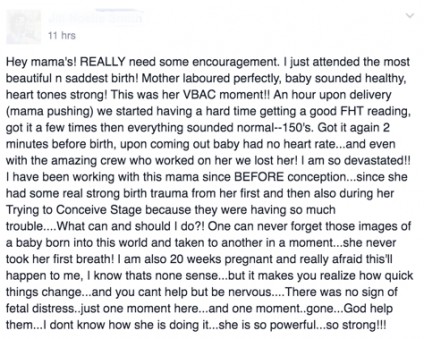
The doula posted this:

image

Hey mamas! REALLY need some encouragement. I just attended the most beautiful n saddest birth! Mothered laboured perfectly, baby sounded healthy, heart tones strong! This was her VBAC moment!!! An hour upon delivery (Mam pushing) we started having a hard time getting a good FHT reading, got it a few times then everything sounded normal — 150’s. Got it again 2 minutes before birth, upon coming out the baby had no heart rate … And even with the amazing crew who worked on her we lost her!…

One can never forget those images of a baby born into this world and taken to another in a moment … she never took her first breast! … There was no sign of distress … just one moment here … and one moment gone …”

Not exactly. The baby almost certainly suffocated and died during the last hour of labor. She wasn’t there one moment and gone the next. She suffered for a long time, but the midwife failed to recognize the signs since there was no fetal monitor to show them.

What does Meg Heket have to say about this baby’s death? Absolutely nothing, of course. She’s far more concerned with what she believes was stolen from her than the life that was stolen from that poor baby.

Who stole Meg’s group? She and other supporters of unassisted homebirth and home VBAC have utterly missed the point of what happened. One of THEIR administrators became distraught at the endless parade of preventable deaths and sought to stop it by changing the leadership of the group, hoping to end the shockingly ignorant medical advice, the mindless cheering of dangerous stunts, and the deliberate efforts to bury dead babies twice, once in tiny coffins in the ground, and again by being expunged from the memory of the group.

I regret that the group was destroyed in the process. That is not my way. If you know anything about me at all, you know that my way is confrontation. I want to confront the lies, not censor them. That’s why I’m constantly offering to debate those that disagree with me.

Meg Heket and her colleagues may be irresponsible, but they are entitled to private support groups even when those groups are echo chambers for ignorance and dangerous medical advice. I don’t blame Heket for being angry, but, as usual, she is missing the point.

The issue is not the women who infiltrated the group. The issue is that the group is enabling preventable infant deaths, so many that even stalwart members are sickened. Yet that’s not even on the radar of Heket and her colleagues.

She ends her article with this:

To the women who love VBAC. You are not alone. You will regroup. You will find your feet, and your voices, and you will be bigger and better and stronger than ever before. Your network may be scattered, but it isn’t gone, I know this because you are working, driven by kindness, not a deranged craving for control and power, flying under the false banner of bravery and care. You are the ones who will rise from these flames…

You stole VBAC, but you wait, it will be back, and you will fade angrily, hopelessly, into insignificance.

I don’t doubt that the irresponsible VBAC group will be back, although those who opposed it will not be fading into insignificance. Their voice is growing. The irresponsibility of Heket and colleagues is being made manifest and we can hope that THEY will fade angrily, hopeless, into insignifance. When that happens there will be fewer dead babies and that can only be a good thing.


*Clarification: Although Meg has been an administrator of some VBAC groups, she was not an administrator of this particular group, just a member.

Dr. Amy