Repeat after me: the C-section rate is not a measure of quality

image

“The operation was a success but the patient died.”

It’s an old joke, but there’s an element of truth to it. Technical prowess in providing medical care is meaningless if the patient does not survive and get better. In medicine outcome is far more important than process.

That’s why efforts to reduce C-section rates are terribly misguided. C-section is a process and measuring rates tell us nothing about the quality of obstetric care. If we want to measure the quality of the care we need to look at perinatal and maternal mortality (outcomes), but that’s hard. So insurers and public health authorities have made a much easier (and potentially lethal) decision. They’re going to measure the C-section rate, then punish hospitals and providers who don’t meet an optimal rate.

According to Southern California Public Radio:

[pullquote align=”right” cite=”” link=”” color=”#FF111E” class=”” size=””]Soon we’ll be able to say, “The vaginal birth was a success but the baby died.”[/pullquote]

California’s health insurance exchange will use the threat of exclusion from its approved provider networks as a way to motivate hospitals and doctors to reduce the number of medically unnecessary Cesarean sections.

Beginning in 2019, insurance companies that contract with Covered California must either exclude from their networks any hospitals that don’t meet the federal government’s 2020 target C-section rate or explain why they aren’t, according to the new contract approved by the exchange’s board last week…

“This is going to catch people’s attention and focus the considerable quality improvement activities of hospitals on this area,” says Dr. Elliott Main, medical director of the California Maternal Quality Care Collaborative.

But there is a very large, indeed a deadly problem with this approach. The C-section rate is NOT and has never been a measure of quality.

In other words, we’re soon going to be able to say, ‘The vaginal birth was a success, but the baby died.’

Medicine is practiced one on one. A health care provider cares for each individual patient with her specific history, symptoms, physical examination and laboratory values in mind.

How do we know if the provider gave the best possible care?

Did the patient survive? Did she get well? If not, the people caring for her failed. Perhaps no one could have done better, but it is a failure nonetheless.

We can measure healthcare quality in the aggregate, of course. We can look at mortality rates and morbidity rates in response to specific treatments, but that tells us nothing about whether each patient got the treatment she needed and no one got treatment that they didn’t need.

Medicine is both art and science.

It is firmly grounded in science, of course, but there are large gaps in our knowledge (what causes cancer? what causes pre-eclampsia? what causes schizophrenia?) and those gaps are bridged by the art of medical care.

I learned that practicing obstetrics. One incident in particular is burned into my memory. I was on call one evening when a patient phoned to say that she was 25 weeks pregnant and had noticed pain running up the inside of her leg for the past two days. I advised her to meet me at the hospital for an exam because I wanted to make sure that she didn’t have a blood clot in her leg (deep venous thrombosis or DVT).

Pregnancy is a hypercoagulable state, meaning that pregnant women are more prone than average to develop blood clots. Blood clots in the leg are not dangerous in themselves, but pieces can break off and get stuck in the lung circulation. That’s known as a pulmonary embolus and it has a very high death rate.

The patient came in and I examined her leg; she had none of the many potential signs associated with DVT, but when I asked her to point out where she felt the pain, she traced the exact path followed by the vein on its way from her foot to her thigh. I was suspicious despite very little clinical evidence so I asked the radiologist to scan her leg … and he refused!

Why?

He explained that the insurance company was trying to reduce the incidence of emergency DVT scans to “improve quality” and he would not get reimbursed for a negative scan. We argued and I ultimately threatened to write in the chart that he was refusing a scan that I thought necessary and if the patient died, he should be held responsible.

He gave in and he found that she had a blood clot so extensive that it extended from her ankle to deep in her pelvis. It almost certainly would have killed her had it not been immediately treated with blood thinners.

A measure designed to improve “quality” inevitably led to poor quality care, because measuring process is not a substitute for measuring outcome.

That’s especially true for C-sections. Except in rare instances (massive hemorrhaging, for example) we have literally NO WAY to determine in advance whether a woman is going to need a C-section. We have NO WAY to predict if her baby is definitely suffering from oxygen deprivation. We have NO WAY to predict if a breech baby is going to die if delivered vaginally. We have NO WAY to tell if a woman with a previous C-section will rupture her uterus (potentially killing her baby) if she tries for a vaginal delivery in a subsequent pregnancy.

What’s the optimal C-section rate? We don’t know.

For years the World Health Organization recommended an “optimal” C-section rate of 10-15% despite the fact that the countries with low perinatal and maternal mortality rates had an average C-section rate of 22% and rates as high as 42% were consistent with excellent outcomes.

A recent study found the a minimum C-section rate of 19% is necessary to ensure low rates of perinatal and maternal mortality. There is precious little evidence that higher rates are dangerous.

That hasn’t stopped public health officials from pretending that they know the optimal C-section rate. In the case of low risk pregnancies:

The federal government has set a goal of reducing C-sections in these low-risk situations to 23.9 percent by 2020. The national rate was 26.9 percent in 2013, according to the Centers for Disease Control and Prevention.

Such specificity ought to mean that public health officials can tell us IN ADVANCE exactly which C-sections made up the 3% difference, but they have literally no idea.

And if they can’t tell in advance, how will obstetricians be able to tell?

They won’t.

Obstetricians will have to guess, risking the lives of individual babies and mothers, leading inevitably to preventable deaths.

Why?

Repeat after me: the C-section rate is not a measure of quality!

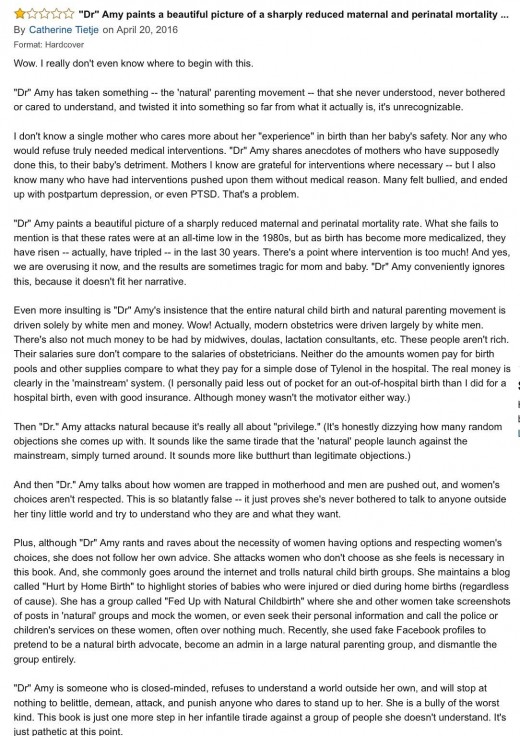
Congratulate me! Modern Alternative Mama hate reviewed my book!

text hate formed with computer keyboard keys on white background

There have been many highlights in my professional life, but rarely has one filled me with as much glee as this one: Modern Alternative Mama, Katie Tietje, hate reviewed my book!

She and her followers are trying to drive down the ratings for PUSH BACK: Guilt in the Age of Natural Parenting.

And the best part is that Tietje didn’t even bother to read it, just like she never reads the scientific literature.

Behold!

image

Wow. I really don’t even know where to begin with this.

“Dr” Amy has taken something — the ‘natural’ parenting movement — that she never understood, never bothered or cared to understand, and twisted it into something so far from what it actually is, it’s unrecognizable.

I don’t know a single mother who cares more about her “experience” in birth than her baby’s safety. Nor any who would refuse truly needed medical interventions. “Dr” Amy shares anecdotes of mothers who have supposedly done this, to their baby’s detriment. Mothers I know are grateful for interventions where necessary — but I also know many who have had interventions pushed upon them without medical reason. Many felt bullied, and ended up with postpartum depression, or even PTSD. That’s a problem.

“Dr” Amy paints a beautiful picture of a sharply reduced maternal and perinatal mortality rate. What she fails to mention is that these rates were at an all-time low in the 1980s, but as birth has become more medicalized, they have risen — actually, have tripled — in the last 30 years. There’s a point where intervention is too much! And yes, we are overusing it now, and the results are sometimes tragic for mom and baby. “Dr” Amy conveniently ignores this, because it doesn’t fit her narrative.

Even more insulting is “Dr” Amy’s insistence that the entire natural child birth and natural parenting movement is driven solely by white men and money. Wow! Actually, modern obstetrics were driven largely by white men. There’s also not much money to be had by midwives, doulas, lactation consultants, etc. These people aren’t rich. Their salaries sure don’t compare to the salaries of obstetricians. Neither do the amounts women pay for birth pools and other supplies compare to what they pay for a simple dose of Tylenol in the hospital. The real money is clearly in the ‘mainstream’ system. (I personally paid less out of pocket for an out-of-hospital birth than I did for a hospital birth, even with good insurance. Although money wasn’t the motivator either way.)

Then “Dr.” Amy attacks natural because it’s really all about “privilege.” (It’s honestly dizzying how many random objections she comes up with. It sounds like the same tirade that the ‘natural’ people launch against the mainstream, simply turned around. It sounds more like butthurt than legitimate objections.)

And then “Dr.” Amy talks about how women are trapped in motherhood and men are pushed out, and women’s choices aren’t respected. This is so blatantly false — it just proves she’s never bothered to talk to anyone outside her tiny little world and try to understand who they are and what they want.

Plus, although “Dr” Amy rants and raves about the necessity of women having options and respecting women’s choices, she does not follow her own advice. She attacks women who don’t choose as she feels is necessary in this book. And, she commonly goes around the internet and trolls natural child birth groups. She maintains a blog called “Hurt by Home Birth” to highlight stories of babies who were injured or died during home births (regardless of cause). She has a group called “Fed Up with Natural Childbirth” where she and other women take screenshots of posts in ‘natural’ groups and mock the women, or even seek their personal information and call the police or children’s services on these women, often over nothing much. Recently, she used fake Facebook profiles to pretend to be a natural birth advocate, become an admin in a large natural parenting group, and dismantle the group entirely.

“Dr” Amy is someone who is closed-minded, refuses to understand a world outside her own, and will stop at nothing to belittle, demean, attack, and punish anyone who dares to stand up to her. She is a bully of the worst kind. This book is just one more step in her infantile tirade against a group of people she doesn’t understand. It’s just pathetic at this point.

When it comes to professional accomplishments, it doesn’t get much better than this!

You know pressure to breastfeed is intolerable when Kim Kardashian can’t own her decision to quit

Pressure

First we heard that the singer Adele, a smart, powerful woman, found the pressure to breastfeed “fu**ing ridiculous.”

Now comes evidence that even Kim Kardashian is vulnerable to that same intolerable pressure. Kardashian, another extroardinarily powerful woman, could not bring herself to own her decision to stop breastfeeding her son Saint. Instead she blamed her two year old for “forcing” her to quit.

[pullquote align=”right” cite=”” link=”” color=”#B71705″ class=”” size=””]She blamed her two year old for “forcing” her to quit.[/pullquote]

According to Yahoo News, North West Forced Kim Kardashian To Stop Breastfeeding Baby Saint:

…Kim has now admitted that she was forced to stop breastfeeding Saint because her two-year-old daughter, North, was getting too jealous…

Speaking on her sister’s chat show Kocktails With Khloe, Kim explained: “North West stopped that for me. You’ll die when I tell you what she did. First of all she’d cry so much and try to pull him off me.

Kim quit and then North had a change of heart:

“She said to me this weekend: ‘Mummy, I’m not mad anymore. You can feed baby brother and I won’t cry.’ And I was like: ‘Honey, the milk’s all dried up.’”

I don’t believe for an instant that North “forced” Kim to quit. Toddlers are often jealous of baby siblings and are not shy about expressing that jealousy. I’ve heard everything from “let’s send the baby back to the hospital!” to “let’s throw the baby in the trash!”

It never occurred to me, nor to any other mother of young children, to take directions from a toddler on how to treat a baby. I suspect that if North had begged her mother to put the baby in the closet, she wouldn’t have done it. And I suspect that if North begs her mother not to go out for work or celebrity appearances, Kardashian does not give in. It is not credible that she stopped breastfeeding Saint because North made her do it.

Kardashian stopped breastfeeding Saint because SHE wanted to stop breastfeeding. Perhaps she found it painful; perhaps she found it inconvenient; perhaps she wanted her body back; or perhaps she had no specific reason at all. It ought to be her choice to use her breasts when and how she wishes to use them.

But it’s not. The breastfeeding industry, including lactation consultants, La Leche League, and the so-called Baby Friendly Hospital Iniative have struggling mightily to thoroughly moralize breastfeeding. They’ve exaggerated the benefits far beyond what the scientific evidence shows. They conjured speculative “risks” to formula feeding. Most importantly, they’ve drummed it into everyone’s heads that the “good” mother breastfeeds.

Not every mother can breastfeed (5-15% of women don’t make enough breastmilk) and not every mother wants to breastfeed or breastfeed for an extended amount of time. But the pressure to breastfeed is crushing. Adele couldn’t bear it and apparently Kim Kardashian can’t bear it, either.

The ultimate irony is that breastfeeding has nothing to do with being a good mother. Breastfeeding is one of two excellent ways to feed an infant. Two generations of Americans were raised nearly entirely on infant formula and infant health parameters improved steadily during that time period. Breastfeeding is integral to the philosophy of attachment parenting, but the psychologists who elucidated Attachment Theory never looked at what an infant was fed, merely that it was fed. They found that mother-infant attachment occurred spontaneously when the “good enough” mother met the baby’s needs for food, protection and love. No special foods or parenting behaviors are required.

You know the pressure to breastfeed has become intolerable with Kim Kardashian is afraid to own her own decision to stop. If powerful women like Kardashian are being crushed by the pressure, average women don’t stand a chance.

We’ve got to push back against the breastfeeding industry that has moralized breastfeeding and return women’s breasts to women’s control.

Have you been duped by “natural” products?

attack great white shark

See the shark?

The shark embodies nature. It’s vicious, deadly, and unconcerned with anything other than its own wellbeing.

Nature is about survival of the fittest … generally by killing both prey and competitors. So how did “natural” come to mean “safe” and “gentle”?

[pullquote align=”right” cite=”” link=”” color=”” class=”” size=””]Anti-vaxxers who prefer “natural immunity” are unwitting dupes to the advertising industry, as are those who purchase “natural remedies” or organic food.[/pullquote]

It hasn’t happened by accident. It reflects a highly successful effort on the part of the advertising industry to trick us and we’ve fallen for it.

In Packaging as a Vehicle for Mythologizing the Brand in the journal Consumption, Markets and Culture, Knaizeva and Belk identify “Myths of the World in the Past” that influence the “stories” found on packaging.

By examining stories printed on the food packages that make use of a popular claim of naturalness, we offer a conceptual framework showing how corporations attempt to graft new myths onto old archetypes. We propose that by revisiting traditional mythology, contemporary commercial storytellers collectively create a grand postmodern marketplace myth—that of an empowered and ennobled consumer. We treat packaging narratives as cultural productions and explore them as vehicles for mythologizing the brand. Our findings reveal mythical themes exploited by companies in their packaging stories and messages they convey.

What did they find?

Packaging narratives depict the modern world as a deeply distorted reflection of what it originally was – the garden before agro-chemical technology. While the values of the past include family, tradition, authenticity, peace, and simplicity, the current era is associated with broken family ties that need to be restored, scientific “advances” that pose threats, constant pressure on the well-being of humans, and unnecessary complexity in everyday life.

The authors pay particular attention to the concept of “naturalness”:

Naturalness appears as a rich emotional construct that connects with positive contemporary images of nature… People do not want to remember that nature can also be destructive as in deadly hurricanes and poisonous mushrooms … In a natural health context, Thompson also finds nature to be a positively framed powerful mythic construction; and his informants attribute magical, regenerative powers to nature. They firmly believe that aligning with what nature has to offer for one’s health lets them assert control over their lives and bodies versus losing control by being complicit in a scientized medical system.

Something unfortunate happens when we hear the word “natural.” It’s almost as if the very word disarms our innate skepticism. The irony is that while natural has come to mean “gentle” and “safe’, nature itself if neither.

In other words, advertisers have appealed to our vanity by conditioning us to believe that we are empowered and ennobled consumers. They’ve rewritten history to depict pre-technological Garden of Eden, where nature had magical regenerative properties. And like lemmings, many of us have followed advertisers off an entirely natural cliff.

Natural immunity? We had that for most of human existence and the average lifespan was 35 years.

Natural childbirth? Among the most deadly events in a woman’s life and the deadliest event in a baby’s life.

Natural remedies? If natural remedies actually worked, our lifespan in nature would have been 70 years, not 35 years.

None of that would be surprising if we recognized the shark as an embodiment of nature. Like the shark, nature doesn’t care if you get smallpox and die. It doesn’t care if half (or more) of your children die in childbirth. It doesn’t care to provide us with natural remedies.

Yes, nature provides some plants and animals with natural poisons used to kill competitors or predators. Penicillin existed to provide protection for a species of mold. We hijacked it to protect ourselves. But no one should imagine that nature created penicillin for us.

Anti-vaxxers who prefer “natural immunity” are unwitting dupes to the advertising industry, as are those who purchase “natural remedies” or organic food. They’ve been deliberately tricked into imagining themselves as empowered and ennobled by their choices when, in reality, they’ve been reduced to compliant sheep who can be manipulated into buying food, books and other products that are worthless or worth far less than the premium being charged for them.

Nature is the shark — conscienceless, vicious, and deadly. We should acknowledge the brilliance of the advertising industry in creating a group of consumers who’d rather believe in the fantasy of safe and gentle nature created by advertisers who are flattering them than the evidence of their own eyes.

It’s great for business, but terrible for health.

Claiming formula manufacturers are waging war against breastfeeding is like claiming birth control manufacturers are waging war against pregnancy

sweet letters war

It’s the central conceit at the heart of contemporary lactivism, and it serves as a justification for the shaming tactics so beloved of lactivists.

It’s the fantasy that the formula industry has been waging war on breastfeeding and it’s a lie.

[pullquote align=”right” cite=”” link=”” color=”#AA0F0B” class=”” size=””]Women use formula for the same reason that women use birth control; it allows them to determine when and how they wish to use their reproductive organs.[/pullquote]

Don’t get me wrong; formula manufacturers are trying to make money. And, yes, decades ago they engaged in deceptive practices to convince women in developing countries to formula feed; but there was never a similar campaign in industrialized countries for a very simple reason — women there couldn’t or wouldn’t breastfeed long before formula even existed.

Formula was not created as a substitute for breastfeeding; it was created as a substitute for the raw animal milk women were already using as a substitute for breastfeeding.

As Jacqueline Wolf explains in the chapter Saving Babies and Mothers: Pioneering Efforts to Decrease Infant and Maternal Mortality, in the book Silent Victories: The History and Practice of Public Health in Twentieth Century:

The custom of feeding cows’ milk via rags, bottles, cans and jars to babies rather than putting them to the breast became increasingly common in the last quarter of the nineteenth century progressed… In 1912, disconcerted physicians complained bitterly that the breastfeeding duration rate had declined steadily since the mid-nineteenth century “and now it is largely a question as to whether the mother will nurse her baby at all. A 1912 survey in Chicago … corroborated the allegation. Sixty-one percent of those women fed their infants at least some cows’ milk within weeks of giving birth.

And the results were deadly:

The late nineteenth century urban milk supply killed tens of thousands of infants each year. Unpasteurized and unrefrigerated as it journeyed from rural dairy farmer to urban consumer for up to 72 hours. cows’ milk was commonly spoiled and bacteria-laden. Public health officials dramatically charged that in most U.S. cities, milk contained more bacteria than raw sewage …

Those death rates did not start falling until cows’ milk was replaced by infant formula, which more closely matches the composition of human milk, is uncontaminated and is very convenient to buy, store and use.

It’s a very important, albeit inconvenient truth about breastfeeding:

There were always large numbers of women who couldn’t or wouldn’t breastfeed.

Why? The answer is another inconvenient truth about breastfeeding:

Many women find breastfeeding to be difficult, painful and inconvenient. Others may wish to breastfeed but don’t make enough milk to fully nourish a growing baby.

Infant formula finally made the widespread use of breastmilk supplements safe. Formula manufacturers didn’t need to convince women to forgo breastfeeding; they just made it safe to do so.

But wait! Why do formula manufacturers still advertise extensively in industrialized countries? It’s for the same reason that birth control manufacturers advertise: to claim market share.

Manufacturers of various formulations of The Pill, condoms and diaphragms aren’t engaged in a war on pregnancy. Women themselves WANT to regulate their fertility. They don’t want to subject themselves to a dozen pregnancies across a reproductive life and they don’t want to raise a dozen children. No one needs to convince women to prevent pregnancy; the market for birth control encompasses just about every woman of reproductive age in every country. The issue for women is not IF they are going to use birth control, but WHICH form of birth control they are going to use. That’s why purveyors of birth control advertise.

Formula manufacturers advertise for the same reason. The issue is not IF women are going to use breastmilk substitutes; many will choose to do so regardless. The issue is which brand to use. It’s the same reason why formula companies give free samples of their product. Contrary to the lactivist fantasy that formula samples are aimed at seducing women away from breastfeeding, the industry is not worried about IF women will use formula; it’s concerned about WHICH formula brand they are going to use.

Lactivists have used this fantasy of formula manufacturers warring against breastfeeding to justify their tactics of grossly exaggerating the benefits of breastfeeding, pretending there are “risks” to formula feeding, invoking shaming language to pressure women into breastfeeding, and coming up with Orwellian programs like the “Baby Friendly Hospital Inititiative” to force new mothers to breastfeed. And, in doing so, they are engaged in a war against women.

Women use formula for the same reason that women use birth control; it allows them to determine when and how they wish to use their reproductive organs. Lactivists oppose formula for the same reason that religious fundamentalists oppose birth control. Fundamentalists believe no woman should have sex unless there is a chance for pregnancy and lactivists believe no woman should give birth unless she plans to breastfeed.

In both cases, what is at stake is not the wellbeing of babies, but the rights of women.

Consumer Reports and the reflexive demonization of C-sections

image

Once again Consumer Reports deserves a big fat “F” for its series on C-sections.

Why? Because it starts with a conclusion and works backward to support it.

“Everybody knows” that the C-section rate is too high, and Consumer Reports is no different, but as is the case with many pieces of conventional wisdom, what “everybody knows” is not necessarily true.

[pullquote align=”right” cite=”” link=”” color=”” class=”” size=””]We should use metrics to evaluate the quality of healthcare, but our metrics should be OUTCOMES not processes.[/pullquote]

To hear Consumer Reports tell it, obstetric care begins and ends with C-sections and our priority should be reducing their number. But C-sections are a procedure, not an outcome, and our focus should always be on outcomes. Curiously while the Consumer Reports series on C-section focuses a great deal on variation in C-section rates between hospitals, it utterly ignores the real metric by which we should judge hospital quality — perinatal mortality.

One of the reasons I left the practice of medicine is because of short sighted, simplistic views of patient care beloved on large healthcare organizations and healthcare journalists. I once was notified that my rate of ordering ultrasounds the previous month was higher than average. When I asked the executives in charge of compiling such statistics whether any of the ultrasounds I had ordered that month were unnecessary, they couldn’t tell me and seemed shocked that I even bothered to ask.

I was once notified that my forceps rate was “too low.” That was truly mystifying since my C-section rate was low also (16%) and I hadn’t left a single baby inside a single woman. Instead of being lauded for a vaginal delivery rate of 84%, I was chastised for an operative delivery rate of nearly 0%. That doesn’t make any sense at all.

Of course we need to use metrics to evaluate the quality of healthcare, but our metrics should be OUTCOMES not processes. When we look at the C-section rate and ask if it is too high, what we OUGHT to be asking is whether any C-sections were recognized as unnecessary in advance not whether they were recognized as unnecessary in hindsight.

To understand what I mean, consider biopsies for breast lumps. We know that 80% of breast lumps are benign, but we biopsy 100% of breast lumps. In other words, we have an “unnecessary” breast biopsy rate of 80% … or do we? The fact that 80% are “unnecessary” can only be known in hindsight; it is impossible to say beforehand which biopsies are safe to skip. We don’t don’t judge breast cancer care by the breast biopsy rate and we shouldn’t. We judge breast cancer care by the survival rate.

Just as we should never judge breast cancer care by how many biopsies were actually cancerous, we should never judge obstetric care by the C-section rate. We should judge obstetric care by the survival rate, but obstetrics has become such a victim of its own success that Consumer Reports starts with the completely irresponsible assumption that all hospitals have the same perinatal mortality rates and therefore, we don’t even need to check them. And that is very, very wrong.

When you choose a hospital for obstetric care, you should choose based on which hospital will give your baby and you the best chances of coming through the process of childbirth without injury or death. For better or for worse, there is no consistent relationship between C-section rates and outcomes. While that may mean that higher C-section rates are not better, it ALSO means that lower C-section rates aren’t better, either. Why? Because the ideal C-section rate is the one where all women and babies who NEED a C-section get one, and not too many women and babies who don’t need a C-section end up with one anyway. Notice that I did not say that there would be NO unnecessary C-sections. Given the current state of technology that can only imperfectly tell us in advance which C-sections are necessary, it is better to do many unnecessary C-sections in order not to miss any necessary ones.

When it comes to C-sections, the current Demonizer-in-Chief is Dr. Neel Shah, who practices in the same place where I trained and practiced, Boston’s Beth Israel Deaconess Medical Center.

While a number of factors can increase the chance of having a C-section—being older or heavier or having diabetes, for example—the biggest risk “may simply be which hospital a mother walks into to deliver her baby,” says Neel Shah, M.D., an assistant professor of obstetrics, gynecology, and reproductive biology at Harvard Medical School, who has studied C-section rates in this country and around the world.

His private remarks to me on the topic of C-sections were particularly irresponsible.

Shah responded on Twitter to a piece I wrote for TIME questioning his sloppy, poorly sourced support for homebirths published in the New England Journal of Medicine. He appeared to be entirely unaware of the published literature on the dramatically increased death rate at American homebirth, and equally unaware that homebirth in the US is typically attended by a second, inferior class of midwife, one who does not meet the basic education and training standards in any other industrialized country. The analogy I used in my TIME piece is that hospitals are like seat belts; most of the time you aren’t going to get into an accident, but if you do, seat belts saved lives.

Shah, clearly stung by my criticism, had this to say:

image

[H]ospitals are not seatbelts; they are airbags that explode in your face 1 out of every 3 times you get in the car.

Holy hyperbole! Shah implies that 100% of C-sections are unnecessary, and are performed merely because the system is malfunctioning spectacularly. At a MINIMUM, fully half of those C-sections he derides are medically necessary and a substantial proportion are literally life saving. Yet Dr. Shah implies that obstetricians are performing C-sections for reasons that aren’t merely illegitimate, but are a travesty exploding in the face of unsuspecting mothers.

It makes for good copy, but it is irresponsible medicine.

Dr. Shah knows as well as I do that the increase in C-section rates have been driven by the fact that our knowledge has eclipsed our technology. We know that vaginal birth can be dangerous and even deadly to a substantial proportion of infants. Indeed, Dr. Shah was a co-author on a recent paper that showed that a MINIMUM C-section rate of 19% is needed to be sure that rates of perinatal and neonatal mortality are low. That means that in order to ENSURE that all babies are born healthy, nearly 1 in 5 MUST be delivered by C-section.

Which 1 in 5 babies needs a C-section to be born safely? We can’t always tell in advance because the things that we need to know are inaccessible to us. To reduce C-sections for fetal distress we need to know the oxygen content of a fetus’ blood during labor, but we don’t have the technology to determine that. To reduce C-sections for breech, we need to know which babies’ heads will get trapped by their mothers’ pelvis, killing them, but we don’t have any technology to determine that. To reduce C-sections for cephalo-pelvic disproportion (a baby too big to fit) we need to know whether the diameter of a baby’s head can mold enough to fit through his mother’s pelvis, but we don’t have the technology to determine that, either. When we have those technologies, we will reliably be able to reduce the percentage of unnecessary C-sections to zero.

In the meantime, we do the best with what we have. Obstetricians perform unnecessary (in retrospect) C-sections because we often CAN’T tell in advance the difference between the necessary C-sections and the unnecessary ones. Not surprisingly, we try to err on the side of caution. The Consumer Reports C-section series deserves a big fat “F” because it is utterly irreponsible. It insists that there are too many C-sections being done but offers NO GUIDANCE on how to determine in advance which C-sections are the unnecessary ones. It presumes that the C-section rate is a quality metric when it is anything but. And it is based on the premise that our goal should be a reduction of the C-section rate when our goal ought to be the best possible rates of perinatal and maternal mortality.

The series doesn’t help mothers, doesn’t help babies, doesn’t help obstetricians, but does sell magazines. I guess that’s the point.

The Baby Friendly Hospital Initiative bullies babies

image

In the dystopian novel 1984, George Orwell introduced the idea that vocabulary has the power to control thought. In 1984, the government, in an effort to control citizens and force them into submission, subverts the meaning of common words and phrases to promote approved views.

This type of language manipulation is also known as “doublespeak,” as Wikipedia explains:

[pullquote align=”right” cite=”” link=”” color=”” class=”” size=””]There’s nothing “baby friendly” about letting an infant starve.[/pullquote]

… Doublespeak may take the form of euphemisms (e.g., “downsizing” for layoffs, “servicing the target” for bombing, making the truth less unpleasant, without denying its nature. It may also be deployed as intentional ambiguity, or reversal of meaning (for example, naming a state of war “peace”). In such cases, doublespeak disguises the nature of the truth, producing a communication bypass.

The Baby Friendly Hospital Initiative (BFHI) is an outstanding example of doublespeak. In 2016, the breastfeeding industry, in an effort to control women and force them to use their breasts in the lactivist approved manner, subverts the meaning of “baby friendly” to promote breastfeeding.

The BFHI torments mothers, muzzles doctors and nurses, and, unconscionably, it bullies babies in an effort to ensure ideological conformity.

What do I mean?

Anything that is baby friendly would take into account the needs of babies, and if babies need anything at all, they need to eat.

Hunger is probably the most elemental of infant drives and, as anyone who has seen an infant scream from hunger would probably agree, is experienced by the baby as suffering. For most mothers, myself included, the sound of their own infant crying is piercing in its intensity and distress. I remember being surprised by this when my first child was born. I had spent my entire professional life surrounded by crying babies and it had never bothered me, yet I found my son’s crying unbearable and always rushed to determine what was wrong and fix it in any way possible.

It is a biological FACT that at least 5-15% of women will not make enough breastmilk to fully nourish a growing baby. If that rate sounds high to you or incompatible with the survival of the human race, consider this: the natural rate of miscarriage of established pregnancies is 20% and we’ve survived and thrived despite a high death rate of embryos. A rate of inadequate breastmilk production of 5-15% is comparable. And that doesn’t even include those mothers whose milk comes in late.

What happened to those babies prior to the advent of infant formula? They starved to death.

Exclusive breastfeeding rates of 100%, as occurs in nature, aren’t very baby friendly at all.

Along comes the BFHI, airily ignoring the biological reality of breastfeeding, and focusing instead on ideological conformity. The BFHI is all about promoting a process. But being “baby friendly” should be about the outcome for babies, not the process. There is nothing baby friendly about letting a baby starve.

Healthy infants are equipped to survive a short period without much nutrition. That’s why most babies lose a little weight in the first two days. But after that point, a baby who isn’t receiving an adequate amount of breastmilk begins to starve. And that’s what happens to those 5-15% of babies whose mothers don’t produce enough breastmilk and the additional babies whose mothers’ milk comes in late. They starve with all the agony that implies.

When a baby continues to lose weight beyond the first few days, the baby’s body begins to digest itself. That’s what weight loss is, the baby breaking down its own cells to supply its brain, heart and other vital organs with nutrients. The baby becomes dehydrated and its sodium level begins to rise; seizures, brain damage, and death can be the result. Bilirubin, a waste product, can built up. If the bilirubin level gets high enough (kernicterus) the baby’s skin color becomes orange and permanent brain damage may occur.

That’s bad enough, but the worst part is that the baby FEELS that she is starving and she suffers. She screams from hunger until she is too exhausted or too weak to cry. She can’t sleep because hunger wakes her up to scream some more.

What’s baby friendly about that? NOTHING!

What can a woman do if she suspects that her newborn is starving? Not much, if she’s in a “baby friendly” hospital. Infant formula, which would ease the baby’s suffering and has been shown to preserve not harm the breastfeeding relationship, is off limits. A mother must subject herself to a mandatory lecture from nurses and or lactation consultants. She may need to beg for formula or send a family member out to buy it. She is the object of official scorn. All the while her baby is suffering.

Nurses and doctors are muzzled; they can’t counsel her about formula supplementation until the baby is seriously ill. All the while her baby is suffering.

We KNOW that this will happen to 5-15% of babies yet, under pressure from the breastfeeding industry, doctors and hospitals have caved to this distinctly baby unfriendly policy. Why? Not because it’s good for babies; not because it’s good for mothers; they submit because the BFHI credential is good for MARKET SHARE.

The ultimate irony? There’s no evidence that the BFHI has much if any impact on breastfeeding rates.

What should we do?

It seems to me that a good first step would be to force the program to change its name to more accurate “Breastfeeding Friendly” Hospital Initiative. Instead of hiding the true motivation in doublespeak designed to manipulate women, let’s be honest about who really benefits: lactivists and their organizations.

Let’s also make the program mother friendly by ending the hectoring lectures to mothers, ending the muzzling of doctors and nurses, making formula easily accessible, and re-opening well baby nurseries so new mothers can rest and heal from childbirth.

Most importantly, let’s make babies’ wellbeing the centerpiece of hospital care by ending the mandatory starvation the agony that goes with it for a substantial proportion of babies.

There’s nothing baby friendly about letting an infant scream in hunger. The BFHI makes babies suffer. That MUST stop.

Have women been tricked into giving up real power for “empowerment” through childbirth and breastfeeding?

image

Imagine for a moment that you were a men’s rights activist (MRA). You know the men I mean, the ones who are whining about Femi-Nazis and how white men such as themselves are victims of discrimination.

Imagine that you felt profoundly threatened by women who were smart, talented and powerful. How might you convince them to cede their power to you?

[pullquote align=”right” cite=”” link=”” color=”” class=”” size=””]What’s the difference between convincing women to compete over who has the whitest laundry and convincing women to compete over who has the most elaborate or the most outrageous breastfeeding photo shoot?[/pullquote]

I know! You could trick them into give up real power by replacing it with faux “empowerment” through childbirth and breastfeeding, the very things that left women powerless for all of human history. And you could call it “natural parenting.”

You don’t have to imagine it; that’s what’s been happening to women for the past few decades. Within the natural parenting movement the word empowerment is promiscuously applied to reproductive functions. Women claim to be empowered by unmedicated birth or by birth at home; women claim to be empowered by extended breastfeeding, tandem breastfeeding, breastfeeding photo shoots and breastfeeding stunts. I’ve been pondering for years how women can be empowered by bodily functions and then I realized that such “empowerment” is a way to convince women to stop reaching for real legal, political and economic empowerment.

The entire industry of natural parenting is dedicated to convincing women to relinquish real power in exchange for the faux “empowerment” of emulating their foremothers who were little more than chattel.

Betty Friedan wrote about the feminine mystique. A Wikipedia synopsis explains some of her central claims:

Friedan shows that advertisers tried to encourage housewives to think of themselves as professionals who needed many specialized products in order to do their jobs, while discouraging housewives from having actual careers, since that would mean they would not spend as much time and effort on housework and therefore would not buy as many household products, cutting into advertisers’ profits.

And:

Friedan interviews several full-time housewives, finding that although they are not fulfilled by their housework, they are all extremely busy with it. She postulates that these women unconsciously stretch their home duties to fill the time available, because the feminine mystique has taught women that this is their role, and if they ever complete their tasks they will become unneeded.

Friedan’s book, The Feminine Mystique launched the feminist movement of the 1960’s and 1970’s, which dramatically increased the power of women.

The philosophies of natural parenting — natural childbirth, breastfeeding and attachment parenting — have replaced the stifling feminine mystique with the equally stifling vaginal mystique and breast mystique. Now instead of competing with each other over who has the whitest laundry and thereby ceding the wider world to men, natural parenting has women competing with each other over who had the longest unmedicated labor and who breastfed the longest … thereby ceding the wider world to men.

It’s a brilliant sleight of hand when you think about it. Don’t try to steal power back from women; manipulate them so they’ll give up power voluntarily. It’s not an accident that women are being encouraged to find their empowerment in forgoing epidurals and breastfeeding three year olds. Women who feel empowered by using their reproductive organs aren’t likely to challenge anyone for real power.

If anything, the vaginal mystique and the breast mystique are even more restrictive than the feminine mystique of the 1950’s. At least back then, women owned their own bodies. The 1950’s emphasis was on the perfect home; the contemporary emphasis is on women enduring severe pain in childbirth, ceding their breasts to their children for years at a time, and ignoring their own needs for fulfillment outside of motherhood.

It’s a neat trick, but we don’t need to fall for it. As someone who had “natural” births, breastfed four children, and gave up medical practice to stay home with them, I know how fulfilling childbearing and childrearing can be for some women in some situations. But fulfillment and empowerment are two very different things. Women are not empowered by unmedicated birth and extended breastfeeding; they are disempowered … and that’s the point.

Our breastfeeding fetish

image

There once was a time when all babies were breastfed … and they died in droves.

That’s because the benefits of breastfeeding are very small. Breastfeeding can’t overcome poor sanitation; it can’t prevent or treat deadly childhood diseases; and many women don’t make enough breastmilk to fully nourish a child.

[pullquote align=”right” cite=”” link=”” color=”” class=”” size=””]Breastfeeding is a natural process in exactly the same way that menstruation or pregnancy are natural processes and every woman knows how painful, inconvenient and disappointing those natural processes can be.[/pullquote]

So why are we fetishizing breastfeeding?

Yes, fetishizing. There are a number of definitions of the word “fetish” and two have particular relevance:

1. Something worshipped for its supposed magical powers.

2. Something regarded with irrational reverence and devotion.

Our fetishizing of breastfeeding begins with those purported magical powers. To hear lactivists tell it, exclusive breastfeeding could save hundreds of thousands of infant lives around the world each year.

How?

It didn’t prevent an astronomical infant death rate prior to the advent of sanitation, vaccinations and antibiotics. Why would it suddenly start saving lives it couldn’t save for nearly all of human history? It wouldn’t.

It doesn’t prevent astronomical infant death rates in poor countries today. Indeed, the countries with the highest infant mortality rates have the HIGHEST breastfeeding rates (essentially 100%). If millions of infants in poor countries die each year in spite of exclusive breastfeeding, how exactly is it going to prevent the much rarer deaths of infants in wealthy countries? It isn’t.

Breastfeeding is a natural process in exactly the same way that menstruation or pregnancy are natural processes and every woman knows how painful, inconvenient and disappointing those natural processes can be.

Breastfeeding shares many similarities with menstruation. It can be painful; it can be inconvenient; and it is subject to complications. In the case of menstruation those complications can be severe pain, heavy bleeding, irregular periods or polycystic ovarian syndrome. In the case of breastfeeding those complications include severe pain, poor latch and inadequate breastmilk.

Just like menstrual pain, heavy bleeding and irregular periods are COMMON, painful breastfeeding, difficulty emptying the breast and inadequate breastmilk are also COMMON.

Similarly, established pregnancies have a miscarriage rate of 20%. In other words, one out of five pregnancies that have implanted in the uterus DIES. If a process as critical to human survival as pregnancy has such a hideous death rate, why would we ever believe that breastfeeding doesn’t have a death rate, too?

Breastfeeding does not have magical properties no matter how much the breastfeeding industry pretends that it does.

Why all the pretending? Precisely because breastfeeding IS an industry, complete with trade unions, lobbying groups and public relations campaigns. The moralization of breastfeeding — the claim that breastfeeding makes infants healthier, smarter and less subject to the diseases of wealthy societies — parallels the monetization of breastfeeding.

I don’t mean that the breastfeeding industry is cynical. They actually believe their own propaganda, but it is propaganda nonetheless.

The fetishization of breastfeeding extends beyond imagining magical powers to irrational reverence and devotion.

Consider the myriad brelfies (breastfeeding selfies) of women dressed up in ludicrous outfits, nursing in ridiculous photo shoots, and gathering for mass breastfeeding photos while dressed in uniform or not dressed at all. The ostensible reason for these breastfeeding stunts is to “normalize” breastfeeding. But why should breastfeeding need to be normalized? Its benefits in first world countries are trivial. It would make far more sense for naked nurses to administer vaccinations in an effort to normalize vaccines since they really do save lives. It would make far more sense for naked mothers to pose with infants properly buckled into car seats to normalize proper car seat use.

Why don’t we see that? Because brelfies and breastfeeding stunts aren’t about normalizing breastfeeding; they’re about blasting the supposed superiority of breastfeeding mothers into everyone else’s faces.

Breastfeeding has been fetishized because it allows some mothers to feel superior to other mothers.

Remember the mean girls in middle school who would imperiously declare who could and could not sit at their table in the cafeteria. Those mean girls have grown up and they are now patrolling the playgrounds and mommy and me groups to enforce submission to their whims.

Or worse. Some, like chiropractor Heather Reed Wolfson, are now representing themselves as healthcare providers and using their positions of authority to bully women who don’t mirror their own choices back to them.

Wolfson had this to say to a woman who chose to feed her child pumped breastmilk:

image

It was NOT your choice to not breastfeed and instead pump. Did you ask your newborn if they minded being fed out of an artificial nipple and plastic bottle that was probably heated up in a microwave?? Missing out on the natural skin to skin bond and immune boosting behavior when you were perfectly capable of nursing the way natural intended?! Did you I know that the mother’s milk changes every time the baby puts his/her mouth (saliva) over her nipple depending on the babies needs? If they are sick the mother’s body will produce antibodies to their babies illness. I would imagine that you don’t know any of this because you are an incredibly arrogant and ignorant mother who thinks she knows it all and has the right to pass nature because of her own screwed up reasons!

This is NOT in your face breast feeding mentality. You are pathetic for even commenting on this article. You need to get your head checked for even saying such crazy comments. Maybe if you nursed your babies the way they deserved to be nursed, you would understand these pictures.

I know mothers who have adopted and spent months prior trying to make milk by pumping and even taking hormones for milk production despite not giving birth! Some still use their breast as a pacifier even if they were never able to develop milk because they know the importance of this behavior.

You have to live with yourself which is why you find it necessary to put other women down who do the right thing. Makes you feel better about yourself and your pathetic “choices” in life.

It is Wolfson who is incredibly arrogant in her ignorance.

Apparently she doesn’t have a clue that antibodies for most childhood diseases (immunoglobulin G or IgG) CAN’T be passed through breastmilk; it is secretory IgA that can be passed through breastmilk and that is effective only against colds and diarrheal illnesses.

There is NO evidence that breastmilk is customized to a particular baby nor any realistic mechanism by which it might be customized. The theory of spit back-wash invoked by Wolfsohn is pure speculation unmoored from actual scientific evidence.

Wolfson is a mean girl spewing a vicious mean girl rant because someone refused to fetishize breastfeeding as Wolfsohn has done.

Wolfson is a particularly ugly example of our breastfeeding fetish, but that merely emphasizes the true purpose of fetishizing breastfeeding. It has nothing to do with what is good for babies and everything to do with some mothers desperately trying to feel superior to other mothers … and sadly revealing their arrogant ignorance of science in the process.

Lactivists unwittingly reveal their true goal: forcing women back into the home

image

A political analyst once defined a gaffe as a politician accidentally telling the truth. The lactivism industry has just committed a gaffe.

As Pediatrics Professor Steven Abrams writes, Guidelines for Breastfeeding and Early Childhood Nutrition Have Value But Go Too Far:

[pullquote align=”right” cite=”” link=”” color=”” class=”” size=””]In a society where women can no longer be forced to stay home, advocates have to manipulate women into forcing themselves to stay home.[/pullquote]

As written, [the proposed guidelines] would block the marketing of whole milk for toddlers who are 1 to 3 years old. They also would strongly support the feeding of solid (weaning) foods that are homemade, as opposed to those that can be purchased at stores…

But in the United States, relatively few — less than 5 percent — of mothers breastfeed after their children reach 12 months of age, and the use of whole milk or similar products for toddlers 12 months old and older is nearly universal.

The Women, Infants and Children (WIC) program and many others provide milk for toddlers, and the recent Dietary Guidelines for America support the use of milk in the population covered by these guidelines, 24 months and above. It’s reasonable to allow the marketing of these products for small children, if only to provide alternatives to soda and other inappropriate beverages…

There is no reason to automatically assume that homemade food — no matter its source or preparation — is superior to commercial products, no matter where they come from or how they’re prepared. There simply is not a reason to forbid reasonable marketing of these foods.

In other words, the lactivist lobby, the same people who moralized infant feeding are now attempting to moralize the feeding of toddlers and small children. Why? For the same reason they moralized breastfeeding: to force women back into the home.

They have grossly exaggerated the benefits of breastfeeding far beyond anything supported by the depth and breadth of the scientific literature. In the case of opposition to cow’s milk and prepared infant foods, they’ve become unmoored from the scientific evidence altogether.

Let’s be clear: there is NO scientific evidence — none, zip, zero, nada — to support any restriction on cow’s milk for toddlers. There is NO scientific evidence — none, zip, zero, nada — that homemade infant foods are better than commercially prepared infant foods.

But this was never about science in the first place. In a society where women can no longer be forced to stay home, advocates have to manipulate women into forcing themselves to stay home. Natural parenting is the perfect stealth vehicle. While ostensibly promoting the wellbeing of infants and small children, it’s really about weighing down mothering with so much work and so much moralizing that a “good mother” can’t possibly do anything but mother.

One of the greatest occurrences of the 20th Century was the emancipation of women. Finally some women in some cultures achieved political and economic rights. Finally some women in some cultures were judged for their intellects, talents and character instead of how they used their uteri, vaginas and breasts.

Seismic shifts like women’s emancipation are inevitably met with backlash. Regrettably part of that backlash has been the rise of natural parenting — natural childbirth, lactivism and attachment parenting — a not so subtle effort to use women’s love for their children to restrain them.

For most of human history, children were considered property of the father. A woman who wanted to leave an abusive relationship had to weigh her freedom and perhaps her very life against the threat that she would never again see her children, the very people she loved most.

With the emancipation of women that overt threat could no longer be used to manipulate women so a new, equally vicious threat had to be contrived. Opponents of women’s emancipation, this time sadly including many women themselves, fell back on the traditional methods for measuring women: the function of their reproductive organs. Since they were no longer able to mandate that women be judged by reproductive functions, they moralized those functions in the natural parenting movements.

Indeed, as I explain in PUSH BACK: Guilt in the Age of Natural Parenting, La Leche League, which dominates the breastfeeding industry, was started explicitly to force women back into the home. In the book La Leche League: At the Crossroads of Medicine, Feminism, and Religion, Jule DeJager Ward explains that the La Leche League was founded in 1956:

… by a group of Catholic mothers who sought to mediate in a comprehensive way between the family and the world of modern technological medicine. . . . [A] central characteristic of La Leche League’s ideology is that it was born of Catholic moral discourse on family life. . . . The League has very strong convictions about the needs of families. The League’s presentations and literature carry a strong suggestion that breast feeding is obligatory. Their message is simple: Nature intended mothers to nurse their babies; therefore, mothers ought to nurse.

Once again, according to natural parenting advocates, women’s needs are irrelevant; women must be judged — valued or excoriated — by how they use their uteri, vaginas and breasts. There must ALWAYS be more work for mother. And that’s precisely what is intended by the proposed guidelines. They are meant to force women to breastfeed for 2 or more years (just like our utterly disenfranchised foremothers). No conveniences like prepared baby food for them! The good mother spends her time preparing special meals for her toddler.

Maybe the next step will be to insist that she grow her own food, too. After all, she’s forced to stay home and her needs are irrelevant; she might as well farm as she breastfeeds.

Dr. Amy