PUSH BACK media round up

image

PUSH BACK: Guilt in the Age of Natural Parenting was published on Tuesday and there’s been quite a bit of media surrounding it.

Here’s a recap:

A Reddit AMA: more than 3000 up votes and over 2000 comments. I was typing for 6 hours straight!

Apparently it was such a great AMA that both Salon,“There is No Recipe to Create the Perfect Child”, and New York Magazine wrote about it, Is Attachment Parenting a Plot to Force Women Back into the Home?

I was interviewed by Elissa Strauss for Slate, Birth Is Not Performance Art.

I wrote:

For WBUR, Adele is Right — the Pressure to Breastfeed is Fu–ing Ridiculous.

For MindBodyGreen, Why You Shouldn’t Feel Guilty About Getting an Epidural: An OB-GYN explains.

For Cosmo, These Parenting Philosophies are Deeply Anti-Feminist.

For Health.com, 4 Things New Moms Don’t Have to Feel Guilty About.

I was interviewed by:

The Austin Statesman, Stop feeling guilty about what happens during birth, infancy.

The Canadian National Post, Feel free to opt for the epidural sans guilt.

SteadyHealth.com, Feeling Crippled By the Natural Parenting Philosophy? It’s time to Push Back.

So far on Amazon there have been nine 5-star views and one 1-star hate review!

Up next:

An excerpt of PUSH BACK on Refinery29.com.

A piece for WebMD.

An interview with The Cut at New York Magazine.

An interview with Glamor Magazine.

How did you PUSH BACK against the pressure of natural childbirth, lactivism and attachment parenting?

Tired Mother Suffering From Post Natal Depression

I’ve done a dozen interviews this week for PUSH BACK: Guilt in the Age of Natural Parenting and I’ve repeatedly been told, “I wish I had this book when my children were small; I thought I was alone.”

It’s very gratifying to hear this, but it’s also distressing. So many new mothers feel battered down and guilt ridden by the philosophies of natural parenting, yet they don’t realize that others are out there who can support them and whom they can support.

How can we help new mothers realize that they don’t have to battle the pressure alone? How can we help them connect with other like-minded women for mutual support? One possible way it to share personal stories, so today I’m opening up the blog to you, my wonderful readers, to offer support to struggling new mothers.

How did you PUSH BACK against the expectations of the natural childbirth industry?

How did you PUSH BACK against the intense pressure to breastfeed exclusively when your instincts were telling you that exclusive breastfeeding was not working for your baby and for you?

How did you PUSH BACK against the philosophy of attachment parenting — which renders women’s emotional, physical and intellectual needs irrelevant — and return to work or carve out alone time or both?

Mothering is hard enough without the pressures of these philosophies. Help me help new mothers PUSH BACK.

Researchers who questioned the public framing of breastfeeding get death threats? Naturally!

Text 100 percent natural with green letters and shadow.

Over the weekend Jessica Martucci, medical ethicist and feminist historian, reached out to me on Twitter to ask how I deal with hate mail. Recently she’s been getting a lot of it, death threats included, in response to a paper she and colleague Anne Barnhill wrote in the journal Pediatrics.

Death threats about breastfeeding? Naturally!

[pullquote align=”right” cite=”” link=”” color=”” class=”” size=””]Martucci and Barnhill didn’t merely step into a hornets nest, they were perceived by the hornets as stomping on it.[/pullquote]

In Unintended Consequences of Invoking the “Natural” in Breastfeeding Promotion, Martucci and Barnhill write:

…[W]e are concerned about breastfeeding promotion that praises breastfeeding as the “natural” way to feed infants. This messaging plays into a powerful perspective that “natural” approaches to health are better … Promoting breastfeeding as “natural” may be ethically problematic, and, even more troublingly, it may bolster this belief that “natural” approaches are presumptively healthier. This may ultimately challenge public health’s aims in other contexts, particularly childhood vaccination.

I found the title of the paper a bit clumsy, but their identification of the problem — the reflexive glorification of the “natural” — is spot-on.

In the world of healthcare, there is nothing intrinsically better about “natural.”

Approximately 30% of Americans are “naturally” nearsighted; correcting their eyesight with “interventions” like glasses and contact lenses dramatically improves their quality of life.

Approximately 20% of diagnosed pregnancies “naturally” end in miscarriage. We can’t currently prevent those miscarriages but if interventions are discovered that preserve these pregnancies, a great deal of pain and anguish could be eliminated.

It is deeply problematic to promote breastfeeding as superior because it natural, as Martucci and Barnhill point out, when it results in the belief that natural methods are better than technological innovations like vaccination.

Martucci and Barnhill didn’t realize that they weren’t merely stepping into a hornets nest, they were perceived by the hornets as stomping on it. Why? Because natural parenting (natural childbirth, breastfeeding, attachment parenting) isn’t about children, it’s an expressions of maternal identity. In the view of lactivists, the naturalness of breastfeeding marks them as superior to other mothers and Martucci and Barnhill were obliquely (and inadvertently) calling the superiority of these “Sanctimommies” into question.

Given the important of breastfeeding to some women’s self-esteem, the vicious response was entirely natural:

… “This reads like an Onion article. I can’t believe this is not satire,” opined one woman on Facebook, while another said, “Extremely upsetting. And simply ridiculous. I mean let’s call a fucking spade a spade. It IS by all definitions of the word the natural way to feed your baby. How is calling it what it is potentially unethical?”

“You and Anne Barnhill both need to be Killed the Natural way the sooner you two are Killed the better off women will be,” wrote a Twitter account with an egg for an avatar… [M]any of the comments on Facebook and on the news stories were from mothers who seemed to have a very emotional attachment to the concept of mother as breast-feeder.

“For the most part, the email response has been very cruel and personal,” says Martucci …

Earth to Sanctimommies:

Go back and read the paper again. The authors did not say that breastfeeding isn’t natural. They questioned the idea that natural equals superior, because it doesn’t. When public health advocates imply that something is better because it is natural they inadvertently diminish the value of public health interventions that are technological like vaccination.

Let’s be honest, vaccination saves far more lives than breastfeeding does. In fact, the countries in the world with the highest rates of infant mortality have the HIGHEST rates of breastfeeding.

In countries with access to clean water, the benefits of breastfeeding are trivial, limited to a few less colds and episodes of diarrheal illness across the entire population of infants each year. Breastfeeding maybe have advantages but NOT because it is natural.

This episode ought to inspire the breastfeeding industry to take a long, hard look at itself. What does it mean when lactivists send death threats to anyone who questions anything about breastfeeding? It means that breastfeeding has gone from one of two excellent methods to feed a baby to a way for breastfeeding mothers to torment anyone who doesn’t agree with their assessment of themselves as innately superior mothers. It has gone from a child rearing choice to an opportunity to bully women who don’t mirror lactivists’ choices back to them.

Remember the girls in the middle school cafeteria who wouldn’t let the unpopular girls sit with them at lunch? Hopefully, as adults we recognize that such behavior is a pathetic attempt to boost their fragile self-esteem by victimizing others.

Those girls have grown up and now hang out at the playground where they are still pathetically attempting to boost their fragile self-esteem, this time by victimizing women who don’t breastfeed. If you question their superiority, they send you death threats on social media.

The medical profession ought to take a long, hard look at itself, too. Doctors and hospital administrators have allowed this to happen by giving in to the breastfeeding industry lobby and promoting breastfeeding far, far beyond it’s actual benefits.

The American Academy of Pediatrics did not cover itself with glory in this incident, either:

The AAP Section on Breastfeeding Leadership read with interest the Perspectives in Pediatrics article, “Unintended Consequences of Invoking the ‘Natural’ in Breastfeeding Promotion” by Martucci and Barnhill. While we agree that the words we choose to encourage healthy behaviors certainly matter, equating breastfeeding as “natural” with the supposed “natural” of the anti-vaccine movement is neither logical, nor appropriate. Furthermore, this direct link is not substantiated in the literature.

Martucci and Barnhill were entirely logical and totally appropriate in questioning the strategy of framing breastfeeding as superior because it is natural. They are absolutely correct to caution that such framing strategies have had deadly unintended consequences by implying that natural is always better.

Let’s get a grip here, people. Breastfeeding simply isn’t that important. It’s time that the AAP disengages itself from the breastfeeding lobby and returns to promoting the interests of babies and mothers instead of the interests of lactivist. In fact it’s long past time to return to a more nuanced, science based policy than the one they currently promote.

I am not a better mother than you!

Best Gold text

I did six radio interviews yesterday to promote my new book, PUSH BACK: Guilt in the Age of Natural Parenting.

Most of them were for drive time radio so it was very important that I condense my message to as short a time as possible. I had my spiel prepared:

[pullquote align=”right” cite=”” link=”” color=”” class=”” size=””]There’s no “right way” to raise a child just like there is no “right way” to have sex. It depends completely on the two people involved.[/pullquote]

  1. Natural childbirth, lactivism and attachment parenting aren’t based on science.
  2. All three are promoted by industries that want to sell you goods and services.
  3. All three are profoundly anti-feminist because they aim to force women back into the home.

But as I gave the interviews, I found that I could condense my message into one sentence:

I had four vaginal births, two with epidurals and two without, breastfed all four and enjoyed it, and practiced attachment parenting … BUT that doesn’t make me a better mother than you!

Why can my message be shortened so drastically?

Because at its heart that’s what the “mommy wars” are about: who is entitled to bragging rights?

It’s not about parenting, and it’s certainly not about babies and what is good for them. There’s no simple answer to what’s good for each family or even what’s good for each baby within a particular family. That’s because each baby is a person with his or her own distinct personality and individual needs. There’s no “right way” to raise a child just like there is no “right way” to have sex. It depends completely on the two people involved.

How did I figure that out? It wasn’t rocket science even though it stems in part from my ability to read the scientific literature.

I figured it out because one of my dearest friends is an adoptive mother and she loves her children every bit as fiercely as I love mine … and I love mine pretty fiercely.

I figured it out because another close friend didn’t breastfeed her children and it hasn’t made one bit of difference. Both are spectacularly accomplished adults.

I figured it out because I’ve spent nearly 30 years as a mother and even more years as a doctor and I learned that individual parenting methods and philosophies might differ but one factor seemed most important regardless of culture, ethnicity or natural origin: all children thrive on parental love. The details of childbirth, infant feeding and parenting during the toddler years don’t seem to matter much at all.

Yes, my reading of the scientific literature confirms that natural childbirth, breastfeeding and attachment parenting don’t produce more successful children or even children who are more attached. Yes, my investigations into the origins of these movements reveal that they were started by people who wanted to force women back into the home. Yes, these movements are profoundly anti-feminist, always recommending more suffering and more work for mothers, and not much of anything for fathers. But that’s not how I figured out that I’m not a better mother than you.

On Monday I did a Reddit AMA (ask me anything) and ultimately got nearly 2000 questions and comments. One question appeared over and over again: what method do you recommend for raising children? I answered the question over and over again: There is no method that is right for every family or even every child within the same family. There is no recipe for raising a successful child.

I realize that for some that is a deeply unsatisfying answer. They want a foolproof recipe not merely because they are anxious to raise successful children, though that is deeply motivating. They want a recipe so that can be sure they are doing it right, and in the case of many mothers, they want a recipe so they can be sure that they are better mothers than all the rest.

That’s not how it works. As a freshman in college I took a course from the sociologist and future Senator Daniel Patrick Moynihan. He said something that has stayed with me ever since: “There is no theory of human causation.” By that he meant that there is no theory that can reliably tell us that specific inputs can create specific outputs in an individual or even in a group. What might motivate one person to do A could motivate another person to do B. We can make some educated guesses, but even educated guesses are often wide of the mark. That’s why the very idea that natural childbirth, breastfeeding and attachment parenting create better, more accomplished, more successful children and adults is ludicrous on its face.

I had natural childbirth with half of my children, and I don’t see a discernible difference between those two groups of two.

I breastfed all four children and I don’t see a discernible difference between them and their college classmates, friends and fellow professionals.

I practiced attachment parenting and when presented with a classroom of children I can’t distinguish those raised with attachment parenting and those raised without.

I did those things because they worked for me and for my family. That doesn’t make me a better mother than you.

“We’re both doing our best even when we do things differently” is not a sexy slogan. It doesn’t get hearts pumping and emotions engaged like “I’m a better mother than you.” But unlike the natural parenting industry, I’m not trying to sell goods and services. And unlike the Sanctimommies I’m not trying to boost my self esteem.

My goal is to offer comfort to women who are struggling to meet demands that ignore their own needs and don’t even reliably meet the needs of their babies.

I did all the things that are supposed to make you a superior mother and it doesn’t make me a better mother than you.

You don’t need to feel guilty about childbirth choices, infant feeding choices or parenting philosophy.

That’s not to say that you aren’t going to end up feeling guilty, but it shouldn’t be about those things.

What should you feel guilty about?

As the mother of four former teenagers, I can assure you that in the years ahead your children will endlessly complain about your many faults and parenting mistakes. Save your strength for those battles and enjoy your babies now.

A special thank you to the readers of my blog

image

PUSH BACK: Guilt in the Age of Natural Parenting is here!

It’s now available on Amazon and everywhere else.

I wanted to share two things from the book with my readers, many of whom have become my virtual friends.

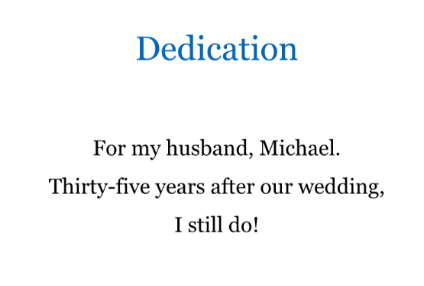
First is the dedication page:

image

For my husband, Michael. Thirty-five years after our wedding, I still do!

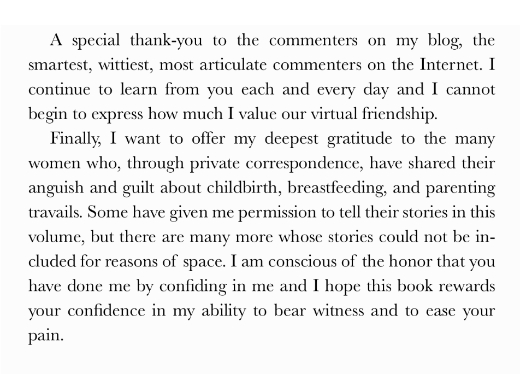
Second is an excerpt from the acknowledgements:

image

… A special thank-you to the commenters on my blog, the smartest, wittiest, most articulate commenters on the Internet. I continue to learn from you each and every day and I cannot begin to express how much I value our virtual friendship.

Finally, I want to offer my deepest gratitude to the many women who, through private correspondence, have shared their anguish and guilt about childbirth, breastfeeding, and parenting travails. Some have given me permission to tell their stories in this volume, but there are many more whose stories could not be included for reasons of space. I am conscious of the honor that you have done me by confiding in me and I hope this book rewards your confidence in my ability to bear witness and to ease your pain.

Hey, Dr. Jay, maybe you could offer personal belief exemptions for formula feeding

Hypocrisy Concept

I suppose if you’re going to be a hypocrite, you might as well jump in with both feet.

I’ve been arguing about breastfeeding on Twitter with anti-vax hero Dr. Jay Gordon.

We started with this:

image

Dr. Jay decided to take a whack at me after I questioned his claim that not breastfeeding is a “major risk factor” for ear infections. Since high quality research shows that breastfeeding reduced the incidence of ear infections by only 8%, formula feeding couldn’t possibly be a major risk factor.

[pullquote align=”right” cite=”” link=”” color=”” class=”” size=””]Here’s a crazy idea: let’s ask women themselves why they choose formula![/pullquote]

Dr. Jay refused to answer a direct question, a move he made over and over again in our conversation.

Instead he offered a personal attack. But how could I be anti-breastfeeding when I breastfed 4 children? Dr. Jay couldn’t answer that one, either.

Then Dr. Gordon offered the standard trope of the breastfeeding industry:

Most of the time that breastfeeding did not succeed it was because we docs did not offer enough support and/or find a good IBCLC

Dr. Gordon is an IBCLC.

Lactivists claim over and over again that women stop breastfeeding because of lack of support.

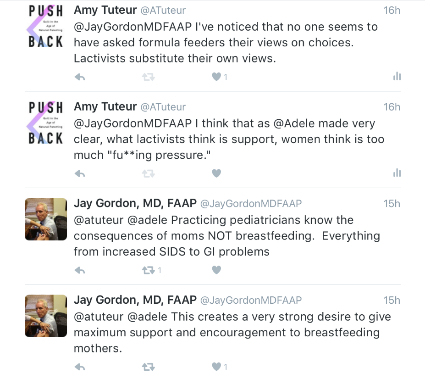
Here’s a crazy idea: let’s ask women themselves instead of having lactivists speculate that what was needed was more support from the breastfeeding industry!

image

Dr. Jay apparently thinks he knows better than formula feeders.

Practicing pediatricians know the consequences of moms NOT breastfeeding. Everything from increased SIDS to GI problems. This creates a very strong desire to give maximum support and encouragement to breastfeeding mothers.

Holy Hypocrisy, Dr. Jay! Aren’t you the same guy who offers personal belief exemptions for vaccine refusal?

Didn’t you say this to CBS?

If somebody with measles walked into Dr. Gordon’s office, 90 percent of the unvaccinated people who come in contact with them would get measles.

I asked Dr. Gordon to explain how that type of contagion isn’t a risk.

“You just said it, they’d get measles,” Dr. Gordon replied. “Not meningitis, not the plague, not Ebola, they’d get measles. Measles is almost an always a benign childhood illness.”

So it’s okay for kids to get measles from being unvaccinated, but you think ear infections are a major public health problem requiring you to hector women into breastfeeding?

I, of course, followed up with the obvious question:

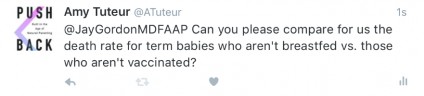
image

Can you please compare for us the death rate for term babies aren’t breastfed vs. those who aren’t vaccinated?

He did not respond.

The incident highlights the hypocrisy of the anti-vax movement, but it also highlights a very serious deficiency of the lactivist movement, the refusal to listen to women who choose formula feeding.

The breastfeeding industry would rather substitute it’s own self-serving views of why women formula feed (they didn’t hire a lactation consultant and pay for support) than to acknowledge that breastfeeding can be difficult, painful and fail to produce enough milk to nourish a baby.

Perhaps Dr. Jay might change his mind about formula feeding if he could find a way to profit from that, too. I humbly suggest personal belief exemptions for formula feeding. Maybe then Dr. Gordon would respect women who formula feed as much as he respects women who don’t vaccinate.

If natural childbirth advocates cared about bodily autonomy they’d be recommending epidurals and C-sections

Rights

Natural childbirth advocates adore facile arguments.

Consider radical doula Elisa Alpert’s screed in New York Magazine’s The Cut.

Alpert asks:

[pullquote align=”right” cite=”” link=”” color=”” class=”” size=””]The natural childbirth industry’s commitment to bodily autonomy for women is a mile wide and an inch deep.[/pullquote]

Why is the delivery room the one place where a woman doesn’t have control over what happens to her body?

And:

But obstetric violence is the last culturally acceptable form of violence against women.

Ooooh, that sounds really edgy. She’s speaking truth to power! Except she’s not.

These glib claims sound deep and meaningful as long as you don’t stop to think about them. But when you unpack the natural childbirth industry’s purported commitment to bodily autonomy for women, you find that it’s a mile wide and an inch deep.

The reality is that the natural childbirth industry is committed to bodily autonomy ONLY in regards to their goods, services and recommendations. If they were truly committed to bodily autonomy, they’d be counseling women to have epidurals and maternal request C-sections, perhaps the ultimate expression of  a woman’s right to control her own body. The reality is, though, that if they can’t provide it or profit from it, natural childbirth advocates don’t support it, bodily autonomy be damned.

The principle of bodily autonomy is very simple: mentally competent adults have the right to control their own bodies.

So if natural childbirth advocates believe that pregnant women have the right to bodily autonomy, that would mean they have the right to choose what happens to them during childbirth. But that’s NOT what natural childbirth advocates mean. Their claim is a stunted, truncated version of bodily autonomy.

When natural childbirth advocates invoke bodily autonomy, they mean “the right to refuse medically recommended interventions in childbirth, and substitute them with the products and services of the natural childbirth industry.” The natural childbirth industry can’t provide or profit from either epidurals or C-sections so they demonize and oppose them.

How is the choice of an epidural an expression of bodily autonomy? Because pain robs women of control.

Dr JaneMaree Maher of the Centre for Women’s Studies & Gender Research at Monash University in Australia, offers a  way of conceptualizing pain and empowerment, one that resonates with the majority of women. In her article The painful truth about childbirth: contemporary discourses of Caesareans, risk and the realities of pain , she observes:

… Pain will potentially push birthing women into a non-rational space where we become other; ‘screaming, yelling, self-centered and demanding drugs’. The fear being articulated is two-fold; that birth will hurt a lot and that birth will somehow undo us as subjects. I consider this fear of pain and loss of subjectivity are vitally important factors in the discussions about risks, choices and decisions that subtend … reproductive debates, but they are little acknowledged. This is due, in part, to our inability to understand and talk about pain.

As she explains:

… [W]hen we are in pain, we are not selves who can approximate rationality and control; we are other and untidy and fragmented. When women give birth, they are physically distant from the sense of control over the body that Western discourses of selfhood make central …

Natural childbirth advocates are well aware that childbirth itself is uncontrollable. That’s why they emphasize giving in to, and reveling in the process. But most women have no interest in letting a bodily process control their minds and choices; they’d prefer to use their minds to control bodily processes.

Most women have no interest in letting menstrual pain control them for several days each month so they choose medications that can diminish menstrual pain and decrease heavy menstrual bleeding.

Similarly, most women have no interest in letting childbirth pain control them for dozens of hours. They choose epidurals to relieve that pain so they can be awake, aware and IN CONTROL as their babies are born.

Vaginal birth is even rougher on women’s bodies than childbirth pain. It can lead to everything from decreased sexual satisfaction to disabling urinary and fecal incontinence. Some women wish to take every possible precaution against unfortunate outcomes by choosing elective C-section instead. We can argue about the risks and benefits, but it is thoroughly disingenuous to argue as natural childbirth advocates do, that women shouldn’t be allowed to opt for C-sections by choice.

Arguments from bodily autonomy should be agnostic as to what women actually do with their bodies. If natural childbirth advocates truly respected women’s bodily autonomy, they’d treat all possible childbirth choices — epidural vs. unmedicated birth, C-section vs. vaginal birth — as equal and equally worthy of respect, but they don’t.

In my view, it is the natural childbirth industry who is perpetuating obstetric violence by insisting that women must be forced or bullied into enduring the violence of childbirth pain and vaginal delivery. They bully women because the natural childbirth industry believes it knows better than women themselves what is good for women — purchasing the products and services of the natural childbirth industry.

I mother with my entire body. Isn’t that what good mothers do?

image

To hear natural childbirth advocates and lactivists tell it, the entire story of mothering can be reduced to three body parts: the uterus, the vagina, and breasts. I’ve been thinking about how I have mothered my four children over the past twenty-eight years, and it seems as if I have used just about every part of my body.

[pullquote align=”right” cite=”” link=”” color=”” class=”” size=””]These are the body parts I want my children to think of when they think of me.[/pullquote]

Arms: I used my arms a lot, not just to carry my children, although I carried them quite a bit when they were small. I used my arms primarily to embrace them. Hugs are the appropriate response in times of both happiness and sadness, or for no better reason than to be close. I cannot count the times I hugged my children, and even now, when they are adults, I still do.

Hands: I think I spent ten solid years holding hands. Holding toddlers’ hands when they learned to walk. Holding hands crossing the street and in the parking lot. Holding hands just because it is fun to hold hands.

I also used my hands to sew clothes for my children, to fill out a million permission sheets for field trips, to feel foreheads for temperatures, and to help with a billion school projects. (If anyone needs pipe cleaners, I still have hundreds!)

Lips: I kissed my children over and over and over again. I kissed boo-boos. I kissed to check for fevers. I kissed for no better reason than I loved to kiss them. Of course there were years I had to lay off the kissing because public kissing was just too embarrassing for teenagers, but those years are over now, and I can kiss them again, at least when I’m greeting them.

Legs: I walked miles holding fretful infants in the middle of the night; shopping for clothes and shoes and toys; tramping out to baseball fields, football fields, soccer fields, and basketball courts to cheer my children on.

Mouth: I used it to tell my children that I loved them, but I also used it to advocate for them, to seek out appropriate evaluation and therapy for learning disabilities, to explain them to teachers, to explain life’s lessons to them, and to praise them when they did something amazing, which was often.

My entire body: Is there anything that gives comfort like a mother’s body? It provides comfort when you are awake sitting near your children, and even when you are asleep lying next to them in bed after a nightmare.

Brain: I thought about my children constantly, when I was with them and when I was not. I taught them facts and I taught them morals. I worried when they were little; I worried when they were teenagers; and I still worry now. I shared my views on how they should treat others and how they should be proud of themselves (or not, as the case warranted). I conveyed my religious beliefs and my political views. I planned for them, I brainstormed with them, and I hoped desperately that I could give them what they needed to be happy and healthy and to reach their full potential.

Last, but not least, I used my heart. Of course I don’t mean my physical heart, although it sometimes felt like it when they were hurt or disappointed. I am referring to my metaphorical heart. I loved and I still love my children more than life itself and I have tried to convey that to them. They and their father are the most important people in the universe as far as I am concerned, and it is my deepest wish that they know it and feel it.

Yes, my children grew in my uterus. Yes, they transited my vagina when they were born. Yes, I nourished them with my breasts, but I don’t think that made much difference to who they are and to how I love them. I would gladly have had C-sections if there had been even the slightest chance that they were at risk during birth. I would have happily supplemented with formula if I hadn’t been lucky to produce enough milk. My children don’t remember those days, and frankly, they couldn’t care less.

That’s fine with me. Those body parts are not the ones that I want my children to think of when they think of me. I want them to remember holding hands when they were little, countless hugs and endless kisses. I hope they remember my physical presence beside them when they were sick, next to them in bed when they had bad dreams and in the bleachers or the audience for sports and plays and graduations.

I, like most women, mother with my entire body. Isn’t that what good mothers do?


Excerpted from PUSH BACK: Guilt in the Age of Natural Parenting.

Birth, the way nature intended it to be!

image

Natural childbirth advocates are like preschoolers who when asked where eggs come from answer, “the store.”

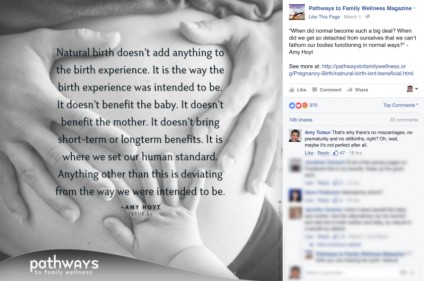
Only a preschooler or a natural childbirth advocates could imagine nonsense such as that from Pathways to Wellness Family Magazine:

[pullquote align=”right” cite=”” link=”” color=”” class=”” size=””]The idea that nature intended childbirth to be safe is hilarious … and deadly.[/pullquote]

Natural birth doesn’t add anything to the birth experience. It is the way that the birth experience was intended to be. It doesn’t benefit the baby. It doesn’t benefit the mother. It doesn’t bring short-term or long term benefits. It is where we set out human standard. Anything other than this is deviating from the way we were intended to be.

The author appears to think that anything other than unmedicated vaginal birth deviates from “the way we were intended to be.”

The idea that homebirth in a plastic kiddie pool is what nature intended is hilarious.

Here’s what nature really intended:

Age at first birth: 16-18
Years since menarche: less than 1
Life expectancy: 35 years
Maternal mortality: 1 per 100
Lifetime birth risk: 1 in 13
Neonatal mortality: 7 per 100
Number of children: 8-10

Nature also intended:

Miscarriage rate: 20%
Prematurity rate: 12%
Stillbirth rate: 1.9%

How did natural childbirth advocates get the idea that nature intended birth to be safe? They got the idea in the same way that 3 year olds get the idea that eggs come from the store: that’s what their personal experience tells them. Three year olds assume that their personal experience is the beginning and the end of what is possible. Natural childbirth advocates assume that the present safety of childbirth is the beginning and end of what is possible. But they’re not three years old; they ought to know better.

Childbirth seems to be safe for one and only one reason: because the widespread use of childbirth interventions has made it safe. Those are the very same interventions that they deem to be unnecessary.

Claiming that childbirth interventions aren’t needed to protect the lives of pregnant women and their babies is the intellectual equivalent of pretending that chickens aren’t needed for eggs since the eggs can be found at the grocery store. Of course, there’s one big difference. Believing that eggs come from the grocery store is charming; believing that childbirth is safe without routine interventions is deadly.

Dr. Amy