Motherhood and the tyranny of the N-words

letter n

Words have power.

Therefore, I am rather surprised at the vehemence with which some people in our multi-day Twitter conversation are defending the use of the word “normalizing” in reference to breastfeeding. Perhaps they simply don’t realize the viciousness with which many mothers wield the two ugliest N-words in contemporary parenting discussions: normal and natural.

Both are used to justify elevating some mothering choices over others, e.g. normal birth, natural childbirth, normalizing breastfeeding, etc.

Obstetrician and bioethicist Anne Drapkin Lyerly explains the problem in her paper Ethics and “Normal Birth”:

… “normal” indicates something that is normative or morally preferable—a state we ought to strive for. The result is a “fundamental tension” between normal as an “ordinary healthy state” and a “state of perfection toward which communities can strive.” In this way, the “normal” birth becomes (in hearts and minds) the good birth, potentially leaving women who use technology to conclude that they have somehow failed …

In other words, there is a fundamental ambiguity between normal as “common” and normal as “morally preferable.”

[pullquote align=”right” color=”#0e533c”]Better to be precise and kind than inadvertently vicious and shaming.[/pullquote]

When natural childbirth advocates and lactivists use the word “normal,” they mean “morally preferable” or normative:

… an ideal standard of or model, or being based on what is considered to be the normal or correct way of doing something.

The word “natural” is used in the same way, and it, too, embodies a fundamental ambiguity between natural as “the absence of technology” and natural as “a state of perfection that can only be marred by technology.” The second use is embodied in the naturalistic fallacy that undergirds so much of alternative health and quackery, the belief that because something is a certain way in nature, it ought to be that way always.

When birth activists promote natural birth or normal birth, they are using the N-words as normative and morally preferable. Natural childbirth is presented as better, safer and healthier than birth with technology. It’s not merely natural, it’s normal, too, the way that birth is supposed to be. Anyone who deviates from natural childbirth has failed her child in a fundamental way.

When lactivists promote normalizing breastfeeding they are also using an N-word to signify normative and morally preferable. Breastfeeding is routinely presented as “best” just in case calling it natural and normal did not convey that good mothers breastfeed exclusively. Anyone who deviates from breastfeeding exclusively has failed her child in a fundamental way.

Birth and breastfeeding advocates are aware that describing childbirth and breastfeeding in these ways is vicious, creating two classes of mothers, good mothers and bad mothers. They want to use these terms viciously but they don’t want to be accused of doing so. Therefore, they exploit the fundamental ambiguity to create plausible deniability. No, no, no, they don’t mean that normal birth is better; they just mean that it is the common way to give birth. No, no, no, they’re not trying to shame formula feeding mothers, they’re simply pointing out that breastfeeding is the normal and natural way to feed an infant.

We shouldn’t let them get away with it.

Words have power and birth and breastfeeding activists use the power of normal and natural to denigrate women who use technology (epidurals in particular) in birth or technology (infant formula) to nourish their babies. Then they capitalize on the ambiguity of those words to claim, with straight faces no less, that they weren’t trying to make anyone feel bad, when that was precisely what they were aiming to do.

Let’s not let them get away with it.

When used in the context of mothering, N-words are explosive and destructive, so let’s not use them. I implore people to think carefully before employing the words normal or natural to describe either childbirth or breastfeeding. We should strike the term “normalize” entirely from any discussions about mothers.

We should support unmedicated vaginal birth for those who seek it, but we should never call it normal or natural, and we should never try to normalize it.

We should support breastfeeding for those who choose it, but we should never call it normal or natural, and we should never try to normalize it.

Words have power, and those who believe they are using the N-words to signify “common” or “expected” should keep that ambiguity in mind. Otherwise, they are contributing to the vicious effort by some mothers to denigrate other mothers. Better to be precise and kind than inadvertently vicious and shaming.

Stop “normalizing” breastfeeding!

26371423_s

Apparently I hit a nerve.

I wrote a post last night comparing admonitions to breastfeed with admonitions to continue unwanted pregnancies.

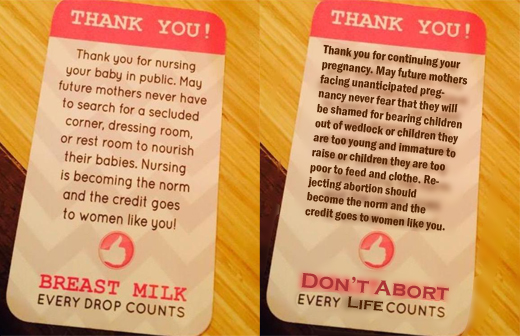
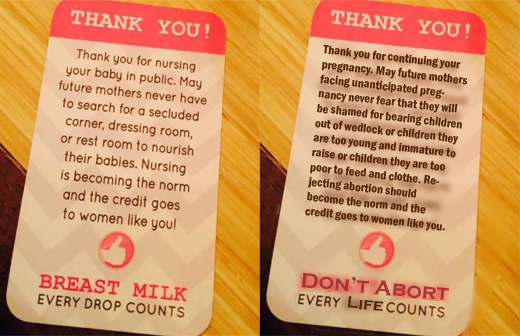
I used the following images to illustrate my point:

Every drop don't abort

On Twitter, journalist Tara Haelle commented on the image on the left. She promoted it as “normalizing” public breastfeeding and I’m confident that she is entirely sincere in that belief. But I see it as promoting breastfeeding as “best.”

As I explained, I suspect that many women would be offended by a group that felt itself entitled to comment on women’s pregnancies and whether or not they choose to continue them. The not-so-subtle hectoring at the bottom, “every life counts,” reflects the group’s religious beliefs and the belief that they are entitled to police pregnant women’s bodies.

The piece generated dozens of tweets, many of them furious that I had dared to equate “pro breastfeeding” with “pro life.” However, not a single person could explain what was wrong with the analogy beyond the fact that they found it unflattering to their cause. Haelle herself emphasized once again that she was only trying to “normalize” public breastfeeding.

[pullquote align=”right” color=”#f9a42f”]Normalization is the construction of an idealized norm of conduct and then rewarding or punishing individuals for conforming to or deviating from the ideal.[/pullquote]

But we shouldn’t be trying to “normalize” breastfeeding (public or private) in the first place.

Why not? Because “normalization” is just a fancy way to discriminate and shame.

Consider:

Uganda wants to “normalize” traditional sexuality, thereby marginalizing gay people.

Many residents of the Old South want to “normalize” the Confederate flag, sending sending subtle and not so subtle messages about race, slavery and citizenship.

Anti-choice advocates struggle to “normalize” continuing unwanted pregnancies because they oppose abortion.

Therefore:

When lactivists seek to “normalize” breastfeeding, they want to marginalize and shame formula feeders.

This harks back to the definition of “normalization.” As Wikipedia explains:

… The concept of normalization is found in the work of Michel Foucault … As Foucault used the term, normalization involved the construction of an idealized norm of conduct – for example, the way a proper soldier ideally should stand, march, present arms, and so on, as defined in minute detail – and then rewarding or punishing individuals for conforming to or deviating from this ideal. In Foucault’s account, normalization was one of an ensemble of tactics for exerting the maximum social control with the minimum expenditure of force …

Lactivists use the term normalization to construct an idealized norm of conduct – breastfeeding – and then rewarding or punishing individual women for conforming to or deviating from this ideal. Normalization is a tactic for exerting maximum social control with minimum effort.

Lactivists seek to make breastfeeding normative, meaning:

… an ideal standard of or model, or being based on what is considered to be the normal or correct way of doing something.

But in first world countries, where the benefits of breastfeeding are trivial, making breastfeeding normative means imposing some women’s norms on other women. It means telling women what they should be doing with their breasts, instead of leaving that decision to them.

Contrary to the claims of lactivists, women choose not to breastfeed or stop breastfeeding for a host of reasons that lactivists refuse to acknowledge: breastfeeding can be difficult, painful and inconvenient for mothers and it can lead to failure to thrive in some babies. It has nothing to do with formula marketing, nothing to do with lack of encouragement in hospitals, and nothing to do with lack of knowledge.

Simply put, women decide to not to breastfeed or to stop breastfeeding for intrinsic reasons, not extrinsic reasons. Normalizing breastfeeding makes as much sense as normalizing heterosexuality. There is not a gay person alive who isn’t aware that heterosexuality is normative and no marketing tactics or lack of education leads them to be gay. Similarly, there’s hardly an American woman alive who isn’t aware that breastfeeding is “best” and no marketing tactics or lack of education leads them to choose formula. It is extraordinarily demeaning to pretend otherwise.

When lactivists normalize breastfeeding, they are subtly and not so subtly sending the message that women who choose formula are abnormal. That’s what they intend to do.

There’s no reason for the rest of us to join them in their campaign of shame and intimidation.

What’s the difference between promoting breastfeeding and promoting continuing unwanted pregnancies? Nothing.

22448979_s

Promoting breastfeeding is about policing women’s bodies in the exact same way that promoting continuing unwanted pregnancies is about policing women’s bodies.

It is a sad fact of history that men have spent a tremendous amount of time policing women’s bodies. And an even sadder fact is that women have often been the prime enforcers in this effort.

Consider female virginity. From shaming to chastity belts to genital mutilation, society has considered a woman’s virginity a husband’s property. It is a practice designed by men, for men, to preserve men’s privileges, yet women were often willing enablers.

[pullquote align=”right” color=”#a3dfe9″]Under the guise of what’s best for babies, lactivists feel entitled to tell women how to use their breasts.[/pullquote]

You might think that the time of women as enforcers of policing other women’s bodies has passed. You’d be wrong. There are now entire movements devoted to policing women’s bodies: one of them is the anti-choice movement.

Another is the lactivist (breastfeeding advocacy) movement.

Consider:

Under the guise of what’s “best” for babies, anti-choice advocates feel entitled to tell other women how handle their pregnancies.

Under the guise of what’s “best” for babies, lactivists feel entitled to tell other women how to feed their infants.

Why do the same women who believe fervently that women have the right to control their own bodies, and that no one should be condemned for choosing abortion ignore the fact that women have the right to control their breasts and shame them for formula feeding?

Does the right to control one’s own body get expelled with the placenta? I don’t think so.

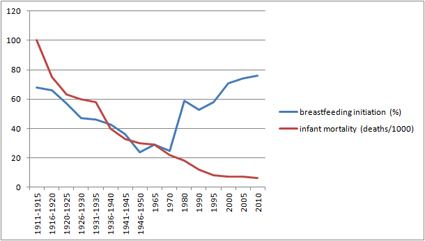
The benefits of breastfeeding are trivial as the chart below demonstrates.

breastfeeding and infant mortality

It’s a chart showing the impact of widely fluctuating breastfeeding initiation rates (70% dropping to 22% rising to 75%) in the last century on infant mortality. As you can see, breastfeeding has had no impact on the single most important measure of infant health.

Public health campaigns ought to be reserved for major public health risks and benefits. A public health campaign against smoking makes sense because lowering the smoking rate saves lots of lives. A public health campaign promoting vaccination makes sense because increasing vaccination rates saves lots of lives. A public health campaign to promote breastfeeding makes no sense because in first world countries the benefits are so small.

So why do we have public health campaigns to promote breastfeeding when the benefits are trivial?

Because there is an entire industry that makes money only when women breastfeed: the lactation consultant industry.

And because some women simply cannot mind their own business. Under the guise of what’s best for babies, they feel entitled to tell women how to use their breasts.

On Twitter, journalist Tara Haelle posted the image about breastfeeding on the left side. She promoted it as “normalizing” public breastfeeding and I’m confident that she is entirely sincere in that belief. But I don’t see that image as normalizing public breastfeeding; I see it as promoting breastfeeding as “best.”

Every drop don't abort

I created the image about pregnancy on the right to explain to Tara why I feel the way I do.

I suspect that many women would be offended by a group that felt itself entitled to comment on women’s pregnancies and whether or not they choose to continue them. The not-so-subtle hectoring at the bottom “every life counts” reflects the group’s religious beliefs and the belief that they are entitled to police pregnant women’s bodies.

I don’t think we would consider it “normalizing” pregnancy.

We should be equally offended by a group that feels itself entitled to comment on women’s infant feeding choices and how they are using their breasts. The not-so-subtle hectoring at the bottom that “every drop counts” reflects lactivists’ personal beliefs and the belief that they are entitled to police the bodies of new mothers.

What’s the difference between promoting breastfeeding as superior and promoting continuing unwanted pregnancies as superior to abortion?

Nothing that I can see.

Postpartum Oppression

image

We’ve all heard of postpartum depression, a form of clinical depression that occurs after childbirth. It is a serious medical issue and is probably precipitated by the wide fluctations in hormones after childbirth, compounded by lack of sleep and other features of mothering a newborn. Postpartum depression is a medical condition that requires medical attention.

There’s another phenomenon, far more widespread, causing misery to many more women. I suggest we call it postpartum oppression. Its cardinal symptom is a suffocating sense of inadequacy provoked by the guilt and shame of failing to meet the arbitrary guidelines of the dominant mothering ideologies, natural childbirth and attachment parenting.

Consider this recent piece featured on news.com.au, Modern mums are anxious, stressed about babies: new study:

…[R]esearch shows mothers are feeling ashamed, marginalised and guilty because they can’t meet the strict messages of breast feeding and sudden infant death campaigns.

They feel even more inadequate when told to use their maternal instinct to solve mothering issues when they are confused by conflicting information.

And they are battling to live up to an idealised image of how motherhood “should” be.

Furthermore:

)Over simplified public health messages that breast is best … overstate the risk of not doing this and can make mums feel anxious.

Public health campaigns, health professionals and others could reduce this anxiety by providing realistic, understandable, numerical information to assist decision making, they say.

“Nobody doubts that the message that promotes breast feeding is a good thing, but breastfeeding might not be easy to do and for some it is extremely difficult. Women who make an informed choice not to go ahead can be made to feel guilty and ashamed,” says Dr Rowe.

Women who decide to bottle feed can be discharged from hospital without any bottles, with no instructions on mixing formula, which can make them feel unsupported and marginalised, she says.

It’s not just pressure to breastfeed that leads to postpartum oppression; pressure to have an unmedicated vaginal birth, and irresponsible speculation on the purported dangers of C-sections are major contributing factors. These triggers for postpartum oppression share several characteristics:

  • They are arbitrary measures of motherhood formulated by privileged white women and reflecting their preferences and prejudices.
  • They grossly exaggerate the benefits of breastfeeding and vaginal birth and flat out lie about the purported benefits of unmedicated childbirth.
  • The condemnation of C-sections is based on hyperbole, hysteria and bad research on the purported dangers of C-sections.
  • A cadre of childbirth paraprofessionals, midwives, doulas, childbirth educators, and lactation consultants profit from these arbitrary standards.
  • They are profoundly anti-feminist, reducing mothering to the ways that women use their breasts, vaginas and uteri, and minimizing the much greater impact of maternal love, learning and character.

In contrast to postpartum depression, which occurs spontaneously and is to be regretted, postpartum oppression is deliberately inflicted by some women (generally Western, white and relatively privileged) on other women (including women of color and women of lower socio-economic classes.) Even though it is a woman-made problem, it is responsible for considerable suffering.

The primary mode of transmission of postpartum oppression is the internet.

Dr Rowe says mother anxiety was being made worse because of the internet which encouraged worried parents to try and find more information when much of it was not evidence based.

“The solution is to try and find a trusted source of information and limit yourself to that,” says Dr Rowe.

Health professionals and those in contact with mothers needed to unpack simplified public health messages and reassure and support mothers in the choices they made, she said.

They should address the inaccurate stereotype that mothering is instinctive, which can paint a highly idealised image of how motherhood ‘should’ be.

“Mothering is a set of learned skills and you learn on the job,” Dr Rowe says.

The deliberate infliction of postpartum oppression has created a crisis of confidence among new mothers and a pervasive sense of guilt and shame. It is a perversion of existing scientific evidence; an arbitrary standard foisted by privileged women on those less privileged; it enriches childbirth paraprofessionals at the expense of their patients, and it is profoundly anti-feminist, grounding successful mothering, as it does, in women’s reproductive organs and effectively ignoring everything else about them …

and it has got to stop!

On our anniversary, a love letter to my husband

image

Years ago, our daughter gave us a very fine compliment.

Discussing her day over dinner one night, she reported that her high school “Issues” class was studying marriage. The teacher had told the students that a successful marriage has three elements: friendship, intimacy and passion.

“That’s you guys,” she said, looking toward her father and me. “I raised my hand,” she continued, “because I had lots of examples to share.”

I was thrilled, both because of the compliment, and because she has been observing what her parents tried to teach to her and to her brothers. My first, greatest, and longest lasting joy in life is my husband.

My children, of course, are my heart. They are as much a part of me as an arm or leg. Their joys are my joys; their sorrows are my sorrows (generally multiplied by a factor of two) and their fears are my fears (generally multiplied by a factor of ten). But my husband is the source of most of the good things in my life, and has been for the 34 years we have been married, and even before.

As the “Issues” teacher said, the basis of a successful marriage is friendship. According to the late, great Ann Landers, “Love is friendship that has caught fire.” That is indeed what happened in our case. We met sophomore year of college as part of a large group living in the same dorm. When I started making my interest known, it was his fear for our valued friendship that made him hesitate. However, after throwing myself at him (there is no more glamorous way to describe it), I wore down his resistance.

Yet as our relationship grew, the friendship remained at the very core. He has been at my side through medical school, residency, work, the births of four children, the struggles we have shared with our children over their challenges, not to mention countless Little League games, Back-to-School nights, and dance recitals. Fifteen years ago when I stepped out of the MRI scanner and told him that I had brain tumor, his first words were, “I wish it were me.”

There is no one I would rather be with, talk to, read with, or watch football with. We are about a micron apart on the political spectrum, but have managed to have countless heated discussions about it, nonetheless.

Intimacy is also a vital quality for a successful marriage. I can share anything with my husband, including every fear and every embarrassment. He is always in my corner. I can also expect good advice. Although I’d like to tell you that he agrees with everything I do, the truth is a bit different. He’s not afraid to gently chide me, or counsel me to approach a situation differently. He’s a much nicer person than I am; in fact, he’s the nicest person I know, so that makes his advice and criticism easier to take.

There are additional components beyond the three that the “Issues” teacher discussed. Commitment and compromise are vital. A lifetime together involves a lot of momentous decisions, and the ability to compromise is necessary to smooth the way. For example, my husband thought he wanted two children, and I wanted four. So we compromised on four and he is very happy that we did.

That issue aside, there have been a lot of compromises: about careers, about work hours, about whose needs will be met when. If you can’t compromise, a marriage can be sunk. And when compromise seems very distant, commitment to the relationship, to making sure that everything works out, and to hanging on even when it seems like it might not, can tide you over to better times.

Everyone knows about the passion part of marriage. What I didn’t know 34 years ago was that the passion only increases. The boy I married because I liked, loved and was attracted to him is now the man who held my hand in labor, who tenderly nurtured our children, who supported me through my personal crises and who has become a respected and admired professional. I still like him, I certainly love him, and I am more attracted to him than ever, but even that does not adequately express the passion I feel for him more than 34 years after he captured my heart.

I am the luckiest woman alive, and I know it. He made all of my dreams come true, including the most the most important one. He showed me that true love is real.

The lyrics from the old standard, I Remember You,  convey my feelings best:

When my life is through,
And the angels ask me to recall
The thrill of them all.
I will tell them I remember you.


Adapted from a piece that first appeared in February 2009.

The unbearable obtuseness of being a Tim Hunt apologist

image

You cannot make this stuff up.

Hunt apologist Louise Mensch published a post on her blog Unfashionista entitled Royal Society’s ‘Diversity Committee’ Pre-Judged #TimHunt. Now UCL Should Give Him Due Process.

In an effort to defend Hunt’s indefensible comments about women in science, Mensch asks us to consider the impact of the outcry on …. his wife.

[pullquote align=”right” color=”#000000″]Who among Hunt’s apologists offered due process to Connie St. Louis before attempting to eviscerate her reputation? [/pullquote]

Imagine the scene: you are a distinguished female scientist, a Professor and an employee of the college you work for, University College, London. You have a blameless employment record and have served your employer – and its students – with distinction for many years.

Suddenly you receive a call from a senior representative of your employer, pressurizing you about the actions of your spouse – actions you have nothing to do with, and do not understand as yet, because he is unable to speak for himself, as he is traveling back home from the far side of the world.

Your employer’s representative gives you a message for your spouse; he must resign, or he will be sacked. Your employer places you in the middle of its workplace drama with somebody else, a drama which, as a female scientist, you had nothing to do.

What a terrible, stressful suggestion – from your place of work – pass on its threat of public humiliation, without due process, to your beloved husband, an old man of 72, whom they are not allowing to come home and speak to them first…

I’d call that sexist … bloody sexist.

Mensch gets an “A” for effort in twisting herself into a pretzel to defend Hunt. How dare anyone hold Hunt accountable for his misogynistic comments? It’s gender discrimation against his wife and it’s ageist since Hunt is an “old man.”

She also gets an “A” for obtuseness and chutzpah.

Consider this example:

Imagine the scene: you are a distinguished female journalist. a You have a blameless employment record and have served your employer – its students – with distinction for many years.

You attend a conference honoring women where a prominent male speaker makes misogynistic remarks. Like any journalist when presented with a story, you report it.

Suddenly you are subjected to a vicious campaign from apologists for misogynists, involving public abuse and destruction of your repuation.

Your abusers gives you a message; you must retract your comments or the abuse will continue.

Other women are also sent a message: prepare yourself for a vicious campaign of character assassination and abusive public comments if you dare to hold a prominent man to account by reporting on his misogynistic views. Your critics place you in the midst of a vitriolic campaign just because you, as a female journalist, dared to report what you had heard.

What a terrible, stressful situation.

That would be the situation in which the journalist Connie St. Louis finds herself. That’s gender discrimination, too, right? That seems never to have crossed Mensch’s mind.

The bulk of Mensch’s rambling, unfocused piece is devoted to her contention that Hunt did not receive due process.

On June 9th, before Sir Tim Hunt had been able to speak to his university, University College London, or any statement from him had been broadcast, three Professors – two with affiliations to UCL and one to the Royal Society were – without even speaking to Sir Tim – plotting to deprive him of his honours without due process of any kind. It is VERY IMPORTANT TO NOTE that they did so BEFORE his comments to Radio 4’s “Today” Show were broadcast.

Let’s leave aside for the moment that due process is a concept from American law and does not have an analog in British law. The idea that it is wrong to rush to judgment without knowing all the facts is certainly a worthy ideal. Which raises several important questions:

Why did Hunt’s apologists rush to defend him before they knew all the facts?

Why did Hunt’s defenders fabricate mitigating details about Hunt’s statements without checking the facts?

Who among Hunt’s apologists offered due process to Connie St. Louis before attempting to eviscerate her reputation? None, right?

What due process has been available prior to publicly heaping abuse on Hunt’s critics? None, right?

Both Mensch’s curious concern for due process for Tim Hunt but no one else and her absurd framing of this episode as gender discrimination against Hunt’s wife while turning a blind eye to the vicious misogyny directed at St. Louis and other Hunt critics is emblematic of the obtuseness of Hunt’s critics. Simply put, Hunt apologists would rather talk about anything else but Hunt’s inexcusable remarks.

What ever happened to taking responsibility for mistakes and accepting the consequences for those mistakes? Hunt made a serious mistake; why are his apologists straining to deny Hunt’s responsibilty and to reject accountability for misogyny?

The manufactured outrage of Mensch and other Hunt apologists is a de facto embrace of gender discrimination and no amount of obtuseness on their part conceals that regrettable fact.

Ricki Lake, Jenny McCarthy and The Business of Being Bamboozled

image

Ricki Lake wants to do for the Pill what Jenny McCarthy did for vaccines.

Lake, like McCarthy, is a mama-shill.

What’s a mama-shill? A mama-shill is a woman who believes that gestating and giving birth to a human being has magically rendered her qualified to shill on pretty much anything related to reproduction and children. Mama-shills make a business out of bamboozling other mothers. What are her characteristics?

  • Anti-intellectualism? Check.
  • Belief in ludicrous conspiracy theories? Check.
  • Advanced education? Surely you jest?
  • Knowledge of biology, statistics and epidemiology? What are those?

[pullquote align=”right” color=”#000000″ ]They’re not pro-preventable death; they just want to be free to profit from it.[/pullquote]

Mama-shills make up for their profound deficiency in actual knowledge by their reliance on discredited members of the medical profession or self-proclaimed experts who are recognized as experts by no one but themselves. McCarthy venerates Andrew Wakefield, the doctor who was stripped of his medical license for a faulty study attempting to discredit the MMR vaccine in order to pave the way for profiting from his own formulation of the vaccine.

For a forthcoming documentary, Ricki Lake has allied herself with Holly Grigg-Spall, the journalist who wrote the book, Sweetening the Pill. In a devastating deconstruction of the book, Lindsay Beyerstein notes:

…Grigg-Spall makes a series of seemingly contradictory claims about the capitalist-medical-feminist bloc that is supposedly bullying women into taking the pill: 1) The pill is popular because it turns women into emotionally stable and industrious workers who never miss a day of work or bleed on the shop floor and because the economy needs women’s “passivity, anxiety and emotionality.” 2) The pill is the modern-day equivalent of the 19th-century practice of “female castration,” which was used to desexualize women, and the pill is promoted as part of a feminist scheme to make women more alluring and available to men. 3) The pill kills female libido, and the pill fuels the supposed epidemic of sluttiness known as “raunch culture.” Does the pill masculinize, ultrafeminize, or unsex women entirely? Grigg-Spall claims all of the above!

Grigg-Spall isn’t sure what the Pill does, but she’s sure she wants to demonize it. And Ricki Lake is attempting to make a documentary from her book because she wants to demonize the Pill, too, so she can profit from the demonization. Lake employs the same tactics that McCarthy used to create fear of vaccination.

  • Faulty “science.”
  • Disingenuous claims of “merely questioning” established science.
  • Refusing to address or even acknowledge scientific criticsm.
  • Accusing anyone who disagrees of being a Pharma-shill.
  • Banning dissent from websites and Facebook pages promoting the product.

Lake, like McCarthy, is in the business of bamboozling other mothers for attention and profit. All of which would be fine if people didn’t die as a result. McCarthy created an empire of books, organizations, articles and appearances built on a lie that killed children. She grossly exaggerated the dangers of vaccines and grossly minimized the much greater dangers of vaccine preventable diseases for fun and profit. As a result vaccine preventable diseases (such as pertussis, measles and even diphtheria) that were effectively eradicated have made a comeback and children have died. McCarthy is still shilling unrepentantly.

Ricki Lake, following Grigg-Spall, is grossly exaggerating the dangers of the Pill while grossly minimizing the much greater dangers of unwanted pregnancy and untreated conditions like endometriosis and polycystic ovary disease for attention and profit. Like all Mama-shills, she camouflages her ruthless business sense under the guise of “educating” other mothers.

McCarthy is not anti-vaccine; she just want to be free to question vaccines. Lake is not anti-Pill; she just wants to be free to question it. They’re not pro-preventable death; they just want to be free to profit from it.

Ricki Lake wants to do for the Pill what Jenny McCarthy did for vaccines … and we all know how well that turned out.

Free speech for Tim Hunt … but not his critics

image

Tim Hunt apologists employ a classic tactic in dismissing gender discrimination.

Gee, who could have seen that coming?

Tim Hunt made offensive comments about women scientists in front of a group of women scientists. He apologized and he resigned.

Many men feel very bad about this.

No, not bad about the fact that Hunt felt free to humiliate women at a meeting designed to honor them. Be serious! They felt bad that any male scientist should be held to account for his not so subtle put down.

And they did just what white men have always done when confronted with their own gender bias. They pretended that Hunt was “misheard,” though there were literally hundreds of witnesses. They pretended that he was misunderstood; it was only a joke, even though such jokes ARE gender bias. They pretended that the woman who broke the story lied about it, and then, predictably, they combed through her life to discredit her by tearing it apart.

Obviously Hunt made offensive statements. He himself admitted it. Obviously, it makes no difference if it were a joke, since jokes at women’s expense are evidence of gender bias. And destroying the reputation of the woman who broke the story, while satisfying to Hunt apologists, and designed to send a warning to other women who might report on similar offensive behavior, doesn’t change the fact that St. Louis reported the truth.

There are a few apologists that are willing to acknowledge the obvious, but then minimize its significance. Jonathan Dimbleby, a broadcaster and writer has resigned his honorary appointment at University College of London, in solidarity with Tim Hunt.

According to Dimbleby:

This is not an offence that should be enough to ensure a distinguished scientist should be told to resign his position.

Woah! What’s next? Donating the proceeds from sale of his unicorn? Nothing like demonstrating your support (resigning an honorary post) in a way that changes nothing and costs you nothing.

At least Dimbleby acknowledges that Hunt’s behavior was indeed offensive.

He explained:

The college has a long and honourable tradition of defending free speech however objectionable it may be. Sir Tim made a very poor joke and it quite rightly backfired. He then apologised for that.

Why do men like Dimbleby have such trouble understanding a concept as basic as free speech? Free speech means that you are free from government control of your speech. It does NOT mean that are free from consequences of your speech.

The government of the UK did not prevent Tim Hunt from speaking his mind. That doesn’t mean that the University College of London isn’t equally free to condemn him for what he said. Curiously, Hunt’s apologists don’t seem to think that their expansive definition of “free speech” applies to Connie St. Louis. Many have gleefully torn her reputation to shreds when there is no evidence of that her reporting of Hunt’s behavior was anything other than truthful.

Dimbleby goes on to say:

The idea that serious grown-up women thinking of pursuing a science career, and thinking of going to UCL to do so, would be put off by an elderly professor saying something silly then apologising for it seems bizarre.

You don’t say, Dimbleby. When was the last time someone made a joke at your expense about your gender, race, or religion? I’m betting never, so you lack the authority and experience to opine what a target of Hunt’s bias would or would not feel about it.

Moreover … and let me see if I can spell it in terms Hunt’s apologists can understand … the issue is not the joke. The issue is the gender bias behind the joke. Someone who feels free to make women the butt of his jokes at a conference designed to honor women may be so clueless about his own gender bias that he feels equally free to display and act on it in his treatment of his female graduate students.

Tim Hunt was entirely free to make offensive remarks to women. Connie St. Louis was entirely free to report his remarks. UCL was entirely free to condemn him for it.

The fact that apologists think there should be no consequences for Hunt’s speech, but condemnation and worse for those who were offended by it is a classic tactic in dismissing gender bias, and it is unacceptable.

The Equality Pill

image

Crossposted from Time.com.

They called it the birth control pill to signal its primary purpose, but it would have been apt to call it the equality pill.

Hormonal birth control, first available only as a pill and now in a variety of forms, is arguably the single most important technological innovation in the emancipation of women.

And Ricki Lake opposes it.

Lake, who became the celebrity avatar of the home birth movement with her movie The Business of Being Born, is embarking on a new documentary based on Holly Grigg-Spall’s book Sweetening the Pill.

[pullquote align=”right” color=”#ffb90f”]Opposition to the birth control pill is opposition to women’s emancipation.[/pullquote]

Grigg-Spall claims:

Depression, anxiety, paranoia, rage, panic attacks — just a few of the effects of the Pill on half of the over 80% of women who pop these tablets during their lifetimes. When the Pill was released, it was thought that women would not submit to taking a medication each day when they were not sick. Now the Pill is making women sick. However, there are a growing number of women looking for non-hormonal alternatives for preventing pregnancy. In a bid to spark the backlash against hormonal contraceptives, this book asks: Why can’t we criticize the Pill?

How did Lake, who advocates women’s empowerment by taking childbirth out of hospitals and returning it to the home, come to criticize what is arguably the greatest source of women’s empowerment of all time, as well as a tremendous boon to women’s health?

Surprisingly, the path is rather straightforward. She’s part of a natural parenting movement that is anti-hospital birth, anti-epidural and anti-formula — technological innovations that have made the legal, political and especially the economic liberation of women possible. Opposition to the Pill is the next logical step of that philosophy.

For most of human history, women have been reduced to slaves to their biology.

Childbirth is inherently dangerous and has always been a major cause of death for young women. Hospital birth changed that.

Childbirth is routinely agonizing and has always been a source of tremendous fear and suffering. Epidurals changed that.

Breastfeeding bound women to the home and posed serious health problems for babies of mothers who couldn’t produce enough milk and turned to unsafe supplements. Infant formula changed that.

But the single biggest factor in women’s enslavement to their biology has been the inability to control their fertility — blighting sexual enjoyment, imposing tremendous economic hardship of unwanted children, and bringing death to young mothers who agonized over being torn from their older children. The Pill changed that.

Yes, the Pill has side effects, but they are nothing compared to the side effects of pregnancy or abortion. Lake is apparently horrified that in rare cases, the Pill can lead to blood clots, and possibly death. She conveniently elides the fact that pregnancy also can lead to blood clots and death, as well as pre-eclampsia, hemorrhage and complications of pre-existing medical conditions. It’s worse than disingenuous to bemoan the Pill as a cause of death when pregnancy has a much higher death rate than the Pill, and the Pill prevents pregnancy.

The Pill isn’t simply a contraceptive; it improves women’s health in other ways. It regulates irregular menstrual cycles, leading to less blood loss as well as a reduced risk of endometrial cancer and precancerous lesions. It controls endometriosis, a painful condition that afflicts many women. Moreover, long term use of the Pill appears to reduce the risk of ovarian cancer.

The technology of the 20th Century — hospital birth, epidurals, infant formula and especially the Pill — freed women from being slaves to their biology.

Opposition to the birth control pill is opposition to women’s emancipation.

It’s bad science, it’s anti-feminist, and it will kill women.

Dr. Amy