WeMidwives reports loss parent to his employer because I condemned the terrible way they treated him

Threat  Concept

Bullies always go for what they perceive as the weakest link.

UK Midwives are very upset with me, upset with what I’ve written and even more upset because it’s all true.

Recently I’ve written:

1. Hypocrite! Midwife Sheena Byrom, who has publicly treated a loss parent viciously, edits a book about compassion:

Byrom ought to be ashamed of herself for the derisive way that she dismissed the father of a baby who died as a result of midwifery incompetence. But that would involve kindness, compassion and respect, something in woefully short supply among UK midwives.

Imagine my surprise, then, to find that Byrom has edited a book about kindness, compassion and respect in maternity care.

Apparently, what she means is kindness, compassion and respect for those who agree with her and vicious, disrespectful neglect of anyone else who dares criticize Byrom and her colleagues.

2. Being a UK midwife means you never have to say you’re sorry:

In the wake of the Morecambe Bay Report, which investigated the deaths of 11 babies and a mother and placed blame squarely on a midwifery culture that valued “normal birth” above all else, you might think that UK midwives would be in a mood of somber reflection about their deadly philosophy.

You would be wrong.

Yesterday I entered the weekly Twitter chat at the hashtag #WeMidwives hosted by the Royal College of Midwives (RCM). If I hadn’t been there myself, I would not have believed the smugness, meanness, utter lack of reflection and inability to tolerate criticism that characterized the Royal College of Midwives and it’s members.

Apparently, no matter how many dead babies, no matter how many dead mothers, being a UK midwife means you never have to say you’re sorry.

3. Midwives are wrong to fight fear in childbirth; it’s a lifesaving gift.

UK midwives’ desire to “fight fear” in childbirth is both grossly hypocritical and stunningly immoral. They want women to fear everything they can’t provide and they want women to ignore the legitimate, protective fear that they or their babies will be injured or die in life threatening emergencies that are all too common in childbirth.

4. And I’ve been participating quite vigorously in the comment section on The Guardian piece I loved being a midwife but bullying, stress and fear made me resign:

… I have never seen midwives or their defenders address is that “normal birth” is a construct of midwives, created for the benefit of midwives without any input from the majority of women. It is wrong for a provider to privilege process over outcome. A safe outcome should be the sine qua non of maternity care. A particular way of giving birth should NEVER be the goal except when a specific individual woman chooses it as HER goal.

Her body, her baby, her birth, NOT —- as it is now — her body, her baby, and the unmedicated vaginal birth that the midwife prefers, which never requires calling in anyone who might not support the midwife.

UK Midwives are very unhappy but apparently incapable of rebutting my claims or addressing my arguments.

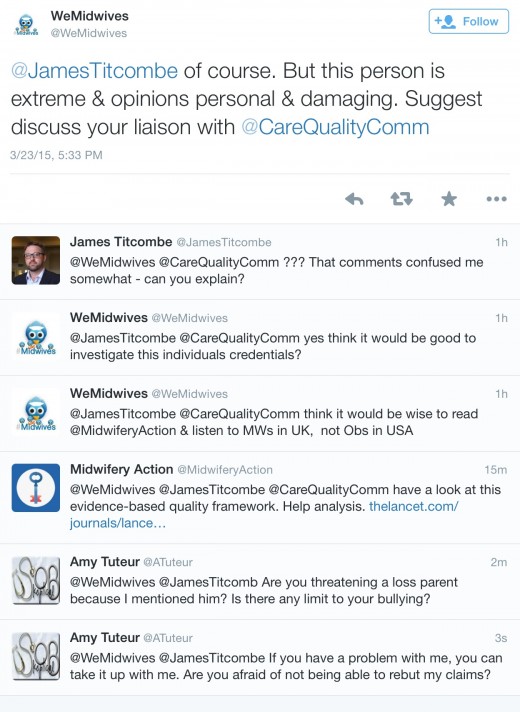
Instead, they appear to be pressuring James Titcombe, whose baby died at the hands of midwives in Morecambe Bay, by sending the Twitter conversation about their unhappiness with his associations directly to his employer.

It appears that he tweeted a link to something I wrote. It’s hard to tell because he deleted it in response to their reaction.
image

WeMidwives

@JamesTitcombe of course. But this person is extreme & opinions personal & damaging. Suggest discuss your liaison with @CareQualityComm

And:

WeMidwives ‏@WeMidwives 2h2 hours ago

@JamesTitcombe @CareQualityComm think it would be wise to read @MidwiferyAction & listen to MWs in UK, not Obs in USA

So WeMidwives thinks it is perfectly acceptable to threaten a loss parent. That’s bad enough.

Why are they threatening him anyway? Because they think he can pressure me to stop.

They don’t know me very well, do they?

Let me state unequivocally (since they did “report” him by sending the tweet to his employer) that James Titcombe has nothing to do with what I’ve written in the past week about UK midwives. I don’t consult him; he doesn’t consult me; he has no control over what I write.

And let me publicly apologize to him for being a target of the wrath that UK midwives have for me. If they have a problem with me, they can address me directly.

Elsewhere in the Twitter feed, they claim:

we aren’t prepared to associate with this person-has no respect or credibility in UK

If that were the case, they wouldn’t be worried about me, and they are worried enough to threaten an innocent bystander.

Maybe someone familiar with the UK medical system can help me out here.

How can these midwives be so brazen as to pressure a loss parent publicly on social media?

Is their union so powerful that it doesn’t matter how they treat people?

Is anyone powerful enough to hold UK midwives to account for the deaths at their hands and for their outrageous, bullying behavior?

Or will the babies and mothers who die at the hands of UK midwives be buried twice, once in coffins in the ground and again by obliterating their deaths from public consciousness?
Midwives are wrong to fight fear in childbirth; it’s a lifesaving gift.

True fear is a gift copy

The meme of the moment in UK midwifery is “fight fear.” It is both hypocritical and immoral.

It’s the keystone of today’s piece in The Guardian by an anonymous midwife, I loved being a midwife, but bullying, stress and fear made me resign and at heart of the new book by UK midwives Sheila Byrom and Soo Downe, The Roar Behind the Silence.

I’ve already written about Byrom’s personal hypocrisy in editing a book about kindness, compassion and respect in maternity care, when she is on public record as treating with utter contempt a parent whose baby died at the hands of her colleagues. But the book itself is an example of the hypocrisy that is at the heart of contemporary UK midwifery theory. UK midwives are among the biggest fear-mongers around.

Before we look at what UK midwives mean by “fight fear,” it is worth considering the advice of security consultant Gavin de Becker who wrote the book The Gift of Fear.

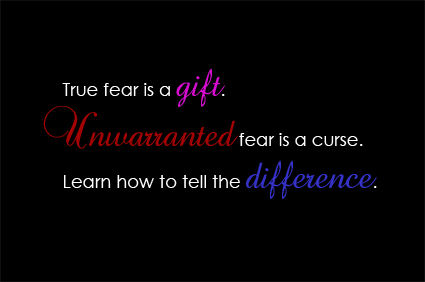
True fear is a gift.
Unwarranted fear is a curse.
Learn how to tell the difference.

Or as this post on a Psychology Today blog explains:

Fear is helpful and safety-oriented whereas worry and anxiety are not helpful and related to phantom ‘possible’ events that often don’t happen. To that degree, worry and anxiety are distracting away from real fear signals that could help …

In other words, fear can be extremely beneficial in helping us avoid danger, while anxiety, generally related to possible events that don’t often happen, is harmful and may actually impede our ability to avoid real harm.

Indeed, fear of death (of the baby or mother) in childbirth has been the impetus for the interventions that have saved and continue to save hundreds of thousands of lives each and every year. In contrast, anxiety about interventions, from epidurals to C-sections, ruins the birth experience for many women and puts them and their babies at risk of injury and death.

What do UK midwives want to fight when they say “fight fear”?

Do they want to fight fear of epidurals?

Absolutely not. They encourage women to fear epidurals, wailing, “Drugs!” and emphasizing complications that are in reality less likely to occur than being killed by a lightning strike.

Do they want to fight fear of childbirth interventions?

Absolutely not. They encourage women to fear childbirth interventions by constantly invoking the dreaded “cascade of interventions.”

Do they want to fight fear of C-sections?

Are you kidding? Their efforts to demonize C-sections are notorious, and they don’t consider themselves restricted to the truth. From “C-sections interfere with bonding” (they don’t) to “C-sections change neonatal DNA” (they don’t), to the supposed “crisis” in maternity care represented by a C-section rate over 30%, no one can touch midwives when it comes to inspiring and creating fear.

So what do UK midwives really mean when they claim they want to fight fear?

Here’s what Sheena Byrom and Soo Downe have to say in the section ‘Fear as a driving principle of maternity care design and delivery’:

…For midwives and obstetricians, fear of recrimination, litigation, negative media exposure and loss of livelihood potentially contributes to defensive practice…

Of course, none of these things — recrimination, litigation, negative media exposure and loss of livelihood — occur UNLESS a baby or mother is injured or dies in childbirth.

The fear that UK midwives want to fight is PROTECTIVE fear of death of a mother or baby in childbirth.

They lament:

In maternity services in England, this issue has been exacerbated since the publication of the Mid Staffordshire Trust public enquiry, with a subsequent increase in internal and external service reviews and a fear of bad publicity of imposed special measures.

Why was the Mid Staffordshire inquiry undertaken?

According to The Guardian:

An estimated 400-1,200 patients died as a result of poor care over the 50 months between January 2005 and March 2009 at Stafford hospital, a small district general hospital in Staffordshire. The report being published on 6 February 2013 of the public inquiry chaired by Robert Francis QC will be the fifth official report into the scandal since 2009, and Francis’s second into the hospital’s failings.

The often horrifying evidence that has emerged means “Mid Staffs” has become a byword for NHS care at its most negligent. It is often described as the worst hospital care scandal of recent times. In 2009 Sir Ian Kennedy, the chairman of the Healthcare Commission, the regulator of NHS care standards at the time, said it was the most shocking scandal he had investigated.

What did the Mid Staffordshire Trust report (Francis Report) find?

The very first sentence of the Executive Summary lays it out quite plainly:

Between 2005 and 2008 conditions of appalling care were able to flourish in the main hospital serving the people of Stafford and its surrounding area.

Byrom and Downe don’t lament the hundreds of unnecessary deaths that occurred in “conditions of appalling care.” They don’t even mention the hundreds of people who died unnecessarily, enduring horrific suffering. No, Byrom and Downe lament the extra supervision and scrutiny that were put in place to prevent another similar episode.

Byrom and Downe’s book went to press before the recent publication of the Morecambe Bay Report, often compared to the Mid Staffordshire report, which found that 11 babies and one mother died preventible deaths at the hands of midwives:

[M]idwifery care in the unit became strongly influenced by a small number of dominant individuals whose over-zealous pursuit of the natural childbirth approach led at times to inappropriate and unsafe care… [W]e heard that midwives took over the risk assessment process without in many cases discussing intended care with obstetricians, and we found repeated instances of women inappropriately classified as being at low risk and managed incorrectly. We also heard distressing accounts of middle-grade obstetricians being strongly discouraged from intervening (or even assessing patients) when it was clear that problems had developed in labour that required obstetric care…

Why did this happen? Because the midwives did NOT fear the inherent deadly dangers of childbirth. It is this fear that they are fighting.

Toward this end, they recognize no limits in encouraging fear of epidurals, fear of childbirth interventions, fear of C-sections (all of which, not coincidentally, they cannot provide), but they abhor fear of the very real risk of DEATH and serious injury in childbirth (which, not coincidentally, they can’t prevent).

UK midwives’ desire to “fight fear” in childbirth is both grossly hypocritical and stunningly immoral. They want women to fear everything they can’t provide and they want women to ignore the legitimate, protective fear that they or their babies will be injured or die in life threatening emergencies that are all too common in childbirth.

UK midwives are the equivalent of an auto manufacturer touting a car that doesn’t have seat belt, air bags or other safety devices:

It costs less!
Crashes are rare!
Seatbelts interfere with freedom of movement!
Seatbelts could trap you in the event of a car fire!
Fight fear of being killed in a car crash!

Most of us are savvy enough to recognize that such an auto manufacturer would have only its bottom line in mind and would be encouraging anxiety over unlikely possible events while discouraging the protective fear that saves lives by being prepared for a car crash.

Similarly, we should be savvy enough to recognize that UK midwives have only their own benefit in mind when encouraging anxiety over epidurals, interventions and C-section, while discouraging the protective fear of death and injury that saves lives by being prepared for life threatening events in childbirth.

As de Becker said, fear is a gift, unwarranted fear is a curse and everyone must learn how to tell the difference.

UK midwives discourage life saving fear, substitute unwarranted anxieties in its place, and women and babies die because midwives cannot or will not recognize the difference.

Hypocrite! Midwife Sheena Byrom, who has publicly treated a loss parent viciously, edits a book about compassion

sheena byrom silence copy

Talk about hypocrisy!

UK midwife Sheena Byrom, whom I’ve called out for viciousness in the past, has edited a new book The Roar Behind the Silence: Why kindness, compassion and respect matter in maternity care

The UK is experiencing a crisis in midwifery. The recently released Morecambe Bay Report decried a midwifery culture which allowed 11 babies and 1 mother to die preventable deaths at the hands of midwives and then participated in a cover up.

All showed evidence of the same problems of poor clinical competence, insufficient recognition of risk, inappropriate pursuit of normal childbirth and failures of team-working,” Kirkup said. (my emphasis)

These failures were compounded by a culture of silence in which midwives protected each other rather than mothers and babies.

James Titcombe is one of the loss parents who has tirelessly fought for justice for his son Joshua; the baby died of a treatable infection when midwives refused to call a pediatrician despite pleas from his parents that he was obviously ill.

Sheena Byrom has publicly treated James Titcombe with unspeakable contempt.

Byrom and colleagues were having a public Twitter confab on the use of social media during and after birth (just like nature intended, no doubt). Byrom tweeted that hospital policies appeared to be dictated by risk and “all this talk about risk. Not comfortable with it.”

James entered the Twitter stream to point out that childbirth is indeed quite dangerous. He should know. His son died as a result of an infection acquired during birth.

A chilling response from Byrom and colleagues followed:

Sheena Byrom 1

Highlights include:

oh James-don’t let’s get on that roll again …

and:

getting out of bed in the morning has risks

Yes, James, how could you be so tiresome, always going on about the risks of childbirth and the babies who die as a result? Sheena is so over that.

Byrom ought to be ashamed of herself for the derisive way that she dismissed the father of a baby who died as a result of midwifery incompetence. But that would involve kindness, compassion and respect, something in woefully short supply among UK midwives.

Imagine my surprise, then, to find that Byrom has edited a book about kindness, compassion and respect in maternity care.

Apparently, what she means is kindness, compassion and respect for those who agree with her and vicious, disrespectful neglect of anyone else who dares criticize Byrom and her colleagues.

I left a comment on the Amazon UK website.

Bryom review comment 1

Nearly twenty colleagues, as well as Byrom herself, rushed to her defense in comments on my review.

No one denied the truth of the allegations that she had treated a loss parent contemptuously. How could they? The proof exists in black and white.

No one offered a defense of Byrom’s disrespectful comments to Mr. Titcombe. How could they? There is no defense for that type of behavior.

No one suggested that she retract her comments and offer Mr. Titcombe a public apology. Of course not. That would mean a UK midwife taking responsibility for her own actions.

Instead they offered her their unqualified support … in the exact same way that the midwives who let babies and mothers die at Morecambe Bay offered each other unqualified support.

I left a follow up comment:

Byrom review comment 2

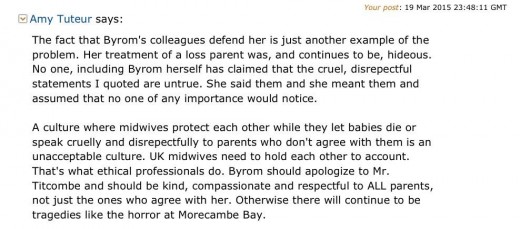
The fact that Byrom’s colleagues defend her is just another example of the problem. Her treatment of a loss parent was, and continues to be, hideous. No one, including Byrom herself has claimed that the cruel, disrespectful statements I quoted are untrue. She said them and she meant them and assumed that no one of any importance would notice.

A culture where midwives protect each other while they let babies die or speak cruelly and disrespectfully to parents who don’t agree with them is an unacceptable culture. UK midwives need to hold each other to account. That’s what ethical professionals do. Byrom should apologize to Mr. Titcombe and should be kind, compassionate and respectful to ALL parents, not just the ones who agree with her views on childbirth. Otherwise there will continue to be tragedies like the horror at Morecambe Bay.

I realize that in the scheme of UK midwifery I am an unimportant critic across the pond, but I can’t let Ms. Byrom’s hideous treatment of Mr. Titcombe go unchallenged. I feel compelled to call attention to the babies and mothers that UK midwives have tried to bury twice, first in coffins in the ground and then by refusing to learn from their deaths or be held accountable.

Ms. Byrom and her colleagues have apparently learned NOTHING from multiple tragedies.

A post about Midwifery reflections on the Kirkup report could best be summarized as “mistakes were made but not by us.”

Ms. Byrom’s response shows that she is part of the problem, not part of the solution:

Protecting normal birth is a midwife’s core function …

No! Protecting MOTHERS and BABIES is a midwife’s core function. Privileging process over outcome is unethical and immoral. It is just this attitude that led to the deaths at Morecambe Bay and the years of effort to cover up those deaths.

Unless and until midwives like Sheena Byrom acknowledge their complicity in a dysfunctional midwifery culture in which midwives place their interests above the health and lives of mothers and babies, innocents will continue to die.

How about it, Ms. Byrom? Will you please publicly apologize to Mr. Titcombe and acknowledge that your contemptuous treatment has no place in contemporary midwifery?

I’ll be waiting.

New breastfeeding study shows that maternal education, family income and birth weight have a greater impact on IQ than breastfeeding

iStock_000035093954Small

Not surprisingly, the authors of a new study on breastfeeding and IQ led with the information likely to generate the best headline, Breastfeeding ‘linked to higher IQ’:

A long-term study has pointed to a link between breastfeeding and intelligence.

The research in Brazil traced nearly 3,500 babies, from all walks of life, and found those who had been breastfed for longer went on to score higher on IQ tests as adults.

Experts say the results, while not conclusive, appear to back current advice that babies should be exclusively breastfed for six months.

But the study, Association between breastfeeding and intelligence, educational attainment, and income at 30 years of age: a prospective birth cohort study from Brazil, which shows that breastfeeding might have an impact on IQ of up to 3.76 points also demonstrates that just about anything else has a far greater impact on IQ than breastfeeding.

Consider this graph showing the impact of breastfeeding on IQ stratified by family income:

Lancet graph

The graph shows several interesting things:

1. Breastfeeding for less than a month has no impact on IQ
2. Breastfeeding for more than a year has no impact on IQ in infants from high income families.
And, most importantly, the impact of breastfeeding on IQ is dwarfed by the impact on IQ of

Maternal education

maternal education v IQ

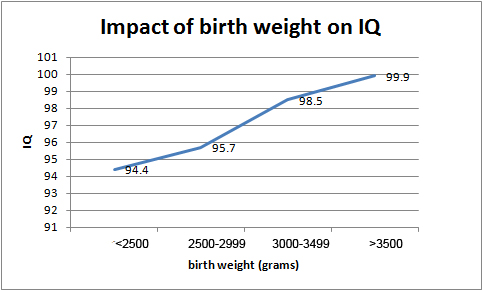
Birth weight

birth weight v IQ

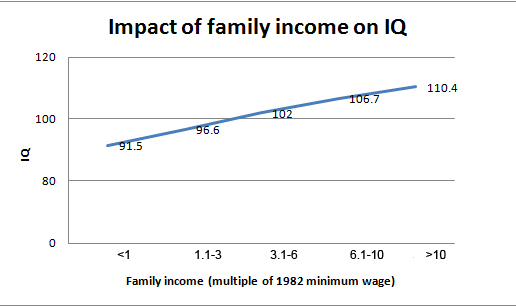
Family income

family income v IQ

(All graphs shows babies that were breastfed for 6 months.)

Arguably, if a mother wants to have the greatest impact on her baby’s IQ, she should go back to work rather than breastfeed.

The BBC piece acknowledges the contribution of many variables to IQ:

Regarding the findings – published in The Lancet Global Health – they stress there are many different factors other than breastfeeding that could have an impact on intelligence, although the researchers did try to rule out the main confounders, such as mother’s education, family income and birth weight.

Dr Bernardo Lessa Horta, from the Federal University of Pelotas in Brazil, said his study offers a unique insight because in the population he studied, breastfeeding was evenly distributed across social class – not something just practised by the rich and educated.

Most of the babies, irrespective of social class, were breastfed – some for less than a month and others for more than a year.

Those who were breastfed for longer scored higher on measures of intelligence as adults.

They were also more likely to earn a higher wage and to have completed more schooling…

Dr Horta believes breast milk may offer an advantage because it is a good source of long-chain saturated fatty acids which are essential for brain development.

But experts say the study findings cannot confirm this and that much more research is needed to explore any possible link between breastfeeding and intelligence.

In Brazil the impact of income of breastfeeding rates is very different than in higher income countries. In the US, for example, breastfeeding is correlated with family income; the higher the family income, the greater the likelihood that an infant will be breastfed. In Brazil, breastfeeding rates were highest at either end of the income spectrum, the very poor were as likely to breastfeed as the very rich. Indeed 80% of the children in the study were breastfed at for at least a full month. And that raises an important question.

In this study, the authors assume that breastfeeding in an independent variable that depends almost entirely on maternal desire. But in a country where breastfeeding is the norm, it may be that the duration of breastfeeding reflects the success of breastfeeding. In other words, women who breastfed for only a short duration stopped not because they didn’t want to continue, but because their babies were showing signs of malnutrition. The fact that babies breastfed for less than a month had lower IQ scores at age 30 might be a reflection of malnutrition in the early weeks, not a lack of breastmilk.

This is a good study. The authors followed a large cohort of infants through adulthood. They carefully controlled for confounding variables. They showed that breastfeeding up to 12 months (but not longer) has a small but measurable impact not merely on IQ, but also on educational attainment and income. But the study also has some significant limitations. The authors did not control for the most important confounding variable, parental IQ. They assumed that income and educational attainment were proxies for IQ, but they did not demonstrate that. One third of the study participants were lost to follow up and they may differ in important ways from those who were available for follow up.

Ultimately, though, the authors showed that the impact of breastfeeding on IQ pales in significance to the impact of everything from birth weight to maternal educational attainment to family income.

The take away message should be:

If you want to improve your future child’s IQ, you should stay in school, work hard and get good prenatal care so you can have a larger infant. If you want to improve your child’s IQ slightly beyond that, you can breastfeed. But it may not be only the breastfeeding that impacts IQ but whether the mother can produce enough breastmilk. Breastfeeding a baby who isn’t getting enough to eat may actually be far worse than not breastfeeding at all.

Being a UK midwife means you never have to say you’re sorry

Better birth initiative

In the wake of the Morecambe Bay Report, which investigated the deaths of 11 babies and a mother and placed blame squarely on a midwifery culture that valued “normal birth” above all else, you might think that UK midwives would be in a mood of somber reflection about their deadly philosophy.

You would be wrong.

Yesterday I entered the weekly Twitter chat at the hashtag #WeMidwives hosted by the Royal College of Midwives (RCM). If I hadn’t been there myself, I would not have believed the smugness, meanness, utter lack of reflection and inability to tolerate criticism that characterized the Royal College of Midwives and its members.

Apparently, no matter how many dead babies, no matter how many dead mothers, being a UK midwife means you never have to say you’re sorry.

The topic of the chat was the latest in deadly midwifery philosophy, the RCM Better Births Initiative.

The Better Births initiative started in May 2014 with the aim of developing service-led and evidence-informed resources for maternity care in the UK covering the antenatal, intrapartum and the postnatal periods.

The three themes that we are focussing [sic] on are:

1 The promotion of normal births for majority of the women and normalisation for all women, achieving normality…

In other words, it is the new iteration of the Campaign for Normal Birth, yet another example of MIDWIFE-centered care.

What about MOTHER-centered care? Don’t be naive. UK midwives apparently believe that if it is good for them, it must follow that it is good for mothers. They seem intellectually incapable of differentiating their interests from their ethical obligations to women and babies.

What is normal birth? It is never explicitly defined, but the fundamental RCM belief appears to be that if a midwife can do it, it’s normal and if only a doctor (obstetrician, pediatrician, anesthesiologist) can do it, it’s abnormal and to be abhorred and eliminated.

You can follow nearly the entire chat on Twitter at #WeMidwives. The topic was “What does better births look like for you and why?” The narcissism of a group of health professionals placing their vision of birth above the mother’s needs and desires is truly mind boggling, not to mention thoroughly unethical.

Below are a few exchanges that will give the flavor of the discussion:

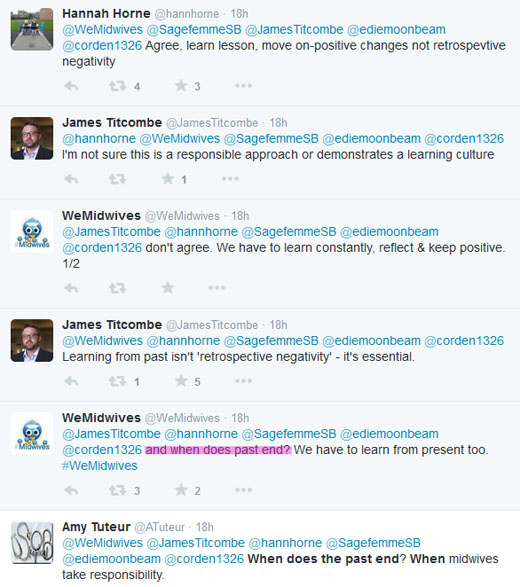
Me: @MidwivesRCM Shouldn’t focus be on what better birth looks like to MOTHERS, not midwives? #WeMidwives

RCM: (No response.)

Me: When will RCM acknowledge that Campaign for Normal Birth led to the Morecambe Bay horror? #WeMidwives

Everyone else: (No response.)

James Titcombe (father of a baby who died at Morecambe Bay): How will better births ensure this type of culture doesn’t develop again? #WeMidwives

Newberry Doula: Inappropriate care fm all levels of staff is more likely in overstretched systems IMO. OBs failed too #WeMidwives

Only one midwife had the integrity to state the obvious:

Geraldine Butcher: @MidwivesRCM @WeMidwives hi need to listen to what we don’t want to hear as well as what we do #wemidwives

The rest of the conversations were meaningless platitudes …

wemidwives tweet 1

wemidwives tweet 2

Or worse:

wemidwives tweet 5

And, of course, the inevitable:

wemidwives tweet 3

And the chilling:

wemidwives tweet 4

Why won’t the Royal College of Midwives or its members apologize for the deaths that occurred at their hands?

Cognitive dissonance:

…[H]ow do we square two dissonant cognitions when one of them is the belief that we are decent people and the other is the knowledge that we have inflicted pain on an innocent victim?

Ask any kid who wallops a younger brother. “I’m decent, but I hit him,” the argument runs, “therefore he must have deserved it.” It’s the most vicious of circles. Aggression begets self-justification, which begets more aggression, and thus do the authors lead us, one small step at a time, down the road to Abu Ghraib and to all those deeds throughout the ages whose doers were never the monsters we’d prefer them to be but just decent people like us.

And at the end of the day, when the time comes for decent people to tell their story, self-justification is left holding the pen.

According to The Advantages of Not Saying You Are Sorry in Scientific American:

Given that apologies offer a relatively simple way to mend relations and heal wounds for victims and offenders, why do people refuse to apologize? Beyond escaping punishment, there may be some psychological benefits to standing one’s ground. For example, adopting a self-righteous stance may feed one’s need for power. If the act of apologizing restores power to the victim, it may also simultaneously diminish the power of the transgressor. Thus actively denying any wrongdoing may allow the offender to retain the upper hand…

A second possible benefit of standing one’s ground in the face of an accusation is saving face. No one wants to admit to being a hypocrite. Inherent in an apology is the admission that one’s behavior failed to align with personal values and morals, as people generally don’t apologize for actions they believe are right and just. Thus when we admit that we are wrong, we expose the fact that we may talk the talk, but we do not walk the walk…

So rather than apologizing for a deadly philosophy and catastrophic failures that resulted in multiple deaths, the RCM and UK midwives have doubled down by refusing to reflect, refusing to take responsibility, refusing to express remorse. Instead they figuratively put their fingers in their ears, blocking those who ask uncomfortable questions in an effort to pretend that criticism doesn’t exist and there is no need to think about past errors. Hence the Twitter chat ended with the RCM praising its members and “celebrating your efforts :)”.

What the RCM fails to recognize is that babies and mothers will continue to die at the hands of their members as long as they continue to evade responsibility for the fatalities that have already occurred as a result of a midwife-centered philosophy that values process over outcome and gives pride of place to midwives’ needs and desires while ignoring those of mothers and babies.

Commentor Cordy, a midwifery student, advised, “don’t be worried she is 1 we are many.”

Here’s my advice:

Be worried!

I may be one, but my voice is transmitted around the globe thousands of times each day. And I’m not the only one. Brave parents, like James Titcombe, battling heartache but faithful to the memory of their precious loved ones will not stop until midwives accept responsibility for their actions and their philosophy.

Be worried!

Your behavior is unethical, immoral, self-serving and harms innocents. I don’t know how many babies and mothers will have to die before midwives will be held to account, but I do know that the day of reckoning is coming.

What my brain tumor can teach us about the shocking lack of ethics at the heart of midwifery care

image

In the summer of 2000 I was diagnosed with a brain tumor.

I had developed double vision because a meningioma, a benign tumor, was pressing on cranial nerve VI, the one that controlled the movement of my left eye. The tumor was small, but it was located in an awkward place near the center of my brain. That meant that surgery to remove the tumor would likely damage the nerves that controlled sensation in my face and my hearing on the left side.

Surgery was, until shortly before that point, the only option for treatment. However, as a physician I had access to those who knew about the latest treatment options. A dear friend, a neuro-radiologist, told me about stereo-tactic (“gamma knife”) radiosurgery, which is not surgery at all, but a one day course of radiation to kill the tumor.

I consulted a neurosurgeon, widely reputed to be one of the best in the US, to find out what he recommended. He recommended surgery.

I asked him:

Which treatment had the highest cure rate?

He told me that surgery had a cure rate of 85% and the gamma knife had a cure rate of 95%.

Which treatment had the highest complication rate?

He told me that surgery would likely lead to loss of sensation on the left side of my face and deafness in my left ear. The gamma knife had no complications beyond local irritation.

If the gamma knife treatment failed, would that make subsequent surgery more risky?

He told me that it would have no effect.

So I asked him why he was recommending surgery if the gamma knife had a higher cure rate and a lower complication rate. He replied honestly:

“I don’t do the gamma knife.”

In other words, he was recommending what was best for him, not what was best for me. It could have been worse; had he believed that he couldn’t successfully perform the surgery or offer the gamma knife, he could have told me not to worry, my brain tumor didn’t need any treatment at all.

And that could be the unethical motto at the heart of contemporary midwifery theory: If she can’t do it, you don’t need it.

Consider the midwifery stories that have appeared in the news within the past few weeks.

1. An update from the inquest into the death of Australian homebirth advocate Caroline Lovell.

A Melbourne mother who died after the home birth of her daughter pleaded with her husband to call an ambulance because she felt she was going to die, the Victorian Coroners Court has heard…

Paramedic Marie Daley noted that Nick Lovell had told her at the scene that his wife had grabbed him by his shirt, looked him in the eye and pleaded with him for help,

“‘Nick I’m telling you, you need to call an ambulance, I’m going to die’…

But midwife Gaye Demanuele did not call an ambulance.

The inquest had previously heard that the now unregistered midwife Gaye Demanuele believed Ms Lovell was panicking and did not identify any physical symptoms, which she expressed to Mr Lovell when his wife started hyperventilating…

… [T]he obstetrician at the Austin on the night, Dr Claire Petterson, estimat[ed] Ms Lovell lost three litres of blood. The midwives estimated Ms Lovell had lost 400 millilitres in the birthing pool.

The midwife did know how to manage postpartum hemorrhage, so she insisted that the patient was not having a postpartum hemorrhage.

2. The failure of British midwives to consult a pediatrician for Joshua Titcombe as detailed in the Morecambe Bay Report. Joshua was seriously ill with an infection, but midwives insisted that he was fine. They couldn’t care for a neonatal infection so they insisted that there was no infection.

3. The New Zealand midwife who missed the homebirth (how often have we heard that story?) and then when the patient complained about severe perineal pain, the midwife insisted that the tear would heal itself if the patient was “ladylike” just kept her legs together The midwife didn’t know how to suture a tear so she insisted that the tear did not need to be sutured.

4. Oregon homebirth midwife Joanna Jech who ignored a mother’s pre-eclampsia, and when the patient went into labor and the fetal heart rate became undetectable, waited 19 minutes before calling 911. The baby was stillborn at the hospital. The midwife would have been required to transfer care of the patient to a physician if she diagnosed pre-eclampsia so she simply insisted that the patient didn’t have pre-eclampsia. She couldn’t treat fetal distress in labor so ignored it for 19 minutes before calling for emergency assistance.

These incidents, though they involved different midwives at different times and in different countries share a glaring ethical lapse: if the midwife couldn’t provide the appropriate care, she insisted that the patient didn’t need it.

As the story of my brain tumor indicates, this ethical lapse is not restricted to midwives, but in the case of midwives has seemingly become part of the professional ethos. The midwifery commitment to “normal birth” is a commitment to what benefits THEM, not what is safest for their patients. Their efforts to demonize obstetrical interventions benefits THEM, not mothers or babies. Their portrayal of the C-section rate as a medical crisis benefits THEM, not mothers or babies.

No doubt many of the midwives believe that “normal birth” is better, safer and healthier despite the fact that there is no scientific evidence to support that claim. It’s a classic example of “where you stand depends on where you sit.” Midwives need to confront their unethical behavior by acknowledging that their commitment to “normal birth” is a commitment to personal benefit, a factor that has no place in the ethical provision of health care.

How the tyranny of lactivism led one woman to use her friend as a wet nurse

image

Elisa Albert wrote a powerful piece for The Guardian entitled My friend breastfed my baby.

The writing is lyrical, the author’s anguish is palpable and the story has a happy ending.

Unfortunately, Albert never questions the real cause of her misery, her unflective acceptance of the anti-feminist propaganda of the natural parenting movement.

Albert had an unintentionally unassisted homebirth of a healthy son because her midwife failed to show up (how many times have we heard that story?).

…I gave birth at home, after a 13-hour posterior, or back-to-back, labour, which the long-practising, well-respected midwife did not bother to attend…

She had difficulty breastfeeding. Her son languished for an entire month, underfed most of that time.

At a week-and-a-half old, my baby began to lose weight. Breastfeeding was not going well. This was not abnormal, we were reassured… One lactation consultant offered advice that was contradicted by a second, whose advice was contradicted by a third. I should use a breast pump every two hours. I should supplement with formula. I should neither pump nor supplement; I should let him get so hungry he would do whatever it took to latch properly. Around and around we went.

Albert sunk into despair:

The imperative to feed my baby from myself blotted out the sun.

She was touchingly grateful when her best friend breastfed her baby.

I handed the baby to her and collapsed into a nearby chair to sob and thank her and sob and thank her, over and over again. The baby drank and drank and drank. His latch was indeed shallow, but she had a surfeit of compensatory milk…

The baby was no doubt grateful to finally eat his fill. Albert spent the next 3 months working strenuously toward exclusively breastfeeding her baby.

I supplemented with formula until I got nursing on track, which took three months, biweekly follow-ups, a hospital-grade rental pump, and a level of determination and commitment I was proud to discover I had…

At no point in what were literally months of misery did Albert ever question the toxic, anti-feminist assumptions that were the real cause of her anguish. Sadly, her story will probably contribute the to the anguish of other mothers who find themselves in the same situation.

Why did Albert, undoubtedly an otherwise sensible woman, come to feel that breastfeeding was so important that it “blotted out the sun”?

It’s pretty simple actually. She believed the New Age version of age old sexism: that a woman’s worth resides in her uterus, vagina and breasts.

I was supposed to accept that, because breastfeeding was exceedingly difficult, I could not do it. I was supposed to concede to that potent cocktail of bad advice that devalues the functional power of the female body. To which I said, and still say: no.

“Valuing the functional power of the female body” is profoundly retrograde. We should be valuing the power of the female mind and character, and relegating reproductive choices to what they are: personal choices that tell us NOTHING about whether a woman is a good woman or even a good mother.

Ms. Albert does not question the absurd propaganda of the lactivist movement that refuses to recognize that not all woman and not all babies can successfully breastfeed and the wholesale rewriting of history to blame formula use on formula manufacturers.

For most of human history, wet nurses were exceedingly common. The best of the best made an excellent living as highly prized employees. Sisters and good friends nursed each other’s babies as a matter of convenience. But 100 years of aggressive formula marketing has effectively erased the tradition of women helping each other in this way.

No, for most of human history, babies who had trouble breastfeeding were not rescued by wet nurses; they died. Wet nurses were not exceedingly common. They were an affectation of privileged women who didn’t want to breastfeed, an aristocracy who hired other women (or used slaves) to do offload what they viewed as an animal function onto lesser beings whom they viewed as closer to animals.

Formula was invented NOT as a substitute for breastfeeding, but as a substitute for everything under the sun, much of it dangerous, that was being used to feed infants who couldn’t successfully breastfeed, or whose mothers had died in childbirth.

Formula companies never had to market aggressively because the need for formula is so high. The marketing that formula companies do is NOT to convince women to bottlefeed, it is to convince women who were going to bottlefeed anyway to choose one brand over another.

Albert does not question the fact that lactivism gives short shrift to infant suffering. Her baby was starving, literally since babies should not lose weight. That suffering could have been entirely averted by using formula as soon as it became apparent that Albert was not producing enough breastmilk. But lactivism insists that there is no amount of infant agony (and that’s what hunger is for infants) that is not justified by the purported benefits of breastmilk, which in first world countries are actually trivial.

Albert no doubt views her story as one of female triumph where one woman assisted another until she, through months of misery and perseverence, ultimately breastfed her infant exclusively.

But there is another way to look at this story, one that I suspect is closer to the truth:

It’s a triumph of the toxic propaganda of the breastfeeding industry, the one that makes 100% of its income from convincing women to breastfeed. It’s a story of infant starvation and suffering that could have been averted by feeding the baby formula. It is a story of maternal misery and feelings of inadequacy that rests entirely on the exaggeration of the small benefits of breastfeeding, and the sexist belief that women should be judged by the function of their reproductive organs.

This is not a story of the power of women. It is a story of their loss of power to a philosophy that harms women and harms babies, and is so insidious that even women as sophisticated as Albert fail to recognize for it for what it is: yet another way to make money by inducing women’s anxiety about their bodies.

Asking if being a stay at home mother is a job or a luxury misses the point

image

This week the mommy blogosphere was roiled by its perennial favorite topic: stay at home mothers vs. working mothers.

The proximate cause was a piece on xoJane entitled Being a Stay-at-Home Mom Is Not a Job, written by a former stay at home mother Liz Pardue-Schultz:

I also understand a stay-at-homer wanting to validate her or his life choice by calling it a “job.” We get a lot of grief from academics and professionals, and we’re very often belittled by our society for not contributing anything “valuable.” There’s a sense that we need to defend ourselves against a culture that wants to make us feel inferior or useless because of the way we’re spending our time, but trying to argue its worth by identifying it as something identical to a full-time career isn’t helping the cause. If you’re proud of how you’re living your life, there’s no need to rephrase it to make it more palatable to those who don’t agree with its worth.

Being a stay-at-home mother to your own kids is not a “job,” no matter how difficult it is or how hard we work. Period. Getting to do nothing but raise a person you opted to bring into the world is a privilege, and calling it anything else is ignorant and condescending.

She elaborates:

parenting is hard work, but so is going camping or throwing a party for a friend or having sex with someone I love; I don’t go around calling those things my “jobs.” And FUN FACT: While there are obviously labor-intensive tasks involved with running a household like cleaning and cooking, those are things every person has to do (or pay someone else to do) regardless of their status as parents, and they don’t define our life’s work.

Obviously, staying at home and taking care of people in lieu of working for wages is a valued lifestyle, but it is not a “career”; people who retire early to care for their elderly parents don’t suddenly tell everyone they’ve gone into the health care profession. Choosing to care for your own small child is no different.

Not surprisingly, there was tremendous push back to this view, including 1200 comments and counting.

This piece in The Motherlode, written by Allison B. Carter, appears to be at least partially in response, A Stay-at-Home Parent Is Not a ‘Luxury’:

He looked at me from across the table and said, “Well, you are lucky you have the luxury to stay at home.”…

I do, indeed, hate it when the word “luxury” is used to define my role as a stay-at-home mom. But not for the reasons you might think.

I am not here to argue who works harder: a working mother or a stay-at-home mother. I stand firm on my belief that it is hard for everyone. What goads me are the financial and lifestyle implications this statement carries.

“Luxury” is a loaded word. Yes, it is absolutely true that my husband and I are lucky that he has been able to secure and keep a job that can pay for us all to live. I am aware that there are many families who require a dual income to successfully sustain their children’s basic needs. Raising children is expensive and on the rise and, for many families, the financial equation is hard.

So in some ways, yes, we are lucky that I can stay home. But a luxury is a nonessential item. An indulgence. What I do is essential, and certainly not self-indulgent.

So which is it? Is being a stay at home mother a job or a luxury?

Neither. Asking that question misses the point. It is just a choice, and women’s obsession with what other women choose tells us more about them than about the issue itself.

There are, of course, some women for whom staying home with their children is not a choice at all. For them, working is the difference between feeding their children and letting them go hungry. But most women who have a partner do have a choice. A job for them is not the difference between food and starvation. How the woman and her partner make that choice depends on many factors including children’s needs, parents’ needs, financial goals, the health of the partnership or marriage, beliefs about money and beliefs about the importance and respect accorded to earning money.

There is no one-size-fits all approach.

A child with special needs alter the calculus.
A history of paternal abandonment and poverty alters the calculus.
Lifestyle goals alter the calculus.
Power relationships within the partnership alter the calculus.
The list of modifying factors is endless.

The two authors quoted above are both wrong in large part.

They’re both wrong because they assume that money inevitably take pride of place in these choices.

Pardue-Schultz is wrong because she implies that the only valuable work is paid work. She conveniently ignores the fact that volunteer work (think healthcare workers who go to underserved areas around the world) is real work.

Carter is wrong because she implies that she is making a sacrifice that working mothers are unwilling to make, never considering that her definition of “sacrifice” is limited to money and the goods it can buy. What she considers a worthwhile sacrifice could easily be an intolerable burden for another woman.

Both women fall into the trap that many other women fall into when considering the value of staying home with children vs. working. They believe that the choice a woman makes tells us about her worth as a mother and person and therefore, they fight fiercely to justify their personal choices.

But motherhood is not a zero sum game with a limited about of child happiness, parental success, and personal self-worth to be doled out among the mothers of the world. It’s not an “I win; she loses” world. Two women making opposite choices can BOTH raise happy children … or not. Two women making opposite choices can both point to the same parenting success … or not. Two women making opposite choices can both be proud of what they have done … so long as they aren’t always judging themselves by what others are doing.

Asking whether being a stay at home mother is a job or a luxury is the wrong question. It’s just a choice, one that should be made based on the needs of the families and individuals involved. One woman’s choice tells us nothing about the validity of another woman’s different choice.

Women don’t need to fight to prove who has made the best decision. Everyone can be right at the very same time.

RCM’s Campaign For Normal Birth = Campaign Against Preventive Care

image

Imagine if the Royal College of Midwives (RCM) treated breast health the way they treat childbirth.

Imagine a Campaign For Normal Breasts.

It would be premised on the assumption that most women (8 out of 9) will go through life without developing breast cancer. It would be premised on the notion that a breast biopsy that does not end with a diagnosis of cancer is simultaneously a failure, a waste of money and an indictment of the technology that discovered the lump in the first place. It would rest on an ideological commitment to “trust breasts” and rely on the provision of care by those who are NOT experts in the diagnosis, treatment and cure of breast cancer. A breast cancer specialist would only be consulted in the event that the patient was near death from cancer.

What would happen?

Inevitably, women would die of breast cancer who didn’t have to die.

Why?

Because we would not diagnose breast cancer until the tumor was large or until it had caused other symptoms by metastasizing. That’s what happens when you deprive patients of the opportunity of early diagnosis and early treatment. That’s what happens when you refuse to use preventive care.

Yet the RCM has done precisely that in its Campaign For Normal Birth. The Campaign For Normal Birth = A Campaign Against Preventive Care.

The RCM Campaign for Normal Birth is a campaign against obstetric interventions and C-sections, but obstetric interventions and C-sections are the pillars of preventive care in childbirth.

Ceseareans are like breast biopsies; most are unnecessary in retrospect. When a woman finds a lump in her breast, the odds that is breast cancer are quite low. When a mammogram detects an abnormality the odds that it is breast cancer are quite low. Therefore, applying the reasoning that RCM applies to cesareans would mean that the rate of breast biopsies should be cut dramatically. In most cases, watchful waiting is all that is necessary to demonstrate that the lump or abnormality was not breast cancer.

Applying the reasoning that the RCM applies to obstetric interventions, women should never have mammograms because most of what they diagnose turns out to be benign. Women probably shouldn’t examine their breasts and if they find a lump, they should watch it until other, more serious, symptoms develop.

Think about how much money we could save. All those mammograms and biopsies cost a fortune; just waiting to see what happens costs nothing.

Think about women’s experiences. If we did far fewer breast biopsies, women would not have permanent scars on their breasts. There would be no need for pain medication, dressing changes, etc. if you just watch and wait to see what happens.

Think of the midwife’s experience. She could maintain control of the patient until the last possible moment. She wouldn’t have to call a breast cancer doctor until it was clear that the patient was dying.

Of course if you think that a policy of watchful waiting is inappropriate for breast lumps and mammogram abnormalities, even considering that most biopsies are unnecessary, why would you think a policy of watchful waiting is appropriate for C-sections simply because many of them are unnecessary in retrospect?

Preventive care is not defective, unnecessary or a waste of money just because we find out later that it wasn’t needed. There is nothing better about “normal breasts” as compared to those that have been scanned or those that have been biopsied. It would be wrong and deadly to campaign for normal breasts by eschewing preventive care.

In medicine, the reasons for a procedure are known as “indications.” So, for example, the indications for a breast biopsy would be a lump in the breast or an abnormality on a mammogram. There is no expectation when undertaking a breast biopsy that a woman would die without it; indeed there is every expectation that a woman doesn’t even have breast cancer. We expect that most breast biopsies will turn out to be unnecessary in retrospect.

There are a variety of indications for obstetric interventions. There is no expectation when emplying interventions that the baby would die without them; indeed there is every expectation that the baby would have survived an unmonitored vaginal delivery just fine. But claiming that a healthy baby means obstetric interventions were unnecessary is like claiming that a benign breast lump means a breast biopsy was unnecessary.

The RCM Campaign For Normal Birth = an RCM Campaign Against Preventive Childbirth Care.

Dead babies, such as those who died at the hands of midwives ideologically committed to “normal birth” in the Morecambe Bay horror, are the INEVITABLE result of any campaign for normal birth.

The RCM should immediately suspend the Campaign For Normal Birth as unethical and deadly. I predict, however, that they will do no such thing. They will emulate the midwives of Morecambe Bay in protecting their turf while babies and mothers continue to die.

Agreeing to disagree on homebirth is like agreeing to disagree on seatbelts: deadly and wrong.

image

Dr. Whitney You, a maternal fetal medicine specialist, writing on the Huffington Post suggests: Maybe We Should Agree to Disagree: A Perspective on Homebirth.

It’s not that she thinks homebirth is safe; she doesn’t.

I am not in favor of home birth. I believe the safest place for a laboring woman is in a hospital or birthing center. Labor and the associated complications are not predictable. When potentially life-saving interventions are delayed because a woman is laboring outside a hospital setting, the consequences can be catastrophic…

She wonders whether agreeing to disagree on homebirth can be beneficial by maintaining the relationship between doctor and patient, thereby maintaining the potential that the doctors may influence the patient to make safer choices.

In an era where patients are seeking information beyond the advice of a medical provider and are vying for control of their medical care, medical professionals need to learn how to enter conversations where their recommendations may not be followed. Attempting to dissuade a convinced patient can be alienating, pushing the patient further away, and driving a chasm between the patient and provider ultimately benefiting no one. It is still the job of the medical community to offer information and voice a recommendation. Sometimes coming along side patients in shared decision-making, even when it goes against medical advice, may offer a chance for the best possible outcome.

But if we’ve learned anything from the vaccine debacle, it’s that agreeing to disagree is both ineffective and dangerous.

Why? Because homebirth, like anti-vaccine advocacy is not about science, it’s about an unmerited sense of maternal superiority.

Homebirth, like anti-vax advocacy, is about privilege. Nothing screams “privilege” louder than rejecting the hospital obstetric care that the majority of women around the world are literally dying to have. The “empowerment” of homebirth reinscribes the privilege of the Western, white, well off women who choose it in the most obvious possible way. The entire homebirth movement is premised on the privilege of having a fully equipped and staffed hospital nearby to rescue your baby when you’ve screwed up by choosing homebirth.

Homebirth, like anti-vax advocacy, is based on the delusion of women who believe they have “done their research” and pose as “educated” despite the fact that they are astoundingly ignorant on the subject of childbirth. Homebirth advocates are no more educated about childbirth than creationists are educated about evolution. Neither group has done research; they’ve simply read propaganda, and both groups need to be disabused of their delusions.

Homebirth advocates need to understand that they have been hoodwinked by an alternate world that bears no relationship to what science actually shows. Just about every premise of homebirth advocacy — that childbirth is inherently safe, that interventions are dangerous, that interventions interfere with breastfeeding and bonding, and that obstetric emergencies always allow for enough time to get to the hospital — are utter lies.

Obstetricians MUST explain to homebirth advocates that their fundamental assumptions are fabrication by the homebirth movement and that the only people who claim homebirth is safe are those who profit from it. I’ve corresponded with all too many women who have lost babies at homebirth, and if there is one common theme it is that these mothers never realized the massive gulf between what they were told and the actual scientific evidence. Obstetricians MUST explain what the scientific evidence really shows, and MUST encourage women to view homebirth advocacy with the same skepticism they would view any industry promoting its products.

Homebirth, like anti-vax advocacy, is a matter of life and death. Agreeing to disagree with homebirth advocates sends the WRONG message: that their claims have merit. Would we agree to disagree about carseats for infants? Would we agree to disagree about bicycle helmets for children? No, we wouldn’t because we recognize that children’s lives depend on parents understanding the deadly risks. The fact is that choosing homebirth is more deadly than forgoing a carseat, or letting children ride bicycles without helmets.

Finally, though every patient deserves to be treated with respect, every idea does NOT deserve to be treated with respect. Homebirth, like any other choice that places children at risk of death, is unworthy of respect. That’s why we must not agree to disagree on homebirth.

Dr. Amy