Henci Goer arrives to rescue the homebirth sheeple!

sheep in spring

You could practically hear the collective sigh of relief from the homebirth world.

The NYTimes solicited the medical opinions of 4 obstetricians to explain the increased risk of death at homebirth. But look, up in the sky, it’s Superbirther; faster than a snake in the grass, more powerful than an actual education, able to ignore mountains of scientific evidence in a single bound.

Henci Goer has arrived to give homebirth advocates permission to ignore actual scientific experts in favor of … herself!

The message of the obstetricians was clear and consistent:

Drs. Grunebaum and Chervenak: “In the United States, those who support home birth as safe are propagating junk science.”

Dr. Caughey: “Even in Europe, the fetal and neonatal risks are higher with home birth.”

Dr. Jennings: “The ability of a physician to rapidly provide care can be the difference between life or death for both mother and baby.”

Now Henci Goer “fact checks” the New York Times homebirth debate, and the sheeple in the homebirth community rush to embrace it. There is no independent thinking in the homebirth community; there are only celebrity homebirth advocates who spew nonsense and credulous homebirth advocates who lap it up.

Who is Henci Goer and what are her qualifications to critique Drs. Grunebaum, Chervenak, Caughey, and Jennings?

Actually she has no expert qualifications. As she herself has written:

You may be wondering about my credentials … since I am not a doctor — either M.D. or Ph.D — a midwife, or a nurse. I am a certified childbirth educator with a degree in biology from Brandeis University. Beyond that, I am self-taught.

So Henci Goer is not a medical professional and has no experience in the field of obstetrics. That, in itself is not a complete bar to understanding the obstetric literature if it is replaced by a PhD in a hard science or statistics. But, Goer doesn’t have those qualifications, either. In other words, Goer is a teacher of childbirth classes who reads the scientific papers that she likes, but has no independent way of assessing the full depth and breadth of the obstetric literature.

In response to a someone questioning the basis for her self-described expertise, Goer offered this cringe worthy response:

… I have a library of books and a collection of several thousand papers, including books and papers on how to analyze and interpret medical research; and I have been writing and speaking about what the consensus of maternity care research establishes as best promoting safe, healthy birth for over 20 years. That being said, my preeminent credential is illustrated by this anecdote: Penny Simkin was once called on the carpet by an anesthesiologist, irate that she had written a handout listing the potential trade-offs of epidural anesthesia when she was not a doctor (although he did not dispute her accuracy). “What are your credentials?” he demanded. “I can read,” she mildly replied. So can I.

Curiously, though Goer presents herself as an “expert” on the obstetric literature, no real experts agree with her grandiose self-description. She is not called for expert testimony in court cases that turn on the obstetric literature. The government does not invite her to join expert panels on obstetric topics. In fact, the only people who consider Goer an “expert” on the obstetric literature are lay people who have no way to evaluate her self-proclaimed expertise.

Ms. Goer never appears in any venue where she can actually be questioned on her supposed expertise. She knows that her claims would be eviscerated in short order. She just continues to spread misinformation by flattering homebirth sheeple into believing that accepting her nonsense means that they are “thinking.”

I am surprised by this piece, however. In the past, Goer has carefully avoided basing her claims on indefensible propaganda, but this time she goes all in, quoting a comment by the American College of Nurse Midwives and the MANA “study” on their own dismal homebirth death rate that she surely knows is an amalgamation of mistruths, half truths and outright lies. I view this as a sign of her increasing desperation. She knows that the evidence on the increased perinatal/neonatal death rate at homebirth is remarkably robust, has been repeatedly reproduced (including by Judith Rooks, CNM MPH in Oregon showing that PLANNED homebirth with a LICENSED homebirth midwife has a death rate 800% higher than comparable risk hospital birth), and is reflected by a growing number of homebirth deaths in the news. There was a time when her critiques were plausible, even if they were wrong. Now she’s been reduced to relying on drivel produced by her allies, most of whom are poorly educated laypeople such as herself.

But, of course, this has never been about the truth; this is about obscuring the truth.

Goer is painfully honest about her intentions:

Hopefully, I’ve helped to provide a defense for those who may find themselves under attack as a result of the NY Times article.

Because that’s what’s at stake for her and her colleagues, defending themselves and their profits from scientific evidence and expert opinion. Henci Goer makes her livelihood by promoting homebirth; she literally cannot afford to acknowledge the truth of the scientific evidence. The babies who die as a result of homebirth are apparently acceptable casualties of homebirth advocates’ strenuous efforts to protect their incomes.

Would you take obstetrics advice from an attorney? Me, neither.

iStock_000031387378Small

A friend sent me a link to a new blog post on Fearless Parenting.

Once I stopped laughing after reading it, I was struck by the fact that, as is often the case, no sooner do I write a post then a homebirth advocate rushes to illustrate it. Yesterday I wrote about 10 things that homebirth and anti-vaccine advocacy have in common and immediately Attorney Valerie Borek steps up to prove my points. It’s almost as if she read my piece!

Borek, a member of the Birth Rights Bar, would like you to know why she chose homebirth (Top Ten Reasons Why This Attorney Chose a Home Birth).

What are Borek’s qualifications to write this piece? According to her LinkedIn profile, her skills include:

  • Wills
  • Legal Writing
  • Legal Research
  • Litigation
  • Research
  • Trials
  • Estate Planning
  • Bankruptcy
  • Personal Injury

Do you see obstetrics anywhere in there? Me, neither.

But homebirth advocates imagine that having a baby makes them experts on childbirth … kind of like the fact that I filed a lawsuit makes me qualified to be a lawyer. Oh, wait, it doesn’t.

Borek disingenuously claims:

So this post isn’t a debate about safety. It’s a declaration of liberty and freedom of choice. (links and strike-through in the original)

Borek sprinkles her piece with citations, proving that homebirth advocates love bibliography salad of cherry picked and misleading citations. (it’s almost as if she read my piece!!) Moreover, she cites Midwifery Today, an immediate signal of extreme gullibility.

What are her reasons?

1. She wanted to be sure she would know who would be at the baby’s birth.

So did lots of homebirth mothers whose midwives didn’t show up in time or didn’t show up at all. The idea that your homebirth midwives will be there to catch your baby is one of the many myths of homebirth advocacy.

2. Pregnancy is not a disease.

Neither is a gunshot wound but that’s cared for in a hospital, too, Ms. Borek. What’s your point?

3. She is capable of maximizing the health of her baby!

That would be the magical thinking I noted yesterday. (It’s almost as if she read my piece!!)

4. Money

Ms. Borek, having a homebirth to save money is like defending your capital murder charge pro se. It is foolish in the extreme and dramatically increases the risk that someone is going to end up dead.

5. “My Man Doesn’t Belong in the Waiting Room… It was such a joy to have him attend appointments with the midwife.”

Maybe you should have a seat, Ms. Borek, because I have news that will leave you stupified: husbands attend obstetricians appointments, too.

6. She wanted to be heard.

An obstetrician would have heard her loud and clear, so that was not the problem. She wanted to be validated and petted, told that she was educated, empowered and a warrior mama. Only a homebirth midwife would do that.

7. She wanted to feel the pain because she credulously believed the made up crap about hormones, pain relief and bonding.

Clearly she received her information from echo chamber websites that delete non-conforming scientific data and ban commentors with actual expertise.

8. “I Assume My Baby Wouldn’t Like the Polar Plunge.”

I bet her baby wouldn’t have liked suffocating to death, either, but she seems to have had no problem exposing her/him to that much more serious risk. In addition, Borek believes that peace on earth begins with birth. Certainly worked that way for Hitler, Torquemada, Henry VIII, and Attila the Hun, right?

9. “A Momma Is Being Born Too.”

And that doesn’t happen in the hospital?

10. “Because I Can.”

That would be the libertarian streak that invokes rights and ignores responsibilities that I wrote about yesterday. (It’s almost as if she read my piece!!)

All that to say that Ms. Borek chose homebirth for the same reasons that most homebirth advocates do so; she knows nothing about obstetrics, believes nonsense made up by homebirth midwives and other laypeople, is impressed by the sloganeering that manages to be simultaneously inane and meaningless (“Pregnancy is not a disease.”), and was clueless that she was putting her baby at substantially increased risk of death.

She had every right to do so, but that doesn’t change the fact that she risked her baby’s life even more than if she had driven around with her baby unbuckled in the back seatof her car. The fact that the baby survived is due to luck, not magical thinking, and certainly not an accurate assessment of the risks.

Let me see if I can come up with an analogy that Ms. Borek might understand:

Ms. Borek, would you take legal advice (sprinkled with citations from outdated, irrelevant and reversed legal cases) from an obstetrician?

Me, neither

10 things that homebirth and anti-vaccine advocacy have in common

Naked Muscular Man Covering with a Box Isolated on White

At the end of their piece in yesterday’s NYTimes Room for Debate feature on homebirth, Drs. Grunebaum and Chervenak make a particularly apt comparison:

We are now seeing the damage done to children from the propagation of junk science about vaccines. It is imperative we, as a society, do not make the same mistake when it comes to birth.

With the advent of the recent Disneyland measles outbreak, it has become painfully apparent that the anti-vax position is and has always been spectacularly wrong.

The Disneyland measles outbreak was not the first incidence of the resurgence of vaccine preventable diseases; multiple children (generally infants) have been sickened, hospitalized and have died since pertussis (whooping cough) has come roaring back. But for some indefinable reason, the Disneyland measles outbreak became the tipping point. Similarly, literally dozens of babies are dying preventable deaths at homebirth each year, but though we are approaching a tipping point (as indicated by the framing of the NYTimes’ question Is Homebirth Ever a Safe Choice?) we probably won’t reached it until a prominent celebrity’s baby dies at homebirth.

Homebirth and anti-vaccine advocacy are ideological twins.

Indeed, it is rather startling to consider what homebirth and anti-vaccine advocacy have in common:

1. Both are based on pseudoscience

Both homebirth and anti-vax advocacy rely on ignoring, twisting or confounding the existing science. Advocates present bibliography salads of cherry picked and misleading citations written by discredited authors or subsequently reversed or retracted.

2. Both ignore the consensus of experts

Vaccination is promoted by nearly all the immunologists, pediatricians and public health officials around the world, yet anti-vax activists imagine they know better than the experts. American hospital birth has been declared safest by obstetricians, neonatologists and pediatricians, but homebirth advocates imagine they know better than the experts.

3. Both are based on the belief that “if I haven’t seen it, it doesn’t exist”

Anti-vax advocates pretended to themselves and others that there was no reason to worry about vaccine preventable diseases since they were so rare, never acknowledging (or possibly even realizing) that they were rare BECAUSE OF vaccines, not in spite of them. Similarly, homebirth advocates pretend to themselves and others that childbirth complications are both rare and easily foreseen in time for hospital transfer, never acknowledging (or possibly even realizing) that they seem rare BECAUSE OF obstetricians and hospitals, not in spite of them.

4. Both are propagated through echo chamber websites that delete non-conforming scientific data and ban commentors with actual expertise

This is a hallmark of pseudoscience. For both anti-vax and homebirth advocacy, a truly educated consumer is their worst customer, so intense efforts are made to to delete scientific evidence and ban commentors who might raise suspicions about the validity of anti-vax and homebirth claims. Advocates are spoon fed what they are supposed to believe and they can’t be allowed to question what they’ve been fed.

5. Both rely heavily on conspiracy theories.

According to anti-vax advocates, we’re supposed to believe that vaccines are a massive world wide conspiracy involving nearly every immunologist, pediatrician and public health official. Indeed immunologists, pediatricians and public health officials are so devoted to maintaining the conspiracy that they actually give their own children vaccines despite the fact that they secretly know that vaccines are useless and dangerous. Similarly, according to homebirth advocates, we’re supposed to believe that modern obstetrics is nothing more than an economic conspiracy to deprive midwives of their livelihood, and to cause childbirth complications so that obstetricians can pretend to be heroes.

6. Both rely on magical thinking, the belief that thoughts can control events

No one conveys that reliance on magical thinking better than homebirth advocates who declare (with straight faces, no less) that the safest place to give birth is where the mother feels safest.

7.Both believe the mystical power of food to ward off disease and complications

Both actually believe, with absolutely no scientific evidence, that eating “right,” and taking supplements and herbs can ward off both vaccine preventable illnesses and childbirth complications. The highest mystical power, however, is reserved for breastmilk, which apparently can do everything from preventing pertussis and measles (it can’t) to treating eye and ear infections by squirting it into eyes and ears.

8.Both have a libertarian streak that invokes rights and ignores responsibilities

The battle cry of anti-vaxxers and homebirth advocates it, “I don’t want to and you can’t make me.” Preventing the illness and death of others is irrelevant in this libertarian conception of citizenship.

9. Both are about parental ego

Both anti-vax and homebirth are forms of parental tribalism where parents distinguish themselves from other parents whom they deride as “sheeple.” Both are concerned with parental “empowerment,” not science. Anti-vax is not about vaccines and not about children; it’s about the need for some parents to view themselves as special, smarter and savvier than all the rest. Homebirth is not about birth and certainly not about babies; it’s about the need for some mothers to view themselves as special, smarter and savvier than the all the rest.

10. Both harm or kill children, not the adults making the choice

Not coincidentally, the greatest risk of harm of these adult choices devolves on innocent children who probably would have made different choices (to preserve their own lives) had they been given the opportunity.

It took years, and dozens of preventable deaths, as well as hundreds preventable illnesses and hospitalizations to finally reach mainstream recognition that anti-vax advocacy is dangerous pseudoscience. How many years, and how many preventable deaths will it take for mainstream recognition that homebirth is the ideological twin of anti-vax, based on faulty science and every bit as deadly?

NYTimes asks: Homebirth is never safest, but can it be safe enough?

Image converted using ifftoany

Hallelujah!

I knew that it was only a matter of time, but sometimes it seemed as if it would take forever for the mainstream media to absorb the scientific evidence that has been around for decades: homebirth results in the deaths of babies who didn’t have to die.

The NYTimes, in its Room for Debate feature, acknowledges this increased risk in today’s featured question: Is Home Birth Ever a Safe Choice? The participants in the debate include Drs. Amos Grunebaum, Frank Chervenak and Aaron Caughey, as well ACOG representative Dr. John Jennings, Tekoa King, CNM and Marinah Valenzuela Farrell, CPM.

The pull quotes say it all.

Drs. Grunebaum and Chervenak: “In the United States, those who support home birth as safe are propagating junk science.”

Dr. Caughey: “Even in Europe, the fetal and neonatal risks are higher with home birth.”

Dr. Jennings: “The ability of a physician to rapidly provide care can be the difference between life or death for both mother and baby.”

In other words, homebirth leads to the preventable death of babies.

How do King and Farrell respond?

Tekoa King, CNM: “In Britain, women are actually advised to have children at home or in a birth center, rather than a hospital, when the pregnancy is low-risk.”

Marinah Valenzuela Farrell, CPM: “Certified professional midwives and certified nurse midwives should be licensed to practice independently in all 50 states.”

The contrast is striking. The obstetricians are concerned with babies’ lives; the midwives are concerned with money.

Here’s how I’d answer the question “is homebirth ever a safe choice?

Homebirth is NEVER the safest choice, so women contemplating homebirth need to ask themselves what risk to the baby’s life is acceptable to them.

The risk of death of a baby at homebirth is far higher than the risk of death of a baby in a car accident, so an appropriate analogy would be to ask “Is failing to buckle your infant into a carseat ever a safe choice?” The answer, of course is that it is never the safest choice, but apparently some parents believe that it is safe enough.

For me, personally the risk of not buckling a baby into a carseat, though tiny, it still too high. The risk of death of a baby at homebirth, which is much higher, is obviously completely unacceptable to me, but other women may feel differently.

Women have a right to make that choice for themselves provided that the choice is an INFORMED choice. That means understanding what homebirth midwives like King and Farrell were forced to acknowledge: homebirth increases the risk of death. Midwives who tell you otherwise are repeating the lies propagated by celebrity homebirth advocates and purveyors of junk science like the Midwives Alliance of North America (MANA), the organization that represents homebirth midwives. Their own data shows that homebirth increases the risk of death by 450%.

Most obstetricians believe that no increased risk to the baby is ever justified.

Most homebirth midwives believe that increasing THEIR income is an acceptable reason to risk the life of YOUR baby.

The obstetricians follow the Hippocratic injunction, Primum non nocere, first do no harm.

The midwives follow their own injunction, the experience of homebirth justifies putting babies at risk of death.

It may be ugly, but at least it’s honest.

What breastfeeding and the failed cholesterol recommendations have in common: weak science

weak

Oops! Their bad.

Remember how the government said fat and cholesterol were dangerous to your health? Never mind.

As Nina Teicholz explains in an NYTimes Op-Ed (The Government’s Bad Diet Advice):

For two generations, Americans ate fewer eggs and other animal products because policy makers told them that fat and cholesterol were bad for their health. Now both dogmas have been debunked in quick succession.

First, last fall, experts on the committee that develops the country’s dietary guidelines acknowledged that they had ditched the low-fat diet. On Thursday, that committee’s report was released, with an even bigger change: It lifted the longstanding caps on dietary cholesterol, saying there was “no appreciable relationship” between dietary cholesterol and blood cholesterol. Americans, it seems, had needlessly been avoiding egg yolks, liver and shellfish for decades. The new guidelines, the first to be issued in five years, will influence everything from school lunches to doctors’ dieting advice.

She asks the obvious question: how did experts go so wrong?

The answer is that the government placed too much reliance on population based studies:

But even the most rigorous epidemiological studies suffer from a fundamental limitation. At best they can show only association, not causation. Epidemiological data can be used to suggest hypotheses but not to prove them.

Instead of accepting that this evidence was inadequate to give sound advice, strong-willed scientists overstated the significance of their studies.

Aaron Carroll addresses the same issue in today’s Upshot column in the NY Times:

For decades, many dietary recommendations have revolved around consuming a low percentage of your daily calories from fat. It has been widely thought that doing so would reduce your chance of having coronary heart disease. Most of the evidence for that recommendation has come from epidemiologic studies, which can be flawed.

Use of these types of studies happens far more often than we would like, leading to dietary guidelines that may not be based on the best available evidence.

And although we have finally learned the error of our ways regarding fat and cholesterol, we are aggressively making the same mistake when it comes to the diet of infants.

The evidence on which breastfeeding recommendations are based is no better than that on which the cholesterol recommendations were based.

The science is extremely weak, contradictory and plagued by confounding variables. Despite this, we are promoting breastfeeding as every bit as important to good health and long life as limiting dietary cholesterol and fat. Indeed, we are going farther, with government attempts to cajole and shame women who choose to formula feed, and dangerous hospital policies like the oxymoronic Baby Friendly Hospital Initiative which, in direct defiance of everything we know about babies suffocating and falling out of hospital beds, promotes 24 hour rooming in of infants, giving exhausted, potentially sedated new mothers little choice but to keep their babies in bed with them.

There were many scientists and physicians who questioned the dietary fat and cholesterol guidelines over the past decades, arguing that the scientific evidence simply did not justify sweeping dietary recommendations, but their voices were drowned out by those who insisted that we could improve the health of the American public by telling them what to eat. Everyone “knew” restricting fat and cholesterol was good for you, and scientific evidence that didn’t comport with what everyone “knew” was ignored.

The exact same thing is happening at this very moment with breastfeeding recommendations. Everyone “knows” that breastfeeding makes children smarter, healthier, thinner, less likely to developed the chronic diseases of old age. Except that’s NOT what the scientific evidence shows. The scientific evidence shows that for full term infants in first world countries, the ONLY health benefits are a minor reduction in incidence of colds and diarrheal illness in the first year of life. That it.

As Carroll notes:

It is frustrating enough when we over-read the results of epidemiologic studies and make the mistake of believing that correlation is the same as causation… In reviewing the literature, it’s hard to come away with a sense that anyone knows for sure what diet should be recommended to all Americans.

I understand people’s frustration at the continuing shifts in nutrition recommendations. For decades, they’ve been told what to eat because “science says so.” Unfortunately, that doesn’t appear to be true. That’s disappointing not only because it reduces people’s faith in science as a whole, but also because it may have cost some people better health, or potentially even their lives.

He’s right.

We’ve made a terrible mistake with dietary recommendations promoting low fat and low cholesterol diets; we went far ahead of what the science showed and we ignored any science that did not support what we “knew”.

We’re making the exact same mistake by promoting breastfeeding recommendations based on weak science.

If we learn anything from the fiasco on fat and cholesterol recommendations it should be this:

Our recommendations on breastfeeding should reflect what the scientific evidence actually shows, not what we think we “know.”

These 3 graphs will make you question everything you’ve been told about breastfeeding

image

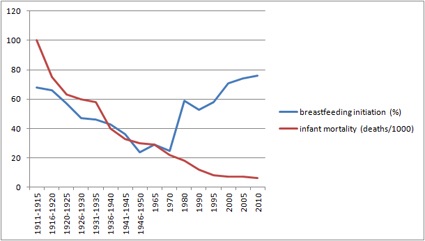
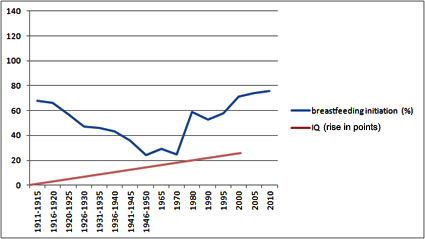
Below you will find the truth about infant formula and its impact on infant mortality, life expectancy and IQ as breastfeeding initiation fell from nearly 70% om 1910 to only 25-30% from the late 1940’s to the early 1970’s and rose again to over 75% in recent years:

image

image

breastfeeding and IQ

As you can see, despite claims of spectacular theoretical benefits, in practice breastfeeding had no impact on infant mortality, life expectancy or IQ.

The next time anyone chastises you or attempts to make you feel guilty about formula feeding, show them this. And the next time you are inclined to beat yourself up about not breastfeeding, take a long look: in first world countries, the benefits of breastfeeding are trivial. Infant formula is an excellent, nutritious food source that provides a strong foundation for health, IQ and long life.


References:

Achievements in Public Health, 1900-1999: Healthier Mothers and Babies, MMWR October 01, 1999, 48(38);849-858.

Life expectancy in the United States. Shrestha, Laura B. Congressional Information Service, Library of Congress, 2005.

The Resurgence of Breastfeeding at the End of the Second Millennium, Wright A, Schanler R, J. Nutr. February 1, 2001 vol. 131 no. 2 421S-425S.

Trends and differentials in breast feeding: an update. Hirschman C, Butler M. Demography. 1981 Feb;18(1):39-54.

Lactivist desperation to prove superiority reminds me of eugenics

BB0.tif

If there’s one thing that proponents are absolutely sure of it is that they are superior. That belief is enhanced by the accompanying conviction that science will demonstrate their superiority.

No, I’m not talking about eugenicists, though I could be. I’m talking about the contemporary lactivist movement. Every time I write about blog post about the incontrovertible fact that infant formula is an excellent, nutritionally complete way to feed a baby, lactivists swoop in like a murder of crows, all cawing loudly, “The Science! The Science!”

Lactivists bear an uncomfortable resemblance to eugenicists, not because they are racists, but because of the way they categorize the world into us vs. them. Moreover, like eugenicists, they abuse science in the service of their unscientific beliefs.

Consider:

1. Both start with a conclusion and then search for proof.

Eugenecists claim that it is self-evident that the white “race” is superior. Their “science” is an attempt to prove that superiority and to quantify it. There is absolutely no possibility that their research efforts will ever conclude that all men (and women) are created equal.

As Prof. Elof Carlson explains:

The eugenics movement arose in the 20th century as two wings of a common philosophy of human worth. Francis Galton, who coined the term eugenics in 1883, perceived it as a moral philosophy to improve humanity by encouraging the ablest and healthiest people to have more children. The Galtonian ideal of eugenics is usually termed positive eugenics. Negative eugenics, on the other hand, advocated culling the least able from the breeding population to preserve humanity’s fitness. The eugenics movements in the United States, Germany, and Scandinavia favored the negative approach.

Grantly Dick-Read, the father of the natural childbirth movement, was deeply influenced by the positive eugenics movement, and made his claims in an effort to convince white women of the “better” classes to have more children. In contrast, American eugenicists were more concerned with using “science” to justify discrimination against other racial and ethnic groups.

Beginning in the 1900s, scientists began to develop different methods for measuring intelligence. These tests were used often to justify racial and ethnic discrimination. The results of these intelligence tests were influential in shaping U.S. immigration policy that limited immigrants from Southern and Eastern Europe, and in justifying race-based segregation in public education, and U.S. conscription during World War I. Previously, the scientific debate centered largely on perceived differences in racial intelligence based on cranial size.

Similarly, lactivists claim that it is self-evident that breastfeeding is superior to formula feeding. Their “science” is a surprisingly desperate attempt to prove that purported superiority. It makes children smarter! It prevents obesity! The microbiome! Epigenetics! There is absolutely no possibility that their analysis of the data will EVER conclude that there is no measurable difference between breastfed babies and formula fed babies, let alone concluding that formula feeding leads to smarter, healthier children.

2. Both feel the need to discriminate.

Eugenicists refuse to accept any of that namby-pamby claptrap about equality. It is critically important to locate themselves within some group that is better than other groups.

Despite the fact that breastfeeding is a practice that affects only your own child, lactivists care deeply whether other women are breastfeeding or formula feeding. Why? Because it is critically important for them to locate themselves within a group of mothers who are better than other mothers; they insist that their children are superior to other women’s children.

3. They are desperate for scientific confirmation of their deeply held beliefs, so they can turn around and use “the science” as a cudgel to beat those who don’t agree.

Eugenicists used and misuse science to support supposedly “morally neutral” race based discrimination.

This is akin to the phenomenon that sociologist Charlotte Faircloth explains in ‘What Science Says is Best’: Parenting Practices, Scientific Authority and Maternal Identity.

Arguably, ‘science’ here is not about understanding, but belief. The use of ‘evidence’ has reached the level of the quasi-religious; … they are held to be beyond the possibility of doubt and revered as truth…

When ‘science’ says something is healthiest for infants, it has the effect, for [lactivists], of shutting down debate; that is, it dictates what parents should do.

Lactivists use and misuse science to support supposedly “morally neutral” claims of superiority. The truth is the opposite; shouting, “The Science!” is a way to moralize a personal choice that has no impact beyond the individuals and families of the person making that choice.

For lactivists, appeals to “the science” are a rhetorical strategy, and a rather cynical one at that. Many of very same people who often ignore the scientific evidence on the dangers of homebirth, who openly spurn the World Health Organization recommendations on vaccination, and who dismiss the scientific evidence on circumcision by insisting it is only relevant in the developing world choose to misinterpret and misuse the scientific evidence on the limited benefits of breastfeeding. Indeed, they often justify vaccine refusal by insisting, falsely, that breastfeeding is better at preventing vaccine preventable illness than vaccines themselves.

Fortunately, most of us have come to recognize eugenics for what it is, a way to codify and justify racial hatred. “Science” that attempts to prove the superiority of the white race should be viewed with deep distrust. It’s not that it couldn’t be true; it’s just that the authors are desperate to believe that it is true for reasons that have nothing to do with science.

Similarly, we need to view scientific papers that claim to demonstrate the superiority of breastfeeding with skepticism. It’s not that it couldn’t be true; it’s just that there are many people desperate to believe that it is true for reasons that have nothing to do with science. In industrialized societies with clean water breastfeeding does have real benefits, but they are trivial. The myriad of extraordinary claims made on behalf of breastfeeding are strikingly similar to typical pseudoscience claims: it prevents every possible disease; it prevents obesity; it prevents chronic diseases of old age; it makes children smarter; it makes for a superior intestinal microbiome; it gives babies better DNA! The more claims that are made, the more spectacular they are, the more divergent they are, the more all encompassing they are, the less likely it is that these claims are true.

When lactivists shout, “The Science!” it’s worth remembering that eugenicists shouted “The Science!” too.

We need to recognize lactivists’ cynical use of “the science” for what it is: a way to justify bullying and humiliating women do refuse to mirror lactivists’ own choices back to them, nothing more and nothing less.

Why is The Alpha Parent happiest when kicking other women?

Beautiful Angry Young Woman In Suit Kicking

As is often the case on The Skeptical OB, a single post becomes a multi-day meditation on a topic. I started the week asking if natural childbirth and lactivism cause postpartum depression, progressed to discussing the lactivist War on Formula as a rather poorly disguised war on women, and then shared a new campaign to support mothers (#sogladtheytoldme) and my gratitude for the women in my life who supported me through motherhood.

And, as so often happens, a natural childbirth advocate or lactivist obligingly provides me with an outstanding example of what I have just been criticizing.

In this case, The Alpha Parent (Allison Dixley) has returned from a two month hiatus, just as hateful as ever, this time with bonus victim blaming.

Which raises the question: Why is The Alpha Parent happiest when kicking other women?

I understand why the lactivist industry grossly exaggerates the benefits of breastfeeding, and grossly inflates the purported “risks” of formula feeding. I understand why the lactivist industry attempts to shame and humiliate women who don’t breastfeed; they profit from monetizing that shame and guilt. But why would an individual woman spend so much time excoriating women who don’t breastfeed when the infant feeding decision is deeply personal and affects no one else? It’s the age old tactic of trying to feel better about yourself by tearing other people down.

The Alpha Parent wants you to know that she is better than you, hence her moniker and her blog. She likes to terrorize other women, finds shaming and humiliating other women to be deliciously satisfying, and merely uses breastfeeding as the rhetorical excuse to stomp on other women.

But The Alpha Parent has a problem. As campaigns like #sogladtheytoldme demonstrate, shaming other mothers is going out of style. The intended victims of the shaming are no longer passive. They point out the harms of idealized images of birth and breastfeeding; they support other women in their mothering journeys; and they take aim at the whole idea of attempting to induce guilt in other mothers.

What’s a woman who feels happiest when kicking other women to do?

Berate those women for their own guilt! How?

1. Women should be strong enough to take what ever Allison Dixley enjoys dishing out.

…“Stop being judgemental, I should not be made to feel guilty” is their mating call.

Yet contrary to what some mothers and stand-up comedians may claim, women are not fragile simpering wallflowers at the mercy of iron-tongued tormentors. They are not passive pawns pushed around by the force of others’ words. The image of the female as a boiling pot of feelings, a puppet to her emotions, easily triggered and unable to control herself is a misogynistic invention of a culture that’s still riding on patriarchal coattails. Sadly, many women continue to lap up this rhetoric, and when they become mothers, it becomes enshrined in their self-entitled, self-serving psyche…

2. It’s their own fault that they feel guilty, not Dixley’s fault for heaping abuse (complete with annoying GIFs) on them.

… By its very nature, guilt assumes a wrong doing that one has committed. So in order to feel guilt, two components must be present: 1. A wrongdoing. 2. Personal blame. Now let’s apply this to an obvious example: failure to breastfeed. If the mother believed that breast milk and formula were equivalent, #1 would be absent in her view. Thus, she wouldn’t feel guilty for not breastfeeding. If on the other hand, #1 is present but #2 is not, the result is merely shame not guilt.

3. They’re doing something wrong.

If you’re feeling guilty right now (heck, you’re a parent), look at your guilt with the idea that you are, or might be, responsible …

To that end, Dixley misinterprets a quote often attributed to Eleanor Roosevelt, “No one can make you feel inferior without your consent.”

The quote does NOT mean that if someone’s abuse makes you feel bad, it must be true. The quote stands for the proposition that you can and should fight against attempts to demean you.

When in 1939 African American contralto Marian Anderson, one of the most celebrated opera singers of her generation, was denied permission by the Daughters of the American Revolution (DAR) to use its Constitution Hall for a concert, Mrs. Roosevelt did not tell Ms. Anderson that if she felt bad that the DAR viewed African American women as inferior, it was because she believed herself to be inferior. She did not say, “no one can make you feel ashamed of your race unless you really are ashamed of it.”

What did Roosevelt do?

First, she resigned from the DAR to signal her disgust with their behavior.

Second, she arranged for Marian Anderson to give an open air concert at the Lincoln Memorial, attended by 75,000 people.

When the DAR figuratively kicked Marian Anderson to the curb, Eleanor Roosevelt KICKED BACK.

As Eleanor Roosevelt showed us, when you encounter someone attempting to shame and humiliate another human being, you don’t laugh it off as harmless; you don’t blame the victim for being upset by abusive treatment; you don’t tolerate that behavior but instead condemn it in word and deed.

Which is what I am trying to do.

I don’t have the power to arrange a public tribute to bottle feeding mothers at a national monument, but I do have the power to publicly reassure them that Allison Dixley speaks from hate, not from science. And I have the power to express my personal disgust that for Allison Dixley, it isn’t enough to stomp on women when they are down; she has to crown her efforts by blaming women for her heel prints on their foreheads.

Allison Dixley’s behavior is nothing more than self-serving viciousness.

So glad they told me #sogladtheytoldme

So glad they told me

On Monday and Tuesday I wrote about the ways in which people misuse science to tear down emotionally fragile new mothers.

Last night, while checking my Twitter feed, I made the happy discovery of a new movement designed specifically to do the opposite, to support mothers, especially emotionally fragile new mothers.

It’s #sogladtheytoldme and it was started by women whom I admire.

Here’s Stephanie Sprenger explaining the genesis of the movement:

… [W]hat if we didn’t do either of those things — fill mothers’ heads with unrealistic, sugar-coated imagery OR try to scare the bejeezus out of them with horror stories and unkind warnings? What if, instead, we just supported mothers? What if we gave them the room to speak honestly and openly about their experiences, including the ugly, hard-t0-hear stuff? What if we compassionately shared our own truths without a hidden, possibly malicious “warning” attached to it?…

I am teaming up with my partner Jessica Smock at The HerStories Project to issue a challenge to mothers this week. We want to hear from YOU now. Did anyone throw you a life preserver at some point—either during your pregnancy, postpartum period, or even later into motherhood? Did someone give you a piece of advice or an honest admission that you were profoundly grateful for?

I had my four children before the motherhood competition became as toxic as it is now. I was exceedingly fortunate to be surrounded by a group of women friends, as well as the greatest sister-in-law in the world, who supported each other through pregnancy, infancy, toddlerhood and beyond. Most are friends from college or professional school. I knew them in their pre-mommy incarnations as doctors, lawyers, teachers and executives. Most were at my wedding, and I was beyond thrilled that nearly all were there when my eldest son and his wife were married over a year ago. It seemed only fitting since there were times I didn’t think I would survive until his adulthood without the love and support of those friends.

I learned a lot from these women as we navigated motherhood together. It wasn’t so much what they told me, as what they showed me.

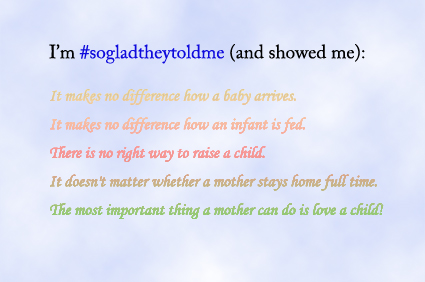
I’m so glad that they showed me that it makes no difference how a baby arrives, whether through vaginal birth, C-section or adoption. The love of a mother is fierce regardless of how the baby came to be part of the family.

I’m so glad they showed me that it makes no difference how an infant is fed. I was proud that I breastfed my children, but 25 years later I can see clearly they are indistinguishable from the children of my friends who bottle fed.

I’m so glad they showed me that there is no right way to raise a child. Different approaches work for different families and different approaches are needed for different children within the same family.

I’m so glad they showed me that it doesn’t matter whether a mother stays home full time with her children, pursues a full time career, a part time career or a career that is staggered over time to accommodate the needs of children.

I’m so glad they showed me that the most important thing a mother can do is love a child and make sure that child knows it. The rest, as they say, is just commentary.

Truth be told, what I learned from these women, influences what I write nearly as much as what I learned in medical school and working as an obstetrician.

I’m so glad they supported me in motherhood, and I hope that by what I write, I can support other mothers in the same way.

The lactivist War on Formula is a war on women

Woman Screaming at Anoher Female on White Background

It’s the third rail of contemporary parenting.

In a society in which intensive mothering (attachment parenting) is the dominant paradigm, though people are willing to acknowledge that idealized representation of perfect motherhood can contribute to postpartum mood disorders, no one dares note that the natural childbirth industry and the lactivism industry are front and center in a campaign to shame and humiliate new mothers.

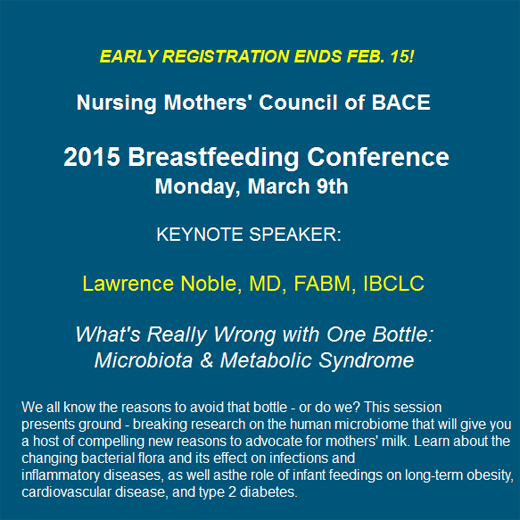
Case in point, a conference that is going to take place in early March sponsored by BACE, the Boston Association of Childbirth Educators & Nursing Mothers Council. Here’s a portion of the email announcement:

Noble breastfeeding talk

Keynote Speaker Lawrence Noble, MD, FABM, IBCLC is going to speak on What’s Really Wrong with One Bottle: Microbiota & Metabolic Syndrome.

Spoiler alert:

What’s really wrong with one bottle of infant formula? Absolutely NOTHING!! Zip, zero, nada! That’s what the scientific evidence tells us.

So if there’s nothing wrong with one bottle of infant formula, what’s Dr. Noble going to talk about?

Presumably he is going to give the same talk that he gave last May.

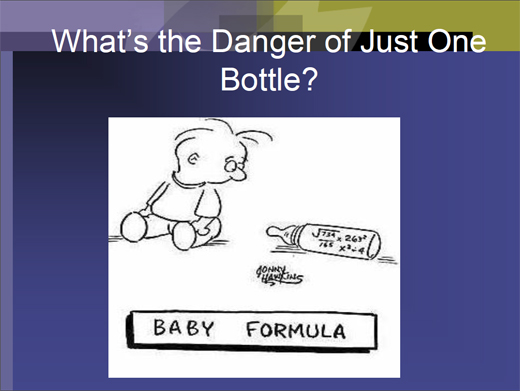
He telegraphed his approach with this opening editorial cartoon:

Just one bottle cartoon

He plans to baffle the attendees with bullshit!

See, look at that scary complicated math! How impressive that an important man like Dr. Noble can understand that stuff! It’s too hard for lil ol’ lactation consultants and childbirth educators. They’ll just have to lap up what he says and regurgitate to “counsel” their clients.

But I don’t have to take Dr. Noble’s word as truth. I’ve reviewed all 83 slides in that talk and there is NOT EVEN ONE that shows any evidence that a single bottle of formula causes any impact at all, let alone a harmful impact.

Looking over the slides, filled with cherry picked studies, discredited studies, and other nonsense, I had a sense of deja vu. It took me awhile to recognize why and suddenly I realized what this reminded me of. It reminded me of the pitches by Big Pharma detail men and women; elaborate presentations packed with slides and statistics that ultimately prove nothing but are designed to convince doctors to prescribe the drugs they are selling.

Dr. Noble is not shilling for Big Pharma, but he is promoting an industry, the lactation industry.

The lactation industry arose as women commercialized what they had previously given to each other for free: advice on how to breastfeed. Now the very same hints and tips cost $100/hour or more. Their biggest competition in efforts to profit from breastfeeding is infant formula. That’s why they’ve embarked on a campaign to demonize formula, the truth be damned.

But the War on Formula has other casualties besides formula sales. The War on Formula is a war on women.

In its impact on women’s health, mental health, economic health, and ability to reach their fullest potential, infant formula is akin to the birth control pill.

Just as the Pill allowed women to control their own bodies, effectively separating the decision to have sex from the potentially unwanted children that could result, infant formula has allowed women to control their own bodies, effectively separating the decision to have and nurture children from the potentially unwanted need to stay with them 24/7/365 and therefore forgo income and career. It also has allowed women who cannot trust their own bodies to produce enough breastmilk to nourish their children just as effectively as if they were breastfeeding. Sure, breastfeeding has benefits, but in an industrialized society with clean water, those benefits are trivial.

The lactation industry wants to go beyond a war on women’s income and women’s careers to a war on women themselves, by promoting humiliation and guilt among new mothers. That’s the primary message of Dr. Noble’s talk. There is no harm from one bottle of infant formula. In fact, the scientific evidence strongly indicates that there is no harm from exclusive use of formula. But how deliciously humiliating and guilt producing to emotionally fragile new mothers to pretend that one bottle of formula is harmful! How delightful to pretend that new mothers should be bullied into breastfeeding for the good of their babies (when the people who are really benefiting are the lactation consultants and their industry)!

Imagine if we tried to address smoking related illness by humiliating anyone who ever had ONE cigarette. Imagine if we tried to address obesity by shaming anyone who ever ate even ONCE at McDonald’s. That’s absurd, right? But that’s the equivalent of what the lactation industry is doing.

Make no mistake, I support breastfeeding; I’ve breastfed 4 children and I enjoyed it. But I also used formula, too and that improved the quality of my life and my children’s lives.

The War on Formula is not justified by scientific evidence, merely by the profits of the lactation industry. If that were all there was to it, the lactation industry would be no different than any other industry such as Big Pharma.

But the War on Formula is a war on women. Talks like Dr. Noble’s are just battle orders on how to shame, humiliate and bully women into breastfeeding regardless of whether it is the right choice for them or the right choice for their families.

Dr. Amy