The biggest problem with The Leaky Boob’s lie

image

Last Friday’s post on The Leaky Boob’s lie has generated a lot of discussion about Jessica Martin-Weber and her lie that she exclusively breastfed 6 children while the reality was that she often used bottles and sometimes used formula.

There are lots of problems with that lie, but one problem is bigger than all the others.

First the small problems:

1. It is wrong to lie

That pretty much goes without saying. Lying is not a good way to relate to others. It is a fundamental violation of their trust and has long term consequences. People will be much less likely to trust you going forward.

2. It is wrong to hold yourself out as a role model

Our heroes have feet of clay; that’s hardly news, but it is still disappointing. That’s why anyone who presumes to hold herself out as a lactivist hero as Martin-Weber did should be very sure that she is modeling the behavior that she extols. Martin-Weber knew the entire time that she was presenting herself as a hero, she was actually engaging in the very behavior she was ostentatiously condemning in print.

3. It is wrong to value process over outcome

Of course this is standard operating procedure for natural childbirth advocates and lactivists. Instead of judging their mothering skills by how their children turn out (which raises the possibility that they might not end up being declared perfect mothers), they evaluate their mothering skills by comparison with an arbitrary ideal. That way they can preen of their motherly perfection without the pesky need to wait until their children grow up and see how they turn out.

But most importantly:

4. The Leaky Boob’s Lie demonstrates that lactivism isn’t about breastfeeding, and it isn’t even about babies. It’s about mothers and their own self-image.

Why was Jessica Martin-Ellis writing about her breastfeeding experiences in the first place? It wasn’t to benefit her children since they couldn’t care less how random strangers view their mother. And it wasn’t to help other mothers with their breastfeeding difficulties since Martin-Weber refused to be honest about her own.

Martin-Weber was writing (dishonestly) about her breastfeeding experiences in order to bask in the adulation of strangers and boost her own self-esteem. That’s because lactivism isn’t about feeding and it isn’t about babies. It’s about some women trying to convince themselves that they are better than other women and grossly inflating the benefits and value of breastfeeding in order to do it. Breastfeeding isn’t that important to babies, but it’s desperately important to lactivists.

Lactivism is about image and new mothers would benefit greatly by realizing that. No mother should feel guilty about breastfeeding, because it is trivial in the overall scheme of child rearing. Those who wish to convince you differently have their OWN best interests at heart, not yours and not your children’s. In fact, they are so concerned about their own interests that they are willing to lie to maintain those interests.

Nothing in nature is “perfect” Michael Pollan, and that goes for breastmilk, too

image

Imagine if I made the following claim: Sexual intercourse is the perfect method of reproduction, formed by natural selection to result in a perfect baby every time. After you picked yourself up off the floor from laughing so hard, you’d probably point out a number of facts to me:

1. Every episode of sexual intercourse does not result in conception.

2. Every conception does not result in pregnancy.

3. Fully 20% of established pregnancies naturally end in miscarriage.

4. Many babies are born premature and die as a result.

5. Some babies are born with birth defects and die as a result.

So how have human beings taken over the planet, expanding from a population of perhaps 10,000 early in human history to 7 billion today?

First, population expansion does not require perfection in reproduction; it only requires more people in the next generation than in the one before. If a couple has 10 children and 7 of them die, the population still expands. Second, technology has dramatically improved our ability to survive and thrive in a myriad of environments, including those previous inhospitable to humans.

That’s because nature doesn’t do “perfect”; it only does “good enough.”

I would think that journalist Michael Pollan, often described as a “liberal foodie intellectual” would understand that, but apparently not. In a recent interview in the magazine Lucky Peach, Pollan makes the following absurd claim:

Breast milk is the perfect food, formed by natural selection to have everything the developing child—and its microbiota—needs. We’ve spent almost two hundred years trying to simulate it, because food companies can’t make money when people are nursing their babies.

Let me pick myself up off the floor from laughing so hard, and point out a number of facts to Michael Pollan:

1. Every pregnancy that results in a live baby does not result in a live mother. No mother = no breastmilk.

2. A mother’s ability to produce breastmilk exists on a continuum just like most other human characteristics. Most women will produce enough, but a lot of women will fall short and their babies would die if not for supplementation.

3. Breast milk is not a perfect food. For example, it does not contain enough Vitamin K to prevent hemorrhagic disease of the newborn in a significant number of babies. Those babies “naturally” die by bleeding to death.

4. Babies are not perfect, either. While most will be able to breastfeed successfully, not all will and if they can’t figure it out in time, they will simply die of starvation.

5. Breastmilk substitutes have existed long before the advent of record history. Babies whose mothers died were nursed by other women (wet nurses). Babies whose mothers couldn’t produce enough milk received milk from goats and cows. Throughout recorded history, women supplemented breastmilk with a wide variety of substances.

6. Formula was not created by corporations. It was created by doctors who were tired of seeing so many babies die for lack of breastmilk and because previous supplements were contaminated with bacteria or lacking in adequate nutrition.

That’s because nature does not do “perfect”; it only does “good enough.” Breastmilk isn’t perfect and neither is breastfeeding. It is only good enough, and Pollan ought to know that.

According to Pollan:

It’s human arrogance to think we can outwit nature.

To which I would say:

It is the human tendency to romanticism to pretend that we do anything other than outwit nature every moment of every day of every year. Nature is not that nice lady wearing a flower crown in the Chiffon Margarine commercial. That was an advertising campaign that thoroughly misrepresented nature in order to sell a product. Nature is heartless. Starvation is natural. Drought is natural. Disease is natural. Earthquakes, tornados and hurricanes are natural. War is natural. Infanticide is natural.

Everyone who lives in a house outwits nature. Everyone who wears clothes outwits nature. Everyone who cooks their meat instead of eating it raw outwits nature. Everyone who ever took an antibiotic to cure an infection, a vaccine to prevent smallpox, or had surgery to removed an inflamed appendix has outwitted nature. Every one of the many, many millions of babies who survived because of formula has successfully outwitted nature.

Breastmilk is good. It has advantage over formula, although in industrialized societies those advantages are trivial. It is not perfect because nothing in nature is perfect. I would venture to guess that the human tendency to romanticize nature, as Pollan has done with breastmilk, is entirely natural. That doesn’t change the fact that it is nothing more than a touching fantasy beloved of intellectuals, most of whom who wouldn’t last 5 minutes if they actually had to live in nature.

When lactivists lie

Fingers Crossed

She’s hardly the first prominent person to lie in order to maintain her place in the natural parenting pantheon.

Actress Kate Winslet lied about the birth of her first baby Mia because she was ashamed of her C-section.

Attachment parenting guru Katie Granju (MamaPundit) lied by omission about her late son’s drug use, painting a picture of an idyllic family life that was anything but.

Now comes word that Jessica Martin-Weber of The Leaky Boob has lied about breastfeeding, and she is ashamed (The Romanticized Myth of What Constitutes Successful Breastfeeding- An Apology.)

… My shame is that I upheld an artificial picture of what it looked like to successfully breastfeed and called it supporting the WHO Code.

My shame is that my actions supported the WHO Code more than they supported women, babies, and families….

Screw shame. I’m done. And I’m sorry. I’m deeply sorry that it has taken 3 years for me to find my courage to take the stand I live but never shared here. I’m sorry that I’ve not been honest…

For every single one of my 6 beautiful children, bottles and breast have been a part of me reaching my goals. And not just because I had to go back to work. I choose to go back to work, I love working and am a better parent when I work, but even when I didn’t work outside the home, I elected to partially bottle feed my milk to my baby. This was a positive thing for me as I get physically stimulated very easily and as an introvert found the need to create some space for myself. I did better mentally and emotionally, which meant I was in a healthier place mentally and emotionally to parent my children. It was the best healthy choice for us. I have never, not once, regretted it. Today, with a breastfeeding 2.5 year old, I also don’t believe it ever interfered with our breastfeeding nor did bottles have a negative impact on me reaching my breastfeeding goals.

In fact, I firmly believe that without bottles, I would have quit breastfeeding early on.

That’s particularly ironic in light of what Martin-Weber wrote early this year in a guest post on The Fearless Formula Feeder’s Blog:

… Sometimes tough love really isn’t tough love, it’s a power trip down false-sense-of-superiority lane.

Even those purporting to support families. Birth, breastfeeding, and, ironically, gentle parenting advocates, far too often resort to shaming other parents. Because that makes sense, something negative is going to have a lasting, positive impact. Undermining parents’ confidence surely is going to result in change for the better, right?

Wrong.

It may get your website page views, it may increase your “talking about” numbers on Facebook, it may even get people pinning your content on Pinterest. But helping people? … Shaming is intentionally trying to make someone not only feel guilt but to internalize it as believing that somehow they are bad/lazy/stupid/unloving/pathetic/unloveable/worthless as a result. Ultimately, shaming comes from a desire to see someone feel bad about themselves…

The Leaky Boob isn’t about that kind of passion. The information, images, stories, and interactions we share are meant to inspire and encourage people. While we can’t control nor are we responsible for the emotions of others, we don’t intentionally try to manipulate others’ feelings.

Yet at the same moment that Martin-Weber was declaring that she doesn’t intentionally try to manipulate others’ feelings, she was busily manipulating others’ feelings.

To her credit, Martin-Weber is eloquent in her understanding of what she has done:

Through The Leaky Boob I have contributed to a beautiful yet often unattainable depiction of what it looks like to breastfeed. In my attempt to normalize breastfeeding and provide support up what breastfeeding looks like, I have held up at the breast breastfeeding as being more beautiful, more important, more viable, more worthy of sharing and discussing and promoting than any other infant feeding methodology…

… [F]or the last 4 years as The Leaky Boob I have not been entirely honest with you. As a public voice in breastfeeding support, I have contributed to a mythical image of breastfeeding. I wish I could say it wasn’t intentional but it was and of the 4 years I’ve been doing The Leaky Boob, I have wrestled with this for three years. Motivated by fear, I allowed myself to present a picture of my breastfeeding journey and an idealized image of “successful” breastfeeding that simply wasn’t true. Well, not true for me anyway and likely not true for many of you. And I know holding that ideal up was damaging for some and a sort of betrayal for others. It wasn’t that I overtly lied, it was more of an omission of truth. I was wrong to do so and I am sorry.

She is deeply insightful about her motivation:

Leakies I am sorry I never shared images of my babies and other babies receiving bottles. I was wrong to only ever present a side of my infant feeding journey that was safe for me as a public breastfeeding supporter. Anxious that I would be inviting drama and attacks from other breastfeeding supporters, educators, blogs, organizations, and my own readers, I didn’t want to risk being accused of being a WHO Code violator by posting pictures of my babies with their bottles. Specially since I do make some income from The Leaky Boob, I was concerned that if I ever even showed bottle feeding some would think it was sending the wrong message.

But message or not, this is the truth: my babies, all 6 of them, got bottles. One got mostly formula in her bottles. Back when I was attending women as they had their babies, often I was helping a new mother and baby pair with their first few feedings while my baby was at home getting a bottle of my milk…

She ends with a heartfelt apology:

By intentionally keeping that part of my breastfeeding journey quiet, by not sharing images of my baby receiving a bottle, by just sharing images of my babies feeding only at my breasts, and by neglecting the real life bottled-up aspects of the breastfeeding journeys of others, I perpetuated a romanticized myth of what constitutes successful breastfeeding.

I am sorry. Please forgive me.

With all my love, sincerely,

~Jessica

What can we learn from this episode?

First, many natural parenting advocates are not honest about what they really do. They hold up an ideal of birth, or breastfeeding, or attachment parenting that is unachievable even by them.

Second, a great deal of natural parenting is not about what is good for babies. The natural parenting advocates who lie about what they’ve been doing are good parents; the fact that they’ve done what is best for their children demonstrates that they care above all for the wellbeing of their children, and that their commitment to ideology comes in second.

Third, natural childbirth, lactivism and attachment parenting is about women boosting their own self esteem by projecting an image of themselves as “better” mothers than other women. It’s about competition among sanctimommies, and the many women who are hurt by it are collateral damage.

Fourth, and perhaps most important, natural parenting advocacy has created a world where women feel compelled to lie in order to preserve their status among their peers. Instead of sharing true images of birth. breastfeeding and parenting, they present a carefully curated image designed to impress.

The take home message, in my view, is this:

Every mother needs to do what she thinks is best for her child and herself, without regard to what other women insist is correct. That’s what Jessica Martin-Weber did even if she didn’t have the courage to admit it.

The next step is creating a world in which is doesn’t take courage to admit that you put your children ahead of your ideology.


Natural childbirth advocates wrong again: C-section and induction rates have nothing to do with quality

Quality Character Shows Perfection Approval And Excellent

Natural childbirth advocates are obsessed with unmedicated vaginal birth with no interventions of any kind. That’s because they value process over outcome. How a baby is born is apparently more important than whether it is born dead or alive, healthy or brain injured.

Unfortunately, the natural childbirth obsession with process at the expense of outcome has infiltrated conventional medicine. Just as natural childbirth advocates judge hospitals and providers by C-section rates and induction rates, cost cutters and self-appointed avatars of quality like Consumer Reports have fallen prey to woo. Hence the bizarre invocation of C-section rates and induction rates and measures of “quality.”

There’s just one problem. The process of birth has NOTHING to do with the outcome. A new paper in the Journal of the American Medical Association (JAMA) makes that crystal clear. The paper is Association Between Hospital-Level Obstetric Quality Indicators and Maternal and Neonatal Morbidity by Howell et al. A more accurate title would be Oops! There is No Association Between Hospital-Level Obstetric Quality Indicators and Maternal and Neonatal Outcome.

As part of its core measure set, The Joint Commission now recommends 2 perinatal quality measures that address important aspects of obstetric care during childbirth: elective deliveries performed prior to 39 weeks of gestation and cesarean deliveries performed in low-risk nulliparous women. The elective delivery measure, which includes nonmedically indicated deliveries associated with medical induction or cesarean delivery at more than 37 weeks and prior to 39 weeks of gestation, is also mandated by the Centers for Medicare & Medicaid Services.11 The elective delivery before 39 weeks of gestation indicator is intended to reduce neonatal complications among term infants. Assessing rates of cesarean delivery performed in low-risk patients is intended to reduce unnecessary variation in rates of cesarean delivery. Both of these measures may be associated with maternal outcomes. However, how well hospital performance on these quality indicators correlates with maternal or neonatal morbidity is not known.(my emphasis)

In other words, C-section rates and inductions rates became indicators of “quality” without anyone bothering to determine if they had anything to do with quality. Why? I suspect that it is because of the unholy alliance between natural childbirth advocates and cost cutters. Natural childbirth advocates have managed to convince cost cutters that “unhindered” vaginal birth is “better” because it saves money. The truth is that rather different on both counts.

Howell et al. looked at births in New York State in 2010:

… The final sample included 115 742 deliveries, of which 2732 (2.4%) were associated with severe maternal morbidity. Of the 119 793 newborns identified, we excluded 4672 multiple births, 4447 with congenital anomalies, and 7258 with gestational age less than 37 weeks. The final sample included 103 416 newborns; of these, 8057 (7.8%) were associated with neonatal morbidity.

What did they find?

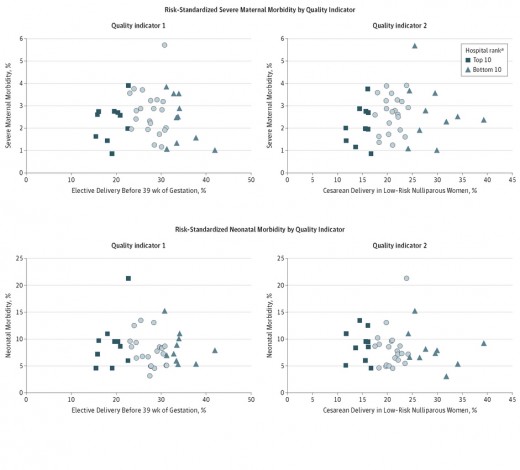
Hospital rankings on both quality measures were not associated with hospital rankings for maternal or neonatal morbidity as demonstrated in the Figure. In fact, among the 10 hospitals with the best performance (lowest rates) on elective deliveries, only 3 were in the lowest quartile of risk-standardized severe maternal morbidity. Among the 10 hospitals with the best performance (lowest rates) on the low-risk cesarean delivery measure, only 3 were in the lowest quartile of risk-standardized severe maternal morbidity. The rankings were similarly discordant for neonatal morbidity.

As the scatter plots show, there is no relationship between C-section rates and outcomes or between induction rates and outcome.

C-section induction rates vs morbidity

The authors conclude:

… Severe maternal morbidity rates varied 4- to 5-fold between hospitals, and there was a 7-fold variation in neonatal morbidity at term between hospitals. Although there was substantial variation in morbidity rates, they were not correlated with the performance measures designed to assess hospital-level obstetric quality of care.

Our results are consistent with findings from the Maternal Fetal Medicine Network and studies in NICUs demonstrating that performance assessment based on isolated measures do not accurately characterize the overall quality of care in a hospital…

… Our findings highlight the need for an expanded array of obstetric quality measures.

I personally think that the findings highlight the fact that process measures are NOT quality measures.

Contrary to the claims of natural childbirth advocates, C-sections and inductions do NOT lead to an increase in poor outcomes. The key to good outcomes is ensuring the correct match between what a patient needs to have an optimal outcome for both mother and baby and what she gets. Interventions themselves as not measures of quality. Only outcomes can tell us whether we are providing high quality care.

Why do so many babies die at American homebirth?

iStock_000042642270Small copy

The increased risk of death and serious injury at American homebirth is well established and a remarkably robust finding across multiple studies, including:

Grünebaum A, McCullough LB, Sapra KJ, et al. Early and Total Neonatal Mortality in Relation to Birth Setting in the United States, 2006-2009. Am J Obstet Gynecol. 2014 Mar 21. pii: S0002-9378(14)00275-0. doi: 10.1016/j.ajog.2014.03.047.

Cheng YW, Snowden JM, King TL, Caughey AB. Selected perinatal outcomes associated with planned home births in the United States. Am J Obstet Gynecol. 2013; 209: 325.e1-8.

Grünebaum A, McCullough LB, Sapra KJ, et al. Apgar Score of Zero at Five Minutes and Neonatal Seizures or Serious Neurologic Dysfunction in Relation to Birth Setting. Am J Obstet Gynecol. 2013; 209: e1-323. e6

Wasden, S., Perlman, J., Chasen, S., and Lipkind, H. 506: Home birth and risk of neonatal hypoxic ischemic encephalopathy. Am J Obstet Gynecol. 2014; 210: S25

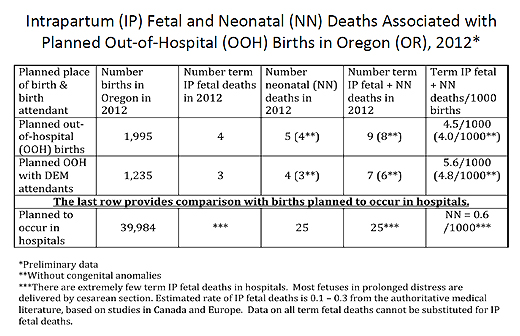
The most remarkable finding is the analysis of Oregon data from 2012 by Judith Rooks, CNM, MPH demonstrating the planned homebirth with a licensed (CPM, LM, DEM) midwife has a perinatal death rate 800% higher than comparable risk hospital birth.

Oregon homebirth death rates 2012

Even the data from the Midwives Alliance of North America survey of their members (Cheyney M, Bovbjerg M, Everson C, Gordon W, Hannibal D, Vedam S. Outcomes of Care for 16,924 Planned Home Births in the United States: The Midwives Alliance of North America Statistics Project, 2004 to 2009. J Midwifery Womens Health. 2014; 59: 17-27) shows that homebirth increases the risk of perinatal death by 450%.

Why do so many babies die at homebirth? A new paper Perinatal Risks of Planned Home Births in the United States by Grunebaum et al. provides answers.

Data from the United States (US) Centers for Disease Control’s National Center for Health Statistics birth certificate data files from 2010-2012 were utilized to analyze the frequency of certain perinatal risk factors which were associated with planned midwife-attended home births in the United States and compare them with deliveries performed in the hospital by certified nurse midwives (CNM). Home birth deliveries attended by “others” were excluded; only planned home births attended by midwives were included. Hospital deliveries attended by certified nurse midwives served as the reference. Perinatal risk factors were those established by ACOG and AAP.

What did the authors find?

Twins:

… 1 in 156 (0.64%) of midwife-attended planned home births were twin pregnancies, even though ACOG considers twins a contraindication for home births, as there is no adequate fetal monitoring, no experienced team, and no ultrasound available in home births. Studies on safety of home births from Canada, England, and the Netherlands excluded twins as candidates for home birth because of increased risks..

Breech:

… 1 in 135 (0.74%) of planned home births attended by midwives were vaginal breech deliveries. Breech vaginal birth is associated with significantly increased risks… Azria et al. recommended that a trial for vaginal births in breech presentations should be attempted only with continuous electronic fetal heart rate monitoring (EFM) and presence of ultrasound during labor and delivery. Neither EFM nor ultrasound is available in home births. Janssen from Canada and the Home birth in England Study excluded breech presentations from their home birth eligibility requirements. Therefore it is not surprising that the Midwives Alliance of North America (MANA) study of planned home births, reported an intrapartum death rate of 13.51/1,000 and a 9.16/1,000 neonatal mortality rate in breech presentations.19 When compared to the neonatal death rates from hospital deliveries these adverse neonatal outcomes are significantly increased

Postterm:

ACOG and AAP criteria for home births specifically exclude pregnancies ≥41 weeks from their home birth eligibility. In this study, 28.19% of home births were ≥41 weeks. Postterm pregnancies are associated with multiple, well-known complications, such as labor dystocia, increased perinatal mortality rate, low umbilical artery pH levels at delivery, low 5-minute Apgar scores, postmaturity syndrome, fetal distress, cephalo-pelvic disproportion, postpartum hemorrhage, and increased risk of neonatal death within the first year of life.

Attempted vaginal birth after C-section (VBAC):

A trial of labor after prior cesarean delivery (TOLAC) is associated with a greater perinatal risk than is elective repeat cesarean delivery without labor. TOLACs have an overall small but significantly increased risk of uterine rupture with often catastrophic consequences to mother and/or fetus.22,23 This study showed that nearly 1 in 23 (4.4%) of midwife-attended home births (n=2,463, 4.4%) had a home VBAC in spite of the fact that ACOG considers prior cesarean section an absolute contraindication to planned home birth… The recent MANA study showed a very high 2.85/1,000 intrapartum fetal death rate with VBACs.

In other words, babies die because American homebirth midwives ignore the risk guidelines accepted by ACOG, the American Academy of Pediatrics, Dutch midwives, British midwives and Canadian midwives. What’s the difference between American homebirth midwives and every other provider who accepts the risk guidelines? American homebirth midwives aren’t real midwives. They lack the education and training of ALL other midwives in the industrialized world and they are ineligible for licensure in ALL other first world countries. American homebirth midwives are lay “birth junkies” who made up their own credential and awarded it to themselves in order to trick American women into thinking they are healthcare providers.

American homebirth midwives are frauds and ignore the safety guidelines accepted by midwives and obstetricians around the world. It is hardly surprising then that so many babies die at American homebirth.

The unspeakable cruelty of lactivists

Cruel Rubber Stamp

I have a dear friend who is a breast cancer oncologist. It is hardly unusual for women to cry in her office, but one incident that she shared truly shocked me.

When my friend opened the exam room door, her patient was already crying. No, she wasn’t feeling ill. No, her disease was not progressing. In fact, she had come to the appointment eager to celebrate her progress. Why, then, was she crying?

When she checked in at the front desk of the office, the secretary had looked at her and blurted out, “You’re bald! What happened to your beautiful hair?”

How could the secretary be so unthinkingly cruel? Obviously her hair had fallen out from chemotherapy.

That topped my list for clueless cruelty until yesterday. That’s when I read Why I don’t breastfeed, if you must know, by Emily Wax-Thibodeau.

Wax-Thibodeau has also battled breast cancer. She was subjected to unfathomable cruelty, not from a medical secretary, but from people who ought to know better, lactation consultants.

The truth is, I’m a breast cancer survivor, and after a double mastectomy with reconstruction, which probably saved my life, I simply wasn’t able to breast-feed…

Five years after the operation that saved her life:

… We were cleared to try getting pregnant. But because chemotherapy ravages fertility and I was now 37, we found ourselves saving money and signing up for in vitro fertilization.

It took two rounds of IVF to get pregnant.

On Jan. 29, 2014, I gave birth to a 71 / 2-pound baby boy who had a head full of light brown hair and whose ravenous appetite and old-man snore we instantly found mesmerizing, maybe in a way only parents could.

“You never gave up,” my husband said, laughing as he watched Lincoln gulp down his first two-ounce serving of formula, which my husband fed to him.

As the two of them cuddled afterward, I was in a mood that I can describe only as postpartum elation.

That is, until those I jokingly call the “breast-feeding nazis” came marching in to my room.

Despite her medical history:

“You really should breast-feed,” the hospital’s lactation consultants, a.k.a. “lactivists,” said.

When I simply said, “I’m going to do formula,” they didn’t want to leave it at that.

So holding my day-old newborn on what was one of the most blissful days of my life, I had to tell the aggressive band of well-intentioned strangers my whole cancer saga.

You might think that would have shut them up. You would be wrong.

“Just try,” they advised. “Let’s hope you get some milk.”

“It may come out anyway, or through your armpits,” another advised later …

These are supposed health professionals. Their ignorance is astounding — mastectomy removes all breast tissue, even the tail of the breast that extends into the armpit — but their cruelty is truly mind-boggling. What’s next, chiding a paraplegic to get out of that wheelchair and exercise?

But as I’ve written many times in the past, many lactation consultants aren’t healthcare professionals. They are laypeople who had an easy time breastfeeding and enjoy feeling morally superior to other mothers. Shaming is integral to lactivism because shaming others is integral to the self-image of lactivists. All their so-called “baby friendly” initiatives — locking up formula in hospitals, mandating lectures on the benefits of breastfeeding to exhausted new mothers, abolishing well baby nurseries — aren’t friendly to babies, and they certainly aren’t friendly to mothers; they are friendly ONLY to lactivists.

Wax-Thibodeau almost feels relieved at having an “acceptable” reason for not breastfeeding.

As Jezebel’s Tracie Egan Morrissey wrote: “What those lactivist [expletive] conveniently forget to tell people — in their ongoing campaign of castigating bottle-feeding mothers as unnatural and ignorant, masking their concern-trolling as “support” — is that breastfeeding, for many women, is an incredibly painful, almost traumatizing endeavor. It was all so miserable and I associated that misery with my new baby, whom I secretly resented.”

Others literally lowered their voices to a whisper, confessing as if they had committed a crime that they supplemented breast-feeding with formula.

Why did they feel they had to whisper? In many ways, it reminded me of the stigma that comes with having a C-section.

The comparison is telling. Lactivists are often natural childbirth advocates, too. And in the same way that they grossly inflate the benefits of breastfeeding, they grossly exaggerate the “risks” of C-sections.

Many years ago I read Harold Kushner’s outstanding book When Bad Things Happen to Good People. Kushner offered an important insight into why people saying unspeakably cruel things to those who suffer misfortune. When confronted with someone who has suffered a tragedy, people often say “It could have been worse” but they mean “it could have been me.” In other words, many cruel remarks directed toward others are actually self-referential.

That is precisely what is going on with the shaming and blaming so beloved of lactivists and lactation consultants. Their comments, and even many of their “scientific” claims are self-referential. They reflect the need for lactivists and lactation consultants to boost their own self-esteem by criticizing others, often under the guise of “support.”

I have bad news for lactivists. In industrialized countries, the benefits of breastfeeding, while real, are trivial. Lactivists are not superior to other mothers; they are just women who chose one excellent form of infant nutrition over another excellent form of nutrition. They wield guilt, not for the benefit of babies, and certainly not for the benefit of mothers. They wield guilt for the benefit of themselves. Their cruelty comes from their self-absorption and those who are victims of that cruelty should not despair.

How you feed your baby is irrelevant. How you love your baby is what counts!

Yes, I’m judging you for choosing homebirth, but not for the reasons you think

iStock_000014649496Small copy

Another day, another homebirth narcissist!

Johanna Parker at Mommyish treats us to yet another boring, self-absorbed “Look at ME! Look at ME! grab for attention” that homebirth advocates love so dearly. The title is I Know You’re Judging Me For Having A Home Birth. Parker is both right and wrong. She’s right that I’m judging her, but she’s wrong about the reasons why.

Parker writes:

When my husband and I made the decision to have a planned home birth, I knew we would be met with some opinions and concerns, both from our loved ones and from any random stranger within an earshot of us talking about it. So after doing a ton of homework and arming myself with every fact and statistic I could find on the subject, I felt ready to take on the haters. I did a ton of research on midwives and bookmarked several websites on my phone that I would always have at the ready in case I needed some backup explaining why someone would choose this method of delivery. The problem is, many people just don’t know much about home births, nor do they want to. They’re happy picturing you burning sage while a woman in Birkenstocks chants over you and your naked family floating together in a giant inflatable tub in your living room (which, by the way, is totally cool if that’s your thing). One major thing I’ve realized is that most people who were upset with or concerned about our decision didn’t even know what a midwife was. Trying to argue the virtues of a home birth with them is like trying to talk politics with your parents – you just can’t.

Excuse me as I pick myself up off the floor for laughing so hard at the napalm grade stupidity and hubris that leads women like Parker to risk killing their own babies for bragging rights. How ignorant and how arrogant is Parker? Let me count the ways:

1. Parker is so ignorant that she actually thinks that she has done “research” by reading a bunch of websites. Research involves reading scientific papers and textbooks, not websites for laypeople.

2. Parker fails to understand that homebirth is a business and that the websites that promote it make their money by selling it. These websites are just extended advertisements. “Researching” the relative merits of homebirth and hospital birth using homebirth websites is the equivalent of researching the relative merits of Ford cars and GM cars by using the Ford website. Only a fool would think she had done research by reading the material from one side.

3. Parker is a walking, talking embodiment of the Dunning-Kruger effect. According to Wikipedia:

The Dunning–Kruger effect is a cognitive bias manifesting in unskilled individuals suffering from illusory superiority, mistakenly rating their own ability much higher than is accurate. This bias is attributed to a metacognitive inability of the unskilled to recognize their ineptitude…

Dunning and Kruger proposed that, for a given skill, incompetent people will:

  • fail to recognize their own lack of skill;
  • fail to recognize genuine skill in others;
  • fail to recognize the extremity of their inadequacy …

4. In her overweening confidence in her own “research” abilities, Parker appears to think that she has armed herself with every fact and statistic she could fine. Really? She seems to have missed quite a few crucial statistics:

  • According to MANA’s (Midwives Alliance of North America) own data, homebirth increases the risk of death by 450%.
  • According to Judith Rooks, CNM MPH’s comprehensive analysis of Oregon’s homebirth data, PLANNED homebirth with a LICENSED homebirth midwife increases the risk of death by 800%.
  • In the Netherlands, the country with the higest rate of homebirth, midwives caring for low risk patients have a HIGHER perinatal mortality rate than obstetricians caring for high risk patients.
  • The risk of a 10 minute Apgar score of zero (stillbirth) is 1000% (yes, 3 zeros) higher at homebirth.

5. Parker believes that others do not know the truth about midwives, but it is likely Parker herself who is misinformed. American homebirth midwives are not really midwives. They are simply lay people who couldn’t be bothered getting real midwifery training and proclaimed themselves “midwives” anyway. The credential of American homebirth midwives is not recognized or accepted by any other country in the industrialized world. Women who hire a homebirth midwife are simply paying a lay birth junkie to amuse herself by ogling someone else’s labor. In the event of an emergency, American homebirth midwives are useless. That’s why the death rate at homebirth is so much higher than comparable risk hospital birth.

The arrogance of people like Parker never ceases to amaze me. Obstetricians, pediatrician, and neonatologists are all on record as noting that homebirth is NOT as safe as hospital birth, but Parker, with no medical education of any kind thinks she knows better and is willing to risk killing her own baby to prove it.

You’re right, Ms. Parker, I’m judging you. I’m judging you as a fool who, in the words of Wikipedia, is suffering from illusory superiority, mistakenly rating your own ability much higher than is accurate. This bias is attributed to your metacognitive inability to recognize your own ineptitude.

As Dame Edith Sitwell said:

I am patient with stupidity, but not those who are proud of it.

Cochrane Review: women should get labor epidurals as soon as they want them

image

The folks at Cochrane Reviews have just crushed a number of the most cherished myths of natural childbirth advocates:

Pain during childbirth is arguably the most severe pain some women may experience in their lifetime. Epidural analgesia is an effective form of pain relief during labour…

We conclude that for first time mothers in labour who request epidurals for pain relief, it would appear that the time to initiate epidural analgesia is dependent upon women’s requests.

That’s three dead myths in only 3 sentences:

1. Contractions aren’t surges but the most severe pain experienced.

2. Epidurals are very effective in managing that pain.

3. A woman should get an epidural when she asks for one since the timing has no impact on outcome.

The Review, Early versus late initiation of epidural analgesia for labour, was published yesterday.

The authors explain the methodology and findings:

We included nine studies with a total of 15,752 women.The overall risk of bias of the studies was low, with the exception of performance bias (blinding of participants and personnel).

The nine studies showed no clinically meaningful difference in risk of caesarean section with early initiation versus late initiation of epidural analgesia for labour (risk ratio (RR) 1.02; 95% confidence interval (CI) 0.96 to 1.08, nine studies, 15,499 women, high quality evidence). There was no clinically meaningful difference in risk of instrumental birth with early initiation versus late initiation of epidural analgesia for labour (RR 0.93; 95% CI 0.86 to 1.01, eight studies, 15,379 women, high quality evidence). The duration of second stage of labour showed no clinically meaningful difference between early initiation and late initiation of epidural analgesia (mean difference (MD) -3.22 minutes; 95% CI -6.71 to 0.27, eight studies, 14,982 women, high quality evidence). There was significant heterogeneity in the duration of first stage of labour and the data were not pooled.

There was no clinically meaningful difference in Apgar scores less than seven at one minute (RR 0.96; 95% CI 0.84 to 1.10, seven studies, 14,924 women, high quality evidence). There was no clinically meaningful difference in Apgar scores less than seven at five minutes (RR 0.96; 95% CI 0.69 to 1.33, seven studies, 14,924 women, high quality evidence). There was no clinically meaningful difference in umbilical arterial pH between early initiation and late initiation (MD 0.01; 95% CI -0.01 to 0.03, four studies, 14,004 women, high quality evidence). There was no clinically meaningful difference in umbilical venous pH favouring early initiation (MD 0.01; 95% CI -0.00 to 0.02, four studies, 14,004 women, moderate quality evidence).

Catherine Pearson at HuffPo interviewed a number of clinicians on their thoughts about the review:

“This review — performed through the rigorous Cochrane methodology — provides a high level of medical evidence that early epidurals do not extend labor time, especially the pushing stage,” Dr. Sng Ban Leong, deputy head and senior consultant with the department of women’s anesthesia and KK Women and Children’s Hospital in Singapore, wrote in an email to The Huffington Post. Leong was an author on the review.

And:

“Epidurals these days are very different from the ’80s and ’90s,” Dr. J. Christopher Glantz, a professor of obstetrics and gynecology in the division of maternal-fetal medicine at the University of Rochester Medical Center, told The Huffington Post. Many hospitals now offer lower-dose walking epidurals, which can leave women with enough strength to move throughout labor and may help them push more effectively.

And:

“The takeaway message is that when women experience labor pain, and they choose to have early epidural pain relief, they [should] be reassured that this does not have any adverse effects to their labor outcomes,” Leong wrote.

When should a woman get an epidural in labor? According to the folks at Cochrane Reviews: whenever she wants it!

Toxicophobia, fear of toxins

iStock_000014509305Small copy

A new book about fear of vaccination reminds me of a piece I wrote nearly 5 years ago on toxicophobia.

The book is On Immunity: An Inoculation by Eula Biss. As a review in the New York Times Review of Books, characterizes the person most likely to be afraid of vaccines:

white, educated, relatively wealthy — a woman drawn to doing things “naturally,” who tells us she gave birth without pain medication, medical intervention or an IV.

That “naturally” is key. Our anxieties about industrialization, at how we’ve polluted the world and presumably each other, have given the word its particular luster: “Where the word filth once suggested, with its moralist air, the evils of the flesh, the word toxic now condemns the chemical evils of our industrial world.”

Biss reports from deep inside the panic. “My son’s birth brought with it an exaggerated sense of both my own power and my own powerlessness,” she writes. The world became suddenly forbidding: There is the lead paint in the wall to fear, the hexavalent chromium in the water. Even stagnant air, she was told, can kill her child. “It is both a luxury and a hazard to feel threatened by the invisible,” she says.

Biss is talking about toxicophobia, the fear of toxins, which underlies a variety of “natural” movements from natural childbirth to anti-vaccination to natural parenting. Aficionados of these movements suffer from a pervasive fear of being poisoned. And not poisoned accidentally, either. They fear being poisoned surreptitiously, deliberately, and as part of a giant conspiracy perpetrated by Big Pharma and Big Farma and Big Medicine.

It is axiomatic among quacktivists — anti-vax activists, organic food devotees, homebirth midwives, natural parenting advocates — that conventionally grown food and the water supply are filled with “toxins.” Sometimes these toxins are named; often they are not. In all cases, though, there is no evidence that anyone is actually being harmed by “toxins,” but, of course, proof is not a requirement in the fantasy world inhabited by devotees of quacktivism.

Vaccines supposedly contain “toxins” that cause autism. (N.B. Toxins always and only cause diseases and syndromes whose etiology is still unknown. No one ever claims that toxins cause strep throat, or sickle cell anemia, or gallstones.) Our food supply is purportedly contaminated by toxins too numerous to even bother mentioning by name. Our water supply is supposedly contaminated by the toxins in pesticides. And, of course, all medications produced by Big Pharma have myriad secret and toxic side effects.

Big Pharma deliberately adds toxins to its vaccines. AND vaccine manufacturers know all about this and do it to make more money. AND the government knows all about it, too, and insists that we take more and more vaccines every year. AND the government pays for it. AND the government has granted vaccine makers indemnity from prosecution. It is a wicked world.

Big Farma covers our fruits and vegetables with toxins, and, if that weren’t enough, adds toxins in the guise of preservatives to everything else. And these toxins cause cancer! What kind? Don’t ask, no one knows, and why would that matter anyway? Cancer is cancer. And if all that weren’t bad enough, Big Farma now wants to flood our food supply with … genetically modified food. Horror of horrors, genetically modified foods (they modified the GENES, for chrissakes) are sure to be filled with unnamed toxins of all sorts. And if that weren’t bad enough, Big Farma wants to irradiate our food to kill harmful bacteria (they’re going to expose our food to RADIATION, for chrissakes). Next thing you know we’ll all be gigantic and super-powerful. Oh, wait, maybe we’ll all be stunted and weak. It doesn’t matter; regardless of what they do you can be sure it will “weaken” our immune systems.

We are facing a big problem. Contrary to what the food and medicine toxicophobes believe, it is not the deliberate contamination of our food and pharmaceutical systems. The problem is a sociological problem. Large segments of the populations are suffering from the delusion that industry and the government are colluding to deliberately poison them.

To be clear, I’m not suggesting that medications don’t have side effects or that pesticides or preservatives are theoretically incapable of being harmful. Everything has potential side effects, but there’s a big difference between “potential” and “real.” Vaccines, for example, are known to cause brain damage and death in a tiny proportion of children who are vaccinated. That is real. But vaccines don’t cause autism. That’s fantasy.

What is the source of this toxicophobia? In part it stems for Americans’ apparent inability to understand risk. Americans are so obsessed with side effects that they forget about effects. They vastly overestimate the risk of side effects and vastly underestimate the life saving benefits of the treatments in question. That tendency to overestimate side effects is directly related to the sense of control that Americans do or do not feel. Just as Americans routinely underestimate the risks of driving, they routinely overestimate the risk of plane flight. They believe themselves to be in control while driving, yet they develop irrational fears about the risk of an unforeseen and unforeseeable plane crash.

So Americans obsess over the risk of side effects from medication and the theoretical risk of side effects from agricultural methods that have made the food supply larger and safer. They are consumed with anxiety by the belief that they are secretly being poisoned. This obsession is magnified by the belief that Big Pharma and Big Farma know about all these side effects and are hiding them. Do large corporations hide damaging information from the public? Yes, unfortunately, they do. But Big Pharma and Big Farma are no different from other large corporations. Yet no one has stopped driving because they fear the auto industry has designed cars that will blow up at the slightest provocation (even though that actually happened with the Ford Pinto) and no one has stopped crossing bridges for fear that shoddy construction will lead them to collapse (even though that has actually happened, too).

Simply put, there is no basis in reality for this pervasive toxicophobia, suggesting that it may be serving a psychological function. Americans are not being poisoned, but they imagine they are because, I suspect, it is a way to channel their anger at being so easily manipulated by large corporate entities like banks and other special interests, and their frustration at their perceived powerlessness. Toxicophobia projects this fear, anger and frustration onto medications, food, and, most importantly, vaccines. Unfortunately, rather than being protective, toxicophobia diverts attention from the real problems onto imaginary ones. And, paradoxically, toxicophobia doesn’t improve health, it kills people, generally babies, small children and the immuno-compromised.

Anti-vax activism is toxicophobia writ large. And as Biss points out, toxicophobia, like most quacktism is a luxury of the privileged.

Getting your information about C-sections from homebirth midwives is like getting your information about solar power from Big Oil

iStock_000007637100Small copy

More than 20 years ago, when my husband and I were seeking a new home for our expanding family, we were shown several beautiful plots of land. The houses were spacious, the plots of land were large and the entire area backed up onto conservation land. The builder who owned the land was offering three different house models, all very attractive.

We toured the development, but were not happy with the available models; none had a family room located off the kitchen and that was one of my few absolute requirements. My children were small and I wanted to be able to see them at all times, including when I was preparing meals. The fact that our 3 year old had recently cut the 5 year old’s hair with kindergarten scissors when I left them playing where I could not see them from the kitchen only strengthened my resolve on this point.

We tried to convince the builder to adapt an existing model to our requirement and were astounded when he told us that while we thought we wanted a family room off the kitchen, we didn’t really want one. Eventually the kids would get older and we would appreciate it when they weren’t in view. In other words, he couldn’t or wouldn’t built a house with the family room attached to the kitchen and it was therefore in his economic interest to convince us that we didn’t need one.

Not surprisingly, we sought out another builder with a different piece of land and ultimately got the house we wanted with a kitchen overlooking a sunken family room. For years I watched 4 children play by themselves, with each other and with friends in that room, and no one ever cut anyone else’s hair with kindergarten scissors ever again. And when the kids got older and we didn’t want them in view, we finished the basement.

I’m reminded of that episode whenever I see homebirth midwives discussing C-sections. Just like the builder who wouldn’t build the house we wanted tried to convince us that we really wanted what he was selling, homebirth midwives, who cannot perform C-sections, try to convince women that they don’t need C-sections, don’t want them, and will be sorry if they have them.

What never ceases to amaze me is that women seeking information on C-section from homebirth midwives fail to recognize the economic motivation behind midwives’ demonization of C-sections. It’s the intellectual equivalent of seeking information on solar power from Big Oil. Would you believe Big Oil if it tried to convince you that solar power was a bad idea? I doubt it. So why believe homebirth midwives when they tell you that C-sections are a bad idea?

Dr. Amy