Why you shouldn’t believe anything you read about the microbiome

Microbes

New scientific discoveries are incredibly exciting, but often poorly understood and misused in dangerous ways.

Consider the discovery of radioactivity. It profoundly changed everything from medical imaging to nuclear power to atomic warfare. But before it was completely understood (no one knew it could lead to genetic mutations that result in cancer) it was misused in a variety of ways that range from humorous to horrifying.

As the website Mental Floss explained in a its post 11 Ways We Used Radiation in Everyday Life:

…Once upon a time, radiation in different forms was new and wondrous and had a million uses -medications, cosmetics, industrial applications, and even entertainment. It was only later that the danger became evident.

These uses ranged from radioactive toothpaste, advertised as providing a bright smile and freshening your breath by killing bacteria in the mouth, to radioactive cosmetics to make your complexion “glow” and prevent aging, to patent medicines, to radioactive suppositories designed to deliver healthful radiation directly to internal organs. There is no way to know how many cases of cancer and how many deaths might have been caused by the enthusiastic adoption of radiation as a “cure.”

We appear to have learned nothing from that debacle even though the message could not be clearer: Do not implement new medical discoveries until they are thoroughly tested and understood. Indeed, we are eagerly rushing to repeat our mistake, only this time the scientific discovery is the microbiome.

The microbiome will likely turn out to be an exceedingly important factor in human health and disease, just as radiation turned out to be exceedingly important in health and disease (think radiology and treating cancer with radiation). But we are only on the cusp of understanding the microbiome, and therefore, capable of doing terrible harm by turning our speculations into action. That’s the theoretical reason why you shouldn’t believe what you read about the microbiome in the mainstream media, but there are practical reasons as well.

Consider that the micriobiome has its own microbiome, the virome, and it is the interaction between the bacteria and the viruses that prey on them and on human beings, that determines health and disease. There is a small, but growing body of evidence that the human body can harness or at least influence the composition of the virome in order to regulated the microbiome. A paper published last year in PNAS, Bacteriophage adhering to mucus provide a non–host-derived immunity, offers a tantalizing glimpse of the possibilities:

Mucosal surfaces are a main entry point for pathogens and the principal sites of defense against infection. Both bacteria and phage are associated with this mucus. Here we show that phage-to-bacteria ratios were increased, relative to the adjacent environment, on all mucosal surfaces sampled, ranging from cnidarians to humans. In vitro studies of tissue culture cells with and without surface mucus demonstrated that this increase in phage abundance is mucus dependent and protects the underlying epithelium from bacterial infection… Based on these observations, we present the bacteriophage adherence to mucus model that provides a ubiquitous, but non–host-derived, immunity applicable to mucosal surfaces. The model suggests that metazoan mucosal surfaces and phage coevolve to maintain phage adherence. This benefits the metazoan host by limiting mucosal bacteria, and benefits the phage through more frequent interactions with bacterial hosts. The relationships shown here suggest a symbiotic relationship between phage and metazoan hosts that provides a previously unrecognized antimicrobial defense that actively protects mucosal surfaces.

In other words, certain viruses help the body to fight off bacterial infections by killing the bacteria. Even more remarkable, it appears that the animal will change the composition of its mucous to recruit more of the helpful viruses and thereby make it easier to ward off infection by harmful bacteria. Moreover, research suggests that the virome differs far more from person to person than microbiome, suggesting that it may play a greater role in health and disease than the microbiome.

The bottom line is that the microbiome is extremely complex and interacts with the body and with both helpful and pathogenic bacteria in ways that we do not yet comprehend. That’s why any contemporary claims about the microbiome, including claims about possible differences in the microbiome of babies born by C-section vs. babies born by vaginal delivery are the intellectual equivalent of radioactive suppositories. We are dealing with something powerful, but we don’t know enough about it yet to make ANY recommendations since we have no idea of what the optimal microbiome looks like, of how the virome and the microbiome interact, of how the body uses the virome to manage the microbiome, whether individual differencess in the microbiome are clinically meaningful, and the long term effects of attempting to manipulate the microbiome.

The microbiome may well turn out to be as important as radioactivity. Only time, and much more study, will tell. Until then, we should be very careful about making any claims and promising any health benefits. As the example of radioactivity demonstrates, it is all too easy to do more harm then good by manipulating a system that is, as yet, poorly understood.
Let’s review: Where are the female obstetricians?

iStock_000015682470XSmall

Decades after I first learned about natural childbirth and homebirth I am still shocked that anyone believes in it.

Natural childbirth was invented by a racist, sexist white male (Grantly Dick-Read) who wanted to encourage women of the “better classes” to stop fearing labor and have more children. It has been perpetuated by a cadre of Western, white, male physicians (Lamaze, Bradley, Odent) who subscribe to the notion that pain is women’s heads, or failing that, should make them feel “empowered.”

The “grandmother” of midwifery is Ina May Gaskin, a hippie from a bizarre commune who has no training in anything, AND let her own baby die rather than seek medical care for him. The foot soldiers in the NCB and homebirth armies are women who have no formal education in science, medicine or obstetrics and seem to think that is no problem. They are women without college degrees who enjoy attending other women’s births as a hobby and who couldn’t be trusted with any professional responsibility, let alone one that involves life and death.

The current “thought leaders” in the NCB and homebirth world are all Western, white men like Michel Odent, the late Marsden Wagner and Michael Klein.

Did you notice that there is rather important group missing from the movement? I did, because I’m one of that group: women obstetricians.

Women obstetricians routinely favor high levels of interventions for themselves. They are open to C-section on maternal request and often have C-sections for maternal request. They love pain medication and freely use epidurals when they have children of their own.

Why aren’t they on board with NCB and homebirth, like some of their male colleagues? Let me count the ways.

1. They have personally experienced the pain of labor.

2. They have personally experienced the pain of labor.

3. They have personally experienced the pain of labor.

And having personally experienced the pain of labor, they recognize Dick-Read, Bradley, Lamaze and Odent for the sexist blowhards that they are.

There are additional reasons:

They have a wealth of knowledge about childbirth and its dangers. They have more experience and skill in handling childbirth than any CNM, CPM, doula or childbirth educator. They know that most of the NCB/homebirth trope is nothing more than made up nonsense.

They do not believe their personal value resides in their breasts and vagina. They recognize that their value lies in their intelligence, insight, professional accomplishments and actions in the world. They are empowered by knowledge, not by what passes through their vagina.

They don’t risk their children’s lives to prove a point because they have nothing to prove. Their accomplishments speak for themselves; they don’t have to create faux “accomplishments” out of bodily functions over which they have no control in any case.

I find it quite ironic that while women without formal training in science and male doctors with strong ideas about how women should react to pain prattle on and on of being “educated” about childbirth and interventions, they don’t seem to notice that women obstetricians, the people with the MOST education and personal experience of childbirth, are not on board.

Who the hell is Marsden Wagner to tell me how I ought to give birth?

Who the hell is Henci Goer to tell me that obstetricians ignore scientific evidence?

Who the hell is Michael Klein to tell me how much pain in labor I ought to endure?

Wake up NCB and homebirth advocates! Women obstetricians are not on board. We don’t need men to tell us how we should experience childbirth and we don’t need women who could barely finish high school to tell us their pretend “facts” about childbirth.

If we don’t believe their nonsense, why should anyone else?


This piece first appeared in June 2011.

Lucy Lactivist explains how to improve vision by locking up glasses

See fingers

Hi, folks! It’s Lucy Lactivist here. I’m a certified lactation consultant, though I prefer to think of myself as “The Breast Whisperer.” I am so skilled I can help any woman to breastfeed … or at least make her feel like its her fault if she can’t. That’s why I’m president of FFFL (Formula Feeding’s For Losers).

I’m branching out these days, and adding certified vision consultant to my list of skills. After all, vision is every bit as natural as breastfeeding, and works right nearly all the time.

Here’s a scary statistic for you: Approximately 30% of Americans are diagnosed as nearsighted and end up wearing glasses or contacts!

Are we really supposed to believe that 1/3 of all people can’t adequately see without vision correction? They didn’t have glasses in nature, folks, and we’re still here, aren’t we? The human race would have died out long ago if that many people really needed glasses.

Think about it: the human eye is perfectly designed to see, just like the human breast is perfectly designed to feed babies. Just as breastmilk is always available in the perfect amount, always at the perfect temperature and always really easy for the baby to get out of the breast, human vision is always available in just the right amount, is always focused in the perfect direction, and never requires squinting.

Some people say that vision corrected by glasses or contacts is just as good as natural vision, but that is absolutely, positively not true. Natural vision contains components that can’t be duplicated in glasses or contacts, which are only artificial attempts to mimic natural vision. Not only that, but glasses and contacts are made of chemicals!!!

Not just chemicals, but toxic chemicals. Did you know that glasses cause obesity, diabetes and cancer? Yes, they do.

For example, the graph below covers the years 1500-2000.

Business graph up

You can see that as the rate of glasses wearing increased dramatically (blue bars), the rate of obesity (blue line) increased dramatically, too. You could draw similar graphs for the relationship between glasses and diabetes and glasses and cancer (except you’d have to make them difference colors). What more proof do you need?

If only people got more support with their vision they wouldn’t need to give up and resort to glasses. Sigh, if only optometrists were more educated about vision. No sooner does a woman complain that she is having difficulty seeing things, then the optometrist immediately gives her a vision test and recommends glasses if the test is abnormal … as if that’s the answer to her problem.

A certified vision consultant such as myself would initially ignore anything a woman has to say about her vision. I never believe women when they claim to assess the functions of their own bodies. Everyone knows that they cannot be trusted to tell the truth; they’re just lazy and prefer to take the easy way out. They don’t realize the extent to which they have been brainwashed by Big Lens.

Don’t get me wrong; I’m not a radical. I recognize that some women truly have vision problems. For example, if a woman pokes her eye out with a stick I immediately refer her to a hospital that is usually less than 10 minutes a way.

Here’s the way that I recommend that vision complaints be handled:

1. Providers should deny that the woman has any problems with vision. You should encourage her to believe that she could see perfectly if she just tried harder.

2. If a woman insists on an eye chart test and can’t see even the big “E” at the top, you should tell her it’s just a variation of normal.

3. Encourage the woman to work harder at seeing.

4. Before even mentioning the option of vision correction, you should have the woman read and sign a statement acknowledging that natural vision is the gold standard and that glasses or contacts are an inferior method of seeing.

5. Under no circumstances should you ever give a woman glasses or contacts to take home. If they’re in the house, they’ll destroy a woman’s resolve to rely exclusively on natural vision.

6. When women are admitted to the hospital, you should hide their glasses or contacts and make them beg for them before you give them back. Sometimes women just need tough love to rely on natural vision.

7. It’s okay to sell reading glasses in drugstores, but they should be locked up behind the counter and women who want them should be stigmatized by being forced to wait in a separate check-out line.

Let’s face it. Every woman could have perfect vision if she just put the time and effort into it. Eyes are perfectly designed to see and they rarely, if ever, fail to function at the 20/20 level. We could dramatically increase reliance on normal vision if we gave women more support, encouraged them to believe that they can see perfectly even when they can barely see it all, reassure them that we wouldn’t be here if 1/3 of people in nature actually needed vision correction, and make it really difficult and embarrassing for them to use glasses or contacts.

Oh, and everyone should wear T-shirts like the one I’m wearing today. Look, it says, “My eyes can see; what’s your superpower?”

What do you mean you can’t see the writing? Stop squinting and just try harder!

Yet another ridiculously misleading obstetric study in the journal Health Affairs

Doctor Giving Thumbs Down Sign

What’s up with the folks at the journal Health Affairs? Do they actually read the studies they publish? It’s hard to imagine that they do since they let the authors get away with outrageous claims based on poor quality data.

Last year I wrote about a paper on C-sections that was misleading and left out important data. The paper was Cesarean Delivery Rates Vary Tenfold Among US Hospitals; Reducing Variation May Address Quality And Cost Issues by Kozhimannil et al. There was just one problem; that’s NOT what the data actually showed.

Yes, it is true that the rate at the hospital that did the greatest proportion of C-section is 10 times higher than the rate at the hospital that did the lowest proportion of C-sections, but looking at the actual data shows that both hospitals are outliers. In fact, more than 90% of hospitals had C-section rates between 21%-44%. That’s still an appreciable difference (double), but very far from the 10 fold difference touted by the authors.

Now comes the latest paper playing fast and loose with the truth, Rates Of Major Obstetrical Complications Vary Almost Fivefold Among US Hospitals by Glance et al. You might think that means that the rates of major obstetrical complications vary almost 5-fold, but you’d be wrong.

What did the study actually show? We’ll get to that, but first take a look at the authors’ disclaimer unusually positioned before the results themselves:

… First, maternal health care must balance the needs of the mother and the fetus. Our data did not allow us to link maternal and newborn records to simultaneously examine the outcomes of mother and child.

Second, administrative data have been used to examine health care quality over the past three decades. However, these data have significant limitations, including the lack of important risk
factors (such as parity—that is, the number of pregnancies carried to birth—and body mass index), laboratory values, and information on other diagnostic tests; problems with coding accuracy
(for example, the extent to which comorbidities and complications are properly coded); and variability in data quality across hospitals.

Third, it is likely that some of the variation in outcomes was the result of residual confounding caused by differences in unmeasured risk factors or reporting across hospitals…

In other words, they have no idea of the tradeoffs that led to the treatment decisions, there was no way to adjust for the risk status of the patients, and there may be variations in reporting across hospitals. Even the authors think that their conclusions should be taken with a ton of salt, and that’s before you look at how they manipulated the data to reach the alarming, and thoroughly unjustified, conclusion of the title.

What did the authors look at?

Our primary outcome of interest was a composite complication outcome that consisted of maternal hemorrhage; laceration or operative complication; infection; and all other complications, such as thrombotic complications.

Any vaginal tear is a major complication? No, 1st and 2nd degree lacerations are minor complications and quite common; many do not even require stitches. To include them in “major complications” is irresponsible and indefensible.

An obstetric hemorrhage is a serious complication? Not if it doesn’t require a blood transfusion, it isn’t. Indeed many studies looking at maternal morbidity do not consider any hemorrhage that does not require 2 or even 3 units of blood to be a serious complication.

Moreover, I’m always suspicious of composite indices in clinical investigations. Amalgamating the results from disparate outcomes into a “composite index” can hide a myriad of heterogeneous findings and lead to faulty conclusions. That’s exactly what happened here.

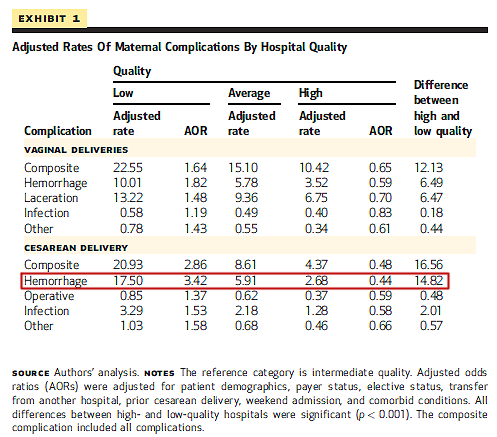
Take a look at the author’s table of results of the various individual outcomes as well as the composite outcomes.

Maternal complications by hospital quality

In the entire table, encompassing multiple outcomes of vaginal births and multiple outcomes of Cesarean birth, there is only ONE individual complication that is more than 5X higher in low quality hospitals than in high quality hospitals (outlined in red on the table below). Every other complication has variations that don’t even come close to 5 fold. But since the rate of hemorrhage is so much higher than the rate of all other complications (except lacerations in vaginal births) that it makes up an outsize portion of the composite index.

The authors claim to have found:

Women undergoing a cesarean delivery at a low-performing hospital were nearly five times more likely to experience a major complication (20.93 percent) than women undergoing a
cesarean delivery at a high-performing hospital (4.37 percent) (Exhibit 1).

That conclusion is deeply misleading and therefore irresponsible.

The authors ACTUALLY found that the rate of peri-Cesarean hemorrhage was 6.5X higher in low performing hospitals than in high performing hospitals. Every other possible complication, including every complication of vaginal birth, and every other complication of Cesarean differed by approximately 2 fold. And we don’t even know if these hemorrhages were serious complications or merely above average blood loss at the time of surgery.

In other words, the title of the paper, Rates Of Major Obstetrical Complications Vary Almost Fivefold Among US Hospitals, is a lie.

Only ONE complication (not complications) differed by 5 fold, and maybe not even that since all obstetric hemorrhages are treated as serious complications even though most of them are not. Everything else did not differ by anywhere close to 5 fold.

Apparently the folks at Consumer Reports don’t read the scientific papers they report on, either. They, too, have a indefensibly misleading headline, Having a baby in the U.S. is more dangerous than you might think.

In addition to promoting the grossly inappropriate conclusion of the Health Affairs paper, they include this gem as well:

Thirteen percent of them, or some 550,000 women a year, suffer serious bleeding, blood clots, infections, or other complications, according to a study out this week in the journal Health Affairs. That’s a complication rate comparable to heart surgery.

But not all of those women suffered serious complications, most of the vaginal lacerations were not serious complications and most of the obstetric hemorrhages were not serious complications. Even the authors of the original paper acknowledge that:

the rate of obstetric complications is nearly 13 percent, which is similar to the rates of major complications for cardiac (13.4 percent) and noncardiac surgery (12.3 percent). Maternal complications such as hemorrhage, infection, and laceration are frequently less severe than complications following major surgery… (my emphasis)

So the authors of the Health Affairs paper used crappy, incomplete data, unadjusted for risk, to reach deliberately irresponsible and misleading conclusions … and then Consumer Reports proceeded to repeat the irresponsible, indefensible claim.

It’s déja vu all over again. Yet another ridiculously misleading obstetric study cheerfully published and publicized by people who apparently didn’t even bother to read it.

YoniFest, Aviva Romm? Really?

Yonifest word

You cannot make this stuff up.

Earlier this month Quebec hosted YoniFest. That’s right, YONIFEST!

Apparently this is a festival celebrating vaginas. Let me amend that. It’s a festival fetishizing the role of the vagina in birth. Just in case you thought natural childbirth and homebirth are about creating a meaningful, spiritual experience for birth, a bunch of immature, giggly girls have held a festival to set you straight.

Can you imagine a group of men’s health professionals speaking at WeenieFest or DickFest? Me, neither. But apparently this makes sense to the homebirth crowd.

According to the doula from Doula Sharing:

Last weekend I had the chance to be part of the very first Yonifest! The yonifest is an emerging space, a festival about birth. Around 400 midwives, doulas, mothers and more gathered at a beautiful piece of land in the eastern townships, for 3 amazing and rich days of learning and sharing about the actual issues around birth. we had the chance to see and hear Ina May Gaskin, Michel Odent, Kathleen fahy, Joëlle Terrien, Isabelle Brabant, Aviva Romm, Betty-Anne Daviss and many more!

Ahh, yes, a bunch of legends in their own minds. It is horrifying to speculate how many infant deaths they may be indirectly responsible for.

But I digress.

Look at all the fun they had at YoniFest!

Yonifest

You absolutely must check out the picture on the doula’s page. It is a classic example of the fact that homebirth advocacy is for fools.

As far as I can determine, the doula has a knitted uterus on her head (I think that’s supposed to be a cervix on top), an anatomically correct placenta bag, a plastic baby, and a knitted uterus/fallopian tubes/ovaries.

I totally understand why the usual clowns are there: Ina May (“I might want to have a cunt one day and a twat the next”) Gaskin, Michel (I hid during my own child’s birth) Odent, Betty-Anne (bait and switch) Daviss. It’s not as if any real medical professionals want to hear the nonsense that dribbles from their mouths. It’s YoniFest or nothing.

But what’s Aviva Romm’s excuse? She has a real medical education, yet there she is at YoniFest, a festival that couldn’t even manage to use anatomically correct words for genitalia.

Apparently, Romm is not too proud of her attendance. On her Facebook page she alludes to “teaching” in Quebec but I can find no mention of Yonifest itself.

So here’s my question for Aviva:

If you were too embarrassed to even mention YoniFest to your own followers, why did you go?

How can you lend your name to a festival where people are wearing knitted uteri on their heads? Do you actually think that the other folks there are doing anything other than making it all up? Doesn’t it bother you that babies die preventable deaths as a result of this nonsense? Or was it simply another marketing opportunity to shill your books and services?

I’m really curious how you justify this to yourself.

Dr. Amy’s top 10 birth affirmations

Golden top 10 on podium. 3D icon isolated on white background

Natural childbirth and homebirth advocates employ birth affirmations as a form of magical thinking. They appear to believe that if they just wish hard enough, they can affect the likelihood of the unmedicated vaginal birth that they are supposed to want.

I’m offering my birth affirmations for a very different reason. These affirmations have nothing to do with a specific type of birth, which cannot be affected by affirmations in any case, and everything to do with a mother’s physical health, the health of her baby and, above all, a mother’s mental health.

1. It makes no difference how my baby is born.

I can guarantee that over the course of your son or daughter’s childhood, you will have many occasions to ponder how your actions impact your child’s life and you will second guess yourself many times, wondering if you had handled a specific situation differently might your child have been happier or more successful. I can also guarantee that whether your baby was born vaginally or by C-section will NEVER be one of them. It will make absolutely, positively no difference to your child how he or she emerged from your womb (or, in the case of an adopted child, even if he or she emerged from your womb). There is no reason for you to worry or obsess about how your baby is born.

2. There is no reason for me to suffer.

Some lucky women have a manageable amount of pain in labor and don’t need any relief. Most, however, have an unmanageable amount of pain and desperately seek relief. There is NO REASON to forgo pain relief when you are in pain. It is not safer, healthier or better in any way for your baby or for you to withstand hours of excruciating pain.

3. I am not in competition with other women.

Admittedly this is hard to believe when your friends, acquaintances and casual strangers demand details of your birth so they can compare their “performance” to your “performance,” but it’s true. It’s nobody’s business how you choose to give birth to your child and they don’t deserve to comment upon or even to know those private details.

Childbirth is not a performance that ought to be rated or compared. Childbirth is a bodily function like vision. Sometimes it works well; sometimes it needs help. No one judges women who wear glasses or contacts for nearsightedness even though their eyes don’t work “as nature intended.” Nearsightedness just happens, is no one’s fault and implies nothing about the overall health or quality of a woman’s body. Similarly, childbirth complications just happen, are no one’s fault and imply nothing about the overall health or quality of a woman’s body.

4. I am not guaranteed a healthy baby, so I need to consult with the professionals who can help me ensure my baby’s health.

Human reproduction, like all reproduction, has a high degree of “wastage,” which is another way of saying that death is a common complication of pregnancy. For example, 1 in 5 established pregnancies will end in miscarriage. No amount of wishing and hoping will change that. Similarly, in nature, nearly 10% of pregnancies will end in the death of the baby, the mother or both. Fortunately, the interventions of modern obstetrics can prevent the vast majority of those deaths, but only if you avail yourself of those interventions and the expertise of the people trained to use them.

5. I will not trust birth, because birth is not trustworthy.

Trusting birth makes about as much sense as trusting vision. No amount of trusting will prevent nearsightedness, so refusing eye exams in favor of trusting vision is stupid in the extreme. That goes double for childbirth, which is far more deadly than nearsightedness.

6. I will carefully analyze the motives of those who declare that any particular way of giving birth is “better” than any other.

When you take the time to analyze the advice and recommendations of “birth workers” like midwives, doulas and childbirth educators, ask yourself if they profit when you follow their advice. That does not mean that their advice is necessarily wrong, but it can and too often does compromise their recommendations. Instead of recommending what is good for you and your baby, they may be recommending what is good for their wallet.

Similarly, you should analyze the advice and recommendations of friends and acquaintance looking at how they benefit if you do what they suggest. Are they anxious for you to validate their birth choices by making the same choices? If so, feel free to ignore them.

7. I will not take pregnancy advice or care from anyone who won’t take responsibility for that advice or care.

If a homebirth midwife doesn’t carry insurance, and makes you sign a document declaring that the responsibility for any and all outcomes in yours, she is signaling that even she doesn’t believe that she is educated enough or trained enough to take responsibility your baby’s life or for your life. Real professionals take legal and ethical responsibility for their work; amateurs and hobbyists never do.

8.My baby does not care whether he or she is breastfed or bottlefed.

It makes literally no difference to the baby how he or she gets fed, only that he or she gets fed. Yes, breastfeeding does have some advantages, but those advantages are small and in industrialized countries those benefits are trivial.

9. Both the baby’s needs and my needs matter when it comes to infant feeding.

Yes, breastfeeding can be difficult and stressful in the first few days and weeks, and it is great to persevere through those difficulties if breastfeeding is important to you. But the baby’s hunger and suffering count for a lot, and if you feel your baby is suffering from hunger, you should feel free to feed the baby formula. Your pain and suffering count, too. If your nipples are raw and bleeding, if you have horrible pain when nursing, if you start crying every time the baby cries with hunger, dreading nursing, it is perfectly healthy and acceptable to use formula instead, either for supplementing or exclusively.

10. I will not judge my mothering by the performance of my body.

You mother with your entire body. Your arms hold and embrace your children. Your hands guide. Your lips kiss. Your brain plans and worries, and your metaphorical heart loves your child. Your uterus, vagina and breasts are trivial when compared to the other body parts, so it makes no sense to judge your mothering by whether you had a vaginal birth or breastfed your children.

Mothering is hard. I know; I have four children and I have spent countless hours caring and worrying, wishing I could carry their burdens, smooth their paths, and absorb their hurts. My children are adults now, and no doubt there are many things that they think I could have done better, but they never, ever give any thought to their route of delivery or to whether or for how long they are breastfed.

Mothering small children (and older children) is hard and you will undoubtedly have regrets and wish you had done some things differently, but the way that you gave birth and the way that your fed your infant aren’t among them. Don’t judge yourself on these issues, and don’t let anyone judge you. It simply doesn’t matter.

Are the philosophies of natural childbirth and lactivism abusive?

iStock_000005872001Small copy

If only I hadn’t said that.

If only she hadn’t looked at the waiter like that.

If only I hadn’t worn the dress that I know he doesn’t like.

If only she had had my dinner ready the minute I walked through the door.

If only I hadn’t disagreed with him.

Among the most tragic aspects of domestic violence are the victim blaming and the self-blame of victims.

It often appears that both victims and perpetrators of domestic violence have an idealized image of how partners in a relationship ought to behave and an overriding belief that they would have that idealized relationship if only the victim behaved better. Curiously, neither the victim nor the perpetrator blame the person who is actually responsible, the man who is perpetrating the abuse. Sadly the victim and the perpetrator may be inextricably tied to each other by sharing the same deep seated belief: their relationship would be ideal if only the victim had done what she was supposed to do.

I have begun to wonder if the relationship between women and the philosophies of natural childbirth and lactivism is also held together by the guilt, shame and self-blame that characterize domestic abuse.

Let me be very clear: I am NOT equating the philosophies of natural childbirth and lactivism with the soul destroying, bone shattering violence of partner abuse. I am raising the possibility that women stick with natural childbirth and lactivism because victim blaming, shame and guilt are as integral to these philosophies as they are to domestic violence.

The philosophies of natural childbirth and lactivism are harmful to the majority of women. The pain of childbirth is excruciating, the risk of death or injury during childbirth is high, and the interventions of modern obstetrics have saved countless lives and relieved an unimaginable amount of suffering. Those facts are immutable and yet they are denied by the philosophy of natural childbirth which claims that the pain of childbirth is women’s heads, that birth is inherently safe and that the interventions of modern obstetrics hurt women and babies. So why do women cling to a philosophy that fails them?

Because of guilt, shame and self-blame.

How many women plan for an unmedicated vaginal birth without interventions and end up requesting an epidural, needing interventions and requiring a C-section? Apparently the overwhelming majority of women will want or need one, two or all three of these. Yet when they don’t “achieve” the natural childbirth ideal of birth, they don’t question whether the ideal was appropriate, they question what they did wrong.

If only I had trusted birth more.

If only I hadn’t agree to the epidural when asked.

If only I hadn’t agreed to the induction just because I was 42 weeks pregnant.

If only my body didn’t fail me.

Guilt, shame and self-blame.

The philosophy of lactivism, that all infants should be breastfed exclusively, is hardly any better. Some women don’t produce enough milk, many women have excruciating nipple pain while nursing and some women simply find formula feeding safe, convenient and appealing. Those facts are immutable and yet they are denied by the philosophy of lactivism which claims that low milk supply almost never happens, that breastfeeding is painless when “done right” and that formula is harmful to babies. So why do women cling to a philosophy that fails them?

Because of guilt, shame and self-blame.

How many women plan to exclusively breastfeed for 6 months to a year and end up supplementing or exclusively formula feeding? Apparently the overwhelming majority of women will stop breastfeeding within days or weeks of leaving the hospital. Yet when they don’t “achieve” the lactivist ideal of exclusive breastfeeding, they don’t question whether the ideal was appropriate, they question what they did wrong.

If only I hadn’t had a C-section my baby would have been more skilled at breastfeeding.

If only I hadn’t had an epidural I would be making enough milk.

If only the hospital hadn’t give me the formula samples to take home, I would have let the baby scream with hunger instead of giving in and feeding him.

If only society were more supportive of breastfeeding, I would have kept at it longer.

Guilt, shame and self-blame.

There’s no doubt that the philosophies of natural childbirth and lactivism are good … for the industries and paraprofessionals who profit from them. It’s not clear that they are good for women or for babies. The science doesn’t support the exaggerated claims of benefits. The suffering from childbirth pain and breastfeeding pain (not to mention the hunger of babies not receiving adequate food) is extraordinary. And refusing the interventions of modern obstetrics or the use of formula can and does lead to injury and death.

But just like the victims of domestic violence blame themselves instead of the person who is abusing them, the victims of the philosophies of natural childbirth and lactivism blame themselves for their own suffering.

It is time to recognize the philosophies of natural childbirth and lactivism for what they are: retrograde, sexist, unscientific and …

… abusive.

The philosophy of natural childbirth is sadistic

STOP PAIN

Nearly a month ago, the website Feminist Current featured a powerful, thought provoking piece entitled Eve’s punishment rebooted: The ideology of natural birth by philosophy graduate student C.K. Egbert.

There’s something pornographic about the way we depict childbirth. A woman’s agony becomes either the brunt of a joke, or else it is discussed as an awesome spiritual experience… [W]e talk about the pain of childbirth — with few exceptions, the most excruciating, exhausting, and dangerous ordeal within human experience — as valuable in and of itself. Hurting women is sexy.

The euphemistically termed “natural childbirth” is often justified on the basis that it is a woman’s choice, that pregnancy and birth is a “natural process,” and that it is best for the woman and baby (both for medical reasons, and because a woman won’t feel attached to her child otherwise). Put into context, these arguments ultimately boil down to “women’s suffering is good.” …

When people tout “natural birth” as an “empowering choice” (sound familiar?), they conveniently ignore all the women who have been harmed by these practices and for whom giving birth was (completely understandably and legitimately) one of the worst experiences of their lives. Natural birth advocates, just like many in the pro-sex movement, don’t seem to be concerned about the harm that women suffer through this practice or finding ways of preventing this harm from occurring. Women can choose, as long as they choose to suffer and see themselves as liberated through suffering.

Egbert is brutally honest about the philosophy of natural childbirth. Responding to the claim that natural childbirth is “better,” she notes:

What about the argument for women’s health? We probably wouldn’t give much credit to an argument that we should strap patients to the operating table and refuse them anesthetic during surgery, even though general anesthetic is usually the most dangerous part of surgery. Rather than eliminating palliative care, we seek safer and more effective means of performing surgeries and administering anesthetic. Natural birth advocates are not concerned with women’s welfare, because they are not advocating for safer and more effective forms of pain management; they argue they should be eliminated, because women’s suffering is itself a good. And while feminists applaud efforts to give women support and comfort during the birth process (e.g., emotional support, more home-like birthing environments, etc.), this is compatible with providing women pain medication. Once again, the danger of anesthetic only becomes an issue — rather than a normalized part of medical treatment — only when and because it can be used to hurt women. (my emphasis)

Not surprisingly, there was tremendous push-back from natural childbirth advocates, but Egbert skillfully defended her thesis in the comments section.

But this isn’t about the best way to give birth. It’s about what significance we give to women’s suffering and pain, and how that relates to women’s subordination in general.

Exactly, and in the world of natural childbirth advocacy, women’s pain and suffering is “sexy” and “empowering.”

That’s not surprising when you consider that the philosophy of natural childbirth was created by old, white men who tried to convince women that the pain of childbirth was in their heads, not their bodies. And the philosophy of natural childbirth has been perpetuated by white women (midwives, doulas and childbirth educators) who enjoy wielding power over other women and glory in humiliating them for failing to mirror their own choices back to them. The tragedy is that many women are complicit in their own subjugation and claim to be “empowered” by it, because they are so used to being judged and bullied that they believe it is for their own good.

Simply put, the philosophy of natural childbirth is deeply retrograde and profoundly anti-feminist.

I’ll even go a step further. The philosophy of natural childbirth is sadistic in that its promoters derive pleasure from inflicting pain, suffering, or humiliation on others and actively prevent others from seeking relief for their pain.

The originators of the philosophy of natural childbirth were sadists when it came to women’s pain. They felt that it was irrelevant, unworthy of treatment, and annoying to doctors. The philosophy of natural childbirth could best be encapsulated as, “Shut up and give birth without bothering us.”

The contemporary avatars of the philosophy of natural childbirth are often sadists when it comes to women’s pain. They consider it irrelevant, unworthy of treatment, and resent effective pain relief as “weakness” and “unhealthy,” when it is neither.

The midwives and doulas who chivvy women into refusing pain relief, who “delay” calling the anesthesiologist when a woman requests an epidural, who promote inadequate forms of pain relief (waterbirth) and praise women as warrior mamas (i.e. “good girls”) for enduring labor without pain relief are sadists. They believe that women’s pain and suffering aren’t worthy of their compassion and concern. They believe that women are improved by agonizing pain, and diminished by relief.

The philosophy of natural childbirth is not based on science; it is based on fundamental beliefs about the irrelevance of women’s suffering, beliefs about the ways that women “should” use their bodies, and value that natural childbirth providers place on their (the providers’) autonomy and having their own personal choices mirrored back to them.

The philosophy of natural childbirth is about glorifying and enjoying women’s agony, and that, of course, is nothing more than sadism.


For more of my thoughts on the subject, you can listen to the Feminist Current Podcast Is ‘natural’ better when it comes to birth? An interview with Dr. Amy Tuteur.

Why I do what I do

empathy word

An email from a reader, reprinted with permission:

I had my first child, a daughter, via C-section in early March. A few weeks later, I came across your website while Googling “does a C-section make me a bad mom” during a tear-filled late-night feeding session.

From adolescence, I had been taught that to have a C-section is to have “failed” as a woman. I had been taught that women should give birth at home, even if their previous birth was a C-section. I had been taught that midwives were the only acceptable providers of care because doctors would only want to schedule women for C-sections so that they could get to their golf game or not stay up late. I had been taught that not breastfeeding your child was tantamount to abuse, and that like having a C-section, formula feeding was done only by lazy moms who couldn’t be bothered. I had been taught that C-sections were almost never medically indicated, and that I should expect to spend my entire pregnancy and labor fighting off a scalpel-happy doctor who wanted to tie me to my bed during labor and delivery. I had been taught that if a C-section was actually medically necessary, it was a terrible tragedy that a mother could only recover from after many years of unhappiness and a HBAC. I had been taught that every mother could breastfeed if she just tried hard enough.

When my OB, who, incidentally, is quite supportive of natural childbirth, told me at my 39 week appointment that my daughter had flipped and was transverse footling breech and that we needed to schedule a C-section, I understood. She wasn’t eligible for an external version, and I knew intellectually that a C-section was the correct decision. We went in for the C-section, my husband was at my side throughout, and my daughter was placed on my chest to nurse within minutes of her birth. It was a beautiful, beautiful birth. The staff and doctor couldn’t have been kinder, my daughter was beautiful, and my husband and I were both thrilled.

Two days later, my daughter had lost over 10% of her body weight. She screamed inconsolably between multiple-hour-long nursing sessions which never left her satisfied; she’d fall into an exhausted sleep for perhaps twenty minutes, then wake up to scream and nurse for hours again. The nurses told me this was normal, the lactation consultants told me over and over again that I just needed to keep offering her the breast (I hadn’t showered in over 72 hours because she was on the breast all the time, but somehow she wasn’t being offered the breast enough?) and that I should pump when she wasn’t nursing to build up my supply. By the third day, our very pro-breastfeeding pediatrician told me to supplement so that she could gain enough weight back to go home. Now, my husband and I live an hour from the hospital. I was told that my choices were to a) supplement with formula and then bring her home when I was discharged or b) get discharged and leave her at the hospital to be fed until she gained enough weight back. Of course I chose to supplement! Insanely, the LC I saw later that day, after my daughter had fallen into her first contented, deep sleep following (shockingly enough) her first real feed, was visibly disappointed that I’d “given up” by feeding my daughter formula after she’d nursed and screamed for hours that afternoon. In my opinion, what nursing relationship we might ever have would be rather better if we were in the same house instead of being separated by an hour’s drive, but that didn’t seem to be the opinion of the LC.

Fast forward a few weeks. I was still supplementing via a tube system (a wretched device if I ever met one), was pumping anytime my daughter hadn’t nursed for an hour, was inhaling fenugreek, blessed thistle, oatmeal, and Mother’s Milk Tea like it was chocolate…and was producing very, very little milk. I was exhausted from never getting more than an hour or two’s sleep and was miserable from the yeast infection I’d gotten in my breasts, around my incision, and in my vagina from the combination of the tube system (impossible to sterilize, and harboring yeast) and showering maybe once every two or three days due to nursing incessantly. My OB very gently told me that I, and no one else, could make the decision on how to feed my baby, and that it was ok to stop nursing when I wanted to stop nursing.

It was at about this time that I started Googling “does a C-section make me a bad mom” over…and over…and over again during those late-night feeding sessions. I was so tired. According to everything I’d ever been told, I was a failure as a mother. I loved my daughter, but I wanted to cry every time she cried because I knew she’d want to eat and it would hurt so badly to feed her. I wanted to cry because I had “failed” to have the right kind of birth, because I couldn’t even feed her properly, because I was so ashamed to have been so stupid as to have a baby when I couldn’t take care of her properly. I loved her so much, and was sure I was failing her so badly. Never mind that we both would have died without the C-section. Never mind that since I wasn’t producing enough milk, I was making formula at 2 AM so that my daughter wouldn’t be hungry. Never mind that I got up with her a half-dozen times a night when she cried, that I walked the floor and sang to her for hours to try to console her and get her to sleep, that I danced with her to my favorite songs during her fussy evenings, or that I took her for strolls around our neighborhood to show her how beautiful the world is in spring. No: I had a C-section and I wasn’t exclusively nursing. Therefore, I must be a failure as a mother.

I found your site, and spent the next week or two’s worth of late-night feeds reading it. Yes, you’re blunt, even harsh in tone sometimes. Having read a lot of your posts and articles, though, I can understand why: you’re passionate about a subject that is worth being passionate about! Also, your “Ode to C-section Mothers,” which was the article I first saw on your website, really helped me readjust my thinking. Having a C-section doesn’t make me a bad mother. Not being able to nurse exclusively doesn’t make me a bad mother. These were very new ideas to me, which is really sad if you think about it.

After countless plugged ducts, a breast abscess and mastitis, I stopped nursing a few weeks ago and feel better about life than I had since my daughter was born. My daughter is thriving, is way ahead of her milestones, is growing like a weed, and has a happy, healthy mother who knows that it doesn’t matter how her baby got here or how her baby’s fed: what matters is that she is here, she is fed developmentally-appropriate food, and she has two parents who love her. She isn’t, despite the claims of the more insane birth activists and lactivists, going to grow up obese, stupid, allergic to every substance known to man, and sociopathic to boot because she came via C-section or was only partly nursed for a few months.

There’s a lot of emotion on both “sides” of parenting, and you address both that and the science behind birth and feeding with a rational tone and scientific facts rather than the usual mishmash that surrounds anything having to do with the medical aspects of parenting. (I actually had someone send me a link to a “study” that “proved” that autism is caused by Pitocin. Riiiight.) With future kids, I’ll discuss with my OB whether I’ll have a RCS or try for a VBAC. I’m not sure at this point which I’ll do. Either way, if I have a healthy baby at the end of it, I’ll be a happy camper. Period. As he very wisely told me towards the end of this pregnancy, “I understand your desire for a natural childbirth, and support it. However, remember to keep it in perspective. It’s much, much better to wish you had a certain type of birth experience than it is to wish that something hadn’t happened to you or the baby.” Smart man. Would you believe that no one had even suggested that to me before? Talk about priorities.

Thank you so much for your hard work and dedication. I’ll keep reading your blog, and I’ve pointed a number of other moms in your direction, too. I’m sorry for this ridiculously long novel of an email, but hope it’ll encourage you to keep doing what you’re doing. You really do make a difference.

How ICAN could dramatically increase the VBAC rate with one simple step

image

ICAN, the International Cesarean Awareness Network, is the premier organization promoting vaginal birth after Cesarean (VBAC). ICAN has taken the lead in advocating for VBAC in nearly every circumstance, opposing VBAC restrictions put in place by hospitals and malpractice insurers, and arguing that principles of bodily autonomy mean that women should be able to force doctors to attend VBACs even when they believe them to be unsafe.

Presumably there is nothing that ICAN wants more than to increase the rate of VBAC in the US, which has dropped precipitously from the 1996 high of approximately 28% to the current rate of only 10%. ICAN has correctly identified the strict ACOG guidelines for VBAC as one reason for the decline, as well as fears of malpractice suits, and so called “defensive medicine.”

But ICAN could fix all that, making it possible for any woman seeking a VBAC to have one regardless of where she lives or what her doctor recommends. What could ICAN do? ICAN could indemnify the doctors and hospitals when they supervise a VBAC.

What does it mean to idemnify? According to Merriam-Webster:

to protect (someone) by promising to pay for the cost of possible future damage, loss, or injury

In this case, ICAN would be promising doctors and hospitals to pay for the cost of possible lawsuits and legal cases that arise from VBACs. Doctors would face no risk from attending VBACs because ICAN would function as a form of insurance, paying them when a woman sued in the wake of serious complications from VBAC.

From ICAN’s point of view, it would be a win-win. On the one hand, they would relieve doctors and hospitals of the fear of malpractice suits and the crushing burden of multi-million dollar verdicts for babies who sustain brain damage or die during attempted VBACs. On the other hand, the financial burden for ICAN would be minimal if VBAC is truly as safe as they insist.

ICAN and its members appear to despise doctors who practice defensive medicine. In one simple step they would relieve doctors and hospitals of the need to practice defensive medicine. They could inform grateful doctors and hospitals to worry no more. From now on, ICAN would agree to be responsible for footing the cost of any lawsuits and subsequent judgments. Imagine the relief of providers who foolishly imagine VBACs to involve indefensible dangers to babies and mothers. Imagine the relief of mothers who would never face so-called “VBAC bans” again.

The best part is that there could be no greater demonstration of ICAN’s belief in the safety of VBAC than its willingness to pay for the outcomes. If VBACs are as safe as ICAN claims, if complications are as rare as ICAN insists, and if defensive medicine is as despicable as ICAN implies, it should cost nearly nothing.

So how about it ICAN? All you need to do is indemnify doctors and hospitals for the outcomes of VBACs and the VBAC rate would soar.

If you truly believe in the safety of VBACs, you should have no trouble putting your money where your mouth is, right?

Dr. Amy