Midwives shilling for themselves in The Lancet

The big shill

Ever notice how midwives can’t seem to write a paper that does not involve shilling for midwifery jobs?

The latest series on midwifery in The Lancet is no exception. The entire focus of the series is on midwives and their employment opportunities, not on women and babies and their needs.

It’s all the more remarkable when you consider the series of stunning midwifery failures in industrialized countries.

Multiple studies in The Netherlands, the country with the highest proportion of homebirths, have shown that Dutch perinatal mortality is among the highest in Europe. Moreover, Dutch midwives caring for low risk patients have a HIGHER perinatal mortality rate than Dutch obstetricians caring for HIGH risk patients. That is an incredible indictment of midwifery.

Over in the UK, the situation is so dire that the government has released a scathing report:

The Health Service Ombudsman examined the supervision of midwives after a series of reports into a scandal at University Hospitals of Morecambe Bay Foundation trust involving the deaths of 14 babies and two mothers…

The damning report is fiercely critical of subsequent investigations into the deaths by the trust and the local health authority – which it found guilty of “maladministration” for failing to properly probe the deaths.

Under the current NHS system of regulation, local midwives in were asked to investigate their peers following a series of deaths at Furness General Hospital.

Despite clear evidence of serious mistakes made, they found their colleagues did nothing wrong.

There were long delays investigating the deaths, and failures to highlight obvious lapses in care – such as babies not having their heart rates monitored and not being given antibiotics despite being very poorly, the report found.

Not surprisingly, the amount of money paid for bad outcomes and the cost of insurance coverage have skyrocketed in the wake of midwifery incompetence. Indeed, a fifth of maternity funding is spent on insurance.

Australia has had its own problems with midwives, and the US has an entire second class of midwives (CPMs) who are grossly undereducated and undertrained and leave a trail of tiny dead bodies in their wake.

Yet as far as I can tell, there has not been a single paper in any midwifery journal investigating the deadly lapses or suggesting stricter standards and greater midwifery accountability.

In contrasts, midwives in general, and midwifery papers in particular, are constantly shilling for midwife employment opportunities.

The new papers in The Lancet appear to be no exception. The focus of the series is squarely on midwives and their employment opportunities, NOT on women and their babies.

The first sentence sets the tone:

Midwifery matters more than ever

That is complete and utter bullshit.

Women and babies have been dying in droves since the beginning of recorded history. Traditional midwives tried, but were not able to do much to stem the tide. ONLY modern obstetrics has been successful in saving lives. Indeed it has been spectacularly successful, saving literally millions of lives each and every year around the world.

Too many women and babies continue to die for lack of obstetric care. The solution is more hospitals, more obstetricians, more medications, more interventions in general, and more C-sections in particular. Well trained midwives, as avatars of modern obstetrics, have an important role to play in providing obstetrical services. They are not the solution to the problem, nor should their employment goals be a focus of a series.

Look at the following list of key findings from the series:

• These findings support a system-level shift, from maternal and newborn care focused on identification and treatment of pathology, to a system of skilled care for all, with multidisciplinary teamwork and integration across hospital and community settings.Midwifery is pivotal to this approach.

• Future planning for maternal and newborn care systems in low-income and middle income settings can benefit from using the evidence-based framework for qualitymaternal and newborn care (QMNC) for workforce development and resource allocation.

• The views and experiences of women themselves, and of their families and communities, are fundamental to the planning of health services in all countries.

• Midwifery is associated with more efficient use of resources and improved outcomes when provided by midwives who are educated, trained, licensed, and regulated, and midwives are only effective when integrated into the health system in the context of effective teamwork and referral mechanisms and sufficient resources.

• Promoting the health of babies through midwifery means supporting, respecting, and protecting the mother during the childbearing years through highest quality care; strengthening the mother’s capabilities is essential to longer term survival and wellbeing for the infant.

• Strengthening health systems, including building their workforce, makes the difference between success or reversal in maternal and newborn health. Since 1990, the 21 countries most successful in reducing maternal mortality rates—by at least 2·5% a year—have had substantial increases in facility-birthing, and many have done this by deploying midwives.

• Effective coverage of reproductive, maternal, and newborn health (RMNH) care requires three actions. These are: facilitating women’s use of midwifery services, doing more to meet their needs and expectations, and improving the quality of care they and their newborn infants receive.

• Although evidence from more settings is needed, evidence so far shows that midwifery care provided by midwives is cost-effective, affordable, and sustainable. The return on investment from the education and deployment of community-based midwives is similar to the cost per death averted for vaccination.

• Quality improvements in RMNH care and increases in coverage are equally important for achieving better health outcomes for women and newborn infants. Investment in midwives, their work environment, education, regulation, and management can improve the quality of care in all countries.

• Efforts to scale up QMNC should address systemic barriers to high-quality midwifery— eg, lack of understanding of midwifery is and what it can do, the low status of women, interprofessional rivalries, and unregulated commercialisation of childbirth.

More bullshit!

A system-level shift, from maternal and newborn care focused on identification and treatment of pathology to a system of skilled care for all? Why on earth would be turn our focus from the mothers and babies dying of pathological conditions to a system that gives greater emphasis to women who don’t need life saving care?

To increase employment opportunities for midwives, mothers and babies be damned.

The typical woo-mongering of midwives is given pride of place. Women and babies are dying hideous deaths, but midwives want to talk about “strengthening the mother’s capabilities.” (For what? They don’t say.) There’s a lot of talk about “respecting” mothers, investing in midwifery, integrating midwifery more fully into healthcare, reducing interprofessional rivalries and stopping the “commercialisation” of childbirth, EXCEPT when it is midwives who are doing the commercializing.

They seem to be entirely ignoring the actual causes of maternal and perinatal mortality.

According to the World Health Organization, the leading causes of maternal death are:

  • severe bleeding (mostly bleeding after childbirth)
  • infections (usually after childbirth)
  • high blood pressure during pregnancy (pre-eclampsia and eclampsia)
    complications from delivery
  • unsafe abortion

WHO data

What can midwives do about these problems? Not much.

According to the WHO, the leading causes of neonatal death are:

  • prematurity
  • infection
  • intrapartum events (asphyxia, shoulder dystocia, etc.)
  • congenital anomalies

Neonatal deaths

What can midwives do about these problems? Not much.

Indeed the report itself provides only paltry evidence that increasing midwifery services will have an impact on these problems.

What do women and babies really need?

They need access to forceps, vacuums, C-sections, D&Cs for miscarriages, surgical services for ruptured ectopics, and skilled surgeons capable of repairing obstetric fistulas.

They need access for medications like anti-seizure meds for eclampsia, Cytotec for obstetric hemorrhage, antibiotics for infections, Rhogam to prevent erythroblastosis fetalis, Vitamin K to prevent hemorrhagic disease of the newborn.

They need access to contraception and pregnancy termination so women can control their own fertility.

They need more obstetricians to supervise midwives, care for patients, and provide care that midwives are incapable of providing. They need more MEDICAL facilities to care for every aspect of women’s and children’s health, NOT birth centers which care only for childbirth related issues.

They need more neonatologists to save premature babies, more neonatal intensive care units, and more supplies with which to run them.

But midwives cannot provide these services, so who cares?

The Lancet series on midwifery is an extended advertisement for midwifery services, despite the fact that those are not the primary services needed.

I have a question for the folks at The Lancet:

Now that midwives have been allowed to run their giant ad, when can we expect to see a series on what women and babies need, as opposed to merely what midwives can provide?

Love your body as it is; love your birth as it is

image

There are countless women who hate their bodies.

Why? Because those bodies don’t meet the contemporary culturally constructed ideal of female beauty.

Don’t believe that the “ideal” female body is culturally constructed? Consider the Venus figures, prehistoric carved art depicting women and goddess. As the Venus of Willendorf above demonstrates, for most of human history, the ideal female figure looked very different than today’s ideal. The prehistoric figurines have pendulous breasts, very wide hips and large bellies.

The contemporary ideal of female beauty is dramatically different: regular features, low BMI, large breasts, thin waist. This cultural construct is everywhere you look. It’s in movies and on TV, in fashion magazines, in advertisements of products of all kinds.

The message has been received loud and clear; there is a “right” way to look and a wrong way to look. Those who don’t meet the cultural construct should work assiduously, diet obsessively, submit themselves to plastic surgery, squeeze themselves into “shapewear” and otherwise torture their errant bodies into the desirable ideal. And those who can’t or don’t submit to the ideal should hate the way they look and they themselves for lack of willpower.

Childbirth is much the same.

The natural childbirth community has created and enforced an “ideal” birth that bears as much resemblance to childbirth in nature as Paris Hilton bears to the Venus of Willendorf.

The contemporary ideal of birth is an unmedicated vaginal delivery without interventions of any kind. Women don’t experience pain or have contractions; they have “waves” and “surges” instead. Women don’t scream, they “vocalize.” They don’t fear birth; fearing birth is now a sign of weakness and lack of ideological fervor. They don’t have complications; everything is a “variation of normal.” They don’t die and their babies don’t die unless they are “meant to die,” in which case embracing technology could not have saved them.

The message has been received loud and clear; there is a “right” way to give birth and a wrong way. Women should stoically bear excruciating pain or even pretend that the pain is orgasmic. They should risk their lives and their babies lives to meet the ideal. Those who can’t or won’t submit to the idea should hate the way they gave birth and hate themselves for lack of will power and ideological fervor. They should embarked upon another pregnancy in order to have a “healing” birth that they can brag about on blogs and message boards.

When it comes to body image, most of us now understand that the culturally constructed ideal is corrosive to women’s view of themselves. It leads to shame, anger and self-loathing. As the various prehistoric Venus figurines demonstrate, women are not meant to be thin, with large perky breasts, moderate sized hips and tiny waists. That ideal was imposed externally and serves to oppress women while simultaneously enriching the fashion, diet and plastic surgery industries, among others.

Hopefully, we encourage our daughters (and ourselves) to love our bodies regardless of whether or not they meet an externally imposed standard. We encourage or should be encouraging our daughters to subvert externally imposed standards by rejecting them. They, and we, should recognize that beauty comes in many different shapes and sizes.

I’d like to suggest an equally subversive response to the natural childbirth industry, an industry that promotes and profits from a culturally constructed “ideal” of childbirth. Those who respect science recognize that unmedicated vaginal birth is not better, safer, healthier, or superior in any way to birth with every intervention known to obstetrics. Those who understand history know that childbirth in nature was always feared, death was a constant accompaniment, the agony of childbirth was deplored and understood to be a divine punishment, not “good” pain.

When it comes to childbirth, the cultural constructed ideal of unmedicated vaginal birth is corrosive to women’s view of themselves. It leads to shame, anger and self-loathing. It only serves to oppress women while simultaneously enriching midwives, doulas, childbirth educators and purveyors of everything from Hypnobirthing tapes to plastic birthing pools.

We should be encouraging women to love their births regardless of whether or not they meet an externally imposed standard. We should encourage women to subvert that externally imposed standard by choosing pain relief if they have pain, technological interventions to predict complications, and Cesarean sections to rescue babies and mothers who might otherwise die. We should recognize that a beautiful birth comes in a million possible iterations, spanning births in which no interventions are needed to those which involve every bit of technology known to man.

The beauty of birth resides in the arrival of a new life and the inauguration of the extraordinarily powerful mother-infant bond, which may take weeks or months to develop, but lasts a lifetime. It has nothing to do with how the baby was born; it has nothing to do with unmedicated vaginal birth; it has nothing to do with meeting a birthing “ideal” so you can boast to friends and acquaintances that you “rocked” the birth, as if anyone could care less.

It’s time to reject both culturally imposed standards of beauty and culturally imposed standards of birth.

Say no to the natural childbirth industry that wants you to feel bad about epidurals, shamed by C-sections, to loathe yourself for not having the “ideal” birth, and to redouble your efforts to have a “healing” birth next time.

Be subversive: love your body as it is.

Be subversive: love your birth as it is.

What is a “healing” birth and why would you need one?

iStock_000006135814Small copy

Natural childbirth advocates, help me out here. I’ve read many times about women having a “healing” birth after a previous C-section or a “healing” homebirth. What is a “healing” birth and, more importantly, why would you need one?

According to Dictionary.com, the definition of heal is:

[T]o make healthy, whole, or sound; restore to health; free from ailment.

I guess my real question then is: What was unhealthy, unsound or broken after having a C-section?

Was your body broken? Your spirit? Your self image?

Where did you get the idea that any or all of these things were broken by having something other than an unmedicated vaginal birth without interventions?

I’m sure it was not from your obstetrician, because obstetricians view C-sections as life saving procedures, not a sign of “broken-ness” of the women who have them. It couldn’t have been the nurses at the hospital, since they couldn’t care less how your baby was born. I suspect it was not your husband or partner who convinced you that you were a lesser woman for having a C-section. He was probably thrilled to be a father and considers the method of birth to be irrelevant. I doubt it was your parents or in-laws who chastised you for the C-section, either.

So who convinced you that you were broken and needed to be healed?

I have a guess: it was the natural childbirth industry who managed to convince you that not having the birth that they have deemed ideal meant that you were broken.

How convenient for them that after the books, websites, childbirth courses, tapes, midwifery care, doula services and affirmations failed to produce their version of the ideal delivery, the fault was with YOU not with them.

How convenient (and profitable) for them that they can double down and offer you more books, websites, childbirth courses, VBAC workshops, midwifery care and doula services to help you “heal” from the stigma of being broken, the stigma that they themselves inculcated in you in the first place.

How convenient for them that at no point are they forced to re-evaluate validity of the books, websites, childbirth courses, workshops, midwifery care and doula services from which they earn their income. They are always correct; they are always ideologically pure; they are always the best mothers; YOU are the one who screwed up.

And they would never, ever have to stop bleating about “birth trauma,” which they pretend is the result of obstetric care, but is the inevitable result of natural childbirth indoctrination.

It’s just like the fashion industry. The same people who spend millions marketing the idea that thin women are better, make millions by marketing the products that will supposedly make you thin. And if your self-image and self-confidence are undermined because you failed to achieve the ideal weight, it’s YOUR fault for failing, not their fault for creating unrealistic expectations.

In the world of natural childbirth, the same people who spend their time and money marketing the ideal of the unmedicated vaginal delivery without interventions  hope to make more money from marketing their products and services that will supposedly ensure an unmedicated vaginal delivery without interventions on the next go-round. And if your self-image and self-confidence are undermined because you failed to achieve the ideal birth, it’s YOUR fault for failing, not their fault for creating unrealistic expectations.

Ina May Gaskin, the grandmother of American homebirth midwifery, is often quoted as saying:

Your body is not a lemon… Human female bodies have the same potential to give birth well as aardvarks, lions, rhinoceri, elephants, moose, and water buffalo…

But who ever implied that having a C-section or other childbirth interventions means that your body is a lemon?

Why none other than Ina May Gaskin and her natural childbirth buddies, of course!

How convenient.

Who hijacked midwifery?

iStock_000008366646XSmall

There have always been midwives.

Ever since our ancestors acquired the ability to walk upright, human childbirth has been fraught with extreme risk to both mother and baby. The first midwives were those who recognized that assistance in childbirth can minimize those risks.

They understood that something as simple as massaging a woman’s uterus after childbirth could prevent life threatening hemorrhage and that different fetal positions like breech posed specific problems that could be overcome with specific maneuvers. Over time they acquired knowledge of the pharmacologic properties of certain plants and gave extracts to women with the intention of starting labor or stopping bleeding.

Above all, ancient midwives were empiricists. Their very existence was predicated on the inherent dangers of childbirth and everything they did was devoted to preventing death and injury. They abjured magic incantations in favor of empirical observation. They noted what worked and what did not and faithfully strove to incorporate those scientific observations into practice.

Despite profound changes in the human condition, midwifery changed very little. Midwifery knowledge grew, of course, and that knowledge was supplemented by appeals to whatever forces were deemed to be in charge at the time (nature, gods, the Church), but the purpose always remained the same. And the faithful adherence to empiricism (as opposed to the often outlandish theories held by doctors up to the 19th century), ensured that midwives provided the best possible care to the women they served.

That was certainly what I understood midwifery to be when I entered medical school, and that view was reinforced by working extensively with certified nurse midwives in the hospital setting. I found them to be highly educated, very experienced and capable of providing a more personalized form of care. But in recent years midwifery has been pervaded by distinctive forms of feminist philosophy that rejects the traditional empiricism of ancient midwives in favor of philosophical theories. In fact, I think it is fair to say that childbirth in general and midwifery in particular have been hijacked by radical feminists.

These feminists were part of the second wave of feminists, who moved from insisting that women are equal to men (and therefore have the same rights) to insisting that women are different from men, and that those differences make women superior. Among the second wave feminists were two types of radical feminists that have profoundly changed the way that childbirth is understood. These two groups of feminists are biological essentialists and feminist anti-rationalists.

Broadly speaking, the biological essentialists are characterized by a belief that women are defined by their biology and that their biological differences should be celebrated. The premier biological essentialist in the natural childbirth movement is Sheila Kitzinger. The anti-rationalists are essentialists with a twist. In their view, empiricism and rational thought are the preserves of men, and that women have “different ways of knowing.” The premier anti-rationalist theorist in the childbirth movement is Robbie Davis-Floyd.

The essentialists and the anti-rationalists share quite a few characteristics. Almost exclusively Western, white women of privileged classes; they believe that they speak for all women because all women purportedly have the same needs and desires. They simply assume that they represent non-Western women and women of color, but have never bothered to ask them. They are sociologists and anthropologists. Curiously, they have little or no practical knowledge of childbirth or modern obstetrics, but don’t view that lack of knowledge to as a problem.

You can recognize them by what they say. The biological essentialists are fond of catch phrases like “trust birth” and “pregnancy is not a disease.” They insist that obstetrics has “pathologized” childbirth and they can display a shocking and callous fatalism by dismissing deaths with the dictum that “some babies are not meant to live.”

The anti-rationalists are distinguished, not surprisingly, by their anti-rationalism. They dismiss science as a male form of “authoritative knowledge” on the understanding that there are “other ways of knowing” like “intuition.” Many are post modernists who believe that reality is radically subjective, that rationality is unnecessary and that “including the non-rational is sensible midwifery.”

How do professional childbirth advocates line up? To some extent, all are biological determinists who deliberately conflate the is/ought distinction. Since childbirth in nature IS a certain way, it OUGHT to be allowed to proceed in exactly in that way at all times. Natural is understood to be superior and technology is automatically inferior.

The difference between biological essentialists and feminist anti-rationalists is primarily in their view of rationalism. Among the true biological essentialists are Henci Goer and Amy Romano. The biological essentialists are represented by organizations like Lamaze and the American College of Nurse Midwives (ACNM). They worship the “natural” on the assumption that biology determines what is best for all women. Nonetheless, they believe that science is non-gendered, valuable and the standard by which claims about childbirth should be judged. They freely quote scientific papers and insist that their views of childbirth are “evidence based,” even when they are not. They value empirical knowledge and advanced education.

The non-rationalists reject science as male, and unfairly regarded as authoritative merely because it is male. To the extent that science supports their beliefs, they are willing to brandish scientific papers as “proof,” but explicitly reject rationalism when it does not comport with their personal beliefs, feelings and opinions. They do not value empirical knowledge and reject rigorous education.

The grandmother of anti-rationalism among childbirth advocates is Ina May Gaskin; and the Midwives Alliance of North America (MANA), which is in part her creation, is the primary organizational exponent of anti-rationalism in childbirth. Radical midwifery theorists like Soo Downe and Jenny Parratt provide the ideological underpinnings of anti-rationalism within midwifery. Also included under the anti-rationalist umbrella are the “freebirthers” like Laura Shanley and Janet Fraser, and the Quiverful movement that rejects rationalism in favor of religious belief.

As far as I (and most women) are concerned biological essentialism and feminist anti-rationalism are two radical theories that have come and gone. Women are not determined by their biology and women differ in their needs and desires even if they share common biology. Anti-rationalism is the preserve of educated social theorists and uneducated laypeople. It is a doctrine of sour grapes: Rationalism does not support their opinions and rather than changing their opinions, they prefer to reject rationality itself. Anti-rationalism cannot account for the fact that some women not only believe in science, but they are scientists.

Ultimately, the natural childbirth movement is wrong, not merely in its scientific and historical claims, but especially in its underlying philosophy. Most women no longer accept that they are supposed to be defined and determined by their biology. They believe that just because something is a certain way in nature, it does not mean that it ought to be that way today. In nature “some babies aren’t meant to live,” but that doesn’t mean that we should withhold our technological expertise and let those babies die. In nature, women give birth in agony, but that does not mean that women ought to give birth in agony or that it is an “achievement” to do so.

Most women are not, and never were anti-rationalists. They do not view reality as radically subjective; they embrace science and become scientists and doctors themselves. They value knowledge and respect advanced education.

Midwifery has been pervaded and in some sense perverted by the biological essentialists and the anti-rationalists. Childbirth has been hijacked by radical feminist theorists, and it is time for the rest of us to take it back.


This piece first appeared in December 2010.

Homebirth advocates, here’s your chance to prove me wrong!

Don't miss your chance

Homebirth kills babies.

Homebirth advocates are well aware of this, and they have a convenient fiction at the ready to combat it. It goes something like this:

Sure babies (and mothers) die at homebirth who could have been saved in the hospital, but that’s dwarfed by the number of babies (and mothers) who die because of hospital interventions and would be alive today if they had simply had an unhindered birth at home.

Therefore, I think it is only fair to allow homebirth advocates to list those who died of interventions as a counterpoint to my many posts about the babies and mothers who died because they were far from the hospital.

There must be an extraordinary number of them if the death rate from childbirth interventions exceeds the death rate at homebirth. Homebirth represents less than 1% of US births, so if the death rate in the hospital were higher, there would need to be nearly 100 intervention related deaths for every homebirth death.

If homebirth advocates are correct, we can expect hundreds of comments about thousands of intervention related deaths. That could be humiliating for me.

Of course if they are wrong, that could be humiliating for them.

So have at it homebirth advocates. Here’s your big chance. Let the world know about all those babies and women who die because of childbirth interventions. Tell their stories. Prove your point…

… if you can.

The childbirth lie that will not die

iStock_000022297266Small copy

It was fabricated from whole cloth in 1985, apparently to suit the prejudices of the man behind it.

There was never any evidence to support it.

It was publicized far and wide in pursuit of a personal agenda.

It is still widely publicized by the childbirth advocates and the mainstream media who have no idea it was disavowed in 2009.

Indeed, it was just recycled in a piece by Andre Picard, Health Writer for the Canadian Globe and Mail.

I like to think of it as Marsden’s Revenge.

It is the claim that:

The World Health Organization suggests that the optimum rate is somewhere between 5 and 15 per cent.

Marsden Wagner, a pediatrician who served as the European Head of Maternal and Child Health for the World Health Organization, appears to have been the driving force behind fabricating and publicizing it. Wagner, without any evidence of any kind, believed that the “optimal” C-section rate was somewhere between 5-15%. He convened a conference of like mind health professionals in 1985 and they simply declared the optimal rate by fiat.

Wagner was yet another elderly white male who felt the need to mansplain childbirth to us benighted women. From Grantly Dick-Read, to Fernand Lamaze, to Frederick LeBoyer, Robert Bradley and Michel Odent, white male doctors, trained in an era of medical paternalism, and with absolutely zero personal experience of childbirth, explained to women how childbirth “ought” to be done.

A bunch of old white men decided that childbirth is “better” when women experience it without pain relief, that vaginal birth is superior to cesarean section, and that foolish women should be taught that the pain of childbirth is all in their heads. Not coincidentally, these men basked in the glow of women without medical training who worshiped and idealized them. They are the superstars of the natural childbirth movement and they are and were bullshit artists of the highest order.

The childbirth lie that will not die is a testament to their talents.

Many years later, Marsden Wagner inadvertently acknowledged that the “optimal” C-section rate was simply made up. According to Wagner himself, in his 2007 paper Rates of caesarean section: analysis of global, regional and national estimates:

… [T]his paper represents the first attempt to provide a global and regional comparative analysis of national rates of caesarean delivery and their ecological correlation with other indicators of reproductive health.

Wagner had been touting an optimal C-section rate under 15% for 22 years before he even bothered to check whether it had any basis in reality. And although Wagner ended up “confirming” the fabricated optimal rate, the actual data showed the opposite. There were only 2 countries in the world that had C-section rates of less than 15% AND low rates of maternal and neonatal mortality. Those countries were Croatia (14%) and Kuwait (12%). Neither country is noted for the accuracy of its health statistics. In contrast, EVERY other country in the world with a C-section rate of less than 15%  had appalling levels of perinatal and maternal mortality.

In 2009, the World Health Organization surreptitiously withdrew the target rate. Buried deep in its handbook Monitoring Emergency Obstetric Care, you can find this:

Although the WHO has recommended since 1985 that the rate not exceed 10-15 per cent, there is no empirical evidence for an optimum percentage … the optimum rate is unknown …

For 24 years the World Health Organization touted a C-section target that was an utter fabrication, created to suit the prejudices of its creators, without any evidence to support it.

Pretty embarrassing, no? And that probably explains why the WHO withdrew the target in a way that suggested that they hoped no one noticed their mistake.

However, this reticence to acknowledge that they had been hoodwinked means that a lot of people, including virtually all natural childbirth advocates and most of the mainstream media, never got the message. Andre Picard, Health Writer for The Globe and Mail, is among that group.

So let me make the point clear for Mr. Picard and others:

There is no optimal C-section rate and there was NEVER any evidence to support an optimal rate. There used to be a target, fabricated and publicized by ideologues, that was ultimately withdrawn by the WHO. Indeed, C-section rates of 40% or more are COMPLETELY COMPATIBLE with very low rates of perinatal and maternal mortality.

There’s a take away message for the general public in all this:

If an article, book or website quotes an optimal C-section rate, you can be assured that you are reading woefully outdated, inaccurate information about childbirth. That applies to Mr. Picard’s article as well.

Natural childbirth advocates and their preschool sense of grievance

Dirty Kid Series - The Brat

There is nothing like the righteous indignation of a preschooler.

I recall that when one of my sons was 4 years old, I issued the following draconian pronouncement:

“You may not watch television until you clean all your toys from the floor.”

He immediately shot back:

“You treat me worse than Pharoah treated the slaves!”

Peering into the backyard I noted that there were no pyramids that he was forced to build. Grudgingly, he turned to the task of gathering up the toys.

I don’t doubt that my son felt grievously wronged. He wanted to watch TV and he wanted to watch it NOW. He did not want to clean up the toys and was indignant that I thought it was his responsibility merely because he had been the one to drop them on the floor. He truly felt that he was being persecuted, when I could have done the job myself or simply left the toys on the floor.

My son has heard me tell that story and laughs whenever he hears it. He’s an adult now and he has an adult perspective. He understands that just because you want something doesn’t mean that you can have it; it is not persecution when someone expects you to live up to your responsbilities; and especially, that real persecution is very, very different than not getting your way.

That incident came to mind when I read the latest example of “deep thinking” from the pens of natural childbirth advocates. It’s a poem in the style of the simple, powerful work of Martin Niemoller, writing in the aftermath of the Nazi Holocaust.

Take a look:

image

Just as my preschooler thought that being required to clean up his toys was “slave labor,” natural childbirth advocates apparently think that doctors refusing to supervise unsafe procedures is the equivalent to carting people off to concentration camps, killing them with poison gas and then incinerating their bones in vast crematoria.

You have to be remarkably ignorant of history, immature, and narcissistic to believe that. In short you have to have the preschooler sense of grievance.

Preschoolers think the world revolves around them. They think that the satisfaction of their wishes is and should be the primary goal of everyone with whom they interact. They have an exceedingly low tolerance for frustration, difficulty understanding danger and the reckless belief that they will never be hurt no matter what they do.

Based on this juvenile poem, it seems that natural childbirth advocates think that satisfying their wishes is and should be the primary goal of everyone with whom they interact. They have an exceedingly low tolerance for frustration, difficulty understanding danger and the reckless belief that they will never be hurt no matter what they do.

I suppose we could be offended and appalled by the poem, but I find it amusing and regrettable. Amusing because preschoolers are naturally amusing and regrettable because grown women shouldn’t be behaving like preschoolers.

I thank the authors of the poem for demonstrating the immaturity, narcissism, and ignorance of history that is the hallmark of contemporary natural childbirth advocacy. I can only aspire to be as successful in discrediting them as they are in discrediting themselves.

ICAN, how successful is the VBAC if the baby is dead?

iStock_000027331450Small copy

Call me old fashioned, but when I think of a successful birth, I think of a healthy mother and a healthy baby.

Apparently that’s not the case for the folks at the International Cesarean Awareness Network (ICAN), an organization that appears to think that the only successful birth is one that involved transit through the vagina … whether the baby was dead or alive.

Consider their post New Survey Shows High Success Rate for VBAC’s at Home. They are talking about the results of the statistics paper from the Midwives Alliance of North America:

Within this cohort were 1054 women with a history of cesarean section who were planning a vaginal birth after cesarean – VBAC – at home. (This is also referred to within the birth community as “HBAC” – home birth after cesarean). Within this subgroup, 87% had successful vaginal births, with 94% of those births occurring at home and the remaining 6% occurring after a transfer to a local hospital. This success rate is substantially higher than the 60-80% success rate reported across other large hospital-based cohorts (2) and likely reflects the high level of commitment to and support of natural birth, both from the mothers and their care providers.

If you are old fashioned like me, you might think that meant that there was a high rate of healthy babies who arrived by VBAC (vaginal birth after cesarean).

You would be wrong.

For those at ICAN, who are more concerned to boast about the use of their vagina than whether their baby survives, a dead baby is a “success” so long as a C-section wasn’t involved. It’s not that ICAN is unaware of the dead babies:

In the cohort reported by MANA, the intrapartum fetal death rate was significantly higher for women with prior cesarean compared to those without a history of cesarean (2.85/1000 versus 0.66/1000). For comparison, neonatal death rates for repeat cesarean and hospital VBAC were 1.03/1000 and 0.84/1000 …

Notice that nifty sleight of hand here (committed by MANA and repeated by ICAN), comparing FETAL death rate of the MANA cohort with NEONATAL death rate of the hospital group. The overall death rate in the MANA VBAC group was 5/1000. That’s a death rate 5X higher than comparable risk women giving birth in the hospital.

We at the International Cesarean Awareness Network (ICAN) find these statistics encouraging and applaud the Midwives Alliance of North America for collecting and presenting this data.

Encouraging??!! Anyone who is considering VBAC should take note:

When ICAN tells you that you have a high chance of a successful VBAC, they do not mean that your baby will survive. If you care about whether your baby lives or dies, you should be getting your VBAC information elsewhere.

The folks at ICAN and have nothing on the geniuses at the Midwives Alliance of North America, though. ICAN merely misrepresents the data and includes dead babies among “successful” VBACs. The fools at MANA don’t even understand their own data.

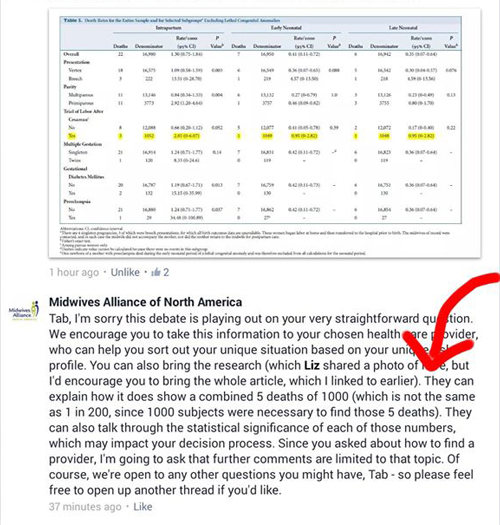
Consider this bit of appalling stupidity, direct from the MANA Facebook page (deleted the following day), in response to the observation that a VBAC death rate of 1/200 is hideous:

MANA Facebook 6-9-14

Here’s the money quote:

…[I]t does show a combined 5 deaths of 1000 (which is not the same as 1 in 200, since 1000 subjects were necessary to find those 5 deaths).

5/1000 is not the same as 1/200??!! 5/1000 is better than 1/200 “since 1000 subjects were necessary to find those 5 deaths”??!!

Those who rely on MANA for their information on the safety of homebirth take note:

If the people at MANA cannot do basic division, you cannot trust them to analyze their own data properly, let alone report it honestly.

It’s pretty clear that you cannot trust either ICAN or MANA to care about the safety of your baby.

Of course if you care about the safety of your baby, you wouldn’t be contemplating a VBAC at home in the first place, would you?

A neonatal resuscitation class does NOT mean that a midwife is actually qualified to resuscitate a baby

A helping hand

I received the following email from Susan O’Connor, a Board Certified Neonatal Nurse Practitioner and Neonatal Resuscitation Program (NRP) instructor:

I see so many comments about midwives being “trained” in NRP, but people not realizing that without the equipment necessary (ETT, bag/mask, oxygen, epinephrine, umbilical lines, saline, etc) you are not performing NRP. NRP is so much more than just the rate of compressions to breaths; … taking a class in NRP [does not mean] that a midwife is actually qualified to resuscitate a baby. And performing NRP correctly can make the difference between life and death in a neonate.

I invited her to share her thoughts and experience with you in the guest post below:

Neonatal Resuscitation Program (NRP) is a specialized type of resuscitation that was designed for neonates and their unique physiology and needs after birth. The American Academy of Pediatrics in a statement May 1, 2013 affirmed “there should be at least 1 person present at every delivery whose primary responsibility is the care of the newborn infant”. This is in addition to the midwife who is attending to the mother, in the situation that both the mother and infant need simultaneous resuscitation.

Many midwives – especially lay midwives – will claim they are trained in NRP and able to provide resuscitation to a newborn. Unfortunately, taking a class in NRP does not mean anything when it comes to the actual resuscitation of the infant. NRP is a systematic method of evaluating and providing support to a struggling neonate, which includes advanced life support.

NRP is set up in 30 second intervals: you have thirty seconds to determine whether your interventions are working and if they aren’t, to escalate care.

First you provide positive pressure ventilation with a bag/mask.

If that is not working, you must intubate the child to provide a secure airway – the first thing that most midwives cannot do. Intubation is not a skill you can perform infrequently and expect to be successful, especially in a stressful situations.

Once you are providing respiratory support, if the heartrate is still low (below 60) – compressions must be started.

But giving compressions in coordination with ventilation isn’t enough. At the point where you are doing this, epinephrine should be drawn up. It can be given through the breathing tube, but the most effective way is through the umbilical vessels. This is the next step in NRP that lay midwives cannot provide. They cannot have epinephrine for the infant, and they definitely do not have the equipment and training to place an umbilical line.

In a code situation, volume expansion [fluid] is frequently needed. Normal saline should be infused through the umbilical line, in order to be able to support circulation.

Occasionally, even other interventions are necessary, such as administration of surfactant, or the child could have a pneumothorax, a leak of air from the lungs into the chest and prevents infants from being able to breath/beat their heart well. In a hospital setting, you have all those supplies and trained personnel to be able to stick a needle into the chest to release the air. Some infants develop a pneumothorax spontaneously, without any risk factors or obvious cause.

All of these things happen in 30 second intervals. That means by 2 minutes of life if the baby is depressed, you are giving epinephrine and putting in lines while giving adequate ventilation. That’s a very short time-frame. It takes confidence, repetition and study to be able to provide adequate resuscitation to a newborn. Midwives are trained in the care of the mother and basic well-baby care. In the hospital, OBs do not provide NRP; typically, it is specialized nurses, nurse practitioners and physicians who do it.

This lack of ability to provide true neonatal resuscitation accounts for some of the morbidity and mortality that is seen with home births.

Bad things can happen at home and in the hospital, but in the hospital, you have a team of highly trained individuals who are dedicated solely to saving the baby’s life. That’s a huge departure from the care provided by midwives and that alone should explain why births are safer in the hospital.

Is Australian midwife Gaye Demanuele a liar or a fool?

iStock_000010467288XSmall

I’ve been told that she’s a disciple of killer midwife Lisa Barrett, who’s notched at least 5 neonatal deaths. But Gaye Demanuele has exceeded her mentor; she’s notched the ultimate obstetric disaster, a preventable maternal death.

Demanuele is taking a page out of the Lisa Barrett playbook. She is acting as if the Coroner investigating the death of Caroline Lovell is a fool by making extraordinarily implausible claims and hoping that he will believe her anyway.

I wrote yesterday about the homebirth horror that ended in Caroline Lovell’s demise. Lovell bled to death in front of not one, but two midwives who assured her she was fine even when she told them she was dying. Allegedly they never even took Lovell’s blood pressure or pulse. Apparently they “trusted birth” while birth was busily killing Caroline Lovell right before their eyes.

According to the Herald-Sun, Lovell’s mother, Jade Markiewicz, stated the obvious:

… [I]t was outrageous that her daughter was the first to notice her condition and that it took too long for an ambulance to be called.

She said two girls had been robbed of a mother and lessons must be learnt to preventing this from occurring again.

“Her death was preventable and it must not be in vain,” she said.

Demanuelle, in contrast, reeled off one whopper after another.

Senior registered midwife and nurse, Gaye Demanuele, told the court the haemorrhage was not in the medical records she was shown by Mrs Lovell and her patient did not tell her about it.

However, she did know about the uterine fibroid, a tear and two operations over suspected retained placenta after Lulu’s birth.

So Demanuele DID know that Lovell was at risk for hemorrhage.

The midwives said Mrs Lovell lost approximately 400ml of blood at home, which the midwives said was not excessive.

But they simply made up that number. Lovell was sitting in a pool of water and there is no way to accurately assess blood loss into a pool of water.

How much blood do you have to lose before succumbing to hemorrhagic shock? According to Clinical review: Hemorrhagic shock, an otherwise healthy person can lose more than 40% of blood volume before lapsing into unconsciousness. Since the average person has approximately 5000 cc of blood volume, it means that Caroline Lovell probably lost more than 2000 cc. That’s more than 2 quarts of blood.

But the biggest whopper of all is this:

[Mrs Demanuele] … denied the homebirth was a political statement in light of this situation.

That is a bizarre claim considering the paper trail left by Lovell and by Demanuele herself.

Caroline Lovell was a prominent homebirth activist who wrote a letter to the government threatening to give birth unassisted if midwives were regulated.

Within months of Lovell’s death, and facing disciplinary action, Demanuele made this flamboyant political statement:

… I choose to no longer call myself a registered midwife (which would attract a $30K fine if I did).

I choose to not collude with a maternity care system that does not respect the rights of birthing women and their midwives.

A maternity care system:
• That restricts women’s birthing choices; that coerces some women into medical treatment that places them at a 1 in 3 risk of surgical birth with it’s associated complications. (Less than 10% of women actually require obstetric services.)
• That restricts the ability of midwives to care for women in a woman centred and holistic, primary health model…

Earlier this year, Demanuele published this manifesto, Why Birth is a Feminist Issue:

… Obstetric practice is based on risk aversion, dictated by insurance underwriters—not on good evidence of where true need exists. More women are facing legal action, accused of acting against the “rights” of their foetus. Midwives and doctors who support women’s autonomy are similarly persecuted. By putting its trust in technocracy instead of the birthing woman, the maternity care system is failing women.

Why is the culture of childbirth saturated in fear? Why not trust women to make their own informed choices about their bodies and their babies?

The answer lies in the rise of private property and the division of society into classes many millennia ago. The ruling class needed to exterminate what remained of matrilineal kinship society and subjugate its respected leaders: women. So it invented patriarchy…

And we’re supposed to believe that neither Lovell nor Demanuele viewed homebirth as a political statement?

Poor Gaye Demauele implies that she is being persecuted by the patriarchy just because the mother of two small children is dead and would be alive had Demanuele provided even the most rudimentary care. She must view the Coroner and the rest of us as gullible fools.

Demanuele is just another in a depressingly long parade of self-pitying homebirth midwifery sociopaths who leave a path of death and destruction in their wake and refuse to accept any responsibility for their own actions.

It wasn’t the patriarchy who ignored Lovell’s obstetric history; it was Gaye Demanuele.
It wasn’t the patriarchy who refused to accurately assess Lovell’s blood loss; it was Gaye Demanuele.
It wasn’t the patriarchy who couldn’t be bothered to check Lovell’s blood pressure when she complained of feeling faint; it was Gaye Demanuele.
It wasn’t the patriarchy who failed to call for an ambulance when Lovell said she was dying; it was Gaye Demanuele who assured her she was fine as her life ebbed away.
It wasn’t the patriarchy who let Caroline Lovell die an easily preventable death, leaving two small children motherless; it was Gaye Demanuele …

And for that she should be punished to the fullest extent the law allows.

Dr. Amy