Obstetricians offer care more personalized than that of homebirth midwives

personalization

Homebirth midwives often proclaim that they offer more personalized care than obstetricians. The truth is 180 degrees opposite from the claims.

I suppose that if homebirth midwives mean that they have nicer personalities than obstetricians (more personable care) or that they will spend more time discussing intimate details of your life that have nothing to do with birth (inappropriately personal care), they are correct. But when it comes to care based on the precise medical situation of the mother, obstetricians are lightyears ahead of homebirth midwives.

I’ve always known this, but my recent attendance at an “updates in obstetrics” reinforced the point. Over the course of two days, I attended 16 sessions on a variety of obstetric topics and every single session was, in essence, about the discoveries that allow obstetricians to counsel and offer care to women in ways that are ever more personalized. Almost all the sessions involved case scenarios:

Prenatal testing: the mother is under 35 with no family history of Down Syndrome, over 35, with a family history, with a previously affected child, etc. etc.

Premature labor: the mother is white, is African-American, has no history of prematurity, has multiple previous premature births, membranes are intact, membranes are ruptured, etc. etc.

VBAC: previous C-section for a non-repeating cause, for a repeating cause, previous vaginal delivery before or after C-section, no previous vaginal delivery, baby is big, baby is small, mother has normal BMI, mother is obese, etc. etc. etc.

After each session there were questions from participants and almost all of them were case scenarios (almost certainly real cases that the questioners had faced or were facing). Nearly all the questions took the same form: these are the patient characteristics, this is the problem, what shall I tell her about what is likely to happen and what we should do about it?

Homebirth midwifery, in contrast, is one size fits all.

Personal characteristics are irrelevant. Advanced maternal age, maternal obesity, pre-existing maternal disease? It doesn’t matter because the counseling and treatment plan are always the same: you can and should have a homebirth.

Medical history is irrelevant. Had a previous shoulder dystocia, C-section, postpartum hemorrhage? Who care? You can and should have a homebirth.

Complications are irrelevant. Baby is breech, have gestational diabetes, colonized by group B strep? Who cares? You can and should have a homebirth.

Labor complications are irrelevant. Dysfunctional labor, prolonged rupture of membranes, pushing for 4 hours? Who cares? You should still stay home because you can and should have a homebirth.

Why do homebirth midwives have a one size fits all approach to pregnancy and childbirth?

Two reasons: ignorance and dogma.

Homebirth midwives are lay people. They basically acknowledge that fact by calling themselves “experts in normal birth,” since most laypeople could easily deliver a baby in the absence of risk factors and complications.

Homebirth midwives have literally no idea of the breadth of possible complications, the effect of various risk factors, the many variations of abnormal in pregnancy and birth. Moreover, they are not able to deal with risk factors or treat complications. If they acknowledge them, they will have to transfer the patient to the care of an obstetrician and lose the fee and the birth junkie high. Instead they paper over their ignorance by declaring that whatever happens makes no difference at all. It doesn’t matter that they cannot anticipate, diagnose and manage complications when everything is a “variation of normal” and the treatment is always to forge ahead with a homebirth.

Ultimately, though, it comes down to the dogmatic cult-like believe in unmedicated vaginal birth. They appear to be unable to fathom the concept that childbirth is dangerous for both babies and mothers. Just like the flat-earthers maintain that the world is flat because that’s the way it seems to them, homebirth midwives maintain that childbirth is safe because that’s the way it seems to them. It simply never occurs to them that their relentless emphasis on unmedicated vaginal birth can and does kill babies and mothers. They literally cannot accept the evidence that is right in front of their eyes, so they deny it (“some babies are just meant to die” sounds so much more soothing than “we tried so hard for a vaginal birth that we killed the baby”), or, in the case of homebirth midwifery leaders like Melissa Cheyney, they tell bald-faced lies about it, claiming that their own hideous death rates are “safe.”

Women who are contemplating homebirth need to ask themselves whether they value obstetric care, which is personalized to their specific circumstances in this specific pregnancy, or whether they’d prefer a one size fits all approach. Obstetric care is personalized because the goal is a healthy mother and a healthy baby. Homebirth midwifery is one size fits all because the goal is unmedicated vaginal birth; if the baby and mother survive without injury, that’s simply a bonus.

Changes in US maternal mortality; the crisis is not what you think

Medical monitors

On Sunday and Monday I attended a Harvard Medical School annual review of obstetrics. One of the sessions that I was most eager to attend was the session on maternal mortality, and it did not disappoint. The most intriguing aspect was that the crisis in maternal mortality is almost exactly the opposite of what natural childbirth activists claim. Simply put, the crisis is not the over use of technology, but rather a mismatch between the number of pregnant women with pre-existing complex medical problems and the dearth of specialists and specialty units with the appropriate expertise to care for them.

The threshhold question, of course, is whether US maternal mortality is increasing. I’ve written about that many times over the years, and the speaker pointed out that it is probably not increasing; the apparent increase that we have seen (from 10.4-14.5/100,000 between 1990-2006) almost certainly reflects the ongoing efforts to appropriately classify deaths that occur in the wake of pregnancy. In other words, the rate of maternal death is not rising, the accuracy of our statistics is rising.

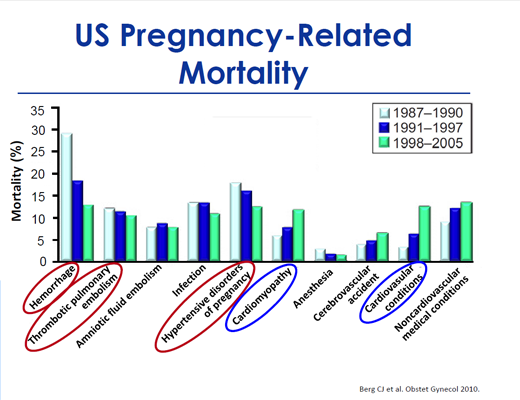
Be that as it may, maternal mortality is certainly not falling, and maternal morbidity (complications that do not result in death) is rising. Most importantly, the profile of maternal mortality is changing, as illustrated by the following graph from the paper Pregnancy-Related Mortality in the United States, 1998 to 2005 (the markings were added by the speaker).

Pregnancy related mortality small

Note that the traditional killers of pregnant women (hemorrhage, pre-eclampsia/eclampsia, blood clots) are being supplanted by new killers including pre-existing heart disease, cardiomyopathy of pregnancy (a weakening of the heart muscle) and other complex medical conditions. Indeed, while the death rate from traditional causes of maternal mortality has been steadily falling, the death rate from unusual causes has been steadily rising.

This almost certainly is a reflection of the increasing age and increasing obesity of pregnant women. So while complications from vaginal birth and C-section (infection, bleeding and blood clots) are still important causes of death, they are being supplanted by pre-existing medical conditions. We can and should work to decrease traditional causes of maternal death. For example, treating women with short courses of blood thinners around the time of surgery could drive down the rate of blood clots much further. However, the real crisis in maternal mortality is that we have not responded effectively to the increasing medical needs of pregnant women.

The speaker compared our response to maternal mortality with our response to perinatal mortality and raised an issue so obvious that I’m embarrassed that I hadn’t thought of it before. The dramatic decrease in perinatal mortality over the past 50 years reflects the creation of a specialty devoted to critically ill newborns (neonatology), specialty units for the care of critically ill newborns (neonatal intensive care units, NICUs), a rating systen for hospital nurseries (levels I, II, and III) to facilitate triage and transport of critically ill newborns to hospitals that have the experts and equipment to to treat them.

We have done nothing similar to address the increase in critically ill mothers. Although the number of pregnant women requiring intensive care is increasing, there are very few obstetric intensivists, very few obstetric intensive care units, and no rating system to facilitate transfer of critically ill mothers to hospitals that have the experts and equipment to treat them.

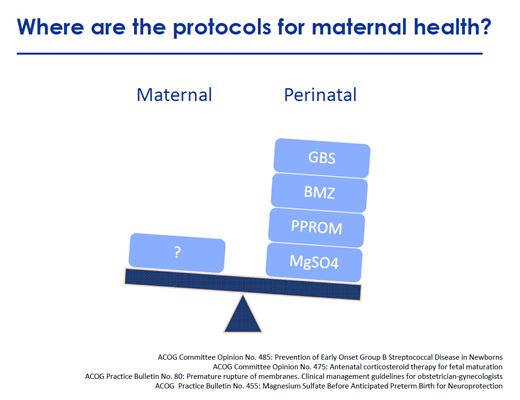
This image graphically represents the difference in our approach to preventing maternal mortality vs. preventing perinatal mortality.

Protocols for maternal health small

In contrast to a wide variety of protocols defining best care practices for high risk perinatal complications, there are virtually none for high risk maternal complications.

The bottom line is that the solution to any crisis in maternal mortality is NOT indiscriminately decreasing interventions, since obstetric interventions are not the proximate cause of most cases of maternal mortality. It is imperative that we INCREASE our ability to identify critically ill pregnant women, transfer them to specialty obstetric units that have the personnel and equipment to manage their complex medical problems so we can apply MORE interventions to those complex medical problems, and identify best practices for managing complex medical conditions in pregnancy.

We may not have a crisis in maternal mortality yet, but if we fail to take these steps, we almost certainly will.

Birth bullies, breast bullies and socially acceptable shaming

image

It’s been a depressing series of decades for those who find deep and abiding satisfaction in bullying others. You can no longer shame people for being divorced or for having a child without being married. You can’t look down on people of different races, sexes or religions. You can’t shame people for being gay and at the rate things are going, it won’t be long before it will be frowned upon to shame people for being overweight.

But, in this world of ever decreasing shaming opportunities, there are still some tried and true options available. You can still shame another women for being a bad mother. In fact, not only are the old options available (“I can’t believe your 14 month old is not walking”; or “My Johnny is always picked first for sports teams”; not to mention the ever popular “I’m so sorry that your child is going to a state college and not the elite college my child is attending.”), there are some outstanding new options. These include shaming women about the births of their children, and shaming them if they did not meet an your preferred length of breastfeeding, or (heaven forfend!) never breastfed at all.

The new methods for bullying/shaming mothers are just as satisfying as the old ones, but they have one important advantage. With the old methods, it was regrettably clear that the only person benefiting from shaming was the person doing the shaming. With the new methods, you can actually pretend that you are shaming another mother, not merely for her benefit, not merely for her child’s benefit, but for the benefit of society. It’s a win-win: all the fun of bullying another mother plus a dollop of self-righteous concern for public health.

Another benefit of the new shaming methods is the opportunity for creativity. So many of the old methods were restricted by the need to tell the truth whereas lying is not merely permitted in the new methods, it is positively encouraged. There’s no need to stick to the actual risks of cesareans or pitocin when so many attractive lies exist: they cause autism, they destroy gut bacteria, they change the very genes of the baby! So not merely is another mother a total loser for having a C-section, she can be shamed for actively harming her baby.

The same creativity applies to the benefits of breastfeeding: it prevents every disease known to man; it cures every disease known to man; there is no problem that exists that cannot be solved by squirting breast milk at it! When a mother is unwary enough to acknowledge in your presence that she doesn’t breastfeed, you can accuse of harming her child, AND being a selfish slob who puts her convenience ahead of her child’s brain functioning. It’s hard to imagine more satisfying bullying then that.

But it isn’t enough merely to bully women one on one; bullying can be institutionalized. Baby Friendly Hospitals represent breast shaming on steroids. Locking up formula in hospitals is oh so painful for mothers and so satisfying for shamers. If only they could require prescriptions for formula, breast bullies’ lives would be complete. And best of all, they are doing the shaming for the public good!

That’s why any attempt to inject sanity into debates about childbirth or breastfeeding must be resisted vociferously. How dare any expert point out that C-sections are often better for babies than vaginal birth? How dare any expert claim that you can raise an intelligent child without breastfeeding? Isn’t any form of shaming sacred anymore?

Being a bully is fun! Being a birth or breast bully is better than fun; it is a public service. They may have taken away the shame of illegitimacy. They may have made gay jokes socially unacceptable. It’s only a matter of time before fat shaming is frowned upon. But when it comes to birth and breast bullying, the sky is still the limit!

A limerick in response to Dr. Gorski

image

Dr. Gorski has expended literally thousands of words on me, but I don’t think he’s worth more than a few of mine. Here’s my response in the form of a limerick:

There was an old skeptic from Boston
Who mourned babes when midwives lost ’em.
Then an ass from Detroit,
Conflict keen to exploit,
Salved his ego and carelessly tossed ’em.

Confessions of a “medwife”

true confessions

“Medwife” is a term of derision typically applied by lay midwives (CPMs, LMs, DEMs) to real midwives, certified nurse midwives (CNMs), to signify disgust with using actual medical knowledge in the care of pregnant women. This “medwife” wrote to me in the wake of baby Gavin’s death to express her sorrow at such a needless, senseless loss of life. During the course of our correspondence, she explained her philosophy to me so eloquently that I asked for permission to publish it as a guest post.


On being a Medwife:

I do not believe babies know when to be born at either end of the spectrum. I am certain no baby intends to die in his mother’s arms on the verge of viability or in her womb pushing well beyond the dates. I use tocolytics to provide steroid administration and provide neuroprotection, 17P to prevent a subsequent premature birth. I believe frequent antenatal testing provides a level of reassurance beyond 40weeks, but will nudge your baby along at 41 weeks with little left to gain from conservative management regardless of the reassurance.

I believe our bodies do grow a baby too big for us and I believe shoulder dystocia is a sentinel event even in the hands of the most experienced providers. It is not a situation caused by poor maternal positioning or relieved by Gaskin maneuver and certainly not in a bathtub of your living room. Watching a healthy baby die on the perineum is a vision to haunt your nightmares for a lifetime.

I don’t believe in the 39 week rule. It will prevent some early term birth admission to a NICU, but will also cause hesitation by providers to act for fear of statistical outliers and repercussions. I will play within the rules, but will not ignore the soft indicators or the intuition to act upon them.

I believe babies have a due date, placentas expire and not much good comes after 41weeks. I do not believe waiting for a baby to display signs of decompensation is the time to act. Perhaps a poor tracing, MSAF and a neonatologist fit into your 41 week plan, but then again perhaps you didn’t really want the intermittent monitoring, minimal attendants and delayed cord clamping.

I believe in preeclampsia. I respect its etiology, pathology and spectrum of progression. No diet, herb or pressure point will prevent the sequence of severity. If you argue or ignore the recommendation to move towards immediate delivery and days later your ICU admission or eclampsia means crash carts and ventilators…your partner has officially forfeited his right to ask “wasn’t there anything you could have done to have prevented this?” I will just walk away.

I believe GBS treatment does not include garlic or tea tree oil. Protecting your baby’s gut flora may seem so important now, but means so little in light of GBS meningitis and seizures or the dopamine drip in the midst of septic shock should it be your baby that becomes the statistic.

I believe in VBAC with a heplock, continuous EFM and my OR team within feet of your room. I will not push the limits. As wonderous a window into the womb as your translucent uterine serosa may be, its presence means this OR is just where you needed to be.

I believe twin births in a dimly lit room with hushed voices can be safe, but that room is best located as an OR and behind those dim lights and hushed voices lies the wonder and safety net of an OB, anesthesiologist and neonatologist.

I believe in Vitamin K. Your fears should lie not in the process of administration or theoretical risk of preservatives, but in the absence of its existence. The process or risk will be far from thought if your child is the child flown to tertiary care with ever expanding head circumference and abnormal neurologic exam.

I believe in Rhogam, its safety and its efficacy. Your unfamiliarity with hydrops fetalis in an era of rare sensitization does not lessen its impact on your baby when undergoing MCA Doppler flows, premature delivery and multiple blood transfusions. Your decision to ignore the real risks and let fear based blogs will not prevent this from being your baby or your regrets.

I believe in breastfeeding, BUT I refuse to allow a mother to feel any less a mother for how she chooses to feed her baby. You may never know what lies behind her decision to bottle feed, but you have an obligation to respect and honor it. Just as labor and birth is one miniscule step in the process of mothering, so is feeding method. In several years no one will know who was born how or who was fed what. It really is that simple.

I believe in the wonder of birth. An unmedicated natural birth and it still leaves me in awe of its beauty, but I also comprehend its functionality. Your coconut water, lavender and doula make you no stronger a woman than the woman next door with a continuous epidural catheter or the mother down the hall lying on the OR table laughing and smiling at her baby’s first cry. Birth is amazing, but it isn’t how we determine our strength.

I believe in interventions from AROM to EFM to Pitocin to forceps to cesarean birth. My responsibility is to observe for progress and wellbeing, as well as to utilize the interventions at modern medicine’s disposal to ensure the safest path and highest outcome. Although I cherish and find reward in the intimate relationship we develop over the course of your care, my responsibility is to the health and well-being of you and your baby. Do not confuse my caring and compassion as a desire to become your friend. I will hold your hand, I will be compassionate…but I will not be afraid to use my ‘dead baby card’ or alter my care to avoid ‘hurt feelings”. If that is what it takes to make you realize these evil interventions stand between the health of you and your baby or the risk to disability or death, I will play my ‘card’.

I believe in doulas by definition, not as adjunct providers. The security and support of a doula can be a positive contribution to your birth experience, but so can your labor and delivery nurse. Please don’t discount the skill and support of your nurse and don’t use a doula to make medical decisions. She has not the training or authority to do so. Your doula is there to support you through labor, not create an atmosphere of animosity.

I will listen to the woo and my office schedule will fall behind, but I will gain the trust that keeps you here and not in the hands of an unregulated, unaccountable and uneducated CPM or lay midwife . I will listen to words of concern, because I believe every mother inherently seeks to protect and desires the very best for her baby. I will seek to clarify, educate and empower in order for others to comprehend the science behind the care I provide and the recommendations I make. My care and recommendations will be based upon guidelines, developed and supported by the highest level of scientific evidence; not chat rooms or anecdotes. I will do this because it is my responsibility as a health care provider and is not intended to cause fear or to disillusion ignorant bliss.

I am saddened by the liberal application of the title ‘Midwife’. I am disheartened when my years of formal education and commitment to continuing professional growth are soiled by the unprofessional and unregulated ranks of others who feel it is their right to share this title. As much as I looked forward to holding the title of “Midwife” I feel relegated to distinguish myself from it.

As others attend Blessingways, perfect the art of holding space and call themselves midwives… I will sit here and read my Green and Grey journals, among RN’s, CNM’s and Physicians. For I am the Medwife and I will be here alongside my colleagues, our resources and interventions keeping birth safe…ready, willing and able to identify and intervene when it’s not. If in so doing I am less the Midwife and more the Medwife, there are no regrets.

Tsk, tsk Dr. Gorski

Blured text with focus on SHAMEFUL

I don’t think it’s much of a secret that there is animus between Dr. Gorski and myself since I quit the blog Science Based Medicine. It’s pretty obvious that’s why Jamie Bernstein asked Dr. Gorski to adjudicate our “kerfuffle.” (Just as an aside, why do men with substantive disagreements have principled arguments, but women have “kerfuffles”?)

That animus probably led Gorski to publish a screed instead of mediating privately. And it was probably what led him to write a long post about me instead of answering a simple question in a few sentences.

So I’m not telling you anything beyond what is obvious about the gusto with which he approached his task. I’ve never spoken publicly about that animus until now. The moderation policy was the proximate reason for my decision to leave SBM, but not the real reason. The reason why I quit SBM is because I felt Gorski was trying to force me out. Why? Because he felt threatened.

I write in a similar take no prisoners style, and I was attracting a tremendous amount of traffic. I threatened his dominance and popularity within the SBM universe.

Did Gorski ever say that to me? No, but it’s what I felt.

There was nothing wrong with what I wrote for SBM. Indeed, every word was approved by Gorski before it was published. Moreover, as far as I know, every word is still on the site years later.

It wasn’t because I didn’t draw traffic because I drew a lot, although curiously Gorski would never let me see the actual figures.

Nonetheless, despite having approved my posts before he published them, he developed a habit of entering the comment section to criticize me. I looked, but I couldn’t find evidence that he did that to the other members of SBM.

Gorski maintained a double standard for himself and me. He privately admonished me for re-using posts from my personal blog, yet he did it all the time.

I felt strongly that the more popular I became, the more likely I was to be forced out, so I quit. I didn’t need to write for SBM; they had asked me to do so. In fact, it was Gorski himself who asked me, and it was to him that I sent samples from my own blog illustrating my style and emphasizing that I wasn’t planning on changing it.

So now you know why I left SBM, and why Gorski figuratively licked his lips over the opportunity to criticize me.

No one should let that obscure the take away message of Gorski’s post: MANA’s homebirth paper does NOT show that homebirth is safe; it shows that homebirth dramatically increases the risk of perinatal death. For all his wordiness, Gorski disagrees with most of what Bernstein wrote.

It seems to me deeply unfortunate that Dr. Gorski was so keen to settle imagined scores with me that he lost sight of the big picture: irresponsible “practitioners” are lying about the risk of their product, in this case homebirth.

There is one important salutary benefit of the fact that Dr. Gorski approached his opportunity to kick me with so much delight that he actually wrote a screed about it. Going forward it’s going to be impossible for MANA to claim that their paper shows that homebirth is safe.

If I have to take a few public kicks to expose the mendacity of MANA and homebirth midwives, I’m willing (though not happy) to do so.

Do we need to revisit the homebirth deaths at the hands of midwife Lisa Barrett?

Evil Concept

Over the years I have written many posts about Australian homebirth midwife Lisa Barrett, and the astounding number of deaths at her hands.

I was pleased to see that she was recently fined $20,000 and court costs and reprimanded in the strongest possible terms for her involvement in 4 preventable neonatal deaths.

Should that be the end of it? After reading the report from the Nursing & Midwifery Board of Australia v Barrett, I’m beginning to wonder if these deaths are worth a second look. While reviewing the 4 deaths previously investigated by the Coroner, the Board learned of ANOTHER death that occurred months after the release of the Coroner’s report. I had received information about YET ANOTHER death back in 2009, leading to an extraordinary total of 6 newborn deaths at Lisa Barrett’s hands.

Of these deaths, 1 was a shoulder dystocia, 2 were second twins, and 3 were breech babies. All of the situations were high risk, but even in high risk situations, most babies do fine. We already know that the deaths were preventable; that’s why Barrett has been disciplined. I’m beginning to question whether we need to investigate these deaths further to determine whether Barrett actually let these babies die. In other words, did Barrett fail to provide appropriate homebirth care and make only ineffectual attempts to save the dying babies.

Reading the timeline of the 6 deaths, as well as a near miss twin death described in the board report, and an extraordinarily story of twin birth that Barrett herself has bragged about (49 hours between the birth of the first and second twin), raises the possibility that these babies died not merely because they were born at home, but because of midwife neglect.

The shoulder dystocia death:

The medical expert opined that Barrett had not applied the appropriate maneuvers to deliver the baby:

Professor Pepperell is critical of the respondent’s attempts to extract the baby. The respondent described performing the McRoberts manoeuvre. Professor Pepperell in his evidence said that such a manoeuvre involves placing the mother on her back and lifting her thighs up to her chest so that the angle of entry in the pelvis is different and is bigger in the hope that by doing so the shoulders will then descend into the pelvis. Professor Pepperell when commenting upon the respondent’s evidence34 as to the manner in which she performed the manoeuvre stated that he did not believe that initial traction had been applied appropriately and that it did not appear that adequate suprapubic pressure was ever applied…

A friend of the mother eventually delivered the baby:

A friend of “S” present at the time was asked by the respondent to assist given it was an emergency. The friend was able to put her hand in to grab under the shoulder and was able to pull the baby out…

An experienced midwife was unable to deliver the baby, but a friend of the family simply reached in and dislodged the baby’s shoulder?

Negligent management of twins:

In the near miss twin case, the second twin was ultimately delivered by C-section 8 hours after the birth of the first twin.

As the Board notes:

To allow at least six hours without foetal monitoring of the second foetus after the birth of the first baby is just unbelievable.

In the story on Barrett’s blog, a healthy second twin was delivered 49 hours after the first twin.

Apparently Barrett’s approach to the second twin in these cases was to do absolutely nothing, including no monitoring to determine whether the second twin was in trouble requiring expedited delivery.

The breech deaths:

One breech baby died when Barrett inexplicably stopped checking his heart rate for 24 minutes prior to birth.

So in at least 4 of the 8 cases that I know about, Barrett provided either negligent care, ineffectual care or no care care at all in the midst of obstetric emergencies.

6 confirmed deaths and 1 near miss is an extraordinary amount of bad luck even for an incompetent midwife, and while there is copious evidence that Barrett was reckless there is no evidence that she is incompetent or unaware of the measures used to handle obstetric emergencies.

And these are only the cases that we know about. There could be more.

6 babies are dead and no amount of investigation will bring them back. Barrett has been disciplined under the assumption that her recklessness led to deaths that were unavoidable at home, though easily preventable in the hospital.

But were those deaths at home unavoidable? Or was Barrett’s unwillingness to provide appropriate homebirth care the real cause of at least some of the deaths?

The terrifying result of refusing newborn Vitamin K

Olive 1

I’ve written in the past that bitter grief is often an unselfish motivator:

Consider organizations like Mothers Against Drunk Driving, started by parents who suffered the ultimate loss, to ensure that other parents would not have to endure the death of a child. Consider the various laws named after children who were abducted and murdered, championed by parents who wanted to make sure that no other family’s life would be shattered by crushing grief…

Where is the organization to ensure that no other mother has to endure the preventable death of a child at homebirth or because the mother refused recommended obstetric or newborn care guideline?

There is no such organization.

Why? Because the mothers who have a child who was injured or died as a result of homebirth or of refusal of routine interventions often collude with the providers who encouraged them.

Thankfully, that is not the case for Stefani Leavitt. She has unselfishly shared the story of the terrifying result of failing to give the recommended Vitamin K injection to her newborn daughter.

You can read the entire story across three blog posts:

The First 24 Hours
Getting Out of the Woods
Why It Happened: The Truth About Vitamin K Deficiency Bleeding

Leavitt has the inner strength to be brutally honest, even with herself:

This may be the hardest part of Olive’s story that I will write. The part where I admit that what happened to her was nearly 100% preventable. And yet it happened.

It happened because she didn’t receive her dose of Vitamin K when she was born.

I spent the first few days that she was in the hospital blaming myself. I ran through the situation in my mind, trying to understand why I would say “No” to something that would keep my daughter from being in this much pain. In Olive’s situation, unfortunately, it was largely accidental. That didn’t stop me from feeling guilty, however, and only recently did I accept that although this happened to Olive, it doesn’t have to happen to another person’s baby.

What happened to Olive?

It all started on Valentine’s Day.

Olive had struggled to eat the night before, so she and I had been up all night…

When we woke up [from a nap], Olive could barely open her eyes – the only word I could think of was “lethargic,” and since that never coincides with anything good, I immediately called the doctor… The doctor told us to go to the ER immediately …

At the hospital:

By this point, Olive was breathing and her heart was beating, but she was otherwise non-responsive…

The pediatric intensivist, Dr. M., came and asked me if we had given our daughter a Vitamin K shot at birth, and I just stared at him and said I had no idea. He said they needed to bring her in for a CT scan, but every time they tried to place an IV (which she needed before she went for the scan), the vein would blow. She was bleeding from every spot that she had gotten poked that night, including the LP point on her spine.

Finally they were able to perform the head CT.

The next thing I knew I was sitting in a room with Eric and our Bishop from church, and seeing the doctor wheel in a computer with pictures on the screen… Just by looking, you could tell it wasn’t good. Where the left side of her brain was supposed to be, there was a huge (16 mm, to be exact) mass of blood, pushing her entire brain off center.

Dr. M. explain that a clot had developed which was placing immense pressure on Olive’s brain. Not only that, but there was bleeding on the back of the right side of her brain as well. The water pockets that are within the brain were completely destroyed, and the tissue on the left side of the brain looked mostly damaged. He said that the lack of Vitamin K in Olive’s system resulted in her body’s inability to clot. Anything as small as putting her down in her bed could have caused this bleed. Since she couldn’t clot, the bleeding didn’t stop. There had been one other case of this that the doctor had seen – I asked what had happened then, and was told that the baby hadn’t lived.

The treatment? Correcting her clotting deficiency with Vitamin K and brain surgery to remove the blood clot.

After the brain surgery:

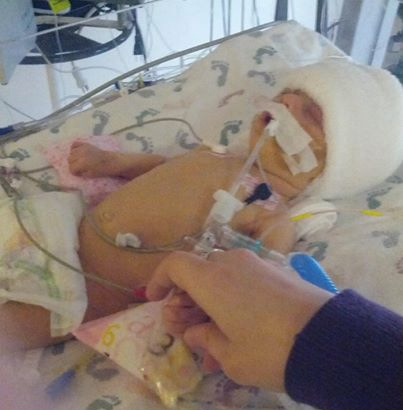
I walked into the hospital room to find Olive hooked up to a plethora of machines, with even more wires running from her. She had a gauze turban around her swollen head, and a breathing tube running from her throat. As hard as it was to see her like that, I was full of so much gratitude that she was alive and I was comforted by the sudden knowledge I had that she was going to be okay – I just didn’t know how.

The surgery had been successful:

Where there was once a huge mass of blood, her brain had moved back into place. The neurologist who spoke with us, Dr. R., explained that there had been a significant stroke on the left side of her brain, but it was on the surface, rather than in the central gray matter. On the right side, there was a pocket of blood in the cerebellum, but this was expected to absorb into the brain. Overall, Dr. R. said that he felt “cautiously optimistic.” ..

The next days were marked by milestones, which all seemed like little miracles.

Towards the end of the third day, Olive was taken off of sedation and opened her eyes for the first time in days.

From the blog C'est Si Bon
From the blog C’est Si Bon

Olive continued to improve.

From the blog C'est Si Bon.
From the blog C’est Si Bon.

Overall, Olive’s progress has been remarkable.

Olive is nothing short of a miracle. After seeing her condition the first night and seeing her now, only two weeks later, I am still in a state of disbelief. Countless doctors and nurses told me what amazing progress she was making. She took to nursing again like a champ. She is moving both sides of her body, with very little difference in strength. And since her surgery, we have all been able to see her beautiful smile.

There will still be struggles from here, I’m sure. We are uncertain of what Olive’s future will bring, or what challenges this brain injury will cause. But despite all of that, I am so grateful for the blessing that she has been to our life thus far …

But none of this had to happen at all. Stefani writes:

… [T]he Vitamin K shot should not be optional.

When a baby is born, they have a limited amount of Vitamin K in their system, and while some begin to produce it on their own, others struggle with a severe Vitamin K deficiency. If these babies receive a shot of Vitamin K at birth, this isn’t a problem and they will eventually begin to produce the Vitamin K on their own in order to avoid any deficiency bleeding. In a case like Olive’s, however, the severe lack of Vitamin K results in an inability to clot, which can cause deadly bleeds in a baby’s brain and gastrointestinal system.

In children that receive the Vitamin K shot at birth, the chance of developing this disease is relatively nonexistent. When the shot is not given, however, the risk of having late stage (from 2 weeks to 2 months old) deficiency bleeding is 81 times greater.

The sad thing is that while it is extremely rare, recent years have seen children suffering from VKBD more and more often. Four cases were reported at a hospital in Tennessee in 2013 – one resulted in severe gastrointestinal bleeding and the other three in severe intracranial bleeding. In the hospital where Olive was treated, there was one other recent, which resulted in the child’s death.

Stefani speaks from experience:

I can’t change what happened to Olive, but I can try to prevent it from happening to another baby.

Please share Olive’s story. Please tell the mothers you know about the importance of Vitamin K. Please let them know that the risks of rejecting the shot may not be as rare as they think.

Kudos to Stefani for turning her family’s pain into vital advice for other families. She will never know how many lives she may have saved.

How you can tell that another woman’s C-section was unnecessary

Young Woman holding Magnifying Glass

A favorite parlor game among natural childbirth advocates is determining whether a stranger’s C-section was necessary. Figuring it out is only half the fun. Once you decide that the woman had an unnecessary C-section, you express ostentatious sadness and distress that she, poor thing, is not as educated as you are.

Gina Crosley-Corcoran, the Feminist Breeder, demonstrates how it’s done:

It’s incredibly difficult for me to overhear a pregnant woman talking about how she had to have a cesarean last time because her baby was “too big” and now they’re giving her an “automatic” repeat cesarean at 38 weeks. I have no judgment about this individual woman, it’s just so painful to hear this story again and again. I say this as a maternal child health scholar and as a woman who vaginally delivered 2 nearly 10 lb babies after a cut-happy OB gave me a cesarean the first time for a “big” 8 lb baby. Why don’t more women know about the overuse and abuse of cesareans? Why are some doctors still doing this shit?

Determining that the stranger’s C-section was unnecessary ✓
Expressing distress ✓
Bemoaning the stranger’s lack of education ✓
Mentioning your own ample pelvis and how many babies passed through it?  That’s the cherry on top.

Well, I’m here to tell you a secret and considering that I am an obstetrics “scholar” (the relevant discipline, not public health) I ought to know.

Come closer and I’ll whisper in your ear exactly how you can tell that another woman’s C-section was unnecessary.

Ready?

Here’s the secret:

YOU CAN’T!!!

No one, least of all someone who isn’t even a medical professional can determine whether another woman’s C-section was necessary or unnecessary.

First of all, the woman may not be disclosing the real reason that she had the C-section. Thousands of C-sections are performed each year for active genital herpes. The herpes virus can easily be transmitted to the baby as it passes through the vagina, leading to encephalitis, sepsis and death. For obvious reasons, not many women are comfortable announcing to their mother-in-law, their boss, and their next door neighbors that the reason they had a C-section was because of active genital herpes, so they make up some other reason, including claiming that they simply preferred a C-section to a vaginal birth.

Second, even an obstetrician cannot tell if a woman’s prior C-section was unnecessary unless he or she has access to the medical records and can examine the patient. Unless you put your fingers inside her vagina and measure the diagonal conjugate, intertuberous diameter and prominence of the ischial spines, you have no idea whether her pelvis can accommodate a large baby or not.

Third, while public health information about large populations can inform treatment of individual patients, it tells us nothing about the appropriate treatment for a specific patient. So even if we were to conclude that the contemporary C-section rate is “too high,” we cannot draw any conclusion about whether a C-section was necessary or unnecessary for a particular patient.

There’s another aspect to this that is equally important and generally overlooked by natural childbirth advocates. Sometimes I can tell (or I think I can tell) that a procedure a patient has undergone was not necessary. I do not share that information unless it is directly relevant to planning future treatment. Who benefits when you tell a patient that you would have cared for her differently? Certainly not the patient. Now she distrusts her previous provider and her own judgment in choosing that provider. Now she has to wonder whether things could have been different, but she has no way to fix what happened. Sure, when I was practicing, I could make myself a hero and tell a mother that my C-section rate was so much lower than many other obstetricians, but what does that do for her? Nothing.

Who benefits when a random stranger tells a woman that her C-section was unnecessary. Certainly not the woman. The only person who gets something out of it is the one who imagines that she is superior and would never have been duped.

And when it comes to accurately assessing whether an a specific C-section was necessary for a specific woman, a self-proclaimed public health “scholar” is no different from a random stranger. Studying health on the population level has NOTHING to do with treating individual patients. It makes about as much sense as a military history “scholar” telling a soldier on the ground in Afghanistan how to react when an insurgent starts firing on him. The fact that the historian has studied the battles of Thermopylae and Waterloo is not particularly relevant in an emergency situation.

The bottom line is that only an obstetrician can tell you whether a C-section was unnecessary, and then only after he or she has reviewed your records and examined you.

Random strangers can’t tell at all.

Homebirth mothers, is your midwife emotionally manipulating you?

Pregnant woman in white smiles and her girlfriend touches her st

Dear Homebirth Mother,

You are planning a homebirth and you can envision it down to the last intimate, spiritual, joyful detail.

You’ve been seeing a homebirth midwife and your relationship with her is awesome. You’ve never had that kind of warm, supportive relationship with any healthcare provider. The connection you have with your midwife makes you feel very good about your decision to have a homebirth, even though your doctor, your parents, your in-laws and your friends have expressed concern about the baby’s safety and your safety.

I’d like you to take a moment and consider the relationship with your midwife. Right now you experience it as incredibly supportive and affirming, but is it possible that your homebirth midwife is emotionally manipulating you?

I suspect that you have a visceral response to the question. Of course she isn’t manipulating you!

I’d ask you to think again and consider these 10 signs that your homebirth midwife is emotionally manipulating you.

Let’s start with the basic premise that you have hired a homebirth midwife to provide care for you and your baby in labor. In other words, you have hired her in her role as a medical professional. Therefore, you need to judge your relationship with her based on whether it comports with an ethical patient-provider relationship.

1. Does your homebirth midwife encourage you to think of her as a good friend?

Your friendship may be one of the unexpected dividends of hiring a homebirth midwife. You didn’t realize that she would spend so much time with you discussing your philosophy of childbirth and your prenatal care, let alone discussing your fears, hopes and dreams. That would be great if you were looking for a new best friend, but it’s not great in someone who purports to be a medical professional. A close personal relationship with a doctor, nurse, or midwife is neither desirable nor ethical.

Certainly a medical professional should be kind, and, hopefully, empathic, but he or she should not try to become your friend. A close personal relationship could compromise your midwife’s ability to provide appropriate care, and, equally importantly, it can compromise your ability to evaluate the care you are receiving. If you feel you cannot question your midwife’s recommendation for fear that you will hurt her feelings, you are being emotionally manipulated.

2. Does your homebirth midwife ignore professional boundaries?

Professional boundaries protect both patients and midwives. There should be no confusion; your midwife should be your health care provider, not your friend. So it is important to consider whether your midwife blurs or crosses professional boundaries in your relationship.

How can you tell? Does your midwife expect you to act as hostess when she visits or while she is attending your birth? Does she expect you to provide meals and snacks and attend to her comfort when she is in your home? Does she encourage you to confide in her about issues that have nothing to do with your pregnancy? Does she make you feel bad if you don’t agree with her recommendations? These can all be signs that your midwife has crossed professional boundaries to create a relationship that allows her to emotionally manipulate you.

3. Does your homebirth midwife encourage distrust of other medical professionals?

A real medical professional does not disparage other medical professionals. Real medical professionals work together for the benefit of patients. No obstetrician would encourage you to distrust your perinatologist, or express disdain for the medical philosophy of the endocrinologist who follows you for diabetes.

Real medical professionals depend on each other to provide you with the best possible care. That’s why it,s a warning sign if your homebirth midwife encourages you to distrust obstetricians or other doctors. If she has a disagreement with another professional over management of your care, they should discuss it between themselves, and you might even wish to be present to evaluate their differing points of view. If your midwife is unwilling to do that, you have to ask yourself whether she is encouraging you to distrust other providers for her own benefit (to keep you as a patient, to deprive you of information that might lead to you questioning your recommendations) rather than for your benefit.

4. Does she encourage you to lie to other medical professionals?

The is a huge red flag. A real medical professional will NEVER counsel you to lie to another provider. Besides the fact that it is deeply unethical, it is incredibly harmful to your well-being. No doctor can advise you appropriately if you are lying in response to their questions. There is absolutely, positively no benefit to you from lying to a doctor about anything. You only stand to lose when you lie. Your homebirth midwife, on the other hand, often benefits when she convinces you to lie because the lies invariably make it easier for her to hold on to you as a patient and to hold on to your fee.

5. Does she encourage you to distrust your family and friends?

One of the hallmarks of emotional manipulation in any setting, not just a medical setting, is the efforts of the manipulator to separate you from the people who care most about you, partners, parents, other relatives, and close friends. Encouraging you to distrust your family and friends (“They aren’t as educated about childbirth as we are.” “They are steeped in a culture of fear.” “They are sheeple who cannot imagine defying authority figures.”) is encouraging an emotional barrier between yourself and those closest to you with the goal of increasing the midwife’s ability to manipulate you into doing what she wants, not what is best for you.

6. Does your homebirth midwife encourage you to lie to your family and friends?

This is another huge red flag. An ethical provider has no reason to encourage you to lie to partners, family and friends. In fact, a good provider will encourage you to enlist those closest to you in supporting you through this momentous event.

7. Does your homebirth midwife try to isolate you from your family and friends?

This is perhaps the biggest warning sign of emotional manipulation. A real medical provider has no need to bar your family and friends from appointments or the birth itself UNLESS you specifically request it. Only someone who views family and friends as possible threats to her influence would encourage you to exclude those closest to you from this emotional experience.

8. Does your homebirth midwife insist that she will “let you know” when you are allowed to consult a doctor or transfer to a hospital?

Who’s in charge here, you or your midwife? Who gets to decide how much pain is too much? Who gets to decide how long a labor is too long? Who gets to decide whether a complication is worthy of consultation with another medical professional? It should be YOU, and if it is not, you should be worried. When the midwife is in charge of these very personal decisions, she is more likely to meet her needs than yours.

9. Does your homebirth midwife discourage medical tests that would involve you having contact with other providers?

An ethical medical provider is never threatened by the thought that test results might lead you to another provider. No obstetrician will recommend against testing that would reveal a high risk condition for fear that you would transfer to a perinatologist. No obstetrician advises against diabetes testing for fear that you might need to see an endocrinologist. They are not threatened to learn that your care is outside their scope of practice. In fact, the sooner they find out about complications, the happier they are, because they can enlist the help of others in providing you with the best possible care.

There is no legitimate medical reason for a homebirth midwife to discourage routine prenatal tests or special tests for special circumstances. There are only emotional reasons: if you are experiencing a complication she may lose you (and your money). Don’t be fooled by someone who counsels you to avoid prenatal tests to “preserve” the chance that you can have the birth you want. That’s emotional manipulation.

10. Does your homebirth midwife encourage you to take risks that would allow you to stay home? Does she insist that complications are “variations of normal”?

No real medical professional would ever encourage you to risk your health or your baby’s health. No medical professional would ever praise you for willingly risking your life or your baby’s life. A real medical professional wouldn’t tell you that you were brave, or a warrior mama, or demonstrating your trust in birth. Those are all forms of emotional manipulation designed to strengthen the midwife’s control over you for her benefit, not for yours.

If you’ve answered yes to any of these questions, you need to consider that your homebirth midwife is emotionally manipulating you toward the outcome that is best for her. The best outcome for her involves maintaining psychological control over you, having you look to her and only her for affirmation and advice, having you praise her, and, of course, having you pay her.

Do you think your homebirth midwife is awesome? That’s great, but just be sure that she is not emotionally manipulating your toward that belief, by encouraging distrust of other medical professionals or by encouraging discord with and isolation from family and friends. Just be sure that she is not emotionally manipulating you by insisting that she can and should control your care even though she has never checked for pregnancy complications or is ignoring the complications that do occur by reclassifying them as “variations of normal.”

If she is emotionally manipulating you to stay with her care, the consequences for you and your baby could be devastating.

Dr. Amy