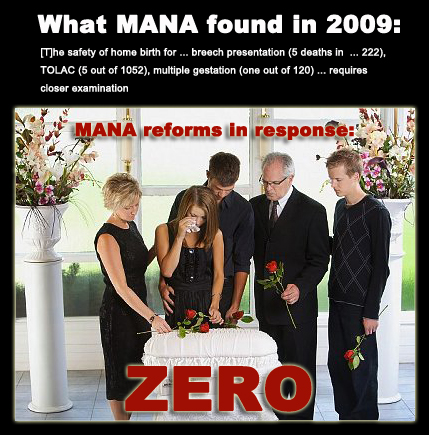
Are we supposed to believe that birth certificate data went from reliable to unreliable in just 5 months? Or does it make more sense to conclude that the Midwives Alliance of North America (MANA) will do and say anything to avoid acknowledging the hideous number of babies who die at the hands of their members?
More mendacity from the Midwives Alliance of North America
As the author Stephen King once explained:
The trust of the innocent is the liar’s most useful tool.
If anyone ought to know, it’s the folks at the Midwives Alliance of North America (MANA), the organization that represents homebirth midwives.
Apparently emboldened by the fact that journalists have not questioned their lie that their paper shows homebirth is safe when it actually shows homebirth to have a death rate 450% higher than hospital birth, they are now telling more lies to defend the paper.
The new lies are from their latest blog post Homebirth Research Q & A.
According to the folks at MANA:
Why doesn’t the Cheyney study compare home birth to hospital birth mortality rates?
It makes sense to want to draw these comparisons. However, hospital rates in the U.S. are derived from vital statistics data (birth certificates and/or death certificates). A number of organizations, including the American College of Nurse Midwives and Citizens for Midwifery have spelled out the limitations, which include a failure to capture the intended place of birth and inaccurate reporting of some outcomes.
That is nothing but a lie.
Where does this supposedly inaccurate hospital data comes from? It comes from the linked birth-infant death files of the CDC (publicly available at the CDC Wonder website). MANA and ACNM insist that birth certificates are unreliable for both place of birth and outcomes. Since 2003, birth certificates have included a question about intended place of birth. Moreover, birth certificates must legally be signed by the person who delivered the baby. If a homebirth midwife delivered the baby, then the birth was a planned homebirth. There is simply no question about that.
As far as outcomes are concerned, the linked birth-infant death files are highly reliable because they cross reference both birth and death certificates. There is simply no question that when a death certificate exists for an infant, that infant has died, and it is simply ludicrous to claim otherwise.
But what may be a more compelling refutation is that both the ACNM and MANA have publicly promoted other studies that were based on THE EXACT SAME DATA.
For example,a press release from September 2013 touting a study that showed an increase rate of homebirth in the US, the ACNM explained:
Analyzing national birth certificate data from 2004 to 2010, the report authors Marian MacDorman, PhD, Eugene Declercq, PhD, and T.J. Mathews, MS, found a 41% increase in the proportion of home births and a 43% increase in birth center births, with 10% of the home birth rise and 14% of the birth center rise occurring within the last year.”
The birth certificate data was apparently reliable then.
MANA frequently bewails the US infant mortality statistics. Wendy Gordon, CPM did so in a MANA bulletin of May 2013. Writing in the Huffington Post, MANA Director of Research Melissa Cheyney spoke disparangingly of the US infant mortality. Where do those statistics come from? You guessed it, the same CDC data that MANA is now disparaging.
Indeed, MANA and the ACNM have repeatedly quoted the CDC data, and never questioned it … right up until I pointed out that the CDC mortality rates are far lower than those quoted by MANA.
The CDC linked birth-infant death data set is the benchmark for infant and neonatal mortality in the US. No one, let alone the ACNM or MANA, has previously questioned the validity of the data. There is no remotely plausible scientific reason for not comparing MANA mortality rates to the CDC data. But Cheyney and MANA refused to compare their death rates to the CDC hospital rates because the MANA mortality rate is hideous in comparison.
Both MANA and the ACNM are lying about the validity of the CDC database, a database they have repeatedly quoted, because that’s the only way to convince the innocent that the MANA death rates are anything other than deplorable. Their behavior is self-serving, unethical and immoral, but apparently for them, anything that might increase their market share is allowed.
The Daily Beast, homebirth, and false journalistic “balance”
Imagine if you read the following in a major mainstream publication:
Take, for instance, the two studies on earth geology that came out this week.
The first, from The Young Earth Society confirmed “there is overwhelming evidence that the earth is only 6,000 years old.”
The next came in the form of an abstract in the journal Nature. Researchers reported the discovery of ancient rocks dating to more than a billion years ago, more than 100X older than The Young Earth Society claimed could exist.
Could both be true?
In a word: NO!
How would we determine which was true? We would READ THEM, analyze them and determine if the claims made by the authors could be justified by the data presented in the paper. It would be inappropriate for a mainstream media reporter to simply throw up her hands and pretend that both papers are equally valid.
Yet that’s just what Brandy Zadrozny did, writing about homebirth in The Daily Beast:
Take, for instance, the two studies on home birth that came out this week.
The first, from the Midwives Alliance of North America(MANA) confirmed “the safety and overwhelmingly positive health benefits for low-risk mothers and babies who choose to birth at home with a midwife.”
The next came in the form of an abstract from researchers at New York-Presbyterian/Weill Cornell Medical Center. Doctors there reported that babies born at home to midwives have four times the risk of neonatal deaths than those delivered in the hospital by midwives. The risk jumps sevenfold for a first-time mother and tenfold in pregnancies over 41 weeks in duration.
Could both be true?
NO, both cannot be true and presenting them as if both could be true is known as false journalistic balance.
According to Wikipedia:
False balance, also referred to as false equivalence, is a real or perceived media bias, where journalists present an issue as being more balanced between opposing viewpoints than the evidence actually supports…
That’s certainly what’s happening in The Daily Beast article, as the reporter might have learned had she bothered to actually read the papers in question.
Had Zadrozny read the paper from the Midwives Alliance of North America, she would have found that the midwives’ own data shows that homebirth increases the risk of perinatal death by an astronomical 450%.
Homebirth midwives reported a death rate of 2.06/1000, while the CDC death rate for term pregnancies in low risk white women during the same time period was 0.38. The midwives’ own data shows that homebirth has a 5.5X higher risk of death.
The Grunebaum study mentioned by Zadrozny found that homebirth increases the risk of death by a factor of 4.2, fairly close. The data in both papers actually agrees and the crucial difference between the papers is that Melissa Cheyney and her co-authors LIED about what their own data showed.
Zadrozny rewards Cheyney and colleagues for lying by doing precisely what MANA hoped reporters would do: read the press releases and ignore the actual scientific papers.
The reality, though, is that BOTH papers show that homebirth increases the risk of death.
Zadrozny helpfully demonstrates what is wrong with science journalism in 2014. Reporters simply read and republish press releases, not the actual scientific papers. As such, they have been the tools of unscrupulous researchers like Cheyney and the executives of MANA.
Zadrozny probably thinks she has performed a journalistic service, but instead she was used to disseminate propaganda … and the worst part about it is she doesn’t appear to have a clue.
Aviva Romm writes things that aren’t true
Yesterday I pointed out that Aviva Romm, MD encourages women to risk the lives of their babies at homebirth, but won’t take the risk of attending homebirths.
Today I’d like to correct the myriad of mistruths in her piece Homebirth: Why This Doctor Would Still Choose One.
Aviva says:
Yet the World Health Organization states that C-section rates in an average, healthy population should never need to exceed 7%!
No, the World Health Organization never said anything of the kind. The only recommendation it ever made for an optimal C-section rate is less than or equal to 15%. But even that recommendation was withdrawn in 2009, with the WHO acknowledging that there had never been any scientific evidence to support it.
Aviva says:
Birth by cesarean can make it more difficult for mom to breastfeed successfully because of physical discomfort.
Yet there is simply no evidence for this assertion.
Aviva says:
chorioamnionitis, an infection in the “bag” that holds the water around the baby … This infection is due almost exclusively to bacteria acquired in the hospital, and is commonly transmitted to the mother when excessive vaginal examinations are performed to assess labor progress.
Wrong. According to the paper Chorioamnionitis: from pathogenesis to treatment:
Chorioamnionitis is generally the result of a polymicrobial infection, with Ureaplasma urealyticum, Mycoplasma hominis and Gramnegative anaerobes being frequent causative organisms.
These organisms are present in the mother, not introduced by vaginal exams.
Aviva says:
Obstetric Evidence Is Reliable Only 30% of the Time.
Wrong. Aviva is deliberately misrepresenting the results of the paper Scientific Evidence Underlying the American College of Obstetricians and Gynecologists’ Practice Bulletins. The study found that 30% of ACOG recommendations are based on “highest quality evidence” (such as randomized controlled trials). But “highest quality” evidence is not always available and decisions must be made anyway.
Not only is Aviva’s claim wrong, but it is rather brazen considering that ZERO % of recommendations exclusive to homebirth midwifery are based on ANY evidence, let alone highest quality evidence.
But Aviva is right about some things. She explains:
As a midwife with 30 years of experience in the birth community, I will also readily admit that there are quite a few not so great home birth midwives contributing to not so great birth outcomes. In fact, in reaction to the problems found in medicalized birth settings, there’s a bit of a midwife ‘wild west’ out there – anyone can get “the calling,” attend some births, and call herself a midwife. Caveat emptor! It’s not black and white. A poorly planned home birth or a less than competent midwife (or physician, though most home births are attended by midwives), in the rare event of a complication, can be disastrous. There’s no romanticization about that from me – I’ve been in the birth trenches for 3 decades and I know some firsthand horror stories from the mouths of the moms and midwives themselves!
And what is the homebirth midwifery community doing about these “not so great” midwives? Nothing. What is MANA doing about the “not so great” midwives among their members? Nothing. Is there any homebirth midwifery organization that offers recommendations on how to tell those “not so great” midwives who preside over “horror” stories from competent midwives? Are you kidding. The first thing that happens when a midwife presides over a preventable death is that the “friends of homebirth midwives” hold a rally to raise money on her behalf. The dead baby and the bereaved family are utterly ignored.
For some reason, homebirth advocates can’t manage to promote homebirth without spouting mistruths, half truths and outright lies about both homebirth and modern obstetrics. For some reason homebirth advocates think it is justified to hide the real death rates from homebirth, protect rogue midwives who precipitate horrors, and lie about what obstetric evidence actually shows.
But call them on it and they respond with plaintive calls for girls to be nice:
…[E]verything I do is about creating a safe space for women … Therefore I reserve the right to delete comments that are irrelevant or hostile …
A safe space? Safe from what? Scientific evidence? Rational debate? Isn’t that a bit misogynistic? Why does Aviva think women are so weak that they cannot handle scientific evidence that doesn’t support their beliefs.
Men don’t need “safe spaces” to be protected from facts that they don’t like. Why doesn’t she respect women enough to assume that they are just as capable as men in dealing with scientific evidence, even with evidence that might make them “sad”?
I don’t think that grown women are so weak that they need to be protected from reality, including the reality that homebirth sacrifices the lives of babies who didn’t have to die. I’m not interested in behaving like a “lady” and creating a “safe space” for deadly lies.
Aviva Romm is happy to encourage women to risk their babies lives at homebirth. And she’s happy to twist, misrepresent and otherwise mangle the truth in her efforts. But she doesn’t dare take the risk of attending homebirths as a physician. And she thinks women must be nice and ladylike, creating “safe spaces” to exchange deadly lies, carefully “protected” from grownups who tell the truth.
Nonetheless, she has every right to refuse to attend homebirths. They are so dangerous that most other family practitioners and obstetricians won’t do it, either.
Is the American College of Nurse Midwives lying about the Cornell homebirth study, or merely ignorant of how it was done?
In the past month, a variety of studies have been published that have shown unequivocally that homebirth increases the risk of perinatal and neonatal death. Even the data from homebirth midwives themselves shows that homebirth has a 450% higher death rate. This is bad news for homebirth midwives and supporters so they’ve embarked on an orgy of lying about what the various studies show, how they were done, and what they mean.
Perhaps I am naive, but I expected better from the American College of Nurse Midwives (ACNM). Unfortunately, they’ve jumped right into the muck. They are actively misleading both laypeople and reporters about the latest Cornell study, which showed that the risk of neonatal death at homebirth is 4 times higher than comparable risk hospital birth. Either they are deliberately lying or they actually don’t understand what they have read, even though it is quite straightforward.
A piece on Time.com about the new Cornell study includes the following claim:
In a response sent to TIME, the American College of Nurse-Midwives (ACNM) raises skepticism over determining the accuracy of the data that the study was based on. “Birth certificates are not always completely filled out, nor are they always filled out by the provider attending the birth. They are not always accurate, when compared to medical charts filled out by the attending provider,” they write. “The birth certificate data do not allow researchers to accurately separate out planned versus unplanned home births. We know that mortality rates are higher for unplanned home births, as they are more likely to involve emergency/urgent situations. The inability to separate these out casts doubt on the findings.”
But the study is NOT based on birth certificates, as the ACNM should know if they read the study, Term neonatal deaths resulting from home births: an increasing trend:
A retrospective cohort study using the CDC linked birth/infant death data set for term (>=37 weeks), >=2500 grams, singleton live births, excluding congenital anomalies from 2007 to 2009. Deliveries were categorized by setting: hospitals, birthing centers, and home as well as providers (midwives, doctors, and “others” for home births). Neonatal mortality (NNM) was defined as neonatal deaths up to 28 days after delivery. Hospital midwives served as reference. (my emphasis)
The CDC linked birth-infant death data set is NOT birth certificates, and is far more accurate than birth certificates alone. The birth and death certificates of each infant was linked to provide the maximum amount of information and to cross check the reliability of the data. So the ACNM is either lying about or ignorant of the source of the data and, therefore, the reliability of the data.
Moreover, since 2003 birth certificates have included place of birth, so no one is guessing where the babies were born. In addition, it is a legal requirement that the person who delivered the baby must sign the birth certificate. Any birth certificates signed by homebirth midwives must have been PLANNED, ATTENDED homebirths. While studies of birth certificates have shown that there can be errors in certain forms of data (e.g. maternal risk factors), they have never shown that the signature of the attendant is anything other than highly accurate.
The chief limitation of the CDC linked birth-infant data set is that it UNDERCOUNTS homebirth deaths because any babies who were transferred during a homebirth and were born and died in the hospital are erroneously removed from the homebirth group.
The bottom line is that the Cornell study unequivocally demonstrates that homebirth increases the risk of neonatal death by at least a factor of 4 and probably much more. The ACNM should apologize for making erroneous claims about the study and about the data … and they might consider studying up on the various forms of natality and infant death data since they appear, at a minimum, to be ignorant of the differences between them.
Aviva Romm, if homebirth is so safe, why don’t you attend them?
Aviva Romm, MD CPM has a new post about the safety of homebirth, entitled Home Birth: Why This Doctor Would Still Choose One.
In the post, Aviva waxes rhapsodic about the beauty of homebirth:
Having home births – and being a midwife – were congruent with how I lived: as close to nature in my lifestyle choices as possible. During labor I felt the most comfortable being in my home, walking on the golf course behind my house, squatting during contractions, and eating & drinking freely to maintain my energy and stamina. It was where I felt the safest and could take the path of least resistance to how I wanted to birth. I also knew I was making an educated decision based on extensive research into the history of birth in many cultures, and the evidence for obstetric practices at the time.
In fact, if she had to do it all over again, she would still have homebirths:
Now that I am a physician many women ask me if I would still have my babies at home.
My answer is unequivocally: “Absolutely.”
… [Y]ou might say, “Well that’s easy for you to say since you’re long past your childbearing years” and don’t have to make that choice …
Exactly! But there is a choice that is still available to Aviva, yet, as far as I can determine from her promotional literature, she didn’t make it.
Aviva could attend homebirths as an MD, back up local homebirth midwives, get privileges to admit her obstetric patients in transfer to local hospitals, and forge relationships with local obstetricians to perform needed C-sections on her patients, and care for her high risk patients.
Yet now that she could actually provide physician services for homebirths, she chooses not to do so.
So my question is this: Aviva, if homebirth is so safe, why don’t you attend them?
Could it be that you don’t attend homebirths as an MD because they aren’t really that safe at all? Could it be that you don’t want the liability concerns that attending homebirths would entail? Could it be that you don’t want to back up local homebirth midwives because you don’t want to be responsible for their screw-ups? Could it be that just like nearly all family practice and obstetric practitioners, you don’t want to put your career on the line just to help women have homebirths?
I don’t know your reasoning. Perhaps you feel that you want an easier lifestyle? Perhaps you prefer to cash in by practicing “functional medicine” on the worried well who can pay out of pocket. I don’t blame you. You probably have massive amounts of debt and a high profile, high profit practice is the best way to clear that debt.
But don’t you think it’s rather hypocritical to promote homebirth while refusing to attend homebirths?
I prefer to judge people by what they do, not what they say. And by refusing to attend homebirths as an MD, your actions speak far louder than your words.
MANA (Midwives Alliance of North America) is just like Big Pharma
Let’s do a little thought experiment.
Imagine for a moment that Big Pharma has invented a new pain reliever, Fly-ox. Fly-ox is terrific. It provides excellent pain relief to many who didn’t like standard pain medications, and patients are singing its praises. Fly-ox is such a big seller that it becomes a major source of income for Big Pharma. The stock price of Big Pharma soars and the stock holders are thrilled.
At first, Fly-ox is not in the formulary of insurance covered drugs, so patients have to pay out of pocket. But Big Pharma has been working assiduously to gain approval from each individual insurance company so the insurance company will pay the full price for Fly-ox, instead of the patient. They’ve had some successes.
There’s just one teensy, weensy problem:
In studies that done by Big Pharma, but carefully removed from its FDA application, Fly-ox increased the risk of death.
At first the executives at Big Pharma thought it might be a mistake and that’s how they justified to each other leaving that information out of the application that led to FDA approval for Fly-ox. But in the past 5 years, Big Pharma has funded secret studies that have shown over and over again that Fly-ox leads to increased deaths, far outstripping deaths caused by side effects from other pain relievers.
The executives at Big Pharma stay mum about the increased risk of death, hoping that no one will notice, but eventually doctors do notice and reporting the deaths to the FDA. The FDA issues a black box warning about Fly-ox, and the survivors of those who died after taking Fly-ox start filing law suits. During the discovery phase of the lawsuits, plaintiffs lawyers subpoena the internal emails of Big Pharma and find prolonged email exchanges about how to keep the news of Fly-ox deaths from the public and the public relations campaign mounted to convince patients and doctors to ignore the FDA warning and continue using Fly-ox. Not surprisingly, juries start awarding big payouts when they learn that Big Pharma knew all along that Fly-ox led to preventable deaths, deaths that Big Pharma worked assiduously to conceal.
That’s reprehensible, right?
Now let’s change the story just a little. Replace “Big Pharma” with MANA (the Midwives Alliance of North America), the organization that represents homebirth midwives, and replace “Fly-ox” with homebirth:
MANA offers a new option, homebirth. Homebirth is terrific. Homebirth provides warm, supportive care to many who didn’t like standard hospital childbirth, and mothers are singing its praises. Homebirth is so popular that it becomes a major source of income for MANA. The public profile of MANA soars and homebirth midwives and advocates are thrilled.
At first, homebirth is not covered by insurance, so patients have to pay out of pocket. But MANA (and its sister organizations like The Big Push) has been working assiduously to gain approval from each individual insurance company so they will pay the full price for homebirth, instead of the patient paying. They’ve had some successes.
There’s just one teensy, weensy problem:
In studies that done by MANA, but carefully concealed from American women, homebirth increased the risk of perinatal and neonatal death.
At first the executives at MANA thought it might be a mistake and that’s how they justified to each other leaving that information out of their public pronouncements about the safety of homebirth.. But in the past 5 years, has continued to collect data that have shown over and over again that homebirth leads to increased deaths, far outstripping deaths that occurred in hospital childbirth
The executives at MANA stay mum about the increased risk of death, hoping that no one will notice, but eventually doctors do notice and begin reporting the deaths. The executives at MANA begin a public relations campaign to convince mothers to ignore the increased death rate and continue to choose homebirth.
In other words, MANA and its executives, are behaving just like Big Pharma, hiding evidence of death caused by its product in order to keep making money from it.
The MANA public relations campaign is a wonder to behold. In fact, MANA is even more brazen than Big Pharma. Big Pharma omitted mention of deaths from its papers about Fly-ox, while MANA actually reveals the 450% higher death rate from homebirth and then brazenly asserts that the death rate is evidence of “safety.”
MANA has its executives and friends stringing together mistruths, half truths and outright lies in an effort to blind their followers to the simple truth that homebirth kills babies.
Melissa Cheyney, Wendy Gordon, and Judith Lothian, I’m looking at you, among others.
Frankly, ladies, I don’t know how you can stand to look at yourself in the mirror. Your behavior is so unethical that it takes my breath away:
You have known FOR YEARS that homebirth increases the risk of perinatal and neonatal death, but you have hidden that information from American women.
You refused to release your hideous death rates because you were fully aware that they demonstrate beyond a shadow of a doubt that homebirth kills babies who didn’t have to die.
You are lying through your teeth about the meaning of the statistics revealed in your latest paper.
You are behaving exactly like big Pharma, throwing women and babies under the bus in an effort to preserve your income and your prestige within the homebirth community.
Your efforts to hide the dangers of homebirth are grotesque, and if you had an ounce of integrity, you’d be ashamed of yourselves.
But then, if you had an ounce of integrity, you wouldn’t be behaving like Big Pharma in the first place, would you?
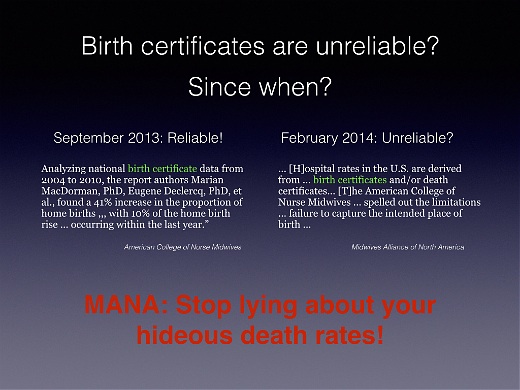
Calculating neonatal mortality using the CDC Wonder database
I’ve explained many times how I obtained the CDC mortality statistics for homebirth and hospital birth. People still have questions, so I made a video to demonstrate how to use the database.
New Cornell study shows homebirth has 4X higher death rate than comparable risk hospital birth
The hits (to the safety of homebirth) just keep on coming.
The latest study, to be presented this Friday in New Orleans at the annual meeting of the Society for Maternal-Fetal Medicine, is titled Term neonatal deaths resulting from home births: an increasing trend.
The study was performed by analyzing CDC data, in exactly the same way that I have been analyzing it for the past 5 years. In this case, the authors chose to remove congenital anomalies as well.
There were a total of 10,453,778 term deliveries between 2007 and 2009 which met study criteria: 9,526,450 (91.13%) were by hospital physicians, 826,543 (7.91%) by hospital midwives, 30,415 (0.29%) by midwives in freestanding birthing centers, 48,202 (0.46%) by midwives at home, and 22,168 (0.21%) by others at home. NNM for those delivered at home by others and by midwives, and those delivered in a freestanding birthing center was significantly higher than those delivered by midwives in the hospital: hospital midwives: 3.1/10,000 (RR:1); home others: 18.2/10,000 (RR: 5.87; 95%CI: 4.21-8.19), home midwives: 13.2/10,000; (RR: 4.32 95%CI: 3.29-5.68), freestanding birthing center: 6.3/10,000;(RR: 2.03; 95%CI: 1.28-3.24)…
Amos Grunebaum, the lead author, was interviewed by Live Science:
For first time mothers, midwife-attended home births had even worse outcomes: 21.9 babies died for every 10,000 births. Risks also increased for older women, and women who were at 41 weeks of pregnancy, meaning they were more than a week past their due-date, Grunebaum said…
Unlike in the Netherlands, where all home birth attendants are professionally trained, home birth attendants in the United States may be inadequately trained, Grunebaum said.
In addition, home birth attendants in the United States don’t have firm criteria limiting which patients they should see, and so they may attend deliveries for high-risk pregnancies.
“They take twins, they take women who have prior C-sections, they do home deliveries in breech babies,” Grunebaum told LiveScience.
But even when looking at low-risk patients, home births are riskier, Grunebaum said. That’s because even a simple, uncomplicated birth can turn into an emergency very quickly.
“When the baby is in trouble, you have literally minutes to deliver this baby,” Grunebuam said. “There’s no time to transfer the patient from the home to the hospital in sufficient time.”
Women who want fewer medical interventions during labor or delivery, but still lower the risks for their babies should consider having trained midwives attend their births in a hospital, Grunebaum said.
It is important to understand that this study includes only PLANNED homebirths, and UNDERCOUNTS the actual risk of death at homebirth in 3 separate ways:
- Transfers to the hospital during attempted homebirth ended up in the hospital group and were not counted in the homebirth death rate.
- Intrapartum stillbirths are not included in this data, so homebirth deaths are undercounted even further.
- The authors of this study looked at all races, but white women account for more than 90% of women choosing homebirth, and the neonatal death rate for white women is much lower than that for all races.
Once again, we find that the dramatic increased risk of death at US homebirth is a remarkably robust finding. No matter where you look, whether it’s at state data like that of Oregon (9X higher), CDC data or even MANA’s own database (5.5X higher), midwife attended homebirth has a risk of neonatal or perinatal death anywhere from 3-9X higher than hospital birth.
What MANA found; what MANA did.
The following is from a comment taking issue with Judith Lothian’s post on the Lamaze blog Science and Sensibility praising the MANA study Outcomes of Care for 16,924 Planned Home Births in the United States: The Midwives Alliance of North America Statistics Project, 2004 to 2009. The authors claimed that the study shows homebirth is safe, but it actually shows that homebirth has a death rate 450% higher than comparable risk hospital birth.
This “study” brings up more questions than answers. And I hope MANA seeks to find answers – true answers, and not unfounded self-promoting headline – regarding the safety and risks of OOH birth…
Does MANA reviews these findings, identify clear risk factors that increase risk of death, and set professional standards for safe practice – based on their own research? Why or why not?
… The authors allude to insufficient collaboration between midwives and medical providers – is there any evidence in this sample to support this assertion? Case reviews of each incidence of perinatal death may illuminate this subject.
In this sample, was there any difference in outcomes between midwives practicing in states where CPMs are licensed and in states where they are not?
In this sample, were there individual midwives who had significantly higher perinatal mortality rates in their own practices? If so, what was there any common denominator among these types of midwives?
Let’s start asking the hard questions. Let’s start coming to conclusions about what makes midwifery and OOH birth safest and stop this nonsense of blind self-promotion. A group of health care professionals should adhere to ethical standards – first and foremost – to do no harm.