Classic homebirth dilemma: can you leave the placenta attached and eat it, too?

iStock_000024570127XSmall

You cannot make this stuff up.

From Mothering.com:

I am having such a difficult time deciding between lotus birth and cubing the placenta for consumption in smoothies. I am trying to find a solution that will be less stressful on both DD and myself. Has anyone waited until the umbilical naturally shriveled closed to sever it?

This is a tough question. On the one hand we have the made up nonsensical claim that lotus birth, leaving the placenta attached to the newborn baby until it rots off several days later, is good for the baby. On the other hand, we have the made up nonsensical claim that eating placenta prevents postpartum depression. What’s a New-Age know-nothing to do?

According to one of the respondents, you can have your placenta and eat it, too.

I waited about 36 hours after my 2nd’s birth, and by that time the cord was dry, hard and quite thin. It was hard to cut, like a thick fingernail. I didn’t feel comfortable eating the placenta so I just stuck it in the freezer. Gloria Lemay has a blog post suggesting you could keep the placenta in a cooler bag with an ice pack while it is attached if you want the best of both worlds.

See, that wasn’t so hard. This is why Mothering.com is the go to guide for sharing mind blowing ignorance and stupidity among homebirth advocates.

Psst, here’s a bribe to breastfeed

iStock_000018897915XSmall

The contempt that lactivists evince for women who don’t mirror their own choices back to them beggars belief.

The latest example: an odious attempt to bribe women into breastfeeding.

According to the BBC:

Under the scheme mothers from specific parts of Sheffield and Chesterfield will be offered the vouchers, which they can then use in supermarkets and high street shops…

To qualify for the full £200 of rewards, the women will have to breastfeed until six months.

However, it will be frontloaded – enabling those taking part to get £120 for breastfeeding for the first six weeks.

Midwives and health visitors will be asked to verify whether the women are breastfeeding.

The team behind the project said breastfeeding was a cause of health inequalities, pointing to research that showed it helped prevent health problems such as upset stomachs and chest infections as well as leading to better educational attainment.

Dr Clare Relton, the Sheffield University expert leading the project, said she hoped the financial incentives would create a culture where breastfeeding was seen as the norm.

Bullshit!

Breastfeeding is a cause of health inequalities? An increase in colds and upset stomachs qualifies as a health inequality?

Do lactivists believe the crap that they spout?

There is NO EVIDENCE, zero, zip, nada, that breastfeeding is a cause of health inequities. There is no remotely plausible reason to believe such nonsense. Breastfeeding has real benefits, but for term babies those benefits are so trivial as to be limited to a population wide minor decrease in infant colds and diarrheal illnesses.

Furthermore, we KNOW that breastfeeding tracks with the real causes of health inequities: race, socioeconomic status, and education levels. When those confounding variables are removed, breastfeeding term babies doesn’t seem to have much benefit at all.

Bribing women will create a culture where breastfeeding will be seen as the norm?

Earth to lactivists: if you have to bribe someone to do it, you are sending the exact OPPOSITE message. You are sending the message that it is difficult, expensive and distasteful. Otherwise you wouldn’t be offering bribes.

Most importantly, there is NO EVIDENCE that either carrots or sticks works to get women to breastfeed. To my knowledge, not a single program specifically designed to increase breasting rates has actually worked. Bribing women with food didn’t work. Banning gifts of formula samples won’t work, and neither will locking up formula in hospitals.

So if bribing women to breastfeed won’t increase breastfeeding rates, why are lactivists promoting it? It’s because it is yet another way for them to demonstrate their contempt for women who bottle feed. Apparently lactivists believe that these economically deprived women are so stupid and so uncaring that they can’t be motivated by “educating” them on the benefits of breastfeeding. Lactivists assume that poor women love money more than they love their babies and therefore money will do the trick.

What is particularly execrable is that lactivists figure that these women are so poor and so venal that they can be bribed with trivial amounts of money. Offering £ 200 for 6 months of breastfeeding works out to slightly more than a pound per day. That’s a bit more than $1.50 per day. Is that really an incentive? It’s less than the cost of formula per day. If the money were really an incentive, those women would be breastfeeding already.

It’s particularly infuriating that lactivists refuse to use the money to address the real reasons for low breastfeeding rates. Breastfeeding is difficult, painful and often inconvenient. But acknowledging the reality of breastfeeding, and helping women to cope with real breastfeeding difficulties would involve admitting the truth about breastfeeding. Lactivists would rather pretend that women who don’t breastfeed are stupid and capable of being bribed with trivial amounts of money than to admit that breastfeeding is anything other than perfect bliss.

So a £ 200 bribe is going to be wasted in a doomed attempt to increase breastfeeding rates. What’s even more galling is how many ways it the money could be better spent to improve the health of infant. How about spending the money to improve the quality of British maternity care overall? According to SkyNews:

Between April and September 2012, more than a quarter (28%) of maternity units were forced to close their doors to patients for at least half a day because of a lack of space or a shortage of midwives.

Of these units, 11% closed for the equivalent of a fortnight or more, the report found.

The result?

A fifth of maternity services funding is spent on insurance against malpractice, according to a review by the National Audit Office (NAO).

The report found the NHS in England spent £482m on clinical negligence cover in the last year – the equivalent of £700 per birth.

The most common reasons for maternity claims are mistakes during labour or caesarean sections and errors resulting in cerebral palsy, the review said.

Public Accounts Committee chairwoman Margaret Hodge said the figures were “absolutely scandalous”.

“The current system is not working as it should,” she said.

“The Department of Health needs to buck up and take responsibility for this.

“It needs to review its monitoring and reporting process to ensure that all relevant bodies can work effectively together to deliver maternity services that are value for money and fit for purpose.”

The British maternity system is in critical condition and babies are suffering and dying as a result. Diverting money from maternity care to bribe women to breastfeed isn’t just loathsome, it’s downright immoral.

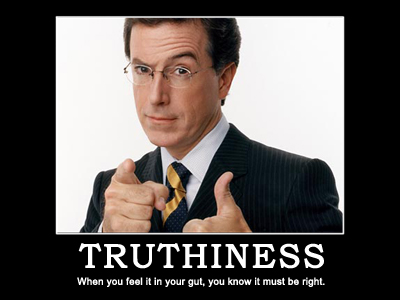
The truthiness of natural parenting

truthiness

Natural parenting advocates are certain that natural parenting is the best way to raise children despite the complete absence of proof for any of its central claims.

They believe that unmedicated vaginal birth is safer and healthier although there is no evidence to support that claim.

They believe that breastfeeding of term infants confers massive, lifelong benefits despite data that is weak, conflicting and riddled with confounding variables.

They believe that baby wearing improves the mother-infant bond although that premise has never been tested, let alone found to be true.

They believe that vaccines are harmful, cause autism and that a multiplicity of vaccines “overwhelm” the immune system despite masses of data proving the exact opposite.

Why do they hold such strong beliefs in the absence of scientific proof? It’s simple; they are impressed with the “truthiness” of natural parenting.

The comedian Steven Colbert coined the term “truthiness.” According to Wikipedia:

Truthiness is a quality characterizing a “truth” that a person making an argument or assertion claims to know intuitively “from the gut” or because it “feels right” without regard to evidence, logic, intellectual examination, or facts.

In an out of character interview Colbert explained:

It used to be, everyone was entitled to their own opinion, but not their own facts. But that’s not the case anymore. Facts matter not at all. Perception is everything. It’s certainty. People love the President [George W. Bush] because he’s certain of his choices as a leader, even if the facts that back him up don’t seem to exist. It’s the fact that he’s certain that is very appealing to a certain section of the country. I really feel a dichotomy in the American populace. What is important? What you want to be true, or what is true?…

Truthiness is ‘What I say is right, and [nothing] anyone else says could possibly be true.’ …

Colbert was talking about politics, but it applies equally to natural parenting. Indeed, the appeal to truthiness is quite explicit in natural parenting. The natural childbirth advocacy advice to trust your “instincts,” is a call to value truthiness above truth. It doesn’t matter what obstetricians say about the dangers of postdates, breech vaginal birth, homebirth, etc; the only thing that matters what you believe the dangers to be.

Why are so many professional natural childbirth advocates either sociologists or anthropologists? Because they, too, value truthiness above truth.

Many dismiss science as a male form of “authoritative knowledge” on the understanding that there are “other ways of knowing” like “intuition.” Many are post modernists who believe that reality is radically subjective, that rationality is unnecessary and that “including the non-rational is sensible midwifery.”

Perhaps nowhere is truthiness more valued than among the vaccine rejectionists. They, too, are quite explicit in their rejection of truth for intuition. Vaccines cause autism because some parents feel that vaccines caused their children’s autism. Never mind that copious scientific evidence has shown that there is no causal connection between vaccines and autism. They embrace modified vaccination schedules because some parents feel that multiple vaccines given together or even separately over time “overwhelm” a child’s immune system. Never mind that anyone with a modicum of knowledge of immunology recognizes this claim as nonsense.

Colbert, in explaining the genesis of truthiness, observed:

We’re not talking about truth, we’re talking about something that seems like truth – the truth we want to exist.

The central claims of natural childbirth, lactivism, attachment parenting and vaccine rejection aren’t the truth; they’re the truth that natural parenting advocates want to exist. Those claims may be appealing because they’re truthy, but the reality is that they are not true.

Why do lactivists think it is okay for hungry breastfed babies to cry it out?

image

Most attachment parenting advocates are strongly opposed to the sleep training method known as “cry it out,” abbreviated CIO.

According to Darcia Narvaez, PhD:

With neuroscience, we can confirm what our ancestors took for granted—that letting babies get distressed is a practice that can damage children and their relational capacities in many ways for the long term. We know now that leaving babies to cry is a good way to make a less intelligent, less healthy but more anxious, uncooperative and alienated person who can pass the same or worse traits on to the next generation.

That’s nothing but nonsense, of course, on a variety of levels. It’s nonsense because crying it out does not cause brain damage and it’s nonsense because it is based on the myth of our “noble savage” ancestors who had nothing better to do with their time than endlessly soothe their multiple babies.

But let’s take CIO opponents at their word for the moment. If they honestly believe that CIO harms babies, why do they think it is okay for hungry breastfed babies to cry it out?

Hunger is probably the most elemental of infant drives and, as anyone who has seen an infant scream from hunger would probably agree, is experienced by the baby as suffering. For most mothers, myself included, the sound of their own infant crying is piercing in its intensity and distress. I remember being surprised by this when my first child was born. I had spent my entire professional life surrounded by crying babies and it had never bothered me, yet I found my son’s crying unbearable and always rushed to determine what was wrong and fix it in any way possible. I cannot imagine letting any of my infants cry in out in hunger for any length of time without feeding them.

So why do lactivists think it okay to let babies cry it out for hours at a time because of desperate, all consuming hunger?

Why do they advise women whose babies aren’t getting enough milk in the first few days CIO arguing that assuaging an infant’s hunger now, when he is suffering, will undermine breastfeeding? Why do they view supplementation in the first view days as an evil so great that it is preferable to force babies to CIO and thereby destroy their brain cells?

Why do lactivists think it is okay to ignore an infant who is not gaining weight because of a maternal milk supply that does not match that infants needs? Why do they denigrate women who find their baby soothed and content after a bottle of formula, and chastise them that they should have let the baby CIO?

Why do lactivists who have children who try to wean before their mothers have planned to stop breastfeeding counsel each other to starve the baby into submission? Why do they tell each other to offer no other source of nourishment and let the baby cry it out until forced to give up his or her drive for independence and bow to the mother’s will to continue breastfeeding in order to survive?

Why do lactivists consider maternal mental health/postpartum depression to be a trivial reason for letting babies CIO, but consider that establishing or preserving a breastfeeding relationship is a perfectly acceptable reason for CIO?

Feel free to correct me, but I’m not aware of a single lactivist or attachment parenting blogger who sees anything wrong with letting a hungry breastfed baby cry it out.

Why the hypocrisy?

Because lactivism and attachment parenting have little if anything to do with babies and their wellbeing and everything to do with parents and their self-image. A “good mother” supposedly sacrifices her sleep and mental health and is willing to spend every minute of every day soothing an infant in order to avoid crying it out. But a “good mother” also breastfeeds and therefore, any amount of CIO is acceptable to preserve bragging rights to exclusive breastfeeding.

Why do natural childbirth advocates have so much difficulty bonding to their own babies?

iStock_000029384270XSmall

I’ve always loved this quote from Maureen Hawkins:

Before you were conceived, I wanted you. Before you were born, I loved you. Before you were an hour, I would die for you. This is the miracle of love.

It beautifully describes how fiercely I bonded to each of my four children, even before they were born.

I had no control over it. It happened without my doing a single thing. So I feel somewhat sorry for natural childbirth advocates who apparently have so much trouble bonding to their own babies and getting their babies to bond to them.

The quote above does not mention vaginal delivery, yet natural childbirth advocates, unlike most women in the world, appear to have trouble bonding with babies who haven’t transited their vagina.

The quote doesn’t mention pain or pain relief in labor, yet natural childbirth advocates, unlike most women in the world, appear to have trouble bonding with babies if they received pain relief in labor, especially if they had planned to refuse it.

The quote does not mention feeding method, yet natural childbirth advocates appear to have trouble bonding to babies unless they breastfeed them, and apparently, it takes them extra long to bond with their own babies since they insist that they must breastfeed them for extended lengths of time to strengthen the tenuous bond.

Indeed, their ability to bond with their own babies is so fragile that unless they immediately hold their babies skin to skin, they have trouble completing that natural bond.

That’s not to say that every woman bonds to every baby immediately. It can take days or weeks or more, but nearly every woman manages to bond fiercely to her child and nearly every child bonds to his or her mother.

So natural childbirth advocates apparently have great difficulty bonding to their own babies. That’s the message that I take away from their endless bleating about how epidurals, C-sections and bottlefeeding undermine the mother-infant bond. Why do they have so much trouble doing what every other woman does naturally? What accounts for the irony that the women most committed to “natural” birth can’t manage natural bonding when faced with even the least little disappointment or difficultly?

I would guess that it has to do with viewing the baby as merely a prop in their little pieces of performance art. Like bridezillas who become enraged by a wedding cake that is the wrong flavor and think the wedding is ruined, natural childbirth advocates appear to become distraught at not having an unmedicated vaginal delivery and bear resentment of the baby for “ruining” their experience. Natural childbirth advocates, and lactivists, too, see babies as bit players in the narrative of their mothering superiority (hence the endless blather that producing breastmilk is a superpower or that vaginas have superpowers). Simply put, natural childbirth advocates seems to have trouble appreciating, bonding to, and loving their babies for who they are, instead of what they can do for them.

Perhaps natural childbirth advocates can explain it to the rest of us: For most women, NOTHING can interfere with the fierce bond that they form to their babies. Why do NCB advocates and lactivists form only fragile bonds that can be destroyed by a C-section or a bottle of formula?

How about a MOTHER friendly breastfeeding initiative?

Woman Screaming at Anoher Female on White Background

If there’s a bigger oxymoron than the “Baby Friendly” Hospital Initiative, I’m not aware of it. There is nothing baby friendly about efforts to promote breastfeeding to the exclusion of a mother and baby’s actual needs. There is not, and there can never be, anything “baby friendly” about destroying the confidence of new mothers and making them feel guilty about a decision with trivial consequences.

It’s time (actually long past time) for a MOTHER friendly breastfeeding initiative.

What would a mother friendly breastfeeding initiative entail? It would start with some basic truths about breastfeeding and mothering:

1. While breastfeeding has real benefits, those benefits are so small as to be trivial in all cases except premature babies. Understanding and acknowledging this scientific reality is the first step to a safe, sane, respectful breastfeeding policy.

2. The obvious corollary to #1 is this: once a woman has been given accurate information about the benefits of breastfeeding, it DOES NOT MATTER what choice she makes, and therefore hospitals should NOT be devoting copious resources to it. Those resources would be much better spent teaching basic parenting to low income, young women or on programs to prevent prematurity.

3. Formula is an EXCELLENT source of nutrition for babies. There is absolutely positively nothing wrong with it, and no mother should be made to feel guilty for feeding to her child, regardless of the reason for choosing it.

4. Breasts are part of a woman’s body. NO ONE has the right to tell women how they must or should use their breasts. PERIOD.

5. I don’t know of a single endeavor where humiliation produces results. It’s time for lactivists and lactation consultants to acknowledge that and stop the hectoring treatment being offered in hospitals.

6. In my judgment, boosting fragile maternal confidence is an important task of anyone who cares for women and babies. Setting arbitrary standards, ignoring women’s own needs, pretending that every woman can breastfeed successfully are sure-fire ways to undermine self-confidence, not build it.

7. Stop treating new mothers like morons. EVERY women knows that “breast is best.” If a woman decides to formula feed, it does NOT mean that she doesn’t understand the benefits of breastfeeding.

8. Breastmilk does not have magical properties. Its ability to prevent vaccine preventable illnesses is small and easily outstripped by vaccination itself. It does not increase intelligence; it does not prevent obesity; and it does not confer health on its recipients.

9. No one has ever demonstrate ANY benefit to donor breastmilk for term babies.

10. The risks of potentially contaminated donor breastmilk from unregulated arrangements far outstrips any putative benefits.

Why is it critically important to make our breastfeeding initiatives MOTHER friendly?

We have made great strides in understanding the devastating impact of postpartum depression, yet we seem to ignore those insights when trying to promote breastfeeding. Adequate sleep, lots of help and feelings of competence can help prevent and treat postpartum depression. Why then do we pretend that breastfeeding is more important than these factors so critical for women’s mental health?

Contemporary efforts at breastfeeding promotion remind me of the efforts to encourage right handedness among the left handed in generations past. The humiliation and physical abuse associated with forcing right handedness were justified by claims that being right handed is “better” and “easier.” The humiliation and guilt inducing behavior of lactivists and their breastfeeding initiatives are justified by claims that breastfeeding is “better” and “easier.” Humiliation and physical abuse were believed to be “effective” in forcing right handedness when the reality was that it was effective only in inducing despair. Lactivists apparently believe that humiliation and guilt are effective in increasing breastfeeding rates when the reality is that they are effective only in getting women to lie about their intentions or to despair when they can’t realize those intentions.

There is NOTHING wrong with formula feeding, the benefits of breastfeeding are trivial and the harms to women and babies of venerating breastmilk as magical far outstrip any of those putative benefits. It’s time to get real about breastfeeding and to stop the nonsense of “baby friendly” hospital initiatives. Such initiatives are friendly to only one group: lactivists, who are building their own self-esteem by tearing other women down. If we actually care about mothers and babies, we would remove “baby friendly” programs and replace them with accurate scientific information, respect for women’s intelligence and efforts to support mothers regardless of feeding choice.

It’s time for safe, sane and respectful breastfeeding policies. It is time for MOTHER friendly breastfeeding initiatives.

The March of Dimes and dishonesty about prematurity

Schweig still / be silent

What does an organization do when it achieves it’s goal? You might think it would disband in triumph, but that’s not the case with The March of Dimes.

The organization was created by President Franklin Roosevelt to combat the scourge of polio and was spectacularly successful in its goal. Polio has been nearly wiped off the face of the earth because of the polio vaccine. Instead of disbanding, however, the organization has sought to perpetuate itself by finding another cause.

For a while, The March of Dimes concentrated on “birth defects”: congenital medical anomalies and illnesses. They have not been nearly as successful in addressing that problem because it is complex and multi-factorial. Now they’ve moved on to prematurity. It is also a complex multi-factorial problem that does not lend itself to easy answers. The March of Dimes has scored no successes in preventing prematurity, but they’re undaunted. Unfortunately, instead of greater efforts to address the major problem of extreme prematurity that is responsible for a large proportion of neonatal deaths, The March of Dimes has chosen to misrepresent the problem in order to be seen as doing something. The misrepresentations are disingenuous and, in some cases, border on outright dishonesty.

The March of Dimes has chosen to misrepresent prematurity as being caused by early elective delivery. While early elective delivery poses risks, it also has significant benefits (reducing the stillbirth rate) and, in any case, is only a tiny contributor to the problem of prematurity. I suppose one could argue that hyping the issue of early elective delivery is like looking for your keys under the streetlamp even though you dropped them elsewhere. The answer is not likely to be there, but at least that’s where the light is.

I can think of no good reason the be dishonest about prematurity and race, however, and The March of Dimes is thoroughly dishonest on that point. Black African ancestry is a major risk factor for prematurity, but the MOD has not simply ignored this reality, they started denying it, too.

The MOD has been publishing a yearly “report card” on prematurity. The report card is rather farcical since while claiming to grade states on prematurity rates, it is basically grading them by the proportion of African-Americans in each state.

According to NBC.com:

Vermont led the nation with just 8.7 percent of births coming before 37 weeks gestation. Alaska, California, Maine, New Hampshire and Oregon had rates of 9.6 percent or lower, the target recommended by the March of Dimes…

The states with the highest rates of preterm birth are Mississippi (17.1 percent), Louisiana (15.3 percent) and Alabama (14.6 percent). If they were countries, they would be among the 14 worst of the 184 for which data are available, according to the U.N. report. The global average is 11.1 percent…

The high U.S. rate for preterm births is often blamed on the nation’s racial, ethnic and economic diversity, said McCabe [medical director of the March of Dimes], “but the California example refutes that.”

California, with half a million births each year, “has an incredibly diverse population, but it set up policies and procedures to make reducing preterm births a priority,” he said.

Not exactly.

The scatter plot below compares prematurity rates to the proportion of African-American’s within each state.

Prematurity vs Race

As you can see, there is a strong correlation between prematurity rates and the proportion of African American in each state. I calculated a correlation coefficient (Pearson’s r) of 0.75. The whitest states have the lowest prematurity rates and the blackest states have the highest prematurity rates. In other words, the whitest states merit an A grade, while the blackest states are awarded F’s.

The arrow identifies the data point for California. Contrary to Dr. McCabe’s claim that California refutes the relationship between race and prematurity, California actually has a very low proportion of African Americans, corresponding to its low prematurity rate.

Why is any of this important?

We aren’t going to be able to solve the problem of prematurity if we aren’t honest about the reality of prematurity. Yes, there is an iatrogenic component to American prematurity rates, but this is a trivial aspect of the problem. Not to mention that reducing iatrogenic prematurity has risks of its own.

More importantly, the strong correlation between race and prematurity suggest a major genetic component. We should be aggressively searching for a genetic basis for prematurity instead of pretending that it doesn’t exist. But that, of course, it hard, and The March of Dimes would prefer the easy way out, grandstanding by “grading” states on prematurity rather than do the difficult work of solving the actual problem.


Addendum:

March of Dimes state by state prematurity statistics can be found here: http://www.multivu.com/players/English/59684-march-of-dimes-75th-anniversary/

African-American state by state population statistics can be found on Wikipedia: http://en.wikipedia.org/wiki/List_of_U.S._states_by_African-American_population

November 1, 2013: This week in homebirth idiocy

iStock_000018428541XSmall

You can’t make this stuff up!

1. Is anyone really so stupid that they could believe this?

From the festival of ignorance known as Mothering.com, comes this from Who the Heck First Thought Up the Cry it Out Approach?

Holt popularized Cry It Out in 1895, and it is my theory that the method caused both World Wars, twenty and forty years later, when these very pissed off babies became adults.

Because we all know that there were no wars before WWI.

2. The title says it all, The Freebirth of Apple Blossom Light Hawk Summer Willow Wind:

Before Peacy’s birth, Joey had told me of a Native American tradition where children’s names were constantly in motion – constantly changing based on their phase of life and their spirit. I tried this out with Peacy, but it didn’t feel right; I wanted her to have a name of her own. It felt like something she was entitled to, something sacred. I thought about it for a long time. I over-thought it. I came up with a name, Lynnea, and I shared it with Joey. He didn’t like it. He asked me why I had chosen it. I told him it reminded me of the forsythia – the first vibrant blossom of the spring.

“What about ‘Spring Blossom,’” he said.

I fell in love with this – I had never even considered a name so beautiful. Over the next few months, her name evolved. It became like a poem. It came to embody her soft, radiant beauty, her fiery spirit, and her deeply passionate soul. We gave her a nickname too, “Peacy,” because who can say “Apple Blossom Light Hawk Summer Willow Wind, come get your dinner!”?

Good point!

3. What’s up with the ridiculously long titles? Consider I Did Not Cut My Baby’s Umbilical Cord for Six Days So We Could Have a Natural “Lotus Birth” Just Like Chimpanzees.

Because, really, who doesn’t aspire to be just like a chimpanzee?

When we clamp and cut the cord too soon, we risk losing this precious fluid and gas exchange. Some wild animals such as our closest relatives, the chimpanzees must know this instinctively as most of them continue to carry around the placenta with the cord attached to their babies until it naturally drops off and is returned to the earth; what we otherwise refer to as a “lotus birth.” Other animals do chew the cord off shortly after birth, but as a vegan this option did not appeal to me.

4. Even though there is a whole lot of stupidity in the first three pieces, the winner this week, hands down, is this fourth effort, illustrating is what happens when your parents and their friends are narcissistic morons who think birth is a piece of performance art and the baby is a prop. No single quote could truly capture the narcissism of all the adult participants, so I urge you to read the whole post if you can stand it.

From the friend:

…[H]e was there, he was there, little floppy white boy was in her arms cradled close to her aching flesh, and he was out and real and so white and limp. For a brief instant we were flooded with relief so sharp it stung. Wendy announced, voice shaking, “It’s a boy!” and there was a flutter of excitement and happiness before Richelle seized the baby and sealed her mouth over his. “Come on baby, breathe,” she muttered between breaths. What? At first I thought Richelle was just taking precautions, just in case, but he’d cry any second now and we’d all laugh and say how freaky that was and how for a minute we were worried something was actually wrong. Right? I saw Dave Rush put his hand over his mouth and the smile slowly disappeared from Wendy’s face. He wasn’t breathing? …

“Turn the fan off!” Richelle snapped at the people behind her, laying Beckham on the floor, continuing filling his little chest with air. Turn pink turn pink, turn pink, this isn’t really happening is it? This is happening. Just cry just be okay, oh baby please please be okay!…

Richelle was still methodically giving the baby breaths. Dave was sobbing into his hands and Wendy was leaning over the edge of the tub staring fixedly at her baby, speaking clearly and forcefully. “I need you to breathe. I need you to breathe for your mommy. Breathe for your mommy. Breathe for your mommy!” … Dave kneeled on the floor above the little guy, begging him to breathe, holding the oxygen tube near that tiny nose, crying.

Fortunately the baby survived, though it is impossible to know the extent of the damage done by lack of oxygen both before and after the baby’s birth.

But wait! They didn’t nearly kill their own baby, they nearly killed the mother, too.:

Everyone in the room was focused on Beckham, and exploded into sobs of relief when he took that first breath. Nobody knew that I was still in peril. Upon Beckham’s birth, my placenta had abrupted and I was hemorrhaging badly into the tub. I felt large placenta-sized clots spilling out of me and the water in the tub was quickly filling with my blood. I began to see stars and felt like I was going to pass out.

The midwives turned their attention toward me and noticed the severity of my hemorrhage. They lifted me out of the tub, placed me on the couch, and administered pitocin in my leg and methergine in an IV. Katie held my uterus firmly between her hands and my doulas cut a piece of the placenta and put in under my tongue. I was pale and weak and I was struggling to stay conscious. I remember thinking that I had to stay awake, because if I closed my eyes, I wouldn’t wake up…

See, just like nature intended: a nearly asphyxiated baby and a mother nearly dying from hemorrhagic shock. But it was worth it because she could immediately snuggle with her baby in the comfort of her own home … No, couldn’t do that, either:

Once I was stable, Richelle began the work of repairing my labia and perenium that had been badly torn as Beckham was crowning. I endured 2 hours of careful stitching as my husband and mother drove Beckham to the hospital to be checked out.

The hospital confirmed that Beckham had some fluid in his lungs, and he was a bit anemic from some blood loss, but that he was really healthy besides that. They recommended that he be placed in the NICU for observation that night, but since that hospital did not have a proper NICU facility, they wrote orders to have him transferred to another hospital.

I did not want to be separated from Beckham, but my husband was worried and wanted to take him. My mom convinced my husband to bring Beckham home to me before they transferred Beckham over to the NICU. Dave explained that the baby was fine but needed to be in the hospital for observation. I told my husband that we would stay up with him all night in shifts and observe him ourselves. He very reluctantly agreed and dropped the conversation…

It took Beckham only a few days to recover. It took four weeks and a blood transfusion for me to fully recover.

Did the mother learn anything from this disaster? Are you kidding?

I am so grateful to my skilled midwife and the loving support of my birth team. Without them, the outcome of my birth would have been very different. I am so glad that I chose to have a homebirth, especially because I had complications. If I had been in the hospital, my baby would have been taken to the NICU and his entire introduction to life would have been different. Instead of being placed in a bright room hooked up to monitors, Beckham was in a dim room, in his mother’s arms, where he knew he was safe.

Yes, it would have been very different! The baby likely would not have risked loss of brain function from asphyxia, and the hemorrhage he experienced when the clueless midwife snapped his short umbilical cord, and the mother would not have nearly bled to death and needed a blood transfusion to function. Plus, she wouldn’t have experienced the two hours of suturing of her labia and perineum which had been torn to shreds.

Of course, had she given birth in the hospital, the mother would not be able to revel in her own narcissism, and what could possibly be more important than that?

Screen time

Screen time cropped copy

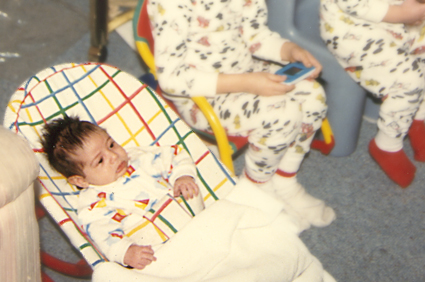
I’ve been following the discussion of screen time in the comments, and thought I’d weigh in.

The picture above is my third son at 3 weeks of age watching TV with his brothers. His eldest brother (4 1/2 at the time) was simultaneously playing a hand held computer game.

I didn’t just allow screen time, I actively encouraged it. Bad mommy!

Dr. Amy