The Journal of Pediatrics highlights deadly outcomes of the Baby Friendly Hospital Initiative

Poor little toddler baby fell down from the bed while crawling on it. Dad missed to catch him

The tide is turning!

It’s been known for years that aggressive breastfeeding promotion in general and the Baby Friendly Hospital Initiative in particular are dangerous for babies. Sadly, it’s taken time for medical professionals to respond to the dangers.

The latest response is an editorial in the Journal of Pediatrics, Breastfeeding, Baby-Friendly, and Safety: Getting the Balance Right.

[perfectpullquote align=”right” bordertop=”false” cite=”” link=”” color=”” class=”” size=””]The BFHI endangers babies through its policies of mandated rooming in and closing well baby nurseries.[/perfectpullquote]

The editorial focuses on the dangers of infant smothering and falls of from mothers’ hospital beds, just a small subset of the harm that the BFHI causes. Even so, it undermines many of the claims of the BFHI.

Any medical or systems intervention comes with risk for adverse events. Overall, this has been understudied for the Baby-Friendly Health Initiative, with only 2 studies identified by the US Preventive Services Task Force as reporting any
adverse events … In this volume of The Journal, articles by Bass et al and by Bartick et al extend what is known about the safety and efficacy of Baby-Friendly.

The conclusion is that — through its policies of mandated rooming in and closing well baby nurseries — the BFHI endangers babies.

A central tenet in the Ten Steps of Baby-Friendly is to enable mothers and infants to practice rooming in and remain together 24 hours a day. This step, perhaps more than any other, has led to concerns about safety of Baby-Friendly practices, particularly when mothers accidentally or intentionally practice bed-sharing with their newborn…

The results has been an increase in Sudden Unexpected Postnatal Collapse (SUPC) and infant falls:

These early events are now referred to as sudden unexpected postnatal collapse (SUPC), a rare subset of sudden unexplained infant deaths
(SUID, defined as the sudden and unexpected death of a baby is apnea or cardiorespiratory failure occurring in an otherwise-healthy term newborn, usually in the first 24 hours of life, and during the initial skin-to-skin contact, with prone positioning, or with the first attempt to breastfeed… [M]aternal fatigue and reduced monitoring have been reported to contribute to infant falls during rooming-in.

Babies are injured and even die not because of breastfeeding, but because of the unnecessary and harmful restrictions — in this case mandated rooming in and closure of well baby nurseries — that lactation professionals have added to breastfeeding promotion.

In a recent analysis of 20 years of Centers for Disease Control and Prevention (CDC) data from 1995 to 2014, Bass et al found that although overall rates of SUID in the first year of life fell, rates of neonatal (within the first month of life) SUID increased from 9% to 10% in 1995 to 11% to 13% by 2014.7 Much of this increase occurred between 1995 and 2000. Of the neonatal SUID events, 29% occurred in the first 6 days of life and 15% on the first day of life. Overall, this translates to 125 SUPC events annually in the US …

Bartick believes that she has rebutted the implication that the rise in neonatal SUID events is the result of the the BFHI.

Bartick et al also report CDC data and found that between 2004 and 2016 (a shorter and later time frame than examined by Bass et al), the adoption of skin-to-skin care as a part of Baby-Friendly practice increased substantially in the US and in Massachusetts. During the same time frame, data from the CDC and Massachusetts Department of Health showed a decrease in the prevalence of SUID in the first 7 days of life (ie, SUPC). Their data suggest this decrease was at least partly due to a statistically significant drop in preterm deaths, but overall the trends in SUID prevalence over their 13-year study period appear similar to the report by Bass et al.

Both investigators attempted to examine the proportion of these early deaths that were directly attributable to accidental suffocation. Although both studies noted an increase in reported accidental suffocation over time, the specific rates are difficult to compare, as the age groups studied were different (

If the BFHI harms babies, alternative approaches to breastfeeding promotion should be considered, especially since there is evidence that the BFHI doesn’t increase breastfeeding rates.

The editorial concludes:

In the hospital, a balance needs to be struck between encouraging and supporting a mother and avoiding system-based practices that inadvertently increase risk to the infant. There is growing support for an individual, tailored approach to promoting breastfeeding duration. All medical personnel need to be familiar with the evolving data supporting best practices for breastfeeding support.

It’s time to end the Baby Friendly Hospital Initiative that has harmed babies and replace it with an individual, tailored approach. Lactation professionals are still in denial about the risks, but babies shouldn’t have to suffer injuries and die as a result.

Why have lactation professionals made breastfeeding so much harder than it ever was before?

E54C1707-38EC-46F7-BE03-375269227DA9

I’ve been studying breastfeeding for more than 30 years. Yet it was only recently that I had something of an epiphany. I realized that lactation professionals have been making breastfeeding steadily harder, not easier, by hedging it around with unnecessary restrictions.

[perfectpullquote align=”right” bordertop=”false” cite=”” link=”” color=”” class=”” size=””]The Fed Is Best movement is about stripping away the unnecessary and harmful restrictions that lactation professionals have ADDED ON to breastfeeding. [/perfectpullquote]

It used to be that breastfeeding meant feeding a baby at your breast. Consider the ur-text of the lactation profession, Diane Weissinger’s Watch your language.

The paper is a remarkable paean to manipulating women through shame.

Artificial feeding, which is neither the same nor superior, is therefore deficient, incomplete, and inferior. Those are difficult words, but they have an appropriate place in our vocabulary…

Because breastfeeding is the biological norm, breastfed babies are not “healthier” artificially-fed babies are ill more often and more seriously. Breastfed babies do not “smell better”; artificial feeding results in an abnormal and unpleasant odor that reflects problems in the infant’s gut.

But the paper is also remarkable for what it doesn’t include:

There’s nothing about an enforced hour of skin-to-skin “care.”
There’s nothing about enforced rooming in.
There’s nothing about closing well baby nurseries.
There’s nothing about refusing to supplement babies who are hungry.
There’s nothing about banning formula gifts.
There’s nothing about refusing to give babies pacifiers.
There’s nothing about co-sleeping or bedsharing.
There’s very little about bonding.
There’s nothing about purchasing donor milk.

In short, there’s nothing about the myriad ways in which lactation professionals make breastfeeding harder for women than it otherwise would be … and it’s already hard enough. These restrictions, in addition to making breastfeeding more onerous, make it more dangerous.

Breastfeeding itself isn’t dangerous, but the restrictions can be deadly. Worse, most of the restrictions have no basis in scientific evidence.

The refusal to supplement leads to newborn dehydration, hypoglycemia (low blood sugar) and jaundice, all of which can cause permanent brain injury and death. Moreover, early judicious supplementation for hungry babies increases the odds of extended breastfeeding.

The enforced hour of skin-to-skin care has led to an increase of babies smothering to death in their mothers’ hospital beds. Yet there’s NO scientific evidence that shows that skin-to-skin care is beneficial for term babies in high resource settings (as opposed to premature babies in low resource settings).

The closing of well baby nurseries has deprived women of much needed rest after the exhausting ordeal of childbirth. It has also increased smothering deaths and deaths of babies fracturing their skulls by falling from their mothers’ hospital beds. There’s no evidence that closing nurseries improves breastfeeding rates, and there is no culture besides ours that forces mothers to exclusively care for their babies from the moment the placenta detaches.

The purchase of astronomically expensive donor milk is a tremendous financial hardship. There’s NO evidence that donor milk provides any benefits for term babies (as opposed to extremely premature babies).

Why have lactation professionals weighed breastfeeding down by encrusting it with so many additional onerous obligations? It doesn’t make sense if the goal is to get make it possible for more babies to receive more breastmilk, and that — supposedly — is the goal.

But it makes a lot of sense if we think back to how modern lactivism got its start and if we recognize it as but one component of the ideology of intensive mothering.

The creation of La Leche League ushered in modern lactivism. LLL was started by a group of traditionalist Catholic women who wanted to keep mothers of young children from going to work. The impetus was NOT the supposed benefits of breastmilk; those were unknown and never mentioned. The impetus was the belief that babies need mothers to stay home. If mothers could be convinced to breastfeed, they’d have to stay home.

In other words, modern lactivism was created to control women, NOT to nourish babies. To that end, anything that makes mothering easier — supplementing, pacifiers, babies sleeping in cribs — is rejected out of hand. No matter that many of these options are actually safer than what lactivists advocate. This has never been about what’s good for babies.

Lactivism is part of an ideology of motherhood known as intensive mothering for the obvious reason that it takes up nearly every moment of a mother’s time. The ostensible goal of intensive mothering is the maximization of children’s capacities and talents, preparing them to succeed in the modern capitalist world. The real goal is the re-domestication of women.

Lactation professionals have embraced the task with gusto, creating new “benefits” of breastfeeding as fast as the old “benefits” are debunked. They demonize formula, deliberately ignoring the fact that insufficient breastmilk is common as well as the reality that many women want to utilize their minds in fulfilling work instead of being tied to the home by the need to breastfeed. And, of course, lactation professionals claim — falsely and in the absence of any scientific evidence — that anything other than exclusive breastfeeding “interferes” with maternal-infant bonding.

The saddest thing about the lactation profession is not that they are harming babies and mothers, although the soaring success of the Fed Is Best movement is a testament to the fact that they are. The saddest thing is that they have enclosed themselves in social media echo chambers — deliberately banning both professionals who disagree and mothers who are being harmed. There they assure each other they are doing good while babies are starving and sustaining permanent injuries and mothers are being driven to postpartum anxiety and depression.

Lactation professionals are bewildered by the success of the Fed Is Best movement and invoke nefarious motives. They tell themselves and each other that the professionals who are sounding the alarm about the dangers of breastfeeding are trying to undermine it, and are on the payroll of formula companies. But that’s not what’s happening at all.

At its heart, the Fed Is Best movement is about stripping away the unnecessary and harmful restrictions that lactation professionals have ADDED ON to breastfeeding. There is absolutely no reason to ban formula supplementation for hungry babies, to ban pacifiers, to close well baby nurseries and any of the other myriad of restrictions that make breastfeeding harder — and more dangerous — than it needs to be.

Baby Friendly USA is backpedaling as fast as they can

Illustration of a bull moose sitting on the handlebars of a red bicycle and pedaling himself backwards.

I’ve always said it was only a matter of time.

For years, the Baby Friendly Hospital Initiative (BFHI) and its US outlet Baby Friendly USA have been exaggerating the benefits of breastfeeding, ignoring the risks of breastfeeding promotion and shutting women out of decisions on feeding and caring for their own babies. As a result, exclusive breastfeeding has become the leading risk factor for newborn re-hospitalization, tens of thousands of babies are re-hospitalized each year and countless women are suffering mental anguish.

[perfectpullquote align=”right” bordertop=”false” cite=”” link=”” color=”” class=”” size=””]They don’t claim insufficient breastmilk is rare, don’t claim newborn stomach size is only a teaspoon and don’t describe insufficient breastmilk as “misperceived.”[/perfectpullquote]

They’ve finally woken up to the fact that they have lost tremendous ground to the Fed Is Best movement. It has been led by the Fed Is Best Foundation but has now expanded to include hundreds of thousands if not millions of women who are no longer silent about the terrible treatment they and their babies have endured at the hands of lactation professionals.

BFUSA is backpedaling frantically.

First they attempted to address the issue of the closure of well baby nurseries. Mothers are forced to room in with their infant 24/7 and care for those infants. The result has been a rising incidence of babies being injured and dying in the hospital from smothering in their mothers’ hospital beds and sustaining skull fractures falling from them. In addition, mothers’ exhaustion from delivery (as well as surgery in the case of C-sections) is not merely ignored; it is worsened. Women are furious.

BFUSA trying to shed responsibility and dump it on nurses.

On August 1, Trish McEnroe wrote Let’s Talk about Clinical Standards and Clinical Judgment. She was attempting to argue (with a straight face no less) that the astronomical number of re-hospitalizations was not the result of the Ten Steps of the BFHI — required by hospitals to gain and maintain certification. It was a result of the fact that individual clinicians were following them too rigidly.

…[M]others describe being unable to care for their infants shortly after birth due to some combination of extreme exhaustion, pain and medications and not having a family member or friend with them for support. Their experience was one of feeling unduly pressured to keep the baby in the room and shamed by their healthcare providers when they asked to have the infant removed from the room for a while…

Clearly, this should not happen.

If mothers are not supposed to feel pressured to keep the baby in the room, why do the Ten Steps fail to include this critical point?

I also wish to remind everyone that Baby-Friendly protocols are not the only way to practice under all circumstances. It is imperative that clinical judgment also be exercised …

Baby-Friendly guidelines are just that – guidelines – and should be followed in most circumstances. However, there are times when rigid adherence to these protocols is not the best thing.

If that’s the case why do the Ten Steps FAIL to mention the important role of clinical judgment?

We depend on the wonderful, talented, compassionate caregivers at Baby-Friendly designated facilities to know when to individualize care for the mother or infant based on the circumstances that present themselves in each unique situation.

Why should individualized care of babies be based on CAREGIVERS’ beliefs and training and not MOTHERS’ needs and preferences?

BFUSA is backpedaling but refusing to make substantive changes to the guidelines that are causing the problems.

The outcry hasn’t merely continued; it has grown. Every month finds more articles, celebrities and social media posts declaring “Fed Is Best.”

Their most recent efort shows that BFUSA is backpedaling even faster.

The cause of most of the tens of thousands of infant re-hospitalizations is insufficient breastmilk, a condition that affects up to 15% of first time mothers, particularly in the early days after birth. The BFHI and the lactation profession have spent decades denying the fact that insufficient breastmilk is common. They’ve declared it to be rare (a lie). They’ve created models of newborn’s stomach size to show infants don’t need and can’t accommodate more than a teaspoon of milk (a lie) and they’ve labeled women’s reports of insufficient breastmilk as “perceived” insufficient breastmilk.

As of this week, BFUSA had suddenly “discovered” the problem. They published What SHOULD Happen When Baby Does Not Get Enough Milk from Mom.

It is perhaps the most important and complex question for hospital staff and medical professionals caring for newborn babies with mothers wishing to breastfeed: what are the proper procedures to ensure the safety of the baby when the mother’s milk is not yet (or never becomes) sufficient to satisfy the baby’s nutritional and hydration needs?

The article is remarkable because it doesn’t claim insufficient breastmilk is rare; it doesn’t claim that newborn stomach size is only a teaspoon; it doesn’t claim that women who fear they are producing insufficient breastmilk are “misperceiving” the situation.

“Delayed lactogenesis is actually increasingly common because the risk factors for it are potentially increasing,” Dr. Rosen-Carole says. “When a baby is born into that situation, the goal is to closely monitor what the baby is doing, instead of giving a bottle right away. Does the baby appear satisfied at the breast? Is the baby distressed? Are they peeing and pooping? And are they having regular weight loss or excess weight loss?”

“If the baby is hungry and they’re not getting enough milk out of the mother’s breast, then they need to be supplemented,” she says. “If lactogenesis hasn’t happened and you’re at day 2 or 3 and the baby is not acting full at the breast, they have excess weight loss, or they are not peeing or pooping appropriately, then I think every breastfeeding expert is going to agree that it’s time to develop an infant feeding plan that includes supplementation.”

Dr. Bobbi Philipp concurs:

“That’s why educating all staff is so important,” continues Philipp, “so everyone on the unit has the knowledge needed to see the early warning signs and they can work together to ensure infants and mothers are adequately monitored and assisted with breastfeeding.”

I wish I could believe that it was the hundreds of thousands of newborn re-hospitalizations that made lactation professionals realize that lying about the physiology of breastfeeding was wrong. But if that were the case, they would have stopped lying years ago. I suspect that they’ve stopped now because the Fed Is Best movement has made the lies deeply unpopular and undermined women’s trust in lactation professionals. In other words, this isn’t about infant outcomes; it’s about maintaining market share.

Although the BFUSA has reversed itself on its approach to insufficient breastmilk, the article is nonetheless filled with misrepresentations. This is a fallback position, not yet an acknowledgement that the scientific evidence doesn’t support the bulk of their claims.

But BFUSA is backpedaling steadily now. I sincerely hope that over time, they’ll arrive at the truth:

Breastfeeding is an excellent way to feed a baby, but its benefits have been grossly exaggerated; its harms have been ignored and Fed Is Best!

Revisiting the 39 week rule

Street number sign on the wall

Over 3 years ago, I wrote about a study that showed that the “39 week rule” (banning elective deliveries before 39 weeks) increased the risk of stillbirth.

A new study purports to show that is not the case. The new study is Association of Widespread Adoption of the 39-Week Rule With Overall Mortality Due to Stillbirth and Infant Death. The authors confirm that the 39 week rule led to an increase in stillbirths BUT that was balanced by a decrease in infant death.

[perfectpullquote align=”right” bordertop=”false” cite=”” link=”” color=”” class=”” size=””]The authors claim that overall perinatal mortality rates were stable, but they used a non-standard definition of  perinatal mortality.[/perfectpullquote]

The new study is both comprehensive and carefully done, but it doesn’t actually settle the question.

The 39 week rule was designed to reduce neonatal intensive care unit admissions and save healthcare dollars. I argued against it for years for two reasons:

1. Given that we know that the stillbirth rate is higher at 39 weeks than at 37-38 weeks, implementation of the 39 week rule would increase term stillbirths.

2. The attempt to reduce perinatal morbidity from early term delivery is misguided. Sometimes the only way that you can prevent perinatal death is to deliver a baby early, which will result in increased morbidity like transient breathing problems and brief admissions to the NICU. An effort to reduce morbidity from early term delivery will NECESSARILY result in an increase in stillbirths.

A previous study Changes in the patterns and rates of term stillbirth in the USA following the adoption of the 39-week rule: a cause for concern? was presented at the 2016 annual meeting of the Society for Maternal-Fetal Medicine. As lead author James Nicholson, MD commented to Medscape:

This study raises the possibility that the 39-week rule may be causing serious unintended harm.

Term stillbirth is clearly one of worst obstetrical outcomes, and it occurs with relatively high frequency — in one per 1000 deliveries that reach 37 weeks …

Unless or until high-quality research is published that proves that the 39-week rule does not increase term stillbirth rates, the forced imposition of the 39-week rule should be immediately reconsidered.

The data presented by Dr. Nicholson and colleagues seemed pretty damning. In an effort to reduce mild, transient complications in newborns, we let nearly 300 babies die stillborn each year, exactly as critics of the 39 weeks rule predicted.

There was an extremely important caveat, however. A critical piece of data was missing and without it, it was difficult to draw conclusions.

What was missing? The perinatal mortality rate. If the 39 week rule is responsible for the increased stillbirth rate, the perinatal mortality rate should rise, too. If it didn’t rise, we’d have to consider the possibility that the babies who were stillborn would have died anyway after they were born and that the 39 week rule merely changed the timing of death, not the eventual outcome.

The new study attempts to address that issue:

Given the [previous] inconsistent findings, coupled with the policy goal of reducing adverse perinatal outcomes, this study examined the rate of stillbirth and infant death before and after the 2010 widespread adoption of the 39-week rule to determine the association with overall mortality. We hypothesized that the implementation of the 39-week rule may be associated with an increase in overall stillbirths, but that overall mortality—combined infant deaths and stillbirths—is reduced.

What did they find?

… Compared with the preadoption period, there was a decrease in the proportion of deliveries at 37 weeks (−0.06%) and 38 weeks (−2.5%) and an increase in the proportion of deliveries at 39 weeks (6.8%) and 40 weeks (0.2%) in the postadoption period (P < .001). The stillbirth rate increased in the postadoption cohort compared with preadoption (0.09% vs 0.10%; P < .001). The infant death rate decreased in the postadoption period compared with preadoption (0.21% vs 0.20%; P < .001). An overall mortality rate of 0.31% was calculated for the preadoption period and 0.30% for the postadoption period (P = .06). Additional analysis in a counterfactual model suggests that up to 34.2% of the difference in mortality could be associated with the 39-week rule.

Conclusions and Relevance: Stable overall perinatal mortality rates were observed in the 2-year period immediately after adoption of the 39-week rule, despite an increase in stillbirth.

At first glance, it appears that the inevitable increase in stillbirth was balance by a decrease in infant mortality. The authors claim that overall perinatal mortality rates were stable, but they used a non-standard definition of “perinatal mortality.” The actual definition of perinatal mortality is “stillbirths + neonatal deaths.” Their non-standard definition is “stillbirths + infant deaths.”

Why did they do that?

I obviously don’t know the authors’ thinking but I wouldn’t be surprised if when they initially ran the numbers, perinatal mortality rates increased because stillbirths increased. In other words, the 39 week rule, as predicted, appeared to be harmful. However, when they included deaths up to one year, the increased stillbirth rate was balanced by a decreased rate of infant death.

How did they justify their use of a non-standard definition of perinatal mortality?

…[N]ot all studies have used infant mortality, defined as death within 1 year of a live birth, despite evidence to suggest that sudden infant death syndrome rates that occur beyond the neonatal period may be associated with gestational age at delivery.

But that’s an assumption, not a fact.

Moreover, the background rate of infant mortality has been steadily decreasing for more than a century. Any decrease in infant mortality, therefore, may reflect an overall trend, not a result of the 39 week rule.

The authors acknowledge this limitation:

One critique of this work and other similar analyses is that the changes in mortality are owing to unknown confounding in the form of temporal changes associated with population differences, clinical practice, and administrative change. In our period examined, there are known and unknown temporal changes that add sources of confounding bias to our observed associations. First, there has been a steady decline in infant mortality in the United States during the period examined… We acknowledge that temporal changes are present and we have made efforts through a counterfactual model to minimize the outcome of such changes… When we considered mortality changes from gestational age redistribution alone through our counterfactual model, we estimated that up to 34.2% of the mortality reduction over time could be associated with widespread adoption of the 39-week rule.

But there are other issues that they don’t acknowledge.

First, they fail to calculate what proportion of decreased infant mortality is due to the “suggestion” that the 39 week rule prevents subsequent cases of SIDS. If it only accounts for few if any deaths, it doesn’t justify extending “perinatal” mortality beyond one month of age to one year of age.

Second, the 39 week rule was proposed as a way to reduce NICU admissions and thereby save healthcare dollars. The authors don’t investigate whether implementation of the 39 week rule did either.

The bottom line is that this study adds to the information we have about the 39 week rule, but it doesn’t resolve the issue.

Vaginal steaming and the seductive appeal of pseudoscience

Hand drawn phrase NO isolated on white sheet

Why, in the absence of any scientific evidence to support it, are ridiculous “treatments” like vaginal steaming embraced by purveyors of pseudoscience?

Why, in the absence of any scientific evidence to support it, has anti-vaccine advocacy become so popular?

Why, in the absence of any scientific evidence to support it, have homeopathic products that are nothing more than water become big sellers?

[perfectpullquote align=”right” cite=”” link=”” color=”” class=”” size=””]Doing the exact opposite of what authority figures recommend is a sign of immaturity, not deliberation.[/perfectpullquote]

These are questions that can be asked of any of the myriad forms of quackery that travel under the banner of “alternative health,” a multi-billion dollar industry that is burgeoning despite the fact that it is based on nonsense.

Doctors, scientists and public health officials often imagine that the problem reflects a lack of understanding of basic science. But opposition to science based medicine has nothing to do with science at all. It’s really defiance based medicine, predicated on the bizarre belief that defying authority is a form of empowering anti-elitism, distinguishing independent thinkers from the pathetic “sheeple” who are nothing more than followers.

In contrast to science, which is defined by the principles that causes and consequences are knowable but unpredictable, alternative health is entirely predictable. It’s just the mirror image of science based medicine.

Consider:

1. If it works, claim it doesn’t. Anti-vax is the paradigmatic form of alternative health. Vaccines are one of the greatest public health advances of all time. That’s why the heart of anti-vax advocacy is the assertion that vaccine preventable illnesses were disappearing before the advent of vaccines.

2. If it doesn’t work, claim it does. Eating right, exercising, and taking herbs and supplements can’t prevent vaccine preventable diseases. There’s no evidence that it can and no evidence that it does so. That hasn’t stopped anti-vax advocates from insisting that the key to health is diet.

3. If it’s safe, claim it’s dangerous. Whether it’s vaccines, medications or GMOs (genetically modified plants), it is an article of faith among alternative health advocates that side effects are scary conditions — autism, autoimmune diseases — whose causes are not yet understood.

4. If it’s dangerous, claim it’s safe. Whether it’s colloidal silver, bleach enemas for autistic children, and even turpentine (I kid you not), alternative health is full of “remedies” that are deadly.

5. If it’s natural, claim it’s perfect. Because everyone knows that natural = safe, even though there is nothing in nature that is perfect and plenty (hurricanes, rattlesnakes, earthquakes) that is naturally deadly.

6. If it’s technological, claim that it’s harmful. Alternative health advocates labor under the delusion that technology has led to disease when the opposite is patently obvious. There was a time when all food was organic, everyone exercised and the only remedies were herbs, and the average life expectancy was — 35 years. In 21st century industrialized countries, massive portions of foods filled with artificial ingredients are plentiful, exercise may be limited to operating the TV remote control, and everyone seems to be on medication of some kind, yet the average life expectancy now approaches 80.

7. If it’s nonsense, claim it’s science. Vaginal steaming is nonsense. Homeopathy is nonsense. Eating placentas is nonsense. People are spending their money on treatments that don’t merely fail to work; they could never work.

8. If it’s science, claim it’s nonsense. Chemotherapy supposedly doesn’t work. Antibiotics supposedly do nothing more than create resistant organisms. Medicine supposedly doesn’t save lives; it kills people.

9. If someone is an expert, claim her education is worthless. Don’t listen to immunologists about vaccines, oncologists about cancer, or gynecologists about care of the vulva and vagina. They’ve been indoctrinated in a technocratic model of illness and disease. What do they know?

10. If someone is an amateur, insist she is an expert. Jenny McCarthy is a prophet of immunology knowledge; Suzanne Sommers is an oncologist, and no one knows more about women’s health than Gwyneth Paltrow.

Yes, there are many societal ills that stem from the fact that previous generations were raised to unreflective acceptance of authority. It’s not hard to argue that unreflective acceptance of authority, whether that authority is the government or industry, is a bad thing. BUT that doesn’t make the converse true.

Unreflective defiance is just the flip side of unreflective acceptance. Only teenagers think that refusing to do what authority figures recommend marks them as independent. Adults know that doing the exact opposite of what authority figures recommend is a sign of immaturity, not deliberation.

Pseudoscience exists in opposition to science based medicine not because advocates don’t understand science (although they don’t); it exists because some people confuse unreflective defiance of authority with independent thinking. But belief in pseudoscience isn’t independent thinking; it’s not thinking at all.

Journalist Jennifer Block’s evidence double standard

double standard

The Twitterverse has been roiled by Scientific American’s decision to publish a hatchet piece on gynecologist Dr. Jen Gunter. The piece, though written by a journalist, Jennifer Block, is hardly journalism. It is a blatantly ad hominem attack by an author whose most recent book is in direct competition with Dr. Gunter’s far more successful book.

Dr. Gunter’s book, The Vagina Bible is currently at #3002 on the Amazon Best Sellers List while Block’s book is #66,243. Block’s jealousy is both palpable and ugly.

[perfectpullquote align=”right” bordertop=”false” cite=”” link=”” color=”” class=”” size=””]Block: doctors are arrogant if they don’t follow the scientific evidence on episiotomies & they’re also arrogant when they do follow the scientific evidence on vaginal steaming.[/perfectpullquote]

Here’s how Block chose to treat the death of one of Dr. Gunter’s sons:

Gunter, who has personal experience performing abortions and losing her own very premature baby, also spends a lot of Twitter time nimbly smacking down fetal rights trolls.

That’s just gratuitous cruelty.

Doctors and scientists have been flocking to Gunter’s defense because she is widely admired and respected. They’ve been canceling their subscriptions to Scientific American not merely because Gunter was never even interviewed for the hit piece but because, at its core, Block is defending the marketing of pseudoscience.

I suspect there’s an additional reason why many doctors and scientists are outraged by Block’s piece. She deploys the evidence double standard so beloved of pseudoscience entrepreneurs.

Like most proponents of pseudoscience, Block has a deeply fraught relationship with scientific evidence. On the one hand, in her books and articles she invokes the imprimatur of science evidence to criticize physicians.

When criticizing routine episiotomy, electronic fetal monitoring or high Cesarean rates, Block bitterly castigates doctors who don’t follow the latest scientific evidence and implies that they are arrogant for letting their personal experience determine the care they offer.

But when scientific evidence undermines her claims, she insists that scientific evidence can be ignored in favor of anecdotes. Defending the bizarre, potentially harmful practice of “vaginal steaming” Block writes:

…There are, anecdotally, many women healing from sexual violence and cancer treatments, who find that steaming helped them regain sensation. Are you really going to argue with them? Isn’t that called gaslighting?

When Gunter, a gynecology expert, advises that the scientific evidence shows it doesn’t work, couldn’t possibly do what is claimed for it and can cause injuries, Block accuses her and other doctors of … arrogance, acting like Gods.

So let me see if I get this straight. According to Block, doctors are arrogant if they don’t follow the scientific evidence on episiotomies, fetal monitoring and C-sections rates, but they’re also arrogant when they do follow the scientific evidence on vaginal steaming?

That’s the evidence double standard.

As Edzard Ernst MD, PhD, a prominent critic of pseudoscience in medicine (complementary and alternative medicine or CAM) has noted: “ Rigorous proof, it seems, is the standard for conventional health care .. “

But:

…unbiased studies are deemed to be not applicable to CAM…

Science has thus become a tool not for testing (its true purpose) but for proving that one’s preconceived ideas were correct.

And when it doesn’t, as in the case of vaginal steaming, it can simply be ignored in favor of anecdotes.

If that weren’t bad enough, Block thoroughly misrepresents feminism.

[Gunter] often begins a tweet: “I am a board certified OB/GYN and …”

This is exactly the kind of doctor-as-god attitude the feminist health movement fought to reform.

Actually it’s not. I would know, since unlike Block, I was there. The point of having more women enter medicine was not to make doctors disavow their own expertise, it was to ensure that experts were more representative of the patients they care for and more attuned to the concerns of those patients.

Can doctors be arrogant? Absolutely! Arrogance is wrong and it harms patients. But expertise is not arrogance and only those who are competing with that expertise and losing would insist that it was.

Indeed, there is something deeply misogynistic about berating a woman for proudly declaring her expertise. It reflect a traditionalist view of women as docile, self-effacing and eager to please, the opposite of the characteristics we should be modeling for the next generation of women.

Is a woman CEO arrogant for directing her subordinates to undertake the tasks she delegates?

No.

Is a woman judge arrogant for sending criminals to jail?

Of course not!

So how can a board certified OB-GYN be labeled arrogant for telling women what the scientific evidence shows?

She can’t and to insist otherwise isn’t merely an evidence double standard, it’s a misogynist double standard.

Pseudoscience is not a feminist statement

Quack Doctor

One of the most depressing aspects of health pseudoscience is that it is dominated by women. Women are far more likely to believe in and use quack “treatments.” They believe in and spearhead deadly movements like anti-vaccination. And, of course, quack practitioners like herbalists, cranio-sacral therapists and lay midwives are often women.

Perhaps even more depressing is that women who profit by peddling pseudoscience, defend it as “feminist.” But there’s nothing feminist about ignorance or making money by peddling it.

[perfectpullquote align=”right” bordertop=”false” cite=”” link=”” color=”” class=”” size=””]The answer to medical professionals who ignore women’s suffering is NOT women entrepreneurs offering faux concern while biopsying women’s wallets.[/perfectpullquote]

The recent attacks on gynecologist Jen Gunter are an excellent example. Gunter has dared to criticize Gwyneth Paltrow and other peddlers of pseudoscience for preying on vulnerable women. And those who make their money selling pseudoscience are not taking it lying down.

According to The Daily Beast:

…Gunter has taken flak from her fellow physicians and feminists. On Twitter and Facebook—and in the respected journal Scientific American—peers criticized her for “bullying” women and “gaslighting” survivors of sexual abuse. Critics wanted to know why she was so skeptical of alternative medicine, and so dismissive of the women who used it.

That’s not true. Gunter is not taking flack from the bulk of physicians or feminists. She’s taking flack from physician and feminist entrepreneurs.

Gunter threatened the hegemony of the book Our Bodies Ourselves:

The first stone in the battle was lobbed by the editors of Our Bodies, Ourselves—a classic feminist tome first published in 1970, which drew on medical research and personal experiences to explain women’s health and sexuality. The book was widely seen as revolutionary for including women’s own experiences—not just a male doctor’s point of view—in a manual about their health.

But in interviews promoting her own book, The Vagina Bible, Gunter highlighted OBOS as a source of misinformation, noting that it was not written by doctors and contained suggestions like using garlic to treat yeast infections. “We [now] know a lot more about the clitoris, and other structures, and about sexually transmitted infections than we did then, and I thought women needed a physician to write a book for them,” Gunter told WBUR.

OBOS is a historically important resource, but that does not exempt it from criticism for promoting misinformation. But those who sold that misinformation were stung.

They weren’t the only ones whose business is threatened by Gunter.

Ob-GYN Jennifer Lang wrote an open letter to Gunter. Lang is also an entrepreneur. She describes herself as “an OB-GYN who supports women who seek alternative, holistic, and awakened care.” She runs Magamama, a vehicle for selling her services, book, and high prices courses ($350+) like “ Money and the Nervous System” and “Activate Your Inner Jaguar.”

Lang mobilizes the language of feminism to protect her business:

There is nothing the patriarchy likes to see more than a good cat-fight. I read your open letter to Ms Paltrow when it was published in 2017, and at the time found it very unfortunate. I, too, struggled with whether it was worth my time or mental energy making a public response as urgent social, environmental and political events piled up around us. I decided to classify your letter as yet one more public beat-down of a female voice offering an alternative narrative to the monopoly-on-truth claimed by the western medical model. I ignored it.

She continues in the same passive aggressive vein:

First, I’ll say that I have no interest in participating in a take-down of any woman, least of all a single mom with medically-challenged kids who (I truly believe) is trying to help. This f***ed up patriarchal world does enough of that every single day. I celebrate strong female voices, professional success, and especially doctors who have found ways to bring in alternative revenue streams as insurance company reimbursements decline by double-digits annually…

She celebrates “strong” female voices but apparently draws the line when a strong female voice potentially threatens her income.

The latest contributor to the pile on is Jennifer Block, another woman who makes her living peddling pseudoscience to women.

It’s a sign of how low Scientific American has fallen that they published her hit job, Doctors Are Not Gods.

I’m familiar with Block’s “journalism” because she wrote a similar takedown about me (How To Scare Women; Did a Daily Beast story on the dangers of home birth rely too heavily on the views of one activist?). It was filled with so many distortions that Michelle Goldberg (current columnist for The New York Times) felt compelled to publicly respond.

Now Block is focusing her ire on Gunter:

In attacking [Our Bodies Ourselves}, Gunter tips her hand. What irks her isn’t actually the manipulative capitalism of Goop, but really anything that undermines her authority as a physician: Jade eggs and vaginal steaming and home remedies like yogurt or garlic to balance vaginal flora cannot possibly be beneficial because the medical establishment, the authorities, have not researched or endorsed them as such.

I suspect however, that what irks Gunter is any attempt to manipulate women into buying products that don’t work, cost a lot and that, in some cases, can harm women.

In advancing this supposedly “feminist” argument, Block betrays distinctly anti-feminist reasoning: women shouldn’t be held to scientific standards because those are the standards of authority figures. Apparently it is subversive to ignore professional expertise. That’s precisely how we got the climate change deniers and the anti-vaccine advocates and it is difficult to be more wrong than they are.

Doctors are not gods, but they are doctors and Block is not.

She’s not an anthropologist, either:

Goop’s grandiose claims about the ancient Chinese origin of jade eggs and their magical powers so incensed Gunter that she teamed up with prominent archeologist Sarah Parcak, winner of the TED prize, and surveyed databases of 5,000 Chinese artifacts for evidence of the concept’s provenance. They found none.

I called up Parcak because I was curious why she, an internationally renowned Egyptologist who created satellite analysis that finds lost civilizations, would care enough about something so relatively insignificant as a Goop trinket. Parcak focuses on “harmful mythologies” writ large—for instance, the racist idea that aliens built ancient monuments. And when she and Gunter crossed paths on Twitter, she was equally perturbed by Goop’s profiteering off what looked like another harmful, racist myth.

“I’m just so sick of the way that people’s money and time and belief systems are being warped,” she says. She did the research because to her, Goop is part of the crisis in facts. “It’s all connected to this bigger theme of what role do experts have in our world today. Who should you be listening to?”

So Jade eggs have no magical powers, may harbor harmful bacteria and didn’t originate in ancient China. No matter!

How dare experts criticize what purveyors of pseudoscience have managed to monetize?

Gunter, who has tweeted “I’m the fucking expert,” takes the same hard-NO stance on vaginal steaming, which she warns could cause a burn (as if women can’t handle boiling a pot of water). Out of curiosity, I tried this at home over the weekend. It was warm, gentle, contemplative—all qualities I also happen to value in a health care provider.

Why are women particularly vulnerable to health pseudoscience? It’s often because conventional medical practitioners ignore their suffering.

But the answer to medical professionals who ignore women’s suffering is NOT women entrepreneurs and their apologists offering faux concern while biopsying women’s wallets. The answer is conventional medical practitioners — like Gunter — who pay attention to women’s concerns, treat women as intelligent and discerning and respond with accurate information.

If that means less profit for those who peddle pseudoscience, so be it!

Anti-vax: a flat earth theory for the 21st Century

Flat Earth

The flat-earthers are back!

Well, not exactly, but their descendants have come up with the flat-earth equivalent for the 21st century: they don’t “believe in” vaccination.

Anti-vaxxers are all over social media promoting the “dangers” of vaccination. Anti-vaccine advocacy isn’t about vaccination, though. It’s all about parents and how they wish to view themselves.

[perfectpullquote align=”right” bordertop=”false” cite=”” link=”” color=”” class=”” size=””]Believing experts is portrayed as an intellectual deficiency and refusing to trust them is constructed as a positive cultural attribute.[/perfectpullquote]

It is important to understand that “vaxophobia” is not based on science. There is no scientific data that supports the fears of anti-vaxxers. Indeed vaccines are one of the greatest public health achievements of all time and virtually every accusation about vaccines by anti-vaxxers is factually false.

Vaccines have been around for more than 200 years, and anti-vaxxers have been around for almost as long. Over the years, they have made countless accusations about the “risks” of vaccines, and they have been wrong every single time. Despite the fact that they have been 100% wrong in their understanding of vaccines, statistics, risks and claims of specific dangers, they still have a large following. In part, that’s because the cultural claims of anti-vaxxers resonate with prevailing cultural assumptions. Anti-vax is a social construct.

‘Trusting blindly can be the biggest risk of all’: organised resistance to childhood vaccination in the UK (Hobson-West, Sociology of Health & Illness Vol. 29 No. 2 2007, pp. 198–215) explores these cultural attitudes. The first social construct is a re-imagining of the meaning of risk:

A primary way this is achieved … is to construct risk as unknowns… [This] serves as an example of how the realist image of risk as a representation of reality is undermined. In the realist account, uncertainty and unknowns may be recognised but are usually framed as temporary phases that are overcome by more research. For the [vaccine rejectionists], there is a more fundamental ignorance about the body and health and disease that will not necessarily be overcome by more research. Interestingly, this ignorance is constructed as a collective – ‘we’ as a society do not know the true impact of mass vaccination or the causes of health and disease.

The problem of anti-vaccine advocacy being based on false premises is elided by ignoring the actual scientific data and focusing instead on whether parents agree with health professionals or refuse to trust them. Agreement with experts is portrayed as an intellectual deficit and refusing to trust them is constructed as a positive cultural attribute:

Clear dichotomies are constructed between blind faith and active resistance and uncritical following and critical thinking. Non-vaccinators or those who question aspects of vaccination policy are not described in terms of class, gender, location or politics, but are ‘free thinkers’ who have escaped from the disempowerment that is seen to characterise vaccination…

This characterization of anti-vaxxers can be unpacked even further; not surprisingly, they imagine themselves as praiseworthy while other parents are denigrated.

… instead of good and bad parent categories being a function of compliance or non-compliance with vaccination advice … the good parent becomes one who spends the time to become informed and educated about vaccination…

And:

… [vaccine rejectionists] construct trust in others as passive and the easy option. Rather than trust in experts, the alternative scenario is of a parent who becomes the expert themselves, through a difficult process of personal education and empowerment…

The ultimate goal is to become “empowered”:

Finally, the moral imperative to become informed is part of a broader shift, evident in the new public health, for which some kind of empowerment, personal responsibility and participation are expressed in highly positive terms.

So anti-vaccine advocacy is about the parents and how they would like to see themselves, not about vaccines and not about children. In the socially constructed world of vaxophobes, risks can never be quantified and are always “unknown”. Parents are divided into those (inferior) people who are passive and blindly trust authority figures and (superior) anti-vaxxers who are “educated” and “empowered” by taking “personal responsibility”.

This view depends on a deliberate re-definition of all the relevant terms, however, and that re-definition is unjustified and self aggrandizing. The risks of vaccination are not unknown. Believing that vaccines work is not a matter of “trust”; it is reality. Questioning authority is not the same as being “educated”; indeed, it isn’t even related. Lacking even basic knowledge of immunology and rejecting medical facts is not a sign of education, independent thinking or taking personal responsibility. It is a lack of education at best, and self-serving, self-aggrandizing ignorance at worst.

OK Lactivist!

21EDF723-EC22-4199-A4B8-0A7FC4D2C756

They think they can ignore the problems they cause.

They refuse to listen to the younger generation they harm.

They imagine that because they hold the power, they don’t have to care.

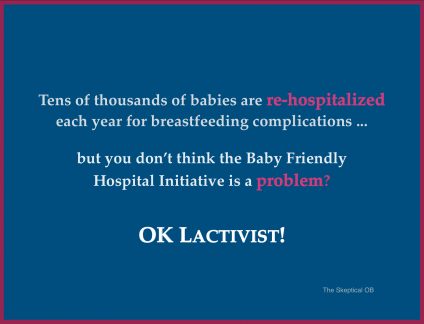
They’re not boomers; they’re lactivists.

[perfectpullquote align=”right” bordertop=”false” cite=”” link=”” color=”” class=”” size=””]Think deleting and banning your critics is a winning strategy? OK Lactivist![/perfectpullquote]

Tens of thousands of infants are re-hospitalized each year for breastfeeding complications. Shockingly, exclusive breastfeeding has become the leading risk factor for newborn hospital readmission.

A new movement, the Fed Is Best movement, encompassing hundreds of thousands of women has come to prominence for trying to protect babies from dehydration, hyperbilirubinemia, hypoglycemia and other complications of insufficient breastmilk.

How has the breastfeeding profession responded?

Amy Brown has written:

…[T]he phrase ‘fed is best’ is nonsensical. At NO point has anyone ever suggested that if a baby can’t be breastfed then they should starve… Fed is therefore not best, because best implies that there are other acceptable alternatives.

OK lactivist!

Marsha Walker wrote:

Social media has been alight with descriptions of exclusive breastfeeding being dangerous, resulting in significant and severe negative outcomes in infants whose mothers wished to breastfeed. This backlash has been led by a campaign that uses inflammatory anecdotes and misleading and inaccurate interpretation of research to bolster its assault on breastfeeding …

OK Lactivist!

Lucy Ruddle wrote:

So, that study being shared by certain places who like to scaremonger… the “1 in 71 breastfed newborns are readmitted” one… I got hold of it, mainly because I was interested in the limitations, which SOB and FIB have a habit of ignoring.

But Ruddle read the wrong paper, misunderstood what she read and it actually showed an even higher rate of readmission. When confronted with her multiple mistakes, Ruddle deleted the post without correcting her errors and without apologizing for them.

Okay Lactivist!

Serena Meyer wrote:

Have you heard about Fed is Best? It’s an organization that believes that the Baby Friendly Initiative is responsible for pushing breastfeeding in a way that essentially starves babies. There is a lot of carefully cloaked vitriol about breastfeeding and brain damage, starvation and death. It makes me feel pretty argumentative; not about the fact that babies can lose more than we would like, but at the goals of the organization as I perceive them.

When faced with hundreds of comments from women whose babies were starved by aggressive breastfeeding promotion, Meyer deleted them … all of them.

When invited by the Fed Is Best Foundation to respond to their careful recitation and debunking of Meyer’s lies, she responded:

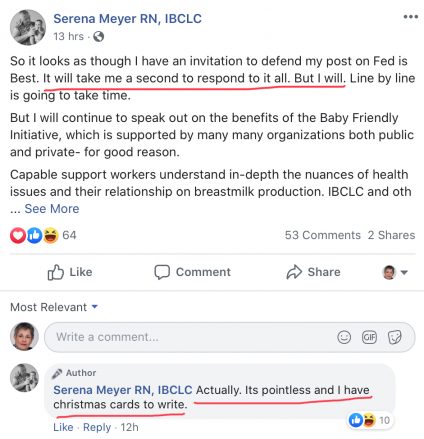
So it looks as though I have an invitation to defend my post on Fed is Best. It will take me a second to respond to it all. But I will. Line by line is going to take time…

26C16ACA-C6BC-4E4F-93B7-CB602A151098

But within an hour she was back-pedaling:

Actually. Its pointless and I have christmas cards to write.

OK Lactivist!

You think you can ignore the problems you cause, but you’re wrong.

You refuse to recognize the younger generation you harm and therefore you are undermining the very programs you seek to support

You imagine that because you hold the power at the moment, you don’t have to care about the anguished mothers whose babies have been hospitalized, injured and, in some cases, rendered permanently impaired or even dead.

You’ve made it impossible to have a reasoned discussion because you delete comments, ban those who try to correct your falsehoods and refuse to engage with your critics.

Think that’s a winning strategy?

OK Lactivist!

Why does LC Serena Meyer think she speaks FOR women with breastfeeding complications without speaking TO them?

Two women whispering about a third woman

Yesterday I wrote about why you can’t trust lactation consultants to understand scientific literature.

I used a post in which an IBCLC insisted the fact that 1 in 71 exclusively breastfed babies are re-hospitalized for complications is not supported by the scientific evidence. I’ve repeatedly cited the claim and the paper that it comes from. The LC read the wrong paper; misunderstood what she read; and the paper she referenced actually has a HIGHER readmission rate.

[perfectpullquote align=”right” bordertop=”false” cite=”” link=”” color=”” class=”” size=””]Fed Is Best threatens lactation consultants’ income, employment prospects and autonomy. No wonder they’re opposed.[/perfectpullquote]

The LC has now “disappeared” her post without acknowledging she was wrong in nearly every respect. So not only can she not be trusted to read the scientific literature; she can’t be trusted to admit when she is wrong and apologize.

Today I offer an example of why lactation consultants cannot be trusted to be honest about the Fed Is Best Foundation.

Serena Mayer, RN IBCLC wrote:

Have you heard about Fed is Best? It’s an organization that believes that the Baby Friendly Initiative is responsible for pushing breastfeeding in a way that essentially starves babies. There is a lot of carefully cloaked vitriol about breastfeeding and brain damage, starvation and death. It makes me feel pretty argumentative; not about the fact that babies can lose more than we would like, but at the goals of the organization as I perceive them.

The name is a real teeth clencher for me and other International Board Certified Lactation Consultants. “Fed is Best”, is a highly charged three words that no one really wants to disagree with. The rhetoric flows untapped within their organization and it appears that they drop all the hot words on parents; words like “starvation” and “dead” are used a lot in their materials.

If you don’t understand what’s wrong with that, try this thought experiement. Imagine if we replaced Fed Is Best with MeToo:

Have you heard about #MeToo? It’s an movement that believes that some men harm women, there is a lot vitriol about touching, misogyny & discrimination. It makes me feel pretty argumentative.

The name is a real teeth clencher for me and other men’s rights activists. #MeToo is a highly charged two words that no one really wants to disagree with. The rhetoric flows untapped within their movement and it appears that they drop all the hot words on women; words like “harassment” and “assault” are used a lot in their materials…

Can you see the disrespect of women? The refusal to believe their stories? The implication that lactation consultants know better than the women whose babies suffered under lactation consultants’ ministrations?

Meyer continues with a reprehensible stream of lies and fabrications.

It’s a classic example of testimonial silencing. Lactation professionals routinely treat women with breastfeeding complications exactly the same way many men treat women who report sexual harassment: they aren’t believed; they are pathologized and they are viewed as trouble makers.

Tactics include: erasure from breastfeeding literature, gaslighting, pathologizing, claiming “lack of support,” disparaging women’s stories and banning from social media feeds.

I pointed this out in the comments but Meyer didn’t respond.

I posted a comment asking: What’s the difference between a doctor who tells a woman her experience is meaningless compared to his training and a lactation consultant who tells a woman her experience is meaningless compared to her training?

Meyer responded by claiming that she was trying to have a “serious” conversation about Fed Is Best.

Taking her at her word I asked her to provide quotations for claims that the Foundation offers “dangerous, anti-breastfeeding rhetoric.” She wouldn’t (or more likely couldn’t) provide any.

I asked: “how many of the Foundation’s 750,000 followers have you spoken to about their experiences? Zero?”

Meyer responded with: “Did you read my post?”

And: “Anyways, thanks for the traffic.”

In other words, she spoke to ZERO women who were helped to breastfeed by the Foundation and ZERO women who were supported in whatever choices they chose to make. Why confuse yourself with the facts, right Serena?

And this is why you can’t trust lactation professionals when they criticize Fed Is Best. They imagine they can speak FOR women who suffer breastfeeding complications without ever speaking TO them.

Mayer does offer this:

I can see the appeal of fed is best.

But I can’t support their political aims and the policies they wish to have in place in hospitals…

I’m not sure what she means by the “appeal” of fed is best. The fact that it’s true? The fact that it provides comfort to millions of women? The fact that it fights against the massive numbers of breastfeeding complications and re-hospitalizations that occur each year?

In contrast, I completely understand what Meyer means by being unable to support the aims and policies of the Foundation. Those aims and policies threaten lactation consultants’ income, employment prospects and autonomy. Those apparently matter more to lactation consultants like Serena Meyer than either babies’ health or mothers’ anguish.

Which leads us to a simple rule of thumb: don’t trust any lactation consultant who claims to speak FOR women who suffer breastfeeding complications without ever bothering to speak TO them.


Addendum: In the wake of this piece, Meyer has edited her original post and DELETED more than 200 comments that pointed out her lies and misrepresentations. This further confirms that you can’t trust lactation professionals to tell the truth.

Dr. Amy