Hannah Dahlen shows how to lie with statistics

Benjamin Disraeli famously said, “There are three kinds of lies: lies, damned lies and statistics.”

Midwife Hannah Dahlen, in her ongoing efforts to blacken the reputation of obstetricians, corroborates Disraeli’s claim. Her latest paper, Rates of obstetric intervention among low-risk women giving birth in private and public hospitals in NSW: a population-based descriptive study, published in the current issue of the British Medical Journal Open edition has, is a master class in lying with statistics.

The primary conclusion of the paper is:

Over the past decade these interventions have increased by 5% for women in public hospitals and by over 10% for women in private hospitals. Among low-risk primiparous women giving
birth in private hospitals 15 per 100 women had a vaginal birth with no obstetric intervention compared to 35 per 100 women giving birth in a public hospital.

The part of the study that is generating media attention is:

TENS of thousands of Australian women with low risk of birth complications are undergoing unnecessary medical interventions in private hospitals in a trend that a leading midwifery expert has described as ”horrifying”.

Indeed, the authors of the paper state:

The continual rise in obstetric intervention for low-risk women in Australia is concerning in terms of morbidity for women and cost to the public purse. The fact that these procedures which were initially life-saving are now so commonplace and do not appear to be associated with improved perinatal death rates demands close review.

There is just one teensy, weensy problem with the paper:

The authors never looked at the perinatal death rate in the population that they studied so they literally have no idea of the impact of the interventions they decry. They performed a bait and switch; they looked at intervention rates in a low risk population and compared them to mortality rates in the overall population including high risk women, prematurity and all complications of pregnancy.

Let’s look at the population they studied, women from the Australian state of New South Wales:

The ‘standard primipara’ is defined as a primiparous woman aged 20–34 years, who had no pre-existing or pregnancy-related medical conditions, gave birth at 37–41 weeks gestation to a fetus in a cephalic presentation within the 10th and 90th centiles for birth weight. The ‘standard multipara’ was a multiparous woman aged 20–34 years, who had no pre-existing or pregnancy related medical conditions, gave birth at 37–41 weeks gestation of a fetus in a cephalic presentation within the 10th and 90th centiles for birth weight. In both definitions we included ‘non smoking’.

That yielded a study population of 124,431 women:

… 30 152 low-risk primiparous women who gave birth in a private hospital and the 94 279 low-risk primiparous women who gave birth in a public hospital.

But when it came time to compare the intervention rates to the mortality rate, the authors used the perinatal mortality rate from 691,738 births during the period 2000–2008. In other words, the perinatal death rate includes 567,307 women that aren’t in the study. In other words 82% of the mothers from whom the mortality rates are derived AREN’T in the study. Those are the women with high risk conditions, prematurity and pregnancy complications, and, of course, most of the perinatal deaths occur in that group.

Even then, the authors play fast and loose with the truth:

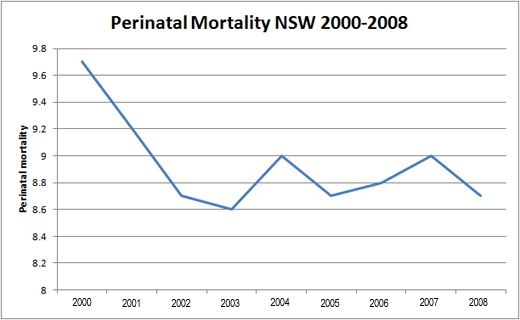
The NSW rate of perinatal mortality was between 8.6 and 9.6 per 1000 births between 2000 and 2005 and between 8.7 and 9 per 1000 births between 2005 and 2009.

That’s a rather curious way to describe a trend over time, but it sounds a lot better for Dahlen’s purposes than an accurate report of the information: from 2000-2008, overall perinatal mortality in New South Wales dropped from 9.7/1000 to 8.7/1000, a drop of 10%.
How did the reviewers let this bait and switch go by. BMJ Open provides the names and comments of the reviewers. The  reviewers for this paper are two midwifery professors Meredith McIntyre,  who researches “midwifery care reform” and Maralyn Foureur, a colleague of one of the authors on another publication, who researches “ways to keep birth normal.” In other words, to professional colleagues of the authors known to be in agreement with their views about interventions. There was no review by an obstetrician or a statistician.

One of the reviewers does note that in the original manuscript, the authors attempted to use perinatal mortality rates from Australia as a whole:

The national rate of perinatal mortality rather than the NSW state rate is used in the Discussion. It is more appropriate to use the NSW rate in order to better support your argument that the increase in interventions for private women does not result in improved benefits for babies…

She’s only half right. It is indeed inappropriate to use the national perinatal mortality rate, but it is also inappropriate to use the NSW rate of perinatal mortality. The correct comparison would require the use of the perinatal mortality rates in the group of low risk women under study.

The BMJ ought to re-evaluate the way that it reviews papers. Professional colleagues allies of the authors should not be used as reviewers, claims about obstetric interventions should be reviewed by obstetricians, and statistics claims should be reviewed by statisticians.

The bottom line is that this study tells us only the trend of intervention use among low risk women in NSW from 2000-2008 and the difference in intervention rates between low risk women in private and public hospitals. That’s all it can tell us. There is no information presented that would allow us to draw conclusions about whether the interventions were used appropriately or whether they led to a decrease in perinatal mortality.

In contrast to Ms. Dahlen’s claims, what is “horrifying” here is not the increase in interventions, but the bait and switch used  in the attempt to advance the midwifery objective of blackening the reputation of modern obstetrics.

She’s dead. Did she have an episiotomy?

Today’s post on Science and Sensibility is an object lesson in everything that is wrong with contemporary natural childbirth advocacy.

The post is entitled The Importance of Understanding and Reversing Disparities in Maternal Health Outcomes, and it proports to be a good faith examination of the high maternal mortality rate among women of color in the US.

How does it illustrate what is wrong with contemporary natural childbirth advocacy? Let me count the ways.

1. It is a cynical exploitation of the issue of maternal mortality.

Following the lead of NCB Cynicist-in-Chief Ina May Gaskin, it raises the issue, not out of genuine concern for women of color, but merely to portray modern obstetrics as a system “in crisis.” Ina May Shows how its done:

Cynically ignore the real crisis in the care of women around the world who die for lack of access to modern obstetric care, and pretend that the “crisis” is that there aren’t more midwives to care for well white women in first world countries. Cynically ignore the fact that the leading causes of maternal mortality in the US are complications of pregnancy and pre-existing medical conditions like heart disease and kidney disease. Midwives can have no impact on these deaths because they don’t care for these patients.

Ina May represents herself as shocked at the current rate of maternal mortality, going so far as to create (and publicize) a memorial quilt. Yet as far as far as I can tell, Gaskin has done NOTHING (no research, no education, no fund raising) to reduce the incidence of maternal mortality. In contrast, modern obstetrics has lowered the maternal mortality rate 99% PERCENT in the past century.

2. Lying by omission is a favorite tactic of NCB advocates. Even so, the disingenuousness of these piece is astounding. Watch how it works in practice.

Write:

The CDC paper compares women of different races, ethnicities and nativity (US or foreign-born) from 1993-2006. They found that for all women, “the pregnancy-related mortality ratio (PRMR) increased significantly (P

But don’t mention:

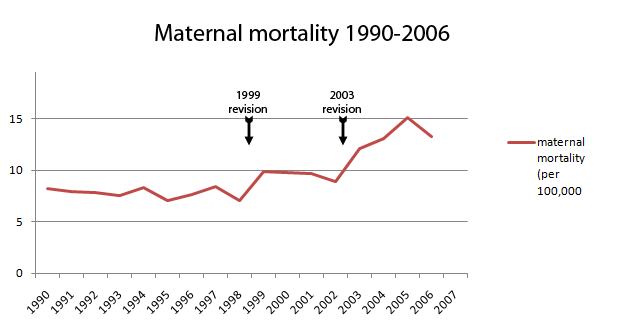
In 1999 and again in 2003, the US Standard Certificate of Death was revised to ask explicitly whether any female death was associated with pregnancy, instead of relying on the person filling out the form to voluntarily provide that information and the definition of maternal death was expanded.

The results of these changes are captured by the following graph.

Write:

African American women have a three to four-fold greater chance of dying as a result of pregnancy than women in any other racial-ethnic group.

But don’t mention:

The disparity between women of African descent and women of other races occurs in all first world countries, among all practitioners including midwives.

Write:

… [E]xperts today commonly state that reasons for this disparity are “not fully understood,” and “limited data exist” to explain why they continue to occur.

But don’t mention:

The lack of understanding is not from lack of trying to understand. This is one of the most intensive areas of public health and obstetric research.

3. Play the one note samba.

Like a piece of music with only one note, natural childbirth advocates have only one response to every situation: question the use of “interventions.”

At this point, it’s like a Monty Python sketch:

Man: “My wife died in childbirth.”
NCB Advocate: “Did she have an episiotomy”

Man: “She died of cardiac complications?”
NCB Advocate: “How unfortunate. Did she have an episiotomy?”

Man: “She had a history of congenital heart disease that led ultimately to her death.”
NCB Advocate: “Bummer. Did she have an episiotomy?”

The authors of the Science and Sensibility piece does not bother to mention that the contemporary causes of maternal mortality are changing. At this point, maternal cardiac disease is one of the leading causes of maternal death. Cardiac disease includes peripartum cardiomyopathy, and underlying cardiac conditions, particularly congenital cardiac anomalies. These women die because of lack of access to advanced medical technology, not because of medical technology.

Yet NCB advocates are still banging away on the same note:

… [P]ublic health paradigms have more often focused on antecedents to care (access to contraception and prenatal care) and outcomes (mostly newborn and infant health) with less attention to the processes of care or interventions during the birth itself.

Those interventions being:

… five major interventions used in the birth process: induction, electronic fetal monitoring, epidurals, episiotomy, and cesarean section.

Is there any scientific evidence that these interventions have any impact on maternal mortality? The author references a book chapter Contemporary Childbirth in the United States: Interventions and Disparities. I just read that chapter. In 43 dense pages of texts and charts, its authors provide NO evidence that the use of interventions in childbirth is related to maternal mortality in any way.  No evidence, none, zip, zero, nada.

No problem. That was never the point of the post. The point of the post was to suggest a maternity system “in crisis,” to deliberately misrepresent the problem, and to provide yet another opportunity to bang away at the one note samba. Mission accomplished!

When faced with a high rate of maternal mortality among African Americans, the question that NCB advocates want to know is: did she have an episiotomy? If asking that question in the face of horrible tragedy is not cynical, I don’t know what is.

Mother bleeds to death at homebirth, but at least she had a “really lovely spontaneous birth”

No mother should ever die at homebirth.

Maternal deaths in the hospital are unusual; perinatal deaths are 100 times more common. There are so few maternal deaths in the developed world that they are measured per 100,000 and most of the women who die have serious medical complications like cardiac disease or pre-existing medical conditions. Death from a routine childbirth complication like bleeding is almost unheard of in an age of blood transfusions and surgical repair.

That’s why it’s horrifying to consider the latest report of a maternal death at homebirth. This marks the 4th publicly reported maternal death at homebirth in the past 4 years. All 4 women were in excellent health prior to childbirth and at least 3 (possibly 4) out of 4 simply bled to death.

Joanne Whale bled to death in 2008 as a result of a uterine eversion. Her midwife did not even know how to start an IV.

Sara Hedgepeth Osceola, mother of 6 small children, bled to death while attempting a VBAC at home.

Caroline Lovell, a homebirth activist, died shortly after she gave birth to her daughter.

Now comes word that Claire Teague bled to death due to retained placenta while the midwife went home.

According to the Mail Online:

A mother died within hours of giving birth at home after a private midwife committed a horrifying catalogue of errors, an inquest heard.

Claire Teague, 29, was left bleeding in bed after Rosie Kacary allegedly pulled out her placenta following the delivery.

The midwife is also accused of failing to realise a large section of the placenta had not come out and not stitching a tear.

In addition:

Mrs Teague complained to her husband, Simon, about feeling weak and in pain after the birth but Kacary left and only returned after ‘repeated contact’.

When she came back to the couple’s home in Woodley, near Reading, Berkshire, she discovered Mrs Teague had stopped breathing.

Instead of performing CPR on a firm area such as the floor, Kacary is said to have done it on the bed, where it was less effective…

The midwife left at 10am. Mr Teague claimed that when she eventually returned and attempted to resuscitate his wife, she ‘didn’t seem to know what she was doing’.

The inquest heard from a paramedic who described the ambulance that took Mrs Teague to the Royal Berkshire Hospital as ‘swimming in blood’.

Doctors established around a third of the placenta – measuring 8in by 3in – had not been delivered.

Kacary believes that she did nothing wrong and (the classic excuse of the homebirth midwife)  the patient would not have accepted advice to transfer.

She believed the placenta had been complete and said, if she thought otherwise, she would have advised an immediate hospital transfer.

But she said: “As Claire felt completely well at the time, I’m very sure they would have declined my suggestion to transfer.”

Why did Claire Teague die?

A post mortem found that Mrs Teague died due to a lack of oxygen caused by the severe haemorrhage due to a recent vaginal birth with a retained placenta.

But, according to Kacary, at least she had a great birth!

“Claire had a great pregnancy, she had a really lovely spontaneous birth at home and I hope Simon in time will remember that.”

Because when it is all said and done, for a homebirth midwife, it’s all about the process, and death is a small price to pay for a great birth experience.

The real difference between natural childbirth advocates and obstetricians

If you want to understand the gulf that separates natural childbirth advocates from obstetricians, check out the latest midwifery and obstetric journals. No, none of this month’s issues have a paper about the difference. Rather, it is the type of papers in each that illustrate the difference.

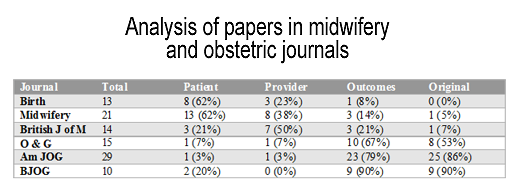
Let’s start with the natural childbirth journal Birth, published by Lamaze International. There are 13 articles and reviews in the September issue: 8 are about the patient experience of childbirth, 3 are concerned with the provider experience and beliefs, only 1 is focused on safety outcomes for babies or mothers, and none contribute original knowledge.

Contrast that with the September issue of Obstetrics and Gynecology. There are 15 obstetrics articles: of these, 1 is about the patient experience, 1 is potentially concerned with provider experience and beliefs, 10 are focused on safety outcomes for babies and mothers, and 8 contribute original knowledge (each article can be counted in more than one category).

In other words, the vast majority of articles in Birth focuses on patient or provider experience, only 1 paper focused on actual outcomes for mother and or baby and there was no research that contributed to the body of scientific evidence about obstetric practice. In Obstetrics and Gynecology, the proportions were reversed. The majority of articles focused on safety outcomes for mothers and or babies and more than half contribute original knowledge to the body of scientific evidence about obstetric practice. Only 1 article focuses on patient experience, and one potentially focuses on provider experience.

These findings extend to other midwifery and obstetric journals. Below is a table with the results of an informal analysis of the latest issues of the 3 most prominent midwifery journals and the 3 most prominent obstetric journals. (In addition to Birth and Obstetrics & Gynecology, they include Midwifery, the British Journal of Midwifery, the American Journal of Obstetrics and Gynecology, and the British Journal of Obstetrics and Gynecology.

Of note, the proportions do not add up to 100% because an article can be counted in more than one category (eg. safety outcomes and original knowledge).

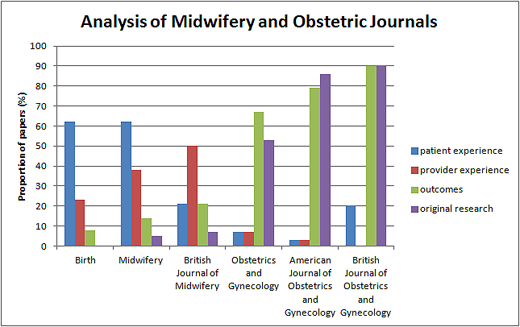
A bar graph of the same data expresses the difference even more dramatically.

What is striking to me is how little midwifery research is concerned with safe outcomes. All of the midwifery journals devote a proportion of 20% or smaller to safe outcomes. Presumably that is not because midwives and natural childbirth advocates don’t care about childbirth culminating in a healthy mother and healthy baby. I suspect that the reason for the bizarre lack of interest in safe outcomes is two fold. First, midwives and natural childbirth advocates see no reason to even think about women who are high risk. If they are outside the scope of practice, these women are simply ignored. Second, midwives and natural childbirth advocates appear to assume that low risk women will nearly always have safe outcomes. That, of course, is a serious problem, since childbirth is inherently dangerous, even for women who are low risk. Midwives and natural childbirth advocates can pretend that the dangers don’t exist because they have been virtually eliminated by the interventions of modern obstetrics, the very interventions that they deplore.

Simply put, the real difference between natural childbirth advocates and obstetricians is that natural childbirth advocates live in a fantasy world of their own construction. In that fantasy world, childbirth is always safe, so there is no reason to ever worry about safety. Hence midwifery journals are filled with articles obsessing about whether women had IVs or midwives enjoyed themselves at their patients’ births. Obstetricians, in contrast, live in the real world, where low risk women can and do routinely have life threatening complications. Their priority is safe childbirth: healthy babies and healthy mothers.

New website, Evidence Based Birth, suffers from a shocking lack of evidence.

There has always been something Orwellian about natural childbirth, from it inception in a monstrous racist lie (primitive women don’t have pain in childbirth) to its insistence on euphemism (rushes = contractions, vocalizing = screaming). Natural childbirth employs a form of “Newspeak,” author George Orwell’s term for language designed to prevent the thinking of prohibited thoughts. According to Wikipedia:

… Newspeak is closely based on English but has a greatly reduced and simplified vocabulary and grammar. The totalitarian aim of the Party is to prevent any alternative thinking — “thoughtcrime”, or “crimethink” in the newest edition of Newspeak – by destroying any vocabulary that expresses such concepts as freedom, free enquiry, individualism, resistance to the authority of the state and so on…

Moreover:

The aim of Newspeak is to remove all shades of meaning from language, leaving simple concepts (pleasure and pain, happiness and sadness, goodthink and crimethink) that reinforce the total dominance of the State. Newspeak root words serve as both nouns and verbs, further reducing the total number of words; for example, “think” is both noun and verb, so the word thought is not required and can be abolished…

Hence “gave birth” becomes “birthed.”

Natural childbirth advocates love mantras. They are a Newspeak way of claiming something without ever having to prove it. One of the most favored, and over used mantras is that obstetricians don’t practice evidence based medicine. Indeed, when natural childbirth advocates invoke the phrase “evidence based,” it is almost always a short hand way to criticize modern obstetrics. I was interested, therefore, to check out a new natural childbirth website called Evidence Based Birth. I wasn’t disappointed; it is profoundly Orwellian in many ways, particularly in its use of Newspeak and its shocking lack of scientific evidence.

I have already criticized the author, Rebecca Dekker, for her deliberately misleading guest post for Science and Sensibility in which she poses one question and deliberately and misleadingly answers another.

Now let’s look at the latest post on her own blog. Entitled Labor Day 2012: The State of Evidence-Based Maternity Care in the United States, it is remarkable for the fact that it doesn’t contain even a single piece of evidence, not one, to support its central claim that obstetrics in 2012 is not based on scientific evidence. Even Orwell would be impressed by that.

Who is the author of the website and what are her qualifications for writing about scientific evidence in modern obstetrics? Once again Orwell would be proud. Rebecca L. Dekker, PhD, RN, APRN, is an assistant professor of nursing at the University of Kentucky:

… holds a Master of Science in Nursing and Doctor of Philosophy in Nursing from the University of Kentucky. Her research focuses on improving the health outcomes of patients with heart failure who are experiencing symptoms of depression. She has served as the primary investigator on six studies examining the link between depression and heart failure outcomes. She recently completed a randomized, controlled study testing a brief cognitive therapy intervention for depressive symptoms in hospitalized patients with heart failure…

In other words, she has precisely zero training and experience in modern obstetrics, midwifery or even obstetric nursing. Like most self-proclaimed “birth professionals,” birth is her hobby. Perhaps that explains why she can’t find even a single piece of evidence to back her central claim.

As I have written in the past about the extraordinary claim that modern obstetrics is not based on scientific evidence:

We are supposed to believe that obstetricians (with 8 years of higher education, extensive study of science and statistics, and four additional years of hands on experience caring for pregnant women), the people who actually DO the research that represents the corpus of scientific evidence, are ignoring their own findings while NCB advocates (generally high school graduates with no background in college science or statistics, let alone advanced study of these subjects, and limited experience of caring for pregnant women), the people who NEVER do scientific research, are assiduously scouring the scientific literature, reading the main obstetric journals each month, and changing their practice based on the latest scientific evidence.

Extraordinary claims require extraordinary evidence. To my mind, that should include, at a minimum, 10 solid examples of current obstetric recommendations, central to the practice of obstetrics, that ignore current scientific evidence.

Let see what Dekker offers in her post.

1. A definition of evidence based medicine: so far so good.

2. Praise for the Cochrane Reviews: Dekker immediately goes right off the rails. She apparently doesn’t realize that the Cochrane Childbirth Reviews are riddled with statistical errors. She apparently doesn’t realize that the Cochrane reviews are all systematic reviews, a form of scientific evidence particularly subject to bias

  • There are numerous ways in which bias can be introduced in reviews and meta-analyses of controlled clinical trials.
  • If the methodological quality of trials is inadequate then the findings of reviews of this material may also be compromised.
  • Publication bias can distort findings because trials with statistically significant results are more likely to get published, and more likely to be published without delay, than trials without significant results…
  • Criteria for inclusion of studies into a review may be influenced by knowledge of the results of the set of potential studies…

These limitations can be summarized by the pithy phrase “garbage in, garbage out.” A meta-analysis or systematic review is only as good as the quality of the papers reviewed.

3. How does contemporary obstetric care compare to evidence based care? Answering that question would involve presenting the actual scientific evidence for various obstetric practices. Dekker doesn’t bother. Instead she provides a bunch of irrelevant crap and expects her gullible readers to be impressed.

  • She is sure that there are too many C-sections but provides no evidence of an optimal number.
  • She is sure that there are not enough VBACs but references a government goal, not the scientific evidence.
  • She is sure that there are too many inductions, but she provides no evidence of an optimal number and throws in the irrelevant claim that Cytotec is being used off label.

Most of the remainder of her examples concern atmospherics that are the subject of hospital policy, not obstetric practice. Where is the discussion of the major issues of contemporary practice? Where is the discussion of preventing hypoxic ischemic encephalophathy? Missing. Where is the discussion of preventing preterm birth? Missing. Where is the discussion of management of postdates? Missing. Where is the discussion of treating obstetric complications like hemorrhage? Missing. Instead we have the substitution of NCB tropes like whether or not women should get out of bed during labor.

4. Having provided no evidence for any of her assertions, having ignored most of the major issues in contemporary obstetrics, and having proved nothing, Dekker concludes in a flourish of Newspeak:

… the vast majority of U.S. women are not receiving evidence-based care during childbirth.

We may not be able to draw a conclusion about modern obstetric practice from Dekker’s drivel, but we can draw a conclusion about her website. The website Evidence Based Birth, yet another natural childbirth website put together by a hobbyist with precisely zero experience in obstetrics or midwifery, is just a collection of typical NCB Newspeak. It has nothing to do with evidence, and everything to do with the classic aim of Newspeak: to enforce ideological conformity, the truth be damned.

Homebirth will never be cost effective

Earlier this year I criticized a paper that claimed that the Birthplace study showed that homebirth is cost effective.

… the study CAN’T tell us about cost effectiveness since it does not take into account the largest costs, the costs of caring for a child injured during birth and the massive costs associated with legal settlements for babies who were injured or died.

There is another issue that I did not address in that post: even leaving aside long term costs of injuries and brain damage, homebirth can never be cost effective. To understand why, it helps to consider a simple example, such as making a pair of pants.

Which pair of pants costs more:

1. The pair of pants fabricated by Joe, using machinery costing tens of thousands of dollars?

2. The pair of pants sewn by Jane using her $800 sewing machine?

At first glance, it seems that the pair of pants created with the inexpensive machine surely costs less to produce, and that would be the case if Joe used his machinery to produce only a single pair of pants. However, Joe uses his machinery to produce 1,000 pairs of pants a day, 5 days a week, 50 weeks a year. Not only that, Joe obtains his fabric on industrial sized bolts at wholesale prices, while Jane has to pay retail price for a small quantity at her local fabric store. Similarly, Joe buys other supplies, like thread, needles and zippers in bulk, leading to lower prices per unit of each item than what Jane must pay.

When the cost of the expensive initial investment is spread over the hundreds of thousands of pairs of pants that Joe produces each year, the actual cost of a pair produced by Joe is far, far less than the cost of a pair produced by Jane. This principle is known as “economies of scale.” As Wikipedia explains:

… There are factors that cause a producer’s average cost per unit to fall as the scale of output is increased. “Economies of scale” is a long run concept and refers to reductions in unit cost as the size of a facility and the usage levels of other inputs increase.

… The common sources of economies of scale are purchasing (bulk buying of materials through long-term contracts), managerial (increasing the specialization of managers), financial (obtaining lower-interest charges when borrowing from banks and having access to a greater range of financial instruments), marketing (spreading the cost of advertising over a greater range of output in media markets), and technological (taking advantage of returns to scale in the production function). Each of these factors reduces the long run average costs (LRAC) of production …

The same economic rules apply to providing obstetric care. At first glance, it appears to cost less for Jane to have a homebirth, than for Joanna to give birth in the hospital. However, when governments are considering the cost of obstetric care, they aren’t looking at individual cases; they’re looking at providing obstetric care for an entire population. It is far more cost effective to provide obstetric care at a centralized facility where a variety of providers can care for many patients at the same time than it is to provide care in a private home where each midwife can care for only one patient at a time.

Many countries, like the UK, have moved to centralize care in regional hospital facilities instead of multiple community hospitals. In a regional facility, 10 midwives can care for 60 patients or more at the same time, since they are in different stages of labor and will not all deliver at the same time. In contrast, 10 homebirth midwives can care for 10 patients in the same amount of time. So while the cost of an individual homebirth attended by a midwife might appear smaller, long run average costs are much, much higher.

Homebirth advocates are looking at the wrong metric, the cost of an individual birth, when declaring that homebirth costs less than hospital birth. The correct metric is the cost of providing obstetric care to the entire population in a given time period. By that measure homebirth is woefully cost ineffective. In countries like the UK, where there is a shortage of midwives, homebirth is probably the least cost effective option of all.

Science and Sensibility seeking new ways to mislead

Imagine if someone wrote an article entitled, What is the Evidence for Treating Chest Pain in Healthy Men? and claimed:

There is no evidence that hospitalization for chest pain in men improves outcome.

Makes it sound like there is no reason for a man to worry if he has chest pain, no reason to call 911, no reason to take an aspirin, no reason to do anything, doesn’t it?

That’s what most people would take away from the article, even if they read the caveat.

There is no evidence that hospitalization for isolated chest pain in otherwise healthy men has any beneficial impact. Based on the lack of evidence, any recommendation for hospitalization for chest pain with no other symptoms, no underlying risk factors, no complicating conditions, and normal test results is a weak recommendation based on clinical opinion alone.

Okay, now it’s clear. The article is actually talking specifically about chest pain that has already been determined to be unrelated to any cardiac issues. Well, duh! No one ever claimed that every episode of chest pain was a heart attack, but that doesn’t mean that chest pain should be ignored.

In other words, the article itself would be considered deeply misleading, suggesting as it does that there is no reason to pay attention to chest pain.

Rebecca L. Dekker, PhD, RN, APRN has written an equivalently misleading article for Science and Sensibility, entitled What is the Evidence for Induction for Low Amniotic Fluid in a Healthy Pregnancy?

She claims to be answering the following question:

Low fluid seems to be the new “big baby” for pushing for induction. What does the research say about low fluid at or near term? From what I’ve been able to see in research summaries at least, there appears to be no improved outcome for babies, but I’d love to see the research really hashed out…

Decker writes:

There is no evidence that inducing labor for isolated oligohydramnios at term has any beneficial impact on mother or infant outcomes.

But that’s not what the questioner asked. She asked about oligohydramnios, not about isolated oligohydramnios. Decker does not even bother to answer the actual question since that would require acknowledging that there is plenty of scientific evidence that oligohydramnios can lead to perinatal death and poor outcomes. Instead, she decides to address a subset of cases of oligohydramnios while never making it clear that this is what she is doing.

There’s a big difference between oligohydramnios and isolated oligohydramnios. In this context, isolated means oligohydramnios in women who have NO other abnormalities, NO underlying risk factors, NO complicating conditions AND normal test results. No one ever claimed that every case of oligohydramnios is a sign of impending disaster, but that doesn’t mean that oligohydramnios should be ignored. To the contrary, it should be investigated vigorously.

As Zhang et al. point out in an paper on isolated oligohydramnios:

It is well established that oligohydramnios is associated with a high risk of adverse perinatal outcomes. On the other hand, oligohydramnios is a poor predictor for adverse outcomes.11,12 An explanation for these seemingly conflicting observations lies in the fact that not all oligohydramnios are the same. Our study shows that oligohydramnios with unfavourable maternal and/or fetal conditions (such as IUGR, anomalies or hypertension) leads to a much worse perinatal outcome than a normal amniotic fluid volume with the same conditions. In these cases, oligohydramnios may be an indicator of a more severe impaired placental function, fetal compromise and worse maternal/fetal conditions. However, we found in the current study that about half of the oligohydramnios cases did not have any coexisting medical or obstetric conditions. Fetuses in these cases tend to be appropriately sized at the diagnosis of isolated oligohydramnios. More importantly, with advancing gestation, their growth does not seem to be impaired… (my emphasis)

Dekker employs the classic NCB technique for deliberately misleading women: the bait and switch. She poses one question (what does research say about oligohydramnios), but answers another, different question (what does research say about isolated oligohydramnios, a subset of all cases of oligohydramnios).

Oligohydramnios is a symptom. As such, it requires investigation to determine whether there are other abnormalities such as fetal growth restriction, maternal hypertension, etc. If any additional symptoms or complicating conditions are found, induction is often the appropriate treatment to reduce the risk of perinatal death. Only IF the search for other symptoms and complicating conditions has revealed NOTHING ELSE can we conclude that there is no need for induction.

Dekker should be ashamed of herself for writing such a deliberately misleading article and Science and Sensibility should be embarrassed to publish it. But I suspect neither will be moved, since it appears that deliberately misleading women is a central element of natural childbirth advocacy. When there is no scientific evidence to support your position, the only way to convince women is the bait and switch.

Ever more homebirth deaths

Death at homebirth is becoming such a common phenomenon that I now have to write about homebirth deaths and disasters in groups. Here’s are the deaths and disasters I’ve learned about in the last week. They have a common theme: the insistence that everything is “normal” when it is not.

#1 When Intuition Fails (postpartum death):

Later that evening [of the day of birth], when he was nursing, I noticed that he was a little blue. I called to my husband and told him I wasn’t sure he was breathing. He whisked him up and tried to get him to wake up. I had enough time to get the midwife, and then 911, on the phone before he got him awake. He seemed okay, so we canceled the ambulance. Then Miriam told us that sometimes big babies get hypoglycemic after birth and pass out so to try and make sure he eats frequently. Well, he didn’t. After that first latch on, he showed no interest in nursing. We actually broke out the free case of formula that we’d been mocking when it arrived.

… The next morning, Miriam came over to check him and said that he seemed fine. But I couldn’t shake the feeling that he was working too hard to breathe. I’ve had asthma since I was 13, and I know what it’s like to have to use all your energy just to breathe. She said if I was still worried I should have him checked by his pediatrician. Only it was Sunday; the pediatrician’s office was closed, and the emergency number for the pediatrician was a cell phone that was out of range.

I called my cousin Jeanine, who is a lactation consultant, and asked for some advice. She gave me some tips that resulted in success later that evening. He nursed beautifully for about a half hour, one of the most beautiful interludes of my life, and I’ll always treasure it. The love in his eyes as he stared into mine was palpable. I could feel it melting the anxiety I’d been carrying for weeks. I thought he must be getting better, but I had resolved to take him into the doctor in the morning anyway.

Later that night, I got worried again and woke up my husband, and the two of us were watching him when he stopped breathing. It was obvious this time. My husband did CPR and I called 911. Police came quickly and took him down to the ambulance. We waited in the police car barefoot and in night-clothes as they worked on him. Finally, they drove us to the hospital and stashed us in the waiting room.

The baby died. The cause was overwhelming infection.

#2 Homebirth disaster, long term effects not yet known:

I trusted birth, my body, and my baby. However, when I was 40 wks along, my blood pressure rose. The consulting doctor wanted me to go to the hospital to be induced, but the MW convinced me there was no need, and induced me instead with homeopathic remedies.

The birth turned into three days and four sleepless nights (I was almost insane with sleep deprivation by the end) of torture and agony. I broke down several times but the MW kept telling me it would be even worse if I went to the hospital. DS was asynclitic, posterior, double-corded with the hand wedged near his face (not to mention weighing 10lbs), and b/c of the strange position, the MW insisted on doing constant internal exams, which were absolutely excruciating. (I guess I should mentioned that I was sexually abused as a child. It was like being violated over and over again.)

At the end, his heart rate decelerated rapidly and the MW screamed: “We have to get this baby out NOW!” I didn’t know what was happening, but DS was stuck with a severe shoulder dystocia. Everything was panic and pain. The MW and her assistants pulled me out of the birth tub and onto the bed, and tried all kinds of different positions, nothing worked, the paramedics were called, I couldn’t breathe, the MW told me I didn’t have time to take a breath, I gasped anyway, everyone was yelling at me, I just wanted to die so it would be all over. The MW had to reach in while I was pushing and dislodge DS’s shoulder, he was born grey, the oxygen tank wouldn’t work at first, but he was finally resuscitated just as the paramedics rushed into my bedroom. I know I am so lucky and I have so much compassion for mamas whose little ones did not make it.

#3 Brain damage after homebirth:

Sadie was born at home 2 days past her due date. Everything in my pregnancy and labor and delivery was normal…actually, so normal that my midwife told me I was clinically the perfect patient!! However, we found out later that I was Group B Strep (GBS) positive and didn’t know it. We have, after MUCH detective work, determined that the infection (which was found in my placenta and all the way through the umbilical cord) must have stressed Sadie out, causing her to pass meconium, which was aspirated and caused Hypoxic Ischemic Encephalopathy (HIE).

Within minutes of being born, paramedics came to my home and rushed Sadie off to the hospital, where they discovered some brain damaged and then transported her to Phoenix Children’s Hospital (PCH). PCH practices newborn brain cooling therapy and immediately got her on a cooling blanket…

The baby now has cerebral palsy.

What did the mother learn from this experience? Not a damned thing.

Here’s a comment she wrote on Baby Center:

I love that you touched on that it’s NOT just about having a healthy baby in the end. It is about having a good birth experience and getting what you wanted. You’ve carried that baby for months in your belly, you should enjoy giving birth!! People say to me all the time that the biggest concern for this baby is it being born healthy (ie. not like Sadie), but I have had to give up my homebirth dream. I hate that I have to give birth in a hospital just so everyone else is comfortable. I’m choosing not to fight them (mostly my husband) this time… but next time I’m staying home!!! I’m glad you’re mad and unsatisfied and I hope that next time you get exactly what you want!

#4 Homebirth death:

… Two lovely midwives came and sat with me in my living room, I had scented candles, soft music.. and having had a homebirth before was very confident that I was going to get through it just fine…

At about 5am they offered to examine me as things were going very slow and my labour didn’t seem to be progressing much. I was 3cms dilated, and Angel’s head was completely engaged, ready to come out beautifully once things got going a bit more. The midwives checked her heartbeat and told me ‘we have a happy baby’ ‘that’s perfectly fine’.

… At about 5.15am one of the midwives came to listen to angel’s heart and said that’s fine carry on.

… At about 5.45 she came again to check the heart beat. She told me to turn on my side as she couldn’t get the heartbeat. She then asked me to move again, saying there’s interference and that her silly monitor wasn’t working very well. She then asked me to get in a towel and come downstairs and lay on the sofa so they could check the heartbeat…

The midwife monitoring the heart beat kept glancing up at me and down again to keep listening. After a few minutes she found the heartbeat and I let out a sigh of relief, but she looked up at me and said ‘okay what we’re going to have to do is transfer you now, baby’s heartbeat in dropping a little’…

The paramedic didn’t even speak to me, they were told to just take us in straight away. The midwife carried on monitoring the heart beat. I knew that Angel’s heartbeat usually sounded like galloping horses. But now all I could hear was ‘thud ..thud ..thud’ it was terrifying and I felt numb and scared.

The trip took 5 minutes, staff were waiting at the hospital entrance…

We got to a room, and … they were all fixated on the monitering machine they’d just attached to my belly. The thuds sounded a bit faster, I sighed massive relief … The doctor quickly told me that ‘no this is not okay, her heartbeat is not okay’ … She told me she was going to break my waters and had the stick in me before I could even respond. ‘gush’
my waters had gone and there was blood everywhere. I would later be told that this meant it was a hidden placental abruption…

We raced through corridors again … [t]he midwife reappeared in theatre and held my hand…

While I was sleeping my first daughter, Angel Elizabeth was born, weighing 8lb14, she had no signs of life. Doctors worked on her for 11 minutes, before being able to bring back her heart beat. They estimated that she was essentially dead for around 20 minutes all in all…

Around 4 hours after her birth I was finally able to see her for the first time, they wheeled my bed down to intensive care and she was SO BEAUTIFUL, with her daddy’s nose, her cute chubby cheeks, but she was full of tubes which was to be expected. The nurse caring for her had obviously been crying.

[Angel] was transported to Addenbrooke’s for cooling treatment to prevent brain damage from the time she had no oxygen going to the brain…

To cut a long story short .. an MRI scan when she was a week old revealed extensive damage and not much activity. At 9 days old, we went to a hospice and took out the tubes and wires, she lay between me and her father, and did not try to breath.

I was hysterical, I picked her up for the first time, finally being able to hold her properly, being able to fully see her beautiful face for the first time. I’m crying as I write this.

We were left alone with her. I tried to resuscitate her, my partner softly told me to stop. I stripped off and laid her on my breast, I thought if she could feel and smell her mummy’s milk she would do something to try and wake up.

She didn’t respond.

I laid in bed with her on my chest, and spend some beautiful time with her, she did a gasping motion every so often and I told myself she was going to come back.

After 20 minutes she had gone.

The take home message from these stories:

Trusting birth is useless.

Intuition is worse than useless.

The hospital is never close enough.

Homebirth is not safe.

My lactation consultant said what??!!

This piece is not satire.

I have complained several times that it is getting harder and harder to parody homebirth advocates and lactivists. No matter how outrageous the parody, there is a comparable example in real life.

Several days ago I wrote a satire entitled Natural childbirth is a risk factor for tyranny. I was satirizing the penchant of natural childbirth advocates to fabricate outrageous claims about the benefits about unmedicated birth (“Peace on earth begins with birth.”) Now I learn that a counselor for the Australian Breastfeeding Association (ABA), a government funded organization, was caught by a reporter insisting that baby formula is like AIDS.

That’s right. Lest you think someone is exaggerating, a major Australian newspaper sent the reporter (who is pregnant) to the class to confirm a complaint that an Australian Breastfeeding Association counselor was teaching utterly fabricated assertions.

Formula is a little bit like AIDS… Nobody actually dies from AIDS; what happens is AIDS destroys your immune system and then you just die of anything and that’s what happens with formula. It provides no antibodies.

Furthermore:

Every 30 seconds a baby dies from infections due to a lack of breastfeeding and the use of bottles, artificial milks and other risky products. Every 30 seconds.

And in case anyone failed to get the point:

“Of course, there’s the higher IQ and all of the diseases that you don’t get,” the breastfeeding counsellor said in her opening remarks.

“We used to talk about all those sorts of things, but we don’t talk about any of those any more.”

She added: “A couple of years ago I broke this leg, quite badly. Nobody said to me ‘we have this wonderful range of wooden legs now’ … they fixed the leg.”

Like wooden-leg salespeople, formula companies would try to promote benefits, attendees heard.

“That’s what formula is; it’s pure sales pitch. They don’t say ‘look, a baby dies from this product every 30 seconds’ … they forget about that bit.”

All this from one of the ABA’s most highly regarded counselors, mentioned by name in the most recent Annual Report, available here:

Desley Hubner, a counsellor with the West End Group, was the counsellor who took the highest number of calls on the National Breastfeeding Helpline …

She received the ABA’s highest honor in April:

The remarks got a swift response from Mamamia, a major Australian parenting website:

If you didn’t read yesterday’s papers, get ready to have your jaw hit the floor.

Yesterday the Australian Breastfeeding Association (ABA) were accused of using ‘scaremongering’ tactics following revelations one of their most popular counsellors told a class that, “Baby formula is a little bit like AIDS’ and that a baby dies ‘every 30 seconds” from formula feeding.

The author put her finger on the real problem:

Baby formula

… it is time to acknowledge that there is a fanatical, zealous undercurrent to the ABA that is disturbing. And it is undermining all the good they do.

Frightening vulnerable parents into breastfeeding by using blatant lies and propoganda [sic]; intimating that formula is akin to AIDS and that babies are dying every thirty seconds is nothing short of a disgrace…

What is without doubt is the fact the ABA counsellor in question is not alone. We know from past posts on Mamamia … that there are many more stories of ABA counsellors who are discrediting the name of the ABA and doing the organisation damage …

A spokeswoman for the ABA appeared on Australia’s Today Show this morning.

Fortunately, the ABA is denouncing the counselors claims, but the spokeswoman could not explain why a counselor would have made such outrageous statements or what the ABA plans to do to prevent others from making the same mistake.

This incident shines a harsh light on a phenomenon that I have described repeatedly: the propensity of natural childbirth advocates, homebirth advocates and lactivists to simply make things up.

It is unlikely that the ABA taught these claims to the counselor. There is no reputable organization or book that advances these claims. Moreover, these claims are ludicrous on their face and betray a woeful ignorance of immunology, AIDS and the benefits of breast milk. But in the world of homebirth, natural childbirth and breastfeeding advocacy, whether or not a claim is true is irrelevant. If it makes sense to an advocate (an extremely low standard), it is deemed to be true and it is proudly proclaimed to others.

Circumcisions: they’re back


Imagine that there was a simple, safe and highly effective treatment that prevents the spread of AIDS and other sexually transmitted diseases, not to mention cervical cancer and penile cancer.

Sounds too good to be true, right? But it is true. It’s not a medication, it’s not a vaccine, it’s … circumcision!

I’ve taken a lot of heat over the years for my stance on circumcision: that it is a matter of parental choice and that it has medical benefits. As far back as 2008, in discussing a just published paper on circumcision and HIV transmission, I pointed out:

The new study does not change what we already know: circumcision dramatically reduces the risk of transmitting HIV.

It was only a matter of time, therefore, before the American Academy of Pediatrics reversed its stance on circumcision to acknowledge the weight of the scientific evidence. The new recommendations were released on line today in advance of publication in the September issue of the journal Pediatrics:

Evaluation of current evidence indicates that the health benefits of newborn male circumcision outweigh the risks and that the procedure’s benefits justify access to this procedure for families who choose it. Specific benefits identified included prevention of urinary tract infections, penile cancer, and transmission of some sexually transmitted infections, including HIV. The American College of Obstetricians and Gynecologists has endorsed this statement.

Specifically:

Systematic evaluation of English-language peer-reviewed literature from 1995 through 2010 indicates that preventive health benefits of elective circumcision of male newborns outweigh the risks of the procedure. Benefits include significant reductions in the risk of urinary tract infection in the first year of life and, subsequently, in the risk of heterosexual acquisition of HIV and the transmission of other sexually transmitted infections.

Contrary to the claims of anti-circ activists:

The procedure is well tolerated when performed by trained professionals under sterile conditions with appropriate pain management. Complications are infrequent; most are minor, and severe complications are rare. Male circumcision performed during the newborn period has considerably lower complication rates than when performed later in life.

Infections disease experts and public health officials have been pushing for years to have the health benefits of circumcision acknowledged and widely publicized. The AAP has finally responded albeit somewhat tepidly:

Although health benefits are not great enough to recommend routine circumcision for all male newborns, the benefits of circumcision are sufficient to justify access to this procedure for families choosing it and to warrant third-party payment for circumcision of male newborns. It is important that clinicians routinely inform parents of the health benefits and risks of male newborn circumcision in an unbiased and accurate manner.

Anti-circ activists have been repeatedly thwarted in their efforts to ban circumcision.

The San Francisco initiative was struck off the ballot:

udge Loretta M. Giorgi ordered San Francisco’s director of elections to strike the measure from the city’s ballot because she said that it is “expressly preempted” by the California Business and Professions Code.

Under that statute, only the state is allowed to regulate medical procedures, and “the evidence presented is overwhelmingly persuasive that circumcision is a widely practiced medical procedure,” the ruling said.

After a brief hearing, Giorgi also found that the proposed ban would violate citizens’ right to the free exercise of religion, said Deputy City Atty. Mollie Lee, because it targets Muslims and Jews, whose faiths call for circumcising males.

And the recent decision by a German court was overturned:

In Europe, a government ethics committee in Germany last week overruled a court decision that removing a child’s foreskin was “grievous bodily harm” and therefore illegal. The country’s Professional Association of Pediatricians called the ethics committee ruling “a scandal.”

Does the change in the AAP’s stance mean that parents should circumicize their sons? That decision is best left to parents … but at least parents will now receive accurate information with which to make the decision.

Dr. Amy