Uterine rupture: how much time do you have to save the baby?

A new study to be published in the April issue of Obstetrics and Gynecology demonstrates that in the wake of a uterine rupture, providers have no more than 18 minutes to deliver the baby before the baby experiences significant hypoxia, and only 30 minutes until the baby suffers major neurological impairment.

The paper, entitled Uterine Rupture With Attempted Vaginal Birth After Cesarean Delivery: Decision-to-Delivery Time and Neonatal Outcome by Calla Holmgren et al. was undertaken to provide the most accurate information possible about the conditions needed to make attempted vaginal birth after cesarean (VBAC) as safe as possible.

The authors note:

The increasing rate of primary and repeat cesarean delivery in the United States is of concern to physicians and patients, and vaginal birth after cesarean delivery is considered to be one way to lower the overall cesarean delivery rate. Trial of labor after cesarean delivery (TOLAC), which peaked at 31% in 1998, has decreased progressively since (8.5% by 2006), primarily because of issues surrounding uterine rupture. Although rupture of the uterus during TOLAC is rare, it can be devastating for both the mother and neonate when it occurs, and it is a major liability risk for physicians. The American College of Obstetricians and Gynecologists’ guidelines advise physicians that TOLAC is most safely undertaken in hospitals where staff can immediately carry out an emergency cesarean delivery. This view is based on the premise that the ability to rapidly intervene will minimize adverse neonatal outcomes. However, immediate availability is loosely defined, and it is not clear how rapidly the fetus must be delivered after uterine rupture to prevent neonatal death or neurologic sequelae. The purpose of this study was to examine whether an association exists between neonatal outcomes and the time from diagnosis of uterine rupture to delivery of the neonate.

In other words, should hospitals refuse a trial of labor to women with a previous C-section if they cannot guarantee that both an obstetrician and and anesthesiologist are on site to start a C-section with less than a half hour?

What did they look for?

The primary adverse outcome was defined as an abnormal umbilical pH level less than 7.0 or a 5-minute Apgar score of 7 or less. Secondary adverse outcomes included fetal or early neonatal death and neonatal neurologic injury attributed to uterine rupture. Neonatal neurologic injury was defined as otherwise unexplained seizures, clinically obvious cerebral palsy, or developmental delay attributable to hypoxia resulting from the uterine rupture.

Who was included in the study?

Within the 10 hospitals studied, 40,772 women were identified with a prior cesarean delivery between January 1, 2000, through December 31, 2009. Of these, 11,195 women (27.5%) attempted TOLAC, with successful vaginal delivery for 9,419 (84.1%) patients… In total, there were 36 cases of documented uterine rupture (0.32%) during TOLAC.

What did they find?

Of the 36 patients, 13 (36.1%) met our criteria for a primary adverse outcome of umbilical artery pH level less than 7.0 or 5-minute Apgar score less than 7. These patients were compared with the 23 patients without this outcome. Median (range) time to delivery for the primary adverse outcome group (n=13) was 19 (9–40) minutes compared with 14 (0 –38) for the nonadverse outcome group. Results after stratifying the sample by hospital type yield a similar result, with those experiencing the primary outcome having, on average, a 5.5-minute (95% confidence interval [CI] 0.0 –15.0) longer time to delivery than those who did not experience the outcome…

Seventeen neonates (47.2%) were delivered less than 18 minutes after identification of uterine rupture. Of these, two neonates had an abnormal 5-minute Apgar score, but both of these neonates had an umbilical pH level greater than 7.0 and none had neurologic injury. Eighteen patients were delivered more than 18 minutes after suspicion of uterine rupture (50.0%). Of these, 11 met criteria for a primary adverse outcome and three met criteria for an adverse secondary outcome. One patient did not have suspected uterine rupture during labor.

Seventeen neonates (47.2%) were delivered less than 18 minutes after identification of uterine rupture. Of these, two neonates had an abnormal 5-minute Apgar score, but both of these neonates had an umbilical pH level greater than 7.0 and none had neurologic injury. Eighteen patients were delivered more than 18 minutes after suspicion of uterine rupture (50.0%). Of these, 11 met criteria for a primary adverse outcome and three met criteria for an adverse secondary outcome. One patient did not have suspected uterine rupture during labor.

A chart of the data makes the relationship between time to delivery and risk of adverse outcomes quite clear.

More than 83% of babies delivered more than 30 minutes after uterine rupture experienced major neurological complications.

As the authors explain:

Our study focused on serious neurologic morbidity in cases of confirmed uterine rupture during TOLAC. In 36 cases of acute uterine rupture, there were no fetal or neonatal deaths. Delivery within less than 18 minutes was associated with adverse primary outcome in two cases, but this was based on a 5-minute Apgar score less than 7; both neonates had normal umbilical pH levels. Three neonates in our study sustained long-term neurologic damage. These neonates were delivered 31, 40, and 42 minutes after uterine rupture was suspected on clinical grounds. When uterine rupture was identified in a timely fashion and delivery occurred in less than 30 minutes, there was no long-term neonatal morbidity in our study. However, delivery within 30 minutes did not prevent every case of low umbilical cord pH level or low 5-minute Apgar score, so these results should be interpreted with caution…

The authors conclude:

Uterine rupture during TOLAC is a rare but serious complication that requires prompt recognition and delivery of the fetus. The response time necessary to prevent neonatal injury has been uncertain and controversial. In our study, all neonates delivered within 18 minutes from decision to delivery had normal umbilical cord pH levels. Delivery within 30 minutes was associated with good long-term outcomes…

This is an important study that has the potential for wide impact. The study strongly confirms the ACOG recommendation that babies should be delivered as soon as possible in the wake of a uterine rupture. Intervals longer than 18 minutes resulted in demonstrable hypoxia and intervals longer than 30 minutes resulted in major neurological impairment. Studies like these make it extremely unlikely that hospitals and malpractice insurers will liberalize access to VBAC.

8 reasons why Massachusetts should not license homebirth midwives

Dear Massachusetts Legislators,

I have heard that you are considering licensing homebirth midwives who have the CPM (certified professional midwife) designation. Before you reach a decision, there are 8 important facts that you ought to know about homebirth and CPMs.

1. ALL the existing scientific evidence, as well as state and national statistics show that homebirth with a homebirth midwife dramatically increases the risk of neonatal death. The most recent CDC statistics for PLANNED homebirth with a non-nurse midwife has a death rate 7 TIMES HIGHER than comparable risk hospital birth.

How about individual states with licensed homebirth midwives? Colorado statistics on planned homebirth show an appalling death rate double that of all births (including high risk and premature births), California has a mortality rate double that of low risk births, and over the past 10 years planned homebirth in Oregon has had a death rate at least 3 times higher than comparable risk hospital birth.

2. The studies that claim to show that homebirth is safe are examples of bait and switch. The widely quoted Johnson and Daviss study (BMJ 2005) compared planned homebirth in 2000 with hospital births in papers dating back to 1969. Comparing planned homebirth in 2000 with low risk hospital birth in 2000 (the data was available) shows a death rate 3 times higher for homebirth.

Moreover the authors do not disclose that Johnson was the former Director of Research for the Midwives Alliance of North America, and Daviss, his wife, is a homebirth midwife. They do disclose that the study was funded by a homebirth advocacy foundation.

3. There are two types of midwives in the US, certified nurse midwives and certified professional midwives. Certified nurse midwives are real midwives with education and training that exceeds all other midwives in the world. In contrast, certified professional midwives (CPMs) are not real midwives at all. The “credential” was made up by women who would not or could not complete real midwifery training. CPMs lack the education and training required of midwives in ALL other first world countries. The CPM is not recognized and is not eligible for licensure in ANY other first world country.

4. Most women who have the CPM designation haven’t attended midwifery school of any kind. They have completed a program of unmonitored “self-study” and paid the fee.

5. The “thought leaders” of homebirth are a self-proclaimed midwife who has no midwifery training (Ina May Gaskin) and who let one of her own children die at homebirth, a self-proclaimed “expert in obstetric research” (Henci Goer) who has no training in obstetrics or research, and a washed up talk show host (Ricki Lake).

6. According to the WHO, the best measure of obstetric care is PERINATAL mortality, and according to the WHO, the US has one of the lowest rates of perinatal mortality in the world.

7. The Midwives Alliance of North America, MANA, the organization that represents homebirth midwives, spent the years 2001-2008 collecting data on the outcomes of planned homebirths. During that time they publicly proclaimed that they would release the data to show that planned homebirth is safe. Once the data was analyzed, they changed their mind. MANA REFUSES to release the death rates for the 24,000 planned homebirths in their database. It doesn’t take a rocket scientist to figure out that MANA’s OWN DATA shows that homebirth increases the risk of neonatal death and they are hiding it so that American women will not find out.

8. Two out of three babies who died at homebirth would be saved in the hospital. Zero babies who die in the hospital would be saved at homebirth.

Homebirth leads to preventable neonatal deaths. All the existing scientific evidence confirms this and all the available state and national statistics demonstrate this. Even MANA knows that homebirth leads to preventable neonatal deaths; they just don’t want the Massachusetts legislature and American women to find out.

Sincerely,
Amy Tuteur, MD

A homebirth midwife explains it all

70B0971B-3E89-4D7D-9721-91113C20F020

Homebirth midwife Charlotte Russell, CPM explains how and why homebirth midwives provide bad care.

Russell herself claims she does not follow many of these self-justifications for bad care, but she gives us great insight into what many homebirth midwives do.

The central motivating factor for homebirth midwives providing bad care? Protecting themselves from accountability. For homebirth midwives, it’s all about what’s good for homebirth midwives.

1. Russell is startlingly honest about homebirth transfers:

… Do you think that when you need to transport to a hospital for the safety of you and your baby, I’m going to be eager to call an ambulance and explain what is going on, then follow the ambulance to the hospital and talk to the physician who is on the receiving end of your care and share my name and charts and record of your prenatal care and labor with him so that you have continuity of care? No. I am going to try to find a way to keep you from the hospital. I may keep you home longer than I should and possibly, although I like to think not, longer than is safe. And when it becomes clear that you need to go (and probably needed to go an hour or two ago), I am going to worry about what may happen when we do go…

Instead of thinking about you and your care and your baby, I am going to be thinking about my own four babies, whose mother might be in jail when they wake up in the morning. When given the choice between going to jail for providing you a homebirth and being present to mother my kids, the children are a higher priority.

2. Practicing without a license (this does apply to Russell): some state midwifery boards such as Louisiana, can’t be counted on to dismiss the charges as the midwifery board of Texas will reliably do.

… In Texas, as a licensed midwife, there are rules in place for complaints against midwives to be reviewed by a committee comprised of two licensed midwives, a physician, and a member of the public. This means that consumers and physicians who have a valid complaint regarding their care have recourse. It also means that a midwife who has a complaint filed against her for anything but a valid reason can trust that the committee will treat her fairly with regard to that complaint.

In Louisiana, there is no such process. Out of five Louisiana licensed midwives I have known personally, two had their licensed suspended THE VERY WEEK a physician called with a complaint. Investigation of the complaint began after the suspension of the midwife’s license, which left clients without a midwife to attend them and left her without the ability to contribute to her family financially. In the third case I am aware of, a complaint was initiated and the midwife hired an attorney before her license was suspended. Although the midwife was technically able to continue practicing, she did not continue to practice in Louisiana and the investigation of the complaint took months.

3. Rejection of standards of practice and accountability:

… If you read the laws and rules carefully, a midwifery client is required to see an obstetrician twice in her pregnancy. This obstetrician is required to verify that the client is low risk and agree to be her back-up physician, meaning that this doctor will receive her transport should she need to transport to the hospital…

Russell sees a conundrum:

The fundamental problem I see with the way the laws and rules are written is that midwives are not trusted to determine risk and refer when something risky presents itself. Therefore if the fundamental problem is that midwives aren’t trusted, Louisiana midwives as a group must prove themselves trustworthy in order to have any hope of changing the laws and rules to allow us to be the primary care providers to pregnant women, as is the case in other states. Now, how can I say to the board and the legislature that midwives as a whole are trustworthy and will not “sneak” in high risk women, if I–or any other midwife, for that matter–am breaking the law and practicing in an illegal and “sneaky” way?

She’s right. It’s difficult to prove that you are trustworthy when you have no intention of keeping your word, following rules and transferring patients in a timely fashion.

The ultimate irony? They have a name for this approach to providing care. It’s called defensive medicine. The midwife’s medical decisions are based on what will protect her, not what is good for the patient.

So the same people who claim that hospitals are unsafe because doctors practice defensive medicine by doing everything possible to prevent bad outcomes for the patient and her baby, are cheerfully providing their own brand of defensive medicine, although in their case they are willing to allow bad outcomes for the patients and babies as long as it prevents bad outcomes for homebirth midwives themselves.

Another day, the same old natural childbirth lies

IMG_3240

Presumably, in the name of journalistic balance, The Atlantic just published a new piece asserted the same old natural childbirth lies.

First, on March 15, 2012, The Atlantic published The Case for Hospital Births by Tufts obstetrician Adam Wolfberg. Using the story of Laura and her failed homebirth as a framing device, Wolfberg explained why obstetricians dread homebirth transfers. As could have been predicted, homebirth advocates responded with their typical combination of ignorance, petulance and anger.

Yesterday, The Atlantic, attempted to present an opposing view. No, they didn’t ask another obstetrician who also has experience with homebirth transfers. They didn’t ask an obstetrician at all. Instead, they published a piece of pure inanity by a professor of bioethics, Alice Dreger, under the absurd headline The Most Scientific Birth Is Often the Least Technological Birth.

It is a wholesale regurgitation of the natural childbirth community’s canard du jour that “obstetricians ignore the scientific evidence.” It is filled with the typical NCB combination of inane assertions and outright lies, as well as a brand new sanctimommy slogan that unmedicated childbirth is “sexy.”

Inane assertion #1:

… [I]f I wanted to scientifically maximize safety, I should give birth pretty much like my great-grandmothers would have …

Sure. Awesome idea. Oh, wait, wasn’t neonatal mortality 10 X HIGHER then? Wasn’t maternal mortality 100 X higher then? Oops!

Inane assertion #2:

… [W]hen the evidence still supports a low-interventionist type of pregnancy and birth management for low-risk cases, we’ve made virtually no inroads to making birth more scientific in the United States.

What scientific evidence would that be? Prof. Dreger doesn’t say. But she proudly announces that she “consulted” the scientific literature, when what she really means is that she read a few Cochrane Childbirth Reviews and thought that was the scientific literature. Apparently she didn’t consult the rest of the scientific literature including the paper on the Cochrane Childbirth Reviews, which shows that most are riddled with serious errors of statistical analysis that render their conclusions suspect or even useless.

Inane assertion #3:

Our midwife could be trusted to be scientific, whereas our obstetrician could not.

Now that’s funny. We are supposed to believe that obstetricians (with 8 years of higher education, extensive study of science and statistics, and four additional years of hands on experience caring for pregnant women), the people who actually DO the research that represents the corpus of scientific evidence, are ignoring their own findings while NCB advocates are assiduously scouring the scientific literature, reading the main obstetric journals each month, and changing their practice based on the latest scientific evidence.

I have the greatest respect for certified nurse midwives, but the concept that they are “scientific” whereas obstetricians are not is simply laughable.

Prof. Dreger disseminate the typical NCB drivel:

but I can’t count how many women have said to me that they “chose” pain medication during birth even though they were never told the risks of pain medication

What are those “risks”? She doesn’t say. Where are the consent forms that fail to inform women of the potential side effects of epidurals? She doesn’t offer any.

… [R]outine ultrasounds [do] not leave babies safer

Who said they did? No one. But how about ultrasounds to provide missing information or address a mother’s right to terminate a pregnancy if the fetus has a major structural anomaly or genetic defect? Prof. Dreger doesn’t say.

To learn more about the use or misuse of technology, Prof. Dreger doesn’t consult obstetricians. No, she asks a sociologist who has “compared birth in the US to birth in The Netherlands.” Dreger clearly has no idea that The Netherlands has one of the highest perinatal mortality rates in Europe and where midwife attended low risks births (home or hospital) have HIGHER perinatal mortality than high risk births attended by Dutch obstetricians.

It’s hardly surprising that Prof. Dreger’s article is filled with mistruths, half truths and total falsehoods. She wrote an entire article about the state of obstetric practice without consulting a single obstetrician.

Dreger finishes with a flourish that would make any sanctimommy proud. She offers the opinion of her doula:

“Birthing a baby requires the same relinquishing of control as does sex — abandoning oneself to the overwhelming sensation and doing so in a protective and supportive environment.” If only more women knew how sexy a scientific birth can be.

Sorry, Prof. Dreger, your choices don’t mark you as sexy, regardless of how much you’d like to think so. They mark you as a typical natural childbirth advocate, uneducated about obstetrics, science and statistics, and remarkably gullible.

Orgasmic birth and other fairytales

D94E0BD2-C176-4050-9BF5-BC494EBF292F

With apologies to Hans Christian Andersen:

Early in this century there lived a Mother who was so exceedingly fond of feeling superior to other mothers that she was constantly searching for ways to distinguish herself from them. She claimed to be the best, most natural, most authentic mother in the world. She took no interest in current events, did not work, and only socialized with other mothers in order to boast of her superior birth, breastfeeding, parenting style.

Now one fine day a swindler, calling herself Midwife, arrived. She declared that she could facilitate the most magnificent birth that one could imagine; better than a homebirth, better than an unassisted birth … an orgasmic birth! Not only was the birth perfect in every way – unassisted, in water, videotaped and painless – but it culminated in the greatest orgasm ever. Even better the orgasm had the special power of being invisible to everyone who was not a super awesome, all natural, authentic woman.

“What a splendid idea,” thought the Mother. “If I had such a birth I could prove that I was the best mother ever, much better than those C-section, formula feeding, unattached mothers.”

So the next time the Mother got pregnant, she gave the swindler Midwife large sums of money to pay for the Midwife’s books and videos and the two week course at her Farm. Day after day the Midwife went home with more money.

Now the Mother was eager to know give birth and have a giant orgasm. She was, however, somewhat uneasy. “Suppose,” she thought secretly, “suppose I don’t have an orgasm at the exact moment of birth. That would mean I am not an awesome, all natural, authentic woman. That cannot be,” she thought, but all the same I will watch videos of orgasmic birth. “I will best be able to see how a birth orgasm looks. After all, I am the best mother and most authentic woman possible.”

So the Mother and her best friend downloaded videos of orgasmic birth from YouTube and watched them together with the Midwife.

The best friend opened her eyes wide. “Shit!” she thought. “I see only women in pain, screaming their heads off at the moment of birth.” But she did not say so.

The swindler Midwife begged the best friend to come nearer and asked her how she liked the videos. “Are not the births painless, and see how rapturous is the orgasm,” she said. The best friend stared and stared. She saw nothing of the kind because there was nothing of the kind. But she did not dare to say she saw no orgasm. “Nobody must find out,”‘ thought she. “I must never confess that I could not see it.”

Instead the best friend said:

“Oh, it is beautiful – most excellent, to be sure. Such a painless birth, such rapturous orgasm. I am now a believer in Orgasmic Birth.” To the Mother the best friend said, “That birth was truly orgasmic.”

Two and a half weeks after her due date, the Mother started having contractions and was looking forward to experiencing painless labor. Accompanied by the Midwife, a doula, the best friend, her college roommate, her husband and her preschool age children, the mother labored in the kiddie pool in her living room. After 4 hours of contractions, painful and getting more painful, the mother was only dilated to 2 centimeters.

“Is not the labor painless?” said the swindler Midwife. “Notice the pleasurable ‘waves’, the glorious ‘tightenings’.” The doula, best friend, the college roommate and the husband looked at the Midwife and nodded. Each thought that the other could see that the labor was painless and pleasurable.

“What can this mean?” said the Mother to herself. “This is terrible. Am I so unnatural? Am I not authentic? This is disastrous,” she thought. But aloud she said, “Oh, the labor is painless and the ‘tightenings’ are wonderful.” She would not, she could not, admit that the contractions were painful, when her doula, her best friend, her college roommate and her husband were watching. “Magnificent.” “Excellent.” “Exquisite,” went from mouth to mouth and everyone was pleased.

Everyone sat up all that night waiting for the labor to progress. By 8 AM, the Mother was entering transition, vomiting into the kiddie pool and screaming with every contraction.

The Midwife issued inspiring statements. “You are doing great,” she said. “You are having a painless labor,” she said. “Let’s tweet your birth progress to your Twitter list. Oh, and could you move a little to the left so that you are not obscuring the videographer’s view of me.”

“Magnificent,” cried the doula, the friend, the roommate and the husband, even as the Mother retched and grunted. Nothing would have persuaded them to admit they were watching a labor that was far from painless, for fear they would be thought unnatural or inauthentic.

And so the moment of birth approached. The doula, the best friend, the college roommate and the husband cheered and cried, “Oh, how painless is the labor. How soothing the waters of the kiddie pool.” No one dared to admit that mother appeared to be in agony and was screaming for the pain to stop.

“Soon it will be time for my orgasm,” the mother thought to herself in scattered moments of rationality.

Finally the baby was crowning and the Mother was screaming, “Get it out of me. Get it out of me now!”

The head was born and then … nothing. “Surely I will split apart in agony,” the mother thought.

The swindler Midwife paled. “Push!” she screamed. “Your baby is stuck!”

“Fuck,” she was heard to mutter under her breath, “another shoulder dystocia.”

The Midwife twisted the baby this way and that. The doula, the best friend and the roommate were screaming, “Push!” and the preschool age children were crying hysterically. The husband was dialing 911.

With an ear splitting howl, the mother pushed with all her might. The baby emerged limp and blue into the hands of the Midwife. It’s right arm dangled at a unnatural angle. The mother fell back into the kiddie pool hemorrhaging into the dirty water.

“Don’t cut the cord,” screamed the Midwife. The doula tried to perform CPR. The best friend burst into tears. The college roommate ran to open the door for the ambulance crew. The husband was heard pleading, “Breathe, baby, please breathe.”

The EMTs bagged the baby who was still unconscious and wrapped him carefully preparing for transport to the hospital.

“Wait,” shouted the Midwife, “there hasn’t been any skin to skin contact. She needs to nurse that baby first!” The EMTs ignored the Midwife and barreled through the door, with the husband grabbing his car keys to follow.

Several hours later, the profoundly anemic Mother was finally settled into bed after passing out several times. The husband had called from the hospital. The baby had regained consciousness and was now intubated and doing well. His arm still dangled limply at his side.

“You pushed out a 10 pound baby with no help at all,” crowed the Midwife, “and you had an orgasm, too.” The doula, the best friend, and the roommate nodded.

From the doorway a little child suddenly gasped out, “But, Mama,” he said,” it looked like it really hurt.”

The Midwife, the doula, the best friend, and the roommate stared at the child. Her little boy’s words seemed to rouse the Mother from her near stuporous state. “What can this mean?” said the Mother to herself. “I did not have an orgasm. I was in agony. Am I so unnatural? Am I not authentic? This is disastrous,” she thought. The Mother made up her mind.

“Oh, no, honey,” she managed to whisper, “I enjoyed it. I had an orgasm.”

She drew herself up and smiled proudly, and the doula, the best friend, the college roommate and the Midwife nodded enthusiastically.

The swindler Midwife collected her multi-thousand dollar fee and headed for the door. “Sorry to run,” she called over her shoulder,” but I’ve got to help the videographer with the footage. A little judicious editing, and we’ll have yet another orgasmic birth video. Check for it on YouTube tonight.”

This piece first appeared in April 2010.

The most important thing you need to know about natural childbirth

The most important thing every women needs to know about the philosophy of natural childbirth is that it romanticizes birth. It romanticizes birth in the same way that countless generations of men have romanticized war. And it does so using similar language and for similar reasons.

General Sherman said, “War is hell.” It’s an accurate description, so it’s surprising that very few people said it before the 19th Century. War is about maiming, gutting, killing other human beings. and potentially being killed oneself. It is horrifying in every possible way, yet that is not how it has traditionally been portrayed. Young men were (and in some places still are) taught that war is about courage and honor, that it is the highest pursuit of “real” men and that success in battle is the ultimate achievement.

For most women, childbirth is hell, replete with agonizing pain, blood and bodily fluids. Traditionally it has been portrayed as excruciating, life threatening and a punishment administered to women by God. But in the mid 20th Century, natural childbirth advocates decided to romanticize it. They romanticize the pain by minimizing it, attaching spiritual significance to it, or by claiming that it is “good” for mothers and babies. They romanticize the dangers by pretending they don’t exist, and they romanticize the death toll by ignoring it altogether. Natural childbirth advocates go so far as to appropriate the classic exhortations of war mongers. Indeed, they refer to women as “birth warriors.”

What’s the worst thing that a man can be in society that values war? A coward. There is nothing worse than refusing to fight, particularly if it is because of the fear of being killed. Cowards are vilified in societies that value prowess in war and brave men receive medals. Natural childbirth advocates have appropriated the same reasoning, even if they express it slightly differently. What’s the worst thing that a pregnant woman can be in a subculture that romanticizes birth? Someone who does not “trust” birth, but “fears” it, i.e. a coward. Natural childbirth advocates teach women that birth is about courage and honor, that it is the highest pursuit of “real” women and that “success” in birth is the ultimate achievement.

The natural childbirth literature is filled with claims about the pernicious nature of fear in childbirth. It is considered the ultimate put down of doctors, who supposedly have created a “culture of fear” around birth. Fearing pain, and abolishing it with pain relief is derided as the province of weak women who are unwilling to fulfill their true function in life. Being alert for complications is asserted to cause complications. Most importantly, just as men who fear war are shamed with the appellation ‘coward,’ women who do not subscribe to the romantic idealization of birth asserted by NCB advocates are also shamed. They are portrayed not merely as cowardly, which is bad enough, but as bad mothers who care more about themselves than the well being of their babies.

Why did generations of men romanticize war? They did so for a very simple reason, to get other men to follow them into battle. Who would want to go to war if they knew what it was really like. Why do natural childbirth advocates romanticize birth? To get other women to validate them by following them and mirroring their choices.

The most important thing that every women needs to know about the philosophy of natural childbirth is that it bears as much relationship to childbirth as army recruiting posters bear to the reality of war. Both are all about hiding the grim and painful reality because very few people would willingly choose either war or natural childbirth if they knew the truth.

The cascade of non-intervention: Emily’s story on the 8th anniversary of her death

Emily’s story as told by her mother Jenn:

Here’s what you really need to know about my daughter’s delivery: After nearly 4 hours of pushing, a senior nurse noticed a disturbing pattern on the monitor tracing. (A junior nurse missed it – as it likely would have been listening via stethoscope, since for the longest time the heart rate recovered – it just lost variability and also recovered increasingly slowly.) Unfortunately at that point the OB was in surgery. 10 minutes later her heart stopped. 5 minutes after that, she was born flat. She was resuscitated and put on a ventilator. The cause was pretty clear, particularly after pathology reports on the placenta, cord, and my daughter: the cord was around her neck twice, and very short between her and the placenta. The labour itself cut off the supply of oxygen from the placenta to my daughter.

We talk about risk-taking in labour but I don’t think people understand the risks they are taking. Some of us know. So here’s what I can share with you.

When my daughter was born vaginally, she was grey. They lifted her limp body over me and my first sight of her — so much for that breast crawl! — was more like a rubber doll. The room had burst into action when the code was called: There were about 15 people in the room and the anesthesiologist was primarily working on her. All I could see were their backs, hear them ripping into sterile packs and talk to each other. I was in shock for a number of reasons and my mind really couldn’t process what was going on. (This is one reason I am sometimes skeptical of natural birth stories where babies have had adverse outcomes. You could have told me just about anything and I’m not sure my logical mind would have been skeptical.)

They worked for probably 45 minutes or an hour. I have no memory of delivering the placenta, or the fundal massage that is on my charts, although I do remember the nurse showing me the sections of the cord that had been cut (three pieces, to get it off her neck and the baby out, I think); it was white, which the nurse remarked on. The OB stitched the tear I had and the epidural was removed, but I have no memory of that either. My focus was on my baby. I waited and waited for a cry that obviously never came, but that was all I could think of: When will she cry?

When they moved her to the NICU my husband took a couple of looks between her and me and then I told him to go with her and he did, relieved that I let him follow his instincts. He became a father in that moment; I could see it in him. This is what happens when your child has a birth accident: You’re not a single biological unit, and suddenly this is the kind of choice you are making. Who goes with the baby? Who goes with the mother?

When I first saw my daughter after delivery, she was in a NICU. The staff asked me not to touch her because they were concerned about the stimulation. I noticed that her chin was trembling and I asked the staff if she was cold. The nurse gently explained to me that what I was seeing was a seizure. She was on painkillers and anti-seizure meds and other things to stabilize her sodium levels etc. These are common results of this kind of injury.

I asked what the prognosis was. The neonatalogist told me that a good outcome would be “learning difficulties.” I heard this as learning disabilities and my mind — which races, by the way, planning a whole life in an hour while you’re lying there without your child in your arms — started to plan out tutors for reading. What the doctor meant, incidentally, was — sorry to use what has been a terrible slur, but the way I grew up this is the term that has meaning — retarded. Probably the diagnosis would have been CP, but I really don’t know.

I got a few hours of sleep thanks to a drug — bring it on, at that point — and when I woke up my daughter’s condition had worsened. As the brain struggles with hypoxia (and other organs by the way: kidneys, liver, heart), my very lay understanding is that it swells. The swelling causes more issues, like seizures, and can cause more damage. Our hospital had made the decision to transfer my daughter to one of the best children’s hospitals in the world, about 40 minutes away. I wanted to see her but they say they had to stabilize her for transfer and no one would be allowed in during that time.

So the next time I saw my daughter she was in a massive portable incubator that also dispenses medication, monitors vitals and does all kinds of things I guess. It looked like one of those sleeping tubes in Alien. The neonatologist from the big hospital had taken a Polaroid of my daughter for me to hold, with the NICU information on the back and reassurance that I could call any time of day or night for updates on my daughter’s condition. Then she sat on my bed and took my hand and told me that I should start to get my mind around the idea that my daughter’s condition was very, very grave.

I started to get it, around the edges of 9 months of hope and expectation. A little bit. Then they left for the new hospital, with my husband. By now my family had arrived and talked around me, but inside I was starting to plan a new life: where to build a wheelchair ramp. Running through our savings in my head. Deciding I would quit my career. I had worked in social services years before and I started to think about relief care, home support, physical therapy. My husband and I had joked we never wanted to have a minivan. I had a close friend with a severely disabled son who had recently received a totally tricked-out van for wheelchairs and I started thinking about that. These are the things you think about. This is what your life becomes, turning on a dime.

After I was discharged from the hospital my husband came to get me. We walked out alone. We had brought the baby car seat up into the L&D room — why we thought we had to have it right there I don’t know, along with our playlists for labour, nursing pillow, cute outfit and multiple cameras — and we carried it out empty and put it in the trunk, where it sat for 5 months, despite repeated trips. Trust me, I will never forget that walk out with no baby.

We stopped for clothes at the house – I was really tired and torn and sore and bleeding and should have had a shower, but I couldn’t wait five more minutes, all of a sudden, to get down to see my baby. I got walked through the handwashing and entry protocols for the NICU. My daughter was in a sea of machinery, lots of it beeping and hissing — the soundtrack of any NICU’s parent’s experience. It was a wash of relief to see her again; there is a deep pain at all that separation.

Which got worse.

That evening was the first time I got to hold my daughter. The nurses were so kind; it took three people to manage all the tubes and hookups just to lift her out and into my arms. Regardless of everything else, holding your baby for the first time is amazing. There is no feeling like it in the world. This is one of the things you put into danger when you take unnecessary risks.

From there the news went downhill pretty quickly. We had to wait 48 hours after the initial injury to get accurate scans. I walked into the room when the technician was doing an EEG which measures electrical activity in the brain.

He was crying.

Other scans, including a MRI, followed. By that afternoon the whole team gathered to give us the news: My daughter had suffered extensive brain damage (and other, but they focused on the brain). She had no pupil reflexes for light. She had no swallow reflexes. She could not move her arms and legs. She could not hear. She would never speak, see, laugh, roll over. The damage was deep down into the parts of the brain that are the most primitive. The staff was caring but direct. They described for her what the quality of her life would be.

What about neuroplasticity? We asked with our fancy-pants New York Times reading vocabulary. (So “educated.”) The brain is not able to recover when most of it has died, said the neonatalogist. Brain cells don’t regrow. (8 years later and stem cell research progresses, but it’s not that far yet.)

The other news, he said, was that she was learning to breathe on her own. Amazing, her little fighting body. Except…and everyone in the room waited for him to take his breath to take this one…he didn’t think this was necessarily a positive thing. He explained that no one could predict what would happen exactly if we took her off the supportive measures, but the longer we waited the more likely she was to survive, and if she was able to breathe on her own we would have a lot of complicated decisions to make down the road, including withholding nutrition. He did not recommend that we wait.

I’m not a scientist, but I am a trained observer of people. I watched this man tell us this. He believed it. He sorrowed for it. He was not distant or distracted. He was giving us, I believe, his absolute best from his years – he is very prominent – of experience. The nurses too. The technicians as well. In that room there were probably 50 years combined experience of watching children and infants with brain and other injuries.

My husband, who had been more aware and more present with our daughter as she was transferred and so on, and I had talked about this possibility the night before…the long dark night before. We had spent quite some time in quiet prayer and thought about it and we had gone over whether we were just afraid to raise a disabled child or not. (We were not. You don’t have to believe me but – we weren’t. She was our daughter.) We did, however, not want her to suffer if there was no chance of any kind of minute quality of life. So we already knew what our answer would be, but after the staff made sure we didn’t have more questions they gave us some time. We took about 45 minutes to let the information sink in and to be sure. To turn that possibility over into our present reality. Our daughter was basically brain-dead. It’s your nightmare scenario, as a parent.

We decided to take her off life support that evening. (For what it is worth, I don’t think we could have withheld feeding. For us it was one thing if she couldn’t breathe without machines; another to do the opposite of what basically every parent throughout time has done: Feed their kids.)) We wanted to get as much family down as possible, and we wanted to plan a baptism. So we did. I decided not to be in the room when they actually took the tubes out. Looking back I’m not quite sure what I was scared of – maybe that I would not be able to go through with it. So the nursing team did that and then they brought her out. All she had was an IV to keep her comfortable – hydrated and with painkillers.

It was the first time we held her properly. We passed her around to her grandparents and aunt after the nurses showed us how not to cut off her breathing. She had stridor; she was working for those breaths with a high pitched sound I will never forget. She lived through the baptism. She laid in my arms. She laid in my husband’s arms. Everyone else went home. We stayed the night with her. We changed her diaper. Slowly…slowly…slowly…over 16 hours, in fact, she stopped breathing. We couldn’t tell she was breathing for the last hour or so and the resident came three times before calling it. She had died. Not passed, not born asleep. She died.

Afterwards, her nurse and we bathed her. We made molds of her hands and feet. We dressed her (for her autopsy). We said goodbye. We walked out of a second hospital without our daughter – and without our hope. We had decided to call her Emily Hope before she was born, and so she was, but hope, as it turned out, was not enough.

A few days later we dressed her again for her funeral. We had about 200 people show up. Once we were past 32 weeks we had pulled out the stops. This baby was hotly anticipated by our wide clan of family, friends and colleagues. We had two dressers full of gifts. We had renovated our house to make it more baby-friendly. After the second trimester passed I spent days and days and days planning everything positive. We had struggled through miscarriages and other issues. I didn’t let a smidgeon of soft cheese or a bite of sushi past my lips; I didn’t dye my hair; I had a cold with no drugs, miserable for a week. I swam and walked and did everything right. In labour I was high on anticipation to meet this child.

It never crossed my mind – so much for positive thinking! – that she could be dying and birth attendants not quite realize it. I thought we were crossing the finish line. I didn’t know how subtle the early signs are, or how twisted thinking can get when the goal is to not do something that should, in fact, be done. I wasn’t aware these things still happen to families. (Once they do, the stories come out though.)

This is the reality of oxygen. I cannot tell you what our lives would have been like with just slightly better results – would she still be alive? Would she have choked to death one night when one of us didn’t wake up to suction her? Would she be in a home after our deaths? Or what our understanding would have been if it had been slightly worse, if she had been stillborn and we had not had the time with her that we had to cope and understand and see her as a living baby and ask pointed questions.

But I can tell you what it would have been like with a c-section, because since then I have gone on to have two healthy children. It would have been great. I might have thought wow, she looks healthy, how unnecessary was that? Cords are around the neck all the time! It’s no big deal! I might be on a forum upset about a scar right now.

But my medical team didn’t catch it or make conservative decisions in my baby’s favour.

And this is what happened. This is her story and mine.

Let’s get the arguing out of the way here: Yes, my baby died in hospital. However, she did not die due to a cascade of interventions. She died due to a negligent cascade of non-intervention. We essentially had the level of care I would have had at home: One birth attendant making decisions based on her philosophy of natural childbirth. As I was pushing I cannot tell you how many times she said to me “trust your body!” “You’re a woman, we’re strong!” “You were made to do this.”

My hospital was aiming for natural birth ideals (particularly low-c-section rates). When you aim for an ideal statistic rather than a case-by-case assessment, sometimes I think — combined with other factors — this is where you end up. But bluntly, it also took a lot of screwing up. Don’t think a single midwife is immune, where nurses & an overworked OB were not.

As for “not simply meant to live.” She WAS meant to live. You should have seen the fight in that little girl. Have a close look at her picture, when she was the healthiest and pinkest; the least scarred; when she still had hair (they had to shave it for needles and tests). You tell me that baby girl was not made to live.

She had an accident, like a car wreck or getting caught on blind cords or choking on a hot dog. These are all accidents which, as parents, we take measures to avoid. 99.9999% of the time, hospital staff would have caught this one. Her umbilical cord got pinched off during a vaginal delivery. There was nothing mystical about it. There was no way to control it. No amount of positive thinking would have helped. Nothing at home could have helped.

Had the proper interventions taken place, she would be running around just after her 8th birthday.

This isn’t about painkillers. It’s not about accomplishment. It’s about responsible, appropriate, knowledgeable decision-making in birth choices and during labour. This is what risk is really about.

Vaginal birth, the faux “achievement”

Believing that vaginal birth is an achievement depends on a fundamental misunderstanding about why some babies fit and others do not. Women have NO control over whether a baby is going to fit, therefore they should not be taking any credit if the baby does fit and they should not be taking any blame if the baby does not fit.

In other words, the claim that vaginal birth is an “achievement” or “empowering” or worthy of praise makes as much sense as believing your eye color is an achievement or empowering or worthy of praise. You have to be pretty desperate for positive attention to take credit for bodily attributes that are beyond anyone’s control.

Let’s leave aside for the moment the issue of whether the baby can tolerate labor and look only at the factors that determine whether the skull of the baby will be able to pass through the bones of the mother’s pelvis. Four major factors are involved: pelvis, passenger, fetal position and power. Women can control NONE of them.

I’ve written about the pelvis and the passenger (fetus) before:

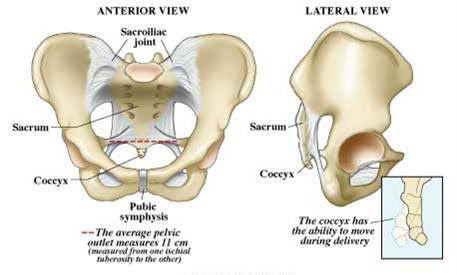
Most people imagine that the pelvis is like a hoop that the baby’s head must pass through, and indeed doctors often talk about it that way. However, the reality is far more complicated. The pelvis is a bony passage with an inlet and an outlet having different dimensions and a multiple bony protuberances jutting out at various places and at multiple angles. The baby’s head does not pass through like a ball going through a hoop. The baby’s head must negotiate the bony tube that is the pelvis, twisting this way and that to make it through…

There are bony protuberances that jut into the pelvis from either side (the ischial spines) and the bottom of the sacrum and the coccyx, located in the back of the pelvis, jut forward. How does the baby negotiate these obstacles? During labor, the dimension of the baby’s head occupies the largest dimension of the mother’s pelvis. But because of the multiple obstacles, the largest part of the mother’s pelvis is different from top to middle to bottom. Therefore, the baby is forced to twist and turn its head in order to fit.

If the pelvic inlet is toot small the baby’s head may never even drop into the pelvis. If the ischial spines stick too far into the pelvis,the head the head will not be able to get past them. If the sacrum and coccyx are angled too far forward they may stop the head from going farther.

It isn’t a matter of the absolute dimensions of the pelvis, but the dimensions relative to the individual baby. Almost all women can vaginally deliver a small baby, but a big baby is another matter entirely. The claims of natural childbirth and homebirth advocates that “a mother cannot grow a baby too big for her pelvis” is simply made up. The size of the mother’s pelvis is determined by her genes and the size of the baby is determined by her partner’s genes as well. His genetic contribution may lead to a large baby and that isn’t going to change simply because the mother’s pelvis is small.

Over time, babies have evolved so that the bones of the skull are not fused and can slide over each other, reducing the diameter of the head. This is called “molding” and accounts for the typical conehead of the newborn. But there is a limit to the amount of molding that the head can undergo and ultimately, the baby may not fit.

That’s pelvis and passenger. What about position? The optimal position for a baby to enter the pelvis is head first, spine facing the mother’s front. This position is known as occiput anterior. Babies don’t always cooperate. If the head is in anything other than the ideal position the fit will be even tighter. That’s why babies in the OP position (facing frontwards) and babies with asynclitic heads (the head titled to one side) are much more difficult to deliver vaginally. Their heads no longer in the smallest possible diameter. It’s like trying to put on a turtleneck face first of over your ear instead of starting from the back of your head. It’s much more difficult.

The final factor is power. Even if the baby is small enough to fit through the pelvis, it won’t go through unless the uterus is pushing against the baby with a sufficient amount of force to counter the resistance of the soft tissue and pelvic bones. The power is the strength, duration and frequency of uterine contractions. Any or all of these can be insufficient to push the baby through the pelvis. That’s where pitocin comes in. Inadequate contractions can be strengthened by pitocin, and the frequency and duration of contractions can be increased. Many women and babies who would have died before the advent of pitocin for labor augmentation have smooth uncomplicated labors once pitocin is given to the mother.

What can the mother do about these factors? Absolutely nothing. She cannot increase the diameter of her pelvic inlet, change the shape of her ischial spines or decrease the angle of her sacrum. She can do nothing about the size of the baby. She can do nothing about the position of the baby. She can do nothing about the power of her uterus.

The only thing a woman can do is to continue with a protracted labor and hope that the baby will eventually fit through. This is where we have to return to the issue of whether the baby can tolerate labor.

Labor is stressful for the baby. Every contraction cuts off blood flow to the placenta. Therefore, the baby is essentially “holding its breath” with every contraction. The placenta is supposed to transfer enough oxygen between contractions so that the baby can tolerate being deprived of oxygen for a minute or more every two minutes. The oxygen transfer capacity of the placenta can be compromised by a variety of factors including high blood pressure, post dates, or an undiagnosed deficiency in the placenta itself. Even a healthy baby with a healthy placenta may be unable to withstand labor indefinitely. The longer the labor lasts, the greater the risk to the baby.

Strictly speaking, the baby is either going to fit or not going to fit and there’s nothing the mother can do about it. If the baby is not going to fit she will eventually have to consent to a C-section or she will ultimately die.

If the problem is poor uterine power, the baby may eventually come through after a very long labor, putting the baby at risk of distress and the mother at risk of postpartum hemorrhage. Treatment with pitocin when the labor is diagnosed as protracted will take hours off the labor, with benefits to both mother and baby. Refusing pitocin can paradoxically increase the need for a C-section by increasing the length of labor until the baby can no longer tolerate it, or until an infection develops or some other complication occurs.

Yes, it is true that a baby born vaginally after a multi-day labor was always capable of fitting and might have been delivered by C-section “unnecessarily” but the corollary is that the baby that ultimately fits may sustain damage from oxygen deprivation during the prolonged labor.

Either way, vaginal birth is not an achievement. If the four factors are not properly aligned, the baby is not coming out through the vagina no matter what. The only issue is how much stress the mother is willing to expose the baby to before she acknowledges reality.

Natural childbirth: with thought leaders like this …

I can understand why women who lack basic knowledge of science might believe the made-up “facts” advanced by the natural childbirth and homebirth movements. And I can understand how women who lack basic knowledge of history might be gulled into thinking that childbirth in nature is inherently safe.

But for the life of me, I cannot understand why any woman would believe the clap trap of a movement whose thought leaders are a self-proclaimed midwife with no midwifery training (Ina May Gaskin), a self-described “expert in obstetric research” with no training in either obstetrics or research (Henci Goer), and a washed up TV talk show host (Ricki Lake). Between the three of them they have NO training in obstetrics, NO training in midwifery, and NO degrees in the fields in which they claim expertise.

Notice a theme here? I do. All three are “self-proclaimed” experts, as if one could acquire expertise by simply declaring that you have it. It’s a classic tactic in pseudoscience. As Physics Professor Rory Coker has written in his article Distinguishing Science from Pseudoscience, pseudoscience appeals to false authority and distrust:

A high-school dropout is accepted as an expert on archaeology … A psychoanalyst is accepted as an expert on all of human history, not to mention physics, astronomy, and mythology, even though his claims are inconsistent with everything known in all four fields…”

In the case of natural childbirth and homebirth, three lay people with no expertise in anything are accepted by their followers as experts on obstetrics, midwifery and statistics. How can anyone believe anything they say?

They are, of course, only the current leading exponents. Perhaps women believe the absurd claims of natural childbirth and homebirth advocacy because of the stellar credentials of the founders of these movements and the respect they are accorded by colleagues. No, it can’t be that. Although they were both doctors, but it is widely accepted among science and health professionals that both Grantly Dick-Read and Fernand Lamaze made up their claims and had no scientific basis for those claims.

Grantly Dick-Read, the father of natural childbirth, was quite clear about his racist and sexist eugenics beliefs and how that influenced his philosophy. He never hid the fact that his theory of natural childbirth was a direct result of his belief that primitive (read black) women were hypersexualiized, knew their place and therefore had painless childbirth, while white women of the “better classes” had developed shriveled ovaries, and painful childbirth because they had acquired education and political rights. As he put it:

… [T]he mother is the factory, and by education and care she can be made more efficient in the art of motherhood.

And:

Woman fails when she ceases to desire the children for which she was primarily made. “Her true emancipation lies in freedom to fulfil her biological purposes …

Fernand Lamaze was hardly any better. According to Sheila Kitzinger:

… Lamaze consistently ranked the women’s performance in childbirth from “excellent” to “complete failure” on the basis of their “restlessness and screams.” Those who “failed” were, he thought, “themselves responsible because they harbored doubts or had not practiced sufficiently,” and, rather predictably, “intellectual” women who “asked too many questions” were considered by Lamaze to be the most “certain to fail.”

So natural childbirth and homebirth advocates are not drawn to the philosophy by the beliefs of its originators.

What’s the appeal then? The appeal is the ego boost that natural childbirth and homebirth advocates get by setting a goal that literally any woman could achieve and then receiving plaudits from the thought leaders and fellow believers for “achieving” it. People pay attention to Ina May Gaskin, Henci Goer and Ricki Lake, not because of what they know, since they know very little, but because they make their followers feel good.

Nonetheless, although I understand the appeal of praise, natural childbirth and homebirth advocacy sets a new standard of desperation. Believers are so desperate to feel good about themselves that they are willing to embrace a philosophy whose thought leaders know virtually nothing about the subject of their purported “expertise.”

Only the uneducated and gullible take medical advice from B movie starlets

I guess I wasted 8 years in medical training. Four years of medical school and four years of residency were over-kill (pardon the expression). It seems that in 2012 the most important requirement for a medical authority is to be a former B movie starlet.

That’s right. Ricki Lake is evidently an expert on childbirth, Jenny McCarthy is an expert on immunology, and Susan Somers is an expert on chemotherapy (in the immortal words of Orac of Respectful Insolence, she has been carpet bombing the media with “napalm-grade stupid about cancer”).

What, you might ask, are the qualifications of these experts beyond their tawdry celebrity? Well, Ricki Lake completed two (count ’em, 2) semesters at Ithaca College; Jenny McCarthy dropped out of Southern Illinois University in favor of a career at Playboy; and Suzanne Somers dropped out of Lone Mountain College after 6 months.

All three had advanced training as well. Ricki Lake has actually given birth to two children. Jenny McCarthy has a child she believed was afflicted with autism. And, Suzanne Somers actually had cancer. If that’s not enough to make you a medical authority, I don’t know what is.

It’s hardly surprising that celebrity has gone to the heads of these women and made them think they are medical experts (look at Kate Gosselin if you want to see what celebrity can do), but what is the matter with the millions of people who appear to believe the drivel fabricated and spouted by these women? What has happened to us, America?

How can anyone believe anything they have to say on any medical topic? Does anyone seriously think they are qualified to dispense medical advice? Aren’t homebirth advocates, vaccine rejectionists and cancer conspiracists embarrassed to be consulting actresses for information on sophisticated medical issues? No? they ought to be.

The sad fact is that instead of being embarrassed, homebirth advocates, vaccine rejectionists and other health conspiracists are actually proud of themselves. You have to be pathetically ignorant to be proud of your own ignorance.

Is this part of the dismaying strain of anti-intellectualism that has longed plagued our country? Do people honestly think that those smarty-pants doctors don’t have any knowledge that couldn’t be acquired on “Three’s Company”?

Or should we blame this farcical behavior on the American penchant for conspiracy theories, the more outlandish the better? Do people really have so little faith in organized medicine that they consider Suzanne Somer’s cancer advice more likely to cure them than medical treatment?

I am a cynical person, but really folks? The government is paying for and recommending the distribution of injectable poisons? Big Pharma wants to create of generation of autistic people? Chemotherapy is a plot to keep you from the real cure for cancer? That’s not cynicism; it is credulousness.

Inquiring minds want to know: How can anyone claim with a straight face to believe that Ricki Lake knows anything about childbirth? How could anyone possibly believe that Jenny McCarthy knows about immunology simply by dint of having a child who she thought was autistic. And Suzanne Somers? Does anyone seriously believe that the purveyor of the “Thigh-Master” just happened to discover the cure for cancer in her spare time?

Someone please explain it to me, because for the life of me I, like other doctors, cannot figure it out.

A version of this piece first appeared in October 2009.

Dr. Amy