Can we please stop framing homebirth as a turf issue?

In the past month or so I’ve given a number of interviews and it’s been a rather discouraging experience.

Of course, I welcome every opportunity to expound upon my favorite subject: accurately informing women about the increased risk of neonatal death at homebirth. And I’ve enjoyed speaking with a variety of thoughtful, intelligent reporters. I’m discouraged, though, because I always have the impression that the article has basically been written according to a script before anyone is called for quotes. The script goes like this:

Meet Jane Doe and her newborn baby. Jane had a blissful, empowering homebirth. (See picture of Jane and baby).

According to the CDC, more women are making the same choice as Jane.

But doctors and midwives disagree about whether homebirth is a safe option. Doctors site the Wax study [insert quote from George Macones, MD of ACOG].

Midwives cite the Johnson and Daviss study [insert quote from local homebirth midwife] and claim that doctors oppose homebirth because they are afraid of losing business.

There are different kinds of midwives. Not all are legal, but some people think that all midwives should be legal [Insert quote from Katie Prown of The Big Push for Midwives.]

Is homebirth safe? We have no idea.

The article, Growing number of women choose to give birth at home, produced by the Washington Post in collaboration with Kaiser Health News and syndicated across the country is a perfect example.

There are a variety of serious problems with this approach, not surprisingly, since it is not an accurate representation either of the issue or of the state of the scientific literature and available statistics. Basically, it frames the issue in the way that homebirth midwives frame the issue, as a turf war.

Framing the issue as one of “turf” has important advantages for homebirth advocates. At a deep (possibly unconscious) level, most homebirth advocates suspect that homebirth may be risky for babies. The few professional homebirth advocates who are familiar with the literature and statistics KNOW that homebirth increases the risk of neonatal death. Moreover, the idea that being far from emergency personnel and equipment in the event of an emergency defies common sense. Therefore, they’ve chosen to frame the argument as doctors bullying midwives over “turf.”

It’s not an issue of turf, it is an issue of safety, but the script does not allow for exploration of the real issue. What would such an exploration involve?

1. A review of all the relevant literature beyond two opposing studies, both of which are poor. The literature includes the Malloy study that shows that homebirth with a CNM has double the risk of neonatal death as comparable risk hospital birth, the BMJ study that shows that low risk birth with Dutch midwives (home or hospital) has a higher rate of perinatal death than high risk hospital birth with an obstetrician, and the recently released Birthplace study that showed that even when the eligibility criteria are extraordinarily strict, homebirth still has an increased risk of adverse outcome.

2. A review of the most recent national and state statistics. The latest CDC statistics show that homebirth with a non-nurse midwives has a neonatal mortality rate more than 600% higher than comparable risk hospital birth. Statistics on planned homebirths attended by licensed midwives in California, Colorado and Oregon exceed death rates for comparable risk hospital birth.

3. Interviews with pediatricians and neonatologists since they are the people who actually care for newborns. This is the best way to break out of the “turf” frame because pediatricians and neonatologists have no economic interest at stake. Moreover, they are the people forced try desperately to resuscitate the babies deprived of oxygen at homebirth.

4. A comparison of American homebirth midwives (CPMs) with midwives from all other first world countries to highlight the lack of education and training of CPMs.

These are just the most important of the issues that ought to be addressed.

I implore reporters contemplating writing about homebirth to stop writing the same articles over and over again and break out of the script. In 2012, there is copious evidence in the scientific literature and in state and national statistics that shows that homebirth increases the risk of perinatal and neonatal death. That evidence ought to be reported and analyzed.

Step back and consider that there are other people who actually care for babies, pediatricians and neonatologists. Ask them whether homebirth is safe and what their personal experience is with homebirth tragedies.

The bottom line is that the only people who think homebirth is safe are homebirth advocates. Everyone who reads and analyzes the scientific literature, everyone who follows state and national statistics, and everyone who cares for newborn babies knows that homebirth increases the risk of neonatal death.

Please report that.

Reducing morbidity by increasing mortality

Nicu admissions v deaths

Suppose that we discovered new preventive treatment that cut the risk of appendicitis by half. The new treatment, Append-end, if added to the water supply, would result in 125,000 fewer appendectomies per year, saving millions of dollars in medical costs and lost productivity and wages.

And suppose that extensive pre-market testing revealed that Append-end had only one side effect. Approximately 1/100,000 people who ingest Append-end will experience a cardiac arrest within a week of taking it. In other words, if we put Append-end in the water supply of 300 million Americans, 3000 will die from cardiac arrest long before they reach the hospital and therefore, long before they can spend healthcare dollars.

Should we put Append-end into the water supply? Think of the more than 100,000 people a year who will be spared pain and suffering. Think of the decrease in hospital utilization. Think of the tens of millions of healthcare dollars saved. Balance that against the side effect of a mere 3000 deaths.

No, of course we shouldn’t and hopefully wouldn’t put Append-end into the water supply. We cannot let 3000 people die in exchange for the relatively trivial benefit of substantially reducing appendectomies. We should never contemplate sacrificing 3000 otherwise healthy individuals just to save money.

Now let’s consider an example a little closer to home. Suppose we found a treatment to reduce the level of medical unindicated iatrogenic late prematurity (37-38 weeks gestation) and the associated respiratory difficulties, NICU admissions, and hospital costs. Medically unindicated iatrogenic late prematurity occurs when elective inductions or C-sections are scheduled before 39 weeks gestation. Accurate figures are hard to obtain, but let us suppose that about 200,000 newborns per year are iatrogenically premature, and that leads to about 20,000 NICU admissions per for medical problems like mild respiratory distress.

Let’s suppose our treatment could prevent all 200,000 cases of iatrogenic late prematurity. We could spare 20,000 newborns and their families the discomfort and distress of a NICU admission, and we could save tens of millions of dollars in the process.

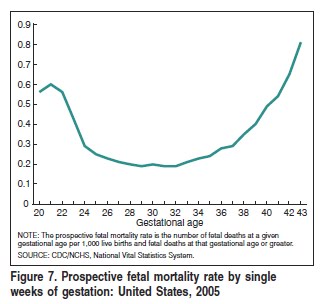
But there is one side effect. As the chart below illustrates, approximately 3/10,000 babies will die in utero each week between 37-39 weeks. If those 200,000 iatrogenic late premature births are prevented, 60 apparently health babies will be stillborn each week for a total of 120 babies.

Should apply the treatment? Think of the more than 20,000 newborns a year who will be spared pain and distress of a NICU admission. Think of the decrease in hospital utilization. Think of the tens of millions of healthcare dollars saved. Balance that against the side effect of a mere 120 newborn deaths.

Is 120 newborn deaths an appropriate price to pay to eliminate 20,000 NICU admissions? I don’t think so.

As it happens, we are already applying the treatment, led by the March of Dimes. Ever since polio was effectively eliminated by routine immunization, the March of Dimes has been struggling for relevance. In the past decade, it has latched on the issue of prematurity, an important issue by any stretch of the imagination. Unfortunately, no one knows how to prevent most cases of prematurity, so the March of Dimes has begun to focus on iatrogenic prematurity, prematurity caused by medical interventions. They have created a campaign entitled Healthy Babies are Worth the Wait. Hospitals, HMO’s and insurance companies have rushed to implement it.

For the life of me, I cannot figure out what the March of Dimes is thinking. It is irrefutable that if you prevent those 200,000 incidents of iatrogenic prematurity, 120 babies WILL die. There is no way around that. There have been no advances in stillbirth prevention so there is no way to prevent those deaths.

What the March of Dimes fails to understand, and apparently has never even considered, is that the increased morbidity of late prematurity has been EXCHANGED for the decrease in perinatal mortality. There is literally NO WAY to decrease morbidity without increasing mortality. It is literally IMPOSSIBLE to reduce NICU admissions for iatrogenic prematurity without sacrificing the lives of 120 babies.

This is a straightforward result of what we already know about stillbirth. Recent research has only served to confirm this. Neonatal Outcomes After Implementation of Guidelines Limiting Elective Delivery Before 39 Weeks of Gestation by Ehrenthal et al published in the November issue of the journal Obstetrics and Gynecology looked at neonatal outcomes before and after limiting elective delivery prior to 39 weeks of gestation and found that reduction in early elective delivery reduced NICU admissions, but the stillbirth rate increased from 2.5 to 9.1 per 10,000 term pregnancies.

I have been struggling to understand what the March of Dimes is thinking. The decrease in morbidity from preventing iatrogenic premature is achieved at the INEVITABLE expense of a substantial increase in perinatal mortality.

It would be one thing if the March of Dimes actually considered and made public this inevitable increase in perinatal mortality, and acknowledge that they believe it is worth it to let 120 babies die in order to prevent 20,000 NICU admissions. At least that would allow the rest of us to participate in the decision making process. But by failing to make clear (either through ignorance or by deception) that the only way to decrease iatrogenic prematurity among newborns is to let some babies die, they have pre-empted the conversation that we need to have. Preventing iatrogenic prematurity by ensuring that a subset of the sufferers die instead can’t possibly be the right way to address this issue.

The Trust Birth Criminals Conference

The time is fast approaching for this year’s iteration of that farce known as the Trust Birth Conference. I’ve written about the inanity of the conference in the past (The Let’s Pretend Birth Is Safe Conference).

When I first wrote about it in 2008, I observed:

I can’t wait. It promises an endless stream of misinformation, wishful thinking and inane pronouncements for me to write about. It is essentially a giant festival of magical thinking: if we all wish really, really hard, birth will be safe. Death in childbirth is just a failure of the imagination.

I was not disappointed. This year, however, the conference illustrates the fact that death in childbirth is a direct result of hiring a birth criminal as attendant. What is a birth criminal?

A birth criminal is a midwife who ignores the growing pile of tiny bodies, babies who died preventable deaths as a result of her direct or indirect professional actions. Lisa Barrett is hardly the only birth criminal, and hardly the only birth criminal lauded for her despicable actions.

Several well known birth criminals are speakers at this year’s conference. They include Lisa Barrett who has presided over at least FIVE preventable deaths of term babies in the past few years, Canadian birth criminal Gloria Lemay who has presided over more term homebirth deaths than anyone can count including a famous case that reached Canada’ highest court.

In that case:

After five hours of second stage labour, the child’s head emerged and no further contractions occurred. Sullivan and Lemay attempted to stimulate further contractions but were unsuccessful. Direct pressure was applied to the uterus, causing soreness to the mother’s stomach and back and some bruising. Approximately twenty minutes later, Emergency Services were called and the mother was transported to the hospital. Within two minutes of arrival, an intern delivered the baby using what the trial judge characterized as “a basic delivery technique”. The child showed no signs of life and resuscitation attempts were unsuccessful.

The case was dismissed on a technicality; because Lemay was so grossly inept, the child died before the body was completely born and therefore was classified as a stillbirth, not a neonatal death.

That was hardly Lemay’s first or only bout of serious legal trouble:

On January 4, 2002, BC Supreme Court Justice Blair found Lemay guilty of criminal contempt of court for attending ten births over a five-month period in defiance of the court injunction. At sentencing, the judge rejected Lemay’s lawyer’s request to impose a conditional sentence. The judge said he was not satisfied a conditional sentence would protect the safety of the public. “This is not an isolated breach but a continued series of breaches,” the judge said in his oral reasons for judgement.

Late in January of 2002, just weeks after being found guilty, Lemay managed another labour planned to be a home birth, which was later investigated by the police after the parents filed a complaint. This non-progressive labour went on for more than two days. Lemay is alleged to have performed a number of restricted acts during that time, including artificially rupturing the membranes. When meconium was apparent, Lemay is said to have stayed at home with the labouring mother for many more hours.

During sentencing the judge made note of this incident, pointing out that when the fetus became compromised Lemay failed to accompany the mother to Burnaby Hospital and told the mother not to mention Lemay’s name to hospital staff. An emergency cesarean was required…

Justice Blair also noted Lemay was previously found in contempt of court for refusing to give testimony at an inquest probing the 1994 death of a newborn in her care. The inquest found that the baby died of cardiac arrest as a result of an infection acquired during this birth attended by Lemay.

This year there is a new birth criminal on the roster, Kristi Zittle. I wrote about her in September 2008 (CPM presides over 2 separate deaths in 6 weeks).

The evidence presented at her suspension hearing is chilling. Regarding Patient A:

… Ms. Zittle did not perform a vaginal examination of Patient A until … approximately six hours after contractions began and approximately 27 hours after the spontaneous rupture of membranes, at which time Ms. Zittle incorrectly identified the presence of a nuchal hand.

Although a vaginal examination at 5:02 a.m. … revealed Patient A to be 8 centimeters dilated with the foot, thigh, and shin of the left foot presenting, Ms. Zittle … did not transfer Patient A to the hospital. Even though Ms. Zittle had never before performed a breech delivery, she opted to continue with a home delivery ..

Delivery of Patient A’s infant began at approximately 6:06 a.m., when the left foot delivered… Ms. Zittle … did not physically intervene to assist the delivery of the infant until approximately 6:35 a.m., when the pulsating umbilicus emerged and Ms. Zittle used her right hand to prevent cord compression. The infant’s buttocks emerged at 6:22 a.m. and by 6:38 a.m. the chest, only to the nipple line, had cleared the cervix. Although Ms. Zittle subsequently noted that the umbilical pulse was getting weaker and, at 6:40 a.m., documented the absence of a fetal heart rate, she did not initiate a 911 call until after the infant was born at 6:42 a.m. in a lifeless condition… Ms. Zittle immediately began performing Delee suction of the mouth, then nose, and began performing CPR, which she had never performed before on an infant.

An autopsy on Patient A’s infant revealed that the liver had ruptured, spilling 55 cc’s of blood into the abdomen, and also that the infant was positive for Group B strep infection. The Medical Examiner who performed the autopsy stated that the condition of the liver indicated that the infant had been breech for some time; that the rupture had developed over time, most likely from being pressed against Patient A’s hard pelvic floor; and that “a c-section would have been life saving in this case.”

Patient B, expecting her 3rd child:

Ms. Zittle failed to respond in a timely fashion to … the intensification [of patient’s contractions] around 10:O0 p.m. on June 9, 2008, in that she did not leave to go to Patient B’s home to attend her labor and delivery until approximately 12:34 a.m. … notwithstanding the 45-50 minute drive anticipated to Patient B’s home and the fact that Patient B was located approximately 17 miles from the nearest hospital and lacked transportation at that time…

En route to Patient B’s home, after Ms. Zittle was aware that Patient B was in the midst of a footling breech delivery, EMT personnel informed Ms. Zittle by telephone that Patient B’s infant had been delivered up to the chest but they were unable to further deliver the infant. Notwithstanding this information, Ms. Zittle instructed EMT personnel not to take Patient B to the hospital, but instead to assist Patient B in delivering her infant at home in the birthing tub. Ms. Zittle also instructed EMT personnel to wait for her arrival, estimated to be approximately 30 minutes later, before transporting Patient B to the hospital.

After transport to the emergency room by EMS, at approximately 1:37 a.m. …, Patient B delivered an infant with a distended abdomen and without respiration, color, movement, or a heartbeat, who was pronounced dead… The cause of death listed on the death certificate was umbilical cord entanglement and compression subsequent to breech delivery.

These women are hardly more than baby-butchers. Between the three of them, they have presided over the entirely preventable homebirth deaths of perhaps dozen infants or possibly more. Instead of being in jail where they belong, they are invited as honored guests at a conference that is nothing more than a festival of ignorance.

They do serve as an object lesson, however. Trusting birth leads to dead babies and, therefore, only fools and criminals trust birth.

Two new studies show increased risk of death, serious complications at homebirth

The annual meeting of the Society for Maternal-Fetal Medicine is currently being held in Dallas. Two different papers will be presented today, both of which highlight the increased risks of homebirth.

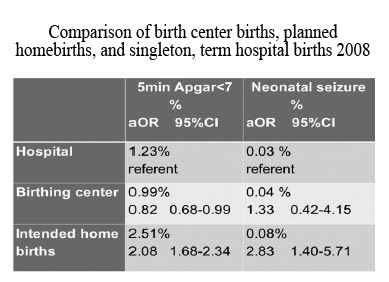
The first is Neonatal outcomes associated with intended place of birth: birth centers and home birth compared to hospitals (abstract 65) by Cheng, Snowden and Caughey. According to the authors:

This was a retrospective cohort study of singleton live births that occurred in 2008 in the U.S. that had specified birthing facility information. Deliveries were categorized by location of occurrence: hospitals, birthing centers, or intended home births…

What did they find?

While the risk of cesarean delivery was much lower for women who delivered/or intend to deliver outside of hospitals (0.02-4% vs. 24%, <0.001), the odds of 5-minute Apgar score <7 and neonatal seizure was significantly higher for intended home births compared to hospital birth.

In other words, while homebirth has a dramatically lower C-section rate, the price is double to triple the rate of birth asphyxia. This study actually substantially underestimates the risk of these serious complications at homebirth because it compares homebirth to all risk hospital birth instead of low risk hospital birth.

The second study is entitled Does planned home birth affect neonatal mortality? (abstract 563) by Joel Larma.

This is a population based retrospective cohort study of all births between 37 and 42 weeks gestation using the National Health Center for Vital Statistics 2005 Linked Birth/Infant Death Cohort Data Set. The primary outcome was neonatal mortality and the primary predictor was planned home birth. The referent group for the regression model was births that occurred in a hospital…

The authors did not separate homebirths attended by CNMs from homebirths attended by non-nurse midwives. The analysis showed that homebirth more than doubled the risk of neonatal death. This actually underestimates the risk because it compares homebirth to term hospital birth in women without pre-existing medical conditions, but apparently includes hospital births with pregnancy complications.

The adjusted OR for neonatal mortality among individuals having a planned home birth was 2.32 (95% CI 1.33, 4.06) after controlling for the aforementioned covariates [age, race, marital status, education, prenatal care, tobacco use, composite medical comorbidities].

CONCLUSION: The odds of neonatal mortality are significantly increased among those individuals having a planned home birth compared to those individuals giving birth in the hospital.

The amount of data on planned homebirth is slowly growing and the findings are remarkably robust. These studies, like all the existing scientific evidence, state and national statistics show that homebirth doubles or triples the rate of neonatal death and other adverse outcomes, and that the analyses almost certainly underestimate the real increased risks at homebirth.

addendum: These studies underestimate the risk even further because, as far as I can determine, bad outcomes that occurred after homebirth transfer are included in the hospital group and removed from the homebirth group. The real number of bad outcomes and deaths is higher than what the authors were able to determine.

Another homebirth horror story

I admit it. I cannot get used to these horror stories. I cannot understand how someone would let her own baby die simply for bragging rights.

I’ve written about unassisted childbirth in the past. I’ve pointed out that the leading American exponent of UC, Laura Shanley, and the leading Australian exponent of UC, Janet Fraser, have each lost one of their own babies at UC. I’ve also written about the death of both a baby and mother at UC.

Now comes word of another UC horror story (cached), posted by the mother herself along with a companion post bemoaning the fact that she is being “judged”:

My son Isaiah … was silently born on January 21st at 10:30 am. His weight and length were 8lbs 5oz and 21.5 inches respectively. Here is his story….

7am I woke up with a contraction and 15 minutes later had my next one. I got up to make breakfast and ended up leaning over my kitchen table with the strongest contraction yet. 2 minutes later another one that broke my water. Soaking wet I waddled to the bathroom as my DH drew me a bath.

5 minutes in the tub I pushed his foot out. I was tickling his foot in between contractions and felt him react to it. I did not know when I went into labour that he was footling. So that was a shock but I had decided that I could continue on with my unassisted homebirth at that time.

Single footling breech is an extremely high risk situation and once the first leg is delivered the risk of death goes up dramatically. That’s because the cord can fall out along side the leg. The cord will go into spasm, cut off the baby’s supply of oxygen and the baby will die. It is an absolute indication for calling an ambulance immediately. Instead, this mother decided to ignore it.

So 30 minutes later I was still trying to push out his other foot…

So as I am pushing I put my hand down to feel his foot again and then I felt it… the cord. I decided that I could still try to birth him myself. I got out of the tub and laboured on my hands and knees on our bed. This continued for a while, I think about 45 minutes.

In the face of obvious disaster, the cord has prolapsed, the mother still does not call for assistance.

I finally laid down at about 10:15 and pushed most of his body out. He was still alive at this point, I felt him moving. My 2.5 year old DD then informed me that our baby was a boy.

I pushed his head out in 2 more pushes. He didn’t cry…

Now, when it is too late, they decide to call for assistance.

My husband checked his airways and performed CPR, called the paramedics (his aunt and uncle) they arrived immediately and continued working on Isaiah for another 2 hours while we waited to be airlifted to the hospital… When the helicopter did arrive they pronounced my son dead.

She held her son’s body at the hospital:

… I was able to hold him most of the day until we left the hospital at 7pm that night. Isaiah’s presence in our life was very brief, but he touched our hearts in a way that we will never forget.

He may have touched their hearts, but that wasn’t enough to cause them to take the most basic steps to save his life. Being able to brag about an unassisted birth was obviously more important than whether Isaiah lived or died.

Another homebirth horror story

I admit it. I cannot get used to these horror stories. I cannot understand how someone would let her own baby die simply for bragging rights.

I’ve written about unassisted childbirth in the past. I’ve pointed out that the leading American exponent of UC, Laura Shanley, and the leading Australian exponent of UC, Janet Fraser, have each lost one of their own babies at UC. I’ve also written about the death of both a baby and mother at UC.

Now comes word of another UC horror story (cached), posted by the mother herself along with a companion post bemoaning the fact that she is being “judged”:

My son Isaiah … was silently born on January 21st at 10:30 am. His weight and length were 8lbs 5oz and 21.5 inches respectively. Here is his story….

7am I woke up with a contraction and 15 minutes later had my next one. I got up to make breakfast and ended up leaning over my kitchen table with the strongest contraction yet. 2 minutes later another one that broke my water. Soaking wet I waddled to the bathroom as my DH drew me a bath.

5 minutes in the tub I pushed his foot out. I was tickling his foot in between contractions and felt him react to it. I did not know when I went into labour that he was footling. So that was a shock but I had decided that I could continue on with my unassisted homebirth at that time.

Single footling breech is an extremely high risk situation and once the first leg is delivered the risk of death goes up dramatically. That’s because the cord can fall out along side the leg. The cord will go into spasm, cut off the baby’s supply of oxygen and the baby will die. It is an absolute indication for calling an ambulance immediately. Instead, this mother decided to ignore it.

So 30 minutes later I was still trying to push out his other foot…

So as I am pushing I put my hand down to feel his foot again and then I felt it… the cord. I decided that I could still try to birth him myself. I got out of the tub and laboured on my hands and knees on our bed. This continued for a while, I think about 45 minutes.

In the face of obvious disaster, the cord has prolapsed, the mother still does not call for assistance.

I finally laid down at about 10:15 and pushed most of his body out. He was still alive at this point, I felt him moving. My 2.5 year old DD then informed me that our baby was a boy.

I pushed his head out in 2 more pushes. He didn’t cry…

Now, when it is too late, they decide to call for assistance.

My husband checked his airways and performed CPR, called the paramedics (his aunt and uncle) they arrived immediately and continued working on Isaiah for another 2 hours while we waited to be airlifted to the hospital… When the helicopter did arrive they pronounced my son dead.

She held her son’s body at the hospital:

… I was able to hold him most of the day until we left the hospital at 7pm that night. Isaiah’s presence in our life was very brief, but he touched our hearts in a way that we will never forget.

He may have touched their hearts, but that wasn’t enough to cause them to take the most basic steps to save his life. Being able to brag about an unassisted birth was obviously more important than whether Isaiah lived or died.

The doubtful father’s guide to homebirth

Today, I’d like to address fathers, specifically fathers whose wives are trying to convince them to give their approval to homebirth.

You were expecting all along that your wife would give birth to your baby in a hospital, but then she watched some movie by that girl who was in “Hairspray” and that convinced her that homebirth is just as safe or even safer, and so much more spiritual.

You are doubtful. You’ve asked her how homebirth could be safer if you are far from help if something goes wrong in childbirth. You wonder if someone who is not a doctor and who shuns technology can keep your wife and precious baby safe. You are dubious that a woman whose main professional qualification is her vow not to “interfere” could possibly provide anything that a laboring woman and her baby needs.

I have two things to tell you:

First, you are right and your wife is wrong.

Second, don’t back down because your child’s very life may depend on your insistence that he or she get the best possible medical care.

You are right that it cannot possibly be safer to deliver far from the help you need in an emergency. Your wife insists that the “research” that she has done proves otherwise and wants to “educate” you. Be very wary.

Do you really need to learn about a movement whose main thought leader is washed up talk-show host Ricki Lake? No you don’t, but your wife insists that there are professionals who have done scientific research showing homebirth is safe. Professionals? Hardly. Ina May Gaskin is a “self-taught” self-proclaimed “midwife” who has NO EDUCATION OR TRAINING in midwifery, nursing or medicine. One of her own children died at a homebirth and she refused to seek help for that baby and watched him die.

Henci Goer is a self-appointed “expert” in childbirth research, yet she has no advanced degree of any kind, not in medicine, not in nursing, not in science and not in statistics. And she is only an “expert” to her followers. She doesn’t teach in any university, doesn’t practice in any hospital, and doesn’t serve on expert panels.

These three woman, who don’t have a single relevant credential between them are the “thought leaders” in homebirth advocacy. Not surprisingly, they have no idea what they are talking about. For regardless of what they say, all the existing scientific evidence, all state and national statistics show that homebirth increases the risk that a baby will die. The increase is in the range of 200% or more. In fact, the latest statistics from the CDC show that planned homebirth in 2007 with a homebirth midwife (often called a certified professional midwife, CPM, or licensed midwife, LM) had a newborn death rate more than 7 TIMES higher than low risk hospital birth.

Death at homebirth isn’t rare; it is all too common. Read the birth stories at Hurt by Homebirth. One of the many moving stories is written by Wren’s dad, Josh.

It’s now been a year since our beautiful boy Wren was born, lived, and died. At first, I was surprised at just how few people knew about Group B Strep, and I latched onto it as a “cause” that could bring some meaning for me to the events that transpired. However, it quickly became obvious that it wasn’t GBS that was the real problem… although our friends and relatives hadn’t heard of it, it is well-known throughout the medical world, and the reason there isn’t much heard about it is that we have a completely safe, 99.8% prevention method for it.

It eventually dawned on me that real smoking gun in this situation was our decision to do a home birth. My wife had gotten interested in home birth partly through seeing “The Business of Being Born” and because she didn’t like going to hospitals. She really just liked the comfort of being at home. I was skeptical about the risks at first, but after we went to a couple different providers around Los Angeles, I came up with a mental model that made me comfortable with the idea: home births were like whole foods!

Which brings me to my second point, don’t back down when your wife tries to convince you that homebirth is safe. You may be the only person standing between your baby and brain damage or death.

Your wife may be seduced by self-proclaimed midwives whose primary goal is receiving their fee. They will do what they know how to do (which is pathetically little) and then insist that anything they can’t do is “unnecessary” and hinders the birth “experience.” Don’t believe them when they dismiss risk factors as meaningless, ignore obstetric standards of care or pretend that there is always “enough time” to get to the hospital.

Don’t be fooled into thinking these women are real midwives. In the US, real midwives have a college degree in nursing and a master’s degree in midwifery. These women (CPMs and LMs) may have nothing more than a high school diploma, if that. That’s why they are not eligible for licensing in the UK, the Netherlands, Canada, Australia or ANY country in the first world. They don’t meet the basic standards of education and training required in ALL other industrialized countries.

This baby is your child too, and his or her protection is your responsibility. Yes, your wife may have her heart set on a homebirth, but she also has her heart set on raising a live baby, and homebirth diminishes the chance that your baby will survive childbirth.

As Josh explained:

You don’t know what “really good” midwives are. The ones we picked are licensed by The California Medical Board and certified by the North American Registry of Midwives. They are CPMs, LMs, MPHs, and LLCs. They’d been in business for decades and delivered thousands of babies. It turns out that … they actually have no medical training…

Overall, I just feel like a fool. My entire focus throughout the pregnancy was on the labor, the delivery, [my wife’s] experience, and maybe the first few minutes after birth. Once he had ten fingers, ten toes, and a lusty cry, I figured we were in the clear.

I was wrong, and our poor defenseless baby boy Wren paid for my ignorance. I thought I had everything figured out, I thought we would glide right through it all, I thought we were so cool.

Don’t let your child become a homebirth statistic or a sad story on Hurt by Homebirth. You are right that homebirth is not safe and it is important for you heed what you know to be true. Your wife may be disappointed that you do not approve of homebirth, but that is nothing compared to the lifelong heartache both she and you will endure if your baby dies at home because the emergency treatment he or she needed was too far away to make a difference.

You risked your baby’s brain function for this?

Are homebirth midwives morons?

I can’t think how else to explain how licensed Texas midwife Ms. Duffy handled this woman’s labor. The baby nearly died and it was only the father’s determination to transfer to the hospital that prevented the baby’s death. It’s not clear, however, how much of the baby’s brain function was sacrificed in the process.

Here is the mother’s story with the midwife stupidity helpfully highlighted. The patient was already more than 42 weeks pregnant.

Moronic homebirth practice #1: Failure to transfer the patient for postdates and pitocin induction.

[After 2 doses of castor oil] I woke up around 2am to heavy and obvious contractions…

Around 6am Matt called Ms. Duffy…

… At 10:15 am I was 5cm, 75% effaced, and the baby was at +1 station. My vitals were good…

Right after the check… my contractions began to space out … They began to give me black and blue cohosh drops to help get labor into a good pattern again. I would continue to get these drops every twenty minutes… The midwife was checking the baby’s heart rate every 30 minutes. It was great. Usually it was between 120-130…

Moronic homebirth practice #2: Inducing a postdates pregnancy with castor oil and failing to monitor the induction.

Moronic homebirth practice #3: Failing to recognize that the patient was in latent phase labor and attempting to speed up normal labor.

Moronic homebirth practice #4: Dosing a woman repeatedly with black and blue cohosh, which is toxic.

Moronic homebirth practice #5: Failing to monitor the baby’s heart rate at a minimum of 15 minute intervals as per the established protocol for intermittent ausculatation, after both inducing and augmenting the patient’s labor.

I was still continuing black and blue cohosh and nipple stimulation at 1:15 when I was checked next. At 1:15pm I was 6cm, 80% effaced. She said baby was lower, but still not quite a +2 station, so she kept it at +1…

… Ms. Duffy told us that she had only ever done this three times in twenty years, but she thought it might help speed things along if we broke my water… My water was broken just a few minutes later [at 4:45 pm]. It was clear.

Ms. Duffy checked me right after she broke my water, and I found out I had actually gone backwards. I was now 5cm dilated… I had suddenly gone from very manageable pain to pain so intense that I was screaming and crying through each contraction… I must have been pretty bad off because I remember looking over and seeing [my husband] crying many times.

… At one point I … began to feel “pushy”. Ms. Duffy told me … I could push any time I wanted if it felt good. I began to push during contractions. I noticed pretty quickly that something didn’t seem right… Ms. Duffy ended up checking me before I started pushing too hard. I was 9.5 cm and almost completely effaced. It was at this point that we learned I had a cervical lip left.

Moronic homebirth practice #6: Encouraging the patient to push without checking to see if there was a cervical lip, thereby causing swelling of the cervical lip.

Ms. Duffy … began to try to stretch and hold back the cervical lip while I pushed so that I could try and get rid of it… Ashley held back and stretched my cervical lip for about two hours… Finally Ashley [the midwife’s assistant] said that she thought the cervical lip was gone. I continued to push on my own under the assumption that the cervical lip was out of the way.

Moronic homebirth practice #7: Sticking your hand up a woman’s vagina and holding it there for TWO HOURS!! If that isn’t “birth rape,” I don’t know what is.

Around 7pm Ms. Duffy checked the baby’s heart rate… Ms. Duffy told me I needed to get out of the pool immediately and get in knee chest position. I later found out this was because the baby’s heart rate was suddenly going down into the 80s.

Moronic homebirth practice #8: Ignoring deep decelerations and pretending that they could be handled at home.

I got out of the pool and got on the floor in the knee chest position… Ms. Duffy told me I could not move from that position because it was what my baby needed. She had me on 8L of oxygen at this point…

Ashley began to continuously read out the baby’s heart beat. Ms. Duffy had her hand inside of me and was still stretching and pushing back my cervical lip while I pushed…

After being on the floor for about an hour, I begged to move to the couch. Baby’s heart rate was still having bad decels as low as the 70’s. I was still on oxygen… [M]y midwife refused to remove her hand from me. I kept begging her to get her hand out of me and let me rest, but she told me she had to do it to get the baby out…

Moronic homebirth practice #9: Ignoring deep decelerations after it is clear that delivery is not imminent.

At 10:45 … Ashley was still telling baby’s heart rate (literally non-stop as if she was reading a book. 130, 120, 80. 75, 83, 90, etc). Ms. Duffy had her hand in me stretching my cervical lip and messing with the baby’s head… My husband … looked at the midwives and told them, and told me he gave them a look that said he was done… At this point, baby’s heart rate was not coming back up above 100…

Ms. Duffy called the hospital and they asked if she wanted them to send an ambulance. She said we didn’t have time to wait on them. She told the hospital we had oxygen and would be driving ourselves. When I got to the back door, I noticed the oxygen was no longer working. Ms. Duffy looked it over and realized the tank was empty. We left the house with no oxygen. I was scared out of my mind…

Moronic homebirth practice #10: Failure to call for an ambulance when transferring for fetal distress.

Moronic homebirth practice #11: Failing to appropriately monitor resuscitation equipment and failing to notice that the oxygen tank is empty.

It was 11:15 when we got to the hospital… I heard someone say we had thick meconium… They checked me and I was basically 10 with a cervical lip. They grabbed my legs and told me to push…

The OB showed up. He told my husband they were going to do a c-section… They told me to rest and breathe between contractions… I couldn’t help but push. My midwife kept snapping at me saying “if you don’t stop pushing you’re just going to cause that cervical lip to swell and then they won’t let you try to have a natural birth. If you don’t stop pushing your baby can’t get any oxygen”…

At 12:45am … [t] wheeled me back to the operating room… At some point during the c-section I heard the doctor say “head is out. Nuchal cord x1”… Finally, someone said “you have a baby boy”. The neonatologist came over and told me that Jonah was born with a heartbeat of 60 and he was not breathing. He told us it took two minutes to get him breathing, another two minutes to get him crying, and then at six minutes old he still didn’t have any muscle tone and was very floppy. They let me kiss his cheek and then took him to the NICU…

About half an hour later my husband came back and told me that they had run a set of blood gases on his cord blood and that it was very acidic. The neonatologist informed us that meant he was deprived of oxygen … [and] he was showing signs that it may have affect his organs and his brain. So the decision was made to transfer him to the downtown Children’s hospital where they had a protocol to treat the problem. Jonah was life flighted to their hospital

Fortunately, there was no evidence of serious brain damage. No test, however, can diagnose subtle brain damage in a newborn.

We got a call later that morning that he had showed no signs of seizure activity (this is what they were watching for). They decided to hold him for observation, and ran a bunch of neurological tests, all which came back normal.

So the baby is alive and appears to be healthy but, not surprisingly:

I have severe post traumatic stress from this birth. My husband and I are already looking into counseling and some resources to help me. I never imagined I would go into labor with a healthy baby and then almost have him die on me…

Well of course she never imagined it. Her homebirth midwife never told her that childbirth is inherently dangerous or that post dates increases the danger or, especially, that Ms. Duffy had absolutely no idea what she was doing.

I’d like to think that someone is going to report the midwife for gross malpractice and violation of just about every standard of regulation of homebirth midwives. Even if no one reports her, I hope she reads this because she needs to know that she is a danger to mothers and babies. Her stupidity exceeds even that typically found among homebirth midwives and probably extends to the fact that she has no clue that she nearly killed this baby and may have left him with permanent brain damage.

Trust umbilical cords?

Natural childbirth and homebirth advocates get very excited about umbilical cords, specifically nuchal (neck) cords, the medical term for an umbilical cord that gets wrapped around the baby’s neck. They get excited because they believe that obstetricians dramatize the risk of nuchal cords (“the baby could die”) when they aren’t dangerous at all. As usual, natural childbirth and homebirth advocates are wrong on this point and the reason is that they fundamentally misunderstand when and why a nuchal cord dangerous.

How does an umbilical cord get wrapped around the baby’s neck in the first place. The reason is that for most of pregnancy, the baby has a lot of room to move and the cord is relatively long. Moving around, up and down, and somersaulting, the baby can easily get the cord wrapped around itself. Most of these loops will slip off at some point, generally without causing a problem. There is the possibility, however, that even if the loops eventually slip off the baby, a true knot will have been formed but many true knots never cause a problem.

Even more likely, a loop may get stuck around the neck because it is more slender than the shoulders below it and the head above it. Contrary to popular belief, the danger of a nuchal cord has nothing to do with the fact that it is wrapped around the baby’s neck. Since the fetus does not breathe, compressing its neck has no impact on whether there is adequate oxygen in the blood. In other words, the effect of neck compression is fundamentally different than if the neck of a child or adult is compressed.

In order to understand the danger of a true knot in the cord or a nuchal cord it helps to think of the cord as similar to the air line of a deep sea diver. It’s easy to understand that if a diver moved around such that he created a true knot in an air line, it could pose a serious problem. If the knot isn’t pulled tight, there is no problem. The oxygen can pass easily through the loop. However if the knot gets pulled tight because the diver pulls on the air line by diving down deep or it gets pulled tight by being snagged on something else, the supply of oxygen can get cut off and the diver could die.

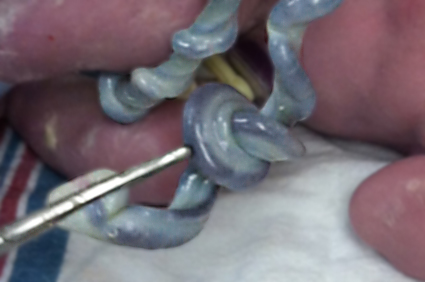
Similarly, a loose true knot in the umbilical cord is not a problem for the fetus because the oxygen continues flowing through the loop. However, if the knot gets pulled tight, either by the cord being pulled as the baby descends into the pelvis or the cord getting pulled by being snagged on an arm or leg, the baby will be deprived of oxygen and die

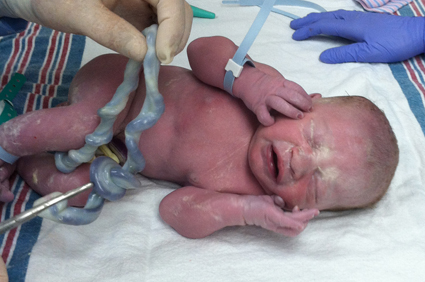
This picture of a true knot (a close up of the picture at the top) was sent to me by a reader. It was noted at her 3rd C-section. It is easy to understand that had the knot been pulled tighter, the baby might have died..

If an air line got wrapped loosely around a diver’s neck, the oxygen would keep flowing through it. However if the loop or loops were so tight as to cut off flow within the line, the diver will die. Of course a diver could actually be strangled by a loop or loops of cord, but a baby cannot. Therefore, the issue with a nuchal cord is NOT the fact that it is wrapped around the neck. The issue is whether the loop is pulled tight enough to cut off the flow of blood and therefore of oxygen.

The bottom line is that true knots of cord are not necessarily dangerous, but there is no way to no beforehand whether the knot will tighten during the course of labor and cut off oxygen to the bay. Similarly, a nuchal cord is not necessarily dangerous; in fact most nuchal cords are loose and therefore do not threaten the baby. Once again, though, there is no way to know beforehand how the loop or loops around the neck will be affected during labor. The higher the number of loops, the shorter the remaining cord, and the more likely that the cord will be fatally compressed during labor. However, even a single loop can be pulled tight during the descent of the baby and the baby will die for lack of oxygen.

Ultimately, when NCB and homebirth advocates “trust birth,” they are trusting that there are either no knots or loops in the cord, or that if they exist, they will not be pulled tight. But that makes no more sense than a deep sea diver trusting that he can assume that there are no knots in his air line and not worry if the air line gets wrapped around his neck. Obviously, in the case of the air line, trust has nothing to do with it, and, in direct contrast to what NCB and homebirth advocates proclaim, in the case of the umbilical cord, trust has nothing to do with the presence or absence of knots and loops.

The only way to know if a knot or nuchal cord is hindering the flow of the blood to the baby is to monitor the baby’s heart rate. Without monitoring, the supply of oxygen to the baby could completely stop during labor and no one would know until the baby was born dead.

The death toll of California homebirth

The state of California has released a comprehensive summary of outcomes of California licensed homebirth midwives of the year 2010. The reports makes for disturbing reading. Homebirths exceed low risk (and sometimes high risk) hospital birth on almost every negative outcome including deaths.

Before we look at the outcomes, let’s look at whether California licensed homebirth midwives comply with their own rules.

The first thing to note is that although all midwives are required to report outcome statistics, 16% never bothered to report their outcomes.

The second is that midwives are required to consult with and generally transfer care to obstetricians if a baby is known to be breech or in the case of twins. Nonetheless, California midwives delivered 13 breech babies and 5 sets of twins at home.

Let’s look at the basic statistics.

There were 2245 who planned homebirths at the onset of labor. 1840 delivered at home, for a transfer rate of 18%. There were 205 C-sections for a C-section rate of 9.1%.

How about outcomes? Simply put, the outcomes are dreadful as the chart below demonstrates.

The fetal mortality rate was 11/1000 compared to the California rate for white women (all gestational ages, all pre-existing medical conditions, all pregnancy complications) of 4.9/1000 for a rate more than double that expected.

The intrapartum mortality rate was 2.6/1000 compared to the expected rate of 0.3/1000, for a rate more than 8 times higher than expected.

The neonatal mortality rate was 0.9/1000 compared to the national rate for low risk white women of 0.4/1000, for a neonatal mortality rate more than double that expected.

A perinatal mortality rate of 12/1000 compared to the California rate for white women (all gestational ages, all pre-existing medical conditions, all pregnancy complications) of 5/1000 for a rate more than double that expected.

These numbers potentially under-count the real death rates for 2 reasons. First, among reported perinatal outcomes after transfer 11 were classified as unknown. Second, fully 16% of California homebirth midwives failed to report their outcomes.

How about birth complications? There were quite a few considering that the mothers were extremely low risk.

maternal

4 cases of massive PPH
1 case of seizure/shock
10 cases of retained placenta

neonatal

1 case of birth injury
2 cases of abnormal cry/seizures/loss of consciousness
6 cases of clinically apparent infection
9 cases of significant cardiac of respiratory issues
3 cases of 5 minute Apgar less than 6

Untimately, 14 mothers suffered serious complications resolved by 6 weeks and 1 mother suffered serious complications that persisted beyond 6 weeks. 21 infants suffered serious complications resolved by 6 weeks and 4 suffered serious complications that persisted beyond 6 weeks.

What conclusions can we draw from this data?

First and most important, despite the fact that the homebirth population presumably represents the lowest of low risk patients, the neonatal death rate is double that expected for low risk white women. The overall perinatal mortality rate is double that for all white women in California (including premature births, all pre-existing medical conditions, and all complications of pregnancy).

Second, homebirth in California has an extraordinarily high rate of intrapartum death, more than 8 times higher than the intrapartum death rate for women of all races, all gestational ages, all pre-existing medical conditions and all complications of pregnancy. While rigorous intermittent auscultation might be equivalent to electronic fetal monitoring under experimental conditions, that is clearly not true of intermittent auscultation as practiced by California homebirth midwives. In a population this size, we would expect that every woman who enters labor with a live baby will deliver a live baby. Instead, 6 babies died in the course of labor, because midwives didn’t recognize fetal distress and/or didn’t transfer in a timely fashion if they did recognize it.

Third, these results probably underestimate the dangers of homebirth in California because a substantial proportion of information is missing.

The bottom line is that homebirth in California increases the risk of perinatal and neonatal death by 100% or more. California homebirth midwives, like all homebirth midwives, “trust birth” and birth, far from being trustworthy, is inherently dangerous.

California birth outcomes can be found here.
For more information on the source of the homebirth statistics: Licensed Midwife Annual Report user guide.

addendum: Ideally, the California homebirth statistics should be compared to the mortality rates for California women in 2010 without any of the following risk factors (in order of importance): African descent, prematurity, pre-existing medical conditions and pregnancy complications that occur before onset of labor. Unfortunately, the mortality rate of that group is unavailable, so each comparison is made with the available group having the least number of risk factors.

In the case of neonatal mortality, the comparison group is hospital birth for low risk white women at term for 2007; for intrapartum mortality the only available group is all women; for fetal mortality the best available group is California white women of 2009; similarly for perinatal mortality the best available group is California white women of 2009.

Practically speaking, the substitution of these groups means that in all cases besides neonatal mortality, the correct comparison group would have much smaller mortality rates and that, therefore, the real increased risk of homebirth is much higher than that depicted here.

It is also important to note that homebirth appears to be associated with dramatically higher rates of intrapartum mortality, a vanishingly rare event among low risk women at term. Therefore, the figures that I routinely quote demonstrating that homebirth has a neonatal mortality rate at least 3 times higher than comparable risk hospital birth, dramatically underestimate the true risk.

Dr. Amy