Narcissism and homebirth

Those who were following the blog comments over the past weekend were treated to a display of narcissism so outsize as to astound nearly everyone who observed it.

I am talking about a series of comments made by a homebirth mother who tried to convince us that her baby chose to die. And, if that’s not bad enough, her baby chose to die as a gift to her.

I wrote about the homebirth death nearly a year ago (Sure my baby died, but look at the benefits to me). Apparently the mother found the post a few weeks ago and has been writing about it on her own blog. I was aware of the mother’s blog posts and I was aware of her post on Mothering.com soliciting support. I did not comment in either place, but then she came here looking for support.

Although the mother deleted her original comment, most of it can still be found on her own website.

… Joseph showed me the true meaning of unconditional Love. I feel like he gave his life to deepen mine, to give me back to me and to help me really discover my drive and purpose in life…

She was initially ambivalent about this pregnancy, because her first child has cystic fibrosis and she knew she was at risk for having another child with CF. However, she took no steps to determine if the baby was affected.

Moreover, despite knowing that her baby might need extra help at birth, she decided to give birth at home with a direct entry midwife. Babies with CF are almost always born without any sign of CF. Her baby’s death at home was the result of lack of oxygen during labor, and the midwife’s inability to perform an expert resuscitation.

Fast forward 9 months, Joseph is born, at home and is not breathing… Here is what happened as far as we can tell: he pinched off his umbilical cord with his own hand during the final minutes of delivery.

This in and of itself is HIGHLY symbolic for me and my family. It was not an “accident” that killed him, he LITERALLY cut off his own air supply.

Claiming that the baby could cut off his air supply by squeezing the umbilical cord makes as much sense as claiming that a baby cut off his air supply by squeezing his own neck. No baby is strong enough to do that, and, even if he were strong enough, he would pass out and drop the cord.

As I have written many times in the past, homebirth is a piece of performance art with the mother as the star of the production. Everyone else, including the baby, is a bit player. Going so far as to claim that the baby’s death is just a particularly extreme example of regarding the baby as nothing more than a prop, but narcissism lurks at the heart of most homebirths.

The narcissism expresses itself in many forms:

  • Homebirth advocates typically refer to the birth as “my” birth, “my” healing journey an “my” triumph (“I did it”).
  • Intuition, and birth affirmations, are forms of narcissistic expression. Only a narcissist believes that her thoughts have the power to control outcomes.
  • It takes a certain level of narcissism to believe that you know more about childbirth than the professionals who have spent 8 postgraduate years studying and practicing obstetrics. It takes a certain level of narcissism to pretend that you can acquire the relevant information by reading internet blogs and publications written by other lay people.
  • Homebirths are invariably displayed. Although homebirth advocates pretend that the rationale for homebirth is to have a private, spiritual experience, they tape it and post it on YouTube for any stranger to watch.
  • Some homebirth advocates are so narcissistic that they demand attention in real time. Hence live-tweeting, live-blogging and live-video feeds of homebirths.
  • In their narcissism, those who display their homebirths to strangers fantasize that they are doing so for the benefit of others; they are “educating” them about what a natural birth looks like, as if births in nature took place in inflatable kiddie pools with state of the art video equipment recording them.
  • Claiming that some babies are meant to die is narcissism in its purest form. It’s a way of shedding responsibility in advance for not doing everything possible to prevent a death, and shedding responsibility in the aftermath of a death by pretending that nothing could have been done to change the outcome. The baby exists only as a bit player whose own needs, even the need for oxygen, can blithely be ignored.

Ultimately, homebirth is about the mother, her feelings, her experience, the way that she would like to view herself. The baby is nothing more than a prop. Of course most women can be jolted out of their narcissistic complacency if the baby dies. But apparently not everyone. Occasionally there is a case of narcissism so severe that the mother actually thinks the baby died as a favor to her.

It is my fervent hope that this mother seek professional psychological help to process this tragedy, both for her own sake, and for the sake of her husband and surviving child. With therapy she may be able to see beyond her own needs to the fact that others are people with needs, needs that ought to be acknowledged and respected.


The Sanctimommy Manifesto

I’ve been writing about sanctimommies for a number of years now, but only yesterday did I learn that there is sanctimommy manifesto and it’s a festival of stupid.

What is a sanctimommy?

The sanctimommy knows how you should raise your children. Specifically, she knows what foods they should eat, what toys they should be allowed to play with; heck, sanctimommy even knows how you should have given birth…

The newest sanctimommy on the block is Darcia Narvaez, PhD. Writing in Psychology Today, Narvaez has produced a sanctimommy manifesto, Do We Need a Declaration for the Rights of the Baby? subtitled ‘What do babies have the right to expect?’

Who is Narvaez and what are her qualifications for opining on the rights of babies? She doesn ‘t have any. Narvaez is an Associate Professor of Psychology and Director of the Collaborative for Ethical Education at the University of Notre Dame. Her research explores questions of moral development. In other words, she has no training at all in pediatric health, obstetrics, nutrition, but hey, when you’re a sanctimommy your sanctimony is all you need!

Dr. Narvaez doesn’t merely what her real or theoretical children need, she knows what YOUR children need.

  • Natural birth.
  • Intentional beginning
  • No induced pain.
  • Breastmilk on demand for several years.
  • To have intensive maternal contact from birth with separations only initiated by the child.
  • Deep bonding.
  • To be treated as a person.
  • Needs respected and met.
  • Appreciation through positive touch and nonverbal and verbal communication.
  • To be embedded within the activities of a family 24 hours a day.
  • Community care.
  • Keeping their autonomy.
  • Keeping their spirit.
  • Full sensory and intellectual development.

In other words, babies have the right to attachment parenting!

Ms. Narvaez, as is the habit with most sanctimommies, insists that these aren’t her ideas; they’re simply what “science” shows is best for babies:

But now we know quite a bit of what helps babies thrive, what helps their brains and bodies grow well, and what facilitates optimal development. We can learn from societies that have happy, cooperative, intelligent children.

There’s just one teensy, weensy problem. The scientific evidence does NOT support Narvaez’ claims. Let’s look at a few of her claims in detail to see what I mean. Narvaez says:

Natural birth. The baby should be allowed to arrive in the new world on his or her own time, not on the doctor’s or mother’s timetable. This means avoiding inducement of labor and avoiding cesareans except in emergencies and preferably past full term (40-42 weeks). This also means maternal self-governance instead of relinquishing control of the birth to medical personnel. Mothers should follow the deep, primal instincts that positively guide healthy childbirth (with a birth plan for emergencies) and that provide the needed hormonal boost for caring for the newborn afterwards. Mothers and babies should not use drugs and fetal monitors, but instead using natural approaches to easy delivery.

In others words, Narvaez advocates just what they did in “the good old days.” And how did that work out? Not particularly well for either babies or mothers. Back in the good old days, 10 times as many babies died in or near childbirth as today; 100 times as many mothers in or near childbirth as today.

Intentional beginning. The birthing environment should mimic the womb as much as possible (warm temperature, soft lighting, no strong sensory input). There should be no procedures that cause pain to the newborn (separation from mother, eye drops, cloth rubbing or wrapping). First impressions on a dynamic system (the baby) shape the trajectory in development of that system–in many ways initial conditions cannot be changed later. The first impression should be one of pleasurable gentleness and loving support, to jumpstart prosociality.

There’s no scientific evidence for any of that other than a warm environment, and no reason to believe that it is true. Moreover, if you take it to heart, mimicking the womb does not lead to “warm, temperature, soft lighting and no strong sensory input.” It leads to intubating a baby, dropping it into a pool of water, leaving it in the dark and feeding it by IV.

Breastmilk on demand for several years... Breastmilk not only builds the brain, body, immune system, it has longterm delayed effects, such as the timing of puberty (delaying it in comparison to infant formula which speeds up pubertal timing)…

But that’s not what the scientific evidence shows. Virtually none of these purported benefits are established science, but rather suggestive results of selected studies, much of which is contradicted by other scientific studies. In addition, even if the benefits are real, most are quite small, and not even clinically relevant.

I’m beginning to detect a pattern here: Dr. Narvaez is offering her personal opinions, claiming (erroneously) that they are supported by scientific evidence, and insisting that babies have a right to expect that their parents will follow this evidence. Too bad that Narvaez is so eager to promote her personal opinions that she ignores her own advice, given in a different article:

But even more important for parents of young children is to realize that there really aren’t any human experiments that can be done to inform you how to parent at any given moment. So, for example, experiments that show the “success” of cry-it-out parenting might be interesting but they have several flaws.

Science cannot recommend particular parenting practices at particular times for a particular child in a particular context. Why not? Because parenting is like white-water rafting (but much harder)—there is too much unpredictability and changing circumstances.

Dr. Narvaez ends her piece with a plea:

Please make suggestions for other rights babies deserve.

How about these from Declaration of the Rights of the Child?

  • The child shall be entitled from his birth to a name and a nationality.
  • The child … shall be entitled to grow and develop in health; to this end, special care and protection shall be provided both to him and to his mother, including adequate pre-natal and post-natal care. The child shall have the right to adequate nutrition, housing, recreation and medical services.
  • The child who is physically, mentally or socially handicapped shall be given the special treatment, education and care required by his particular condition.
  • The child … shall, wherever possible, grow up in the care and under the responsibility of his parents, and, in any case, in an atmosphere of affection and of moral and material security; a child of tender years shall not, save in exceptional circumstances, be separated from his mother…
  • The child is entitled to receive education, which shall be free and compulsory …
  • The child shall in all circumstances be among the first to receive protection and relief.
  • The child shall be protected against all forms of neglect, cruelty and exploitation. He shall not be the subject of traffic, in any form.
  • The child shall not be admitted to employment before an appropriate minimum age …
  • The child shall be protected from practices which may foster racial, religious and any other form of discrimination…

Of course, they’re from the United Nations General Assembly, and what could they possibly know about human rights?

Dr. Amy’s “support with integrity” pledge

Can you imagine the sanctimommies of the world uniting to support all mothers regardless of the choices those mothers make?

No, I can’t either.

But here’s what such a pledge might look like:

  • I PLEDGE to use my energy to help defuse dogmatic battles about what route of delivery, pain relief and interventions a woman chooses for childbirth. I further pledge to refrain from dogmatic battles about feeding method (breast or bottle), transport method (sling or stroller) and sleeping place (family bed or crib). I affirm that my time is best spent directing my positive, encouraging support toward helping mamas successfully parent their newborns.
  • I PLEDGE to keep my ego in check, while treating other mothers respectfully, knowing that we’re all working toward the common goal of happy, healthy babies. I also welcome respectful disagreement with my own opinions and accept that disruptive disagreement is counter to the goal of helping mothers raise their babies.
  • I PLEDGE to agree that there are many right ways to give birth to, feed and raise a baby. A mother should not feel pressure or judgment to perform a specific way. There isn’t a “wrong way” as long as the baby is happy and healthy.
  • I agree to hold help mothers get what they need to make child rearing work for them, no matter how they choose to do it. If a mother and baby are making it work, I’ll stand and cheer them on from the sidelines.

I got the idea for this pledge from another group that has just created a pledge, Support with Integrity, which is supposed to facilitate “judgment-free breastfeeding.”

According to the creators for the Support with Integrity pledge:

… there are many right ways to breastfeed a baby. A breastfeeding mother should not feel pressure or judgment to perform a specific way. There isn’t a “wrong way” as long as the breast milk is flowin’ and the baby is growin’.

The Feminist Breeder is lending her support, after she was chastised by another lactivist for allowing her baby to use a pacifier:

If I – a vocal and stubborn breastfeeder – could feel shamed and ousted by the Lactivist preaching the “right” way of being a breastfeeder, then what about the mothers who aren’t quite as tenacious as me? How does this make them feel? Does shaming, insulting, and humiliating them really help them achieve their breastfeeding goals? Will more babies be breastfed because this Lactivist decided to make a public spectacle about unfollowing me over my pacifier usage? I seriously doubt that a single mother saw that post and thought, “Wow, I hadn’t planned to breastfeed before, but knowing that there’s only ONE “right” way definitely makes me to try it now!”

How ironic then that the same people who proclaim that there is not one right way to breastfeed a baby and it only matters if the baby is eating enough and growing appear to believe that there is only ONE right way to feed a baby, and that is breastfeeding. And many of them have made it clear over the years that there is only ONE best way to give birth to a baby and that is vaginally without pain medication. Some even believe that there is only one place for a baby to sleep, in a family bed, and one way to transport a baby, in a sling.

I wonder if these women see the irony. Having discovered that chastising women about the WAY that they are breastfeeding is not helpful to women or babies, it does not seem to occur to them that chastising women about WHETHER they are breastfeeding is equally unhelpful.

I’m not expecting any breakthroughs on the childbirth front, either. I doubt we’ll be seeing these women advocate for patient choice elective C-sections; I doubt we’ll see them acknowledging that pain relief in childbirth is both safe and appropriate for those who choose it.

In fact, their pledge is not about supporting mothers; it’s about supporting themselves. Evidently it’s still okay to criticize everyone else.

I challenge the creators and supporters of the Support with Integrity Pledge to make their pledge look much more like my pledge. Instead of pledging:

to keep my ego in check, while treating other breastfeeding boosters, lactation facilitators, breastfeeding organizations, and mothers respectfully, knowing that we’re all working toward the common goal of providing breast milk for babies.

how about pledging this?

“I pledge to keep my ego in check, while treating other mothers respectfully, knowing that we’re ALL working toward the common goal of happy, healthy babies.”

Why do babies die?

Members of the British Stillbirth and Neonatal Death charity SANDS, including Joshua Titcombe’s parents James and Hoa, will visit Parliament today to present a major new report Preventing Babies’ Deaths: what needs to be done.

The report is a deeply moving and deeply distressing account of why babies die and what can be done to prevent those deaths.

In 2010, 4,110 babies were stillborn; 1,850 babies died in the first hours or days of their lives, and another 507 babies died between one and four weeks old.

Contrary to common perception, stillbirth is not a rare event: one in every 200 babies is stillborn (a death after 24 weeks gestation).

To my mind, the most disturbing of the many distressing findings is that many of these deaths could have been prevented with appropriate obstetric care. In contrast to the beliefs of many people, these babies are not “meant” to die.

It is a common misconception that all stillbirths are unavoidable tragedies where something is irreversibly wrong with the baby.

In fact over 90% of babies who are stillborn have no congenital abnormality; around a third of stillbirths are unexplained (in other words perfectly formed, normal-sized babies); and a further third are also perfectly formed but growth restricted.

Moreover:

… Around 500 babies die every year because of a trauma or event during birth that was not anticipated or well managed. These deaths, when they occur at term, should never happen and almost always could be avoided with better care.

The report offers a startling fact:

Today it is rare to lose a baby in a high-risk pregnancy. But when it comes to stillbirth the so-called ‘low-risk’ women who in fact have high-risk babies are being missed.

The report itself is filled with tragic stories of low risk pregnancies where providers insisted that a low risk pregnancy was “normal” in the face of mounting risk factors and actual clinical deterioration of babies.

In the wake of these preventable deaths, providers attempt to hide what actually happened.

Joshua’s avoidable death – the true causes of which would never have come to light without the courageous persistence of his father – not only highlights extreme failures of care, it also emphasises the unwillingness of some Trusts to learn in an open and honest way from those mistakes, thereby risking repeating these failures in the future.

The Titcombes’ case is an extreme example of poor care but it is also just the tip of the iceberg. Most bereaved parents do not have the leverage … to pursue answers as to whether the quality of the care they received contributed to their baby’s death. The death is generally presented to them as a rare and regrettable, but unavoidable, tragedy. Yet we know that substandard care plays a role in many perinatal deaths.

In a national confidential enquiry into stillbirth in 2000, sub-optimal factors were found to have contributed to the death in three quarters of cases with failures in identifying problems (especially poor growth), in intervening and in communication.
In more recent regional confidential enquiries into the deaths (before or shortly after birth) of 65 normally formed babies, carried out in 2008/9 by the West Midlands Perinatal Institute, it was concluded that 54% could have been avoided
with better care.

The key to preventing these deaths is auditing the deaths and reviewing individual deaths to determine what, if anything, could have been done differently. In a move that is incomprehensible, the Britain has STOPPED counting the deaths, let alone investigating them:

If deaths are not counted, in official terms they as good as disappear. Yet the UK’s national audit programme, the Clinical Outcome Review Programme (CORP) Maternal and Newborn Health, which is tasked with collecting perinatal mortality data, has been suspended since April 2011. In other words the 17 babies who die today will not go into any kind of national audit to help understand why babies die and how to improve care.

Evidence shows that audit can save lives. Without facts on where and why deaths are happening, or any review of maternity units’ performances on perinatal mortality, the potential and impetus to do something about the problem fades. In a
health care system driven by outcomes this situation is unacceptable.

The official panel who reviewed the CORP programme recommended that it recommence by April 2012, but that is not certain. Meanwhile, there is grave concern, and a sense of disbelief, that two or more years of vital perinatal mortality
data have potentially been lost.

In addition, though parents who experienced stillbirth or neonatal death regret that they were not more aware of the possibility, providers view the provision of that information as ‘scaremongering.”

“You can’t make informed decisions if you’re not informed,” says [a father]. “We asked the Head of Midwifery to review the information they give parents but she said, ‘We don’t want to scaremonger parents’.”

Is it scaremongering to tell prospective parents of the risks, however relatively small, of their baby dying before or soon after birth (after all women are expected to assess information about Down’s syndrome and cot death) or is it giving them the power to make truly informed choices about their own health and pregnancy care?

The report concludes with substantive proposals for action and models to guide providers and government officials in making necessary changes.

Preventing Babies’ Deaths: what needs to be done is a deeply affecting and deeply distressing review of maternity care in the UK. A press release summarizing the findings is available on the SANDS website. The full report will be available tomorrow; I urge everyone to download and read it. It is impossible not to be moved and angered. Hopefully, Parliament and health officials will take action in response.

Medical care and the limits of autonomy

Talk to a natural childbirth or homebirth advocate for more than a few minutes and you are bound to be treated to a disquisition on autonomy. There is the standard assertion on the right to control your own body,the rejection of paternalism in medicine and the insistence that it is the responsibility of the physicians and nurses to do whatever patients tell them. Invoking autonomy, therefore, is seen as the trump card.

That, however, assumes that there is no limit to autonomy within a medical setting and that assumption is wrong. Consider a classic problem of medical ethics:

What if a patient requests amputation of a healthy leg?

Applying the straightforward claims about autonomy invoked by NCB and homebirth advocates would leave us with only one conclusion: as long as the patient is mentally competent, he or she has the right to expect that a request for healthy limb amputation must be honored. Is that what medical ethics and the principle of autonomy require? Many medical ethicists would argue against that view.

If the right of autonomy does not entitle patients to demand and receive amputation of a healthy limb, there must be some limits. What might those limits be?

To answer the question, it helps to understand what the right to autonomy really means.

In the introduction to Healthcare Decision-Making and the Law; Autonomy, Capacity and the Limits of Liberalism, Mary Donnelly notes:

Since the latter part of the twentieth century, the law’s approach to healthcare decision· making has centred on ensuring respect for the principle of individual autonomy. In t his, the law reflects the predominant ethical status which has been accorded to the principle. Thus, John Stuart Mill’s famous aphorism that ‘[o]ver himself, over his own body and mind, the individual is sovereign’ might be seen as the defining summation of principle. This principle is given legal effect in Cardozo’s often cited dictum that ‘every human being of adult years and sound mind has a right to determine what shall be done with his own body.’

Or as Kellie Williamson explains in Healthy Limb Amputation, Bioethics and Patient Autonomy:

…Ultimately, autonomy is about an individual being able to live their own life according to their own idea of what a good life entails. In other words, it involves self-determination and self-rule, and is closely associated with personal identity. In order for each person to be autonomous, other people must respect that person’s autonomy. Respect for autonomy can also be extended to the state, institutions and health-care professionals…

However, even a right as fundamental as autonomy has limits. In Autonomy, the Good Life, and Controversial Choices, Julian Savulescu notes:

According to the German philosopher, Immanuel Kant, our autonomy is tied to our rational nature…

There are compelling independent ethical arguments to suggest that the exercise of full autonomy requires some element of rationality … These arguments are based on the concept of self-determination… not mere choice but an evaluative choice of which of the available courses of actions is better or best. The reason that information is important is to enable an understanding of the true nature of the actions in question and their consequences. But if information is important, so too is a degree of at least theoretical rationality to draw correct inferences from these facts and to fully appreciate the nature of the options on offer.

In other words, an autonomous decision is not merely a wish, but a decision made with appropriate information and rational consideration of the outcomes. Therefore, simply telling your doctor that you want him to amputate your healthy leg is not a sufficient reason for him to honor your request.

How do we determine whether a person is making a rational decision? Savulescu argues that it does not rest on whether the decision in prudent; imprudent decisions can still be honored. The issue is whether the imprudence is rational or irrational, which he defines as follows:

Rational imprudence is imprudence based on a proper and rational appreciation of all the relevant information and reasonable normative deliberation. Some other reason grounds the action beside prudence – this is typically the welfare of others. Thus we should respect decisions to donate organs or participate in risky research, if these are based on a proper appreciation of the facts. However, merely citing a normative reason is not sufficient to make some action, all things considered, rationally defensible . To donate one’s healthy kidney to a sick relative would not be rationally defensible if the chances of rejection were very high. There must be a reasonable appreciation of the values in question.

The classic example of rational imprudence is the refusal of a Jehovah’s Witness to accept a desperately needed blood transfusion. The decision may be imprudent because it can lead to death, but it is rational because the individual values spiritual well being above health and even life itself.

On the other hand:

Irrational imprudence is imprudence where there are no good overall reasons to engage in the imprudent behavior. The explanation might be that the person is not thinking clearly about information at band or holds mistaken values or wildly inaccurate estimates of risk. We should attempt to reason with and try to dissuade the irrationally imprudent.

Theoretically, then, it is permissible to amputate a healthy limb on request, but only when the person desiring the amputation has a complete appreciation of the results of this choice.

What does this mean for natural childbirth and homebirth advocates?

Autonomy does not mean that medical professionals are required to honor all requests. Medical professionals are not required to honor requests when the patient fails to understand the consequences and therefore is not making a rational choice, or understands the possible consequences but wildly underestimates the risk of those consequences occurring.

Indeed, these are the arguments that patients themselves often make in the wake of bad outcomes that derived from their own choices. Consider the case of attempted vaginal birth after Cesarean that leads to uterine rupture and death of the baby. Patients have argued successfully in courts of law that although they did make a rational decision to attempt labor after a previous C-section (and signed a consent form acknowledging that they had been apprised of the risks), they failed to understand that the baby could really die, or they failed to understand that even when there is only a small risk, catastrophic outcomes will occur.

This is why natural childbirth and homebirth advocacy are so problematic. Most professional natural childbirth and homebirth advocates have a poor understanding of the risks of their choices because they have been misinformed by other NCB and homebirth advocates, and because they lack the most basic understanding of childbirth, obstetrics and statistics, leaving them unable to evaluate their beliefs in any systematic way.

There are limits to the principle of autonomy. You can’t expect a doctor to amputate a healthy limb just because you request it. Similarly, if you are an NCB or homebirth advocate, you can’t expect obstetricians to violate standards of practice, just because you request it. That is not what the principle of autonomy demands.

Ina May invokes elephant birth

You just can’t make this stuff up.

Over on Feministing, Ina May Gaskin suggests that feminists and other women can learn more about bodily autonomy by watching videos of … elephants and chimps!

Who knew that elephants were feminist? Who knew that elephant birth had anything to do with human birth? Ina May, that’s who.

The interviewer breathlessly explains:

I asked Ina May what could our readers do to learn more on the topic of bodily autonomy and birth, and she suggested watching the two videos after the jump, of an elephant and chimpanzee giving birth. Apparently we have a lot to learn from these animals!

In fact, Ina May says:

We’re so affected by prudery and corporate media that you don’t get to see the reality of birth on television unless you go to YouTube. I’d say type in “The Dramatic Struggle for Life.” There, you’ll see an elephant give birth. Her baby doesn’t breathe spontaneously and she has to resuscitate the baby. That’s powerful to watch.

So watching elephant birth shows the reality of human birth? And what exactly does the fact that the elephant baby doesn’t breathe spontaneously tell us about women’s bodily autonomy? Evidently nothing.

Of course, chimps are among our closest primate relatives so they must surely be able to teach us about bodily autonomy:

The second I’d recommend is “Chimp Birth Attica Zoo” and there you see a chimpanzee give birth and labors in a position that nobody would ever guess that anyone would take [upside down]. But, you watch her expertly give birth without any damage to herself with definite calm and perhaps pleasure.

Or perhaps agonizing pain. But I guess Ina May fancies herself a lay expert of chimp sexual satisfaction as well as midwifery. And what does this have to do with women’s bodily autonomy? Once again, absolutely nothing.

You realize when you see these that neither of these mammals are afraid. They’re comfortable with their body and what people will begin to ask is, “What could we learn from this?”

Did Ina May interview the elephant and the chimp? Oh, I get it, she intuited that those animals were not afraid. And she was able to intuit their feelings just by watching the videos.

Birth has been commodified so escaping it is like finding your own wild nature. If you choose to go to a hospital, which I’m not putting down, then I suggest be wild when you’re there and you’ll teach ‘em something!

Teach ’em what? That you listen to the ravings of wacky self-appointed birth experts? What does being wild with uncontrollable pain have to do with women’s bodily autonomy? Nothing, of course. And why isn’t employing technology (an epidural) so you won’t have to be wild with pain an expression of women’s bodily autonomy? Because Ina May says so.

Honestly, I can’t imagine why anyone (let alone feminists) takes this woman seriously. She lives in a cult, has no training in midwifery, let one of her own children die without seeking medical attention, and can’t tell the difference between an elephant and a human being. Will some one please explain to me how anyone with a modicum of intelligence could believe anything she says?

Birth plans: worse than useless

img_1630

Yesterday I wrote about birthzillas, pregnant women who are hypersensitive, obsessively controlling, and rude to healthcare providers. They justify their behavior with the all purpose excuse “It’s my special day.”

Several commenters took umbrage at the idea that a birth plan is the hallmark of a birthzilla. What’s wrong with making a birth plan they ask? The answer: a lot.

Birth plans engender hostility from the staff, are usually filled with outdated and irrelevant preferences, and create unrealistic expectations among expectant mothers. But the worst thing about birth plans is they don’t work. They don’t accomplish their purported purpose, make no difference in birth outcomes, and, ironically, predispose women to be less happy with the birth than women who didn’t have birth plans.

Birth plans were instituted based on the philosophy of various natural childbirth advocates such as Penny Simkin and Lamaze International. They basically made up what they thought would improve the birth experience for women without any study at all about what actually improves birth experience for women.

Joanne Motino Bailey, CNM et al. write in Childbirth Education and Birth Plans, Obstetrics and Gynecology Clinics – Volume 35, Issue 3 (September 2008):

Advocates of birth plans claim that they can improve communication with staff, enhance choice and control during labor, and make women more aware of available options for their birthing experience. Too raised concerns that birth plans offer meaningless choices and “create an atmosphere of distrust between patient and physician or have the opposite effect by setting up the patient for a sense of ‘failure’ if the birth does not go as planned.”

There are no randomized controlled trials that analyze birth plans and the literature that does exist reaches varying conclusions … Lundgren and colleagues found “although a birth plan did not improve the experience of childbirth in the overall group, there may be beneficial effects with regard to fear, pain, and concerns about the newborn for certain subgroups of women.” Brown and Lumley stated that “women who made use of a birth plan were more likely to be satisfied with pain relief, but did not differ from women not completing a birth plan in terms of overall rating of intrapartum care, or involvement in decision making about their care.” Whitford and Hillan found that most women who completed a birth plan found it useful and stated they would write another birth plan in a future pregnancy, although most did not believe it made any difference in the amount of control they felt during labor and many did not think enough attention had been paid to what they had written.

Why are birth plans ineffective?

1. Most birth plans are filled with outdated and irrelevant preferences. As childbirth educator Tamara Kaufman writes in Evolution of the Birth Plan (J Perinat Educ. 2007 Summer; 16(3): 47–52):

… [Women] identify the Internet as the resource they use most frequently to gather information about pregnancy, birth, and birth plans… [M]any of the birth plans detailed on these sites are outdated. For example, several on-line, interactive tools start with questions regarding being shaved or receiving an enema. Because these procedures are no longer routine in most areas, such details may cause parents to devote too much attention to unimportant issues and cause the hospital staff to dismiss the couple as being uneducated regarding routine hospital procedures…

2. Birth plans are gratuitously provocative, as Kaufman notes:

On-line birth plans are frequently more than one page in length, which may inhibit the hospital staff from closely reading the plan. On-line birth plans also have a tendency to use phrases such as “unless absolutely or medically necessary”—a phrase that is not always useful when caregivers usually believe the intervention they recommend is medically necessary at the time …

3. Birth plans have no impact on outcomes. The most important component of any birth plan is requests around the issue of pain relief. As Pennell et al, point out in Anesthesia and Analgesia–Related Preferences and Outcomes of Women Who Have Birth Plans:

Women who elected birth plans were primarily white, college-educated, primigravida, and under the care of a certified nurse-midwife. One-third of births were induced, 10% required instrumentation, and 29% were cesarean births. Nearly every birth was associated with at least 1 labor and birth complication, although most complications were minor. Analgesic preferences were reported to be the most important birth plan request. Greater than 50% of women requested to avoid epidural analgesia; however, 65% of women received epidural analgesia. On follow-up, greater than 90% of women who received epidural analgesia reported being pleased. The majority of women agreed that the birth plan enhanced their birth experiences, added control, clarified their thoughts, and improved communication with their health care providers.

4. Birth plans encourage unrealistic expectations. Just the idea itself is unrealistic. There is very little that can be planned about birth: not the timing, not the length of labor, not the amount of pain experienced, not the relative size of the baby’s head and the bony pelvis, not the adequacy of contractions and not how well the baby tolerates labor. Yet all birth plans implicitly assume that labor with fall in the normal range in every possible parameter. Disappointment is inevitable.

In Is the Childbirth Experience Improved by a Birth Plan?, Lundgren et al. were surprised to find:

… A questionnaire at the end of pregnancy, followed by a birth plan, was not effective in improving women’s experiences of childbirth. In the birth plan group, women gave significantly lower scores for the relationship to the first midwife they met during delivery, with respect to listening and paying attention to needs and desires, support, guiding, and respect.

It appears that the birth plan may have actually set women up to be disappointed with their birth experience.

5. It is not really surprising that birth plans fail to achieve their stated aims when you consider that they are not plans for births. No one writes in their birth plan that they want to have a 16 gauge IV in each arm at all times; no one demands active management of labor; no one insists on extra blood tests for the baby. A more accurate name for birth plans would be “I refuse all these things regardless of whether they are routine and/or medically indicated because I know much more about the scientific evidence than any obstetrician or nurse.” In other words, birth plans are an extended tantrum in written form.

Why do women write absurd ultimatums? Why do they think their a priori refusal of medically indicated interventions is remotely appropriate? Why do they think they have a better understanding of the scientific evidence than the professionals who create it, read it faithfully and are legally responsible for being completely up to date on it? Because people like Henci Goer (who has never delivered a single baby) and Ina May Gaskin (a woman with no training in midwifery, who let her own baby die, and who believes that birth is controlled by invisible “forces”) told them so.

Why do they write these extended tantrums (“I’m not gonna and you can’t make me!)? Because they’ve completely lost sight of the goal. Doctors and nurses are HEALTHCARE providers whose goal is to make sure that mothers’ pregnancy complications are treated or prevented and that they give birth to healthy babies. Their role is not to facilitate birth goddess fantasies. Women know so little about birth, and are so sure (erroneously) that complications are vanishingly rare that they’ve confused birth with a piece of performance art. Birth plans are not about birth; they’re about creating the most esthetically pleasing tableau.

That’s why NCB and homebirth advocates can, with a straight face, have arguments about whether a C-section is actually a birth. It makes sense when you realize that for them birth is not about the baby being transferred from inside the uterus out to independent life. For them, a birth is an intricately choreographed performance that follows a pre-approved script. Deviate in any way, and the performance is ruined.

Ultimately, birth plans are not merely useless for their stated goal of achieving control over birth. They are worse than useless because they are filled with outdated nonsense, alienate providers, fail to achieve their stated aims and, through unrealistic expectations, encourage disappointment.

By all means share your most important preferences with your providers, but think long and hard before you present your provider with a list of refusals and ultimatums. Birth plans have been encouraged by ancillary birth personnel (childbirth educators, doulas) as a thumb in the eye of obstetricians. They accomplish nothing besides gratifying a desire to defy authority.

Birthzilla

We’ve all heard about bridezillas, the women who are so obsessed with having the perfect wedding that they become tyrants toward everyone else. There’s an argument to be made that many homebirth and natural childbirth advocates are “birthzillas” who justify their hypersensitivity, obsessive need for control, and rudeness to everyone else with the all purpose excuse “It’s my special day.”

Consider:

Obsessive need for control – One of the hallmarks of the bridezillas is the obsessive need for control. No detail is too small for consideration, planning and decrees.

Birthzillas? It’s difficult to imagine anything more obsessive than birth plans. Birthplans, in addition to being useless for their stated purpose of improving the birth, are attempts to plan the unplannable. You might as well have a “weather plan” for the day of birth for all the good it’s going to do you. Birthplans, like obsessive wedding plans, have the added drawback of irritating everyone around you. The need to ruminate on every aspect of the day, and share those ruminations with everyone else is boring at best and narcissistic at worst.

Hyersensitivity – Bridezillas spend a lot of time being angry. Things aren’t going according to plan. People are not taking their desires as seriously as they take them. People don’t behave as instructed. Everything is perceived as a slight. Flowers the wrong color? Have a fit. Napkins not folded just so? Accuse the caterer of incompetence. Groom expresses a different preference that has not been preapproved? Who does he think he is? After all, it’s not about him. It’s all about, exclusively concerned with, revolving only around Bridezilla.

Homebirth and natural childbirth advocates spend a lot of time being angry. The birth is not going according to plan. The hospital staff are not taking their desires as seriously as they take them. The hospital staff are not behaving as instructed. Everything is a slight. Offered an epidural? Have a fit. Labor support not exactly as desired? Accuse the nurses of evil intentions. Baby needs something different than the pre-approved birth plan? Who does that baby think he is? After all, birth is not about the baby. It’s all about, exclusively concerned with, revolving only around Birthzilla.

Outsize feelings of disappointment – Bridezillas are psychologically very fragile, and make no apologies for their fragility. Cake filling the wrong flavor? The wedding is ruined.

Birthzillas are psychologically very fragile and make no apologies for their fragility. Baby needs resuscitation before being placed skin to skin with Birthzilla? The birth is ruined. C-section needed to deliver a healthy baby? That no longer qualifies as a birth at all!

Using others as characters in performance art – This is perhaps the worst of the many unattractive traits of Bridezilla. Everyone, from the guests, to the bridesmaids, to the groom himself, are nothing more than bit players in Bridezilla’s ultimate piece of performance art, her wedding. Bridezilla feels free to dictate what the guests should wear, how much the bridesmaids should weigh, and every possible details of the groom’s existence. What if those people feel badly about the way they’re treated? Bridezilla doesn’t care. It’s her day and that means she’s entitled to use people any way she wants.

Birthzilla is the same. Everyone, medical personnel, her partner, even the baby are nothing more than bit players in Birthzilla’s ultimate piece of performance art, “her” birth. Birthzilla feels free to dictate what everyone involve is allowed to do or say. What if her requests compromise the obligation of medical personnel to provide safe care? Birthzilla doesn’t care. It’s her day and that means she’s entitled to use people any way she wants.

Bridezillas are narcissists. They have an outsize view of their own importance, a hypersensitivity to slights, a feeling a being persecuted when things don’t go their own way, and an insensitivity to others who work with or for them. Homebirth and natural childbirth advocates often behave like narcissists, too. They have an outsize view of their own importance, a hypersensitivity to slights, a feeling of being persecuted when the birth does not go as planned, and an imperiousness and insensitivity to others who work with or for them.

Ultimately, both bridezillas and birthzillas are psychologically fragile. Instead of integrating the inevitable disappointments associated with a wedding or birth, they get psychologically “stuck.” They experience their disappointments as narcissistic injuries and respond with rage and accusations of persecution. They have no time for and no interest in the feelings of others, and feel entitled to use other people for their own ends.

Ironically, the behavior of birthzillas often fails to produce the perfect birth, just as the behavior of bridezillas cannot produce the perfect wedding. Because of their psychological neediness and fragility, they are unable to appreciate that every change in plan is not the “fault” of someone, unable to accept that unwillingness of providers to follow commands is not a sign of persecution and, worst of all, unable to enjoy what they have.

A version of this piece first appear in August 2009.

Natural childbirth is like anorexia, and neither is feminist

Consider this portrayal of the online natural childbirth community:

Natural childbirth website and blogs constitute is an online community consisting of a number of informational and personal webpages. They offer information and advice on how to achieve a natural birth including advice on nutrition strategies, natural remedies, affirmations and ways of thinking that help maintain commitment to natural childbirth in the face of the actual pain of labor. They also provide access to a range of birth stories used to inspire commitment to NCB. As a social movement, NCB employs a range of inter-textual strategies of narration to express its political concerns – from personalized webpages and blogs, to petitions, and videos. In these ways, NCB occupies a complex boundary between commentary and practice, it is both a meta-discourse and a lived phenomenon.

It seems fairly accurate to me. However, these words were not originally written about NCB. They are actually a paraphrased description of pro-anorexia websites.

I was inspired to examine the similarities between the NCB and pro-anorexia movements because of the strikingly similar rhetoric of empowerment. In both cases, believers derive a sense of empowerment through a natural body function. In the case of the pro-anorexia community purported empowerment comes from resisting the natural urge to eat in response to need. In the case of the NCB community purported empowerment comes from resisting the natural urge to seek pain relief in response to severe pain. The key difference, of course, is that the pro-anorexia community is viewed with horror and concern, while the NCB community receives a great deal of respect in certain quarters.

I can imagine the protests from the NCB community against this unflattering parallel. I suspect they would claim that NCB is about following natural urges, not denying them, but even the most cursory consideration will reveal that claim to be false. The key component of NCB is not so called “unhindered” birth; the sine qua non of NCB is the refusal to accept pain relief when it is available. Hence there is no praise for women who give birth “unhindered” because they have no access to healthcare and there is no praise for women who endure unmedicated childbirth because they arrive at the hospital too late for an epidural or when there is no anesthesiologist. Since women who don’t have access to pain relief cannot refuse it, they are not eligible to be empowered by NCB.

Of course, we understand that no one can actually be empowered by refusing to eat while barraged (consciously or unconsciously) by hunger. Any sense of empowerment is purely illusory; strikingly, it is a desperate attempt by the powerless who are reduced to torturing themselves (through hunger) in order to have control of something. Similarly, any sense of empowerment through NCB is also purely illusory and also represents an attempt by the powerless who are reduced to tortunring themselves (with pain) in order to have control over something.

It is not an accident that throughout history, up to the present day, pain in childbirth has been viewed as women’s punishment and aggressively promoted by those men believed that women should remain powerless or those women who are powerless.

It is not a coincidence that Grantly Dick-Read, the father of NCB, was a sexist who opposed any attempt of women to seek economic, legal or educational power. Similarly, it is not a coincidence that the primary American exponent of NCB is Ina May Gaskin, a woman who lives in a cult run by her husband, a cult leader who exercises the same level of control over his wife as over his other followers. (Many people do not realize that The Farm is a commune for a cult, not a refuge for NCB believers.) Moreover, it is not a coincidence that one of the primary goals of first wave feminists was widespread access to pain relief in labor. They recognized that true empowerment of women could be achieved only when women have the ability to control reproduction (including childbirth pain), not through encouraging women to be slaves to reproductive biology.

Claiming that empowerment can be found through a bodily function is a cri de coeur of those believe themselves to be throughly powerless. It is a way to find meaning in their powerlessness, controlling the only thing they believe they are entitled to control, forcing themselves to face pain that eveyone else would “naturally” avoid.

Claiming that NCB is feminist makes no more sense than claiming that anorexia is feminist. Women torturing themselves (whether by refusing food or refusing pain relief) is the heartrending act of someone who secretly believes herself to be powerless, not someone who is empowered.

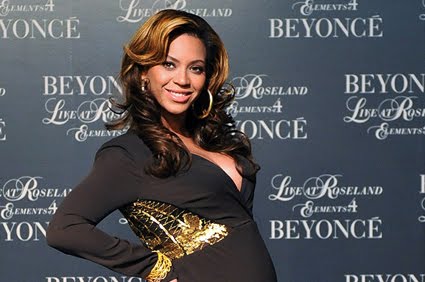
What? Natural childbirth advocates don’t support Beyonce’s choice?

If there is one thing that natural childbirth advocates are very clear about it is supporting women’s choices in childbirth. Women have the right to make whatever decisions they want about their own bodies. Therefore, NCB advocates loudly and wholeheartedly support Beyonce’s decision to have a C-section.

Wait, what? They DON’T support Beyonce’s decision?

Well maybe it’s because it wasn’t medically indicated. There was no reason for Beyonce to have a C-section. She was just too posh to push.

Wait, what? There was a medical indication? The baby was breech?

Okay, but that doesn’t mean she couldn’t have had a vaginal birth. Breech vaginal birth is safe for all babies. That’s what studies show.

Wait, what? Breech birth is only safe under certain very stringent conditions? And even then it increases the risk of neonatal death?

Okay, maybe the C-section was medically indicated, but certainly not the timing of the delivery.

Wait, what? Beyonce could have had premature rupture of membranes, pre-eclampsia, intra-uterine growth retardation or any of a host of other medical indications for early delivery?

But think of everything that could have gone wrong! These very serious, indeed life threatening complications are very common.

Wait, what? These complications are rare? They are far less common than the life threatening conditions of pre-eclampsia, intra-uterine growth retardation or neonatal sepsis?

Well at least Beyonce took to heart the natural childbirth advocacy belief that women must give birth in privacy and in the way that they are the most comfortable. That’s why NCB advocates thoroughly support Beyonce’s decision to rent an entire hospital floor to be sure that her privacy was not invaded.

Wait, what? They don’t support her decision to create privacy for herself? Privacy is only for those who choose to give birth at home?

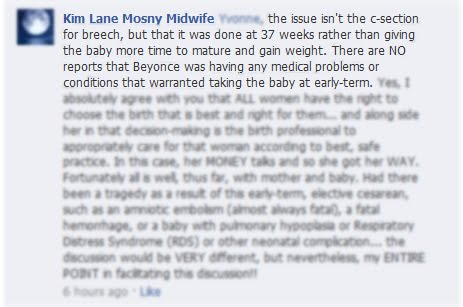
But good people can disagree. That’s why Kim Mosny, CPM allows everyone to express their opinions on her Facebook page.

Wait, what? Dissent will not be tolerated?

In the end, though, all that matters is a healthy baby. That’s why NCB advocates support women in choosing breastfeeding or bottlefeeding.

Wait, what? …

Dr. Amy