Lose your license, keep practicing homebirth midwifery

The utter contempt with which homebirth midwives greet attempts to hold them accountable for homebirth deaths and disasters is truly amazing. Consider Melissa Cheyney and company enshrining into Oregon law the ability to practice homebirth midwifery without regulation of any kind including a license, Amy Medwin in North Carolina soliciting funds from her midwifery colleagues to pay the fines stemming from her felony guilty plea, or Lisa Barrett who is so contemptuous of the law as to tweet from the courtroom during her Coroner’s Inquest. But for sheer nerve, you can’t beat the midwives who been stripped of their licenses and continue practicing homebirth midwifery.

Case in point: Kaleem Joy (aka Jody Lyn Robinson, aka Jody Lyn Brecke) of One Heart Midwifery in Citrus Heights, California.

Kaleem/Jody is cool as you please in advertising her illegal midwifery practice on her own professionally designed website.

Midwifery for me is a joy. To enlighten woman to their power and strength and to support them in giving birth to their babies safely and satisfyingly at home… It is especially important to me that babies be respected and honored in their ability to be born and celebrated. I am there to watch over safety, this I know. But I expect the best and the best happens. We use medical equipment when needed. I use my tools of the trade i.e.: homeopathy, herbs, cranial sacral therapy, awakening a woman to the truth about birth and it’s power and purpose, nutrition, education and my optimisms. Trust is really the key.

Kaleem/Jody boasts about her midwifery license and RN, as well as her myriad of “degrees” in quackery:

… Very simply I have been a pediatric RN, Licensed midwife, and am now a Certified Professional Midwife, Massage Therapist specializing in Cranial Sacral Therapy of newborns, infants and pregnant woman. I have a Certificate degree in homeopathy that I graduated with honors and have self studied herbs for over 20 years.

In her CV, she boldly proclaims:

RN 1983-2005 …
Licensed Midwife of State of California 1997– 2003 …

She does not mention that the midwifery license, and subsequently the RN, were stripped from her for gross negligence:

… [O]n and between January 10, 2000 and January 12, 2000, Respondent committed acts constituting gross negligence for patient M.I.’s labor and delivery … Respondent admitted the truth of the charge … resulting in the surrender of her Midwife Certificate No. LM-63.

Subsequently Kaleem/Joy’s RN was revoked. The revocation was initially stayed, pending satisfactory completion of a 3 year probation. She failed to meet the probation requirements and was stripped of her RN.

The loss of her midwifery license means that Kaleem/Joy is no longer entitled to practice midwifery in Califoria, but that hasn’t stopped her from attending births and publicly advertising her services. And the best part? Kaleem/Joy teaches midwifery students.

The midwifery students are practicing on roasts using sutures and instruments with sterile fields and yes even head lamps. We cut a hole out to simulate a yoni and asked them to do interrupted, basting, and figure 8s. The week before we did knot tying with instruments and yarn…

… Sisterhood among students and midwives and among the midwifery community as a whole, is the heart of the midwifery.

Homebirth midwives like Kaleem/Jody should be prosecuted for practicing midwifery without a license. It is nothing short of appalling that a homebirth midwife commits gross negligence, loses license and continues practicing homebirth midwifery and publicly advertising that illegal practice.

Ignore the dead babies, or else.

iStock_000015744306XSmall

Homebirth midwives abhor being held accountable for letting babies die preventable deaths. When they’ve exhausted their typical gambits: the “baby would have died anyway” gambit, the “some babies just die” gambit, and the “mother is responsible for the baby’s death” gambit, they move on to what they consider the ultimate threat.

That would be the “ignore the dead babies, or other babies will die” gambit.

It’s what Mark Twiggs, lawyer for the indefensible Lisa Barrett, is employing in a last desperate attempt to sway the coroner’s court as well as the court of public opinion.

According to today’s piece on an Australian TV channel:

Greater regulation of home births would force women determined to avoid a hospital birth to go “underground”, increasing the risks for mother and child, an inquest has heard…

In final submissions on Friday, counsel for Ms Barrett, Mark Twiggs said mothers who chose to have a home birth should not be considered uneducated or naive.

He said such women had considered the risks and were determined to avoid delivering in hospital.

“They have studied and made a choice, and they should always have that free choice,” he said.

Mr Twiggs said more regulation surrounding home births would take away that choice.

“They need help, but heavy regulation is going to push these people underground,” he said.

In other words, Twiggs warns that if the Coroner’s Court doesn’t let Lisa Barrett get away with murder, other midwives might refuse to participate in future avoidable homebirth deaths and then what would happen? Homebirth advocates might resort to homebirths without a midwife and OTHER BABIES COULD DIE!!! Simply put, if the Coroner’s Court doesn’t allow Lisa Barrett to kill babies, mothers might do it themselves.

This threat (for it is a blatant threat) is absurd on a variety of levels. First, it is a false empirical claim; indeed, it is really two empirical claims, neither one of which is proven.

The first empirical claim is that punishing homebirth midwives for preventable neonatal deaths will have no deterrent effect because those same women would had homebirths anyway and their babies would have died anyway. That could be true, but there’s no evidence that it is true. Moreover, it conveniently ignores the enabling role played by the midwife herself. When a midwife like Lisa Barrett ensures the mother that homebirth in her situation is safe, she encourages that homebirth. It is equally if not more likely that a homebirth midwife, by telling a mother that the risk of the baby’s death is so great that she won’t get involved, will lead the mother to conclude that hospital birth is the safest option for her baby.

The second empirical claim is implied: homebirth midwives are preventing more deaths than they cause. Sure these babies died at Lisa Barrett’s hands, but she must have saved some babies who would have died otherwise. In other words, yes, homebirth midwives kill babies, but they save even more babies. There’s no evidence that is true, either. Where’s the data that shows that neonatal deaths at homebirth have dropped since allowing midwives to attend homebirth? There isn’t any and there isn’t likely to be any. That’s because babies die at home for lack of emergency C-section facilities and for lack of expert neonatal resuscitation. Parents cannot provide these, but homebirth midwives can’t provide them, either. Homebirth midwives could theoretically be saving lives, but there’s certainly no evidence that they do, and certainly no evidence that they save more lives than they lose.

Leaving aside the fact that it is based on unproven claims and assumptions, the threat is remarkably cold blooded. It’s essentially a hostage claim: yes, we killed these babies, but you shouldn’t punish us because if we’re not allowed to let hostages die, then less professional hostage takers (parents) will take over and even more hostages will die.

Twiggs is accurately representing Barrett in this threat. She expresses no remorse for the preventable deaths of these babies. She refuses to take any responsibility for these deaths. Indeed, by all appearances, she doesn’t especially care that they are dead. But she knows that the judges care. So she threatens that if she is not allowed to get off for letting these babies die, even more babies will die. But this is not a seminar in utilitarian theory. We don’t accept the death a few babies just to prevent the entirely theoretical deaths of a few more.

Tate Spencer-Koch and Jahli Jean Hobbs died utterly senseless, totally preventable deaths because Lisa Barrett didn’t know what she was doing and didn’t care, either. She is responsible for those deaths and she should be held accountable for those deaths. No less an authority than the Australian Supreme Court deemed that Barrett could not avoid being investigated by insisting that the babies were dead when they were actually alive.

The coroner’s inquest that Barrett feared has demonstrated that she, in her hubris and ignorance, is responsible for those deaths. The Coroner’s Court should hold Barret accountable for these deaths and should not be swayed by her last, desperate gambit, the claim she should be allowed to let babies die or else mothers will do it themselves.

Melissa Cheyney and Oregon homebirth midwives channel the Flintstones

Remember the Flintstones?

Flintstones, meet the Flintstones
They’re the modern stone age family
From the town of Bedrock
They’re a page right out of history

Let’s ride with the family down the street
By the courtesy of Fred’s two feet …

The conceit of the Flintstones animated series is that prehistoric life faithfully emulated modern life except machines used rocks, animals and people power in place of motors. Hence Fred drove a car, but made it move using his feet. Wilma vacuumed the floor using a mammoth’s trunk (connected to a live mammoth).

Melissa Cheyney and the homebirth midwives of Oregon have set out to create the Flintstones version of midwifery. How else to explain Auscultated Acceleration Testing?

First a little background. I have written many times about fetal monitoring and how intermittent auscultation provides only a fraction of the amount of information of an electronic fetal monitor. For example, intermittent auscultation is incapable of parsing the most ominous fetal heart rate tracing.

In addition, intermittent auscultation cannot be used to verify the well being of the baby through a non-stress test (NST). Not until now that is, since Melissa Cheyney recently came up with the Flintstones version of an NST!

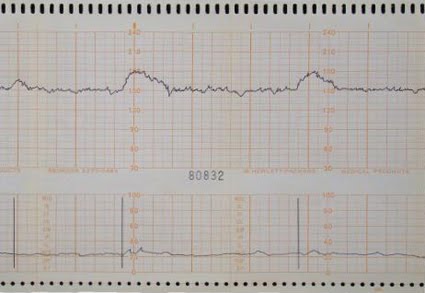
A non-stress test, as its name implies, evaluates the baby in the absence of pitocin induced contractions. NSTs are graded reactive or non-reactive. In a reactive NST, the fetal heart rate accelerates for at least 15 beats per minute (bpm) above the baseline for at least 15 seconds, at least twice in a twenty minute period. The NST is the gold standard for determining fetal well being. A reactive NST is almost a sure sign of a healthy baby.

Here’s an image of a reactive NST. You can see that the baseline fetal heart rate is 150 bpm and there are two accelerations up to 180 bpm, each lasting approximately 40 seconds.

Not surprisingly, it is impossible to perform an NST using intermittent auscultation, which is a problem for homebirth midwives since it is the gold standard for assessing fetal well being. But wait! What would the Flintstones do? The Flintstones would jury rig a set up that appeared to be able to perform the same function using only the tools available to them, but could never actually work in reality.

Melissa Cheyney and colleagues have brazenly (and with a straight face) proposed the Flintstones alternative to an NST. It is called Auscultated Acceleration Testing. Not surprisingly, it requires tools that are easily accessible to a homebirth midwife such as a fetoscope and a watch with a second hand.

Here’s how is “works”:

Step 1 – Listen to fetal heart rate (FHR) for 2 minutes to establish a baseline rate.

Step 2 – To do this, count the FHR in every other 5-second increment and record on an AAT collection graph.

Step 3 – If an acceleration of 2 beats per 5-second period does not occur during the initial 2 minutes, then perform an external manual manipulation of the fetus using a 5-second external stimulation 3
procedure.

Step 4- If no fetal movement occurs in the 2 minutes following the initial shaking procedure, repeat steps 1, 2 and 3.

Step 5 – Continue collecting data for an additional 2 min. and end at 6 minutes.

It’s difficult to imagine anything more moronic. First of all, using a regular watch means that there is no way to know if it is keeping time correctly. This is especially critical considering that the “test” involves measuring heart beats in 5 second increments and multiplying by 12 to obtain the heart rate. Even the tiniest error in timekeeping is going to be magnified by a factor of 12, rendering any results meaningless.

Second, the extremely small time increment means that any error made by the time keeper is also multiplied by a factor of 12. Consider that the normal fetal heart rate is anywhere from 120-160 bpm. In a 5 second increment, that would be 10 – 13.3 beats per increment. It is literally impossible to get an accurate reading of the fetal heart rate by listening to a 5 second increment.

Even if it were possible to get accurate, meaningful information from this exercise (and it is not), it does not even meet the criteria for a reactive NST, which translated into 5 second increments would be a sustained increase lasting at least three 5 second increments.

So this is a test done with an inaccurate timekeeping device by an inaccurate time keeper (since it is literally impossible to get an accurate reading of fetal heart rate in a 5 second increment) that doesn’t even provide the information needed to satisfy the criteria for a reactive NST. It is to an electronically monitored NST what Wilma using a mammoth trunk is to vacuuming. It provides a bizarre cartoon appearance of an NST that can’t possibly work in the real world.

From where did Wilma Flintstone Melissa Cheyney dredge up this bit of idiocy?

According to the protocol, it comes from Paine, et al. A comparison of two time intervals for the ausculated acceleration test, (2001) Journal of Midwifery and Women;s Health. The paper begins:

Midwives around the world often work with minimal resources because technology is not available to their populations. In locations where electronic fetal monitoring (EFM) is available, the nonstress test (NST) is currently the most widely used technology for screening fetuses at risk for antepartum fetal death or other poor perinatal outcomes. In other settings, low-technology methods such as fetal heart rate auscultation or maternal fetal movement counting may offer the only means of antepartum assessment available to midwives. Interest in an inexpensive, easy-to-use antenatal screening test lead to the development of the auscultated acceleration test (AAT) in the late 1980s. Using a fetoscope, midwives or nurses can easily administer this test, which is conducted without the use of EFM.

In other words, this test can be used as a middling to poor substitute for an NST in developing countries where there is no access to electronic fetal monitoring. It is NOT in any way a substitute for a real NST, which, as we already know, is the gold standard.

(Just as an aside, this paper cited in support of the accuracy of the auscultation test is grossly underpowered to measure anything and therefore, is meaningless).

Let’s review:

1. Melissa Cheyney and the Board of Direct Entry Midwifery have implicitly acknowledged that the NST is the gold standard for assessing fetal well being.

2. Homebirth midwives have no access to the technology. (That, of course, means that they have no business taking care of women, but that’s another matter altogether).

3. Therefore, they’ve come up with the Flintstones equivalent of an NST, a test that was literally designed to be used in places that have little more than stone age technology.

4. This Flintstones equivalent, just like the mammoth vacuum looks like an NST, but just as the mammoth vacuum doesn’t clean the floor, the auscultation acceleration test literally cannot produce any meaningful results. That’s because the measuring instrument (a watch) is not calibrated for accuracy; the time keeper listening in a 5 second increment is literally incapable of accurately calculating the fetal heart rate, and the test has never been shown to work in any case.

Exactly how stupid does Melissa Cheyney think the women of Oregon are? How stupid does she think the legislators of Oregon are?

This is not a “test.” This is yet another pathetic effort to convince everyone that no education and no technology are required to ensure fetal health at the hands of birth junkie hobbyists who can’t be bothered to get a real midwifery degree and simply proclaim themselves “midwives.” It is an attempt to fool the public and fool the regulators into letting these self proclaimed midwives make money despite their ignorance, regardless of how many babies are harmed or die in the process.

For those who believe that this is anything other than a brazen, self serving attempt to protect hobbyist “midwives” at the expense of babies lives, I’d like to sell you a mammoth vacuum cleaner that you’ll just love.


How many homebirth advocates does it take to change a light bulb?

Ten:

One to teach the course “Empower yourself by changing your own light bulb.”

One to whisper affirmations encouraging the light bulb to be in the correct position.

One to photograph the event.

One to tweet the event live.

One to fill the kiddie pool. (Note: professional electricians claim that standing in water while changing a light bulb is dangerous, but they just say that to ruin your light bulb changing experience.)

One to call 911 if you get electrocuted while standing in water while changing the light bulb.

One to reassure you that people get electrocuted changing light bulbs even when they are not standing in water, so you shouldn’t let the warnings of those stupid electricians scare you.

One help you eat while changing the light bulb in order to keep up your strength.

One to tell you to turn the bulb only when you get the urge.

And finally, one to actually change the light bulb and pretend to have an orgasm while doing it.

This post first appeared in April 2010.

Is there any limit to the stupidity of homebirth advocates?

I read this story, and all I could think of was the Disney Superbowl commercials where the announcer asks the winning quarterback what he’s going to do next, and the quarterback says he’s going to Disney World.

Announcer: Hey, Mrs. Bernstein, your baby was just left profoundly brain injured by your decision to have a homebirth. What are you going to do next?

Mrs. Berstein: I’m going to refuse to vaccinate him!

There are two possible responses to precipitating a death or disaster because of homebirth nonsense: those with a modicum of critical thinking skills ask themselves whether, perhaps, since their beliefs about homebirth turned out to be entirely wrong, their other pseudoscience beliefs might also be wrong. But for those for whom pseudoscience is akin to religious beliefs, and where critical thinking skills are never applied, they just keep believing … and keep putting their innocent child at risk of death because of their own stupidity.

Consider this new thread on Mothering.com, Needing help with my backbone please, in the vaccination forum. mrsbernstein writes:

Due to circumstances that I would change in a heartbeat if I could, my son had severe hypoxia during birth (and subsequent brain injuries). He is currently “delayed” and is almost 10 weeks old…

Our original plan was the Select/Delay. And managed to find a Ped that was/is VERY willing to go along with this AS LONG AS we do the TDap on “schedule.” And my dear babe is “scheduled” to get the Vax on Monday.

Along with the “medical” route of handling my son’s brain trauma, we are also seeking alternative routines of care. One being with our family Chiro who is ADAMANT that we don’t start ANY vaxes until age 2 … and maybe not even then…

I’m so torn as what to do… My gut is saying “NO”. But my mind and family are justifying JUST THIS ONE.

So let’s see if I get this straight, Mrs. Bernstein. Your gut told you to have a homebirth and it left your baby profoundly brain damaged. Now your gut is telling you avoid vaccination and you think you should listen to it??!!

You’ve already hurt your child very badly through your personal beliefs. Here’s a suggestion: please consider that your “gut” is worse than useless, and start educating your brain. And by education, I do not mean researching things on Mothering.com a virtual cesspool of idiotic beliefs and scientific ignorance.

It is IMPOSSIBLE to make an educated decision about vaccination without an education in immunology. You can either choose to listen to someone who does know and understand immunology (a pediatrician) or you can choose among a plethora of charlatans, like chiropractors and homebirth midwives, whose ignorance will hurt and perhaps kill innocent children.

Mrs. Bernstein, you have already made one hideous mistake. Please learn from it:

Your “gut” is not trustworthy. Your MDC friends are not knowledgeable. Your use of alternative practitioners is deadly, and your child has already been profoundly injured by your well meaning ignorance.

You have screwed up in the worst possible way, but you probably didn’t understand that pseudoscience is dangerous. Now you know that it can maim and kill; don’t screw up again.

What’s in it for the midwife?

You’re thinking about homebirth and you are interviewing the midwife. Or perhaps you’ve already decide on a homebirth, but you have developed a complication and you need to decided whether to deliver in a hospital instead. Maybe you’ve decided on a homebirth, but you haven’t decided whether to have the tests routinely included in MD supervised prenatal care.

You’ve asked the midwife for her opinion, but before you decided to accept it, you need to ask yourself a critical question: What’s in it for the midwife?

For better or for worse, most obstetricians have no vested interest in how you end up with a healthy baby. Most obstetricians make no extra money for a C-section, and they certainly don’t profit from fetal monitoring, routine prenatal tests, ultrasound, induction, just about any intervention you can think of. Homebirth and NCB advocates routinely deride “defensive medicine” but even that it about giving you a healthy baby. They order tests and recommend interventions because they think it will increase the chances of an excellent outcome, not because it will line their pockets.

The situation is entirely different for a homebirth midwife. She stands to make money if she can convince you that you need nothing more than what she knows how to provide. She stands to lose money if she can’t provide what you need. Therefore, it is important to understand that an inherent financial conflict of interest exists for a homebirth midwife at every juncture requiring a decision.

Are you a good candidate for homebirth?

For homebirth midwives, this is the threshold financial issue. Unless they can convince you that it is safe for you to give birth at home, they can’t make any money from you. Therefore, they have a tremendous financial incentive to minimize any and all risk factors. Previous C-section? Previous shoulder dystocia? High risk condition in pregnancy? In any of these cases, you are not a good candidate for homebirth. If your homebirth midwife tells you that you are, ask yourself: what’s in it for her?

Following her financial interest will lead her to tell you that you are a good candidate even when you are not. A midwife who is not distracted by her own financial concerns will tell you honestly that you are at greater risk of a poor outcome. She may offer to attend you anyway, to facilitate whatever choice you make, but if she denies you are at increased risk, you should be asking yourself whether she is worried about her wallet instead of being appropriately concerned about you.

Should you be tested for gestational diabetes?

This one is a no brainer. The primary treatment for gestational diabetes is diet. Any pregnant woman contemplating homebirth is almost certainly very careful about her diet, eating only what she believes is best for her baby. Learning that she needs to cut down on sugar to keep her baby safe is valuable information and it is easy to act on it.

There may be a downside for a homebirth midwife, though. She may not have access to the equipment needed for the screening test or the follow up test if the screening test shows a problem. Or a diagnosis of moderate to severe gestational diabetes might risk you out of a homebirth, depriving her of income. There’s a lot of potential downside to a homebirth midwife in following the recommendation to screen for gestational diabetes. Therefore, if your midwife tells you it’s okay to skip the test, consider that it benefits her, but it does not benefit you and it certainly does not benefit your baby who may be exposed to excess blood sugar for weeks or even months.

You are measuring unusually large or small for dates. Should you have an ultrasound?

If the issue turns out to be as simple as an error in your due date, both you and the midwife will benefit from having the information. However, if there is a problem like intra-uterine growth retardation or if it turns out you are carrying twins, you are no longer a good candidate for homebirth. If your midwife tells you that it’s not an issue if you are consistently measuring smaller or larger than dates, she is thinking of herself, not of you. If you have the information an ultrasound will provide, you might decide to change your provider. That’s a financial loss for her.

Should you be tested for group B strep?

Group B strep is the leading infectious threat to newborn babies. Since routine screening and IV antibiotics in labor for women who are found to be GBS has been instituted, the neonatal death rate from GBS has dropped 70%.

For most homebirth midwives, though, GBS testing is all downside. They may not have access to the screening test. They may not have access to IV antibiotics. They may not know how to put in an IV. It is ever so much more covenient for a homebirth midwife to ignore GBS than to acknowledge the danger. If a homebirth midwife recommends not testing for GBS or if she recommends something other than IV antiobitics for treatment, she is making a decision that benefits her and puts your baby at risk. It is not in her interest to be honest about GBS, so you have to think long and hard about whether to take her recommendation to avoid screening and/or conventional treatment.

You are 41 weeks. Should you have a non-stress test and a biophysical profile (ultrasound)?

Does your midwife have easy access to that technology? If not, and she tells you that you don’t need to check the well being of your postdates baby, you need to ask yourself why. Is it truly because the tests are unnecessary, or is it because she can’t arrange them for you or she doesn’t want to have you risked out of her care if the NST or biophysical profile are abnormal?

You are 42 weeks? Should you have an induction?

Whether you decide to have an induction or not, you should know that going beyond 42 weeks doubles your baby’s risk of death (and that’s in the hospital; it’s almost certainly much higher at home). Your midwife cannot perform an induction and thereby loses control of your care. She has financial and personal benefits to denying the increased risk of postdates and denying the benefit of induction. If she tells you to avoid induction for postdates, you need to ask yourself whether she’s doing so because of what’s in it for her, or because it is truly the best course for you.

Should you transfer in labor?

There’s thick meconium. Or there’s an unusual amount of bleeding. Of labor is going far more slowly than normal. Should you transfer to the hospital? You’ve probably paid the midwife by now, so there’s no financial incentive for her but there is an even more powerful motivation at work. If you transfer to the hospital, she may end up in legal trouble. It is far better for her to convince you to stay home than to let you transfer to a hospital. When she begs you to trust birth, ask yourself: is that for your benefit and the safey of your baby or is it to protect herself?

The financial incentives for homebirth midwives are almost always in opposition to what is safest for you and your baby. For a homebirth midwife, ignorance is bliss (and cash). It is better for her not to know about complications, better for her not to test for high risk conditions, better for her not to treat problems that she doesn’t have the equipment or experience to treat and better for her not to transfer to the hospital. But all too often, it is not beneficial or even safe for you and your baby.

Homebirth midwives want to convince you that you never need more than what they can provide. They have a vested interest in denying the validity of tests they cannot order, monitoring they cannot offer, and treatments they cannot access. The next time your homebirth midwife recommends ignoring conventional medical practice, ask yourself: what’s in it for her?

Homebirth midwife pays out $1.9 million

The homebirth midwife trusted birth and the baby suffered permanent brain damage. It appears, however, that this homebirth midwife carried insurance. Although it does not change the fact that their child is disabled, it allowed the parents to sue and obtain a large settlement that will be used to care for their son.

According to the American Association for Justice website:

Ara Flores delivered her first child at home with the assistance of Gale Aucott, a certified nurse midwife. Aucott monitored Flores’s baby using a stethoscope and fetal doppler. After pushing for almost three hours, Flores gave birth to a son. He was born with Apgar scores of two at one minute and four at five minutes. Now 5, he suffers from permanent brain damage, seizures, and other problems.

Flores and her husband sued Aucott’s employer, alleging Aucott failed to recognize and properly respond to fetal distress and failed to transfer Flores to the nearest hospital after she had been pushing for two hours. Among other claims, the plaintiffs asserted that Aucott should have monitored the baby every 10 minutes instead of every 45 minutes.

The lawyer’s website reports:

Plaintiffs’ experts maintained that the Defendant mid-wife failed to appreciate a prolonged second stage of labor and that the mother needed to be transferred the nearest hospital once her second stage of labor approached 2 hours. Long second stages of labor are associated with increased fetal and maternal morbidity and mortality because fetal reserves may become low from the stress of prolonged labor and pushing. Plaintiffs maintained that long second stages of labor may be indicative of impending problems and the Defendant mid-wife failed to appreciate or react to the length of the second stage which was at minimum 2 hours and 47 minutes.

The midwife did attempt to defend herself.

The multiple defense experts opined that the second stage of labor was not too long and did not necessitate that she be transferred to the nearest hospital. A neuro-radiologist expert for the defense also maintained that the child’s neurological insult occurred several days before the birth.

But her most creative attempt at defending herself is more than a bit ironic:

Finally, the defendant’s obstetrical expert testified that because the home birth did not include the use of electronic fetal monitoring it was impossible to know whether the baby was in a hostile intra-uterine environment and required an emergency cesarean section.

There you have it, folks. A homebirth midwife declared that she did not know that the baby was suffering from a lack of oxygen during labor because it is impossible to tell with only intermittent auscultation. If you really want to know if a baby is in distress, you have to use electronic fetal monitoring.

What’s the difference between scientific research and midwifery research?

Midwives have a large and ever growing problem with scientific research. The stark reality is that scientific research demonstrates that most of what is exclusive to midwifery is unsupported by scientific evidence and much of it (including all of homebirth midwifery) is irrational.

Hence, there is a large and ever growing divided between midwifery research and scientific research. Scientific research seeks to learn, specifically to learn how the human body works and how to maximize healthy outcomes. Midwifery research, in contrast seeks to justify, specifically to justify a primary role for midwives in the delivery of obstetric care.

Midwives make no bones about it. Consider the chapter, RCTs and everyday practices … a troubled relationship, in the leading textbook on midwifery “evidence,” Promoting Normal Birth – Research, Reflections and Guidelines, edited by Sylvie Donna.

RCTs are randomized controlled clinical trials, generally considered the gold standard of scientific research. Why is the relationship between RCTs and everyday midwifery practices troubled? Because RCTs (like most methods of clinical research) don’t support the practices exclusive to midwifery. Therefore, scientific research, which seeks to learn. must be discarded in favor of midwifery research, that exists only to justify midwifery.

The author of the chapter, Jette Aaroe Clausen, makes it clear that midwives have nothing against scientific evidence per se. If it supports midwifery practice, it’s fine, but she rails against the “hegemony” of science when it does not support practices exclusive to midwifery.

… It is now take for granted that evidence always improve midwifery care. Evidence has gained a hegemonic status in midwifery and obstetrics …

Clausen approvingly quotes Murray Enkin, a supporter of midwifery and evidence based medicine, who apparently has recommended that there must be a parting of the ways:

… The power of randomised trials, particularly as they feed into official health care guidelines, is enormous. They are a form of advice unlike ordinary advice; because of pressure to conform, there may be no option to refusal. The ‘scientific evidence’ has achieved a mythical status; it is excessively powerful rhetoric, a tool that has so easily become a weapon.

No one can accuse midwifery advocates of hiding their motivation. Truth isn’t even mentioned, because midwifery advocates are uninterested in what is true. The reference to scientific evidence as a weapon is particularly revealing. Midwives used to promote scientific evidence as a tool that could be used to undermine obstetrics. But it turns out that scientific evidence undermines midwifery instead and therefore it is nothing more than a weapon against aims of midwifery advocates.

Clausen goes on to illustrate this “problem” with an excruciatingly stupid attempt to justify monitoring the fetal heart rate with the Pinard stethoscope over the far more accurate Doppler. I won’t bore you with a complete recounting of a justification that can only be charitably described as idiotic, but I will offer a few choice quotes for your entertainment. Interestingly, both the Pinard vs. the Doppler have absolutely nothing to do with the role of RCTs in midwifery and obstetrics, but I guess if you are writing a thoroughly nonsensical chapter arguing for ignoring scientific evidence, using an example that has nothing to do with the subject at hand has a certain “logic.”

And no, the following quotes are not satire:

‘Listening to the stomach’ and ‘listening to the fetal heart’ are often understood as synonymous acts.

How can we describe the relationship between the midwife and the Pinard? Verbeek describes the relationship between the experienced midwife and the Pinard as an embodiment relationship, i.e. she becomes a ‘Pinardmidwife.’

[M]any midwives use ‘listening to the stomach’ as a way of bringing the mother child relationship to the foreground.

In fact, the Pinard can be used as more than a medical device or a connecting tool. Some midwives use the silence of the Pinard to keep the unborn baby inside the woman’s body …

The Pinard invokes a private and intimate connection to the unborn baby because only one person can hear the fetal heart sound … whereas the [Doppler] invites multiple listeners to share the sound.

What does this have to do with RCTs? Nothing. What does this have to do with scientific evidence? Nothing. What is the purpose of this bizarre exposition within a chapter purporting to discuss the deficiencies of the RCT? Beats me, but Clausen thinks she has accomplished something:

I have now illustrated the relationship between everyday midwifery practices and randomized trials. Randomised trials are not innocent experiments… Since some randomized trials come to carry tremendous authority they carry the potential to destroy local productive practices… As one standard prevails, other standards cease to exist.

Ahh. We have come to the heart of the matter. Scientific evidence in general, and randomized clinical trials in particular have the potential to destroy the authority of the midwife. As her “standards” of practice are revealed to be based on what enhances her role rather than what promotes safety, she is being displaced.

In case that wasn’t clear enough for you:

… [T]he use of randomised trials trials and the promotion of evidence based midwifery come at a price. Evidenced-based medicine is strongly connected to positivist science, and within this framework, everyday midwifery practices can easily be framed as irrational and unfounded …

What’s the problem with scientific evidence in general and RCTs in particular? Simply put, they make midwives look like fools.

Homebirth and cognitive biases

One of the most bizarre aspects of homebirth advocacy is the insistence that “babies die.” Why do homebirth advocates blithely offer this cold blooded claim, at odds with everything they profess to believe about the trustworthiness of birth, in the wake of every homebirth death?

They are desperate to resolve the cognitive dissonance between what they believe about birth (“trust birth”) and the homebirth disasters that result because birth is inherently dangerous and homebirth midwives are woefully incapable of preventing, diagnosing and managing homebirth disasters. Most people, in the face of scientific evidence, would alter their beliefs to conform with the evidence. However, many homebirth advocates are so desperate to believe in the safety of homebirth that they direct their efforts, instead, to bolstering their beliefs. To do that, they employ a variety of cognitive biases.

According to Michael Shermer, in The Believing Brain, subtitled in part How We Construct Beliefs and Reinforce Them as Truths allow people to confirm beliefs in the face of evidence that those beliefs are not true.

Cognitive biases come in very handy in homebirth advocacy. As the number of homebirths resulting in dead babies begins to climb, homebirth advocates fall back on cognitive biases that allow them to maintain belief in the safety of homebirth in the face of evidence that homebirth is not safe. There are many different types of cognitive biases.

1. Confirmation bias

Shermer describes confirmation bias as “the mother of all cognitive biases.” Confirmation bias is:

the tendency to seek and find confirmatory evidence in support of already existing beliefs and ignore or reinterpret disconfirming evidence.

Ever wonder why birth stories play such an important role in homebirth advocacy? This is why. Every story with a successful outcome serves to confirm the belief that homebirth is safe. The “best” stories, of course, are those in which women were warned of possible bad outcomes, but had a good outcome. Sure the woman was told that a VBAC after two previous C-sections could result in a ruptured uterus and a dead baby. But look! She had a healthy baby! Not only did she teach those doctors a lesson, she provided other homebirth advocates with a story that confirms their belief that homebirth is safe.

2. Hindsight bias

Birth stories with happy outcomes are a form of hindsight bias. Homebirth advocates love to make fun of the “fear-mongering” doctors who warn against dire outcomes. What better way to do it than to take a story that you already know will have a happy ending, and disparage the warnings of the doctors who had no way of knowing what the outcome would be?

3. Self-justification bias

Shermer defines self-justification bias as:

the tendency to rationalize decisions after the fact to convince ourselves that what we did was the best thing we could have done. Once we make a decision … we carefully screen subsequent data to filter out all contradictory information related to that decision … One of the practical benefits of self justification is that no matter what decision we make … we will be satisfied with the decision, even when the objective evidence is to the contrary.

Self justification bias leads a mother who has been warned repeatedly that she is not low risk to “why me?” in the wake of her baby’s death. That’s why Annie Bourgault, who was advised to have a C-section for malpositioned twins, “doesn’t understand” why one of her babies died. The reason, obviously, is that she made a bad decision, but she will not accept that reality. Instead, she insists that there was no way to know in advance that this would happen.

“Babies die” is a form of self-justification bias. The implication is that the baby would have died in the hospital anyway or in the variation “babies die in the hospital, too” would have died from some other, iatrogenic, cause in the hospital. This allows the mother to console herself that her decision to have a homebirth was correct, despite the dead baby that is objective evidence to the contrary.

These cognitive biases demonstrate why it is critical that the ever growing number of birth stories that end in disaster are not suppressed and are easily available for any woman to read. If every story of homebirth on the web ends with a happy outcome, it will merely confirm the beliefs of homebirth advocates without acknowledging the reality of homebirth dangers.

Birth stories that end in the death of the baby don’t confirm the homebirth advocacy assertion that trusting birth is all that is needed for a good outcome. They show that the hindsight bias of the happy stories is just that, bias. The outcome easily could have been disastrous. Most importantly, they provide objective evidence that homebirth is not safe.

Yes, homebirth advocates will use the self-justification bias that “babies die” to insist that the death was inevitable, but those who are not ideologically committed to the belief that homebirth is safe will see it for the self-justifying tactic that it is.

Postdates + long labor + CPM = dead baby

The whole “trust birth” thing continues to work out very poorly for homebirth midwives, the mothers they serve, and most of all the babies who die preventable deaths because of their lack of education and training.

At this point, it appears that homebirth death stories are becoming so common that mothers report on them without anger and even without surprise. Consider the homebirth death that occurred yesterday in the Santa Cruz area under the care of “Rebecca, CPM.”

The mother was not sure of her due data, but believed it to be sometime in late August or early September. So this baby was postdates, but as we know “babies aren’t library books do on a certain date;” we just have to trust birth.

And the labor was extremely long, beginning at 1 AM, progressing to 3 cm 18 hours later. That falls within the definition of prodromal labor, but progress continued to be extremely slow. She was 5 cm at 3 PM and 9 CM at 7 AM the next morning. In other words, it took 6 hours to go from 3 to 5 cm, and was only 9 cm 16 hours after that. Fortunately, they weren’t in the hospital where doctors would have overreacted and probably performed a C-section nearly 12 hours earlier. No, no C-section for them. They were trusting birth.

At that point, though, the CPM’s “trust” began to flag. According to the mother:

Around 7am Rebecca told us that we needed to go into the hospital. Although we were getting the heart beat it was in a hard place to get (very low near my left hip.)

As Rebecca almost certainly understood, the baby’s position was not low enough for the heartbeat to be heard right above the hip. She probably suspected that she had been listening to the mother’s heart beat, not the baby’s. Mom and Dad headed off to the hospital, but, curiously, Rebecca did not accompany them.

Even though she was anxious to get far away from what she suspected was an utter disaster, she had the decency to call the hospital and explain that she was unsure about the baby’s heart rate. Though she never bothered to inform the parents, the hospital staff knew they had an emergency on their hands.

Once we got to the hospital, we were rushed into a room right away. Rebecca had called and let them know why we were coming in. The nurse had trouble getting the baby’s heart beat on the external monitor. The doctor came in to break my water bag and do an internal monitor. She broke my water bag and said, “Meconium thick.” This was my first idea that something was wrong. Then she put in the internal monitor. There wasn’t a heartbeat. I knew then that our baby had died. Of course they checked to make sure everything was plugged in, and got an ultrasound, and a second ultrasound. Then the doctor turned to us and told us that our baby had died…

At some point during the 54 hours of labor, the baby stopped getting adequate oxygen. The baby expelled meconium repeatedly, suggesting that she suffered for hours. An electronic fetal monitor would have made it clear that the baby was oxygen deprived, but they didn’t want that, because they were trusting birth. As is all too common at homebirth, the baby died after a long struggle and the CPM not only had no idea that the baby was struggling, but she had no idea that the baby was dead.

To summarize, a postdates mother was allowed to labor for 54 hours with grossly inadequate monitoring of the baby and the baby died a completely preventable death. Why? Because the parents trusted a CPM, an ignorant, undereducated, undertrained, self proclaimed “midwife” who blithely sat by completely clueless while a baby’s life ebbed away.

The mother’s ordeal was not over; she continued with her plan for a “natural” birth, though she did agree to pitocin. The baby was very large and the shoulders got stuck. Since the baby was already dead, there was no urgency, but the fact that it took doctors 40 minutes to extricate her is a testament to the size of the baby.

The mother is still in shock (it appears to have happened within the past few hours) and shows no awareness that this could have been avoided entirely. This morning, instead of nursing her precious daughter, she is planning a funeral. The CPM who presided over this preventable disaster is nowhere to be found.

Trust birth?

Sure, as long as you aren’t concerned about whether your baby is born alive or dead.

Dr. Amy