US newborn death rate tied with Qatar? Not exactly.

U.S. newborn death rate tied with Qatar

The headlines imply that the news is both accurate and shocking:

Babies in the United States have a higher risk of dying during their first month of life than do babies born in 40 other countries, according to a new report.

Some of the countries that outrank the United States in terms of newborn death risk are South Korea, Cuba, Malaysia, Lithuania, Poland and Israel, according to the study.

The truth is that they are neither. What is shocking, however, is the propensity for the mainstream media to misinterpret scientific papers.

The paper, Neonatal Mortality Levels for 193 Countries in 2009 with Trends since 1990: A Systematic Analysis of Progress, Projections, and Priorities, appears in this month’s issue of PLoS Medicine, a journal published by the Public Library of Science.

The goal of the paper is to track TRENDS in neonatal mortality over the last two decades. It is not to compare inter-country variation since almost all the statistics in the paper are mathematically modeled estimates, with a significant degree of uncertainty.

Of the 193 countries that the study reviewed, only 38 have records that can accurately assess neonatal mortality. The authors MODELED the neonatal death rates for fully 155 countries. The models are extremely useful in that the same method was applied across estimates throughout the fully two decades. Therefore, the models accurately represent TRENDS in neonatal mortality, which, of course, was the purpose of the study. The models are not accurate for comparing intercountry variation, particular variation between countries with accurate neonatal mortality rates and countries with modeled rates.

This is such a serious limitation that the authors set it off in a highlighted blue box:
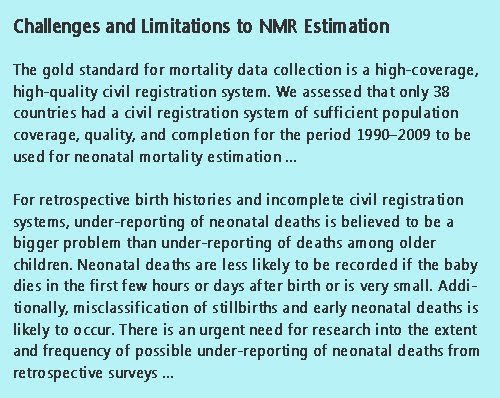
In other words, though the modeling method allows for useful comparisons across time within an individual country, there is tremendous uncertainty in the absolute value of neonatal mortality rates and therefore, we don’t know the actual rates of neonatal mortality in those countries. If we don’t know the actual rates of the countries for which results were estimated, we cannot directly compared mortality rates among countries if they are relatively similar.

What does that mean for the comparison of the US with Qatar? We don’t know what the Qatar neonatal mortality rate is. In fact, the paper supplies a graphs for each country, showing the difference between various methods of modeling neonatal mortality.

Here’s the graph for Qatar:
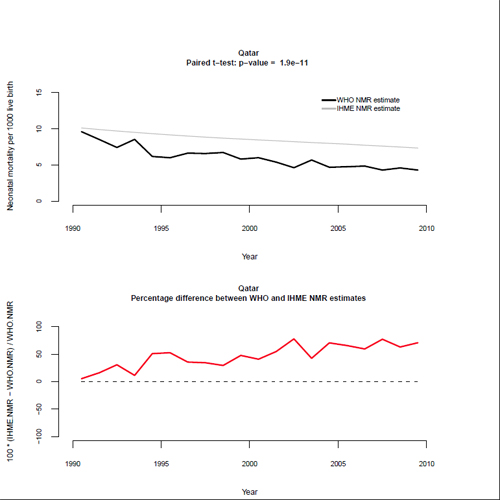
What’s the neonatal mortality rate for Qatar? According to this method of estimating, in 2010 it was approximately 4.5/1000. But according to the World Health Organization estimate for the exact same year, it is approximately 7/1000.

How about the neonatal mortality rate for the US? According to actual data (not an estimate), the US neonatal mortality rate in 2010 was 4.25/1000.

Is the US neonatal mortality rate the same as Qatar’s? Almost certainly not, since, as the authors take pains to stress, any estimation method underestimates neonatal mortality.

What about comparisons of neonatal mortality between countries where the rates are calculated from actual data, not estimates? In those cases, the comparisons are potentially more valid because there is no estimation error. But that’s not the whole story.

Different countries calculate neonatal mortality differently. The US counts every liveborn baby who subsequently dies. In the Netherlands, however, in order to improve the neonatal mortality statistics, very premature babies are classifed as born dead (stillbirths) even if they are born alive. Therefore, very premature babies, the babies who are most likely to die, are artificially and inappropriately removed from mortality calculations. That’s why The World Health Organization recommends perinatal mortality (neonatal mortality + stillbirths) as the best measure of obstetric care, since it is not susceptible to such sleight of hand as counting live babies as dead.

Even taking that into account does not tell the whole story, because race is a major risk factor for neonatal mortality. Women of African descent have neonatal mortality rates nearly 3 times higher than that of other races, and that finding is independent of economic status. It is regrettable, therefore, but hardly surprising that “whiter” countries have lower neonatal mortality than the US.

The US does not have the lowest neonatal mortality rate in the world, and we certainly have plenty of room for improvement. However, inter-country comparisons, like those currently being reported in the mainstream media, are fundamentally inaccurate and misleading.


What should Navelgazing Midwife call herself now?

Barbara Herrera, CPM, Navelgazing Midwife has found that her beliefs have evolved over the years to the point where she no longer feels comfortable in the natural childbirth community.

Suddenly … I notice I don’t fit in the Natural Childbirth Community (NBC) anymore. This is probably a “duh” moment for many folks, but it wasn’t until I was invited into a Natural Birth Professionals group in Facebook that I really caught up that I just don’t belong anymore.

This post is to express my dismay at the Natural Birth Advocates (NBAs) and their continued insistence on evidenced-based care and then going completely against what evidence there is! From homeopathy to acupuncture … from not acknowledging anything being too risky to deliver at home to the blasé acceptance of babies dying or being damaged in homebirths… I just can’t take it anymore.

What should Barb call herself now?

I’ll have to find a name for myself. I embrace “Medwife” now, but think there’s a place for us middle-of-the-roaders … Realistic Birth Advocates? I kind of like that. It’s taken nearly thirty years to get here, but here I am. And perhaps for the first time, I feel at peace with my place in birth.

How about PCM: patient centered midwife?

The evolution in her thought (and there is nothing wrong with that, by the way; lots of great thinkers evolve in their thinking) has occurred gradually over the years. But for me, watching from afar, it seemed to crystallize around one central insight.

All too often, [homebirth midwifery] has zero to do with what is truly safer for the baby, but is all about the midwife.

Homebirth midwifery, in my judgment, has always been about what’s good for the “midwife.” The focus of homebirth midwifery is not babies, not mothers, not even birth. It is about a group of high school birth junkies who want to attend births, but don’t want to do the hard work necessary to make them qualified for this important role.

Women like Ina May Gaskin, who couldn’t be bothered with getting an actual education, simply declared themselves to be midwives. The CPM credential was conjured out of thin air to increase their perceived legitimacy among an unsuspecting public. Gaskin and her colleagues have been adamant all along that the CPM credential should be awarded to anyone who can take the test and pay the fee. The credential has one and only one purpose: to provide faux legitimacy, not to ensure competence. Most women would undoubtedly be shocked to learn that the majority of CPMs have never attended ANY midwifery program at all.

The CPM is a “midwife-centered” credential.

The recommendations of CPMs are often based on what they know how to do, and have nothing to do with what is safe for babies and women.

Consider midwifery “treatments” for Group B strep. Until recently, Group B strep was the leading infection killer of babies. The bacteria itself is harmless to children and adults, and is ubiquitous. However GBS is uniquely lethal to newborns and they are extremely vulnerable if the mother is carrying GBS in her vagina. Routinely testing pregnant women for GBS and giving them antibiotics in labor has reduced the death rate from GBS by 70%, saving approximately 700 newborns each and every year.

But homebirth midwives have a problem; most of them do not know how to start an IV and cannot administer antibiotics at home even if they were able to get them from a pharmacy. Solution? Most homebirth midwives either deny that treatment is necessary, or recommend “treatments” that they can provide (but are ineffective). That’s the origin for alternative “treatments” for GBS, either washing the vagina out with soap (Hibiclens), the “high tech” alternative, or putting garlic cloves in the vagina in the weeks prior to delivery, the “low tech” alternative.

In other words, because midwives cannot administer antibiotics, the treatment backed by high quality evidence and shown to save hundreds of lives each year, they deny that the treatment is necessary or substitute “alternatives” that have never been shown to work, and whose only virtue is that midwives can buy them over the counter.

The recommendation for Hibiclens douches or garlic in the vagina is a “midwife-centered” recommendation.

Consider the ongoing debate in Oregon over midwifery licensure. No license is necessary to call yourself a midwife in Oregon and midwives like it that way. But who could possibly be harmed by a requirement to have a license to practice midwifery?

Midwifery advocates claim that a licensing requirement would deprive women of “choice,” but that’s false. Women have the right to give birth at home and they have the right to surround themselves with whomever they choose during labor and birth. A licensing requirement would not change that. The real effect of a licensing requirement is that high school graduate birth junkies could not CHARGE for attending a birth. A licensing requirement hurts untrained self-proclaimed midwives and that’s why it is opposed.

The refusal to demand licensing as a requirement for practice in Oregon is a “midwife-centered” refusal.

Navelgazing Midwife is rightfully fed up with putting midwives at the center of homebirth midwifery. She wants to put patients at the center, where they belong. That’s why I suggest that she call herself a PCM, a patient-centered midwife.

Katie Prown is afraid of me

When it comes to homebirth, the truth hurts.

The truth is that homebirth midwives are grossly undereducated and grossly undertrained. The truth is that homebirth increases the risk of neonatal death. The truth is that the Midwives Alliance of North America (MANA), the organization that represents homebirth midwives, knows that their own data shows that homebirth has an unacceptable neonatal death rate. That’s why every effort must be made to suppress the truth.

That’s an old story, but the new story is that women who have been hurt by homebirth and those who care about them are speaking up and having a major impact, an impact so great that homebirth midwives have decided to take action.

No, they haven’t decided to improve education and training of homebirth midwives.

No, they haven’t decided to honestly inform women about the increased risk of neonatal death at homebirth.

No, they haven’t decided to investigate the homebirth midwives who have presided over preventable neonatal deaths.

Evidently the Big Push for Midwives Campaign is so frightened by the truth that they’ve decided to mobilize their followers to suppress it.

Check out the following email from Katie Prown, the Campaign Manager of the Big Push for Midwives Campaign.

From: Katherine Prown

To: “”thebigpushformidwives@yahoogroups.com”” ; birthpolicy

Sent: Friday, September 2, 2011 7:12 AM

Subject: [BirthPolicy] Comments needed!

Hi everyone–

As many of you know, Amy Tuteur’s followers have become much more organized and are now swarming every online article about CPMs and out-of-hospital birth with highly negative, but to the average person, highly plausible, comments. I’ve linked to the latest example below and I’d like to ask all of us out there with our Google alerts set to make a point of posting these stories and asking the community to comment.

Registering on these sites can be a pain, but it’s worth creating a gmail account and username just for that purpose because we can’t afford to have an entire army of commenters out there reinforcing every negative stereotype about midwives and home birth that the general public and worse, legislators, already hold.

http://www.registerguard.com/web/opinion/26790141-47/midwives-oregon-licensed-birth-direct.html.csp

Hmm, highly negative, but to the average person, highly plausible comments? No mention of why those negative comments are wrong, because they aren’t wrong. The Big Push For Midwives is evidently officially committed to responding to these comments because they are negative. The truth is irrelevant.

In light of this, I want to give a big shout out to the many new bloggers who are producing terrific blogs filled with correct information (and some, like The Mama Tao, incredibly entertaining as well). YOU are having an impact. YOU are educating women about the risks of homebirth and the lack of education and training of homebirth midwives.

You should be proud to learn that Katie Prown is afraid. She and other homebirth midwives aren’t really afraid of me, and they aren’t really afraid of you. They are afraid of the truth and we are just the messengers.

Homebirth and narcissism: I bet you think this birth is about you.

I’ve been writing about homebirth for years, and I am continually struck by the level of narcissism within the homebirth movement. Rixa Freeze’s latest post, designed specifically to be shared with the freshmen in the college writing class that she teaches, is yet another exemplar of that narcissism. What could be better for her students than writing samples that are by her, about her, and involve homebirth?

Whether as mothers or as homebirth midwives, homebirth advocates continually place themselves as the center of every birth story. The baby is just a prop in a piece of performance art in which the mother gets empowered and the midwife birth-junkie gets her fix. Being an infant, the baby cannot serve as a source of narcissist supply. The homebirth must be acted out in front of others (hence the need for posting the video on YouTube) for the purposes of receiving praise and to demonstrate that the mother is an empowered “birth/warrior goddess.”

The most extreme examples, of course, involve the actual death of the baby. For women like Ina May Gaskin, Laura Shanley, and now Annie Bourgault, a dead baby is just the collateral damage of an empowering birth story with mom as the star. It is difficult to imagine a more heartless narcissist than Janet Fraser who blithely dismisses the death of her third child at homebirth as less traumatic than the “birth rape” that results in her first, living, child.

For homebirth midwives like Melissa Cheyney, Amy Medwin, and Karen Carr, dead babies are the inevitable (some babies aren’t meant to live) collateral damage of their selfless devotion to a woman’s right to choose (to risk their babies’ lives at) homebirth. They want to be midwives (trained or untrained, apparently it doesn’t matter), to get their birth fix, to be heroes and BFFs to the women they supposedly serve, and, by the way, to get paid for the opportunity to feel powerful, needed and fulfilled. It is difficult to imagine a more heartless narcissist than Lisa Barrett, who is literally live-tweeting her scorn DURING the inquest into two neonatal deaths over which she presided.

Rixa Freeze firmly established her role as narcissist when she publicly displayed the video in which her daughter nearly died in the wake of a homebirth. It’s the ultimate birth/warrior goddess event. Give birth to a baby who fails to breathe, then resuscitate. Did Rixa feel even a teensy bit badly that baby Inga was so compromised that she initially failed to breathe? Be serious! Those questions involve positing that it was Inga’s birth and we all know that it was Rixa’s. It was, is and always will be about Rixa.

Rixa’s piece is a classic of homebirth narcissism. The ostensible subject of the paper is what it means to be a woman. For Rixa, of course, being a woman is about pregnancy and birth.

When I was pregnant for the first time, I felt a strange sense of recognition for my expanding body. My belly stretched, my breasts swelled, my skin tightened. I felt, for the first time, entirely myself. This, I thought, is what a woman’s body really is. It was a great discovery, as if I had circumnavigated the globe and split the atom and solved global hunger in the course of an afternoon.

Oh, yes, this is exactly what college freshman want to know about their writing instructor!

Rixa goes on to talk about the baby inside, but even in a writing piece, Rixa cannot recognize that her children are separate individuals. She gives lip service to the idea:

There was a person inside me, hidden behind skin, muscle, and water. This person was half me and half my husband, completely reliant upon my body but entirely its own self.

But she cannot acknowledge the separateness of her children and herself, even after birth.

When did we become not-one-but-two—was it when her head emerged from my body? Was it when her legs and toes slipped out? Was it when, a few seconds after her birth, she lost her color and I gave her the first breaths of life? Even those breaths were not hers. They were mine, passed from my lungs to hers in the most intimate and urgent embrace either of us had ever known. (Note: obligatory narcissistic reference to her homebirth and subsequent birth/warrior goddess performance.)

She continues:

So I am not convinced that the act of birth marks the line between one and two. After birth, when our bodies were no longer tied together by umbilical cord and placenta, my babies still relied upon me for survival. My breasts were literally their lifeline. My youngest baby, six months old today, is still only nursing. I cannot leave her for more than a few hours at a time. Her rolls of fat, her dimpled bottom, even her hefty double chin came directly from my body. (Note: Me, me, me and did I mention, me.)

I don’t know about you, but I can’t think of anything college freshman would want to know about more than the function of the instructor’s breasts!

The big finish:

We are more than one, but not quite two. I haven’t discovered the calculus to describe where one self ends and another begins…

Really? Who would have guessed that Rixa has trouble appreciating the boundary between herself and her children?

And that get’s back to the heart of the matter. Homebirth is often about narcissism. It’s about the mother, her experience, her feelings, “her” birth. The baby is just a prop in the ongoing story of a woman trying desperately to feel good about herself.

P.S. Rixa, do your students a favor and lose this writing “sample.” College freshman need to learn about writing, NOT about you, your breasts and your births.

Melissa Cheyney, have you no shame?

Melissa Cheyney is at it again. This time she brings her special brand of hypocrisy and mendacity to a guest piece for the Oregon Register-Guard, with the jaw dropping title of Oregon has some of the strictest guidelines on midwifery.

Why is it jaw dropping? Because Oregon does NOT require that midwives be licensed!

Cheyney and her colleague Colleen Forbes do have nerve:

We are writing to correct several erroneous claims put forth in these pages in the course of a recent debate over the qualifications of midwives and the safety of home birth.

First, before midwives may be considered for licensure in Oregon, they must pass the North American Registry of Midwives examination — the national credentialing exam for direct-entry midwives in the United States.

To qualify to sit for this examination, a student midwife must, at a minimum: demonstrate competency in all of the core clinical skills identified by the Midwives Alliance of North America; attend 20 births as an assistant; attend an additional 20 births as a supervised primary attendant …

Oregon actually has some of the most stringent guidelines for licensing in the United States.

Cheyney claims that the licensing standards for direct entry midwives in Oregon are rigorous. Incredibly, what she fails to mention is that licensing is NOT required to practice as a midwife in Oregon!

According to the Oregon statutes:

687.415 … Nothing in [Oregon Statutes] is intended to require a direct entry midwife to become licensed …

So far from having strict guidelines for the practice of direct entry midwifery, Oregon has the most lax guidelines in the US. Oops!

Next Cheyney and Forbes take on a claim that has been gaining traction:

[W]e want to address claims about the existence of a database on birth outcomes for licensed midwives in Oregon. Over the past two years, the Board of Direct-entry Midwifery has worked to institute new administrative rules that would make the reporting of all birth outcomes mandatory for licensed midwives. These new rules went into effect July 1, meaning that a comprehensive, nonvoluntary data set on the outcomes of home and birth center births attended by licensed midwives will be available as soon as enough data accumulates to create a valid sample for analysis.

They neglect to mention is that in her role on the Board of Direct Entry midwifery, Cheyney has vigorously opposed releasing the data that ALREADY exists. MANA (the Midwives Alliance of North America), the organization that represents direct entry midwives, has collected outcomes on more than 23,000 midwife attended planned homebirths across the US.

Who is in charge of that database? None other than Melissa Cheyney herself, in her OTHER role as Director of Research for MANA. Cheyney refused to release the data to the state of Oregon. Oops!

Why won’t Cheyney release the data? As I have written before:

The minutes of the August 5, 2010 Board meeting available on the DOR website) reports that the state of Oregon asked for the ability to retrieve information on Oregon midwives from the database.

Cheyney stated that the MANA board’s official policy is to give state-level accounts to professional organizations as a tool to evaluate areas where more training might be needed for the purpose of self regulation, and to not provide the data to regulatory entities.

In other words, the database is only to be used by MANA itself, and not shared with anyone who could potentially identify unqualified midwives and discipline them. How does MANA justify hiding that information from the very agencies (such as the one on which she serves) who are charged with protecting the public from unqualified or dangerous providers?

Cheyney explained that MANA suspected that, due to some state regulatory boards having very hostile relationships with midwives, the quality and quantity of data submitted might be adversely affected if regulatory authorities were provided access.

Apparently, if homebirth midwives knew that the number of babies who died at their hands would be reported to regulatory authorities, they might refuse to report the number of babies who died at their hands?

So here’s what I want to know:

Melissa Cheyney, have you no shame?

How can you write an article for the newspaper claiming that Oregon has “strict” licensing standards for direct entry midwives when Oregon does not require that direct entry midwives be licensed? Technically it is not a lie, but it is most definitely a brazen attempt to trick the women of Oregon.

How can you write an article for the newspaper claiming that midwives are not refusing to release their death rates and citing future requirements when you have aggressively opposed those requirements, and when you refuse to release the EXISTING statistics that show how very many Oregon babies have died at the hands of direct entry midwives? Technically, what you’ve written is not a lie, but it is most definitely a brazen attempt to trick the women of Oregon.

Most importantly, how can you defend a system that you KNOW (because you have the data) has already led to the death of an appalling number of Oregon babies at the hands of direct entry midwives?

Have you no shame?

A special feature


You can’t make this stuff up.

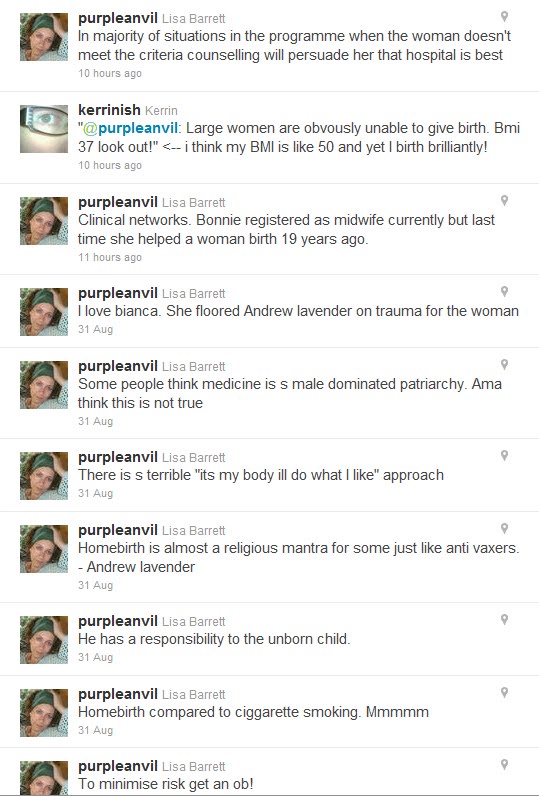
Look to your right. See the twitter feed? That’s midwife Lisa Barrett live tweeting her contempt at the Coroner’s inquest into her role in two homebirth deaths.

Her lawyer must be horrified.

I wonder if the judge knows.

Addendum:

Nice touch to include geo-location so you know just where she is.

Addendum 2:

Lisa Barrett is off line now, but here are some of her most recent tweets from the courtroom:

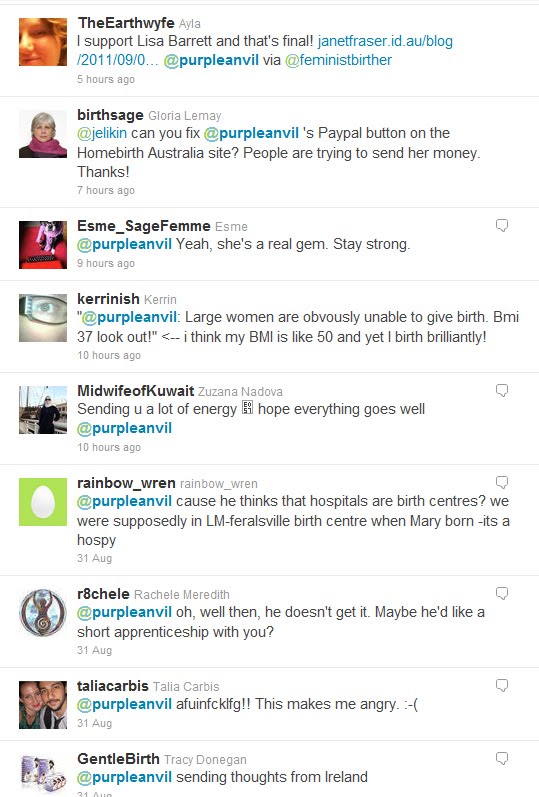
Who was she tweeting with? Here’s a sample:

How touching! Both Gloria Lemay and Janet Fraser are supporting her. What could be better than the support of others who have let babies die?

Author of “Perfect Birth Experience” has a dead baby

The increasing popularity of homebirth is the quickest road to ending the increasing popularity of homebirth. Why? Because more homebirths means more homebirth deaths. It is difficult to argue for the safety of homebirth when the dead babies pile up all around.

Even homebirth celebrities are not immune. In fact, they appear to have experienced a mini-epidemic of homebirth deaths. Ina May Gaskin, the doyenne of homebirth midwifery, lost a child at homebirth, Laura Shanley, the American exponent of freebirth (homebirth without a midwife) lost a baby at homebirth, and Janet Fraser, the Australian exponent of freebirth, lost a baby at homebirth, too. Don’t worry about her, though. She thought the entirely preventable death of her baby at home wasn’t particularly traumatic, not nearly as traumatic as the “birth rape” with her first (living) child.

Two months ago Canadian homebirth celebrity Annie Bourgault had a twin homebirth. One of them lived and one of them died.

Bourgault describes herself as:

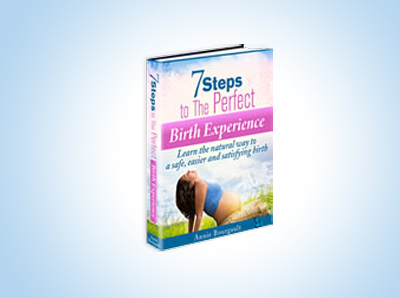
… a reporter who finds evidence based information about birthing. She interviews health professionals, leading experts in childbirth and parents whose work help women feel empowered and fulfilled during pregnancy, birth and motherhood. Sign up for her free report: 7 Steps To The Perfect Birth Experience.

Bourgault was expecting twins, and her “perfect birth experience” did not involve being “fearful of the birth process.”

She was irritated with her obstetrician when he told her:

The babies were not very well positioned. Very unlikely they will move. I will need an epidural for the second twin. Start thinking of a c-section!

Wow! I understand why we are so fearful of the birth process and why we just hand them our lives and the life of our babies. He got me! He induced fear in me very easily…

Later I talked to my Doula & midwife who repeated what I already know: He just wants to paint the worst scenario for you. Don’t take that on board. You will be fine…

I love this man for doing his job the best he could. I understand where he comes from. But I would like to suggest to him that fear is not the way to help a woman achieve a happy outcome at birth. Comfort is. Knowledge and fear inducing are two different things.

Knowledge and “comfort” are also different things.

Pushing Max who was breech was amazing. I could even say it was easy-ish. Even if it wasn’t that easy. It felt like it. When I held him in my arms I kept thinking: “What was the big deal? Why did the hospital refused to let me birth you the way I wanted? Without drugs? Without a c-section? I knew we could do it.”

Then Sam… came out 45 minutes after his little brother. He was in a perfect position: head down. We heard his little heart beating 10 minutes before he came out…everything was fine…seemed fine. While I was pushing him out I heard my midwife say: Oh no! It’s the placenta!” She came in front of me and said: “push your baby out right now!”

… I pushed a baby and a double placenta at the same time. They came out at the same time!! I felt like I was opening a bottle of Champagne through my vagina. I scooped my baby out of the water. He was limp. We started CPR and gave him oxygen.

I had my little boy in my arms and I named him. Sam! Sam! I kept saying his name over and over..like a song. I thought if he had a name he couldn’t die. ” Sam my boy, my beautiful boy. I love you so much…stay with us Sam. We love you. You are not going anywhere. Are you? Stay with me. Stay with us!” I kissed him, massaged him, loved him with all I had. I believed he was going to be OK.

He wasn’t. He never took a breath.

Bourgault offer the usual homebirth disbelief:

So what were the chances of me suffering a placenta abruption? I was healthy, had energy, did yoga, ate more broccoli and kale in one day than my whole family in a year and my twins were 39 weeks +. So what happened? Fuck! What the fuck happened????

What the fuck happened happened? An utterly predictable complication of twin birth, placental abruption. In fact the high risk of placental abruption is THE reason that twin birth is considered high risk.

Before birth the entire surface area of the placenta adheres to the wall of the uterus. Once the baby is born, the uterus contracts around the empty space. The fact that the placenta is incapable of contracting. The illustration demonstrates that as the uterus contracts the placenta is forced off the uterine wall. The space between the contracted uterine wall and the peeled off placenta fills with blood. The pressure of the blood in the enclosed space forces more placental surface off until the entire placenta comes away accompanied by a gush of blood, the blood that filled the space between the uterus and placenta.

In a twin birth, the first baby is born and the uterus contracts down around the empty space. The placenta is incapable of contracting, both the placenta of the baby that has born and the placenta of the baby still in the uterus, still depending on the placenta for all of its oxygen. That’s the main reason why twins are considered high risk. The second baby may lose its supply of oxygen long before it can be born vaginally. That’s why the second twin needs to be monitored very carefully, typically in an operating room with a team standing nearby to start an immediate C-section if the placenta begins to detach.

What happened to Annie Bourgault’s son Sam? First, the midwife utterly failed to recognize what was happening. During the 45 minutes between the birth of the first and second twin, she was almost certainly listening to the heartbeat of the mother, not the baby. The fact that a completely detached double placenta came out before the second baby indicates that the baby had been dead for some time, but the midwife never even noticed. Second, Bourgault was at home, too far away from the personnel and equipment that would have easily saved her baby’s life.

Bourgault, of course, is busily pretending that Sam’s was unpreventable.

I never thought he wouldn’t make it. I never thought he wouldn’t survive. Babies often come out flat at birth but they come back…Mine didn’t. He never took a breath.

It’s not suppose to be like that. Babies come first and the placenta comes out after because if it doesn’t the baby is deprived of it’s vital oxygen and can die.

Birthing at home is as safe as birthing at the hospital. Isn’t? True. But death doesn’t spare home birth. It doesn’t spare anyone.

Not exactly. Death is ALWAYS a risk at birth. The risk of death does not spare anyone (even those who write books insisting that homebirth is safe). But death itself CAN be prevented. That’s what hospitals are for; that’s what obstetricians are for; that’s what C-sections are for.

Bourgault insists:

When we went to the hospital later that day. I learned that in the case of a placental abruption like this…there is no so called “safer place”. Because when it happens the baby has only a few minutes to live. Had I been at the hospital I was told I would have had an emergency c-section…but I would also have a dead baby or a very brain damaged one. A c-section AND a dead baby. Thank you very much. I’d rather be at home.

Not exactly. The obstetrician who had advised Bourgault to have a C-section was not nearly as sanguine as she about the baby’s death.

The Ob/gyn who wanted me to have an elective c-section before she went on holidays two weeks prior to the birth came to our room to offer her sympathy and announced that she had called the coroner’s office for an investigation in the death of our baby…

Bourgault still doesn’t get it:

I came to the conclusion that women are allowed to give birth at home but not allowed to loose (sic) a child at home.

She didn’t “lose” a child at home. She let him die. It was more important to her to have the “Perfect Birth Experience” than to take the simple precaution of ensuring that her baby had access to life saving technology. Had Bourgault followed her obstetrician’s recommendation for an elective C-section, she’d have two babies at home today, instead of one at home and one in a grave.

Ignoring science is not a feminist statement

In the midst of the discussion that homebirth is not a feminist statement, an interview I did several weeks ago with Teen Skepchick was published. The discussion was wide ranging, but one of the issues we kept coming back to is the need for women to have a strong grounding in basic science and math.

Teen Skepchick is an awesome website run by Rebecca Watson:

… Rebecca is leading a team of skeptical female activists at Skepchick.org and TeenSkepchick.org, co-hosting the weekly podcast The Skeptics’ Guide to the Universe, hosting her public radio show Curiosity …

The world of skeptics is dominated by men, which is not surprising considering that the world of science was until recently dominated by men. Now, though, women are doctors, chemists and rocket scientists. I love that Teen Skepchick is encouraging the next generation of women to study science, think logically and beware of pseudoscientific claims.

To me, one of the most depressing aspects of health pseudoscience (so called “alternative” health) is that it is dominated by women. Women are far more likely to believe in and use quack “treatments” like homeopathy. They believe in and spearhead nonsense “movements” like anti-vaccination. And, of course, quack practitioners like homebirth midwives (certified professional midwives or CPMs) are exclusively women.

Why might that be? I suspect that it has a lot to do with the fact that many women have no knowledge of basic science and math.

When we were children, my generation was told that science and math were “too hard” for women, and girls were steered away from physics and engineering toward professions like teaching and nursing. Women like me owe a deep debt to feminist pioneers who, often at great personal cost, paved the way for acceptance of women into every subject of study and every possible career.

That’s why it’s especially depressing to me to find that while women are free to learn science and math, many still avoid it as “too hard.” Without a strong foundation of science and math, it is perhaps inevitable that many women are drawn to pseudoscience. What’s truly amazing, though, it that they want to pretend that ignoring science is some sort of feminist statement.

I suspect that comes from a fundamental misunderstanding about feminism. True, feminism is about choice; women can make whatever choices they deem best for themselves, regardless of society’s view of what is “proper” for women. But that doesn’t mean that every choice made by a woman is a feminist choice. It is not a feminist choice to wear a burqa; it is not a feminist choice to remove your daughter’s clitoris with a dirty razor blade; and it is not a feminist choice to declare that you are subservient to your husband.

Similarly, it is not a feminist choice to ignore science.

You have to give the feminist anti-rationalists credit for making lemonade out of lemons, though. Rather than confessing to ignorance of science, the feminist anti-rationalists declare that science is male and that women have “different ways of knowing” (i.e. intuition). That’s a pretty neat trick: cloaking the sexist belief that science and math are too difficult for women under the intellectual burqa of feminine intuition.

Although women have a right to have a homebirth, a homebirth is not a feminist statement. It is absurd to suggest, in this age when more than half of obstetricians are female, that obstetrics is patriarchal. It is absurd to claim that in this age when women can be nuclear physicists that science is male and women have “different ways of knowing.” And now that young women are finally allowed to study as much science and math as they wish, it is downright bizarre to insist that science and math aren’t necessary to understand the function of the human body.

Homebirth is not a feminist statement, not merely for the obvious reason that every choice made by a woman is not inherently a feminist choice. It is also not a feminist statement because homebirth advocacy is based primarily on ignorance of science, statistics and basic medical facts. Ignoring science is never a feminist choice.

How many babies have died at Lisa Barrett’s hands?

How’s that’s “trust birth” thing working out for Lisa Barrett? Not too well, evidently, and even worse for babies, based on what I’ve heard. Since 2007 she’s presided over at least 2 preventable neonatal deaths and one severely injured newborn.

I look up to the birthing woman, her ability, her energy and I trust birth.

That’s how Barrett describes her philosophy of midwifery. It’s inane on its face. There is nothing trustworthy about birth. It is and has always been, in every time, place and culture, a leading cause of death of young women, and the day of birth is the most dangerous day in the entire 18 years of childhood. Trusting a bodily process to work perfecty in every woman, for every baby, every time, is nothing more than a recipe for disaster … as Barrett herself has demonstrated repeatedly.

First, Barrett presided over the absolutely horrible and completely preventable death of Tate Spencer-Koch from shoulder dystocia. By Barrett’s admission, it took her an unbelievable 20 minutes to extricate Tate after the baby’s shoulders got stuck behind her mother’s pubic bone. During that time, Tate began to suffocate and she was delivered nearly dead and could not be resuscitated.

Barrett, hoping to avoid an investigation into her conduct argued that she was so grossly incompetent that the baby was completely dead by the time she was born and therefore the coroner did not have jurisdiction to investigate the death. Barrett acknowledged that if she had merely rendered the baby profoundly brain damaged, an investigation would have been in order. But, hey, the baby died; let’s just step around the dead body and carry on; too bad, no investigation allowed.

But the ambulance staff begged to differ. Although Tate had no heartbeat at the time they arrived, EMTs were able to detect electrical activity of her heart, known as PEA (pulseless electrical activity), the terminal event before actual death. Therefore, the coroner did have jurisdiction to investigate Tate’s death. Lisa Barrett fought the ruling all the way to the Australian Supreme Court. Barrett didn’t even bother with the pro forma declaration that of course she would welcome an investigation that she was sure would exonerate her. She did everything in her power to stop the investigation and made no bones about it.

Incredibly, in the wake of Tate’s preventable death, Barrett portrayed HERSELF as the victim, arguing that she was merely standing up for legal precedent, that any effort to provide justice for Tate was just a witch hunt against midwives, and, for good measure, Barrett was martyring herself for women’s reproductive freedom.

Barrett lost at the Australian Supreme Court.

Now that the investigation has begun, we can see why she was desperate to stop it. First up, the story of ANOTHER homebirth death that Barrett presided over two years later. Barrett apparently learned nothing from Tate’s preventable death. This time she was “trusting” breech birth and once again a baby got stuck. Jahli Jean Hobb’s body emerged but her arms became wedged behind her head. This is known as nuchal arms and usually can be prevented by properly handling the breech, but that’s not what happened here.

Barrett struggled mightily to pull down the baby’s arms, but without success. Incredibly, she asked a friend of the mother (who, coincidentally, was a student midwife in the earliest states of her training) to take over for her! The student, thought she very little experience, had read about managing breech birth and remembered what to do. She was able to extract the baby’s arm and the rest of the baby was delivered.

The midwife has been scarred by the experience:

Gemma Noone wanted to be part of one of her friend’s most exciting moments and witness the miracle of life.

Her elation turned to despair, however, when Ms Noone – a student midwife – was forced to assist in the ill-fated homebirth of Tate Spencer-Koch.

When private midwife Lisa Barrett got hand cramp she told Ms Noone to take over, leaving her to pry the baby’s shoulders free from its mother. Yesterday, she told the Coroner’s Court she had been traumatised by Tate’s tragic death and had been put off her studies as a result.

“(Ms Barrett) asked me to try to get the baby out, it was an emergency,” Ms Noone said. “She was sort of saying `you have to help me’, she said her hand was seizing up. That was never the plan, I was not to be involved.”

Neither Tate’s mother, nor Jahli’s mother were appropriate candidates for homebirth. Both had had C-sections for their first births. Jahli’s mother, and probably Tate’s mother were not even candidates for VBAC (vaginal birth after cesarean) in a hospital let alone at home. But Lisa Barrett was too busy trusting birth to pay attention to anything as mundane and restrictive as clinical guidelines and Tate Spencer-Koch and Jahli Jean Hobbs are dead as a result.

And Lisa Barrett is till clueless. Here’s what she wrote on the Australian forum Joyous Birth just two months after Tate Spencer -Koch died:

There are actually very few predisposing factors to shoulder dystocia.

There aren’t a lot of predisposing factors, but there are some and they should not be ignored. One of the most important is history of a previous shoulder dystocia. But Barrett ignored that risk factor just a year after Tate Spencer-Koch, attending the “accidental” homebirth of a woman whose first baby suffered a severe shoulder dystocia.

Guess what? Another shoulder dystocia. What a coincidence.

Baby comes very quickly to eyes and then each contraction only brings a little more baby,few more and baby’s mouth is half in half out, she’s on all fours so we are just waiting. chin is barely out just waiting, no contraction for a number of mins so I don’t touch but ask her to change position, touching before any sign impacts the shoulder, she changes position baby does a bit of a turtle neck thing but tries to swallow. another 5 mins on peri and I ask them to call an ambulance but all is very calm, I’m well aware of their last experience so we keep chatting. I felt shoulder abdominally and just tried to put them in the AP and I asked her to turn back onto all fours, Still nothing baby is looking a little off colour so with next contraction about 5 mins on, I put in my hand and with some difficulty, (lots actually) I move the posterior shoulder and as it’s birthing I hear it snap. FUck, However the arm came through and I was able to pull the baby out. I am so over this!! baby had great cord pulse apgar is 1. I mouth to mouth baby and after 2/3 mins feel a few resps under my mouth …

Prosecutor Naomi Kerera is conducting the inquest. Fortunately, in addition to investigating Lisa Barrett’s judgement and competence, she plans to go further.

It will also look at the wider systemic issue of homebirth, the apparent disparity between public and private midwives (and) the need for closer regulation of homebirths overseen by private-sector midwives.

Lisa Barrett is a poster child for greater regulation of homebirths, but in her case, regulation is not enough. Barrett should lose her license for gross negligence. It’s the least that can be done in memory of the babies who have died at Lisa Barrett’s hands.

Ricki Lake has blood on her hands: An open letter

Dear Ms. Lake,

I notice that you are quick to claim credit for a rising number of homebirths in the wake of your film The Business of Being Born:

The impact of the documentary was monumental. The blogosphere blew up (I can handle a few people yelling at me if it means my message is being heard!) Every day women stop me on the street to share stories of their safe, successful, meaningful births. Many say they felt “in the dark” about their options until seeing The Business of Being Born…

I wonder if you’re also willing to accept blame … for the babies and mothers who have died because they believed your nonsense.

What do you say when women stop you to share stories of their dead babies, babies who died because their mothers saw your movie and believe that homebirth was safe and empowering? What do you say when they share their stories of a ruptured uterus, a breech baby with a trapped head, a severe shoulder dystocia? What do you say when they tell you how their “midwife” encouraged them to labor for days and push for hours, all the while unaware that the baby had died from the stress of labor?

In the past several months alone I have written about 10 babies who have died at homebirth in addition to the older stories recounted on the website Hurt by Homebirth. And this week, a mother apparently died as a result of an attempted homebirth. Just this afternoon, in fact just before I sat down to write this, I learned of a baby born this week after an attempted homebirth whose parents are currently trying to process the fact that their baby has suffered significant brain damage.

What do you tell them, Ms. Lake? Oh, and don’t bother saying, “babies die in the hospital, too.” That may work on uneducated lay people, but that doesn’t work on me. I know that CDC data shows that homebirth triples the rate of neonatal death. I know that in the state of Colorado, licensed homebirth midwives attending planned homebirths have a death rate DOUBLE that of the state as a whole (and the state numbers include premature babies, babies whose mothers have pre-existing medical problems, and babies whose mothers suffered complications of pregnancy.

In fact I know, and perhaps you know, too, that the Midwives Alliance of North America, the organization started by your friend Ina May Gaskin, is refusing to release their own death rates because an appalling number of the 23,000 babies in their database died at homebirth.

Do you plan to take responsibility for these deaths, Ms. Lake. Because if you do, I have a great idea for you. I think you ought to set some of your profits from YOUR business (and it is a business) of being born (books, DVDs, etc) into a no-fault compensation fund for those parents who have lost babies at a homebirth. I’m not sure how much money would be available for each family, since, unfortunately, there is a large and growing number of such families, and I don’t know if would be enough to cover the millions of taxpayer dollars that are going to be spent caring for the babies who were left brain damaged by homebirth. Nonetheless, it seems to me that it is the least you could do.

But if you don’t plan to take responsibility, and I’m not holding my breath because I would turn awfully blue, the very least you could do is amend your film, books and website to reflect the very real dangers of homebirth. I don’t doubt that you were unaware of the dangers of homebirth when you started, and as you seem to have no knowledge of science, statistics or obstetrics, you may still be unaware. But it doesn’t take any specialized knowledge to count the growing number of dead babies, babies who died preventable deaths because their mother listened to you.

Sincerely (and with a great deal of sadness and anger),

Amy Tuteur

Dr. Amy