It’s not risky for me

A recent scientific paper reported that aficionados justify the increased risk in five ways:

1. risk perspective
2. reasonable use is not harmful
3. counter-evidence
4. compensatory behavior
5. as the lesser evil

In accordance with these strategies, they generally claim that 1. they are low risk; 2. reasonable precautions minimize harm; 3. they or their friends have already done it already and they’re fine; 4. they are very careful about nutrition and exercise, which lowers their risk; and 5. if the choice is taken away, they will replace it with other, riskier choices.

Homebirth advocates? No, tobacco smokers.

You may have been confused, though. That’s because homebirth advocates justify their risky behavior in the exact same way that smokers justify theirs. Looking at these tactics through the prism of smokers’ behavior makes it clear that they are nothing more than psychological defense mechanisms, and have no basis in science.

The paper is Smokers’ accounts on the health risks of smoking: Why is smoking not dangerous for me? by Heikkinen et al. The authors ask:

[O]n what grounds is it possible to continue a habit that is widely presented as detrimental to health?

In contrast to smokers, homebirth advocates are far more willing to contest the scientific evidence or to make up “facts” to support their belief that homebirth is safe. But even those who acknowledge that homebirth increases the risk of neonatal death are still willing to take that risk.

How do they justify themselves? They mobilize the same strategies that smokers use and for the same reasons. These strategies:

… served to protect [them] from self-blame as well as blame from others. [They] presented themselves as risk-aware and calculating actors, who have nevertheless made their choice … Second, [they] tried to convince the interviewers and themselves of the harmlessness and acceptability of their own [choice].

Sound familiar? It should. Consider the following quotes:

When talking about their own smoking, participants tended to deny or disprove the possible health risks by expressing a view that their own smoking was actually not that risky to them. In the accounts the health harms of smoking were accepted as a risk on a population level, but not individually.

When talking about their choice of homebirth, advocates tend to deny the possible health risks by expressing the view that the risk does not really apply to them. In their accounts, the risks might be accepted on the population level, but not individually.

Regardless of the amount of cigarettes the participants smoked, many participants stated that a small number of cigarettes does not pose serious health risks, or at least reduces the harm.

Similarly, homebirth advocates insist that homebirth is not risky for them because they are “low risk,” have chosen a qualified attendant or live near a hospital.

… [T]he participants’ own observations and experiences served as a source of health information and as opposing evidence of the claimed health hazards. This counter-evidence could be divided into two sub-types: either the participants referred to their own experiences, or to the experiences of their
peers or public figures.

When it came to their own experiences, the participants most frequently referred to their current good state of health … The absence of current health problems actually seems to act for some as an enabling force …

Homebirth advocates love the anecdote, preferably the celebrity anecdote. Ricki Lake had a homebirth and her baby is fine. My neighbor had a homebirth and nothing went wrong. And most powerful of all, I’ve already had a homebirth and it was glorious.

The impression of being healthy and immune to tobacco-related diseases was often underpinned with preventive measures or harm-reduction techniques. Many of the participants reported leading an otherwise healthy lifestyle e except for the smoking. It was clearly expected that the risks of smoking can be reduced or avoided through such preventive measures as sports or exercising …

For homebirth advocates, it is axiomatic that good nutrition and exercise reduce the risks of homebirth, even though, as in the case of smoking, there is no evidence to support the claim.

Finally:

… [S]moking was quite often compared or contrasted to other habits, such as … alcohol consumption… Contrasted to these other risks, smoking was presented as a very small health risk – almost nil …

Homebirth advocates like to claim that the risks of hospital birth are higher than homebirth, even though that is a bald-faced lie. They also insist that if the choice of midwives is restricted, they will petulantly resort to unassisted childbirth, therefore increasing the risk that their babies will die.

In reviewing these strategies, the Heikkinen et al. point out:

Three of the account types – moderation, lesser evil and compensatory behaviour e draw from an overall view that lifestyle is composed of many healthy and unhealthy components and the end-result is a calculus of these components…

Another way of downplaying the risk of smoking on an individual level entailed referring to personal experiences … and using these as counter-evidence to the
medical view … These accounts resembled the I-know-many-old-people-who-smoke arguments..

In light of these strategies, the authors recommend:

… [A]nti-smoking advocates and health promotion specialists should consider the following questions arising from smoker’ own perceptions and argumentation: is there such a thing as moderate smoking and, if so, why is it not recommended? Why should smoking not be seen as a lesser evil and compared to other vices? Is it possible to compensate for the consequences of smoking with physical activity or the eating of healthy food? Why is a currently good health status or lack of illness symptoms not a guarantee of future good health? Why there are individuals who have smoked for decades but who don’t get lung cancer?

Answering these questions reveals that even moderate smoking is harmful, smoking is not the “less of two evils,” diet and exercise do not prevent lung cancer, and the fact that a celebrity or relative smoked and did not get lung cancer does not mean that smoking doesn’t cause lung cancer.

Homebirth advocates should not make the same mistakes that smokers do. ANY homebirth can lead to neonatal death regardless of risk status, homebirth is more risky than hospital birth, diet and exercise do not prevent neonatal death, and just because Ricki Lake had a successful homebirth does not change the fact that homebirth increases the risk of neonatal death.

Homebirth advocates would do well to consider that their “arguments” in favor of homebirth are strikingly similar to smokers’ arguments in favor of continued smoking. And as in the case of smokers, rather than conveying the impression that homebirth advocates are risk aware actors making choices that are the lesser of two evils, their arguments serve instead to highlight the fact that they are only kidding themselves.

Unnecesseat belts

Why wear a seat belt?

The average person, driving the average car on the average trip is not going to be involved in a major crash. If that’s the case, seat belts are a useless intervention that merely provide extra revenue for car manufacturers, right?

In fact, the average person, driving the average car is probably not going to get into a crash during the entire life of the car. If that’s the case, there’s no reason to put seat belts into every car when only a very small percentage will actually benefit from them. The majority of seat belts could be described as “unnecesseat belts,” right?

And what’s up with air bags? The average driver, driving the average car on the average strip will not need both a seat belt AND an airbag. If you want to understand why all cars have airbags, follow the money: air bags are really expensive so car companies install air bags into every car to justify jacking up the price by hundreds of dollars.

A woman should have complete autonomy over her body. If she wants to buy a car without unnecesseat belts and without airbags, that should be HER decision. She has the right to decide how she feels safest.

And anyway, if her intuition tells her that she is likely to be in a car accident, she can always transfer to a fully equipped rental car for a specific trip.

So educated women, who care about their quality of life, not just whether they live or die, don’t wear seat belts, right?

Wrong!

Any woman with a grain of common sense in her head wears a seat belt EVERY time she gets in a car. Why? Because she knows that it is foolhardy to trust averages. Just because the average person, driving the average car on the average trip won’t need a seat belt in retrospect does not change the fact that tens of thousands of lives are saved each and every year by routine use of seat belts.

Women who claim to “trust birth” are really trusting averages. It’s true that the average woman, carrying the average baby in the average position will have an uncomplicated labor and that any and all interventions can be deemed unnecessary in retrospect. But as in the case of seat belts, just because the average woman carrying the average baby in the average position won’t need those interventions does not change the fact that tens of thousands of lives are saved each and every year by the routine use of obstetric interventions.

Trusting birth is no different from trusting driving. The vast majority of people who refuse routine use of seat belts will not die in a car accident, but that hardly makes their choice safe or sensible. Similarly, the vast majority of women who refuse the routine use of the interventions of modern obstetrics will not have their babies die as a results, but that hardly makes their choice safe or sensible.

Most of us would be appalled if people took to referring to seat belts as “unnecesseat belts,” because we recognize that they are necessary, even if they are never needed. The same principle applies to the routine interventions of modern obstetrics. Anyone who understands the routine dangers of childbirth is appalled by those who refer to C-sections as “unecesareans,” because we recognize that they aren’t unnecessary even if they weren’t needed in retrospect.

The routine use of modern obstetric interventions rests on the same principle as the routine use of seat belts. Both save tens of thousands of lives each and every year, NOT because everyone needs them, but because “trusting” that you are average is nothing more than a foolhardy, and sometime deadly, mistake.

Natural childbirth stupid: the pulsing umbilical cord

Natural childbirth and homebirth advocates fabricate claims and then insist that their fabricated claims are “facts.” In that way they can ensure that their “facts” always comport with their beliefs, and in that way, they don’t have to waste any time actually learning anything about childbirth.

There’s one teensy, weensy little problem, though. Their “facts” are not facts at all. They are often stupid and deadly errors.

There are so many stupid and deadly “facts” that it is difficult to choose the one that is most stupid and most deadly, but I nominate the following bit of idiocy taken from Mothering.com:

While the baby is still attached to the pulsing cord, it is still receiving its oxygen supply. This is sort of the same logic which explains why water-born babies don’t drown.

Leaving aside for the moment the fact that babies can and DO drown at waterbirth, the claim is a complete fabrication. Why? The baby’s heartbeat makes the cord pulsate. But it is perfectly possible that the pulsing umbilical cord is carrying little or no oxygen because the placenta, which absorbs the oxygen, may stop functioning almost immediately after birth.

Simply put, the fact that the cord is pulsating tells us NOTHING about whether the the baby is receiving any oxygen.

The amount of oxygen absorbed by the placenta depends on three things: the functional ability of the placenta, the amount of blood flowing through the uterine blood vessels and the surface area of the placenta that is in contact with the uterus. As I discussed in Trust placentas? the functional ability of the placenta can be compromised by a variety of factors (such as deterioration of the placenta in postdates pregnancy) and the amount of blood flowing through the uterine vessels can be compromised by contractions which squeeze the vessels shut, and the surface area can be decreased by a partial separation of the placenta from the uterine wall.

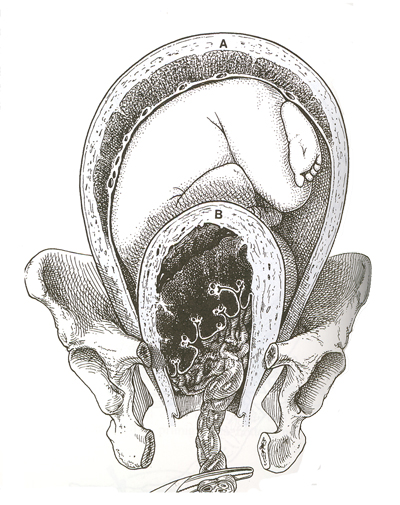
In the immediate aftermath of birth, placental function is severely compromised as uterine blood vessels close down and as the placenta starts separating from the uterine wall. Both are the direct result of the precipitous change in uterine volume after the baby has been expelled. The following illustration, taken from Williams Obsterics, makes the change clear.

The illustration shows the uterus after the baby has been born superimposed over the uterus before the baby has been born. In the before portion, the entire surface area of the placenta adheres to the wall of the uterus. Once the baby is born, the uterus contracts around the empty space. Some uterine vessels are immediately closed cutting down the available oxygen.

Even more important is the fact that the placenta is incapable of contracting. The illustration demonstrates that as the uterus contracts the placenta is forced off the uterine wall. The space between the contracted uterine wall and the peeled off placenta fills with blood. The pressure of the blood in the enclosed space forces more placental surface off until the entire placenta comes away accompanied by a gush of blood, the blood that filled the space between the uterus and placenta.

Looking at the illustration, it is not difficult to understand that the amount of oxygen absorbed by the placenta in the before view is dramatically reduced in the after view. You could let the cord pulsate forever, and the baby would still suffocate if it did not quickly begin to breathe.

Of course, no doctor or scientist ever claimed that delayed cord clamping improves oxygenation. Delayed cord clamping is supposedly beneficial because it reduces anemia by increasing the red blood cell count. Delayed cord clamping may reduce the need for supplemental oxygen in preterm neonates, but NOT because they have more oxygen in their blood. It’s because more red blood cells mean more oxygen carrying capacity. That’s it; nothing more. There is no scientific evidence, and no scientific claims that delayed clamping provides oxygen.

The fact is that once the baby is born, the umbilical cord does NOT become a supplemental supply of oxygen because the placenta can no longer absorb very much if any oxygen. Natural childbirth and homebirth advocates have simply made up the claim because it “makes sense” to them. Of course it only makes sense if you are ignorant about placental function and if you are ignorant about placental separation in the third stage of labor. And when it comes to ignorance about childbirth, it’s hard to beat NCB and homebirth advocates.

Five bald-faced homebirth lies

One of the things that amazes me about homebirth advocates is that they casually utter bald-faced lies, and persist in doing so even after it has been demonstrated to them that their claims are false.

They are not alone, of course. Anti-vax activists, creationists, and believers in other forms of pseudoscience do the same thing. They boast that they are “educated” but their education consists of what I call pseudo-knowledge, labeled by author Damian Thompson as counter-knowledge:

… [W]e are witnessing a huge surge in the popularity of propositions that fail basic empirical tests. The essence of counterknowledge is that it purports to be knowledge but it is not knowledge. Its claims can be shown to be untrue, either because there are facts that contradict them or because there is no evidence to support them. It misrepresents reality (deliberately or otherwise) by presenting non-facts as facts. (my emphasis)

For example:

Bald-faced homebirth lie #1
Childbirth is inherently safe.

This is without a doubt the greatest bald-faced homebirth lie, and the lie at the heart of all the other lies. Childbirth is inherently dangerous. Childbirth is and has always been, in every time, place and culture, a leading cause of death of young women. For babies, the day of birth is the single most dangerous day of the entire 18 years of childhood.

It is a bald-faced lie that can easily be disproven by even the most cursory examination of the historical record, or by the most basic awareness of the death toll in countries that lack access to the interventions of modern obstetrics.

Bald-faced homebirth lie #2 The countries with the greatest use of midwives have the lowest mortality rates.

Though nothing more than a bald-faced lie, no less an “authority” than Cathy Warwick the general secretary of the Royal College of Midwives has uttered it publicly and then been forced to publicly retract it.

In an interview with a major British newspaper, Warwick railed against those who argue that homebirth is not safe:

Mrs Warwick is determined to prove the critics wrong. She pointed to the Netherlands, which has the lowest perinatal mortality levels for babies in Europe.

It is also a country where a third of women have home births. In the UK the figure is just 3 per cent.

But not only is that untrue, it is the exact opposite of the truth. The Netherlands has the HIGHEST perinatal mortality in Western Europe. The paper was forced to retract the claim from the article.

Bald-faced homebirth lie #3 The US does terribly on measures of obstetric care.

Actually, the US does very well on measures of obstetric care. According to the World Health Organization, the best measure of obstetric care is perinatal mortality (late stillbirths plus deaths in the 28 days of life). In fact, the US has a lower perinatal mortality rate Denmark, the UK, and The Netherlands.

Natural childbirth advocates deliberately misrepresent reality by routinely quoting infant mortality (death from birth to 1 year of age) a measure of pediatric care, not obstetric care.

Bald-faced homebirth lie #4 The World Health Organization recommends an optimal C-section rate of 5-15%.

When homebirth advocate Marsden Wagner headed one of the World Health Organizations divisions of maternal and childbirth health, the organization did make such a recommendation. But now that Wagner is gone, the WHO has withdrawn the recommendation, acknowledging that there was NEVER any evidence to support it.

In last year’s edition of its handbook Monitoring Emergency Obstetric Care, the WHO wiithdrew the recommendation and acknowledgd that was not based on solid evidence.

Although the WHO has recommended since 1985 that the rate not exceed 10-15 per cent, there is no empirical evidence for an optimum percentage . . . the optimum rate is unknown …

Bald-faced homebirth lie #5 The Johnson and Daviss BMJ 2005 study demonstrated that homebirth with a CPM is safe.

This is a bald-faced lie perpetrated by the authors of the study themselves. Johnson, who fails to inform readers that he is the former Director of Research for the Midwives Alliance of North America (MANA) and Daviss, his wife, who fails to acknowledge that she is a homebirth midwife, pulled a deliberate bait and switch.

They compared the death rate of CPM attended birth is 2000 to … a bunch of out of date papers on hospital birth extending to 1969. They should have compared homebirth in 2000 to low risk hospital birth in 2000, and that data had been published more than 2 years before they submitted their paper. But that would have shown that homebirth with a CPM in 2000 had a mortality rate approximately triple that of comparable risk hospital birth in 2000, so they just left it out.

Far from demonstrating the safety of homebirth, the Johnson and Daviss paper actually demonstrates the opposite.

I often say that homebirth advocacy is based on mistruths, half truths and outright lies. The five bald-faced lies detailed above are at the heart of homebirth advocacy. They have been repeated so many times by homebirth advocates that credulous women have begun to believe them and the mainstream media has begun to repeat them.

Homebirth advocates like to boast that they are “informed,” but you can’t be informed if you believe in bald-faced lies.

Trust placentas?

Do you trust placentas? Whether you realize it or not, if you “trust birth,” that is precisely what you are doing.

Simply put, in order to “trust birth,” a woman must trust that her baby will fit, that her baby will survive labor, and that her baby will survive the serious challenges of the transition from life in utero to life outside.

Trusting that the baby will fit may be foolish, but it is usually not dangerous. There are many factors that determine whether a specific baby in a specific position will fit through a specific pelvis (Why won’t my baby’s head fit?). All the wishing, hoping and “trusting” in the world make no difference, but enduring many hours of fruitless labor is usually not harmful, and eventually it will become crystal clear that the baby does not fit.

Trusting newborns to make the transition is more problematic. Can a newborn be trusted to master breathing difficulties, circulatory problems and infections? As I wrote earlier this month, the signs of serious newborn illness are subtle can often can be diagnosed only by a medical professional. Therefore, “trusting” newborns to let us know when they have been overwhelmed by Group B strep bacteria, for example, is a recipe for disaster.

How about trusting placentas? That is what you are trusting when you “trust” that your baby will survive labor.

The placenta is the interface between the circulation of the mother, which provides oxygen and nutrients, and the circulation of the baby, which distributes oxygen and nutrients throughout the baby’s body. While most placentae function well, the placenta can be compromised by a variety of conditions. Moreover, the function of the placenta declines with age and as the due date passes, the placenta may become incapable of keeping up with the baby’s needs.

NCB and homebirth advocates who insist that “babies aren’t library books; they don’t have a due date” are implicitly trusting not merely that placental function will not decline, which is foolhardy since it is well known that placental function declines, but that it will not decline enough to suffocate the baby. Stillbirths rise in late pregnancy as the due date approaches and passes specifically because the placenta was not trustworthy.

“Trusting” birth means, in large part, trusting the placenta to provide the baby will a large enough reserve to tolerate contractions. During contractions, blood flow to the uterus (and therefore the placenta) is cut off. During each contraction, the baby is, in essence, holding its breath. Most babies tolerate this pretty well, because between contractions the placenta is providing so much oxygen that the baby has a reserve to draw upon during the contractions.

But what happens if the placenta is not functioning optimally? In that case, the baby develops fetal distress. Of course otherwise healthy babies can tolerate a fair amount of fetal distress. That’s why C-sections done in the early phases of fetal distress produce very healthy, apparently undistressed babies.

It’s like drowning. When someone who can’t swim falls into the water, they initially bob around for awhile. The sink, resurface and gulp air, and sink again. Eventually they fail to resurface. In the early phases, if you pluck the person out of the water, he or she will be perfectly fine, but that doesn’t mean they would have survived if you had refused to pluck them out.

It can take a long time for a baby to die of oxygen deprivation in labor, because the baby is usually getting some oxygen, albeit not enough. The typical pattern on the fetal monitor is known as “late decelerations.” The baby’s heart rate is completely normal between contractions, but toward the end of a contraction, the heart rate will drop and slowly recover. If that continues, the baby may develop bradycardias, periods of low heart rate that persist between contractions. Ultimately, the baby may develop a sustained bradycardia and the heart rate fails to come up; then the baby dies.

The bottom line is that NCB and homebirth advocates who claim they are trusting “birth” are actually trusting the placenta.

Is the placenta worthy of that trust?

That depends on a variety of factors:

Has the placenta been compromised before labor begins, either by a maternal condition like high blood pressure, or by the natural deterioration that occurs as the due date approaches and is passed?

Does the placenta provide the baby with an adequate oxygen reserve enabling the baby to tolerate “holding its breath” during contractions? That has to evaluated on an ongoing basis. Even when the oxygen reserve is inadequate, the baby can do well for quite some time, just like the drowning person flailing and bobbing for air. Eventually, though, the baby will not be able to tolerate any more and will die.

“Trusting birth” sounds sweetly spiritual. Trusting the placenta, not so much. That’s because the placenta is an organ, capable of being damaged, diseased, or failing altogether.

NCB and homebirth advocates need to ask themselves whether they “trust” a specific placenta to support a specific baby through a specific length of labor. And they need to be quite confident that they are right, because the baby’s life is literally depending on it.

Mothering.com: more than 20 preventable homebirth deaths in 2 years

Mothering.com has inadvertently become one of the best places to do learn about the deadly consequences of homebirth. Babies of MDC mothers routinely die preventable deaths at homebirth, and the moderators routinely remove any discussions about safety in connection with these deaths.

In other words, they attempt to sweep the dead babies under the rug, but for a two year period, I kept track of the homebirth deaths to determine just how frequent they are. In the years 2007-2008, there were more than 20 preventable homebirth deaths on Mothering. com, as well as additional cases of anoxic brain damage. Keep in mind that these are the cases that were reported; there may have been more.

Preventable homebirth deaths on MDC 2007:

1. breech, nuchal arms (arms trapped behind head), brain dead, ventilator disconnected

2. shoulder dystocia, profound brain damage

3. unanticipated anoxic brain damage sustained during labor

4. normal labor, baby dead at birth

5. decelerations during attempted home VBAC, transfer to hospital, uterine rupture, baby dead, massive hemorrhage, hysterectomy

6. postdates, severe meconium aspiration

7. normal labor, baby dead at birth

8. post dates, baby dead at birth

9. unanticipated severe birth asphyxia

10. prolonged ruptured membranes, overwhelming infection

Preventable homebirth deaths on MDC in 2008:

11. normal labor, baby dead at birth

12. normal labor, baby dead at birth

13. normal labor, baby dead at birth

14. attempted VBA2C, baby dead at birth

15. unanticipated severe birth asphyxia

16. mother rejected medical care, stillbirth

17. shoulder dystocia

18. transferred for pain relief, severe birth asphyxia

19. cord prolapse

20. normal labor, baby dead at birth

21. abnormal cord vessels, baby hemorrhaged

Sadly, this is what happens when you trust birth.

CPMs include midwives who “damage and ruin lives”

Who said this?

… [T]he [CPM] credential has a huge hand in creating some of the “bad apples” as you call midwives who damage and ruin lives. CNMs and MDs see a zillion more variations of the norm AND abnormal before they ever start practicing on their own. A CPM has seen a *few* typical variations, but if they haven’t ever seen the nuances that can lead to tragedy, how are they supposed to recognize it? …

No, it wasn’t me, although I agree with it wholeheartedly. It was actually a midwife, a CPM, in fact. It was Barbara Herrera, also known as Navelgazing Midwife.

Herrera is part of a tiny but growing trend of homebirth advocates willingly to seriously address the deadly shortcomings of the CPM credential. She was writing in response to a post by Imogen-Alternative Mama entitled Home Birth: A Different View.

Imogen emphasizes that she is a passionate supporter of homebirth, but:

… I hate to admit it but I can’t help but worry when I read stories of women giving birth to breech twins at home with a CPM – to me, that is way too risky. That’s not to say that there isn’t a whole load of wonderful CPM’s out there – there are. But there are also plenty who are underqualified, underexperienced and take too many risks.

I cringe when I read stories of CPM’s advising mothers to refuse GBS testing, lest it come back positive and end their chance of a home birth. Why do we think that midwives are somehow immune to greed? We’re all very happy to assume that doctors only care about lining their pockets, but when a midwife advises against testing that could save a baby’s life, coincidentally preventing the mother from having a homebirth and paying the midwife for it, nobody bats an eyelid.

And Imogen is suspicious of the refusal of the Midwives Alliance of North America (MANA) to release the death rates at homebirth:

Ignoring the fact that sometimes things go wrong at birth, even totally natural home births, is irresponsible and ignorant. Furthermore, I am very concerned about the fact that MANA (Midwives Alliance of North America) are hiding their data on homebirth death rates. Surely if the statistics showed that home birth in the US is as safe or safer than hospital birth, they would be shouting it from the rooftops? Instead, they are withholding the data and only allowing access to those who can prove they will use it for “the advancement of midwifery”.

Herrera responds enthusiastically:

Bravo!!! *standing ovation*

Your observations are 100% accurate… right on… exactly what I’ve been saying for a long time and am only just now getting much louder about it.

There are absolutely CPMs that are undereducated and underskilled. If we had a standardized system as you do in GB and in Canada, it’d be a whole lot different around here. But it isn’t. We’ve got a mish-mash of education routes and an endless supply of incestuous apprenticeships that perpetuate (what I call) black holes of knowlege that are only discovered when something goes awry.

I also believe homebirth can be a safe and wondrous option for women and babies. I *do* believe there are limitations to that safety and women need to suck it up that they can’t always have The Experience they want.

When another commenter insists that it isn’t the CPM credential itself, but rather the “bad apples,” Herrera disagrees as I quoted at the top, and continues:

It’s far, far easier to learn to sit on your hands than it is to recognize and manage the slew of silent-to-deafening complications that can -and do- arise in even the most normal of births. Not often… maybe even not rarely… but they can happen.

Preparation is never a bad thing. Neither is more education and experience.

I have heard privately from a number of CPMs expressing similar sentiments. Most fear going public with their concerns because they believe (probably correctly) that they will be ostracized by their colleagues. It is therefore refreshing to see a midwife who isn’t afraid to counsel CPMs to reform themselves as if babies lives depend on it … because they do.

Did the homebirth rate really rise?

iStock_000006518803XSmall

Ahhh, the power of the press release.

Evidently the folks in the PR office of the “journal” Birth: Issues in Perinatal Care have been working overtime. They’ve sent out thousands of press releases touting the latest study by MacDorman and colleagues purporting to show the the rate of homebirth in the US has risen 20% (from a teeny, tiny number to a bigger teeny, tiny number) during the years 2004-2008.

The public relations campaign that is promoting the paper implies that there has been a meaningful and substantial increase in the rate of planned homebirths in the US as a direct result of women rejecting hospitals and hospital based interventions. Is that what the paper shows? Not exactly, not least because it doesn’t even bother to distinguish between planned and unplanned homebirths.

Marian MacDorman et al., authors of the paper, United States Home Births Increase 20 Percent from 2004 to 2008, claim:

In 2008, there were 28,357 home births in the United States. From 2004 to 2008, the percentage of births occurring at home increased by 20 percent from 0.56 percent to 0.67 percent of United States births. This rise was largely driven by a 28 percent increase in the percentage of home births for non-Hispanic white women, for whom more than 1 percent of births occur at home. At the same time, the risk profile for home births has been lowered, with substantial drops in the percentage of home births of infants who are born preterm or at low birthweight, and declines in the percentage of home births that occur to teen and unmarried mothers. Twenty-seven states had statistically significant increases in the percentage of home births from 2004 to 2008; only four states had declines.

But even a brief glimpse at the methods used by the authors to calculate the rate of homebirths reveals that numbers quoted are nothing more than “guesstimates” based on proxies for real data.

In order to accurately determine the number of planned homebirths in the US, we’d need to know the number of women who planned to have a homebirth and successfully did so, the number of women who planned to have a homebirth and ultimately delivered in the hospital, as well as the numbers of babies who were born dead during homebirth. That’s not what the authors looked at.

MacDorman and colleagues looked at birth certificates to determine whether a birth occurred inside or outside of a hospital. In fact, the authors used the exact same technique used in part of the Wax study, a technique bitterly criticized by homebirth advocates specifically because it failed to distinguish between planned and unplanned homebirths.

So what did the authors actually find? They discovered that in 2004 there were 23,150 births that took place outside the hospital and in 2008 there were 28,357 births. Then the authors made a leap of faith, or rather several leaps of faith. MacDorman et al. ASSUMED the ratio between planned and unplanned homebirths remained the same from 2004 to 2008. They ASSUMED that the rate of hospital transfer during planned homebirth remained the same from 2004 to 2008. They ASSUMED that the death rates of planned homebirth remained the same from 2004 to 2008.

Those are big assumptions to make about a dataset composed of very small numbers (relative the to overall number of births). It is entirely possible that some portion of the purported “increase” that they observed reflected NOT an increase in the number of planned homebirths, but an increase in the number of unplanned homebirths. It is equally possible that some portion of the purported “increase” that they observed reflected NOT an increase in the number of planned homebirths, but a decrease in the number of hospital transfers. It is equally possible that some portion of the purported “increase” that they observed reflected NOT an increase in the number of planned homebirths, but a decrease in the number of homebirth deaths. And, of course, it is very possible that a substantial proportion of the purported “increase” in planned homebirths actually reflects some combination of the three.

The authors are anything but subtle in their motivation for publishing this study. They announce their motivation in the abstract:

Conclusion:  The 20 percent increase in United States home births from 2004 to 2008 is a notable development that will be of interest to practitioners and policymakers.

In other words, this is an attempt to convince policy makers that the rate of planned homebirth is rising and that, therefore, there is a demand for more homebirth practitioners.

If that wasn’t clear enough, the “journal” Birth released the article on-line four months before actual publication. How ironic is that? Homebirth advocates, the very same people who bitterly criticized the early on-line publication of the Wax study and denounced it as an attempt to influence public policy respond by attempting to influence public policy with an article published online even farther in advance.

Of course, the MacDorman paper fails utterly to address the most serious concern about homebirth, the increased risk of perinatal death. The authors enthusiastically boast that the rate of “homebirth” has risen without bothering to find out how many babies died in the process.

That’s fairly typical in the world of homebirth advocacy. And increase in homebirth rates is a cause for celebration. Who cares how many babies died as a result?

Complaining that obstetricians “play the dead baby card”

From a recent thread on Mothering.com claiming that doctors play the “dead baby card” with women who are postdates.

I felt exactly as you did around 36 weeks pregnant with my VBAC attempt. I had already switched DRs around 20 weeks to a group of Family Practice doctors that are probably the most VBAC friendly in the area… I watched Business of Being Born and really started feeling like the only way I’d get a VBAC was with a homebirth midwife. Unfortunately, DH was NOT on board with that idea and I felt like it was “too late” to make such a drastic switch. I really should have listened to my instincts… The switch in their attitude around 41 weeks was shocking. When I wouldn’t agree to an induction I was told I was risking fetal death and they couldn’t be responsible for that – basically the next week was spent scaring me into a bunch of testing where they found a reason to induce me and even with the help of a doula, I wasn’t able to avoid ending up with another failure to progress c-section. I later learned that their license and hospital privileges can be called in to question when they “let” a woman go to 42 weeks. Obviously, there utmost concern remained with what was best for them …

After that experience and the regret of not trusting my instinct, I told DH that we’d be having no more babies unless I was able to plan a homebirth for the next one. I’m full-term with baby #3 and hoping to have an awesome HBA2C story in the next month! No matter how the birth turns out, I appreciate having a care provider who understands that each pregnant mother is an individual who is capable of researching and making her own decisions about “HER” body and child…

The mother began labor spontaneously at 41 1/2 weeks, labored for 24 hours and apparently delivered vaginally the day before yesterday.. The baby was born not breathing. Subsequent evaluation revealed meconium aspiration and catastrophic brain damage due to lack of oxygen. The decision was made to take the baby off life support.

The baby is dead.

Midwife lets baby die, breaks law, pleads guilty to felonies; I think I’ll hire her

According to a recent piece in The Washington Post, certified professional midwife Karen Carr boasted in the wake of her guilty plea in connection with the entirely preventable death of a baby in her care, her phone is ringing off the hook with women wanting to hire her.

It can’t be because of her safe midwifery practices; it can’t be because she abides by the law; and it certainly can’t be because the trail of dead babies in her wake demonstrates that homebirth is safe. So why hire her? And why hire her now?

Such seemingly inexplicable behavior is reminiscent of the response of cults when their predictions prove entirely false.

In a fascinating article in Mother Jones (The Science of Why We Don’t Believe in Science), the author offers the classic tale of psychologist Leon Festinger’s research on a doomsday cult after its prediction for the end of the world proved false:

… [T]he aliens had given the precise date of an Earth-rending cataclysm: December 21, 1954. Some of Martin’s followers quit their jobs and sold their property, expecting to be rescued by a flying saucer when the continent split asunder and a new sea swallowed much of the United States. The disciples even went so far as to remove brassieres and rip zippers out of their trousers—the metal, they believed, would pose a danger on the spacecraft.

Festinger and his team were with the cult when the prophecy failed…December 21 arrived without incident. It was the moment Festinger had been waiting for: How would people so emotionally invested in a belief system react, now that it had been soundly refuted?

At first, the group struggled for an explanation. But then rationalization set in. A new message arrived, announcing that they’d all been spared at the last minute. Festinger summarized the extraterrestrials’ new pronouncement: “The little group, sitting all night long, had spread so much light that God had saved the world from destruction.” Their willingness to believe in the prophecy had saved Earth from the prophecy!

… In the annals of denial, it doesn’t get much more extreme than the Seekers. They lost their jobs, the press mocked them, and there were efforts to keep them away from impressionable young minds. But while Martin’s space cult might lie at on the far end of the spectrum of human self-delusion, there’s plenty to go around…

In other words, in the wake of evidence that their fundamental beliefs were false, cult members responded by ignoring the evidence and attempting to explain how the fact that their beliefs were shown to be false, actually proved them to be true!

Sound familiar? It sounds distressingly like the response of homebirth advocates whenever their fundamental beliefs are shown to be false. If the Karen Carr disaster demonstrates nothing else, it demonstrates that homebirth practitioners are reckless, that intuition (of both mother and midwife) is useless, and that far from being as safe as hospital birth, homebirth increases the risk of neonatal death. How have homebirth advocates responded? Many have responded by insisting that the demonstration of Karen Carr’s incompetence proves that she is competent, so competent, in fact, that they want to hire her.

Homebirth involves a cult-like belief in its safety despite any and all evidence to the contrary. Homebirth advocates crown “prophets” like Ricki Lake and Henci Goer, when there is no reason to believe their “prophecies” about anything, let alone homebirth. They repeat outright lies over and over again, even after the evidence demonstrates that they are repeating lies. And the more spectacular the demonstration that they are utterly wrong, the more they insist that being proven wrong actually proves that they have been right all along.

Hiring Karen Carr as your midwife is like insisting that the fact that the world did not end on the predicted day actually indicates that the prophecy was correct. It demonstrates a disturbing willingness to ignore reality in a desperate effort to justify an uneducated and obviously inaccurate system of belief.

Dr. Amy