Why do lactivists portray anyone who is not an ally as an enemy?

6850A9AD-A082-4749-B454-2BC0D944BEC4

Yesterday I wrote about the vicious treatment — the “Semmelweis treatment” — of the Fed Is Best Foundation. I explained that lactation professionals demonize Fed Is Best for the same reasons Semmelweis’ colleagues demonized him when he identified that doctors were spreading childbed fever. They can’t bear to acknowledge that they might be harming patients.

But why are lay lactivists often equally vicious in the way they interact with women who can’t or don’t wish to breastfeed? Instead of viewing all women as potential allies in the struggle to raise children, lactivists position women who make different choices as antagonists. They employ two primary rhetorical gambits: friend-enemy politics and “formula as poison.”

[pullquote align=”right” cite=”” link=”” color=”” class=”” size=””]Lactivists’ favorite rhetorical gambits: friend-enemy politics and “formula as poison.”[/pullquote]

Why?

Because the issue of breastfeeding vs. bottlefeeding isn’t about food and it isn’t about babies. It’s about womanhood. For lactivists, that is a battle worth fighting to the emotional death.

A new paper, Formula for Success: Dueling Discourses in the Breastfeeding Battle, from the International Conference on Gender Research explains that lactivism promotes a “culture of true womanhood.”

Lactivists:

… have essentialized womanhood to a degree that excludes the concept of maternal choice… [E]ssentializing womanhood in this manner reifies doctrines of motherhood as a dualistic construct formed by competing subjects of good and evil…

The cultural activism we analyze here continues to rely on an archetypal figurehead of natural motherhood— the True Woman … The breastfeeding mother emerges as the True Woman via hegemonic femininity … These Cult narratives employ the rhetorical strategy of definition by negation where the bottle feeding mother is portrayed as a “bad mother” who unnaturally puts herself before her children…

Both friend-enemy politics and “formula as poison” reflect the cultural and rhetorical touchstone of lactivism: the Nestle formula scandal. In the 1970’s and 1980’s, Nestle marketed formula in Africa and babies died as a result. Of course formula was NEVER harmful to babies; it was the contaminated water used to make the formula that was dangerous. No matter. Forty years have passed, but that tragedy shapes lactivist rhetoric today.

The authors use The Alpha Parent and KellyMom as paradigmatic examples. They also investigate Jack Newman, MD and Darcia Narvaez, PhD.

The Alpha Parent supports its heavily pro-breastfeeding stance with articles like “Is Formula Feeding Worse than Smoking?” and tweets depicting breastfeeding mothers and captions that read “Tbe, Skinny on Mommy Guilt (those of a nervous or butthurt disposition, look away now) #breastfeeding”. As a whole, The Alpha Parent uses aggressive, friend-enemy rhetoric that valorizes breastfeeding mothers and creates a strong sense of identification amongst them, while concomitantly blaming bottle feeding mothers for their children’s ailments …

Framing women who make different choices as enemies is key.

The Alpha Parent engages in a game of debasement with a strategy of shaming “other” women (women who are not breast feeding). It valorizes the true woman via heuristics of the natural (“If you feel guilty of your choice, that is your internal accountability system being triggered”)…

What about KellyMom?

Specifically addressing whether or not it is appropriate to make bottle feeding mothers feel guilty, Jack Newmann, a contributor to KellyMom writes:

“Let’s look at real life… If [a woman] went to the office with her one-week old baby and told the physician that she was feeding her baby homogenized milk, what would be the reaction of her physician? Most would practically collapse and have a fit. And they would have no problem at all making that mother feel guilty for feeding her baby cow’s milk, and then pressuring her to feed the baby formula. (Not pressuring her to breastfeed, it should be noted, because “you wouldn’t want to make a woman feel guilty for not breastfeeding”.)”

Newman mobilizes the rhetorical strategy of “formula as poison.”

Newmann’s article demonstrates how women are disciplined when operating outside of traditional gender boundaries. Newmann strips women of their choices in performing motherhood and places control of motherhood in the hands of medical professionals…

It would be more accurate to say that Newmann places control of motherhood in the hands of lactivist medical professionals. All others can be ignored.

Darcia Narvaez, PhD draws on anti-corporatist bias:

Narvaez’s … employed an interesting tactic of associating breastfeeding and health with the capitalist ideology:

“When your fellow citizens are not breastfed, it costs you. If you were not breastfed, it is costing you. It is costly for all members of society, whether or not you are a parent or grandparent… People who are breastfed are less likely to be a host of mental and physical diseases throughout life and are less likely to end up in prison”… [I]n denying her child the breast, predetermined her or him to a life of crime. In contrast, the breastfeeding mother, quite literally passed her virtue on to her children through her milk and breast.

But why make enemies of women who, though they make the choice to bottlefeed, are actually sympathetic to the struggles of ALL mothers?

For the same reason that radical conservative political outlets portray liberals as enemies and liberalism as moral and political poison: to build a following.

These websites and biogs promote a strong sense of identification amongst users and allow women to engage in a heuristic of the natural when addressing infant health. Through high levels of interactivity (posting, replying, commenting, etc.) followers foster strong group identifications which provides a rationale for their beliefs, to the detriment of holistic discussions that engage professional research and outside opinions.

And just as the conservative political culture constructs compromise as betrayal and support for the “other” as anathema, contemporary lactivist culture constructs compromise on aggressive breastfeeding promotion as betrayal and support to the formula feeding “other” as anathema.

It’s a great strategy for boosting followers, but a harmful response to everyone else.

It doesn’t have to be this way.

The authors don’t discuss the Fed Is Best movement, but the movement provides an antidote to toxic lactivist culture. Feeding safety advocates, myself included, promote CHOICE, not specific choices and try to support ALL women regardless of the way they choose to feed their babies. Because the truth is that formula is NOT poison and the benefits of breastfeeding term babies in industrialized countries are trivial. Babies don’t care whether they are breastfed or bottlefed so long as they are fed.

Breastfeeding and bottle feeding mothers could be allies in the struggle that is motherhood … but only if lactivists stop playing friend-enemy politics and drop the ugly rhetorical gambit of “formula as poison.”

The Fed Is Best Foundation gets the Semmelweis treatment

78E865D8-C78E-4D95-A432-70B52988A594

It was a tragedy in every respect.

Dr. Ignác Semmelweis was an obstetric physician in 19th century Vienna. He … was appointed to Vienna General Hospital in 1846. There, he became aware of a puzzling disparity.

The hospital offered two free maternity clinics for economically disadvantaged women. First Clinic was run by all-male doctors and medical students. Second Clinic was operated by midwives and their students. The clinics admitted on alternating days…

… Between ten and twenty percent of women in First Clinic died of puerperal [childbed] fever, while Second Clinic’s percentage was only two to four percent.

Why was there such a vast disparity?

The death of a fellow doctor provided Semmelweis with his central insight:

[pullquote align=”right” cite=”” link=”” color=”” class=”” size=””]If Semmelweis had created a slogan it would have been “Disinfected Is Best.”[/pullquote]

One of his colleagues pierced his skin on a scalpel while performing an autopsy and died from the infection. When Dr. Semmelweis examined the wound on his dead colleague, he found it showed the pathology as the bodies of women who died of puerperal fever.

Semmelweis realized that the cause of childbed fever was something in the cadavers and insisted that doctors wash their hands in chlorinated lime before seeing obstetric patients.

Immediately after this policy was instituted, mortality rates dropped 90%…

He broadened his theory to include infected but still-living women, not just corpses, and ordered doctors to wash between patients, too, and the numbers of infections fell even further. When Dr. Semmelweis included the medical instruments used on the women, the rate of infection dropped to around one percent.

If Semmelweis had created a slogan it would have been “Disinfected Is Best.”

What was the response to this astounding discovery? Nothing but abuse.

But Dr. Semmelweis’s discovery was not heralded as the life-saving breakthrough it was. Instead, doctors were offended by the implication that they were dirty and needed to wash more, or that doctors could be somehow at fault for their patients’ demise…

We could call this the “Semmelweis treatment.” His insight and the remarkable improvement in patient outcomes that resulted was rejected because it offended the people who were causing the deaths. As far as his detractors were concerned, “disinfected could never be best” because that would mean acknowledging their own role in the suffering they left in their wake.

Sadly, a similar scenario is playing out today. Christie del Castillo-Hegyi, MD and Jody Seagrave-Daly RN, IBCLC, founders of the Fed Is Best Foundation, are being subjected to the Semmelweis treatment.

Like Semmelweis, Dr. del Castillo-Hegyi came to her central insight because of a tragedy in her life, though in her case it happened not to a colleague, but to the doctor herself. Her own son sustained permanent brain injuries as a result of profound dehydration. She had been concerned that her son wasn’t getting enough breastmilk, but was repeatedly reassured by lactation professionals — incorrectly — that he was receiving all the breastmilk he needed.

Dr. Castillo-Hegyi’s central insight is that insufficient breastmilk and its complications are common, affecting up to 15% of first time mothers especially in the early days after birth. She has also identified a startlingly simple treatment that could prevent the tens of thousands of newborn hospital readmissions for breastfeeding complications each year: observing babies closely for weight loss and dehydration and having a low threshold for temporary formula supplementation. In other words, Fed Is Best.

What has she received for this critical discovery? Nothing but abuse!

Her insight and the improvement in neonatal outcomes that would result have been rejected for the exact same reason Semmelweis’ insight was rejected: it offends lactation professionals, the people who are causing the suffering of mothers and babies.

In contrast to Semmelweis, who couldn’t offer a scientific explanation for what he observed, Dr. del Castillo-Hegyi has provided reams of analysis, copiously referenced with contemporary scientific papers that have confirmed her central insight. No matter. She, Seagrave-Daly, and the Foundation have been subjected to an endless stream of abuse and invective.

Lactivist Prof. Amy Brown wrote an influential blog post entitled Why Fed Will Never Be Best:

‘[F]ed is best’ is simply putting a sticking plaster over the gaping wound that is our lack of support for breastfeeding and mothering in general.

She insists that lactation professionals — with their aggressive efforts to promote exclusive breastfeeding and avoid supplementation under almost all circumstances — are providing the best possible care. This despite the fact that exclusive breastfeeding is now the leading cause of newborn hospital readmission, responsible for tens of thousands of readmissions each year. Brown argues that what women and babies need is more of that care.

It’s the equivalent of Semmelweis’ medical colleagues who insisted they were providing the best possible care DESPITE the fact that they were actually causing patients’ deaths. It’s the equivalent of the colleagues arguing that what women needed was more of that (deadly) care.

Lactation professional Kimberly Seals Allers heaps abuse on the Fed Is Best Foundation:

… Is Fed is Best more interested in saving lives or stoking fear and anger among women? …

Perhaps FIB is only interested in speaking into their own echo chamber and putting out reports. And telling inflammatory stories designed to incite emotions but they are short on actions with others …

She’s and many of her sympathizers — particularly lactivists who run Facebook pages — are no different from the physicians who heaped abuse on Semmelweis.

There’s actually a Facebook group entitled “Fed Ain’t Best” whose administrators use a defaced version of the Fed Is Best logo as their own.

Semmelweis was nothing if not colorful in his own defense.

In an open letter to a medical editor he wrote:

I denounce you before God and the world as a murderer, and the History of Puerperal Fever will not do you an injustice when, for the service of having been the first to oppose my life-saving [treatment] …, it perpetuates your name as a medical Nero.

I wouldn’t go so far as to say Amy Brown, Kimberly Seals Allers and lactivist bloggers are medical Nero’s, but they are definitely on the wrong side of history. I have no doubt that, like Semmelweis, the Fed Is Best Foundation will ultimately be recognized as having been correct all along.

The only question is how many babies and mothers have to be harmed in the meantime by lactation professionals who —like Semmelweis’ detractors —have put their own egos above patient wellbeing.

Lamaze and Hannah Dahlen demonstrate moral bankruptcy

Rubber stamp with word unethical inside, vector illustration
You can’t make this stuff up!

If Lamaze International and Hannah Dahlen wanted to demonstrate their contempt for the wellbeing of mothers and babies, they couldn’t do better than to promote Robert Biter as a feature speaker at their Australian conference. Nothing illustrates contempt for women quite like featuring a doctor stripped of his license for harming women.

FFA9EE35-BDC9-4A06-85D2-8C5D239E8898

Biter initially had his license to practice medicine severely restricted because of 7 separate instances that the Medical Board of California described as:

“gross negligence in his care and treatment” of a patient”
“repeated negligent acts” performed on 6 additional patients”
“prescribing without an appropriate prior examination”
“acts of dishonesty with respect to the care and treatment of patients”
“failure to maintain adequate and accurate medical records”
“general unprofessional conduct”

Biter was suspended from the practice of medicine for 60 days, followed by 7 years of strict probation. However, AFTER he signed documents acknowledging the findings of the Board and the prescribed disciplinary action, but before the official start of the suspension, he presided over a homebirth death. In November of 2013 he surrendered his license to practice medicine. You can read the findings of the Board here.

[pullquote align=”right” cite=”” link=”” color=”” class=”” size=””]Nothing illustrates contempt for women quite like featuring a doctor stripped of his license for harming women.[/pullquote]

According to the records of the San Diego Superior Court, at least 8 lawsuits have been filed against him. I recently learned that he is trying to resurrect his career by opening a birth center in Mexico. Perhaps the licensing standards there are less stringent or perhaps the Mexican authorities are unaware of his history of “gross negligence, repeated negligent acts and general unprofessional conduct.”

Biter has publicly complained that he was victimized because of his commitment to natural childbirth but the majority of accusations of negligence and harm were claimed by GYN patients and had nothing to do with birth.

So why is he a featured speaker at a Lamaze conference on “Creating a New Paradigm in Birth”? Why is Hannah Dahlen proudly appearing along side him? Because contemporary natural childbirth ideology has precious little to do with what is good for women (otherwise why invite someone who has allegedly caused so much harm to women?) and is really about increasing employment opportunities and market share for midwives, doulas and childbirth educators.

Indeed, irony of ironies, in 2013 Biter was a featured speaker at a Human Rights in Childbirth conference. Naïvely, you or I might think that human rights in childbirth refers to making sure that all women have access to competent medical care, without regard for ability to pay, that incarcerated women not be forced to labor in chains, and that women have access to birth control. Don’t be foolish. Who cares about those women? HRiC is about the “rights” of white, Western, relatively well off midwives, doulas and childbirth educators to do and say whatever they want and be paid for it.

What about the human rights of the women and babies injured and killed by negligent and unprofessional providers? They apparently have no rights at all. Lamaze and Dahlen should be ashamed of themselves for associating with Robert Biter, but we’ve known for a long time that they are beyond shame.

Finally there is something this lactation consultant and I agree upon

Cheerful diverse young girls sitting together in sports studio before starts training giving high five feel happy and healthy, close up focus on hands. Respect and trust, celebration and amity concept

I suspect that Lucy Ruddle, IBCLC feels put upon by me.

First I took her to task for her meme that analogized formula to cake.

I created this:

C4F1DAB8-4AE6-4D3D-A58C-4FA1B75F5F72

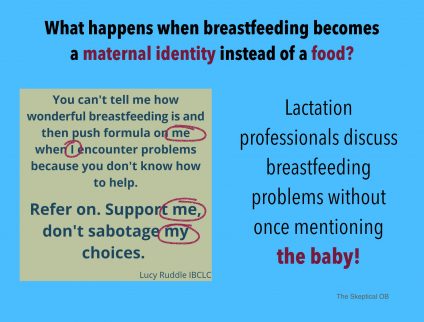
Then she implied that anyone who recommends formula supplementation for starving babies is trying to “sabotage” breastfeeding mothers. I created this to express my incredulity that a lactation consultant could discuss breastfeeding problems without once mentioning the baby and his or her suffering:

ACA6010F-462F-40B2-A656-1778906CB0BC

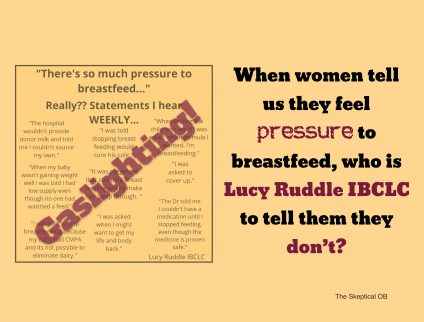
Most recently Ruddle posted a meme questioning the existence of pressure to breastfeed:

8BF292B6-6159-49CE-99FA-F9DD94163B6D

It was a classic example of gaslighting and I called her on it.

She was angry. That’s the typical response of people who suffer from attribution bias, the tendency to assume that one’s own motives are pure while simultaneously insisting that anyone who disagrees has malicious motives.

[pullquote align=”right” cite=”” link=”” color=”” class=”” size=””]The continuing insistence that “breast is best” is designed to create anger, anxiety, and to pitch us against one another.[/pullquote]

I don’t doubt that Ruddle’s motives are pure. I simply point out the harmful impact her claims have on women who can’t or don’t wish to breastfeed.

But finally there’s something on which we can agree, the Facebook post she wrote today:

A2DD521B-C40E-4482-AF97-3C6F0844BB99

The entire point of (“insert feeding method of choice) is best” is to create anger, anxiety, and to pitch us against one another. They aren’t about true support, because if they were, there would be no need to argue. X is best relies on divides… women beating each other up… it relies on our fears. Because while we’re arguing over who is best, we’re not focusing our attention on the real issue. Which is that mothers are not valued, heard, or encouraged to trust their instincts. That we are routinely silenced, are subject to abuse from professionals, and that we are not given access to the quality of respectful, kind support we all deserve…

I would modify that only slightly:

The ORIGINAL point of “breast is best” was to maximize the health of babies. At the time it came into widespread use many professionals believed that breastfeeding must be best because it is natural. There were also studies that suggested that breastfeeding had major health benefits.

But over the following years several things became clear:

  • Breastfeeding in industrialized countries is socially patterned. Most benefits that were ascribed to breastfeeding are actually benefits of wealth.
  • Breastfeeding, like most natural reproductive processes, has a high failure rate.
  • Tens of thousands of babies are hospitalized each year for breastfeeding complications.
  • Exclusive breastfeeding has become the leading risk factor for newborn hospital readmission.
  • Women who can’t breastfeed successfully are suffering soul searing guilt.

Indeed, it’s been clear for MORE THAN A DECADE that breast ISN’T best for many babies and many mothers. The response of lactation professionals has been to ignore the evidence and dig in their heels. They keep shouting “breast is best” regardless of the fact that the claims of benefits have been largely debunked.

Why?

I agree with Ruddle’s assessment:

The continuing insistence that  “breast is best” is designed to create anger, anxiety, and to pitch us against one another.

Breastfeeding promotion in 2019 isn’t about what’s best for babies. It’s about what’s best for lactation consultants and there is no limit to the amount of anger and anxiety (not to mention harm to babies) that they are willing to provoke to pitch women against each other.

Ruddle’s point is the one I have been making repeatedly for years:

This isn’t about true support, because if it were, there would be no need to argue. BREAST is best relies on divides… women beating each other up… it relies on our fears. Because while we’re arguing over who is best, we’re not focusing our attention on the real issue. Which is that mothers are not valued, heard, or encouraged to trust their instincts. That we are routinely silenced, are subject to abuse from professionals, and that we are not given access to the quality of respectful, kind support we all deserve.

Fed is best is a REJECTION of that mentality. Fed is best doesn’t divide women; it doesn’t promote women fighting with each other; it soothes fears. The POINT of “fed is best” is to VALUE and HEAR women and to encourage them to trust their instincts about whether formula, breastfeeding or both is best for their babies or for them.

Breast is best is designed to silence women; there can be no argument. It serves to justify the abuse that lactivists heap on women who can’t or don’t wish to breastfeed; and it promotes a culture that insinuates that women who formula feed are “dupes” of the formula industry and lazy, selfish women who aren’t “baby friendly.”

Ruddle’s words are words to live by. She and other lactation consultants should try to live by them instead of merely paying them lip service.

Lactation professionals treat mothers like cows

5A268291-8A10-41D8-B67E-3C92C93AC170

My email inbox is filled with messages from women who hate themselves, blame themselves and are nearly incapacitated by guilt at being unable to breastfeed exclusively.

Why?

It’s certainly not because breastfeeding in industrialized countries is so beneficial for babies that it has a measurable impact on mortality rates, life expectancy or IQ. Walk into any kindergarten classroom and it is impossible to tell which children were breastfed and which were not.

It’s because in the past 30 years we have seen the rise and professionalization of a movement, lactivism, thats benefit from viewing new mothers the same way farmers view cows: as milk suppliers.

[pullquote align=”right”]Regardless of the difficulty, the lactivist prescription is always the same: “Breastfeed harder.”[/pullquote]

Consider:

The concept of choice doesn’t exist among lactation consultants. There is only one acceptable choice and that is to breastfeed. They will go to great lengths to help women who make that choice, but they will do nothing for women who bottlefeed.

A mother’s pain is irrelevant. For the breastfeeding industry, just because a mother has cracked and bleeding nipples is no excuse for her to avoid being a milked like a cow. It’s just another opportunity to sell her products that purportedly reduce the pain.

A baby’s hunger is irrelevant. For lactation professionals, just because a baby is screaming in hunger is no excuse for his mother to provide milk from any other source than herself or another mother breastmilk dispenser.

Breastfeeding difficulties are irrelevant. Regardless of the difficulty (poor latch, flat nipples, poor suck, insufficient breastmilk) and regardless of the severity of the difficulty the lactivist prescription is always the same: “Breastfeed harder.”

A mother’s need for sleep is irrelevant. She is supposed to dispense breastmilk 24/7/365. What else could be more important than being a breastmilk dispenser?

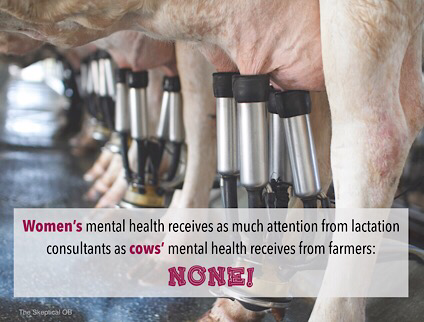
A mother’s need to control her own body is irrelevant. If breastfeeding makes her psychologically uncomfortable, she’s supposed to get over it. Her mental health receives as much attention from them as cows’ mental health receives from farmers.

A mother’s mental health is irrelevant. Lactation professionals are much more concerned with whether treatments for postpartum depression are compatible with breastfeeding than with whether they are the best possible treatment for the mother’s condition. The mother must continue dispensing breastmilk as she approaches and even endures psychological collapse.

The connection between breastfeeding and postpartum depression has been noted, but lactation professionals have chosen to spin it as evidence that successful breastfeeding prevents postpartum depression; the reality is that pressuring women to breastfeed when they can’t or don’t want to do so increases the risk of postpartum depression. That’s certainly what suffering women tell us, but lactation consultants don’t bother listening to them.

Treating women like cows has a corollary in pregnancy and childbirth and that corollary has been emphatically rejected by most women. The corollary is treating women as breeding stock, evaluating every decision they make by asking whether it is good for the baby. Ironically, many of the same people who would be horrified by reducing pregnant women to baby incubators, have no problem reducing new mothers to breastmilk dispensers.

In response to the never ending lobbying of lactation organizations, we have moralized breastfeeding far, far beyond any actual benefits. It has become a signifier of social status and an emblem of maternal superiority; indeed, it has become a requirement for being a “good” mother.

As a result we treat new mothers as if they were cows and there only reason for existence is to dispense breastmilk. Even if breastmilk were “the elixir of life” as some lactivists pretend, that would not justify this cavalier treatment of women. Since the benefits of breastmilk are in reality trivial, treating women like cows isn’t merely unjustified, it is gratuitously cruel.

Every women is capable of looking at the scientific evidence about breastfeeding term babies in industrialized countries (the real evidence, not the wildly exaggerated claims) and making her own considered decision how to feed her infant. Insisting that it is the lactation industry’s business deprives a woman of autonomy … and treats her as no better than a cow.

Evolutionary parenting means embracing technology not rejecting it

Asteroid that wiped out the dinosaurs

If our ancient foremothers could see Tracy Cassells, PhD, of Evolutionary Parenting (and other parenting “experts” like her) they wouldn’t know whether to laugh or cry.

We as humans have evolved in a particular manner, and the parent-child relationship is no different. Children, especially babies, expect certain behaviours from their caregivers and research is starting to understand both how deviations from these expectations affect child development and the bidirectional nature of the child-parent relationship. Of course, not all people can or want to parent our children based on their biology. In this realm, Evolutionary Parenting focuses on the idea that anytime we deviate from a known biological norm, we should have good reason and try to mimic biological processes as much as possible in order to minimize disruptions to later outcomes and child well-being.

The infant mortality rate in nature was astronomical, possibly as high as 1 in 3; babies died during childbirth, they died of dehydration before breastmilk came in, they died of infectious diseases, they died when minor injuries became infected, they died when they were attacked by predators, they died and their siblings died and if women didn’t give birth to the natural biological allotment of 8 infants of more, there was a chance they wouldn’t ever have an adult child.

[pullquote align=”right” cite=”” link=”” color=”” class=”” size=””]Evolution never goes back to the past; that’s the surest way to extinction.[/pullquote]

Many mothers lived permanently bereft and forever in fear of the death of those their surviving children. This is what Cassells and her fellow natural mothering “experts” want to return to.

Why? Because they are remarkably ignorant about evolution and natural selection. Evolution always involves ADAPTATION, not the return to the past that Cassells recommends. Evolution is always about survival and WHATEVER maximizes survival is “evolutionary.”

The paradigmatic example of evolution in action was described by Charles Darwin. He noted the amazing variety of finches in the Galápagos Islands:

A few million years ago, one species of finch migrated to the rocky Galapagos from the mainland of Central or South America. From this one migrant species would come many — at least 13 species of finch evolving from the single ancestor.

… The ecological niches exert the selection pressures that push the populations in various directions. On various islands, finch species have become adapted for different diets: seeds, insects, flowers, the blood of seabirds, and leaves.

The ancestral finch was a ground-dwelling, seed-eating finch. After the burst of speciation in the Galapagos, a total of 14 species would exist: three species of ground-dwelling seed-eaters; three others living on cactuses and eating seeds; one living in trees and eating seeds; and 7 species of tree-dwelling insect-eaters.

Different species of finches evolved to exploit the environments of different islands. It was the CHANGES that ensured their survival, not the insistence on stubborning clinging to behavior that evolved thousands of years before.

Finches can teach us critical lessons about evolution.

1. Fitness is not static.

As conditions changes, fitness changes. And conditions always change, whether it is climate, pressure from other species, local events like volcanic eruptions, etc. There is no such thing as an animal that is “perfectly fit” because there is no such thing as a static environment.

2. Fitness is tied to the environment.

How successful do you think the seed eating finches were on islands that had very few seeds of the type they had been evolved to eat? Not very. That’s why they evolved characteristics like changes in beaks to allow them to eat different seeds and, in some cases, switched from seeds to insects.

3. The most successful animals are those who adapt, not those who remain unchanged.

If we anthropomorphize the finches, we can see just what is wrong with the philosophy of natural parenting, the philosophy of Cassells and her colleagues.

Imagine the finches who arrived in the Galapagos had surveyed the situation on each island and announced:

“We were evolved to live on the ground and eat seeds. Therefore, we will continue living on the ground and eating seeds and pretend we are still on the mainland.”

“Nature has rendered us perfectly evolved and all we have to do is live like we have always lived.”

The result would have been extinction from the islands. The finches destined to be most successful were those who abandoned the way they had evolved and sought out new food sources and new places to live.

It’s not hard to see the parallels with natural parenting.

Lactivists are equivalent to finches who insisted on eating seeds because they always ate seeds. In nature, many babies died due to insufficient breastmilk; those babies can now survive on formula. They are FITTEST for the current environment.

Parents who advocate co-sleeping are equivalent to finches who insisted on living on the ground even though there were new predators on the ground. The parents who will be evolutionarily MOST successful are those who let their offspring sleep in a separate bed, on a firm surface, with no bedding or soft toys because those children are most likely to survive and evolution is ALWAYS about maximizing survival.

Natural parenting advocates are evolutionary dinosaurs. Dinosaurs had been successful for millions of years. Yet when a massive asteroid impacted earth and the environment changed dramatically, they couldn’t adapt fast enough and died out.

Technology is the equivalent of a massive asteroid impact; it has changed everything. Those who can adapt to use it are evolutionarily successful while those who try to return to the past are less fit and their children are less likely to survive. Real evolutionary parenting means embracing the technology of the times, not rejecting.

Evolution NEVER goes back to the past; that’s the surest way to extinction.

The Birthing Person’s Bill of Rights

425FB13A-E463-46B3-A72C-6EB79417D58C

I was lucky to do my internship and residency at the first hospital to have a Patient’s Bill of Rights, Harvard’s Beth Israel Hospital.

The Patient’s Bill of Rights was based on the belief that doctors and nurses owed patients MORE than merely excellent treatment; they owed them compassionate and ethical care. It reflected the change from a paternalistic mindset — doctor knows best — to one that recognized patients as individuals entitled to complete information and capable of making decisions for themselves.

[pullquote align=”right” cite=”” link=”” color=”” class=”” size=””]Nothing about me without me![/pullquote]

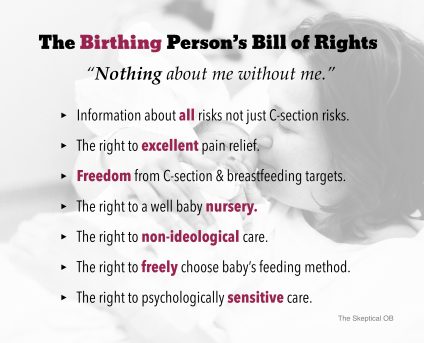
It seems to me that we are now in need of a Birthing Person’s Bill of Rights. Those who provide maternity care owe patients more than just excellent medical treatment; we owe them compassionate care that meets their goals, not ours. We must give up the maternalistic mindset — natural childbirth advocates and lactation consultants know best — for one that recognizes patients as individuals whose priorities may be different from those of professionals.

Here’s a first attempt.

Nothing about me without me.

That should be the guiding principle of maternity care. The patient is the “decider” NOT the professionals. Sure professionals know more about the science, but we don’t know enough about the competing pressures in an individual’s life to tell her how she must give birth and feed her baby.

As the paper Shared decision is the only outcome that matters when it comes to evaluating evidence-based practice explains:

Population-level health outcomes rarely if ever take into account patient values and preferences and therefore by definition fly directly in the face of the fundamental goals and definition of EBP. Ignoring patient values and preferences or at least not placing them at the forefront of decision making legitimises the argument that the presence of effects at population levels is sufficient justification for recommending treatments even though the absolute magnitude of these changes clearly may not be important to all individual patients.

In other words, even if a treatment is shown to have population level benefits, that does NOT justify pressuring patients to make those choices. That’s because scientific evidence is a tool akin to a measuring tape to be used to evaluate various treatment options, not a stick to be used to beat patients into conformity.

VBAC activists may not know it, but they rely upon this insight in arguing for greater access to VBACs. Just because scientific evidence shows that elective repeat C-sections are safer overall for mothers and babies does not mean that all mothers should be pressured to have repeat C-sections. Individual women have different needs and priorities and those needs and priorities MUST be respected.

But the same principles tell us that even if vaginal births are safer overall, that does not mean that all birthing persons should be pressured into giving birth vaginally. Even if breastfeeding were safer overall (and that’s not clear), that does not meant that birthing persons should be pressured into breastfeeding.

We owe patients our recommendations, but we shouldn’t be forcing them to comply. Everything else follows from that principle.

Information about all birth risks not just C-section risks.

For the last 30+ years we’ve withheld vital information from birthing persons in order to convince them to do what some professionals want. We’ve eagerly offered information about the risks of C-sections, but we’ve withheld and even misrepresented information about the risks of vaginal birth. That has resulted in women grievously harmed by vaginal birth (prolapsed organs, incontinence, sexual dysfunction). Forceps deliveries dramatically increase the risks of these injuries yet we’ve represented instrumented vaginal deliveries as “better” than C-sections, thereby depriving women of the opportunity to make an informed choice between them.

Birthing persons are entitled to ALL relevant information about the risks of ALL possible choices.

The right to excellent pain relief.

Effective pain relief in labor is a human right, no different from the right to have effective pain relief for a broken bone.

Natural childbirth advocates often euphemize labor as “pain with a purpose,” but the pain from a broken bone is “pain with a purpose,” too. The purpose is to keep the limb or other body part immobilized. But just as casting has addressed evolutionary issue, access to medical assistance has addressed the evolutionary purpose of labor pain. There is NO benefit to pain itself and that’s why effective pain relief is a human right.

Of course some people need less pain relief than others. Some people need only ibuprofen for the pain of a broken bone while others might require something stronger. Some women need only support for labor pain, while others might require an epidural. NO ONE should ever deny or deliberately delay an epidural to a laboring woman.

Freedom from C-section & breastfeeding targets.

Targets exist for the benefit of institutions and insurers, NOT patients and, as such, should never determine the care of an individual.

Furthermore, according to Goodhart’s Law.

When a measure becomes a target, it ceases to be a good measure.

Campbell’s Law, a corollary of Goodhart’s Law, is equally instructive:

The more any quantitative social indicator is used for social decision-making, the more subject it will be to corruption pressures and the more apt it will be to distort and corrupt the social processes it is intended to monitor.

In other words, targets result in patients being pressured into choices that are best for institutions not best for patients. C-section targets are used to pressure women into vaginal births they might not want; induction targets are used to pressure women into longer pregnancies that have higher risks; breastfeeding targets are used to deprive women of choice in infant feeding.

The right to a well baby nursery.

No hospitalized patient should ever be forced to care for another hospitalized patient. If a person who has given birth needs to be in the hospital, BY DEFINITION that person is not healthy enough, strong enough or well rested enough to be fully responsible for a hospitalized baby. Therefore, there is a MEDICAL need for well baby nurseries in every hospital and a right of all birthing persons to send their babies to the nursery so they can rest and recover.

This is not rocket science, yet we have allowed lactivist organizations to do away with common sense for the purpose of promoting breastfeeding. Even worse, there is no evidence that pressuring women in this way increases breastfeeding rates.

The right to non-ideological care.

Ideologies of birth and infant feeding have no place in compassionate maternity care, just as they have no place in compassionate gynecological care. It is not up to a provider to decide whether or not a woman “needs” birth control or pregnancy termination; it is up to the individual patient. Similarly, it is not up to a provider to decide whether a birthing person “needs” an epidural, a C-section on maternal request, a pacifier to soothe a baby or formula to supplement; it is up to the individual patient.

The right to freely choose a baby’s feeding method.

It is not a providers job to determine how a baby should be fed; it is a parent’s job. We must give women accurate information — including information about the RISKS of breastfeeding — so they can make informed decisions. Support for breastfeeding should be provided ONLY on request; women are entitled to make feeding choices free from provider pressure.

The right to psychologically sensitive care.

Care that promotes provider objectives and targets ahead of patient preferences is not psychologically sensitive care. Indeed, it is often perceived by patients as pressure, shaming and humiliation. Instead of offering one-size-fits-all directives — reduce interventions, prevent C-sections, promote breastfeeding — providers are ethically obligated to determine an individual patient’s needs, desires and obligations and provide care responsive to that individual.

The sad reality is that we need a Birthing Person’s Bill of Rights now, more than ever. Ideology has been allowed to invade hospitals; scientific evidence that applies to populations has been used to justify treatment of individuals; and birthing persons have been denied accurate evidence and therefore been impeded from making informed decisions. That has got to stop.

Let The Birthing Person’s Bill of Rights be the first step toward more compassionate care!

Planning to breastfeed? Bring formula and pacifiers to the hospital!

Milk bottle for baby feeding and dummy

I’ve been writing for years about how the Baby Friendly Hospital Initiative (BFHI) is harming babies. The incidence of severe dehydration, sometimes accompanied by permanent brain damage, is rising. Also rising is the incidence of skull fractures of babies who fall from their mothers’ hospital beds and smothering deaths when mothers fall asleep while feeding or cuddling their babies. In a truly appalling development, exclusive breastfeeding has become the leading risk factor for newborn hospital readmission.

I’ve advocated for ending the BFHI on the twin grounds that it is not friendly to babies and it doesn’t work to promote breastfeeding. It’s going to be around for the near future, though. How can mothers learn to successfully breastfeed AND protect their babies and themselves from the harmful, unscientific Ten Steps of the Baby Friendly Hospital Initiative? Bring formula and pacifiers to the hospital!

[pullquote align=”right” cite=”” link=”” color=”” class=”” size=””]It’s YOUR body and YOUR baby. Take back control![/pullquote]

I recommend bringing formula and pacifiers for both practical reasons and philosophical reasons.

The practical reasons include:

  • We KNOW that many women won’t have their milk come in for more than two days after birth, but babies may get hungry before then.
  • We KNOW that up to 15% of first time mothers don’t make enough breastmilk to fully nourish and infant, especially in the days following birth.
  • We KNOW, as even Dr. Alison Stuebe of the Academy of Breastfeeding Medicine acknowledges, that as many as 44% of babies will need formula supplementation in the early days.
  • We KNOW that judicious formula supplmentation INCREASES rates of successful breastfeeding.

In other words, women who have easy access to formula supplementation in the first few days are MORE likely to breastfeed successfully, not less. The BFHI explicitly ignores this.

Sadly, breastfeeding promotion has become both humiliating and punitive.

  • The BFHI mandates refusing to offer supplementation to hungry babies.
  • It forces mothers to beg for formula and subject themselves to lectures on the benefits of breastfeeding (as if they aren’t already aware).
  • It muzzles postpartum nurses from appropriately counseling women about the risks of dehydration and the benefits of supplementation.
  • It mandates counseling mother about purported risks of pacifiers even though there is no evidence that pacifiers interfere with breastfeeding and a growing body of evidence that they reduce the risks of SIDS (sudden infant death syndrome).

These practices aren’t merely humiliating and punitive. They are fundamental violations of medical ethics and they rest on a deeply misogynistic view of women.

Lactation professionals cling to their beloved fiction that women don’t breastfeed or stop breastfeeding because they are too stupid and gullible to resist the marketing of formula manufacturers. The truth is quite different. The truth is that women don’t breastfeed because initiating breastfeeding can be frustrating for both mother and baby, and painful. They stop breastfeeding because continuing may be frustrating, painful,  inconvenient and may fail to provide the baby with enough nutrition.

Lactation professionals are afraid. They fear that if mothers see how easy, convenient and satisfying formula is, women will be seduced into using it instead of breastfeeding. So they prattle on about how easy and convenient breastfeeding is when it’s neither. They babble that breastmilk is the perfect food when it isn’t perfect if there is not enough of it. And, of course, they grossly exaggerate the benefits of breastfeeding when the truth is that in countries with clean water the benefits are limited to a few less ear infections and episodes of diarrheal illness across the entire population of babies in the first year.

Women are not selfish fools who must be forced into breastfeeding. Most women want to breastfeed and will make strenuous efforts to do so.

If you are one of those women I recommend that you take both formula and pacifiers to the hospital. Your baby will probably never need the formula, but knowing you have it will be reassuring. If your baby screams incessantly from hunger, you can offer a little formula to settle her and allow her (and you) to get some sleep. Pacifiers can also help in bridging the gap between your baby feeling distressed and your milk coming in.

The practical reason for bringing formula and pacifiers is that they can promote successful breastfeeding, but there’s a philosophical reason, too:

Having easy access to formula and pacifiers puts mothers, not lactation professionals, in charge of both babies and their own bodies. It eliminates the ability of hospital personnel to pressure and humiliate women into fulfilling the lactivist agenda and leaves personal decisions to the person actually affected by them, the mother.

HER baby, HER body, HER breasts, HER choice!

If you want to control your own body, protect your baby from the excesses of aggressive breastfeeding promotion AND ensure a successful breastfeeding relationship, take formula and pacifiers to the hospital. You may not need either, but if you do, you’ll be very glad you brought them.

Are you a good mother who feels bad? Remember the 7 R’s.

CBCB34E2-C277-49AB-87DB-586CA27861B1

I write a lot about scientific papers, policy and philosophy around childbirth, breastfeeding and mothering. But papers, policy and philosophical principles aren’t very helpful when you are up at 2 AM crying with exhaustion — trying to breastfeed a baby screaming from hunger — and convinced you are a bad mother.

That’s why I’ve created the 7 R’s. Think of them as a reality check and emergency boost for your maternal self-confidence.

[pullquote align=”right” cite=”” link=”” color=”” class=”” size=””]Are you providing food, diaper changes, sleep and love? Your baby thinks you are a good mother, regardless of how others have taught you to judge yourself.[/pullquote]

1. REMEMBER what your baby actually needs

You’re crying because your baby is crying and you fear you are failing him or her. Let’s consider what your baby actually needs and whether you are fulfilling those needs.

Your baby needs to be fully fed, with regular diaper changes, plenty of sleep and lots of love. That’s it!

Your baby does NOT need an unmedicated birth, a vaginal birth, breastfeeding, skin-to-skin contact, baby wearing or any of the myriad rituals promoted by natural mothering advocates.

Are you providing food, diaper changes, sleep and love? Your baby thinks you are a good mother, regardless of how others have taught you to judge yourself.

2. RECOGNIZE propaganda

According to Wikipedia:

Propaganda is information that is used primarily to influence an audience and further an agenda, which may not be objective and may be presenting facts selectively to encourage a particular synthesis or perception, or using loaded language to produce an emotional rather than a rational response …

The best propaganda is hard to recognize because it seems like conventional wisdom. The conventional wisdom of natural childbirth, breastfeeding and natural mothering is exceedingly fine propaganda. Its loaded language includes:

  • Natural
  • Normal
  • Physiological
  • Traditional
  • Best

This is the language of marketing, not science. A good rule of thumb is: if it is used to market products like yogurt or vitamin supplements, it has nothing to do with science.

Propaganda presents facts selectively, sometimes even presenting falsehoods as facts. It’s meant to influence the way that mothers’ view themselves and each other. Don’t fall for it.

3. RECALL the history of these movements

Natural childbirth, lactivism and attachment parenting were created by anti-feminists for the specific purpose of keeping women out of the workforce and stuck in the home.

Grantly Dick-Read, the father of natural childbirth, was a eugenicist who feared that upper class women with political and economic rights would have fewer children; he taught that childbirth pain was the result of “overcivilization” and he fabricated the claim that “primitive” women had painless labors because they knew their place.

La Leche League was started by members of a traditionalist Catholic women’s group as a way to convince mothers of babies to stay out of the workforce. They claimed no scientific benefits for breastfeeding, merely insisting that if Mary mother of Jesus breastfed, other women should emulate her.

Attachment parenting was created by Dr. William Sears, a fundamentalist Christian who has written that the philosophy was vouchsafed to him by God as His preferred method of family organization. He supposedly wants the father as the head and mother restricted to care of children.

Is this your philosophy, too? If not, there’s no need to feel bad for not conforming to the propaganda.

4. REALIZE: other women are trying to boost their self-esteem at your expense

Babies don’t care how they are born. They don’t care whether they are breastfed or formula fed. They don’t care if they have mandated skin-to-skin contact or if they are worn on their mothers’ bodies. Only adults care about those things.

Sadly, many women have been taught to boost their fragile self-esteem by submitting themselves to natural mothering propaganda. To maintain their self-image they believe they need other women to mirror their own choices back to them. Don’t let them boost their self-esteem at the expense of yours!

5. REMUNERATION: follow the money

What would happen to the salaries and employment prospects of midwives, doulas and childbirth educators if women discovered that babies DON’T benefit from unmedicated vaginal birth? What would happen to the salaries and employment prospects of lactation consultants if women discovered that breast ISN’T best for many babies? What would happen to the sales of books and services by self-appointed parenting “experts” if women discovered that MOTHERS know what their own children need far better than any parenting experts?

Now you understand why they enthusiastically use propaganda to manipulate you into improving their incomes.

6. RISKS: There are no benefits without risks

Anyone who tells you the benefits of unmedicated vaginal birth without detailing the considerable risks is manipulating you and potentially threatening your health and your baby’s health. Anyone who counsels you on the benefits of breastfeeding without disclosing the substantial risks (breastfeeding is now the leading cause of newborn hospital readmission) is manipulating you and threatening your baby’s health. Anyone who counsels you on the benefits of attachment parenting without mentioning the cost to your job, career and mental health is also manipulating you.

If you don’t understand the risks, guilt can be used to control your behavior. Do you want others to control your choices for their own benefit or do you want to choose what’s best for you and your baby?

7. REST: you can’t think clearly without sleep; childbirth is exhausting and leaves you vulnerable

Sleep deprivation is a form of torture and is routinely used by cults in order to subdue potential recruits. It’s not a coincidence that natural mothering advocates normalize maternal exhaustion; natural mothering functions as a cult and sleep deprivation makes it easier to manipulate women.

The pain of labor exhausts women and renders them vulnerable. Natural childbirth advocates pressure women to endure the pain; it makes it easier for midwives and doulas to manipulate them.

Childbirth exhausts women and renders them vulnerable. Natural mothering advocates pressure women to begin caring for their infants from the moment the placenta detaches. It makes it easier to manipulate them.

Breastfeeding around the clock exhausts women and renders them vulnerable. Lactation professionals are obsessed with exclusivity and promote barbaric regimens (triple feeding) that INCREASE exhaustion. Not, coincidentally, it makes it easier for lactation professionals to manipulate women.

The bottom line:

Are you a good mother who feels bad? It’s almost certainly because others are pressuring your for their own benefit. They will tell you what your baby supposedly needs and make you feel bad if you aren’t providing it.

I promise you that there is no benefit to natural mothering that your baby needs more than your physical and mental health. YOU are enough! Don’t let anyone convince you otherwise.

The relentless, ubiquitous pressure to breastfeed is emotional abuse

Sad woman

Lactation professionals have been successful in their attempt to “normalize” breastfeeding … and the harm has been incalculable while the benefits have been virtually imperceptible.

At this point, breastfeeding is the leading cause of newborn hospital readmission. 1 out of every 71 (!) exclusively breastfed newborns is readmitted to the hospital for complications of breastfeeding, amounting to tens of thousands of readmissions per year at a cost of hundreds of millions of dollars.

[perfect pull quote align=”right” cite=”” link=”” color=”” class=”” size=””]Normalizing breastfeeding hasn’t merely harmed babies’ physical health; it has taken a dreadful toll on women’s mental health.[/perfectpullquote]

In defense of lactation professionals, they had no idea that breastfeeding promotion would have such a harmful impact. What is indefensible is that now that they have learned that aggressive breastfeeding promotion hurts so many babies, they aren’t merely ignoring it, they are vilifying the physicians and lactation consultants who are trying to prevent infant starvation.

But normalizing breastfeeding hasn’t merely harmed babies’ physical health; it has taken a dreadful toll on women’s mental health.

Women’s Choice Regarding Breastfeeding and Its Effect on Well-Being details the problem.

It starts, as nearly every paper about breastfeeding does, by paying obeisance to the theoretical (to date too small to measure) “benefits” of breastfeeding. Then it details some of the psychological harms:

Andrews and Knaak interviewed 60 Canadian and Norwegian women and found that greater breastfeeding rates were supported by cultures of pressure and judgment in these countries. [A] … study in Scotland … found that women perceived that formula-feeding was not a topic to be discussed by health care providers and that they felt pressure to breastfeed… [H]ealth care practitioners’ interpretation of the U.K. Baby-Friendly Initiative may be preventing prenatal discussion about infant feeding choices.

Sheehan, Schmied, and Cooke, in a small qualitative study in Australia, found that some women initiate breastfeeding in hospitals to avoid judgment by their health care providers. [Others] … found that among women who had ceased breastfeeding by 3 months after birth, those for whom breastfeeding was strongly related with maternal identity … were seven times more likely to show psychological distress … In a qualitative study encompassing 10 focus groups conducted with 51 health care professionals involved in breastfeeding promotion, Marks and O’Conner documented concerns about the dichotomy between breastfeeding promotion versus coercion but reported that some women also believed that promotion was not always carried out appropriately.

The authors state:

Based on these studies, we believe it is reasonable to extrapolate that women who choose to breastfeed and have difficulty breastfeeding or who have negative early breastfeeding experiences and must discontinue breastfeeding prematurely may experience increased stress due to their own internal pressure to breastfeed or/and external pressure, potentially from well-meaning hospital health care staff who are expected to promote and support exclusive breastfeeding.

The ugly reality is that the Baby Friendly Hospital Initiative and similar programs are emotionally abusive.

Emotional abuse is often associated with a power imbalance. It involves shaming, blaming and gaslighting, all of which are integral to contemporary breastfeeding promotion. Indeed, the Ten Steps of the BFHI would be considered akin to psychological abuse were they applied in other healthcare situations.

  • Imagine if overweight patients were repeatedly counseled throughout their hospital stay on the dangers of obesity.
  • Imagine if they were shamed and told that their weight was their “fault.”
  • Imagine if they were put on rigid diets, not allowed to supplement those diets and forced to sign consent forms signaling their awareness of the “dangers” of eating anything other than what was prescribed.
  • Imagine if any time they deviated, they were publicly humiliated by healthcare personnel.
  • And imagine when they complained of hunger, their hunger was both denied and derided.

Outrageous, right? But those tactics — shaming, blaming, and gaslighting — are integral to contemporary breastfeeding promotion in general and the Baby Friendly Hospital Initiative in particular.

But wait! Weren’t women “designed” to breastfeed? Sure, they were also “designed” to be heterosexual but that doesn’t mean that their sexuality is a choice that can be changed with “counseling” or that everyone should be pressured into using their organs for that which they were “designed.”

    • Imagine if gay patients were repeatedly counseled throughout their hospital stay on the “dangers” of homosexuality.
    • Imagine if they were shamed and told that their sexuality was their “fault.”
    • Imagine if they were subjected to gay “conversion therapy.”
    • Imagine if any time they resisted, they were publicly humiliated by healthcare personnel.
    • And imagine when they insisted that they were gay, their sexuality was both denied and derided.

Emotionally abusive, right? But those tactics — shaming, blaming, and gaslighting — are integral to contemporary breastfeeding promotion in general and the Baby Friendly Hospital Initiative in particular.

The paradigmatic example of the emotional abuse of breastfeeding promotion is the phrase “perceived insufficient breastmilk.”

It is gaslighting in the extreme, since insufficient breastmilk is common, affecting up to 15% of first time mothers in the days after birth. It is also gaslighting because it implies that women cannot be trusted to understand that their babies are screaming babies in hunger.

It involves blame because the subtext is that women are using the claim of insufficient breastmilk as an excuse to stop breastfeeding.

And it is shaming; women who have insufficient breastmilk are encouraged to view themselves as defective.

The authors of the paper note:

…[I]t is important for these health care providers to acknowledge that research has shown that difficulties in breastfeeding are not uncommon and that failure to meet breastfeeding intentions correlate with increased postpartum depression symptoms…

Health care providers also need to be supportive of women who choose to supplement with formula or who eschew breastfeeding altogether. It is not possible for health care providers to be aware of all the
factors that play a role in forming a woman’s infant feeding intentions, but so long as a woman is provided appropriate education to make informed decisions, clinicians must trust that a woman will choose to do what is best, even if the woman’s definition of best is different than that of the health care provider.

Compassionate behavior should be the rule:

Failure to acknowledge that the majority of mothers will not breastfeed exclusively for 6 months may contribute to undue stress in mothers who may not be exposed to or even educated about best practices in formula-feeding or formula supplementation, which most mothers are likely to benefit from. Educating women on safe formula-feeding represents an opportunity to protect the health and well-being of infants who might otherwise suffer as a result of potentially poor practices by well-meaning mothers.

Yet such compassionate behavior is literally prohibited by the BFHI.

The authors conclude:

Women who have difficulty breastfeeding can be subject to pressure to continue, which may contribute to anxiety and/or depression symptoms. Despite clinicians’ best intentions to promote women’s and infants’ health by encouraging exclusive breastfeeding, health care providers must continue to offer emotional support and reassurance to those women who cannot or will not breastfeed exclusively to avoid unduly stressing mothers about their infant feeding choices…

Anything else is emotionally abusive.

Dr. Amy