What is defensive medicine?

The Defensive Medicine series on The Unnecessarean has tried to be inclusive, offering the perspective of two obstetricians, two lawyers, two sociologists and a lay person. There’s one thing that’s missing from the series, though: an explanation of how defensive medicine works.

According to Wikipedia:

Defensive medicine is the practice of diagnostic or therapeutic measures conducted primarily not to ensure the health of the patient, but as a safeguard against possible malpractice liability. Fear of litigation has been cited as the driving force behind defensive medicine…

Defensive medicine takes two main forms: assurance behavior and avoidance behavior. Assurance behavior involves the charging of additional, unnecessary services in order to a) reduce adverse outcomes, b) deter patients from filing medical malpractice claims, or c) provide documented evidence that the practitioner is practicing according to the standard of care, so that if, in the future, legal action is initiated, liability can be pre-empted. Avoidance behavior occurs when providers refuse to participate in high risk procedures or circumstances.

What about defensive medicine in obstetrics?

Consider the explosion in the rate of C-sections and inductions. They satisfy the requirements of assurance behavior.

Reducing adverse outcomes? Check.
Deterring medical malpractice claims? Check.
Pre-empting liability? Check.

Consider the precipitous decline in the rate of VBAC. That’s avoidance behavior: malpractice insurers have forced providers and hospitals to refuse to participate in VBACs.

There’s an important subtext that undergirds defensive medicine that often goes unrecognized and therefore unanalyzed. Defensive medicine is driven by the fact that we live in a “risk society,” a society that is organized around a new understanding of risk.

There have always been risks, of course, but they have traditionally been viewed as outside the control of human beings. The risk society has arisen because of new beliefs that we can and (especially) that we should control every aspect of risk.

In our risk society, we are obsessed with the risk of auto accidents and outfit our cars with ever more airbags and safety features. We are obsessed with risks to our children, and restrict their play outdoors and their independence, and we are obsessed with illness and death, literally passing laws to control personal habits like smoking.

How does the “risk society” impact obstetrics? We have become obsessed with the perfect child, and we construct ever more elaborate requirements to ensure that everything we do contributes to the perfect outcome.

There have always been risks in childbirth. Indeed, it has traditionally been the leading cause of death of babies, and one of the leading causes of death of young women in every time, place and culture. The “risk society” demands that we do everything possible to reduce those risks to zero.

Lay people often conceptualize risk as a dichotomy: an individual is either low risk (it won’t happen) or high risk (it will happen). But that’s not how risk works. Risk exists on a continuum; the risk varies from individual depending on a complex interaction of numerous factors. What’s the risk that a baby will die of group B strep meningitis? That depends on the presence of GBS in the mother’s genital tract, the exposure of the baby when delivered, and the presence or absence of antibiotics. We can determine the risk of GBS meningitis in large populations, but for the individual woman who carries GBS, we cannot predict the risk that her infant will be infected.

What does this have to do with defensive medicine? Consider that in our risk society we are supposed to reduce our risk to zero. How do we do that? We do that by acting to reduce risk regardless of how small the risk might be.

That represents an entirely new approach. Until the advent of the risk society, we determined which tests and procedures to use by establishing a risk threshold. For example, we know that the risk of stillbirth begins to rise in the last weeks of pregnancy (from about 36 weeks onward). The risk of stillbirth begins to increase precipitous at 42 weeks. So we arbitrarily established the risk threshold for postdates induction at 42 weeks.

Lay people, with their dichotomous view of risk, tend to imagine that there is no risk of stillbirth prior to 42 weeks, and there is a risk of stillbirth after 42 weeks. But the reality is that risk exists on a continuum. Defensive medicine can best be conceptualized at lowering the risk threshold. In the case of induction, the risk of stillbirth starts rising long before 42 weeks. Since the risk society mandates that we reduce risk to zero, doctors feel they have no choice, but to offer postdates induction to women by 41 weeks, or even 40 weeks. That’s really the only way to reduce the risk to zero.

This is a critical point. Lay people imagine that defensive medicine offers no benefits to patients and is undertaken solely to protect doctors, but that’s not a complete picture. Defensive medicine is simply lowering the risk threshold. It benefits patients in that the risk of a particular outcome (like postdates stillbirth) is reduced as far as it can be reduced.

So what’s wrong with defensive medicine? Defensive medicine rests on the premise that we must do things to reduce risk. It completely ignores the risks posed by doing things. But that’s not only a feature of defensive medicine, it is a feature of every aspect of a risk society.

Yes, we make cars safer by putting in more safety features, but we increase the price of cars. Yes, we reduce the risk of kidnapping if we don’t let our children play outdoors, but it’s not good for children to grow up cowering inside their houses. Yes, we reduce the risk of illness when we pass laws regulating private habits, but we also reduce freedom. And when we do more inductions for postdates we lower the risk of postdates stillbirth, but raise the risk of C-section.

In our risk society, though, we apparently don’t care. We consider ourselves required to reduce risk to zero, regardless of the other risks or costs that increase as a result.

Where does that leave us in regard to defensive medicine?

First, we can see that defensive medicine is not the use of tests and procedures on people who don’t need them. It’s lowering the risk threshold for using tests and procedures that we previously reserved for higher risk individuals.

Second, defensive medicine is not really a medical issue, but rather a societal issue. As a society, we need to give up the idea that we can and should reduce all risk to zero. We need to recognize that there are negative consequences to reducing risk, as well as positive ones. Most important, we need to figure out how much risk we are willing to tolerate. Zero risk is not achievable, and the price for attempting to achieve it can be very high.

What does this mean for birth activists?

It means that blaming doctors for defensive medicine not only isn’t working, but it can’t work. It means recognizing that low risk is not no risk and that, therefore, doctors need guidance on what patients believe is acceptable risk. And most of all, it means deciding, as individuals in a risk society, what trade offs we are willing to accept in order to reduce risk.

Cesareans and brain damage

One of the articles in the Unnecesarean’s series “Defending Ourselves Against Defensive Medicine” was written by a plaintiff’s attorney. The piece, The Necesarean: The Perspective of a Plaintiff’s Birth Trauma Attorney, was rather long and a bit unwieldy, but I took away several important points from it.

1. Hesitation in performing C-sections damages or kills babies:

For too many families, delays in performing Cesarean sections have transformed the most joyous occasion in the life of a family, the birth of a child, into a tragedy. Like other human beings, fetuses need a constant supply of oxygen, a supply that can be compromised during labor and delivery. Delays in restoring the oxygen supply by performing a Cesarean can cause brain damage or even kill the child. The daily struggles of the survivors, and that of their families to support them, are heroic…

2. Cesarean activists spread misinformation about C-sections. He tries to remedy that:

… Cesareans are not inherently bad. Some Cesareans have benefits and are medically necessary. Every human, including a fetus, needs a constant supply of oxygen. The fetus depends entirely on oxygen that passes through the placenta and umbilical cord. (Think of the fetus as a deep-sea diver, and the placenta as the oxygen tank.) Events which impair the function of the placenta (e.g. placental abruption) and umbilical cord (e.g. cord compression) threaten the oxygen supply necessary for fetal metabolism. Without oxygen, the baby’s brain cells can be injured or die within minutes. Restoring the oxygen lifeline to the baby may require a Cesarean.

3. Doctors spread misinformation about anoxic brain injuries to provide ammunition for their defense attorneys to use at trial:

Sadly, the debate has been clouded by medical literature written to defend birth trauma lawsuits… Some of the misinformation comes from respected sources of medical information… The misinformation usually appears in articles about whether events in labor and delivery cause, or a Cesarean might prevent, fetal oxygen deprivation and resulting cerebral palsy… If there was scientific evidence that events in labor and delivery, and particular fetal asphyxia, did not cause cerebral palsy, that evidence could be used to defend malpractice cases.

I don’t doubt that this is true. Anoxic brain injury cases rely in large part on portraying the hardship and medical expenses of the brain injured child. But they also rely on scientific evidence. Every trial has dueling medical experts wielding lots of scientific papers. The medical literature provides a great deal of evidence that lack of oxygen in labor leads to brain injuries. Some scientists believe that the brain injuries occur before labor even begins. If that could be shown to be true, it would provide a powerful defense for obstetricians being sued.

4. Cesarean activists seize upon the same (mis)information and use it to make the same case that defense attorneys make. They wield the information in different ways, though. The defense attorney insists that the brain damage had nothing to do with delaying a C-section; the brain damage occurred before labor. Cesarean activists insist that Cesareans don’t prevent brain damage, so it is pointless to do them.

5. Tilson explains the typical approach of the plaintiff’s attorney (the lawyer for the baby and parents):

Most birth asphyxia cases with which I have been involved share a common pattern. After fetal heart monitors display an abnormal fetal heart pattern, the nurses and staff undertake what is called “intrauterine resuscitation.” …

Many litigated birth asphyxia cases involve repeated attempts at intrauterine resuscitation. The Cesarean is not performed until the fourth, fifth, or sixth attempt at resuscitation relieves the signs of fetal distress …

The proposition that intrauterine resuscitation must fail before Cesareans are indicated and before surgical teams can be assembled creates an unconscionable risk of fetal asphyxia, injury and death.

6. Defense attorneys and Cesarean activists, each for their own reasons, argue the opposite: there’s no reason to do a C-section until attempts at resuscitation fail completely, the baby’s heart rate becomes extremely slow, and the baby does not recover.

7. Tilson strongly disagrees and delivers what is probably the coup de grace of his legal presentations:

… A successful intrauterine resuscitation strongly indicates that the fetus needs oxygen. A successful intrauterine resuscitation is not an “all clear” sign, but a warning sign. It is as clear of a warning sign as nature can give us that the fetus is not getting enough oxygen. If oxygen solves the problem, a lack of oxygen might have caused it.

Tilson’s message to Cesarean activists is important. As I understand it, he is saying, first: Beware scientific papers that claim to show that brain damage occurs before labor begins and cannot be prevented by C-section. Rather than representing “proof” that C-sections are unnecessary, they are cynical attempts to get doctors off in malpractice suits.

And second: The fact that episodes of abnormal heart rate (fetal distress) may end after oxygen is administered does not mean that those episodes can be ignored. They are warning signs that the baby is not getting enough oxygen and is depleting its own reserves. The baby is not “fine,” it is “hanging on” and needs to be rescued by C-section before things get worse.

Maybe defensive medicine works

Jill Arnold at the Unnecesarean is running a special series this week entitled Defending Ourselves Against Defensive Medicine. Defensive medicine is a problem in obstetrics. Obstetricians report that they are ordering tests, planning inductions, or performing C-sections that may not be necessary, not merely in hindsight, but which have no medical indication at the time they are done.

The first piece in the series is Myths of Malpractice in America by Louise Marie Roth, PhD who makes a rather bizarre claim:

Physicians and the public at large often attribute this to a “malpractice crisis,” whereby obstetricians perform c-sections routinely to avoid malpractice litigation… One of the things that I have learned is … the belief that a high risk of malpractice litigation has caused the rise in cesarean delivery rates is empirically false.

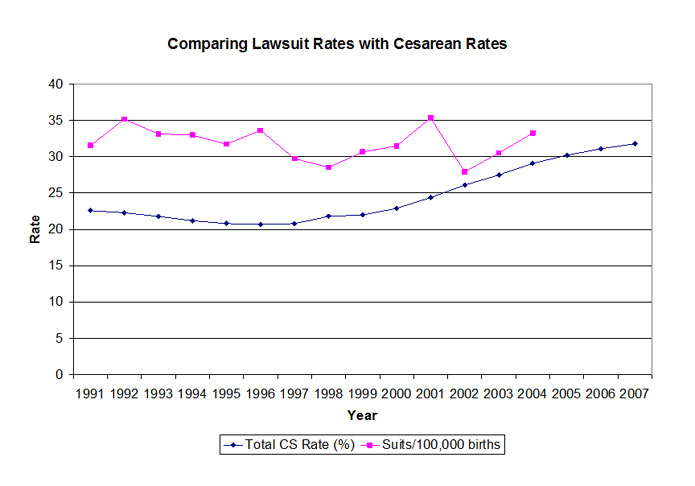
… The simple fact, however, is that cesarean rates in the United States have increased for 12 consecutive years, while malpractice litigation has remained the same or decreased. Data from the National Practitioners Data Bank reveals that obstetric malpractice suits fluctuated from 1991-2004 rather than increasing over time. This is not what one would expect if a malpractice crisis were causing the rise in cesarean rates.

In other words,there is no malpractice crisis. How does Prof. Roth support this claim? She uses one graph, and a series of personal interviews:

In addition to examining data on lawsuits, I am interviewing malpractice attorneys and birth attendants. I interviewed Jane,[1] a malpractice defense attorney (i.e. represents physicians) who has practiced for 15 years.

[1] All names are pseudonyms

That’s the goofiest thing I’ve heard in a while. For an article on medical malpractice she interviews a few friends who won’t even go on record with their real names? Since Roth has made no effort to ensure that the people she interviews are representative of lawyers, I can’t imagine why she expects such drivel to be taken seriously.

So here entire thesis rests on only one empirical observation, a graph that portrays the relationship between the number of obstetric malpractice claims. Here’s the graph:

Prof. Roth thinks this demonstrates that fear of being sued is not driving the rising C-section rate. Her conclusion is wrong because it is based on assumptions that are wrong. First, she assumes that obstetricians judge the likelihood of being sued by using the number of malpractice claims filed per year as a proxy for the risk of being sued. But obstetricians don’t need to use a proxy, they know their risk of being sued. The latest data indicates that 77% of obstetricians have been sued at least once in their career. So obstetricians know that almost all obstetricians ARE sued.

Second, she assumes that the deterrent effect is tied to the number of malpractice suits per year. That assumption is the equivalent of saying that bank robbers decide whether or not to rob a bank based on how many people went to jail last year for bank robbery. What keeps aspiring bank robbers from robbing the local bank is the belief that if they are caught, they will go to jail. It makes no difference to them how many individuals actually go to jail for bank robbery each year; the idea that they would reason that way is absurd.

The deterrent effect of malpractice suits on obstetricians is similar to the deterrent effect of jail sentences on potential bank robbers. The fact that the likelihood of being sued is high is what drives doctors’ actions, just like the fact that the likelihood of going to jail is high is what restrains people from robbing the local bank whenever they need cash.

I look at Prof. Roth’s graph and see the opposite of what she sees. The graph suggests that defensive medicine works.

First of all, the graph represents an anomalous time in obstetrics. Although Prof. Roth neglects to mention it, from 1991-2003, the rate of VBAC rose dramatically and then declined dramatically; that’s the reason for the relatively flat C-section rate in those years. Over all, the C-section rate has risen steadily and dramatically since 1970. And while the rate of obstetric malpractice filings may have been flat between 1991-2004, the rate rose steeply in the prior 2 decades.

In other words, since 1970 the C-section rate has risen steadily except for an anomalous period when VBACs became popular. Rates of obstetric malpractice filings rose steadily from 1970 and flattened out in the 1990’s. Looking at the data from the longer period suggests that the flattening of the malpractice filing rate may have been caused by the increased C-section rate.

In other words, defensive C-sections have done exactly what they are intended to do, prevent the filing of lawsuits. When I pointed this out to Prof. Roth (after being personally invited to comment by Jill), she replied:

With respect to Amy Tuteur’s comment, the reason that the malpractice lawsuit rate stabilized and started to decline is not because of the increase in cesareans. The reason that malpractice litigation is declining is because it has become increasingly difficult for injured patients to find legal representation.

Yes, that’s my point; it is increasingly difficult to find legal representation when your case is unwinnable.

Malpractice litigation is done by lawyers on a contingent fee basis. That means that the client pays nothing. The lawyer pays for everything and takes one third of any financial award. It is expensive to mount these cases, but there is the potential for multimillion dollar payouts that cover all expenses and leave millions left over.

Since lawyers use their own money to bring the malpractice cases, they will only take cases they believe they are likely to win; otherwise they will have wasted their entire investment in the case. In order to win a malpractice case, the lawyer must show that outcome of the medical situation would have been different if the doctor had done something different. In the case of obstetrical malpractice that typically means that the lawyer must show that if the doctor had done a C-section, or done one sooner, the baby would have been perfectly healthy.

So if an obstetrician performs a c-section at the first sign that something might be wrong, or even before anything goes wrong, any lawyer is deprived of the heart of the case. The case becomes unwinnable and no lawyer will take an unwinnable case. The entire purpose of a defensive C-section is to make sure that the case is unwinnable and therefore will never me brought.

If the rate of obstetric lawsuits has stabilized because lawyers are refusing to bring lawsuits, then the dramatic rise in the C-section rate is working exactly as intended.

New website: Hurt by Homebirth


Over the years I’ve received pleas from women who have lost their babies at homebirth. Each woman has suffered unimaginable tragedy and she wants to know that her baby’s death will not be ignored.

She cannot change the choices that she made, cannot bring her baby back, but perhaps the story of her baby’s death can open the eyes of other women to the dangers of homebirth. Each woman is different and the details of her story is different, but one refrain is common to them all: “if only I had known the truth about homebirth, I would not have chosen it.” The irony of homebirth is not lost on them; they thought they were making a loving choice and instead they were taking a terrible risk.

Unfortunately, women contemplating homebirth don’t know the risks and homebirth advocates aren’t about to tell them. In fact, adding insult to injury, when a bereaved mother attempts to share her baby’s story with other homebirth advocates, the baby is figuratively erased out of existence. Homebirth websites delete homebirth tragedies. They don’t want women to know the truth.

Enough is enough. Hurt by Homebirth has been created as a safe place where women can tell the stories of the babies who died or who were left injured by homebirth.

The babies who have died at homebirth will be hidden no more.

Amie Newman thinks it’s okay to hide the death toll of homebirth

I’ve participated in a number of on line discussions this week, and although the topics vary and identity of the homebirth advocates vary, one thing is always the same. When I mention that MANA is hiding the number of babies who died at the hands of CPMs, the silence is deafening.

Most homebirth advocates try desperately to pretend that I didn’t say it. They don’t deny that MANA (the Midwives Alliance of North America) is hiding the death rates at 18,000 homebirths attended by CPMs (certified professional midwives, formerly known as lay midwives). How could they? They don’t respond. What could they say? Instead they try to ignore this glaringly unethical behavior and hope that women will forget they ever heard about it.

Finally, though, someone decided to take a stand. Amie Newman, who blogs for RH Reality Check, explained why it is okay for MANA to hide the number of babies who died. After tangling with me through several back and forth comments, Newman wrote:

I 100% believe that women deserve the right to know how safe planned homebirth is with a Certified Professional Midwife. I also 100% believe that we have that information currently.

I replied:

You believe that we know the number of babies who died at the hands of CPMs in the 18,000 case MANA database?

Well, if you know the number, don’t keep us in suspense! Exactly how many babies died at those 18,000 CPM homebirths?

Or … will you simply acknowledge the obvious: we don’t have that information, MANA is hiding it, and you think it’s just fine for MANA to hide their own death rates from American women if those death rates are appallingly high.

At that point Newman simply stopped responding.

Honestly, I simply cannot fathom how a site that exists to support reproductive rights can produce a blogger and commenters that think women have no right to accurate information about the death toll of homebirth. Of course they join a long list of homebirth advocates who blithely ignore the issue that MANA is hiding homebirth deaths.

Ina May Gaskin thinks it’s just fine if MANA hides the number of homebirth deaths from American women.

Jill Arnold of the Unnecesarean claims to believe that “all maternity care data should be readily accessible to consumers and the general public,” but apparently thinks that does not apply to MANA.

Gina Crossley-Corcoran, the Feminist Breeder, offers the usual homebirth prattle without recognizing the irony:

I thought providers took an oath to help people? Putting their business ahead of reproductive choices isn’t keeping anybody safer, and the science proves that. Shame on them for ignoring the vast body of evidence from their own collegues.

Yes, shame on MANA for HIDING the vast body of evidence about homebirth deaths from their own colleagues, but especially from American women.

And Danielle Ellwood, the blogger who wrote the original piece on Babble performed the typical homebirth flounce:

Today, in true internet style… the poster [Dr. Amy] who started it all tried to call me out, and this is when I knew I needed to have my final word.

“And where’s Danielle who claims to care so much about mothers and babies? Why isn’t she demanding that MANA release their death rates?”

… Reply?

@Amy – There is no reasoning with someone like you. I care about women, I work on a local level, I work in my community, and I have actively been working for better maternal outcomes since entering the birth community 6 years ago, before even having my first child.

I am not going to feed into this debate anymore because it is clearly useless…

I am done.

In other words, she had painted herself into a corner and was too embarrassed to continue. Plus, she has all the right “birth cred” and everyone knows that means she really, really cares about women.

For these women and other homebirth advocates, I have a message:

You should be ashamed of yourselves.

Stop pretending! We all know that those statistics are being hidden because they show that an appalling number of babies died at homebirths with CPMs. Otherwise MANA would have published them and sent out a thousand press releases to boot.

It is time for American women to learn the truth about homebirth deaths, and homebirth advocates should be the first to call for transparency, not the first to offer the pathetic excuse that women already have all the information they need.

Don’t like the findings? Pretend they’re not true!


Sigh. Another day, another goofy Science and Sensibility post.

It may be a new year, and there may be a new editor, but the Lamaze blog appears to have merely traded one form of incompetent analysis for another. The previous editor Amy Romano, CNM, left to take a position with the lobbying organization Childbirth Connection. The new editor is Kimmelin Hull,

a Lamaze Certified Childbirth Educator, Physician Assistant, American Red Cross First Aid/CPR instructor, novelist and freelance writer for local and international parenting magazines.

In other words, she has no experience in caring for pregnant women, has no background in science or statistics, and essentially no qualifications for analyzing scientific literature. Not surprisingly, she’s off to a very unimpressive start.

Her first blunder didn’t even involve science. She wrote with a piece praising the Lamaze policy on conflicts of interest. Explaining why she declined to teach a class on breastfeeding at a local store, she wrote:

The slippery slope, however, became evident in this business owner’s expectation that the content of my presentation would directly entice class participants to buy certain products, based on my recommendations under the guise of authoritative knowledge.

But then I asked:

So why does Lamaze International license and recommend baby toys, women’s body lotions and women’s apparel? Clearly is trying to women to buy certain products based on their recommendations and under the guise of authoritative knowledge.

Cue the backpedaling. Hull tried to make an exception:

… if you truly believe in the healthy, helpful aspect of a product/service, providing information on it (or samples of it) to your clients becomes an act of “helping” vs. “promoting.” …

We’re supposed to believe that Lamaze collects licensing fees on baby toys, women’s body lotions and women’s apparel because they like “helping”?

Today Hull tries her hand at analyzing a scientific paper, The impact of maternal age on fetal death: does length of gestation matter? published in the December issue of the American Journal of Obstetrics and Gynecology. The authors found that women 40 and older had the highest risk of fetal death throughout pregnancy.

Hull accurately explains the methodology and findings of the paper, but then offers this startling assertion:

… other factors that have not garnered much attention in the literature but, in my estimation, certainly influence a woman’s general state of health and well-being (and thus potentially, the health of her pregnancy) are factors such as: diet, exercise routine and overall stress level. Designing a future study which could control for these additional variables would undoubtedly alter the data tremendously …

What??!! In her estimation? Based on what evidence? Apparently none.

Hull really, really wishes that advanced maternal age did not increase the stillbirth rate, so she is casting about for reasons she can ignore the evidence. Hmmm, let’s pretend that some easily modified factors (diet! exercise! stress!!) negate the impact of maternal age. Oooh, that sounds good! And as long as we’re pretending, let’s go all the way: these variable would undoubtedly alter the data tremendously! Really, Kimmelin?

Hull then proceeds to offer the “tremendously” altered data. Too bad she just made it up. But wait! She’s not finished making things up:

Despite the mention of induced labors being included in the cohort, there are no numbers on how many of the 2 million + pregnancies ended in induction—leaving a potentially HUGE confounding variable unchecked.

Yes, inductions may be a confounding variable because they REDUCE the risk of stillbirth. If inductions are a confounding variable, correcting for them would INCREASE the association between advanced maternal age and stillbirth, not decrease it, as she mistakenly believes.

The editor may have changed, but the quality of the scientific analysis at Science and Sensibility is still pathetic. Here’s some helpful advice: If you are going to dispute the results of a scientific paper, you need to offer scientific evidence to support your claims. Merely pretending the results aren’t true if they don’t fall in line with your personal beliefs does not represent scientific analysis, merely the wishful thinking that is so characteristic of contemporary NCB advocacy.

Is the new midwifery merely unreflective defiance?

Years ago I wrote a brief piece about homebirth midwifery entitled Whatever the scientific evidence shows, do the opposite. It turns out that I was echoing a feminist criticism of the “new” midwifery.

Among the most influential commentators on the subject are Ellen Annandale and Judith Clark, authors of the widely quoted paper, What is gender? Feminist theory and the sociology of human reproduction published in Sociology of Health & Illness Vol. 18, No. 1, 1996. The paper is long and filled with academic jargon, but has important insights that have created controversy among feminist theorists. The heart of Annandale and Clark’s criticism of the new midwifery is almost exactly the same claim that I made:

… the lived experience of midwifery … is revealed only as the largely unresearched antithesis of obstetrics. An alternative is called into existence in powerful and convincing terms, while at the same time its central precepts (such as ‘women controlled’, ‘natural birth’) are vaguely drawn and in practical terms carry little meaning.

This is a stunning criticism. Midwifery is described as unscientific and based on reflexive defiance. How did the new midwifery get to this point? Annandale and Clark believe that it starts with biological essentialism. They approvingly quote the work of a colleague:

… what both feminists and phallocentrists see as hegemony based on masculine perceptions of domination, performance, hierarchy, abstraction, and rationality, finds its antipode in a woman’s community proclaiming itself as naturally nurturant, receptive, cooperative, intimate, and exulting in the emotions . . . [feminists] assume that such principles exist and that they have been fixed and dichotomous since the dawn of patriarchal history. . . . Thus it is that the dominant culture and the counterculture engage in a curious collusion in which . . . a rebellious feminism takes up its assigned position at the negative pole.

Peeling away the jargon leaves us with the basic point, biological essentialism perpetuates women’s oppression by validating men’s belief that women are emotional and irrational. Or as Annandale and Clark write:

… Thus … reproduction is still centred for women and put on the agenda as if it were central to all women’s lives. This may serve to lock women into reproductive roles which may be politically problematic since the centrality of reproduction, contraception and childbirth to biomedicine is transferred to women’s experiences. This may be the reality of their experience, but equally importantly, it may not. To a certain extent this may be seen as an unavoidable consequence of a critique which appears as if it must engage the dichotomies of biomedicine to develop its own narrative.

The authors identify Sheila Kitzinger as an exponent of this false dichotomy.

‘Altematives’ to male-biomedicine were heavily valorised in research in the 1970s and 1980s. This was particularly evident in suggested alternatives to mainstream gynaecological and obstetric care. Sheila Kitzinger, for example, wrote that

the new midwifery has a vital part to play in the woman’s movement and is at the very centre of the great creative upheaval which is taking place as we reclaim our bodies and come to learn about, understand and glory in them. This new midwifery gives vivid expression to the way in which women are discovering strength and sisterhood as we turn to help and support one another during the intense, exhilarating and powerful experience of childbirth (1988:18).

A clear line of demarcation tends to be drawn in the literature between obstetrics and midwifery: each is portrayed as a unitary and intemally coherent body of thought and practice which is at odds with the other. The ‘alternative’ female-midwifery is clearly put forward as the better model…

Not only are such assumptions wrong, they are also elitist:

… The charge of elitism evidenced in the privileged white middle-class voice of much research, and the silence around differences between women, applies well to Barbara Katz Rothman’s influential 1982 work … which ends with an implicit call for a home-based natural birth experience …. This is made in joyous terms with little recognition that many women may not be in the position to avail themselves of such an ‘alternative’ even if they wanted to.

Annandale and Clark ask a critical question about the new midwifery. Are midwives “with women” or exploiting women for their own ends?

If we conceive of power as a fundamentally male preserve we are led to gloss over ways in which women may exert power over others, including other women . In these terms, as recent institutional reforms stimulate community midwifery midwives may begin to consider the notion of affinity with women embedded in such concepts as ‘continuity of care’ … as masking the potential exploitation of midwives by their clients.

Who, after all, is being served by this concept of midwifery?

In my view, the ultimate irony of the new midwifery is that the very people who bemoan the supposed inability of modern obstetrics to cooperate with midwifery are the very people who have made such cooperation impossible.

By insisting that all women are the same, that childbirth has a biological “essence” that must be preserved and, especially, that midwifery is defined by its opposition to modern obstetrics, midwifery theorists have created a false dichotomy that is by definition unbridgeable. Midwifery theory ignores the interests of many, if not the majority of women. Indeed, the new midwifery goes beyond ignoring women who refuse to subscribe to the theory of biological essentialism and questions the very “authenticity” of their womanhood and motherhood.

Most women in contemporary first world countries have rejected essentialism, embrace technology, and have no use for a philosophy that presumes that midwifery exists only insofar as it rejects defies modern obstetrics. If midwifery is to survive, midwifery theorists had better wake up to that reality and stop pretending that unreflective defiance is a virtue.

Childbirth educators: those who can’t do, teach

A surprising number of childbirth websites are run or staffed by childbirth educators, which is rather surprising, since they entirely lack the education, training, and experience to provide scientifically accurate, unbiased information. It’s the equivalent of a civil war website run by the Daughters of the Confederacy. They may be passionate, but they are last people who you would expect to be knowledgeable about the details and unbiased in their transmission of information. But why bother any of that, when it is well known cliche that those who can’t do, teach.

Who are childbirth educators, and what makes them think they are qualified to advise other women?

There are no requirements for becoming a childbirth educator. According to prominent childbirth educator Robin Elise Weiss, who dispensse her personal views on childbirth at a variety of websites:

… [A]lmost anyone can become a childbirth educator (CBE). You do not need to be a nurse, a midwife, or a doula. You really need a more than basic level of knowledge of childbirth …

In fact, you only need 16 HOURS of childbirth education, including indoctrination is the ideology of the certifying organization. According to the International Childbirth Education Association, those 16 hours comprise:

Part I – Family-Centered Maternity Care (FCMC) and the Role of the Childbirth Educator
Part II – Anatomy&Physiology of Preconception, Conception and Pregnancy
Part III – Nutrition for the Childbearing Year and Infant Feeding
Part IV – Psychosocial/Emotional Changes in Pregnancy, Abuse Issues
Part V – Labor and Birth
Part VI – Labor Coping Skills
Part VII – Obstetrical Tests and Procedures
Part VIII – Cesarean Birth and Vaginal Birth After Cesarean (VBAC)
Part IX – Postpartum and the Newborn
Part X – Teaching Skills

In other words, less than 2 hours apiece are spent on the massive subjects of labor and birth, obstetrical tests, and C-section and VBAC. That would be fine if childbirth educators limited themselves to giving women basic familiarity with what is likely to happen during pregnancy and labor. Unfortunately, childbirth educators do not limit themselves to what they could reasonably do. Instead, they offer medical advice, criticize obstetric procedures, promote ideology above science, and proselytize for their personal preference. And for those tasks, they are entirely unqualified.

Childbirth education organizations are also like the Daughters of the Confederacy in that they make no effort to hide their bias. The ICEA calls its philosophy “Family Centered Care” which is a misnomer for the biological essentialism at the heart of their philosophy.

Family-centered care consists of an attitude rather than a protocol. It recognizes a vital life event rather than a medical procedure… It realizes that the decisions she may make are based on many influences of which the expertise of the professional is only one…

So childbirth educators promote a specific “attitude,” refuse to acknowledge the inherent dangers of pregnancy and childbirth, and seek to undermine the patient’s trust in her care providers. And all without any real education in anything!

That’s just generic childbirth educators. Women who are certified by specific organizations like Lamaze must subscribe to the beliefs of the Lamaze organization. Lamaze requires:

Competency 1: Promotes the childbearing experience as a normal, natural, and healthy process which profoundly affects women and their families.
Competency 2: Assists women and their families to discover and to use strategies to facilitate normal, natural, and healthy pregnancy, birth, breastfeeding, and early parenting.
Competency 3: Helps women and their families to understand how complications and interventions influence the normal course of pregnancy, birth, breastfeeding, and early postpartum.
Competency 4: Provides information and support that encourages attachment between babies and their families.
Competency 5: Assists women and their families to make informed decisions for childbearing.
Competency 6: Acts as an advocate to promote, support, and protect natural, safe, and healthy birth.
Competency 7: Designs, teaches, and evaluates a course in Lamaze preparation that increases a woman’s confidence and ability to give birth.

No one could accuse them of keeping their biases secret, either. In addition to promoting “natural” birth (i.e. biological essentialism), they think they are supposed to promote breastfeeding and attachment parenting, and act in opposition to actual care providers when their personal view of childbirth is threatened.

We would be outraged if a school system in in the South insisted that as a a requirement for certification, history teachers promote state’s rights, and protect the belief that slavery wasn’t that bad. We should be equally outraged that the field of childbirth education has been hijacked by women who have no intention of providing unbiased information and view their job as explicitly favoring certain childbirth and mothering choices above others.

Childbirth educators seek to change obstetrical care to reflect their personal preferences, but they can’t do (change it from within by becoming a midwife or obstetrician), so they teach.

Ina May runs away

I try to follow as many natural childbirth pregnancy blogs and websites as I can to keep up to date on what women are reading across the web. As I have repeatedly noted, most of them are chock to the brim with misinformation, misleading information and wacky “information.” Occasionally I will comment when I see a particularly egregious example, like a recent blog entry about maternal mortality on Babble. I have written a great deal on the subject (Hold the handwringing: is maternal mortality really rising?) and wanted to correct the manifold errors in the piece.

No, maternal mortality is NOT rising. It has fallen in 2006 and fallen again in 2007 to 12.7/100,000, facts that this piece completely ignores.

Moreover, it is far from clear that maternal mortality was ever rising. A careful review of the data suggests that changes in the way that maternal mortality is assessed may be leading to a spurious “increase” in maternal mortality.

The author of the piece had no response, not surprisingly, but the other day Ina May Gaskin parachuted in, once again attempting to cynically exploit this tragic issue as she has been doing for years on her “Remember the Mothers” website. She calls for “honesty” and then proceed to offer a bunch of out of date bibliography salad and never addresses any of the issues that I raised.

Here are just a few examples of articles that have been published during the last decade or so about the too high US maternal death rate: “Pregnancy-related deaths: Moving the wrong direction,” published in OBG Management, January 1998; “Maternal mortality: No improvement since 1982.” ACOG Today, August 1999; Maternal mortality: An unsolved problem. Contemporary Ob.Gyn, September 1999; “U. S. maternal death rates are on the rise.” The Lancet, 1996; “Pregnancy-related deaths increasing,” Contemporary Ob.Gyn, December 2010.

To anyone who knows anything about obstetrics, this bibliography salad is not only out of date (newsflash: anything before 2000 is NOT in the last decade, and, considering that we are discussing maternal mortality from 1998 to 2005 has absolutely nothing to do with this purported rise), but it is laughable. OBG Management, ACOG Today and Contemporary Ob.Gyn are what is known as “throw away” magazines. They are not journals, and they are mailed to almost all obstetricians for free. It’s the equivalent of citing “House Beautiful” to make a claim about architecture.

Ina May was obviously cutting and pasting from out of date claims she has made in the past (she accidentally pasted twice), and actually makes my point for me:

Prior to 2003, only 2 states used the US Standard Death Certificate—the only one containing the questions that CDC epidemiologists designed to prevent misclassification of maternal deaths. Many states still refuse to use the standard death certificate. This makes the CDC’s data much less accurate and useful than they should be for such an important statistic. Underreporting maternal deaths leads to a false sense of security and misunderstanding of the true causes of preventable deaths.

Yes, Ina May, that’s just what I said. Prior to 2003,there was considerable under-reporting of maternal deaths. And just as under-reporting can lead to misunderstanding about the scale of maternal mortality, correcting that under-reporting can lead to a spurious “increase” in maternal mortality.

Babble began promoting the exchange on Twitter:

Are you team Ina May Gaskin or Dr. Amy? See what they have to say about pregnancy related deaths in the U.S.

I responded to Ms. Gaskin:

You represent yourself as shocked at the current rate of maternal mortality. Yet as far as far as I can tell, direct entry midwives in general and you in particular have done NOTHING (no research, no education, no fund raising) to reduce the incidence of maternal mortality. In contrast, modern obstetrics has lowered the maternal mortality rate 99% PERCENT in the past century…

Anyone who visits your “Remember the Mothers” website will notice something rather curious. There is NO information about the causes, treatments and research into maternal mortality…

… You want to leave the impression that maternal mortality is caused by obstetric interventions…

The reality, as you OUGHT to know, iatrogenic deaths represent a tiny fractions of maternal mortality. The most common causes of maternal mortality are complications of pregnancy and pre-existing medical conditions.

You should be embarrassed at the way that you have deliberately misrepresented the issue for your own personal ends.

Then Ina May ran away. I’d like to think she was ashamed, but I doubt it. She had simply used up everything she had to say on the subject (relevant and irrelevant) and had no response. Like all professional natural childbirth advocates, she was not going to engage in a debate that required her to defend her claims.

Dr. Amy