Natural mothering and the subversion of women’s empowerment

F893FC0B-279C-4D76-9708-1D4704D3E256

On the face of it, it makes no sense.

  • How can women be empowered by rejecting the lifesaving technologies of modern obstetrics in favor of “natural” childbirth?
  • How can women be empowered by refusing pain relief and laboring in agony?
  • How can women be empowered by breastfeeding exclusively for years at a time?
  • How can women be empowered by re-immuring themselves in the home, devoted only to the care of their children?

They can’t. Indeed, the raison d’etre of natural childbirth, breastfeeding promotion and attachment parenting — as articulated by their founders — was specifically to disempower women by convincing them to forgo political and economic emancipation.

[pullquote align=”right” cite=”” link=”” color=”” class=”” size=””]The irony of natural mothering: the women with the least power imagine themselves as the most “empowered.”[/pullquote]

So how can women claim to be empowered by natural mothering?

It’s not merely a failure to understand the term, it reflects a subversion of the meaning of empowerment. Empowerment has been reduced to consumer choice. Thus natural mothering ideologues can camouflage women’s disempowerment as “empowering.”

As Oana Crusmac explains, empowerment has been subverted. It no longer means “the acquisition of power” but rather “self-expression through consumer choice.”

The self-expression right … comes along with the encouragement to “embark on projects of individualized self-definition exemplified in the celebration of lifestyle and consumption choices.” …

But it is not choice per se that is being promoted, but specific, highly restricted and restrictive choices.

Hence you can be “empowered” by choosing homebirth, but not by choosing maternal request C-section.
You can be “empowered” by choosing to forgo pain relief, but not by choosing an epidural.
You can be “empowered” by surrendering your freedom to exclusive breastfeeding, but not by claiming your freedom and using formula.
You can be “empowered” by being so bound to your children that you literally “wear” them, but you can’t be empowered by a high paying job or a satisfying career.

And who decides which choices are empowering? Those who seek to disempower women.

…The autonomy promoted by postfeminism is determined by the fact that “patriarchy has produced desires in women to want the very things that patriarchy needs them to choose.” Hirschmann refers to this subversive elaboration of women’s autonomy as ‘oppressive socialization’ that leads to their false impression that they act freely and autonomously when in fact, women are not the ones which set their preferences and goals.

In this subversion of empowerment, women can only be “empowered” by choosing re-domestication.

As Kumarini Silva notes in Got Milk?: Motherhood, Breastfeeding, and (Re)domesticating Feminism:

…[W]omen are discouraged from making connections with and to other women … that will make a systemic shift for the equitable distribution of recourses and rights. Instead, young women … are encouraged to disarticulate from the systems that question or make visible their own oppressions. In place of the very real work of making these connections and building on them, we are increasingly asked to celebrate various ‘faux feminist’ symbols that permeate (popular) culture.

Indeed:

…When motherhood is discussed within this broader celebratory context of women’s progress and ‘arrival,’ it tends to ignore larger, deeply historical, systemic inequalities associated with race, class, gender, and sexuality that sustain narratives of idealized motherhood. This disarticulation, between the past and present, speaks to the ways in which feminism and feminist discourses become co-opted in the neo-valorizing of motherhood as a domesticated practice.

Breastfeeding is the paradigmatic example.

Silva asks:

Breast is best: for whom?

It’s been touted as best for babies and mothers. But is that the real reason why breastfeeding is now promoted aggressively?

Silva asks us to consider that the explanations typically offered are revealing in ways its proponents perhaps did not intend:

One such example from 2003 is from a brief introduction to the journal Obstetric and Gynecology by Dr John T. Queenan… Queenan noted that during ‘World War II, while men were off to war, women entered the workforce in droves. During the war and in the good times that followed, fewer and fewer American women practiced breastfeeding. Formula feeding was on the rise as breastfeeding fell to an all-time low of 25 percent in 1971.’ … In his description and summary, Queenan seems to imply that women’s transition from private spaces to public spaces, in the form of professional work (and war efforts), jeopardized the ‘important gift’ of mothering vis-à-vis breastfeeding.

“Good” mothers stay home:

…[W]hat is assumed here is a common connection made between women’s transition to the workforce (and the ‘good times’), and the decline in ‘good mothering,’ including breastfeeding. While not explicit, it speaks to the myriad of ways that women’s work outside the home continues to be positioned as ‘bad’ for the welfare of the infant, the family, and, consequently, even the nation state…

That’s why we are endlessly bombarded with unvalidated mathematical models that predict economic benefits of breastfeeding that never actually come to pass:

…[B]reastfeeding becomes … a way of helping the country, and doing one’s part, as a woman. But unlike the past, instead of joining the workforce and earning a living wage, women’s participation in the economy, in this instance, is reduced to her breasts. While breastfeeding is touted as a boon for the nation’s economy, and the family, there is little-to-no conversation about the connections between these macro-economics and the micro economy of women’s lives.

What would it look like if women were truly empowered in their mothering choices?

Both homebirth AND maternal request C-sections would be viewed as empowering.
Both unmedicated AND medicated births would be viewed as empowering.
Both breastfeeding AND formula feeding would be viewed as empowering.
Both stay-at-home mothering AND working mothering would be viewed as empowering.

Instead we have the ultimate irony of natural mothering: women with the least power imagine themselves as the most “empowered”!

Trust penises!

0B103911-DF6C-4C36-B47A-5F4BF3706E36

Mr. Jones, so nice to meet you.

Allow me to introduce myself, Ima Frawde, IBCEC. What are the letters for? International Board Certified Ejaculation Consultant, of course. I support men who have ejaculation dysfunction at the low introductory price of $200 per hour. I’m here to help you with your erectile dysfunction.

Examine you? No, I’m not going to examine you. I know what’s wrong without examining you; I learned during my training that so called “erectile dysfunction” is always caused by the man who claims he is suffering from it. Different ejaculation consultants may have different opinions about a variety of issues, but on one thing we are all agreed: there is no such thing as “not enough” erectile function.

Just think about it. If erectile dysfunction were real, the population of the world would have died out long ago and we wouldn’t be here. We’re here, so that proves my point!

[pullquote align=”right” color=””]There is no such thing as “not enough” erectile function.[/pullquote]

What is causing your problem? Well, there are a number of possibilities.

1. You are not trying hard enough.

Some men simply don’t care about giving their wives the best sexual experience possible. Let’s face it, sexual intercourse can be a challenge and most husbands are just too lazy to meet the demands of regular activity. When the going gets tough, they give up and give in, opting for vibrators and other sex toys. Sure their wives may seem satisfied with vibrators, but over time those same wives will experience a decrease in IQ. If you really cared about your wife, Mr. Jones, you’d try harder. Lololol, get it? Try harder?

2. You are deformed, but that’s not an excuse.

Sigh, you have a circumcised penis, and we all know who’s to blame for that. Your ignorant parents never realized that circumcision causes erectile dysfunction. Sure you might not have noticed it for the first 65-70 years of life and it might not have started until after you had your first heart attack and began insulin for diabetes, but it is just as much the cause as if you were circumcised yesterday. Too bad for you.

3. Decreased blood flow? Don’t be silly.

You might have heard that erectile dysfunction can be caused by diseases that decrease blood flow to all organs, not just the penis, but it’s not true. That’s just a lie made up by Big Pharma in an effort to sell Viagra. There is no such thing as “not enough blood flow”! Your body is perfectly designed to have an erection and if you only gave it enough time, everything would be fine.

4. So what if your wife is crying because you can’t have intercourse; she’ll just have to wait.

Erectile dysfunction is a matter of supply and demand. If you don’t try to have sex often enough, you’ll never have enough blood flow. You have to keep trying to have sex over and over and over again each day and eventually there will be enough blood flow for erections on demand.

5. You’re doing it wrong.

Positioning is very, very important to prevent erectile dysfunction. If you held your wife the right way, she’d be able to “latch on” to your penis properly and you would then get an erection. So basically this is all your fault.

Oops, time’s up. You can pay with a check, although cash under the table is always appreciated. I’ll be back later in the week for another session. Just remember what I told you: you are not trying hard enough; you are deformed; there is no such thing as decreased blood flow; your wife is just going to have to deal with her disappointment; and, don’t forget, you are doing it wrong.

What? Of course it is your fault! Stop whining that there’s something wrong just so you have an excuse to stop having intercourse. We all know that is what is really going on.

You feel worse now?

No need to thank me; I’m just doing my job as an IBCEC, International Board Certified Ejaculation Consultant.

Midwifery and breastfeeding ideologues have hijacked evidence based medicine

Treasure chest with gold coins on a beach

Midwives and lactation professionals use the term “evidence based medicine” so often, you might think they actually practice it. You would be wrong.

That’s because evidence based medicine is often hijacked by ideologues and industry.

Dr. David Sackett, credited with popularizing the phrase and concept, explained it in an influential 1996 paper, Evidence based medicine: what it is and what it isn’t:

[pullquote align=”right” cite=”” link=”” color=”” class=”” size=””]Evidence based medicine was never meant to be a tyranny. It is NOT supposed to produce one size fits all recommendations.[/pullquote]

Evidence based medicine is the conscientious, explicit, and judicious use of current best evidence in making decisions about the care of individual patients.

John Iaonnidis explains how EBM has been hijacked hijacked:

As EBM became more influential, it was also hijacked to serve agendas different from what it originally aimed for.

Industry immediately recognized the possibilities of hijacking EBM:

Influential randomized trials are largely done by and for the benefit of the industry. Meta-analyses and guidelines have become a factory, mostly also serving vested interests. National and federal research funds are funneled almost exclusively to research with little relevance to health outcomes… Risk factor epidemiology has excelled in salami-sliced data-dredged papers … and has become adept to dictating policy from spurious evidence…

Diabetes care serves as a cautionary example.

In 2009 a large-scale study of tight blood sugar control showed that, contrary to guidelines, tight control actually increased the death rate for adult onset diabetics. How could EBM have been so wrong?

It quickly became apparent that the guideline for tight control was approved over the protests of many diabetes experts. Second, there was a third party that would benefit from a guideline for tighter control: the drug companies that sold insulin, and they promoted such a guideline. Third, the National Committee for Quality Assurance, a supposedly impartial organization that sets the standards used by insurers to determine whether a treatment qualifies for payment, had received money from the drug industry.

When industry stands to benefit from evidence based guidelines, they use their influence to promote guidelines that benefit themselves. They start with the guideline result they want — greater use of their products — and then produce the “evidence” to support it. Then they market it as “evidence based” medicine.

Sadly, ideologues can hijack evidence based medicine in exactly the same way.

Midwives and lactation professionals start with the guideline results that they want — greater use of their services — and proceed to produce the “evidence” to support it. Then they market it as “evidence based” medicine.

How?

Influential midwifery research is done by and for the benefit of the industry of midwives, doulas and childbirth educators and published largely in journals dedicated to promoting them. They start with the results they want — women should be pressured to have unmedicated vaginal births — and proceed to produce the “evidence” to support it. Moreover, they conduct research on low risk women who have few complications and then extrapolate extravagantly — and absurdly — claiming that it was the midwifery care that led to low risk of complications. Then they market their claims as “evidence based” medicine.

Influential breastfeeding research is done by and for the benefit of the breastfeeding industry and published largely in journals dedicated to promoting breastfeeding. They start with the results they want — breastfeeding has major health benefits — and proceed to produce the “evidence” to support it. They conduct small trials riddled with confounding variables and then extrapolate absurdly to make extravagant claims that are never validated and never come to pass. Then they market their claims as “evidence based” medicine.

Midwifery and breastfeeding ideologues have hijacked research to create “evidence” designed to serve their own interests.

They’ve also violated a central tenet of evidence based medicine.

Sackett explained:

Good doctors use both individual clinical expertise and the best available external evidence, and neither alone is enough. Without clinical expertise, practice risks becoming tyrannised by evidence, for even excellent external evidence may be inapplicable to or inappropriate for an individual patient. Without current best evidence, practice risks becoming rapidly out of date, to the detriment of patients.

Evidence based medicine was never meant to be a tyranny. It is NOT supposed to produce one size fits all recommendations since even excellent evidence may be inapplicable to or inappropriate for an individual patient.

Evidence based medicine is not “cookbook” medicine. Because it requires a bottom up approach that integrates the best external evidence with individual clinical expertise and patients’ choice, it cannot result in slavish, cookbook approaches to individual patient care.

Promoting “normal birth” is a slavish, cookbook approach to patient care. Unmedicated vaginal birth is NOT best for every mother. When providers ignore that fact, babies and mothers die.

“Breast is best” is a slavish, cookbook approach to patient care. Breast is NOT best for every baby. When providers ignore that fact, babies die.

In a subsequent paper, Ioannidis likens evidence based medicine to a treasure ship hijacked by pirates.

…[T]he pirates have hijacked the EBM ship because it is a superb, worthy vessel loaded with goodies that are deemed to have high value. No pirates with some profiteering mind would have ventured to
capture a sinking tub that had no treasure.

Those who care about babies and women must fight back.

…We should do our best to throw overboard the pirates who have captured the ship and then stay the course to more rigorous, more unbiased evidence that matters for patients and healthy people.

It will not be easy:

Finance-based medicine, conflicts of interest (financial and other), just-bring-more-money approaches to research, questionable research practices, … salami slicing, spurious reward systems, methodological illiteracy and innumeracy, “basic science” hype, and overall stark ethical poverty are becoming increasingly common …

But it is a worthy task. Babies and mothers are depending on us to take back evidence based medicine from midwifery and breastfeeding ideologues who have hijacked it.

Breastfeeding and the canonization of false facts

true and false choice

“Breast is best.”

Except that it’s not.

How did an ideological claim, never proven with scientific evidence, get accepted as a “fact”?

Nissen and colleagues explain the canonization of false facts:

Science is a process of collective knowledge creation in which researchers use experimental, theoretical and observational approaches to develop a naturalistic understanding of the world. In the development of a scientific field, certain claims stand out as both significant and stable in the face of further experimentation. Once a claim reaches this stage of widespread acceptance as true, it has transitioned from claim to fact. This transition, which we call canonization, is often indicated by some or all of the following: a canonized fact can be taken for granted rather than treated as an open hypothesis in the subsequent primary literature; tests that do no more than to confirm previously canonized facts are seldom considered publication-worthy; and canonized facts begin to appear in review papers and textbooks without the company of alternative hypotheses.

A claim doesn’t have to be true to be canonized.

Consider:

[pullquote align=”right” cite=”” link=”” color=”” class=”” size=””]Breastfeeding professionals are like the surgeons who continued doing radical mastectomies after lumpectomy was shown to produce the same outcome.[/pullquote]

Breast cancer is best treated with radical mastectomy.
Acid causes ulcers.
Episiotomies prevent vaginal tears.

Even though these claims were considered medical “facts” for decades, they were never true. It took years of near heroic work (often while enduring widespread scorn) for doubters to overturn conventional wisdom.

It’s only a matter of time before “breast is best” is added to the list.

The process is under way as we speak as hospitals grapple with tens of thousands of newborn readmissions each year at the cost of hundreds of millions of dollars. The process is furthered by the growing body of papers detailing harms of aggressive breastfeeding promotion including in hospital suffocation of newborns in mothers’ hospital beds as well as skull-fracturing falls from those beds in the wake of closing well baby nurseries. But what will almost certainly seal the de-canonization of “breast is best” is that almost none of the predicted benefits of breastfeeding have come to pass. With the exception of premature infants, breastfeeding has never been shown to save lives, prevent severe disease, or reduce healthcare costs.

If the claims were never true, why was it so hard to convince the believers that they were never true?

White hat bias

The current era of breastfeeding promotion reflected disgust with Nestle’s unethical marketing of formula in Africa. Early breastfeeding promotion efforts in the 1980’s did NOT assert that breast was best, merely that breast was better than formula prepared with contaminated water. The International Code of Marketing of Breastmilk Substitutes was designed to restrain and punish formula companies.

In a very real sense, breastfeeding promotion had its origins in an ideologically motivated boycott of formula manufacturers. That anti-corporatist zeal persists to this day but the demonization of formula manufacturers has transmuted into the demonization of formula itself.

The professionalization of breastfeeding support

In the mid-1980’s, La Leche League realized that it could monetize the advice and support it had been providing for free for decades. The lactation professional was born. While there is certainly nothing wrong with women earning money to promote breastfeeding, it created a group whose economic health was directly tied to the spread of its promotion efforts. It is hardly surprising then that the moralization of breastfeeding followed swiftly upon its monetization. Although breastfeeding professionals have been scathing in their criticism of allowing formula companies to market within hospitals, they have not ended marketing efforts, merely replaced them with their own product: breastfeeding.

Publication bias

As Nissen et al. explain:

Publication bias arises when the probability that a scientific study is published is not independent of its results…

Publication bias is pervasive. Authors have systematic biases regarding which results they consider worth writing up… Journals similarly have biases about which results are worth publishing.

What kinds of results are most valued? Findings of statistically significant differences between groups or treatments tend to be viewed as more worthy of submission and publication than those of non-significant differences. Correlations between variables are often considered more interesting than the absence of correlations. Tests that reject null hypotheses are commonly seen as more noteworthy than tests that fail to do so. Results that are interesting in any of these ways can be described as “positive”.

Publication bias in breastfeeding research means that it is extremely difficult to publish a study that doesn’t conclude breast is best. This bias is exacerbated by the existence of journals whose purpose is to promote breastfeeding. Those journals — the primary sources for scientific information about breastfeeding — rarely publish any studies that dare to question the canonization of false facts about breastfeeding.

Sloppy research methods

As I have noted many times, most breastfeeding research is appallingly bad. It is weak, conflicting and riddled with confounding variables. The central claims are based on the massive extrapolation of small studies as well as unvalidated mathematical models, both of which assume causation whenever correlation is observed. Almost none of it has been consistently reproduced by follow up investigations.

That doesn’t mean that breastfeeding professionals are lying. They truly believe that breast is best, just like generations of surgeons who believed radical mastectomy is best and like generations of internists who believed that acid caused ulcers. There is no shame in canonizing facts that turn out to be false. The only shame is refusing to consider the possibility that you are wrong when new data don’t confirm your beliefs.

That’s where breastfeeding professionals are now. They are like those surgeons who continued doing radical mastectomies after lumpectomy was shown to produce the same outcome. They may believe in their own righteousness but the result is unnecessary suffering.

“Breast is best” is a false fact. Let’s stop pretending otherwise.

What should we do when underperforming big ideas — breastfeeding saves lives — become entrenched?

Big Idea And Innovation Concept

I’m frustrated.

Every year tens of thousands of babies are hospitalized for breastfeeding complications at the cost of hundreds of millions of dollars. Meanwhile, despite 20 years of aggressive breastfeeding promotion and rising breastfeeding rates, the benefits we have been promised, from lives and money saved to conditions and diseases reduced, have failed to appear. Meanwhile researchers keep publishing papers claiming ever more arcane benefits even though their predictions consistently fail to come true.

[pullquote align=”right” cite=”” link=”” color=”” class=”” size=””]In breastfeeding research and practice, NO mechanisms exist to sunset failing initiatives; effort is devoted toward increasing funding for them.[/pullquote]

What should we do when underperforming big ideas — like the claim that breastfeeding saves lives and money — become so entrenched that they can’t be challenged, even by reality?

I found some answers in a paper by John Ioannidis and colleagues, What Happens When Underperforming Big Ideas in Research Become Entrenched?.

They were writing about different issues: gene therapy, stem cell therapy and electronic health records (EHRs):

For several decades now the biomedical research community has pursued a narrative positing that a combination of ever-deeper knowledge of subcellular biology, especially genetics, coupled with information technology will lead to transformative improvements in health care and human health…. [We] show that this approach has largely failed; and propose a wholesale reevaluation of the way forward in biomedical research.

They start with the primacy of the narrative:

In 2016 approximately $15 billion of the $26 billion of extramural research funding sponsored by the National Institutes of Health (NIH) could be linked to some version of search terms that include gene, genome, stem cells, or regenerative medicine. These topics have also increased geometrically in their representation among published articles… Apparently a large number of scientists either believe in the potential of these topics or feel compelled to work on them, recognizing that these topics constitute a major locus of important science, financial support, recognition, and prospects for a successful career.

Yet the extravagant predictions about curing most disease including cancer have not come to pass.

For example:

The complex and adaptive nature of most tumors thwarts the optimistic projections for molecularly targeted therapy for cancer. A randomized trial of targeted therapy based on molecular profiling … showed no improvement in progression-free survival… So far, just 2.5% of screened patients have been assigned to a trial intervention group… [T]he rarity of the targeted mutations means that this approach will help only a minority of patients with cancer.

This is hardly the only “big idea” whose benefits have failed to materialize. Stem cell research has been particularly disappointing, and the implementation of electronic health records (EHR) has had a disastrous impact physician morale without the promised improvement in patient care.

Sound familiar? The benefits of the big idea about breastfeeding — that increased rates will lead to diseases prevented and lives and money saved — has not merely failed to materialize, breastfeeding promotion turns out to have significant harms to infants, mothers and the bottom line. Demonstrating that breastmilk does reduce the risk of necrotizing enterocolitis (NEC) in preterm babies merely highlights the fact that breastfeeding can have substantial benefits in specific situations while simultaneously having no benefits for most.

How do those who promote big ideas respond when their claims cannot be substantiated?

They have two choices:

The first is to continue with calls for more funding, more complex measurements, and more sophisticated instrumentation. The second is to reevaluate and reset the current focus.

Thus far breastfeeding professionals continue with calls for more funding and more complex measurements, while claiming ever more arcane “benefits” (the microbiome! epigenetics!)

What if we were to re-evaluate?

When NIH funds translational or preclinical research with specific deliverables promised (as in the case of personalized medicine, and stem cell therapy), independent assessors should regularly appraise whether these deliverables were achieved and, if so, at what cost, and with what effect. Assessors must be objective, independent of the funding source, and have no professional stake in whether a particular line of research is deemphasized. The deliverable criterion should include public health benefit achieved by these initiatives (ie, measurable reductions in mortality and morbidity). Criteria such as number of publications, citations, prizes, and recognition are irrelevant as these are simply self-rewarding artifacts of the system…

How would that work for breastfeeding?

Independent assessor should regularly appraise whether the claimed benefits of increased breastfeeding rates — conditions prevented, lives and dollars saved — are actually achieved, at what cost, and with what iatrogenic complications for babies, mental health complications for mothers and costs to treat those complications.

Criteria such as the number of publications or the support of authoritative healthcare organizations should be recognized as irrelevant since they are simply self-rewarding artifacts of a system that continues to promote entrenched ideas long after they have been disproven.

The fundamental question:

Has aggressive breastfeeding promotion improved quality of life and life expectancy, by how much, for how many, and for whom?

Despite extravagant predictions, the benefits of breastfeeding have been limited to preterm babies. Breastfeeding cannot be shown to have prevented major disease, saved lives or extended life expectancy. And it can be shown to have caused tens of thousands of hospitalizations per year at the cost of hundreds of millions of dollars.

Ioannidis and colleagues declare:

Mechanisms should be in place to sunset underperforming initiatives.

In breastfeeding research and practice, NO mechanisms exist to sunset existing initiatives; instead massive effort is devoted toward increasing funding for them. Why? Because careers, reputations and economic support for lactation professionals and breastfeeding researchers rests on maintaining the fiction that breastfeeding has major benefits and no risks when the reality is that it has few benefits and significant risks.

The history of medicine is a history of a some excellent big ideas among a much greater number of underperforming big ideas. There’s no shame in the fact that many big ideas turn out to be bad ideas. The only shame is in refusing to recognize it.

Women can’t reclaim their agency from doctors by ceding it to midwives and lactation consultants

6908054C-53CC-426D-BA4A-ADE136FCB6DA

How did the natural childbirth and breastfeeding industries go so wrong?

Why do I receive emails and Facebook messages from desperate women nearly every day detailing their guilt, self-abnegation and torment over “failing” to give birth vaginally or to breastfeed?

Why, when I talk about my writing with friends and acquaintances, do women years removed from childbearing burst into tears about their struggles?

[pullquote align=”right” cite=”” link=”” color=”” class=”” size=””]Doctors shouldn’t pressure or shame you … and neither should midwives or lactation consultants.[/pullquote]

The philosophies of both natural childbirth and lactivism were created as ways to re-domesticate women, so they would not seek legal and economic equality. Their retrograde beginnings were hidden when they reached the mainstream and their the goal of reclaiming women’s agency from paternalistic doctors resonated widely. Instead of doctors deciding that women should be asleep during birth, deprived of emotional support from partners and subject to unnecessary procedures like shaving and enemas, women insisted that it was their right to be conscious, to be accompanied by partners and to accept or reject procedures based on informed consent. Instead of being convinced to forgo breastfeeding or forced to give up breastfeeding due to lack of breastfeeding support, women insisted that it was their right to receive encouragement and support in nourishing their infants in the way they thought best.

What went wrong?

Both natural childbirth and lactivism went off the rails when they insisted that the only way women could reclaim their agency from paternalistic doctors was to hand it over to paternalistic midwives and lactation consultants.

What would childbirth and lactivism look like if women themselves were in charge of the decision making? It would look very different than it does today.

  • All possible choices would be represented because women have a broad spectrum of needs and desires.
  • Birth plans would just as readily include maternal request C-sections as unmedicated vaginal births.
  • Pain relief would have a prominent place in birth plans since most women find they need pain relief.
  • Women would choose how to feed their infants based on what worked for them, and they would NEVER be shamed for bottlefeeding.
  • Free formula gifts would be available to those who want them.

In other words, every safe childbirth or feeding decision made by mothers would be respected by professionals and by other mothers. Decision making would be bottom up: women would make the decisions and inform providers of their choices.

Instead, in the process of women reclaiming their agency from doctors, midwives and lactation consultants swooped in to steal it from them. Within natural childbirth and lactivism, decision making is top down. Midwives, doulas and childbirth educators decide what a “good” or “normal” birth should look like and they force that decision down women’s throats. How? By hectoring and shaming dressed up with the twin lies of being “better for baby” and “evidence based.” Lactation consultants decide how babies should be fed and force that decision down women’s throats. How? By hectoring and shaming dressed up with the twin lies of being “better for baby” and evidence based.”

The Baby Friendly Hospital Initiative (BFHI) is the paradigmatic example of how natural childbirth and lactivism reflect top down decision making and deprive women of their own agency.

The name itself — Baby Friendly Hospital Initiative — is a deliberate slap in the face to women, implying that women who can’t or don’t wish to breastfeed don’t care about their babies. It reflects the professional lactivists’ beliefs that they know better than women what is best for them and their babies, and it is the apogee of mother shaming.

It’s appalling that any hospital allows such an organization anywhere near emotionally fragile new mothers. The medical community has regrettably empowered a group of zealots — lactation professionals — with top down decision making authority over infant feeding. They’ve allowed these zealots to frame the issue of breastfeeding as “baby friendly” when it may be anything but. They’ve allowed them to ignore the needs of mothers. And they’ve allowed them to promote shaming woman as an acceptable tactic for manipulating them.

These zealots deprive women of agency. The assumptions behind the BFHI are that women cannot be trusted to make decisions for their infants, must be hectored into breastfeeding, any alternative must be made as inconvenient as possible, and that bottlefeeding or combo feeding mothers can and should be deprived of valuable infant formula gifts.

Similarly, national health systems that rely on midwives as gatekeepers to care have done the same thing. In the case of childbirth, it’s about saving money. Midwives cost less because they are less educated, less trained and provide less care. But many are zealots, promoting an ideology of “normal birth” above the needs and desires of women. In the UK, for example, these zealots have been empowered to deny desired pain relief, desired and (sometime necessary) C-sections and to shame women who won’t abide by their ideological dictates.

These midwifery zealots deprive women of agency. The assumptions behind contemporary midwifery ideology is that women can’t be trusted to make decisions about birth. They must be hectored or even tricked into giving birth the way that midwives prefer.

Lactivists rationalize their abysmal and disrespectful treatment of new mothers as “better” for babies, just as midwives justify their insistence on unmedicated birth as a standard by claiming that is is “better” for babies and mothers … just as doctors justified shaving and enemas as “better.”

But women can’t reclaim their agency from doctors by ceding it to midwives and lactation consultants.

It’s YOUR baby and YOUR body. You are entitled to YOUR choices in birth and infant feeding.

Doctors shouldn’t pressure you or shame you … and neither should midwives or lactation consultants.

How we know natural mothering is about re-domesticating women: there’s no natural fathering.

938A3AC2-73A8-4759-A38A-E5C3D6531E4F

A lot of angry women have parachuted onto my Facebook page to berate me on my claim that the philosophies of natural mothering — natural childbirth, lactivism and attachment parenting — were promulgated for the express purpose of re-domesticating women.

It’s not my opinion; it’s empirical fact. Grantly Dick-Read (a fundamentalist and eugenicist) made it clear that his philosophy of natural childbirth was designed to pressure women into having more children. La Leche League was explicit in its purpose on founding (by religious traditionalists); the philosophy of “mothering through breastfeeding” was created to keep mothers of small children from working. William Sears (a religious fundamentalist), the man who created the philosophy of attachment parenting, initially made no secret of the fact that he believed his philosophy was vouchsafed by God as His preferred method for organizing the family.

[pullquote align=”right” cite=”” link=”” color=”” class=”” size=””]Where is the claim “good” fathers demonstrate their love for their wives and children by killing game animals and dragging them home?[/pullquote]

Their goal: to re-domesticate women, particularly those women who dared to have jobs and careers, exercising economic power that was previously the purview of men.

The unwitting agents: midwives, doulas, lactation consultants and attachment parenting “experts” who convince women that mothering requires staying home, sacrificing and suffering.

The threat: Advocates of natural mothering claim — with no evidence of any kind — that if women refuse to submit to the ideologies of natural childbirth, lactivism and attachment parenting, their children won’t bond (i.e. won’t love them).

And it’s working!

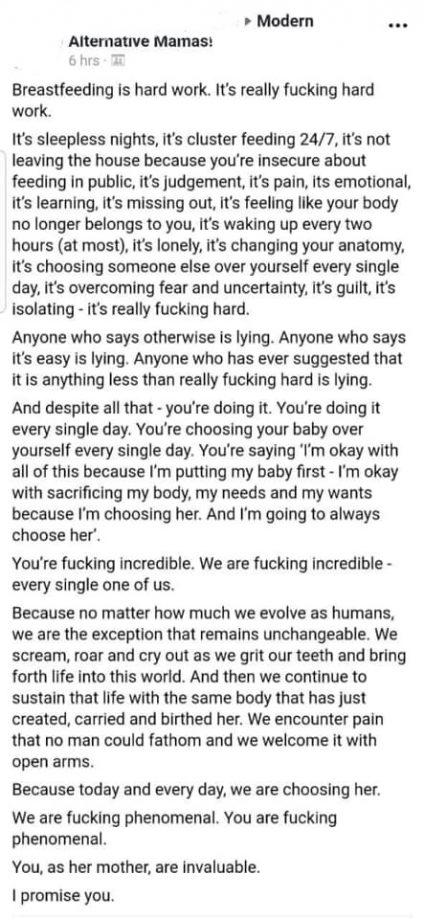
Consider this Facebook post:

3B82645C-2AEC-46C8-B4C3-C8AC51B209E1

Breastfeeding Is hard work. It’s really fucking hard work.

It’s sleepless nights, It’s cluster feeding 24/7. It’s not leaving the house because you’re insecure about feeding in public, it’s judgement, it’s pain, it’s emotional, it’s learning, it’s missing out, it’s feeling like your body no longer belongs to you, it’s waking up every two hours (at most), it’s lonely, it’s changing your anatomy, It’s choosing someone else over yourself every single day, It’s overcoming fear and uncertainty, it’s guilt, it’s isolating -it’s really fucking hard.

Staying home ✔
Sacrificing ✔
Suffering ✔

Cluster feeding? Not leaving the house? Pain? Missing out? Never sleeping more than two hours? Lonely? Isolating?

All of that could be easily averted with formula. That’s why it’s so important to convince women that formula is bad. We wouldn’t want mothers feeling happy, well-rested, able to engage with the world, right?

But there’s another way you tell that the ideology of natural mothering is intended to re-domesticate women: there’s no natural fathering.

There has been no comparable attempt to return fatherhood to the supposedly superior lifestyle of our ancestors with which we evolved. There’s no effort to keep men in pain, away from technology, out of the workplace and tied to their children.

  • Where is the claim “good” fathers demonstrate their love for their wives and children by killing game animals and dragging them home?
  • Why aren’t men escorted out of the delivery room because traditional societies do not allow fathers at childbirth?
  • Where are restrictions on what men can consume, justified by the desire to keep their sperm safe for maximum fertility?
  • Why aren’t fathers competing over who is the more natural father?

Obviously any large social movement, like the movement to re-domesticate women within industrialized societies, is complex and multifactorial. Nonetheless, a significant impetus is to return to the good old days … good for men, possibly good for children, but not good at all for women.

That’s why there are mommy wars, but no daddy wars.

But, but, “the science”!

If the last two decades have shown us anything it is that “the science” is weak, conflicting and riddled with confounding variables. We cannot pin down the answer to something as basic as whether it is good or bad for children if their mothers work and the reason we cannot pin it down is that there is no one answer. It depends; it depends on the individual mother, and individual child and the life circumstances of the family.

It’s just like breastfeeding, where “the science” is also quite fuzzy no matter how much lactivists insist otherwise. That’s because the greatest danger of not breastfeeding comes from contaminated water used to prepare it and that’s not a problem in first world countries. Is breastfeeding better for term babies than formula feeding? It depends; it depends on the individual mother, the individual baby and the life circumstances of the family.

The weak “science” of breastfeeding and the weak “science” on working mothers is stronger by far that any science on natural childbirth or attachment parenting. That’s because there is no science at all to support either of those two components of natural mothering.

What does science show about fathering in nature? No one knows, because virtually no one is looking.

In part that reflects the importance of mothers during pregnancy and early infancy, but, I would argue, it also reflects the fact that we use mothering to control women while there is no comparable effort at all to control men through fathering.

As a society we need to step back and ask ourselves why we are placing such pressure on new mothers and why we are demanding that women accede to the imperatives of natural mothering (and shame them for not doing so), while paying no attention to fathering.

Is this really about what’s best for children? Is this really about “the science”?

No, it’s just the thoroughly modern way to re-domesticate women.

Medicalized birth is a feminist triumph!

cropped view of woman pointing at pink feminist t-shirt, isolated on grey

Childbirth is a reproductive rights issue.

Every woman deserves access to high quality obstetric care, and every woman deserves access to state of the art pain relief. That’s because medicalizing birth is a feminist triumph and all women should be able to share in its benefits.

[pullquote align=”right” cite=”” link=”” color=”” class=”” size=””]”A possible death sentence came with every pregnancy.”[/pullquote]

Childbirth, in every time, place and culture, is a leading cause of death of young women and the leading cause of death of babies. As historian Judith Walzer Leavitt has noted in Under the Shadow of Maternity: American Women’s Responses to Death and Debility Fears in Nineteenth-Century Childbirth, until the last 100 years:

A possible death sentence came with every pregnancy.

Visit any cemetery, from any century, in any country, and you will find the gravestones of the countless young women who died in childbirth, many after days of horrific agony.

Maternity, the creation of new life, carried with it the ever-present possibility of death. The shadow that followed women through life was the fear of the ultimate physical risk of bearing children. Young women perceived that their bodies, even when healthy and vigorous, could yield up a dead infant or could carry the seeds of their own destruction… Nine months’ gestation could mean nine months to prepare for death.

The very real possibility of death during childbirth shaped women’s lives and relationships:

Perhaps more valuable to our understanding of the reality of maternal death is the observation that most women seemed to know or know of other women who had died in childbirth. One woman, for example, wrote that her friend “died as she has expected to” as a result of childbirth as had six other of their childhood friends. Early in the twentieth century approximately 1 mother died for each 154 live births. If women delivered, let us estimate, an average of five live babies, these statistics can mean that over their reproductive years, one of every thirty women might be expected to die in childbirth. In another early-twentieth century calculation, one of every seventeen men claimed they had a mother or sister who had died as the immediate results of childbirth.

Medicalizing childbirth changed that. Now no woman with access to medicalized birth expects to die during pregnancy.

But living through the birth was only the first hurdle for many women. Some sustained injuries that affected them for the rest of their lives:

In the past, the shadow of maternity extended beyond the possibility and fear of death. Women knew that if procreation did not kill them or their babies, it could maim them for life. Postpartum gynecological problems – some great enough to force women to bed for the rest of their lives, others causing milder disabilities – hounded the women who did not succumb to their labor and delivery. For some women, the fears of future debility were more disturbing than fears of death. Vesicovaginal and rectovaginal fistulas .., which brought incontinence and constant irritation to sufferers; unsutured perineal tears of lesser degree, which may have caused significant daily discomforts; major infections; and general weakness and failure to return to prepregnant physical vigor threatened young women in the prime of life.

Medicalizing childbirth changed that. Now no woman with access to medicalized birth expects to become permanently incontinent of urine and feces as a result of childbirth.

Women viewed childbirth not as the empowering fantasy so beloved of midwives and natural childbirth advocates, but as a specter of unremitting agony:

Apart from their concern about resulting death and physical debility, women feared pain and suffering during the confinement itself. They worried about how they would bear up under the pain and stress, how long the confinement might last, and whether trusted people would accompany them through the ordeal. The short hours between being a pregnant woman and becoming a mother seemed, in anticipation, to be interminably long, and they occupied the thoughts and defined the worries of multitudes of women. Women’s descriptions of their confinement experiences foretold the horrors of the ordeal.

The voices of these women have the power to move us profoundly more than one hundred years later:

Josephine Preston Peabody wrote in her diary of the “most terrible day of [her] life,” when she delivered her firstborn, the “almost inconceivable agony” she lived through during her “day-long battle with a thousand tortures and thunders and ruins.” Her second confinement brought “great bodily suffering,” and her third, “the nethermost hell of bodily pain and mental blankness. . . . The will to live had been massacred out of me, and I couldn’t see why I had to. Another woman remembered “stark terror was what I felt most.”

“Between oceans of pain,” wrote one woman of her third birth in 1885, “there stretched continents of fear; fear of death and dread of suffering beyond bearing.” Surviving a childbirth did not allow women to forget its horrors. Lillie M. Jackson, recalling her 1905 confinement, wrote: “While carrying my baby, I was so miserable… I went down to death’s door to bring my son into the world, and I’ve never forgotten. Some folks say one forgets, and can have them right over again, but today I’ve not forgotten, and that baby is 36 years old.” Too many women shared with Hallie Nelson her feelings upon her first birth: “I began to look forward to the event with dread-if not actual horror.” Even after Nelson’s successful birth, she “did not forget those awful hours spent in labor…”

Medicalizing childbirth changed that. Now no woman with access to medicalized birth expects to suffer severe, unremitting pain from the beginning of labor to the end. She can request and receive an epidural and simply rest and sleep through hours of contractions.

Indeed, so confident of excellent pain relief are women who have access to medicalized childbirth that some women actually think they’ve “achieved” something by refusing it.

One of the great deceptions of contemporary midwifery involves midwives fooling themselves and others that the philosophy of natural childbirth reverts back to unmedicalized birth. Nothing could be further from the truth. Natural childbirth is a philosophy of privilege, specifically the privilege of having easy access to medicalized childbirth. An “unmedicalized” birth can only be safe when embedded firmly within a society that provides unlimited access to obstetricians to rescue women from their own folly.

A midwife without an obstetrician is better than nothing at preventing death in certain limited circumstances, but virtually useless when it comes to saving lives in most emergencies. Without the ability to perform a C-section, midwives, like their ancient counterparts, are helpless in the face of everything from life threatening crises to simple failures of the baby to fit through the maternal pelvis. Without the ability to end a protracted labor by means of forceps or C-section, midwives are helpless to prevent obstetric fistula. Without the ability to offer epidurals, midwives are reduced to pretending that ineffective measures are effective, or, bizarrely, that labor pain is beneficial.

Childbirth is a reproductive rights issue.

Every woman deserves access to high quality obstetric care, and every woman deserves access to state of the art pain relief. They are only available in a system that medicalizes birth.

Is mothering the new sex?

Old Lady in shock

It used to be that sex was tightly culturally regulated and mothering had no oversight. In 2019, in industrialized countries mothering is tightly culturally regulated and sex has no oversight.

What happened?

For most of recorded history, there were regulations about who could have sex with whom, who pursued and who was expected to resist. From the Bible to the Puritans, the regulations were particularly rigid for women.

[pullquote align=”right” cite=”” link=”” color=”” class=”” size=””]Natural mothering is the missionary position of contemporary motherhood.[/pullquote]

Men could have sex with any woman (but no men); men could have more than one wife; and men could — indeed were expected — to have sex outside of marriage. None of these practices were thought to have any effect on a man’s virtue. In contrast, a woman’s virtue was situated firmly in her vagina. She was allowed to have sex only after marriage and only with her husband at his whim; she had no right to refuse. Rape was routinely blamed on women and even if they were not blamed, they were “ruined,” condemned to live outside the circle of polite society.

Even within marriage, women’s sexuality was tightly regulated. Certain behaviors were considered the province of courtesans and prostitutes and proscribed for wives. The “good” wife settled for the missionary position when and only when her husband wished to meet his sexual needs; her needs were irrelevant.

In contrast, how she mothered her children was not regulated at all. There were no choices to be made in childbirth, but when it came to infant feeding women could breastfeed, supplemented by or replaced with a wide variety of (generally unsuitable) alternatives like animal milks, or — if wealthy — could hire a wet nurse. For those with means, day to day childrearing was outsourced to hired help or slaves; for those without means, children were often put to work on the farm and, later, in the factories. Your children were your husband’s property. He might care how you treated them; certainly no one else would. No one would have even looked askance if you beat your children regularly. Some even thought regular beating improved their character.

Today, in contrast, sexual license prevails. Have sex with anyone and everyone, inside marriage and outside it; most people don’t care. Sexuality is ascribed to women as well as men; everyone is believed to be entitled to sexual satisfaction as a matter of health and wellbeing. We have utterly rejected the rules that guided sexual relationships for most of recorded history. Instead — at almost precisely the same time — we have created elaborate rules for mothering.

There are rules for what constitutes the “best” birth; there is only one acceptable way to feed a baby; and we have become deeply censorious of mothers spending time apart from their children. So-called “natural mothering” is the missionary position of contemporary motherhood. The “good” mother embraces it. She has no higher purpose than to meet her children’s needs; certainly her own needs are irrelevant.

We have constricted motherhood as tightly as we used to constrict women’s sexuality and for the same reason — to control women.

You don’t have to have a sociology degree to understand that the myriad historical regulations around women and sex were created to protect men’s prerogatives. Every respectable woman was owned by a man and was forced to stay home to meet his needs, raise his children and preserve her virtue. While there were always women who rebelled at such strictures, by and large most women didn’t merely support this view of women, they defended it by shunning women who wouldn’t comply. For a woman, being excluded from polite society meant being excluded from and by other women.

It’s harder to see that the modern prescriptions around mothering — in particular the ideology of natural mothering, also known as attachment parenting or intensive mothering — have been promoted primarily to protect men’s prerogatives. A “good” mother has unmedicated vaginal births, breastfeeds exclusively and for an extended period of time, and literally wears her babies. With the advent of women’s legal and economic emancipation, women have thrown off traditional strictures so they must be forced back into the home. The primary enforcers, as in the case with sexual restrictions, is other women.

But in contrast to sexual restrictions, enforcing mothering restrictions has been professionalized: midwives, doulas, lactation consultants and attachment parenting “experts” profit only when they force women to comply with their priorities. Not surprisingly, they spend a great deal of time pressuring women. In addition to the shaming and shunning that were formerly applied to sex, they have hit upon an even more powerful motivator. They have claimed — with no evidence of any kind — that if women don’t knuckle under to natural childbirth, breastfeeding and attachment parenting, their will children won’t bond; in other words, their children won’t love them. That fate is far crueler than being shunned by one’s peers.

Make no mistake, I am not referring to women who make affirmative choices:

Some women are affirmatively heterosexual and monogamous. They have husbands and they are faithful to them. They might prefer the missionary position, feel uncomfortable initiating sex, or might not enjoy sex but submit because they love their husbands. I applaud them for living the lives they choose.

That’s very different from women who are forced to appear heterosexual and monogamous on pain of condemnation and shunning. They might want more from a sexual relationship than merely meeting a spouse’s needs and they should not be pressured into believing they are “bad” wives when they won’t submit to their husbands.

Similarly, there are some women who are affirmatively domestic. There is no place they would rather be than home with their children; there is nothing they would rather do than breastfeed a child; they glory in unmedicated vaginal birth. I don’t merely applaud them for living the lives they choose; in many respects I have emulated them.

But that’s very different from women who are pressured into unmedicated vaginal births they don’t want, breastfeeding they don’t enjoy, and enforced isolation with small children instead of a job or career they prefer.

Our society has gone from sexually puritanical and unrestrictive about motherhood, to sexually licentious and rigidly restrictive about motherhood. That’s not an advance. It’s just a different way to do the same thing: domesticating women by convincing them that they exist for the benefit of others, while their needs and desires are ignored.

Thinking about homebirth? Think about this difference between obstetricians and homebirth midwives.

Time for Accountability Words Clock Take Responsibility

Babies die.

The most critical difference between obstetricians and homebirth midwives is their response to these tragic deaths:

When faced with a dead baby obstetricians ask, “How can we prevent this from ever happening again?”

In contrast, homebirth midwives ask, “How can we avoid responsibility?”

[pullquote align=”right” cite=”” link=”” color=”” class=”” size=””]“I want a bumper sticker that says, ‘Babies Die’.”[/pullquote]

Don’t believe me? Consider the irresponsible, self-serving blather from Jan Tritten, Editor of Midwifery Today.

Remember Jan? She’s the one who presided over the hideous spectacle of homebirth midwife Christy Collins crowdsourcing advice as baby Gavin Michael died.

A216DD3B-B9A2-41C1-9E65-DB18533C5E8B

In the wake of the baby’s death, there was no soul searching about the entirely preventable death of a baby. There was no reflection on what was done wrong and how future tragedies could have been prevented. There was nothing; Tritten simply deleted the multiple posts and comments concerning the tragedy from her Facebook page. She and the presiding midwife tried to bury Gavin Michael twice: first in a small coffin in the ground, then from the memory of anyone who had followed the story.

Her current column gives insight into her ugly fatalism and repulsive lack of concern for anyone but herself and sister midwives.

BACCC8F8-9934-4212-9A85-5A5DEE248999

I remember Marsden Wagner once saying, “I want a bumper sticker that says, ‘Babies Die’.”

Ha, ha, ha. Are you laughing yet?

Although that sounds awful, he was reflecting his experience of frequently appearing as a witness in cases where midwives were being prosecuted for the death of a baby at a homebirth.

Why did Wagner have to appear frequently? Homebirth deaths ought to be vanishingly uncommon — as they are in Canada, where homebirth midwifery is tightly regulated.

He knew full well that many more babies die in hospital birth than homebirth, but these were not the cases that got the attention. The authorities—opposed to homebirth—would bide their time and wait for a baby to die under the care of a homebirth midwife. Then they would pounce on that midwife. It was another great way to deal with “the midwife problem.”

Pro-tip: when comparing the safety of two groups of providers, we look at death RATES, not absolute numbers. The death RATES at homebirth in the US are up to 800% HIGHER than comparable risk hospital birth. The death RATES at homebirth in the US are up to 800% HIGHER than homebirth in Canada.

Are midwives in Canada smarter, better educated, more extensively trained than homebirth midwives in the US? Yes on all counts.

That’s relevant if you care about protecting babies and mothers. Jan is only interested in protecting providers.

Life is a circle. Some babies live only a few months and may pass in utero… Some babies live 10 years, some live 80 years, but all will pass into the next world.

Ho, hum, babies die. How dare anyone try to hold homebirth midwives accountable?

Tritten’s lackadaisical attitude toward dead babies isn’t merely a betrayal of homebirth clients, it’s a betrayal of the long, proud tradition of midwifery.

There have always been midwives. Ever since our ancestors acquired the ability to walk upright, human childbirth has been fraught with extreme risk to both mother and baby. The first midwives were those who recognized that assistance in childbirth can minimize those risks.

Above all, ancient midwives were empiricists. Their very existence was predicated on the inherent dangers of childbirth and everything they did was devoted to preventing death and injury. They abjured magic incantations in favor of empirical observation. They noted what worked and what did not and faithfully strove to incorporate those scientific observations into practice. They didn’t simply throw up their hands and declare, “Babies die.”

Why would Tritten and other homebirth midwives betray the ideals of midwifery? Because they aren’t really midwives; they are women who can’t be bothered or lack the intellectual ability to complete real midwifery training. They are birth hobbyists who want to be paid as if they were real midwives, who want to be respected as if they were real midwives, but absolutely refuse to be held accountable as if they were real midwives.

It’s no different than if your neighbor decided she was qualified to declare herself a surgeon because she watched multiple seasons of the TV show Grey’s Anatomy. It’s no different from that neighbor insisting — each and every time someone died from botched surgery — that patients died from surgery in the hospital, too.

Which would you prefer, a real surgeon who cared whether or not her patients died and tried to prevent future deaths, or a self-proclaimed surgeon whose chief concern in the wake of a preventable death was to avoid blame for it?

Thinking about homebirth? Which do you prefer, a real midwife who cares whether or not her patients die and tries to prevent deaths, or a self-proclaimed midwife who cares only about avoiding responsibility?

Yes, sadly, babies die, but the critical difference between obstetricians and homebirth midwives is that obstetricians are desperately trying to reduce infant deaths while homebirth midwives prefer to pretend they’re inevitable.

Whom do you trust with your baby’s life?

Dr. Amy