Kate Cohen and the casual condescension of radical feminists

Yesterday I critiqued Kate Cohen’s recent piece in The Washington Post, Sorry, but these choices aren’t ‘feminist.’ They’re sexist. on substantive grounds.

It isn’t specific choices that make women feminists; it is the conviction that choices should be made BY them, not FOR them. It’s anti-feminist for women to knuckle under to specific choices prescribed by patriarchal societies but it is EQUALLY anti-feminist for women to knuckle under to specific choices prescribed by other feminists.

However the fundamental ugliness of the piece isn’t that it is substantively incorrect. It’s the casual condescension of radical feminists like Kate Cohen, a condescension that grievously harms the entire feminist cause. How? By accusing women, including other feminists, of false consciousness.

False consciousness typically refers to political beliefs. According to Dictionary.com, false consciousness is:

… a Marxist theory that people are unable to see things, especially exploitation, oppression, and social relations, as they really are; the hypothesized inability of the human mind to develop a sophisticated awareness of how it is developed and shaped by circumstances.

For example, Marxists insisted that working people who opposed Communism suffered from false consciousness. That inevitably led to the conclusion that the opinions of anti-Communists could be ingnored and that Marxists’ opinions were more valuable than those of people who opposed them.

Cohen insists that women who make feminine choices are unable to see things as they really are. They lack the sophisticated awareness that Cohen flatters herself in imagining that she has but the rest of us lack.

Cohen smugly declares:

Some argue that what matters is how a woman feels, not what she does. “The non-feminist likely shaves because she feels that she has to for others,” explains one blogger, “while the feminist will shave because she wants to do it for herself.”

Goodness, no. The feminist knows that the reasons she wants to shave are deeply compromised — and that as long as men aren’t expected to do it, doing it for yourself is an illusion.

It’s hard to imagine anything more harmful to a cause than the condescension of its followers.

As political theorist Steve Cook explains in ‘Why calling “False Consciousness”’ is dangerous and unreasonable:

The moment that someone believes that another agent suffers from false consciousness, then they risk denying the equality of citizens. If someone believes that another suffers from false consciousness, then they can discount any reasons the other gives. The agent believes that they have special access to the truth, which others do not. Once you have special access to the truth … then your reasons automatically count and another’s can automatically be discounted…

Is it any wonder that many contemporary women reject feminism when radical feminists like Cohen insist that their choices — like the choices to wear makeup, shave their legs or change their surname on marriage — aren’t merely wrong, they mark the women who make those choices as both unsophisticated and easily manipulated?

And the best part for Cohen is she needn’t disdain to consider those who disagree.

As Cook notes:

The only way to prove that you don’t suffer from false consciousness is to wholeheartedly agree with the one who believes that you suffer from it. Effectively, you are regarded as fallible, and they as infallible. This kind of thinking can easily provide a justification for them to impose their will upon you…

I have a tip for radical feminists like Cohen:

If your feminism allows you to denigrate women who make choices different from yours, it’s not feminism; it’s condescension … and it’s both ugly and unjustified.
Sorry, Kate Cohen, you don’t get to decide what’s feminist

Another day, another misguided feminist who mistakenly believes she has the right to define feminism.

Writing in The Washington Post, Kate Cohen feels it necessary to tell us what she thinks about other women’s personal choices, in this case women like Jennifer Lopez who change their surname after marriage:

… some claim that changing their names is in fact a feminist choice…

Defenders of Affleck’s new name have taken a similar tack. “True feminism means each and every woman has the freedom to make her own choices, J-LO included,” tweeted one. A writer in the Irish magazine Image opined, “Feminism revolves around equality, and a woman’s freedom to make decisions as she sees fit.”

You get the idea. Feminism is about choice; therefore Affleck’s choice must be feminist.

No, sorry. It’s the opposite.

Cohen appears to have her own personal definition of feminism.

Every choice to conform to sexist social norms makes it harder for other women to choose otherwise. Every woman who has plastic surgery or Botox or gets her hair dyed or, yes, changes her name makes it harder for other women not to.

Some argue that what matters is how a woman feels, not what she does. “The non-feminist likely shaves because she feels that she has to for others,” explains one blogger, “while the feminist will shave because she wants to do it for herself.”

Goodness, no. The feminist knows that the reasons she wants to shave are deeply compromised — and that as long as men aren’t expected to do it, doing it for yourself is an illusion.

In other words, according to Cohen, “real” feminism must be transgressive.

But defying “authority” doesn’t make you more feminist; it just makes you defiant.

Cohen reminds me of anti-vaxxers. The fact that there is no scientific evidence for their claims is elided by ignoring the actual science and focusing instead on whether people agree with health professionals. Defiance is imagined to be the hallmark of independent thinking when, in truth, it is the hallmark of failure to think.

Defying health experts doesn’t make anti-vaxxers smart and defying cultural norms doesn’t make women feminist. Unreflective defiance is just the flip side of unreflective acceptance. Only teenagers think that refusing to do what authority figures recommend marks them as independent. Adults know that doing the exact opposite of what authority figures recommend is a sign of immaturity, not deliberation.

It isn’t transgressive behavior that marks some women as a feminists; it is the conviction that they are intellectually and morally equal to men and entitled to the same political and economic rights.

Cohen indulges in humble bragging:

But still, as a feminist, I faltered many times on the way toward the aisle. I lost weight for my wedding, shaved my underarms, wore heels and lipstick and virginal white.

Guess what sort of choices those were. Sexist ones. Sure, I could say I looked good in white or I liked the feel of smooth armpits. But any excuse beyond “I gave in” would disrespect the women who do stand up to patriarchal traditions, downplay the enormous power of the forces arrayed against us, and disregard the potential harm created by my sexist choices.

How adorable that Cohen believes that lipstick and underarm shaving are feminist issues!

Or it would be so long as we ignore the 47,000 women murdered each year by men or that this Supreme Court believes women do not have the right to control their own bodies. When you consider the stakes the fact that Cohen focuses on heels or surname changes as hallmarks of feminism seems absurd and even grotesque.

It isn’t specific choices that make women feminists, it is the conviction that choices should be made BY them, not FOR them. It’s anti-feminist for women to knuckle under to specific choices prescribed by patriarchal societies but it is EQUALLY anti-feminist for women to knuckle under to specific choices prescribed by other feminists.

Sorry, Kate Cohen, you’re not a better feminist for making transgressive choices. Indeed you are not a feminist at all if you believe that you have the right demonize other women’s choices as insufficiently transgressive.

For anti-abortion legislation the cruelty is the point

Anti-choice advocates say they oppose abortion because it stops a beating heart.

They say it makes no sense to have a rape or incest exception because it’s not the fault of the beating heart that it was conceived through violence.

That’s rather difficult to believe when the exact same people also say that capital punishment — though it stops a beating heart — is an appropriate punishment.

It’s also rather difficult to believe when the exact same people also say that stopping the beating hearts of hundreds of children who were simply attending school is just the price we have to pay for gun rights.

But it’s the extreme cruelty of the refusal to make exceptions to save the life of the mother — to prevent stopping HER beating heart — that reveals what’s really going on.

When it comes to anti-abortion legislation, the cruelty is the point!

Adam Serwer, writing in The Atlantic in 2018 first articulated in print what we all know to be true:

President Trump and his supporters find community by rejoicing in the suffering of those they hate and fear.

Unpacking his assertion further:

Taking joy in that suffering is more human than most would like to admit. Somewhere on the wide spectrum between adolescent teasing and the smiling white men in the lynching photographs are the Trump supporters whose community is built by rejoicing in the anguish of those they see as unlike them, who have found in their shared cruelty an answer to the loneliness and atomization of modern life.

And they hate and fear women, particularly educated and powerful women.

That’s why when a tape surfaced immediately before the 2016 election that quoted Trump advising another man, “Grab ‘em by the pussy,” it wasn’t disqualifying. To his supporters it was fulfillment of their ugliest fantasies: to humiliate, punish, and terrorize the women they fear.

The recent spate of anti-abortion legislation is just another form of “grab ‘em by the pussy.” It is designed with the express intent of humiliating, punishing and terrorizing women.

THAT’S why such legislation often doesn’t have exceptions for rape or incest. It’s not enough imagine violated women; it is more satisfying to watch them fear an unwanted pregnancy and live a life destroyed. And it sends a message to all women — even their wives and daughters — that men are ENTITLED to control women’s lives.

THAT’S why such legislation often doesn’t have exceptions for the life of the mother. Apparently even humiliation, punishment and terror are not enough to appease the men who fear they have lost control of women. Women must die. It sends a message to everyone that men OWN women’s lives, which they can extinguish at their will.

To paraphrase Serwer:

The fundamental belief of those responsible for anti-abortion legislation is that the United States is the birthright of straight, white, Christian men. Their only real, authentic pleasure is in cruelty. The ability to execute that cruelty — anti-abortion legislation — makes them euphoric. And if women have to die, so much the better!

A linguist analyzes competing claims of Breast Is Best vs. Fed Is Best

‘Breast is Best’ or ‘Fed is Best’? A Study of Concessive Relations in the Debate on Methods of Infant Feeding is a fascinating new paper about the rival claims of the Breast Is Best vs. Fed Is Best movements. The paper was written by linguistics professor, Giorgia Riboni.

As a linguist, she analyzes the claims for content, not scientific validity. What does each movement say about itself and its challenger?

She finds:

1. The key difference is that Breast Is Best starts with a conclusion and never questions it.
2. There is NO evidence that the formula industry is behind the Fed Is Best Foundation.
3. Contrary to lactivists’ claims, there is NO evidence that Fed Is Best promotes bottle feeding.

The author explains what she is attempting to accomplish:

The ongoing ‘Breast is best’ vs. ‘Fed is best’ dispute represents an interesting object of study: it lies at the crossroads of multiple topical discourses and provides the opportunity to explore the ways in which contrasting constructions of reality interact and compete…

…[A] dataset consisting of approximately 450 texts published in the last thirty-five years was gathered and examined through the use of automated interrogation routines (Sketch Engine). The approach adopted in the research is therefore corpus-based and enables the identification of recurrent patterns … this last step is instrumental in uncovering tacit beliefs about motherhood and breastfeeding characterizing the ‘Breast is best’ and ‘Fed is best’ approach.

The author starts by establishing that Breast Is Best is a hegemonic discourse despite weak scientific evidence:

Whereas public policies are aligned with the ‘Breast is best’ approach, the scientific community is more divided on the topic. While acknowledging that maternal milk is species-specific and therefore good and safe for babies, research on the possible health advantages associated with it has (yet?) to produce conclusive scientific evidence …

She describes the origin of the Fed Is Best movement, started in an effort to protect babies from the potentially deadly consequences of insufficient breastmilk. Contrary to the claims of lactivists there is ZERO evidence that the Fed Is Best Foundation is associated in any way with the formula industry.

Detractors of the ‘Fed is best’ approach claim that companies producing formula are behind it; while this may seem a realistic possibility, (currently) no evidence can be found to back it up. … [T]he ‘Breast is best’ approach benefits professional figures such as lactation consultants and breastfeeding counselors as well as businesses specialized in breastfeeding gear, supplies, publications etc.

The article is filled with jargon but the findings are easy to describe.

…[W]hereas the FED subcorpus focuses on the discussion of whether breast is ‘really best,’ and … is mainly aimed at debunking this belief, the BREAST subcorpus starts from this theory and never problematizes it… The ‘Fed is best’ position is instead an instance of counter-discourse, not because it promotes formula over maternal milk, but because it frames infant feeding as an open question and raises the possibility that breastfeeding may not necessarily be the optimal solution for everyone.

The key difference between the two competing claims is that Breast Is Best starts with a conclusion and never questions it, Fed Is Best considers the purported benefits of breastfeeding (and it drawbacks) to be an open question.

Both movements look at the difference between the numbers of women who start breastfeeding and the number of women who are exclusively breastfeeding weeks or months later.

The Breast Is Best movement is preoccupied with the discrepancy between what “should” be and what is. Lactivists blame the formula industry, hospitals, providers, workplaces and even women themselves, but they never consider that breast might NOT be best for some babies and their mothers.

In contrast:

… [T]he predominant topic of the FED subcorpus is the debunking of the theory that breast is always best. The analysis of the texts revealed no attempt to encourage bottle-feeding over breastfeeding, unlike what used to happen in pro-bottle-feeding topics in the historical periods prior to that considered in the study.

The bottom line is this: linguistic analysis reveals that while Breast Is Best is pro-breastfeeding, Fed Is Best is NEITHER pro-formula NOR anti-breastfeeding.

Trans women vs. women: what is justice?

One of the most contentious aspects of the currently roiling debate about the rights of transgender persons is that both sides imagine that they are defending the principle of justice.

Trans advocates are absolutely, positively, unalterably convinced that justice REQUIRES not merely acceptance of transgender individuals, but capitulation to all their demands. Anyone who doesn’t agree is angrily labeled transphobic or worse. Women’s rights advocates are absolutely, positively, unalterably convinced that justice does NOT require acceptance of transgender demands, especially if those demands pose a threat to women. Anyone who doesn’t agree is angrily labeled delusional or worse.

Both sides often do agree that the dispute rests on the answer to a simple question, “who is a woman (or a man)?” In contrast, I am coming to believe that the dispute rests on the answer to an entirely different question about justice. The question is not simply “what does justice require?” The real question at the heart of these debates “what is justice?”

Trans advocates often hold a view of justice that resembles a moral caste system based both on group identity and history of oppression. Arguments are easily adjudicated by reference to the caste system with those in a higher caste automatically correct. We might describe this system as “justice as reparation.”

Therefore, when a woman demands something from a man (or accuses a man of assault), the moral caste system requires that we accept the woman’s demands or believe her accusation, since as a victim of misogyny she is in a higher caste. In contrast, if a trans woman demands something of a cis woman, the moral caste system REQUIRES that we accede to the trans woman’s demands since — by virtue of greater oppression — a trans woman is in an even higher moral caste.

The virtue of this system of justice is it does away with messy details like determining who might be correct or whose demands might be reasonable or unreasonable. There’s no need to treat people as individuals who could be right or wrong; the relative position of their caste determines all.

The major defect in this system of justice is … it does away with messy details like determining who might be correct or whose demands might be reasonable or unreasonable. Instead of treating people as individuals whose demands should be adjudicated on the merits, it reduces them to members of a specific group.

If you subscribe to a system of justice based on a moral caste system it is obvious that any woman who refuses to knuckle under to demands of trans women must — by the system’s definition — be wrong. Indeed, refusal to knuckle under is — by the system’s definition — unalterably transphobic and deserves every vicious slur and accusation (“your refusal to use gender neutral language to describe pregnancy will KILL trans women!!!”) you can throw at her.

I, and many millions of other like me, subscribe to a very different system of justice — justice as fairness — one based largely on that described by the great 20th Century political philosopher John Rawls. Rawls wrote that if we want to know what justice requires of us, we ought to imagine the world we would want if we didn’t know the position that we would occupy in that world. In other words, justice is what we would choose if we didn’t know if we were rich or poor, Black or white, brilliant or plodding, talented or talentless, … trans or cis. If we didn’t know our specific circumstances we wouldn’t be able to tailor our principles to benefit ourselves or our friends.

In determining whether trans women should be allowed to compete in women’s sports, the issue is not who has a history of greater oppression but how can we balance the interests of both groups. If you imagine yourself as the trans woman who wants to compete you might arrive at one conclusion. If you imagine yourself as the cis woman whose athletic career will be blighted by allowing trans women to compete you might arrive at the opposite conclusion. But what if you didn’t know which one you were? What would you decide then? You would likely aim for the fairest solution. That’s not transphobia.

In determining whether trans women should be housed in women’s prisons, the issue is not who has a history of greater oppression but how can we balance the interests of both groups. If you imagine yourself as the trans woman you might arrive at one conclusion. If you imagine yourself as the cis woman who could be raped you might arrive at the opposite conclusion. But what if you didn’t know which one you were? What would you decide then? You would likely aim for the fairest solution. That’s not transphobia.

Therefore, the fundamental question at issue is not “who is a woman?” but “what is justice?” when the interests of trans women and cis women are in conflict. If you believe in justice as reparation you must acknowledge that those who believe in justice as fairness are not transphobic. And if you believe in justice as fairness you must stop calling trans people delusional since that is fundamentally unfair and unjust.

5 lies the AAP told me about breastfeeding

The American Academy of Pediatrics recently released guidelines promoting breastfeeding each child for two years — despite the fact that there is NO scientific evidence for the recommendation.

How did that happen? When you let lactivist zealots make breastfeeding policy, you end up with breastfeeding policies that ignore scientific evidence in favor of lactivists’ cherished beliefs.

Case in point: the AAP’s attempt to explain the unsupported recommendations to laypeople on its website, Breastfeeding: AAP Policy Explained. It’s even worse than the execrable paper on which it is based.

The paper, Policy Statement: Breastfeeding and the Use of Human Milk, is filled with weasel words like “might,” “associated,” and “linked.” Yes, breastfeeding is “linked” with good outcomes. Better educated, wealthier women are far more likely to breastfeed. It is the higher socio-economic status, including greater access to health insurance and healthcare, that is responsible for the improved health outcomes “associated with” and “linked to” breastfeeding, NOT breastfeeding itself.

The information for laypeople replaces the weasel words — which at least acknowledge the lack of proof for causation — with words that imply causation. In other words, the AAP lies in order to manipulate women into breastfeeding or breastfeeding longer. And the lies aren’t minor; they’re egregious.

#1 The Lifesaving Lie

“Breastfeeding can reduce … up to 40% overall infant deaths.”

This is a bald-faced LIE. I don’t believe this is even true in places where access to clean water is problematic, let alone in industrialized countries. At the moment, with the exception of extremely premature babies, there is NO evidence that breastfeeding saves ANY lives in industrialized countries. Indeed, as I’ve noted in the past, the United Kingdom has literally the LOWEST breastfeeding rate IN THE WORLD, yet one of the lowest infant mortality rates in the world.

#2 The Disease Prevention Lie

“Breastfeeding can also help protect your baby against lower respiratory tract infections and severe or persistent diarrhea, asthma, eczema, Crohn’s and ulcerative colitis, obesity, type 1 and 2 diabetes, leukemia, oral malocclusion and dental caries, while increasing IQ.”

This is another bald-faced lie. Breastfeeding is ASSOCIATED with these outcomes. There is ZERO evidence that breastfeeding causes them.

#3 The Nutritionally Complete Lie

“Breastmilk has all the nutrients, calories and fluids your baby needs!”

No, it doesn’t. It lacks both iron and vitamin D. That’s why vitamin supplements have been recommended for breastfed babies.

#4 The Bonding Lie

“Breastfeeding … helps create special bonds between you and your baby.”

This isn’t just a lie, its a particularly vicious one. There is NO evidence — zip, zero, nada — that breastfeeding has ANY impact on maternal infant bonding. Lactivist zealots simply made that up.

#5 The Misogynist Lie

“ Breastmilk … is free!”

Leaving aside for the moment the expenses associated with breastfeeding — lactation consultants, extra food, special bras, etc. — breastfeeding is only “free” if a woman’s time is worthless. And only misogynists think women’s time is worthless.

Those are not the only lies on the AAP page. There are a few other whoppers, including the claim that breastfeeding releases hormones that “promote healthy parenting behavior,” but those are the most egregious.

I’d be willing to bet that most members of the AAP don’t believe most of what is on this page. So why is it there? It’s there because the AAP, like most professional medical organizations, has left breastfeeding recommendations to the lactivist zealots among its members.

I’d be happy to publicly debate (in print or in person) the author of the AAP page, Dr. Lori Feldman-Winter, on these 5 lies. I doubt that will ever happen because even the lactivist zealots are aware that they cannot possibly defend their lies against the lack of scientific evidence.

The bottom line is that the AAP has risked its credibility by giving an imprimatur to 5 particularly egregious lactivist lies. Don’t believe them. Breastfeeding is grest but its only one of two excellent ways to nourish babies. Mothers should make infant feeding decisions based on what is good for them and their babies, not the lies of lactivist zealots.

And the AAP ought to stop the lactivist zealots among its members from LYING about breastfeeding in its name!

Why do we allow zealots to make breastfeeding policy?

There has been a furor over the latest American Academy of Pediatrics recommendation to breastfeed children for two years.

The paper that offers the new recommendation is Policy Statement: Breastfeeding and the Use of Human Milk written by Joan Younger Meek, MD and Lawrence Noble, MD.

Extended breastfeeding dramatically increases the physical, psychological and economic burdens on mothers. The recommendation, in addition to being utterly tone deaf in the wake of the overturning Roe v. Wade, it is NOT supported by scientific evidence. The paper is filled with weasel words like “might,” “associated,” and “linked.” Indeed extended breastfeeding has been linked to improved health outcomes for both babies and mothers but that’s because it is a proxy for something far more important: maternal education and socio-economic status.

Breastfeeding in industrialized countries like the US and the UK is highly socially patterned. Better educated, wealthier women are far more likely to breastfeed. It is the higher socio-economic status, including greater access to health insurance and healthcare, that is responsible for the improved health outcomes “associated with” and “linked to” breastfeeding. The idea that breastfeeding improves maternal and infant health is particularly absurd in the case of the UK. The United Kingdom has literally the LOWEST breastfeeding rate IN THE WORLD, yet one of the lowest infant mortality rates in the world.

How did breastfeeding guidelines become completely unmoored from reality? It has happened because we allow lactivist zealots like Dr. Younger-Meek and Dr. Noble to make policy.

This is hardly the first time that either of them have made completely unsupported, nonsensical health claims about breastfeeding.

Back in 2018 Dr. Younger Meek wrote Breastfeeding has been the best public health policy throughout history. Only a zealot would make such an absurd claim.

For most of human history breastfeeding was the standard and often the only method of feeding babies and throughout that time infant mortality rates remained astronomical.

A great public health policy saves millions or even hundreds of millions of lives. In contrast, with the exception of extremely premature infants, breastfeeding hasn’t yet been shown to save many lives at all.

To understand what I mean, lets look at some of the real greatest public health achievements.

1. Clean water
2. Sewers and sanitation
3. Antisepsis
4. Blood transfusions
5. Antibiotics
6. Vaccination
7. Anesthesia
8. Tobacco control
9. Modern obstetrics
10. Neonatology

Each of these has saved and continues to save many millions of lives every year. Breastfeeding doesn’t come anywhere close. Moreover, the purported lifesaving effect of breastfeeding would be entirely abolished if all women had access to clean water with which to prepare formula.

Dr. Noble is, if anything, more zealous and more obnoxious, in his promotion of breastfeeding. In 2015 he gave a talk entitled What’s Really Wrong with One Bottle: Microbiota & Metabolic Syndrome which advanced the scientifically false and psychologically vicious claim that “just one bottle” of formula harms babies.

He starts with this ugly cartoon:

I reviewed all 83 slides of his standard professional talk and there is NOT EVEN ONE that shows any evidence that a single bottle of formula causes any impact at all, let alone a harmful impact.

Indeed the scientific evidence strongly indicates that there is no harm from use of formula. But how deliciously humiliating and guilt producing to emotionally fragile new mothers to pretend that one bottle of formula is harmful! How delightful to pretend that new mothers should be bullied into breastfeeding for the good of their babies.

Imagine if we tried to address smoking related illness by humiliating anyone who ever had ONE cigarette. Imagine if we tried to address obesity by shaming anyone who ever ate even ONCE at McDonald’s. That’s absurd, right? But that’s the equivalent of what lactation zealots do.

It is important for mothers to understand that the recommendation to breastfeed infants for two years is yet another absurd claim about the “benefits” of breastfeeding from two people who have a history of absurd claims unsupported by scientific evidence.

Who am I to criticize the claims of Drs. Younger Meek and Noble? I’m a physician who is very familiar with the breastfeeding literature and I am more than willing to put my criticism to the test. I’d be happy to debate either (or both!), in print or in person, on their ridiculous claims.

I doubt my challenge will be accepted. Zealots never put themselves in positions where those who disagree could challenge them. Though they choose personal beliefs over facts, they are aware that they could not win a scientific debate. In addition, they fear alerting women to just how weak and specious their claims really are.

Who knows? Maybe they, unlike other professional breastfeeding zealots, have the courage of their convictions. I’ll be waiting to find out.

Extended breastfeeding linked to autism

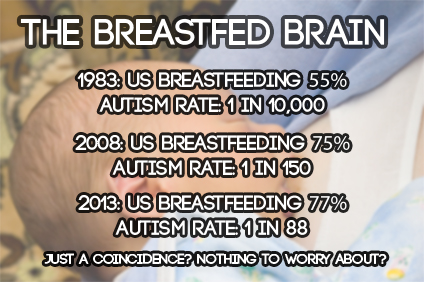
They say a picture is worth a thousand words and the images above and below are quite impressive. They compare the rate of autism over time compared to the rate of breastfeeding over time:

Over the past 4 decades, there has been a shocking rise in the prevalence of autism. Antivax activists have pointed out that there has been an increase in the number of vaccines that infants receive and conclude that vaccines cause autism. But as this graph shows there has also been a dramatic increase in breastfeeding rates. Indeed the two seem to rise in concert over time demonstrating a link between breastfeeding and autism.

Obviously more research is needed. We should be urgently investigating whether breastfeeding causes autism. We should reconsider recommendations designed to encourage breastfeeding and ask if we are ignoring the harmful effects. In the meantime, we should direct lactation consultants, La Leche League and the Baby Friendly Hospital Initiative to inform new mothers of the very clear association between breastfeeding and autism. How can women make an informed decision about breastfeeding if they don’t know about the link?

If you read this far you’re probably asking yourself what has happened to my reasoning abilities. Just because two phenomena rise in concert doesn’t make them linked. Sure, it raises the possibility, but it is grossly irresponsible for any medical professional or organization to announce a link based merely on a temporal association. I must be joking, right?

Sadly, I’m merely copying the efforts of the American Academy of Pediatrics to pressure women into breastfeeding. Their latest attempt to manipulate women, Breastfeeding and the Use of Human Milk was published earlier this week.

The press release highlights the disingenuous tactics:

Research has shown that breastfeeding is linked to decreased rates of lower respiratory tract infections, severe diarrhea, ear infections and obesity. Breastfeeding is associated with lower risk of sudden infant death syndrome, as well as other protective effects.

Notice that the authors do not — indeed CANNOT — say breastfeeding causes these benefits. They’re simply “linked” and “associated” with breastfeeding in EXACTLY THE SAME WAY rising rates of autism are “linked” and “associated” with breastfeeding.

The AAP paper continues:

There are continued benefits from breastfeeding beyond 1 year, and up to 2 years especially in the mother. Long-term breastfeeding is associated with protections against diabetes, high blood pressure, and cancers of the breast and ovaries.

The second sentence makes it clear that the first sentence is a falsehood. Long-term breastfeeding is merely “associated” with these benefits, NOT caused by them. In EXACTLY THE SAME way rising rates of autism are “associated” with extended breastfeeding.

I don’t for a moment believe that breastfeeding causes autism and neither should you. For the EXACT SAME reason, no one should yet declare that breastfeeding causes the “linked” and “associated” benefits touted by the AAP.

What’s really going on here?

Breastfeeding in industrialized countries is highly socially patterned. Breastfeeding and extended breastfeeding are far more common among women of higher education levels and higher socio-economic status. The purported “benefits” of breastfeeding are almost certainly benefits of wealth and access to health insurance and healthcare.

What does the scientific evidence really show?

The paper Is the “breast is best” mantra an oversimplification? is a comprehensive summary of the existing evidence and demonstrates that the benefits of breastfeeding have been overstated and the risks ignored.

The evidence for infant breastfeeding status and its association with health outcomes faces significant limitations; the great majority of those limitations tend to overestimate the benefits of breastfeeding. Nearly all evidence is based on observational studies, in which causality cannot be determined and self-selection bias, recall bias, and residual confounding limit the value or strength of the findings.

How is the average mother to understand the real benefits of breastfeeding (if there are any) when even the AAP is attempting to pressure them? Look at the actual wording of the claims.

When anyone tells you that breastfeeding is “linked to” or “associated with” myriad benefits remember that breastfeeding is ALSO “linked to” and “associated with” rising rates of autism.

Unless and until there is research to show that breastfeeding CAUSES a specific benefit, NO ONE — especially the AAP — should claim that it does. The touted “benefits” of breastfeeding are likely the result of higher socio-economic status, NOT breastfeeding itself.

Dear AAP, Fuck Normative Standards!

Breastfeeding is the “normative standard.”

So says the American Academy of Pediatrics in a new paper entitled Breastfeeding and The Uses of Human Milk.

You know what else is the “normative standard”?

Right-handedness.

Heterosexuality.

Genotype determining gender.

Here’s what I say: fuck normative standards!

Why does the AAP give moral authority to nature when it comes to breastfeeding but deny that same moral authority when handedness, sexuality and gender identity are involved?

Why does the AAP pathologize women who don’t breastfeed, encouraging moral condemnation, but would be horrified by anyone who pathologized women who are left-handed, gay, or trans?

If the AAP believes handedness, sexuality and gender identity are perfectly acceptable NON-normative choices for those who wish to control their own bodies, why isn’t formula use equally acceptable for the same reason?

Philosophy professor Alison Suen gets to the heart of the matter when she discusses the dangers — for women in particular — of ceding moral authority to nature:

When nature becomes a “moral authority,” can it still make good on its initial promise to liberate women, allowing them to reclaim control over pregnancy and childbirth? Or does it liberate women from the tyranny of the medical establishment only to subject them to the new puissance of “nature”?

More to the point, giving moral authority to nature or subjugates women (and men) to misogynistic, homophobic, transphobic beliefs on how women ought to behave. Giving moral authority to nature would justify efforts to “support” left handed women into becoming (or pretending to become) right handed. It would justify efforts to “support” gay women into becoming (or pretending to become) straight. It would justify laws that limit access gender identity affirming care and protections.

But the greatest danger is this:

…[A]n appeal to nature that accords nature a moral authority does not necessarily promote diversity or tolerance, especially when such an appeal merely replaces one practice with another as the proper, normative practice. In other words, even if the language of nature may empower some, it is done at the expense of others…

When a biology is portrayed as a normative standard, those who ignore or reject that standard are almost invariably oppressed. For example, the most malignant expressions of homophobia are often justified by insisting, correctly, that heterosexuality is a normative standard.

Therefore, when the AAP represents breastfeeding as the normative standard, they are pathologizing women who cannot breastfeed or — heaven forefend! — prefer formula feeding.

Just as the biological norm does not and cannot justify homophobia or transphobia, it does not and cannot justify pressuring women to breastfeed.

The practice of medicine should NEVER be based on normative standards but rather on individual needs and desires.

The American Academy of Pediatrics is wrong — profoundly morally wrong — in promoting breastfeeding as the normative standard.

Racism is unlikely to be the cause of the Black maternal mortality crisis

Everyone “knows” that the Black maternal mortality crisis is due to racism.

According to Ms. Magazine:

Maternal mortality is one of the most compelling indicators that America runs on racism. Here’s what we need to do to overcome this legacy and current reality.

WGBH Boston reported:

Despite all the modern advances in medical care, pregnancy and birthing can be dangerous for women of color. Massachusetts boasts some of the best hospitals in the world, yet here in the Bay State, Black women are nearly two times more likely to die from pregnancy-related causes than white women.

It’s a sobering statistic, and racism is largely to blame, local experts [claim} … Black women are often disregarded and ignored when raising concerns about their symptoms.

Hulu is about to release a documentary on Black maternal mortality entitled Aftershock:

The statistics speak for themselves: According to the CDC, Black and Native women are two to three times more likely to die from pregnancy-related causes than white women in this country. “Aftershock” is the result of tragedy, and the collaborative efforts of families who have endured the outcomes of systemic racial discrimination in reproductive health.

But for every complex problem there is a solution that is clear, simple … and more than likely wrong.

Such is the case with the effort to place the blame for the massive rates of Black maternal mortality on racism. While it is depressingly true that racism in America is active, ugly and apparently growing, the statistics about race and maternal mortality do speak for themselves — and they show there is no clear relationship between racism and maternal mortality.

Black people are hardly the only victims of racism in the US. Latinos, Native Americans and those of Asian descent are also victimized.

If racism were the proximate cause of maternal mortality we would expect to see mortality rates among ethnic groups proportionate to the likelihood of racism. But that’s not what we find.

These are the latest maternal mortality statistics from the CDC:

If racism were the cause of maternal mortality we would expect Hispanic women to have maternal mortality rates substantially higher than those of white women but not as high as Black women. Yet that’s not what we find. Instead Hispanic women have maternal mortality rates even lower than those of white women. So discrimination is not linearly related to maternal mortality.

That’s in contrast to factors like age and socio-economic status that are linearly related suggesting that — unlike racism — they are major contributors to maternal mortality.

If racism were the cause of increased mortality it would not be confined just to the weeks and months after birth. Overall mortality would also reflect the level of discrimination. Yet that’s not what we find. Instead Hispanic people have the highest life expectancy.

Mortality statistics from the CDC:

Moreover, women — who arguably face much higher rates of discrimination than men —nonetheless have higher life expectancy.

In my view, blaming racism as the primary driver of Black maternal mortality while satisfying to some is too easy and likely to be ineffective since there is no clear relationship of racism to mortality.

Consider that cardiovascular disorders are the leading cause of maternal mortality in the US, and Black women have higher rates of pregnancy-related heart attack, stroke, peripartum cardiomyopathy, and pulmonary embolism than White women, even when differences in age, health conditions, cesarean section rate, socioeconomic factors, and access to health care are taken into account.

Blaming racism isn’t going to help these women avoid cardiac complications or recover from them. That would require a commitment to increase the number of perinatologists and obstetric ICUs and to provide expensive interventions. It’s much easier and cheaper to pretend that Black doulas could improve maternal outcomes by ameliorating racism.

I would never deny the existence of virulent racism in the US. But just because racism exists and Black women die in appalling numbers does not mean that the former causes the latter. I fear that as long we focus on racism, and not on providing high tech obstetric care, Black women will continue to die in heart-breaking numbers.

Dr. Amy