Fisher-Price Rock ‘n Play recalled for 32 infant deaths; hospital skin to skin care kills more babies each year

BEE4446B-C6EC-42BE-BFDF-83854DFEA5D9

Unless you have been living under a rock, you have heard that the Fisher-Price Rock ‘n Play was recently recalled.

…A reclining baby sleeper that rocks, vibrates, and plays music, it developed a cult following among sleep-deprived parents and has been the subject of thousands of glowing reviews.

But recently, the product has come under scrutiny for safety concerns. It’s been linked to at least 32 infant deaths, and on April 12, Mattel, which owns Fisher-Price, announced it would recall all of its Rock ’n Plays. The company is advising that “consumers should immediately stop using the product.”

“Infant fatalities have occurred in Rock ’n Play Sleepers, after the infants rolled from their back to their stomach or side while unrestrained, or under other circumstances,” a joint warning from Fisher-Price and the Consumer Product Safety Commission reads.

Pediatricians warned about this problem for years, yet were largely ignored:

[pullquote align=”right” cite=”” link=”” color=”” class=”” size=””]How many babies have to die each year just so we can keep lactation professionals happy: 10, 50, a hundred?[/pullquote]

“As a pediatrician and parent consumer, I believe it is irresponsible to promote the Rock ’n Play Sleeper as a safe, overnight sleeping option for infants. By continuing to do so, you are putting babies at risk,” pediatrician Natasha Burgert wrote in an open letter to the company in 2015. “I am asking you to consider re-marketing the Rock ’n Play Sleeper as a comfortable, portable infant seat; to be used for observed play, and as a temporary place for brief rest.”

But finally, the US government acted:

“We cannot put any more children’s lives at risk by keeping these dangerous products on the shelves,” Dr. Rachel Moon of the AAP said in a statement. “The Rock ’n Play inclined sleeper should be removed from the market immediately. It does not meet the AAP’s recommendations for a safe sleep environment for any baby.”

Now consider this:

Routine skin to skin care as currently practiced by most hospitals causes more deaths each year than the Rock ‘n Play did in a decade.

How? Through Sudden Unexpected Postnatal Collapse.

As a paper from December 2017 explains:

This sudden collapse occurs in apparently healthy term newborns soon after birth, commonly during initial skin-to-skin contact or the initial breastfeeding session…

International data show an incidence of 0.026 to 0.05 per 1,000 live births. In Australia, the reported incidence is 0.05 per 1,000 live births >37 weeks’ gestation per year. A twofold difference in the reported incidence in Australia, compared with New South Wales (0.1/1,000 live births) suggests reluctance on the part of clinicians to report cases. Failure to investigate cases by autopsy leaves parents uninformed about the cause of death and without relevant information that may affect future pregnancies.

So from 25 to 50 or more infants per million infants die each year of this condition. In the US, with 4 million births per year, that means anywhere from 100 to 200 infant die each and every year in a misguided effort to promote breastfeeding.

How do hundreds of otherwise health babies die in the hospital, often on the day of birth?

The peak incidence of SUPC is within the first 2 hours after birth, typically, the time when the mother first places the newborn skin to skin and also breastfeeds for the first time. Although many risk factors have been identified, prone positioning, first-time mother, unsupervised first attempt at breastfeeding, and parental distraction, including smartphones, appear to be primary among them.

In a recent report involving 26 cases of SUPC, 15 of the infants were positioned prone during skin-to-skin contact, 18 were born to primiparous mothers, 13 occurred during unsupervised breastfeeding within the first 2 hours after birth, and 3 cases occurred during maternal use of a cellular smartphone. Some of these (situational) risk factors are easily modifiable.

Although SUPC events are relatively rare, the clinical outcomes for these infants are devastating, with many infants dying either at the time of the event or after a prolonged hospital course. Those who survive are at risk for hypoxic-ischemic encephalopathy, which is often severe, with seizures occurring as early as 6 hours after the period of asphyxia. Despite prompt hypothermia treatment, SUPC survivors may suffer severe neurodevelopmental disabilities.

Compounding these completely preventable tragedies is the fact that the evidence that skin to skin care provides any benefits for term infants is non-existent.

Skin to skin care was originally developed as a substitute for incubators in the care of premature infants in low resource settings. It has only been studied in preterm infants.

So why has it become “standard of care” for term babies? According to the American Academy of Pediatrics paper Safe Sleep and Skin-to-Skin Care in the Neonatal Period for Healthy Term Newborns, the evidence on the benefits of skin to skin care for term infants is this:

Although not specifically studied in full-term infants, it is likely that these infants also benefit in similar ways.

In other words, there is NO EVIDENCE it has any benefits for term babies, including the benefit claimed by lactation professionals of promoting breastfeeding success.

The AAP acknowledge that skin to skin care carries a risk of death. How can we prevent these deaths? They’re not sure.

Several authors have suggested mechanisms for standardizing the procedure of immediate postnatal SSC to prevent sentinel events; however, none of the checklists or procedures developed have been proven to reduce the risk. Frequent and repetitive assessments, including observation of newborn breathing, activity, color, tone, and position, may avert positions that obstruct breathing or events leading to sudden collapse. In addition, continuous monitoring by trained staff members and the use of checklists may improve safety.35 Some have suggested continuous pulse oximetry; however, there is no evidence that this practice would improve safety, and it may be impractical. Given the occurrence of events in the first few hours of life, it is prudent to consider staffing the delivery unit to permit continuous staff observation with frequent recording of neonatal vital signs.

But I know exactly how we can prevent these deaths:

Stop promoting skin to skin care!

Lactation professionals will howl, but honestly, how many babies have to die each year just so we can keep lactation professionals happy: 10, 50, a hundred?

I agree with the authors of this paper: Sudden Unexpected Postnatal Collapse: One Newborn Death is One Too Many.

Skin to skin care is more deadly than the Fisher-Price Rock ‘n Play. The government mandated that Fisher-Price recall its defective product. It should do no less to protect newborns from lactation professionals; hospitals should end the deadly practice of mandated skin to skin care.


The cruelest lactivist lie has been exploded: breastfeeding does NOT promote bonding

7DBFA365-D8E9-40DA-9AC0-FC4CAC2D1D0E

Most lies are cruel, depriving people of information they need. Lies about breastfeeding are particularly cruel because they are used to shame women and often harm babies. But the cruelest lactivist lie has just been debunked: breastfeeding does NOT promote bonding!

That’s not what the authors of Mother-infant bonding is not associated with feeding type: a community study sample expected to find.

The believed they would find the exact opposite:

[pullquote align=”right” cite=”” link=”” color=”” class=”” size=””]”Contrary to our hypothesis, and to commonly held beliefs, breastfeeding was not associated with the quality of mother-infant bonding.”[/pullquote]

The first hypothesis was that there will be a negative correlation between breastfeeding and bonding difficulties … Second, that this relationship would be age-dependent such that breastfeeding would have a greater impact on bonding during the first weeks of life … Finally … we further hypothesized that breastfeeding would be protective against the ill-effects of mood and sleep disturbances on mother-infant bonding.

Instead, they found that breastfeeding had NO positive effective on bonding and some negative effect:

Contrary to our hypothesis, and to commonly held beliefs, breastfeeding was not associated with the quality of mother-infant bonding. Moreover, and in contrast with previous reports, breastfeeding did not attenuate the association between depression symptoms or sleep-related daytime symptoms with bonding. In fact, a positive association between mood symptoms and bonding difficulties was observed among mothers who were actively breastfeeding, but not among those who never breastfed or stopped breastfeeding.

How could that be? The idea that breastfeeding facilitates bonding was fabricated by lactation professionals in the ABSENCE of evidence, as the authors acknowledge prior to detailing their investigation:

However, only a handful of studies have directly tested the existence of a positive association between breastfeeding and bonding in humans with inconsistent results… Thus, it remains unclear if breastfeeding considerably contributes to bonding among healthy mothers.

Sadly, this is a common tactic employed by the lactation industry. For example, at the inception of the Baby Friendly Hospital Initiative, there was literally no evidence for most of the recommended Ten Step and it was a full decade before anyone tried to find any (and often couldn’t).

The authors acknowledge this, too:

Arguably, the notion that a link exists between maternal bonding and breastfeeding originates in cultural norms. Although human mother’s milk has been the primary form of infant nutrition for thousands of years, in the absence of appropriate alternatives, wet nursing (AKA, adoptive breastfeeding), whether paid or via communal sharing of maternal responsibilities, was very common well into the eighteenth century … Only in the later decades of the twentieth century, with the surgence of breastfeeding advocacy, which recommends exclusive breastfeeding for the first 6 months of life and beyond (e.g., ‘Breast is Best’) has breastfeeding also been linked with maternal affiliative bond to her child.

This is part of a larger trend of trying to force women back into the home by problematizing infant attachment. As I noted recently, before the past century in highly industrialized societies, the bond between mother and child was understood as spontaneous and not contingent on any specific practices. Natural mothering advocates, in contrast, imagine mother-infant attachment to be a fraught process constantly shadowed by the looming risk that mother and child will fail to bond. Therefore, they have medicalized it, prescribing specific behaviors like breastfeeding.

This paper is so important not merely because it explodes the lie that breastfeeding facilitates bonding but because it analyzes the history and purpose of the claim:

In the past several decades public health policies have actively promoted breastfeeding adducing three apparent evidence-based benefits to the health and development of the infant the health of the mother the quality of the relationship between mother and infant… [D]irect evidence in support of a positive effect on maternal bonding is scant, at best. It has been argued that implicit in the assumption that breastfeeding has positive effects on maternal bonding is the notion that lactation activates endocrine cues that reinforce engagement with the infant.

Indeed, an elaborate hormonal theory was advanced without any evidence at all and some evidence of the opposite:

Oxytocin release, specifically, has received the most attention, being a key pro-social biological cue that enhances parental care in both human and non-human animals. However, recent evidence suggests that oxytocin is released by parents in response to many innate infant behaviors, such as clinging, facial expressions and vocal calls. Feldman, Gordon, Influs, Gutbir & Ebstein also showed stable oxytocin levels across a three-year period, concluding that: “long-term stability of peripheral oxytocin suggests the notion that oxytocin represents a ‘trait-like’ dimension”. Thus, breastfeeding-related oxytocin release may not have additive effects to oxytocin release associated with other infant-parent interactions.

The authors recognize the pernicious effect of this cruel claim:

Despite inconclusive empirical support, the bonding function of breastfeeding has permeated social meanings of motherhood and is often cited as a major motivation for wanting to breastfeed, as demonstrated in a recent meta-analysis of 17 ethnographic studies … The study found that the majority of women identified breastfeeding as “important for bonding”, that the belief that breastfeeding is consonant with being a “good mother” was highly prevalent, and that women who ceased to breastfeed experienced guilt and failure. Thus, in Westernized cultures breastfeeding has become a “moral” choice, and a test of motherhood, while the psychological, social and economic costs to women have largely been ignored.

The take home messages from this study are deeply important:

1. Breastfeeding does NOT facilitate bonding.

2. The claim was made DESPITE the fact that there was little to no evidence to support it.

3. The claim originated in CULTURAL norms about the role of women, not biological facts.

4. The false claim was highly effective in attaining the goal of its fabricators: shaming women who can’t or won’t breastfeed.

As the authors conclude:

…[M]others may be reassured that we don’t currently have evidence that their bond with their child will be negatively impacted if they do not breastfeed.

Anti-vax motto: Don’t be Happy, Worry!

9C7F4162-8552-4CDC-A8AE-DACED035E706

In your life expect some trouble
When you worry you make it double

The lyrics come from the 1988 Bobby McFerrin hit Don’t Worry, Be Happy, but the phrase originated with Indian mystic Meyer Baba as a meditation on the power of positive thinking.

According to Baba:

Say to yourself ‘I am meant to be happy, to make others happy’ and gradually you do become happy yourself and make others so too. Don’t suggest to your mind ‘I am tired, haggard, depressed.’ That will make you feel worse. Always say ‘All is well and beautiful. I will be happy.

Anti-vaccine advocacy, in contrast, is a meditation on the power of negative thinking. Don’t be Happy, Worry!

[pullquote align=”right” cite=”” link=”” color=”” class=”” size=””]Anti-vaccine advocacy is a meditation on the power of negative thinking.[/pullquote]

Don’t be happy that vaccine preventable diseases have been nearly eradicated; worry that there is a secret price to be paid.

Don’t be happy that vaccines allow children to develop immunity to a disease without having to survive it first; worry that vaccines are a plot to enrich drug companies at your expense.

Don’t be happy that it is the rare parent faced with burying a child who died of an infectious disease; worry that vaccines are a conspiracy to give your children autism … or auto-immune diseases … or cancer.

Don’t enjoy your good fortune to live in a time and place that can protect children; worry that you are being tricked into harming them.

Anti-vaxxers are united by fear and debilitating, chronic anxiety.

It’s not cynicism. It takes more than cynicism to conjure a giant conspiracy involving nearly all the doctors, scientists and public health officials in the world. It’s not skepticism. Skepticism demands proof; it doesn’t insist that every possible proof is inadequate.

It’s deep, disabling paranoia.

As Will Saletan noted in his explanation of conspiracy theories:

They tell themselves that they’re the ones who see the lies, and the rest of us are sheep.

But the truth is that they are in a state of chronic anxiety, convinced that they must constantly be on their guard against manipulation by “elites.”

He continues:

The strongest predictor of general belief in conspiracies … was “lack of trust.”

The common thread … is a perception of bad character. More broadly, it’s a tendency to focus on intention and agency, rather than randomness or causal complexity…

The rise in cases of autism is a complex, and as yet unexplained, phenomenon. But it is perversely more comforting for anti-vaxxers to believe that it is deliberately being caused by Big Pharma: It’s thimerosol! No, it’s aluminum! No, it’s some as yet unidentified toxin. Anything, in other words, besides acknowledging that it is random and there is nothing they can do to prevent it.

The more you see the world this way — full of malice and planning instead of circumstance and coincidence — the more likely you are to accept conspiracy theories of all kinds…

It’s hard to imagine anything more malicious than a giant conspiracy involving every major drug company, aided and abetted by all physicians and scientists IN THE WHOLE WORLD, plus the US government, pushing useless injections on innocent infants in order to deliberately poison them.

Anti-vaxxers can’t be happy because they are worried that drug companies are making money at their expense. It seems never to occur to them to do the math.

For example, the cost of two doses of MMR to prevent measles (and mumps and rubella) is $40.44/person. The cost of letting measles run rampant is $4785/person. Big Pharma and Big Medicine make money when people are sick, not when they are well.

No matter. Anti-vaxxers have a reflexive fear of elites, and for them, anyone who has an advanced science education is an elite. They feel small and powerless in the world of hospitals and corporations. To manage that fear, they have concluded that elites are plotting against them. They tell themselves that they’re the ones who understand, and the rest of us are sheeple.

They look at the massive success of vaccines in preventing deadly childhood illnesses and paradoxically conclude: Don’t be Happy, Worry!

Here’s the problem with lactivist claims about Fed Is Best: they miss the forest for the trees.

23AB9A58-4800-417C-89F6-1074A6D36FAA

Lactation consultant Wendy Wisner has written a piece for Scary Mommy criticizing the Fed Is Best movement. The piece is instructive, but not in the way she intended. Wisner demonstrates that lactation consultants continue to miss the forest for the trees.

The forest is a set of deeply disturbing statistics about the harms of aggressive breastfeeding promotion:

One in every 53 breastfed babies is readmitted to the hospital for complications of breastfeeding.

That’s tens of thousands of babies each year at a cost of hundreds of millions of dollars.

Exclusive breastfeeding on discharge is now the LEADING risk factor for newborn hospital readmission.

Wisner acknowledges the forest — that breastfeeding isn’t best for every mother and every baby:

[pullquote align=”right” cite=”” link=”” color=”” class=”” size=””]The forest is the tens of thousands of babies readmitted to the hospital for insufficient breastmilk; the trees are the theoretical and largely debunked benefits of breastfeeding.[/pullquote]

There were times – like when a baby was failure to thrive, or when a mother was deep in the throes of postpartum depression – where it was my job to actively encourage formula supplementation or full weaning. I didn’t hesitate to do that either.

Besides crisis situations like these, there are so many reasons why a mother might decide not to breastfeed: a history of sexual abuse, medical issues that prohibit breastfeeding (like a need for cancer treatments), military deployment, or simply no desire to pursue breastfeeding.

But then she obsesses over the trees — the purported benefits of breastfeeding:

I recently wrote an article for Scary Mommy about a newly discovered benefit of breastmilk: that it protects mothers against liver disease. It was based on a study published in a reputable medical journal and carried out by physicians and experts in the field. I also included quotes from physicians not directly affiliated with the study, backing up the claims in the study.

And yet, the comments section was filled with Fed Is Best supporters trying to take apart the research, saying that it must not to be true, that the results were overblown, and that there really isn’t a discernible difference between breastmilk and formula.

Tens of thousands of babies are being readmitted to the hospital. Some are sustaining permanent brain injuries. A few have even died as a result of dehydration or severe jaundice. And Wisner thinks what we really ought to concentrate on is small studies that propose benefits that aren’t yet proven and have not been demonstrated in large populations? Really?

Wisner insists:

The fact is, breastmilk is a healthier food for babies than formula. It has immune and disease fighting factors that formula is simply unable to replicate. It has benefits – some of which science has only scratched the surface of – that last a lifetime for both moms and babies.

No, the fact is that aggressive breastfeeding promotion is responsible for thousands of hospitalizations and countless brain injuries and no lactation professional can demonstrate that even a single term baby has been saved or made healthier by breastfeeding.

Wisner and her fellow lactation professionals have become so entranced by individual trees that not merely have they lost sight of the forest, they ignore the fact that the forest is on fire!

Wisner writes:

Especially these days, we need to rely on scientific evidence as we make health choices for our families – and not all the pseudoscience mumbo jumbo that seems to be at our fingertips all the time. What’s more, we need to be able to talk about these things clearly and thoughtfully, without worrying that we are automatically shaming someone just by stating facts.

I agree, so let’s look at what a comprehensive review of ALL the scientific evidence about breastfeeding shows.

A 2018 paper, Is the “breast is best” mantra an oversimplification?, summarizes the evidence that the benefits have been overstated and the risks ignored.

The authors could be talking about Wisner:

Recommendations about breastfeeding — absent critical analysis and removed from context — may overvalue its benefit…

The benefits of breastfeeding for infants have long been touted as numerous and supported by overwhelming evidence…

The truth is that most of the benefits originally claimed by breastfeeding researchers have been thoroughly and repeatedly debunked as caused by confounding variables like maternal socio-economic class. Breastfeeding is socially patterned; higher educated, higher income women are much more likely to breastfeed than their lower educated, lower income peer. A lot of the benefits that appeared to come from breastfeeding are actually benefits of being wealthier and having greater access to healthcare.

The authors review the data to answer the critical question: does breastfeeding save lives? A detailed review of the entire breastfeeding scientific literature shows that no clear association has been found between mortality and breastfeeding status in developed countries, except for the association with SIDS. And pacifiers reduce the risk of SIDS more than breastfeeding does.

Critically, breastfeeding has serious risks:

…[E]xclusive breastfeeding at discharge from the hospital is likely the single greatest risk factor for hospital readmission in newborns. Term infants who are exclusively breastfed are more likely to be hospitalized compared to formula-fed or mixed-fed infants, due to hyperbilirubinemia, dehydration, hypernatremia, and weight loss …

Many of these hospitalizations and events could be avoided with appropriate monitoring and medically indicated supplementation …

The bottom line?

The evidence for infant breastfeeding status and its association with health outcomes faces significant limitations; the great majority of those limitations tend to overestimate the benefits of breastfeeding. Nearly all evidence is based on observational studies, in which causality cannot be determined and self-selection bias, recall bias, and residual confounding limit the value or strength of the findings.

Wisner declares:

Women should be able to make informed choices when it comes to whether to breastfeed or not.

But women CAN’T make an informed decision when lactation consultants like Wisner are making claims about breastfeeding that simply aren’t true and refusing to provide detailed information about the risks.

Wisner concludes:

Mothers are smarter than that, and don’t like to be lied to. I believe that mothers are more powerful than they know, even when they are at their breaking points – and the way to fully empower mothers is to give them good, clear information, along with honest, non-judgmental, deeply loving emotional support.

Yes, mothers ARE smarter than lactation consultants think and they don’t like lactation consultants to LIE to them. That’s why nearly 700,000 have joined the Fed Is Best Foundation in promoting the message on Facebook and elsewhere.

If we want to give women good, clear information we must tell them the truth: Fed IS best! That’s the forest. Lactation consultants should stop obsessing about the trees of purported (and largely debunked) benefits and take a good look at what they’ve been missing.

Breastfeeding, medicalization and the pernicious rise of quasi-science

CDFDDEF8-3B07-4D7B-850F-DB5386777C44

How can we explain the unmerited veneration of breastfeeding in contemporary society?

The predicted benefits of raising breastfeeding rates have failed to appear; tens of thousands of infants are harmed each year; and breastfeeding promotion hasn’t saved money, only wasted it. Nonetheless breastfeeding is still promoted aggressively.

[pullquote align=”right” cite=”” link=”” color=”” class=”” size=””]Like the formula industry before it, the breastfeeding industry has invaded hospitals to promote itself, not the health or wellbeing of babies and mothers.[/pullquote]

Why?

The celebration and promotion of breastfeeding is a case study in the pernicious rise of quasi-science.

Everyone is familiar with pseudoscience. It is sham science, from the Greek pseudo for “fake.” Breastfeeding promotion isn’t pseudoscience, but it isn’t real science, either. I propose the term quasi (also Greek) for “nearly” to identify something that appears to be science — and may even invoke some scientifically valid claims — but ultimately isn’t real science because it violates the most critical principle of science: it is non-falsifiable.

How did breastfeeding promotion become quasi-science?

It’s all about the breastfeeding industry and market share. While they claim to abhor the tactics of the formula industry, no one could have copied those despised tactics more assiduously than the lactation profession. They recognized early on that it’s all about marketing!

Breastfeeding as natural is adequate for marketing breastfeeding goods and services to lay people, but the holy grail for the breastfeeding industry was to supplant the formula industry in hospitals. What better way to promote breastfeeding could there be than to give it both the imprimatur of medicine and exclusive access to new mothers recovering in hospitals?

But doctors weren’t likely to believe that just because something is natural it must be good. So lactation professionals chose a marketing technique they knew physicians were likely to understand: they medicalized infant feeding. The language and authority of science was once used to promote formula feeding as best; lactation professionals now use the language and authority of science to promote breastfeeding as best.

The Baby Friendly Hospital Initiative, created by the World Health Organization in conjunction with La Leche League, instituted elaborate medical practices around breastfeeding and justified its intrusiveness with claims of major medical benefits.

Breastfeeding saves lives!
Every woman can breastfeed!
Formula supplementation interferes with breastfeeding!
Pacifiers cause “nipple confusion”!
Long periods of skin-to-skin contact facilitate breastfeeding!
Mandating mother/baby rooming in makes it easier to breastfeed!

This was the first indication that breastfeeding was quasi-science, not real science. The lactation profession literally fabricated “science” to support its goals.

It is shocking to reflect that those claims were confidently made in the ABSENCE of any scientific evidence to support them. It was fully a decade before anyone attempted scientific investigation of the specific claims and by then nearly every scientific investigation was undertaken for the purpose of supporting the existing claims, not testing them.

That speaks to the non-falsifiability of medical claims about breastfeeding. Of course lactation professionals and the scientists they enlisted in their cause did not understand at the time that they were violating a basic principle of science. To the contrary, they were so sure that breastfeeding is always so much better than formula feeding that they embarked on scientific investigation merely to prove what they already believed to be true.

And at first, they found the scientific evidence they “knew” they would find. Small observational studies suggested that breastfeeding did indeed have significant benefits. Those findings were publicized far and wide and became the basis for aggressive breastfeeding marketing and promotion efforts.

But those small observational studies did not correct for socio-economic status, a critical flaw when studying something that is as socio-economically patterned as breastfeeding. Women of higher educational socio-economic status are much more likely to breastfeed. Therefore, the purported benefits of breastfeeding might actually be benefits of wealth and access to healthcare.

The past decade has witnessed a thorough debunking of nearly every claim made about the benefits of breastfeeding. When studies are corrected for maternal socio-economic status, the benefits of breastfeeding evaporate. Unfortunately, the lactation profession has made the deliberate choice to ignore that the scientific evidence they repeatedly quote was debunked long ago. That’s another reason why breastfeeding promotion is quasi-science: it doesn’t change as the scientific evidence changes. It relies on real science, but real science that has been superseded by better science.

The lactation profession has chosen not merely to ignore the fact that their favorite scientific claims have been bebunked, but, more ominously, they have chose to ignore the large and growing body of scientific evidence that breastfeeding promotion is harmful to babies, actually injures and in some cases kills them. That, too, speaks to the non-falsifiability of claims about breastfeeding promotion.

The bottom line is that breastfeeding promotion is quasi-science (nearly science but not real science) because:

It’s central claims were enunciated before they were tested.
It promotes real scientific evidence, but evidence that has been debunked.
It doesn’t change when the scientific evidence changes.
It ignores scientifically documented harms.

And most importantly:

It’s central claim is non-falsifiable; the breastfeeding industry will never admit that breastfeeding is NOT best for every mother and every baby.

Although it is not science, it is nearly science, and that has fooled us, but no longer.

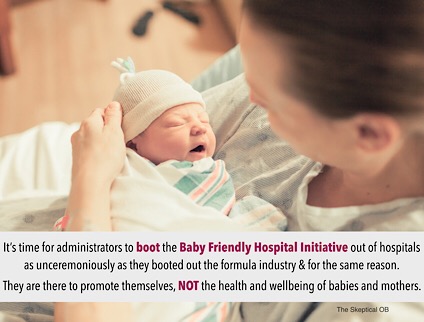
It’s time for doctors, nurses and hospital administrators to boot the Baby Friendly Hospital Initiative out of hospitals as unceremoniously as they booted out the formula industry and for the same reason. They are there to promote themselves, not the health and wellbeing of babies and mothers.

Midwives and lactation professionals, stop abusing women and calling it empowerment

CC13AD28-CEF7-4A85-8855-F9A6B07F33F3

Imagine a gynecologist who performed hysterectomies on every women done with childbearing — whether women wanted them or not.

Regardless of the women’s complaint (be it vaginitis, sexually transmitted disease, fibroids, heavy menstrual bleeding or pelvic pain), he always recommended hysterectomy. If the woman involved opted for something else, a D&C for example, he would perform a hysterectomy anyway when she was under anesthesia.

[pullquote align=”right” cite=”” link=”” color=”” class=”” size=””]Empowerment comes from giving a patient what SHE seeks, not what WE seek and certainly not what we think she OUGHT to seek.[/pullquote]

Now imagine that when called on it he claimed that he was entirely justified because he had empowered them.

They would not longer have fibroids, heavy periods or pelvic pain. As for the women who had vaginitis or sexually transmitted diseases, he had empowered them by making sure they would never get cervical or endometrial cancer.

I doubt any among us would fall for such self-justifying, self-aggrandizing nonsense.

We would recognize that empowerment, to the extent it can come from any medical provider, comes from giving the patient what SHE seeks, not what WE seek and certainly not what we think she OUGHT to seek. That’s not empowerment; that’s a violation of medical ethics.

So why do we let midwives and lactation professionals offer the same self-justifying, self-aggrandizing excuse for ignoring what patients want? Midwives claim that they are “empowering” women with campaigns to pressure women into unmedicated vaginal births, whether they want them or not. Lactation professionals insist they are “empowering” women by pressuring them to breastfeed, whether they want to or not.

Consider this self-serving, toxic nonsense offered by Rachel Reed, Midwife Thinking, approvingly quoting a student midwife:

As student midwives, we begin bright eyed and bushy tailed, with a passion for natural birth, for normal birth. We believe in the innate abilities of women, the knowing that she knows her body, her baby. That the woman is the expert and we trust in the seeming simplicity of this. Our university education aims to facilitate this passion, underpinned with feminist theory, enabling critical thinking, the use of evidence and the ability to learn how to apply clinical skill with heart and soul. Then, at some point, the on-the-ground practice begins. We set foot into the hospital. Here we fall into the deep chasm between theory and practice and experience the raw and visceral realities of the midwifery culture which exists at present. Where we thought we would be supporting women and the spectacular physiology of birth, we find the technocratic perspectives in full force. At every turn, in every space, be it antenatal, birth suite or postnatal, we view women being actively disempowered, intervened with and unsupported. Every damn day.

Not a single word about what women want, only what midwives believe women SHOULD want.

What if a woman DOESN’T want an unmedicated vaginal birth? She should be forced to have one anyway so she can be “empowered.”

But a woman is no more empowered by being denied an epidural or C-section than she is by being forced to have a hysterectomy she does not want.

Or this self-justifying nonsense from lactation professional Amy Brown:

Breastfeeding is not simply a logical choice based on some health benefit, but an urge, an instinct. And breastfeeding is useful to women, not just as a milk delivery system but as a convenience and means of mothering. Just as we quite enjoy having a sense of smell, women can enjoy breastfeeding. They can feel empowered, healed and calmed by it. And wanting that – expecting that – is fine.

But what about NOT wanting that, NOT enjoying it, NOT being able to breastfeed?

Formula milk can be life saving and some women may feel it works best for their family, but for others it can never replace the experience they hoped to have as a mother. They don’t want to simply give a bottle instead. Complications and stopping breastfeeding before a woman is ready can be a huge strain on maternal mental health. Women will grieve their loss – and should be allowed to.

She’s obviously disempowered and should be pressured to be empowered by breastfeeding so she won’t “grieve the loss.”

But a woman is no more empowered by being forced to breastfeed than by being forced to have a hysterectomy she does not want.

Who is being empowered in these situations? The professionals who insist that their skills offer empowerment.

Only gynecologists are empowered (and enriched) by forcing hysterectomies on women.

Only midwives are empowered (and improve their employment prospects) by withholding epidurals and demonizing C-sections.

Only lactation professionals are empowered (and enriched) by pressuring women to breastfeed.

A gynecologist who forces a woman into a hysterectomy is abusing her.

A midwife who forces a woman into an unmedicated vaginal birth is abusing her.

A lactation professional who forces a woman to breastfeed is abusing her.

No amount of empowerment blather changes these ugly realities.

Her baby, her body, HER choices and — regardless of who is or is not being empowered — nobody else’s business.

Another way to kill a baby through breastfeeding promotion

Wrongful Death report and gavel in a court.

Breastfeeding promotion has a death toll and it’s likely to be substantial.

As breastfeeding promotion has become ever more aggressive, babies have been dying from dehydration, hypoglycemia, severe jaundice, failure to thrive and starvation.

As lactation professionals have embraced mandated skin-to-skin care and mandated rooming in of babies and mothers, babies have been dying from smothering in their mothers beds in the hospital and at home, and skull fractures as a result of falling out of those beds.

[pullquote align=”right” cite=”” link=”” color=”” class=”” size=””]The problem of death from breastfeeding promotion has become so severe that the US government is taking action.[/pullquote]

Now we can add a new cause of potential death: massive hemorrhage from tongue tie clipping.

We might not have heard about this baby’s near death experience if his father hadn’t been an Australian celebrity:

Struggling to hold back tears, the children’s entertainer explained how the most traumatic days in his and wife Tori’s lives unfolded late last week after a tongue-tie snip went horribly wrong.

“My son Mack was in for a routine procedure and it didn’t go very well,” he said through tears in the emotional clip that aired on Dancing With The Stars last night, explaining to fans why he chose to withdraw from the competition.

“It led to blood loss, it snowballed from there. The blood loss got worse. He was rushed to hospital, it got critical and CPR was administered to the little fella.”

A Facebook post offers more information:

After a failed tongue tie snip on Thursday afternoon my son was rushed by ambulance to Gosford hospital where he lay in resus and had over 30 people working on him. CPR, blood transfusions, ventilator, emergency surgery, NETS transfer, ICU and a hell of a lot of drugs my Mack has proved the specialists wrong and is slowly mending. Gosford emergency department, you saved my son’s life – you were incredible. I love my family, I love my sons, I love my friends, and thank you so much for your thoughts – we are going to be ok. xxx @jimmyrees

The family posted a picture on Instagram:

9DD2C2DD-DFA1-447B-94E3-5F6F480C05B7

What went wrong?

I speculate that the clipping was being performed by a lactation professional or midwife, not a physician.

Given the massive blood loss, it sounds like someone clipped a blood vessel on the underside of the tongue — or worse, mistook the blood vessels FOR a tongue-tie.

As this illustration shows, the blood vessels that supply the tongue run close to where the tongue meets the floor of the mouth, in exactly the area where tongue-ties are severed.

A137BC63-4085-4B45-B598-DCA11FDD110C

Isn’t it possible that a physician lacerated a blood vessel? It’s far less likely since they are much more knowledgeable about the anatomy of the tongue and because a physician is likely to have the clamps necessary to close off the blood vessel until it could be repaired and the ability to repair it.

It’s also possibly, though less likely, that the massive blood loss was the result of an underlying clotting defect such as hemorrhagic disease of the newborn, the result of refusing Vitamin K prophylaxis at birth. It’s less likely because that would have led to a continuous ooze and it would have taken more time to result in the infant’s cardio-respiratory collapse.

As long as I am speculating, I am going to speculate about something else: I suspect that the baby didn’t have a tongue-tie at all or at least not one that required correction. The blood vessels were probably mistaken for a tongue-tie because someone was looking for an explanation for pain or difficulty breastfeeding, not because there was evidence of a tongue-tie. There has been a massive increase in tongue-tie surgery in the past decades and most of it has been unnecessary.

As a recent article in The Atlantic noted:

In recent years, surging numbers of infants have gotten minor surgeries for “tongue tie,” to help with breastfeeding or prevent potential health issues. But research suggests many of those procedures could be unnecessary.

So add yet another way to kill a baby through aggressive breastfeeding promotion.

How many babies are dying each year?

We don’t know because we don’t keep track. That must change.

The Fed Is Best Foundation formally submitted an addition to the pending Healthy People 2030 goals:

Reduce the proportion of infants who require treatment and/or extended or repeat hospital admission for insufficient feeding-related hyperbilirubinemia, hypernatremia, dehydration, excessive weight loss, hypoglycemia and failure-to-thrive.

The Committee promulgating the recommendations has already reduced the aggressive pressure to breastfeed by removing 7 of the 8 goals that appear in Healthy People 2020. Hospitals will no longer be required to reduce the proportion of infants who receive formula and no longer be encouraged to seek Baby Friendly Hospital Initiative certification.

How did we get to the point where the government must try to rein in breastfeeding promotion efforts to protect babies?

We got here because the lactation profession’s bizarre insistence that — unlike ALL other bodily processes — breastfeeding is supposedly perfect.

The egregious harm to babies — including the fact that exclusive breastfeeding on discharge has become the leading cause of neonatal hospital readmission — is not because lactation professionals have grossly exaggerated the benefits of breastfeeding although they have done so.

The egregious harm to babies, including deaths, is because lactation professionals have refused to acknowledge the limitations and risks of breastfeeding:

They’ve refused to acknowledge that the incidence of insufficient breastmilk is HIGH, not low … and babies have died.
They’ve refused to acknowledge that formula supplementation is OFTEN needed, not rarely needed … and babies have died.
They’ve lied about the size of the newborn stomach in order to pretend that babies need less fluid than they do … and babies have died.
They’ve lied about the need for skin-to-skin contact … and babies have died.
They’ve lied about the need for babies to room in with mothers … and babies have died.
They’ve lied the incidence of tongue-tie and the need for tongue-tie clipping … and babies may die.

The problem has become so severe that the US government is taking action. Individual mothers need to be aware of the deadly risks of breastfeeding promotion, too, so they can protect their babies from lactation professionals.

We MUST create a sleep supportive environment for new mothers after birth

Tired mother sleeping with her baby

Sleep is so important for healing, for mental health and possibly even for pain perception that it is functionally a healthcare treatment.

New mothers need to heal from childbirth, manage the pain that often results and are at risk for serious mental health disorders like postpartum depression and anxiety. They need sleep.

So why have we allowed hospitals — through the Baby Friendly Hospital Initiative — to create a sleep environment for new mothers that normalizes maternal exhaustion?

[pullquote align=”right” cite=”” link=”” color=”” class=”” size=””]Only one culture cruelly expects exhausted new mothers to fully care for their babies from the moment the placenta is delivered. Ours.[/pullquote]

And what can we do to create a more sleep supportive environment?

Everyone knows about the benefits of sleep.

“Sleep services all aspects of our body in one way or another: molecular, energy balance, as well as intellectual function, alertness and mood,” says Dr. Merrill Mitler, a sleep expert and neuroscientist at NIH.

And the benefits aren’t limited to the brain:

“Sleep affects almost every tissue in our bodies,” says Dr. Michael Twery, a sleep expert at NIH. “It affects growth and stress hormones, our immune system, appetite, breathing, blood pressure and cardiovascular health.”

Sleep may affect pain perception and it has a profound effect on mental health.

That’s probably why nearly all cultures, ancient and modern, mandate a period of confinement for new mothers.

Those who practice it typically begins immediately after the birth, and it lasts for a culturally variable length: typically for one month or 30 days, up to 40 days, two months or 100 days. This postnatal recuperation can include “traditional health beliefs, taboos, rituals, and proscriptions.” The practice used to be known as “lying-in”, which, as the term suggests, centres around bed rest.

China:

“Sitting the month”: 坐月子 “Zuò yuè zi” in Mandarin or 坐月 “Co5 Jyut2” in Cantonese. The custom, going back to the year 960, is referred to as ‘confinement’ as women are advised to stay indoors for recovery from the trauma of birth and feed the newborn baby.

East Asia:

Other East Asian cultures, such as South Korean and Vietnamese, have their own versions of “sitting the month”, combining prescribed foods with proscribed activities. Similar practices are popular among Japanese women called 産後の肥立ち “Sango no hidachi” and Korean women called 삼칠일 “Samchilil” for at least 21 days. The new mother is given special postnatal foods, such as seaweed soup in Korea. Samchilil is practiced in addition to other traditions encompassed in sanhujori, which is Korea’s version of postnatal care. During this period of time that could extend beyond the 21 days, women followed principles that emphasize activities and foods that keep the body warm, rest and relaxation to maximize the body’s return to its normal state, maintaining cleanliness, eating nutritious foods, and peace of mind and heart.

India:

Most traditional Indians follow the 40-day confinement and recuperation period also known as the jaappa (in Hindi). A special diet to facilitate milk production and increase hemoglobin levels is followed.

Latin America:

The cuarantena (literally, forty days, also meaning quarantine) is practised in parts of Latin America, and amongst immigrant communities in the United States.] It is described as “intergenerational family ritual that facilitated adaptation to parenthood”…

In other words, most cultures believe that we should mother new mothers, and adequate sleep is considered critical for both recovery of the mother and production of breastmilk for the baby.

Only one culture cruelly expects exhausted new mothers to fully care for their babies from the moment the placenta is delivered. Ours.

Our culture has normalized maternal exhaustion, portraying it as necessary for breastfeeding.

According to The Milk Meg, Meg Nagle:

Feeding your baby back to sleep. Not a mistake, the biological norm! Most babies will need a mid-nap breastfeed and frequent feeds during the night. For months or years.

Prof. Amy Brown speaks disparagingly of mothers who need sleep:

“We are told by so-called experts that you should get your baby in a feeding routine and your baby should not wake up at nights,” said Brown. “But that is really incompatible for breastfeeding. If you try and feed them less, you make less milk. You need to feed at night to make enough milk.”

And the Baby Friendly Hospital Initiative, designed to promote breastfeeding, has encouraged closing well baby nurseries where mothers can leave their babies while they sleep. The BFHI promotes mandated rooming in, leaving mothers fully responsible for the care of their babies from the very first hours after birth.

The BFHI has led to a mini epidemic of babies smothering to death in their mothers’ hospital beds and fracturing their skulls by falling from them.

A recent article asks, Has the push for breastfeeding gone too far?

“One of the requirements is that 80% of the babies need to be at least 23 hours of the day with the mom,” said neonatologist Enrique Gomez Pomar.

That is a chilling statistic. How can a new mother be expected to get hours of unbroken sleep if she is solely responsible for the care of a newborn? She can’t and lactation professionals don’t care about the harm that causes.

“The problem with this comes when you have a mother that had a C-section or when you have a mother that was laboring for two days and is exhausted,” he said.

Like the two moms mentioned earlier, and others. Finding them was no trouble, basically just a matter of posting on neighborhood Facebook groups, looking for recent delivery experiences.

Such stories are common, Pomar said, because giving moms a break — taking healthy babies to the nursery — is a “ding” against the Baby-Friendly designation.

“They’re very strict about their numbers,” he said. “Say the mom says that she wants to rest, then you take the baby to the nursery. That baby, that case, actually dings the hospital.”

What kind of healthcare system penalizes a hospital for allowing new mothers to sleep? Our system under the Baby Friendly Hospital Initiative.

But sleep is critical for healing, for mental health and potentially for pain management. If we care about women — as we claim we do — we MUST create a sleep supportive environment for new mothers.

That means reopening well baby nurseries in ALL hospitals.

That means encouraging mothers to use those nurseries if they feel a need for additional sleep.

That means prioritizing the health of women’s entire bodies and minds, not merely their breasts — as if they are nothing more than milk machines.

As cultures around the world both past and present demonstrate: exclusive, extended breastfeeding isn’t merely compatible with mothering new mothers; it is enhanced by it.

There is precisely ZERO evidence that normalizing maternal exhaustion improves anything. That’s why it’s imperative that we support sleep for new mothers!

I’m in Facebook jail for stating a scientific fact

Megaphone inside metal cage 3D

Far be it from me to bewail the power of social media and tech.

It is social media and tech — first the platform Blogger, then my own website, as well Facebook and Twitter — that has brought my concerns about the dangers of homebirth, natural childbirth, breastfeeding and anti-vax to such a wide audience. I have become so well known that those who feel threatened have gathered 6000 signatures on a Change.org petition to have me censored from Facebook.

The petition claims:

Facebook has recently started removing the pages and groups of people they claim to be spreading “fake news” or “false science,” yet somehow, the page run by Amy Tuteur (which she titled “The Skeptical OB”) stays up. Amy regularly spreads false information (proven time and time again by science). She has been quoted as saying “rape is natural” and a “successful evolutionary strategy.”

Birth and breastfeeding professionals — who are too cowardly to face me in any debate and too unsure of themselves to rebut my claims in any setting — are hoping to prevent me from offering comfort and support to the many women they harm in their pursuit of profit. If they think that will that will stop me, they don’t know me very well.

[pullquote align=”right” cite=”” link=”” color=”” class=”” size=””]Ironically, natural childbirth advocates and lactivists are proving my point: they have become blind to the real meaning of the word “natural.” [/pullquote]

But the petition has nothing to do with why I am in Facebook jail. I have been temporarily banned for pointing out that just while unmedicated vaginal birth and breastfeeding are natural, so is rape.

Entire books have been devoted to this issue, including A Natural History of Rape: Biological Bases of Sexual Coercion.

As I explained in a recent post:

If we define rape as forced copulation, it isn’t merely natural among humans, it is natural throughout the animal kingdom…

In species where females pick or accede to males based on fitness, rape represents an important evolutionary strategy for less fit males. Instead of leaving the choice of mate to the female, the male who forces copulation on a female who wouldn’t otherwise choose him is given a chance to spread his genes that he wouldn’t otherwise get. If he is a successful rapist, he will father many offspring. Rape offers this male an extra opportunity to be an evolutionary winner. So rape isn’t merely natural in such settings, it is a winning strategy.

Predictably, some people were upset, reasoning — wrongly — that if rape is natural, it must follow that rape is excusable. Ironically, they were demonstrating the point I had set out to prove: that natural childbirth advocates and lactivists have become blind to the real meaning of the word “natural.”

Natural is NOT equivalent to “good.” Just because something is natural does NOT make it best nor something we can or should wish to emulate. Rape is always wrong. Even if rape occurred in the past in nature, and occurs to this day in the animal kingdom, it is still always wrong and SHOULD be punished harshly and prevented by the best means we have at our disposal. And just because unmedicated vaginal birth and breastfeeding occur naturally does not make them best or even good.

So how did I end up in Facebook jail? The same people who are organizing and supporting the petition to censor me, reported my posts for using the word rape. Facebook did not elaborate on why I was temporarily banned for using the word “rape,” but under its Community Standards I found:

We remove content that displays, advocates for, or coordinates sexual acts with non-consenting parties …

Of course I did none of those things, so why was I banned anyway?

Sadly, the same social media and tech that have empowered me have inadvertently also empowered the mob. How? By automating decisions about speech.

Facebook has over 2.2 billion users and has been struggling to monitor and address outrages that occur on or are promoted by its platform. There probably aren’t enough people in the world to put eyes on all the content posted to Facebook each day so Facebook relies on complaints from individuals, subjecting the purportedly offensive content to tech that autonomatically screens it, probably using key words. The word rape is almost certainly a key word and if someone uses it in a way that makes someone else complain, the user is banned.

There is an appeals process, and I have engaged it, but it’s the weekend and the ban will be over before Facebook ever addresses it.

I did not violate Facebook’s Community Standards because I was not promoting rape; I was discussing a scientific theory about rape. Once someone complains about the use of the word rape, the automated technology wrongly concludes that rape is being promoted and bans accordingly.

Facebook made a mistake that they never intended to make. But such mistakes are inevitable when you automatically act on complaints without determining whether or not those who are complaining have a legitimate reason to do so.

As for the petition, I am considering my options in consultation with my lawyers since it is defamatory. Facebook certainly hasn’t acted upon it and I suspect they never will.

No petition will ever keep me from speaking out in support of women bullied by natural childbirth advocates and lactivists and against the harmful effects of pernicious ideologies that subvert science. The fact that 6000 birth and breastfeeding advocates are so afraid of me that they want to censor me only confirms my effectiveness.

Fellow physicians, why are we letting the Baby Friendly Hospital Initiative harm our patients?

danger tapes, danger sign

No one truly knows how hard a doctor works on behalf of patients than another doctor.

I understand how obstetricians struggle to make the right decision on when and how to deliver a baby to maximize the health of both infant and mother. I know what it’s like to confront at a worrisome fetal monitor tracing, unable to determine whether it represents real fetal distress but having to act anyway. I’ve lived the gut churning terror of a shoulder dystocia. I’ve been woken out of a deep sleep, snapped to awareness and raced to save a woman who showed up on the hospital doorstep hemorrhaging from a massive abruption, desperately hoping I’m not too late to save the life of her baby, too.

[perfectpullquote align=”right” cite=”” link=”” color=”” class=”” size=””]We give our all in service to our patients. Then we hand them over to the lactation lobby that harms both babies and mothers. [/perfectpullquote]

We and our pediatric/neonatology colleagues give our all in service to our patients. Then, too often, we hand them over to the lactation lobby that harms both babies and mothers. I’m referring, of course, to the so-called Baby Friendly Hospital Initiative designed to promote breastfeeding.

But wait, I hear you say. Doesn’t the conventional wisdom tell us breast best?

If you are as old as I am, you probably remember when the conventional wisdom was that routine episiotomies were best, that routine hormone replacement therapy for menopause was best, that routinely putting babies to sleep on their stomachs was best.

All too often the conventional wisdom is wrong and this is another case. Routinely pressuring all women to breastfeeding exclusively is wrong. Routinely withholding pacifiers and infant formula is wrong. Closing well baby nurseries and routinely forcing 24/7 rooming in is wrong.

How wrong?

This wrong:

Taken together, these papers demonstrate that insufficient breastmilk is common (up to 15% of first time mothers), formula supplementation makes successful breastfeeding more likely, pacifiers prevent SIDS, extended skin to skin contact lead to babies falling from their mothers’ hospital beds or suffocating while in them, and the latest results from the PROBIT studies show no impact on IQ at age 16. In addition, we know that the leading cause of jaundice induced brain damage (kernicterus) is breastfeeding.

[pullquote align=”right” cite=”” link=”” color=”” class=”” size=””]The BFHI is a creation of La Leche League; it’s a full employment plan for its leaders allowing them to monetize the information they previously gave away for free.[/pullquote]

So wrong that exclusive breastfeeding is now the LEADING risk factor for newborn hospital readmission, accounting for literally tens of thousands of hospital readmissions for dehydration, jaundice and failure to thrive each year.

And those benefits we were taught about in medical school? Nearly all have been debunked.

It’s been 5 years since the publication, Is Breast Truly Best? Estimating the Effects of Breastfeeding on Long-term Child Health and Wellbeing in the United States Using Sibling Comparisons by Colen and Ramey that found the purported benefits of breastfeeding nearly all disappeared with corrected for confounding variables like socio-economic status and ethnicity.

A recent paper, Is the “breast is best” mantra an oversimplification?, is a comprehensive summary of breastfeeding research and concludes that the benefits have been overstated and the risks ignored.

The evidence for infant breastfeeding status and its association with health outcomes faces significant limitations; the great majority of those limitations tend to overestimate the benefits of breastfeeding. Nearly all evidence is based on observational studies, in which causality cannot be determined and self-selection bias, recall bias, and residual confounding limit the value or strength of the findings.

And there is growing evidence that the BFHI is harmful to mothers as well as babies:

The literature that does investigate harm consistently finds that women who have difficulty breastfeeding or choose formula feeding report feelings of inadequacy, guilt, loss of agency, anxiety, and physical pain during breastfeeding that interferes with 1) their ability to bond or otherwise care for their infant and 2) competing work obligations…

Why have we been promoting breastfeeding so aggressively?

The BFHI is a creation of La Leche League and is essentially a full employment plan for its leaders, allowing them to monetize the information they previously gave away for free.

…[T]he BFHI was crafted in close conversation with individuals from La Leche League’s inner circle. First, early work by UNICEF and the WHO to develop the BFHI includes language which reproduces key components of La Leche League’s commitments…

[I]t’s also possible to trace the influence of individual policymakers from La Leche League in the 1970s to UNICEF in the 1980’s…In fact, the extensive connections between La Leche’s leadership and the WHO and UNICEF are well documented in the archival record of the League. These collections detail the involvement of the organization’s leadership, including its president Marian Thompson …

At the same time, LLL was engaged in an effort to monetize breastfeeding support, creating the lactation consultant credential.

The International Board of Lactation Consultant Examiners® (IBLCE®) was founded in March 1985 using a $40,000 loan from La Leche League International as start-up funding…

These factors of consumer demand, scientific evidence and practical clinical skills converged to create an ideal climate for the new profession…

Not exactly. The heart of the BFHI program — the Ten Steps to Successful Breastfeeding — were operationalized BEFORE there was any scientific evidence to support them.

It was not until nearly a decade after the birth of the program, in 1998, that the WHO published a review of scientific evidence in support of the Ten Steps. Their review of the scientific literature at that point served not to inform or influence the design of the BFHI but instead to defend the initiative as it had been initially drafted.

Think about that: a program designed by LLL to be staffed by its members was implemented without ANY scientific evidence to support it. It’s no wonder then that the BFHI has ended up harming our patients.

Fellow physicians, we have the power to protect our patients from the BFHI and we should use that power. The BFHI is a private organization; they can be removed from hospitals altogether or they can be forced to amend their guidelines to put preventing harm to babies and mothers first.

You work so hard to ensure the health of every baby and every mother. Please don’t let the lactation lobby continue to harm them.

Dr. Amy