Hundreds of babies are dead and UK midwives feel sorry for … THEMSELVES

The recently released Ockenden Report could not have been clearer. UK midwives bear responsibility for literally hundreds of newborn and maternal deaths and injuries. The report faulted a culture of “normal birth” at all costs and a refusal to both investigate and learn from mistakes.

In case you doubted the Report, we now have the apologia from the UK midwifery leadership and it is every bit as damning as the original report. Hundreds of babies and mothers are dead, thousands of families’ lives have been destroyed and UK midwives are overcome by … SELF-PITY.

Responding to the Ockenden Review: Safe care for all needs evidence-based system change – and strengthened midwifery is an ugly, self-serving screed.

How does this paper address the preventable deaths and injuries? With misdirection, grievance and self-pity.

Misdirection:

Failures of care at this scale and duration stem from failure of the maternity and wider health system and a lack of political will to support a high quality national health service. Multiple structural reforms of the National Health Service (NHS) and a decade of severe NHS budget cuts have led to chronic underfunding of the maternity workforce, resulting in shortages of midwives, sonographers, and doctors, cutbacks in professional development and training, limited time to care, burnout, low morale, and unprecedented retention problems.

Those claims are true, but they are not responsible for nor do they justify the abysmal treatment of women and babies at the hands of UK midwives. The authors are brazen in their attempt to blame everyone but themselves and their ideology.

Claims of persecution:

Reports of service failures have dominated the headlines and overshadowed the many positive developments in place across the country. Some professional, political, and media responses to this and previous reports are feeding a narrative that blames midwives and the physiology of birth itself despite clear failings by multi-professional teams and organisations. The search for someone or something to blame has led to the notion of a widespread ‘ideology of normal birth at any cost’ as the scapegoat for complex system-wide failings, despite a lack of evidence for this in the reports themselves.

The central defect of contemporary UK midwifery is the radical ideology of “normal birth.” The authors of the piece are so blinkered by their devotion to that ideology that it literally never occurs to them that their cherished belief — “normal birth” is both better and safer — has repeatedly been shown to be both false and deadly.

Self-pity:

It is essential to recognise that midwives are the only professional group who are by a woman’s side from her first contact with the health services until after she and her baby are settled together, or during and after care for perinatal loss. Skilled midwifery care can prevent problems, support early identification of and referral for complications, and promote multiple positive outcomes including physical and mental health and well-being. Midwives are especially important for women who have additional care needs, whether physical, psychological, social, or cultural.

Did the authors read the Ockenden Report before criticizing it? They seem to have missed the part where midwifery care CAUSED the problems and that reform of midwifery care is a sine qua non for preventing similar injuries and deaths in the future.

The authors’ response is a classic effort at self-justification.

According to the book ‘Mistakes Were Made (but not by me)’:

As fallible human beings, all of us share the impulse to justify ourselves and avoid taking responsibility for actions that turn out to be harmful, immoral, or stupid… most of us find it difficult if not impossible to say “I was wrong; I made a terrible mistake.” The higher the stakes—emotional, financial, moral—the greater the difficulty.

It goes further than that. Most people, when directly confronted by evidence that they are wrong, do not change their point of view or plan of action but justify it even more tenaciously…

When directly confronted by the evidence that the radical “normal birth” ideology of UK midwifery has harmed babies, the authors do not change their point of view or plan of action, but justify their allegiance to normal birth even more tenaciously.

Indeed, they conclude:

We already have good quality evidence, strong national policy, transformational UK-wide midwifery education standards, positive change programmes, recommendations for increased resources, and skilled and committed multidisciplinary professionals. There are informed and engaged advocates for women and families, and examples of excellence to draw on.

Hundreds of babies and mothers are dead, thousands of families’ lives have been destroyed at the hands of UK midwives, but shockingly these authors use the preventable tragedies as yet another opportunity to celebrate themselves.


Thinking about homebirth? Willing to leave your children motherless?

Perhaps you want a homebirth enough to be willing to risk your baby’s life. But have you considered the potential impact on your older children and the baby of leaving them motherless? Neither did the mothers of these 25 children who experienced the ultimate catastrophe, all because their mothers wanted a specific birth experience.

– Florida woman Stephanie left 6 small children motherless, including her newborn, after choosing homebirth.

– Australian woman Caroline Lovell left 2 small children, including her newborn, motherless after bleeding to death in front of her clueless homebirth midwives.

– A young American woman left 4 small children motherless, including newborn twins after bleeding to death at homebirth.

– A 24 year old American woman left her newborn motherless after bleeding to death at homebirth.

– British mother Joanne Whale left her newborn motherless after bleeding to death from a uterine eversion at homebirth. Her midwife did not know how to start an IV that might have saved her life.

– British woman Claire Teague left two children motherless, including her newborn, after bleeding to death from a retained placenta at homebirth. Her midwife claimed in her defense that Claire “had a really lovely spontaneous birth at home and I hope Simon [her husband] in time will remember that.”

– Maria Zain, a prominent Malaysian-British advocate for unassisted homebirth, left 6 children motherless, including her newborn, after her 4th unassisted homebirth!

Now comes word of Australian yoga teacher Lauren Verona’s death a homebirth, leaving 3 motherless daughters.

On her Facebook page Ms. Verona had discussed her “countless pregnancy complications” including a low lying placenta and gestational diabetes; she didn’t even mention additional risk factors including postdates pregnancy and advanced maternal age.

On June 5 she wrote on her Facebook page:

… I hear my own children say “divine timing” when anyone asks when the baby is coming out. I love that they get it. I love that our children reinforce our own belief systems when we quietly question it, I love that it rolls off the tongue and the statement just stands. So here we are 41 weeks pregnant trusting the higher plan.

Now she is dead.

We are devastated, on behalf of Ryan, Allira, Evie and their families, to let you know that our beloved, inspiring, shining light Lauren passed away due to complications after giving birth to her beautiful, healthy, thriving baby girl – Lucinda …

In this time of darkness, we still have a shining light, not only in Lucinda, but also those who she leaves behind, especially Ryan and her daughters. May they and we all continue to share her light, her wisdom, her laughter, her tears for lifetimes to come.

No doubt her memory will provide inspiration and comfort for her daughters for years to come. But she could have provided a lot more to her daughters had she survived. They will feel the devastating pain of her loss for the rest of their lives.

So I ask: which was ultimately more important, her birth experience or their need for their mother?

Thinking about homebirth? Consider what your death would do to your children and think again.

A mother who refuses medical assistance for birth isn’t recapitulating nature; she’s defying it!

Another day, another homebirth death.

A Perth newborn has died after an at-home birth with only a doula to support the mother ended in tragedy.

The girl was born Saturday about 3am inside a Wattle Grove home, however she became stuck during labour and wasn’t breathing when she arrived.

…[T]he father of the child began CPR as the doula did not know how to resuscitate the newborn.

St John Ambulance paramedics arrived at the scene 10 minutes after receiving the triple-zero call and rushed the baby to St John of God Midland.

She was transferred to Perth Children’s Hospital but could not be saved.

Yet another death that is not merely a tragedy but also a tragic irony. Why? Because in attempting to give birth “as nature intended” homebirth and freebirth advocates have missed nature’s most critical “intention”: that mothers — human and higher animal — will do whatever it takes to protect their infants.

For “Nature” success is measured by children who live to reproduce, the “survival of the fittest.” And the fittest are those who live, not those born without medical assistance.

Evolution doesn’t care one whit about the process of survival, it only cares about the outcome. Evolution doesn’t care whether a particular animal has black fur or white fur. It rewards the color that offers the best camouflage for the particular environment in which the animal lives. In our current environment, with easy access to technology, evolution rewards those who use that technology to survive. Women who reject lifesaving technology in order to recapitulate birth in nature aren’t winners; they haven’t achieved anything. If their babies die, they are losers.

Evolution doesn’t care about a vaginal birth; it doesn’t care about birth without pain medication; it certainly doesn’t care about a vaginal birth after a previous C-section. It cares about one and only one thing: whether the baby survives.

Women who let their babies die for lack of obstetric interventions at homebirth or unassisted birth DIDN’T do what “nature intended”; they did the exact opposite. They aren’t successful; they’re failures.

And they’re not responding to natural instincts; they’re defying them. Nearly every large female mammal will defend the lives of her offspring to the death. Everyone knows that there is no more dangerous animal than the mother who feels that her brood is threatened.

The woman who consents to a C-section for fetal distress is acting on that primal instinct. She is willing to let herself be cut open if that gives her baby a better chance of survival. The woman who chooses homebirth specifically to recapitulate birth in nature is acting AGAINST that primal instinct. She is more interested in herself and her bragging rights than in the baby’s life.

That’s not merely deadly; it’s shockingly UNnatural.

The freebirth delusion: how the selfish convince themselves they are selfless

Freebirthers are often delusional.

According to Dictionary.com, delusional means:

characterized by or holding idiosyncratic beliefs or impressions that are contradicted by reality or rational argument.

Their delusions include:

The ahistorical delusion that childbirth in nature was often unassisted. In reality midwives exist in EVERY time, place and culture.

The bizarre delusion that childbirth is inherently safe. In reality, childbirth is —in EVERY time, place and culture — a leading cause of death of young women and THE leading cause of death of babies.

The racist delusion that when a privileged white women willingly gives birth without medical assistance she is emulating her sisters of color who UNWILLINGLY give birth without medical assistance.

But my personal favorite of the many delusions cherished by freebirthers is their delusion they that they curated the birth for social media not out of a selfish desire for attention but — get this — because they selflessly wish to help others.

Benni Cornelius, the partner of ocean freebirther Josy Peukart gives us a master class in this delusion.

Cornelius, apparently stung by my characterization of freebirth as remarkably narcissistic, had this to say in response:

Have you ever thought that it makes sense to show a natural birth to encourage other women. What is happening in hospitals is not good and the mothers-to-be are only important to make money.

I don’t have to explain to you that it is important to listen to the female body.

Incidentally, most complications occur in hospitals and not during free births…

It’s such a shame that people are so torn and full of fear that only the hospital counts and anyone who does it differently is judged.

Sure, it looks like they selfishly risked their baby’s life out of a desperate need for attention and validation, but actually they selflessly did it to educate US!!

Can you imagine that there are more reasons than our alleged narcissism to show a natural birth?!

Basically, it’s about encouraging women not to always let outsiders tell you what’s good for you.

If that’s not a delusion — grandiose and self-serving — I don’t know what is!

Lactivists and the Fatal Sleep Five

Why do breastfeeding advocates continue to put their precious babies’ lives at risk by bed-sharing?

Why do they ignore the fact that 9 out of 10 SIDS deaths could be prevented if bed-sharing were eliminated?

Why do they dismiss the scientific data and the exhortations of pediatricians in favor of anthropology nonsense like “The Safe Sleep Seven”?

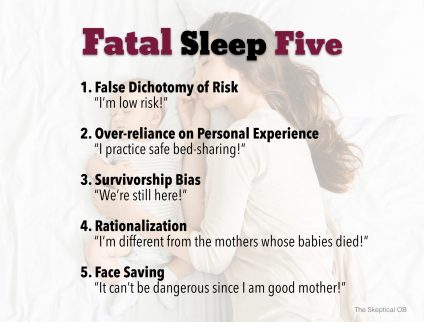
Sadly, babies continue to die preventable deaths because their mothers fall prey to the Fatal Sleep Five.

1. False Dichotomy of Risk: “I’m low risk!”

False Dichotomy of Risk is based on the erroneous notion that the only possible outcomes are at opposite extremes when in reality there is a spectrum of risk. Lactivists like to pretend that bed-sharing results in deaths only in high risk situations and never in low risk situations. Therefore, they fantasize that since they are at low risk of a bed-sharing death, there is no risk at all.

As all too many low risk mothers can attest, such thinking is FATALLY fclawed.

2. Over-reliance on Personal Experience: “I practice safe bed-sharing!”

This form of poor reasoning is based on the unexamined belief that if it hasn’t happened to the individual before, it is never going to happen. It’s often the rationalization used by drunk drivers who have not yet been in an accident when driving drunk. Many are under the impression that they are “good” drunk drivers and therefore not at risk of a fatal accident. Similarly, many lactivists who bed-share are under the impression that they are “good” at bed-sharing since their infant has survived thus far.

As all too many mothers who are “good” at bed-sharing can attest, such thinking is FATALLY flawed.

3. Survivorship Bias: “We’re still here!”

Survivorship Bias is the effort to reason by considering only historical successes while ignoring historical failures.

Most of us above a certain age traveled in cars throughout our entire childhoods without ever using a car seat and we’re still here. Does that mean car seats are unnecessary?

The dramatically lower death rates for infants in accidents today compared to the 1960’s makes it clear that placing an infant in a car seat is much safer than no car seat. But if we only looked at people alive today even though they never used car seats, we might erroneously conclude that car seats are unnecessary. Putting a sleeping infant in her own sleeping space is like using a car seat.

As all too many mothers can attest, such thinking is FATALLY flawed.

4. Rationalization: “I’m different from the mothers whose babies died!”

When informed of a bed-sharing death, advocates of bed-sharing often appear heartless when they immediately blame the victim. “She was probably fat and I’m thin.” “She rolled over on her baby and I am always completely aware of where my body is relative to my baby.”

As all too many mothers can attest, such thinking is FATALLY flawed.

5. Face Saving: “I would never risk my baby’s life!”

Good mothers don’t risk their babies’ lives. In order for lactivists to bed-share and continue to view themselves as good mothers, they must practice iron clad denial of the risk of bed-sharing. The so-called “Safe Sleep Seven” codifies that denial and therefore helps mothers who are actually risking their babies’ lives to save face.

As all too many mothers who followed the Safe Sleep Seven can attest, such thinking is Fatally flawed.

Think bed-sharing is safe? Ask yourself whether it’s because you subscribe to one of more of the Fatal Sleep Five. Then stop bed-sharing.

The Supreme Court is Making Hypocrisy Great Again!

In the wake of a leaked draft of a Supreme Court opinion that seeks to eviscerate abortion rights, it’s worth asking:

Is there anything more hypocritical than a reactionary Republican Party — that revels in cruelty and violence against its perceived enemies — claiming that their opposition to abortion rights stems from a respect for human life?

I doubt it.

The Republican Party, the same group of people who can’t be bothered to restrict guns, which kill more than 30,000 people per year, that separated immigrant toddlers from their mothers and put them in cages are rabid to restrict abortions. It has nothing to do with respecting life and everything to do with oppressing women.

How do I know?

By observing the monstrous gulf between what they say and what they do.

Check out their favorite slogans:

Choose life.

That’s an argument for universal healthcare, not an argument for banning abortions. Curiously, many of those who staunchly oppose pregnancy termination have no problem denying life saving healthcare for others, including children.

Providing health insurance for poor children is choosing life, but apparently for the anti-choice crowd all life is not equal. They are keen to protect life from conception up to, but not including, birth. Once you’re born, your life is worthless if you are poor or a child of immigrants or a child of color.

Abortion stops a beating heart.

You know what else stops a beating heart? Capital punishment. Despite that incontrovertible fact, many of those reactionary Republicans who profess “pro-life” beliefs have no problem letting government stop the beating hearts of those convicted of crimes. If your reason for opposing abortion is to preserve life, it is hypocritical to promote mandated death at the hands of government.

They feel pain.

We could argue about whether or not science supports the claim that an embryo feels pain, but there is absolutely no doubt that everyone born, regardless of age, race or economic class feels pain. So why do the same reactionary Republicans who feel they must protect the unborn from pain practically revel in the pain of Black families whose fathers, brothers and sons are shot in the back by police officers? Why do they support the police and not the innocents who are gunned down?

Pro-life means every life has value.

If every life has value, why didn’t Republicans support Colin Kapernick’s campaign to kneel when the national anthem is played in order to draw attention to the Black lives lost to police violence? Those opposing Kapernick justify it by claiming he is disrespecting the flag. That’s a lie, but even if it were true, are we supposed to believe that a piece of cloth has greater value than the life of a young Black man?

Abortion is murder.

We could argue whether abortion is murder, but there’s no argument that murder is murder. Guns facilitate murder. Indeed, hand guns and semi-automatic and automatic weapons have no purpose other than to murder or threaten to murder others. If reactionary Republicans actually cared about murder, they would ban murder weapons, but you won’t see anyone in Congress stand up to the gun lobby.

These five slogans of the anti-choice movement put its hypocrisy into high relief. The so called “pro life” crowd has no problem being anti-life whenever it suits them. So if ending abortion isn’t about saving lives, what is it about?

It’s about punishing women — but never men — for sex.

It’s about promoting misogyny, forcing women — but not men — to be slaves to their biology.

It’s about privileging radical white Christian nationalist ideology above the Constitution.

Because make no mistake, criminalizing abortion will not end abortion. It will just kill women.

Who cares? Certainly not the “choose life” crowd!

Do Kegel exercises work? It depends.

Kegel exercises to strengthen the pelvic floor are widely recommended as a panacea as well as a preventive for female pelvic organ prolapse and or incontinence.

What are kegel exercises? They are basically just repeated clenching of the muscles of the pelvic floor (the same muscles you use to stop the flow of urine in midstream). The object is to strengthen those muscles to reduce or prevent pelvic organ prolapse and/or incontinence.

They have several significant advantages. They are free; they are easy; they are unlikely to cause any harm.

But do they work?

That depends. (It’s not meant to be a pun).

It depends on who, what and when, among other things.

The pelvic organs are held up by a sling of internal muscles that cover the pelvic floor. The theory behind Kegel exercises is that prolapse and or incontinence are due to a weakening of the pelvic muscles. Such weakness allows the uterus (or the bladder or rectum) to fall through the normal openings in the sling that accommodate the urethra, the vagina and the rectum.

Whether or not Kegel exercises work depends on:

1. The fundamental cause of the problem.

Although prolapse and incontinence can be the result of muscle weakness, they can also be the result of permanent muscle injuries like tearing. Exercising any muscle can strengthen it but it cannot repair permanent injury. Therefore, Kegel exercises are useful when the cause is simply stretching of the muscles (as occurs in pregnancy) but not if the cause is tearing (as occurs from a forceps delivery or a vaginal delivery of a large baby).

2. The severity of the prolapse.

Once the pelvic organs are significantly displaced — for example if the cervix has descended enough to be visible at the opening of the vagina — no amount of pelvic exercising is going to reverse the problem.

3. The type of urinary incontinence.

Kegels can help prevent or improve stress urinary incontinence which occurs with increased intra-abdominal pressure due to coughing or sneezing. But Kegels can do nothing for incontinence that results from an overactive bladder or nerve damage to the sphincter.

4. The timing of the problem.

Kegels can be effective in reducing incontinence in pregnancy or the immediate aftermath but is far less effective in reducing incontinence long after pregnancy.

5. Age.

Pelvic organ prolapse and incontinence might not manifest until the time around menopause. That’s because the reduction of estrogen leads to weakening of the ligaments that hold the pelvic organs in place. Kegel exercises have no impact on ligaments.

The bottom line is that kegel exercises are hardly a panacea for pelvic organ prolapse or incontinence. They are an excellent first step in treatment, but depending on the cause, the severity and the age of the woman they may ultimately prove ineffective.

The uterus isn’t the only pelvic organ that can prolapse

Yesterday I wrote about uterine prolapse. When the muscles of the pelvic floor are are stretched or torn by childbirth, the uterus can slip down into the vagina. This can distort the relationship between the sphincter that controls release of urine from the bladder into the urethra leading to stress urinary incontinence.

But the uterus isn’t the only organ that can fall through the pelvic floor. As the image above demonstrates, the bladder or the rectum can also fall through.

When the bladder falls through it is called a cystocele.

As the Urology Care Foundation explains:

Under normal conditions in women, the bladder is held in place by a “hammock” of supportive pelvic floor muscles and tissue. When these tissues are stretched and/or become weak, the bladder can drop and bulge through this layer and into the vagina. This results in bladder prolapse, also called cystocele. In severe cases, the prolapsed bladder can appear at the opening of the vagina. Sometimes it can even protrude (drop) through the vaginal opening…

A cystocele is often referred to as an anterior vaginal wall prolapse.

Symptoms include:

– a vaginal bulge…
– frequent voiding or the urge to pass urine
– urinary incontinence (unwanted loss of urine)
– not feeling relief right after voiding
– frequent urinary tract infections …
– sex that is painful …

Not surprisingly a cystocele can distort the relationship between the sphincter that controls release of urine from the bladder into the urethra. Although the sphincter itself has not been damaged, it nonetheless prevents the woman from “holding” urine. The sphincter works well enough that urine doesn’t constantly dribble out of the urethra, but when the intra-abdominal pressure is dramatically increased as occurs during coughing and sneezing, urine squirts out (stress urinary incontinence).

Although it is possible for the bladder alone to prolapse, it is more commonly accompanied by (or even caused by) uterine prolapse.

Just as the bladder can prolapse anteriorly, the rectum can prolapse posteriorly. This is known as a rectocele.

Symptoms include:

– A sensation of pressure or fullness in your rectum or vagina.
– A soft bulge of tissue …
– Feeling that your rectum hasn’t completely emptied after pooping.
– Having the urge to poop several times a day.
– Experiencing discomfort during intercourse …
– Having to press your fingers on the bulge in your vagina to push out a stool during a bowel movement …

Voices for Pelvic Floor Disorders publishes a fantastic fact sheet about prolapse.

What are the risk factors for pelvic organ prolapse?

-Pregnancy and childbirth: One in three women who gave birth has prolapse. Being pregnant and having a vaginal delivery can damage the pelvic muscles and nerves, allowing the organs to drop. This is particularly true of women who had a large baby, needed forceps to deliver, or had many babies.

– Aging and menopause: Loss of estrogen with menopause, along with other changes with aging, can weaken the pelvic floor. POP becomes more likely with age.

– Certain health conditions: Health problems that involve repeated straining, such as obesity, chronic cough, and constipation, can injure the pelvic floor over time.

– Heavy lifting: Extreme weight lifting or picking up heavy items on a repeated basis can increase POP risk. • Genetics: Genes help determine the strength of the connective tissue, so if your mother had POP, you are more likely to develop POP.

Very few of these are modifiable risk factors but:

You can try to prevent the prolapse worsening by making lifestyle and behavior changes. For example, to prevent the prolapse from worsening, eliminate constipation and do not strain with bowel movements. Plus, stop extreme weight lifting activities and avoid repeated heavy lifting. Keep your weight in a normal range and lose weight, if you are overweight. Lastly, quit smoking-tobacco use doubles your risk for pelvic floor disorders, such as POP.

In a future post we’ll review treatments for pelvic organ prolapse.

Uterine Prolapse: How It Happens & What It Causes.

FullSizeRender

We need to speak more honestly about the risks of childbirth. Vaginal birth can lead to a lifetime of serious, embarrassing and life altering problems. Uterine prolapse, with or without incontinence, is an entirely natural consequence of an entirely natural vaginal birth.

What is uterine prolapse? As the animation above demonstrates, uterine prolapse is when the uterus falls down the vagina. It is described in terms of degrees. The animation shows a grade 3 prolapse where the cervix hangs out the vagina but the rest of the uterus stays inside.

To understand why these problems develop we need to understand how the pelvic organs are held in place. Why doesn’t the uterus fall down through the vagina before childbirth? It’s partly because of ligaments that hold it in place in the pelvis, but it’s mostly because of the muscles of the pelvic floor form a sling to hold the organs up.

Multiple muscles form a sling perforated by three tubes: the urethra, which carries urine from the bladder to the outside, the vagina, and the rectum.

Imagine a baby’s head, 10 centimeters in diameter, passing through this sling. It’s obvious that the fetal head is going to dramatically stretch, distort and possibly tear the muscles that surround the vagina. They will literally never be the same again. Where once the space between the muscles of the pelvic floor was only large enough to accommodate three relatively small tubes, now that space has been stretched tremendously.

Keep in mind that we are talking about internal muscles, not the tears in the vagina that occur externally (1st, 2nd, 3rd and 4th degree tears). External tears produce visible external damage. Internal injuries to muscles do not.

The most common injury to these muscles is stretching and kegel exercises are designed to strengthen the muscles and thereby tighten them. But the injuries can be more severe than stretching. The muscles themselves can be torn away from the pelvic bones.

No amount of kegel exercises can repair pelvic muscles that are torn. When these muscles are torn, the uterus can slip through the middle of the pelvic floor. This is uterine prolapse.

The damage to the internal muscles may not be immediately apparent. It may not become obvious until menopause when ligaments are weakened by the lack of estrogen and the uterus begin to drop between the muscles. A woman who has had no problem for 20+ years after the births of her children may gradually develop uterine prolapse and/or incontinence as she enters menopause.

When the uterus prolapses it can cause a feeling of heaviness or fullness, bulging in the vagina, lower-back pain and painful intercourse.

When the uterus prolapses, it can distort the relationship between the sphincter that controls release of urine from the bladder into the urethra. Although the sphincter itself has not been damaged, it nonetheless prevents the woman from “holding” urine. The sphincter works well enough that urine doesn’t constantly dribble out of the urethra, but when the intra-abdominal pressure is dramatically increased as occurs during coughing and sneezing, urine squirts out (stress urinary incontinence).

How often does damage to the pelvic floor occur? Research suggests that up to 75% of women who have a vaginal birth will end up with some permanent damage to the muscles. The likelihood of damage rises dramatically with the use of forceps for obvious reasons. Putting forceps into the vagina and around the baby’s head creates a larger diameter than the baby’s head alone.

Uterine prolapse and its associated symptoms like painful sex and incontinence are not trivial problems. They can be life altering and it’s hardly surprising that many women want to avoid them by having a maternal request C-section.

It’s deeply unfortunate that in a society like ours, where vaginal birth is valued more than C-sections, no one warns women that eventual uterine prolapse and urinary incontinence can occur as a result of vaginal birth.

The REAL reason why breastfeeding hurts

Despite ubiquitous recommendations to breastfeed and notwithstanding sincere intention to breastfeed, women often quit for two common reasons: not enough breastmilk and too much pain while breastfeeding.

For decades we’ve done nothing about either problem for the simple reason that lactation professionals have engaged in a massive campaign of denial.

The most cherished article of faith among breastfeeding professionals is that breastfeeding — unlike all other bodily processes — is perfect.

Therefore any difficulties are blamed on:

1. Mothers breastfeeding “wrong” as a result of the twin evils of formula advertising and cultural brain washing.
OR
2. “Broken” babies, victims of the twin evils of formula supplementation or tongue ties that must be surgically severed.

Recently, in large part due to the efforts of the Fed Is Best Foundation, breastfeeding professionals have finally acknowledged that insufficient breastmilk is common, not the result of poor commitment, affecting up to 15% of mothers, especially in the early days after birth.

Now comes evidence that pain is also common, and NOT the result of poor breastfeeding technique or infant tongues ties.

The paper Re-thinking lactation-related nipple pain and damage by physician Pamela Douglas lays the issues out clearly and concisely.

She notes — as I have done repeatedly in the past — that breastfeeding has paradoxically been over-medicalized.

…[O]vermedicalization and overtreatment is widespread in the care of breastfeeding women and their babies when inflammation, pain, and visible damage of the nipple–areolar complex emerge

What is the REAL reason women have breastfeeding pain?

Lactation-related nipple pain is most commonly a symptom of inflammation due to repetitive application of excessive mechanical stretching and deformational forces to nipple epidermis, dermis and stroma during milk removal. Keratinocytes lock together when mechanical forces exceed desmosome yield points, but if mechanical loads continue to increase, desmosomes may rupture, resulting in inflammation and epithelial fracture. Mechanical stretching and deformation forces may cause stromal micro-haemorrhage and inflammation. Although the environment of the skin of the nipple–areolar complex is uniquely conducive to wound healing, it is also uniquely exposed to environmental risks.

In other words, the nipple-areolar complex is damaged by the mechanical forces of the infant’s mouth and obvious wounds often result:

If epithelium can no longer adapt to the mechanical strain … epithelium ruptures … [T]he weakest part of the nipple–areolar complex epithelium, or the part placed under the most constant and severe elastic tension in the baby’s mouth, breaks apart. This results in visible trauma, including cracks, grazes, and ulcers, with associated pain and inflammation. Blisters result when horizontal shearing forces cause partial fracture and inflammatory serum collects in a pocket of fluid between layers of skin. Bruising results from vascular damage and haemorrhage.

Douglas addresses and discards the traditional reasons offered for breastfeeding pain.

It is NOT the result of an abnormal infant tongue:

The hypothesis that maternal nipple pain and damage results from abnormal tongue movement which pinches or rubs the nipple against the palate or upper alveolar ridge has resulted in widespread overtreatment of breastfeeding infants with frenotomy and bodywork exercises. This hypothesis is not supported by ultrasound or magnetic resonance imaging of the biomechanics of infant suckling, nor anatomic dissection of the infant floor of mouth fascia.

It is NOT the result of pacifiers or artificial nipples:

Similarly, clinicians and researchers have hypothesized that pacifiers and bottle teats alter neural pathways coordinating tongue movement and sucking patterns, resulting in nipple pain. But this theory is based on misconceptions about the role of tongue in milk transfer. A 2015 systematic review of 14 articles found little evidence of a causal relationship between pacifier and bottle teat use, and nipple confusion.

It is NOT the result of low maternal pain threshold:

…[U]ltrasound and vacuum studies of women experiencing nipple pain corroborate the mechanobiological model of lactation-related nipple pain.

Lactation professionals’ teaching about positioning may make things WORSE not better:

Commonly taught approaches to fit and hold when problems emerge rely upon outdated biomechanical models of infant suck. Much of what is offered women with breastfeeding difficulty, including interventions for fit and hold, is based upon experience or opinion…

The failure of current approaches to fit and hold to effectively resolve repetitive biomechanical micro-trauma during breastfeeding leads to widespread overmedicalization and overtreatment of both breastfeeding women and their babies, risking unintended outcomes.

The insistence on blaming women and babies for breastfeeding pain harms them both because lactation professionals’ diagnoses and recommendations:

– Invalidate her lived experience, which is that suckling or mechanical milk removal causes her pain and that if she were to cease this altogether, her pain would rapidly resolve;

– Disempower her, since she is not helped to resolve the pain herself … but is advised that she requires pharmaceutical intervention and multi-disciplinary teams;

– Re-traumatize her if she is a sexual abuse survivor by taking a sexual trauma history in a breastfeeding consultation, then proposing that persistent nipple pain is linked to sexual trauma and associated nociplastic effects;

– Place her at risk of side-effects of pharmaceutical interventions without evidence of benefit; and

– Result in financial burden of treatments without evidence of benefit.

The bottom line is that breastfeeding pain is real.

It is not the result of maternal mistakes or “broken” baby tongues.

Much of what lactation professionals believe about breastfeeding pain is wrong; therefore their approach often causes more harm than good.

The large number of women who quit breastfeeding because of persistent pain is testament to the lactation profession’s failure to understand it.

Dr. Amy