When is it okay to risk a baby’s death?

All Alone

A new piece on NPR suggests that it’s okay to risk a baby’s death in order to bed share.

The piece asks Is Sleeping With Your Baby As Dangerous As Doctors Say? and answers by suggesting that the “right” kind of parents can bed share while the “wrong” kind of parents cannot.

[pullquote align=”right” cite=”” link=”” color=”” class=”” size=””]Is the relative risk irrelevant? Is it only the absolute risk that counts? Who gets to decide?[/pullquote]

Parents who drink or do drugs shouldn’t be sleeping with their babies because they could roll over onto their child. Babies who are born premature or whose parents smoke shouldn’t sleep in the parents’ bed because of potential respiratory problems. Suffocation can also happen when babies sleep on sofas because babies can be trapped between a parent and the cushions…

But what about the “right” kind of parents?

So far, only two studies have looked at this question. And doctors and families need to be careful with how they interpret these studies, says Robert Platt, a biostatistician at McGill University, who analyzed the studies for the AAP.

“The evidence is quite thin or weak,” he says. In both studies, the number of SIDS cases is small. One study of 400 SIDS had 24 cases in which that baby had shared the bed in the absence of parental hazards, and in the other study, there were just 12 of these cases out 1,472 SIDS deaths. In the latter study, some information about the parent’s drinking habits was missing and had to be estimated.

Nevertheless, the two studies came to similar conclusions. For babies older than 3 months of age, there was no detectable increased risk of SIDS among families that practiced bed-sharing, in the absence of other hazards.

Nevertheless? Pro-tip for the folks at NPR: when a study is underpowered, the results are not valid. You cannot use them to make recommendations. But let’s imagine for the moment that these statistics are accurate.

Even the “right” parents can still smother an infant less than 3 months old.

And for babies younger than 3 months?

“I would probably say there may be an increased for this group,” Platt says. “And if there is an increased risk, it’s probably not of comparable magnitude to some of these other risk factors,” such as smoking and drinking alcohol.

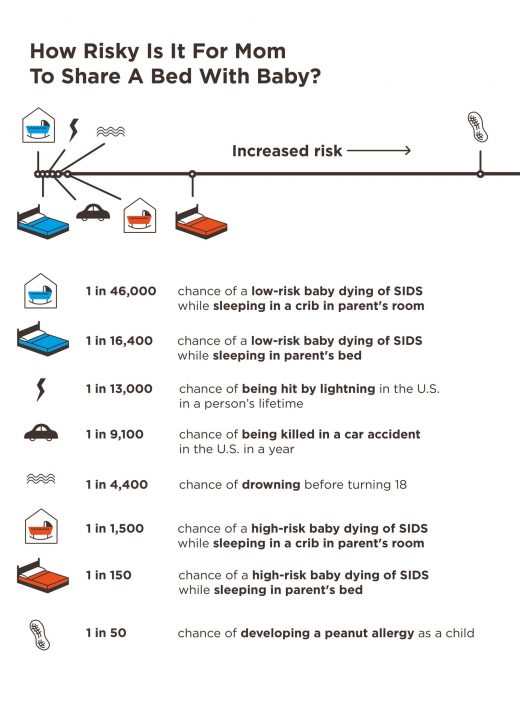
NPR includes a chart that attempts to distinguish when it’s okay to risk a baby’s death from when it’s not.
48850801-E696-4FE8-81DA-84ADEFF9F446

The chart implies that tripling the risk of a baby’s death by bed sharing in the “right” situation is acceptable because the absolute risk is low — 1 in 16,4000. In other words, it purportedly doesn’t matter how much a particular maternal action increases the risk of death as long as the absolute risk is low.

Is that what we really believe?

Consider the case of infants and car seats. According to the Insurance Institute for Highway Safety, from 1975 to 2013, infant fatalities fell from 6/100,000 (1 in 16,7000) to 1.3/100,000 (1 in 76,900) while car seat use rose to 99% of children under age 1. So the risk of death from to a baby riding in a car without a car seat is LOWER than the risk of death from bed sharing.

If it’s the absolute risk that counts and not the increase in relative risk than mothers who don’t strap their babies into car seats are better mothers than those who bed share, right? If it’s only the absolute risk that counts — as implied by breastfeeding researchers — that’s the inevitable conclusion.

How about formula feeding? Breastfeeding decreases the risk of SIDS, but the absolute risk is low in any case. Bed sharing when parents do not smoke: is there a risk of SIDS? An individual level analysis of five major case–control studies was referenced by Dr. Platt above.

Here’s a chart from the study:

75033510-450E-4E07-A6AD-607713073477

Notice that the absolute risk of SIDS from formula feeding without bed sharing is LOWER that the absolute risk of breastfeeding with bed sharing. So are mothers who formula feed without bed sharing better mothers than those who breastfeed and bed share? If it’s the absolute risk that counts — as implied by breastfeeding researchers — that’s the inevitable conclusion.

How about homebirth? The absolute risk of death from homebirth with an American homebirth midwife was found to be 5.6/1000 (1 in 179) in a 2012 analysis of Oregon state data. That’s more than 100X higher than the risk of death from bed sharing while breastfeeding. If it’s the absolute risk of death that counts, those women are monsters.

The NPR piece suggests:

…[A]ll bed-sharing is not the same. It doesn’t add the same amount of risk for all families. And so perhaps recommendations about it shouldn’t be the same? Maybe they should be tailored for each family and their circumstances?

How ironic! Those who insist that bed sharing recommendations should be tailored to individual families are often the same people who think that infant feeding recommendations should NOT be tailored for each family and their circumstances; they believe that every family should received the same recommendation that breastfeeding is best for every baby even though that’s obviously untrue.

But let’s get back to the original question: when is it okay to risk a baby’s death? Is the relative risk irrelevant? Is it only the absolute risk that counts? Who gets to decide?

Please share your thoughts in the comment section.

The WHO’s recommended C-section rate is fake news

fake news and misinformation concept

Another day, another piece demonizing C-sections.

How the C-Section Went From Last Resort to Overused was written by Rebecca Onion and appears on Slate. We don’t even get to the body of the piece before the first falsehood appears. The subtitle is: The history of the surgery is rife with horror, but today, 1 in 3 American babies are delivered via the procedure, twice what the World Health Organization recommends.

There’s just one problem. The World Health Organization’s recommendation is fake news.

It is this fake news that forms the heart of Onion’s piece:

[pullquote align=”right” cite=”” link=”” color=”” class=”” size=””]The WHO’s optimal C-section rate less than 15% is no different from Wakefield’s claim that vaccines cause autism. Both are lies in the service of ideology.[/pullquote]

C-sections remained extremely rare throughout the 19th century. Even after the mid-20th-century advent of antibiotics and blood transfusions, which rendered the surgery much safer, the national rate of C-sections remained low. Then, the procedure exploded. Between 1965 and 1987, it rose 455 percent. Today, despite the work of the birth-reform movement of the ’70s and ’80s, 1 in 3 babies are still delivered by C-section. That’s twice the recommendation set by the World Health Organization, which states that a 10–15 percent rate is the ideal, since a rate higher than that has been assessed to have no effect on mortality rates, even as it pushes up medical costs and increases other risks for both mother and baby.

We live in a world where we have stopped battling over ideas, and started battling over facts themselves. Facts no longer inform beliefs; ideology begets lies masquerading as “facts” in service to a predetermined conclusions. We call this fake news.

One of the original examples of fake news is the World Health Organization’s recommended C-section rate. The WHO “optimal” C-section rate of 10-15% is a bald faced lie. It was fabricated from whole cloth apparently by a single physician; there was NEVER any evidence to support the lie when it was first released in 1985 and it has been thoroughly debunked repeatedly in the past 30 years. No matter.

The WHO’s claim that the optimal C-section rate is less than 15% is no different than Andrew Wakefield’s claim that vaccines cause autism.

I don’t say that lightly.

Wakefield’s claim has been used, as he intended, to call the safety, efficacy and desirability of vaccines into question and to demonize them. The WHO’s optimal C-section rate has been used, as Marsden Wagner its fabricator apparently intended, to call the safety, efficacy and desirability of C-sections into question and to demonize them.

Both claims were made up to serve the interests of the individuals who fabricated them.
Both NEVER had any support in the scientific evidence.
Both have been repeatedly debunked.
Both are fervently believed by some people despite the lack of evidence.
Both cause serious harm and very little good.

Marsden Wagner, a pediatrician who served as the European Head of Maternal and Child Health for the World Health Organization, appears to have been the driving force behind fabricating and publicizing the fake news optimal C-sections rate. Wagner, without any evidence of any kind, convened a conference of like mind health professionals in 1985 and they simply declared the optimal rate of less than 15% by fiat.

Many years later, Wagner inadvertently acknowledged that the “optimal” C-section rate was simply made up. In his 2007 paper Rates of caesarean section: analysis of global, regional and national estimates:

… [T]his paper represents the first attempt to provide a global and regional comparative analysis of national rates of caesarean delivery and their ecological correlation with other indicators of reproductive health. (my emphasis)

Wagner had been touting an optimal C-section rate under 15% for 22 years before he even bothered to check whether it had any basis in reality. And although Wagner ended up “confirming” the fabricated optimal rate, the data showed the opposite. There were only 2 countries in the world that had C-section rates of less than 15% AND low rates of maternal and neonatal mortality. Those countries were Croatia (14%) and Kuwait (12%). Neither country is noted for the accuracy of its health statistics. In contrast, EVERY other country in the world with a C-section rate of less than 15% had unacceptable levels of perinatal and maternal mortality.

In 2009, the World Health Organization surreptitiously withdrew the target rate. Buried deep in its handbook Monitoring Emergency Obstetric Care, you can find this:

Although the WHO has recommended since 1985 that the rate not exceed 10-15 per cent, there is no empirical evidence for an optimum percentage … the optimum rate is unknown …

In 2015 researchers from Harvard and Stanford — including Neel Shah, MD and Atul Gawande, MD, put a stake through its heart in the paper Relationship Between Cesarean Delivery Rate and Maternal and Neonatal Mortality.

They found:

The optimal cesarean delivery rate in relation to maternal and neonatal mortality was approximately 19 cesarean deliveries per 100 live births.

According to the press release that accompanied the paper:

“This suggests on a policy level that benchmarks for C-section rates on country-wide level should be reexamined and could be higher than previously thought.”

The graphs they created are quite impressive:

05810C12-DEB5-437B-84D8-9732AA3D4BFA

D1412974-3586-4E26-9272-64859387BCAB

These graphs show that C-section rate below 19% lead to preventable maternal and neonatal deaths. In other words, they show that the WHO “optimal” rate, far from being optimal, is actually deadly. They also show that C-section rates above 19% are NOT harmful. There appears to be NO increased risk of either maternal or neonatal mortality for rates as high as 55%.

Why is the WHO continuing to disseminate fake news? Why are they demonizing C-sections?

Because they honestly believe — in the absence of any scientific evidence and in the face of their claims having been debunked — that C-sections are “bad.” It’s the same reason that anti-vaxxers disseminate fake news about vaccines and demonize them. They honestly believe — in the absence of any scientific evidence and in the face of their claims having been debunked — that vaccines are “bad.”

Both are wrong. Sadly, it is women and babies who pay the price for their fake news.

Should we obtain informed consent for vaginal birth?

51F14F16-593A-437A-B0F0-00EFEA0C07E5

Kavin Senapathy, writing in Self reports Giving Birth Made Me Question the Informed Consent Process During Childbirth.

The issue: should we obtain informed consent for vaginal birth? After all vaginal birth is natural, not a medical procedure.

[pullquote align=”right” cite=”” link=”” color=”” class=”” size=””]We must counsel women about the risks of vaginal birth for the same reason we counsel them about the risks of unprotected sexual intercourse.[/pullquote]

I would pose the question a bit differently. Are doctors ethically required to counsel women about the risks of vaginal birth when they counsel women about the risks of C-sections, forceps and vacuum? The answer is yes and the reason is the same as the ethical imperative to counsel women about the risks of unprotected intercourse: so she can protect herself.

Kavin had a forceps birth for her first child.

My daughter is a perfectly healthy first-grader now, and I haven’t suffered permanent damage to my pelvic floor structures…

All that being said, I don’t know whether I would have opted for a C-section for my daughter’s delivery, but I do wish that I had made a choice in advance of giving birth about which procedure to use in the event of an emergency—a choice informed by a more extensive lay understanding of potential outcomes and risk factors.

She reviews themes I’ve discussed repeatedly.

There are significant risks to vaginal birth:

With vaginal deliveries, there is a real possibility not only of vaginal tearing, but pelvic floor problems that can manifest as urinary incontinence, anal sphincter injury and fecal incontinence, and pelvic organ prolapse.

The meta-analysis in PLOS Medicine found that vaginal delivery is associated with greater risk of urinary incontinence (14.9% incidence after vaginal delivery, compared to 8.93% incidence after C-section) and pelvic organ prolapse (5.99% for vaginal delivery, compared to 1.81% for C-sections) in the mother. According to ACOG, the risks of tearing and urinary and fecal incontinence are higher with assisted vaginal delivery.

The absolute risk of vaginal delivery complications is much higher than the absolute risk for C-section complications:

Here is where an extensive understanding of the various risks might come into play. While an unplanned hysterectomy due to complications from a C-section is generally viewed as much worse and more traumatic than urinary incontinence, the number of women who have the former is significantly lower than the number of women walking around with permanent pelvic floor damage. Ask a woman to weigh a 0.07% risk of unplanned hysterectomy to a significantly higher risk of spending the rest of her life peeing a little when she laughs, coughs, sneezes, runs, lifts, and other general life activities, and her answer might not be so obvious.

Kavin asks doctors for their opinions. Not surprisingly, those who treat injuries from vaginal birth think informed consent ought to be necessary:

Hans Peter Dietz, M.D., Ph.D., professor of obstetrics and gynecology at the University of Sydney, tells SELF that informed consent for emergency procedures can often be overlooked in the time leading up to the delivery. And that’s in stark contrast to the way we treat many other medical procedures. “When I propose a surgical procedure, we talk for at least half an hour, and sometimes several times,” about nuances surrounding individual risk factors and potential outcomes, he explains. But “in obstetrics it’s totally different. We’ve been totally backwards in terms of applying those rules of consent.”

But that view is not shared by all obstetricians:

“Informed consent is not obtained for vaginal birth,” Aaron Caughey, M.D., professor and chair of the Department of Obstetrics and Gynecology at Oregon Health Science University, and vice chair of the ACOG Committee on Practice Bulletins-Obstetrics, tells SELF via email. “Informed consent is an ethical concept designed to respect patients’ moral right to bodily integrity by protecting them from unwanted medical treatment or intervention, but giving birth vaginally is a natural physiologic process that by definition is not medical treatment.”

Dr. Caughey offers three reasons why informed consent is not necessary: vaginal birth does not involve a threat to bodily integrity; vaginal birth is entirely natural; and vaginal birth is not an illness.

I respectfully disagree with Dr. Caughey on all three reasons.

First, continence and sexual function are important aspects of bodily integrity. Vaginal birth can impair or destroy both. If the purpose of informed consent is to respect the right to bodily integrity and vaginal birth has a much higher absolute risk of permanently impairing bodily integrity than C-section, then we are ethically mandated to tell women about those risks and how she can avoid them.

Second, the natural vs. technological dichotomy is irrelevant for obtaining informed consent. For example, when a patient faces a cancer diagnosis, the option to forgo debilitating treatment is a critical option and widely recognized as ethically appropriate. Some patients, prefer to leave their fate to nature. They reject chemotherapy, radiotherapy or surgery and hope they can cure themselves with herbs, supplements or prayer. It is just as important to counsel patients about the risks of allowing nature to take its course as it is to counsel them about the risks of treatment.

Finally, the dichotomy between health and illness is also irrelevant. There’s nothing wrong with a person’s health when she chooses to have unprotected sexual intercourse. And there certainly isn’t anything more natural than the desire to have unprotected intercourse. Nonetheless we consider providers ethically mandated to counsel women about the risks of unprotected pregnancy and sexually transmitted diseases. We believe it imperative to counsel women about different methods of birth control as well as condoms to prevent disease with or without other contraceptive methods.

The bottom line is that providers are always ethically mandated to inform women about risks when they face choices of how to protect themselves. It doesn’t matter if the course of action is the biological default; it doesn’t matter if it’s only the refusal of treatment; and it doesn’t matter if it has nothing to do with illness. Women deserve the information about the risks of vaginal birth for the same reason they deserve the information about the risks of unprotected intercourse. They can’t protect themselves unless they have accurate and complete information.

Which is more important in healthcare: scientific studies or real world evidence?

48455727 - real world phrase made from metallic letterpress type on wooden tray

It is often said that randomized controlled studies (RCTs) are the gold standard in healthcare.

As David Shaywitz explains in a piece in Forbes Will Real World Performance Replace RCTs As Healthcare’s Most Important Standard?:

The value of RCTs lies in the random, generally blinded, allocation of patients to treatment or control group, an approach that when properly executed minimizes confounders (based on the presumption that any significant confounder would be randomly allocated as well), and enables researchers to discern the efficacy of the intervention (does it work better – or worse – than controls) and begin to evaluate the safety and side-effects.

But sometimes there is a mismatch between the results of clinical trials and actual real world experience. The intervention performs much better in scientific studies than in the general public. Why?

The subjects who enroll in clinical trials … may not be representative of either the larger population or of the patients who are likely to receive the intervention currently under study; groups underrepresented in clinical trials include the elderly, minorities, and those with poor performance status (the most debilitated).

This begins to get at what may be the most significant limitations of clinical trials: the ability to generalize results. The issue is that clinical trials, by design, are experiments, often high-stakes experiments from perspective of the subjects … as well as the sponsors, who often invest considerable time and capital in the trial. Clinical trial subjects tend to be showered with attention and followed with exceptional care, and study investigators generally do everything in their power to make sure subjects receive their therapy (whether experimental or control) and show up for their follow-up evaluations. Study personnel strive to be extremely responsive to questions and concerns raised by subjects.

But in real practice, YMMV, as they say on the interwebs — your mileage may vary; adherence is less certain, evaluation can be less systematic, and follow-up more sporadic…

That’s why real world evidence (RWE) is becoming increasingly important in assessing healthcare interventions.

Consider our experience with birth control methods. Early on it became apparent that birth control methods performed much better in scientific studies than in real world use. That’s because, depending on the difficulty of using the method, people don’t always use it properly or regularly or both.

This slide demonstrates the difference between the two:

9B37019B-9281-426F-B51B-1B2D3DC7C3CB

How each method works in practice is much more important to the individual than how it works in theory. As a result, when providers discuss the risks and benefits of various forms of contraception, we use real world experience as the basis of our discussions.

The same principle applies even when randomization is not possible because it is unethical. Scientific studies are very valuable, but real world experience is possibly even more important.

Consider the case of homebirth. One of the most widely quoted papers on the topic is the Birthplace Study that found in a carefully selected population, subjected to much more stringent eligibility requirements than those in the real world, and followed much more carefully than real world patients, homebirth increased the risk of poor outcomes compared to hospital birth for first time mothers and was essentially equal for mothers having a second, third or higher order child. That’s good to know, but just as in the case of contraception, real world experience is more important than theoretical results.

So how do the outcome of homebirth and hospital birth compare in the real world? The British National Health Service almost certainly knows since they collect the data, but they won’t tell the public. I’m willing to bet that if the real world data showed homebirth in the UK to be as safe as hospital birth it would have been released years ago. The fact that it is not available suggests that in the real world homebirth, which the government has been aggressively supporting as a way of saving money, is significantly more dangerous than hospital birth.

Just as in the case of contraception, real world data is far more relevant and far more accurate than data from the best studies. We would never counsel patients on the risks and benefits various forms of birth control using theoretical effectiveness. Therefore, no one should be counseling women on the risks of homebirth using the Birthplace Study.

When it comes to breastfeeding, the dichotomy between scientific study results and real world experience is massive. The theoretical benefits of breastfeeding — based on extrapolation of small studies that assume causality — are large. The real world benefits of breastfeeding are almost non-existent. There is no real world evidence of which I am aware that shows that increasing breastfeeding rates saves any term babies or any money in actual practice. For example, there seems to have been no impact on infant mortality or healthcare expenditure despite the fact that the US breastfeeding rate has tripled in the past 45 years. Countries with the highest breastfeeding rates have the highest infant mortality rates while countries with the lowest infant mortality rates have the lowest breastfeeding rates.

What are we to think of situations in which the interested parties suppress real world evidence while aggressively promoting scientific studies? The drug Vioxx offers an instructive example. In scientific studies, Vioxx had tremendous benefits and few risks. But then reports began to come in to the manufacturer that in real world experience Vioxx increased the risk of heart attack and stroke. The manufacturer tried to suppress that evidence and many people were harmed as a result.

Homebirth is treated by its advocates the same way as Vioxx was treated by its manufacturer. Real world evidence of harm isn’t released to the public. Breastfeeding is treated by its advocates the same way Vioxx was treated by its manufacturer. Although the information on neonatal hypernatremic dehydration, kernicterus, infants smothering in or falling from their mothers’ hospital beds in the wake of closure of well baby nurseries is available from a variety of databases and published in scientific papers, lactation professionals simply ignore it. Over and over again they cite theoretical mathematical models created by Drs. Melissa Bartick and Alison Stuebe, and completely ignore both real world harms and lack of real world benefits.

So which is more important in health care: scientific studies or real world evidence?

Shaywitz offers his view:

…[A]t its best, real world evidence provides an opportunity to evaluate medical interventions on what arguably matters most – real world performance …

Real world evidence is not always available, but when it is — as in the case of homebirth and breastfeeding — it must take a central place, equal or superior to evidence from scientific studies. Partisans are going to resist, but that’s all the more reason to make sure that individual women have access to it. As with birth control methods, women can not make informed medical decisions in the absence of real world evidence.

Does it matter that VBAC significantly increases the risk of poor maternal and neonatal outcomes compared to repeat C-section?

1A601C64-6569-43C8-8335-076F3EEDF7DD

A new paper published this month in the Canadian Medical Association Journal, Mode of delivery after a previous cesarean birth, and associated maternal and neonatal morbidity, shows that attempted vaginal birth after C-section (VBAC) significantly increases the risk of poor maternal and neonatal outcome.

Absolute rates of severe maternal morbidity and mortality were low but significantly higher after attempted vaginal birth after cesarean delivery compared with elective repeat cesarean delivery (10.7 v. 5.65 per 1000 deliveries, respectively; adjusted RR 1.96, 95% CI 1.76 to 2.19). Adjusted rate differences in severe maternal morbidity and mortality, and serious neonatal morbidity and mortality were small (5.42 and 7.09 per 1000 deliveries, respectively; number needed to treat 184 and 141, respectively).

67451824-32FB-4AEC-BC96-1312B38546F4

The study confirms what we’ve known for sometime. Successful VBAC is safer than elective repeat C-section, which is much safer than failed VBAC.

[pullquote align=”right” cite=”” link=”” color=”” class=”” size=””]Should we be so desperate to lower the C-section rate?[/pullquote]

The authors explain:

Vaginal birth after cesarean delivery is increasingly contentious as rates of cesarean delivery rise and prior cesarean delivery serves as the most common single indication for a cesarean delivery. Planning mode of delivery for women with a previous cesarean delivery is challenging both for the patient and the care provider. An elective repeat cesarean delivery is associated with an increased risk of surgical complications, as well as an increased risk of abnormal placentation in subsequent pregnancies. On the other hand, attempted vaginal birth after cesarean delivery is associated with a higher risk of uterine rupture and other maternal and infant complications.In addition, a substantial proportion of women attempting a vaginal birth after cesarean delivery will require an emergency cesarean delivery, which increases the risk of maternal and infant complications.

The question is: should this matter to our desperate efforts to lower the C-section rate?

We are currently living through a moral panic about the C-section rate. To hear partisans of “normal” birth tell it, the current C-section rate of 32% is nothing short of a medical scandal even though there is considerable evidence that C-section rates of over 40% are entirely compatible with low rates of maternal and neonatal mortality and morbidity. Nevertheless we are continually exhorted that the C-section rate must be reduced.

One of the ways to reduce the current C-section rate would be to increase the rate of attempted VBAC. VBAC rates were essentially 0% back when all incisions on the uterus were vertical. Because of the high risk of uterine rupture in a subsequent labor, the mantra of “once a Cesarean, always a Cesarean” held sway. As horizontal incisions on the uterus became standard of care, and the rupture rate dropped dramatically, VBAC became quite popular. When I was practicing I, like my colleagues, offered a VBAC to every woman with one previous C-section. Nearly 80% of the attempted VBACs were successful.

In the 1990’s large scale data collection, along with spectacular malpractice settlements, demonstrated that the risk of ruptured uterus after a previous horizontal uterine incision was dramatically smaller, it was emphatically not zero. This study confirms those findings.

The authors note:

The evaluation and interpretation of risks associated with attempted vaginal birth after cesarean delivery presents a challenge because risk perspectives vary widely. Both the relative increase in rates of severe maternal and neonatal morbidity and mortality after attempted vaginal birth after cesarean delivery compared with elective repeat cesarean delivery and the absolute difference in these rates need to be weighed carefully before a decision is made about whether the excess risks are acceptable or high. In additional, women planning large families need to be cognizant of the risks of morbid placentation in subsequent pregnancies, because such risks increase with repeated cesarean deliveries. These inputs into decision-making may also be affected by desire for vaginal birth, the severity of the outcomes in question and other personal valuations. Health care providers need to help women to contextualize risks better so that they are able to make informed and personalized decisions.

There is nothing wrong with a high C-section rate in and of itself. A high C-section rate is perfectly compatible with low rates of maternal and neonatal mortality and morbidity. Every woman should be counseled that successful VBAC is safer than elective C-section, which is much safer than failed VBAC. However, the chance of successful VBAC varies from women to woman and from pregnancy to pregnancy and that, too, will be a factor in decision making.

Different women will assess the importance of individual risks differently. The job of obstetricians is NOT to lower the C-section rate but rather to deliver healthy babies to healthy mothers while respecting women’s right to make decisions about their own bodies. It is never appropriate to privilege a process — in this case vaginal birth — over the outcome.

ACOG was wrong about episiotomies, wrong about hormone replacement therapy and now it’s wrong about breastfeeding

Cutting the branch your sitting on

I was very fortunate in my OB-GYN training. I did my internship and residency at Boston’s Beth Israel Hospital, a Harvard hospital. I prize that training, but over the past 35 years I’ve discovered that some of things I was taught were wrong. Three of the principles of obstetrics and gynecology that were accepted as conventional wisdom when I was trained were actually untrue.

In the 1990’s we finally recognized we were wrong about episiotomies; they were not beneficial but actually harmful. In the 2000’s we finally recognized we were wrong about hormone replacement therapy (HRT); it was not beneficial but actually harmful. In both cases, it took years to change clinical practice but eventually the scientific evidence forced us to back away from defending the status quo.

[pullquote align=”right” cite=”” link=”” color=”” class=”” size=””] How many babies have to be injured, starved or allowed to die before ACOG admits they’re wrong about breastfeeding.[/pullquote]

In 2018 we have copious data that we have been wrong about breastfeeding; sadly, just as in the case of episiotomies and HRT, ACOG (the American College of Obstetricians and Gynecologists) is resisting the acknowledgement that what we thought was an unalloyed good doesn’t have the benefits we’ve claimed and can actually be harmful in some cases.

In a recent newsletter, ACOG published a remarkably fact free attack on the Fed Is Best Foundation:

In May 2017, an organization called the “Fed is Best” (FIB) Foundation issued an open letter to obstetric care providers that outlines concerns about the safety of exclusive breastfeeding, and has caused some expectant mothers to question breastfeeding as the optimal feeding method for the health of the mother and baby. Although FIB describes itself as a non-profit volunteer organization and appears to cite peer-reviewed literature, many of the assertions that FIB makes misrepresent the findings of referenced studies…

ACOG believes that parents must have accurate, current, evidence-based information on which to base their infant feeding decisions, not on sensationalized headlines. FIB’s inflammatory anecdotes and misleading portrayal of evidence threatens to undermine and confuse mothers about well-established knowledge and breast-feeding protocols.

Inflammatory anecdotes, ACOG?

You mean the seizure and subsequent death of Jillian Johnson’s baby from dehydration only 12 hours after she was reassured by hospital personnel that her son was getting enough breastmilk and discharged home?

A5BBC41A-B7A4-4138-BD08-53C1A776EA21

You mean the appalling before and after photos of Mandy Dukovan’s baby, emaciated on breastmilk but thriving on formula?

7D9A0200-A721-4DFE-BA71-7C52FA4920E6

E5AD07B5-5459-4D12-81B9-C9DA6815D564

Fed Is Best misrepresents the findings of referenced studies?

Care to explain how the findings of these papers were misrepresented?

Taken together, these papers demonstrate that insufficient breastmilk is common (up to 15% of first time mothers), formula supplementation makes successful breastfeeding more likely, pacifiers prevent SIDS, extended skin to skin contact lead to babies falling from their mothers’ hospital beds or suffocating while in them, and the latest results from the PROBIT studies show no impact on IQ at age 16. In addition, we know that the leading cause of jaundice induced brain damage (kernicterus) is breastfeeding.

In what way has Fed Is Best misrepresented the findings of these up to the minute papers? They haven’t misrepresented them at all.

ACOG, you seem certain that breastfeeding is the optimal feeding method for every infant. If it’s optimal why is there no correlation between breastfeeding rates and infant mortality rates? Why, given that the breastfeeding rate has tripled in the past 45 years, have the savings in lives and healthcare dollars predicted by breastfeeding advocates, failed to materialize?

And what’s up with the ugly insinuations? Fed Is Best describes itself as a non-profit volunteer organization? Do you have any evidence they are anything other than that? They appear to cite peer-reviewed literature? How can one “appear” to cite the scientific literature? This is nothing more than a thinly veiled attempt at the “shill gambit”, a claim beloved of quacks and charlatans, that medical providers with whom they disagree are hiding the fact that they are on an industry payroll. It’s wrong the peddlers of pseudoscience use it and it is wrong of you to insinuate it about Fed Is Best.

ACOG, it took you years to admit that you had been wrong about episiotomies for decades. It was hard to give up on something that had become embedded in clinical practice, especially because it seemed to make so much sense. ACOG, for years you promoted hormone replacement therapy despite the fact that the evidence in its favor was relatively weak and had not yet been confirmed by longterm studies. It seemed to make so much sense that you rushed to incorporate it into clinical practice. Now, ACOG, you are refusing to admit that you have been wrong about breastfeeding. It seemed to make so much sense that something natural would have great benefits and low failure rates so, in response to high pressure lobbying by the breastfeeding industry, you incorporated its promotion into clinical practice even though the data was weak, conflicting and riddled by confounders.

There’s no question in my mind, ACOG, that you will eventually be forced to acknowledge that you have been wrong about breastfeeding just like you were wrong about episiotomies and hormone replacement therapy. The only question is how many babies have to be injured, starved or allowed to die before you acknowledge your mistake.

Why do good mothers feel so bad?

Happy mothers day composition. Flowers on white background. Studio shot.

You’re a good mother; your children show you that you are.

Your baby greets you with a thousand watt smile when you pick her up from her nap. She loves to be in your arms when she feels happy and she needs to be in your arms when she feels ill.

Your toddler can’t get enough of your snuggles. You’re the first person he wants to see every day, which for him means cuddling with you in bed at 5 AM as you desperately try to get a few more minutes of sleep.

Your pre-schooler thrives on your praise. “Watch me, Mama, watch me!,” he calls whenever he learns a new skill. And you’re the one he runs to when he is sad, or angry or frustrated.

[pullquote align=”right” cite=”” link=”” color=”” class=”” size=””]We’ve been socialized to believe that children’s happiness and success can only be purchased with the coin of maternal suffering.[/pullquote]

Your children love you, need you and cry for you.

You’re a good mother … so why do you feel so bad?

Because the dominant mothering ideology in contemporary culture, often described as attachment parenting or natural mothering, is designed to make you feel inadequate.

When you stop and think about it, your children themselves aren’t the ones who make you feel bad. They are happy, healthy, growing and thriving. It is other adults who make you feel bad, everyone from acquaintances to Facebook friends to the experts who write the parenting books that you consult. They make you feel inadequate, like you are failing to meet your children’s most important needs, that no matter how much you do, you are never doing enough.

It’s not an accident. It is a product of our beliefs about women. While many of us proudly declare ourselves feminists, we have failed to question fundamentally anti-feminist beliefs about motherhood, sacrifice and how the differing needs of women and children ought to be negotiated. We don’t question them because we have been socialized to believe that children’s happiness and success can only be purchased with the coin of maternal suffering.

It starts with the deep, powerful love we feel toward our children.

As Jana Malamud Smith explains in A Potent Spell: Mother Love and the Power of Fear, our love, as well as our terror of loss, leaves us vulnerable to being manipulated:

The mother’s fears of child loss and the derivative fears of harming children or caring for them inadequately have been continually manipulated, overtly and subtly, even aroused gratuitously, to pressure, control and subdue women for a very long time — possibly millennia.

And it seems as if there are dangers everywhere.

Ironically, there has arguably never been a better time to be a mother. The specter of dying while giving life has dramatically receded. No longer do women have to fear the consequences of traumatic birth injuries. It is the rare mother who has to bury a child. We can ensure our children are healthy, well educated and equipped with the resources to succeed in life and yet we still feel bad.

But you’d never know that if you are part of the natural parenting culture, which justifies its intrusiveness into maternal choice by promoting fear in regard to infant and child health. Natural parenting advocates inflate risks of rare events to monstrous proportions or invent theoretical risks that have never been seen in real life.

For example, childbirth is inherently dangerous, but has been made dramatically safer by the liberal use of obstetric interventions. Yet to hear natural childbirth advocates tell it, childbirth is inherently safe and any dangers that exist are caused by technology.

Infant formula has never been safer or more nutritious. Yet to hear lactivists tell it, breastmilk is lifesaving and formula is deadly.

Vaccines have never been safer or more effective (as evidenced by the bottoming out of incidences of childhood diseases), but anti-vaxxers utterly ignore both medicine and history in denying the public health triumph of universal vaccination. Instead they obsess about rare or even fabricated vaccine injuries.

By promoting fear about children’s well-being, the philosophy of natural parenting causes women to tightly regulate their behavior so it conforms with the “rules” of natural parenting and to pathologize and blame themselves when they fail in conforming to those rules. Hence the outpouring of guilt and recrimination for epidurals, C-sections, formula feeding and other deviations from natural parenting diktat.

The conceit behind natural parenting is that women can only be successful mothers if they lose themselves. Their pain doesn’t count; their suffering doesn’t count; their time doesn’t count. Yet neither mothers nor children are benefiting as a result.

Natural parenting — natural childbirth, lactivism and attachment parenting — were all created by religious fundamentalists who believed that women belong in the home and must be pressured to return to it.

Grantly Dick-Read, the father of natural childbirth, famously said: “Woman fails when she ceases to desire the children for which she was primarily made. Her true emancipation lies in freedom to fulfil her biological purposes …”

The founders of La Leche League wished to convince mothers of small children that they should not work. Promoting breastfeeding seemed the ideal way to pressure them to stay home.

And Bill and Martha Sears wrote: “We have a deep personal conviction that this is the way God wants His children parented.” And just in case you didn’t get the point: “Now as the church submits to Christ, so also wives should submit to their husbands in everything …”

Don’t get me wrong, mothering requires sacrifice. Mothers sacrifice money, time, convenience and indulgences in order to raise children. But it does NOT require maternal suffering. There is precisely zero evidence that women who suffer in labor or breastfeed or practice attachment parenting have children who are happier or more successful. There’s no reason to feel bad for being unable to or refusing to conform to the “rules” of natural parenting.

So if suffering is not integral to raising happy, healthy children, why are natural parenting advocates exhorting women to suffer? Why do good mothers feel so bad?

Because one of the central unexamined assumptions of our culture is that women deserve to suffer. When your children show you that you are a good mother, you deserve to feel good. Don’t let acquaintances, Facebook friends, parenting “experts” — those who profit from or rest their self esteem on the tenets of natural parenting — make you feel bad.

Happy Mother’s Day!

Baby decapitated in hideous case of obstetric malpractice

Trauma

Warning! This story is not for the faint of heart.

According to a story in The Independent:

A doctor caused an unborn baby to be accidentally decapitated inside her mother’s womb while performing a delivery, a medical tribunal has heard…

The obstetrician at Ninewells Hospital in Dundee is accused of wrongly going ahead with a vaginal labour in spite of several complications that meant a Caesarean delivery would have been safer because the premature infant was in a breech position.

The 30-year-old patient’s baby boy died during childbirth. Dr Laxman was suspended by NHS Tayside in the wake of the incident in March 2014.

How could something so hideous have happened? It appears that in the midst of an life threatening emergency, the obstetrician resorted to a last ditch procedure appropriate in a low resource setting instead of an immediate C-section.

[pullquote align=”right” cite=”” link=”” color=”” class=”” size=””]The baby deserved every reasonable attempt to save its life; instead it was dismembered. [/pullquote]

The woman’s waters had broken early at 25 weeks and upon examination her unborn baby was found to have a prolapsed cord, was in a breech position while the mother’s cervix was around 2-3cm dilated. It can be 10cm when fully dilated.

The prolapsed cord posed an immediate threat of death to the baby. That’s because the umbilical cord goes into spasm in room temperature air, cutting off blood supply and therefore oxygen to the baby. The baby must be delivered immediately by C-section to save his life. Although the mother was in labor, the cervix was not dilated enough for the baby to pass through. Furthermore, premature babies in the breech position are at even higher risk of injury from a vaginal birth than term babies. That’s why C-section is almost always recommended for premature breech babies.

But what if you’re in a setting where you don’t have access to a C-section and the baby is dying? In that case, you might use Durhssen’s incisions to cut open the cervix and allow the baby’s trapped head to come through.

What are Durhssen’s incisions?

Three surgical incisions of an incompletely dilated cervix, corresponding roughly to positions at 2-, 6-, and 10o’clock,used as a means of effecting immediate delivery of the fetus when there is an entrapped head during a breech delivery.

The use of Durhssen’s incisions carries serious risks for the mother including hemorrhage, injury to the urinary tract and the possibility of incompetent cervix leading to second trimester miscarriage in subsequent pregnancies. That’s why they’re reserved for situations in which an immediate C-section cannot be performed.

In contrast, this situation was a hideous case of malpractice. According to the mother:

I remember them saying I was two to three centimetres dilated and I was told to push. Nobody said I was not having a c-section and doing something else instead. Whilst this was going on I was in pain.

… I had the doctors putting their hands inside me and I had them pushing on my stomach and then pulling me down.

I tried to get off the bed but they pulled me back three times and just said they had to get the baby out. They twice tried to cut my cervix and nobody told me they were going to do it. There was no anaesthetic. I said to them ‘it doesn’t feel right, stop it, what’s going on, I don’t want to do it’ but nobody responded to me in any way.

Apparently the obstetrician pulled on the baby’s legs until the baby’s head detached inside the uterus. The details are nearly beyond belief:

They tried to coerce the birth through traction as the baby was coming feet first followed by the lower abdomen, upper abdomen and head,” lawyer for the General Medical Council Charles Garside QC said.

“However, there was an obstruction during the birth which proved to be fatal. Dr Laxman allegedly delivered the legs, torso and arms successfully but whilst trying to deliver the head, it got stuck in the cervix.

“The attempt to manipulate the baby’s head to come out of the cervix failed because the cervix has clamped onto the baby’s head and despite effort made to assist, these efforts failed. Dr Laxman made three attempts to cut the cervix with scissors but Baby B’s head was separated from his body and his head was stuck inside Patient A’s body.

“The doctors had to arrange for the head to be removed. A Caesarean was then carried out – not by Dr Laxman who had become overcome by events – but by Dr C and Dr D, and his head was removed in that way.

“As a matter of compassion the head was reattached so the appearance of the baby was not too extreme. The baby was shown to his mother so she had the consolation of seeing him.

I cannot image what the obstetrician was thinking. I wonder if she is mentally ill because I can’t find a remotely logical explanation for this entirely preventable tragedy. That’s does not mean that the baby would necessarily have lived. Cord prolapse is often fatal, and extremely premature infants face monumental risks. But the baby deserved every reasonable attempt to save its life; instead it was dismembered. And that doesn’t even count the horror that this mother had to endure and cope with for the rest of her life.

If the facts are as presented in the newspaper accounts, this doctor should never practice again.

Breastopia vs. the real world

23479931 - utopia cloud word

It’s the ur-myth of lactivism, the belief that we came from Breastopia and we should return to Breastopia.

There’s just one problem: Breastopia never existed and frantic efforts to “reclaim” it are harming babies and mothers.

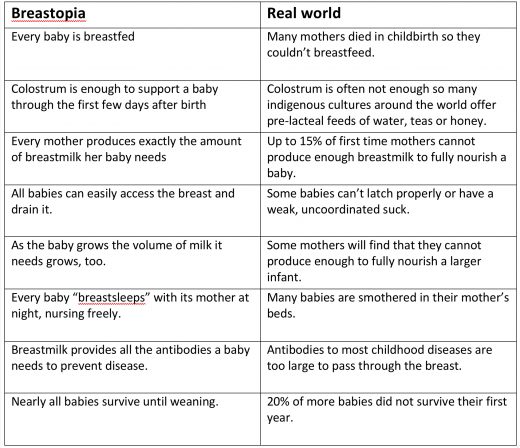
To understand why it helps to compare Breastopia to the natural world. That’s why I created the handy chart below.

292A33E1-7D74-4A0E-A8A8-0BB36C28E2AC

In Breastopia every baby is breastfed, but in the real world many mothers died in childbirth and therefore couldn’t breastfeed. Many of these babies died.

[pullquote align=”right” cite=”” link=”” color=”” class=”” size=””]Breastopia never existed and frantic efforts to “reclaim” it are harming babies and mothers.[/pullquote]

In Breastopia colostrum is enough to support a baby through the first days after birth. In the real world many babies suffer dehydration, hypoglycemia and severe jaundice as a result of insufficient breastmilk. That’s probably the reason why indigenous cultures around the world offer pre-lacteal feeds. Many of these babies died.

In Breastopia a mother’s breastmilk production completely matches her baby’s needs. In the real world up to 15% of first time mothers don’t produce enough breastmilk to fully nourish an infant. Many of these babies died.

In Breastopia all babies can easily latch and can effectively suck. In the real world some babies can’t latch properly or have a weak, uncoordinated suck. Many of these babies died.

In Breastopia every baby “breastsleeps” with its mother, nursing freely throughout the night. In the real world many babies are smothered their mothers beds.

In Breastopia nearly all babies survive until weaning. In the real world anywhere from 20-40% babies or more do not survive their first year.

The clever among you are probably sensing a theme: breastfeeding, like any natural process, is far from perfect. As a result there are high rates of infant wastage. In other words, many babies naturally die in infancy.

Despite the fact that Breastopia literally never existed, many lactation professionals insists that we can and should return to it.

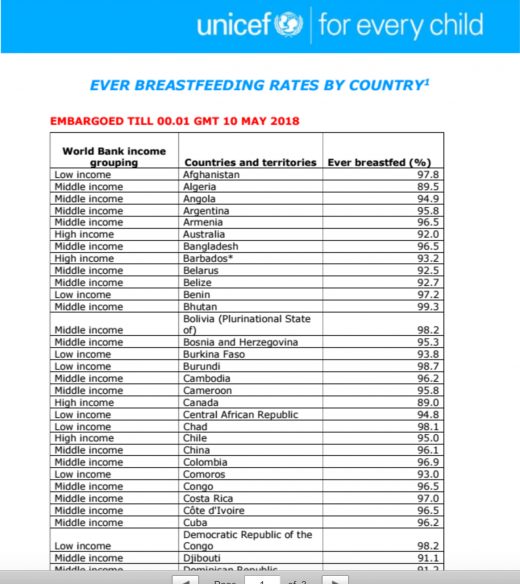
Consider the latest data dump on breastfeeding released by UNICEF.

According to a CNN article entitled The countries where 1 in 5 children are never breastfed:

A new UNICEF report released Wednesday that ranks countries by breastfeeding rates shows that in high-income countries, more than one in five babies is never breastfed, whereas in low- and middle-income countries, one in 25 babies is never breastfed…

“The data and the analyses are a confirmation of a trend that we have seen for a number of years now,” said Victor Aguayo, UNICEF’s chief of nutrition, who was involved in the report’s policy analysis.

Aguayo bemoans the fact that many children are never breastfed and insists that we must make breastfeeding the norm.

“In higher-income countries, we see that the proportion of children who have never been breastfed is significantly higher than the number of children in low- and middle-income countries. That is a fact,” he said. “We need to create environments — including in the US — that make breastfeeding the norm.”

It’s almost as if he thinks breastfeeding makes infants healthier and saves lives. But that’s NOT what the data shows.

186CB685-A9DA-4B14-B999-28451E903B69

You can examine the full chart of international breastfeeding rates embedded in the article.

Let’s look at a few representative countries.

Afghanistan has a breastfeeding rate of 97.8%. It also has an astronomical infant mortality rate of 102.9/1000.

Burundi has an even higher breastfeeding rate of 98.8%. It’s infant mortality rate is also appalling at 81.1/1000.

How about the countries that UNICEF chastises for low breastfeeding rates like the US and France?

The US has a breastfeeding rate of 74.4% and an infant mortality rate of 5.87/1000.

France has an even lower breastfeeding rate of 63% and an even lower infant mortality rate of 3.2/1000.

Are you noticing a trend? That’s right, breastfeeding rate has NOTHING to do with infant mortality.

Moreover, as far as I know, there is no evidence that increasing the breastfeeding rate in a country leads to any measurable benefit in reduced infant mortality. The only exception to this is the case of very premature babies who have a reduced incidence of necrotizing enterocolitis when fed breastmilk.

None of this should be remotely surprising. Breastfeeding was far from perfect in nature and it is far from perfect now. Indeed, as I’ve written many times in past, the benefits of breastfeeding in countries with clean water are trivial, and not particularly compelling elsewhere, either.

So what’s driving the relentless pressure to increase breastfeeding rates? It obviously isn’t scientific evidence since no one can demonstrate any real world benefit to increased breastfeeding rates for term babies.

What’s driving it is the lactivist belief in Breastopia — the belief that Breastopia existed in the past and we could return to Breastopia in the future if we just offered greater support pressure to breastfeed. Lactivists are longing for a past that literally never existed. By relentlessly seeking to recapture it they are coming up against the real world limitations of breastfeeding … and seriously harming babies and mothers as a result.

Claiming breastfeeding has major benefits is politically correct, but sadly not true

Caution - Politically Correct Area Ahead

In a world of vicious clashes over ideas and even over facts themselves, there is one thing on which everyone can agree. Thought leaders on the left and the right, among every possible ethnic and religious group, among scientists and lay people are united in their insistence that breastfeeding has major benefits for babies.

Too bad it’s not true.

Consider these papers detailing the dangers of aggressive breastfeeding promotion. Even they start with the premise that breastfeeding has major benefits.

[pullquote align=”right” cite=”” link=”” color=”” class=”” size=””]Lactivists have constructed a narrative about breastfeeding that allows them to insist — against factual evidence to the contrary — that they are being discriminated against.[/pullquote]

The revised United States Preventive Services Task Force (USPSTF) guidelines

There is convincing evidence that breastfeeding provides substantial health benefits for children …

The Baby Friendly Hospital Initiative and the ten steps for successful breastfeeding. a critical review of the literature

There is no doubt regarding the multiple benefits of breastfeeding for infants and society in general…

Or this opinion piece:

Are Breastfeeding Messages Actually Hurting Mothers?

There is no dispute that breast milk and feeding has innumerable benefits and is the gold standard.

But the scientific evidence shows the opposite. The benefits of breastfeeding in industrialized countries are limited to a few less colds and episodes of diarrheal illness across the entire population of infants in their first year. While there are a variety of mathematical models that claim to show how much money and how many more lives could be saved if breastfeeding rates were higher, there’s no evidence that the tripling of breastfeeding rates in the past 40 years has saved any lives (except for premature infants) or any money.

The insistence that breastfeeding has major benefits is political correctness run amok.

According to Wikipedia:

The term political correctness is used to describe language, policies, or measures that are intended to avoid offense … to members of particular groups in society. Since the late 1980s, the term has come to refer to avoiding language or behavior that can be seen as excluding, marginalizing, or insulting groups of people considered disadvantaged or discriminated against …

No one dares offend lactivists and professional breastfeeding advocates, people whose self-esteem or income depend on their insistence that breast is best. Lactivists have constructed a narrative about themselves and breastfeeding that allows them to insist — against the massive amount of factual evidence to the contrary — that they are disadvantaged and being discriminated against.

For lactivists and lactation professionals, the history of formula begins in the 1970s when Nestle, in an immoral effort to increase market share convinced African mothers to forgo breastfeeding in favor of powdered formula. Thousands of babies died because the water used to prepare that formula was contaminated with pathogens, a fact of which Nestle was well aware. To hear lactivists tell it, formula use is rarely necessary and was foisted on mothers by an avaricious industry with the collusion of doctors who were both ignorant and greedy.

Though it was black African women whose babies died as the result of corporate malfeasance, lactation professionals — almost exclusively white and well off — expropriated the tragedy to insist that they were victims of the formula industry, discriminated against for their heroic efforts to feed babies the best way, the way nature intended.

The truth is that formula was invented 100 years before Nestle ventured to Africa and it was invented to save the lives of countless babies who were dying for lack of breastmilk because their own mothers had died or couldn’t produce enough. Those babies were being supplemented with raw cow’s milk that proved to be deadly for many.

Doctors, far from discriminating against breastfeeding, were the original lactivists. As Jacqueline Wolf explains in the chapter Saving Babies and Mothers: Pioneering Efforts to Decrease Infant and Maternal Mortality, in the book Silent Victories: The History and Practice of Public Health in Twentieth Century:

The custom of feeding cows’ milk via rags, bottles, cans and jars to babies rather than putting them to the breast became increasingly common in the last quarter of the nineteenth century progressed… In 1912, disconcerted physicians complained bitterly that the breastfeeding duration rate had declined steadily since the mid-nineteenth century “and now it is largely a question as to whether the mother will nurse her baby at all. A 1912 survey in Chicago … corroborated the allegation. Sixty-one percent of those women fed their infants at least some cows’ milk within weeks of giving birth…

The medical community deemed human milk so vital to infants’ health that doctors even feared that providing clean cows’ milk to babies might be counterproductive since it tended to exacerbate low breastfeeding rates…

Infant formula, far from being a corporate plot to harm infants and discriminate against breastfeeding, was designed to save babies from the reality that breast is often not best.

But in 2018 very few dare to point that out because they will be subjected to a torrent of lactivist abuse.

And that brings us to the Baby Friendly Hospital Initiative. I’ve been told (and I can find no evidence to contradict this) that the BFHI is the only private organization allowed to operate within and determine policies for hospitals. Until the BFHI, private organizations were prevented from operating within hospitals because it was understood that their beliefs, no matter how well intentioned, might be in conflict with patient values, provider values or even safety.

And that’s exactly what has happened with the BFHI. The BFHI privileges a process, breastfeeding, over the outcome of healthy mothers and healthy babies. It privileges belief over scientific facts. The facts are that insufficient breastmilk is common (up to 15% of first time mothers), formula supplementation makes successful breastfeeding more likely, pacifiers prevent SIDS and extended skin to skin contact lead to babies falling from their mothers’ hospital beds or suffocating while in them. In addition, it is well known that the leading cause of jaundice induced brain damage (kernicterus) is breastfeeding.

I have no ax to grind. I breastfed four children successfully with minimal problems. My babies were fat and happy and I enjoyed breastfeeding. But as a physician I have become increasingly alarmed at the number of babies and mothers who are being harmed by aggressive breastfeeding promotion. These harms are often justified by the claim that breastfeeding has major benefits. There’s no doubt that it is politically correct to say so, but there’s also no doubt that it is absolutely untrue.

Dr. Amy