Lactivism and the hallmarks of pseudoscience

72775232 - paradigm shift, 3d rendering, traffic sign

On the first day of medical school, they tell students that half of what they are about to learn will be overturned or changed in the next five years; the problem is that we don’t know which half. But the hallmark of science is that new information challenges old certainties and doctors must change their thinking and practice in response.

Pseudoscience, however, does not change as the facts and understanding change. It starts with a claim —for example, the claim that breastfeeding is best for every baby — and it sticks with that claim regardless of new facts that come to light.

[pullquote align=”right” cite=”” link=”” color=”” class=”” size=””]Lactation professionals who resist changes to the Ten Steps are no different from obstetricians who continue doing routine episiotomies.[/pullquote]

The recent response of lactivists to the growing body of evidence that aggressive breastfeeding promotion is injuring and in some cases killing infants suggests that lactivism is a form of pseudoscience. While pediatricians, neonatologists and organizations like the Fed Is Best Foundation are begging the World Health Organization to revise the Ten Steps to Successful Breastfeeding to incorporate the new findings, lactivist organizations will not budge.

Contrast the response of the science of obstetrics to the pseudoscience of lactivism in the face of paradigm shifting scientific evidence.

I was taught to perform episiotomies very early in my training.

It was the rare delivery of a first time mother that was not accompanied by an episiotomy and the rationale was persuasive. The baby’s head often tore apart the lower vagina and tears might radiate out to the labia and clitoris and well as down to the rectum. It was thought that making a precise incision that was easier to repair would spare women from multiple, ragged lacerations. Most important, obstetricians believed that episiotomies made is less likely that the rectum would be damaged. Avoiding fecal incontinence was a high priority.

It made a lot of sense, but it was wrong. Paradigm shifting research done in the 1980’s and 1990’s demonstrated that a median episiotomy (straight up and down), by weakening the tissue of the lower vagina, made tears down to the rectum MORE likely, not less. Most obstetricians (including me) didn’t believe it at first, but the scientific evidence was clear and clinical practice changed on a dime. Within a few years the rate of routine episiotomies dropped precipitously and episiotomies are now almost solely reserved for forceps and vacuum delivery.

Lactation consultants are taught that breastfeeding is best for every baby, that formula supplementation and pacifiers harm the breastfeeding relationship, that insufficient breastmilk is rare, and that extended skin to skin contact and rooming in are safe and improve the likelihood of breastfeeding success. Paradigm shifting research done within the past decade has shown that insufficient breastmilk is common (up to 15% of first time mothers), formula supplementation makes successful breastfeeding more likely, pacifiers prevent SIDS and extended skin to skin contact lead to babies falling from their mothers’ hospital beds or suffocating while in them. The leading cause of jaundice induced brain damage (kernicterus) is breastfeeding and breastfeeding doubles the risk of neonatal hospital admission leading to literally tens of thousands of hospital admissions per year.

The evidence on the dangers of breastfeeding is actually far more compelling than the evidence on the dangers of episiotomies. In a feeble response, the WHO has made some minor, inadequate changes to the their recommendations. The response of lactation professionals has been to erect a wall of denial; they are vigorously protesting even the insufficient changes.

This letter from the International Baby Food Action Network, in partnership with the Baby-Friendly Hospital Initiative Network of Industrialized Nations (BFHI), International Lactation Consultant Association (ILCA), La Leche League International (LLLI), World Alliance for Breastfeeding Action (WABA) makes clear their insistence on clinging to old, discredited claims.

Global standards

The issues babies face in developing countries are very different than those in industrialized countries. Breastfeeding provides significant health benefits in developing countries as opposed to trivial benefits in industrialized countries. The WHO has proposed acknowledging these differences by allowing individual countries to develop national standards. Lactation professionals are opposed:

we still believe this approach will allow for wide variation of practices and inconsistent standards throughout the world, undermining global indicators. Global standards are the foundation of the BFHI and they are essential to monitoring the global effort to improve breastfeeding rates.

Yes, global standards might make things easier for the BFHI but they don’t make things better, healthier or safer for mothers or babies.

The BFHI

Given the paucity of evidence that the BFHI improves breastfeeding rates, the WHO has designated it as a “key” strategy, not the only strategy. Lactation professionals, sensing a threat to their employment prospects, vigorously disagree.

The Ten Steps

Many of the Ten Steps have been found to be harmful to babies and most have been found to be ineffective in promoting breastfeeding. No matter. Lactation professionals object to changes that incorporate the scientific evidence.

Consider the response to changing Step 9: Give no pacifiers or artificial nipples to breastfeeding infants. Pacifiers are lifesaving; indeed research shows that they are more likely to prevent SIDS than breastfeeding itself. Lactation professionals don’t care. They are affirmatively OPPOSED to making decisions based on the scientific evidence.

…[I]t was not the most appropriate method for examining the evidence related to the socio-cultural and ethical complexities of the BFHI. This method failed to portray the reality that those working and researching in this field have experienced over the past 30 years.

That’s the equivalent of obstetricians insisting that they are going to keep doing routine episiotomies because they believe in them despite the scientific evidence showing harm.

Lactation professionals have exerted tremendous pressure on the WHO to retain the outdated, dangerous Ten Steps. The WHO appears to be caving, but apparently not far enough.

WHO and UNICEF, based on an evaluation of the evidence and information submitted by the collaborative, appear to have made significant changes to the proposed initial draft, including the retention of the order, number and subject matter of each of the original Ten Steps. However, significant gaps in the alignment of our thinking with WHO and UNICEF remain.

They are encouraging their members to lobby the WHO to maintain the status quo even though the the status quo ignores the scientific evidence, is dangerous for babies leading to literally tens of thousands of newborn hospital readmissions in the US alone, and increases sudden infant deaths in hospitals.

Science necessitates change based on new information; pseudoscience resists change regardless of scientific evidence. By that metric, contemporary lactivism — cheered on by its lactation professional enablers — is pseudoscience.

Hey, Fatso, we have some breastfeeding advice for you

Beautiful woman doing different expressions in different sets of clothes: be careful

Information for Porky Patients from Smug-Bigoted Maternity Hospital

Welcome to Smug-Bigoted Maternity Hospital! We know how frightening and disruptive hospital admission can be and we want to tell you we are are sorry that a big honking whale like you has been admitted. We’re not just sorry for you; we’re sorry for ourselves. Do you have any idea how hard it is to turn a fat cow like you in bed?

Hey, we’re not insulting you. We care about your health and obesity is unhealthy. Push yourself away from the table for a moment and listen up. Hungry Hippos like you often have trouble breastfeeding and have to resort to artificial baby milk. It’s your choice to be the size of a house so don’t think we’re going to provide you with powdered or ready to feed poison, a suboptimal choice for nutrition chosen only by shit mothers. Losers like you can bring your own.

[pullquote align=”right” cite=”” link=”” color=”” class=”” size=””]Referring to formula as “artificial baby milk” is no more effective than addressing overweight women as “fatso” and just as harmful and unethical.[/pullquote]

Is this an ethical or effective way to address patients? Is insulting women about their weight likely to result in weight loss? Does insulting them make women more likely to follow healthcare advice? No, no, and no! We would rightfully be appalled at hospitals and healthcare providers treating obese and overweight patients this way.

So why is it acceptable for formula feeding mothers to be bombarded with insults under the guise of providing healthcare?

The BBC reports Hospital’s ‘artificial feeding’ letter to mothers criticised:

A hospital trust has been criticised for describing mothers who use formula milk as “artificially” feeding babies.

Worcestershire Acute Hospitals NHS Trust made the comment in a letter that said it would no longer provide formula milk in its maternity units to mothers who had decided not to breastfeed.

One woman who said she had been unable to breastfeed said the letter’s wording made her “sick to the stomach”.

The trust said it would “consider carefully” feedback it had received.

Where did they get the idea that such language was acceptable in the first place? They got the idea from lactation consultant Diane Weissinger.

Risky Business: Breastfeeding Promotion Policy and the Problem of Risk Language a 2017 paper published in the Journal of Women, Politics & Policy explains:

In 1996 the Journal of Human Lactation published a guest editorial called “Watch Your Language!” by Diane Wiessinger, an International Board Certified Lactation Consultant … In her editorial Wiessinger argued that, rather than providing a convincing case for breastfeeding, the language most commonly used to describe breastfeeding instead serves to reinforce formula feeding as the normative method of feeding infants. Words like “[b]est possible, ideal, optimal, perfect,” she insisted, “are admirable goals, not minimum standards”. Few people feel driven to provide the best, to “be far above normal,” she pointed out, but most people “certainly don’t want to be below normal”… [B]y using words like “best” and “benefits of breastfeeding” rather than “normal” and “risks of formula feeding,” breastfeeding supporters are depriving “mothers of crucial decision-making information”…

[Her] argument has become so well known among lactation consultants, [breastfeeding advocates] often introduce her “Watch Your Language!” piece as “seminal” or “classic.” It is perhaps even more telling that
her name has been made into a verb that is widely understood in the breastfeeding support community: to “Wiessingerize” means to refer to breastfeeding as the norm against which other infant feeding methods fall short…

The decision by the Worcestershire Trust to derogate formula as artificial baby milk is typical of the strategy.

The effort to promote breastfeeding by demeaning formula feeding has only accelerated in the past two decades.

Even just a cursory Internet search shows that breastfeeding promotion materials framed in terms of “the risks of formula feeding” are currently being used by some state breastfeeding coalitions, two hospitals, two private corporations, the Departments of Public Health in California and New York, the City of New York, as well as The Special Supplemental Nutrition Program for Women, Infants, and Children (WIC) programs in at least five states… The United States Department of Health and Human Services’ Office on Women’s Health publishes a 50- page guide to breastfeeding that points out that “among formula-fed babies, ear infections and diarrhea are more common”. It goes on to state that “Formula-fed babies also have higher risks” of a variety of conditions …

The authors note:

Making it hurt: The strategy of risk
The irony, of course, is that individuals and organizations so determined to convince women to breastfeed because of evidence-based claims about its health effects are themselves choosing a breastfeeding promotion approach that is not based on actual evidence.

Insulting formula feeding mothers is no more effective than insulting obese women. Indeed, there is a large and growing body of evidence that Weissingerizing breastfeeding promotion efforts is harming mothers and thereby harming babies as well.

They interviewed hundreds of women and found:

[Women] can recognize when they are being manipulated and that they distrust breastfeeding promotion materials worded in ways they identify as manipulative. Listening shows that many of them think it is cruel or unfair to make infant formula sound so dangerous, especially when it is the only option available to some mothers. Listening indicates that some of them believe that the science is correct and that others have doubts based either on their own experience or on their assessments of the science itself. Listening shows us that some of these women may not believe the risk is large enough, or that there are other risks that are larger or that matter more to them.

They conclude:

All of this suggests that breastfeeding promoters need to do more than simply “watch their language,” lest they themselves risk alienating their audience. Rather, they may want to consider stopping talking altogether, even for just a moment, so that they can hear what women are saying.

In other words, referring to formula as “artificial baby milk” is no more effective than addressing overweight women as “fatso” and just as harmful and unethical.

What do midwives and lactation consultants have in common with right wing trolls?

449F2B1E-717C-4773-8FA9-6C2C6530F7AB

Who could possibly be so heartless as to claim that the survivors of the Parkland high school shooting are actors faking their distress?

How vicious do you have to taunt the parents of the first graders massacred at Sandy Hook elementary school?

How could anyone with a modicum of compassion insist that the Pulse night club horror was faked?

[pullquote align=”right” cite=”” link=”” color=”” class=”” size=””]What’s the difference between tormenting a father whose son died at the hands of midwives and tormenting a Sandy Hook parent whose child died at the hand of a gun user? Nothing.[/pullquote]

Right wing trolls have done all three. Even more horrifying than their utter lack of decency is the fact that other right wing commentators/Facebook users/Tweeters haven’t rebuked them, but embraced these vile lies instead. Apparently it is easier and more comforting for gun rights activists to believe outrageous falsehoods than to acknowledge the tragedies that arise as a result of their beloved ideology.

Lest you think that such vicious behavior is somehow restricted only to gun rights activists, consider the response of midwives and lactation consultants to the tragedies that arise as a result of their beloved ideologies.

UK midwife Sheena Byrom, ironically author of the a book about “kindness, compassion and respect” in maternity care has relentlessly trolled loss father James Titcombe who has had the temerity to insist that the death of his son at the hands of midwives could have been prevented.

F890386B-B5F2-4591-9705-18846B5003CC

Highlights include:

oh James-don’t let’s get on that roll again …

and:

getting out of bed in the morning has risks

What’s the difference between tormenting a father whose son died at the hands of midwives and tormenting a Sandy Hook parent whose child died at the hand of a gun user? Nothing.

In the wake of newspaper reports detailing the massive increase in UK liability claims as a result of injured and dead babies, Australian midwife Hannah Dahlen declared that the dead babies were “fake news.”

EFBE9887-4CBC-41FB-B206-B338141362DB

For all those UK midwives feeling hammered this week by Fake News remember “thinking is difficult which is why most people judge” #ENOUGH!

What’s the difference between claiming that dead babies are fake news and claiming that the Pulse nightclub massacre didn’t happen? Nothing.

Lactivists are no better. When the story of Baby Landon Johnson broke, the story of a baby who died of dehydration from insufficient breastmilk, various lactation professionals and lactivists weighed in with their belief that the baby didn’t die of dehydration, some people even going so far as to fabricate the vile slander that Landon had been suffocated by his mother’s inattention when she was holding him.

What’s the difference between claiming that Landon’s mother lied about his death and claiming that the survivors of the Parkland school shooting are lying about their suffering and grief. Absolutely nothing!

Even more horrifying than their utter lack of decency is the fact that other midwives and lactation consultants commentators/Facebook users/Tweeters haven’t rebuked them, but embraced these vile lies instead. Apparently it is easier and more comforting for midwives and lactation consultants to believe outrageous falsehoods than to acknowledge the tragedies that arise as a result of their beloved ideologies.

The reason there’s no difference is because midwives and lactation consultants are afflicted by the same problem that bedevils right wing trolls: cognitive dissonance.

In A Theory of Cognitive Dissonance (1957), Leon Festinger proposed that human beings strive for internal psychological consistency in order to mentally function in the real world. A person who experiences internal inconsistency tends to become psychologically uncomfortable, and is motivated to reduce the cognitive dissonance. This is done by making changes to justify their stressful behavior, either by adding new parts to the cognition causing the psychological dissonance, or by actively avoiding social situations and/or contradictory information likely to increase the magnitude of the cognitive dissonance.

Gun rights activists insist that lax gun laws have no impact on public safety. When a gun massacre occurs precisely because of lax gun laws they have two choices to reduce cognitive dissonance. They can give up their treasured belief that widespread gun ownership is not dangerous, or — easier and more comfortable — they can pretend that gun massacres didn’t happen, blame the suffers as faking their suffering, or, worst of all, insist that the survivors are somehow responsible for their own suffering.

Many midwives and natural childbirth advocates insist that unmedicated vaginal birth (so called “normal” birth) is safest. When babies die because of the philosophy of normal birth, they have two choices to reduce cognitive dissonance. They can give up their treasured belief about normal birth or — easier and more comfortable — they can pretend that dead babies are “fake news”, insist that grieving parents are unfairly blaming the ideology, or, worst of all, insist that the survivors are somehow responsible for their own suffering.

Lactation consultants are certain that breastfeeding is best for every baby. When babies die because of aggressive breastfeeding promotion, they have two choices. They can give up their treasured belief about breastfeeding or — easier and more comfortable — they can pretend that dead babies are “fake news,” insist that grieving parents are unfairly blaming the ideology, or, worst of all, insist that the survivors are somehow responsible for their own suffering.

I have some sympathy for those suffering from cognitive dissonance. If you base your identity on a belief that turns out to be not merely false, but dangerous, it is very difficult to reconcile that treasured belief with the even more powerful need to feel you are a good person. It’s so much easier and more satisfying to insist that the tragic result of your belief didn’t happen and to troll the people whose suffering is making a mockery of your treasured belief.

I have no sympathy whatsoever for the wider community that fails to call those issuing vile accusations to account. I have no sympathy for gun owners who won’t disavow the ugly tactics of those who insist that deaths are fake news and grieving survivors are actors. Indeed, I find it inexplicable and indefensible. Similarly, I find it inexplicable and indefensible for the wider midwifery community’s failure to call the Sheena Byroms and Hannah Dahlens to account for their reprehensible claims that dead babies are fake news and grieving survivors have nefarious motives or even deserve their suffering. I find it inexplicable for the wider lactation community’s failure to call those questioning the sincerity and motivations of  the Fed Is Best founders and community members.

What do midwives and lactation consultants have in common with right wing trolls? Their willingness to do and say anything, no matter how vile, to ease their own cognitive dissonance.

5 lies my lactation consultant told me

E09458F2-0FC6-4CA9-8524-ECB67B94E261

Another day, another “study” of breastfeeding based on ignorance and ideology.

When I first saw the article from Manchester University, Research reveals why obese mothers less likely to breastfeed, I thought it would be about insulin resistance. After all, insulin resistance, a common complication of obesity, has been found to affect production of breastmilk.

[pullquote align=”right” cite=”” link=”” color=”” class=”” size=””]These 5 lies interlock to create the impenetrable wall of denial faced by new mothers who have breastfeeding complications. [/pullquote]

[P]revious research had shown that for mothers with markers of sub-optimal glucose metabolism, such as being overweight, being at an advanced maternal age, or having a large birth-weight baby, it takes longer for their milk to come in, suggesting a role for insulin in the mammary gland…

“This new study shows a dramatic switching on of the insulin receptor and its downstream signals during the breast’s transition to a biofactory that manufactures massive amounts of proteins, fats and carbohydrates for nourishing the newborn baby,” says Dr. Nommsen-Rivers.

“Considering that 20 percent of women between 20 and 44 are prediabetic, it’s conceivable that up to 20 percent of new mothers in the United States are at risk for low milk supply due to insulin dysregulation.”

But shockingly the paper didn’t mention insulin resistance at all. Instead it advanced the all purpose lactivist lie that the only limitation to breastfeeding is lack of maternal support.

Factors holding obese women back from breastfeeding included: lack of breastfeed planning, low belief in breastmilk’s nutritional adequacy and sufficiency, poor body image and lack of social knowledge.

That’s like looking at someone with glasses and blaming lack of support — instead of nearsightedness — for difficulty seeing. In an additional irony, the paper appears on the website Obesity Reviews beneath a paper exploring the role of insulin resistance and obesity in prostate cancer. Apparently no one insists that prostate cancer is due to a lack of support.

This is just the latest example of the sad fact that lactivism is based on a system of lies. Babies are suffering and dying as a result and their mothers are suffering, too.

Each individual lie is harmful of course, as any lie about healthcare will inevitably be, but the true danger comes from the system of lies and the clever way they interlock to prevent women and babies from receiving appropriate medical care.

What are these lies?

1. Breastfeeding is perfect? No, that’s a lie.

This is the foundational lie of breastfeeding advocacy — the belief that breastfeeding is perfect — and the lie from which all the other lies spring. Breastfeeding is a biological function just like any biological function; that means it will inevitably have a failure rate. And like most aspects of reproduction (human or animal), its failure rate is HIGH. Up to 20% of couples will suffer from infertility. Up to 20% of established pregnancies will end in miscarriage. It is hardly surprising then that up to 15% of first time mothers will be unable to produce enough breastmilk to fully nourish an infant especially in the first few days after birth.

2. All but the rare woman will make enough breastmilk? No, that’s a lie.

Insufficient breastmilk isn’t rare; it’s common and the consequences are widespread. Breastfeeding doubles the rate of newborn hospital readmission leading to literally tens of thousands of hospital readmissions per year for dehydration and jaundice. The leading cause of kernicterus (jaundice induced brain damage) is breastfeeding, accounting for 90% of cases.

The cost of hospital readmissions is massive, literally hundreds of millions of dollars each year. And that doesn’t even count the downstream costs of caring for children who suffer injuries and learning disabilities as a result of breastfeeding induced dehydration, hypoglycemia and hyperbilirubinemia.

3. The benefits of breastfeeding are massive? No, that’s a lie.

The benefits of breastfeeding in industrialized countries are trivial. Most of the myriad benefits claimed are based on studies that are weak, conficting and riddled with confounding variables. When breastfeeding studies are controlled for maternal income and education (both independently associated with improved health of offspring), nearly all of the purported benefits disappear. To the extent that breastfeeding has greater benefits in the developing world it’s because the unclean WATER used to make the formula is harmful NOT the formula itself.

4. Formula supplementation or pacifiers interfere with breastfeeding? No, that’s a lie.

The Baby Friendly Hospital Initiative, designed to promote breastfeeding, specifically discourages both formula supplementation and pacifiers as harmful to the breastfeeding relationship. But research shows that early judicious formula supplementation increases breastfeeding rates and pacifiers save lives by preventing SIDS (sudden infant death syndrome).

Moreover, many women successfully combo feed using both breastmilk and formula for months or years.

5. All breastfeeding problems can be solved with more support? No, that’s a lie and a particularly self-serving one.

A new paper about publicly funded lactivism, State power and breastfeeding promotion: A critique, makes the point eloquently.

The problem – whether it be postnatal depression, multiple births, or severely cracked nipples – can almost always be surmounted with appropriate counselling, management and determination. This is the case even when the problem is one of insufficient milk and the infant itself is not thriving as well as their peers. Hausman, for example, writes that ‘no one disputes that cases of true (or primary) insufficient milk syndrome exist – breastfeeding advocates simply tend to question the idea that there are large numbers of women who physically cannot make enough milk’…

Perseverance, counselling and management, and not choice, context and individual circumstances, seem to be an all too common response from many public and/or publicly funded health professionals and institutions to those struggling.

In other words, whatever the problem, more lactation consultants making more money by providing more government (or privately) funded support is  always the solution.

These 5 lies interlock to create the nearly impenetrable wall of denial that greets most new mothers when they experience entirely predictable difficulties and complications with breastfeeding. That’s how you end up with the travesty of a paper blaming obese women’s difficulty breastfeeding on “lack of support” when the cause is almost certainly biological at least in part if not entirely.

Latest data on US maternal mortality confirms it is a problem of race and healthcare disparities

36059381 - loving expecting couple expecting their first child.

The ongoing series on by ProPublica has shined light on the serious problem of US maternal mortality. Interestingly the series evolved over time, initially framing the problem with a story of a privileged white woman who was a victim of malpractice and ultimately recognizing that it is a problem of race and healthcare disparities.

Perhaps the most shocking fact about US maternal mortality is this:

…[A]lthough Washington, DC, has the highest maternal mortality ratio in the nation, non-Hispanic white patients in this district have the lowest mortality ratio in the United States. Excellent care is apparently available but is not reaching all the people.

New data presented in the forthcoming issue of Obstetrics and Gynecology confirms this assessment. The paper is Health Care Disparity and Pregnancy-Related Mortality in the United States, 2005–2014.

[pullquote align=”right” cite=”” link=”” color=”” class=”” size=””]Excellent obstetric care is available but it is not reaching the women who need it most.[/pullquote]

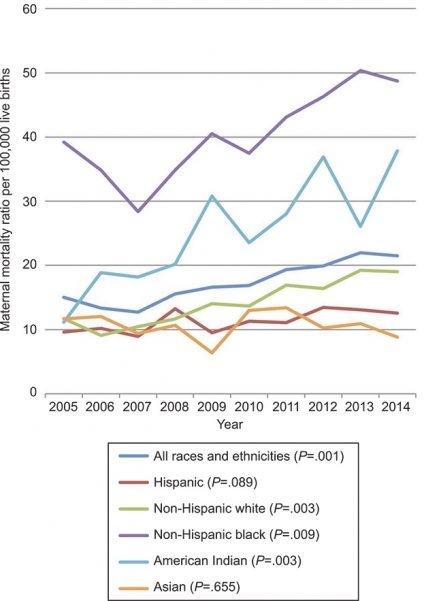
The trend is displayed in the following graph: Trends in maternal mortality ratio (maternal deaths/100,000 live births) by ethnic group and race: United States, 2005–2014. Numbers in parentheses represent P values for the Jonckheere-Terpstra test.Moaddab.

8210DFF5-AA7F-4BD3-90A9-2609F58F90C9

The authors note:

The U.S. maternal mortality ratio continues to climb and reached a rate of 21–22 per 100,000 in 2013 and 2014. Many explanations for this trend have been offered. Although the United States has a higher rural population than many European nations … our data failed to identify a statistical correlation between state-specific maternal mortality and either rural status or poverty. Immigration has also been cited as a factor in this mortality trend. However, we found lower mortality for Hispanic women who make up the majority of recent immigrants.

So the cause is NOT rural status, immigration or poverty.

What about the C-section rate, the all purpose bogeyman constantly used by natural childbirth advocates to scare women about obstetric care?

The high U.S. cesarean rate has also been invoked as an explanation for increased mortality, yet our data demonstrate only a weak correlation of mortality with cesarean delivery. Furthermore, previous work has demonstrated that this correlation does not reflect causation; the overwhelming majority of maternal deaths associated with cesarean delivery is a consequence of the indication for the cesarean delivery, not the operation itself.

What accounts for the difference in statewide maternal mortality rates?

Our data suggest that much of the variation in statewide maternal mortality ratios in the United States is accounted for by social rather than medical or geographic factors: unintended pregnancy, unmarried mother, and non-Hispanic black race. These data provide evidence for a strong contribution of racial disparity to maternal mortality ratio in the United States. Particularly striking is the close correlation between ethnic background and maternal mortality. A factor derived from factor analysis, which primarily represented ethnic background, accounted for 26% of the differences in statewide mortality. Excellent care is apparently available, but is not reaching all the people.

How should we compare maternal mortality across states (or countries, though the authors do not address international differences)?

…[C]omparative health care statistics that do not adjust for these important demographic factors are of little significance in judging the intrinsic quality of available health care in an individual state or region. The potential relative contributions of factors such as racial disparities in health care availability and access or utilization by underserved populations are not addressed by our data, but are important issues faced by states seeking to decrease maternal mortality. Ethnic genetic differences may also be involved. In addition, the potential role of unconscious (implicit) bias in this significant racial disparity must be considered.

Indeed, the US, which has the highest maternal mortality of any industrialized nation has by far the highest proportion of women of African descent.

The British press has been bemoaning the high US maternal mortality rate. For example, a recent BBC interview with Serena Williams was described thus:

Serena Williams says it is “heartbreaking” black women in the United States are more likely than white women to die from complications in pregnancy or childbirth.

It IS heart breaking that black women in the US are 3X more likely to die from complications in pregnancy or childbirth. What the BBC and Serena Williams don’t seem to realize is that the disparity is even greater in the UK; black women in the UK are 4X more likely to die from complications in pregnancy or childbirth.

According to the UK and Ireland Confidential Enquiries into Maternal Deaths and Morbidity 2013–15:

The rates of maternal mortality varied by age, socioeconomic status and ethnic background of the women, which are known to be independently associated with an increased risk of maternal death in the UK. The rate of maternal mortality was higher amongst older women, those living in the most deprived areas and amongst women from particular ethnic minority groups… Comparable to the previous reports, the risk of maternal death in 2013–15 was signi cantly higher among women from Black ethnic minority backgrounds compared with White women (RR 4.28; 95% CI 2.65 to 6.69).

The overall UK statistics look better than the US because women of African descent represent a far smaller proportion of the population in the UK (3%) than in the US (12.85%). The sad truth is that lower rates of maternal mortality in other industrialized countries reflect the fact that those countries are whiter. The countries with the lowest maternal mortality rates in the world (including Iceland, Sweden, Finland and Japan) are the whitest countries in the world.

The authors conclude:

…The increased mortality ratios seen in the United States in recent years reflect significant social as well as medical challenges and are closely related to lack of access to health care in the non-Hispanic black population. Our results provide evidence for the strong contribution of racial disparity to the maternal mortality ratio in the United States and suggest that addressing issues related to health care disparity and access for this population will play an important role in national attempts to reverse this mortality trend.

The only question that remains is whether we have the will to tackle the problem.

File Hannah Dahlen’s latest paper under D for Duh!

Three wooden blocks spelling "Duh!".

What if I told you that people who take insulin are more likely to develop blindness than those who don’t?

Duh!

Blindness is a known complication of diabetes and insulin is a treatment for diabetes. It’s the diabetes that causes blindness NOT the insulin.

The real issue is whether diabetics who take insulin are more or less likely to develop serious complications than those who don’t.

How about if I told you that people who have heart transplants have a shorter lifespan than those who don’t?

[perfectpullquote align=”right” cite=”” link=”” color=”” class=”” size=””]The critical issue, which the authors did not bother to address, is whether those who got the interventions did better than if they hadn’t gotten them.[/perfectpullquote]

Duh!

If you need a heart transplant you are very sick indeed and your other organs might have been damaged by your weak heart before you became got an available organ. It’s the underlying disease that created the need for the transplant that caused the shorter lifespan NOT the transplant itself.

The real issue is whether those who need heart transplants and ultimately get one live longer than those who don’t.

Along comes Hannah Dahlen to tell us that those babies who need childbirth interventions have more bad outcomes than those who don’t.

Duh!

But that’s not how Dahlen spins it.

On The Conversation, Dahlen writes.

Medical and surgical intervention during birth continues to rise in much of the world. Nearly one in three women who give birth in Australia have a caesarean section and around 50% have their labour induced and/or augmented (sped up with synthetic hormones).

Our new research, published today in the journal Birth, found babies born via medical or surgical intervention were at increased risk of health problems. These include short-term concerns such as jaundice and feeding problems, and longer-term illnesses such as diabetes, respiratory infections and eczema.

You remember the “journal” Birth, right? That’s the one owned by Lamaze International, the organization that makes its money by convincing women that childbirth interventions are bad. Although they routinely charge $38 dollars for 24 hour access to one article, they’ve conveniently made this one free so everyone can learn about the “dangers” of childbirth interventions.

But childbirth interventions are like insulin or heart transplants; the people who need them will often die without them. The real issue is whether those who need childbirth interventions do better or worse without them.

How did Dahlen and colleagues answer that question? They didn’t even bother.

In a paper of 11 pages in length, buried near the very end, is the single most important sentence in the paper:

…[W]e were unable to control for confounding by indication since the underlying reasons for the provided medical and operative birth interventions were unknown.

And that renders the results of this study 100% meaningless!

But that doesn’t stop Dahlen.

We found:

Babies who experienced an instrumental birth (forceps or vacuum) following induction or augmentation had the highest risk of jaundice and feeding problems needing treatment in the first 28 days

Babies born by caesarean section had higher rates of being cold and needing treatment in the hospital for this compared to babies born via vaginal birth

Children born by emergency caesarean section had the highest rates of metabolic disorders (such as diabetes and obesity) by five years of age

Rates of respiratory infections, such as pneumonia and bronchitis, metabolic disorders, and eczema were higher among children who experienced any form of birth intervention than those born vaginally.

Wow, they really had to slice and dice the data to make up something ominous.

And even Dahlen acknowledges that most of those results are entirely expected:

Forceps and vacuum birth, for instance, can cause bleeding and bruising in the baby’s scalp. These blood cells break down, releasing bilirubin that causes the skin to look yellow, which signals jaundice.

Babies born by caesarean section are more likely to be cold because the operating theatre is cold. Despite recommendations for the baby to be placed on the mother’s chest as soon as possible, this doesn’t always happen.

What she should have pointed out — but deliberately did not — is that babies born by C-section are often rescued from medical problems like fetal distress which necessitated treatment in the NICU.

What she should have pointed out — but deliberately did not — is that children born by emergency C-section are more likely to have mothers who are diabetic and obese (both of which are therefore more likely in offspring).

What she should have pointed out — but deliberately did not — is that large data sets are vulnerable to p-hacking.

Researchers look for statistically significant differences between two groups. Then they announce them as “findings” without acknowledging that any large dataset looking at multiple outcomes is bound to have random statistically significant differences that are coincidental and don’t represent real outcomes. Indeed, by definition using a p value of less than 0.001 means that almost 0.1% of the differences that appears to be statistically significant are actually due to chance and don’t represent a real finding at all.

How do you guard against p-hacking? The most important way is to recognize that it is always a possibility when analyzing large datasets; in other words, it is wrong to conclude that every statistically significant result in such an analysis is a real result.

Despite having found found NOTHING AT ALL, Dahlen proceeds to spin elaborate theories about her “findings.”

Reasons for the increased risk of longer-term problems are much less clear, but there are a couple of interesting hypotheses.

The first key theory is based on epigenentics: that life events affect how genes function and are passed on to the next generation.

Labor and birth exert a positive form of stress on the fetus, which impacts on the genes responsible for fighting off bugs, weight regulation and suppressing tumours. Too little stress (no labour and elective caesarean section) or too much stress (induced/augmented labour and instrumental birth) could impact the expression of these genes.

The second key theory is the extended hygiene hypothesis. This suggests that vaginal birth provides an important opportunity to pass gut bacteria from mother to baby to produce a healthy microbiome and protect us from illness.

If we have an unhealthy microbiome, we may be more vulnerable to infections, allergies, diabetes and obesity.

Dahlen doesn’t even asked the single most critical question.

Just as the key question for insulin and heart transplants is whether those who received it did better than they would have if they hadn’t received it, the key question for birth interventions is whether those who received them did better than they would have if they hadn’t received them.

Dahlen didn’t bother to look because that would have produced entirely different results than the demonization of interventions that drives contemporary midwifery theory.

File Dahlen’s latest paper under D for “Duh!” as well as D for “demonization.” It is not science; it’s ideology masquerading as science and it isn’t even very well disguised.

Hideous death rate prompts temporary closure of Baby + Co birth center

60762777 - scandalous colorful word on the wooden background

The latest scandal in American midwife attended birth out of hospital birth is occurring in Cary, NC. According to the The News & Observer:

Three-and-a-half years after its splashy debut in Cary, the Baby+Company natural birthing center has stopped delivering babies after the deaths of three newborns in the past six months.

The spa-like facility that enticed expectant moms with midwives and water-birth pools alerted its customers by email on Friday, March 16, that it would be sending all moms in labor to WakeMed Cary hospital, the birth center’s business partner, while it reviewed recent “incidents.” On Thursday, after inquiries from parents and The News & Observer, the center released the information about the newborn deaths.

The company said the Cary site has had a total of four deaths since it opened in October 2014. That compares to only one death at its other five centers in three states. According to Baby+Co, it has supported 1,200 pregnancies over its 3 1/2 years in business in Cary.

An additional baby is currently hospitalized in the NICU at Duke.

Four deaths in only 1,200 births is an extraordinarily high death rate of 3/1000. To put that in perspective, according to the CDC Wonder database, midwife attended hospital birth for low risk women has a death rate of 0.4/1000. The death rate at the Cary birth center is more than 600% higher than expected!

[pullquote align=”right” cite=”” link=”” color=”” class=”” size=””]The death rate at the Cary, NC birth center is more than 600% higher than expected.[/pullquote]

Is out of hospital birth safe?

I asked that question about homebirth in The New York Times back in 2016 and answered it.

[T]here are places in the world where home birth is relatively safe, like the Netherlands, where it is popular at 16 percent of births. And in Canada, where it appears safest of all, several studies have demonstrated that in carefully selected populations, there is no difference between the number of babies who die at home or in the hospital.

In contrast, home birth in the United States is dangerous. The best data on the practice comes from Oregon, which in 2012 started requiring that birth and death certificates include information on where the birth occurred and who attended it. The state’s figures show that that year, the death rate for babies in planned home births with a midwife was about seven times that of births at a hospital.

Many studies of American home birth show that planned home birth with a midwife has a perinatal death rate at least triple that of a comparable hospital birth …

Birth center birth is homebirth with a twist. The birth takes place outside a hospital but in a facility that has some safety standards and equipment.

Why is out of hospital birth in the US so deadly? There are a variety of reasons but one of the most important is the philosophy of “normal birth,” the self-serving idea promoted by midwives that the process of birth is somehow equally or more important than the outcome. It’s self-serving because “normal birth” is defined as what midwives can do autonomously, not by what is best for babies and mothers.

There’s a major problem with that definition: “normal birth” is inherently deadly. Since even apparently uncomplicated births in low risk women can naturally end in death for babies and mothers, birth outside the hospital is essentially a gamble. Women and the midwives who encourage them gamble that if complications occur (and some serious complications will inevitably occur), midwives can recognize them and transfer women to the hospital in time to prevent death.

But that can only happen if the midwives are proactive in making sure that women with risk factors are not allowed to give birth at the center, if complications are correctly identified and not dismissed at “variations of normal” and if complications are acted upon immediately before they become full blown disasters.

I’ve heard privately from a variety of people with knowledge of the Cary birth center situation who insist that this is just the tip of the iceberg. There have been serious safety concerns since shortly after the center opened, safety concerns that were not taken seriously.

The director of the center, Margaret Buxton, CNM was interviewd by a local TV station. You can listen here to her weasel words about a “cluster” of deaths and her false implication that this can happen in the hospital, too.

Buxton repeatedly reference to the “cluster” is both tasteless and misleading. A “cluster” did not die, four individual beloved babies are dead and at least on camera Buxton never offers her condolences. The deaths were almost certainly preventable. And while it is true that deaths can occur in a cluster, when those deaths are averaged over the number of patients delivered at the center, the death rate should be THE SAME as the death rate in the hospital, not 600% higher.

There should have been a maximum of 1 death among 1,200 patients. Once a second death occurred, it might have been reasonable to talk about a cluster and assume that the rate would average out over time. With a 3rd and 4th death, Buxton should not be talking about a cluster and in my view should be acknowledging a disaster.

Baby + Co is a birth center franchise. The News & Observer article claims that the other 5 birth centers have had lower death rates so the problem may be confined to the particular center and its staff. I wonder what kind of malpractice insurance Baby + Co carries. It looks like it may be needed.

Get government’s hands off women’s breasts!

47676651 - female controlling breast for cancer, isolated on white

Under the guise of what is “best for babies,” the government has wrongly brought its considerable power to bear on promoting breastfeeding. In a fascinating paper entitled State power and breastfeeding promotion: A critique, political philosophers Balint et al. advance a compelling political argument against government promotion of breastfeeding. Simply put, the government misuses its power when it aggressively promotes breastfeeding.

[pullquote align=”right” cite=”” link=”” color=”” class=”” size=””]The government misuses its power when it aggressively promotes breastfeeding.[/pullquote]

State-sponsored breastfeeding promotion campaigns have become increasingly common in developed countries. In this article, by using the tools of liberal political theory, as well as public health and health promotion ethics, we argue that such campaigns are not justified. They ignore important costs for women, including undermining autonomy, fail to distribute burdens fairly, cannot be justified neutrally and fail a basic efficacy test… (my emphasis)

I’ve been making these arguments for years: breastfeeding promotion campaigns like the Baby Friendly Hospital Initiative (BFHI) violate women’s autonomy, re-inscribe privilege and are not justified by the trivial benefits of breastfeeding.

Why does the government need to justify itself? This goes to the heart of what we believe about the proper role of government.

One of the roles of liberal institutions is to make it possible for people to pursue their ends; and not to define their ends for them, nor favour some conceptions of the good over others, nor avoidably favour one way of life over others. In relation to breastfeeding promotion, this means that the burden must be carried by the health and welfare argument, and not any view about the goodness of any particular type of motherhood or the natural role of women. That is, only if breastfeeding provides significant welfare benefits for infants or mothers could such promotion be neutrally justifiable.

Breastfeeding promotion programs like the BFHI are unabashedly manipulative. They force women to undergo mandated “education”; they limit women’s feeding choices within the hospital; and they interfere with the free speech rights of medical professionals who believe that aggressive breastfeeding promotion is harmful to mothers and potentially deadly to babies. Manipulation violates women’s autonomy and autonomy ought to be valued very highly by government.

… [M]anipulation, like coercion, bends the will of one to that of another. This invasion of autonomy is severe even when the distortion it causes in a person’s decision making is relatively minor. Here we will argue that in the case of breastfeeding campaigns the quality of the information and the nature of the messages used at a time of particular emotional vulnerability can constitute a form of manipulation and can thus be autonomy-undermining for women …

The government is of course justified in promoting public health but that is subject to limiting principles:

(i) When there is more than one possible way to achieve a goal, we should always choose the least restrictive (i.e. least liberty-infringing) alternative.
(ii) Liberty-infringing interventions should be used in a non-discriminatory way, and we should be particularly cautious about using such interventions when those singled out by it come from the worst-off groups of society.
(iii) The burdens should be as minimal as possible.
(iv) Those who bear the burdens should be compensated.
(v) If a public health intervention is warranted (i.e. it meets the above conditions), an individual should be helped and supported to discharge her duties as much as possible (‘reciprocity’)…
(vi) Respect autonomy as well as doing good…
(vii) Do not cause fear, anxiety and vulnerability unnecessarily…
(viii) A campaign should be efficient in achieving its goals.

How do the BFHI and other breastfeeding programs violate these principles? Let me count the ways:

  • It affects only women and is more burdensome for poor women than for rich women.
  • The burdens are considerable.
  • In the absence of a comprehensive maternity leave policy, the government is imposing the burden without helping the affected women discharge it.
  • Fear mongering about the “risks” of formula is central to these campaigns.
  • Breastfeeding campaigns don’t actually work and produce only minimal health benefits even when they do (except in the case of prematurity).

The authors are justifiably scathing in their assessment of lactation professionals’ response:

While many of the physical problems … are acknowledged by breastfeeding advocates, the response is usually one of perseverance. The problem – whether it be postnatal depression, multiple births, or severely cracked nipples – can almost always be surmounted with appropriate counselling, management and determination. This is the case even when the problem is one of insufficient milk and the infant itself is not thriving as well as their peers. Hausman, for example, writes that ‘no one disputes that cases of true (or primary) insufficient milk syndrome exist – breastfeeding advocates simply tend to question the idea that there are large numbers of women who physically cannot make enough milk’. And, in response to a woman who, while unsuccessfully trying to breastfeed her infant, had ‘blood dripping down her chest and tears streaming down her face’, the advice was that the issue could be resolved by proper ‘lactation management’…

Perseverance, counselling and management, and not choice, context and individual circumstances, seem to be an all too common response from many public and/or publicly funded health professionals and institutions to those struggling. (my emphasis)

What about the health benefits of breastfeeding? The evidence is weak, conflicting and riddled with confounding variables.

As we argued, if this is true, there remain the problems of autonomy and fairness. And moreover, as we demonstrated, such a claim seems empirically suspect: (a) much of the empirical evidence for breastfeeding is beset with methodological problems, and (b) where positive health effects seem well demonstrated, they are often very small, in non- serious areas, or very rare. Thus, because the scientific evidence for the infant health benefits of breastfeeding is much weaker than is usually claimed, the ethical principle of efficacy (viii) is challenged. It seems then that there is no neutral justification for such a policy given that exclusive breastfeeding is associated with a particular view of child-rearing and motherhood. This means that promoting breastfeeding appears to unjustifiably privilege one conception of the good over others.

In summary, government breastfeeding promotion violates important political principles:

Because of the special role of the state, our argument focused on state power, rather than private organisations. This special role, however, enables the state to act in this sphere. It should provide accurate factual information, and legislate and agitate for more family-friendly workplaces, including for women who want to breastfeed… This is quite different from actively and strongly encouraging, often with quite manipulative and autonomy-undermining messages, a practice, the benefits of which for infants are marginal at best, and under current conditions, the negative effects of which on women’s welfare and autonomy can be strong and long-lasting, and certainly not equally or fairly distributed… Perhaps, breastfeeding is better for a child’s health, but it is certainly not always better, all things considered, particularly when one of the considerations is the health, welfare and autonomy of the woman who is being asked to do the breastfeeding.

Therefore, we should get government’s hands off women’s breasts!

Australian midwives use tiny, unblinded study to claim quackery could save millions

0FB420DE-AD79-483C-899B-9347EE06DEC2

Ever notice that most midwifery “studies,” like those of chiropractic or homeopathy come to the same conclusion? It’s always something like this: “we studied ourselves and we are the cure for everything!”

The latest midwifery “study” from Australia is destined to be a classic of this type. According to the headline in The Age, Childbirth program reduces caesarean rate, could save health system $97 million a year:

[pullquote align=”right” cite=”” link=”” color=”” class=”” size=””]The study on which this cost analysis is based is tiny, unblinded and involves quackery.[/pullquote]

Lead author Dr Kate Levett, now at the University of Notre Dame Australia, has conducted a cost analysis follow-up study, published in BMJ Open, that found antenatal education could reduce the rates of medical interventions during childbirth and therefore save the healthcare system up to $97 million each year.

The team multiplied the average saving of $808 per woman with the number of women giving birth for the first time in Australia each year – 120,000…

There’s just one problem. The study on which this cost analysis is based is tiny, unblinded and involves quackery.

The original study, published in 2016, is Complementary therapies for labour and birth study: a randomised controlled trial of antenatal integrative medicine for pain management in labour.

Midwives mobilized quackery — acupressure, visualization, massage and yoga — and found it is the cure for everything!

There was a significant difference in epidural use between the 2 groups: study group (23.9%) standard care (68.7%; risk ratio (RR) 0.37 (95% CI 0.25 to 0.55), p≤0.001). The study group participants reported a reduced rate of augmentation (RR=0.54 (95% CI 0.38 to 0.77), p<0.0001); caesarean section (RR=0.52 (95% CI 0.31 to 0.87), p=0.017); length of second stage (mean difference=−0.32 (95% CI −0.64 to 0.002), p=0.05); any perineal trauma (0.88 (95% CI 0.78 to 0.98), p=0.02) and resuscitation of the newborn (RR=0.47 (95% CI 0.25 to 0.87), p≤0.015)…

9AA637D7-190A-4860-8D65-4121BA31982B
9846CBEF-1D6C-4027-8479-373D1C3D9439

The results are nothing short of astounding! Epidural use dropped from 68.7% to 23.9%; unassisted vaginal birth rose from only 47% to 68.2%; the C-section rate dropped from 32.5% to 18.2%; Pitocin augmentation dropped from 57.8% to 28.4%.

How did these miracles occur? It was so simple any midwife could do it!

The tools used were:

Visualisation—four guided visualisations rehearsed through the courses and given to participants on a CD to practice at home;

Yoga postures—five postures and movements practiced to encourage relaxation, physiological position for labour, opening of the pelvis and downward descent of the baby;

Breathing techniques—four breathing techniques were introduced: soft sleep breaths for relaxation between contractions; blissful belly breaths (BBs) which were used during contractions for pain relief; Cleansing Calming Breaths used following contractions during the transition period of labour; and the gentle birthing breath (GB) which was for use during the second stage of labour and encouraged descent of the baby avoiding active pushing and protection of the pelvic floor;

Massage—two techniques were shown to partners: the endorphin massage used between contractions, which is a soft technique and encourages endorphin release; and the stronger massage which is used during contractions for pain relief and focuses on squeezing the buttock, especially the piriformis muscle, to interrupt pain perception;

Acupressure which uses six main points for use during labour selected from a previously published protocol. These focus on hormone release for labour progression, augmentation of contractions, pain relief, nausea and positioning of baby;

Facilitated partner support uses the concept of working with pain and instructs partners to advocate for the labouring woman, promoting her oxytocin levels and minimising her stress with actions and techniques which are supportive for the birthing woman, and gives time for facilitated discussion and rehearsal by couples during the course.

Usual care consisted of the hospital-based antenatal education course routinely available at each hospital…

Extraordinary claims require extraordinary evidence and this study is both tiny and unblinded.

It involved only 176 women. And although the authors claim that the study was blinded, blinding was impossible since the study group employed techniques that only they had learned. It was easy for midwives to determine which group received the specialized training and consciously or unconsciously treat them differently (for example, allowing the control group to receive epidurals while pressuring the study group to avoid them).

There were more problems than tiny sample size and unblinding.

A comment submitted in response to the paper noted:

The findings are contradicted by existing research on epidurals and C-section rates:

It seems to us that the study was designed to assess both pain control and unnecessary medical intervention. Epidural use as analgesia was used as a surrogate measure for failing pain management during labour. Whilst the use of surrogate endpoints can be highly problematic,the authors justify its use in this case due to its role in initiating the ‘cascade of interventions’. They describe that as epidural rates increase, so do the rates of instrumental births and other associated unnecessary medical interventions.

Whilst reviews cited by the authors have shown instrumental deliveries may increase, the same high-quality evidence shows epidural blocks neither increase the overall caesarean rate nor adverse neonatal outcomes…

Levett et al assume that epidural blocks are used when other pain management strategies fail. We question whether this is a true reflection of how epidurals are used in practice. Epidurals can be placed early in labour, which allows for the use of blocks with fewer side effects however delivery suite personnel and other factors occasionally delay administration. As such the rate of epidural block may more accurately represent women’s antenatal attitudes to pain relief during labour rather than the pain they experience. Previous studies have assessed attitudes towards analgesia and the birthing process as a baseline characteristic between groups.

The findings are contradicted by existing research showing that epidurals increase the rate of operative vaginal delivery:

Despite approximately three times the epidural rate in the control group there was no significant difference in the instrumental delivery rate. Epidural analgesia increases instrumental delivery rate by approximately 1.4 times. Given the differences in epidural rate between groups, the magnitude of this effect would be expected to be detectable with this sample.

Notably women in the study group felt they had significantly LESS control over the birth process suggesting that it was the midwives who determined whether the patients received pain relief and interventions, NOT the patients.

Finally, the findings are contradicted by multiple studies on complementary methods in childbirth that show that none of the methods employed relieve pain or reduce interventions.

So what are we to make of this study? Not much. It claims that quackery dramatically reduces epidural and C-section rates but the tiny sample size, unblinded nature of the study (and the fact that study participants felt they had less control over their births) and well as anomalous findings suggest that the study itself if meaningless.

Despite the ever-desperate desire of midwives to promote themselves and their nonsense, midwives are not the cure for everything.

The mother of all lactivist lies bites the dust

84257515 - lies word cloud on a white background.

Suppose I told you that there was a substance that when used judiciously in the first few days of life increases breastfeeding rates, reduces hospital readmissions and has no impact on the infant gut microbiome?

That substance exists; it’s called: formula.

Surprised? You might be if you believed the endless stream of lies that the breastfeeding industry has fabricated over the years. I wrote last week about the fact that the Fed Is Best Foundation has forced professional lactivists to acknowledge that breastfeeding, like all biological functions, has a failure rate; up to 15% of first time mothers will not make enough breastmilk to fully nourish an infant in the early weeks of life.

[pullquote align=”right” cite=”” link=”” color=”” class=”” size=””]Lactivist fetishizing of breastfeeding exclusivity is contradicted by the scientific evidence.[/pullquote]

Now a large and growing body of scientific evidence shows that the mother of all breastfeeding lies — the lie that “even one bottle of formula” obliterates the benefits of breastfeeding — is equally delusional. The lactivist fetishizing of exclusivity has no basis in science.

Don’t get me wrong. Most people in the breastfeeding industry did not believe that they were lying about the infallibility of breastfeeding. They simply substituted what they wished to be true for what the scientific evidence actually shows. They were willing victims of the contemporary iteration of naturalistic fallacy, the belief that whatever occurs naturally has been rendered perfect by evolution or else “we wouldn’t be here.” This despite the fact that the neonatal mortality rate in nature is hideous and the historical fact that many indigenous peoples traditionally offer infants prelacteal feeds.

The same thing applies to the lactivist belief in the imperative of exclusivity; but that wishful thinking is steadily being dismantled by the scientific evidence,too. The latest addition is a new paper in The Journal of Pediatrics The Effect of Early Limited Formula on Breastfeeding, Readmission, and Intestinal Microbiota: A Randomized Clinical Trial.

The press release offers a succinct explanation:

For infants in this study, offering formula after each breastfeeding for an average of two days did not stop new mothers from continuing to breastfeed, nor did it have a detrimental impact on the bacteria lining the infant’s intestines, the authors concluded in the study publishing in The Journal of Pediatrics on March 14, 2018.

Specifically:

Breastfeeding rates at 1 week did not differ by treatment assignment; 95.8% of infants receiving ELF were still breastfeeding, compared with 93.6% of controls (P = .54)… At 1 week of age, control newborns receiving formula received 13.7 ± 10.6 fl oz per day and newborns receiving ELF received 10.2 ± 9.6 fl oz per day (P = .32). Treatment assignment did not correlate with breastfeeding self-efficacy scores, maternal satisfaction with healthcare, postpartum depression, or state anxiety. In the first week, 4 control infants were readmitted to the hospital (3 for hyperbilirubinemia and 1 for which reason for readmission was not provided), and no infants receiving ELF were readmitted (P = .06).

At one week supplemented infants were MORE likely to be breastfed and were receiving LESS formula than those who had not been supplemented initially. No supplemented infants had been readmitted to the hospital in contrast to 4 infants in the control group.

That’s not all; the benefits of early limited formula persisted at one month of age.

Breastfeeding outcomes at 1 month did not differ by treatment assignment; 86.5% of infants receiving ELF were still breastfeeding compared with 89.7% of controls (P = .53). The risk ratio for the effect of ELF on the outcome of breastfeeding cessation by 1 month of age was 1.21 (confidence interval 0.55-3.16). Among the subgroup of infants enrolled at UCSF, breastfeeding prevalence at 1 month was 100% among those assigned to ELF and 97.6% among the control group (P = .35); among the subgroup of infants enrolled at Penn State, breastfeeding prevalence at 1 month was 73.7% among infants receiving ELF and 81.1% among the control group (P = .44). Among control participants, 43 (57.3%) had received some formula by 1 month of age. Current breastfeeding without formula at 1 month did not differ by treatment assignment; 65.8% of controls had received no formula in the past 24 hours, compared with 54.6% of the ELF group (P = .18). In total in the first month, 1 infant receiving ELF was readmitted for hyperbilirubinemia, and 5 control infants were readmitted (3 for hyperbilirubinemia, 1 for umbilical infection, and 1 for which reason for readmission was not provided)…

What about the vaunted infant gut microbiome? ELF had no impact.

All participants showed large shifts in microbial abundance between enrollment and 1 week of age and between 1 week of age and 1 month of age… The use of ELF did not reduce the abundance of Lactobacillus or increase the abundance of Clostridia in this cohort. In principal component analysis, ELF did not have sufficient impact to cause separation of control vs treated subjects at any time point.

The authors concluded:

Current public health initiatives emphasize the importance of exclusive breastfeeding during the birth hospitalization, but our randomized trial of 164 newborns did not demonstrate improved outcomes for infants receiving exclusive breastfeeding compared with limited formula supplementation using the ELF strategy…

[T]hese results suggest that using ELF in a carefully structured, temporary manner may not interfere with breastfeeding or maternal experience in the first month or have a negative impact on intestinal microbiota. At the same time, our results suggest that further studies are needed to assess whether ELF reduces the risk of neonatal readmission, especially in the first week after birth. Using small volumes of formula on a temporary basis for newborns with pronounced weight loss may have the potential to help clinicians and mothers provide the nutritional volume needed by babies without interfering with duration of breastfeeding or with the health benefits achieved from longer breastfeeding duration.

This paper is just the latest one to demonstrate the harms of the lactivist fetishizing of exclusivity. Others include:

  • Restrictions on pacifier use though pacifiers don’t interfere with breastfeeding and actually reduce the risk of SIDS.
  • The promotion of co-sleeping despite the fact that it dramatically increases the risk of infant death.
  • The closing of well baby nurseries leading to an increase in infants being smothered in their mothers beds or fracturing their skulls by falling from them.
  • The lie that newborn stomach capacity is only 5 cc when it is 20 cc or more.

The harm that lactivists have done with these lies is incalculable and if lactivists can’t tell the truth about the basics — the failure rate of breastfeeding and the fact that exclusivity is unnecessary — why should we believe anything they say?

Dr. Amy