How much should a baby be forced to suffer to establish breastfeeding?

Crying newborn infant in white blanket

Readers often ask me why I breastfed my four children despite the fact that the benefits of breastfeeding are trivial.

The simple answer is: because I could. Sure, I had problems with pain and mastitis, five bouts including two with a temperature of 104 and shaking chills. Sure it was often inconvenient; I was working 70 hours per week when my first child was born. Moreover, it was before a myriad of studies made it clear that lactation professionals were grossly exaggerating the benefits.

[pullquote align=”right” cite=”” link=”” color=”” class=”” size=””]A baby shouldn’t be forced to suffer at all![/pullquote]

But there was never a moment that I worried that breastfeeding was making my babies suffer.

It was obvious that they were satisfied by breastfeeding. They nursed vigorously 5-10 minutes per side and always from both sides. They fell off the breast “milk drunk,” with milk dribbling down their chins and slept for several hours between nursing sessions, and even longer at night. They were fat and happy, growing like weeds.

I was lucky; that was just how I was told it would be. Had there been any sign they were suffering from hunger, or worse, failing to gain weight, I would have supplemented with formula immediately.

So here’s my question for lactivists, lay and professional:

How much should a baby be forced to suffer to establish breastfeeding?

Here’s my answer: A baby shouldn’t be forced to suffer at all!

I’m appalled at what lactation professionals recommend for women who aren’t making enough breastmilk, counseling them to breastfeed every two hours PLUS use a SNS breastfeeding assist system PLUS pump their breasts afterward to further stimulate milk production. That leads to tremendous maternal sleep deprivation and suffering and is nothing short of barbaric. Yet because mothers love their babies, and because we have lied to them about the benefits, they are willing to put themselves through this torture.

But it also involves tremendous infant suffering. It means these babies are spending most their waking hours experiencing gnawing hunger. They are never, ever fed to satiety. They never, ever drift to sleep content with a full belly, but rather cry or nurse themselves into exhaustion. Their suffering is made manifest in their failure to gain weight and their failure to thrive. It’s heartbreaking because it is not their choice to suffer and it is infuriating because their suffering can be alleviated easily with a few ounces of formula.

But isn’t breastfeeding dependent on a feedback loop? The more you nurse, the more milk you produce, right?

That’s the way it’s supposed to work, but it has a high failure rate. Up to 15% of first time mothers can’t produce enough milk to fully support an infant in the first few days. More pumping can’t change that.

Insulin production depends on a feedback loop, too, but no one would suggest giving a diabetic a candy bar in order to produce more insulin. If the pancreas can’t produce enough insulin to regulate blood sugar, flogging it with more sugar isn’t going to do the trick. Similarly, if a woman’s breasts can’t produce enough milk to support her baby, flogging them with extra nursing and pumping isn’t going to solve the problem.

How did we get to the point where we are allowing babies to suffer hours of hunger and cry themselves into exhaustion? We got here because lactivists have an obsession with exclusivity. There are countless articles produced by the lactation industry to scare women into believing that “just one bottle” dooms both the breastfeeding relationship and infant health. There is precisely ZERO evidence for these claims. They have been fabricated by an industry of extremists who value process (breastfeeding) above outcome (healthy babies). Indeed, the evidence shows the opposite, that judicious formula supplementation can save a breastfeeding relationship.

This is especially important to keep in mind in the face of mounting evidence that inadequate breastfeeding has significant risks and aggressive breastfeeding promotion leads to significant harm. The study I wrote about a few days ago, Health Care Utilization in the First Month After Birth and Its Relationship to Newborn Weight Loss and Method of Feeding by Flaherman et al. shows that breastfeeding doubles the risk of newborn hospital readmission. With 4 million births in the US each year and more than 75% hospital breastfeeding rates, that means we could expect 60,000 excess newborn hospital admissions at a cost of more than $240,000,000 each and every year — nearly a quarter of a billion dollars. And that doesn’t even count the downstream impact of brain injuries, a consequence that was beyond the purview of this study.

Think about that. Aggressive breastfeeding promotion could causing the suffering of tens of thousands of babies each year, suffering so great that it requires hospitalization. That’s a lot of suffering and all of it unnecessary. It could easily be alleviated by formula supplementation.

Don’t get me wrong: there are times when parents must make their children endure suffering for the benefit of their health. There’s no doubt that vaccinations cause babies to suffer for at least a few moments in order to give them years of protection from deadly childhood diseases. But that’s a small amount of suffering for a big benefit. In contrast, forcing babies to suffer for hours or days at a time, becoming so ill that they need to be admitted to the hospital, just to preserve exclusive breastfeeding is trading a large amount of suffering for a trivial benefit.

How much should a baby be forced to suffer to establish breastfeeding? A baby shouldn’t be forced to suffer at all!

How would feminists feel about a Baby Friendly Abortion Initiative?

Abortion is a Personal Decision

Imagine if hospitals invited a Baby Friendly Abortion Initiative organization (BFAI) to implement abortion policy.

This might be the BFAI Mission Statement:

Abortion stops a beating heart and therefore is not optimal for any baby; every mother should be informed about the risks of abortion and the benefits to the baby of continuing her pregnancy to term.

[perfectpullquote align=”right” cite=”” link=”” color=”” class=”” size=””]The Baby Friendly Hospital Initiative uses coercive tactics to deprive women of choice and violates their bodily autonomy.[/perfectpullquote]

These might be their Ten Steps to successful pregnancy continuation:

  • Have a written anti-abortion policy that is routinely communicated to all health care staff.
  • Train all health care staff in the skills necessary to implement this policy.
  • Inform all pregnant women about the benefits of pregnancy continuation
  • Help each mother to initiate the baby friendly abortion policy within one hour of learning she is pregnant.
  • Show mothers how to continue their pregnancy even if they don’t want a baby.
  • Give no information about pregnancy termination, unless medically indicated.
  • Practice rooming in – force women who are continuing unwanted pregnancies to live together away from society to hide their shame.
  • Encourage pregnancy continuation.
  • Give no information about pregnancy termination or testing for anomalies.
  • Foster the establishment of anti-abortion support groups and refer mothers to them on discharge from the hospital or birth center.

How would feminists feel about a Baby Friendly Abortion Initiative?

I suspect they would be outraged.

They would immediately recognize that such an initiative uses coercive tactics meant to deprive women of choice and violates women’s bodily autonomy.

So why don’t they recognize that the Baby Friendly Hospital Initiative, designed to promote breastfeeding, also uses coercive tactics meant to deprive women of choice? Why don’t they decry the fact that the BFHI violates women’s bodily autonomy?

They don’t recognize the similarities between a policy designed to prevent abortion to the BFHI policy designed to prevent formula use because they’ve fallen prey to the same sexist myths about motherhood that have captured the larger society.

1. They romanticize motherhood.

It’s a curious failing when you consider that feminists don’t romanticize pregnancy. Pregnancy is the “natural” result of sexual intercourse and pregnancy is “what women’s bodies were meant to do,” but feminists have no trouble understanding that a woman might not want to be pregnant and might not want to take on physical labor and responsibility that inevitably ensues from pregnancy.

It’s even more surprising considering that feminists have become deeply involved in preventing the coercion of pregnant women into giving birth in whatever way is “best” for babies. They are front and center (as they should be) in legal cases involving forced Cesareans and resisting (as they should) efforts to criminalize addiction to drugs during pregnancy. They understand that babies have no recourse in those situations, yet they promote maternal choice despite the potential harm or even death of the unborn child.

It should be obvious to feminists that a woman’s right to control her own body even at the expense of the unborn baby who has no recourse seamlessly extends to her right to control her own breasts after birth, especially considering that babies have recourse to formula — an excellent alternative method of nutrition. Instead they blithely accept the romantic notion that mothers can and should endure anything — violation of bodily autonomy, pain, and mental anguish — so their babies can receive breastmilk.

2. They romanticize nature.

Feminists have no problem promoting the right of women to breastfeed in public. Babies need to eat and breastfeeding is the “natural” way feed them. Hence women have unrestricted rights to expose their breasts in public regardless of whom they offend. Feminists react with shock and horror when women are shamed for public breastfeeding but utterly ignore the ongoing shaming of women who don’t want to breastfeed.

Even worse, they (like the general public) ignore the injuries and deaths of babies caused by aggressive breastfeeding promotion. Breastfeeding nearly doubles the risk of newborn hospital readmission; it is the leading cause of kernicterus (jaundice-induced brain injury) and it is responsible for literally hundreds of cases of newborn babies being smothered in their mothers’ hospital beds or fracturing their skulls from falling out of those beds. It’s as if feminists don’t understand, or refuse to acknowledge that just because something is natural doesn’t make it best or even safe.

3. They have no interest or energy for anything beyond abortion rights.

Many feminists appear to believe that abortion rights are the sum total of reproductive rights. They argue against coerced C-sections because it is but a short step to coerced pregnancy continuation. They argue against criminalizing addiction in pregnancy because it is but a short step to criminalizing abortion. But they are unable to connect a woman’s right to control her own breasts with the fight to maintain abortion rights, so they simply ignore it.

It doesn’t really matter, though, why feminists have ignored the misogyny of breastfeeding promotion efforts. It’s time they recognize their mistake. Feminists should view the Baby Friendly Hospital Initiative to promote breastfeeding the same way they would view a Baby Friendly Abortion Initiatve: as a coercive attempt to deprive women of choice and a violation of their bodily autonomy. Anything else is hypocritical.

Oops! Breastfeeding nearly doubles the risk of newborn hospital readmission

Newborn child baby having a treatment for jaundice under ultraviolet light in incubator.

For lactivists, breastfeeding occupies roughly the same place as Earth occupied for medieval Catholics in the geocentric theory.

The idea that Earth was the center of the universe was accepted an incontrovertible proof of the importance of man in God’s plan. Never mind that as scientific instruments improved it became increasingly clear that Earth and the other planets revolved around the sun. The medieval Catholic Church clung to the geocentric theory and persecuted those who opposed it because if the Bible were wrong on that point, the faithful might waver in their belief. The laity were instructed to ignore scientific evidence in favor of doctrine.

[pullquote align=”right” cite=”” link=”” color=”” class=”” size=””]Aggressive breastfeeding promotion could lead to 60,000 excess newborn hospital admissions at a cost of nearly a quarter of a billion dollars each year.[/pullquote]

Similarly, breastfeeding is the center of the mothering universe for lactivists, accepted as incontrovertible proof of the importance of “natural” mothering to Nature’s plan. Never mind that study after study has failed to demonstrate the purported lifesaving benefits of breastfeeding and a growing body of scientific literature is making it clear that aggressive promotion of exclusive breastfeeding has substantial and deadly risks. Lactivists — and the organizations they have captured like the World Health Organization and the Centers for Disease Control — have clung to the belief that breastfeeding has major, lifesaving benefits despite all evidence to the contrary. The faithful are routinely instructed to ignore scientific evidence in favor of doctrine.

The latest addition to the scientific literature is Health Care Utilization in the First Month After Birth and Its Relationship to Newborn Weight Loss and Method of Feeding by Flaherman et al. The results are startling.

Exclusively breastfed newborns had higher readmission rates than those exclusively formula fed for both vaginal (4.3% compared to 2.1%) (p<0.001) and Cesarean deliveries (2.1% compared to 1.5%) (p=0.025). Those exclusively breastfed also had more neonatal outpatient visits compared to those exclusively formula fed for both vaginal (means of 3.0 and 2.3, p<0.001) and Cesarean deliveries (means of 2.8 and 2.2, p<0.001)

Aggressive breastfeeding promotion is making babies sick, so sick that they need to be readmitted to the hospital.

We had data on inpatient feeding for 105,003 (96.6%) vaginally delivered newborns and 34,082 (97.0%) delivered by Cesarean. Among vaginally delivered newborns, readmission after discharge from the birth hospitalization occurred for 4.3% of those exclusively breastfed during their birth hospitalization and 2.1% of those exclusively formula fed during their birth hospitalization (p<0.001)… For Cesarean births, readmission occurred for 2.4% of those exclusively breastfed during the birth hospitalization and 1.5% of those exclusively formula fed during the birth hospitalization (p=0.025)…

This was not an anomalous finding. Breastfed infants had more outpatient visits as well.

Those exclusively breastfed during the birth hospitalization also had significantly more outpatient visits in the first 30 days after birth compared to those exclusively formula fed during the birth hospitalization for both vaginal (means of 3.0 and 2.3, p<0.001) and Cesarean deliveries (means of 2.8 and 2.2, p<0.001)…

In addition to the pain and suffering of the newborns and anguish of the parents, a tremendous amount of money was spent.

…[S]ince the cost of a neonatal readmission has been estimated at $4548.27 a potential savings of $7.8 million might be realized for a cohort similar to ours if the readmission rate of exclusively breastfed newborns approximated that of newborns exclusively formula fed.

To put that in perspective, with 4 million births each year and more than 75% hospital breastfeeding rates, that means we should expect 60,000 excess newborn hospital admissions at a cost of more than $240,000,000 each and every year — nearly a quarter of a billion dollars. And that doesn’t even count the downstream impact of brain injuries, a consequence that was beyond the purview of this study.

These are impressive results of significant harm, made even more disturbing by two important facts.

1. The excess hospitalizations represent iatrogenic insults and injuries.
2. The excess hospitalizations could have been easily avoided by liberal formula supplementation.

We caused this harm and we could easily prevent it.  All it would take is a bottle of formula. That’s what the data shows, but that’s not what the authors suggest.

… Such short-term adverse consequences of exclusive breastfeeding may be viewed as representing an acceptable tradeoff given the magnitude of its reported benefits.

What reported benefits? Where is the evidence that breastfeeding reduces hospitalizations, saves lives or saves money? There is no evidence; countries with the highest breastfeeding rates have the highest mortality rates and vice versa. No one can show that changes in breastfeeding rates have any impact on mortality rates. The belief that breastfeeding has lifesaving benefits — benefits that would represent an acceptable tradeoff for 60,000 additional newborn hospital readmissions and nearly a quarter of a billion dollars in healthcare spending — is an article of faith, just like the geocentric universe.

And just like the geocentric universe was promoted by religious leaders who felt they needed it to preserve religious “market share,” the purported benefits of exclusive breastfeeding are promoted by lactivists who also feel they need it to preserve market share.

Lactivists could and should learn the lesson that religious leaders learned: no amount of lying or wishful thinking about the geocentric universe changed the fact that the sun is at the center of the solar system. And no amount of lying by lactivists about the “benefits” of breastfeeding changes the fact that the benefits are trivial, the risks of aggressively promoting breastfeeding are substantial and — unacceptably — babies and mothers are entirely preventable casualties of putting belief before science.

Withholding medical care over moral objections? Awesome, let’s start by withholding care from bigots!

16FA0E2F-B607-48D1-AFC2-EAB6707D7DDB

President Trump is very concerned about my religious and moral objections to providing appropriate medical care to those who need it.

According to the Washington Post:
[pullquote align=”right” cite=”” link=”” color=”” class=”” size=””]Show up at the pharmacy bearing Nazi tattoos? Sorry, can’t fill your prescription for antibiotics.[/pullquote]

The Trump administration will create a new conscience and religious freedom division within the Health and Human Services Department to ease the way for doctors, nurses and other medical professionals to opt out of providing services that violate their moral or religious beliefs.

Specific details are scheduled to be announced Thursday. But the new policy appears to be broad and aimed at protecting health-care workers who cite those reasons for refusing to take part in abortions, treat transgender patients or participate in other types of care.

Fantastic! I say we start by withholding medical care from bigots, including the president himself.

Conservative groups praised the move Wednesday as upholding providers’ right to religious liberty.

“We think the Trump administration should set an example in enforcing the multiple conscience laws that have been passed since the 1970s to prevent the government from punishing people who have objections to participating in abortions,” said David Christensen, vice president of government affairs at the Family Research Council.

Religious liberty? What could be more religious than refusing to care for those who won’t uphold the Ten Commandments — like Trump himself.

Commandment 7-9 are quite explicit:

Thou shall not commit adultery.
Thou shall not steal.
Thou shall not bear false witness against your neighbor.

Trump has boasted about committing adultery, is known for refusing to pay vendors and began his political career by lying about President Obama’s birth certificate. Surely, by Trump’s reasoning, doctors have every right to refuse to treat him. He’s a religious abomination!

And how about moral beliefs? Bigotry of any kind is immoral. You’re supposed to love thy neighbor as theyself. It stands to reason that doctors, nurses and pharmacists should have the right to withhold medical care, even life saving medical care, from bigots and their families:

Show up at the pharmacy bearing Nazi tattoos? Sorry, can’t fill your prescription for antibiotics.

Bleeding from a gash in your face after a fight at a white supremacist rally? Stitch it up yourself.

Need a liver transplant after years of hard drinking with your Klan buddies. Sucks to be you because we’re not putting bigots on the transplant list.

Wait, what? The new policy is only supposed to allow providers to deny care to gay or transgender people and to those who request birth control or abortion? That’s not what it’s backers claim:

“President Trump promised the American people that his administration would vigorously uphold the rights of conscience and religious freedom,” HHS Acting Secretary Eric Hargan said in a release Wednesday night. “That promise is being kept today. The Founding Fathers knew that a nation that respects conscience rights is more diverse and more free, and OCR’s new division will help make that vision a reality.”

See: rights of conscience and religious freedom. My conscience tells me that bigots are a religious abomination; according to the new policy that’s enough for me to deny care.

Wait, what? That’s a violation of basic medical ethics? Duh! So is refusing to treat gay and transgender people or refusing to prescribe contraception or facilitate abortions. According to the Trump administration, medical ethics are secondary to freedom of conscience.

Let’s take the president at his word: going forward doctors, nurses and pharmacists should refuse to provide medical care for Trump, his family, his administration and his supporters. Who could possibly be more immoral than they are?

No, breastfeeding does not prevent maternal diabetes

Bullshit button

Another day, another bullshit breastfeeding study.

This one is Lactation Duration and Progression to Diabetes in Women Across the Childbearing YearsThe 30-Year CARDIA Study:

Among young white and black women in this observational 30-year study, increasing lactation duration was associated with a strong, graded 25% to 47% relative reduction in the incidence of diabetes even after accounting for prepregnancy biochemical measures, clinical and demographic risk factors, gestational diabetes, lifestyle behaviors, and weight gain that prior studies did not address.

In truth, the study didn’t show anything because it violated the  most important requirement for a breastfeeding study; it failed to correct for maternal education and socio-economic status.

[pullquote align=”right” cite=”” link=”” color=”” class=”” size=””]It’s the intellectual equivalent of claiming that Volvo ownership prevents maternal diabetes.[/pullquote]

How does this discredit the paper?

Breastfeeding in industrialized countries is closely associated with maternal education and socio-economic status. Adult onset diabetes is also closely associate with maternal education and socio-economic status. Unless the researchers correct for these factors (and they did not do so in this study), they end up demonstrating what we already know: the incidence of adult onset diabetes is a function of education and SES. It’s the intellectual equivalent of claiming Volvo ownership prevents maternal diabetes.

Researchers have confirmed the relationship between adult onset diabetes and socio-economic status in a wide variety of studies, including Type 2 diabetes incidence and socio-economic position: a systematic review and meta-analysis. The authors looked at 23 studies:

Compared with high educational level, occupation and income, low levels of these determinants were associated with an overall increased risk of type 2 diabetes; [relative risk (RR) = 1.41, 95% confidence interval (CI): 1.28–1.51], (RR = 1.31, 95% CI: 1.09–1.57) and (RR = 1.40, 95% CI: 1.04–1.88), respectively.

Similarly, there are a myriad of studies that confirm the relationship between breastfeeding rates and socio-economic status in industrialized countries. As an article in Quartz starkly illustrates, breastfeeding is basically a marker of education and income:

A59536D4-A203-4C87-B39E-B8B7D1F164F1

Why is it so closely associated with maternal education and socio-economic status?

Well-off parents have access to the infrastructure that supports breastfeeding: longer maternity leaves, jobs that allow for pumping breaks, the ability to hire outside help to support a new mother, and—perhaps most importantly—immersion in a culture that unconsciously views breastfeeding as a desirable status symbol and pressures them to continue to that hallowed six-month mark and well beyond.

Breast milk has become a luxury good, another example of what the sociologist Elizabeth Currid-Halkett calls inconspicuous consumption: the investments in intangibles like health and education that increase social capital for the modern wealthy. And because these costs are largely invisible, it’s easy to frame breastfeeding as a free good equally available to all. The truth is much more complicated.

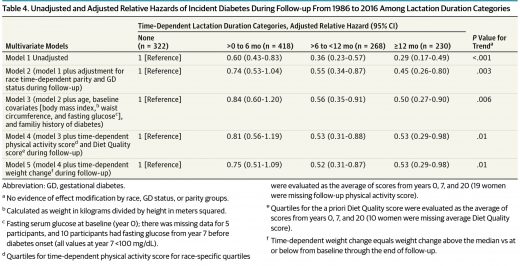
How did the authors of the new paper account for the association between maternal education and income and both breastfeeding rates and rates of adult onset diabetes? They didn’t. That’s especially disconcerting when their own data (buried in Table 3) indicated a statistically significant difference in failure to graduate from high school [15% vs 13%; p <0.001] between those who developed diabetes and those who did not.

Adjusted models included covariables: examination years (time), race, family history of diabetes, baseline age, fasting glucose, BMI and waist circumference, time-dependent GD, parity and physical activity, and dietary quality score. Trend P values were generated from models of continuous time-dependent lactation duration. We evaluated potential confounders based on a priori hypotheses for selected baseline (BMI, fasting blood glucose and lipids, HOMA-IR, blood pressure, sociodemographics), and follow-up (smoking, dietary quality, physical activity, hypertension, medication use, and pregnancy outcomes) covariates.

C0E7BEBB-3DC1-4AF0-B317-31FC79F547A2

Maternal education and income were ignored. And that makes the study worthless.

The authors blithely ignore their failure; they don’t deign to mention it in their self-reported limitations of the study despite the fact that it is the most critical — and inexcusuable — limitation of all.

The authors claim:

Our findings may have implications for social policies to extend paid maternity leave to achieve higher intensity and longer duration of breastfeeding. Second, increased allocation of health care resources to increase breastfeeding rates through the first year postdelivery may be offset by lower health care costs associated with prevention of chronic disease in women. It is also imperative to improve breastfeeding practices to interrupt the transgenerational transmission of obesity-related diseases. Lactation is a natural biological process with the enormous potential to provide long-term benefits to maternal health, but has been underappreciated as a potential key strategy for early primary prevention of metabolic diseases in women across the childbearing years and beyond.

Wrong! Their findings have no implications at all because they showed nothing beyond what we already knew: both breastfeeding and diabetes are associated with maternal education and income.

It’s yet another example that at this point breastfeeding research has become a self-reinforcing farce. Researchers assume breastfeeding is beneficial and then go searching for the benefits without bothering to correct for critical variables that are well known to be confounders for both health status and breastfeeding incidence.

That’s not science; that’s bullshit.

Anti-vaccine sentiment: a mile wide but an inch deep

6084144C-49AA-4FEC-A5F3-D91AD9D2175D

In the wake of the Disneyland measles outbreak, I wrote about what I believe to be the drivers of anti-vaccine sentiment: privilege, defiance and parental ego.

We have to confront anti-vax parents where they live — in their egos. When refusing to vaccinate your children is widely viewed as selfish, irresponsible, and the hallmark of being UNeducated, anti-vax advocacy will lose its appeal.

It turns out that it was even simpler than that. Anti-vaccine sentiment collapses nearly completely when it costs parents time or money.

[pullquote align=”right” cite=”” link=”” color=”” class=”” size=””]Anti-vaccine sentiment collapses as soon as a parental cost is imposed.[/pullquote]

That’s the take home message from Emily Oster’s piece in today’s NYTimes, After a Debacle, How California Became a Role Model on Measles:

Data from a county-by county analysis shows that in many schools with the lowest vaccination rates, there was an increase of 20 to 30 percentage points in the share of kindergartners vaccinated between 2014 and 2016. One law changed the behavior of impassioned resisters more effectively than a thousand public service announcements might have.

That law was California SB 277 and it barred unvaccinated children without medical exemptions from public and private schools. For parents, it suddenly imposed a personal cost to anti-vax sentiment; the price for belief in pseudoscience became the need to homeschool your children. Vaccine rejection collapsed, especially in schools where anti-vax sentiment was driven by privilege, defiance and parental ego.

At the Berkeley Rose School, in Alameda County, only 13 percent of kindergarten students were up to date on vaccinations in 2014…

In the Berkeley Rose School, a private Waldorf school, all of the unvaccinated students (87 percent of the kindergartners) had personal belief exemptions…

By 2016, 57 percent of entering students were vaccinated — a huge change, and that was only in the first year of the law.

When there was apparently no personal cost to refusing vaccination, 87% of the parents refused. As soon as a cost was imposed, the refusal rate was immediately cut in half to 43%. No doubt it’s been cut further still in the past year.

The same thing is happening in Australia with the “No Jab, No Pay” policy.

As the Washington Post reported:

…[A] year ago, the country’s leaders took action. They launched the succinctly titled No Jab, No Pay campaign, which said simply — if you don’t vaccinate your kids, we’re not going pay out the customary $11,500 child-care welfare credit to you. “Conscientiously objecting” on nonmedical grounds wasn’t an option anymore. And all parents had to report their kids’ status to the centralized Australian Childhood Immunisation Register. Parents were given until March 2016 to get their children on track.

…[A] year in, it looks as though the program has had some success. Because of the policy, 200,000 more children received their vaccinations.

When there was apparently no personal cost to refusing vaccination, the parents of more than 200,000 children refused. As soon as they were hit in the pocketbook, the refusal to vaccinate evaporated.

In both California and Australia, anti-vaccine sentiment was a mile wide but only an inch deep. Anti-vaccine sentiment never really reflected fear of vaccine harm; it was just a status symbol among the privileged. It collapsed as soon as a parental cost was imposed.

As Oster notes, regarding California:

When SB 277 was passed, people worried about the possible effects: Would children be pulled out of school? This concern was misplaced. Over all, there has been no change in enrollment, even in schools with the lowest vaccination rates in 2014. People worried that parents would substitute (fake) medical exemptions for belief exemptions. This did happen, a little, but not nearly enough to offset the increases.

In the end, the effect of the law was simple: More children were vaccinated, and the risk of disease outbreaks has gone down.

What does this tell us?

It tells us that anti-vaccine sentiment doesn’t represent principled opposition to vaccines.

If parents truly thought that vaccines were harming their children, barring those children from public and private schools (California) or reducing the child care tax credit (Australia) would have almost no impact on vaccination rates. Parents, fearing serious injuries to their children, would simply homeschool them or do without the tax credit. But when the rubber hits the road — when refusing vaccines imposed a cost on them — parents decide they aren’t really that worried about vaccines after all.

False reassurance, the medical error killing new mothers

EAA71D46-FA34-4E12-9C4E-BEFE8D592B85

When people think about medical errors they imagine mistakes like prescribing the wrong medication, performing the wrong surgery, or leaving a sponge inside a patient. Sadly, there are many technical errors like this, but often the worst medical errors — and the most insidious — are the simplest. Indeed, it’s hard to imagine anything that kills more patients than false reassurance.

As I’ve followed and written about the ProPublica/NPR series on maternal mortality I’ve been struck by many pregnant and postpartum women have died or nearly died from false reassurance. Yesterday I wrote about how Serena Williams nearly died from a pulmonary embolus when the nurse falsely reassured her that her difficulty breathing was due to confusion from medication. ProPublica/NPR highlighted the case of Shalon Irving, who died of post partum pre-eclampsia after receiving multiple reassurances from a midwife that her weight gain, swelling and other symptoms weren’t anything to worry about. The series began with the story of the death of Lauren Bloomstein, a women in the throes of full blown HELLP syndrome (a variant of pre-eclampsia) who complained repeatedly about severe abdominal pain and was falsely reassured.

[pullquote align=”right” cite=”” link=”” color=”” class=”” size=””]We are falsely reassuring new mothers to death.[/pullquote]

“Listen to your patient, [s]he is telling you the diagnosis.”

Those are the words of William Osler (1849-1919) often called the Father of Modern Medicine for his contributions to the development of medical education. I first heard them from the chief of surgery at the beginning of my internship. It is almost always true, the patient is almost always telling you the diagnosis, but listening is harder than you might think. That’s because most patients are simultaneously offering a lot of extraneous information, and some patients are not complete or completely honest in the information they offer.

Listening is even more difficult on contemporary labor & delivery and postpartum floors as the societal emphasis has shifted from preventing deadly complications to crafting a birth “experience.” Listening is especially difficult for nurses in obstetrics who are are inundated with propaganda that unmedicated vaginal birth is superior, C-sections are a failure and that the most important postpartum nursing task is not saving lives but promoting breastfeeding.

OB and postpartum nurses, and to a lesser extent obstetricians themselves, have become experts in gaslighting pregnant and postpartum women.

Don’t worry; your baby isn’t moving less. He just has less room to move now.

Don’t worry; your headache isn’t serious. It’s just nerves.

Abdominal pain after birth? Don’t worry; that’s normal.

Or in the case of Serena Williams, this mindboggling exchange:

Short of breath off your daily anticoagulant that you take for a history of a near fatal pulmonary embolus? No, you’re just confused by your pain medication.

It’s as if everyone has developed collective amnesia of the fact that pregnancy, in every time, place and culture (including our own) has ALWAYS been one the leading causes of death of young women.

Everyone involved in the care of women giving birth should have a high index of suspicion for life threatening complications and instead they’ve been fooled into developing a low index of suspicion. As ProPublica noted:

Earlier this year, an analysis by the CDC Foundation of maternal mortality data from four states identified more than 20 “critical factors” that contributed to pregnancy-related deaths. Among the ones involving providers: lack of standardized policies, inadequate clinical skills, failure to consult specialists and poor coordination of care. The average maternal death had 3.7 critical factors.

Maternal deaths and serious complications often involve a myriad of these factors, but the most important is the one that isn’t mentioned: the low index of suspicion. You can’t diagnose a complication if you’ve been taught that complications are rare and doing nothing is the best response. When providers falsely believe that pregnancy is inherently safe when in reality it is inherently dangerous, nurses and even some doctors will insist that everything is fine even while a woman is dying before their eyes. Complacency is deadly.

This complacency is driven by ideology, not by science. Gallons of ink have been spilled on advancing the obsessions of privileged, mostly white women — the C-section rate, the induction rate, epidurals and promoting breastfeeding — while ignoring the deadly problems that are literally killing new mothers: cardiac disease in pregnancy, pre-existing chronic conditions, hemorrhage and blood clots. What’s worse is that when women present with these deadly complications they don’t get lifesaving medical care, they get gaslighted.

The single most important factor in diagnosing life threatening complications is listening to patients. Instead we are falsely reassuring them — to death.

Serena Williams almost becomes a maternal mortality statistic

66CAC6C0-DD78-45CA-87F0-5D53CD72851C

Serena Williams holds many wonderful statistical records in tennis, but recently she nearly became a tragic maternal mortality statistic. Her experience further illuminates the shape of the maternal mortality problem.

Maternal mortality is disproportionately a problem of black women with pre-existing health conditions. All too often it involves poor medical care, specifically assuming pregnancy complications are rare when they are common. In Williams case, she literally had to save her own life.

[pullquote align=”right” cite=”” link=”” color=”” class=”” size=””]Serena Williams literally had to save her own life.[/pullquote]

According to Vogue Magazine:

Though she had an enviably easy pregnancy, what followed was the greatest medical ordeal of a life that has been punctuated by them. Olympia was born by emergency C-section after her heart rate dove dangerously low during contractions…

The next day, while recovering in the hospital, Serena suddenly felt short of breath. Because of her history of blood clots, and because she was off her daily anticoagulant regimen due to the recent surgery, she immediately assumed she was having another pulmonary embolism.

Williams had a history of a near fatal pulmonary embolism. A blood clot that developed in her leg traveled to her lungs and almost killed her. The problem was so serious and the risk of recurrence (and death) was so high that Williams needed to take anticoagulants daily. This is a major isue in and of itself but is further exacerbated by pregnancy which always increases the risk of blood clots above a woman’s pre-pregnancy risk.

A history of pulmonary embolus requires specialized management in pregnancy. The best daily anti-coagulant, coumadin (warfarin) is teratogenetic. Pregnant women must be switch to an anti-coagulant compatible with pregnancy, typically injectible heparin. The anti-coagulant must be carefully dosed during the last weeks of pregnancy and suspended altogether during labor in order to prevent excessive bleeding at the time of birth; the risk of excessive bleeding is even higher if a C-section is needed.

In the immediate aftermath of birth, the risk of blood clots remains very high so anticoagulants must be restarted within 6-12 hours after vaginal birth and between 12-24 hours after a C-section. While anticoagulants are suspended, the mother is extremely vulnerable and should be monitored closely.

Instead, Williams had to diagnose her own life threatening complication and then convince the nurse of its seriousness.

She walked out of the hospital room so her mother wouldn’t worry and told the nearest nurse, between gasps, that she needed a CT scan with contrast and IV heparin (a blood thinner) right away. The nurse thought her pain medicine might be making her confused.

The nurse thought the pain medication might be making her confused? Did the nurse have any idea of the risks to this particular patient? Apparently not. Instead, like all too many people who care for pregnant and postpartum women she assumed that everything was fine.

But Serena insisted, and soon enough a doctor was performing an ultrasound of her legs. “I was like, a Doppler? I told you, I need a CT scan and a heparin drip,” she remembers telling the team. The ultrasound revealed nothing, so they sent her for the CT, and sure enough, several small blood clots had settled in her lungs. Minutes later she was on the drip. “I was like, listen to Dr. Williams!”

Williams was absolutely correct. She needed an immediate CT scan (the appropriate diagnostic test for a pulmonary embolus) and IV heparin. Instead she was subjected to a useless screening test that wasted precious time. There is no excuse for the delay in her treatment.

But this was just the first chapter of a six-day drama. Her fresh C-section wound popped open from the intense coughing spells caused by the pulmonary embolism, and when she returned to surgery, they found that a large hematoma had flooded her abdomen, the result of a medical catch-22 in which the potentially lifesaving blood thinner caused hemorrhaging at the site of her C-section. She returned yet again to the OR to have a filter inserted into a major vein, in order to prevent more clots from dislodging and traveling into her lungs.

These were unfortunate complications that could have been predicted, but almost certainly could not have been prevented. Preventing a pulmonary embolus took priority over everything including bleeding into her incision. You can replace blood loss, but it is almost impossible to save someone from a massive pulmonary embolus. The decision to place a filter into her inferior vena cava was the appropriate response. It’s an invasive procedure but it prevents blood clots from traveling to the lungs and eliminates the need for any anti-coagulation.

Williams’ near death experience highlights the failure of our healthcare system in preventing maternal mortality. We know who is at risk and we know how to minimize that risk, yet in practice we ignore those risks, fail to employ the interventions that are needed, and falsely reassure women when they tell us they are ill.

The true scandal here is not that Williams nearly died; that was foreseeable. The scandal is that Williams had to save her own life; that’s inexcusable!

Claiming breastfeeding is optimal for babies is like claiming Volvos are optimal for babies

A50FC612-221B-43C9-B092-FCBD4420C48C

Volvos are widely recognized as the safest cars on the road.

The National Highway Traffic Safety Administration announced today [June 7. 2017] that Volvo Cars will receive an award for its continued focus on safety. Of course, Volvo changed the car industry—and essentially invented the concept of highway safety—in 1959 when it released a patent for the three-point seatbelt to other automotive companies…

The NHTSA agrees that Volvo is the leading company in automotive safety technologies, as it looks for the most cutting-edge safety systems and holds its cars to the highest standard of protection. To do this, Volvo needs the most adept safety consultants to help build cars that will keep its drivers in one piece and significantly decrease fatalities on the road. The NHTSA has found these qualities in Magdalena Lindman and Per Lenhoff, both high-ranking members of the Volvo Cars Safety Centre. They developed many of the challenges in Volvo’s rigorous safety testing program, analyzing countless real-life accidents and simulating them to prepare each new Volvo for any dangerous situation.

For most parents, the welfare of their babies is paramount; therefore Volvos, as the safest cars, are optimal for babies. Any mother who doesn’t drive a Volvo is a sub-optimal parent, right? She is obviously too lazy and self-absorbed to put her child’s wellbeing first.

[pullquote align=”right” cite=”” link=”” color=”” class=”” size=””]A good mother drives a Volvo; breastfeeding is not enough.[/pullquote]

Wait, what? You disagree? But it’s not a matter of opinion; it’s SCIENCE. Science shows — both in the lab and on the road — that Volvos have the most advanced safety features and the best safety records. Disagreeing that Volvos are optimal is an effort to compensate for your sense of inferiority from your failure to provide your child with the very best.

You use the safest possible car seat? Are we supposed to be impressed by that? Let’s face it, safe car seats are the bare minimum; “Volvos are Best.”

You worry that if you bought a Volvo, you couldn’t afford your mortgage or food for your older children? Get your priorities in order. There is NOTHING more important than providing your baby with optimal transportation.

You feel guilty that you didn’t buy a Volvo? Sorry, but your guilt is not a reason to deny the truth. It is more important to protect babies lives than to protect your feelings.

You feel bad that you can’t afford a Volvo? Good! You should feel bad. How dare you have children if you don’t intend to buy the optimal car?

Wait, what? You think there is more to raising children than the car your drive? What’s more important than whether your infant lives or dies?

You think your own needs and priorities matter? Get a grip. Only selfish mothers consider their own needs.

How do Volvos compare with breastfeeding? Car accidents are a major cause of infant mortality. Safer cars save lives. Breastfeeding is not nearly so important. The benefits of breastfeeding in industrialized countries are trivial, limited to 8% fewer colds and episodes of diarrheal illness across the entire population of infants in the first year. In other words, the majority of infants will experience NO benefit from breastfeeding.

How dare a women gloat that she is breastfeeding and therefore providing her infants with optimal nutrition if she doesn’t drive a Volvo to provide her infant with optimal transportation?

A good mother drives a Volvo; breastfeeding is not enough.

Breech deaths are vanishing; why would anyone want to bring them back?

Sad mother missing her daughter

The folks at VBACFacts are shocked, shocked that breech vaginal birth is discouraged.

It’s time to summon all that passion you have for patient autonomy and take some action!

Let’s support Dr. Annette Fineberg and flood this hospital with letters!

The following is copied from a fellow birth advocate in California:

“I’m so sad right now. Like in tears.

Dr. Annette Fineberg at Sutter Davis is being pressured to stop supporting vaginal breeches. She’s by far our best option around.

She’s asking for our help collecting stories to convince the administrators to continue to allow her to openly offer this option. This is huge! …

Dr. Fineberg is one of very few OBs within driving distance of the Bay Area skilled in breech birth. She’s also the only ‘local’ OB breech expert who actively supports/encourages people with breech babies to birth in non-lithotomy positions and labor in the tub prior to stage two — and she is the only one who doesn’t pressure them to get epidurals.

According to Dr. Fineberg:

[pullquote align=”right” cite=”” link=”” color=”” class=”” size=””]The death rate from vaginal breech is more than 1000% higher than the death rate from SIDS.[/pullquote]

I am getting a lot of pressure to stop attending breech and despite my best efforts to get privileges at a tertiary care hospital with neonatology, it is not happening.

Why is Dr.Fineberg being “pressured”? Because breech deaths are vanishing and no one wants to bring them back.

What’s the death rate from vaginal breech. It is approximately 6/1000. That sounds like a small number, too small to be concerning, right? Not exactly. The death rate from vaginal breech is more than 1000% higher than the death rate from SIDS. It doesn’t sound like a trivial risk of death when you put it like that, does it?

We have spent literally millions of dollars trying to change the habits of parents and caregivers in order to prevent SIDS deaths. We’ve heavily promoted a regimen of putting babies to sleep on their backs even though that does not happen in nature, leads to poorer quality sleep, and has created an epidemic (200,000 cases per year) of tiny babies wearing tiny helmets to correct iatrogenic plagiocephaly (flat head syndrome).

We think that’s entirely appropriate in order to prevent deaths from SIDS that occur at the rate of 0.54/1000 babies. Doesn’t it make sense that we would want to prevent the much greater (6/1000) risk of death from breech birth?

There’s even greater urgency for hospitals and malpractice insurers to prevent death from breech birth. When a baby dies fo SIDS because a parent or caregiver put the baby to sleep face down, there may be recriminations but there is generally no one to be sued. In contrast when a baby dies as a result of attempted breech birth, there’s always someone or several someones with deep pockets (including neonatologists and others who had nothing to do with the decision) who can be sued.

While parents might not sue for a baby who dies, they will almost certainly sue for a baby who sustains severe brain damage because the costs of caring for such children are astronomical. No matter how much the mother avers that she understands the risk, no matter how many consent forms she signs, she will insist in her lawsuit that she didn’t understand that it could happen to her baby and she certainly didn’t understand the aftermath of caring for a severely disabled child. When hospitals prohibit breech vaginal births, they aren’t merely protecting babies; they are protecting themselves and their staff.

Does a mother have a right to have a breech vaginal birth? Of course she does, just like she has the right to lay her baby face down to sleep. Neither is illegal and both are fully within the purview of autonomous adults. But that doesn’t mean she has a right to force hospitals and doctors to attend her while she attempts that breech vaginal birth just like it doesn’t mean that she has the right to force daycare centers to put her baby to sleep facedown.

If you met a mother who proudly told you that she ignores the “back to sleep” recommendation because the risk of SIDS is tiny, would you be impressed? Would you consider her a brave, transgressive proponent of maternal autonomy or would you be horrified that she was willing to risk her baby’s life? I suspect that most people would be horrified.

So why would anyone be impressed with a mother who wished to to expose her baby to a 1000% times greater risk of death at vaginal birth? Breech deaths are vanishing; why would anyone want to bring them back?

Dr. Amy