Reinforcing privilege through maternal foodwork

Mother cooking in blender pure for baby

One of the most important aspects of being privileged — whether that is through race, class or the size of your bank account — is to make sure everyone else knows that you are privileged. That’s just as true about motherhood as in any other area. It can be accomplished through conspicuous consumption (extraordinarily expensive strollers, designer baby clothes, live-in help) but in recent years a more subtle form of demonstrating privilege has become popular. Maternal foodwork is an example of this new way to demonstrate privilege.

[pullquote align=”right” cite=”” link=”” color=”” class=”” size=””]Organic food is a form of conspicuous consumption, albeit less flashy than designer clothing.[/pullquote]

As Joslyn Brenton explains in The limits of intensive feeding: maternal foodwork at the intersections of race, class, and gender:

…[M]others today confront increasing social pressure to embody perfection through their foodwork… Extending Hays’ concept of intensive mothering, rich descriptions of feeding children reveal how mothers in this study are discursively engaged with what I call an ‘intensive feeding ideology’ – the widespread belief that good mothering is synonymous with intensive food labour…

Intensive foodwork is yet another expression of the intensive mothering ideal:

… that defines good mothers as those who invest intense emotional and physical labour, as well as significant financial resources, into maximising their children’s potential. This ideology remains the gold standard to which all mothers are held, regardless of their resources…

In a foodscape that encourages mothers to take individual responsibility for keeping children safe and healthy, middle-class mothers in particular may see engaging in expensive and time-consuming food strategies, such as purchasing and preparing organic food and making foods from scratch, as a demonstration of good mothering. Such acts are associated with a deep maternal love and commitment to protecting children’s symbolic purity.

Those engaged in intensive maternal foodwork may claim — and may even believe — that they are improving their children’s health, but the primary purpose of intensive foodwork is to demonstrate privilege.

Intensive feeding encompasses a combination of activities, including shopping at multiple grocery stores for the healthiest foods; finding ways to stretch the family budget to buy organic food; navigating nutritional information and expert feeding advice; negotiating food with children; and teaching children how to develop a taste and preference for particular foods.

Hence women are preparing their own baby food:

Homemade baby food, argues sociologist Amy Bentley, ‘signifie[s] a type of conspicuous consumption, an elite economic and cultural status conferred by virtue of having the option of extra time and energy to make baby food from scratch’.

It’s not healthier than commercially prepared baby food; it’s a demonstration of privilege. And it allows women who practice intensive foodwork to look down upon women who don’t.

For mothers who embrace the ideology of intensive feeding, it is not simply one of many feeding strategies. It is articulated as the strategy well-educated mothers would naturally opt for. Mothers striving for this ideal felt they were outliers compared to other parents, whom they constructed as less educated and less willing to put in the time needed to raise healthy children.

Though it is not discussed in this paper, breastfeeding represents the apogee of intensive maternal foodwork. Breastfeeding requires significant time, significant effort, the ability to remain out of the workforce for months/years or to hold a high status job that is compatible with privately pumping breastmilk multiple times per day. That’s why most of the supposed advantages of breastfeeding disappear when data are corrected for maternal educational and socio-economic status. Breastfeeding doesn’t improve infant health; being privileged enough to be able to breastfeed improves infant health.

Purchasing organic food is another example of the way that maternal foodwork reinforces privilege. Organic food is not healthier than conventionally grown food, but it is far more expensive. It is just a form of conspicuous consumption, albeit less flashy than designer clothing.

Not surprisingly, black mothers may associate intensive maternal foodwork with “whiteness”:

…[M]any black mothers implicitly associated healthy eating with white spaces – like expensive grocery stores – or white foodways, such as the kind of self-deprivation that leads to disordered eating commonly associated with white middle-class women…

When women feed their families they are often reproducing … dominant norms about white middle-class femininity and motherhood. These narratives of foodwork demonstrate that feeding strategies are about far more than health; they are intimately linked to race, class and gender hierarchies…

The author concludes:

Current discourse surrounding health and ethical consumption often promotes expensive ways of eating, and is also ‘linked to ways of performing Euro-Canadian whiteness’. To the extent that embodying these feeding practices defines good mothering, intensive feeding marginalises not only poor mothers, but all mothers of colour, regardless of class…

Intensive foodwork doesn’t make a woman a better mother, just a privileged one.

Social media leaves natural parenting advocates both ignorant and indignant

Social media

Social media is the lifeblood of the natural childbirth and lactivists movements; advocates have been fattened on alternative “facts” and therefore rendered ignorant of the truth and indignant at anyone who dares to correct them.

Consider this Facebook comment from Scarlett Lynsky:

IMG_2220

Amy Tuteur- Professional Troll, Woman with a Vendetta. Angry at anyone who breastfeeds or gives birth without medication and anyone who supports them. Just, like, a life of angry trolling on the internet. I hope you get happy someday, Amy, because this is a weird life you’ve chosen.

It’s a perfect illustration of the ignorance, indignation and inability to tell the difference between disagreement and criticism that characterize both lactivism and natural childbirth.

[pullquote align=”right” cite=”” link=”” color=”” class=”” size=””]It is infinitely more gratifying to imagine that breastfeeding makes some mothers superior, but the doesn’t make it true no matter how relentlessly social media insists.[/pullquote]

What provoked it? I dared to correct the faux “facts” of lactivist Lucy Martinez Sullivan’s in her HuffPo piece The National Scandal Of Newborn Deaths And Why Support For Breastfeeding Moms Matters.

I posted this meme:

IMG_2208

The real scandal here is the way that Martinez Sullivan exploits the tragedies of poor women and women of color to promote full employment for lactation professionals.

The biggest risk factors for infant death in the US are race and class. There is no evidence that breastfeeding make much of an impact on infant mortality and no reason to think it would. Sure, breastmilk can reduce the incidence of necrotizing enterocolitis and thereby lower the death rate for very-low birthweight infants, but that accounts for only a small fraction of infant deaths. Over the past 100 years, breastfeeding rates have dropped dramatically and then risen again; there has been no impact on infant mortality by either of those trends. No one can point to any term infants whose lives have been saved by breastfeeding.

I don’t know if Martinez Sullivan is ignorant of this reality or merely willing to exploit it for her own ends, but I do know lactivist organizations as well as natural childbirth organizations use social media to create a carefully curated faux “reality” and then lash out at those who dare to point out that it isn’t reality at all.

That’s George Will’s point in The ‘alternative facts’ epidemic goes way beyond politics. Quoting Tom Nichols author of The Death of Expertise: The Campaign Against Established Knowledge and Why It Matters, he notes:

Our devices and social media are … producing people who confuse “Internet grazing” with research and this faux research with higher education …

As Carolyn Stewart writes in The American Interest:

We recuse ourselves from reality via the device in our hand, which rewards us for ignoring reality with a series of dopamine-releasing mini-tasks. From Candy Crush and Twitter to work emails, these activities hook us on a seeking-reward feedback loop that is infinitely more gratifying than staring at the commuter sitting across from you. These cyber preoccupations allow us to customize our surroundings, and accustom us to regulating and controlling the information that comes our way. This has several effects: an expanded sense of what falls under our personal social domain, an increased expectation of control over that domain, and a greater sensitivity to input that deviates from our preferences.

Lactivism and natural childbirth webpages, Facebook pages and Twitter feeds encourage lactivists and natural childbirth advocates to believe they have “done their research,” are in possession of “knowledge,” and are battling for the dissemination of knowledge to others. The reality is that they have read propaganda, are in possession of propaganda, and are battling for the dissemination of propaganda to others.

As Will explains:

In today’s therapeutic culture, which seems designed to validate every opinion and feeling, there will rarely be disagreement without anger between thin-skinned people who cannot distinguish the phrase “you’re wrong” from “you’re stupid.”

The Facebook comment above perfectly illustrates the inability of lactivists and natural childbirth advocates to distinguish between “you’re wrong” and “you’re stupid.”

Lucy Martinez Smith wrote a piece that flagrantly ignores facts about breastfeeding in an effort to promote full employment for breastfeeding professionals like herself. Breastfeeding is not perfect; it doesn’t save the lives of term babies; and it has little if anything to do with the tragedy of US infant mortality.

But Scarlett Lynsky heard none of that. She simply cannot tell the difference between “breastfeeding doesn’t save lives” and “you are angry at anyone who breastfeeds and anyone who supports them.” Considering that I breastfed four children, that’s obviously nonsensical, but the a steady diet of social media seems to erode the ability to think logically.

Pointing out that breastfeeding is not lifesaving is NOT the same as saying that breastfeeding is hateful. But social media has so warped the senses of lactivists and natural childbirth advocates that they believe they are entitled ignore facts or create new ones to keep the hits of dopamine coming.

Not surprisingly, it is infinitely more gratifying to imagine that breastfeeding makes some mothers superior to others. But the doesn’t make it true no matter how relentlessly your customized social media environment insist that it does.

Heads up, lactivists! Nature doesn’t care if your baby lives or dies.

IMG_2218

Breastfeeding is excellent.

If lactivists confined themselves to that message, they’d be on solid ground. Instead they insist that breastfeeding is perfect. Since nothing in nature is perfect, their aggressive efforts to promote breastfeeding are leading to injuries and deaths. And in attempting to justify those injuries and deaths, blithering idiots write pieces like This is Why I am Fed Up with “Fed is Best.”

[pullquote align=”right” cite=”” link=”” color=”” class=”” size=””]Nature does not intend that every baby will survive.[/pullquote]

According to Lauren Lewis:

As a childcare provider, mama, and breastfeeding advocate, I LOVE me some fact-based research. So if your argument is that the slogan “fed is best” is more supportive than “breast is best”- know that it just isn’t factually correct. Saying that “Fed is Best” takes away the message behind “Breast is best” the exact same way that “All lives matter” takes away from “Black lives matter”- it is completely missing the point of the campaign in the first place.

So much stupidity in so little space.

Let’s start with the “Black lives matter” reference. “Black lives matter” is an elliptical sentence. An elliptical sentence is one that is missing important information, but that information can be understood from context.

“Mary runs faster than John” is an elliptical sentence. The full sentence would be “Mary runs faster than John runs.” The full sentence uses the verb runs twice; the elliptical sentence uses it only once but the second use is understood from context.

“Black lives matter” is elliptical. The full sentence is “Black lives matter as much as white lives.” Those who invoke “all lives matter” as if that counters “black lives matter” are deliberately ignoring the fact that it is an elliptical sentence in order to score political points.

Similarly, “Fed is Best” is also elliptical. The full sentence is “Fed is best compared to inadequate amounts of any specific food.” Breast is best is also an elliptical sentence. It stands for “breastmilk is better than formula,” but the truth is that adequate amounts of formula beats inadequate breastfeeding every time.

The author of the piece betrays more than just a misunderstanding of grammar. Like many lactivists, she doesn’t understand either physiology or evolution, either.

Lactivists like the author engage in motivated reasoning. If breastfeeding isn’t the perfect way to feed each and every baby, then they can’t be sure that they are perfect mothers. But by insisting on the perfection of breastfeeding lactivists betray more than their insecurities. But what they fail to understand is that “Nature” does not intend that every baby will survive.

Infant mortality rates in nature are astronomical. Babies die from congenital anomalies, prematurity, dehydration, starvation, vaccine preventable diseases and accidents among other causes. Genetic and chromosomal abnormalities are astoundingly common. Fully 20% of pregnancies end in miscarriage, almost all because of genetic defects. “Nature” could care less. If only 80% of fertilized eggs are perfect, why would breastfeeding be perfect?

Approximately 12% of babies are born prematurely, and until very recently, most premature babies died. “Nature” didn’t care. If only 88% of babies know when to be born, why would breastfeeding be perfect?

Smallpox is an entirely natural virus. The human immune system can naturally make antibodies to smallpox but, in the absence of vaccination, 20%-30% of people will die before they can produce enough antibodies. There have been repeated smallpox epidemics through history and “Nature” didn’t do anything to stop them. If immunity isn’t perfect, why would breastfeeding be perfect?

It wouldn’t, obviously.

Yet, the author believes this nonsense:

The biological norm is what keeps babies alive.

Actually, the biological norm results in massive numbers of dead babies. It’s all the same to “Nature” if a mother gives birth to 10 babies and 7 die then if a mother gives birth to only 3 babies who live.

The author quotes the World Health Organization:

Saying that “Fed is Best” takes away the message behind “Breast is best” the exact same way that “All lives matter” takes away from “Black lives matter”- it is completely missing the point of the campaign in the first place.

Sadly, even the WHO sometimes comes up with absolute bullshit. The WHO claims are based on statistical modeling, not actual population data. For most of human history all babies were breastfed and infant mortality was very high. Breastfeeding is not protective against most of what kills babies. Moreover, many of the countries in the world with highest infant mortality rates have breastfeeding rates approaching 100%.

The author ends with typical lactivist lie:

Lactation Consultants, Doulas, midwives, breastfeeding advocates — even lactivists — are NOT SHAMING parents who choose to promote the benefits of breastfeeding. We are just trying to help parents who WANT to breastfeed.

Who does she think it stupid enough to believe that?

Curiously, the author is right about one thing.

She insists that “Fed is minimum.” Well, yes, fully fed is the minimum that every mother ought to provide. If your baby is not fully fed, regardless of whether you are breastfeeding, you haven’t even reach the minimum that your baby needs. In that circumstance breast isn’t merely inferior; it can be deadly.

Breastfeeding — like pregnancy, childbirth and the immune system — has a naturally high failure rate. Nature doesn’t care whether an individual baby lives or dies just like it doesn’t care if an individual pregnancy ends in miscarriage. Nature makes it up in volume.

“Fed Is Best,” it’s shorthand for the truth:

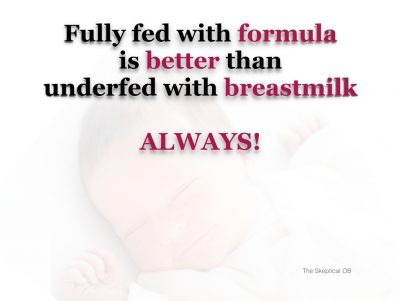
Fully fed with formula is better than underfed with breastmilk — ALWAYS!

Lactivists criticize the Fed Is Best Foundation because they’re desperate to shoot the messenger

IMG_2204

The lactivist attack on the Fed Is Best Foundation is a perfect example of shooting the messenger.

According to Wikipedia:

“Shooting the messenger” is a metaphoric phrase used to describe the act of blaming the bearer of bad news.

In this case, the bad news is that the relentless efforts to promote breastfeeding are leading to babies being injured or killed by accidental starvation.

[pullquote align=”right” cite=”” link=”” color=”” class=”” size=””]What’s the difference between formula companies letting babies die from contaminated water to increase market share and lactivists letting babies die from insufficient breastmilk to increase market share?[/pullquote]

From the lactivist point of view, the bad news brought by the Fed Is Best Foundation has three components:

  • Breastfeeding is not perfect.
  • Infant starvation is common.
  • The Baby Friendly Hospital Initiative (BFHI) hurts and even kills babies.

The Fed Is Best Foundation functions as an industry whistle blower and as in any industry, lactation industry leaders are desperate to suppress and discredit anyone who threatens maketshare. It is a sad irony that the lactation industry has become exactly what it despised about the formula industry. As its attacks on the Fed Is Best Foundation make clear, market share is more important than babies’ lives.

And even greater irony is that they use exactly the same tactics as Nestle, the avatar of the contemptible formula industry used:

  • Exaggerating benefits
  • Ignoring Risks
  • Claiming the imprimatur of “science”

Nestle also tried to shoot the messenger and the result should give pause to the critics of the Fed Is Best Foundation. Nestle brought libel charges in Germany:

Nestlé had a fast response to this event and decided to sue the publisher of a German-language translation of War on Want. The multinational corporation did not want to accept the allegations. After a two-year trial, in 1976 the court found in favor of Nestlé because they could not be held responsible for the infant deaths in terms of criminal law. The defendants were only fined 300 Swiss Francs (if adjusted to inflation, over US$400). The judge found the 30 members of TWAG guilty of libel.

It won the libel battle, but it lost the public relations war.

The first Nestlé boycott in 1977 has been led by Infant Formula Action Coalition (INFACT) and had a large negative impact on Nestlé’s revenues… The boycott campaigners set a goal to improve total infant nutrition and health of babies throughout the Third World countries as well as to resolve this issue on a global basis.

The boycott against Nestlé’s products and the infant formula manufacturers generated the largest support of the consumer movement in North America, and its impact has still been felt in the industry around the world. The Nestlé boycott has been lasting for 7 years in 65 countries and ended in 1984 after the world’s leading organizations took a variety of restrictive actions against Nestlé. The company lost more than $5.8 million in revenues.

By relentlessly attempting to discredit the Fed Is Best Foundation, the lactation industry seems determined to repeat Nestle’s mistake: win the battle yet losing the public relations war. That’s despite the fact that the lactation industry has an advantage that Nestle did not have.

Nestle could not afford to acknowledge the risks of their product. The water in third world countries was often contaminated, and the poverty of the purchasers led to them to dilute the product thereby harming their babies. Informing women of these risks would have dramatically reduced the number of women purchasing formula.

In contrast, acknowledging the risks of breastfeeding would not mean a drop in market share for the lactation industry. Women could still breastfeed and supplement with formula when necessary. But breastfeeding is more than just a business decision for the lactation industry; it is a lifestyle decision. Acknowledging that other mothers may have valid reasons for using formula might diminish lactivists’ sense of superiority regarding their own ability to exclusive breastfeed. That is apparently an intolerable sacrifice.

But the lactation industry, like Nestle before it, is fighting against the truth and will inevitably lose:

Breastfeeding has real risks and refusing to acknowledge them discredits lactivists, lactation consultants and the breastfeeding organizations like La Leche League and the BFHI.

Shooting the messenger, in this case the Fed Is Best Foundation, calls the credibility of the lactation industry into question. Attempting to silence an industry whistle blower often precipitates a public relations debacle.

Most importantly, heartless behavior — letting infants scream in hunger, suffer injuries from dehydration and low blood sugar, and even die — is profoundly immoral. That’s what Nestle did and they paid the price. Surely the lactation industry can learn the lesson that letting babies die in order to preserve market share is not merely deeply unethical, but unprofitable, too.

Kimberly Seals Allers, don’t bury dead babies twice

IMG_1778

Baby Landon Johnson died a preventable death from insufficient breastmilk, but he is making a big difference nonetheless.

Landon’s story has lit a fire under the breastfeeding industry. Oh, not to make sure that other babies don’t die, too. Be serious! The lactation industry has mobilized all its resources to prevent cognitive dissonance and loss of income.

[pullquote align=”right” cite=”” link=”” color=”” class=”” size=””]Ignoring a baby’s preventable death from insufficient breastmilk by claiming it is is rare is as immoral  ignoring a child’s preventable death from asthma by claiming it is rare.[/pullquote]

Lactation consultant Kimberly Seals Allers is simply the latest. She wrote Setting the Record Straight: Breastfeeding Saves Lives, Doesn’t Cost Lives; Beyond the Recent Headlines.

The subtitle is:

Getting beyond the headlines to the truth about recent stories of “breastfeeding-related deaths.”

Why is Landon’s death in quotes? Because Seals Allers, like other professional lactivists, are trying to bury him twice, (first from breastfeeding risks and second by being erased  from consciousness by lactivists).

Pro-tip: When a patient dies a preventable death it is heartless and unethical to pretend that death never happened.

Seals Allers writes:

Most importantly, we must not allow the media or any organization’s desire to sensationalize a rare occurrence turn into a dangerous, broad-based message that exclusive breastfeeding kills. That is categorically untrue and extremely irresponsible. In fact, decades of global research proves that exclusive breastfeeding consistently saves lives.

Let’s parse that paragraph:

1. Reporting a preventable death is not “sensationalizing” it and it is immoral to imply otherwise.

Health professionals should promote outcomes, i.e. healthy babies, a process, i.e. breastfeeding. Landon died because lactivists lied — to each other and to mothers. Lactivists have idealized breastfeeding to the point that it bears no relationship to reality.

Breastfeeding isn’t perfect because it’s natural; it’s imperfect precisely because it’s natural. Ignoring babies screaming from hunger by claiming insufficient breastmilk is rare because women were “designed” to breastfeed is no different from ignoring a child who is wheezing by claiming asthma is rare because children are “designed” to breathe. It reflects ignorance of physiology at best and heartlessness at worst.

2. Breastfeeding does kill.

The benefits of breastfeeding in industrialized countries are trivial, a few less colds and episodes of diarrheal illness across the entire population of infants in the first year. Indeed, around the world, the countries with the highest rates of infant mortality have breastfeeding rates approaching 100%.

The incidence of insufficient breastmilk (particularly in babies’ first most vulnerable days) is 15% or more. If breastfeeding disappeared tomorrow, no team baby’s life would change appreciably. If formula disappeared tomorrow, tens of thousands of American babies would die each and every year, let alone babies from other countries.

3. Decades of research does NOT prove breastfeeding saves lives.

It would be more accurate to say that decades of extrapolation from small studies predicts that breastfeeding might save lives in theory, BUT there’s no population based data that shows that breastfeeding saves the lives of term babies in reality.

I can point to studies that report hundreds of infant injuries and deaths from insufficient breastmilk and smothering in or falling from mothers’ beds in so-called “Baby Friendly” hospitals while Seals Allers can’t identify term babies who died as a result of properly prepared infant formula. Neither can Melissa Bartick, MD, the author of many of the studies that predict that breastfeeding saves hundreds or thousands of lives.

One paragraph, three bald-faced lies. No doubt Seals Allers believes what she is writing, but that doesn’t make it any less spurious or any less deadly.

Seals Allers also subscribes to the immature “reasoning” of lactivists that if you don’t praise breastfeeding, you must be trying to undermine it and whines that her feelings and those of her colleagues are being hurt by those who want to prevent the deaths of babies from breastfeeding

But I’m deeply concerned by the aggressive and mean-spirited comments posted by the founders on blogs and social media. People are being viciously attacked or blocked simply for expressing counter opinions and sharing important facts. There’s high school-ish name calling that’s downright nasty (please stand by and watch this comments section) and other tactics clearly designed to silence and control women. Is this the best way forward? Adopting tactics of aggression and using cyber bullying is not the modus operandi of a well-intentioned education campaign that merely seeks to caution mothers. With so much at stake, we owe it to our babies and ourselves to question the true intent here.

Oh, the irony. I can’t imagine a more vicious form of cyber bullying than denying both the deaths of babies and the lives experiences of hundreds of thousands of women as Seals Allers does in the very piece she has written.

Kimberly Seals Allers, if breastfeeding saves hundreds of thousands of lives each year, show us the changes in infant mortality as breastfeeding rates rise and fall that support that claim.

Show us a the scientific evidence that hundreds of term babies die in the US as a result properly prepared formula. Can’t do that, right?

Show us the scientific evidence that tens of term babies babies die in the US as a result of properly prepared formula. Can’t do that either, right?

If you can’t, stop trying to bury babies like Landon twice. It’s a tragedy that he was buried in a tiny coffin because lactation professionals reassured his mother he was doing fine at the same time that he was actually dying. Don’t compound that tragedy by trying to erase his death and ignore the lesson that we ought to learn from it:

Breastfeeding, like vision and like breathing, have very substantial failure rates. Pretending otherwise may ease your cognitive dissonance, but it condemns hundreds of babies to painful, preventable deaths.

The grossest form of birth art yet

Disgust

There is no limit to the self-idolatry that is contemporary natural childbirth advocacy.

It’s no longer enough to boast about your unmedicated vaginal birth, let your baby’s placenta rot off instead of cutting the cord, or photograph yourself smeared with postpartum blood.

[pullquote align=”right” cite=”” link=”” color=”” class=”” size=””]The mother is the painter and blood and excrement is create the palette. [/pullquote]

Apparently, if you are a birth goddess, even your excrement is worthy of veneration. That appears to be the message of “birth sheets,” a new form of birth art.

Birth sheets capture a new, messy, weirdly beautiful side of childbirth appears on BabyCenter.

Australia-based artist Suzie Blake doesn’t think her collection of women’s birth sheets should be as controversial as it is. She doesn’t see why birth secretions are being perceived as gross. In fact, the project is meant to elevate women and fight against the notion that anything having to do with birth should be revolting to anyone. It’s also intended to be a beautiful new way to capture childbirth.

Here’s an example:

[Example removed at the request of the “artist.” You can see examples here.]

According to Blake’s website, birth sheets are:

The indexical trace of childbirth in which mother is painter and blood is the palette.

Speaking to BabyCenter, she explains:

“Birth is raw and animalistic. It’s powerful and messy and unhinged. It’s hard work and it’s sweaty and bloody. It’s not this perfect, clean, white, sanitized experience we’re sold through cinema. If women keep believing that the things that their bodies do are disgusting and gross they will never be liberated and the perpetual cycle of body hating will continue,” Suzie told us.

Ultimately, she feels that women should appreciate what their bodies can do, instead of focusing on what they look like. She adds, “Why is it perfectly ok for the media to flood us with brutal images of war? Why is it ok for us to see extreme and bloody violence in cinema? Why is it ok for men to show us their experiences of blood, which usually relate to death, but when a woman reveals the blood excreted during birth it’s somehow more shocking, or ‘gross?’”

Call me old-fashioned, but I believe the miracle of birth is the baby, not the blood and excrement.

But the baby is a separate person; birth art, like most of natural childbirth advocacy, is the mother boasting about and worshipping herself.

As Melissa Willets, author of the BabyCenter piece points out:

…I love the birth sheet idea! It’s another memento of what we go through to bring a life into the world. I don’t see how it’s different from a placenta print, or an umbilical cord clipping, or photos taken by a birth photographer.

Of course you do. It’s yet another opportunity to celebrate the awesome “achievement” of doing exactly the same thing as all of the billions of mothers over the course of human history have done. Who wouldn’t be proud of their excrement in that situation?

Oh, right, people who recognize that the goal of childbirth is a new human being, not another opportunity to boost your own self-esteem.

Natural childbirth is the designer handbag of birth

IMG_2190

I just read a great piece on Ravishly, Natural Childbirth Is Great But Let’s Stop Pretending It’s A Matter Of Choice.

I agree with a lot that the author has to say:

Labor is excruciating.

[pullquote align=”right” cite=”” link=”” color=”” class=”” size=””]Natural childbirth is an affectation just like a designer handbag.[/pullquote]

…There was no warning, no gentle increase of pressure, just sudden stabbing pain, followed by incredible pain, followed by a pain that obliterated all of my other senses until I was just a small, pulsing ball of pure, radiating pain. And then the contraction ended, and I could think and see and speak again. And then, without warning, the pain would return. My mom stood over me, rubbing my back, encouraging me to “relax, breathe, relax,” but I couldn’t. My body was a muscle fully contracted. I couldn’t anticipate the pain so I couldn’t ease into it. It consumed me.

Epidurals are miraculous.

Take the worst pain you’ve ever felt. Double, triple, quadruple it. Reset your entire pain scale so that instead of 1-10 it now goes 1-1,000. And then stop it completely. Replace it with a gentle tickling sensation. The epidural took the pain away and, as my body continued to labor, I took a nap.

Choice is a luxury.

Natural childbirth is all about choosing to suffer in agony. If that’s what you want, you should go for it. But don’t pretend it’s some sort of achievement to refuse effective pain relief. It’s a privilege that most women who have ever existed never had and would have given a great deal to have.

But I take issue with the author’s fundamental premise expressed in the title. There’s nothing great about natural childbirth. It’s not healthier, safer or better in any way than childbirth with pain relief

It’s not an achievement, either, unless you think that root canal without pain relief or refusing pain relief after breaking your leg is an achievement.

It’s no more of an achievement than having good vision without glasses, breathing without asthma or eating without being gluten intolerant.

It’s what nature intended? Nature intended that an astronomical number of babies and women will die in childbirth. That doesn’t making dying in childbirth an achievement, does it?

Natural childbirth is a choice just like a designer handbag is a choice. There’s nothing intrinsically better about a handbag that has a designer label than one that doesn’t. A designer handbag doesn’t carry more items or carry them better. I like designer handbags and occasionally buy one, but I recognize that they are an affectation. The entire point of a designer handbag is that others recognize that you have a designer handbag.

They are also a big money maker for designers. They are often no more expensive to fabricate than non-designer handbags. They command a premium in the marketplace because of snobbery, not because of value.

Natural childbirth is also an affectation. There’s nothing intrinsically better about unmedicated childbirth than childbirth with an epidural. It isn’t more likely to result in a vaginal birth, and it doesn’t decrease the C-section rate. Natural childbirth is an affectation primarily among Western, white, relatively well off women. The entire point of natural childbirth as a philosophy is bragging to yourself and others that you “did it.”

Pro-tip: if it’s not an achievement when a 15 year old Afghan child has an unmedicated vaginal birth because she had no choice, it’s hardly an achievement when a well off 35 year old white woman does it because she has the luxury of every possible choice.

Natural childbirth is a big money maker for the natural childbirth industry — midwives, doulas, childbirth educators — and they market natural childbirth as aggressively as designers market their handbags and in the same way. The focus of marketing efforts in both cases is to convince women that purchasing the products (books, courses and services in the case of the natural childbirth industry) marks them as superior to other women.

If you want to spend hundreds of dollars on a designer handbag, I won’t stop you. But don’t tell me that it marks you as better than other women. If you want to buy the goods, services and philosophy of the natural childbirth industry, go for it. But don’t pretend that it marks you as better than other women.

Natural childbirth, like a designer handbag, is a choice — not a good choice, not bad choice, and certainly not a great choice — nothing more.

Natural childbirth and lactivism reflect our deepest fears and prejudices

Word Fear spelled from single dice letters, with reflection on bottom

You must read Heather Kirn Lanier’s extraordinarily beautiful, haunting essay about giving birth to a child with an unexpected disability, SuperBabies Don’t Cry.

Although it is long, I encourage you to read it in full. The writing is lyrical, the emotions are raw and the love of a mother for her child infuses nearly every sentence. The reason that I am writing about it, though, is that Lanier explores the ways in which natural childbirth and lactivism reflect our deepest fears and prejudices.

[pullquote align=”right” cite=”” link=”” color=”” class=”” size=””]Natural childbirth and lactivism are based on fear of anything less than perfection.[/pullquote]

Lanier’s experience puts flesh on the bones of many major themes I have explored in my own writing about childbirth and natural parenting.

Natural childbirth and lactivism are concerned with creating a perfect product, not a person.

When I was pregnant, I tried to make a SuperBaby. I did not realize I was doing this… But looking back, my goal was clear. I ate 100 grams of protein a day. I swallowed capsules of mercury-free DHA. I gave up wheat for reasons I forget… I spoke to my SuperBaby, welcoming it into my body so that it would feel loved and supported. I avoided finding out my SuperBaby’s sex so I wouldn’t project gender roles onto her/him/them. I slept on my left side because I’d read it was best for my baby’s and my circulation…

Natural childbirth promotes magical thinking.

Preparing for an unmedicated waterbirth, Lanier used Hypnobabies.

My baby will be born healthy and at the perfect time, a woman’s voice uttered as I descended into a dreamy soup of electronica chords and affirmations. My body is made to give birth nice and easy. I look forward to giving birth with happiness. My baby is developing normally and is healthy and strong. The words were supposed to become lodged into my subconscious. I see my bubble of peace around me at all times now. I focus on all going right…

But magical thinking doesn’t work.

It was immediately apparent to healthcare providers that there was something wrong with Lanier’s 4 pound 12 oz daughter Fiona.

Too tired from my 36 hours of unmedicated natural easy comfortable excruciating childbirth, I didn’t concern myself.

I focus on all going right…

My baby is developing normally and is healthy and strong.

But after a shift change, when a new nurse entered my room (someone who hadn’t just seen me squeeze a person from my vagina without medication), she asked a question that felt like a slap: “Did you take drugs while pregnant?”

No, nurse, I wanted to say. I took superfoods. I took reiki. I took electronica chords and affirmations.

This is the moment when I realized perhaps I hadn’t made a SuperBaby after all….

Fiona has a serious chromosomal abnormality.

Lanier is an insightful person and she reflects on why she had thought she could produced a SuperBaby. She notes that her stepfather was a chiropractor:

When one of my family members became ill, we consulted Louise Hay’s little blue book, Heal Your Body: The Mental Causes for Physical Illnesses and the Metaphysical Way to Overcome Them. “Both the good in our lives and the dis-ease are the results of mental thought patterns that form our experiences,” Hay writes… “We’ve learned,” Hay writes, “that for every effect in our lives, there’s a thought-pattern that precedes and maintains it.” The bulk of Heal Your Life is a list of ailments in alphabetical order. You can find everything from hemorrhoids to tuberculosis to AIDS, and beside each ailment is an emotional cause.

Lanier thought she had already come to grips with the fact that physical diseases aren’t caused by psychological problems when her stepfather died of melanoma that failed to respond to all of her stepfather’s beliefs. But, she notes, the “culture of pregnancy,” which encourages women to believe that if they follow the right rules and think the right thoughts, they will be rewarded with a SuperBaby. Fiona’s birth disabused her of that thinking once and for all.

Natural childbirth and lactivism are ableist.

With my woo-woo belief that the mind could control the body, I’d pushed disability away. I’d done this by subscribing to the belief that disability always had an avoidable cause. I’d believed I could control the body because I could not stomach the truth: that the body is fragile, ephemeral.

Natural childbirth and lactivism are based on fear … of anything “less” than perfection.

I had not realized this about myself. I had not realized this about my parents. I did not see our adamant devotion to vitamins and affirmations and organics as fear-based, as an attempt to control the uncontrollable. I also did not see it as political. I saw it as morally good. I was making a SuperHuman. What was wrong with that?

By insisting on the perfection of bodily processes, natural childbirth and lactivism reflexively blame women for anything that goes wrong.

Here’s the thing. If you buy into a false narrative that the body is controllable, that illness can always be prevented, then by proxy you are left with a disturbing, damaging, erroneous conclusion: the belief that a person’s disability is their fault.

But there is another choice:

The world is a terrifying place. We manage it by believing we can control it. And when it hasn’t been controlled—when it doesn’t bend to our wills—we either look for something to blame, or we surrender.

Instead of pretending that childbirth is inherently safe and easily controlled with birth affirmations, we ought to surrender to the fact that it is inherently dangerous.

Instead of believing that our thoughts have the power to deliver a healthy baby, we should accept the necessity of medical interventions.

Instead of pretending that breastfeeding is inherently perfect and that claims of insufficient breastmilk or other difficulties are just ways for lazy mothers, brainwashed by the formula industry to justify their selfishness, we should accept the necessity that formula feeding is the best and healthiest choice for many infants.

Instead of pretending that our job as new mothers is to guarantee SuperBabies, we should surrender to the fact that our job as new mothers is to love our babies — not as perfect products — but as new, unique, possibly flawed people.

New Cochrane Review shows that cutting tongue-ties does not improve breastfeeding

IMG_2179

I’ve written before that we’re in the midst of a curious epidemic of “broken” baby tongues.

Lactivists insist that women are mammals and mammals are “designed” for breastfeeding. They insist that breastmilk is the perfect food. They appear to believe that there is no such thing as not enough breastmilk. Simply put, no woman’s breasts are ever “broken”; if there’s a problem with breastfeeding it must be because … the baby’s tongue is broken (tongue-tie or ankyloglossia).

[pullquote align=”right” cite=”” link=”” color=”” class=”” size=””]Should you really cut your baby’s tongue when bottles of pumped breastmilk or formula may solve the problem with far less pain?[/pullquote]

What is tongue-tie?

If you look carefully at the photo above, you will see that underneath the infant’s tongue there is a small vertical membrane that connects the tongue to the floor of the mouth. Tongue tie occurs when the membrane (the frenulum) is abnormally shortened and or thickened, restricting the movement of the tongue itself. Since the motion of the infant tongue is critical in breastfeeding, it’s easy to see how tongue-tie can cause problems breastfeeding.

The epidemic of tongue tie is surprising since the natural incidence of tongue-tie has been estimated as 1.7-4.8%

But releasing (snipping) the tongue tie is big business. The surgical fee for frenectomy/frenotomy is $850. I presume that $850 is what the doctor bills; what he or she is actually paid probably varies by insurance company.

How effective is surgery for tongue-tie in reducing breastfeeding problems?

Not very.

That has been confirmed in a variety of papers, but now The Cochrane Review has weighed in and they find that cutting babies’ tongues does not improve their ability to breastfeed.

Randomised, quasi-randomised controlled trials or cluster-randomised trials that compared frenotomy versus no frenotomy or freno- tomy versus sham procedure in newborn infants.

What did they find?

Five randomised trials met our inclusion criteria (n = 302). Three studies objectively measured infant breastfeeding using standardised assessment tools. Pooled analysis of two studies (n = 155) showed no change on a 10-point feeding scale following frenotomy (mean difference (MD) -0.1, 95% confidence interval (CI) -0.6 to 0.5 units on a 10-point feeding scale). A third study (n = 58) showed objective improvement on a 12-point feeding scale (MD 3.5, 95% CI 3.1 to 4.0 units of a 12-point feeding scale)… No study was able to report whether frenotomy led to long-term successful breastfeeding.

Yet frenotomy has become a big business.

Consider this study in British Columbia, Temporal trends in ankyloglossia and frenotomy in British Columbia, Canada, 2004-2013: a population-based study.

The population incidence of ankyloglossia increased by 70% (rate ratio 1.70, 95% confidence interval [CI] 1.44-2.01), from 5.0 per 1000 live births in 2004 to 8.4 per 1000 in 2013. During the same period, the population rate of frenotomy increased by 89% (95% CI 52%-134%), from 2.8 per 1000 live births in 2004 to 5.3 per 1000 in 2013. The 2 regional health authorities with the lowest population rates of frenotomy (1.5 and 1.8 per 1000 live births) had the lowest rates of ankyloglossia and the lowest rates of frenotomy among cases with ankyloglossia, whereas the 2 regional health authorities with the highest population rates of frenotomy (5.2 and 5.3 per 1000 live births) had high rates of ankyloglossia and the highest rates of frenotomy among cases of ankyloglossia.

They concluded:

Population rates of frenotomy in British Columbia exhibited a substantial spatial variation by regional health authority, as did rates of frenotomy among cases of ankyloglossia. This is concerning insofar as it reflects arbitrariness with regard to the diagnosis of ankyloglossia and in the use of a potentially unnecessary surgical procedure among newborns. The controversy with regard to the use of frenotomy has been framed as a conflict between lactation nurses, breastfeeding support groups and mothers who have experienced difficulties in breastfeeding versus pediatricians who are focused on the evidence for the efficacy of frenotomy. The latter position is also informed by a culture that has increasingly rejected minor surgical intervention (e.g., tonsillectomy, ear tubes) for babies and children with the understanding that most conditions improve spontaneously.

In other words, breastfeeding advocates are increasingly insisting that breastfeeding difficulties are due to tongue-tie and can be cured with painful surgery on babies while pediatricians can’t find evidence that such surgery actually works.

Mothers should be extremely dubious about any surgery recommended by the lactation industry. Instead of acknowledging that pain in breastfeeding is distressingly common and that breastfeeding may not be right for every mother and every infant, babies are being cut on the theory that breastfeeding is always perfect and, therefore, it is babies who are “broken.”

Only further research will answer these questions definitively, but until then mothers should seek second opinions on tongue tie surgery from someone other than lactation consultants and the doctors who perform the surgery.

Mothers should ask themselves if the benefits of breastfeeding outweigh the risks of surgery:

Should you really cut your baby’s tongue when bottles of pumped breastmilk or formula may solve the problem with far less pain?

Lactivist Prof. Amy Brown takes a page out of the anti-choice playbook

29043743 - my body my choice message printed on apper hanging on clothesline

When it comes to infant formula, I’m prochoice.

Sure, I breastfed my own four children; I had relatively few problems, I enjoyed it and I had four fat, happy babies. I chose to use my breasts for breastfeeding, but that tells me nothing about what other women ought to do with their breasts.

[pullquote align=”right” cite=”” link=”” color=”” class=”” size=””]Brown is no more interested in making formula cheaper than antichoice activists are interested in making abortion safer.[/pullquote]

Similarly, I have never had an abortion and that tells me nothing about what other women should do if they experience an unwanted pregnancy.

Lactivists, like antichoice advocates, feel differently. Antichoice advocates want to make sure that NO woman can have an abortion, except perhaps in extremely limited circumstances like rape and incest. Lactivists want to make sure that NO woman can feed her baby with formula, except perhaps in extremely limited circumstances such as when a baby ends up half dead from insufficient breastmilk.

Both lactivists and antichoice advocates recognize that the majority of people don’t agree with them. That’s why they’ve resorted to stealth tactics — restrictions that are designed to prevent formula feeding or abortions, masquerading as health initiatives.

Consider this bit of nonsense from lactivist Prof. Amy Brown. She may have set a new standard in hypocrisy with her latest piece in HuffPo.uk entitled Don’t We Deserve Fairer Priced Formula Milks? She’s writing about the bill proposed by Scottish MP Alison Thewlis meant to further restrict formula marketing.

What this bill is seeking to do is to introduce a source of fair and accurate information about formula milks, outside of those who are trying to sell a product. It aims to reduce its cost, by preventing false claims and reducing advertising charges. Overall it plans to hold manufacturers accountable for their claims.

Bullshit!

Claiming that the Thewlis bill is designed to lower the cost of formula is like antichoice activists claiming that the restrictive Texas abortion access law was designed to improve the safety of pregnancy termination.

Proponents say that the Texas law will give women who have abortions better access to emergency treatment should complications arise, while providing greater oversight of their doctors. But many mainstream health care groups, who analyzed the law on its medical merits, say the measures are unnecessary and could even compromise patient well-being.

Two provisions of the 2013 law are before the court, which will hear arguments in the case on Wednesday. One requires doctors to have admitting privileges at a hospital within 30 miles of the abortion clinic. The other requires all abortion facilities to meet the specifications of ambulatory surgical centers, which have more staff and equipment, and are more expensive to manage.

The Supreme Court rejected their argument.

“There was no significant health-related problem that the new law helped to cure,” Breyer wrote. “We agree with the District Court that the surgical-center requirement, like the admitting-privileges requirement, provides few, if any, health benefits for women, poses a substantial obstacle to women seeking abortions, and constitutes an “undue burden” on their constitutional right to do so.”

The Thewlis bill is similar. It is meant to increase the obstacles for woman who can’t or don’t want to breastfeed. And that’s not surprising; Brown is on record as vociferously opposing the use of formula. She is the author of Why Fed Will Never Be Best: The FIB Of Letting Our New Mothers Down. The title is in keeping with what appears to be the cardinal rule of lactivism — never miss an opportunity to shame women who can’t or don’t breastfeed.

The Texas bill, as terrible as it was, had a justification that was plausibly related to women’s health. Brown’s claim doesn’t even have that.

Both she and Thewlis insist that restricting formula marketing will make formula cheaper. On which planet would that happen? Making an product cheaper involves economies of scale. The more product a company sells, the less it costs to make. That’s why companies of all kinds spend money on marketing. They know that it increases sales and therefore increases profits. There is no evidence of any kind that restricting formula marketing will have ANY positive impact on the price.

Are Brown and Thewlis so ignorant that they don’t know that? Or are they merely sly, attempting to limit access to formula without admitting it?

That would be bad enough, but the truth is even worse. Brown and Thewlis support policies that are designed to make formula MORE EXPENSIVE. In the UK, discounting formula is banned.

[T]he relevant EU regulation bans “any … promotional device to induce sales of infant formula directly to the consumer at the retail level, such as … discount coupons” … [T]he law bans “multi packs (bulk packs), loyalty/reward card schemes, free formula, price reductions, discounts or mark downs and buy one get one free” offers.

Brown is no more interested in making formula cheaper than antichoice activists are interested in making abortion safer. And, like antichoice activists, Brown is willing to say anything — no matter how disingenuous, nonsensical or untrue — to restrict women’s choice of formula.

Dr. Amy