Why safe health choices are viewed as dangerous and dangerous health choices are viewed as safe

IMG_1913

What’s the difference between risk assessment and risk perception?

This:

How extraordinary! The richest, longest-lived, best-protected, most resourceful civilization, with the highest degree of insight into its own technology, is on its way to becoming one of the most frightened.

As political scientist Aaron Wildavsky notes, Americans are frightened of health risks. There’s just one problem: they’re frightened about the wrong things.

[pullquote align=”right” cite=”” link=”” color=”” class=”” size=””]Everyone from anti-vaxxers to lactivists needs to understand that their perceptions of risk are totally out of line with actual risk.[/pullquote]

Anit-vaccine advocates are frightened about vaccines although vaccines are safe and effective, one of the greatest public health triumphs of all time. And they’re not frightened of the deadly diseases that vaccines prevent because they are profoundly ignorant of what they haven’t personally seen.

Food fetishists are frightened of gluten, additives and spurious “toxins,” and happily dose themselves with nonsensical and often dangerous supplements and “detoxes.”

Natural childbirth advocates fear technology in birth although obstetric technology has led to a 90% drop in neonatal mortality and a nearly 99% drop in maternal mortality in the past 100 years. And they’re not frightened of the myriad causes of perinatal and maternal death because they are profoundly ignorant of what they haven’t personally seen.

Lactivists are frightened about the purported “harms” of formula feeding which are essentially non-existent and they’re not frightened of the risks of infant dehydration, starvation and death because they live in a fantasy world where everything natural is good and everything technological is bad.

In every case, the risks they perceive as large are actually minuscule, and the risks they perceive as minuscule are actually large. In other words, their perception of risk has nothing to do with the actual risk assessment.

Risk assessment is the mathematical determination of a specific risk, and is usually carried out by professionals in statistics or related disciplines. Risk perception is the belief about a specific risk and is typically the province of lay people. Why is there often such a wide gulf?

Risk perception is modified by factors that have nothing to do with actual risk. According to David Kane in Science and Risk: How Safe is Safe Enough, these factors include “newness” of the risk, control, and benefits.

What is the “newness of the risk”?

Generally, a risk that has always existed is regarded as an acceptable risk, while newer risks that are brought to the public eye receive greater scrutiny. This intense examination makes the new risk appear to be more dangerous.

That is especially true when the magnitude of the risk is unknown to many (the risk of death during childbirth) or has not been directly witnessed (the risk of death from vaccine preventable diseases). It is also affected by the naturalistic fallacy, the claim that the way that things were is the way that they ought to be.

The second factor is control.

An individual is more willing to accept the risk of an activity of which he or she is in direct control… This underlying factor explains why … indirectly controlled activities have a high perceived risk.

A key type of control is the decision to be exposed to a risk. Voluntary risks involve this kind of choice, while involuntary risks lack this element of control. Because voluntary risks involve a choice based on an individual’s own set of values, [research has shown that] the acceptance levels are a thousand times greater than those of involuntary risks.

For example, even when homebirth advocates are apprised of the increased risk of neonatal death, many will still choose homebirth. It seems to them that the risk they choose (to have a homebirth) must be smaller than risk of hospital birth.

The third factor is benefits.

The public is only willing to tolerate a minute level of risk for activities which it considers to be of little value, such as constructing nuclear power plants. Conversely, for those events which the public perceives great benefit, the acceptance level is quite high.

Kane includes a graph that dramatically illustrates this phenomenon. Here’s a modified version of the graph.

IMG_1912

As the graph demonstrates, large risks are considered acceptable if the benefits are valued highly.

For these reasons, anti-vaxxers’ perceived risk of vaccination is much higher than the actual risk. They often perceive the risks of “new” vaccinations are far higher than “old diseases.” They are more frightened of risks posed by mandated vaccination than the far higher dangers of voluntarily rejecting vaccines. And since they don’t understand the magnitude of the benefit, they erroneous conclude that risk of vaccination is not acceptable.

Similarly, for homebirth advocates the risk of hospital technology are perceived as far higher than the risk of birth in the traditional venue of the home. They are far more frightened by the risks of undesired hospital policies than the far higher dangers of freely chosen homebirth. And for those who understand that the risk of neonatal death is higher at homebirth, it is judged acceptable because the perceived benefits are valued so highly.

The wide gulf between risk assessment and risk perception has led to a marketing bonanza whereby a variety of industries and personalities market products as diverse as elimination diets, breastfeeding and detoxes by capitalizing on the fact that most people have very little actual medical knowledge and a childlike belief in the naturalistic fallacy — that if it’s natural it must be good.

Anti-vaxxers, food fetishists, homebirth advocates and lactivists (among others) need to understand that their perceptions of risk are totally out of line with actual risk. Until they do, they will continue to erroneously believe that dangerous choices are safe, and safe choices are dangerous.

The lactivist lie that causes so many babies to suffer

Crying newborn baby boy

Lactation consultants and organizations tell new mothers that the average size of a newborn baby’s stomach is only a teaspoon (5 cc). That’s supposed to ease their minds when their newborns are screaming in hunger and they can tell that they are producing very little colostrum or milk.

There’s just one problem. It’s not true.

Nevertheless, that lie has been enshrined in a variety of products designed to hammer home the lie to lactation consultants, nurses and new mothers that infants need far less to eat than they really do.

[pullquote align=”right” cite=”” link=”” color=”” class=”” size=””]The average size of the newborn stomach on day 1 is NOT 5-7 cc but 20 cc or more.[/pullquote]

Lactation consultant Christy Jo Hendricks is one of the leading purveyors of products that promote the lie and she’s very upset that the Fed Is Best Foundation is working hard to debunk that lie.

Here is the product that Hendricks sells, a lanyard that supposedly illustrates the size of the newborn stomach on day one.

IMG_1908

It’s accompanied by a card that contains 3 sentences, all of them lies.

The biggest lie is that the capacity of the newborn stomach is only 5-7 ml.

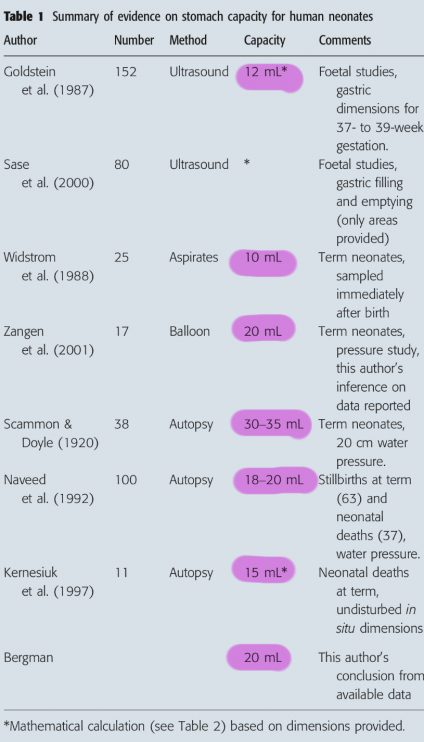
Here’s what the scientific evidence actually shows:

IMG_1910

The chart comes from a literature review published in Acta Pediatrica in 2013. You can see that the average stomach size was found to be anywhere from double to nearly quintuple the size quoted by lactation consultants.

Why is there such a big discrepancy? The problem lies in the nomenclature.

The lactivist claim is based on a study from 1920 by Scammon and Doyle. In that study the authors found that the average PHYSIOLOGIC capacity of the newborn stomach is 5-7 cc. but that’s a misuse of the term “capacity.” It’s actually the size of the average infant MEAL as measured by weighing the baby before and after breastfeeding with mothers allowed to breastfeed only 5 time per day. It has nothing to do with the ANATOMIC capacity of the stomach itself.

The anatomic capacity of the stomach is the amount that the stomach can hold during a meal without becoming distended. According to Scammon and Doyle, the ANATOMIC capacity of the stomach at birth is 33 cc. If you look carefully at the chart from the literature review, you will see that Scammon and Doyle report the largest anatomic capacity of any of the papers.

So the average size of the newborn stomach is NOT 5-7 cc but closer to 20 cc, rising dramatically over the first first days. And some babies need every one of those 20 cc per feeding and more!

The Fed Is Best Foundation has filed a complaint with the Consumer Product Safety Commission alleging that the lanyard is based on claims that are factually false and can lead to infant harm.

Dr. Christie Castillo-Hegyi wrote:

“The lactation lanyard and keychain are visual tools used to convince mothers that their newborns are not in need of supplemental feeding. It claims a newborn stomach size of 5-7 mL when in fact the scientific data has shown it is 20 mL. This is leading to dangerous newborn starvation and brain injury…”

How does Hendricks respond?

I know my product is well-respected by professionals and health organizations. I know it contains sound advice, backed by science. Unfortunately, I fell compelled to to respond now because a misled individual has gone to great lengths to discredit my work and the evidence behind it… I am sharing the Open Letter I sent in response … Let’s end her tirade once and for all. Let’s call out those who pretend to support breastfeeding but try to sabotage its success. Let’s expose lies and half-truth.We cannot embrace “alternative truths” when it comes to infant feeding and public health. There is so much more I could say, but for now I will share my response to an invalid complaint about a powerful visual and important teaching tool that is empowering moms around the world.

But you can’t empower women with a lie and Hendricks’ product is based on a serious misunderstanding of a paper from 1920.

In Hendricks’ defense, I doubt that she has ever read the Scammon and Doyle paper. She was taught the lie by other lactivists who did read it and either didn’t understand what they read or chose to lie about what they read.

Why would they lie? For the exact reason that Dr. Castillo-Hegyi noted. It is an effort to prevent women whose babies are screaming from hunger to supplement with formula.

Lactivists don’t merely fetishize breastmilk as some sort of magic elixir, they also fetishize exclusivity. They suggest or even claim that “one bottle” of formula can ruin the breastfeeding relationship and the infant gut microbiome. Neither is true. Indeed no less an authority that Alison Stuebe, MD of the Academy of Breastfeeding Medicine acknowledges:

…a substantial proportion of infants born in the US require supplementation. Delayed onset of lactogenesis is common, affecting 44% of first-time mothers in one study, and 1/3 of these infants lost >10% of their birth weight. This suggests that 15% of infants — about 1 in 7 breastfed babies — will have an indication for supplementation.

Other scientific evidence demonstrates that judicious early formula supplementation not only DOESN’T harm the breastfeeding relationship, but can actually IMPROVE it.

Hungry babies are suffering babies. Most mothers understand that instinctively and want to ease their babies’ pain by supplementing. Lactivists prefer to let babies scream. Instead lactivists falsely reassure mothers with products that graphically represent a believe a lie.

That’s not merely wrong and dangerous to infant health; it is insupportably cruel.

Vaccine refusal is the equivalent of drunk driving

IMG_1906

Vaccine refusal stems from ignorance of immunology, so it would make sense that correcting their erroneous beliefs with facts would reduce the incidence of vaccine refusal. Unfortunately, the opposite is what actually happens.

Nyhan and colleagues tested a variety of vaccine information interventions and found:

None of the interventions increased parental intent to vaccinate a future child. Refuting claims of an MMR/autism link successfully reduced misperceptions that vaccines cause autism but nonetheless decreased intent to vaccinate among parents who had the least favorable vaccine attitudes. In addition, images of sick children increased expressed belief in a vaccine/autism link and a dramatic narrative about an infant in danger increased self-reported belief in serious vaccine side effects.

In other words, more education did not change uneducated beliefs.

That’s not surprising when you consider that anti-vax advocacy is based nearly entirely on motivated reasoning, cherry picking poorly done, non-replicated findings instead of relying on the massive body of scientific literature that shows vaccines to be safe and effective.

Moreover, anti-vax advocacy is not about vaccines or even about children. It’s about parents and how they wish to see themselves: educated, defiant of authority, and empowered. Within certain “natural living” communities, vaccine refusal has become a social norm. Therefore, to address it we need to make it an unacceptable social norm — just like we have done with drunk driving.

In truth, vaccine refusal is no different from drunk driving.

They share several important characteristics.

Over-estimation of abilities: Anti-vaxxers are sure that they are smarter than the average person; drunk drivers believe that alcohol does not impair their fantastic driving skills.

Harm to others: Anti-vaxxers rarely harm themselves since they refuse vaccines on behalf of their children. Sure, they put their own children at risk but they put other more vulnerable children (infants, children suffering from cancer) at much greater risk. Similarly, while drunk drivers can and do kill themselves, they pose a tremendous threat to other drivers and pedestrians, not to mention the people who are in the car with them.

Defiance of authority: Those rules about vaccination and drunk driving? Those are for other people, not them.

Empowerment: Anti-vaxxers imagine themselves to be empowered by “doing their own research” and driving drunk makes some drivers feel powerful.

I’m old enough to remember when drunk driving was acceptable. That has changed dramatically through public relations campaigns designed to shame drunk drivers. These campaigns contain information on the harms and risks of drunk driving, but more importantly, they characterize drunk driving as selfish, irresponsible and socially unacceptable. These campaigns succeeded where merely providing information had not.

We need to make vaccine refusal equally socially unacceptable and for the same reasons; both involve individuals who harm others while overestimating their own abilities, defying authority and enjoying a sense of empowerment and both reject the facts.

But won’t that backfire? Won’t anti-vaxxers just get angry and refuse to listen? The existing research on drunk driving suggests that it will not.

Since vaccine refusal is about parents and how they want to view themselves, it would be very hard for them to present themselves as educated and empowered if everyone else believed them to be ignorant and selfish. When declaring yourself to be an anti-vaxxer brings only eye-rolls, condemnation and pity, most anti-vaxxers will start vaccinating their children once again.

Obviously any attempt to increase vaccination rates will need to be multi-pronged, but I suspect that painting anti-vaxxers as reprehensible is going to be by far the most effective strategy. They are no better than drunk drivers and should be treated with similar scorn.

How dangerous is homebirth? This dangerous.

BABY SISTER HEAD STONE, ANONYMOUS

Last April, in an op-ed in the NYTimes, I explained Why is American homebirth so dangerous?:

The problem is that there are two types of midwives in the United States. The first, certified nurse midwives, called C.N.M.s, are perhaps the best-educated, best-trained midwives in the world, exceeding standards set by the International Confederation of Midwives. Their qualifications, similar to those of midwives in Canada, include a university degree in midwifery and extensive training in a hospital diagnosing and managing complications.

The other, certified professional midwives, or C.P.M.s, fall far short of international standards…

This second class of poorly trained midwives attend the majority of American home births…

The finding that homebirth with a CPM has a infant death rate 3-9X higher than hospital birth of comparable risk women is remarkably robust. There has not been a single study that has showed American homebirth to be as safe as hospital birth.

[pullquote align=”right” cite=”” link=”” color=”” class=”” size=””]Homebirth with a CPM is a form of Russian roulette, but it is the baby who takes the bullet[/pullquote]

The risk of neonatal death at homebirth is not evenly distributed as demonstrated in a new scientific communication by Grunebaum et. al., Planned home births: The need for additional contraindications.

The authors note:

The ACOG Committee on Obstetric Practice considers fetal malpresentation, multiple gestation, and prior cesarean delivery as the only absolute contraindications to planned home birth. The objective of this study was to identify planned home birth patients who may have additional contraindications.

The authors looked at a large number of births, 75,065 home and 1,098,700 hospital births. This chart makes it clear that other risk factors dramatically increase the risk of perinatal death at homebirth:

IMG_1900

These findings are not surprising. Modern obstetrics is preventive care and preparedness. Those in higher risks groups are more likely to benefit from preventive care and preparation for emergencies since they are more likely to experience emergencies.

Homebirth with a CPM is a form of Russian roulette, but it is the baby who takes the bullet. Mothers are gambling that they won’t experience complications; if nothing happens, homebirth turns out fine. But if they guess wrong, they are far from the lifesaving measures that the baby desperately needs. Not surprisingly, the baby dies as a result.

Moreover, this study undercounts the risk. As the authors explain:

Our study shows that there are sub-groups beyond those listed by ACOG as absolute contraindications which are at significantly higher risks of NNM including nulliparous women, pregnancies ≥41 weeks, and women ≥35 years of age. Our data are likely an underestimate of the actual NNM outcomes at planned home births as patients transferred to the hospital with likely higher adverse outcomes are not included in the planned home birth outcomes. These significantly further increased neonatal risks in women with certain characteristics should be added when considering absolute contraindications for planned home births, and must be disclosed as part of the informed consent process when counseling patients considering a planned home birth.

The findings highlight that birth affirmations like “trust birth” and “your body was made to do this” are unadulterated nonsense and being “near” a hospital isn’t good enough. There is nothing trustworthy about birth; in every time, place and culture, it has been a leading cause of death among young women and THE leading cause of death of babies. Indeed the day of birth is the most dangerous day of the 18 years of childhood.

To the extent that women’s bodies are “designed” to give birth, they are designed to give birth in the teens and twenties, not over age 35. Moreover, just as a premature birth can be deadly, postdates birth can also be deadly.

Childbirth follows the exact same principles as the rest of human health. Prevention and preparation are the keys to good outcome, not pretending that bad outcomes won’t occur if you just wish hard enough.

American CPMs are grossly undereducated and grossly undertrained. They are not recognized as midwives and not allowed to practice in the Netherlands, the UK, Australia, Canada and all other first world countries. They are midwife wannabes who can’t be bothered to obtain the education and training of real midwives and babies die as a result.

Thinking about homebirth? Think again!

Pity The Milk Meg, whose self esteem resides in her breasts

56280679 - pathetic word on red wall

When you frame an issue, you control the discourse. That’s particularly true in politics (Make America Great Again), but it’s also true in healthcare.

That’s why lactivists have owned the breastfeeding debate for the last decade or more. Their frame — Breast Is Best — was meant to be the beginning and the end of all breastfeeding discussion. But now Dr. Christie Castillo-Hegyi and veteran NICU nurse/lactation consultant Jody Segrave-Daly have reframed the issue and it’s driving lactivists to distraction. Their brilliant frame — Fed Is Best — has placed the focus back where it ought to be, on the outcomes for babies, not process.

[pullquote align=”right” cite=”” link=”” color=”” class=”” size=””]Resting your self esteem on your ability to lactate is pathetic.[/pullquote]

Lactivists don’t realize they’ve been outplayed and they’re fighting back as hard as they know how. Consider The Milk Meg who appears to think that her only accomplishment resides in her breasts.

There is this huge push to bring awareness to the “accidental” starvation of breastfed babies to further push the “fed is best” campaign that’s floating around. You know, the one that assumes us “lactavists” are all just sitting around trying to find ways to MAKE women breastfeed even if they can’t make enough… because ya’ll know that is what we do, right? *sarcasm*.

That is what you do, Meg Nagle, and no amount of whining changes that reality.

Well by saying that just simply being “fed” is best, completely takes away any sort of importance attached to HOW we are feeding our babies. When the reality is that yes, it actually does matter how we feed our babies.

No, the truth is that it DOESN’T matter. There is no demonstrable difference between term babies who are breastfed and those who are formula fed. Sure, in large populations you might notice 8% fewer ear infections and 8% fewer episodes of diarrheal illness across the first year, but most babies will derive NO obvious benefit from breastfeeding.

Of course that hasn’t stopped lactivists from lying about the benefits, from promoting weak and poorly done research, or from refusing to acknowledge the deadly consequences of relentless promotion of breastfeeding — the injuries and deaths of babies from dehydration and starvation, and the relentless guilt occasionally leading to depression and suicide of mothers.

But what’s a bunch of dead babies and a few dead mothers compared to lactivists’ desperation to imagine themselves as better than other mothers? Not much, apparently.

Meg is still framing, still trying to take back the moral high ground.

Breastmilk is a living tissue which has been referred to as “white blood” as it is always changing depending on what your child needs, the entire time you breastfeed for. A living, changing tissue.

That claim is simply nonsense since the evidence that breastmilk changes in response to babies needs is exceedingly thin. It also rests on the bizarre notion that breasts, out of all the many organs in the human body, are the only ones that always work perfectly. Claiming that breastmilk is always perfect is like claiming that no one ever gets anemic because blood itself is a living tissue.

But according to this piece in the American Family Physician:

The prevalence of iron deficiency anemia is … 9 to 12 percent in non-Hispanic white women, and nearly 20 percent in black and Mexican-American women.

Now imagine that same percentage applies to breastfeeding. Would it be acceptable for anywhere from 9-20% of babies to starve for lack of breastmilk?

No less a lactivist authority than Alison Stuebe, MD of the Academy of Breastfeeding Medicine, has publicly acknowledged that 15% of babies can benefit from formula supplementation, especially in the first days of life.

Moreover, though calling breastmilk “white blood” sounds cool, but we don’t feed our infants blood, do we?

Meg insists:

These cases of the “accidentally starved” babies are stories of negligence within the health care system from the women and babies’ health care providers and the utter lack of support and information we give new mothers.

Why is accidentally starved in quotes? Does Meg imagine that these babies are not suffering from dehydration and starvation? Does Meg imagine that the babies who died aren’t really dead?

She’s right about the negligence, though, and most of it can be attributed to lactation consultants who commit malpractice when they tell women that low milk supply is rare when, in fact, it is quite common. The lack of support is also attributed in large part to lactation consultants who are so obsessed with the process of breastfeeding that they fail to support the HEALTH of babies and mothers.

Lactivism has very little to do with babies and a great deal to due with a subset of women who think their greatest accomplishment resides in their breasts. If breastfeeding isn’t as important as they insist, then they aren’t as superior as they wish to believe.

Meg’s desperation — and the fact that this is about Meg and her fragile self esteem — shines though:

This is about people paying attention while also being honest and truthful that breastmilk DOES MATTER. Because breastmilk and formula are not the same. Breastmilk matters. Breastfeeding matters. Women matter. Babies matter. The only thing that is “best” is what’s best for mother and baby. This might mean supplementing or switching to bottles. This might mean breastfeeding a four year old like me. It does not mean that we have to start spreading information that suggests WHAT we feed them doesn’t matter. Because for millions of us, how we go about feeding our babies does matter. A great deal.

So let me make it perfectly clear to Meg. The fact that you are obsessed with your breasts and what comes out of them does NOT make you a better mother than anyone else. And no one said it doesn’t matter what we feed babies. No one is suggesting that we feed infants anything other than breastmilk or formula. Fed Is Best acknowledges that there’s NO significant difference between breastmilk and infant formaula.

The only way we might be able to determine if you are a superior mother is to wait for your children to grow up and see how they turn out. And even then we won’t be sure because good mothers can raise criminals and bad mothers can raise Nobel Prize winners.

For all we know, Meg, you might be an abysmal mother, regardless of the fact that you shove your breast into your child’s mouth on a regular basis. Ask any child, teenager or adult; I’ve yet to meet anyone who thinks infant feeding has anything to do with good or bad mothering.

Please, Meg, find another source for your self-esteem that is more realistic and less fragile. Resting your self esteem on your ability to lactate makes as much sense as resting your self esteem on your blood count. It’s not merely foolish; it’s pathetic.

Bribe a woman to breastfeed?

.

Today on Slate, Elissa Strauss asks Paying Low-Income Moms to Breastfeed Might Raise Breastfeeding Rates, But Is It Ethical?

For the study, a team of researchers, led by Dr. Yukiko Washio of Christiana Care Health System and the University of Delaware in Newark, divided 36 low-income, Puerto Rican new mothers enrolled in WIC into two groups. Half of them would receive cash incentives to breastfeed totaling up to $270 over the course of six months; the other half would not. At one month, 89 percent of women who were being paid were still breastfeeding, compared with 44 percent of mothers who were not being paid. At three months, the percentage of the cash group who were still breastfeeding remained the same, while the control group’s breastfeeding rates declined to 17 percent. When the babies were six months old, 72 percent of the mothers receiving payments were still breastfeeding, while none of the mothers in control group were.

[pullquote align=”right” cite=”” link=”” color=”” class=”” size=””]Bribing women to use their bodies in societally approved ways is not ethical.[/pullquote]

Is it ethical to bribe a woman to breastfeed? Before we address that issue, we need to deal with an even bigger  problem. The problem is that the study itself is emblematic of the crap that is passed off as breastfeeding “research.”

1. Any findings from this study are meaningless because there aren’t enough people in it. It only involved 18 women in each arm of the study. It is underpowered to detect anything. The authors acknowledge:

… [T]he current study did not have a sample size to ensure power and examine potential mediators or moderators of the incentives on breastfeeding rates.

2. The study was not blinded.

…[N]either research staff nor participants were blinded to the study design. Participants in the control group realized that they were not receiving the contingent monthly incentives. A future study should provide noncontingent monthly financial incentives of an equal amount for attending WIC group or individual support to control for incentive provision …

3. The authors assume that breastfeeding will save healthcare dollars but offer no evidence to support that assumption. This is an example of the white hat bias that pervades all breastfeeding research. There is no real world evidence that breastfeeding saves money. There are only statistical models that predict that breastfeeding will save money and those generally postulate exclusive breastfeeding. To my knowledge it has never been shown that decreased healthcare spending is associated with (let alone caused by) increased breastfeeding rates.

4. Breastfeeding was defined as the ability to demonstrate that the baby was swallowing when placed on the breast during an appointment. The mothers could have been breastfeeding as little as once a day. There is no documented evidence that any of the mothers were exclusively breastfeeding.

5. There was no measurable difference between the two groups in health outcomes.

Although the proportion of emergency department visits for infants was consistently lower in the incentive group, no significant differences were detected between study groups (incentive versus control: 11% vs 22% at 1 month, P = .66; 0% vs 18% at 3 months, P = .10; 6% vs 12% at 6 months, P = .60).

To the extent that this study proves anything, it is merely proof of concept. An appropriately sized study might be feasible and might produce meaningful results.

This is not the first time that the concept of bribing women to breastfeed has been tested. A similar investigation is being carried out in England and the results are not encouraging. The study is entitled Are financial incentives for breastfeeding feasible in the UK? A mixed methods field study. I analyzed the results here:

[Financial incentives] raised the breastfeeding rate from approximately 25% to 34%. If 108 women were eligible, that means they raised the number of women breastfeeding from 27 to 37; 10 additional women breastfed for 6-8 weeks who might not have done so.

How much did it cost? At £200 ($300) per participant, it cost $11,100.

In other words, the government spent $1100 PER WOMAN to increase the breastfeeding rate and the bulk of that $1100 went to women who were planning to breastfeed anyway.

The expenditure in the new study was similar, the difference in breastfeeding rates was substantial (not particularly meaningful because the study was underpowered) and there was no demonstrable difference in health outcomes.

Let’s go back to Strauss’s original question: is it ethical to bribe a woman to breastfeed?

Strauss writes:

A small part of me loves the idea of women given cash for breastfeeding. It deromanticizes the act, stripping it of its associations with beauty and instinct and acknowledging what it is for most women: hard work. But a bigger part of me sees red flags. Would a cash incentive program make the notoriously frustrating and prescriptive WIC even more stressful for low-income mothers? Would it encourage other adult household members to pressure moms to breastfeed? Also, would it push moms to prioritize providing their children with breastmilk, whether by way of boob or pump, above all other aspects of infant care? I know and have read about many women for whom the pressure to breastfeed was so stressful that it interfered with their ability to bond with their babies.

I believe that bribing women to use their bodies in societally approved ways is not ethical. It is similar to bribing a woman to continue an unwanted pregnancy because some people think pregnancy is “better” than abortion. My view can be summed up as “her baby, her body, her breasts, her choice.”

I’m also deeply uncomfortable with the notion of bribing poor women of color to emulate wealthy white women, which is really what this is about. In first world countries, the health benefits of breastfeeding are trivial and any healthcare savings purely theoretical. If the goal is improving the health of low income children, there are many more effective ways that the money could be spent.

The decision to breastfeed is deeply personal and should not be subjected to the “improving” impulses of socio-economically advantaged others.

Nevertheless she persisted

IMG_1885

Last night Sen. Elizabeth Warren joined a long list of brave, brilliant women who persisted despite being warned not to challenge the status quo. These included Rosa Parks, Marie Curie and Susan B. Anthony.

Please share other brave, brilliant women who refused to be silenced.

#NeverthelessShePersisted

President Snowflake

IMG_1877

One of the greatest ironies of the train wreck Trump presidency is how conservatives have eagerly embraced previously despised attributes of liberals. After years of decrying political correctness, micro-aggressions and trigger warnings, we now have a president who thinks he is a special snowflake.

What’s a special snowflake?

[pullquote align=”right” cite=”” link=”” color=”” class=”” size=””]Trump allows himself to be emasculated by Bannon and Putin because of his desperate need for flattery. [/pullquote]

According to the LA Times, a special snowflake is typically a millennial:

… who has been raised to see herself and her experiences as unique and therefore demanding of heightened levels of sensitivity and respect…

According to the stereotype, snowflakes drive professors crazy by recoiling at emotionally charged reading material and drive their bosses crazy by chafing at the concept of an office hierarchy. They can’t tell the difference between an awkward social interaction and a microaggression.

Sound familiar?

President Snowflake sees himself as special and not bound by the usual rules of social interaction. He finds facts intolerable, interprets every bit of criticism as a micro-aggression and is obsessed with the way the world views him.

President Snowflake’s actions, which are inexplicable to most mature adults, and virtually unprecedented in any government official who wishes to be taken seriously, make perfect sense when viewed from the prism of his heightened sense of both self-regard and grievance.

True, Trump is not a millennial. He came by his special snowflake status the old fashioned way: he had a rich father. Money is what initially gave Trump the conviction that he is deserving of special accommodations and his belief that rules are for other people not for him.

By accounts of many people who have known him throughout his life, he has always been a bully. He is thin-skinned, narcissistic and incredibly vindictive. Those traits have metastasized to full blown snowflake status.

He cannot tolerate facts he doesn’t like so he skips intelligence briefings; he cannot tolerate criticism so he surrounds himself with flunky losers like Sean Spicer and Kelly-Anne Conway; he is easy prey for anyone who flatters him, like Steve Bannon despite the fact that Bannon has made him look stupider, clumsier and even more obnoxious that he already looked. That also explains his avidity for Vladimir Putin who has played him like a fiddle. Trump may have committed outright treason because Putin, one of the greatest threats to humanity, has made him feel good about himself.

Trump consistently retreats to lies that his enablers sugarcoat as “alternative facts.” Partly that’s because lies are essential to any authoritarian state and Trump dreams of being a tin-pot dictator.  But I suspect that like most special snowflakes, he prefers to see the world as he imagines it should be rather than the way it is.

His obsession with Saturday Night Live parodies, individual reporters, and individual media outlets stems from his belief that anything that make him feel bad is an aggression that must be punished. Most politicians, when parodied on SNL take it as a sign that they have “arrived.” Trump, in contrast, evinces no understanding that this is part of the job of any president nor any understanding that it is his own words and personal behavior that make every parody so scathing.

Trump is such a special snowflake that he cannot tolerate disagreement of any kind. When Assistant Attorney General Sally Yates refused to implement his unconstitutional Muslim ban, he characterized it as a “betrayal.” When Federal judges blocked him, he attempted to defy them. When another Federal judge upheld a lower court ruling Trump demeaned him as a “so called” judge and sought to blame him for future terrorist attacks.

Trump’s attempts to muzzle the press by accusing them of lying — despite a complete lack of evidence — and his efforts to punish CNN in particular are political correctness of the highest order, just right wing correctness, not left wing correctness. Trump is triggered by the truth, but no warning is adequate; the truth must be abolished altogether.

The ultimate irony is that Trump is everything that he professes to despise. He is an ignorant, incompetent loser, a small man who appears even smaller in the awesome job of president. And he allows himself to be emasculated by Bannon and Putin because of his desperate need for flattery.

He is President Snowflake, endlessly tweeting his hostility to laws, people and even facts that bruise his fragile ego.

Leave Melania out of it

Fear, spelled with dice letters

I’ve made no secret of my visceral disgust with Donald Trump and his effort to inaugurate American fascism and I can get behind nearly any non-violent protest of Trump’s policies and behavior … except one.

I’m very uncomfortable with complaints about paying for Melania Trump’s decision to stay in New York with her son. I’ve seen reports that her security detail will cost twice the budget for the National Endowment the Arts (unproven) or could pay for the re-settlement of dozens of refugees. While we might quibble about the actual size of the expenditure, there’s no question that it will be substantial.

[pullquote align=”right” cite=”” link=”” color=”” class=”” size=””]We ought to give serious thought the meaning of the devastating inaugural clip.[/pullquote]

My discomfort stems from my belief that we must think very carefully about why a woman, under considerable public pressure to live in the White House, might choose to live apart from her husband: she might be afraid. Let me stress that I have no specific knowledge about the Trump’s marriage. Nonetheless I found the following clip from the inauguration utterly chilling:

https://youtu.be/96Mu0rnkFNY

As Slate noted:

In a dark and mesmerizing clip that’s been circulating on social media today, Donald Trump turns to face his wife Melania at the inauguration ceremony, and she smiles back at him widely. When Trump faces forward again, we get a split-second glimpse of Melania’s inner turmoil as her face melts into a frown.

No matter how corrupt, ignorant and irresponsible Trump is, and he is all those things, we should not take out our anger on his wife.

In the first place, it wasn’t her decision to run for President; it was his. It has been apparent from the earliest days of Trump’s campaign that she has been reticent to be a part of it. She is rarely seen, and far more rarely heard, both quite unusual for a presidential spouse. And the one time she agreed to a major public appearance, she was humiliated when she was given a speech to read that had been plagiarized from Michelle Obama.

Second, it is not her decision to receive Secret Service protection; it’s a Federal mandate. She could easily pay for her own security but has not been given that choice.

Third, we ought to consider the possibility that she is protecting her child. Both the Clintons and Obamas went to extraordinary lengths to protect their young children when they occupied the White House even though they never had to wonder if they were up to the demands of public appearances. Melania may feel that her son needs the additional protection that will be afforded by living elsewhere so that he cannot be forced to participate in public displays. If that’s the case, she is showing tremendous resolve to put her son’s wellbeing above politics and that deserves our admiration, not contempt.

Fourth, and most important, we ought to give serious thought the meaning of the devastating inaugural clip. I don’t presume to know what Melania was thinking, but I do know what I can see.

As Slate explains:

Jezebel, which posted the Melania/Melancholia video on Monday, shows the exchange taking place during Franklin Graham’s speech on Inauguration Day, then zooms in further on Melania’s devastating grimace…

If you watch the video of Graham’s speech from another angle, it looks like Trump may have been saying something to his son Barron. Perhaps, then, Melania is frowning as a reaction to her son being scolded. You could interpret that look a lot of ways, to be honest. But there’s something about her complete about-face that seems to reveal a deeper truth.

If the clip of Donald Trump ripping up his notes after one of the presidential debates distilled the essence of a man who knew he’d screwed up big time, this clip is its sad sequel, a vision of what that “perverted version of charisma” does to all the people who have to live with it.

As a physician, the clip raises multiple red flags for me. The contrast between the smile when her husband is looking at her, and the apparently intense sadness as soon as he looks away is agonizing.

The “Free Melania” signs at the Women’s Marches were supposed to be a humorous allusion to the Trump marriage, but they may contain more truth than we will ever know. For that reason, both Melania and Barron Trump should be off limits for political protests and jokes. What we are witnessing may not be the least bit funny.

Fourteen features of fascism

Army unit at the parade

I’m beginning to think Republicans in general, and Trump supporters in particular are intellectually incapable of recognizing Trump’s burgeoning fascism until one of his enablers pistol-whips them. In the hope that it’s not too late yet and at least some Republicans are capable of following an intellectual argument, I offer Italian philosopher and novelist Umberto Eco’s defining characteristics of fascism, or as he put it Eternal Fascism: Fourteen Ways of Looking at a Blackshirt. For the sake of brevity, I include only some of the fourteen features.

[pullquote align=”right” cite=”” link=”” color=”” class=”” size=””]Thinking is a form of emasculation.[/pullquote]

A Cult of Traditionalism expressed most obviously in the slogan Make America Great Again. Sure it’s a longing for a past that never existed, but it is obviously backward looking not forward looking.

Rejection of Modernism expressed as a distrust scientists and other educated elites as well as an appeal to irrationality.

Action for Action’s sake:

Action being beautiful in itself, it must be taken before, or without, reflection. Thinking is a form of emasculation…

Trump has released a series of executive orders that are shockingly inept both intellectually and pragmatically. The Muslim travel ban is paradigmatic. It makes no sense from a practical standpoint since the terrorism we have experienced has never been associated with individuals from the banned countries, but rather from their neighbors who are not banned. Nonetheless, Trump supporters praise it as action even though it is doomed to be entirely ineffective.

Disagreement as treason:

Trump’s fired Assistant Attorney General Sally Yates because she refused to carry out what she viewed as unconstitutional Muslim travel ban. The firing was legal but the language was extraordinary.

The acting Attorney General, Sally Yates, has betrayed the Department of Justice by refusing to enforce a legal order designed to protect the citizens of the United States…

Yates owes no allegiance to the Justice Department. She owes allegiance to the Consitution.

Trump’s reaction to a Federal judge who halted enforcement of the travel ban is even more outrageous:

IMG_1867

The opinion of this so-called judge, which essentially takes law-enforcement away from our country is ridiculous and will be overturned.

Trump appears to reject the great system of American jurisprudence designed by the Founding Fathers and based on checks and balances. The Judiciary is charged to serve as a constraint on the action of Congress and the President not to rubber stamp it.

The Demonization of Difference:

…Fascism grows up and seeks consensus by exploiting and exacerbating the natural fear of difference. The first appeal of a fascist or prematurely fascist movement is an appeal against the intruders. Thus … Fascism is racist by definition.

Trump has grounded his Presidency in bigotry and xenophobia.

An Appeal to Social Frustration:

…[O]ne of the most typical features of the historical fascism was the appeal to a frustrated middle class, a class suffering from an economic crisis or feelings of political humiliation, and frightened by the pressure of lower social groups.

The slogan Make America Great Again has nothing to do with making America great and everything to do with assuaging the social frustration of white, blue collar workers and returning them to the center of American life.

A Racialist Nationalism:

…[A]t the root of the … Fascist psychology there is the obsession with a plot, possibly an international one. The followers must feel besieged. The easiest way to solve the plot is the appeal to xenophobia. But the plot must also come from the inside …

The Muslims are purportedly threatening America from the outside and Mexicans, African-Americans and liberals of all races are purportedly threatening America from the inside.

A Sense of Humiliation:

…[F]ollowers must feel humiliated by the ostentatious wealth and force of their enemies.

The Erosion of Individual Rights:

For … Fascism, however, individuals as individuals have no rights, and the People is conceived as a quality, a monolithic entity expressing the Common Will. Since no large quantity of human beings can have a common will, the Leader pretends to be their interpreter…

Orwellian Newspeak:

Trump and his minions have a new name for this type of propaganda: alternative facts.

Thus, in the face of photographic evidence that Trump’s inauguration was poorly attended, thePress Secretary Sean Spicer could claim with a straight face:

That was the largest audience to ever witness an inauguration — PERIOD!

As George Orwell himself famously wrote in 1984:

In the end the Party would announce that two and two made five, and you would have to believe it… [T]he logic of their position demanded it… [T]he very existence of external reality was tacitly denied by their philosophy.

For anyone with the wit to see it, Trump’s embrace of these fascist principles is chilling. But many people don’t want to see what is right in front of their faces. As Eco concludes:

…It would be so much easier for us if there appeared on the world scene somebody saying, “I want to reopen Auschwitz, I want the Blackshirts to parade again in the Italian squares.” Life is not that simple… Our duty is to uncover [fascism] and to point our finger at any of its new instances — every day, in every part of the world…

That’s what I intend to do and so do millions of other true American patriots, those who love our country and its values of freedom and toleration.

Dr. Amy