Breastfeeding advocacy is not about convincing women to breastfeed? Tell me another one.

Baby girl.

Yesterday I came across a remarkable claim.

Pediatrician and breastfeeding advocate Dr. Daniel Flanders wrote this on Twitter.

IMG_1744

Breastfeeding advocacy is not about convincing moms to breastfeed; it is about enabling and supporting their success if they choose to.

Really? Really??!! On what planet is breastfeeding not about convincing moms to breastfeed?

Surely not this one.

Consider the philosophy statement of La Leche League:

  • Mothering through breastfeeding is the most natural and effective way of understanding and satisfying the needs of the baby.
  • Mother and baby need to be together early and often to establish a satisfying relationship and an adequate milk supply.
  • In the early years the baby has an intense need to be with his mother which is as basic as his need for food.
  • Human milk is the natural food for babies, uniquely meeting their changing needs.
  • For the healthy, full-term baby, breast milk is the only food necessary until the baby shows signs of needing solids, about the middle of the first year after birth.
  • Ideally the breastfeeding relationship will continue until the baby outgrows the need.
  • Alert and active participation by the mother in childbirth is a help in getting breastfeeding off to a good start.
  • Breastfeeding is enhanced and the nursing couple sustained by the loving support, help, and companionship of the baby’s father. A father’s unique relationship with his baby is an important element in the child’s development from early infancy.
  • Good nutrition means eating a well-balanced and varied diet of foods in as close to their natural state as possible.
  • From infancy on, children need loving guidance which reflects acceptance of their capabilities and sensitivity to their feelings.

Do you see anything there are about restricting breastfeeding promotion to women who have declared that they want to breastfeed? Me, neither.

Or how about the Ten Steps of the Baby Friendly Hospital Initiative:

  1. Have a written breastfeeding policy that is routinely communicated to all health care staff.
  2. Train all health care staff in the skills necessary to implement this policy.
  3. Inform all pregnant women about the benefits and management of breastfeeding.
  4. Help mothers initiate breastfeeding within one hour of birth.
  5. Show mothers how to breastfeed and how to maintain lactation, even if they are separated from their infants.
  6. Give infants no food or drink other than breast-milk, unless medically indicated.
  7. Practice rooming in – allow mothers and infants to remain together 24 hours a day.
  8. Encourage breastfeeding on demand.
  9. Give no pacifiers or artificial nipples to breastfeeding infants.
  10. Foster the establishment of breastfeeding support groups and refer mothers to them on discharge from the hospital or birth center.

Do you see anything there about limiting proselytizing to those women who have declared their intention to breastfeed? Me, neither.

How about this statement from Diane Weissinger’s paper on promoting breastfeeding:

IMG_1751

All of us within the profession want breastfeeding to be our biological reference point. We want it to be the cultural norm; we want human milk to be made available to all human babies, regardless of other circumstances.

It’s hard to be clearer than that.

When called on it, Dr. Flanders began backpedaling furiously. Did he say that “breastfeeding advocacy is not about convincing moms to breastfeed”? What he meant is that HIS personal version of breastfeeding advocacy is not about convincing women to breastfeed.

Would he disavow the statements from leading breastfeeding advocates and their organizations?

Silence.

The Fed Is Best Foundation was created specifically to counter the relentless pressure to breastfeed on women who can’t or don’t wish to do so. I asked Dr. Flanders if he agreed that #FedIsBest.

IMG_1758

He responded:

I do not like how the #fedisbest movement has evolved.

When asked to elaborate, he could not or he would not.

Instead, he used a classic obfuscation ploy which he repeated on Facebook where I posted his initial tweet.

IMG_1760

Amy, I have said this to you on twitter and will repeat it here (since you thought it appropriate to bring across platforms without mention to me): talking with u is like groundhog day. I know your views on this well. If you haven’t yet figured out mine then you never will. Although I consider it a waste of my time discussing these matters with you, there are a number of interesting folks on this thread with whom I enjoyed dialoguing and I am grateful for the productive discussion.

Yes, Dr. Flanders, I’ve figured out your position. It’s the same passive-aggressive position of many breastfeeding advocates: Pressure women to breastfeed and then, when called on it, deny that you are applying pressure.

Such passive-aggressive behavior has been tolerated for far too long. It’s time to name it, shame it, and force breastfeeding advocates to treat women who can’t or don’t wish to breastfeed with respect.

Of peanuts, breastmilk and faulty medical recommendations

Groundnuts on a white background


What do peanuts, the cause of deadly allergies, and breastmilk, the purported “elixir of life,” have in common?

Both have been the subject of medical recommendations that are wrong, based on weak science, implemented without adequate studies, involving failure to consider risks as well as benefits.

[pullquote align=”right” cite=”” link=”” color=”” class=”” size=””]Peanuts do not cause peanut allergies, and breast is not best.[/pullquote]

Peanuts do not cause peanut allergies, and breast is not best.

Medical researchers recently announced that they had made a big, life threatening mistake. The advice they provided regarding deadly peanut allergies, was 100% wrong. After years of insisting that keeping babies away from peanuts prevented peanut allergies, experts have reversed themselves and announced that giving babies peanut protein prevents deadly peanut allergies.

It’s hard to be more wrong than that.

As pediatrician Aaron Carroll notes in the NYTimes piece How to Prevent Whiplash from Ever-Changing Medical Advice:

…[T]he National Institute of Allergy and Infectious Diseases expert panel changed course and recommended that we start giving babies peanut powder or extract in food before they are six months old rather than make sure they go nowhere near it. The panel said this is good advice, especially if the babies are at higher risk for developing an allergy…

But it’s important to remember that the earlier recommendation wasn’t made in the Dark Ages. As recently as 2000, the American Academy of Pediatrics declared that children at risk for allergies be given no peanuts until they were 3 years old. It’s not unrealistic to think that this might have increased the number of children with peanut allergies, not decreased them.

This is hardly the first healthcare reversal. I’m old enough to remember when mothers were told to place their babies on their stomach to sleep … which turned out to increase the risk of death from SIDS (sudden infant death syndrome). I’m old enough to recall when doctors were told to give all post menopausal women hormone replacement therapy … which turned out to increase the risk of breast cancer. And I’ve lived through a plethora of dietary injunctions … which paradoxically increased the incidence of problems they were designed to prevent.

How could researchers and physicians have made such terrible mistakes?

Carroll carefully elucidates the reasons.

1. Concluding causation from research that merely demonstrates correlation.

A great deal of epidemiological research, particularly research about nutrition, suffers from this problem.

…[M]ost often, recommendations fail because they aren’t supported by high-quality research. They have only observational trials behind them, not the full weight of randomized controlled trials. Too many times, organizations have been burned when the associations we see don’t translate to causal changes in the more strict randomized controlled trials.

Correlation is not causation. That is Statistics 101, yet researchers, in their enthusiasm to address serious medical problems, often ignore that most critical caveat.

The recommendations to restrict peanut exposure were based on observational studies that erroneously concluded causation. Similarly, nearly all recommendations about the purported benefits of breastmilk are based on small observational studies — weak, conflicting and riddled with confounders — that erroneously conclude causation.

2. Extrapolation from high risk groups to everyone.

If something works for one group, we tend to believe that it should work for more. People at high risk for breast or prostate cancer may need to be screened for the diseases. Expanding that screening to people at low risk, however, yields more false positives than true revelations. Hormone replacement therapy most likely benefits some women, especially younger women and those who have had a hysterectomy. Others get the same side effects or harms with little benefit.

Premature babies benefit from breastmilk. Premature babies are at risk for nectrotizing enterocolitis and breastmilk seems to reduce the risk as compared to formula. But just because breastmilk is beneficial in high risk situations does not mean that we ought to extrapolate to all babies.

3. Failure to study, in many cases to even contemplate, the downsides of recommendations as carefully as the upsides.

This would apply to recent sleep recommendations, which may (and I stress may) benefit babies but also might hurt them and parents in other ways.

This especially applies to breastfeeding research, which suffers from a severe case of white hat bias.

‘White hat bias’ (WHB) [is] bias leading to distortion of information in the service of what may be perceived to be righteous ends… WHB bias may be conjectured to be fuelled by feelings of righteous zeal, indignation toward certain aspects of industry, or other factors…

Breastfeeding researchers are so sure that breastfeeding is beneficial and are so angry at historic malfeasance of the formula industry, they exaggerate findings that place breastfeeding in a positive light and ignore findings that the benefits of breastfeeding in industrialized countries are actually trivial (approximately 8% of breastfed infants have one fewer cold or diarrheal illness in the first year). They never consider the potentially deadly side effects of the relentless promotion of breastfeeding including starvation, dehydration and even death. Indeed, the Fed Is Best Foundation now exists to warn women about the very real risks and downsides of breastfeeding as well as the benefits.

Breastfeeding researchers “know” that breast must be best and therefore always begin and end any breastfeeding study with the claim that the benefits of breastfeeding are well proven when the truth is that they are not. The purported benefits are based almost exclusively on small observational studies, assumed rather than demonstrated causation, and unjustified extrapolation from high risk studies.

Researchers on peanut allergies were forced to reverse the recommendations that they had based on weak science. Breastfeeding researchers have based their claims on science that is even weaker still.

It is inevitable that “breast is best” will eventually be replaced by “fed is best.” The only question is how many infants and mothers will be hurt in the meantime.

Bashing breastfeeding?

Hammer Through Window.

If you’ve been on The Skeptical OB Facebook page this week you’ve probably noticed a seemingly never ending parade of lactivists dropping in to rail at me. What have I done this time? I’ve dared to insist that #fedisbest. In response I’ve been repeatedly accused of “bashing” breastfeeding.

[pullquote align=”right” cite=”” link=”” color=”” class=”” size=””]Is claiming that women deserve equal rights bashing men?[/pullquote]

Why?

Apparently because I’ve dare to tell the truth.

When lactivists insist that breastfeeding provides lifesaving benefits, I’ve ask them to show me that the lives of term babies are saved by breastfeeding using real world data, not theoretical models; they can’t.

I’ve posted graphs like this one, explaining that US breastfeeding dropped to an all-time low of 24% in the early 1970’s before rising again. Even a cursory glance makes it clear that breastfeeding rates have no correlation with infant mortality, let alone causation.

IMG_1730

And this one that demonstrates that countries with the highest mortality rates have the HIGHEST breastfeeding rates, not to claim that breastfeeding causes high infant mortality, but to show that it doesn’t prevent it.

IMG_1679

I linked to disturbing personal story from the Fed Is Best Facebook page about a baby who, at one month of age, looked emaciated despite his mother’s desperate attempts to breastfeed him.

IMG_1738

Just last night I posted this meme pointing out that infant nutrition is not a seesaw. High respect for breastfeeding does NOT require low respect for formula feeding.

IMG_1736

And still the accusations that I am bashing breastfeeding keep coming.

So I have some questions for lactivists:

Is claiming that women deserve equal rights bashing men?

Is asserting that all religions are worthy of respect bashing Christianity?

Is prohibiting discimination based on sexual orientation bashing heterosexuality?

No, no and no. Why then would honestly noting that fed is best be bashing breastfeeding?

Out of the many hundreds of lactivists comments, I find this one particularly illuminating.

IMG_1740

Natalie writes:

…Why do you insist on trying to devalue breastfeeding. If “fed is best” why did I go through hell to breastfeed my son? …

Why?

Because you wanted to do so and because you were physically capable of doing so.

Isn’t that reason enough?

Being honest with women about the real benefits (and risks) of breastfeeding is not bashing breastfeeding anymore than promoting equal rights for women is bashing men. Pointing out that formula feeding is an excellent form of nutrition is not bashing breastfeeding anymore than pointing that women are equally intelligent is bashing men.

In both cases, though, it deprives one group of the opportunity to declare superiority over another group and that’s what really bothers lactivists.

Why breastfeed? Not for bragging rights. Not to make a martyr of yourself. Not so you can shame other women who don’t.

You should breastfeeding because you want to and you can.

And like any other aspect of motherhood, you should not expect that your ego should be boosted in return.

Milk Meg and the marsupialization of mothers

Isolated kangaroo with cute Joey

Maybe it’s because she lives in Australia, but Meg Nagle, the Milk Meg, appears to believe that mothers are marsupials.

Human beings, like nearly all mammal species, are placentals. We have relatively long pregnancies during which we nourish our young through the placenta. The placenta is a complex organ that allows for indirect communication between the baby’s bloodstream and the mother’s bloodstream. The baby gets its oxygen and nutrients, not to mention antibodies, from the mother’s circulation and dumps its carbon dioxide and waste products back to her for processing and removal.

[pullquote align=”right” cite=”” link=”” color=”” class=”” size=””]If you want to mother like a marsupial, go for it! But don’t judge other mothers for refusing to imagine they are marsupials, too.[/pullquote]

The marsupials (like kangaroos) do not have a complex placenta and have a very different gestational process.

According to Wikipedia:

An infant marsupial is known as a joey. Marsupials have a very short gestation period (about four to five weeks), and the joey is born in an essentially fetal state. The blind, furless, miniature newborn, the size of a jelly bean, crawls across its mother’s fur to make its way into the pouch, where it latches onto a teat for food. It will not re-emerge for several months, during which time it develops fully…

A marsupial joey is unable to regulate its own body temperature and relies upon an external heat source. Until the joey is well-furred and old enough to leave the pouch, a pouch temperature of 30–32 °C (86–90 °F) must be constantly maintained.

In other words, a human baby relies for gestational growth on the placenta and uterus. A joey relies on the teat and the pouch. A human baby is born far more developed than a joey, and although it cannot care for itself, it can be successfully cared for by the father, siblings and members of the extended family. A joey can only be cared for by its mother.

But lactivists like The Milk Meg prefer to imagine human infants as marsupials with the teat, in this case the breast, serving as the center of infant existence.

A joey must, for itself survival, maintain continuous contact with the teat for months. A joey, because it cannot maintain its own body temperature, must stay within the embrace of its mothers pouch for a year or more. For both these reasons a joey must sleep with its mother.

The Milk Meg insists that human babies have the same needs as joeys. This is expressed by her belief that human babies can and should be in continuous contact with the breast for years.

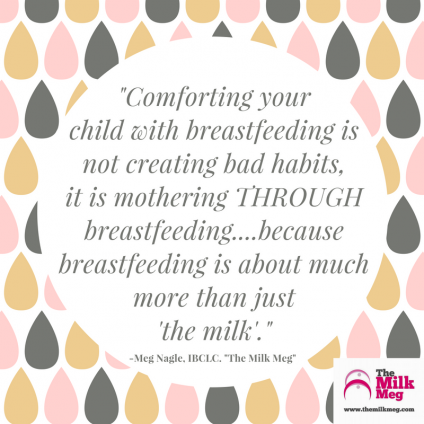
In this meme, for example, Meg declares:

img_1715

Comforting your child with breastfeeding is not creating bad habits, it is mothering THROUGH breastfeeding … because breastfeeding is about much more than just milk.

Here Meg insists:

img_1717

Your baby is not “using you” as a pacifier. A pacifier takes the place of what normally happens at the breast.

She is telling mothers that their breasts not merely ought to be used as pacifier, but are pacifiers.

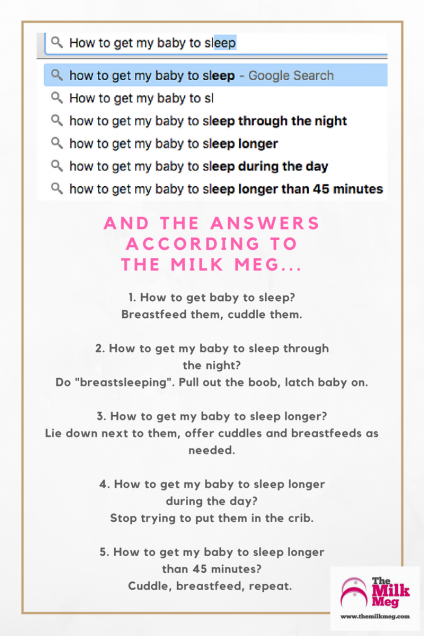
Consider this advice on how to get your baby to sleep more:

img_1642

Breastfeed them …
Do “breastsleeping.” Pull out the boob, latch baby on.
Offer cuddles and breastfeed as needed…
Cuddle, breastfeed, repeat.

In other words, let your baby attach to your breast and never let go … just like a marsupial.

Except humans are not marsupials.

Consider:

Joeys stay in the pouch for up to a year in some species, or until the next joey is born.

A mother kangaroo is usually has only one joey in her pouch at a time. Her older offspring are physically independent. But human children requires the care of their mothers for more than a decade. With the exception of the first child, a human mother is always caring for other children who need her just as much as the infant needs her. They too have physical and emotional needs that must be met in order to ensure optimal development.

Lactivism makes no provision for meeting the needs of older children (unless they want to breastfeed, too) and, of course, it makes no provision for meeting the physical and emotional needs of the mother beyond increasing and maintaining her ability to lactate.

What’s wrong with that?

Nothing so long as it is your choice to mother as a marsupial.

Where I disagree with Meg is in her insistence that human babies have the same needs as joeys do. I disagree with her conviction that good human mothering is the same as good marsupial mothering.

Human babies are placental mammals. They do NOT need to be attached to the breast. They do NOT need to use the breast as a pacifier. They do NOT need to be in constant physical contact with the mother. It is not merely untrue, but it is cruel to insist that human babies need to be treated like marsupials.

Why is it cruel?

Because human mothers aren’t marsupials, either. They have different needs, desires and demands on them than kangaroo mothers. It is cruel to tell women that their babies physical and emotional health depend on behaving like marsupials when it doesn’t; that belief requires sacrifices that, as placental mammals, we AREN’T designed (or evolved) to make.

If you want to mother like a marsupial, go for it!

But don’t judge other mothers for refusing to imagine they are marsupials, too.

WWJI: Who would Jesus insure?

img_1709

I first asked this question in 2009 during the months in which Congress debated the Affordable Care Act (ACA, also known as Obamacare).

I was struggling with the irony of religious conservatives, who have a sordid history of trying to force religion into medicine, rejecting the effort to provide health insurance for all Americans. I wondered what they thought Jesus would do when faced with a similar situation.

[pullquote align=”right” cite=”” link=”” color=”” class=”” size=””]It is impossible to imagine Jesus declaring: “I’m here to relieve all your suffering … except for your pre-existing leprosy.” [/pullquote]

Now as religious Conservative seeks to overturn the Affordable Care Act, I’m still struggling.

When faced with the prospect of depriving tens of millions of people of affordable healthcare access, what would Jesus do? WWJI? Who would Jesus Insure?*

According to religious conservatives, Jesus does not allow abortions, so laws should prevent abortion, or, failing that, should place innumerable roadblocks in the way of women who want abortions.

According to religious conservatives, Jesus wants all life to be preserved, so they mustered a public campaign to prevent Terri Schiavo’s husband from honoring her wishes and allowing her to die instead of continue on in a vegetative state.

According to religious conservatives, Jesus considers homosexuality to be an abomination, so discrimination against gay people should be enshrined in law.

Since they appear to believe that medical decisions (even other people’s medical decisions) should be made with regard to what Jesus would want, what do they think Jesus would want?

I’m no theologian, but I feel confident that Jesus would not approve of taking affordable healthcare away from tens of millions and going back to the health insurance system prior to the ACA.

Consider:

Would Jesus tie health insurance to employment? I doubt it. He made manifest his concern for the poor and downtrodden, so it is doubtful that he would want their miseries magnified by denying them access to healthcare.

Would Jesus allow pre-existing conditions to be exempted? Not likely. He ministered to the sick without regard for how long they had been sick before he arrived. It is impossible to imagine him declaring: “I’m here to relieve your suffering, except for your pre-existing leprosy.”

Would Jesus consider it a priority to preserve existing insurance companies? Would he reject a public option for health insurance because it threatened the profits of insurance giants? Once again, not likely. He would not put profits ahead of the life and health of innocent people.

Who would Jesus insure? The conclusion is inescapable. He would insure everyone. He would insist that it was the moral responsibility of those who have health insurance to make it available to those who don’t. And the way we do that is by providing a public option for health insurance, exactly the same option that the elderly now enjoy.

So I have a suggestion. For those who believe that we should make healthcare decisions based on what Jesus would do, how about making healthcare insurance decisions based on what Jesus would do? Obamacare may be anathema to religious conservatives, but it is impossible to deny that his plan for healthcare reform bears the closest resemblance to what Jesus would do.

WWJI: Who would Jesus insure? Everyone, of course.

There’s a word for religious conservatives who want to repeal the ACA: hypocrites.


* I know that is “whom would Jesus insure” is grammatically correct, but “who would Jesus insure” sounds better.

The “live” breastmilk hoax

hoax

The lactivist blogosphere is buzzing with news of micro photographs and videos that purported demonstrate that breastmilk is alive.

They were originally posted by Jansen Howard on her Facebook page.

img_1702

[pullquote align=”right” cite=”” link=”” color=”” class=”” size=””]Under the microscope breastmilk looks just like salad dressing.[/pullquote]

You guys… this is SO COOL!!!!!!!! this is the living liquid gold we call breast milk in motion!!!! My dad is a blood microscopist and this is a single drop off my breast milk under his microscope!!!! It’s miraculous and it’s ALIVE tailored to my babies needs at this moment!!!!

What’s blood microscopy also known as live blood analysis? It’s quackery. Even alternative health guru Dr. Andrew Weil acknowledges that:

… This procedure is used by practitioners who claim that a darkfield analysis of a blood sample reveals much about a person’s health. Usually, the magnified blood cells are projected onto a large screen, so that patients can watch as practitioners point out “abnormalities.” Most of the abnormalities are artifacts of the technique of darkfield microscopy, but LBA proponents claim they represent early indications of cancer and other serious diseases…

None of this is actually possible by LBA…

But that’s not what makes the breastmilk images a hoax. This is:

img_1704

The images look very similar to the breastmilk image above, but they’re not breastmilk; they’re salad dressing.

Why do they look so similar? Because in both cases we are looking at fat globules in an emulsion. Breastmilk, like salad dressing, is an emulsion.

According to Wikipedia:

An emulsion is a mixture of two or more liquids that are normally immiscible (unmixable or unblendable)… In an emulsion, one liquid (the dispersed phase) is dispersed in the other (the continuous phase). Examples of emulsions include vinaigrettes, homogenized milk, mayonnaise …

Breastmilk, like all milk, is an emulsion of fat and casein in water as depicted below.

img_1705

It is true that breastmilk is a living fluid in that it contains immune cells, but Howard’s microscopic images of breastmilk don’t show that. They merely show that breastmilk looks a lot like salad dressing under the microscope … and salad dressing is not alive.

Are lactivist campaigns abusive?

Woman sitting alone and depressed

Breastfeeding is great. Lactivism not so much.

Breastfeeding is about feeding a baby. Lactivism is about pressuring women to use their body in lactivist approved, ways. Breastfeeding support is undeniably good. Lactivist pressure can be frighteningly abusive.

[pullquote align=”right” cite=”” link=”” color=”” class=”” size=””]Sadly the abusive nature of lactivism is not a side effect; it’s a feature.[/pullquote]

Indeed, lactivist pressure shares a disturbing number of characteristics of psychological abuse.* Even more disturbing, the abusive nature of lactivism is not a side effect; it’s a feature. It seeks to control women’s behavior in the exact same ways as many male abusers seek to control women’s behavior.

This website Out of the Fog, about escaping abusive behavior, defines emotional abuse:

Any pattern of behavior directed at one individual by another which promotes in them a destructive sense of Fear, Obligation or Guilt (FOG).

Emotional abuse is designed to benefit the abuser at the expense of the abused.

One of the foundational documents of contemporary lactivism, Diane Weissinger’s Watch Your Language, is a veritable primer on emotional abuse. It explains in detail how to use fear, obligation and guilt to force women to breastfeed.

Weissinger acknowledges that lactivists want to control women:

All of us within the profession want breastfeeding to be our biological reference point. We want it to be the cultural norm; we want human milk to be made available to all human babies, regardless of other circumstances…(my emphasis)

That phrase, “regardless of other circumstances,” makes it clear that lactivists aim to force women to breastfeed and do not care about the physical and psychological toll of forced breastfeeding has on mothers. They apparently consider emotional abuse to be a reasonable approach to promoting breastfeeding.

The website offers a list of abusive tactics. It is disturbing to see how many of them are routinely employed by lactivists, including:

1. Thought policing: This is the foundational tactic and Weissinger waxes poetic on techniques of thought control:

When we … say that breastfeeding is the best possible way to feed babies because it provides their ideal food, perfectly balanced for optimal infant nutrition, the logical response is, “So what?” Our own experience tells us that optimal is not necessary. Normal is fine, and implied in this language is the absolute normalcy and thus safety and adequacy-of artificial feeding… Artificial feeding, which is neither the same nor superior, is therefore deficient, incomplete, and inferior. Those are difficult words, but they have an appropriate place in our vocabulary.

What better way to ensure fear, obligation and guilt than to insist that infant formula is “deficient, incomplete, and inferior”?

Lactivist thought policing goes far beyond the mere use of words. It’s a key principle of the Baby Friendly Hospital Initiative (BFHI), which mandates that staff must be trained to substitute their clinical judgment on what is best for a specific baby with a relentless effort to promote breastfeeding.

The acme of lactivist thought policing is a breastfeeding contract. The Fraser Health System in Canada tried to implement such a contract containing phrases like:

Although most babies grow on formula, studies show the routine use of formula comes with some risks to both mothers and babies…

Even one feed of formula can damage (baby’s gut) coating and make illness more likely…

Babies who do not receive breast milk are more likely to get significant illness and disease…

Beyond thought control, these phrases exemplify another trait of emotion abuse: lying.

2. Lying: Lactivists lie routinely in promoting breastfeeding. Yes, breastfeeding is beneficial, but in first world countries with access to clean water the benefits for term babies are trivial. Honesty is unlikely to promote the fear, obligation and guilt desire by lactivist so they lie instead. This deprives women of the opportunity to make informed decisions about breastfeeding since the information they are given is proganda, not scientific evidence.

3. Invalidation: In the world of lactivism, women’s thoughts, needs and values are dismissed out of hand. Maternal exhaustion? Who cares. Maternal need to return to work? Just pump. A history of maternal sexual abuse that leads a woman to avoid anyone touching her breasts? She should just get over it. Mothers’ feelings aren’t simply irrelevant; they are invalid.

4. Gaslighting: This is a specialized form of invalidation that involves denying reality. A mother says her baby is hungry? Tell her all babies scream like that. A mother worries that she is not producing enough breastmilk? Lie and say that all women produce enough milk. A mother needs medication incompatible with breastfeeding? Tell her she doesn’t really need it. In other words, lactivists refuse to accept the lived reality of breastfeeding for many women, substituting preferred beliefs instead.

5. Alienation attempts to extend thought control efforts by encouraging distrust of anyone who places the needs of mothers and babies above the effort to promote breastfeeding. Mother-in-law expresses fear that baby is losing weight? Tell her to mind her own business. Pediatrician recommends formula to prevent dehydration and life-threatening hypernatremia? Ignore him. Friends tell you to stop being so hard on yourself? Drop them. Those who place the needs of mothers and babies first are obviously not suitable allies in promoting the fear, obligation and guilt needed to force women to breastfeed.

6. Projection: This plays a more subtle role in lactivist emotional abuse. Whenever their abusive tactics are exposed lactivists respond by insisting that they are the victims and that critics are “anti-breastfeeding,” as if anyone opposes breastfeeding itself. Like many abusers, when lactivists are confronted with evidence of their abusive tactics they seek refuge in self-pity.

These are not the only emotional abusive tactics used to promote breastfeeding, but they are among the most prominent. Rather then treating women as autonomous individuals with their own needs and desires, emotional abusers treat women as less beings who exist to be manipulated to satisfy the abuser’s own needs. Rather than treating women as autonomous individuals with their own needs and desires, lactivists treat women as milk dispensers who exist to be manipulated into breastfeeding by deploying fear, obligation and guilt.

Like all emotional abusers, lactivists deploy thought control, lying, gaslighting and alienation to exert control. Why? Weissinger has told us: lactivists “want human milk to be made available to all human babies, regardless of other circumstances,” the actual needs of mothers and babies be damned.


* I am not suggesting in any way that the emotional abuse meted out by lactivists has anywhere near the destructive effects of the emotional abuse that can occur within personal relationships.

Fish can’t see water; lactivists can’t see brainwashing.

Brain washing concept

[pullquote align=”right” cite=”” link=”” color=”” class=”” size=””]If breastmilk is only milk than they are only mothers — and that’s simply unacceptable.[/pullquote]

There’s a saying that fish can’t see water because they entirely surrounded by it. Similarly lactivists can’t see brainwashing because they’re entirely surrounded by it.

Consider these gems:

This came from a mommy group.

img_1669

If you don’t breastfeed you’re a selfish cunt.

Sherry posted this on my Facebook page.

img_1675

If I had a tailored 5 star meal defy (sic) every single day vs just a mcdonalds burger every meal … im picking the 5 star meal… Shit food = shit health. Sooner or later the effects will show.

What made Sherry so upset? These quotes come from Pam Lowe’s book Reproductive Health and Maternal Sacrifice.

The underlying assumption … is that women who decline breastfeeding only do so through ignorance or as the dupes of formula marketing campaigns…

That women might have different needs and priorities and could make an informed choice not to breastfeed is not considered seriously.

Sherry certainly hasn’t considered it seriously.

What’s going on here? Why are lactivists reduced to using profanity to describe women who can’t or don’t wish to feed their babies using their body parts?

I believe that they are brainwashed. They are so brainwashed — choosing to marinate in the toxic lactivist stew of minimal scientific knowledge and a desperately desired sense of superiority — that they can’t even begin to see that they’ve been brainwashed.

Here’s where I make the obligatory bow to the benefits of breastfeeding. Yes, breastfeeding has benefits, but in industrialized countries with access to clean water, those benefits for term babies are trivial, a few less colds and episodes of diarrheal illness across the entire population of infants in the first year; there is potentially a reduced risk of SIDS (although that research is plagued by confounding variables), and, in any case, can be duplicated by simply giving a baby a pacifier.

Why have lactivists come to believe that women who can’t or don’t breastfeed are “selfish cunts” feeding their babies “shit food”?

Two reasons: economic and psychological.

The economic reason is pretty obvious to someone as old as I am, who went through medical training before the rise of lactation consultants. Breastfeeding has been around since the beginning of human existence but no one was especially impressed by its advantages until a group of women appeared whose entire income is predicated on convincing women that breastfeeding has extraordinary advantages.

In an effort to keep the customers coming, lactation consultants and the organizations that represent them, have resorted to modern advertising techniques. Unlike toothpaste manufacturers they don’t imply that if you use their toothpaste everyone will like you better. Instead, they imply that if you breastfeed, you will like yourself better because you will be better than other mothers.

The lactation consultants’ search for business has dovetailed nicely with a larger cultural trend — problematizing infant safety in order to convince women that only their bodies stand between their children and disaster. How better to convince women to retreat back into the home than by telling them their precious babies will die (or even worse, fail to get into Harvard) if they don’t?

It’s a form of brainwashing. The law prevents those who fear women’s emancipation from discriminating against them to force them back into the home. In response, they’ve resorted to distortions, exaggerations and lies to convince women to force themselves back into the home.

The new “momism” attempt to convince women that their children face hideous dangers as a result of everything from formula to forced abduction. Therefore women must use their constant physical presence and their very bodies to protect their babies.

Women like the creator of the charming cunt meme and those who denounce infant formula as shit food have completely fallen for the brainwashing. Indeed, they have staked their self-image on the belief that their sacrifices of time, energy and personal boundaries mark them as superior to other mothers.

How devastating for them then when other women fail to acknowledge that superiority. If infant formula is just as good as breastmilk for term babies (and all the real world population data at our disposal indicates that it is) then they aren’t superior at all. They’re dupes who have made immense sacrifices for nothing much.

They’ve been brainwashed but they not only can’t see it; they can’t allow themselves to see it.

That’s why they insist that women who can’t or don’t breastfeed are victims of false information or false consciousness. That’s why they call them cunts and purveyors of shit food. If breastmilk is only milk than they are only mothers — and that’s simply unacceptable.

Natural childbirth and the valorization of maternal masochism

29673371 - eraser deleting the word masochism

There are many viewpoints sheltering under the umbrella of the philosophy of natural childbirth — midwife attended birth, home birth, unassisted birth, hypnobirthing and even orgasmic birth — but all share a central belief in the value of masochism.

Ashley Noel Mack writes about the supposed transformative value of maternal masochism in The Self-Made Mom: Neoliberalism and Masochistic Motherhood in Home-Birth Videos on YouTube.

[pullquote align=”right” cite=”” link=”” color=”” class=”” size=””]The philosophy of natural childbirth isn’t transgressive; it’s a new way to oppress women by ecouraging them to oppress themselves. [/pullquote]

I explore their role in cultivating a masochistic subjective posture that rationalizes self-governance and subordinates opportunities for feminist systemic critique in favor of celebration of individual autonomy. After detailing the functions of birth stories as self-made narratives that reinforce dominant discourses of masochistic motherhood in a neoliberalist context that conditions mothers to self- renounce, self-deny, and sacrifice in order to be “good” citizens …

While her analysis is based on homebirth, it seems to me to be generalizable to the philosophy of unmedicated childbirth in any venue: from hospital, to birth center and to the great outdoors.

Mack believes that there is more to birth videos and birth stories than their creators suppose:

While the videos likely reflect a deeply felt and real experience of self-empowerment and transformation for the maternal subjects depicted, in the present essay I build a case for complicating the videos’ claims of empowerment by asking questions about for whom and to what end these videos function.

The philosophy of natural childbirth isn’t transgressive; it’s a new way to oppress women by ecouraging them to oppress themselves.

The glorification of “the natural” is particularly problematic:

…As a plethora of feminist and gender scholars have previously noted, discourses of naturalism serve to bind women to notions of motherhood and womanness that are then taken for granted as “innate” and inescapable. Considering the fact that giving birth is a biological process of the “female body,” the naturalization of the birth process may seem like an obvious articulation. However, while birth is certainly a biological and physiological process that certain female bodies are capable of performing, its meanings are socially produced …

Women who refuse to root their value in their reproductive organs are pathologized as victims of false consciousness:

Discourses … often suggest that if only the maternal subject would “wake up” from the state of false consciousness imposed on her by the technocratic model of birth, she would become what she has always been predetermined to be. The naturalist orientation, taken to its furthest conclusion, forecloses on possibilities, alternatives, and routes to indeterminacy in birth and mothering by tethering these experiences to privileged, socially produced, and homogenized conceptions of the female body and motherhood.

But perhaps it is natural childbirth advocates themselves who have been tricked into eagerly accepting a philosophy that promotes the idea that pain is good for women.

“Pain” is symbolically negotiated and depicted as a resource for self-optimization in these texts, and the masochistic impulse of the self-made narrative contributes to the reification of modern motherhood on particular terms… I chart how pain is not only framed as central to the narrative but also valorized as maternal subjects are depicted enduring, embracing, or even enjoying their encounter with pain.

Is this is a subversion to the biblical injunction that the agony that women suffer in childbirth is punishment for their intrinsic sin or this merely a way to convince women to accept the punishment? If you believe that women ought to be punished for having sex (and many people do), what better way to enforce that punishment than to have women embrace it?

The pain of childbirth is also valorized as a hardship that the subjects endure or pass through on their way to transcendence… Unsurprisingly, many of the women state that “giving birth naturally was my biggest accomplishment” or proclaim while holding their baby, sobbing and wailing shortly after birth, “I did it, oh my God, I did it,” or that “It was so worth it.”

There’s no better brainwashing than that.

Feminist scholars have written repeatedly about the ways in which women are convinced to punish themselves:

Ehrenreich and English argue that by the mid-20th century, motherhood was defined rhetorically by a dutiful self-denial and renunciation. A good mother gave up her passions and sacrificed her happiness (and often well-being) to take care of her children and her family… To be a good and healthy mother, citizen, and person, then, was to be a masochistic child bearer, mother, and wife.

Betty Friedan questioned this emphasis on self-sacrifice and the woman’s movement seemed to sound its death knell:

Of course, the voices of disenchanted mothers would prove that the experts’ “prescription” of masochism was insufficient to quell the anxieties and disaffection facing house-wives and mothers during the mid-20th century. The depression and anxiety afflicting mothers and housewives became a powerful resource for the radical and liberal feminist movements, the women’s health movement, and critics of the cult of domesticity and the institution of motherhood.

But it has been surprisingly resistant to efforts to kill it:

[I]n the 1980s, pro-family values campaigns returned to emphasize the social responsibility of the family unit, while naturalizing women’s traditional role in the family as a mother and domestic laborer through “dubious psychological theories of maternal instinct, mother–child bonding, and primary maternal preoccupation.”

In the 1990s, a “new momism” emerged that held mothers liable and accountable for “producing ever more perfect children” by exercising a great degree of self-surveillance to be ever-present, both mentally and physically. This new institution of motherhood stipulates that “mothers’ primary occupation is to predict and prevent all less-than-optimal social, emotional, cognitive, and physical outcomes.” Accordingly, an increasing amount of pressure is placed on the maternal body to self-optimize through breastfeeding, staying fit, providing financial stability, creating a stronger bond with her baby, and sacrificing herself for her children.

Although natural parenting in general and natural childbirth in particular wax rhapsodic about the value of maternal choices, but in truth there is only one acceptable choice: masochism.

Therefore, even as popularized motherhood narratives celebrate the freedom of the individual maternal subject to make choices on her own, self-empower, and self-optimize, “the guiding principle of contemporary motherhood is [still] that women who are mothers must act first as mothers and that their self-identity is dependent on optimizing their children’s lives.” Discourses of contemporary masochistic motherhood compel mothers to self-optimize in the name of efficiency and self-empowerment at the same time that they function to normalize the suffering, anguish, or anxiety that this persistent state of self-governance may produce.

In valorizing maternal masochism, the natural childbirth movement reveals itself as profoundly retrograde and deeply anti-feminist.

Lactivist tells mother to stop bemoaning her baby’s brain damage

angry woman with bad attitude giving talk to hand gesture

Bitter grief is often an unselfish motivator.

Consider organizations like Mothers Against Drunk Driving, started by parents who suffered the ultimate loss, to ensure that other parents would not have to endure the death of a child. Consider the various laws named after children who were abducted and murdered, championed by parents who wanted to make sure that no other family’s life would be shattered by crushing grief.

[pullquote align=”right” cite=”” link=”” color=”” class=”” size=””]Dr. Christie del Castillo-Hegyi is performing a valuable public service. Why are lactivists chastising her for it?[/pullquote]

Fed Is Best is an organization like Mothers Against Drunk Driving, started by a parent whose baby was starved into devastating brain damage by the relentless promotion of breastfeeding at a so called “Baby Friendly” hospital. It was started by Dr. Christie Castillo-Hegyi.

My son was born 8 pounds and 11 ounces after a healthy pregnancy and normal uneventful vaginal delivery. He was placed directly on my chest and was nursed immediately. He was nursed on demand for 20-30 minutes every 3 hours. Each day of our stay in the hospital, he was seen by the pediatrician as well as the lactation consultant who noted that he had a perfect latch. He produced the expected number of wet and dirty diapers. He was noted to be jaundiced by the second day of life and had a transcutaneous bilirubin of 8.9. We were discharged at 48 hours at 5% weight loss with next-day follow-up. We were told by the lactation consultant before discharge that he would be hungry and we were instructed to just keep putting him on the breast…

This went on for several days. Then Christie note:

When I pumped and manually expressed, I realized I produced nothing. I imagined the four days of torture he experienced and how 2 days of near-continuous breastfeeding encouraged by breastfeeding manuals was a sign of this. We fed him formula … and he finally fell asleep. Three hours later, we found him unresponsive. We forced milk into his mouth, which made him more alert, but then he seized. We rushed him to the emergency room. He had a barely normal glucose (50 mg/dL), a severe form of dehydration called hypernatremia (157 mEq/L) and severe jaundice (bilirubin 24 mg/dL). We were reassured that he would be fine, but having done newborn brain injury research, knowing how little time it takes for brain cells to die due to hypoglycemia and severe dehydration, I did not believe it, although I hoped it.

She was right to be concerned:

At 3 years and 8 months, our son was diagnosed with autism spectrum disorder with severe language impairment. He has also been diagnosed with ADHD, sensory processing disorder, low IQ, fine and gross motor delays and a seizure disorder associated with injury to the language area of the brain…

Christie took her grief and did something positive with it. She founded the Fed Is Best Foundation along with lactation consultant Jody Segrave-Daly in order to spread the word about the dangers of insufficient breastmilk. She works spare other families her agony.

Not surprisingly, lactivists are up in arms about the foundation and its hashtag #FedIsBest.

This recent post on Meg Nagle’s Facebook page is typical:

img_1635

#fedisbest takes away the importance of HOW we are fed. In what other area of health does the actual product going into our mouths not matter? It’s not just about being “fed”. Being fed is minimum, and obviously a baby needs to be fed. But being fed the milk that is made exactly for our child and continually changing to meet their needs is the norm…and how we are fed does actually matter.

Here’s my English to English translation:

Breastfeeding has to be best, otherwise I’m not the best mother and that’s just impossible!

Other lactivists, their fragile self-esteem on the line, joined in.

That’s not news, of course. We see this all the time, but every now and then a response is so vicious that it deserves special notice. Like Jennifer’s response:

img_1633

Christie del Castillo-Hegyi Please learn to accept your child the way they are. Your constantly publicly bemoaning your child’s diagnosis is disturbing. When they are an adult, they will find out how horribly you viewed parenting them, and how publicly you exploited their diagnosis as a tool to build your anti-breastfeeding platform. How will you answer when they ask why you didn’t spend more time working to promote disability justice, accommodation, and advocacy?

Yes, Dr. del Castillo-Hegyi, please stop bemoaning your child’s brain damage. How dare you try to prevent other babies from suffering the same preventable fate? It’s … it’s … it’s exploitation!! How dare you criticize breastfeeding, the source of my self-esteem? My breasts work great; too bad yours didn’t, but it’s time to move on.

Here’s what I’d like to ask Jennifer:

When your child is old enough to read what you have written online, and sees that you just told the mother of a brain-injured child to stop moaning about it, how will you explain your cruelty?

Is your self-esteem so fragile that it can’t deal with the notion that motherhood is powered by love, not by breastmilk. Is your identity so bound up with the function of your breasts that other women must mirror your choices back to you?

No one is interfering with YOUR ability or desire to breastfeed your child. Why are you trying to interfere with Dr. del Castillo-Hegyi’s desire to inform women about the serious, even deadly, consequences of insufficient breastmilk?

She’s generously performing a public service, so why are you chastising? You should be thanking her instead.

Dr. Amy