Another VBAC group, another dead baby

img_1513

This came from the VBAC group set up in the wake of the implosion of Jen Kamel’s VBAC group.

You may recall that the group imploded after they cluelessly boasted about their VBAC rupture rates, not realizing that they were 70% higher than typically quoted rates. Someone asked Kamel to comment on the fact that the rate was so high and she responded by deleting the question. It went downhill from there.

[pullquote align=”right” cite=”” link=”” color=”” class=”” size=””]”Fighting the doctor for my vbac!”[/pullquote]

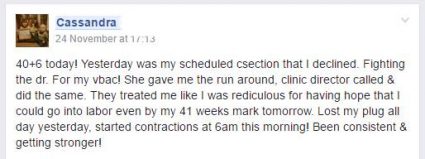
At least one new group was set up to support women in ignoring medical advice in attempting a VBAC. Cassandra was part of that group. When she cancelled her scheduled C-section she received nothing but support.

img_1501

40+6 today! Yesterday was my scheduled c-section that I declined. Fighting the doctor for my vbac! She gave me the run around; clinic director called and did the same. They treated me like I was ridiculous for having hope that I could go into labor even by my 41 week mark tomorrow. Lost my plug all day yesterday. Started contractions at 6am this morning! Been consistent & getting stronger!

Group members cheered her on:

img_1506

S: Good for you, Keep up the strength and your vbac goal…

H: Good for you for standing your ground!! You’re on your way to a successful vbac!! Rock it Mama 🙂 …

A: You go momma! You got this! …

H: Of course they called … they are losing money if you don’t submit to unnecessary surgery. 😏 …

B: Doing fantastic honey. Good luck 💕💕💕💕

img_1507

J: GO YOU! Determined mama, you WILL GET THIS VBAC!!! …

D: You’ve got this! Listen to your body & believe that you were born with the ability to birth a baby! …

Cassandra announces that she’s heading in to the hospital.

img_1508

M Own your VBAC girl go get it!! …

S: I went into labor at 40+6. Baby was born ten minutes after midnight on 41 even. Go get it, mama!

img_1509

A: Good for you girl. Your body. Your birth! You got this …

M: Good for you sweetheart! Don’t ever let someone dictate what will be done to your body! You continue to advocate for yourself. I’m so happy for you and proud of you!

J: Go mama! You’re amazing and brave for standing up to them and fighting for your vbac! Congrats!!!!!

And then this:

img_1511

We got to the hospital and they couldn’t find a heartbeat. Did several tests and there are no signs of life.

She continues:

She was perfect on Tuesday for the biophysical scan. Thursday labored all day. When they told me no heartbeat my labor stalled. I am still laboring… We are devastated that we won’t get to raise our baby girl but I am thankful for the small blessing through this tragedy… We don’t know why this happened but we are thankful for Catalrina’s life and know that we will see her again one day in heaven.

Ultimately the baby was born vaginally. Cassandra got her VBAC just like her cheerleaders predicted. Sadly, her baby was dead, just like her doctor feared.

You can contribute to her GoFundMe campaign here.

A new paper shows how lactivists abuse their power as health providers

img_1408

I wasn’t going to write about corrosive nature of breastfeeding “support” again today, but then I read a new paper that brilliantly explains how the lactation professionals who claim to be providing information and support abuse their position as health providers to shame and blame.

The paper Getting the Green Light: Experiences of Icelandic Mothers Struggling with Breastfeeding, written by Sunna Simmonardottir was published today in Sociology Research Online. Simmonardottir is writing about the experience of Icelandic women and the pressure they feel from midwives who are the main lactation professionals. However, the experience of these women is identical that that of American women and lactation consultants.

[pullquote align=”right” cite=”” link=”” color=”” class=”” size=””]Lactation professionals embrace a hierarchical relationship where they can shame women at will.[/pullquote]

Simmonardottir focuses specifically on whether the “support” they receive is remotely supportive and describes a critical principle:

The interaction between women who struggle with breastfeeding and health care professionals can sometimes be problematic and fraught with conflict and many women tend to feel that they did not get the help they needed and even felt that their feelings and experiences were not acknowledged. It is therefore extremely valuable to examine the role of health care professionals working ‘in the field’ as they possess the power to define and promote the dominant scientific discourses that women have to contend with as well as provide them and their infant feeding actions with the professional stamp of approval.

Lactation professionals including LCs and midwives are typically extremely critical of the supposedly tyrannical behavior of physicians, especially as regards the technocratic model of birth and the emphasis on authoritative knowledge. Ironically, they have become the very professionals they detested, advancing a technocratic view of breastfeeding and touting their authorative knowledge.

The technocratic model of breastfeeding postulates extraordinary scientifically determined health benefits for breastfeeding, although:

… when it comes to measuring the impact breastfeeding actually has, the conclusions are at best contradictory and ‘for every study linking it to better health, another finds it to be irrelevant, weakly significant, or inextricably tied to other unmeasured or unmeasurable factors’. Nevertheless, the assumed multitude of benefits and the supposed risk reduction of breastfeeding have become ‘scientific truths’ that have achieved dominance world-wide and are rarely questioned or contested.

So the choice to breastfeed is not really a choice at all:

…[T]he decision to breastfeed in an Icelandic context [and among privileged, white American women] is not really a ‘decision’, per se. Mothers are simply expected to breastfeed and the assumption that all mothers would want to breastfeed (for some length of time at least) is completely taken for granted. Exclusive breastfeeding is constructed as a pillar of successful bonding and attachment and absolutely paramount when it comes to promoting the close primary relationship between mother and child.

Lactation professionals insists that every woman can breastfeed if she wants, so there’s no point in studying why women don’t breastfeed or stop breastfeeding beyond analyzing their “excuses.” Lactation professionals, like the physicians they despise. strikingly ignore what women tell them — breastfeeding can be difficult, painful and provide inadequate milk supply — and substitute their authoritative knowledge that women don’t understand the benefits of breastfeeding and aren’t receiving adequate support to breastfeed.

Breastfeeding is constructed natural and therefore, women aren’t breastfeeding successfully must be “broken.” Therefore, they must endure techlogical efforts to fix them.

This idea that women have a ‘natural ability’ to breastfeed is culturally very strong but at the same time is counteracted with messages about the possible ‘faults’ that the women possess. They are discursively situated as both ‘natural’ and ‘unnatural’ at the same time, and in order to successfully breastfeed they have to rectify those unnatural faults often by going through quite technical processes, involving a range of breastfeeding aids such as breast pumps, artificial breasts and finger- or syringe feeding systems.

Lactation professionals routinely abuse their power as health providers to confer or deny approval to women.

The power dynamics of this particular relationship between mother (patient) and expert are clearly hierarchical, where the latter is in a position to shame and even scold, and the former feels that she has lost her subject status and is even treated like a child …

Many of the women described how the health care professionals had expressed very negative views towards formula and others had a hard time getting information on formula feeding from health care professionals, who wouldn’t comment on practical information, like quantity, the number of feeds and so on… Many of the mothers associate health care professionals with being judged and having to explain and justify their infant feeding practices.

The outcomes can be heartbreaking:

Should a mother exercise her own agency and decide for herself that the best thing for her would be to give up on trying to breastfeed, she runs the risk of being constructed as the villain, the selfish mother who didn’t want to inconvenience herself for the sake of her child. The biggest sin according to this cultural script of good mothering is not trying hard enough and giving up without a fight. The women want an outsider, especially a health care professional to tell them that they have done enough and that they have passed the test, but for some of the women no one ever does.

Lactation professionals insist that they aren’t forcing women to breastfeed or to continue to breastfeed when it isn’t working, but that’s not true.

The notion of freedom and choice does however become debatable when we consider the culture that they inhabit, where almost all women initiate breastfeeding and the notion of ‘giving up’ on breastfeeding means that you have failed your child and your identity as a ‘good mother’ is challenged.

Ironically, lactation professionals have merely replace the despised medical patriarchy with a new matriarchy based on what is “natural.”

The discursive shift from the ‘medical’ to the ‘natural’ has been successfully implemented without any recognition of the fact that the ‘natural’ is also a cultural category, and has no intrinsic meaning. The unequal power relations between patient (female) and physician (male) that were once so strongly criticized have not been discarded, but simply re-imagined and reproduced within current health care systems. By proclaiming that all women have a ‘natural’ ability to breastfeed, for as long as they wish, the experiences of a large number of women are marginalized and pathologized and essentialist understandings of women as a homogenous group are sustained.

Lactivist-splainin’ is not support, no matter how much lactivists insist that it is

img_1493

Yesterday I wrote about lactivist-splainin’ and compared it to mansplainin’.

Lactivist-splainin’ occurs when a lactivist explains to formula feeders why they choose not to breastfeed. The fundamental problem is the same as in mansplainin’: a group of people so enamoured of their own opinions that they never listen to anyone else.

[pullquote align=”right” cite=”” link=”” color=”” class=”” size=””]Those who truly wish to offer support take ownership of their behavior and then ask how they can do better.[/pullquote]

Lactivist-splainin’ shares another important trait with mansplainin’. When confronted, the splainers insist that they were just trying to be helpful.

Point out the biological essentialism of lactivism — demeaning formula feeders for not using their breasts is no different from demeaning gay people for not having heterosexual intercourse — and the splainers insist that they were just offering “support.”

Point out the misogyny of lactivism — judging women by the function of their reproductive organs — and the splainers insist that they were just offering “support.”

Point out the sheer obnoxiousness of campaigns like “Breast is Best” and the Baby Friendly Hospital Initiative — imagine a health facility where any woman fearing an unwanted pregnancy was forced to navigate staff and signage that proclaim that “Pregnancy is Best” and boasting they are a Pregnancy Friendly hospital — and the splainers insist they they were just offering “support” (just like the anti-abortion crowd whines that it is only offering support.)

But they’re not offering support; they offering lactivist-splainin’ instead of support.

How can we tell the difference? It’s pretty easy.

Support depends on the perception of the recipient NOT the feelings of the donor. In a medical setting, support always starts with listening to the patient, emphathizing with her feelings and perceptions, determining her desires, and helping her achieve HER goals, not yours.

Lactivist-splainers ignore all of them.

Consider this thought experiment:

Imagine if a 35 year old woman came to you requesting a tubal ligation. She and her husband have been happily married for 10 years and have decided they don’t want children.

Would you tell her that she was made to have children? That’s biological essentialism.

Would you tell her that she will never know her true power as a woman unless she gives birth? That’s misogyny.

Would you force her to listen to a lecture or sign a “contract” acknowledging that remaining childless is an inferior option? That’s obnoxious.

When she became frustrated and angry that you weren’t considering her goals and feelings would you angrily declare that you were just offering “support,” that surely she would want children if she only knew more about them?

No one would consider those actions to be “support” and rightfully so. They are directed toward the goals of the provider, NOT the goals of the patient.

There’s also a quick and dirty way to tell the difference between lactivist-splainers and those who offer support:

What do they do when informed that their efforts do not feel remotely supportive?

Those who truly wish to offer support take ownership of their behavior and then ask how they can do better. In contrast, the splainers immediately become defensive and insist that those who are upset are at fault for misunderstanding.

That’s what has happened in the Twitter discussion I referenced yesterday, when called out Prof. Amy Brown for the biological essentialism of claiming:

We are animals. Mammals. Did you not realize? Or are breasts the animal bit? …

She and her many lactivist colleagues have continued arguing — over and over and over again — that they only offer support.

But if they truly offered support they’d be asking what they could do to improve, not incessantly splainin’ that they do everything right and that women who feel pressured and bullied into breastfeeding are at fault for their own despair.

Lactivist-splainin’

41015744 - model angry scolding and pointing

I’ve written before about mansplainin’. Mansplainin’ occurs when a man condescendingly explains something to a woman assuming he has a superior understanding since he is a man.

The founders of the natural childbirth movements were mansplainers, assuming that as male physicians they had a better understanding of what women feel during childbirth than women themselves. The fundamental problem with mansplainers is they are so enamored of the sound of their own voices that they never stop to listen. If they listened, truly listened, to women they would realize that women are not merely their intellectual equals, but have specialized knowledge that they as men could never have.

[pullquote align=”right” cite=”” link=”” color=”” class=”” size=””]When a lactivist explains to formula feeders why they choose not to breastfeed.[/pullquote]

I’d like to introduce a new term: lactivist-splainin’.

Lactivist-splainin’ occurs when a lactivist explains to formula feeders why they choose not to breastfeed. The fundamental problem is the same as in mansplainin’: a group of people so enamoured of their own opinions that they never listen to anyone else.

In the past few days I’ve had the typical lactivist-splainin’ experience, when a group of lactivist imagined they would taunt me and then couldn’t address my arguments about the misogynism at the heart of contemporary lactivism. So they fell back on lactivist-splainin’as if their experience of pressuring women to breastfeed gives them greater knowledge of women who choose formula than those women themselves.

For example, this tweet comes from British psychology professor Dr. Amy Brown. It’s a perfect example of the biological essentialism at the heart of lactivism: the believe that women should be defined by and limited to their biology.

img_1481

We are animals. Mammals. Did you not realize? Or are breasts the animal bit? …

You may remember Dr. Brown from my piece The naked misogyny of pressuring women to breastfeed in which I took her to task for ignoring the results of her own research that 80% of women stop breastfeeding because of pain and difficulty and instead lactivist-splained that they really stop breastfeeding because of lack of understanding and support.

I pointed out to Dr. Brown that insisting that women ought to breastfeed, whether they want to or not, because they have breasts is like insisting that gay women ought to have penetrative intercourse, whether they want to or not, because they have vaginas.

img_1483

Dr. Brown starts back pedaling.

I’ve never told women to do anything. Just supported.

Really? And what do women think about such “support”? They don’t feel supported; they feel bullied.

A new paper, The emotional and practical experiences of formula-feeding mothers, joins a long list of previous papers in pointing out that lactivist “support” isn’t supportive in the least :

…Given the widespread knowledge of the many merits of breastfeeding among mothers, the moral statuses of those who decide not to breastfeed, or who are unable to, are left in jeopardy. Assuming that every new parent desires the “best” for their infant, the “breast is best” slogan becomes a profoundly moralistic message, rather than a promotional tool to simplify the scientific evidence about the benefits of breastfeeding. This is amplified further by expert claims about the “riskiness” of choosing formula. In this manner, the pro-breastfeeding discourse has become intertwined with broader ideologies of the concept of optimal parenting. This can lead to considerable pressure to conform to infant feeding guidelines in pregnancy and an emotional burden for those who do not manage to adhere to current recommendations in the postnatal period.

That’s not support; that’s bullying.

But lactivist-splainers wouldn’t know how their efforts are received because they aren’t listening to women who can’t or don’t want to breastfeed, or ignoring them when they do listen:

Compared with the large literature on breastfeeding and despite the high percentage of infants receiving formula and the potentially grave consequences for maternal and infant health and wellbeing arising from negative feeding experiences, there is very limited evidence regarding the opinions and experiences of formula-feeding mothers… To our knowledge, no study has explored emotional and practical factors simultaneously nor quantified them in a large sample.

What would lactivist-splanners learn if they ever stopped talking and started listening?

…[A] high percentage of mothers experienced negative emotions including guilt (67%), stigma (68%), and the need to defend their decision (76%) to use formula.

The primary source of these negative feelings was internal, but:

These negative emotions were secondarily driven by health professionals. These feelings may occur as a result of not conforming to health professionals’ recommendations or stem from a perception that health professionals judge formula to be an inferior option. Such conclusions are further reinforced by data revealing that the majority of mothers in this study felt unsupported by health professionals and were more likely to rely on the internet for infant feeding information than seek advice from them…

The Baby Friendly Hospital Initiative is recognized as promoting these negative outcomes:

While the BFHI message is critically important in developing countries or high-risk situations (prematurity, very low birth weight) where the relevance for child survival is undisputed, it may be internalized differently among affluent or low-risk populations. The evidence presented here suggests that the current approach to infant feeding promotion and support in higher-income countries may be paradoxically related to significant issues with emotional well-being and may need to be situationally modified…

In other words, while breastfeeding can be lifesaving in developing countries, the benefits are far smaller in places like the US and the UK. In industrialized countries, lactivist efforts do not improve outcomes for babies but instead they damage mothers’ mental health.

And that’s not surprising since regardless of the claims of Dr. Brown and her colleagues, they are not providing support, they are deliberately bullying. Lactivism is often more about making lactivists feel superior for their choices by demeaning women who make different choices.

Dr. Amy Brown and her colleagues need to stop lactivist-splainin’ and start listening. Based on her responses, I’m not hopeful that she or they give a damn.

Is PMS real? It’s every bit as real as erectile dysfunction.

59766856 - hysteria disorder grunge concept

Let’s try a thought experiment.

Imagine if I asked if erectile dysfunction is real or is it socially constructed. I might write something like this:

[pullquote align=”right” cite=”” link=”” color=”” class=”” size=””]Bures exemplifies a culturally mediated response that has existed since time out of mind: ignoring women’s symptoms.[/pullquote]

Erectile dysfunction is widely accepted to be a real disorder and there is an entire industry devoted to treating it with everything from medications to mechanical devices. But does erectile dysfunction reflect biological causes or is it figment of our sex ambivalent culture and men’s embrace of traditional gender roles?

You’d probably think I was nuts. Then you’d have some idea how I (and many other women) feel about author Frank Bures’ piece in Slate Is PMS real? Or is it a figment of our menstruation fearing culture?

Bures was researching culture specific syndromes:

Eventually this path led me back to my own culture, and to our own syndromes that don’t occur in other cultures. Premenstrual syndrome was near the top of this list. And much of what I read suggested that PMS was not caused by a tide of hormones wreaking havoc on a woman’s psyche, as I’d always believed…

He claims that PMS is social constructed:

… meaning it’s an imaginary condition foisted on women by society, which is another way of saying PMS is “not real.” Yet just because something is a social construction does not mean we don’t experience it—it simply means that our “real” physiological symptoms can have roots in our mind as well as our body.

Bures is wrong.

Part of the problem is that Bures conflates “culturally constructed” and “culturally mediated.” For example, Bures quotes several studies to support his contention.

Others have elaborated on PMS’s problematic nature as an evidence-based biological condition. Researchers Lisa Cosgrove and Bethany Riddle found that women who endorsed traditional gender roles experienced more menstrual distress. “One of the most striking results,” they wrote, “was that PMS discourse has gained such cultural currency that women often expect to have PMS.” Another study found that patients “firmly believed that PMS is biologically based, and they rejected situational attributions for their distress.” In another experiment, women who were misled to believe they were premenstrual experienced more symptoms of PMS than those who were actually premenstrual but who were misled to believe they were not.

But these studies don’t demonstrate that PMS is culturally constructed, merely that the way women experience and talk about their symptoms can be culturally mediated. The fact that the response varies among cultures is not proof that the syndrome itself exists only in the minds of its sufferers.

Indeed, the response to any condition, be it premenstural syndrome or erectile dysfunction is inevitably culturally mediated. A striking example occurs in the case of leprosy. The term “leper” originally meant someone who was suffering from leprosy (Hansen’s disease), a disfiguring condition that has long been met with social rejection. The term has come to mean a person who is avoided or rejected for moral or social reasons and that’s particularly apt when you consider that Hansen’s disease is not particularly contagious. Nonetheless, it was culturally perceived as punishment and in many ways people feared it more than an illness like tuberculous, which is far more common, more contagious and more deadly.

Yes, the response to leprosy has been culturally mediated, but that doesn’t mean that leprosy itself isn’t an organic syndrome. Similarly, while the response to PMS may be culturally mediated, it doesn’t mean that it is any less an organic syndrome than leprosy itself.

Ironically, in arguing that PMS is culturally constructed as opposed to culturally mediated, Bures exemplifies a different culturally mediated response that has existed since time out of mind, the culturally mediated response of men in discounting women’s symptoms, especially pain.

Bures alludes to this history before unwittingly adding to it. Bures explains:

In our own culture, the underlying idea behind PMS can be traced back 2,500 years to Hippocrates, the father of Western medicine, who believed that certain moods and physical disorders in women were caused by “hysteria” or the “wandering uterus,” meaning the organ literally drifted around the body, pulled by the moon, lodging in wrong places, blocking passages, causing pressures. Cures included marriage and intercourse, which supposedly worked. This notion endured for eons. But by the early 1900s, medical theories around “hysteria” were beginning to crumble. In 1908, at the meeting of the Societé de Neurologie in Paris, Joseph Babinski argued that hysteria was “the consequence of suggestion, sometimes directly from a doctor, and more often culturally absorbed.”

Hyster is the Latin word for uterus. Women’s ailments were traditionally classed as hysteria and thought to be caused by the uterus. But the fact that hysteria does not exist does NOT mean that the symptoms they were meant to describe did not exist. Hysteria provided a scientific sounding nomenclature by which to dismiss women’s real physical and psychiatric symptoms.

The diagnosis of hysteria may have disappeared but the cultural impulse to ignore women’s symptoms persists to this day. It is well established that women’s symptoms, particularly pain, are notoriously undertreated when compared to men’s symptoms. Women in agony are deemed to be “hysterical” while men are simply treated with the relevant medication or procedure.

Sadly, Bures is committing the same error in questioning the existence of PMS.

Good mothering is about emotional choices, not physical choices

img_1469

The not so hidden subtext of natural parenting is that physical choices make a mother, not emotional choices.

Specifically, natural parenting fetishizes physical proximity of mother and child. The child must spend hours trying to pass through the mother’s body (short cuts by C-section not allowed); skin to skin contact in the first hour is imagined to be critical (although there is precious little evidence to support that claim); the mother must feed her baby using her body, she must wear her baby on her body and she must sleep with her baby physically next to her in the same bed.

[pullquote align=”right” cite=”” link=”” color=”” class=”” size=””]Good mothering is not about physical closeness, but about emotional closeness.[/pullquote]

In other words, human mothers are assumed to be no different than animal mothers. If it’s good for puppy, or a kitten, or a kit or a joey, it’s good for an infant.

But the truth is very different. Human beings have a much richer existence than physical needs and their fulfillment. Human connections are not based on instinct, but on emotional connection. Good mothering, therefore, is not about physical closeness, but about emotional closeness. That’s why physical choices like natural childbirth, breastfeeding, baby wearing and the family bed are completely irrelevant.

Good mothering is actively embracing the role of caretaker, confidante, educator and moral guide that mothering entails. It means worrying, planning, consulting, advising and ultimately letting go. Should he be the youngest in kindergarten or wait a year and be the oldest? How should she handle the playground teasing? Am I expecting too much from him or does he have a learning disability? Should I let her go to the dance with the older boy or is she still too vulnerable?

It is kissing the boo-boos, helping them face the fears, stepping aside and allowing them to talk to the doctor in private when they are old enough. It is piano lessons, orthodontia, religious services, holiday celebrations. It is not responding when she says “I hate you” and never failing to respond when you see him teasing another child. It is hard, damn hard, with weeks or months that leave you exhausted or emotionally drained. Yet it is also rewarding at the deepest level, forging a bond to last a lifetime, launching a happy young adult into the world.

Natural parenting advocates, therefore, are not the best parents since children don’t particularly care how their physical needs are met. Breast or bottle? The baby doesn’t care as long as she is fed. Natural childbirth? Meaningless. Baby wearing? It depends on the baby and on the mother. Extended breastfeeding? Irrelevant in the long run (and often in the short run, too).

How do we know a woman is a good mother? We know because she cares; she cares about her children and cares about the impact that she is having on those children. To love a child is to tend an emotional connection. Specific physical choices have nothing to do with love, because there are a myriad of ways to foster and emotional connection and express a mother’s love.

My fundamental objection to the philosophies that travel under the designation “natural parenting” is that they privilege physical proximity over emotional closeness. They elevate animal instincts over human connection. It might be great for ducklings, baby badgers or lion cubs, but it hardly fulfills the needs of a human infant.

That’s not surprising when you consider that natural parenting has nothing to do with what children need and everything to do with how mothers want to see themselves. Natural parenting is a boring recipe; add the right inputs, get the right outputs. Real parenting is the work of a master chef, using the ingredients available, bringing out their inherent strengths, fashioning something new, intriguing and sublime every time.

Sadly, instead of viewing mothering as a service they willingly give their children, natural parenting advocates view mothering as a social identity that they construct for themselves, boosting their own egos in the process. That’s why discussions about natural childbirth, breastfeeding and attachment parenting are such a source of discord between women. None of those discussions are about the best way to mother a baby; they’re all about who is the best mother. It may seem like a trivial difference, but it is an immense difference and most women recognize it as such.

The most critical ingredient of good mothering is love. A child who is loved has the advantage over any other child, regardless of the specific parenting choices his mother made. It’s time to acknowledge and value the power of emotional connection and stop judging other women based on physical choices, which in the final analysis have little if any impact on children.

Homeopathy: it takes mega stupidity to believe in the power of nano doses

img_1467

The hallmark of homeopathy is the belief that tiny doses of medicinal substances have big effects. It’s like insisting that the less salt you put in water, the more salty the water will taste. In other words, it defies common sense, is scientifically unfounded, and has been thoroughly debunked.

Even more inane than the concept of homeopathy are its proponents’ attempts to explain how it works. Homeopathy is, perhaps, the paradigmatic pseudoscience, and like most pseudosciences, it invokes science while at the same time ignoring the scientific evidence.

One of the best (and inadvertently funniest) examples can be found on the Huffington Post. Dana Ullman has written How Homeopathic Medicines Work: Nanopharmacology At Its Best.

Pseudoscience advocates have learned the benefits of clothing pseudoscience in “scientese,” language that sounds scientific but makes no sense. “Nano” sounds scientific, so Ullman insists that homeopathy is “nanopharmacology.’ As Ullman breathlessly explains:

Although the word “nano” also means one-billionth of a size, that is not its only definition. In fact, “nano” derives from the word “dwarf,” and “nano” is the only word in the English language that is used on common parlance as denoting extremely small AND yet extremely powerful.

Sounds cool and so scientific, doesn’t it? Just a few minor problems, though. First, nano does not mean powerful and has nothing to do with power. Second, there is a scientific discipline of nanopharmacology and it means something very different than what Ullman pretends it means.

Nanopharmacology is not about tiny amounts of medication. Nanopharmacology involves assembling tiny particles into medications or medication delivery systems. So nanopharmacology might involve the delivery of chemotherapy drugs directly to cancer cells, not the use of tiny amounts of chemotherapy to cure cancer.

In other words, nanopharmacology refers to the size of the medication delivery system, NOT the dilution of the medication.

How does homeopathy work? Well, it doesn’t work; copious scientific evidence has thoroughly debunked homeopathy. Ullman ignores that point to speculate on various possibilities, each more ridiculous than the last.

Scientists at several universities and hospitals in France and Belgium have discovered that the vigorous shaking of the water in glass bottles causes extremely small amounts of silica fragments or chips to fall into the water. Perhaps these silica chips may help to store the information in the water, with each medicine that is initially placed in the water creating its own pharmacological effect.

Or, perhaps these silica fragments do nothing. Certainly it doesn’t help water “store information” since that is a chemical impossibility.

Or maybe it’s the bubbles:

Further, the micro-bubbles and the nano-bubbles that are caused by the shaking may burst and thereby produce microenvironments of higher temperature and pressure.

If it’s not the silica fragments or the bubbles, maybe it’s the waves:

Normal radio waves simply do not penetrate water, so submarines must use an extremely low-frequency radio wave. The radio waves used by submarines to penetrate water are so low that a single wavelength is typically several miles long!

If one considers that the human body is 70-80 percent water, perhaps the best way to provide pharmacological information to the body and into intercellular fluids is with nanodoses. Like the extremely low-frequency radio waves, it may be necessary to use extremely low (and activated) doses for a person to receive the medicinal effect.

Of course every self-respecting quack must invoke, and profoundly misinterpret, quantum mechanics:

Quantum physics does not disprove Newtonian physics; quantum physics simply extends our understanding of extremely small and extremely large systems. Likewise, homeopathy does not disprove conventional pharmacology; instead, it extends our understanding of extremely small doses of medicinal agents.

But quantum physics is involves sub-atomic particles of very small size, NOT small numbers of particles.

Homeopathy is nothing more than pseudoscience, and a particularly inane pseudoscience at that. It is not involve nanopharmacology. However, we can say that belief in homeopathy is evidence of mega-stupidity, best defined as startling gullibility combined with a profound deficit of scientific knowledge.


This piece first appeared in December 2009.

The bizarre assumptions behind natural parenting

50519094 - human evolution digital illustration, homo erectus, australopithecus,sapiens

Last week I explained that, contrary to the conceit of its advocates, contemporary natural parenting harks back NOT to nature, but rather a Victorian era romanticization of motherhood. I quoted extensively from Petra Buskens’ The Impossibility of “Natural Parenting” for Modern Mothers

Today I’d like to flesh out that romanticization so we can see how dramatically natural parenting deviates from mothering in nature. Buskens has a lot to say on this as well.

[pullquote align=”right” cite=”” link=”” color=”” class=”” size=””]Mothers who think they are doing things “naturally” are absurdly naive about both the throughly modern concerns that motivate natural parenting and the critical role that technology plays in its transmission.[/pullquote]

1. On the faulty notion that hunter-gather societies were the apogee of human existence:

[Many attachment parenting advocates] seem blissfully unaware of the social differences between a hunter-gatherer society and a modern one other than to deem the former “good” and the latter “bad.” The corollary to this crude formulation is that western mothers have become too “civilized to care and that this socialization must be expurgated in favour of a “natural” way of life.

Grantly Dick-Read, the father of natural childbirth, was explicit in his insistence that childbirth in nature was painless and that it was over-civilization that socialized women to believe that childbirth is painful. That is obviously nonsense, but that nonsense has extended to lactivism and attachment parenting, which postulate a natural Garden of Eden where parenting was perfect, having only degenerated since them.

2. On the bizarre belief that hunter-gather societies were uniform across vast tracts of both time and space culminating in the racist trope of the noble savage:

…[T]he “primitive” is constructed as an “empty category” in this kind of formulation; a site of redemption upon which Westerners can project their own anxieties and fantasies. A close reading suggests, moreover, that advocates of “natural” parenting in fact select childcare practices that correspond to current western anxieties: for example, the “breakdown” of the family, or the changing role of women. And so, women are encouraged to mother with the embodied devotion simplistically attributed to “primitives.” … It is rather naively assumed that the stability or harmony lacking in us can be found elsewhere and then simply appropriated, as if culture were as simple as stitching a patchwork quilt. Again this is classic romantic nostalgia for the “noble savage” arising in conditions of destabilizing social change. It depends on the glorification of social practice in non- industrialized societies, and the demonization of practices in industialised ones.

3. On the attempt to valorize primitive practices by the misuse of science:

[Natural parenting advocates] assume special access to some unadulterated, traditional wisdom and then proceed to demonstrate (and defend) this through the process of scientific study. It kills two birds with the one stone so to speak, by defending the natural or instinctual (which, in this instance, doubles for caring, softer) approach with the indisputable rigour of science. No matter what ideological ends the research serves (conservative family values or romantic resistance to the rational-efficiency model), it does so under the powerful rubric of science. This carries with it it’s own specific set of dilemmas, yet these experts have been spectacularly successful in disseminating their ideas popularly as a challenge to scientific-rationalism.

Hence the demonization of obstetric interventions in general and C-sections in particular. Hence the gross exaggeration of the benefits of breastfeeding and the pretzel-like logic of those who are desperate to insist that delayed umblical cord clamping is beneficial. It isn’t enough for natural parenting advocates to claim superiority based on tradition; they insist that science validates traditional practice when it emphatically does not.

4. On the insistence that natural parenting harks back to nature when it is indisputably modern:

[Natural parenting advocates] engage in rhetorical strategy to present their own partial and loaded (that is, “natural”) account of what is “best for baby.” An account that can only ever be modern because it is ensconced within a public debate of competing truth claims; because it is conveyed through the abstract mediums of science and writing; and because it is read by individuals largely divested oftheir “traditions.” … As such, this expert discourse is itself emblematic of the shift from predetermined tradition (the organic and unquestioned transmission of social custom) to a constantly revised present (the modern reflexive world order where multiple discourses compete for truth status)…

In other words, if you have to transmit your views through books, websites and Facebook pages, you are offering the opposite of the natural.

Natural parenting is unnatural:

Again, if we look at social histories of private life we can see that isolated caregivingis a product of the modern gendered split between public and private spheres. There is nothing “traditional”about this. Therefore, while mothering as a practice has intensified through the post-enlightenment emphasis on “good mothering,” this has also taken place in a context of diminishing support with the loss of the traditional, coherent community or “gemeinschaftn.” Mothers are thus attempting to carry out rigorous schedules of attached mothering in an increasingly fragmented and unsupportive social context. And while some aspects of the attachment style may be derived from non-industrialized cultures, the fact that this style of care is first encountered through the purchase and consumption of books themselves written by experts and then carried out by privatized mothers in isolated nuclear families, means “natural” or “attachment” parenting cannot claim in any truthful sense to be outside of modern practice.

Natural parenting is unnatural because it reflects a sanitized and romanticized view of nature, because it reflects a thoroughly modern gender segregation that never occurred in nature, because in nature it “takes a village” to raise a child, not a solitary mother practicing “natural parenting” and because it is just another form of highly technological consumerism.

Natural parenting advocates who think they are mothering as their ancient foremothers did are deluding themselves since our ancient foremothers did not view mothers as solitary caregivers and did not live within gender segregated societies where women “stayed home” while men undertook the work of ensuring the family’s survival.

Natural parenting advocates who think they are copying the “best” way of caring for children are woefully ignorant of the multiplicity of cultures across ancient time and space.

Natural parenting advocates who think they are doing things “naturally” are absurdly naive about both the throughly modern concerns that motivate natural parenting and the critical role that technology plays in its transmission.

These ironies are lost on the sanctimommies who imagine they are recapitulating nature when they are actually falling victim to the relentless consumerism of contemporary culture.

Fake news is not new; anti-vaccine advocates were among its pioneers

47309828 - child vaccination, baby injection, anti vaccine background

The mainstream media has suddenly discovered fake news.

According to PBS:

[pullquote align=”right” cite=”” link=”” color=”” class=”” size=””]The mainstream media served for a decade as purveyors of fake news on vaccines and children have died as a result. [/pullquote]

A new analysis by BuzzFeed found that false election stories from hoax sites and hyperpartisan blogs generated more engagement than content from real news sites during the last three months of the election. Users shared false stories like this one about Pope Francis endorsing Donald Trump, or Hillary Clinton selling weapons to ISIS hundreds of thousands of times, even more than real stories.

The power of fake news comes from the willingness of partisans to believe it and share it without ever checking to see if it is true.

Social media companies like Facebook are shocked, shocked to find that they have been used as conduits for fake news … as if their business model isn’t built on making millions by monetizing it. Journalists are shocked, shocked that an election could have been won or lost based on such dirty tricks and are bitingly dismissive of the uninformed, gullible multitudes who fell for it … as if those in the media are far above such ignorance and credulousness.

But fake news is not new, and the mainstream media are not above such fatuousness. For years, social media and mainstream media have been the primary conduits for the spread of fake news about vaccines. True, anti-vax “news” does not originate in the mainstream media, but then fake news about politics doesn’t generally originate in the mainstream media, either. The birthplace of fake news about vaccines, like fake news about politics, is the internet and its acceptance and believability is nurtured on social media sites first. But ultimately the mainstream media served for a decade as purveyors of fake news on vaccines and children have died as a result. But they didn’t call it fake news; they called it “balance.”

The Washington Post interviewed a leading creator and purveyor of fake political news in order to understand how and why it works. It is startling how closely the political fake news industry hews to the tactics of the anti-vax fake news industry.

Paul Horner is not a political partisan; he creates fake news because it is extraordinarily lucrative to monetize it.

How lucrative?

I make most of my money from AdSense — like, you wouldn’t believe how much money I make from it. Right now I make like $10,000 a month from AdSense.

I don’t think I’ve ever come across an anti-vax “news” site that isn’t chock-a-block with Adsense ads that provide tremendous revenue for the website owners.

I have Adsense in the sidebar of this blog, so I know how it works. I only run one ad on a page and many the visitors to my site are “hate readers” who would never knowingly contribute to my ad revenue by clicking on the ads. Hence my income from ads is paltry. Moreover, I actually have to spend time crafting real articles for people to read. The ad revenue doesn’t come close to paying for maintaining the site, let alone writing for it. But anti-vax websites, like fake news websites, are filled with multiple ads on each page, ads within the articles themselves, and even ads within comment sections.

Adsense has decency standards for whether they will put ads on your site, just like Facebook has decency standards for what they will allow on their pages. But truthfulness is not one of their standards so you (and they!) can make more money and get more attention for click-bait then you ever could for real news.

And the best part is readers don’t care whether content is true.

As Horner explains:

Honestly, people are definitely dumber. They just keep passing stuff around. Nobody fact-checks anything anymore — I mean, that’s how Trump got elected. He just said whatever he wanted, and people believed everything, and when the things he said turned out not to be true, people didn’t care because they’d already accepted it. It’s real scary. I’ve never seen anything like it.

Horner hasn’t seen anything like it, but I have. It’s how anti-vax sites work, too. Anti-vaxxers are remarkably dumb and gullible. They just keep passing stuff around; nobody fact checks anything. Anti-vaxxers say whatever they want, with absolutely no regard for the truth, and people believe it. Even when things anti-vax websites say turn out to be obviously untrue, anti-vaxxers don’t mind and cheerfully accept it any way.

In other words, when an anti-vaxxers tells you she’s “done her research” and she has “educated” herself, what she means is that she’s read fake news sites, never fact checked it and believes it because she wants to believe it. She imagines that she’s sophisticated when she’s merely the victim of a not particularly sophisticated con. The anti-vaxxers who believes that vaccines cause autism is no different than the hard Right partisan who believes Obama is Kenyan. She’s a fool.

Journalists drip with derision for the “Obama is a Kenyan” fools, but for many years they gullibly served as purveyors of anti-vaccine nonsense under the guise of journalistic “balance.” Most science journalists are not scientists and they lack the basic understanding required to tell the difference between fake science news and real science news. For years they carefully included the anti-vaccine “perspective” in pieces on vaccines and fanned the flames of anti-vaccine autism hysteria. They never bothered to fact check anti-vax “news”; indeed they didn’t care if it was true or not. They profited by selling the “controversy.”

The truth is that fake news is as big a problem in science as it is in politics. And whereas mainstream media outlets in general will not transmit fake political news unwittingly, they cheerfully transmit fake science news all the time. They shouldn’t be looking down on Facebook and Google for profiting from fake political news, when they are equally guilty of cheerfully profiting from fake science news. It’s inevitable whenever a business puts profits before principles.

Natural parenting is unnatural

37452307 - unnatural vector word on red concrete wall

The biggest irony of natural parenting is that it is entirely unnatural.

As Petra Buskins explains in The Impossibility of “Natural Parenting for Modern Mothers:

[pullquote align=”right” cite=”” link=”” color=”” class=”” size=””]Natural parenting is not a return to nature, but a return to “traditional” values.[/pullquote]

Numerous histories of “the family” show us that intensive, romanticized caregiving carried out by biological mothers in the private sphere is an “invention of modern economic and political arrangements. It was only with the division of public and private and the shift from a domestic to an industrial economy, that mothers were cordoned off to a special occupation called “Motherhood.” Prior to this, women mothered with a community of men, women, and children and did so in and around a myriad of other subsistence oriented tasks…

In other words, natural parenting harks back not to nature, but to Victorian values:

…[W]ith the social changes brought about by the creation of a public sphere (populated by male citizens) together with industrialization and a free-market economy, women in western societies … were sequestered to the private sphere as glorified mothers …

This period of extreme romanticization of the role of mothers was followed by a period of rationalization. It was during this period that motherhood became regimented and “efficient.” Those were the years of rigid infant schedules, veneration of bottle feeding, and the glorification of parental authority. What we think of as “natural parenting” arose in response. Buskens quotes Diane Eyer writing in Mother-Infant Bonding: A Scientific Fiction:

The infant of the 1920s and 1930s was known to be in need of discipline. He should not be picked up everytime he cried or he would become spoiled and would not learn the important habits of living according to a strict and efficient schedule… In the 1940s and 1950 sthe infant was known to be in need of constant gratification. He should be picked up every time he cried or he would become frustrated and develop a neurotic personality…. In the 1970s, this idealized dyad [of mother and child] was threatened with dissolution.. ..Bonding was a kind of social medication for these problems at the same time that it seemed a means to humanize birth. It was eagerly purchasedby parent consumers who wished to preserve at least some remnant of power of the early maternal relationship as a kind of insurance against the unknown.

As Buskens notes:

The emphasis on maternal nurture as an antithesis to the dominant values of rational efficiency and liberal individualism,therefore, provides an invisible subtext of romantic opposition to western modernity. In other words, contained within this radical critique is a thinly veiled conservatism concerning the “natural” place of women …

So natural parenting is not a return to nature, but rather a return to the romanticized Victorian view that women should be immured within the home. Hence it is not a coincidence that natural parenting precludes women working outside the home; it is its central feature and raison d’être.

Buskens identifies William Sears as a major proponent of this ahistorical view of mothering designed to promote Victorian (i.e. “traditional”) values. Her critique of Sears and attachment parenting is both incisive and devastating:

Sears is specifically opposed to mother’s working outside the home and encourages 24-hour embodied care … [amounting] to an utterly exhausting regime of caregiving and patience for the mother. Her role as isolated caregiver precludes her participation in both paid work and socializing but we are assured this is a “natural” and “traditional” state of affairs. One wonders how such a blatant ignorance of history could go unnoticed by both Sears and his readers, but we have only to remember the emotional power of the word “mother.” In the name of this word, Sears manages to reconstruct the past and foreclose much of the future for new mothers.

Buskens takes advocates of attachment parenting to task for presenting their personal views as natural when they are anything but.

Under the emotional power of “instinct,” in other words, the experts have managed to obscure their own status as scientists rationally procuring more and more knowledge on the categories of motherhood, infancy, and childhood. This is classic enlightenment thinking: the improvement of the human condition through the use of scientific reason, yet it has managed, cleverly indeed, to fashion itself as a powerful critique of that very paradigm.

The reality is that natural parenting isn’t about children; it’s about women and their place in the world. Natural parenting is a rhetorical strategy to promote Victorian values.

As such, natural parenting isn’t ancient and it isn’t natural. It’s thoroughly modern effort to immure women in the home and foreclose the most of their future under the guise of what “best” for children.

Dr. Amy